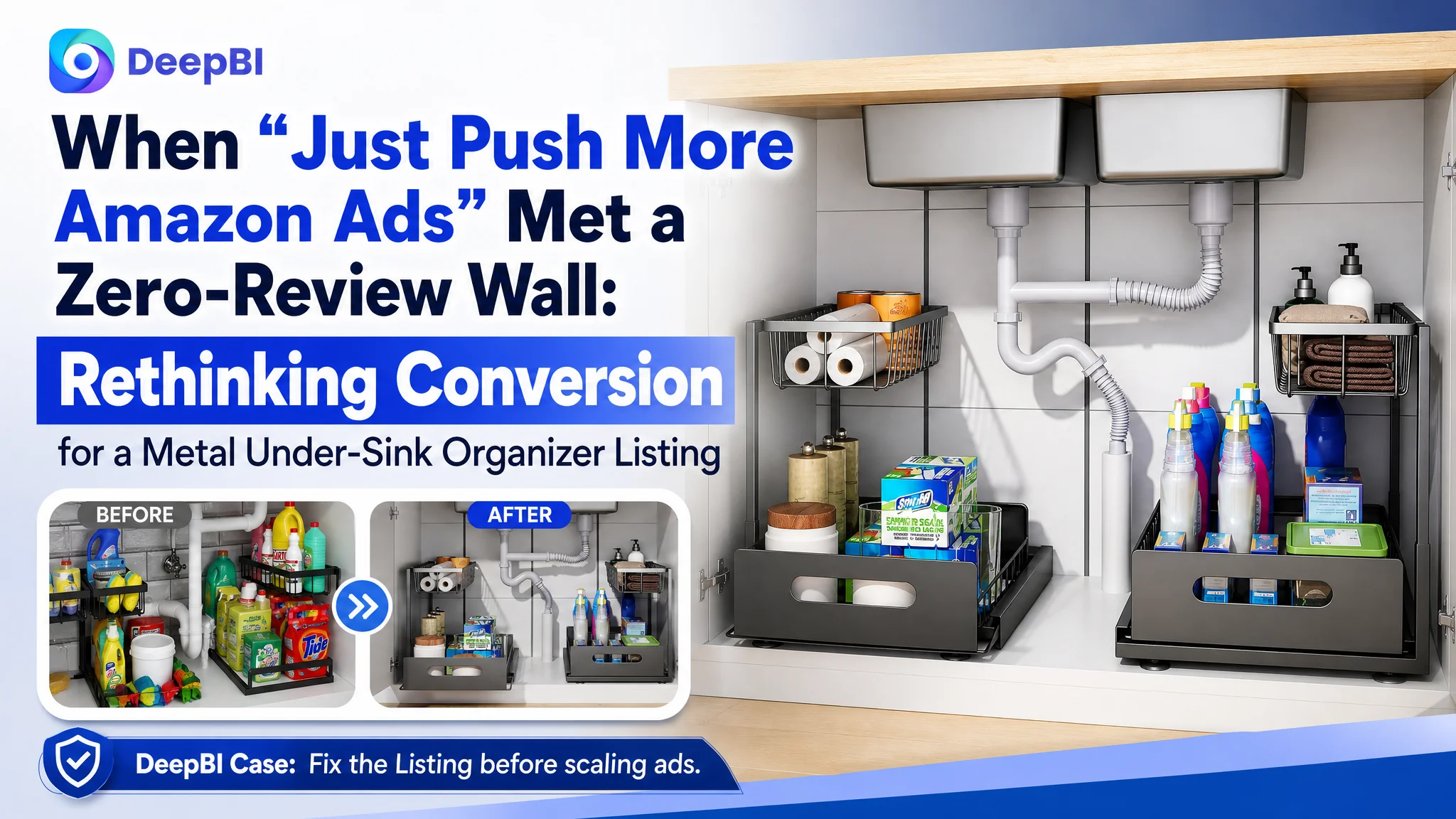
Rethinking Conversion for a Metal Under-Sink Organizer Listing
For this Amazon seller in the home-organization category, the initial instinct was straightforward: if the new metal under-sink organizer was not generating enough orders, the answer must be “optimize ads and increase traffic.” Bids were adjusted, keywords were expanded, and campaigns were restructured—yet the business pressure did not ease, because the core problem was not in the ads at all.
Once DeepBI stepped in and benchmarked the Amazon Listing against a leading plastic competitor, a different picture emerged. The page already had solid copy, a stronger material story, and a well-structured A+ section—but it had zero reviews, no social proof, and an image sequence that failed to resolve the buyer’s main doubts in the right order. The product page was structurally capable, but commercially “mute”: it could not convert the traffic it already had.
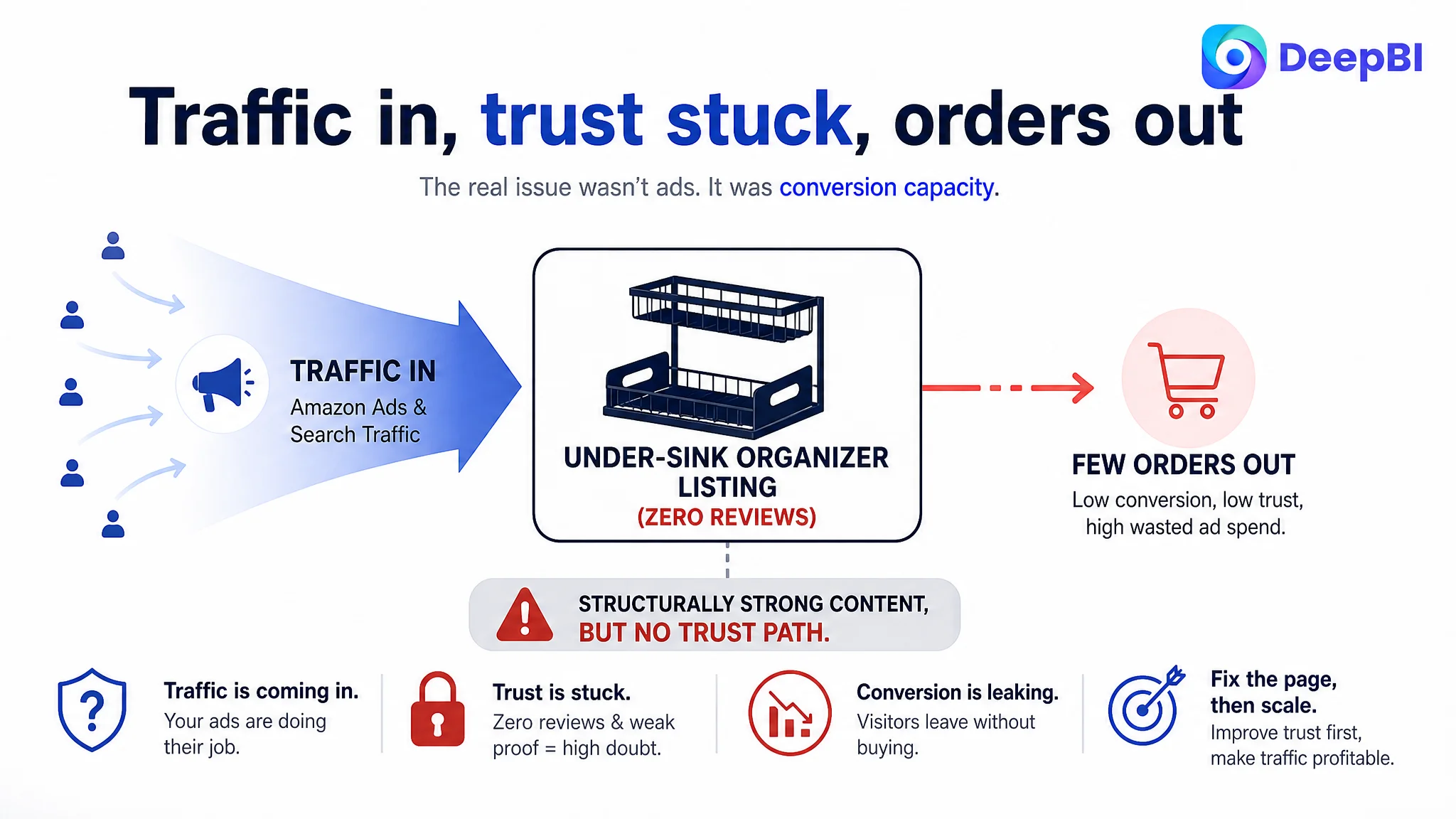
The optimization therefore shifted away from endlessly tuning campaigns and toward one thing: restoring Listing conversion capacity. That meant rebuilding the main-image logic to answer “Will it fit?” and “Is it sturdy?” up front, re-ordering A+ modules to confirm compatibility before selling material advantages, and aligning title and bullets around multi-purpose use and metal differentiation—while recognizing that, with zero reviews, the primary task was to reduce perceived risk at every visual node.
This case is a reminder for Amazon sellers: when a product page has no review base and an unprioritized story, pouring more budget into ads only amplifies the leak. The real leverage often lies in how the main image, title, bullets, A+, and reviews work together to convert the traffic you already pay for.
Amazon Ads Were Not Failing. The Page Was Consuming the Traffic.
From the seller’s perspective, the problem appeared familiar: a new metal under-sink organizer had been launched on Amazon US in a highly competitive storage subcategory. A leading plastic competitor was already dominating with strong sales and thousands of reviews.
The seller saw:
- A category where ads were mandatory just to be visible
- A metal product that was objectively better than many plastic alternatives
- Clicks coming in, but order growth lagging expectations
Under pressure to push sales, the first judgment was: “Our Amazon ads and keyword strategy are not strong enough.” More campaigns were launched, bids were adjusted, and additional terms—especially around “under sink organizer” and similar phrases—were targeted.
But on the product page:
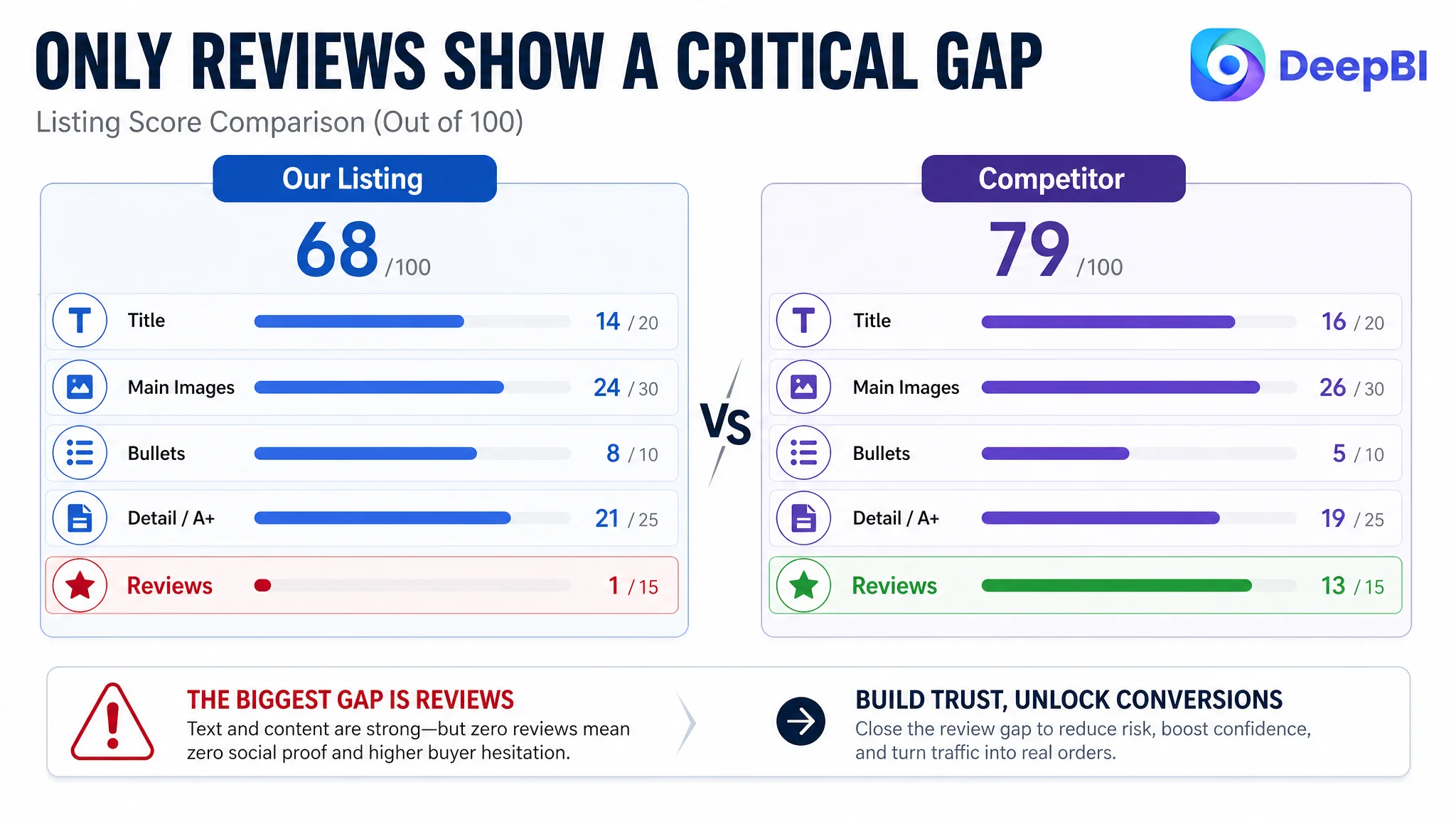
- The Listing’s overall score was 68/100 versus the competitor’s 79/100
- The seller’s title, bullets, and A+ were actually competitive or better in several areas
- The review dimension was 1/15 (effectively zero) versus the competitor’s 13/15 with 4.6 stars and over 6,000 reviews
The ads were performing their basic job—delivering traffic—but the page could not turn that traffic into trust, let alone orders.
“The real problem was not that ads failed to bring traffic. It was that the page could not convert the traffic.”
The Customer’s Original Misdiagnosis: “It Must Be an Ads or Copy Problem”
The seller initially grouped the problems into two buckets:
1. Ads problem – Not enough exposure on core keywords, ACOS pressure, and a perception that campaign structure and bids needed further refinement.
2. Copy problem – A concern that the Listing might not be persuasive enough, especially versus a well-established competitor.
Because this was a new Listing without historical conversion or review data, it was tempting to assume that better advertising tactics and more polished copy would “kick-start” the flywheel.
Several signs pointed the team in the wrong direction:
- The main image looked reasonably professional and showed the organizer in use under a kitchen sink.
- The title contained the core keyword “Under Sink Organizer” and mentioned “Sliding Pull-Out” and “Metal Made for Durability.”
- The bullets had been written with real user pain points and clear benefits in mind (no more kneeling, no blind reaching, rust resistance, etc.).
- The A+ content already highlighted industrial-grade metal and anti-rust coating, giving a more premium positioning than the plastic competitor.
From a surface view, it was easy to think: “If we just push more ads and maybe improve wording, results should follow.”
They did not—because a different constraint was silently dominating the outcome.
What DeepBI Saw in the Data: A Structurally Strong Page With a Trust Vacuum
When DeepBI benchmarked this Amazon Listing against the leading competitor, the numbers revealed where the real break was happening:
- Total Listing score: 68 (seller) vs. 79 (competitor), an 11-point gap
- Title: 14 vs. 16 – slightly behind but not catastrophic
- Main image set: 24 vs. 26 – decent, but mis-allocated in terms of decision logic
- Bullets (five points): 8 vs. 5 – seller actually outperformed competitor in persuasive copy
- Detail / A+: 21 vs. 19 – again, the seller was ahead in depth and rational support
- Reviews: 1 vs. 13 – the only dimension with a massive structural deficit
This meant:
- Conversion power was not fundamentally blocked by text quality. In fact, bullets and A+ were in better shape than the competitor’s in several respects.
- Visual and structural logic were mis-ordered. “Will it fit?” and “Is it sturdy?” were not answered early enough in the main images and A+.
- Trust signals were almost non-existent. Zero reviews, no star rating, no UGC images or videos, and no front-facing proof that others had successfully used the product.
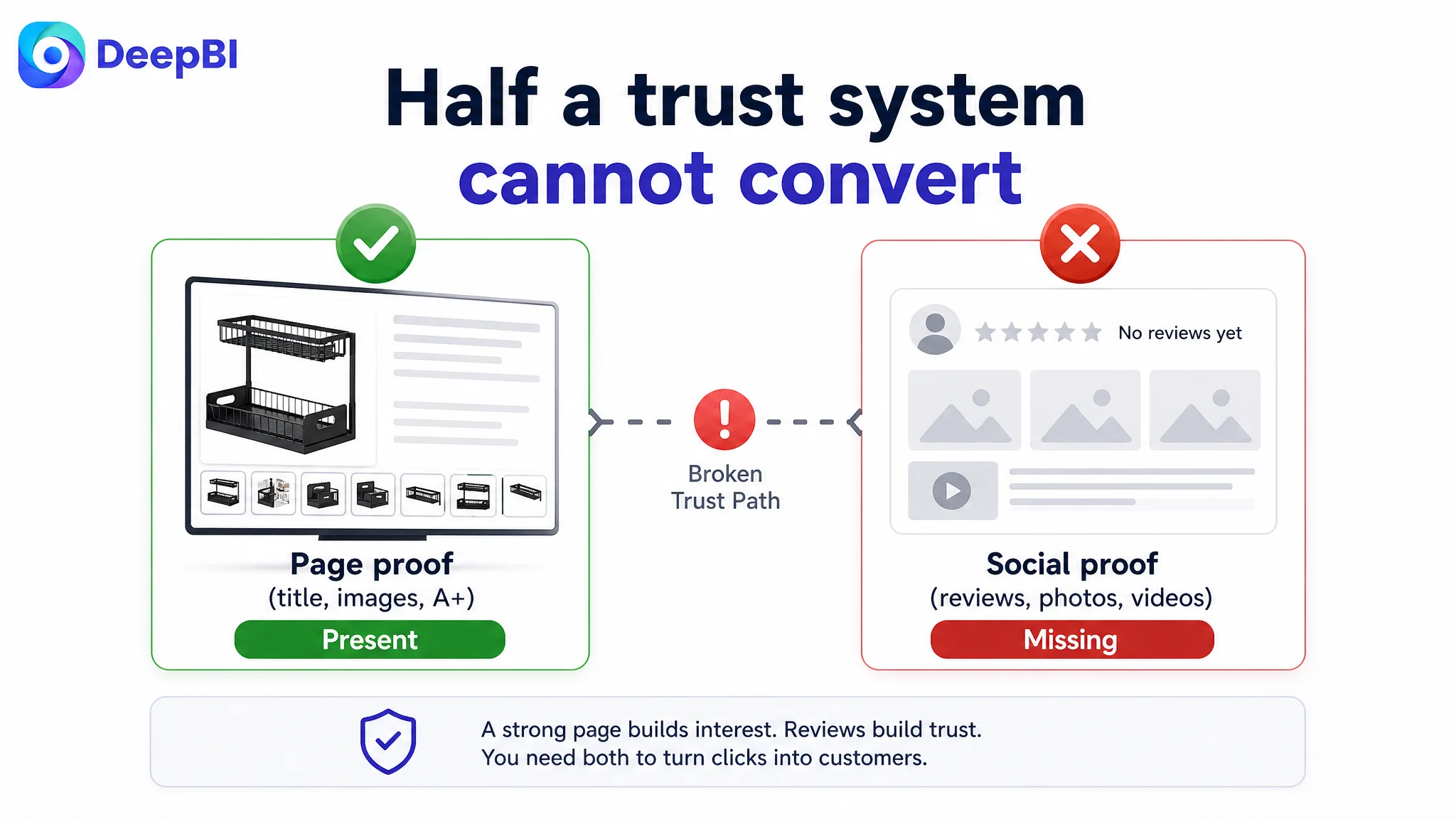
In other words, the product page had a latent conversion capacity but was being handicapped by:
1. A complete lack of social proof
2. A visual narrative that did not prioritize the right doubts at the right time
Pouring more ad spend into this state could only have one result: more expensive traffic flowing into an unproven, high-friction page.
The Real Constraint Was Listing Conversion Capacity, Not Keyword Coverage
DeepBI’s judgment was that the bottleneck at this stage was not traffic volume or keyword spread, but the page’s ability to convert visitors under conditions of zero review trust.
Several factors supported this decision:
1. Reviews: A Severe Structural Gap
- The competitor: 4.6 stars, 6,018+ reviews, including photo and video reviews visible on the first page.
- The seller: 0 reviews, 0 stars, no social proof at all.
In Amazon’s environment, this is not a marginal difference—it is a decisive structural handicap. Even with excellent copy and images, a zero-review product sits under a trust ceiling that ads cannot break on their own.
2. Copy vs. Visual Order: Strong Content, Weak Sequencing
DeepBI’s analysis found that:
- Bullets were well-structured around pain point → solution:
- No more kneeling on the floor
- No blind reaching into dark cabinet corners
- No corrosion in damp environments
- A+ content already used:
- Industrial-grade metal as the core visual anchor
- Clear depiction of the unit installed under a standard P-trap
- Visual elements supporting rust resistance and weight capacity
But the sequence of information was misaligned with how buyers actually decide:
- Dimensions and P-trap compatibility were not surfaced early enough.
- Material strength and load capacity were highlighted too early, before “Will it fit?” was fully resolved.
- Installation simplicity (“no tools, quick setup”) and “before/after” problem–solution visuals were missing or underused, further increasing perceived risk for a zero-review product.
3. Ads Were Already Doing Their Job
Based on the Listing scoring logic and competitive benchmark:
- There was no sign that the page lacked relevant traffic potential; core search terms were properly embedded in the title and bullets.
- The main gap was not “no one can find us,” but “those who find us hesitate to buy.”
Under these conditions, traditional ad optimization—refining bids, adding more long-tail keywords, changing match types—could not materially change the outcome. Ad traffic was being consumed by a page that couldn’t close the deal.
“Advertising does not only amplify advantages. It can also amplify a page’s existing defects.”
Why DeepBI Did Not Recommend “Keep Tuning Ads First”
From a business-risk perspective, continuing to focus on Amazon ads first would have created three immediate issues:
1. Escalating ACOS without structural improvement
More traffic to a zero-review Listing with unresolved doubts only increases spend while keeping conversion depressed.
2. Distorted learning signals
If the product underperforms, it becomes unclear whether the problem is:
- Wrong audience/keywords, or
- A page that scares away valid prospects.
DeepBI’s analysis showed the second was more likely.
3. Lost time in a competitive subcategory
In a space where a plastic competitor already has thousands of reviews, every week spent “testing bids” instead of fixing conversion logic allows the competitor to widen the trust gap.
Therefore, DeepBI prioritized:
- Rebuilding the page’s sales logic
- Clarifying fit, durability, and ease-of-use visually
- Preparing the Listing to actually deserve more traffic
Only once the page could convert paid and organic visitors more reliably would it make sense to scale advertising again.
This Product Page Did Not Lack Information. It Lacked a Trust Path.
A key insight in this case is that information volume was not the problem. The seller had:
- Technical details on metal construction and rust-resistant coating
- Specific dimensions and load capacity (up to 50 lbs)
- Realistic use cases (kitchen, bathroom, laundry room)
What the page lacked was a trust-building path tailored to a new, unrated Listing competing against an entrenched, well-reviewed product.
Title: Clear Enough, but Not Maximizing Click Triggers
The original title:
- Started with the brand name, then “Under Sink Organizer,” then a series of attributes and scenarios.
- Contained “Sliding Pull-Out Cabinet Organizing Rack” and “Metal Made for Durability,” which were specific but wordy.
- Did not clearly highlight pack size or dimensions, and lacked broad, high-value phrases like “Multi-Purpose” and “Storage Organizers.”
The competitor’s title:
- Led with “Multi-Purpose Pull-Out Storage Organizers”
- Emphasized “Under Sink/Cabinet Organizers and Storage”
- Included “12.8 Inches” and “2 Packs” in a compact structure
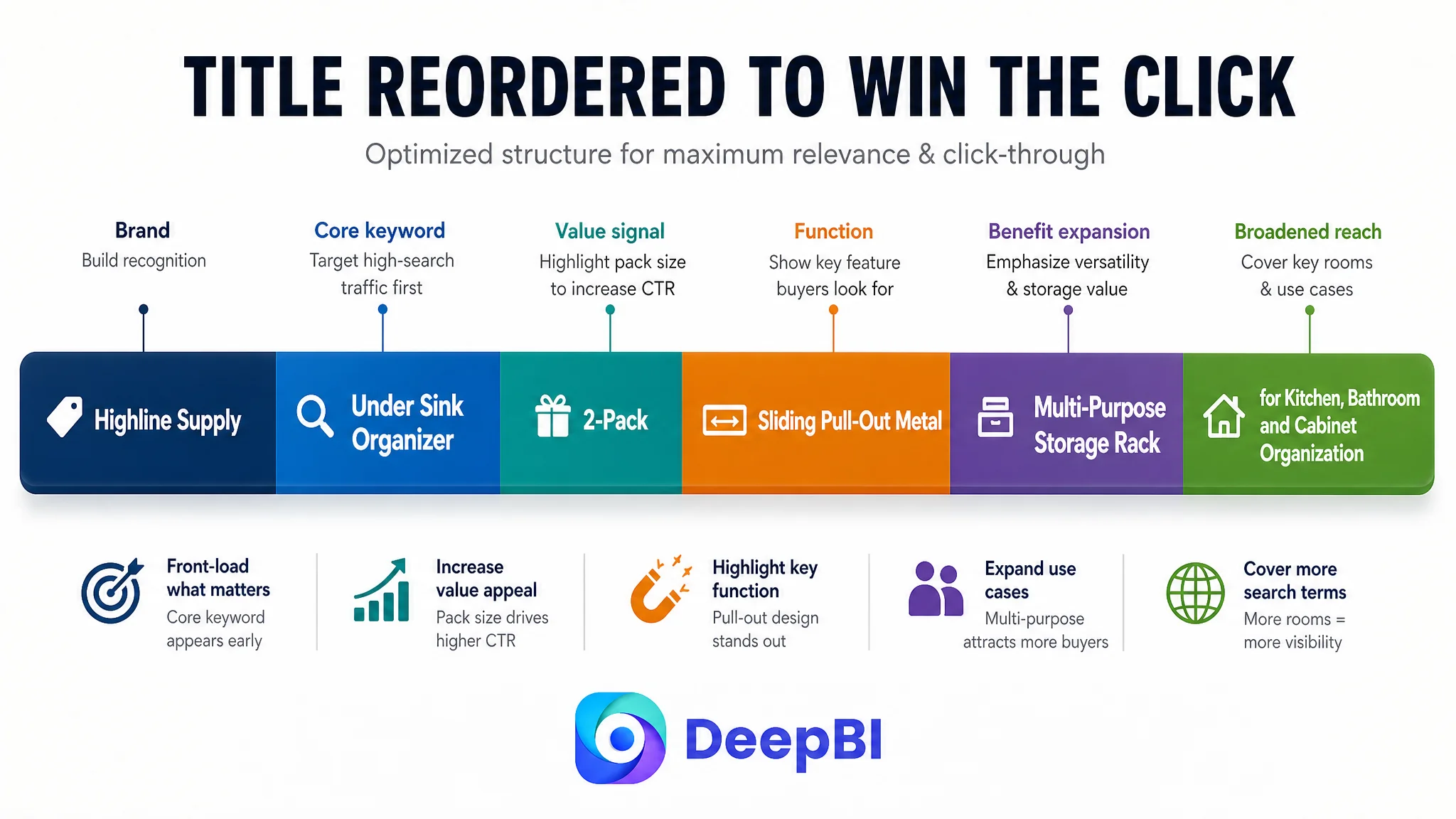
DeepBI’s recommendation reframed the seller’s title to:
- Move “Under Sink Organizer” immediately after the brand
- Highlight “2-Pack” and “Sliding Pull-Out” early to increase CTR
- Integrate “Multi-Purpose” and “Storage Rack” to broaden search relevance and expectation-setting
- Retain “Metal” to differentiate clearly from plastic alternatives
The goal was not cosmetic. It was to ensure that when Amazon ads placed this product in results, the title alone would signal: packed value, metal build, sliding function, and multi-room utility—making each paid impression more likely to turn into a click.
Main Images: Right Scenes, Wrong Order
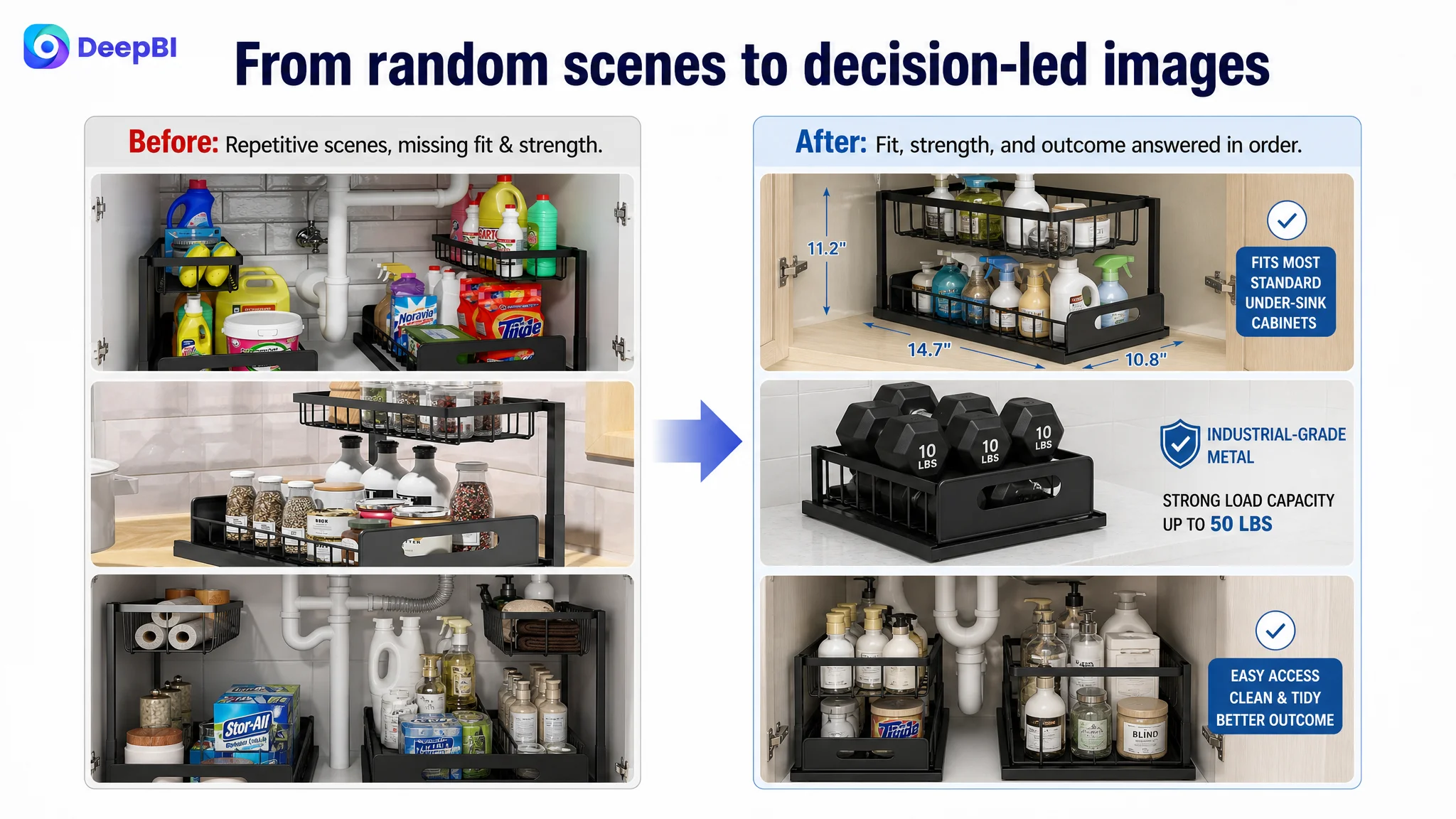
The initial image set:
- Showed a loaded organizer under a sink
- Repeated kitchen/laundry scenes
- Highlighted the anti-rust coating layers
- Included a laundry-room scene to suggest multi-scenario use
But from a decision-logic perspective, the sequence failed to answer questions in the order buyers actually think:
1. Will it really solve my under-sink chaos?
2. Will it fit my cabinet and P-trap?
3. Is it sturdy enough, or will it sag like cheap plastic?
4. Is it easy to use and access items at the back?
5. Can I use it beyond the kitchen, so my purchase feels “worth it”?
DeepBI’s recommendations re-mapped the image roles:
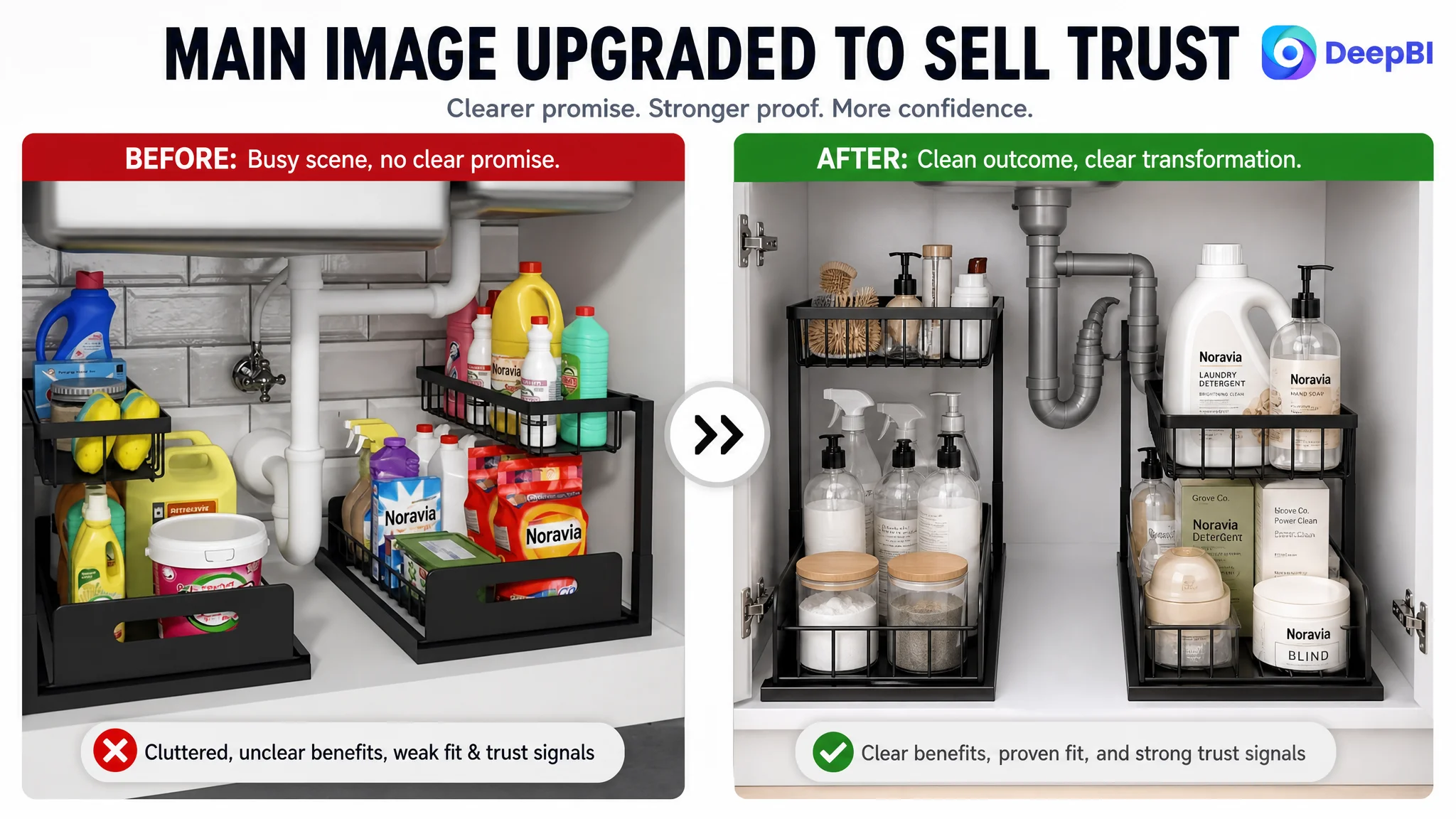
1. Image 1 – Outcome-first under-sink transformation
- Clean, “dream kitchen” after state as the hero
- Realistic load to avoid overpromising, but visually clear transformation from clutter to order
2. Image 2 – “Will it fit?” verification
- Dedicated dimension and clearance callouts
- Explicit P-trap compatibility, removing the biggest early objection
3. Image 3 – Durability and structural strength
- All-metal construction as the focus
- Visual proof it can handle heavy cleaners and bulk containers without bending or sagging
4. Image 4 – Slide-out usability
- Lower tier extended, side handles visible
- Directly answers “Will I still have to kneel and reach blindly?”
5. Image 5 – Before/after multi-pack validation
- Side-by-side comparison: chaotic cabinet vs. organized with both units
- Confirms the value of a 2-pack and summarizes the transformation visually
This was not about making images prettier. It was about converting ad-driven clicks into a guided, low-friction decision sequence on the product page.
A+ Content: Strong Raw Material, Misplaced Priorities
In A+ (detail page) analysis, DeepBI found the seller actually had a more “mature” story than the competitor:
- Strong emphasis on industrial-grade metal as a premium differentiator
- Visual cues for rust resistance and heavy-load capacity (up to 50 lbs)
- Real under-sink installations in typical P-trap configurations
However, the module order diluted their commercial impact:
- Fit and compatibility were not confirmed immediately
- Durability led the story, even though “Will it fit my cabinet?” is a higher priority doubt
- No visual “before/after” module to dramatize problem vs. solution
- No clear, visual step-by-step assembly to make “no tools” feel credible
- Multi-scenario usage was claimed in text but underrepresented visually
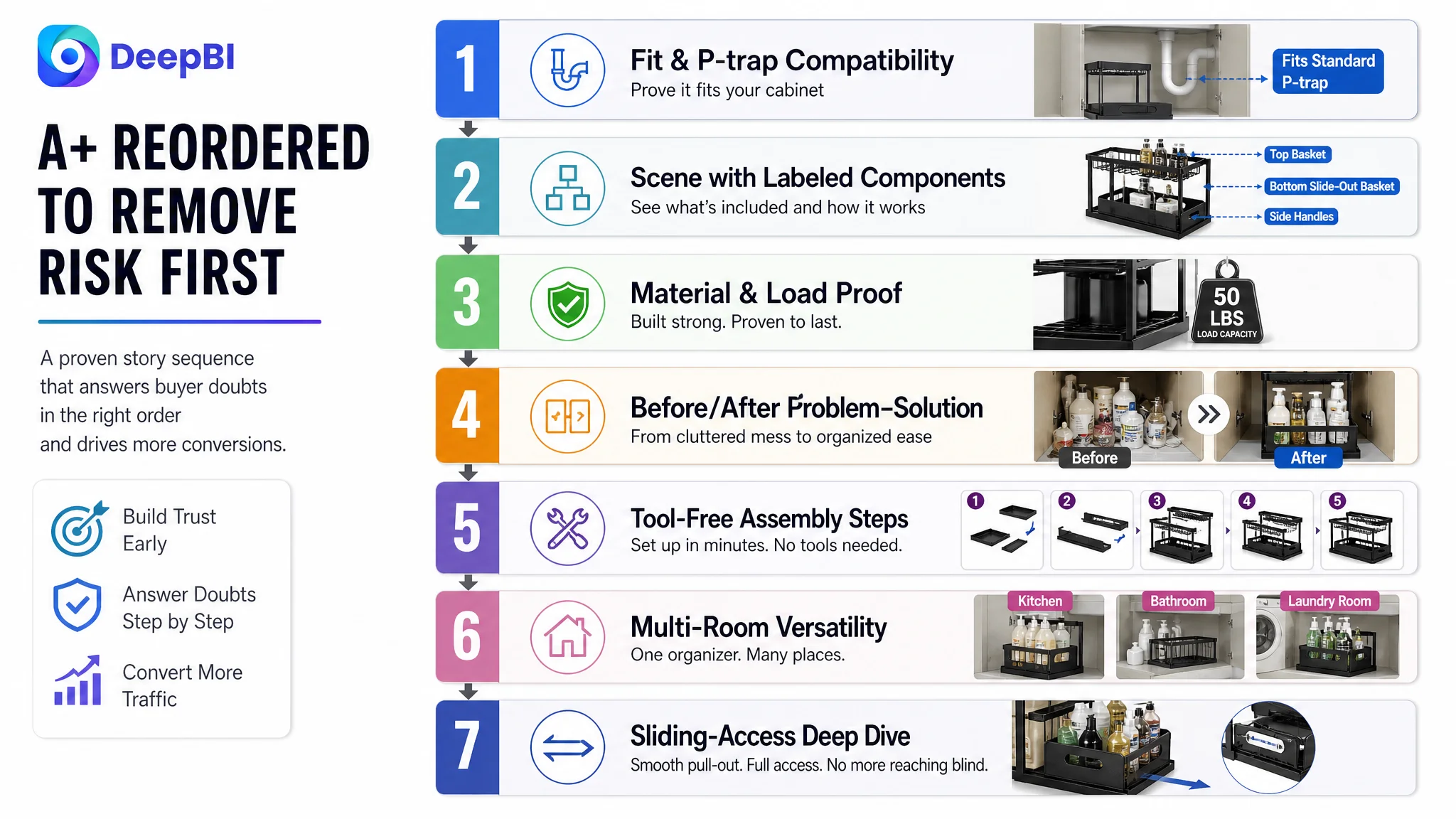
DeepBI’s re-ordered A+ blueprint:
1. Module 1 – Fit & P-trap compatibility first
- Dimensions, required clearance, and standard P-trap compatibility
- Objective, risk-reducing information at the very top
2. Module 2 – Functional scene with clear labeled components
- Real under-sink setting with pipes
- Labels for top wire shelf vs. bottom sliding drawer to show how it works around obstacles
3. Module 3 – Material & load proof
- Industrial metal vs. typical plastic alternatives
- Explicit 50 lbs capacity as an objective proof point
4. Module 4 – Before & after problem–solution
- Visual conversion from cluttered under-sink chaos to ordered vertical storage
5. Module 5 – Tool-free assembly steps
- 3–5 simple steps, visually confirming “no tools, no hardware”
- Designed for non-handy buyers who fear complicated assembly
6. Module 6 – Multi-room versatility
- Kitchen sink, bathroom vanity, laundry/pantry scenes
- Reinforces “multi-purpose” promise made in the title and bullets
7. Module 7 – Deep-dive sliding-access utility
- Comparison: with vs. without slide-out
- Emphasizes why this is more than “just a basic shelf”
This re-architecture addressed the specific risk of a zero-review Listing: without user proof, the page itself must shoulder far more of the trust-building burden.
Bullets: Strong Content, Now Aligned With Decision Priorities
Interestingly, the seller’s bullets already exceeded the competitor in logic and persuasion. DeepBI focused not on rewriting from scratch but on sharpening and aligning them with buyer priorities:
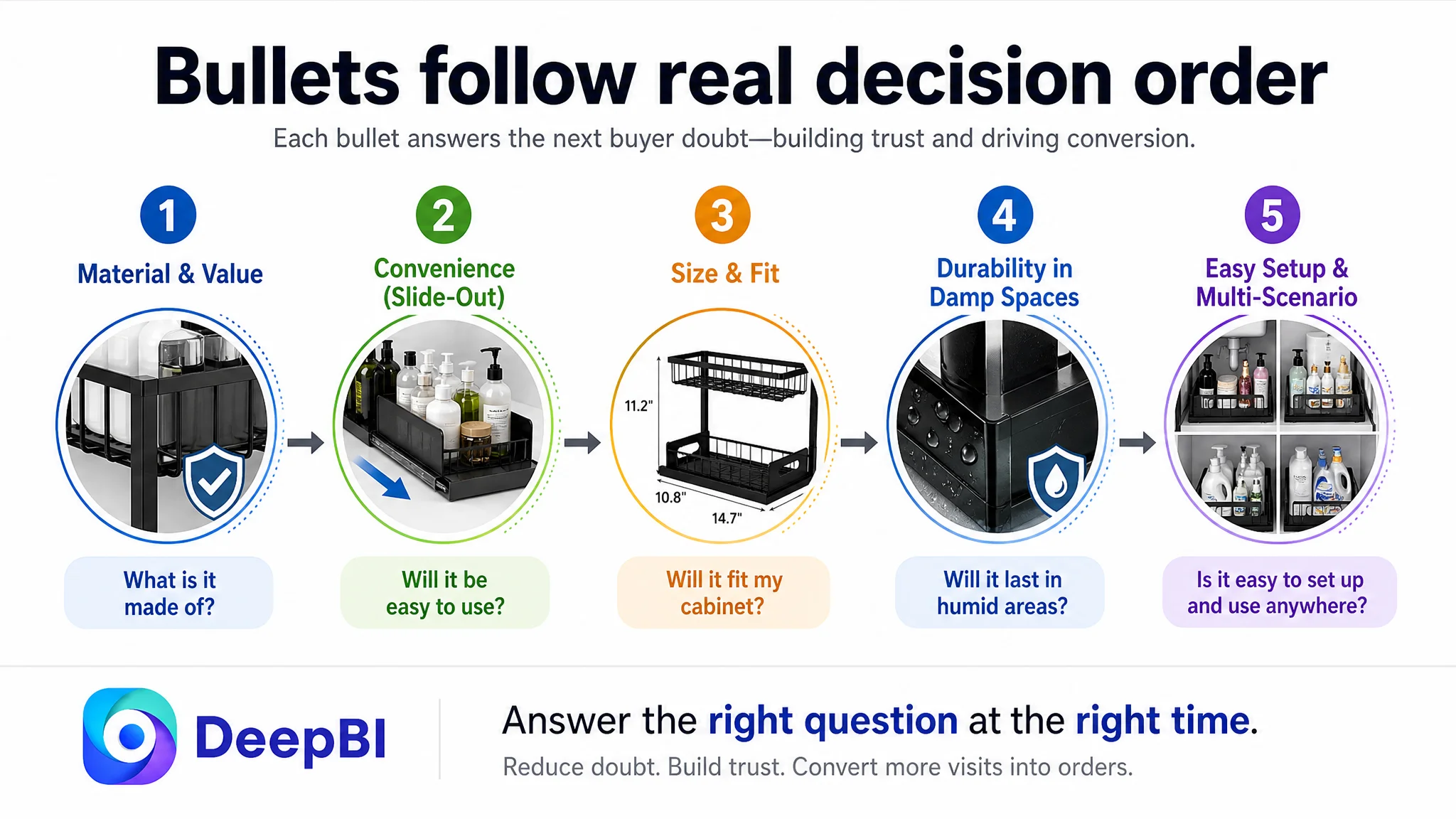
1. Lead with material & value (Industrial-grade metal vs. plastic)
- Emphasize rust-resistant, all-metal construction
- Contrast with flimsy plastic alternatives that need frequent replacement
2. Clarify functional convenience (Smooth slide-out accessibility)
- “No more kneeling,” “no more reaching into dark corners”
- Explicitly frame the lower pull-out drawer and top shelf division
3. Confirm size & compatibility (P-trap friendly design)
- Exact dimensions, standard cabinet fit, and P-trap accommodation
- Directly attack the “might not fit” objection
4. Highlight long-term durability (Rust-proof in damp cabinets)
- Explain why this survives humid kitchen/bath environments
- Focus on preventing cabinet floor staining and corrosion
5. Combine easy assembly with multi-scenario use
- “5-minute, tool-free assembly” plus kitchen/bath/laundry versatility
- Positions the product as a simple, broadly useful upgrade
This sequence aligns bullet reading with the path the A+ and images now follow, giving a coherent, reinforcing story from title to main images to bullets to A+.
How the Page’s Sales Logic Started to Recover
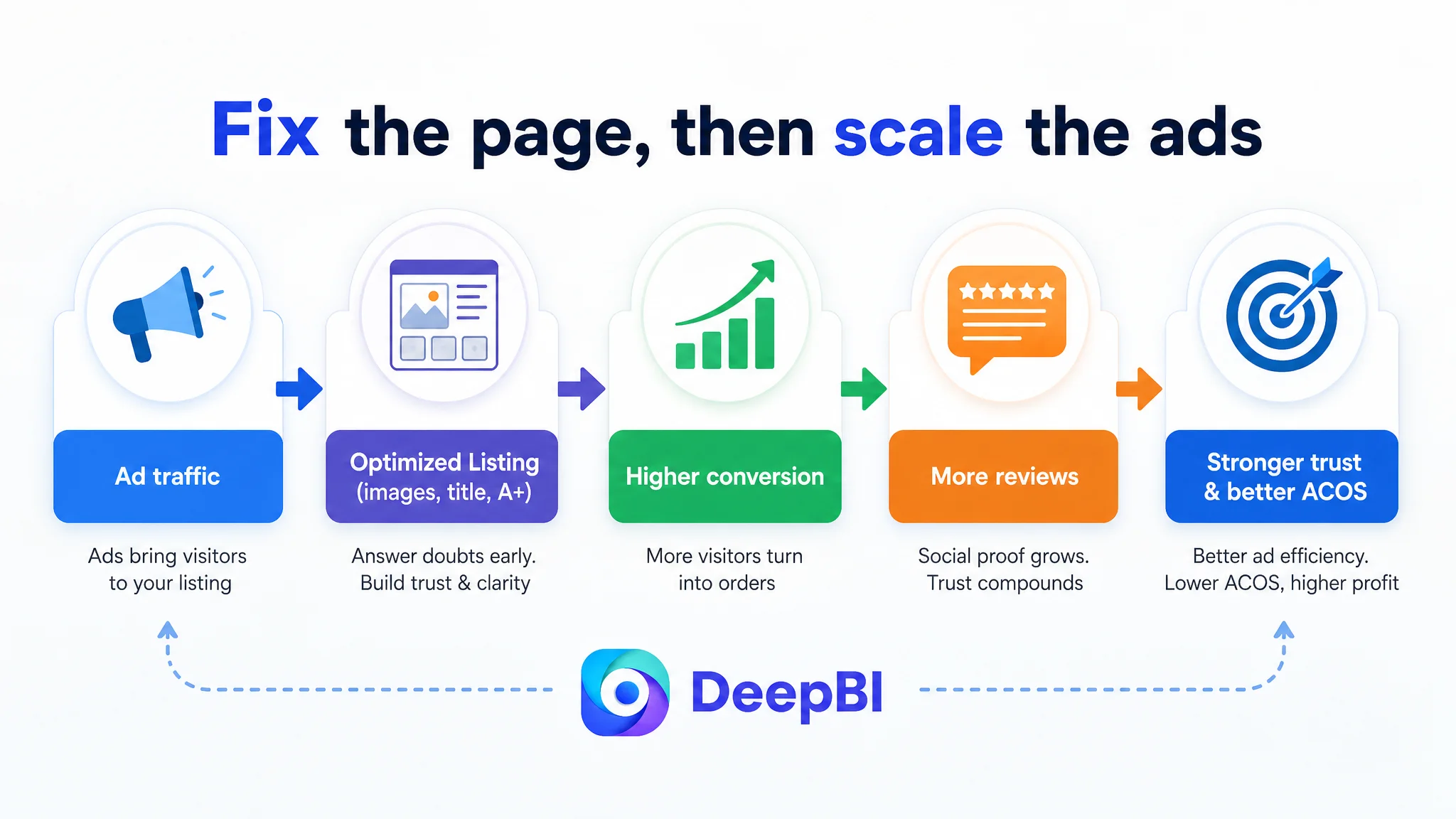
After reframing the problem as a Listing conversion and trust-building challenge, not an advertising challenge, the key changes were:
- The main-image sequence moved from repetitive scenes to a structured buyer journey:
- Outcome → Fit → Strength → Usability → Before/After summary
- The A+ layout was reordered to:
- Remove “Will it fit?” as early friction
- Back claims with objective load and material proof
- Visually prove ease-of-assembly and multi-room utility
- The title and bullets were tightened to:
- Elevate “2-pack,” “multi-purpose,” and “metal” as primary differentiators
- Mirror the successful long-tail structure used by the competitor while preserving the product’s own advantages
In practical terms, these changes meant:
- Each ad-driven click now encountered a page that systematically lowered uncertainty instead of amplifying it.
- The absence of reviews was partially offset by stronger visual and structural proof, improving the page’s ability to retain and convert traffic.
- Early conversion improvements could then help the product begin collecting its first wave of reviews, gradually unlocking the review dimension that previously scored 1/15.
DeepBI did not “fix ACOS” directly. It made ad traffic useful again by giving it a page that could credibly convert visits into orders and, over time, into reviews.
How the Seller’s Understanding Changed
By the end of the engagement, the seller’s mental model of the problem had shifted:
- From:
- “Our Amazon ads and keywords aren’t strong enough.”
- “Maybe the copy and images just need to look better.”
- To:
- “This Listing had a trust and decision-order problem, not a traffic problem.”
- “Our title, bullets, and A+ were decent, but we weren’t answering ‘fit’ and ‘trust’ early enough.”
- “With zero reviews, the page itself must act like 80% of the salesperson.”
The main business takeaways:
- Amazon ads cannot solve a structural trust gap. If the page has zero reviews and an unprioritized story, more traffic just increases cost.
- Listing quality is the foundation of ad efficiency. Main image, title, bullets, and A+ must work together to:
- Win the click
- Remove doubts in the right order
- Create enough trust to justify purchase—even before reviews accumulate
- Before scaling ads, ask: “Does this page deserve more traffic?”
If the answer is no, the first budget should go into conversion repair, not bid increases.
For other Amazon sellers—especially those launching new products against entrenched competitors—this case underlines a critical point: the real bottleneck often hides in the Listing’s ability to convert and build trust, not in the sophistication of your campaign structure. Solving that first makes every subsequent advertising decision more predictable and more profitable.