

An Amazon kitchenware seller came to us with a familiar frustration: traffic was not the problem. Their collapsible colander set was live on Amazon US, ads were ready to scale, but the Listing could not turn visits into orders. In their view, the issue was mainly “not enough advertising” and “images not attractive enough.”
Once we put their Amazon Listing against a category-leading collapsible colander competitor, a different picture emerged. The gap was not in basic visuals or keyword choice; it was in conversion infrastructure. The main image set carried risky, unverified claims, the A+ detail section was essentially non‑existent, and the product had zero reviews competing against a 1,000+ review, 4.6‑star benchmark.
DeepBI’s diagnosis reframed the problem: Amazon ads were not underperforming; they were about to amplify a page that lacked trust, data, and a complete buying story. Optimization had to start with the core Amazon product page—title clarity, main-image truthfulness, structured bullet logic, and a real A+ visual narrative—before any meaningful ad scaling could make sense. This case shows why many sellers who “fix ads” first end up burning budget on a Listing that never had the capacity to convert in the first place.
 Amazon Ads Were Not Failing. The Page Was Consuming the Traffic.
From the seller’s perspective, the initial problem sounded operational: the collapsible colander set had decent photos, a functional title, and they planned to push harder on Amazon ads once budgets allowed.
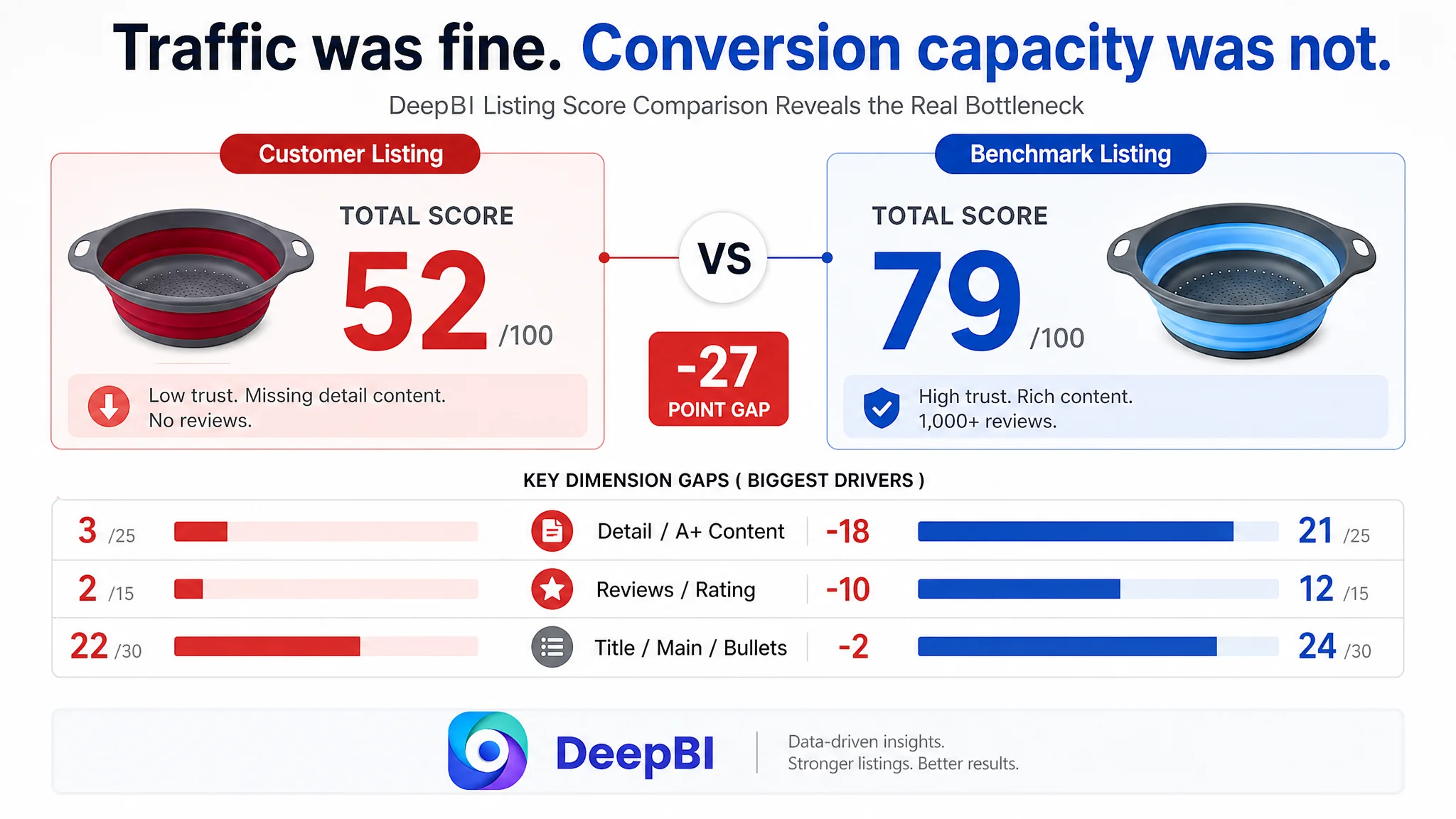
But against a directly comparable top Listing in the same collapsible colander niche, DeepBI’s scoring made one thing obvious:
- Customer Listing total score: 52 / 100
- Benchmark Listing total score: 79 / 100
- Gap: –27 points
When we broke this down by Amazon Listing dimensions:
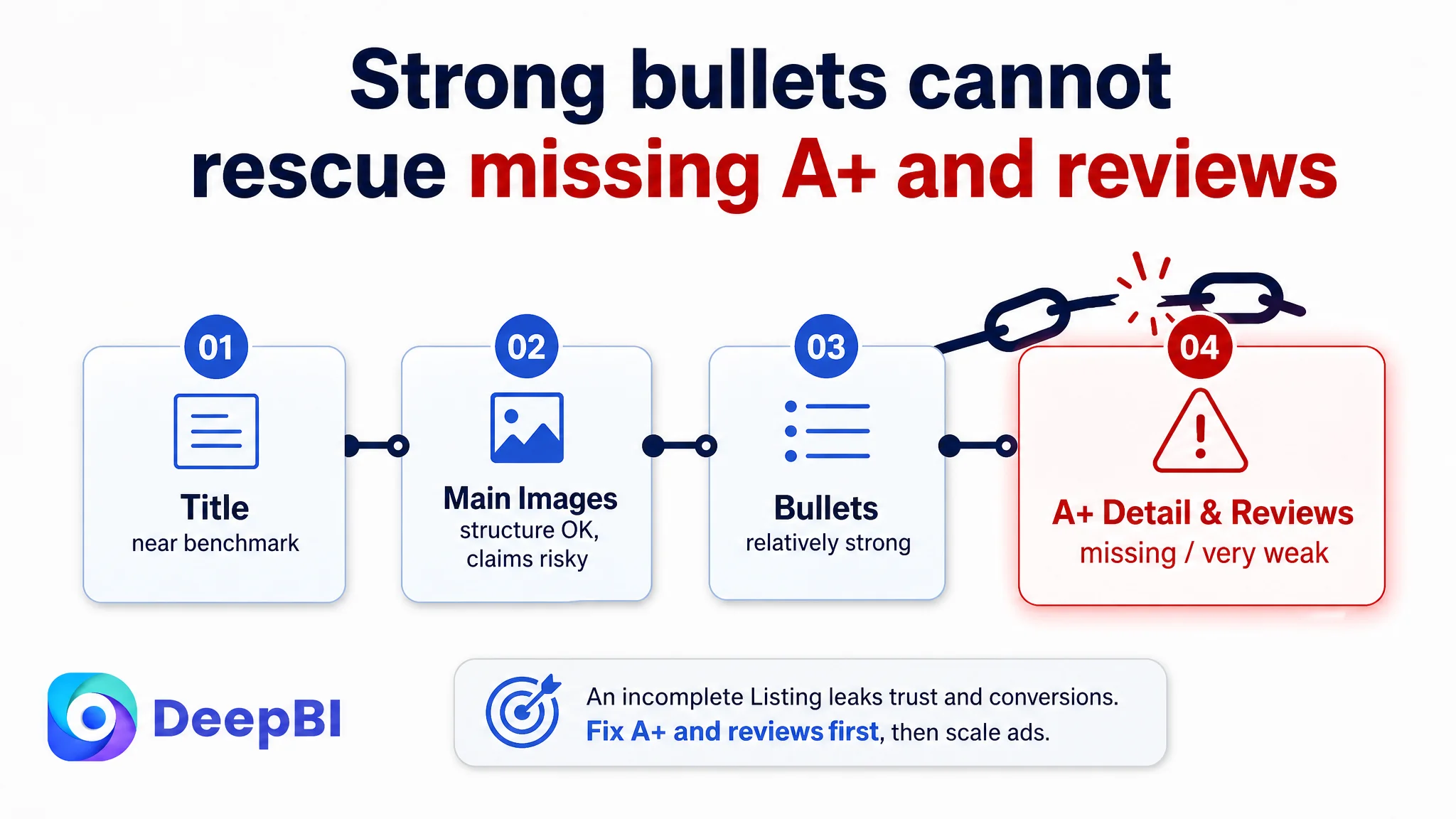
- Title: only –2 points behind the benchmark
- Main image set: effectively on par (even slightly ahead in raw score)
- Bullet points: slightly stronger than the benchmark
- Detail / A+ section: –18 points
- Reviews / rating: –10 points
In other words:
The real problem was not that ads failed to bring traffic. It was that the page could not convert the traffic.
At this stage, pushing more Amazon ads would not “fix” the business; it would simply buy more clicks into a structurally incomplete Listing.
 The Core Constraint: Listing Conversion Capacity, Not Traffic Volume
The seller’s original judgment focused on surface levers:
- “If we improve images and maybe tweak some copy, we can then scale ads.”
- “The bullets are already strong; the main thing is to get more exposure.”
DeepBI’s view, grounded in Listing diagnostics, was different:
1. The A+ / detail section was effectively missing.
The seller relied on plain text only—no visual modules, no structure, no proof of claims. The benchmark, by contrast, used a full A+ stack: brand story, material safety visual proof, structural close‑ups, folding and storage diagrams, multi‑color and multi‑size showcases, and space‑saving comparisons.
2. The trust gap was extreme.
- Customer Listing: 0 reviews, no rating, no image/video reviews.
- Benchmark Listing: 4.6 stars, 1,024 total reviews, 45 reviews on the first page, many with images.
3. Main images carried risky, non‑credible claims.
One key image claimed “precision filtration” of oil and fine particles such as tea/coffee grounds—capabilities that contradict what a standard colander hole pattern can do and were not supported anywhere else on the page.
In a category where buyers can easily choose a high‑rating, richly presented benchmark product, this combination—no reviews, no visual detail, and over‑promised functionality—destroyed conversion confidence.
The constraint was clear: the Listing did not deserve more traffic yet.
Why “Traditional” Optimization Kept Failing
Left alone, the seller’s most likely path would have been:
- Slightly rewrite the title,
- Swap in “nicer” lifestyle pictures,
- Add or adjust keywords in campaigns,
- Increase bids to grab more Amazon ad impressions.
This is exactly how many Amazon sellers operate—and why so many see rising ACOS with no stable CVR improvement.
Why this path was dangerous here
- Ads would amplify a trust deficit.
With 0 reviews and no visual A+ story, every incremental click would land on a page that feels “unproven” next to a 1,000‑review competitor.
- Risky claims exposed the brand to returns and complaints.
Over‑promising “oil filtration” and fine‑particle filtering invites both buyer disappointment and potential compliance issues.
- The seller would misread performance signals.
Poor CVR might be blamed on keywords or bids, when the real issue was the buyer’s inability to find hard proof of space‑saving, material safety, and capacity fit.
Instead of letting ads mask the deeper problem, DeepBI’s judgment was to treat the Listing itself as the primary bottleneck.
What the Data Said: A Listing Built on Text, Not Evidence
DeepBI’s competitive scoring broke down where the collapse in persuasion really happened.
 Title: Close, but Under‑leveraged
- The benchmark title leads with the brand name, aligning with Amazon norms and building brand search equity.
- The benchmark explicitly tags “BPA Free” and “Dishwasher-safe silicone”, directly addressing health and convenience concerns.
- It tightly couples “Set of 3” with exact capacities (4 quart / 2 quart), and appends clear use cases (“for Pasta, Veggies”) at the end.
The customer title, while not terrible, showed gaps:
- No brand lead, thus weaker brand recognition in Amazon search.
- No “BPA Free” or material safety language, weakening click appeal for safety‑sensitive buyers.
- Capacity labeling was less compact (3QT, 4QT, 5QT scattered) and usage terms were diluted in the middle.
Importantly, this was not the main reason the Listing was failing—the gap was only –2 points. Fixing title alone would not move the business needle if the rest of the page stayed the same.
Main Images: Decent Structure, Dangerous Messaging
On raw visual quality and variety, the main image set was not catastrophically behind. The issue lay in what the images were claiming and what they failed to answer:
- A “VS” comparison image used non‑standard design and emotive icons (smiley vs. frown), telling shoppers “ours is better” without rational proof.
- A usage image claimed complex filtration of oil and fine particles—capabilities not realistically supported by the product’s hole pattern.
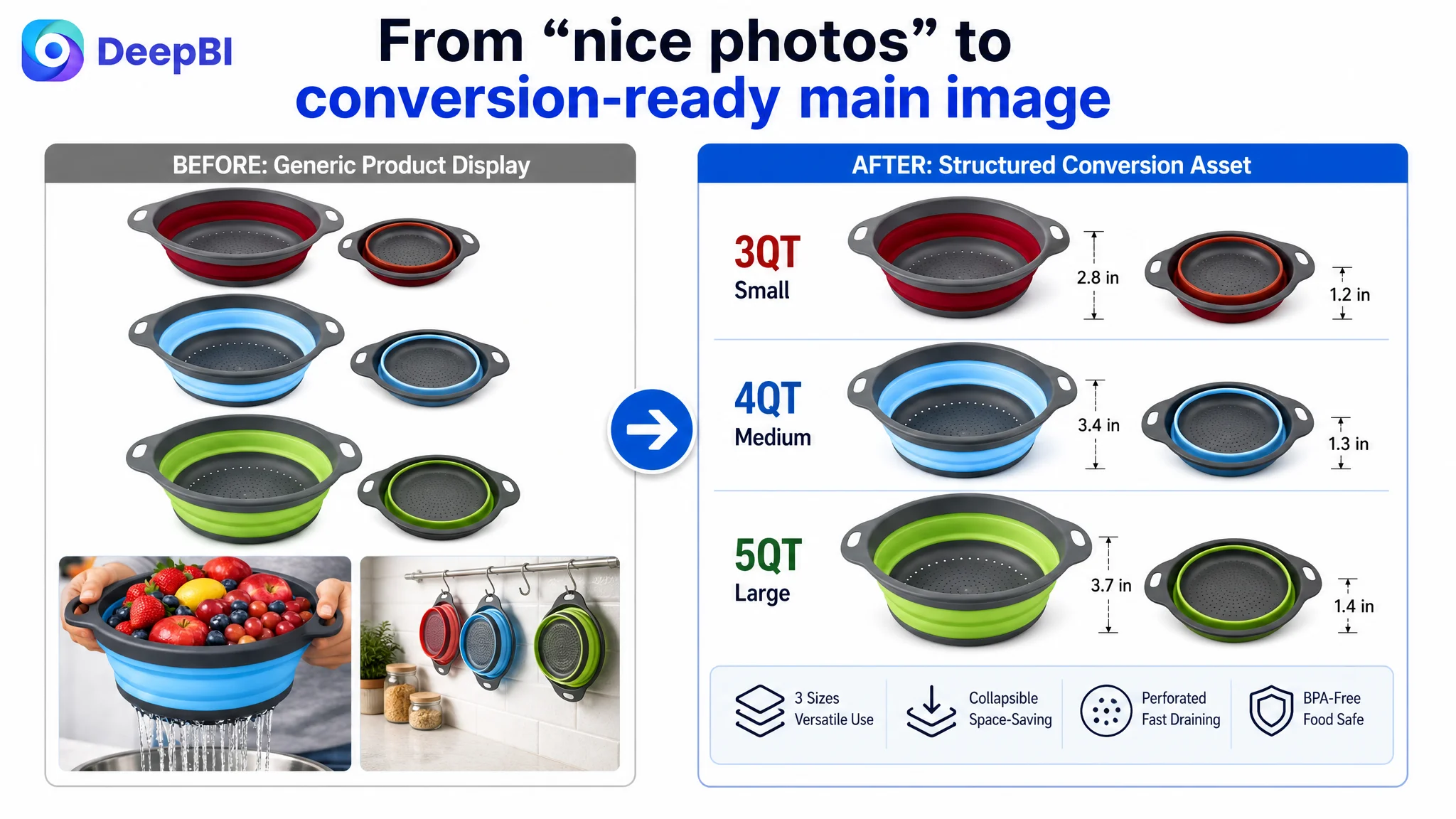
- The dimension image only showed top diameter for each colander, omitting:
- Expanded height,
- Collapsed height,
- Handle‑to‑handle length,
- Clear nested storage impact.
Meanwhile, the benchmark’s image set:
- Used clear, precise dimension diagrams,
- Showed the product in real scenario use,
- Validated folding thickness (e.g., 1.1‑inch collapsed) and sink/drawer fit.
Buyers trying to answer “Will it fit my sink? my drawers?” or “Is this really safe for my family?” could do so easily on the benchmark Listing—but not on the target Listing.
Bullets: One of the Few Strong Assets
Ironically, the customer’s bullet points were structurally better than the benchmark’s:
- They used a problem → solution logic (messy countertops, washing hassles) rather than just listing features.
- They leaned on concrete verbs (“fold down in seconds”, “rapid liquid release”) and end results (“keep countertops organized”).
- They covered multiple need layers: space, function, material stability, heat resistance, kitchen organization.
Scoring even showed a slight advantage over the benchmark in this dimension.
However: bullets alone cannot carry conversion if the buyer:
- Sees risky, over‑promised images,
- Sees no visual A+ evidence,
- Sees zero reviews.
The bullets became a “silent advantage” no one fully trusted because the rest of the page did not support them.
Detail / A+ Section: A 3 vs. 21‑Point Gap
This was the real structural failure.
- Customer Listing: plain text only, no A+ images, no modules, no hierarchy.
- Benchmark Listing: a full suite of A+ modules:
- Brand positioning (“your kitchen partner”),
- Material safety callouts (BPA‑free with visual confirmation),
- Structural close‑ups,
- Space‑saving diagrams with quantified folded thickness,
- Multi‑size and multi‑color arrangement visuals,
- Before/after and storage comparisons.
The impact on buyer behavior is straightforward:
Where the benchmark tells a visual, quantified story, the target Listing forces the buyer to imagine everything and trust text alone.
In commodity kitchen tools on Amazon, that is rarely a winning proposition.
How DeepBI Reframed the Problem
Given this data, DeepBI’s judgment path was:
1. This product page does not lack traffic. It lacks trust.
With 0 reviews and no A+ images, every visit arrives at a page that feels unproven, especially when Amazon’s right rail and “Sponsored” rows show colanders with hundreds or thousands of ratings.
2. Ads would not rescue this Listing; they would expose it.
More traffic into a low‑trust environment only accelerates bad reviews or poor engagement signals.
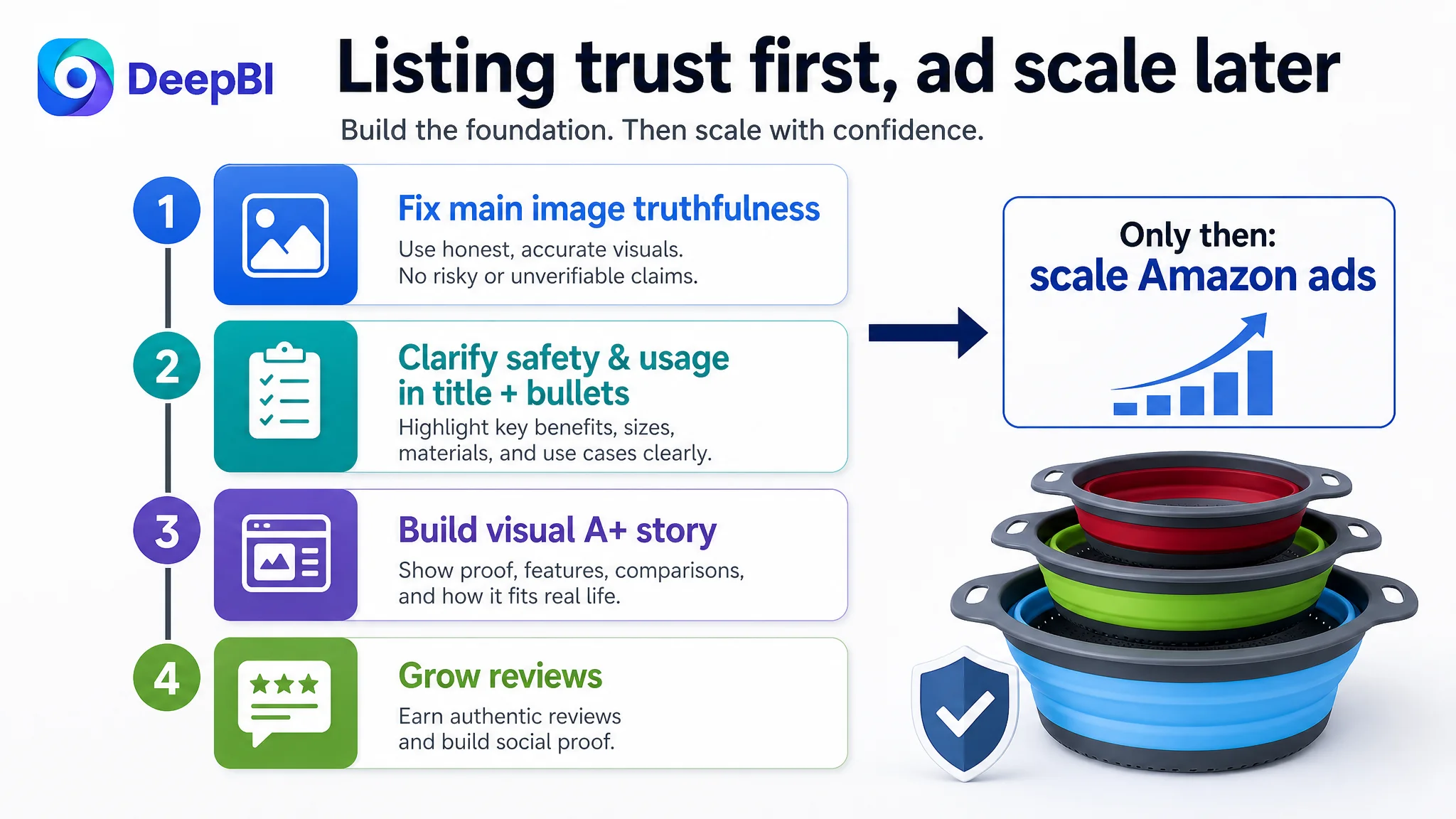
3. The first priority is to rebuild the conversion infrastructure:
- Clean, truthful main image logic.
- A clear, safety‑anchored title.
- Bullets integrated into a coherent A+ visual narrative.
- Visual proof for space‑saving and performance claims.
4. Review strategy must follow quickly after page repair.
Because the benchmark’s 1,000+ reviews are a powerful moat, the seller cannot afford to stay at “0 reviews with weak visuals” while trying to compete on ads.
Only once these layers are in place does it make sense to talk about scaling Amazon ads again.
 Why DeepBI Did Not Keep Tuning Ads First
From a pure advertising manager’s perspective, the instinct might be:
- Test new keywords,
- Restructure campaigns,
- Adjust bids by placement,
- Optimize budgets day‑by‑day.
DeepBI’s Listing‑first view treated those as later‑stage multipliers, not first‑line fixes, because the business risks were clear:
- High ACOS with no structural learning.
If the Listing cannot convert, ad performance data says more about page defects than about keyword quality. You pay to learn what you already know: the page is not trustworthy enough.
- Amazon’s algorithm gets mixed signals.
Poor CVR from paid clicks can slow visibility gains, undermining both paid and organic momentum.
- Every click becomes a potential complaint.
Over‑promised “precision filtration” claims could trigger returns or negative reviews once buyers realize the product behaves like a normal colander.
From DeepBI’s perspective, it would be irresponsible to recommend ad scaling before fixing the Listing’s truthfulness and persuasive capacity.
Rebuilding the Page: From Abstract Claims to Concrete Proof
The optimization focus was not to “beautify” the Listing, but to make it commercially credible.
1. Title: Clarifying Safety and Purpose
The proposed title direction:
Collapsible Kitchen Strainer Colander Set 3 Pack (3QT, 4QT, 5QT) – BPA Free Silicone Foldable Kitchen Strainer for Fruits, Veggies & Draining Pasta, Dishwasher Safe (Green, Blue, Red)
Key shifts in logic:
- Front‑loaded core keywords: “Collapsible Kitchen Strainer Colander Set 3 Pack” placed early for maximum indexing value.
- Safety and material spelled out: “BPA Free” + “Silicone” address the fundamental “Is this safe?” question.
- Concrete capacities kept visible: 3QT, 4QT, 5QT remain, but more compactly organized.
- Clear use cases: “Fruits, Veggies & Draining Pasta” connects search terms to real kitchen tasks.
This doesn’t fix conversion alone, but it syncs the title with what the rest of the page must prove.
 2. Main Images: Remove Risk, Add Decision Data
DeepBI’s diagnosis turned into a new image logic:
- Image 1 – Product and set overview:
Keep the strong composition showing all three colors and both states (expanded/collapsed), but add clear overlays for:
- Sizes (3QT, 4QT, 5QT),
- “Collapsible” state labels,
- Simple, realistic benefit like “Space‑Saving 3‑Pack.”
- Image 2 – Honest in‑use demonstration:
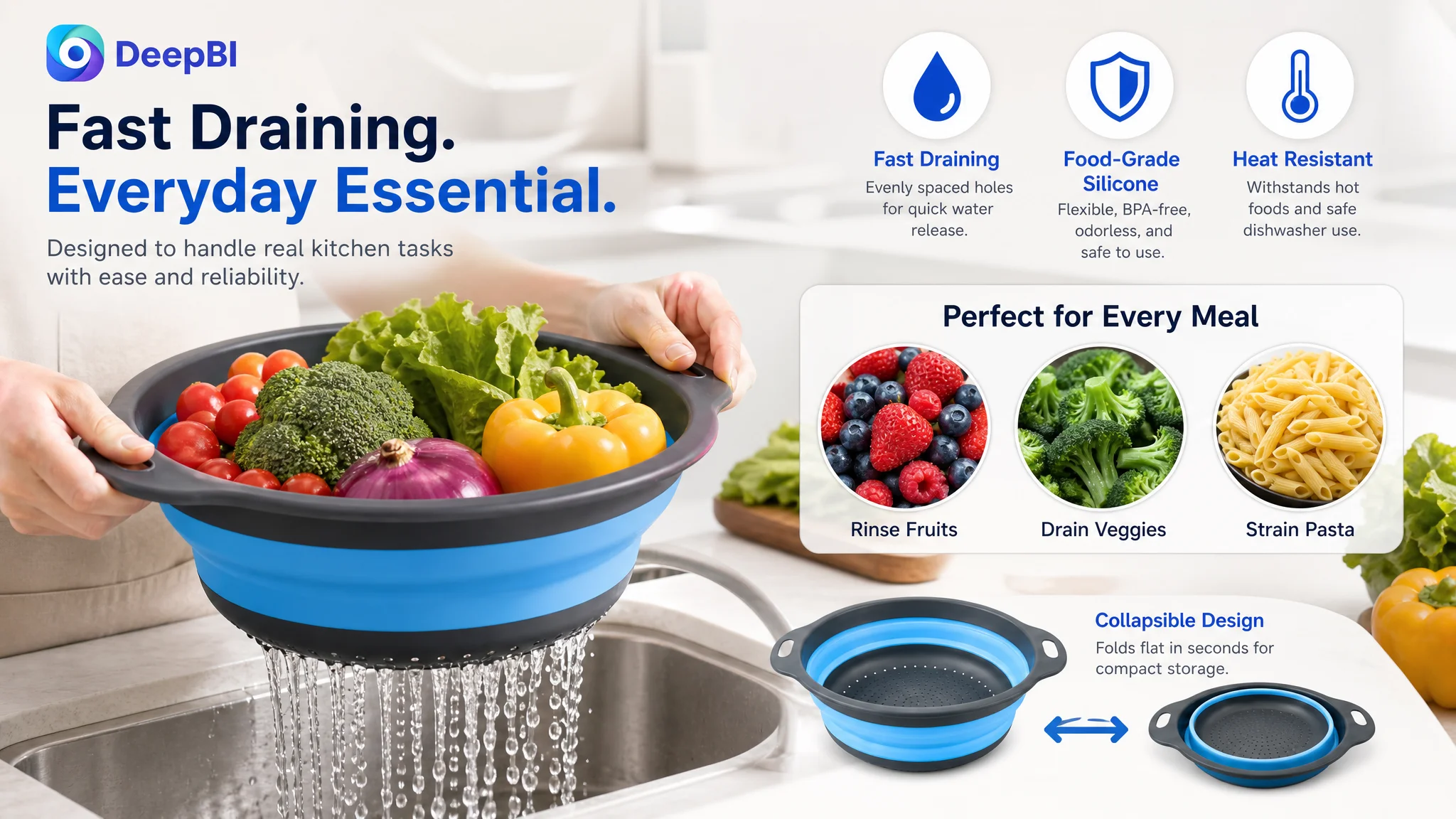
Remove all “complex filtration” claims (oil, fine particles). Replace overlays with verifiable functions: “Fast Draining for Fruits & Vegetables,” “Ideal for Pasta & Boiled Veggies.”
- Image 3 – Full dimension schematic:
For each colander show:
- Top diameter,
- Handle‑to‑handle length,
- Expanded height,
- Collapsed height.
Include a clear quantitative statement like “Collapses down to X in. for compact storage” (once actual values are confirmed).
- Image 4 – Specific functional superiority instead of generic ‘VS’:
Swap emoji‑style comparisons for a close‑up of the perforated drainage base to show:
- Hole pattern,
- How ingredients are held securely while water drains.
- Image 5 – Real space‑saving narrative:
Show all three colanders collapsed and nested, or stacked in a real drawer/shelf. Emphasize “Stackable, Collapsible Storage in Tight Kitchen Spaces” rather than generic “it hangs on a hook.”
In short: less hype, more measurable reality.
3. Bullets: Turning a Quiet Strength into a Visible One
The bullets were already structurally sound. DeepBI’s role was to align them with search intent and trust logic:
- BP #1 – Space‑Saving Collapsible Design
Make the folding behavior concrete: folds in seconds, fits in tight drawers, keeps countertops organized.
- BP #2 – BPA‑Free & Heat‑Resistant Material
Pair safety (BPA‑free, food‑grade, odorless) with high‑temperature kitchen use (boiling pasta water, blanching vegetables) to close material‑safety and durability doubts.
- BP #3 – Efficient Drainage for Versatile Use
Enumerate actual food use cases—fruits, salad greens, spaghetti, potatoes, broccoli, green beans—capturing both SEO value and mental imagery of real use.
- BP #4 – Ergonomic & Sturdy Handling
Emphasize comfortable, non‑slip handles, stable lifting, and no bending or breaking under normal kitchen loads.
- BP #5 – Color‑Coded Set for Enhanced Workflow
Use the set’s unique advantage (multi‑color) to differentiate:
- Separate raw vs. cooked ingredients,
- Avoid cross‑contamination,
- Make multi‑tasking easier in a busy kitchen.
This transforms the bullets from “good copy” into a backbone that matches the visual story the A+ section needs to tell.
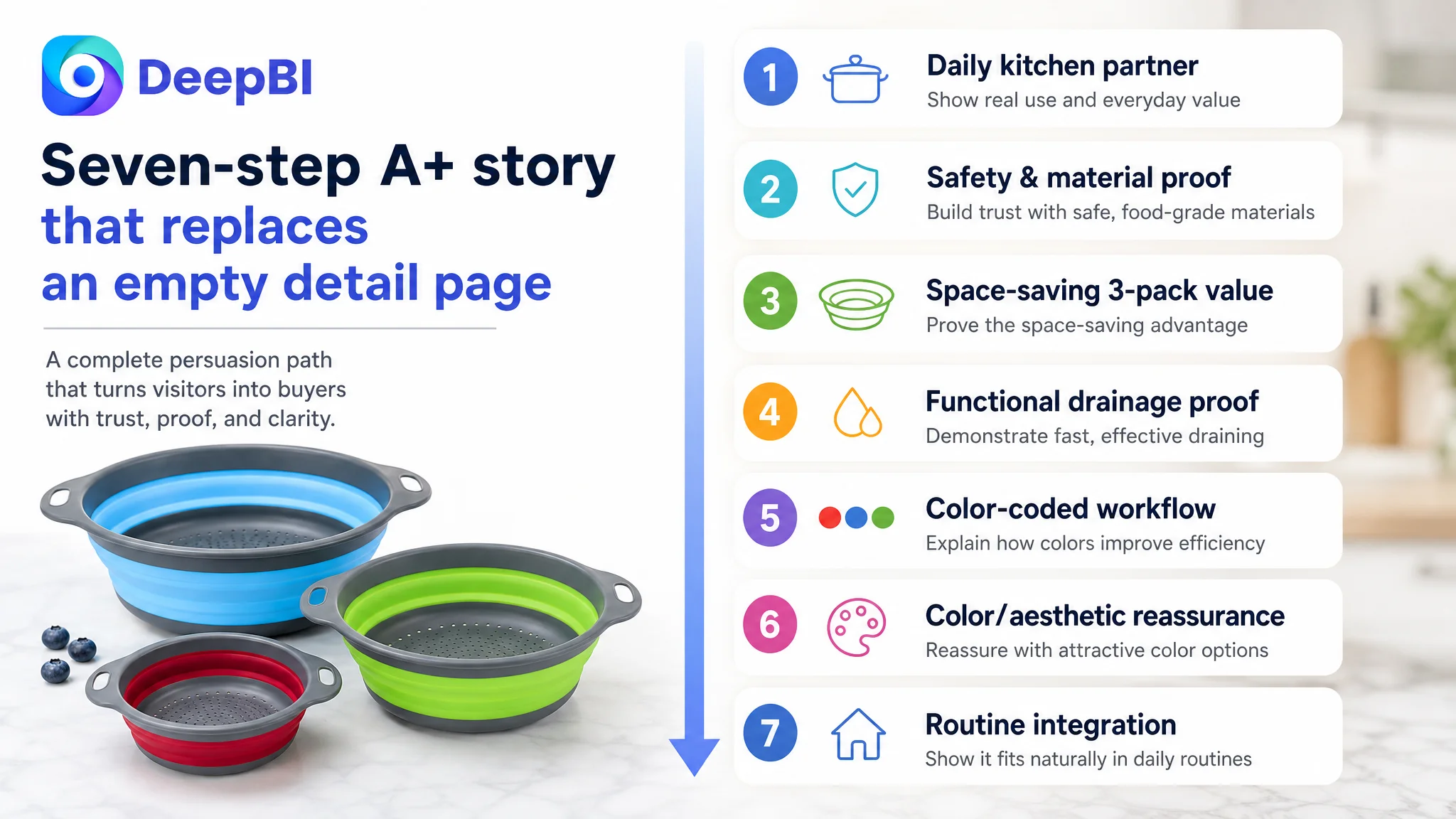
4. A+ / Detail Page: From Empty Text Block to Seven‑Step Persuasion
With only plain text, the original detail area could not support higher‑intent buyers.
DeepBI’s optimization logic rebuilt it into a structured path:
1. Module 1 – Immediate utility hook
Position the colander set as a reliable daily kitchen partner that:
- Handles washing, draining, and transferring tasks smoothly,
- Keeps counters and storage spaces organized,
- Uses color coding to streamline prep.
2. Module 2 – Material safety confirmation
Answer “Is this safe for my family?” directly with:
- Food‑grade, BPA‑free materials,
- Heat resistance for boiling water and hot rinses.
3. Module 3 – Space‑saving and 3‑pack value proof
Visually validate:
- The nesting logic of the three sizes,
- Collapsed thickness,
- Storage in tight drawers/cabinets.
4. Module 4 – Functional effectiveness
Show the perforated base in action:
- Rinsing fruits and vegetables without spillage,
- Draining pasta quickly without clogging or mess.
5. Module 5 – Workflow and organization
Demonstrate color‑coded separation:
- Green for vegetables, blue for pasta, red for fruits (or any logical mapping),
- Avoiding cross‑contamination and confusion.
6. Module 6 – Aesthetic hesitation reduction
Present all three colors clearly, in a cohesive visual that makes the set feel intentional and coordinated rather than random.
7. Module 7 – Extended routine integration
Connect heat resistance and durability to:
- Weekly meal prep,
- Family dinners,
- Frequent washing and folding routines.
This seven‑step structure repositions the A+ section from “missing” to “the central trust engine” of the Amazon product page.
 What Changed in the Business State (Even Before Hard Numbers)
The case did not revolve around a dramatic before/after metric screenshot. Instead, it was about the operating state of the Listing and the seller’s decision logic.
After the Listing‑first optimization path:
- The page regained the ability to earn trust.
Buyers could now see:
- Real dimensions and fit data,
- Clear safety markers (BPA‑free, food‑grade),
- Concrete proof of space‑saving and usage,
- Coherent bullet and A+ storytelling.
- Ad traffic became meaningful again.
Bringing in clicks would now test:
- Whether the improved visuals and structure support CVR,
- Which keywords and audiences best respond to the clarified offer.
- Organic potential was no longer capped by page emptiness.
Over time, as reviews start to accumulate, the Listing can compete not only on price, but on a complete product experience.
- The seller’s understanding shifted.
They moved from:
- “We need better ads and prettier images”
to:
- “Our Amazon ads will only be as efficient as our Listing’s ability to convert.”
- “Title, main image, bullets, A+, and reviews must work as a system before we buy more traffic.”
What Other Amazon Sellers Can Take from This
For many Amazon sellers, this case will feel uncomfortably familiar:
- Ads seem like the lever to pull, because they are measurable and adjustable.
- The Listing “looks fine,” so attention drifts to campaign structures and bids.
- But ACOS refuses to come down, and every round of ad tuning feels less effective.
This collapsible colander case shows a different lesson:
Advertising does not only amplify advantages. It can also amplify a page’s existing defects.
If your Amazon product page:
- Has thin or non‑existent A+ visuals,
- Has weak or zero reviews compared to direct competitors,
- Makes claims that are hard to prove visually,
- Leaves buyers guessing about dimensions, fit, and safety,
then the problem is not primarily in your Amazon ads. It is in your Listing’s ability to convert the traffic you already have.
DeepBI’s role in this case was not to “apply a feature,” but to re‑order decisions:
1. Stop assuming ads are the main issue.
2. Diagnose Listing conversion capacity against real benchmark competitors.
3. Repair trust, data, and persuasion logic first.
4. Only then, use ads to scale what the page can genuinely deliver.
For Amazon sellers under growing ad‑cost pressure, this shift in judgment often matters more than any individual keyword or bid change. It is the difference between repeatedly paying to push traffic into a leaky page, and building a Listing that can turn both organic and paid traffic into sustainable sales.