

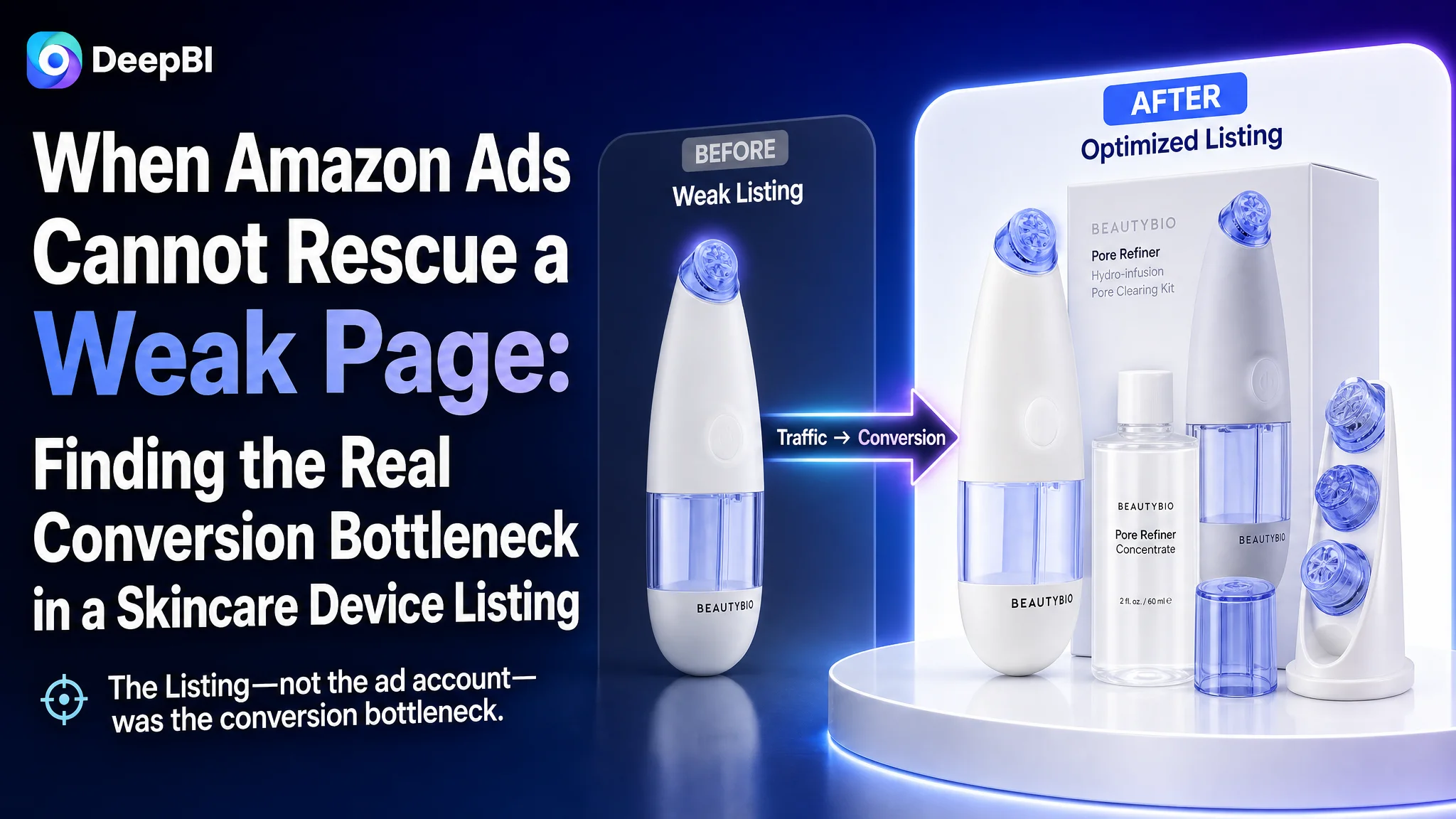
The customer was an Amazon seller in the US beauty-device category. Its hydro-infusion pore-cleansing Listing had the basic product information in place, but the page was not building enough confidence for shoppers to move from interest to purchase. The natural reaction was to look toward Amazon ads, keywords, bids, or traffic quality.
That diagnosis was incomplete. DeepBI’s comparison showed that the larger constraint was inside the Amazon product page itself: the Listing scored only 44 out of 100 against 91 for a comparable high-performing Listing. The largest gap was not the title or even the main image. It was the missing sales logic across the detail page, supported by a nearly absent review foundation.
The later optimization therefore focused on rebuilding the Listing as a complete at-home skincare routine: showing the full kit earlier, making the problem-solution relationship visible, clarifying the sequence from exfoliation to hydration, and using the available ingredient and product information without inventing clinical evidence. The case offers a practical lesson for Amazon sellers: before sending more paid traffic to a page, determine whether the page has enough clarity and trust to convert it.
The Amazon Ads Question Was Actually a Product-Page Question
The target Listing was competing in a visually demanding Amazon beauty category, where shoppers often make fast judgments from the first image, title, and visible trust signals.
At first glance, the product had several relevant selling points:
- A hydro-infusion pore-cleansing tool
- A 20 ml concentrate
- Large and small treatment tips
- A clarifying cap
- A charging display stand
- Support for exfoliating skin and removing dirt, excess oil, and makeup from pores
- A formula containing salicylic acid, hyaluronic acid, botanical extracts, and niacinamide
The issue was not a complete absence of product value. The issue was that the page did not present that value as a persuasive buying path.
The product appeared to be asking shoppers to interpret its functions on their own:
1. Understand what the device is.
2. Infer how the device works.
3. Determine whether the concentrate is important.
4. Decide whether the treatment is suitable for their skin concerns.
5. Trust the expected result without strong evidence.
6. Confirm that the kit includes everything needed.
A competing Listing made those decisions easier through stronger visual hierarchy, richer A+ content, clearer process explanation, and a more established review base.
The page did not primarily lack information. It lacked a sequence that turned information into purchase confidence.
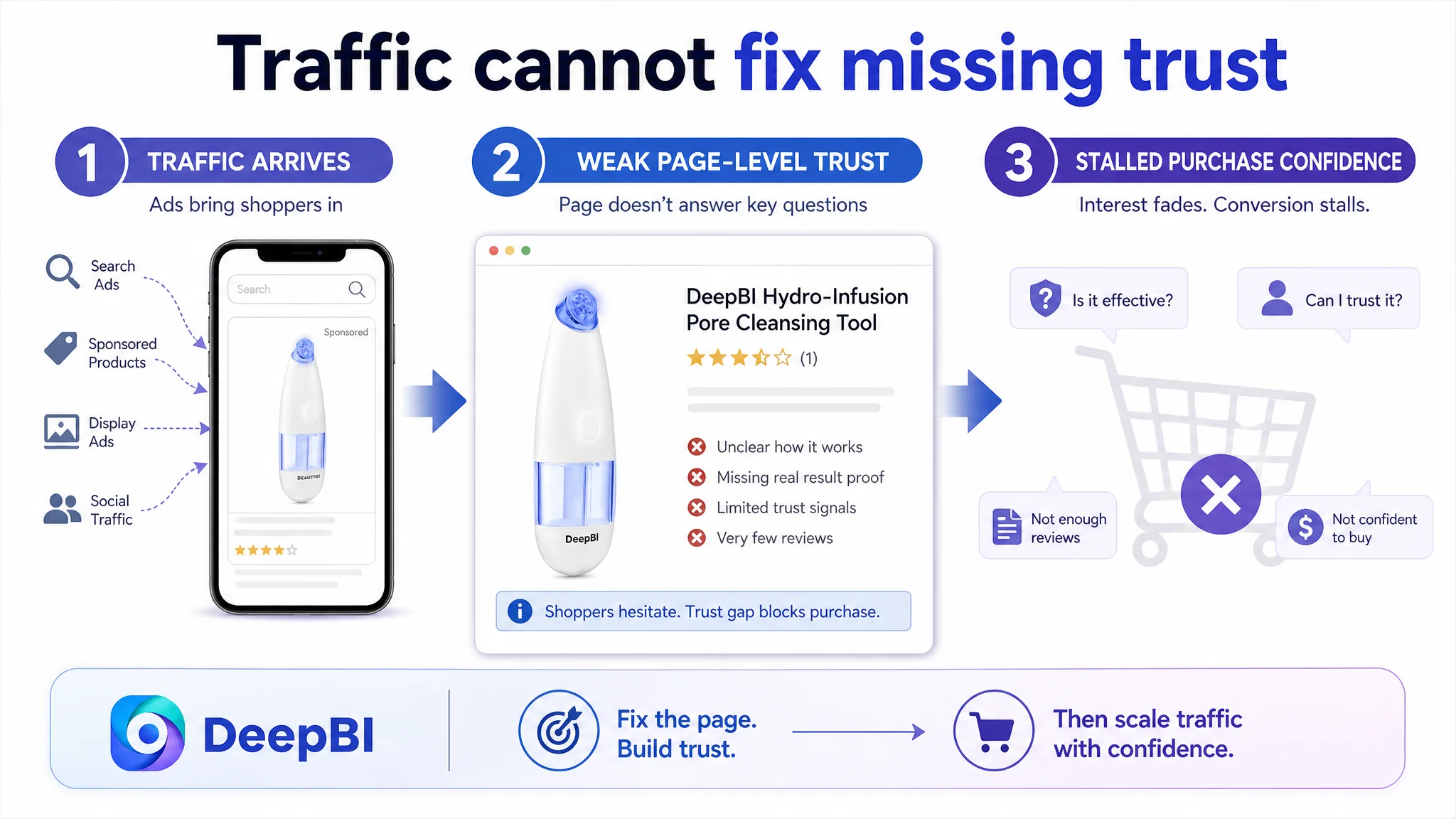
That distinction matters for Amazon ads. If advertising sends more shoppers to a page that does not answer these questions, additional traffic may only make the conversion weakness more visible.
A 47-Point Gap Changed the Priority
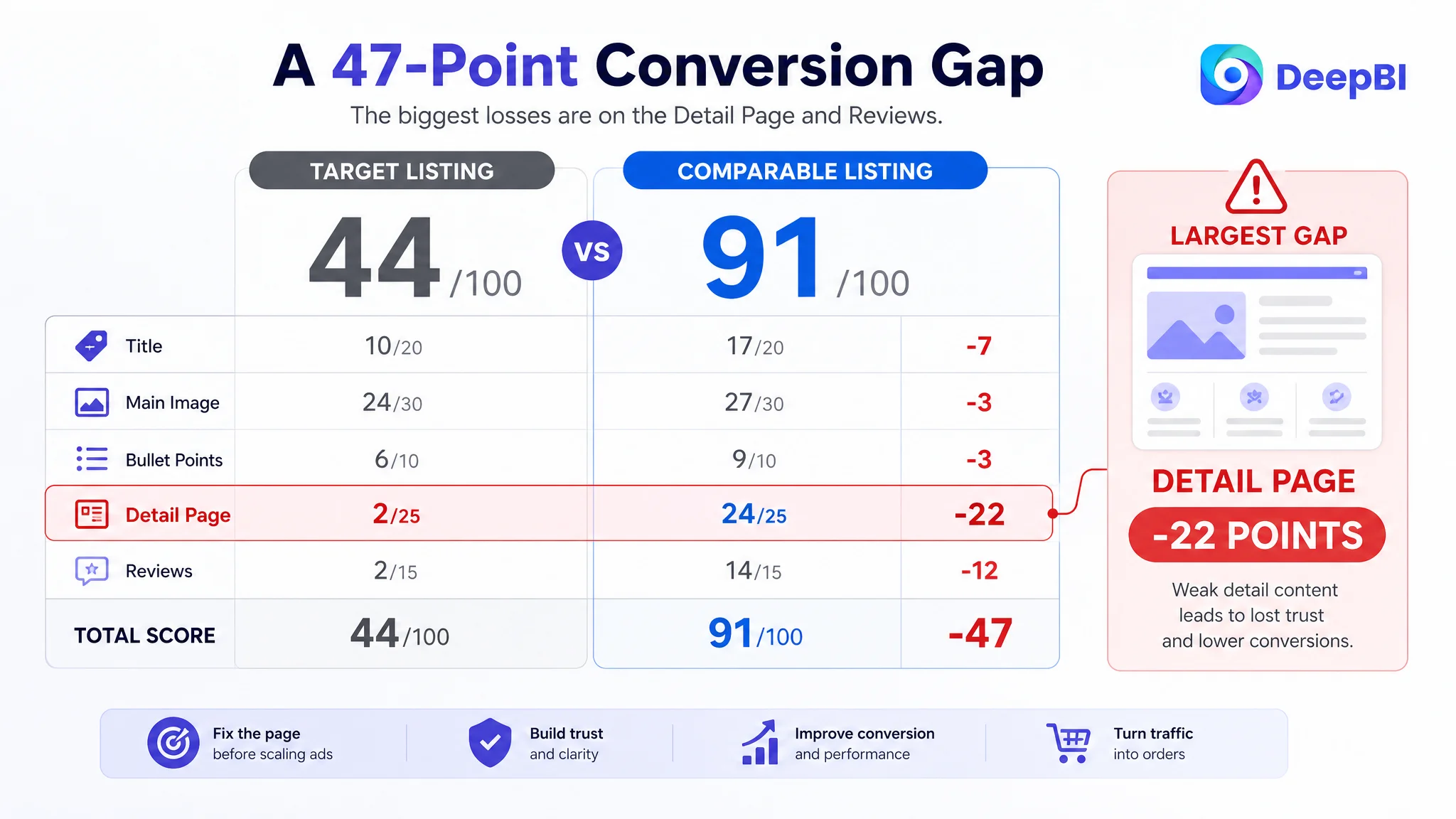
DeepBI’s Listing comparison placed the target page at 44/100 and the comparable high-performing Listing at 91/100.
- Title: Target Listing: 10/20, Comparable Listing: 17/20, Gap: -7
- Main image: Target Listing: 24/30, Comparable Listing: 27/30, Gap: -3
- Bullet points: Target Listing: 6/10, Comparable Listing: 9/10, Gap: -3
- Detail page: Target Listing: 2/25, Comparable Listing: 24/25, Gap: -22
- Reviews: Target Listing: 2/15, Comparable Listing: 14/15, Gap: -12
- Total: Target Listing: 44/100, Comparable Listing: 91/100, Gap: -47
The distribution of the scores was more important than the total.
The title, main image, and bullet points were behind, but not catastrophically so. The detail page accounted for the largest content gap by far. The review dimension added another serious trust deficit.
This prevented the team from making the common mistake of treating every weakness as equally urgent. A title rewrite could improve search clarity. A stronger first image could improve product understanding. More structured bullets could improve readability. But none of those changes alone could replace an absent A+ narrative.
The key question became:
What is the most important missing layer between receiving Amazon traffic and earning the order?
The answer was product-page trust and comprehension.
The Original Direction Was Too Close to Advertising Logic
When an Amazon Listing is not producing enough orders, teams often begin with the most measurable levers:
- Search-term refinement
- Keyword expansion
- Bid adjustments
- Campaign restructuring
- Placement control
- Budget allocation
These actions are important when the problem is traffic quality or traffic cost. But they are not a substitute for page-level persuasion.
For this Listing, the page-level signals suggested that the customer was not dealing with a simple traffic acquisition problem. The page had several weaknesses that could affect both paid and organic conversion:
- The core keywords appeared too late in the title.
- The title did not communicate a clear result or use case quickly.
- The primary visual presentation showed the product more than the complete system.
- Technical diagrams appeared before the shopper had formed a clear problem-solution connection.
- The bullets described functions and components more than customer concerns.
- The A+ area contained no meaningful visual structure.
- The page had almost no review-based reassurance.
That meant an ad-first approach carried a clear risk: the store could spend more to create visits without improving the page’s ability to convert those visits.
Advertising amplifies exposure. It does not automatically repair an unclear value proposition, a weak visual story, or a missing trust layer.
The Largest Leak Was Not the Main Image Alone
The main-image score was 24/30, only three points behind the comparison Listing. That did not mean the images were already doing enough commercially.
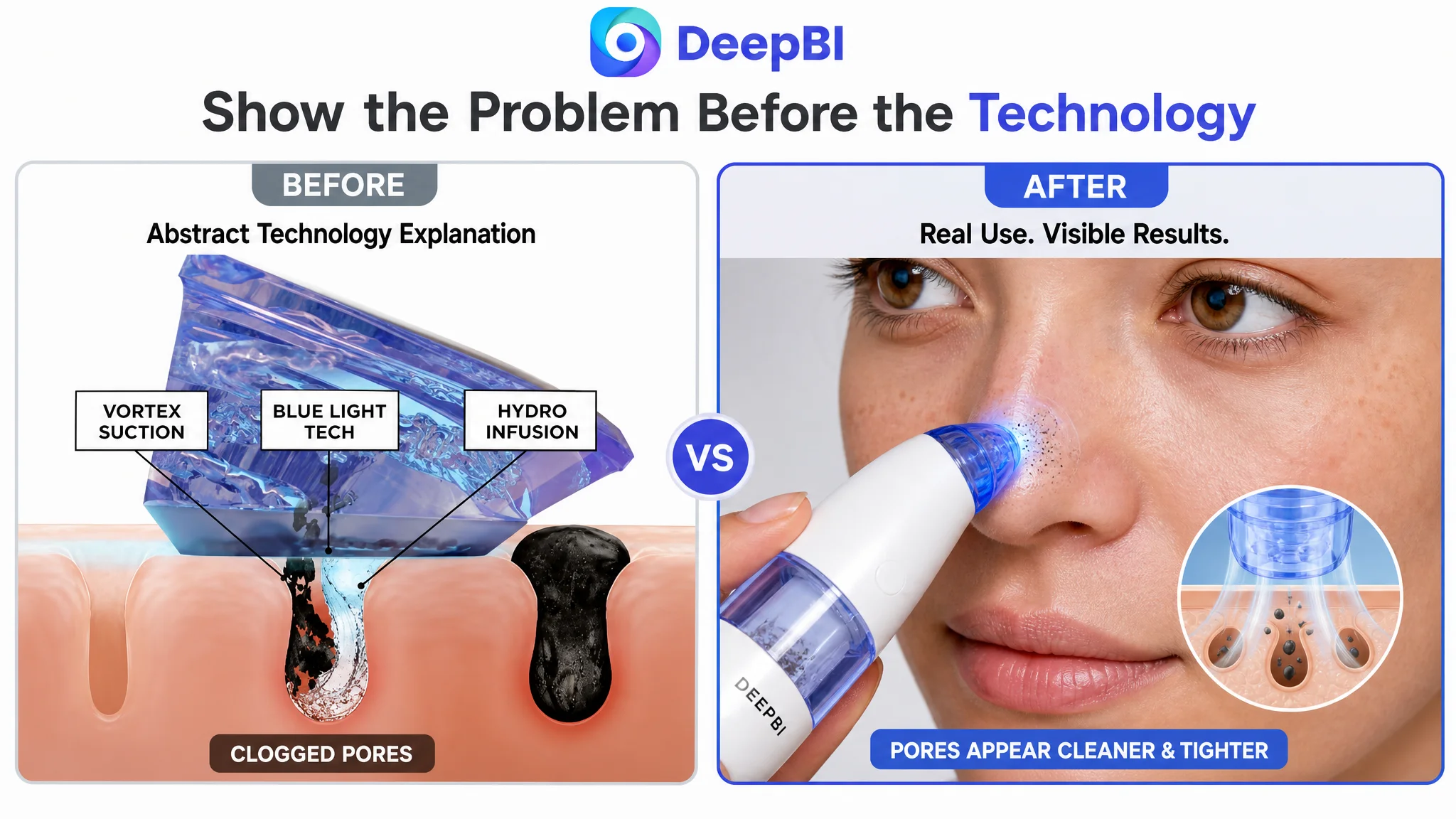
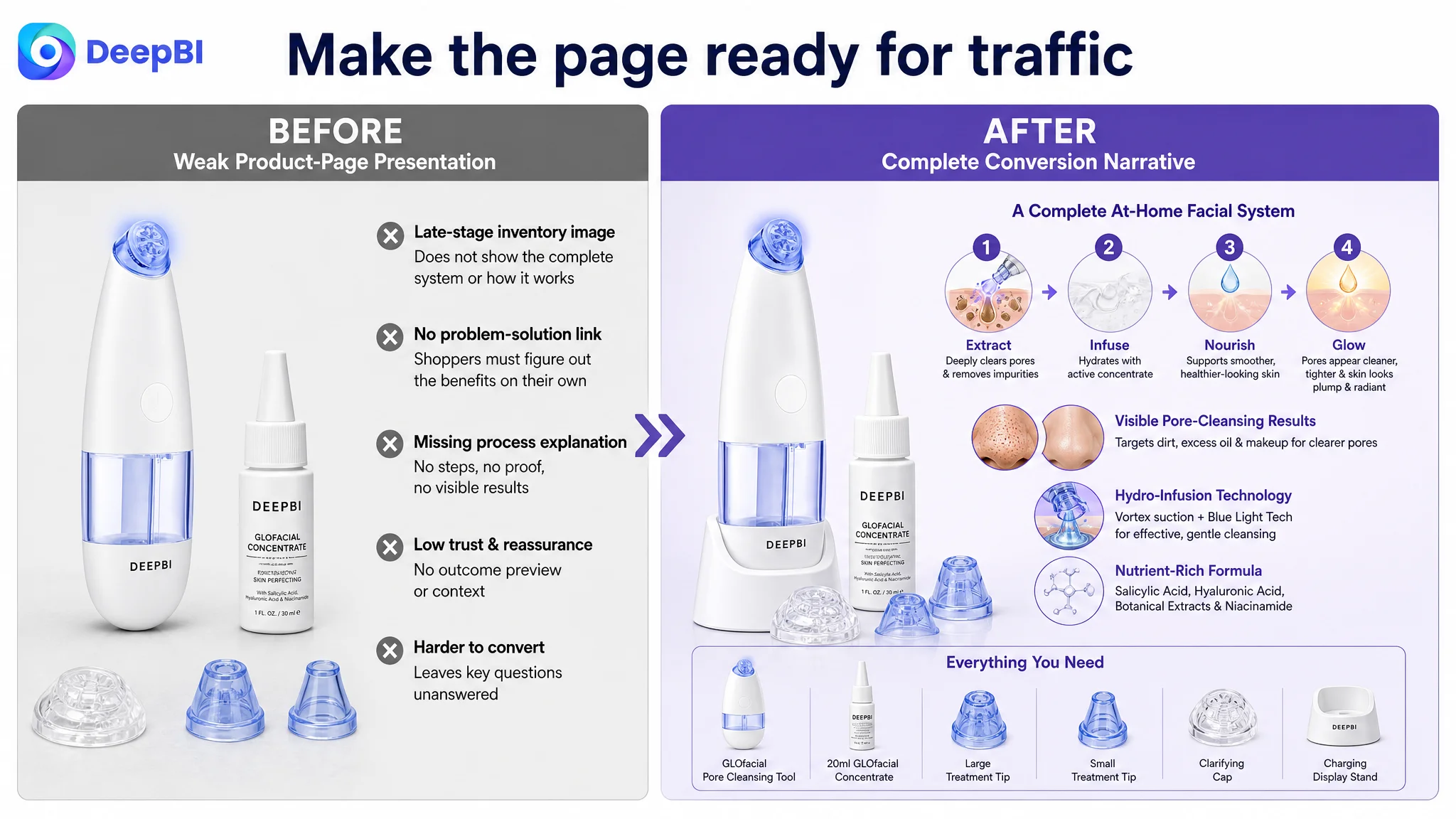
The current image sequence had a structural problem. It introduced the device in isolation, moved into abstract technology explanation, and placed kit information too late. The shopper had to understand the product before seeing why the complete system mattered.
DeepBI reframed the image sequence around three practical questions.
What does the buyer receive?
The first image needed to show the complete kit rather than only the device. The tool, concentrate, treatment tips, clarifying cap, and charging display stand should be presented as one organized system.
This was not merely a packaging adjustment. It changed the perceived effort and value of the product.
A device shown alone can appear complicated or incomplete. A complete kit can make the at-home routine feel more understandable and intentional.
What problem does the product address?
The abstract technology diagram was being asked to do too much too early. Vortex, blue light, and hydro-related explanations may help validate the product later, but they do not necessarily create an immediate reason to keep reading.
The earlier visual should instead connect the tool with a recognizable facial application area, such as the nose or cheek, while staying within the product’s confirmed claims. The shopper needs to recognize the use case before being asked to process the technology.
What makes the treatment believable?
The original sequence had visual material related to pore debris and cleansing, but the case material did not establish sufficient proof to support a stronger “visible waste removal” story. It also did not provide clinical study evidence.
That created an important boundary. The Listing should not imitate a competitor’s proof points simply because those proof points look persuasive.
The stronger direction was to use evidence the customer actually had:
- The complete set contents
- The two treatment-tip sizes
- The product’s cleansing and hydration functions
- The ingredient combination
- The step-by-step treatment process
- The intended visible appearance benefits, such as cleaner-looking pores and more radiant-looking skin
A stronger Amazon image sequence does not mean adding more claims. It means placing the available truth in the order shoppers need it.
The Title Needed Better Search and Decision Logic
The title scored 10/20. Its primary problem was not that it contained no relevant terms. It was that the important terms and product value were not organized effectively.
The core phrases related to pore cleansing and facial hydration appeared too late or remained too general. The title also lacked the stronger category positioning and outcome-oriented language used by leading Amazon Listings in the space.
The recommended direction was to bring forward:
- Hydro-infusion as the central product mechanism
- Pore cleansing as the primary use case
- At-home facial-system positioning
- A professional spa skincare context
- Results-oriented language such as deeper cleansing and a radiant-looking appearance
The purpose was not to copy another Listing’s title formula. It was to improve the connection between Amazon search intent and shopper interpretation.
A useful title should help the shopper answer three questions quickly:
1. What kind of product is this?
2. What does it help me do?
3. Why is it different from a basic cleansing tool?
The revised title direction was therefore less about adding adjectives and more about improving the order of meaning.
The Bullets Had Features, but Not a Buying Path
The bullet-point score was 6/10. The customer’s bullets mentioned functions, ingredients, effects, and kit contents, but the sequence did not consistently connect a customer concern with a solution.
The comparable Listing used a more complete persuasion structure:
- A recognizable skin concern
- A direct product response
- A reason to believe
- A description of the treatment experience
- Guidance on safe and practical use
- A reason to continue using the product
The customer’s bullets needed to move toward the same decision logic without making unsupported claims.
From cleansing function to visible experience
Instead of stopping at “helps cleanse pores,” the copy could explain the intended experience more clearly: exfoliation and cleansing followed by infusion, leaving skin appearing cleaner, smoother, plumper, or more radiant.
These should remain appearance-oriented descriptions rather than unsupported clinical promises.
From ingredient list to formula logic
Listing salicylic acid, hyaluronic acid, botanical extracts, and niacinamide as isolated ingredients creates limited persuasion. The stronger structure is to explain how the formula fits the treatment sequence:
- Salicylic acid supports the pore-cleansing story.
- Hyaluronic acid supports the hydration story.
- Botanical extracts and niacinamide contribute to the broader skincare positioning.
The page does not need to invent percentages or clinical outcomes to make this combination understandable.
From accessory list to practical fit
The large and small treatment tips should not be presented only as items in the box. They should help shoppers understand that the system is designed for different facial contours and treatment needs, while avoiding specific area-mapping claims that the source material does not confirm.
This turns an inventory detail into a usability signal.
The Missing A+ Content Was the Central Constraint
The detail-page score of 2/25 made the diagnosis decisive.
The target Listing had no meaningful image-based A+ structure and relied on repeated text. The comparison Listing used a sequence of visual modules that helped shoppers understand the product from several angles:
- A strong opening benefit
- A step-by-step routine
- Ingredient and technology explanation
- A visual interpretation of the expected result
- Kit contents
- Trust and suitability reassurance
The target page had no equivalent narrative.
The opening should sell the treatment experience
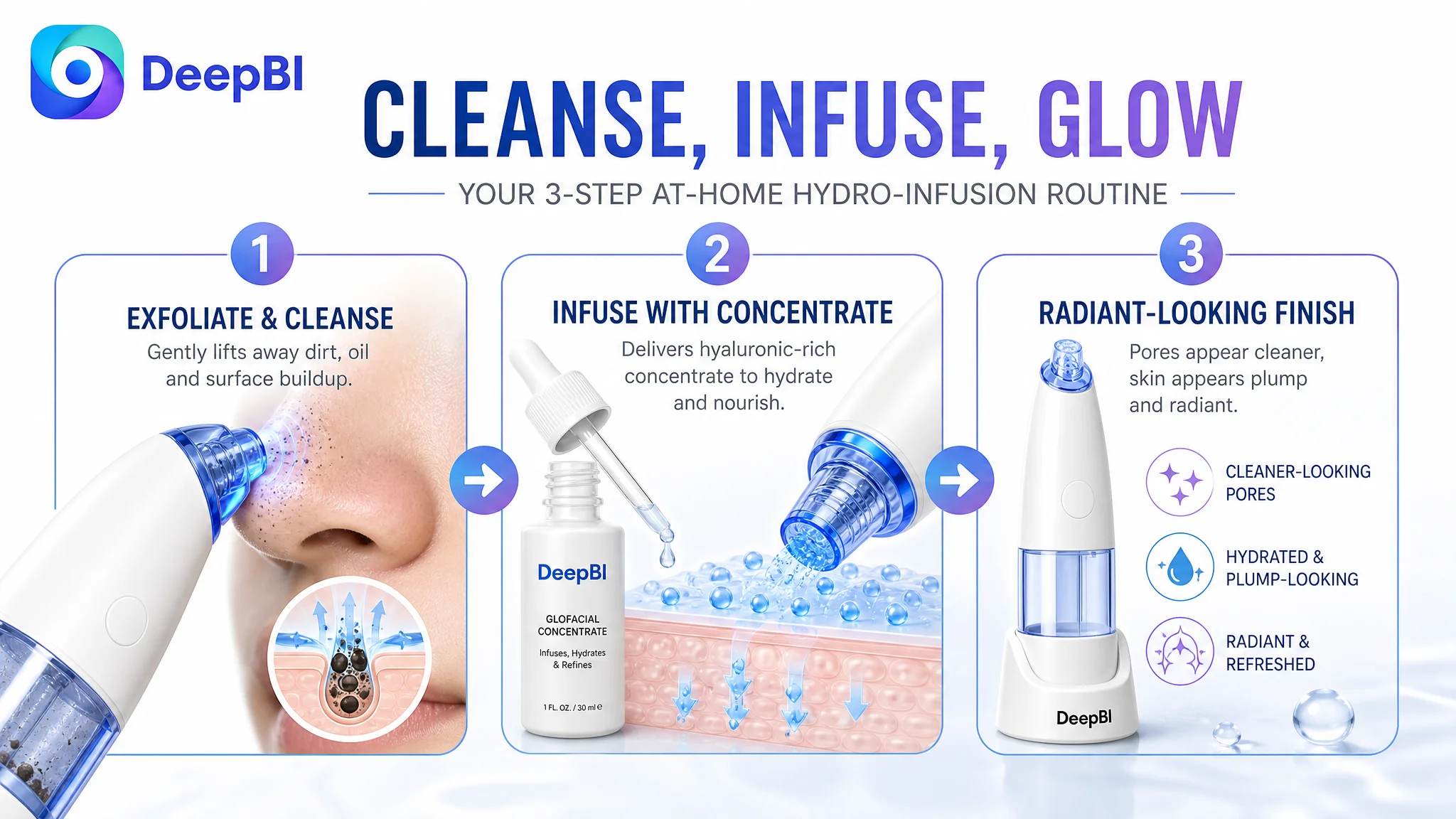
The first A+ module should establish the idea of an at-home hydration facial and focus on the intended visible outcome: cleaner-looking pores, a plumper appearance, tighter-looking skin, and a radiant-looking finish.
This is more appropriate for the available evidence than attempting to match a competitor’s quantified clinical claims.
The process should be visible
The product combines a device and a concentrate. If the page presents them as separate features, the shopper may not understand why both are necessary.
A clearer structure would show:
1. Exfoliate and cleanse.
2. Remove dirt, excess oil, and makeup from pores.
3. Infuse the skin with the concentrate.
4. Complete a hydration-focused facial routine at home.
The exact product experience should remain consistent with confirmed usage information, but the page should make the sequence easier to follow.
Ingredients should support rational trust
The A+ page can use ingredient names to establish a credible formula story without implying percentages, medical endorsement, or clinical validation that are not available.
This is where disciplined content judgment matters. The absence of clinical data is not a reason to leave the page empty. It is a reason to choose a different persuasion route.
Suitability should replace unsupported proof
The competitor’s visual proof around extracted debris and clinical results was powerful, but the customer did not have equivalent confirmed material.
DeepBI therefore did not recommend forcing an imitation of that proof. Instead, the page could reduce uncertainty through:
- Clear display of the included treatment tips
- Transparent presentation of the complete set
- A simple explanation of the treatment sequence
- Appearance-oriented benefits
- A clear account of how the tool and concentrate work together
This does not create evidence that the product does not have. It makes the available evidence easier to evaluate.
The final module should remove purchase uncertainty
The last A+ module should clearly list the full system:
- Hydro-infusion pore-cleansing tool
- 20 ml concentrate
- Large treatment tip
- Small treatment tip
- Clarifying cap
- Charging display stand
A final inventory check is commercially useful because it prevents shoppers from wondering whether a key component must be purchased separately.
Reviews Created a Separate Trust Risk
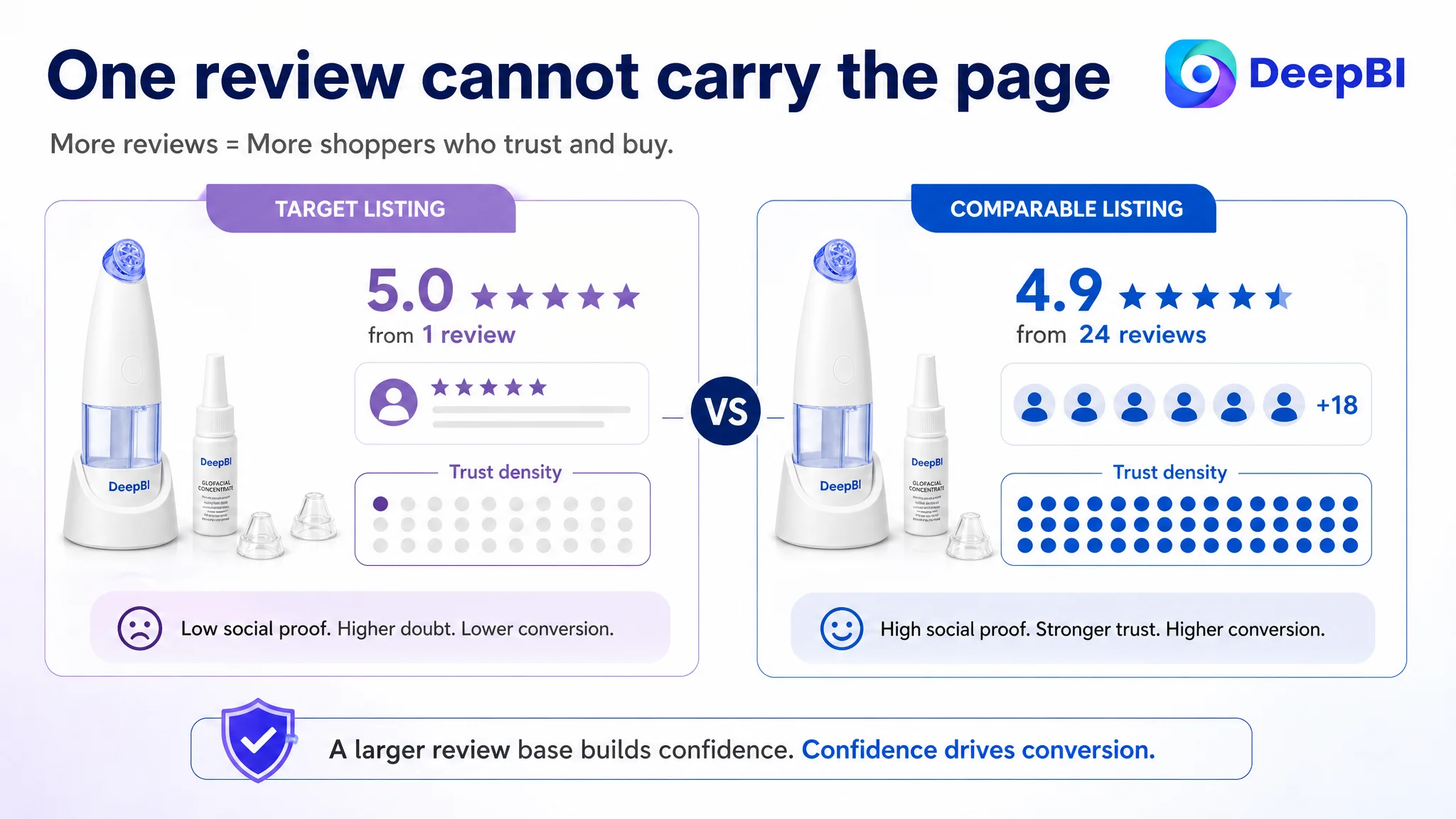
The customer’s Listing had a 5.0-star rating from one review, with no effective review content visible on the first page. The comparable Listing had 24 reviews, a 4.9-star average, and multiple visible reviews with richer usage detail and visual content.
The difference was not simply a matter of star rating. It was a difference in social proof density.
A single positive review does not provide the same reassurance as a larger collection of detailed customer experiences. This is especially important for a skincare device, where shoppers may have concerns about:
- Whether the device is easy to use
- Whether the treatment feels comfortable
- Whether the result matches the product description
- Whether the concentrate is necessary
- Whether the product fits into a weekly routine
The Listing content cannot manufacture review history. But it can avoid making the review gap worse.
A page with weak A+ content and almost no review support asks the shopper to create trust from scratch. A page with clear process visuals, transparent kit contents, and careful benefit language gives the limited review base more support.
This was another reason not to treat Amazon ads as the first repair point. More traffic would not remove the social-proof gap.
Why DeepBI Did Not Recommend Copying the Competitor’s Data Claims
The comparable Listing used quantified claims such as clinical study results and hydration improvements. Those statements created a high level of authority, but the customer did not have the supporting clinical evidence required to use equivalent claims responsibly.
That limitation shaped the optimization strategy.
DeepBI’s judgment was not “make the page sound more scientific at any cost.” It was:
Use the strongest available persuasion mechanism that remains true to the product and evidence.
For this Listing, that meant emphasizing:
- The complete at-home routine
- The visible skincare experience
- The relationship between cleansing and hydration
- The ingredient combination
- The physical treatment tips
- The transparent kit structure
- The expected appearance benefits
This approach is commercially more durable than adding unsupported percentages or professional endorsements. It also reduces the risk that the product page promises a level of proof the customer cannot substantiate.
The Decision Order Was the Real Optimization
The case did not call for abandoning Amazon ads. It called for putting the decisions in the right order.
First, repair the page’s conversion capacity
The immediate priority was to rebuild the title, main-image sequence, bullets, and A+ content around one coherent skincare routine.
The purpose was to make the Listing easier to understand and more credible before increasing the amount of traffic sent to it.
Then, test the revised message against traffic behavior
Once the page structure is improved, Amazon advertising data becomes more useful for interpretation.
- If CTR remains weak, the main image and title may still lack a strong search-page hook.
- If CTR improves but CVR remains weak, the page may still have a trust or offer problem.
- If CVR begins to recover, ad traffic is more likely to produce useful signals about keywords, audiences, and placements.
- If organic conversion improves, the Listing may be becoming less dependent on paid traffic alone.
The available case material does not include post-optimization performance data, so no numerical improvement should be claimed. The important change documented here is the operating logic: the team stopped treating advertising as the only place where the problem could be solved.
Finally, use ads to scale a page that can carry the traffic
Ads work best when the product page has already answered the shopper’s central questions. At that point, campaign optimization can focus on traffic quality and efficiency rather than compensating for basic Listing weaknesses.
Before scaling Amazon ads, the team had to decide whether the product page deserved more traffic.
What Changed in the Business Diagnosis
The original problem could have been described as a visibility or advertising challenge. DeepBI’s analysis reframed it as a conversion-capacity problem inside the Amazon Listing.
That changed several business judgments:
- A weak ACOS position should not automatically be treated as a bid problem.
- A low order volume should not automatically lead to more keyword expansion.
- A technically accurate image can still fail if it does not create immediate product understanding.
- A list of ingredients is not the same as a persuasive formula story.
- A complete product kit has more value when shown as a usable routine.
- A+ content is not decorative brand material; it can carry the page’s trust and explanation burden.
- A small review base makes the quality of every other trust signal more important.
- Competitor claims should be analyzed for logic, not copied without evidence.
The central lesson is straightforward:
Amazon ads can bring shoppers to the Listing, but the product page determines whether those visits become useful traffic.
For this skincare device seller, the next optimization direction was therefore not “keep adjusting ads until the numbers improve.” It was to rebuild the page’s sales logic first, using truthful product information, clearer visuals, more structured content, and a stronger connection between cleansing, hydration, and the at-home facial experience.
That is the point at which Amazon traffic can begin working for the Listing rather than exposing its weaknesses.