


TL;DR: The shortest path to more organic traffic
Amazon organic growth is a compounding loop: match shopper intent, earn qualified sessions, convert those sessions, and use seller-side data to improve the next iteration.
- Treat relevance and conversion as connected drivers. A listing can attract impressions through relevant search signals but still lose organic momentum if shoppers do not click or buy. Track both CTR and CVR rather than optimizing keywords in isolation.
- Do not build the strategy around a supposed ranking formula. Amazon does not publish exact ranking weights, so avoid fixed percentage claims or attempts to reverse-engineer a precise formula. Use observable performance signals instead.
- Control keyword intent first. Separate broad traffic terms from high-intent search terms that better match the product and shopper need. Use those signals to guide the title, bullets, and supporting listing content.
- Strengthen the listing’s conversion path. Improve title structure, keyword placement, bullet logic, A+ content, reviews, and trust-building information so qualified traffic has a clearer route to purchase.
- Treat visual assets as performance levers. The main image and supporting images influence both clicks and purchase decisions. Evaluate their effect through CTR and CVR, not subjective design preference alone.
- Maintain backend indexing as an implementation check. Confirm that relevant terms are represented in the areas Amazon can index, while avoiding unsupported assumptions about exact indexing rules.
- Measure the loop with seller-side reports. Compare impressions, clicks, orders, CTR, CVR, advertising performance, ACoS, and BSR after each meaningful listing change. Feed those observations into the next optimization cycle and track listing cycle time from diagnosis to deployment.
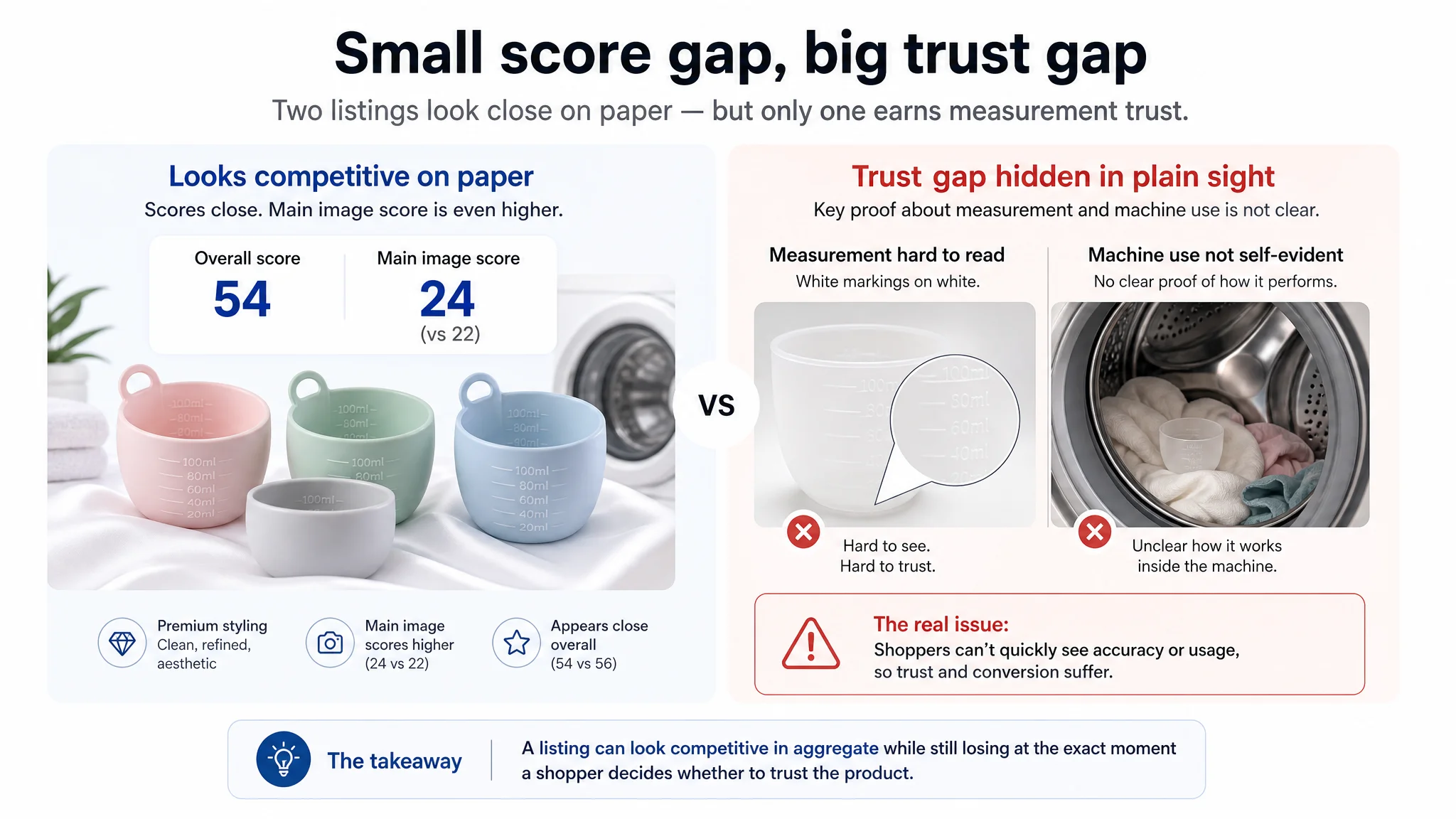
A practical warning sits underneath all seven points: a listing can look competitive in aggregate while still losing at the exact moment a shopper decides whether to trust the product. One UK seller of silicone laundry dosing cups initially believed that its listing was broadly equal to a close competitor, partly because its main-image score was actually higher. A deeper comparison showed that the page was not losing because it lacked polish or traffic. It was failing to make measurement accuracy and washing-machine usage sufficiently clear.
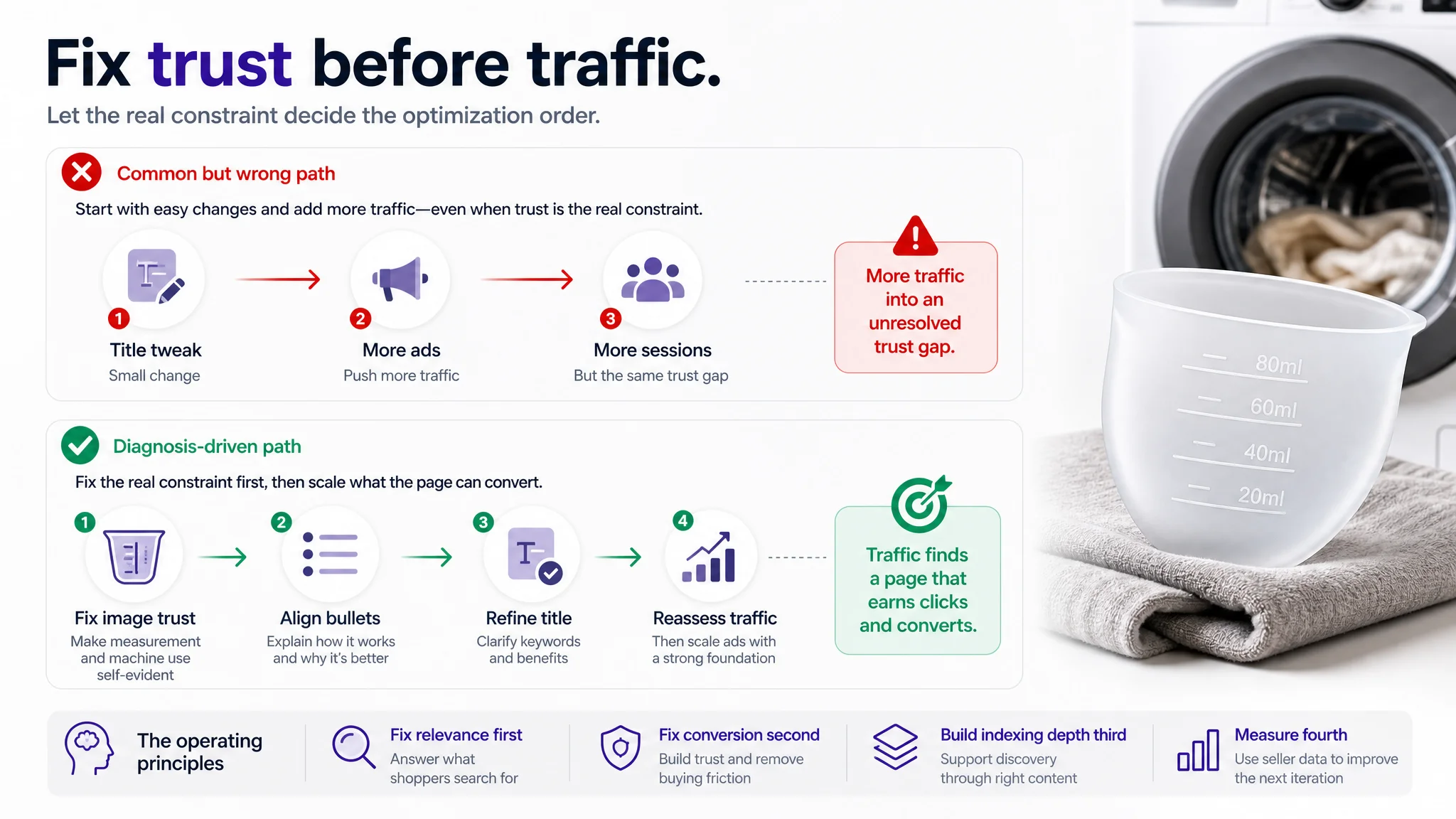
The team had first considered a title adjustment and additional advertising the most sensible next steps. The diagnosis pointed in the opposite direction: if shoppers could not clearly see the scale, understand how the cup behaved inside the machine, or connect the product features to their own concerns, more traffic would simply bring more visitors to an unresolved trust gap. Organic growth depends not only on being found, but on giving qualified shoppers enough evidence to click and buy.
Latest updates that changed organic visibility
Amazon organic visibility is becoming more contextual. Search evaluation increasingly reflects how well a listing matches shopper intent, product attributes, and surrounding content—not only whether a keyword appears on the page. Personalization and review-integrity signals also matter to the broader shopping experience, making relevance and accurate product representation more important than aggressive keyword stuffing.
Conversational shopping surfaces, including Rufus-style assistants and Alexa shopping experiences, further reinforce the value of natural-language, answer-led phrasing. Titles, bullet points, and A+ content should explain what the product is, who it is for, and which buying questions it answers. This approach supports both shopper comprehension and measurable listing outcomes, including CTR and CVR.
Amazon has also published research on context-aware systems such as COSMO. However, Amazon has not confirmed COSMO as a production ranking factor. Sellers should therefore treat named systems and unofficial algorithm labels as directional signals, not as instructions to reverse-engineer a hidden formula.
The practical response is to monitor evidence at the ASIN level. Track changes in impressions, CTR, CVR, ACoS, and BSR after meaningful listing or content updates. Review customer feedback for product-expectation gaps and protect product-entity consistency: visual or written claims that do not match the delivered item can create negative reviews and refunds, undermining organic growth.
A listing audit should also ask whether its content answers the questions that matter most in the category. In the laundry dosing-cup example, the seller’s images and bullets mentioned machine washability, soft silicone, reduced noise, durability, and measurement. Yet the most important proof was difficult to read: white measurement markings appeared against white silicone, reinforced by a white magnifier graphic. The page discussed precision without making precision visually self-evident.
The competitor’s visuals were less aesthetic but more direct. High-contrast measurement markings, liquid shown inside the cup, and an image of the product being used with laundry made the operating principle easier to understand at thumbnail size. This is a useful reminder that contextual relevance is not limited to keywords. A product page must also be relevant to the shopper’s decision problem. If the buyer is asking, “Can I really measure accurately with this?” a polished image that does not answer that question is not necessarily a strong conversion asset.
Ranking changes continuously, while major changes are announced irregularly. Check Seller Central announcements and validate any suspected shift against your own search visibility and conversion data before changing the entire catalog. Optimize for observable performance signals, not speculation about unofficial update names.
How Amazon organic search actually works
Amazon organic search is best understood as a performance system, not a fixed formula that sellers can calculate from a public scoring table. Visibility depends on two connected questions: does the listing match the shopper’s query, and do shoppers respond by clicking and buying? When either answer is weak, organic impressions, orders, and BSR momentum can suffer.
Relevance signals
Relevance signals indicate whether Amazon can reasonably match a listing to a search query. They may come from the product title, bullet points, backend search terms, category placement, attributes, and the broader meaning of the detail page. A keyword included in a listing is not automatically a strong ranking signal; the product must also fit the shopper’s intent.
Sellers can investigate this layer through Search Term Reports, Brand Analytics, and listing diagnostics. Search-term data helps reveal which queries generate meaningful shopper activity, while listing analysis shows whether the product’s language and attributes clearly communicate its relevance.
Relevance also has a customer-facing side. A listing may contain the right words and still leave the shopper uncertain about what the product does or why it fits the intended use case. The laundry accessory listing illustrates this distinction. Its overall score was close to the benchmark, at 54 versus 56, and its main-image score was ahead at 24 versus 22. On a simple scorecard, that could suggest that relevance and presentation were largely under control.
However, once each content element was mapped to a buy-side question, the gap became more meaningful. The competitor communicated scale readability, foldable or space-saving structure, and how the cup would be used inside the washing machine. The seller’s page devoted more attention to attractive styling and repeated product views. The product was visible, but the functional context was less clear. Relevance is therefore not just about appearing for a query; it is also about making the product’s relationship to that query immediately understandable.
Performance signals
Performance signals describe what happens after the listing is shown. CTR indicates whether the result earns the click. CVR indicates whether the detail page converts the resulting session. The unit session percentage is calculated as units ordered divided by sessions:
Unit Session Percentage = Units Ordered ÷ Sessions
Sales velocity is different. It is the number of units sold per day, not the percentage of sessions that convert. A listing can have a high conversion rate at low volume, or substantial sales velocity with a lower conversion rate. Both conversion rate and sales velocity can influence organic rank, so sellers should not optimize one while ignoring the other.
A commonly discussed four-signal model includes relevance, shopper performance, external traffic, and seller authority. It is a useful operating framework, but it is not Amazon’s official scoring formula or a complete description of the algorithm. External traffic and seller authority are better treated as secondary modifiers rather than core inputs.
A high visual score does not guarantee strong performance signals. In the dosing-cup example, the seller’s main-image score exceeded the competitor’s, but the images did not clearly prove the product’s central functional promise. The page showed silicone texture, machine-related scenes, and a family-oriented image, yet it did not make the measurement markings easy to read or create a progressive explanation of how the cup moved from measuring detergent to operating inside the drum.
That distinction matters when interpreting CTR and CVR. A design can be aesthetically refined but fail to earn the click if the product is difficult to identify in the thumbnail. It can also earn the click while failing to convert if the page does not resolve concerns about accuracy, durability, noise, or practical use. Performance diagnosis should therefore examine what each asset does in the decision path rather than treating an overall creative score as proof that the visual layer is working.
The practical approach is to infer patterns from Business Reports, Brand Analytics, and Search Term Reports. Track how changes affect CTR, CVR, sales velocity, ACoS, and BSR, then improve the listing based on observed evidence rather than assumed ranking weights.
The "A10" playbook: what sellers should really optimize
“A10” is useful industry shorthand, but it is not an officially documented Amazon algorithm name. Amazon has not publicly released a search system by that name, and sellers should not treat A9 versus A10 as a confirmed product-history comparison. The safer reference is Amazon Search and the observable performance signals around it.
The practical shift is from chasing version narratives to improving the conditions that support organic discovery and sales:
- Relevance: Build titles and bullet points around the product’s core search terms, functions, and use cases. Keyword placement matters, but keyword density alone does not establish relevance.
- Conversion readiness: Use the main image, product detail page, pricing, and offer structure to turn impressions into clicks and orders. A weak visual hook can suppress CTR; weak detail-page communication can reduce CVR even when traffic is relevant.
- Context: Connect the product to the right shopper, use case, price band, and competitive set. A product should be compared with genuinely similar alternatives, not simply with products sharing a few keywords.
- Shopper trust: Reviews, rating distribution, useful customer images, accurate claims, and consistent product information help shoppers evaluate risk. Trust cannot be manufactured through invented features, materials, or specifications.
The laundry dosing-cup listing demonstrates why these four areas need to be read together. The seller’s team initially interpreted a small total score gap—54 versus 56—as evidence that the listing was essentially competitive. They also believed the higher main-image score meant the visual layer was a strength, while the slightly weaker title was the main problem. The diagnosis revealed that the decisive weakness was not a missing keyword or an unattractive image. It was the lack of visible proof around accurate measurement and machine use.
The competitor did not outperform on every dimension. Its advantage was narrower: it made the most important category questions easier to answer. The shopper could see the measurement markings, understand the space-saving structure, and observe the cup being used with laundry. The seller’s page had many of the right ingredients, but repeated some concepts without creating a clear sequence from measuring to placing the cup in the machine to supporting the wash. This is why score composition and decision flow matter more than a single aggregate score.
Execution should run as a measurement loop. Audit the title, bullet points, main image, A+ content, and Voice of the Customer together. Then use advertising reports to identify high-conversion search terms and attribute signals for the next content or visual revision. After publishing, tag the change and monitor CTR, CVR, ACoS, and organic movement rather than assigning every result to an alleged algorithm update.
What remains uncertain is the precise weighting of Amazon Search signals, the extent of personalization, and how those signals interact across categories. Sellers can control the quality and consistency of their inputs; they cannot verify an unofficial version number or guarantee a ranking outcome.
What this guide covers
Organic search growth is not a single keyword or ranking task. It is an operating sequence: diagnose the current listing, make targeted changes, measure market response, and feed the findings into the next cycle.
1. Understand Amazon search mechanics. Establish how discoverability, relevance, click behavior, conversion, and sales velocity interact before changing the listing.
2. Fix relevance. Identify the search terms and customer intents the product should serve, then improve title, bullet-point, and backend keyword alignment without forcing unrelated terms into the copy.
3. Fix conversion. Address the reasons qualified shoppers do not click or buy. Main-image clarity can influence CTR, while feature communication, A+ content, reviews, and trust signals can affect CVR.
4. Deepen indexing. Expand and organize relevant search coverage across the listing so the product can be discovered for more qualified queries, while preserving clear customer-facing language.
5. Connect paid and organic. Use advertising reports to identify high-converting search terms and visual attributes, then apply those signals to listing decisions. The objective is to make paid traffic produce learning that supports organic growth and can reduce dependence on inefficient spend over time.
6. Measure the change. Track exposure, clicks, orders, CTR, CVR, ACoS, TACoS, and BSR against the timing of each content update. Separating listing impact from assumption requires a clear before-and-after measurement window.
7. Repeat the cycle. Diagnosis, planning, production, delivery, and feedback should function as one system. Each iteration should narrow the next priority, shorten listing cycle time, and turn observed performance into the next optimization action.
Step 1: Target purchase intent, not raw keyword volume
High search volume can attract attention, but it does not prove that a keyword will attract qualified buyers. A broad term may bring shoppers whose expectations, budget, or use case do not match the product. That mismatch can produce clicks without purchases, weakening CVR and making the traffic less useful for organic growth.
Start with the product’s confirmed attributes, functions, price position, and target audience. Extract keyword candidates from the title and bullet points, then test whether each term accurately describes the item a shopper will find on the listing. Do not select a keyword simply because it is popular or used by a leading competitor. A top-ranked competitor may differ substantially in features, audience, or price, creating an inaccurate benchmark.
The dosing-cup team initially focused on the title because the competitor led with “4 Pcs” and “Foldable,” while the seller’s title began with the brand name and repeated “Laundry Dosing Ball” and “Dosing Ball.” Those were legitimate clarity issues, but they were not the only or most urgent constraint. The deeper question was whether the product’s core use case—accurate, reusable dosing inside a washing machine—was being communicated consistently across the title, images, and bullets.
This distinction prevents a common optimization error: treating the competitor’s most visible keyword difference as the whole explanation for lost ground. Keyword structure should make the product easier to find and understand, but it cannot compensate for a page that does not prove the product will work as promised.
For example, “power bank” is a broad head term. A more specific phrase such as “fast-charging USB-C power bank for travel” signals stronger purchase intent, but only if the product genuinely supports fast charging, USB-C connectivity, and that use case. The phrase narrows the audience to shoppers seeking a defined solution rather than general information.
The operating logic is straightforward: better product-keyword fit creates more relevant impressions, which can support stronger CTR and CVR. When the listing consistently converts intent-matched traffic, its organic performance can strengthen, supporting BSR improvement and reducing dependence on paid traffic. Keyword selection should therefore optimize for qualified conversion signals, not raw reach.
Step 2: Listing content that converts the sessions you already have
Ranking creates an opportunity, not a sale. Organic sessions only compound when the listing turns visibility into clicks, orders, and positive sales velocity. If the title is difficult to scan or the bullets fail to explain the product’s value, CTR and CVR suffer. Lower click and order momentum can then weaken BSR and organic rank indirectly.
A title must serve two audiences: Amazon’s ranking system and the shopper reading on a search results page. Front-load the primary keyword, then make the product form, differentiating attributes, and shopper outcome easy to understand. Avoid repeating the same keyword with vague modifiers.
- Bad: Portable Charger, Portable Power Bank, Portable Battery Charger, Premium Fast Portable Charger
- Better: Portable Charger 10000mAh, Slim Power Bank with Fast Charging and Travel-Friendly Design
The second version still places the core search term early, but uses descriptive attributes that help shoppers decide whether the product fits their needs. Title limits are category- and marketplace-specific, often landing around 150–200 characters rather than following one universal cap. A 75–80-character target can support mobile readability, but it is not a universal indexing limit.
Bullets should translate features into benefits instead of presenting isolated specifications. A useful structure is:
- Shopper concern or need
- Product feature or proof
- Problem that feature solves
For example, “10000mAh” is only a specification. “High-Capacity Power: 10000mAh battery helps reduce concern about running out of power while traveling” connects the feature to a practical benefit. Clear benefit communication supports both CTR and CVR.
The laundry dosing-cup listing shows what happens when the ingredients are present but the choreography is weak. The bullets mentioned machine washability, soft silicone, reduced noise, non-fading scales, cleaning assistance, and wider household uses. Yet these points moved between features, benefits, and use cases without following the order in which a cautious shopper would evaluate the product.
A stronger sequence would address the major behavioural concern first: whether the cup can safely go into the washing machine. It could then explain quiet and durable silicone, clear measurement markings, the measure-to-machine-use process, and only afterward broader household applications. The point is not to add more claims. It is to organize existing information around the buyer’s decision path.
Keyword stuffing does not need to trigger an explicit penalty to damage performance. Repeated or irrelevant wording can make the listing harder to read, weaken click appeal, reduce effective sessions, and slow the velocity that supports organic growth.
DeepBI’s Listing diagnosis can benchmark a listing against closely matched competitor ASINs, score CTR and CVR drivers, identify gaps across the title and bullets, and generate executable copy and visual direction. The action is to optimize for search relevance and shopper comprehension together. Organic ranking compounds only when the listing converts the traffic it earns.
The visual layer: image slots that earn clicks and reduce doubt
Images are a major conversion factor, but their impact varies by category, product type, and shopper decision process. A strong image stack can raise CTR by making the search result easier to understand, then support CVR by answering questions before the shopper leaves the detail page. It should not be treated as a guaranteed ranking lever: image changes alone do not prove organic-rank gains. Their value comes from improving the customer signals that feed the broader organic growth system.
Use a deliberate sequence rather than filling slots with disconnected creative:
- Main-image clarity: Make the product immediately identifiable, prominent, and visually clean. The primary image must create a clear reason to click without relying on unexplained decoration.
- Scale and context: Show size, proportions, and relevant surroundings so shoppers can judge fit and intended placement.
- Lifestyle: Demonstrate the product in a credible use environment and resolve the gap between abstract features and real-world use.
- Infographic: Visualize verified specifications, parameters, or differentiating features that are difficult to understand from text alone.
- Use-case detail: Show operation, feature details, and practical application where shoppers are likely to hesitate.
This sequence reduces uncertainty in stages: what the product is, how large it is, where it belongs, what matters technically, and how it is used. Clearer information can support both CTR and CVR, while stronger downstream engagement may contribute to BSR performance over time.
A visual audit should distinguish aesthetic quality from functional clarity. In the dosing-cup listing, the seller’s main-image score was 24 compared with the competitor’s 22, and the team therefore believed the images were a relative strength. But several images used white measurement scales on white silicone, along with a white magnifier graphic. The visual language suggested precision without allowing a shopper to verify that precision quickly.
The competitor’s images were less refined stylistically but more useful at the point of decision. High-contrast markings, liquid shown inside the cup, and a clear use scene made the scale and operating context legible even in small thumbnails. The seller’s hero image also placed the cup too small within a washing-machine scene, making the use environment visible while making the product itself less immediately identifiable.
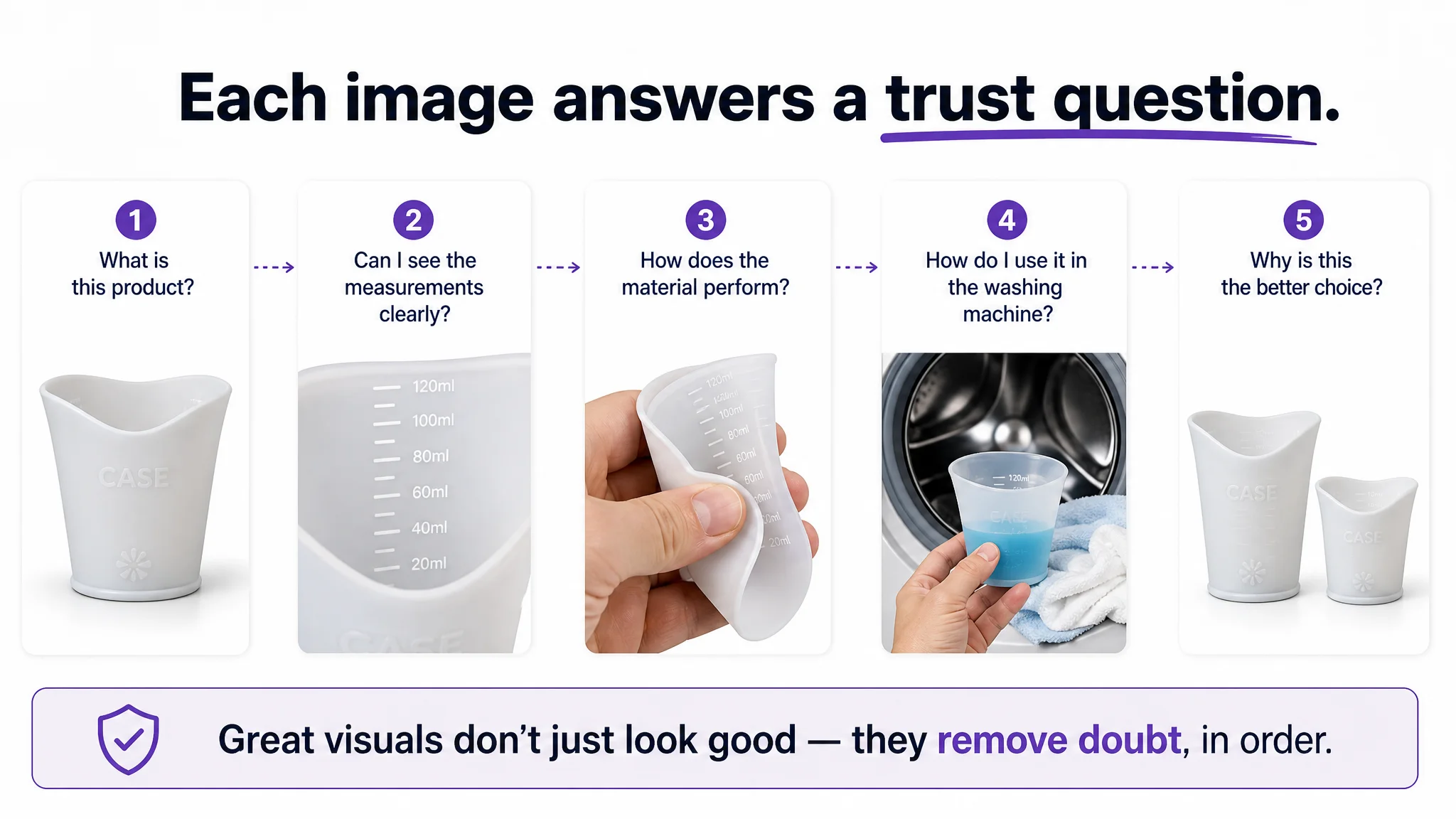
This is why image analysis should ask what doubt each asset removes. Does the main image show what the product is? Does the next image prove the measurement? Does another explain how the material behaves? Does the use-case image show what happens inside the machine? If several images repeat the same general idea without progressing the story, the gallery may look full while still leaving the core decision unresolved.
Competitor analysis should examine the entire image stack, not only the hero image. Compare image quantity, type diversity, information density, scene context, sizing communication, technical visuals, and comparison frames. A missing context shot, unclear sizing, absent parameter visualization, weak use-case explanation, or no comparison frame is a qualified click-through opportunity. Improve the missing information while preserving the product’s actual structure, proportions, materials, colors, logo placement, and functions. Competitor assets can guide presentation, but not product claims or design copying.
For a functional product, a useful image sequence might be:
1. A clear product hero showing the available sizes or set composition.
2. A high-contrast close-up of the measurement scale.
3. A material or handling image that demonstrates flexibility and durability.
4. A usage image showing the product in the machine.
5. A value or storage image that explains the set and prevents confusion about space or capacity.
Each image should answer a different question. No image should exist only because the gallery has an available slot.
After publishing a visual change, mark the iteration in advertising data and compare subsequent CTR and CVR behavior. In DeepBI, a published image can be linked to a visual iteration event, allowing sellers to observe CTR changes during the following 7–14 days rather than judging the redesign by opinion alone.
Step 3: Backend search terms and indexing depth
Backend search terms provide an additional indexing layer for relevant queries that do not fit naturally into the title, bullets, or other visible copy. Their role is not to replace front-end optimization. They help Amazon interpret additional long-tail query variants, attributes, use cases, and phrasing patterns that qualified shoppers may search.
The first rule is to avoid duplication. Repeating a title keyword or bullet-point phrase consumes limited backend capacity without expanding query coverage. Instead, compare the visible listing against search-term research and identify relevant gaps. A product may already target a core term in the title while missing adjacent wording related to a specific use case, audience, compatibility detail, or attribute. Those uncovered variants are stronger candidates for the backend field than another repetition of the primary keyword.
A practical workflow is to reverse-engineer the title and bullets, extract the core search terms, and then use advertising data to identify high-converting query patterns. Remove terms already represented in the visible copy, discard irrelevant traffic, and prioritize uncovered variants with commercial relevance. This approach supports broader indexing without weakening the listing’s readability or keyword focus. Better query coverage can contribute to more qualified impressions and support CTR, CVR, and BSR over time, but backend terms alone do not guarantee ranking or indexation.
The laundry dosing-cup diagnosis reinforces the proper role of backend terms. The seller did have a title issue: the brand appeared first, and the core product phrase was repeated rather than structured around the main generic search need. A clearer title could improve search understanding by bringing the product type, liquid and powder compatibility, reusability, and washing-machine use closer to the front.
But that adjustment was not a substitute for visual proof. If a shopper discovers the listing through a relevant term and still cannot read the scale or understand the usage sequence, broader indexing may increase exposure without resolving CVR. Backend coverage should extend discovery after the customer-facing listing has established a credible conversion path.
Treat the backend field as a byte budget, not a character budget. The limit is generally described as up to 250 bytes, but sellers should confirm the current specification directly in Seller Central before publishing. Bytes and characters are not equivalent across languages or encoding systems, so a string that appears short on screen may consume more capacity than expected. Validate the final field against Amazon’s live limit, remove spaces and redundant variants where appropriate, and use the remaining capacity for relevant terms that the visible listing does not already cover.
Step 4: Turning paid sessions into organic momentum
Paid advertising does not directly buy Amazon organic rank. Ad spend can create impressions and orders, but Amazon does not treat budget alone as a ranking input. The useful connection is indirect: when advertising brings qualified shoppers to a listing, the resulting clicks, conversions, and sales may provide signals that the ranking system reads positively. That possibility should guide testing, not justify assuming that every ad order will produce an organic lift.
The practical objective is to turn paid traffic into better search decisions. Review advertising data for keywords that combine:
- High click-through rate (CTR)
- High conversion rate (CVR)
- Meaningful order value
- Sufficient order volume to support a reliable decision
These terms can reveal where shopper intent and listing relevance are already aligned. They also show where listing improvements may have the strongest commercial effect. If a keyword attracts clicks but produces weak CVR, the problem may be the main image, offer presentation, or page content. If it converts efficiently, it may deserve stronger indexing and more deliberate organic placement.
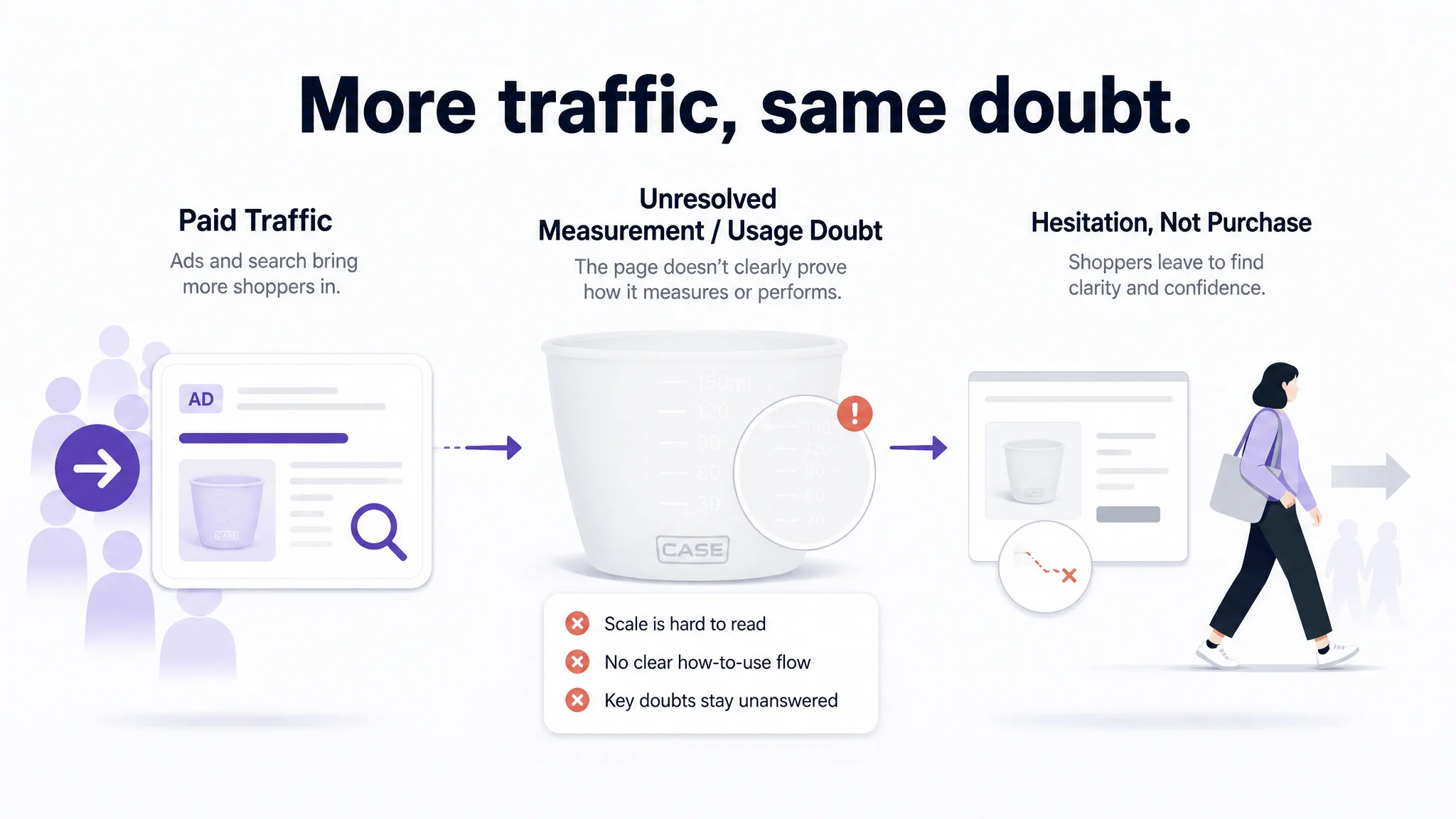
One seller’s initial response to worsening advertising costs was to consider spending more to compensate for lost ground. That approach was understandable because the listing appeared nearly equal to its competitor and the title looked slightly weaker. Yet the diagnostic showed that the page had not answered the high-intent questions behind the traffic. A shopper could enter from a relevant search or advertisement and still hesitate over whether the cup measured accurately, whether it would deform or make noise in the drum, and how exactly it was meant to be used.
In that situation, additional traffic does not solve the main problem. It multiplies the number of sessions exposed to the same uncertainty. The better sequence is to rebuild measurement and usage trust in the image set, align the bullets with that logic, refine the title, and then reassess advertising once the page is more capable of converting qualified visits.
DeepBI’s organic growth layer can filter advertising data around these signals and identify priority keywords for action. It can then support focused Top-of-Search pushes around the strongest opportunities while the listing is refined for better CTR and CVR. Advertising volume and long-term organic rank lift should be managed as parallel tracks, not treated as one automatic mechanism.
The operating loop is straightforward: collect ad impressions, clicks, conversions, ACoS, and order-value signals; identify promising search terms; strengthen the listing and keyword strategy; then monitor whether CTR, CVR, ACoS, and BSR move in a healthier direction. A strong organic listing also makes paid traffic more efficient because more relevant shoppers are more likely to convert after the click. The channels reinforce one another through better data, stronger page performance, and more disciplined allocation—not through a direct purchase of organic rank.
Ask DeepBI about your Amazon data
Amazon does not show sellers the exact weights behind organic ranking. You can observe outcomes—impressions, clicks, conversions, sales, and BSR—but you cannot open a report and see precisely how much each signal contributes. Treating one metric as the entire ranking formula can therefore lead to wasted ad spend, weak listing changes, and slower organic growth.
A more reliable approach is to triangulate signals across Amazon’s own data. Use:
- Business Reports to examine sessions, page views, units ordered, sales, CTR, and CVR.
- Brand Analytics to identify search behavior, query performance, and competitive patterns.
- Search Term Reports to separate high-value keywords from terms that consume spend without producing sufficient traffic or conversions.
The goal is not to guess a hidden formula. It is to identify repeatable relationships between keyword exposure, paid clicks, conversions, ACoS, TACoS, and organic order contribution. Any optimization detached from real market benchmarks is a waste of resources.
A listing score can be useful for prioritization, but it should not replace diagnosis. In the laundry accessory example, the overall score gap was only two points, and the seller’s main-image score was higher than the competitor’s. Those numbers initially encouraged the belief that only minor title changes and additional traffic were needed.
A multi-dimensional reading produced a more actionable conclusion. The relevant questions were not simply whether the image looked polished or whether the score was close. They were:
- What is the product?
- How does it work?
- Can the shopper verify the measurement?
- Will it behave safely and quietly inside the washing machine?
- Does the page explain why the product is worth choosing over a simpler alternative?
This approach turned “the listing is nearly equal” into a more specific operating diagnosis: the page had an unresolved functional trust gap. Data becomes more useful when it connects a metric or score to a concrete customer decision.
Start the analysis with a business objective and an operating preference. For example, set the objective as profit or growth, then specify whether the preference is to control ACoS, scale qualified traffic, protect TACoS, or increase organic order share. The same data can produce different actions depending on that priority.
DeepBI can turn this input into an Amazon-focused analysis and execution loop. It can screen advertising data for high-value search terms, connect stable conversion signals to listing and visual optimization, monitor TACoS and organic order share, and flag trends that may indicate weakening ranking stability. It is positioned as an executor rather than a decision-maker: the seller defines the goal and constraints, while the system analyzes, applies approved optimization actions, and uses performance feedback for the next iteration.
This reduces high-frequency manual intervention without removing strategic control. Review the resulting recommendations against CTR, CVR, ACoS, TACoS, BSR, and listing cycle time, then keep the loop running rather than treating each report review as a one-time task.
A 30-day organic traffic operating plan
Organic search growth should run as a cycle, not as a one-time listing edit. A practical 30-day cadence moves from diagnosis to targeted intervention, then uses KPI evidence to select the next action.
- Days 1–7: Fix relevance first. Review the title, bullet points, and search-term coverage against a genuinely similar benchmark. Remove redundant wording, clarify the product’s core use case, and correct keyword placement. The objective is to improve qualified impressions and protect CTR from irrelevant traffic.
- Days 8–14: Fix conversion second. Examine the main image, detail-page depth, reviews, pricing, and trust signals. A weak CTR often points to a visual or positioning problem; a weak CVR may indicate that the page does not resolve buyer concerns. Apply only the changes that address the diagnosed gap.
- Days 15–21: Build indexing depth third. Expand relevant coverage around validated search intent without adding unrelated terms or weakening readability. Recheck whether the listing is earning impressions for the intended query groups.
- Days 22–30: Measure fourth. Compare exposure, clicks, orders, CTR, CVR, ACoS, and BSR with the prior state. Record each asset change as a clear iteration point, then decide whether to continue, revise, or reverse it.
The order is important. The dosing-cup team’s original sequence was closer to title tweak, additional ad spend, and occasional image polish. The revised sequence began with the functional trust layer: make the scales readable, clarify how the silicone behaves, and show the path from measuring detergent to placing the cup inside the machine. Bullets could then mirror that order, followed by title refinement and a reassessment of traffic allocation.
This does not mean every listing should always prioritize images before keywords or ads. It means the first action should address the diagnosed constraint. If the page cannot explain the product’s central promise, traffic expansion is premature. If the page converts well but lacks qualified impressions, indexing or keyword coverage may deserve priority. The operating plan should reflect evidence rather than a fixed optimization ritual.
Refresh leading SKUs and variants periodically, prioritizing those with meaningful traffic or conversion signals. Apply proven characteristics across related assets only after human review. New listings often need roughly 60–90 days for ranking to stabilize, but category competition, pricing, reviews, inventory, and advertising can change that timeline. Reassess after every 30-day cycle; the goal is precision targeting, not repeated edits without diagnosis.
Mistakes that stall organic traffic
Organic traffic often stalls because sellers treat different signals as interchangeable or assume the algorithm responds to simple rules. The result is wasted listing work, weaker CTR or CVR, and decisions that do not improve BSR or order volume.
Keyword stuffing is a common example. There is no basis here for claiming that Amazon applies an explicit penalty every time a listing repeats keywords. The more defensible concern is indirect: awkward, repetitive copy can reduce readability, weaken the value proposition, and lower engagement or CVR. Search relevance and customer comprehension must be balanced. Adding more terms is not automatically better than using fewer, more relevant terms clearly.
Longer titles should not be treated as inherently stronger titles either. A title should remain within Amazon’s requirements while removing redundant modifiers and preserving clear product relevance. Extra characters that do not improve search understanding or click appeal can make the title harder to scan, potentially weakening CTR rather than increasing it.
The laundry dosing-cup team made a related mistake in a different form: they identified a real title weakness and allowed it to dominate the diagnosis. The brand name appeared first, the core product phrase was repeated, and useful attributes such as quantity, intended media, and reusability were not clearly prioritized. But correcting those issues alone would not have solved the more important problem. The images still made the measurement scale difficult to verify, and the usage story remained incomplete.
This is a common pattern in listing work. Sellers often optimize the asset that is easiest to edit or easiest to score, rather than the asset that constrains the buyer’s decision. A title change may be necessary, but it should not become a substitute for fixing the evidence that supports conversion.
Keep CVR and sales velocity separate. CVR measures how efficiently clicks become orders. Sales velocity describes the pace of orders over a defined period. A listing can have a stable CVR but weak velocity because qualified traffic is limited. It can also gain traffic while CVR falls, producing a different diagnosis. Review exposure, clicks, orders, CTR, and CVR together instead of relying on one listing score.
Do not build a strategy around a presumed fixed Amazon algorithm-update calendar. Market feedback and performance data should drive iteration. Likewise, a low-converting term should not be assumed to be automatically de-indexed; its value requires diagnosis against relevance, traffic, and conversion behavior.
Finally, percentage gains are not additive guarantees. Define whether a lift is relative or absolute, identify the baseline CVR, and model the available traffic before estimating orders. A claimed CTR improvement without its denominator, traffic base, and observation window is not a reliable business forecast.
FAQ
How long does Amazon organic ranking take?
There is no reliable fixed timetable for organic ranking changes. Amazon ranking behaves more like a flywheel: relevance helps the listing enter the right searches, while clicks, CVR, orders, and sales velocity provide performance feedback that can strengthen or weaken visibility over repeated cycles. A new listing typically needs iterative optimization, application, and measurement rather than a single launch-day adjustment. Amazon does not publish the exact ranking weights, so you can diagnose observable signals without promising a specific BSR or traffic outcome.
Do Amazon ads improve organic rank?
Ads do not guarantee a direct organic ranking boost. Their value is that paid sessions can generate measurable evidence about search relevance and shopper response, including impressions, clicks, orders, CTR, CVR, and ACoS. Use that evidence to refine keywords, the main image, the title, and detail-page information. If paid traffic produces stronger conversion signals, organic performance may benefit, but the mechanism is indirect and depends on the quality of the listing and the resulting customer behavior.
The dosing-cup example shows why this distinction matters. Advertising costs were rising, so the seller initially considered more traffic a likely answer. But the page had not made its central promises sufficiently credible: shoppers could not easily verify the measurement scale or follow how the product was supposed to work inside the washing machine. Advertising could bring more sessions, but it could not independently provide that proof. The page needed to become more trustworthy before additional traffic could be evaluated fairly.
Does keyword stuffing still work on Amazon?
Keyword stuffing is not a dependable visibility strategy. Repeating terms can make a title harder to read, reduce CTR, and create weaker sessions and sales velocity even when the listing contains the target phrase. Use relevant search terms in clear customer-facing copy, remove redundant modifiers, and place long-tail terms in appropriate backend search fields when they support indexing. The practical test is not how many times a keyword appears, but whether the listing earns qualified clicks and converts them.
What should I check first when organic traffic drops?
Start with the full funnel rather than assuming one cause. Compare impressions, clicks, orders, CTR, and CVR, then review recent listing or image changes, advertising reports, competitor movement, and relevant market benchmarks. A CTR decline points first to the main image’s hook, contrast, composition, and product prominence; a CVR decline calls for a review of detail-page clarity, trust elements, reviews, and buyer objections. Amazon’s formula is only partly knowable, but these signals make the diagnosis testable. Record each change and its subsequent performance so recurring reviews replace guesswork.
When a competitor appears to be gaining ground, compare the composition of the experience rather than only the total listing score. In the dosing-cup case, the two pages appeared close overall, yet the competitor was clearer on a few decisive questions: how the product measured, how much space it saved, and what happened when it was placed in the drum. The seller’s page had more aesthetic polish but less decision-flow clarity.
That comparison suggests a practical diagnostic order:
1. Is the product immediately identifiable in the main image?
2. Can the shopper verify the key functional promise without relying only on copy?
3. Do the images and bullets explain how the product works in sequence?
4. Does the page address the main risks of use, durability, accuracy, or fit?
5. Only after those questions are answered, should the team decide whether the primary constraint is traffic, indexing, title structure, or offer performance.
Organic growth improves when diagnosis follows the buyer’s decision path. Optimize the factor that is actually limiting trust and conversion, then use seller-side data to verify whether the next iteration improves the full loop.