


Why the Title Still Decides Whether Buyers Ever Reach Your Listing
Your Amazon title serves two audiences at once: Amazon’s ranking system and the shopper scanning a search-results page. It must first create a relevant search match, then give the shopper a reason to click. Treating either job as optional can waste impressions before the rest of your listing has a chance to influence CVR.
A title with loose relevance may appear for related queries, yet still fail at the click stage. If the primary product type, use case, or differentiating benefit is unclear, shoppers may choose a competing ASIN with a more immediately understandable offer. That weak CTR can also reduce the value of advertising traffic and contribute to higher ACoS, even when the listing receives impressions.
This distinction became clear in the diagnosis of a slim RFID women’s wallet listing. The seller had a rich product page, 18 high-quality A+ images, a 4.5-star rating, and more than 13,000 reviews. The total DeepBI Listing score was 78, only two points below the benchmark competitor’s 80. From the seller’s perspective, the page looked mature enough that advertising seemed like the more likely problem.
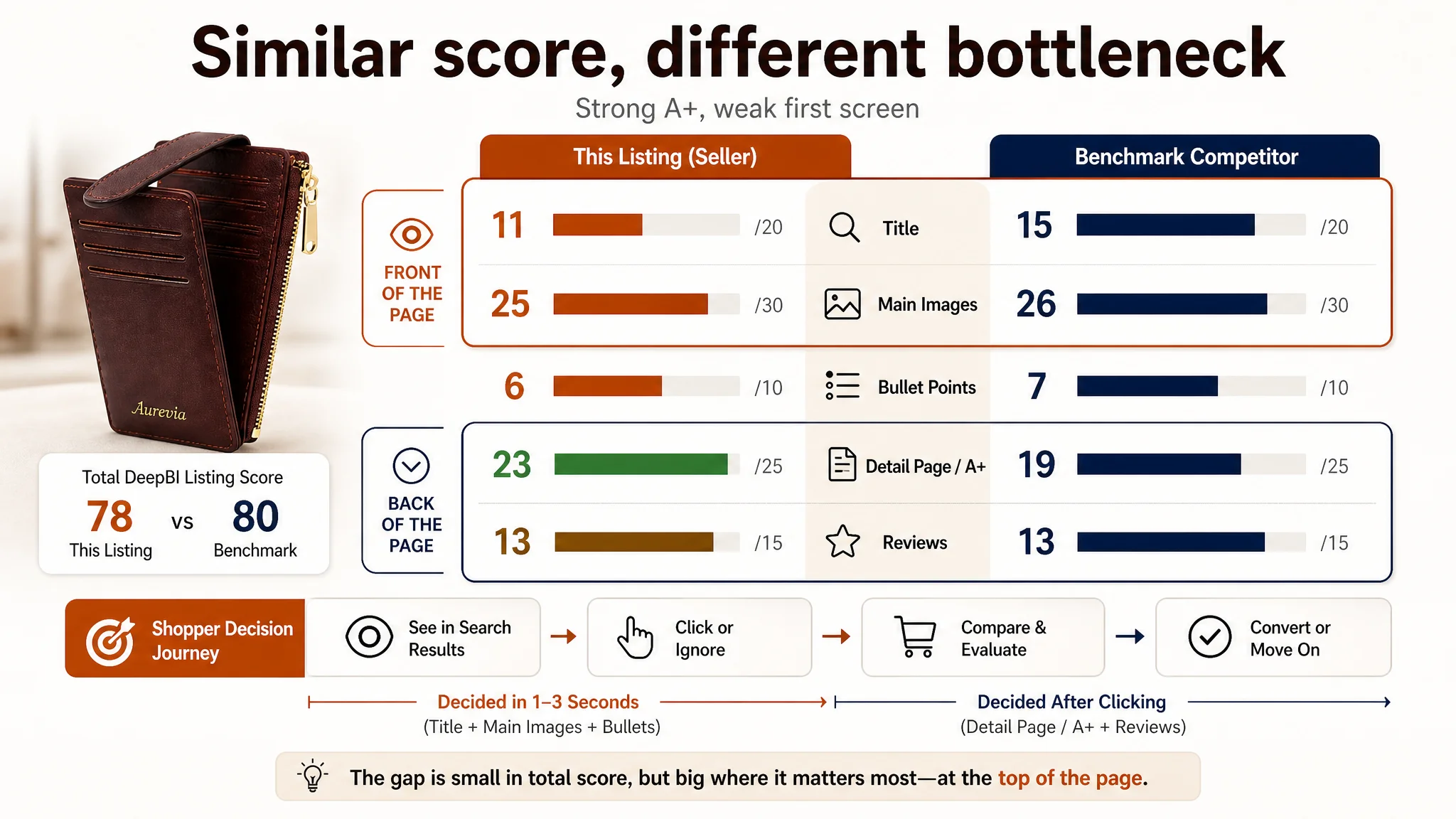
However, the breakdown showed a different pattern: the seller’s A+ content scored 23 compared with the benchmark’s 19, while the title scored 11 compared with 15. The main image set and bullet points also lagged slightly. The page was not failing because it lacked content at the bottom. It was losing strength at the front of the funnel, where shoppers decide whether the product is relevant and trustworthy enough to click or continue evaluating.
The practical sequence is therefore:
- Identify the search terms that genuinely describe the product and buyer intent.
- Place the most important terms where the title remains readable and specific.
- Present a clear reason to consider the product after it appears.
- Review CTR and CVR together rather than judging the title by impressions alone.
- Diagnose the title together with the main image and bullet points, because a strong title can still lead into a weak conversion path.
Keyword relevance creates the opportunity to be seen; title clarity helps convert that opportunity into a click. Amazon does not publicly confirm every detail of its ranking logic, so treat algorithm terminology as an optimization reference—not a guarantee of placement.
Amazon Title Optimization Tips: What a High-Performing Title Actually Contains
A strong Amazon title does more than include search terms. It helps the query match the product quickly while giving shoppers enough information to decide whether the listing deserves a click. A practical structure is:
- Place the primary keyword near the front, where its relevance is clear to both shoppers and Amazon’s search system.
- Follow a readable word order instead of repeating related terms in a keyword pile-up.
- Add verified product facts, such as size, quantity, compatibility, product form, or use case.
- Connect an important feature to the buyer’s likely decision rather than presenting every specification with equal weight.
A useful pattern is brand + core selling point or result promise + product form + supplementary modifier, with redundant modifiers removed. For example, a title should clarify what the product is and who it serves without suggesting specifications or functions that are not confirmed. Better clarity may support CTR and help the shopper assess relevance before opening the listing; unsupported claims can create confusion and weaken CVR.
The slim wallet diagnosis illustrates why word order matters. Its title placed a low-recognition brand first, followed by a long list of functional terms such as “9 Card Slots,” “2 ID Window,” “Soft Leather,” and “Holder Wallets.” The core keyword “Slim Women Wallet” was present, but the title read more like a specification list than a concise buying promise. “RFID Blocking” also appeared in a way that did not naturally connect security with the women’s wallet use case.
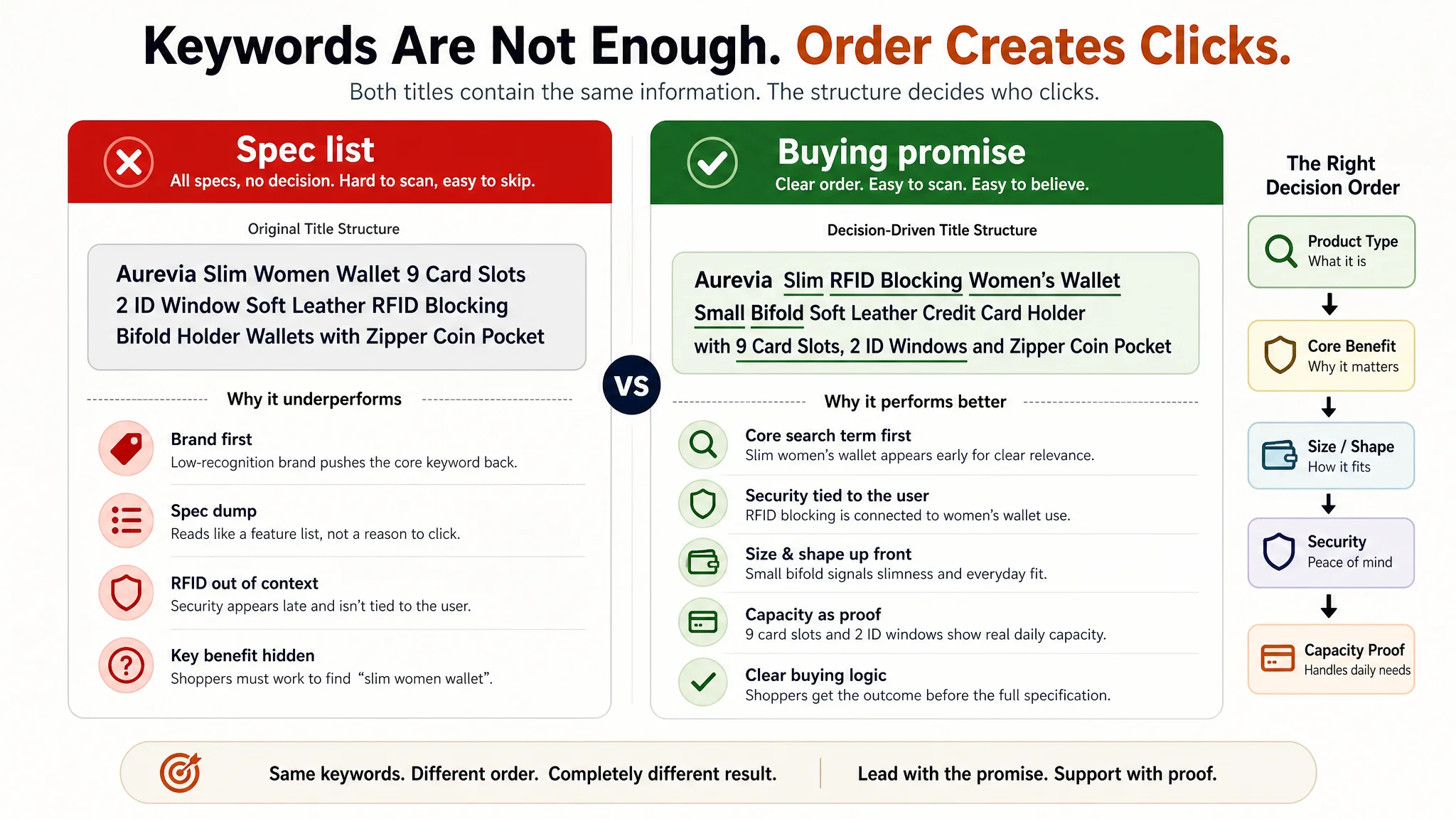
The problem was not simply that a keyword was missing. The title made shoppers work too hard to understand the product’s central value: a slim women’s wallet that offers RFID protection and enough capacity for daily essentials. A revised structure such as brand + core search term + size or shape attributes + security + capacity specifications gives the shopper the decision logic earlier. Capacity details can then serve as proof instead of taking over the title.
Title work is also stronger when it is part of a structured listing diagnosis rather than a standalone rewrite. A scoring workflow can evaluate the main image, title, bullet points, A+ content, and customer feedback, then identify where the listing loses strength. It can compare the listing with a relevant high-competition ASIN selected for similar product logic, use case, audience, and price range. The useful output is not merely a total score: it makes weak points explicit and prioritizes them for revision.
In the wallet example, the small total-score gap concealed a meaningful structural difference:
- Title: Seller 11 vs. Benchmark 15
- Main images: 25 vs. 26
- Bullet points: 6 vs. 7
- Detail page / A+: 23 vs. 19
- Reviews: 13 vs. 13
A total score of 78 versus 80 could easily encourage the conclusion that the listing was already close enough and that more advertising was needed. The module-level comparison showed that the strongest content was not necessarily located where shoppers needed it first. Benchmark alignment can guide optimization, but it does not guarantee a higher ranking, CTR, or CVR.
Finding the Right Title Keywords Before You Rewrite Anything
Start with what the product actually does and where buyers use it. Reverse-engineer your existing title and bullet points to identify core terms, then check each candidate against confirmed product functions, features, materials, and use cases. A keyword that attracts attention but describes a capability your product does not have can damage relevance and conversion.
For a slim RFID women’s wallet, relevant concepts might include the product type, intended audience, size, security function, capacity, and carry scenarios. But these concepts should not automatically be placed in a random sequence. The title needs to reflect how a shopper evaluates the product:
1. What is it?
2. Who is it for?
3. What important problem does it solve?
4. What proof supports that promise?
That sequence is different from simply listing every available attribute.
Separate broad head terms from specific long-tail phrases. Head terms may offer wider reach but often face stronger competition and weaker intent. Long-tail phrases can be narrower, yet they may better express a buyer’s function, scenario, or required feature. Prioritize relevance and specificity first, then assess competitiveness rather than treating search volume as the decision rule.
The wallet seller’s original title included several useful terms, but their arrangement diluted the product’s primary message. “9 Card Slots” and “2 ID Window” communicated capacity, but they appeared before the shopper had clearly received the more important context of a slim, small, women’s RFID wallet. This is a useful distinction when selecting keywords: a keyword can be relevant and still be poorly prioritized.
Validate the shortlist with your own search-term and advertising data. Review exposure, clicks, orders, CTR, and CVR, while remembering that limited-period or low-volume data is directional rather than conclusive. Keywords alone do not secure placement; sales performance, conversion rate, relevance, pricing, availability, listing quality, and competitor conditions also influence ranking.
Advertising data should also be interpreted alongside the page experience. In the wallet case, the seller had been changing bids, search terms, and match types because CTR and CVR were not responding as expected. The initial assumption was that traffic quality or competition was the main issue. The listing diagnosis suggested that shoppers were being brought to a page whose title and first images did not explain the product’s most important promises quickly enough.
That does not mean the keywords were irrelevant or that advertising had no role. It means the traffic source and the landing-page message were not being evaluated as one system. A searcher who clicks on an “RFID blocking wallet” query should encounter an immediate explanation or visual cue for RFID protection. A searcher looking for a “slim wallet for women” should quickly see evidence of slimness, size, and practical capacity. If the title and first image sequence do not deliver that continuity, changing bids may not resolve the conversion problem.
Finally, diagnose the listing across dimensions before rewriting. If low CTR appears alongside unclear title or main-image messaging, improve the search-facing hook first. If CTR is acceptable but CVR is weak and detail-page or review signals are poor, adding keywords may not address the real loss. If A+ content is already strong but title, main images, and bullets are weak, redesigning the lower page first may also misallocate effort.
Sequence work by the gap with the clearest potential impact on CTR, CVR, ACoS, BSR, or listing cycle time.
Placement Rules: Where Keywords Belong and What to Cut
A title has limited space, so prioritize relevance and product meaning over maximum keyword coverage. If the strongest phrase identifies the product and its primary use case, place it near the beginning—often after the brand—where shoppers can understand the offer quickly. A practical structure is:
- Brand
- Core selling point or result promise
- Product form
- Useful modifier
The exact order may vary according to the brand’s recognition, category rules, and buyer intent. A well-known brand may deserve a prominent position because shoppers already understand its meaning. A low-recognition brand should be assessed more carefully: placing it first may consume valuable opening characters without helping the shopper identify the product.
This was one of the weaknesses identified in the slim wallet title. The competitor could lead with a recognized brand without sacrificing immediate comprehension. The seller’s less familiar brand name occupied the first position, while the more important product and use-case language arrived later. The issue was therefore not that branding was inherently wrong; it was that brand prominence was not aligned with the amount of trust the brand could create at that moment.
Keep the opening human-readable. A title that begins with an awkward string of terms may match search language but weaken shopper comprehension, which can reduce CTR and make the listing less persuasive after the click. Read the first segment as a customer would: can they identify what the product is and why it matters without decoding it?
A title should also make the relationship between features clear. “RFID Blocking” has more value when it is naturally connected to the wallet and its audience than when it appears as an isolated functional term. Likewise, capacity specifications should support the promise of a slim but usable product rather than turning the opening into a technical inventory.
Use separators to organize distinct information instead of repeating the same term across multiple title segments. Remove long, redundant, or weak modifiers, especially when they do not clarify product relevance. Within a strict character limit, each remaining phrase should earn its space by supporting search intent, product understanding, or purchase consideration.
A useful editing test is to remove each phrase temporarily and ask what the title loses:
- Does it clarify what the product is?
- Does it identify the intended user or use case?
- Does it communicate a meaningful benefit?
- Does it provide verified proof?
- Does it improve search relevance without damaging readability?
If the answer is no, the phrase may not deserve its position.
Also separate front-end and backend decisions. The visible title should explain the product to shoppers. A backend search-term field, where provided by a particular Amazon category or template, is a separate placement area and should not be treated as a reason to overload the title. Review both independently for compliance and coverage. A cleaner title can support stronger CTR and CVR while reducing unnecessary listing-edit cycles; keyword repetition alone does not guarantee better ranking or lower ACoS.
Amazon Rufus and Title Optimization: What Sellers Need to Know in 2026
What Rufus Is and How Intent-Based Discovery Differs From Keyword Search
Rufus represents a more conversational discovery context: shoppers may describe a need, situation, or desired outcome instead of entering only a short product phrase. A title that clearly answers that situation can improve comprehension before the shopper reaches the bullets or detail page.
Keyword fundamentals still matter. Core search terms, product form, and relevant attributes remain necessary for phrase matching and indexing. Treat conversational discovery as an additional layer, not a replacement for keyword research or Amazon’s title requirements. Poorly structured titles can lose both search coverage and CTR, while unclear wording can weaken CVR even when the listing receives impressions.
The same principle applies whether the shopper types a short phrase or expresses a need in more natural language. “Slim women’s wallet,” “small wallet for daily carry,” and “RFID wallet for travel” may reflect different search expressions, but the shopper still needs the page to answer a similar set of questions: Is this the right product? Is it genuinely slim? Does it protect my cards? Will it hold what I carry?
The wallet listing showed how a page can contain the right facts without presenting them in the order shoppers need. The seller had capacity details, material information, RFID references, strong reviews, and extensive A+ content. Yet the title and first image set did not immediately connect those facts into a coherent answer. Intent-based discovery makes that clarity more important, not less.
Optimizing Your Titles for Rufus-Era Discovery
Write the title so a shopper can understand the product and its primary use without decoding a keyword string. A practical structure is:
- Brand
- Core selling point or result promise
- Product form
- Relevant supplementary modifier
Use high-frequency search terms where they accurately describe the product, then remove repetitive or low-value modifiers. Advertising data can help identify attributes associated with stronger conversion, which may deserve greater emphasis. Keep every specification grounded in the actual product; do not add unsupported functions, materials, or measurements.
For the wallet, a decision-oriented title would make “slim,” “RFID blocking,” “women’s wallet,” and the relevant size or capacity logic visible earlier, while moving detailed specifications into a supporting role. This is not an argument for adding every conversational phrase to the title. It is an argument for making the title understandable as a plain-language product answer.
Read the finished title aloud. If it sounds like a plain-language answer to a shopper’s situation while retaining the essential search phrase, it is serving both discovery paths. Monitor CTR, CVR, ACoS, and BSR after meaningful listing changes, and assess whether clearer wording reduces listing cycle time during future revisions.
Content Strategy Signals for AI Discovery—and the Q&A Adjacency
Question-oriented shopper language can reveal what the title should anticipate: who the product is for, what problem it addresses, and which attribute affects the purchase decision. Review the product detail page and Q&A area for recurring questions, then reflect only the most relevant answers in the title or supporting content. The Q&A area is an adjacent source of intent signals, not a workflow to automate.
For the wallet listing, the most important questions were not limited to “What material is it?” or “What colors are available?” The diagnostic comparison surfaced more consequential doubts:
- Will a small wallet hold daily essentials?
- Is the RFID blocking function real and understandable?
- Will the wallet remain practical when fully loaded?
- Is the stated slimness meaningful in a real pocket or small bag?
Those questions should influence the title, image sequence, bullets, and A+ structure. A title cannot answer everything, but it should establish the central promise so that the rest of the page can provide proof instead of introducing the product from the beginning.
Before publishing in 2026, verify Amazon’s current category-specific title rules, character limits, and mandatory content policies.
Title Mistakes, Myths, and Overclaims to Avoid
A common title mistake is treating more keywords as better optimization. Keyword stuffing can make a title harder to scan, weaken relevance, and reduce CTR even when it contains valuable search terms. Use readable wording, remove redundant modifiers, and place the most relevant product attributes where shoppers can understand them quickly. Review the effect through CTR and CVR rather than assuming that additional terms will improve BSR.
The slim wallet listing did not lack relevant functional terms. Its problem was that the terms appeared as a list without a clear buying outcome. “9 Card Slots,” “2 ID Window,” “Soft Leather,” and “Holder Wallets” described components, but the title did not make the relationship between slimness, security, intended user, and daily capacity immediately obvious. Adding more similar descriptors would likely have increased density without repairing the decision logic.
Do not assume that entering a keyword in a backend field guarantees first-page placement. Search visibility depends on wider signals, including listing relevance, shopper response, clicks, orders, and conversion behavior. Treat the keyword field as one input, then diagnose performance across the listing instead of attributing ranking to one field.
Seller-community shorthand also requires caution. A repeated claim is not automatically official Amazon policy. Check the applicable guidance before turning informal advice into a compliance rule or ranking strategy.
Verified-purchase badges can strengthen shopper trust, but Amazon states that it does not weight reviews differently because of the badge. Badge eligibility is determined at the product level and is not limited to sellers of a particular size. Use the badge as a trust signal, not as proof that reviews receive extra ranking weight.
External traffic should be treated as potential ranking support only when it brings qualified shoppers who click, convert, and contribute to sales velocity. Do not claim that traffic alone directly improves organic ranking. Compare traffic quality with CTR, CVR, orders, and ACoS before scaling the channel.
There is another related mistake: assuming that visual richness automatically means strong conversion support. The wallet seller had 18 high-quality A+ images, strong lifestyle visuals, multi-scenario gift usage, and a much larger review base than the benchmark. Yet the front of the page still failed to answer two important doubts quickly: whether the wallet could hold daily essentials and whether the RFID protection was credible.
This does not make the A+ content worthless. It means that content strength is positional. A shopper who never reaches the relevant module cannot benefit from it. A strong lower-page module cannot fully compensate for a title and main-image sequence that fail to create enough trust at the top.
How to Measure Whether a New Title Worked
A title change should be treated as a dated test, not a creative success judged by intuition. Record the implementation date, then compare the relevant seller and advertising reports before and after the update. Use the same product, audience, price range, and comparison period where possible.
Start with the core funnel:
- CTR: Did impressions generate more clicks after the title changed?
- CVR: Did those clicks produce orders at a stronger rate?
- Orders and impressions: Did the change affect traffic volume or only click behavior?
- ACoS and ad spend: Did paid efficiency improve, remain stable, or decline?
Next, review search-term data for movement in long-tail queries. Pay particular attention to terms that produce conversions or show stronger relevance after the update. If those terms become more prominent while CVR holds, the title may be matching search intent more effectively.
Check organic performance separately. A favorable BSR or organic-ranking movement is more convincing when it holds without a matching increase in ad spend. Avoid attributing every change to the title if images, bullets, price, inventory, or campaigns changed at the same time.
The wallet diagnosis also shows why title testing should not be interpreted in isolation. The seller’s title, main images, and bullet points all had front-funnel weaknesses, while A+ and reviews were already strong. If the title is changed without considering whether the thumbnail and image carousel reinforce the new promise, the test may produce an incomplete result.
For example, a title that emphasizes RFID protection should be supported by a visible explanation of that function in the main-image sequence. A title that promises a slim but practical wallet should be supported by a filled-wallet image and a relatable size comparison. Otherwise, a shopper may click because of the title and still hesitate because the page does not provide the expected proof. The title may improve CTR while CVR remains weak, not because the title failed, but because the rest of the front funnel did not carry the promise forward.
For a safer rollout, test the revised title on one listing or a limited group before applying the pattern broadly. An observation window of 7–14 days can help reveal the initial CTR trend, but the exact impact varies by category and competition. Treat report-based evidence as the decision standard, not a predicted score or assumption.
Where DeepBI Fits in a Title Optimization Workflow
Title optimization works best as a repeatable listing loop, not as a one-time rewrite. Use DeepBI to connect diagnosis, strategy, production, publication, and performance review:
- Diagnose the current title against a meaningfully similar competitor set. Review keyword layout, selling-point clarity, structural compliance, and the relationship between the title, images, bullets, and A+ content. Prioritize the gaps most likely to limit CTR or CVR instead of editing every element at once.
In the slim wallet diagnosis, the total Listing score initially suggested only a small competitive gap: 78 versus 80. The module breakdown prevented that number from becoming a false reassurance. A+ content was already stronger than the benchmark, and reviews were equal, but the title lagged by four points while the main image set and bullet points also trailed. This showed that the first optimization priority was not additional A+ depth or more traffic. It was the front-of-funnel decision path.
- Generate candidates from the diagnosis and strategy. DeepBI can turn identified gaps into executable title guidance, such as removing redundant modifiers, reorganizing the brand, core benefit, product form, and qualifiers, and checking the applicable character limit. Keep product claims tied to verified inputs and user instructions.
For the wallet, that meant moving away from a keyword-heavy function list and toward a structure that made the product’s central promise clearer: slim women’s wallet, RFID protection, small form, and practical capacity. The purpose was not to make the title longer or more impressive. It was to ensure that search relevance and shopper understanding appeared in the same opening sentence.
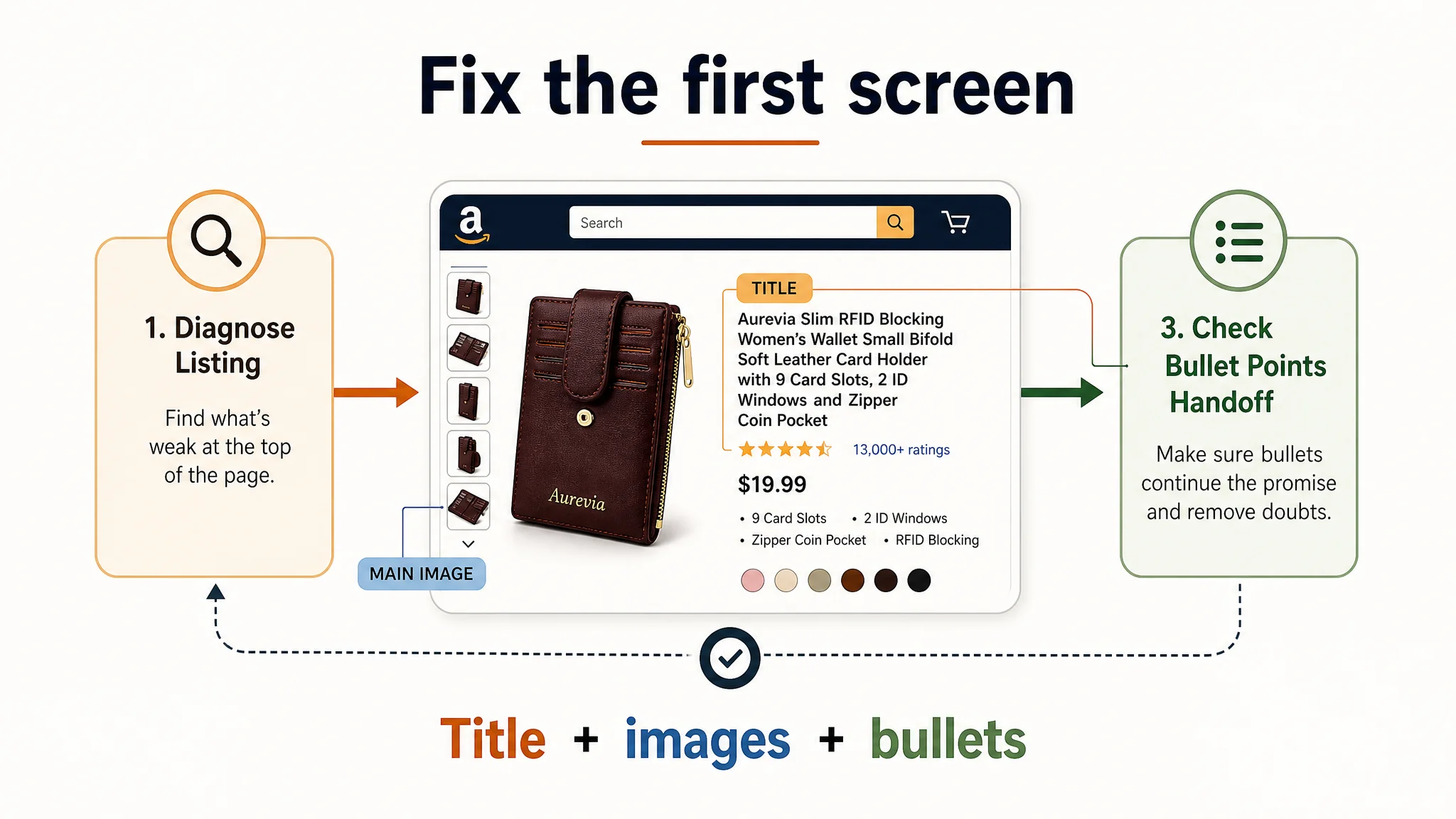
- Generate and preview visual variants before publishing. For image or A+ changes, compare the original and proposed assets in the front-end workflow, then select only the versions you approve. Do not treat visual generation as a substitute for title validation.
This matters because the wallet’s visual problem was not a lack of attractive assets. The existing images showed an opened wallet, lifestyle scenes, color options, and material details. The missing elements were decision proofs: a filled wallet showing actual capacity, a familiar-object comparison showing slimness, and a visual explanation of RFID blocking. The image review therefore needed to ask not only whether an asset looked polished, but which buyer doubt it resolved.
- Apply approved visual assets through Amazon SP-API one-click sync. This reduces manual upload friction and reports processing status. Handle approved title text through the supported listing publication workflow rather than assuming that the same visual-asset sync path publishes titles.
- Keep the operating loop running: analysis → strategy → generate → publish → optimize. After publication, review CTR, CVR, BSR, listing cycle time, and relevant business or advertising data. A title that earns more qualified clicks can support paid-traffic efficiency downstream, but DeepBI remains a listing diagnosis, generation, and synchronization workflow—not an advertising system.
This workflow also changes how advertising decisions are made. In the wallet case, the seller had been adjusting bids, search terms, and match types while treating the product page as already optimized. DeepBI’s diagnosis reframed the problem: advertising was not necessarily failing to generate traffic; it was amplifying a front-end conversion leak.
That distinction is important. Advertising can bring shoppers to the listing, but it cannot independently establish that the product is secure, appropriately sized, sufficiently capacious, or worth considering. Those promises must be made and supported by the listing itself.
A title optimization workflow should therefore connect four questions:
1. Can the shopper find the product?
2. Can the shopper understand the promise from the title and first image?
3. Can the page prove that promise before the shopper abandons the evaluation?
4. Do CTR, CVR, ACoS, and organic signals confirm that the revised logic is working?
When the answer to the second or third question is weak, increasing traffic may increase spend without repairing the underlying problem.
The Listing Must Prove the Title’s Promise
Title optimization is often discussed as if the title works independently from the rest of the page. In practice, the title creates an expectation that the main image, bullets, and A+ content must fulfill.
The wallet listing made this relationship visible. The recommended title structure emphasized a slim women’s wallet with RFID protection and practical capacity. That structure could only improve the customer journey if the rest of the page provided matching proof:
- A main image sequence that made security visible.
- A filled-wallet image that demonstrated capacity.
- A size comparison that made slimness relatable.
- Bullets that answered specific doubts in a logical order.
- A+ content that explained the functions and use cases in greater depth.
The original image set was not aesthetically weak. It included an opened wallet, lifestyle scenes, color arrays, and close-ups of materials and hardware. But the benchmark competitor used its image slots more directly as a conversion script. It showed an RFID-blocking diagram, filled every slot to demonstrate capacity, and used familiar objects to establish size.
That contrast illustrates a broader rule: the most useful asset is not necessarily the most beautiful asset. A visually polished image that repeats a point shoppers already accept may contribute less than a simpler diagram that resolves a purchase objection.
The same principle applies to bullets. A title may mention RFID protection, but the first bullet should explain the function in a way that matches the shopper’s search intent. A title may call the wallet slim, but a bullet should connect that claim to front-pocket, backpack, or small crossbody use. A capacity specification becomes more persuasive when the page shows the wallet fully loaded rather than displaying empty compartments.
In other words, title optimization should not end when the title is rewritten. It should trigger a consistency check across the entire front funnel.
Why Advertising Should Not Be the First Fix for Every Weak Listing
When CTR or CVR underperforms, advertising is often the most visible variable. Sellers can change bids, match types, search terms, placements, budgets, and creative formats. Those controls are useful, but they can also encourage teams to optimize the traffic source before confirming that the listing is ready to receive the traffic.
The wallet seller followed this familiar pattern. Because the page had strong reviews and rich A+ content, the team assumed that the page itself was not the bottleneck. They continued iterating campaigns while ACOS remained difficult to control and CTR and CVR did not respond as expected.
The diagnosis revealed why that approach was limited:
- Shoppers searching for RFID protection did not see an immediate visual explanation of the feature.
- Shoppers searching for a slim women’s wallet did not receive an intuitive size and capacity proof at the top of the page.
- Shoppers who reached the A+ content encountered stronger information, but many did not scroll far enough to benefit from it.
This creates several risks:
1. More spend without proportional conversion improvement. Additional clicks enter the same incomplete decision path.
2. Unclear testing results. Ad creative performance becomes difficult to interpret when the landing page does not support the creative promise.
3. Dependence on paid traffic. If conversion does not improve, additional traffic may not create sustainable organic momentum.
4. Misallocated listing work. Teams may keep adding images or refining A+ modules even though the highest-priority gaps are in the title, main image, and bullets.
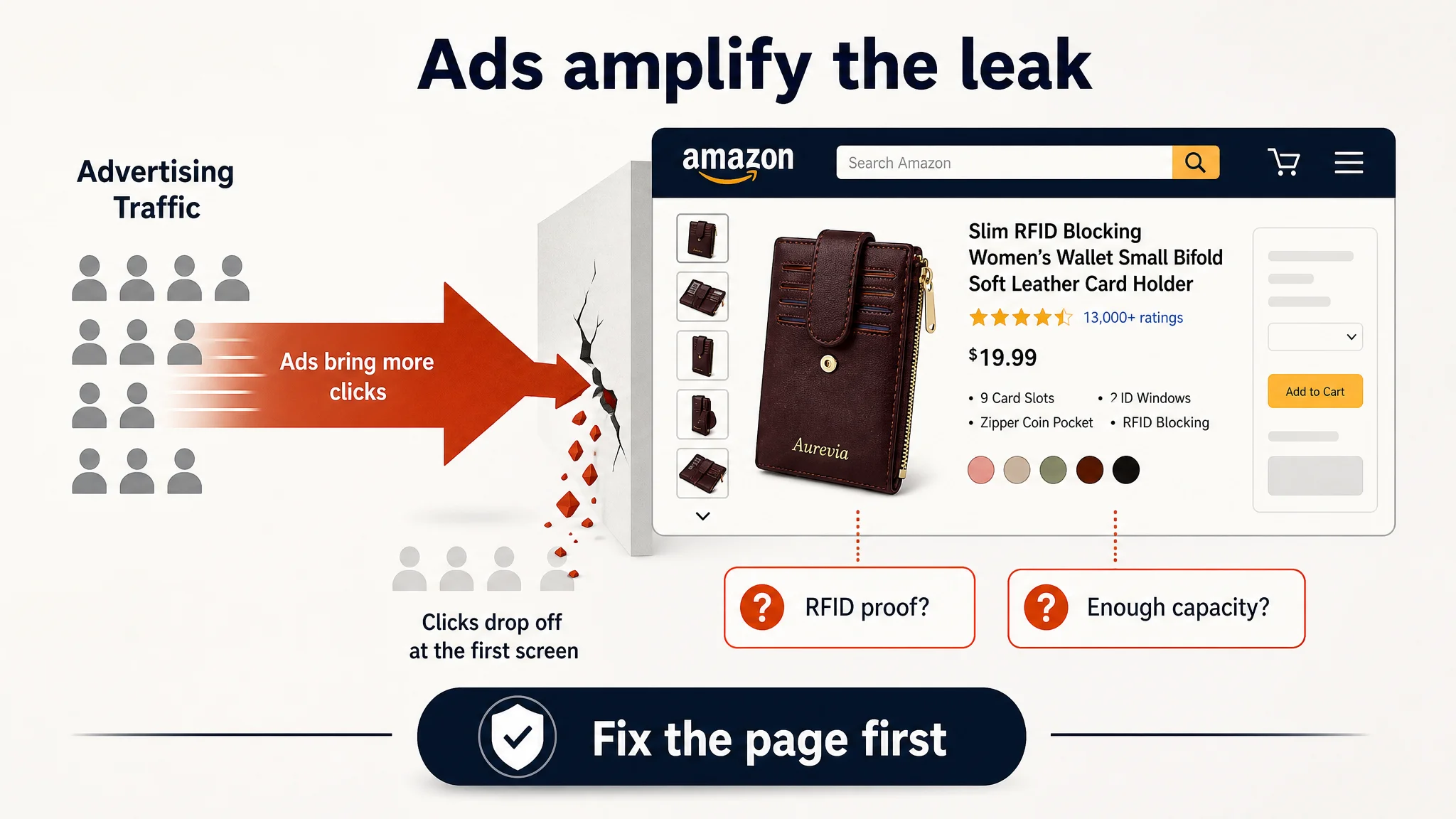
The correct sequence is not “never change ads.” It is “diagnose the conversion path before scaling the traffic lever.” Advertising should be evaluated as part of the full funnel, not as an isolated explanation for every weak result.
What Other Amazon Sellers Can Take from This Listing Diagnosis
The slim RFID wallet example is not unique to accessories. Its underlying pattern can appear whenever a listing looks complete but fails to communicate the right promise early enough.
- Rich A+ and many reviews do not guarantee a healthy Amazon Listing. A page can score well on detail-page fullness and still leak conversion at the top.
- Small total-score gaps can hide large structural differences. A four-point title deficit and smaller gaps in main images and bullets may matter more than a four-point A+ advantage helps.
- A title can contain the right keywords and still be poorly optimized. Relevance depends on placement, readability, and whether the title communicates a meaningful reason to consider the product.
- Ads cannot fix a missing promise. When the title and first images fail to articulate the real reason to buy, more campaigns can simply accelerate spend into a leaky funnel.
- The first image sequence should answer the most important doubts. For the wallet, those doubts involved daily capacity, practical slimness, and whether RFID protection was credible.
- A strong lower-page module cannot rescue a weak opening. Shoppers who never reach A+ content cannot benefit from its explanations.
- The real root cause is often misdiagnosed. The seller thought, “Our Listing is good. Ads are the issue.” The diagnosis showed, “The A+ is good, but the title and main images are consuming the traffic.”
- Decision order matters. Before scaling Amazon ads, ask whether the title states the core outcome for the search intent, whether the main images answer the top doubts without scrolling, and whether the bullets turn features into a decision narrative.
DeepBI’s value in this diagnosis was not simply making the page look more polished. It was identifying which part of the Amazon product page was actually limiting conversion and prioritizing that area before more traffic was purchased.
For Amazon sellers, the practical takeaway is straightforward: when ACOS feels stuck and “more ads” is the default lever, step back and interrogate the listing. Often, as with this slim wallet, A+ content and reviews are not the main problem. The real constraint is whether the title and main-image logic deserve the traffic the listing is already receiving.