

Why core and long-tail keyword layout decides Amazon discovery
How Amazon shopper intent differs from general web search
Amazon search behavior is usually closer to product evaluation than open-ended information discovery. A shopper may already know the product category, intended use, or purchase constraint and search with language that reflects those decisions. A listing that attracts broad impressions but does not match that intent can lose CTR, CVR, and eventually paid efficiency through a higher ACoS.
Generic SEO habits may underperform when they prioritize broad topical coverage, isolated keyword frequency, or traffic volume without clarifying the product’s role in the purchase journey. Amazon relevance depends on whether the listing connects the search term with the product’s features, use case, and functional context. Keyword presence alone cannot compensate for weak relevance or unclear positioning.
A borescope listing reviewed by DeepBI illustrates this distinction. The product page already had a 4.7-star rating, 437 reviews, strong A+ content, and an overall listing score of 79/100 against a benchmark competitor at 81/100. Because the page looked “good enough” on the surface, the seller initially treated stubborn ACoS and weak click-to-order performance as an advertising problem. However, the diagnosis found that the title, main-image logic, and bullets were not aligned closely enough with how industrial and automotive buyers searched and evaluated the product.
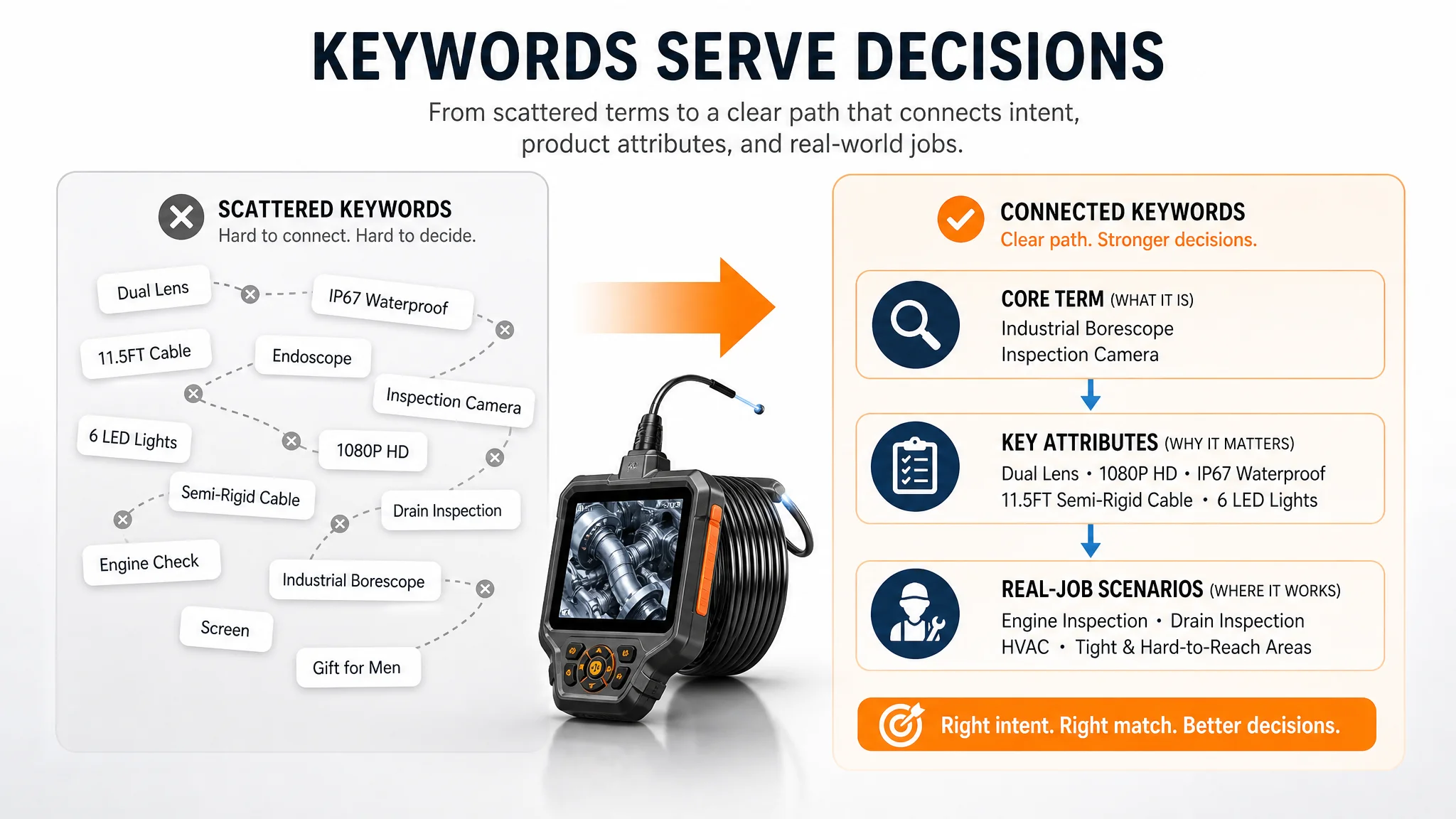
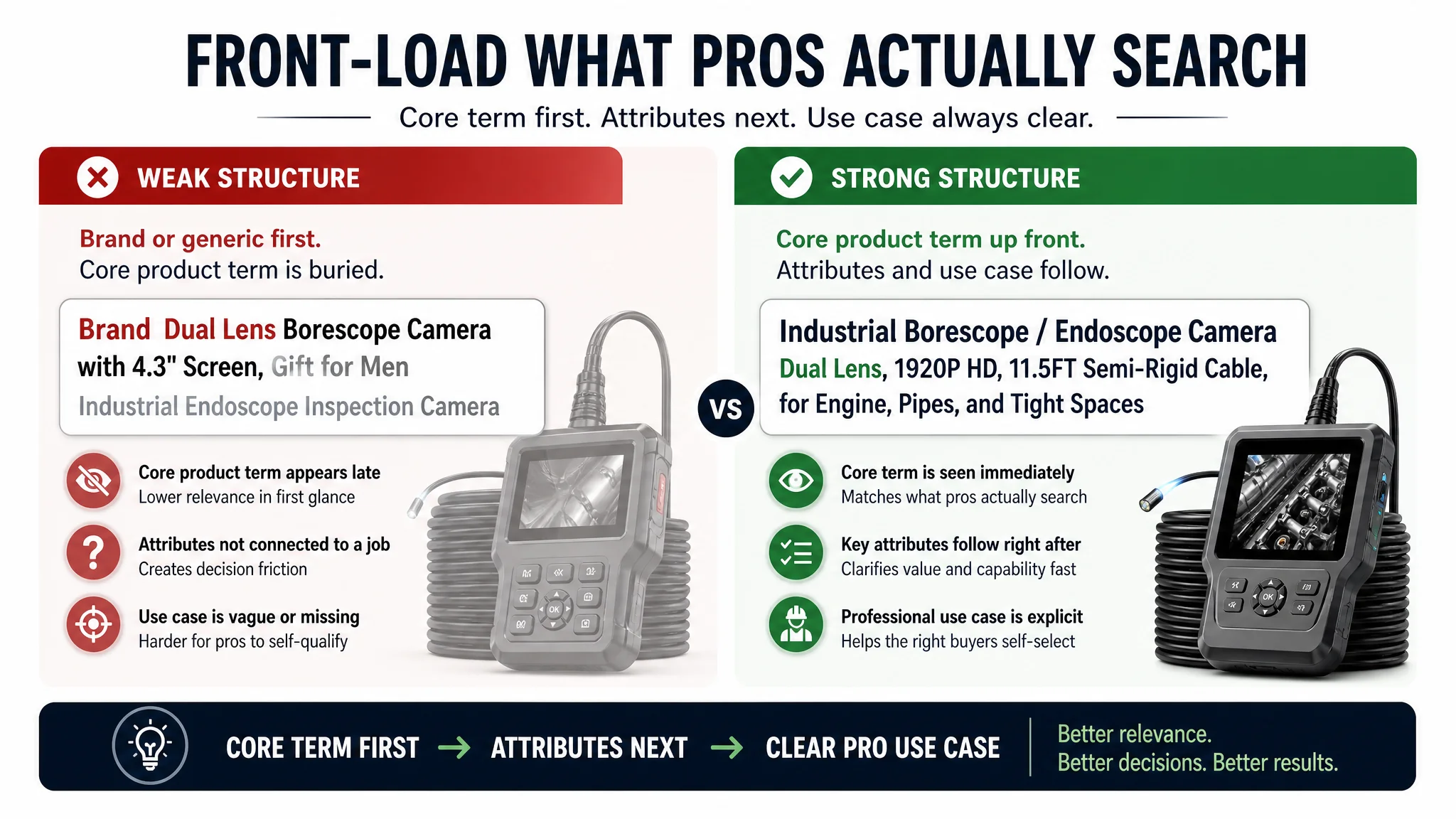
The issue was not simply a lack of keywords. The title placed the core product term too far back, emphasized “Dual Lens” without clearly connecting it to a professional search intent, and included broader language such as “Gift for Men” that diluted the industrial positioning. The competitor’s advantage came from framing product attributes around jobs, constraints, and outcomes. This is why keyword layout must connect search language with the buyer’s decision context, not merely increase the number of terms present.
Core keywords provide the category-level foundation. They help establish what the product is and which broad demand space it belongs to. Long-tail keywords add specificity, such as a particular use case, feature, audience, size, compatibility requirement, or customer problem. Their narrower intent may produce fewer impressions, but the traffic can be more commercially qualified when the product genuinely satisfies the query.
A layout is a structure, not a keyword list
A keyword layout assigns each term a defined role and placement instead of collecting phrases in a spreadsheet and inserting them wherever space is available. A practical structure can include:
- Title: Core category, product-form, and primary defining terms that communicate relevance quickly.
- Bullet points: Supporting feature, benefit, use-case, and pain-point terms that explain why the product fits the search.
- Visible content: Additional context that strengthens semantic relevance and helps shoppers connect functions with real usage.
- Backend search terms: Relevant supplementary language that is not necessary to repeat visibly, provided it remains accurate and non-redundant.
The layout should be checked against competitor titles, bullet logic, selling-point coverage, and search-term signals. Advertising data can also identify terms associated with stronger CVR and inform which attributes deserve greater emphasis. The execution task is to map core and long-tail terms to intent and placement, then review whether the resulting listing supports CTR, CVR, ACoS, and BSR rather than merely containing more keywords.
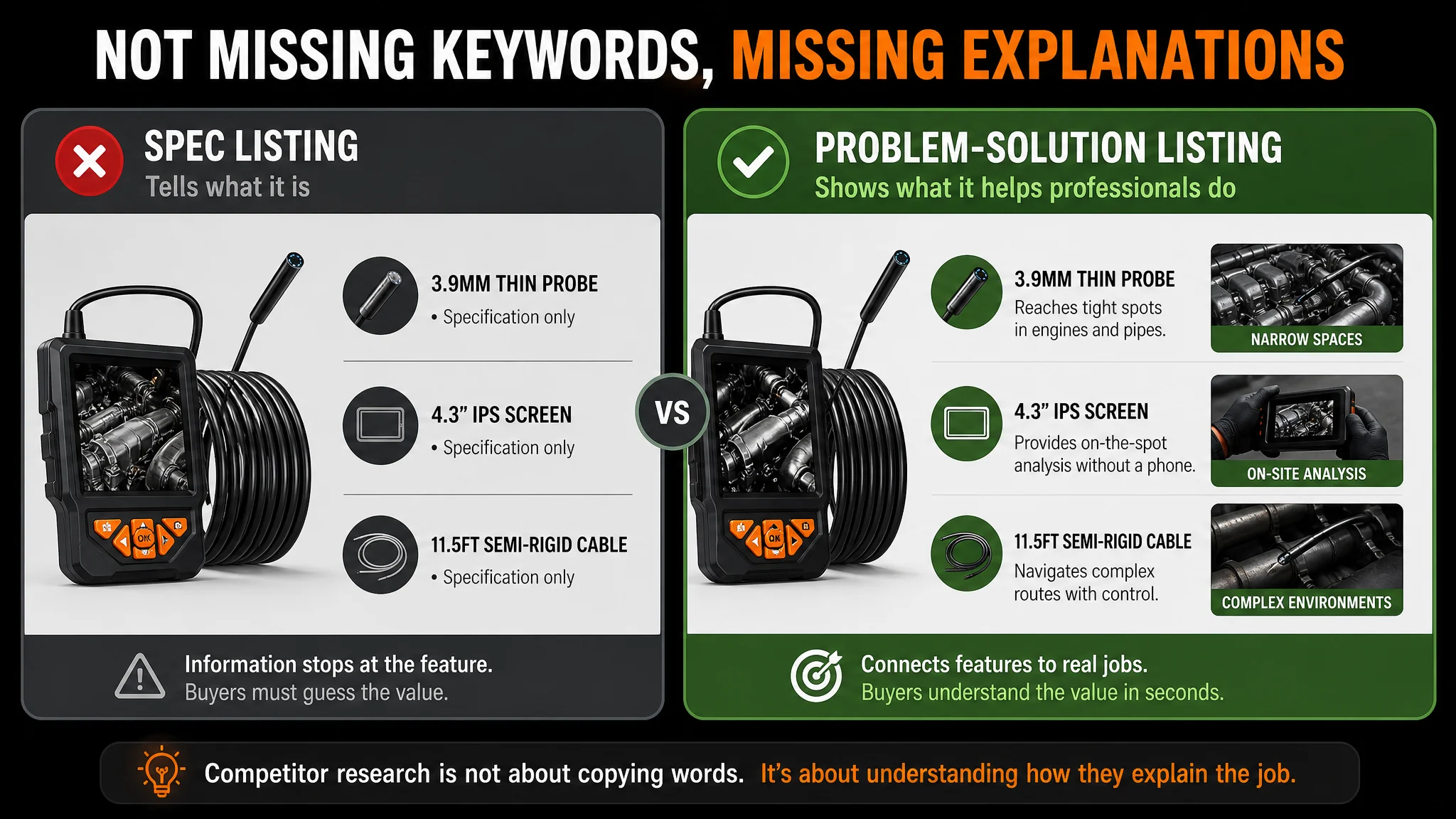
The borescope case shows why this structural view matters. The client’s bullets contained technical specifications and accessory information, but they did not consistently explain what those specifications helped a mechanic or technician do. The benchmark competitor, by contrast, connected a thin probe with access to narrow spaces, an independent screen with on-the-spot analysis, and waterproofing with work in wet or dark environments. The competitor was not necessarily winning because it had more features. It was presenting those features in a clearer decision sequence.
A keyword placed in the wrong message hierarchy can therefore be technically present but commercially weak. “11.5FT Semi-Rigid Cable,” “IP67 Waterproof,” and “Dual Lens” become more useful when they are tied to pipe drains, engine inspection, blind spots, or other verified use cases. The layout should help shoppers understand both what the product is and why the attribute matters.
What should sellers do before Prime Big Deal Days 2026?
Build the pre-event keyword inventory
- DeepBI Listing Product Document, Combined Edition — Supports building a working term inventory from multiple evidence sources: title and bullet-point extraction, simulated buyer searches, autocomplete-style discovery, and seller advertising data such as impressions, clicks, orders, CTR, and CVR.
- DeepBI Listing Product Document, Combined Edition — Supports separating current-state terms from target terms. Seller data indicates which keywords and listing elements are already associated with traffic or conversions, while competitor analysis and high-converting search terms help identify gaps worth pursuing.
- DeepBI Listing Product Document, Combined Edition — Supports comparing the listing’s title and bullet-point keyword layout with relevant competitors rather than relying on isolated keyword matching or subjective edits. Competitor selection should remain within the same product form, price band, use case, and audience.
- DeepBI Listing Product Document, Combined Edition — Supports prioritizing high-converting search terms as optimization signals. These terms can be reviewed alongside impressions, clicks, orders, CTR, CVR, ACoS, and BSR to establish a pre-event baseline.
The inventory should also record how each term contributes to the first stages of the purchase decision. The borescope diagnosis found that the competitor’s title led with a core product expression such as “3.9mm Endoscope Camera,” then connected image quality, screen size, probe diameter, cable length, and professional scenarios. The client’s title contained relevant attributes, but their order created a less immediate answer to the buyer’s question: what is this tool, and is it designed for my job?
That difference is important when building a pre-event baseline. A term may exist somewhere in the listing while still being weakly positioned. Sellers should therefore distinguish between keyword presence and keyword function. A core term buried behind the brand name, or a professional use case placed after broad gift-oriented language, may not support the same CTR or CVR as a term positioned where the shopper can process it quickly.
Lock the layout before the traffic spike, not during it
- DeepBI Listing Product Document, Combined Edition — Supports assigning each term to a specific listing role before changes are made. Title analysis covers core terms, product form, and supporting modifiers; bullet-point analysis addresses the supporting keyword and selling-point structure.
- DeepBI Listing Product Document, Combined Edition — Supports treating field assignment as an operational layout decision, not a guaranteed ranking outcome. Terms should remain factually relevant, and competitor keywords should not be added when they imply unsupported functions, materials, or specifications.
- DeepBI Listing Product Document, Combined Edition — Supports stabilizing the keyword layout before deeper content or visual work. Diagnosis and scoring should identify listing weaknesses and competitor gaps first; broader content changes should follow an approved optimization plan rather than occur simultaneously with unresolved keyword decisions.
- DeepBI Listing Product Document, Combined Edition — Supports a staged event workflow: establish the baseline and keyword layout before the traffic increase, monitor CTR, CVR, impressions, clicks, orders, and ACoS during the event period, then review post-event data to determine which terms and listing changes produced meaningful movement.
- DeepBI Listing Product Document, Combined Edition — Notes that exact Prime Big Deal Days 2026 dates, drop schedules, and event mechanics are not established in the source material. Sellers should confirm those details on Amazon’s official event page before setting the final review calendar.
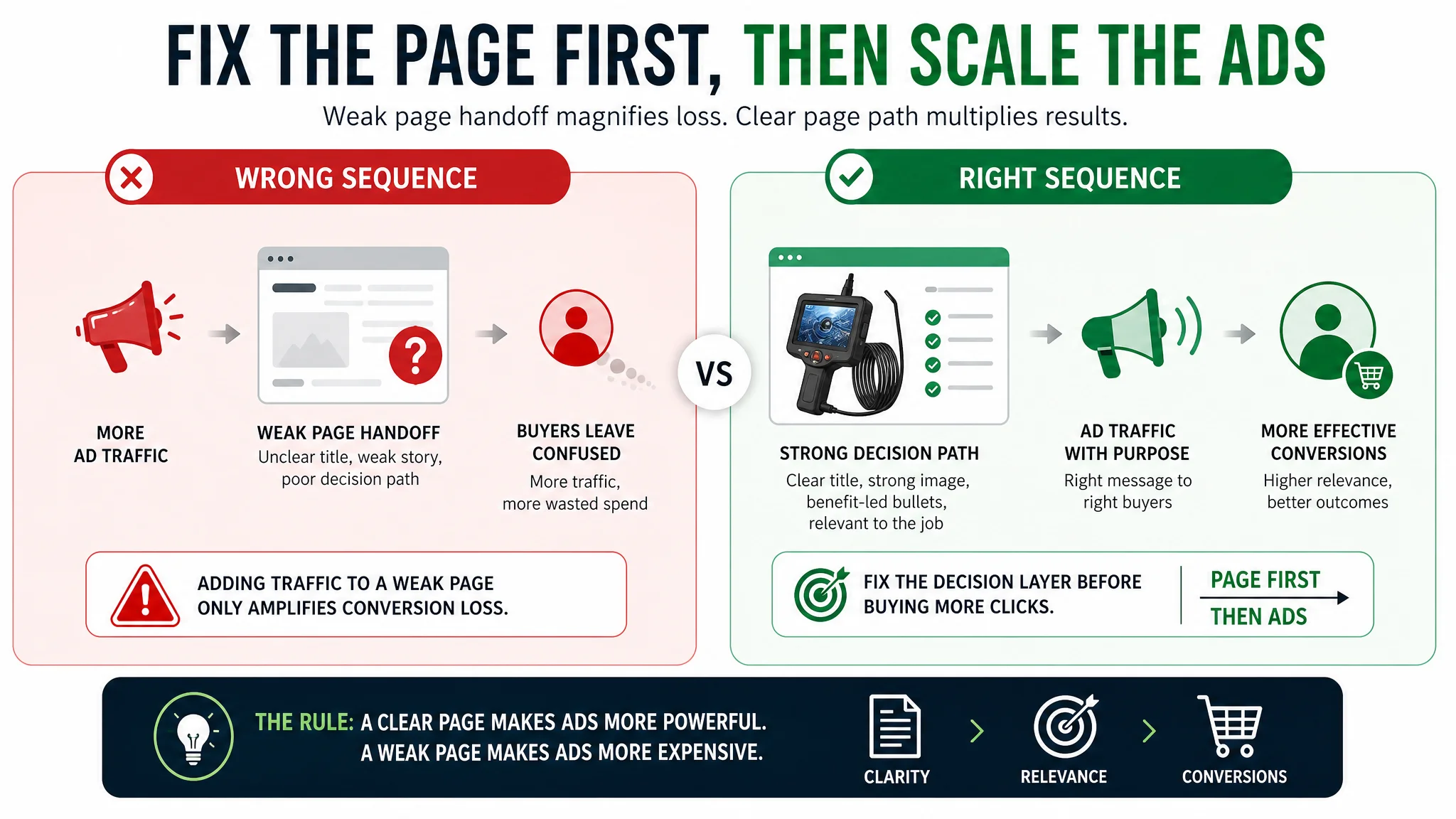
Locking the layout early also prevents teams from using advertising changes to compensate for unresolved listing problems. In the borescope case, the seller’s instinct was to add keyword expansion, create more granular campaigns, and adjust bids. DeepBI instead found that the front half of the listing—search-result presentation, main image, and bullets—was weaker than the back half, while A+ content and review volume were already strong.
More traffic through an unclear title or function-first bullet structure would have magnified the existing conversion loss. The correct sequence was to clarify the page’s decision path first and then use advertising to test and amplify the improved positioning. Event preparation should therefore treat keyword layout, page communication, and campaign changes as connected decisions rather than separate workstreams.
Prime Big Deal Days 2026: an Amazon seller's competitor research checklist
Competitor research is useful when it produces a documented keyword and information-hierarchy gap, not a list of attractive phrases. Use public listing evidence to identify opportunities, then test each opportunity against your own product, performance data, and economics.
Capture the competitor keyword and layout gap
- Define the target term and product context: Start with the core and long-tail terms relevant to the Prime Big Deal Days 2026 offer, including the intended use case, audience, price band, and product form.
- Select a small reference set: Choose genuinely comparable ASINs for each target term. Do not automatically use the category bestseller if its function, audience, price range, or product form differs materially from yours.
- Review visible competitor fields: Record terms and claims appearing in titles, bullet points, A+ content, and other publicly visible listing areas. Do not infer competitors' internal traffic, sales, conversion, or advertising performance.
- Reverse-check your own listing: Identify the core terms already present in your title and bullets, then mark competitor terms that are visibly absent from your listing.
- Compare hierarchy, not wording alone: Note which keyword appears early in the title, which benefit leads the bullets, which pain point receives priority, and whether the competitor presents a claim before a feature or specification.
- Validate product support: Keep only keywords, benefits, materials, parameters, and claims that your product can genuinely support. A visible competitor claim is not permission to add an unverified attribute or copy its wording.
- Separate opportunity from priority: Treat every observed difference as a possible gap rather than an automatic fix. A gap may affect CTR, CVR, ACoS, BSR, or listing cycle time differently depending on the field and shopper intent.
The borescope comparison demonstrates why hierarchy deserves separate attention from wording. The benchmark competitor placed the core product term, image quality, screen size, and quantified probe specifications near the front of the title. Its bullets then followed a pain–solution–value pattern: a thin probe was linked to access and time savings; the independent screen was linked to avoiding phone-related friction and supporting immediate analysis; the cable length was connected to difficult work environments.
The client listing contained many of the same general product facts, but the information arrived as a list of features and accessories. Its title also mixed professional terms with broader “Gift for Men” language. The observable gap was therefore not simply “missing keyword.” It was a difference in how the keyword, attribute, and use case were ordered. For sellers reviewing competitors, this is a more actionable distinction than copying phrases from a stronger-looking listing.
Record gaps in a table you can actually act on
- Create one row per finding: Avoid broad notes such as “competitor copy is stronger.” Record a specific keyword, claim, ordering difference, or pain-point omission.
- Capture the competitor evidence: Include the reference ASIN, the exact visible field where the term or claim appears, and its position or role in the information hierarchy.
- Record your current status: Classify the seller listing as covered, partially covered, absent, or unsupported by the product. This prevents an optimization plan from treating a product limitation as a copy problem.
- Assign the affected field: Identify whether the proposed action belongs in the title, a specific bullet, A+ content, or another visible listing field.
- Add the executable fix: State whether to test term placement, clarify a benefit, reorder the selling points, strengthen pain-point coverage, or leave the gap unfilled.
- Add seller-side validation: Link the finding to available impressions, clicks, orders, CTR, CVR, advertising reports, or conversion-related attributes. Competitor visibility alone cannot establish commercial value.
- Prioritize by expected impact and economics: Consider cost structure, inventory position, and target margin before changing the listing. A keyword gap deserves priority only when the expected demand and conversion contribution fit the offer's commercial constraints.
- Avoid universal competition cutoffs: Use category context, similarity, price, audience, and your own market data to judge whether a reference ASIN is relevant and whether a gap warrants action.
A useful table should make the difference between a term gap and a decision gap visible. For example, a row might record that a competitor presents a thin probe as a solution for narrow mechanical spaces, while the seller listing only states the probe specification. The proposed fix would not be to repeat the specification in more fields. It would be to test whether a supported use-case explanation belongs in the title, a bullet, or an image.
The same process applies to image and content gaps. In the borescope review, the main-image set had acceptable visual quality and even scored slightly higher than the benchmark on raw quality, but it lacked immediate scenario anchoring. The competitor showed the probe inside real mechanical gaps and made key specifications easier to understand at a glance. A record should therefore distinguish “image quality is weak” from “image hierarchy does not show the product’s primary job quickly enough.”
This level of specificity keeps the table operational. It also prevents sellers from treating every difference as a keyword insertion task when the real issue may be the relationship between a term, a visual, and a buyer concern.
How can you tell whether a competitor's deal is meaningful?
Rank or price movement is a signal, not sales proof
A competitor’s lower price or improved BSR can help you decide what to investigate, but neither observation establishes why performance changed. If a product’s price falls and its sales rank improves afterward, several explanations remain possible: the discount may have contributed, traffic may have increased, the product may have received stronger placement, or demand may have shifted independently.
Treat the observed price as a research lead—not proof of a planned Prime Big Deal Days 2026 discount. A lower point in a history record does not establish the product’s current price, the reason for the reduction, or whether the same offer will appear during the event window. It also does not establish that the competitor’s rank movement will be repeatable.
Use a signal hierarchy before changing your keyword or deal assumptions:
- Initial signal: observed price movement, rank movement, or a visible deal badge.
- Stronger verification: complete price-history records, relevant timestamps, and a competitor that matches your product form, price band, audience, and market position.
- Business validation: aligned changes in impressions, clicks, orders, CTR, CVR, and, where available, ACoS or BSR patterns.
Even verified movement supports investigation rather than automatic causal conclusions. Compare the competitor’s visible advantages with your own Listing attributes, then test whether the evidence aligns across multiple dimensions.
This caution also applies when interpreting a competitor’s apparent advertising strength. In the borescope case, the seller saw the benchmark appearing for similar search terms and assumed that more aggressive keyword and bid management was required. The deeper comparison showed that the competitor was also winning the early decision sequence through clearer title language, scenario-led visuals, and outcome-oriented bullets.
That does not prove that the competitor’s rank or advertising performance came from those elements alone. It does show why visible listing differences should be treated as diagnostic signals rather than isolated proof. A competitor’s presence for a term can identify a question worth testing: does the term describe a job that your listing currently explains less clearly?
What one live price-history check showed, and what it cannot prove
Consider this explicitly illustrative example, not a real dated retrieval. A price-history request returns response code 200 and several lowest-price points, such as $29.99, $28.99, and $27.99. The record also contains gaps, an empty value, a null value, and entries outside the event-analysis window. A response code confirms that data was returned; it does not confirm that the record is complete or that every value belongs to the period you are studying.
Review every timestamp and value individually. Separate in-window observations from out-of-window entries, flag missing fields, and avoid converting the lowest recorded point into a supposed event discount. If the record does not show when a price applied, how long it remained active, or whether the data coverage is continuous, classify it as limited evidence.
That check can direct further verification: inspect the product page, compare similar competitors, and review your own CTR, CVR, ACoS, and BSR context. It cannot prove a current price, explain the cause of a price low, or predict future event performance. Use competitor data to sharpen questions, not to replace evidence.
How to build the core keyword layout
Choosing core terms by intent and conversion potential
Start by reverse-decomposing your product title and bullet points into the search terms that describe the product’s function, use case, audience, and positioning. Then compare those terms with buyer search behavior and relevant competitor language. High search volume is useful context, but it should not decide the layout on its own. A term that attracts broad traffic but does not match the product’s actual offer can raise impressions while weakening CTR, CVR, and ACoS.
For each candidate term, ask three questions:
- Does it accurately describe a verified product attribute?
- Does it match a buyer intent that the listing can satisfy?
- Does it support the product’s positioning strongly enough to deserve visible placement?
Give every selected core term a distinct job. One may serve as the primary title term because it best captures category and purchase intent. Another may clarify the product form or audience as a secondary title term. A benefit-led term may anchor a bullet, while a narrower supporting term may belong in A+ content or backend terms. Avoid copying the same term into every field unless each repetition performs a different function, such as discovery in the title and proof or clarification in a bullet.
The borescope listing shows why “core term” should be defined through buyer intent rather than brand preference. The original title led with the brand and emphasized “Dual Lens,” but it did not immediately establish the product as an industrial borescope or endoscope camera for professional inspection. DeepBI’s recommended structure moved “Industrial Borescope” and “Endoscope Camera” forward, then connected “Dual Lens,” “1920P HD,” screen size, cable length, and waterproofing to the relevant professional context.
The objective was not to claim that one title formula guarantees ranking. It was to reduce ambiguity for a mechanic or technician scanning several search results. A core term should tell the shopper what the product is; a supporting term should explain the form, differentiator, or job context; and the bullets should make the commercial value of those attributes easier to understand.
Placement map for title, bullets, A+ content, and backend terms
Build the map from the product’s message hierarchy rather than from a list of popular phrases. An illustrative title structure can move from brand to core selling point or outcome, then product form, followed by relevant qualifying modifiers. This is a logic model, not a fixed formula. The primary term should appear where shoppers can understand the offer quickly; secondary terms should add precision without making the title difficult to scan.
Use bullets to connect a category concern with the product expression or proof and then the resulting pain-point solution. Place terms in the bullet where they strengthen comprehension and conversion, rather than inserting them as isolated phrases. Reserve A+ content for terms that require explanation, comparison, usage context, trust signals, or supporting proof. Backend terms can capture relevant coverage that does not fit naturally into customer-facing copy. Confirm the current backend search-term limit and measurement unit in Seller Central before finalizing them.
In the case, DeepBI’s recommended bullet structure turned the product’s specifications into a job script:
- Dual Lens and 1920P HD clarity were connected to two viewing angles in narrow spaces and to automotive, industrial, and HVAC inspections.
- The 4.3-inch IPS screen was connected to real-time analysis without depending on a smartphone, while the product limitation around photo and video capture was clarified to reduce future frustration.
- The 11.5-foot semi-rigid cable was explained as a distance advantage in environments such as pipe drains and wall structures.
- IP67 waterproofing and adjustable LEDs were combined with work in wet or dark areas and handheld usability.
- Accessories were tied to practical tasks such as retrieving lost items rather than being presented as an unexplained list.
This structure illustrates the difference between adding terms and assigning them a purpose. “Dual Lens” becomes more meaningful when it resolves a blind spot. “IP67 Waterproof” becomes more meaningful when the listing explains the supported working environment. The keyword map should therefore show not only the intended field, but also the buyer question that the term helps answer.
Use diagnostic output to prioritize the map. Title analysis can reveal weak keyword layout, unclear positioning, or poor structure; bullet analysis can expose weak selling-point order, missing pain-point coverage, or readability problems. A weak CTR points toward the title or primary message, while a weak CVR may require stronger detail, proof, or benefit communication. Treat the scoring service as a market health check: convert each concrete gap into a ranked placement action aligned with positioning, rather than relying on an overall score.
A relatively small total score difference can conceal a meaningful front-page gap. In this case, the client was only two points behind the benchmark overall and had stronger review volume and A+ content, yet the benchmark’s advantage was concentrated in title clarity and bullet-driven decision logic. This is why an aggregate score should guide investigation, not replace field-level diagnosis.
How to build the long-tail keyword layout
Modifier stacking and question-form expansion
- DeepBI listing product document combined edition: Start with the product term extracted from the title and five bullets, then expand it with confirmed attributes, functional features, use cases, audience needs, benefits, pain points, and question-form language. Keep every modifier tied to a visible product attribute or verified specification; do not add unsupported materials, functions, or parameters.
- DeepBI listing product document combined edition: Use a specificity ladder to prevent flat word stuffing. For a generic base term such as “insulated water bottle,” the structure can progress from the broad term, to a phrase variant such as “insulated water bottle stainless steel,” to an exact multi-attribute phrase such as “24 oz stainless steel insulated water bottle,” and then to a long-tail phrase combining product, attribute, use case, and benefit, such as “24 oz stainless steel insulated water bottle for hiking keeps drinks cold.” The final wording should be treated as a research candidate, not an automatic ranking claim.
- DeepBI listing product document combined edition: Include question-form candidates where they reflect real customer intent, such as queries about compatibility, capacity, cleaning, installation, or use conditions. Compare these terms with the listing’s existing bullets and visible content before deciding whether they belong in the layout.
- DeepBI core capabilities: Listing analysis can support keyword extraction from existing copy and incorporate performance signals such as CTR and CVR when available, helping sellers prioritize terms that may affect both discovery and conversion rather than expanding volume without relevance.
Long-tail terms should also express the practical question behind the search. For an industrial borescope, a buyer may not only be looking for “borescope camera.” The relevant decision may involve whether the probe can enter a narrow gap, whether the screen supports on-site inspection, whether the cable reaches a difficult area, or whether the tool works in wet conditions. These use-case dimensions can help sellers expand candidate terms without adding unsupported claims.
The case also shows why long-tail coverage should be evaluated across fields. Some context belongs in the title because it clarifies the product’s identity and audience. Other context belongs in bullets or images because it explains how a specification helps with a job. A long-tail phrase should not be forced into the title if it makes the offer harder to scan or introduces a claim the product cannot verify.
Filter long-tail terms against category-relative competition
- DeepBI listing product document combined edition: Judge competition against a comparable category and benchmark set, not against a universal result-count or review-count cutoff. Result counts and review counts can serve as category-relative starting heuristics, but their meaning changes across niches, price bands, and product types.
- DeepBI listing product document combined edition: Select comparable listings using similarity, price-band, audience, and market-validation constraints. A recently launched or low-review listing should not be treated as proof of ranking strength without additional verification; limited reviews may indicate insufficient market validation.
- DeepBI listing product document combined edition: Use listing diagnostics to identify long-tail themes competitors cover while your title, bullets, or detail content does not. Check gaps in keyword placement, selling-point coverage, pain-point coverage, and feature or parameter visibility. Filling a relevant gap may support CVR and listing cycle time, while unrelated insertion can weaken relevance.
- Recommended two-source validation standard: Retain a candidate only when two independent signals agree, such as a competitor-listing comparison plus customer-language research or autocomplete observation. Autocomplete is useful for directional popularity and phrasing, not as an exact search-volume ranking. Use a clean or incognito session where possible to reduce personalization effects, then confirm the term through the second source before adoption.
The comparison should ask whether the competitor’s long-tail expression represents a genuine buyer concern that your listing fails to address. In the borescope case, the competitor’s emphasis on a thin probe was not valuable merely because it contained a measurable specification. It translated that specification into access to tight clearances and reduced inspection time. The client’s page had the product capability, but shoppers had to infer where it mattered.
That distinction helps avoid a common error: treating competitor language as a ranking shortcut. A competitor’s phrase should become a candidate only when it matches your verified product attributes and clarifies a real use case. Otherwise, it may create relevance problems or attract shoppers whose expectations the product cannot meet.
How to connect the core and long-tail layers
Keyword architecture should not end when the promotion window closes. Use the event as a measurement period, then connect paid-search evidence to both budget decisions and Listing priorities. The objective is not to force every term into the same role. It is to identify which terms earn more attention based on their contribution to CTR, CVR, ACoS, ROAS, and order value.
Review search-term performance at the term level rather than relying only on campaign averages. A useful working screen includes:
- Impressions, to assess whether the term is receiving meaningful exposure.
- CTR, to identify terms whose search intent and creative presentation attract clicks.
- CVR, to distinguish traffic that converts from traffic that only consumes spend.
- ACoS or ROAS, to evaluate commercial efficiency.
- Order value, where available, to identify terms that bring higher-value demand.
High-click, high-conversion terms may deserve additional budget or stronger placement, while terms with attractive order value may justify attention even when their volume is lower. Any allocation should remain conditional on category economics, product lifecycle, margin, and observed performance; a fixed core-versus-long-tail budget split is not a default rule.
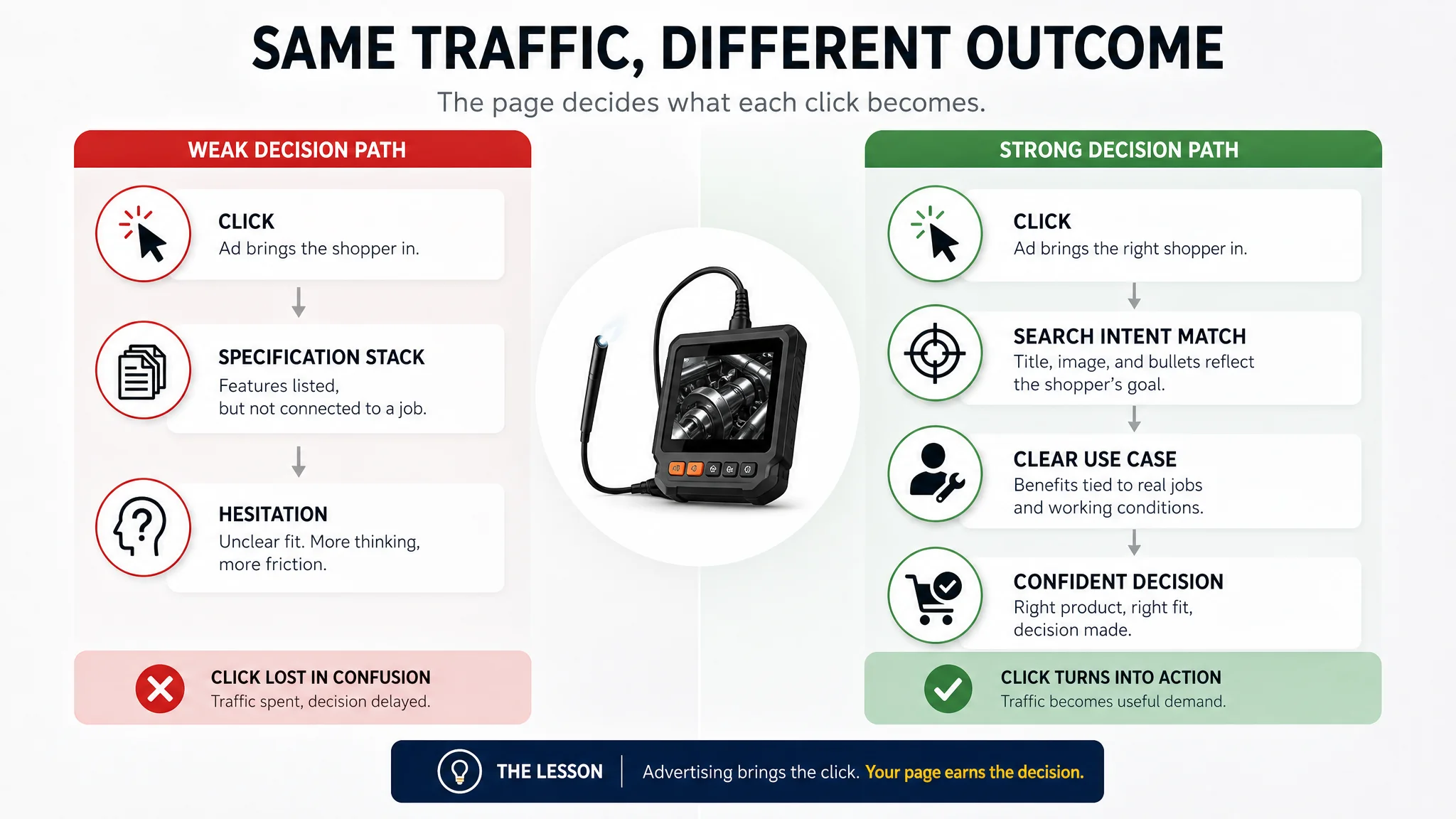
The borescope case adds an important condition to this feedback loop: advertising data should not be interpreted independently from page capacity. The seller had traffic and relevant search-term exposure, but the page’s early decision architecture did not convert that attention efficiently. If a term receives clicks but the title, images, and bullets do not clearly confirm the buyer’s intended use, increasing budget may increase wasted sessions rather than create a useful test.
This is why a high-traffic term should be reviewed alongside the page experience it leads to. A weak CTR may suggest that the search-result message is not aligned with intent. A weak CVR may indicate that the listing does not provide enough proof, clarity, or job relevance after the click. The data does not automatically identify the cause, but it can show where the next diagnostic question belongs.
Rank consolidation as the bridge to organic strength
A converting long-tail term can provide more than short-term sponsored-sales data. It can reveal a specific combination of intent, attribute, and product relevance that deserves reinforcement in the Listing title, bullets, images, or other relevant content. When that term continues to attract qualified clicks and conversions, it may build term-specific ranking strength. That strength can potentially support visibility for broader core terms, although rank consolidation should be treated as a strategic mechanism to test, not a guaranteed outcome.
This creates a feedback loop between promotion and organic improvement:
1. Use event-period advertising to identify high-value search terms.
2. Compare impressions, CTR, CVR, ACoS, ROAS, and order value by term.
3. Give proven terms appropriate budget and content attention.
4. Mark Listing or visual changes as measurement points.
5. Review subsequent advertising and organic signals, then adjust the layout.
Repeat the review on a recurring cycle. Keyword research is ongoing, and shifts in consumer language, competition, margin, or product positioning can change which terms deserve priority. A disciplined refresh helps preserve the connection between short-term promotional demand and longer-term BSR and organic visibility work.
The page-first lesson from the case should remain part of this cycle. After the listing’s title, main image, and bullets were realigned around industrial buyers’ jobs, the product’s attributes became easier to understand: dual lens addressed viewing angles, the long cable addressed reach, IP67 addressed environmental conditions, and the independent screen addressed real-time inspection. The case does not provide specific post-optimization performance metrics, so it cannot establish a quantified ranking or revenue result. It does show that advertising became more useful when the page gave each click a clearer reason to convert.
How DeepBI supports keyword layout decisions on Amazon
DeepBI is an Amazon-only, AI-driven operations system that connects listing competitiveness, advertising quantification, and organic growth decisions. Its role is not to replace the seller’s commercial judgment. It acts as an analysis, execution, and feedback layer that helps turn keyword evidence into controlled listing actions.
For a Prime Big Deal Days planning cycle, listing diagnostics can compare your title, bullet points, images, A+ content, and review signals with a similarity-filtered competitor benchmark. The title analysis can also assess keyword placement, high-frequency search terms, selling-point clarity, and structural compliance. These findings can populate a keyword gap table with practical fields such as:
- Missing core terms that may affect discoverability and BSR
- Underused long-tail terms aligned with confirmed product attributes
- Competitor selling points that require validation before adoption
- Listing weaknesses with potential implications for CTR or CVR
The benchmark must remain commercially relevant. An unrelated bestseller should not become the reference point, and DeepBI should not fill a gap by inventing materials, features, or specifications that the product does not actually have.
The borescope diagnosis shows the value of separating an overall score from the location of the weakness. The listing scored 79/100 against the benchmark’s 81/100, had stronger review volume, and had A+ content that scored above the benchmark. Yet the title was three points behind, the bullets were one point behind, and the main-image logic lacked strong scenario anchoring. This made the small aggregate gap less informative than the field-level pattern.
Strategy generation then helps order the diagnosed issues by priority rather than presenting an unranked list of suggestions. A seller could use that sequence to decide whether to address title structure, bullet-level long-tail coverage, or supporting content first, based on the expected effect on organic visibility, CTR, CVR, or listing cycle time. The seller still sets the profit and growth objectives and authorizes the final changes.
In the case, this prioritization led to a page-first sequence. The seller did not need to add more A+ modules simply because A+ content existed, nor did the diagnosis recommend continuing to refine bids before addressing the title and bullets. Instead, it focused on the early decision layers: leading with the professional product category, making the primary differentiators understandable, and connecting features with jobs and outcomes.
Advertising evidence adds another decision layer. Term- and attribute-level reports can reveal high-converting search terms or product benefits that deserve stronger organic treatment. These signals can guide keyword weighting, but they are evidence for prioritization, not a guarantee of rank, revenue, ACoS, or BSR improvement.
By linking market analysis, scoring, strategy, optimization, and Amazon listing application, DeepBI can shorten the handoff from a keyword decision to a live update. The resulting workflow supports iteration while keeping approval and commercial accountability with the seller.
Put your next idea to work
Complete the following checklist for one product before expanding the method across the catalog. The objective is not to collect more keywords indiscriminately, but to create a traceable layout decision that can later be evaluated against CTR, CVR, ACoS, BSR, and listing cycle time.
- Choose one product: Select a product with confirmed features, a defined use case, and an existing listing that can be reviewed before the event window; avoid starting with a product whose positioning or attributes are still uncertain.
- Build a core and long-tail keyword-layout worksheet: Reverse-parse the title and five-point description to identify core search terms, then add relevant long-tail terms. Give each term a field for intended placement, current placement, search or market relevance, and whether comparable competitors cover it.
- Run a competitor layout-gap review on a small reference set: Select a limited group of products that match your product form, function, price band, use case, and audience. Do not use the first-ranked or Best Seller listing automatically, and exclude materially mismatched products or listings with very little validation.
- Record observable gaps rather than relying on a score: Note whether a comparable listing covers a high-frequency term, places a core term more prominently, or explains a selling point more clearly. Link every gap to the specific title, bullet, or other listing module where it appears, then decide whether the term is supported by your product’s confirmed attributes.
- Separate manual evidence from automated summaries: A manual search, competitor comparison, and pain-point review consumes real operator time in each session. Treat that time as a planning cost, while recognizing the tradeoff: manual inspection gives you direct access to raw, unfiltered search and listing signals that a summary may not expose.
- Set one post-event review date: Schedule a single re-audit after the event window and compare term-level performance with the pre-event layout. Review impressions, clicks, orders, CTR, CVR, and advertising-report signals, using the listing application point as the reference for the measurement period. Document which layout changes warrant retention, revision, or removal rather than assuming a keyword change caused an outcome without supporting data.
When completing the worksheet, add one more question to every important keyword: what decision is this term helping the shopper make? In the borescope case, “Dual Lens” was not sufficiently persuasive as a standalone feature label. It became more useful when connected to front-and-side viewing in narrow spaces. Likewise, the screen specification mattered more when positioned as an independent tool for on-the-spot analysis, and cable length mattered more when tied to reach in difficult environments.
This prevents the worksheet from becoming a keyword inventory without a conversion purpose. It also helps identify when the next action belongs in an image or bullet rather than in another campaign. If a shopper cannot understand why a supported attribute matters, adding traffic to that message may not solve the underlying problem.
Bring a real ecommerce question
Before reviewing competitor keyword gaps, name one live decision from your own catalog:
- Which core term should receive stronger placement in the title, bullets, or other high-value content?
- Which long-tail theme appears to be missing from the current listing?
- Which keyword is consuming advertising spend without showing enough commercial relevance?
Then state what evidence you would require before changing the layout. A competitor’s repeated use of a term can establish a hypothesis, but it cannot establish priority for your product. Check whether the keyword matches the product’s verified attributes, use case, price position, and intended audience. Then examine seller-side evidence such as search-term or advertising data, impressions, clicks, CTR, conversions, and CVR. If relevant, connect the decision to ACoS, BSR, or listing cycle time rather than treating visibility alone as success.
The case suggests an additional diagnostic question: after a shopper clicks, does the first screen justify the click? The borescope seller initially focused on high ACoS and the competitor’s presence in similar search terms. The listing already had strong ratings, many reviews, and well-built A+ content, so the page did not appear obviously broken. However, the title, main image, and bullets did not help the intended professional buyer identify the product’s job and advantages quickly enough.
This distinction matters when planning around a major event window. Competitor research can surface an unclaimed core term or expose a long-tail theme that deserves investigation. However, a gap found in a poorly matched comparison may have no commercial value, and a gap that looks persuasive may not improve your own listing or advertising performance. Recommendations should remain grounded in observable product facts and verified specifications.
Use the competitor view to start the review, not to make the final call. Your own performance data completes the analysis by showing whether the proposed keyword layout has a credible relationship to demand, relevance, CTR, CVR, and profitability. Review the decision against measurable evidence rather than competitor preference or personal opinion.
The practical sequence is straightforward:
1. Identify the search intent and the relevant core or long-tail term.
2. Compare how comparable competitors position that term across the title, images, bullets, and A+ content.
3. Determine whether your listing contains the relevant product attribute but fails to explain its job or value.
4. Fix the appropriate part of the page before assuming more advertising is the answer.
5. Use term-level performance data to evaluate whether the revised layout supports better commercial efficiency.
Advertising can bring a shopper to the listing, but it cannot make an unclear product story clear by itself. A strong keyword layout is therefore not only a discovery system. It is part of the decision path that determines whether paid traffic becomes useful demand or simply more expensive exposure.