

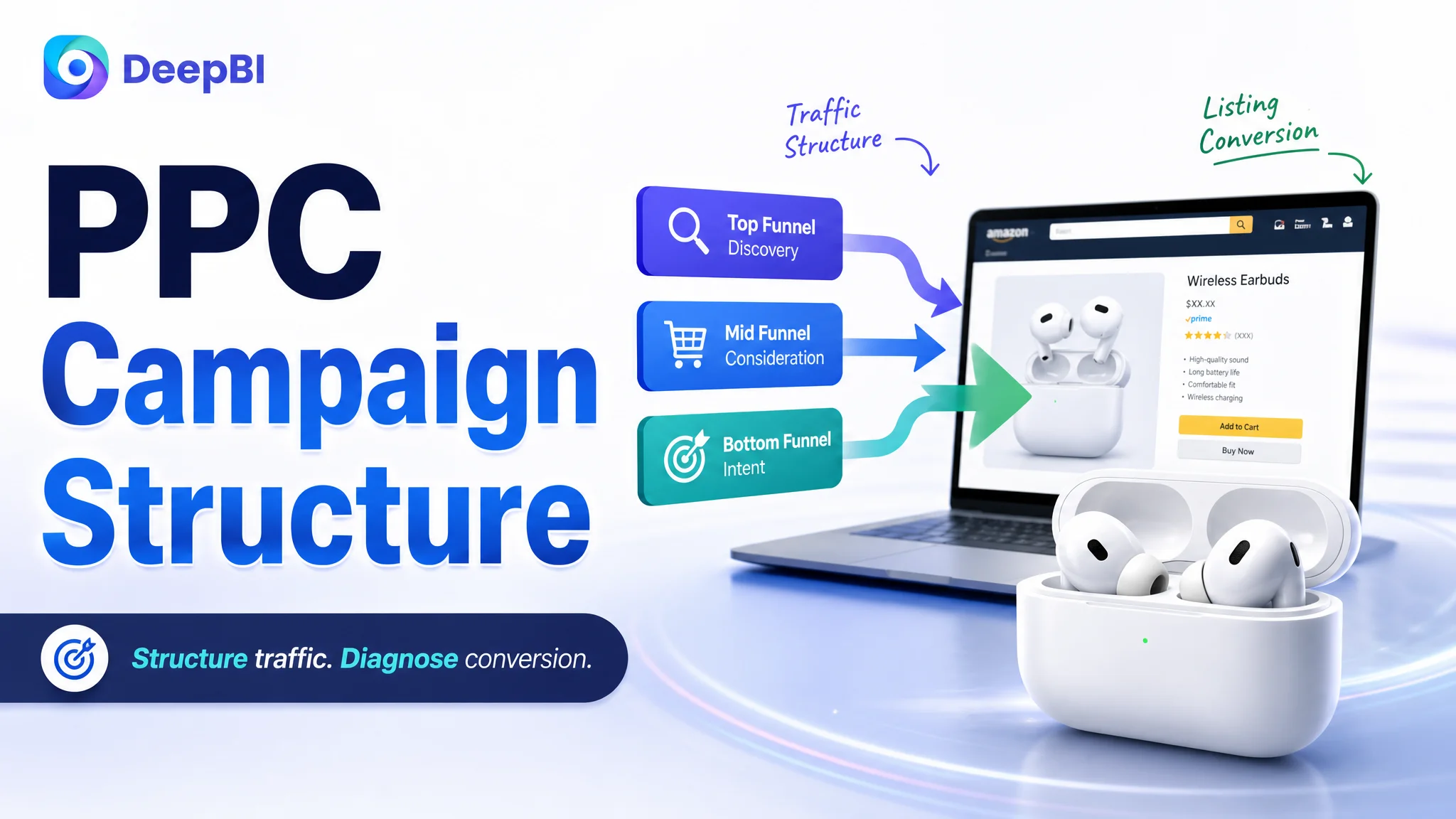
Why PPC Campaign Structure Matters More Than Ad Copy
Ad copy and bids can influence performance, but they cannot compensate for a campaign structure that combines incompatible buyer intents. Sponsored Products campaigns should be organized around how shoppers search and make decisions—not simply around a product catalogue, service catalogue, or every keyword available for an ASIN. An intent-based structure gives each campaign a clearer role, produces more interpretable data, and provides tighter control over budget allocation.
That makes structure a primary lever for learning speed and budget control. When high-intent and exploratory traffic share the same campaign or ad group, impressions, clicks, conversions, and spend become difficult to attribute. Poor allocation can consume a meaningful share of the budget without revealing a clear path to improving CTR, CVR, or ACoS.
However, campaign structure is only one side of the advertising system. The traffic path must also lead to a Listing that can convert the demand being purchased. A US marketplace seller once approached DeepBI with rising ad costs, unstable orders, and the belief that the central problem was simply “bad Amazon ads.” Yet when the product was opened in the Listing system, there was no Listing score, no title or main-image assessment, no bullet or A+ breakdown, and no competitor benchmark. Every major diagnostic field was marked “N/A.”
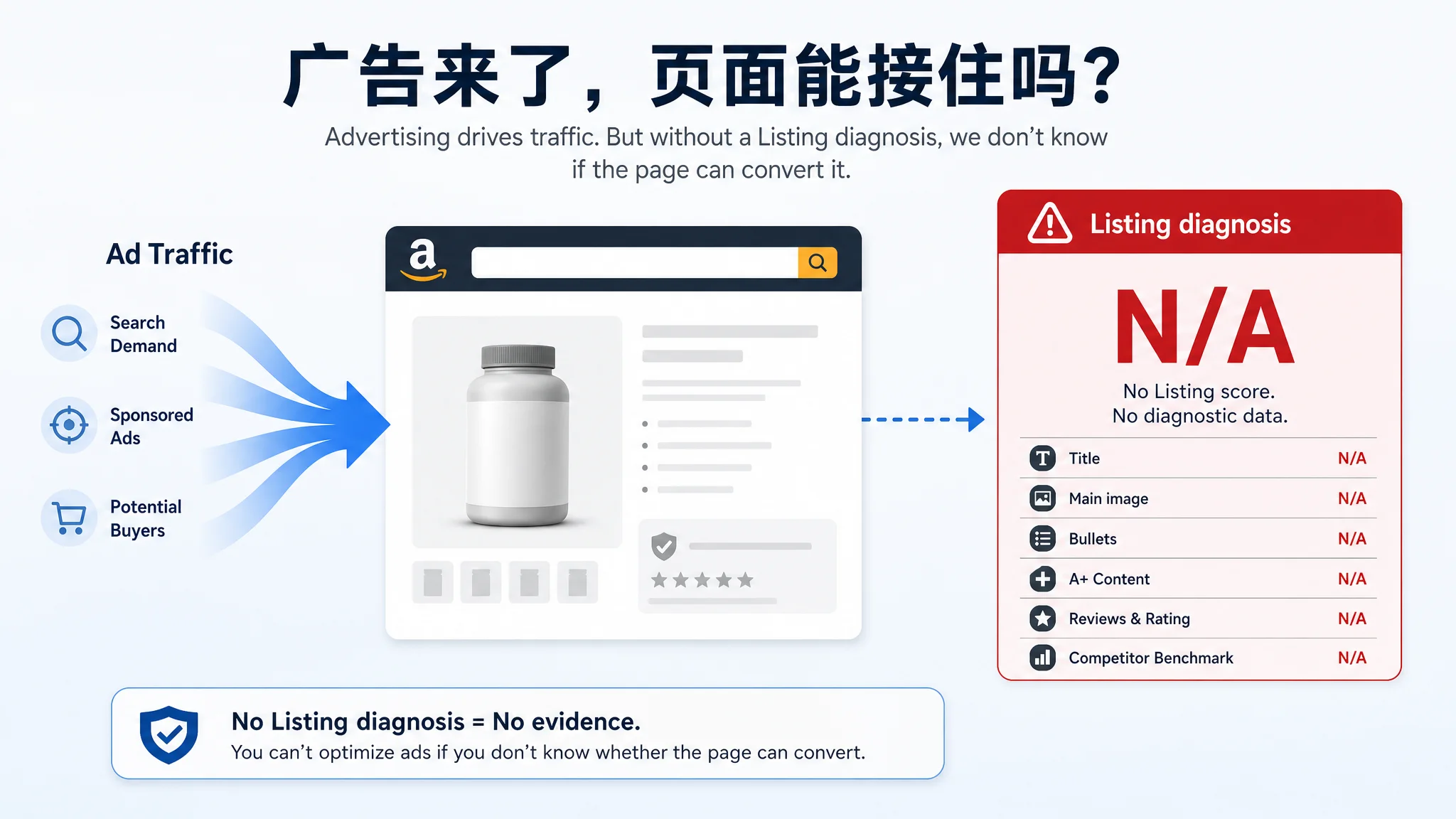
That absence changed the diagnosis. The seller was not only operating campaigns with unclear intent separation; the team was also sending traffic to a product page whose conversion capacity had never been objectively judged. The initial assumption was that bids, budgets, match types, or keywords needed further adjustment. The more fundamental issue was that there was no evidence showing whether the page deserved more traffic at all. Campaign structure can make advertising data clearer, but it cannot make an undiagnosed page competitive.
A common mistake among small advertisers is placing everything in one campaign or ad group and then judging the result after only a few days. The account has not generated a sufficiently clean signal for a reliable decision, yet bids or copy are changed anyway. This cycle creates more noise instead of accelerating learning. A quantified Sponsored Products system can optimize only within the lanes it is given. If those lanes do not separate buyer intent, the system cannot reliably direct budget, weigh search-term signals, or identify which traffic merits scaling.
The same principle applies after the click. If the main image does not establish enough clarity or trust, if the bullets only list features, or if the A+ content does not support the buyer’s decision, the campaign may generate traffic without producing orders. Structure therefore comes first on both sides of the funnel: separate the traffic lanes, then diagnose whether the Listing can receive and convert that traffic. Copy and bidding should be refined after the data paths and conversion path are controlled.
How to Run a PPC Campaign Structure Reset: Build, Expand, Protect
A reset should not begin by moving keywords between campaigns. Start by mapping search intent and funnel stage, then define and lock the role of each campaign lane. The objective is to discover relevant traffic, screen out waste, isolate proven demand, and scale without allowing higher bids to amplify weak CTR, CVR, or ACoS.
Before increasing spend, add one more question to the reset: has the destination Listing been evaluated against a meaningful benchmark? In the case described above, the seller had already adjusted bids and budgets, changed match types and keyword lists, and shifted budgets between campaigns and ad groups. The team was effectively trying to solve an advertising problem without knowing whether the product page was capable of converting the traffic. A campaign reset without a Listing diagnosis would have created a cleaner way to send traffic into an unknown conversion environment.
Use this sequence:
1. Map intent: Separate discovery terms, competitor ASINs, high-intent keywords, and proven converting targets.
2. Define campaign lanes: Assign each intent group to discovery, screening, precision, or scale. Splitting is not automatically better: low conversion volume can fragment data and create additional management overhead. Consolidate where evidence is thin.
3. Architect keywords and match types: Use broader coverage for discovery, tighter matching for precision, and controlled targeting for scale.
4. Prepare creative assets: Align the Listing, images, and message with the traffic each lane is expected to attract. Low CTR suggests an entry or relevance problem; low CVR may indicate a landing-page, trust, or offer-communication problem. If the Listing has not been scored or compared with competitors, diagnose that uncertainty before treating every weak result as a keyword problem.
5. Weight budgets: Fund discovery and screening enough to generate evidence, while reserving only a small top slice of traffic for scale.
6. Set a measurement cadence: Record impressions, clicks, CTR, conversions, CVR, ACoS, and optimization events so later decisions reflect stable signals rather than one-off results.
7. Confirm conversion readiness: Check whether the title, main image, bullets, A+ content, and reviews provide enough evidence for the buyer to move from click to purchase.
- Map intent: Decision it locks in: What demand is being pursued
- Define lanes: Decision it locks in: Where each target belongs
- Set match types: Decision it locks in: How broadly traffic is discovered
- Prepare assets: Decision it locks in: What promise receives the click
- Weight budgets: Decision it locks in: Which funnel stages receive spend
- Set measurement: Decision it locks in: When evidence is strong enough to act
- Confirm conversion readiness: Decision it locks in: Whether the destination page can support more traffic
The operating loop is build, expand, protect. Build coverage through keyword and competitor-ASIN discovery. Expand targets that generate relevant clicks and conversions, using recent ad data to filter out low-converting or low-quality traffic. Protect proven keywords and ASINs in precision campaigns through multiple rounds of testing before increasing bids or budgets.
The four layers require different success measures:
- Discovery: judge reach, relevance, and useful search-term or ASIN findings—not profit alone.
- Screening: judge traffic quality through CTR, CVR, conversion contribution, and waste reduction.
- Precision: judge repeatable conversion performance and controllable ACoS.
- Scale: judge incremental sales and efficient budget absorption—not reach. Only a small top slice of traffic should reach this layer.
A Listing diagnosis should follow the same evidence discipline. If the page has no benchmark or module-level assessment, the correct response is not to invent a conclusion from a single CTR or CVR value. First establish whether the main image and title are competitive enough to earn the click, then examine whether the bullets, A+ content, reviews, and offer communication can support conversion. This prevents a campaign reset from being mistaken for a complete growth diagnosis.
Mark each change and feed the subsequent results into the next decision. A winner is a stable signal observed repeatedly, not a single attractive report row. Similarly, a weak advertising result should not automatically be treated as proof that the campaign is wrong when the Listing itself has never been judged.
Amazon Sponsored Products Is the Spine: The Four-Layer Traffic Funnel
Amazon Sponsored Products should be structured around four funnel layers: discovery, screening, precision, and scale. Discovery uses broader targeting to surface search terms and ASIN opportunities; screening evaluates CTR, CVR, orders, and ACoS; precision concentrates spend on validated keywords and products; and scale expands only the lanes that sustain efficient conversion. A practical account separates four objectives: brand defence, non-brand category growth, competitor or ASIN targeting, and discovery. Brand lanes are defensive and steady, while competitor lanes should be capped and treated as experiments.
Common structural defects include overlapping campaigns, combining brand defence with conquest goals, and allowing broad-match spend to drain budgets without producing orders. Keep budgets and reporting distinct so search-term evidence can guide movement between layers and scaling decisions remain controllable.
The funnel also requires a clear distinction between traffic acquisition and conversion capacity. The seller whose Listing report was entirely “N/A” had been evaluating the first part of the funnel through ad activity, but had no structured view of the second part. There was no verified benchmark showing whether the main image created a competitive reason to click, whether the bullets addressed category-specific concerns, or whether the A+ content provided the proof needed after the click.
That made every layer harder to interpret. A low CTR could have reflected the main image, title, or traffic relevance. A low CVR could have resulted from weak trust, incomplete bullets, missing A+ content, reviews, or a mismatch between the promise in the ad and the information on the page. Without a Listing-level evidence chain, campaign metrics could describe the symptom without identifying the cause.
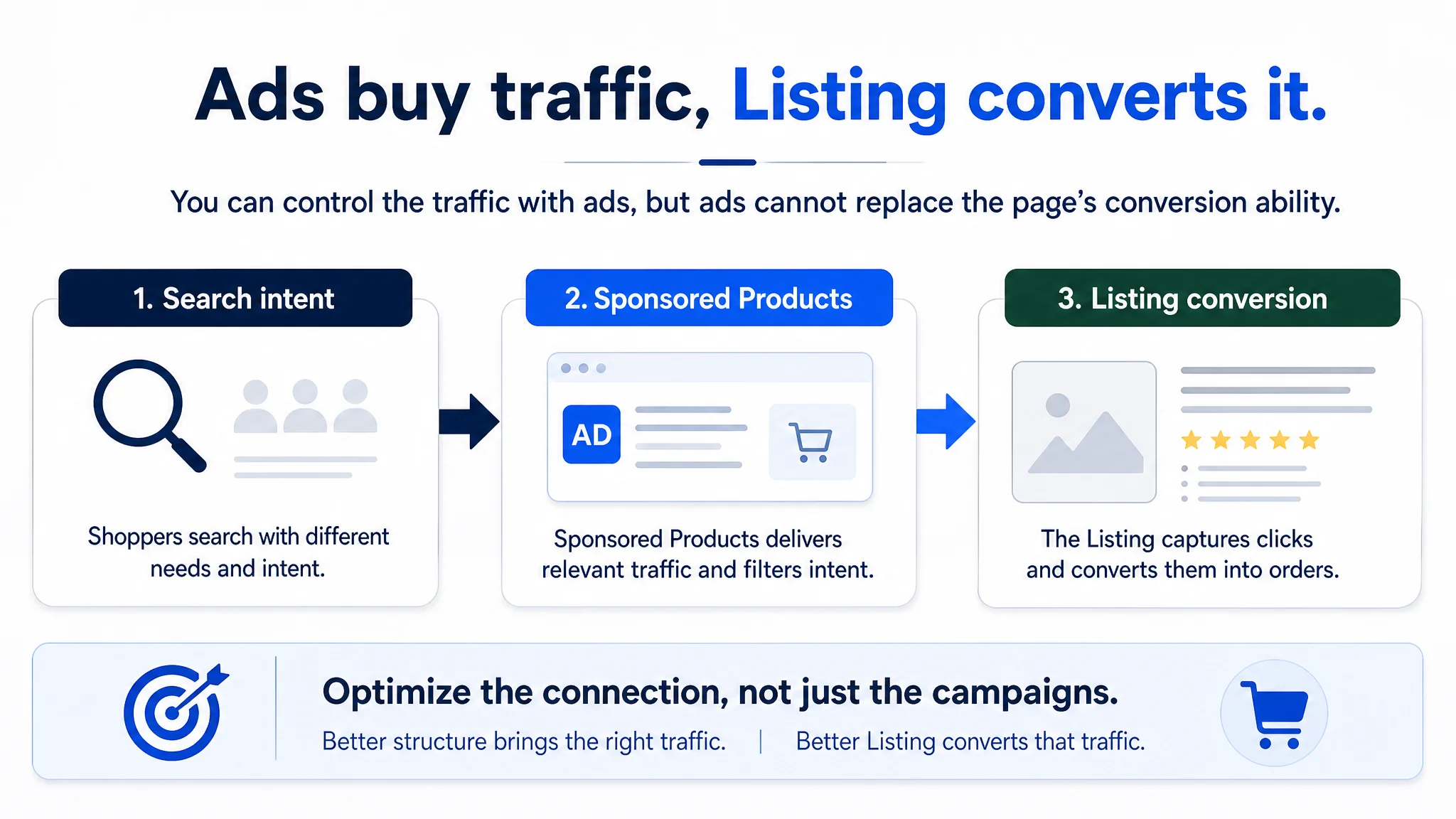
This is why the four-layer funnel should not be understood as permission to scale traffic mechanically. Discovery can absorb uncertainty, but precision and scale require stronger evidence. If the destination page has not been diagnosed, more traffic may simply amplify a page defect. Sponsored Products remains the spine of marketplace advertising, but the product detail page is part of the same operating system.
Google Search
Google Search is also intent-led, so its keyword and match-type logic helps clarify why Amazon discovery should not be confused with precision traffic. However, it operates in a different ecosystem: it has no competitor-ASIN targeting, its campaigns are not organized around a marketplace catalogue in the same way, and its auction has distinct ranking, query, and bidding dynamics.
Amazon practitioners can borrow the principle of separating intent, but they should not assume that a Google Search structure can be copied directly into Sponsored Products. On Amazon, the product detail page, ASIN relationship, retail readiness, and marketplace context influence how traffic should be screened and scaled.
The Listing problem described above reinforces this distinction. The seller’s team was treating the challenge as an advertising-parameter issue, but the missing information was page-level and marketplace-specific. A Google-style focus on keywords and bids would not answer whether the Amazon page was competitive against the relevant category benchmarks. On Amazon, campaign structure must therefore be evaluated together with the ASIN’s ability to convert the traffic being purchased.
Google Display and social PPC
Display and social campaigns often support awareness, consideration, and retargeting rather than capturing only active product-search demand. Retargeting often ranks among the highest-ROI types when the audience is large enough and ad frequency is managed; without sufficient audience volume or frequency control, however, efficiency can deteriorate.
Their creative and audience controls therefore offer a useful contrast, but they should not dictate Amazon lane design. Sponsored Products remains closer to marketplace intent, where CTR and CVR must be assessed alongside search terms, ASIN targeting, conversion volume, and ACoS.
The same comparison also clarifies why creative and landing-page quality cannot be separated from traffic quality. A campaign may reach shoppers with relevant intent, but the page still needs to communicate the product’s value and resolve objections. In the “N/A” Listing case, there was no evidence showing whether the page’s visual structure, bullets, A+ content, or reviews could support that process. This was not a reason to abandon advertising; it was a reason to diagnose the destination before using advertising data to make stronger claims.
Performance Max
Performance Max provides broader inventory coverage, but it offers less control than standard Search because it does not support keyword-level bidding. Asset quality, audience signals, negative keywords, and brand exclusions can still influence where the budget goes, yet the advertiser has less direct control over individual query allocation.
For Amazon operators, this reinforces the value of explicit Sponsored Products lanes: discovery can absorb uncertainty, screening can filter it, precision can protect efficiency, and scale can receive budget only after the evidence supports expansion.
It also reinforces the need to distinguish control over traffic from control over conversion. Even a highly organized Amazon campaign cannot compensate for a page whose conversion capacity is unknown. If the Listing has no clear benchmark, the advertiser may know where spend was allocated without knowing why that spend did or did not produce orders.
Account Segmentation: Brand, Non-Brand and Competitor Lanes
Unsegmented Sponsored Products budgets make it difficult to distinguish protected demand from experimental spend. A weak competitor campaign can absorb budget intended for proven category terms, while a strong branded campaign can conceal inefficient non-brand acquisition. Separate lanes give each objective its own budget logic and performance diagnosis.
- Brand lane: Defends branded search demand, captures shoppers already familiar with the product, and protects efficient sales that often support CVR and ACoS.
- Non-brand lane: Builds category reach through generic search terms and should receive the primary growth budget because it tests whether the Listing can win demand beyond existing brand recognition.
- Competitor lane: Tests selected competitor terms and ASIN targets under a defined risk limit. It should be treated as controlled acquisition, not as a substitute for proven category coverage. Use one normalised starting allocation rather than mixing independent percentage ranges: approximately 20% for brand, 70% for non-brand, and 10% for competitor, totaling 100%. The competitor lane must also carry an explicit cap, so exploratory spend cannot drain campaigns with established conversion and margin contribution.
Choose competitor targets through a competitor-layout-gap lens. Prioritize terms and ASINs where competitor coverage is thin and the competing detail page leaves room to win through visual structure, content clarity, or offer presentation. Competitor-lane clicks convert only when the destination detail page closes the layout and content gap relative to the benchmark competitor.
This point became especially important in the Listing diagnosis with no measurable scores. The problem was not merely that competitor campaigns had not been segmented. No true benchmark competitor had been locked, and there was no module-level comparison for the title, main image, bullets, A+ content, or reviews. As a result, the team could not tell whether competitor traffic was being lost because of targeting or because the destination page was less convincing than the competing detail page.
A competitor lane is therefore not just a traffic experiment. It is also a test of whether the Listing can compete after the click. If the competitor’s page provides clearer visual information, stronger use-case communication, comparison content, or more trust signals, increasing the bid does not remove that gap. The lane may produce clicks, but the page still needs to give shoppers a reason to switch.
Treat 20/70/10 as a starting hypothesis, not a universal rule. Reweight the lanes against your own margin data, CTR, CVR, ACoS, and stable advertising signals, then adjust caps as evidence accumulates. Before reallocating aggressively, make sure a weak lane is not being judged without considering the Listing experience that receives its traffic.
Keyword Architecture: Intent Ladder, Tight Themes, Controlled Broad Match
A keyword plan should follow buyer intent rather than search volume. High-volume terms can attract clicks while weakening CVR and raising ACoS when the shopper is still researching. Build an intent ladder with clear campaign roles:
- Precision lane: “stainless steel insulated water bottle 32 oz” signals a buy-now need and belongs in exact match.
- Category lane: “insulated water bottle” captures mid-intent shoppers comparing options and can support controlled exploration.
- Exclusion lane: “how to clean a water bottle” is informational rather than transactional and should be excluded when it produces irrelevant traffic.
Group related terms into tight themes instead of defaulting to one keyword per ad group. In modern auctions, several closely related terms can create greater signal density around the same product promise, improving relevance for CTR and CVR while making ACoS diagnosis easier. Single-keyword structures may offer control, but they can fragment data and lengthen the Listing and campaign optimization cycle.
Broad match still has a role, but it should be capped by budget and reviewed frequently. Use the discovery layer for keyword and comparable competitor-ASIN expansion. The screening layer filters candidates against recent performance, while the precision layer receives only harvested winners. Each week, move converting search terms into exact match and place non-converters on a negative list when they continue to consume spend without producing orders.
With the search-term signal flowing back into prioritization, stable CTR and CVR patterns—not surface-level volume—should determine which terms receive more budget.
Yet CTR and CVR should be interpreted through the entire search-to-purchase path. In the “N/A” case, the team had assumed that keyword and bid changes were the most direct route to improvement. But even if the targeting became more precise, the diagnosis still lacked answers to basic Listing questions: Was the main image competitive at the search-results level? Did the title communicate the relevant value clearly? Did the page resolve buyer concerns through its bullets and A+ content?
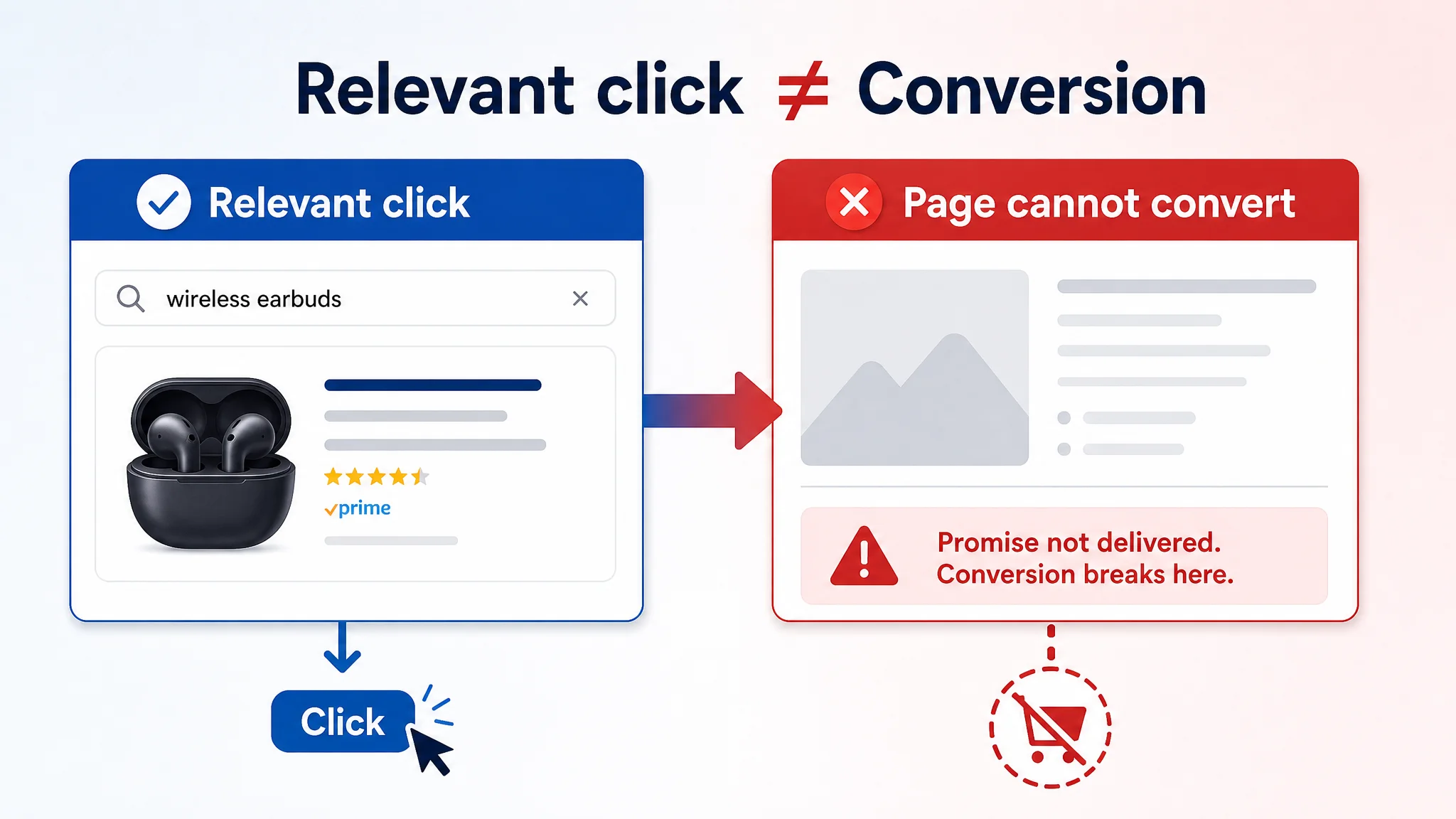
This does not mean a keyword plan is unimportant. It means that a keyword can be relevant and still fail to convert when the page does not support the promise behind the click. If a high-intent term produces clicks but no orders, the investigation should include both traffic relevance and page-level conversion capacity. Otherwise, the advertiser may keep refining the search term while leaving the actual conversion constraint untouched.
Bid and Budget Structure: Rolling Multi-Day Tuning and Learning-Phase Discipline
Bid and budget mechanics should follow a sound campaign structure rather than compensate for poorly separated keyword, match-type, or product architecture. Once the structure is coherent, give each campaign enough conversion volume to exit its learning phase. Search campaigns often need roughly one to two weeks, while automated campaign types may require longer. During this period, avoid major bid changes or pauses, because repeated intervention can make CTR, CVR, spend, and ACoS harder to interpret. Adding negative keywords remains a routine optimization and can be performed whenever clear irrelevance or waste appears.
Treat 30 days as a review milestone, not a fixed learning or reset rule. For reliable automated bidding, roughly 15–30 conversions within 30 days can serve as a practical working guide, but this is not a platform requirement. Actual confidence still depends on traffic quality, conversion consistency, and the campaign objective.
Targets should reflect economics. If products have varied margins, use margin-tier targets or profit-aware bidding rather than applying one account-level Target ROAS across the catalogue. A high-margin ASIN and a low-margin ASIN should not be held to the same efficiency expectation.
For daily management, review a trailing multi-day window of clicks, conversions, spend, and ACoS instead of reacting to a single anomalous day. DeepBI can support this evidence loop by bringing advertising report signals together for ongoing analysis. Record the reason, expected effect, and review date for every bid or budget adjustment so each decision remains explainable. The advertiser sets the objective—protecting margin or scaling growth—while the system supports disciplined execution rather than micromanaging every bid.
The same discipline should apply before the learning phase begins. A seller may need to allow a campaign time to collect evidence, but that does not mean every Listing is ready to receive more traffic. In the case with no Listing scores, the team had already been adjusting bids, budgets, match types, and campaign allocation while lacking a stable page-level diagnosis. Waiting longer under those conditions would not automatically create a better signal; it could simply produce more spend against an unknown page.
A useful distinction is:
- Campaign learning: whether the advertising system has enough data to evaluate targeting and delivery.
- Conversion readiness: whether the Listing gives shoppers enough clarity, trust, and evidence to purchase.
The first can be improved through stable campaign structure and sufficient volume. The second requires examination of the title, main image, bullets, A+ content, reviews, and competitive positioning. Both matter before scaling, but they should not be confused.
Structural Audit Before You Scale: Separating Waste From Bidding Noise
A defective structure turns every budget increase into a larger waste multiplier. Before scaling, apply one diagnostic rule: structural problems amplify as spend grows, while bidding problems more often appear as ACoS volatility despite relatively stable spend. Treat overlap, non-converting spend, and conflated lane goals as a mandatory pre-scale gate.
Add a second gate for the destination page: if the Listing has never been benchmarked, do not assume that more efficient traffic will solve the problem. The seller whose entire Listing report was marked “N/A” could not determine whether low CTR, if present, came mainly from the main image or title, or whether low CVR, if present, came from weak bullets, A+ content, social proof, or another page-level issue. Without that evidence chain, a bidding adjustment would have been difficult to interpret.
- Campaign segmentation: Measurement window: Review multiple periods, separating discovery, branded, competitor, and profit campaigns, Action: Reassign campaigns to one clear objective; separate discovery evaluation from profit evaluation
- Negative-keyword framework: Measurement window: Compare search-term performance across recent periods, Action: Add negatives where terms create overlap or repeated non-converting spend; preserve useful discovery paths
- Budget allocation logic: Measurement window: Compare budget, spend, CTR, CVR, orders, and ACoS by campaign, Action: Move budget toward campaigns that support the intended growth or profit lane
- Keyword cannibalisation: Measurement window: Check whether the same terms compete across campaigns and match types, Action: Define ownership and use negatives to reduce internal competition
- Zero-order spend share: Measurement window: Compare each lane with the account’s own multi-period baseline, Action: Investigate abnormal movement; do not apply a fixed threshold across categories, purposes, or account maturity
- ASIN-level TACoS: Measurement window: Review by ASIN across multiple periods, Action: Identify products where advertising spend is not supporting total-revenue efficiency
- Listing conversion capacity: Measurement window: Compare title, main image, bullets, A+, reviews, and page structure with a relevant benchmark, Action: Diagnose and repair page-level gaps before treating additional spend as a scaling solution
TACoS is one of the most useful high-level measures linking ad spend with total revenue, but interpret it alongside margin, ACoS or ROAS, and MER. Many waste issues stem from avoidable structural faults; strategy, creative, and measurement can also be responsible.
The Listing audit should be equally specific. Under normal conditions, a structured diagnosis can identify whether the main image has lower information density than the benchmark, whether bullets list features without resolving buyer pain points, whether A+ content lacks comparison or use-case support, or whether reviews and ratings are weak relative to category norms. Those findings create a path from an advertising symptom to a page-level action. If the report contains only “N/A,” the correct conclusion is not that one module is definitely responsible; the correct conclusion is that the evidence chain is incomplete and must be established.
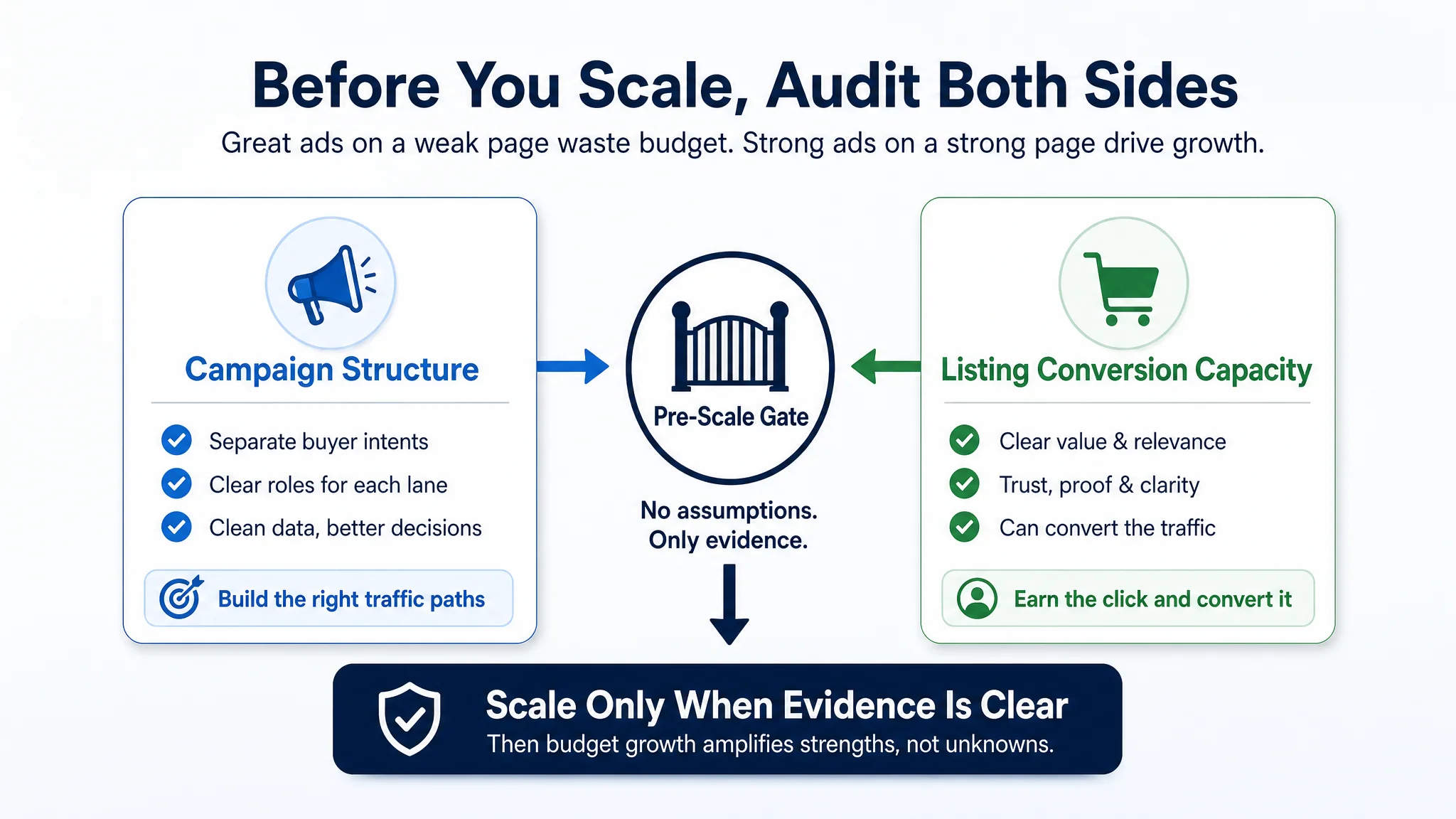
Concentrate keywords with strong CTR, CVR, and order value at Top of Search so paid volume and natural rank can improve together over time while TACoS trends down. But scale only after confirming that the page can support that volume. Otherwise, the account may improve delivery into a conversion constraint rather than improve the economics of the whole funnel.
Why PPC Results Vary for Small Advertisers
PPC performance rarely changes for a single reason. A campaign can show different CTR, CVR, or ACoS even when the advertiser makes no structural change, because auction conditions and customer behavior shift independently.
Key sources of variance include:
- Competing bidders: More aggressive advertisers can increase auction pressure, alter impression share, and raise the cost required to win relevant placements.
- Seasonality: Demand, shopper intent, and conversion patterns can shift by period, making one date range a poor baseline for another.
- Budget level: A limited budget may reduce reach or interrupt delivery, while a larger budget can expose the campaign to more varied traffic quality.
- Landing-page experience: If the Listing does not communicate value, answer objections, or establish trust, clicks may not become orders, weakening CVR and potentially increasing ACoS.
- Creative quality: Main images and other visual assets influence the initial click, help attract more relevant shoppers, and can affect targeting signals and cost efficiency. A creative change should be assessed through CTR and downstream CVR rather than appearance alone.
- Measurement and tracking quality: Missing, delayed, or inconsistent data can make a campaign appear to improve or decline when the reporting process changed instead.
- Learning-phase timing: Early delivery may not represent stable performance, so decisions made before sufficient signals accumulate can overreact to noise.
- Unknown Listing capacity: When the title, main image, bullets, A+ content, reviews, and competitive position have not been objectively evaluated, the advertiser may mistake a page problem for an advertising problem.
Some variance is environmental and cannot be structured away. Diagnosis therefore needs to distinguish market conditions from controllable problems in campaign architecture, Listing experience, creative, and measurement.
The “bad ads” assumption illustrates why this distinction matters. The seller saw rising costs and unstable orders, then cycled through bids, budgets, match types, keywords, and campaign allocation. But the Listing system contained no score or competitor comparison, so the team could not establish whether the page was ready to convert the traffic. The issue was not merely that the wrong optimization had been selected; the judgment base itself was missing.
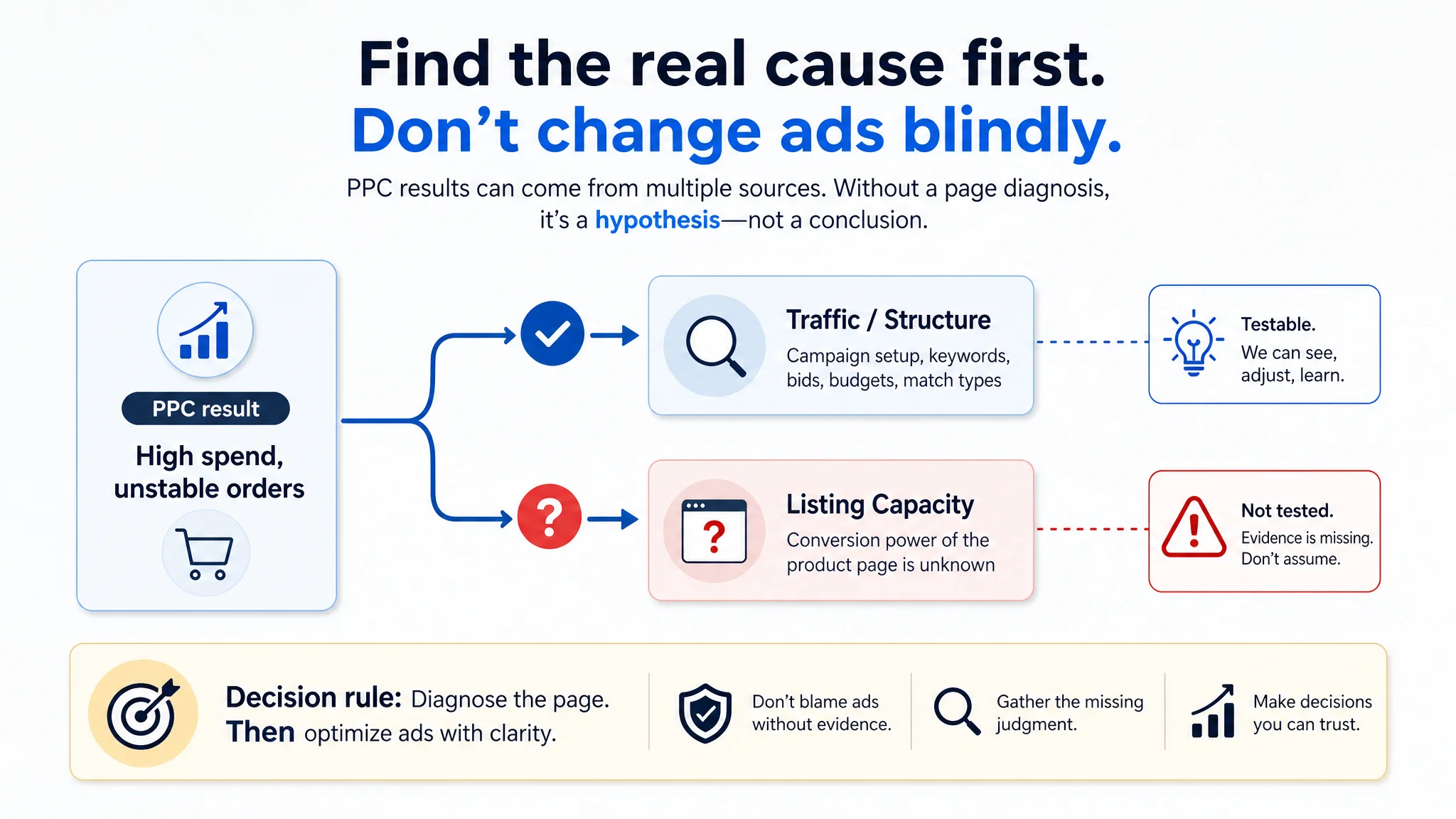
A normal Listing diagnosis would connect advertising outcomes to page modules:
- A low CTR might point toward the main image, title, or traffic relevance.
- A low CVR might point toward bullets, A+ content, reviews, trust, or offer communication.
- A difference between the ad promise and the product-page evidence might explain why relevant clicks do not become orders.
- A competitor gap might show why another page is more effective at moving shoppers from consideration to purchase.
These are hypotheses to validate, not conclusions to assume from an empty report. The correct operating sequence is to gather the missing evidence, establish the benchmark, identify the likely conversion gaps, and then test the corresponding advertising and Listing changes.
For this reason, rolling multi-day tuning helps dampen short-term volatility. After an image is uploaded, tracking CTR changes in advertising reports creates a clearer comparison window. A consistent campaign structure and repeatable scoring approach make period-over-period analysis more meaningful than anecdotal observations.
The broader lesson is simple: advertising should not be judged in isolation from the page it drives traffic toward. Structure separates intent, rolling analysis reduces noise, and Listing diagnosis explains whether the destination can convert the resulting demand. When those three layers are connected, PPC decisions become more interpretable and budget changes become easier to justify.