


Quick answer: AI-generated vs. AI-assisted on Amazon listings
The one-line rule
If AI created the listing content itself, classify it as AI-generated and disclose it. If a human created the content and used AI only to brainstorm, edit, or refine it, classify it as AI-assisted; disclosure is not required. Heavy human editing does not by itself change content that AI originally created into AI-assisted content. When the classification is uncertain, disclose conservatively and verify the current rule in Amazon’s official Help Center documentation.
The comparison table (placed here, at the top)
- Who created the content?: AI-generated content: AI created the actual text, image, or other listing asset., AI-assisted content: A human created the content, while AI provided limited support.
- Typical examples: AI-generated content: An AI system produces a product image or writes listing copy from instructions., AI-assisted content: A seller drafts the copy and uses AI to correct grammar, suggest wording, or refine structure.
- Does heavy editing change the classification?: AI-generated content: No. Human editing does not automatically remove the AI-generated classification., AI-assisted content: The content remains AI-assisted when the human remains the creator and AI only supports the work.
- Is disclosure required?: AI-generated content: Yes. AI-generated content must be disclosed through the applicable Amazon workflow., AI-assisted content: No. AI-assisted content does not require disclosure under this distinction.
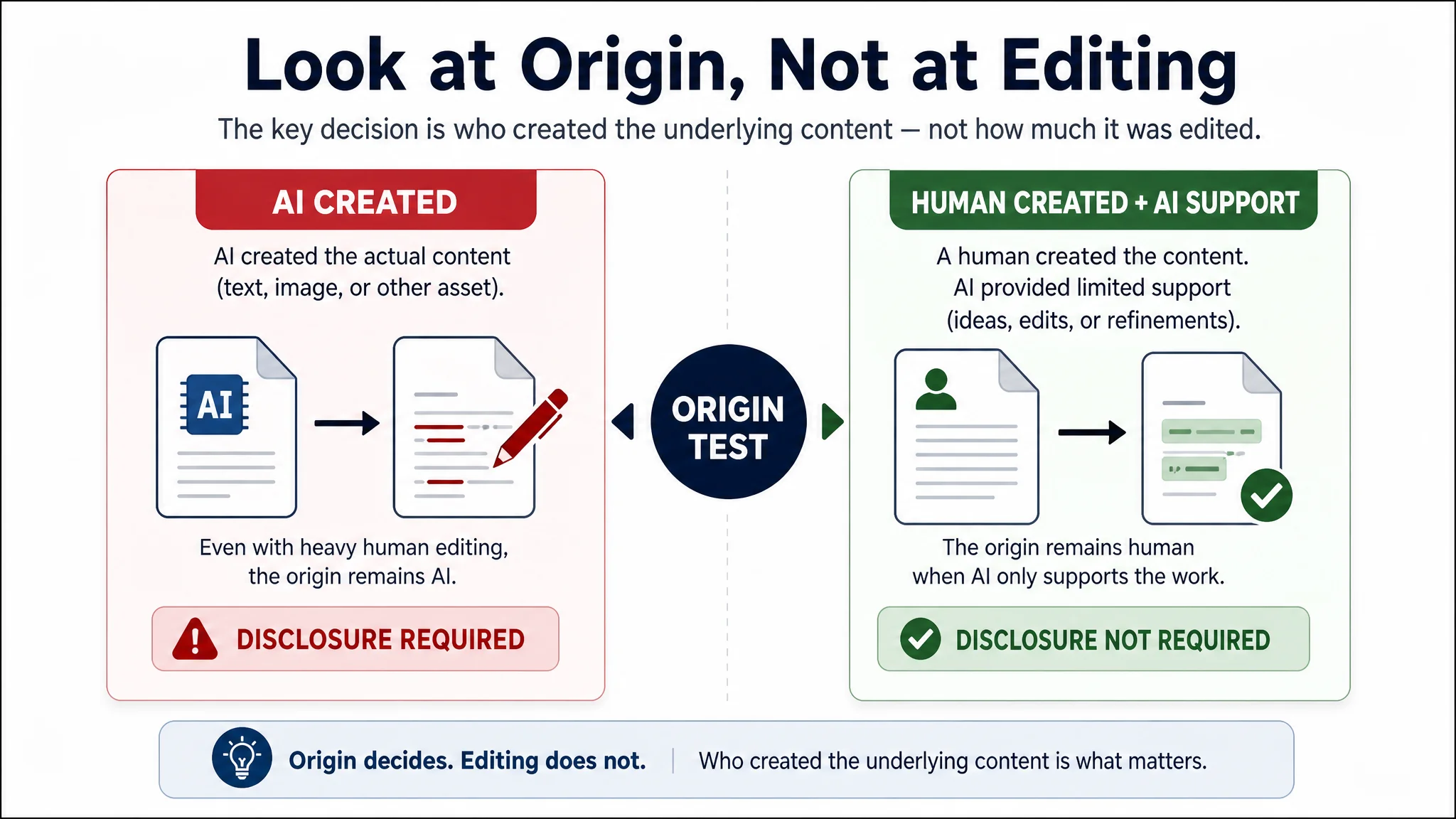
For sellers, the key decision is not how much time a person spent reviewing the output. It is who created the underlying content. A person can direct an AI tool, select the strongest result, and manually revise it, yet the result may still be AI-generated because the system produced the underlying asset.
This distinction matters beyond compliance. The origin of an asset also affects how carefully the team should validate its factual accuracy and product representation. In one grill-replacement-parts listing review, the seller already had titles, bullet points, images, and A+ content in place. The problem was not the existence of content, but whether each element accurately helped the buyer judge fit, material, durability, and value. A complete-looking page can still contain unsupported claims, unclear specifications, or visuals that fail to represent the product precisely.
Keep the same discipline for visual listing content. AI-generated images should remain faithful to the physical product. Changes to material, color, dimensions, or industrial design can create a product-image mismatch that affects customer trust, CVR, refunds, and reviews. Human approval should therefore check both disclosure classification and product accuracy before publication.
Do not assume that a disclosure is necessarily a customer-facing label, or that its placement is the same across Amazon workflows. Treat it as a required platform declaration where applicable, retain a record of how the asset was created, and confirm the current disclosure and visibility details in Amazon’s official Help Center as of the writing date.
Does Amazon allow AI-generated listings and books in 2026?
“Allowed subject to the rules” is not “approved”
As of the writing date, Amazon’s public guidance should be read as allowing certain AI-generated content only when it complies with the applicable rules. That is conditional permission to use a production method, not Amazon’s approval, endorsement, or certification of the resulting listing or book.
The distinction matters for both sellers and KDP-adjacent publishers. Using generative AI does not remove the obligation to provide accurate, non-misleading content, follow marketplace requirements, and meet any applicable disclosure obligations. A compliant workflow can reduce avoidable risk, but it cannot promise:
- Listing approval
- Search visibility or BSR improvement
- Royalties or sales
- A particular CTR, CVR, or ACoS outcome
- Immunity from enforcement or other account consequences
Verify the latest wording before publishing or updating content, because policy pages and implementation guidance can change.
- Amazon Seller Central — The primary account-facing source for seller policy requirements, listing rules, and operational guidance. Use it to confirm the requirements that apply to product detail pages and seller submissions.
- Generative-AI Content Guidelines in the Amazon Help Center — The relevant source for determining how Amazon distinguishes AI-generated content, AI-assisted content, and related disclosure responsibilities.
- Listing Content Guidelines in the Amazon Help Center — The source for requirements governing accuracy, relevance, formatting, and other conditions for marketplace listing content.
- KDP Content Guidelines — The authoritative source for publishing-related content requirements, including rules that may apply when AI is used to create or assist with books.
What the policy actually regulates
The rules regulate the content and the publisher’s or seller’s compliance responsibilities, not the commercial result. Disclosure, where required, is only one part of the review. The underlying text, images, metadata, and product claims must still be accurate and consistent with what the customer will receive.
A real listing diagnostic illustrates why these responsibilities should not be separated from commercial analysis. A grill-replacement-parts seller initially believed rising advertising costs and weak order growth pointed to a keyword or bidding problem. A product-page comparison showed that the more important weaknesses were elsewhere: the title diluted core search and fit information, the A+ section lacked persuasive visual proof, and the review layer did not provide enough trust. The page had content, but it did not make the product’s fit, durability, and value easy to judge.
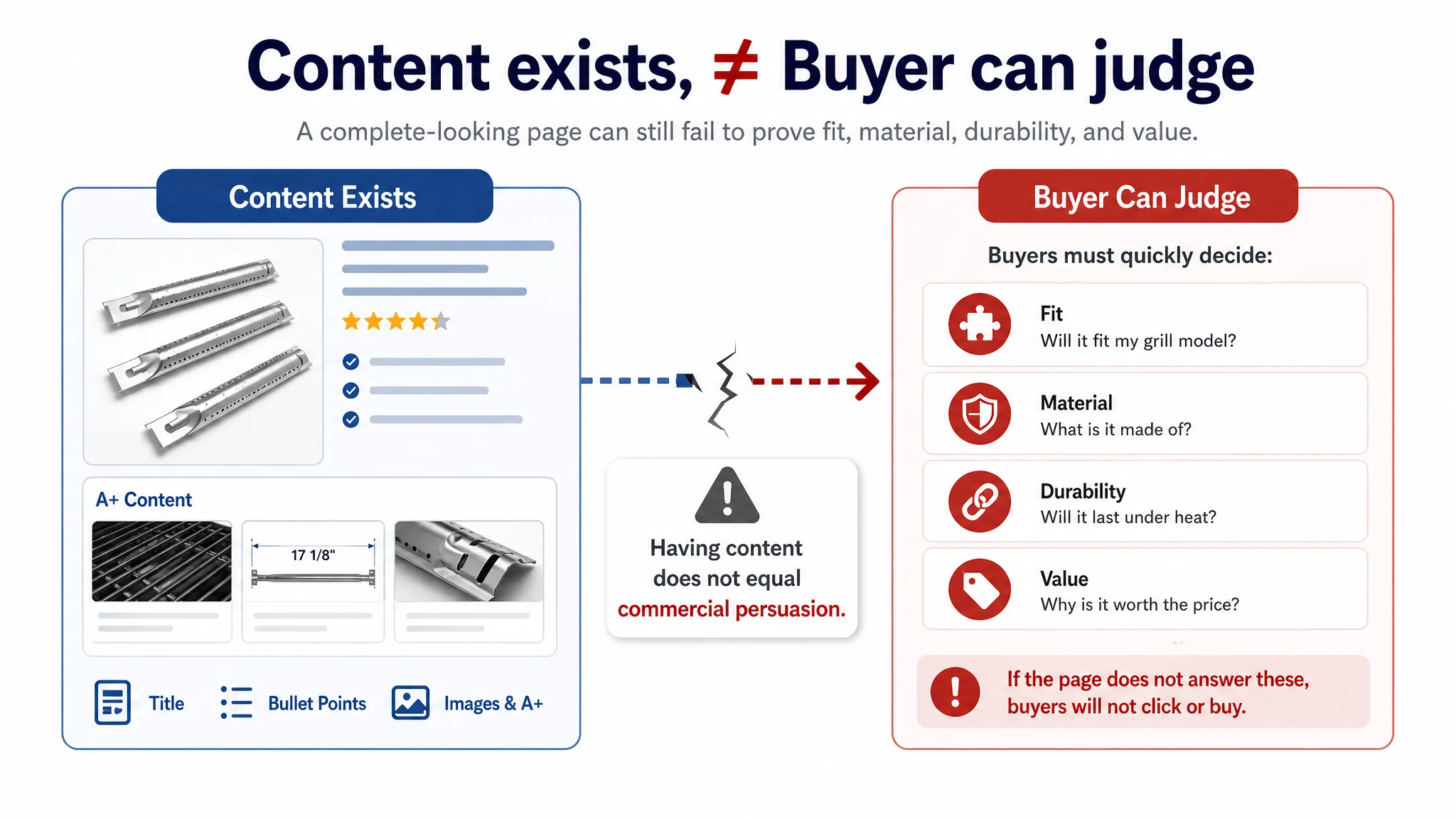
For listing images, product consistency is especially important. An AI workflow should not alter the product’s material, color, or industrial design merely to create a more attractive visual. A mismatch can increase customer dissatisfaction, refunds, and negative reviews even when the image passes a basic format check.
- Amazon Seller Central
- Generative-AI Content Guidelines in the Amazon Help Center
- Listing Content Guidelines in the Amazon Help Center
- KDP Content Guidelines
Use these official sources as the final verification point before submission, rather than treating AI use itself as evidence of approval or commercial safety.
AI-generated vs. AI-assisted content, in Amazon’s own words
The origin test, not the editing test
Amazon’s Help Center distinction is based on how the content originated, not on how much work a person performed afterward. In Amazon’s wording, AI-generated content includes text, images, or translations created by an AI-based tool. AI-assisted content, by contrast, begins with human-created material that a tool helps edit, refine, translate, or otherwise improve.
Use an asset-by-asset origin test:
- If an AI tool produces the first substantive draft of listing copy, the text is AI-generated, even if a seller later rewrites it.
- If a seller writes the copy and uses AI only to correct grammar or suggest alternate phrasing, the result is AI-assisted.
- If an AI system creates a product image, book cover, illustration, or translation, that asset is AI-generated.
- If a human creates the image or translation and AI only helps with polishing or correction, it is AI-assisted.
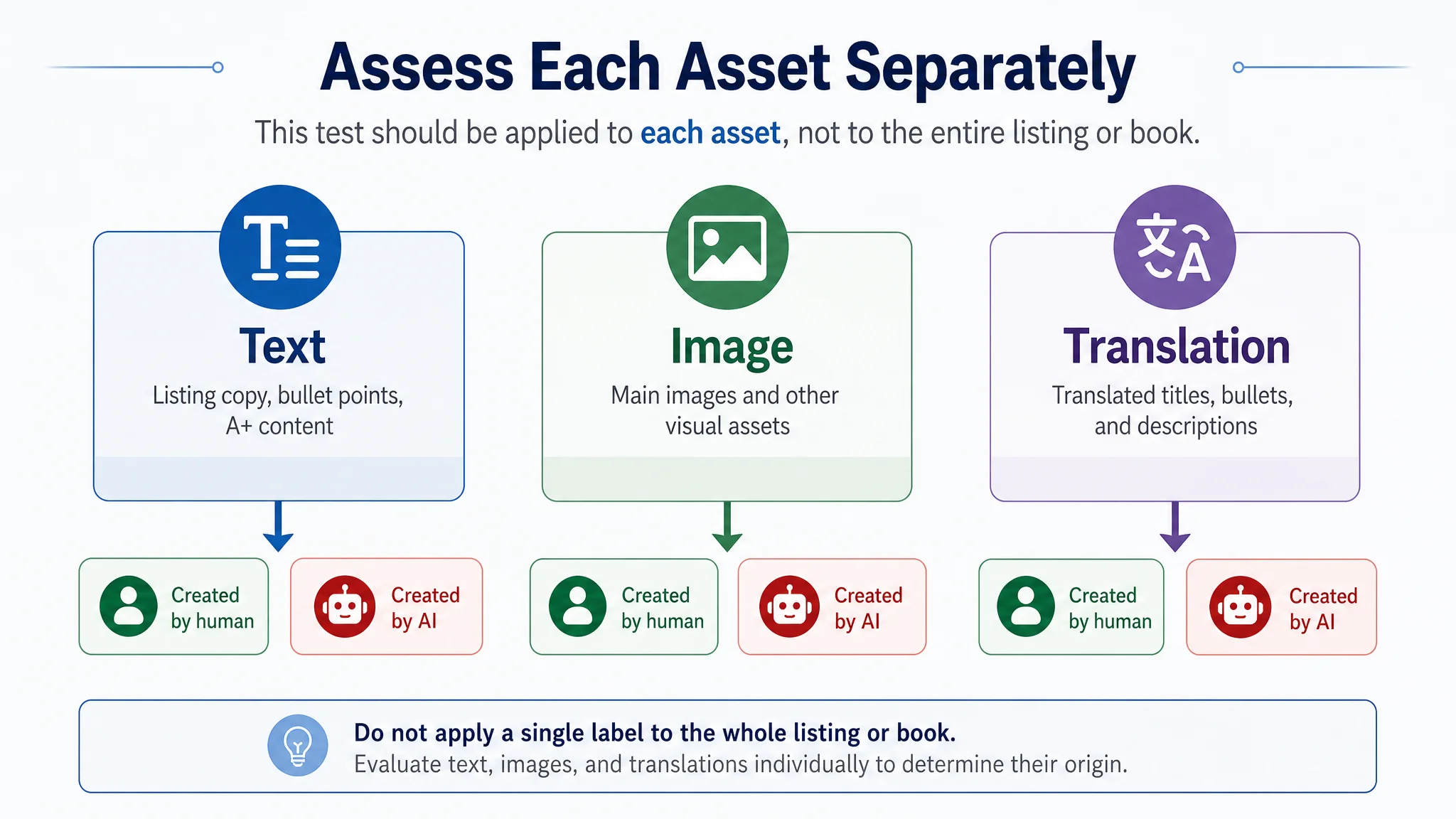
This test should be applied separately to each relevant asset rather than to the product or book as a whole. For example, a publisher may write a manuscript entirely by hand while using a generative image tool to produce its cover. The manuscript is human-created, but the cover is AI-generated. The fact that both assets appear in one publication does not merge their classifications.
The same component-level discipline is useful in marketplace operations because different listing assets perform different jobs. In the grill-parts diagnostic, the main images were actually stronger than the benchmark in terms of information coverage: they addressed functionality, material comparison, sizing, installation, and usage scenarios. Yet the A+ content remained a major weakness, and reviews supplied less trust. Treating the entire listing as simply “AI-made” or “human-made,” or judging it by one overall score, would have concealed those differences.
Why “I edited it heavily” is not a reclassification
Heavy human editing does not turn AI-drafted output into wholly human-created content under this distinction. Editing changes the final form, but it does not change the source of the initial generated material. Therefore, a seller should not treat extensive rewriting as an automatic move from AI-generated to AI-assisted.
The practical compliance question is simple: Did the AI tool create the underlying text, image, or translation, or did a person create it first? Record that answer for each asset before publication. If AI created the underlying material, retain its AI-generated classification when evaluating whether Amazon requires disclosure in the relevant workflow. If a person created the material and AI only supported revision, evaluate it as AI-assisted under Amazon’s Help Center framework. This approach avoids relying on subjective measures such as editing time, rewrite percentage, or perceived originality.
It also prevents a second operational mistake: assuming that extensive editing automatically makes the content commercially sound. In the grill-parts listing, the title was technically usable, but it diluted important compatibility information. The main images contained useful specifications, but the bright orange visual style and cluttered backgrounds weakened the industrial, precision-fit positioning. Editing effort alone did not determine whether those assets communicated the right decision logic. Origin determines classification; human review determines whether the asset is accurate, clear, and suitable for publication.
Does Amazon publicly label AI-generated listings or books for shoppers?
What the public guidelines do and do not describe
Amazon’s public materials support a narrower conclusion than either extreme commonly repeated by sellers. It is inaccurate to say that AI disclosures are guaranteed to remain private forever. Where Amazon’s requirements call for disclosure, the platform describes an indicator or disclosure mechanism that may be provided where applicable. That leaves open the possibility that information about AI-generated content can become visible beyond an internal review process.
It is equally inaccurate to claim that Amazon publicly flags every AI-generated book or listing for shoppers. The available guidance does not establish a universal, shopper-facing badge for all AI-generated content, nor does it confirm that every product page or book detail page receives the same treatment.
The practical distinction is between:
- Whether a seller or publisher must disclose AI-generated content to Amazon.
- Whether Amazon presents that disclosure to shoppers.
- Where an indicator appears, how prominent it is, and whether it applies consistently across product types.
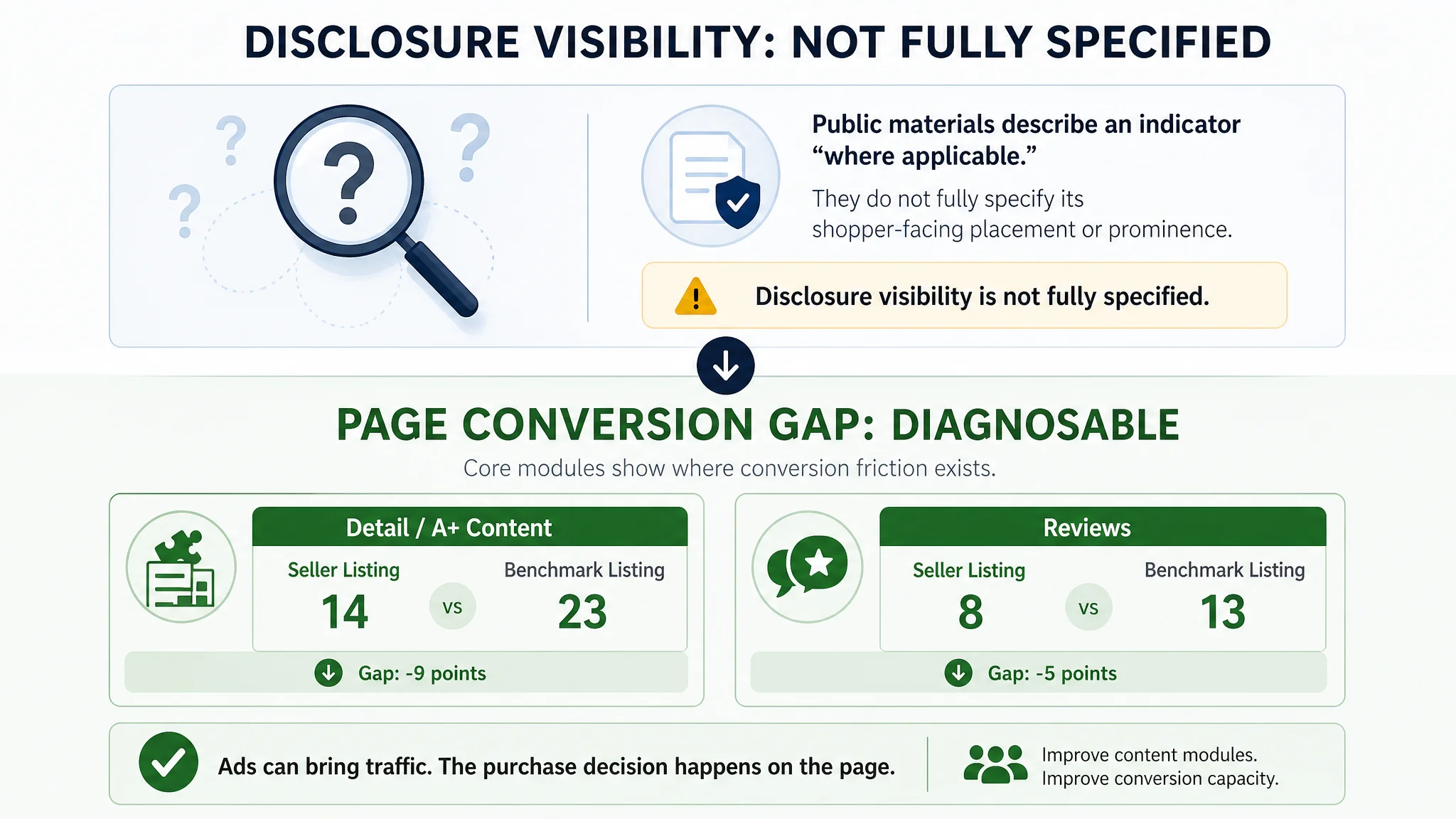
Public materials describe an indicator where applicable, but they do not fully specify its shopper-facing placement, visual prominence, coverage, or permanence. They also do not establish that disclosure alone automatically changes CTR, CVR, ACoS, BSR, or a listing’s organic visibility. Those performance effects should not be presented as verified policy outcomes without stronger evidence.
A listing diagnostic should therefore keep disclosure analysis separate from conversion analysis. In the grill-parts example, the seller’s total Listing score was 70/100 against a benchmark score of 80/100. The important finding was not a universal penalty attached to any one content-production method. The breakdown showed a 9-point gap in Detail/A+ content and a 5-point gap in reviews, while the seller’s main-image score was higher than the benchmark. The page’s conversion problem was tied to trust, proof, and decision clarity—not to an established public-label effect.
For compliance purposes, retain accurate records of how content was produced, follow the applicable Amazon workflow, and check Amazon-owned documentation again before publishing or updating a title or listing. The evidence should be treated as policy-specific and subject to change, not as a permanent promise of secrecy or universal public labeling.
The Audible narration contrast as a comparison, not a precedent
Amazon’s treatment of AI-related information can differ by product and feature. Audible narration provides a useful comparison because Amazon has described labeling for certain narration situations. That example shows that Amazon-owned products may use explicit disclosure practices when a particular feature requires them.
It does not prove that AI-generated book text, cover art, product images, bullet points, or other listing elements receive the same label. Nor does it establish the location, prominence, or scope of any indicator in another Amazon workflow. Sellers should use the Audible example to avoid assuming that one disclosure model applies everywhere—not to infer a universal precedent.
The defensible position is therefore limited: follow the applicable disclosure requirement, do not promise permanent privacy, and do not promise that shoppers will see a standard AI badge on every affected listing or book. Where public documentation stops short of explaining visibility details, verify the current official guidance as of the writing date.
Why does Amazon even ask—and could disclosure affect visibility?
What is verified about the
Amazon may present disclosure questions in publishing or listing workflows that ask whether submitted content was generated or assisted by artificial intelligence. The practical obligation is straightforward: when a workflow requires an answer, provide a truthful classification rather than treating the field as an optional marketing statement. “AI-generated” and “AI-assisted” should not be treated as interchangeable if Amazon defines them separately in the relevant instructions.
The compliance function is verifiable; the complete business rationale is not. Amazon may collect this information to support compliance review, content quality controls, rights enforcement, or related platform governance. However, the available public record does not establish that disclosure is collected for one single purpose, and it does not show that the field is irrelevant to performance.
This distinction also matters for listing operations. Content may be checked against separate technical and policy requirements, such as image dimensions, color mode, white-background rules, brand identity, and product consistency. A nonconforming asset can be blocked before upload or returned with a violation status. Those controls concern whether content can be processed or accepted; they do not, by themselves, establish how an AI disclosure affects CTR, CVR, ACoS, BSR, royalties, or listing visibility.
The commercial risk often appears through the content itself rather than through a confirmed disclosure penalty. A seller may see rising ACoS and assume that keywords or bids are responsible. In the grill-parts review, traffic was already entering through Amazon search ads, but the page did not convert that traffic efficiently. The team initially considered expanding terms, refining bids, and adjusting campaign structure. The diagnostic instead found weak A+ proof, limited review support, and a visual presentation that did not sufficiently communicate a precise, durable replacement part.
In other words, advertising can expose a content problem without proving that disclosure caused it. A required declaration and a page’s ability to earn trust are separate questions.
What is speculation, labeled as speculation
Speculation: Some sellers may assume that disclosure lowers search visibility, while others may assume that honest disclosure is rewarded with neutral or favorable treatment. Neither conclusion is established by the materials available here. Amazon has not publicly specified whether an AI disclosure changes rankings, impressions, placement, royalties, conversion performance, or other commercial outcomes.
The direct answer to the visibility question is therefore: the effect is unknown from the public record. Do not promise a penalty-free outcome, and do not claim that disclosure protects or harms BSR, CTR, CVR, or sales. Treat policy compliance and performance optimization as separate workstreams.
Before publishing or updating a listing, record the content classification, answer the required disclosure question consistently, and retain the supporting production record. Then verify Amazon’s latest official documentation as of the writing date, because the wording, scope, and treatment of disclosure fields may change.
The component map: listing copy, images, and translations
Text, images, translations, and how much you edited
Disclosure should be assessed component by component, not by asking whether AI appeared anywhere in the workflow. Under Amazon’s applicable Help Center distinction, AI-generated content is produced by an AI tool, while AI-assisted content is created by a person who uses AI for limited support and retains authorship. The official rule should control the final decision; where the Help Center does not resolve a boundary, record the uncertainty and confirm it before publishing.
- Listing title, bullets, description, or A+ text: AI involvement: AI drafts or substantially produces the wording, Extent of editing: Seller reviews, edits, and approves, Disclosure implication: Treat as AI-generated when the tool created the underlying text; limited proofreading or restructuring is closer to AI-assisted
- Translation: AI involvement: AI produces the translated version, Extent of editing: Human checks terminology and accuracy, Disclosure implication: Review under the applicable Amazon disclosure rule rather than assuming translation is exempt
- Main, secondary, or A+ images: AI involvement: AI creates the image or materially fabricates visual content, Extent of editing: Human selects or lightly adjusts it, Disclosure implication: Treat as AI-generated when the AI created the visual asset; ordinary resizing or formatting does not create a new classification
- Cover or interior illustration: AI involvement: AI creates all or part of the artwork, Extent of editing: Human edits, crops, or places it, Disclosure implication: Assess the generated portion separately and apply the relevant publishing disclosure requirement
- Coloring pages or other designed content: AI involvement: AI creates the underlying forms, scenes, or illustrations, Extent of editing: Human cleans, arranges, or compiles pages, Disclosure implication: Do not classify the whole work solely by the final editing effort
- Children’s content: AI involvement: AI assists or generates text, images, or activities, Extent of editing: Human reviews for safety, accuracy, and age suitability, Disclosure implication: Apply the same component-level analysis, with additional care because misleading or unsuitable content can create compliance and quality risks
AI-assisted work is not automatically disclosure-free, particularly where the tool generated a substantive component. Keep source files, prompts, revisions, and approval records so the classification can be defended.
The component approach also improves conversion diagnosis. For the grill-parts listing, the title was near parity with the benchmark, the bullet points showed no score gap, and the main images were ahead visually. The largest content weakness was the Detail/A+ layer. This is why a single “AI content quality” label or overall listing judgment is insufficient: a page can contain strong assets alongside a weak decision stage.
Images of people: the recognizability test
A real person’s photograph that receives light retouching is different from an image that fabricates a synthetic performer. Correcting lighting, removing a minor blemish, or adjusting presentation may leave an identifiable individual intact. It should not be treated as automatically safe: an AI edit that replaces the person, reconstructs the face, or changes the subject so that no identifiable real individual remains is closer to an in-scope synthetic image.
Photorealism and recognizability are practical boundary tests. A clearly non-photorealistic character will typically fall outside a rule targeted at photorealistic people, but the official Help Center wording should be checked where style, realism, or identity is ambiguous.
Non-AI generators and synthetic people: the honest boundary
A deterministic tool, such as a grid generator, is not automatically an AI system merely because software created the output. Its treatment should remain an interpretation requiring confirmation against Amazon’s official documentation. Do not label every software-made asset as AI-generated, and do not assume a non-AI label resolves a synthetic-person issue. Record the tool, its inputs, the edits made, and the final identity outcome before submission.
Disclosure mechanics: where the compliance step actually lives
AI-content compliance is not reliably handled by adding a note to a listing description or placing a label in an internal file name. The operational step belongs in the relevant publishing or listing workflow, supported by accurate records showing how each asset was created and changed.
In-product disclosure selections versus file-level metadata
When Amazon provides structured disclosure selections in a publishing or listing flow, complete those selections directly rather than relying on free-form explanations. The available workflow may distinguish which components contain AI-generated content and how extensively those components were edited before submission. For a KDP-adjacent publisher, that can require reviewing text, cover art, or other submitted elements separately. For a seller, the same discipline applies to listing images and other creative assets.
Do not infer field names, classifications, metadata keywords, or API parameters from third-party tools. Platform standards still apply independently: an asset can fail because it violates image requirements, while a visual alteration can create a separate product-consistency problem involving the product’s material, color, design, structure, or proportions. A disclosure selection does not cure either issue.
The same separation is necessary when reviewing performance. In the grill-parts listing, the team’s advertising diagnosis focused on keywords and bids because costs were rising. But the page-level review showed that the A+ section used black-and-white line art, sketch-style visuals, generic slogans, and scattered claims, while the benchmark used product photography, material comparison, thickness cues, and clearer proof of fit. No disclosure selection could repair that conversion gap. Compliance records explain how an asset was created; they do not make an unclear asset persuasive.
File-level metadata is a different layer. It should be treated as a local asset-management practice using ordinary image and file tools, not automatically as an Amazon-required disclosure mechanism. Record enough provenance to identify the original file, any generated alternative, the selected replacement, and the workflow history behind the decision. Avoid assuming that a particular keyword or embedded field is officially required unless Amazon’s documentation expressly says so.
The durable discipline: knowing what is in your asset library
The durable control is internal knowledge. A structured record can preserve the product’s non-changeable boundaries, while separate workflow records can show analysis, generation, evaluation, and delivery steps. Unique internal identifiers can link a score or review to its history, and an original-versus-replacement comparison can support a deliberate selection rather than automatic application of every generated asset.
At minimum, maintain an inventory that answers:
- Which assets are original, AI-generated, AI-assisted, edited, approved, or rejected?
- Which listing position or publishing component does each asset serve?
- What edits were applied after generation?
- Which file was actually submitted?
- Where is the supporting workflow or review record?
This inventory reduces response time when a compliance question arises and helps prevent an untracked asset from entering the listing. It also makes it easier to distinguish a compliance issue from a conversion issue. A listing can have an accurate image that still creates a weak first impression, or a compliant title that still buries the most important fit information. Those problems require different decisions.
Before publication, confirm the current disclosure selections, file-handling expectations, metadata practices, and workflow requirements in Amazon’s official documentation as of the writing date.
Practical risk checklist: listing copy, images, and ads automation
A safe workflow treats every asset as both a conversion input and a compliance record. Review before publication, preserve traceability across reuse, and do not use automation to work around Amazon enforcement.
Listing copy and images
- Confirm that titles, bullets, descriptions, and image text match the actual product, including measurements, materials, accessories, functions, and expected effects.
- Check AI-generated or AI-assisted copy for invented claims, exaggerated proportions, unsupported performance statements, and factual inconsistencies that could reduce CVR or increase refunds.
- Compare every generated image with a structured product-identity record before approval; preserve the product’s structure, proportions, logo placement, brand colors, and functional openings.
- Limit visual changes to approved presentation variables such as composition, lighting, background, angle, or scene, rather than changing the product itself.
- Validate mandatory image and listing requirements before submission, including applicable main-image rules, color mode, dimensions, image-slot placement, title limits, and other current Seller Central standards.
- Use both automated checks and human approval gates; route failed assets for correction instead of sending them live.
- Compare original and proposed assets individually, and require explicit approval before replacing any live image or copy element.
- Record the source asset, creator or tool, product or ASIN, variant, approved use, reviewer, and publication version for each catalog asset.
- Assign stable identifiers and change records so teams can trace which creative was reused, when it changed, and which listing received it.
- Do not assume that an image treatment approved for one ASIN is accurate for another; recheck product-specific constraints before catalog-wide reuse.
- Keep a source-of-truth hierarchy for visual work: product identity records take priority over original imagery, and competitor references must not override product facts.
A product-page review should also ask whether each compliant asset helps the buyer make a decision. In the grill-parts listing, the main image set covered many useful subjects, but bright orange styling, background clutter, and weak narrative continuity made the first impression less precise than the product category required. The recommended direction was a restrained blue-white industrial presentation, clearer dimensions, visible thickness cues, and an installed-in-grill context. These changes were not a substitute for compliance; they showed how accurate assets can still be improved as conversion inputs.
The same logic applies to copy. The seller’s title contained relevant terms but diluted core compatibility information with early dimension details and shorthand model references. A clearer structure would lead with the product type and material, then make compatibility and replacement information easier to scan. The objective is not simply more keywords or more AI editing. It is accurate information arranged around the buyer’s decision.
Ads and automation channels
- Treat advertising automation as a separate review surface: link each creative change to authorized reports and monitor CTR, CVR, ACoS, or TACoS without allowing performance data to excuse inaccurate content.
- Use Amazon’s approved API channel set, such as authorized Selling Partner API or advertising integrations, with only the permissions required for the workflow.
- Keep unsupported scraping, credential reuse, browser mimicry, and browser-automation substitutes outside publishing and advertising operations.
- Maintain request identifiers and publication logs to prevent duplicate submissions or unintended overwrites during synchronization.
- Understand enforcement as generally tiered, with possible warnings, restrictions, or suppression, while recognizing that some violations may trigger immediate action.
- Treat a warning as no safety net; verify the current Seller Central requirements and enforcement guidance as of the writing date before deployment.
Do not use advertising metrics as a shortcut for diagnosing listing content. In the grill-parts case, rising ad costs and inconsistent orders led the team toward keyword expansion, bid changes, and placement adjustments. The deeper comparison found that advertising was sending visitors to a page with trust gaps. The lesson is not that ads are unimportant; it is that ad optimization cannot repair an inaccurate or unconvincing product page.
Human-review workflow: build compliance in, do not bolt it on
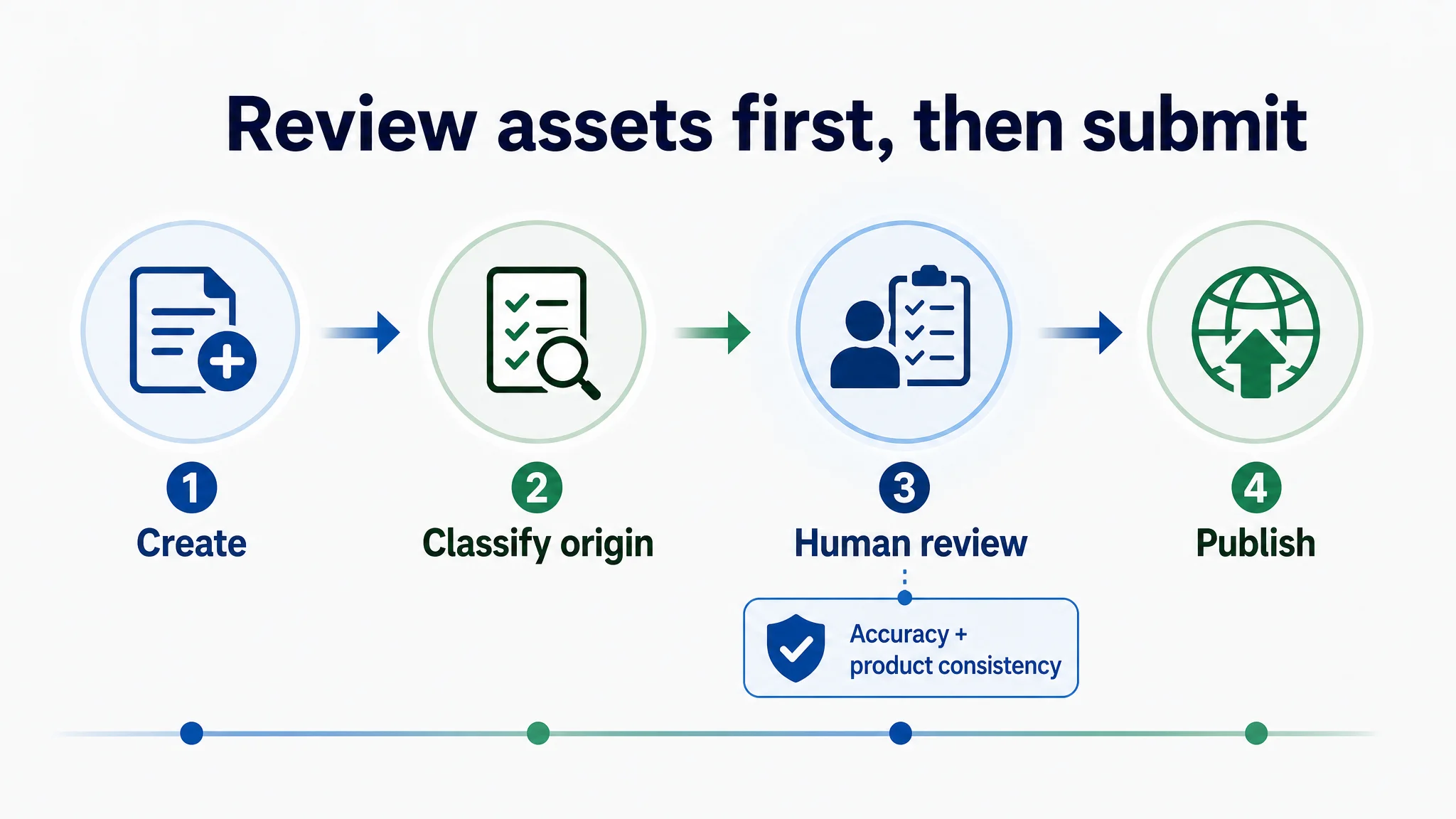
A reliable review process starts when an asset is created, not when a listing is about to be uploaded. Classify each component by origin at the point of production: human-created, AI-assisted, or AI-generated. Keep that classification in a structured record rather than relying on memory or free-text notes. For each listing, identify which words, images, edits, or variations were produced or materially changed by AI.
Before publication, route AI-assisted copy and AI-generated images to a human reviewer. The reviewer should compare the content with the approved product information and check claims, specifications, materials, logos, physical attributes, and image-to-product consistency. General-purpose image generation can alter a product’s structure or invent features, creating risks of negative reviews, refunds, or listing problems. A product-identity record can serve as a constraint, but it does not replace human judgment.
Human review should also assess whether the page makes the product’s value understandable. For the grill-parts listing, the diagnostic identified three practical buyer questions:
1. Will this fit my exact grill?
2. Is the material and thickness good enough not to rust, warp, or crack?
3. Is this safe, reliable, and worth the money compared with an OEM part?
The benchmark answered these questions more quickly through its title, visual hierarchy, A+ modules, and review evidence. The seller’s page left buyers to assemble the answers themselves. This does not establish that any particular disclosure affects visibility. It demonstrates why accurate, traceable content still needs human evaluation for clarity and trust.
Make the review auditable. Record:
- The asset or listing version reviewed
- The AI-generated or AI-assisted components identified
- The checks completed
- The reviewer’s name or identifier
- The review date and publication decision
Structured workflow records, unique report identifiers, original-versus-new comparisons, and user approval points can support traceability. The system should not apply replacements automatically when a human decision is required.
Compliance checks should be embedded in production through content validation, image-format checks, product-consistency checks, and pre-publication blocking where appropriate. Outdated prompts, templates, hard-coded rules, or tools that have not been revisited are a common risk, especially after Amazon changes its requirements. Re-audit the workflow whenever official policy is updated, and use the current Amazon Help Center documentation as the verification source before relying on any classification or disclosure decision.
Finally, treat Amazon processing language narrowly. A status such as successful, processing, or not blocked describes Amazon’s operational response; it is not a compliance guarantee. Human review reduces risk, but it does not guarantee approval or immunity from enforcement.
Where DeepBI fits: auditable Amazon listing compliance at catalog scale
DeepBI should be treated as an Amazon-only listing-content compliance aid, not as an authority that classifies content or approves publication. Its practical value is organizing listing copy and creative assets so human reviewers can examine more SKUs without losing the decision trail.
The workflow can bring together titles, bullet points, main images, A+ content, and related listing assets for structured review. Scoring identifies weak modules rather than reducing the listing to one overall score, while optimization plans record which changes were proposed and why. For larger catalogs, this creates a repeatable way to review content that may affect CTR, CVR, BSR, or listing cycle time without treating speed as a substitute for compliance judgment.
The grill-parts diagnostic shows why module-level analysis matters. The seller’s total score was 70/100 compared with 80/100 for the benchmark. Yet the breakdown was uneven:
- Title: 14 compared with 15
- Main images: 26 compared with 21
- Bullet points: 8 compared with 8
- Detail/A+: 14 compared with 23
- Reviews: 8 compared with 13
A single overall score would not have explained the business problem. The listing was not uniformly weak, and the main images were not the first area requiring more traffic or more production. The largest gaps were in detailed proof and social trust. This is the practical value of structured diagnosis: it helps teams identify where the page is losing the buyer rather than assuming that every weak outcome is an advertising problem.
Catalog teams can also use the workflow to keep variation families aligned: compare related child listings, check that shared claims and creative treatments remain consistent, and flag any item that requires human compliance review before publication. A proposed image or copy change should remain distinguishable from the original, with the reviewer confirming whether it is accurate, authorized, and suitable for the specific ASIN.
Traceability is central. Each scoring task produces a unique report identifier, allowing teams to connect the diagnostic output with proposed changes, reviewer decisions, and later revisions. Original-versus-proposed comparisons and explicit user confirmation support a manual origin-classification process: the reviewer determines whether the material is AI-generated or AI-assisted from the actual production history, then handles any required disclosure decision through the appropriate Amazon workflow. DeepBI does not apply disclosure labels, perform Amazon’s review, or guarantee approval.
Any platform-facing action also requires seller authorization. Advertising automation is a separate compliance surface and should receive its own human authorization and review rather than being treated as a DeepBI listing capability.
Common compliance myths and the corrections behind them
Myth: Heavy editing turns AI-generated content into wholly human-created content. Correction: No. Classification generally turns on origin, not the amount of later editing. If generative AI created the content, extensive rewriting, retouching, or formatting does not automatically erase that origin. Human editing may improve accuracy and compliance, but it should not be used as a reason to answer a disclosure question inaccurately.
Myth: Amazon approves AI content without conditions. Correction: No. Amazon permits AI-generated or AI-assisted content only within its applicable rules, including requirements for accuracy, intellectual-property rights, product representation, and any required disclosure. Permission is conditional, not a blanket approval. For visual assets, preserve product-entity consistency: AI should not alter the product’s material, color, industrial design, included accessories, or physical proportions. Otherwise, image-product mismatch can damage CVR and increase refunds or negative reviews.
Myth: Every AI-created asset receives a public label shoppers can see. Correction: Not necessarily. Public shopper-facing labeling is narrower and less fully specified than many seller discussions suggest. Do not assume that every disclosure produces a visible badge, or that no visible badge means disclosure was unnecessary. Follow the relevant Amazon Help Center prompt and retain your origin record.
Myth: Honest AI disclosure automatically lowers ranking or royalties. Correction: No published rule identified here ties an honest answer itself to a ranking or royalty penalty. Amazon also does not promise any particular CTR, CVR, BSR, sales, or royalty outcome. Treat disclosure as a compliance action, not a performance guarantee.
Myth: Any software-made asset is AI-generated. Correction: No. The relevant question is whether the tool used AI-based generation or transformation. Ordinary design, formatting, or editing software is not automatically generative AI.
Myth: A listing with enough content is automatically ready for more traffic. Correction: No. Content presence and conversion capacity are different. The grill-parts listing had a title, bullet points, image set, and A+ section, but buyers still lacked enough visual proof and trust to make a confident decision. Before increasing ad spend, confirm that the page clearly establishes fit, quality, use, and value.
Myth: Geographic or statutory claims apply everywhere. Correction: Unverified unless supported by a dated official source. Separate Amazon’s platform guidance from reported seller experiences and local-law commentary; neither should be presented as universal policy without authoritative support.
When in doubt, disclose: tie-breakers, scope caveats, and FAQ
When classification is uncertain, use the conservative rule: when in doubt, disclose. This is general guidance, not legal advice; the official Amazon policy governs, so verify the latest Seller Central and KDP Help Center documentation as of the writing date.
- Apply the origin test: classify text, images, and translations by whether an AI-based tool created them, not by how heavily you edited them afterward.
- Record the decision: note which listing components contain AI-generated content and how much human editing occurred.
- Check creative assets separately: review covers, illustrations, interior content, and translations rather than assuming one answer covers the entire listing or book.
- Verify public-label assumptions: Amazon materials describe an indicator “where applicable,” but do not fully specify shopper-facing prominence. Do not promise permanent privacy or a confirmed public badge.
- Recheck before publication: compare your records with the latest official Seller Central and KDP Help Center wording, and consult the Amazon Privacy Notice where relevant.
- Diagnose performance separately: if CTR, CVR, or ACoS is weak, do not assume disclosure is the cause. Review the title, images, bullets, A+, reviews, and product-page trust signals before changing advertising inputs.
- Use the tie-breaker: if the official wording does not resolve the classification, disclose and retain the basis for your decision.
FAQ
- Does heavy editing remove the disclosure obligation? No. Substantial editing does not change AI-generated content into human-originated content.
- Does Amazon approve AI content automatically? No. Content may be allowed subject to the rules, but approval or performance is not guaranteed.
- Will shoppers always see an AI label? Not necessarily. Public materials mention an indicator where applicable, without fully defining its prominence.
- Does disclosure guarantee no ranking or royalty effect? No published outcome should be assumed in either direction.
- If advertising costs rise, should I change bids first? Not automatically. Confirm that the listing can convert the traffic it receives. A page with weak fit communication, limited product proof, or insufficient trust may consume additional traffic regardless of bid adjustments.
- Is this legal advice? No. It is general guidance based on official documentation reviewed in March 2025; verify the latest official policy before acting.