

Benefits of AI-generated listing content on Amazon
AI-generated listing content is most valuable when it reduces listing cycle time without weakening the decisions that affect CTR, CVR, ACoS, and BSR. A reported workflow example shows the production process falling from about one hour to under 15 minutes. That is a meaningful operational gain for sellers managing frequent launches, localization, or large catalogs, but it should be treated as recovered production capacity—not proof of higher sales. Better results still depend on relevance, clarity, compliance, and product-market fit.
Scale is another practical advantage. A dedicated bulk AI tool is reported to create hundreds of listings in roughly 15–30 minutes, allowing teams to move beyond one-by-one drafting. Amazon’s own generative AI can also produce more than 70% of required listing attributes in many cases, reducing repetitive data entry. These capabilities can shorten the path from product information to a reviewable draft, particularly when teams must maintain multiple SKUs. The remaining work—checking attributes, claims, variations, and marketplace requirements—cannot be treated as optional.
Consistency improves when the input framework is consistent. Fixed prompts, defined style constraints, and structured product data can keep titles, bullets, and brand language aligned across a catalog. They also make revisions easier to control. However, AI output can drift from the required tone, omit a critical selling point, or introduce unsupported wording. Human review remains necessary before publication, especially for factual accuracy and prohibited claims.
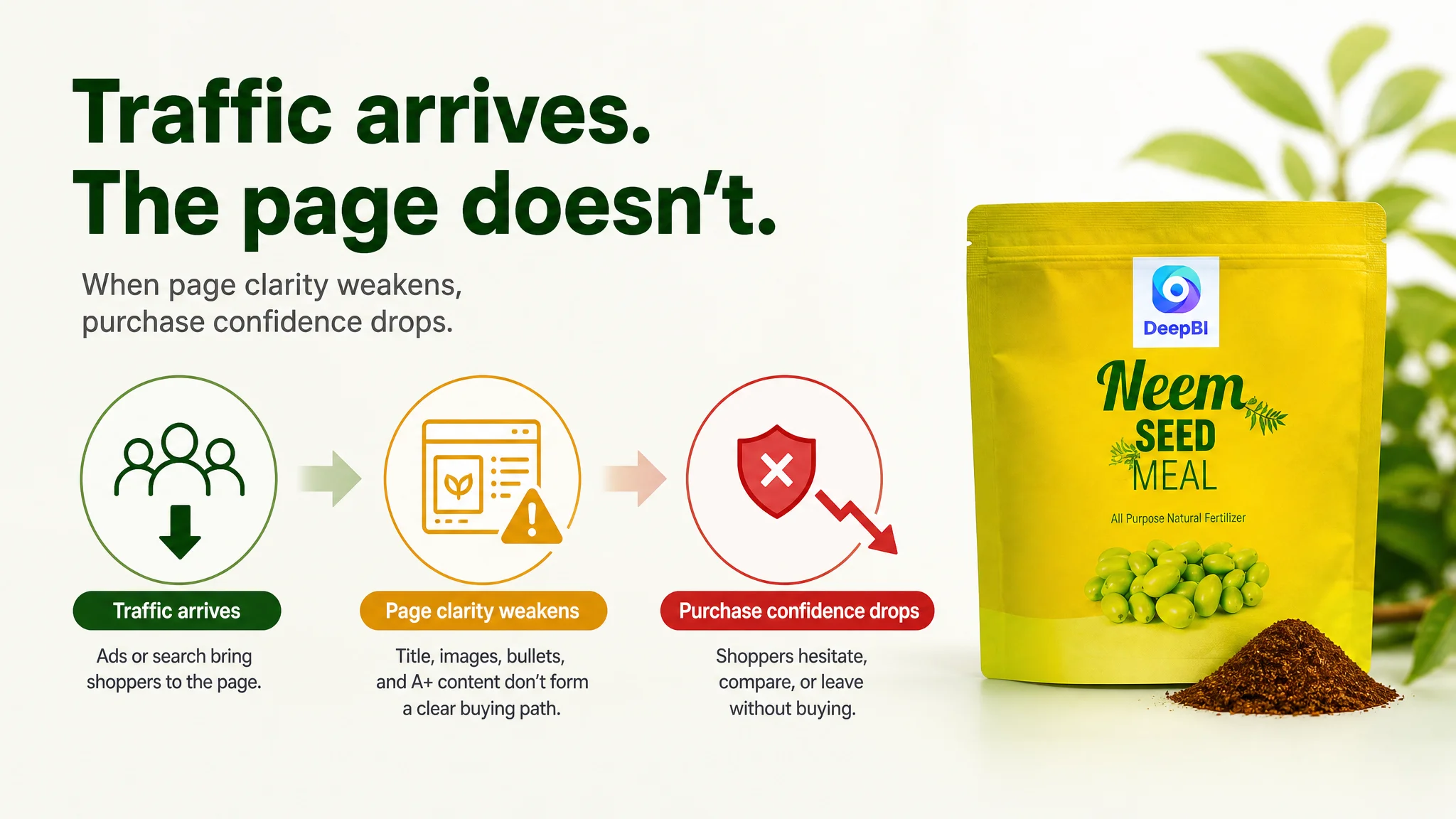
The conversion mechanism has two stages. Keyword relevance and title structure help the product appear in front of qualified shoppers and support search visibility. Once traffic arrives, bullets, A+ modules, usage explanations, and trust elements must address doubts and persuade the shopper to buy. AI can accelerate both stages, but it does not automatically improve either CTR or CVR.
A gardening-category listing illustrates why this distinction matters. The product page had a real product, usable claims, product images, A+ modules, and enough customer feedback to support a purchase decision. Yet the page was not converting as effectively as a stronger comparable listing. The initial instinct was to add more product information and reinforce broad benefits. DeepBI’s comparison later showed that the deeper problem was not simply a lack of content: the title delayed its most important keyword, the main images repeated product identity, the bullets lacked enough proof and process guidance, and the A+ content did not answer the buyer’s practical questions.
The useful question is therefore whether AI closes a measurable competitor-layout gap: weak title hierarchy, thin bullets, missing A+ modules, unclear product form, or duplicated visual content. In the gardening listing, the page did not primarily need more claims. It needed a clearer sequence for helping shoppers understand what the product was, why they should trust it, how it worked, and how to apply it.
DeepBI Listing supports this controlled workflow by benchmarking comparable competitors and using multi-agent scoring across titles, bullets, A+ content, visuals, and reviews. Its structured strategy generation turns diagnostic gaps and product constraints into executable title, bullet, and A+ plans rather than generic copy. Sellers can compare the old and new versions, confirm the approved output, and use one-click SP-API publishing to synchronize content instead of downloading, renaming, and uploading assets manually.
That automation can reduce delivery time from dozens of minutes to seconds, while strategic review remains with the seller. The business case is therefore strongest when AI serves as a governed production layer: faster drafting, broader scale, consistent execution, and clearer conversion readiness—not a guarantee of sales growth.
Amazon AI listing features sellers can use today
Amazon’s Accelerate 2025 adoption signal shows that generative AI has moved beyond experimentation: more than 900,000 selling partners have used Amazon’s generative-AI tools overall, while more than 400,000 have used product-listing workflows. These figures describe two different populations. The first covers Amazon’s broader generative-AI ecosystem; the second refers specifically to workflows for creating or improving product listings.
For listing work, Amazon provides several native entry points. Sellers can generate listing content from a product description and images, convert a publicly available product URL into a draft listing, and create multiple listings in bulk. Amazon also provides assistance for developing A+ Content, support through Enhance My Listing, and broader seller-assistance tools, including Project Amelia-style business guidance. These features can reduce listing cycle time, especially when sellers are working across large catalogs or multiple marketplaces.
Amazon’s generative-AI tools are powered by Amazon Bedrock. However, access to generation does not remove the need for quality control. Amazon evaluates output quality through a composite data-quality score that incorporates seller submissions, human audits, seller feedback, and listing acceptance rates. Sellers should therefore treat AI-generated copy and assets as drafts: review the claims, confirm product accuracy, check policy alignment, and approve the content before publishing.
The commercial question is not simply whether Amazon can produce a title, bullet points, images, or A+ modules. It is whether the resulting content addresses the listing’s actual weaknesses. A polished rewrite may still fail to improve CTR if the main image lacks differentiation, or fail to support CVR if the copy does not resolve important customer concerns. It may also create compliance or rejection risk when product attributes are inferred incorrectly.
The gardening listing made this problem visible. At first glance, it appeared to contain sufficient information: product identity and quantity, natural and soil-health claims, application-related messaging, package imagery, A+ benefits, and customer reviews. But the content did not consistently answer four basic buying questions:
1. What exactly am I buying?
2. Why should I trust this product?
3. How does it work in soil and around plants?
4. How should I apply it without making a mistake?
The page was not empty, but its information did not form a complete buying argument. This is why native AI generation should not be evaluated by how fluent the resulting copy sounds. The more important test is whether the content helps the shopper progress from recognition to confidence and then to action.
That is where an execution layer can add structure without replacing Amazon’s native tools. DeepBI works within the Amazon ecosystem and extends the workflow through competitor benchmarking, diagnostic scoring, structured optimization instructions, and one-click synchronization through Amazon’s official SP-API. Its scoring layer can assess areas such as the main image, title, bullet points, A+ Content, and customer feedback against a relevant competitor set.
The workflow connects diagnosis to delivery: approved assets can be synchronized after seller confirmation rather than being handled through repeated downloads, renaming, backend logins, and manual uploads. In the gardening example, the useful outcome of comparison was not the score by itself. It was the connection between each score gap and a buyer decision: title clarity affected search and click motivation, images affected differentiation and trust, bullets affected proof and usability, and A+ content affected expectation management.
The practical distinction is clear. Amazon supplies broad generative assistance and marketplace-native publishing routes; DeepBI helps sellers determine what to change, translate findings into executable content directions, and deliver approved updates efficiently. Sellers can then evaluate the result through relevant signals such as CTR, CVR, ACoS, BSR, listing acceptance, and listing cycle time rather than relying on the apparent fluency of AI-generated text alone.
Creating listings from product descriptions and images with AI
AI-generated listing content is most effective when it starts with verified product evidence rather than a blank prompt. A practical workflow connects product data, image assets, competitor analysis, diagnostic scoring, and human approval. The objective is not simply to produce more copy; it is to reduce listing cycle time while protecting the factors that influence CTR, CVR, ACoS, and BSR.
1. Collect the source material. Gather existing product descriptions, confirmed specifications, product facts, logos, packaging details, and available image assets. These inputs should represent what the product actually is and what the seller can substantiate. Ambiguous details should remain unresolved rather than being filled with invented parameters, materials, functions, or accessories.
2. Build the product structure. DeepBI Listing maps the product’s “Product DNA” from original images and verified parameters. This record defines structural, material, branding, and other non-changeable attributes. It serves as the source of truth for later copy and visual concepts, helping prevent image-product mismatch caused by AI altering the product’s physical characteristics.
3. Extract attributes and selling points. The system organizes product facts into usable attributes, benefits, use cases, and customer-relevant information. In many cases, AI can generate more than 70% of the required attributes, reducing repetitive manual data entry. That figure should be treated as a productivity aid, not a guarantee that every generated field is accurate or complete.
4. Generate the listing draft. Using the structured product data, create the title, bullet points, detail or A+ content, and visual concepts. DeepBI Listing can also evaluate title keyword layout, selling-point clarity, feature coverage, pain-point coverage, and readability. Multiple copy or visual versions can be generated and compared before the seller selects the assets worth keeping.
5. Benchmark against competitors. Compare the draft with suitably similar competitor ASINs, selected by factors such as product form, function, price range, audience, and market validation. Look for the weakest competitor structures and content gaps: unclear title logic, incomplete feature coverage, weak bullet sequencing, missing parameter visualizations, or insufficient usage and trust information. Use those gaps to guide improvements without copying competitor product details or designs.
A comparison of a neem seed meal fertilizer listing shows why this step is more useful than a general rewrite. DeepBI found a total Listing score of 67 out of 100, compared with 86 out of 100 for a comparable high-performing listing. The largest gap was in the main images, followed by the title and A+ content. That distribution indicated a structural problem across the early click decision and the later trust decision, rather than a single missing phrase.
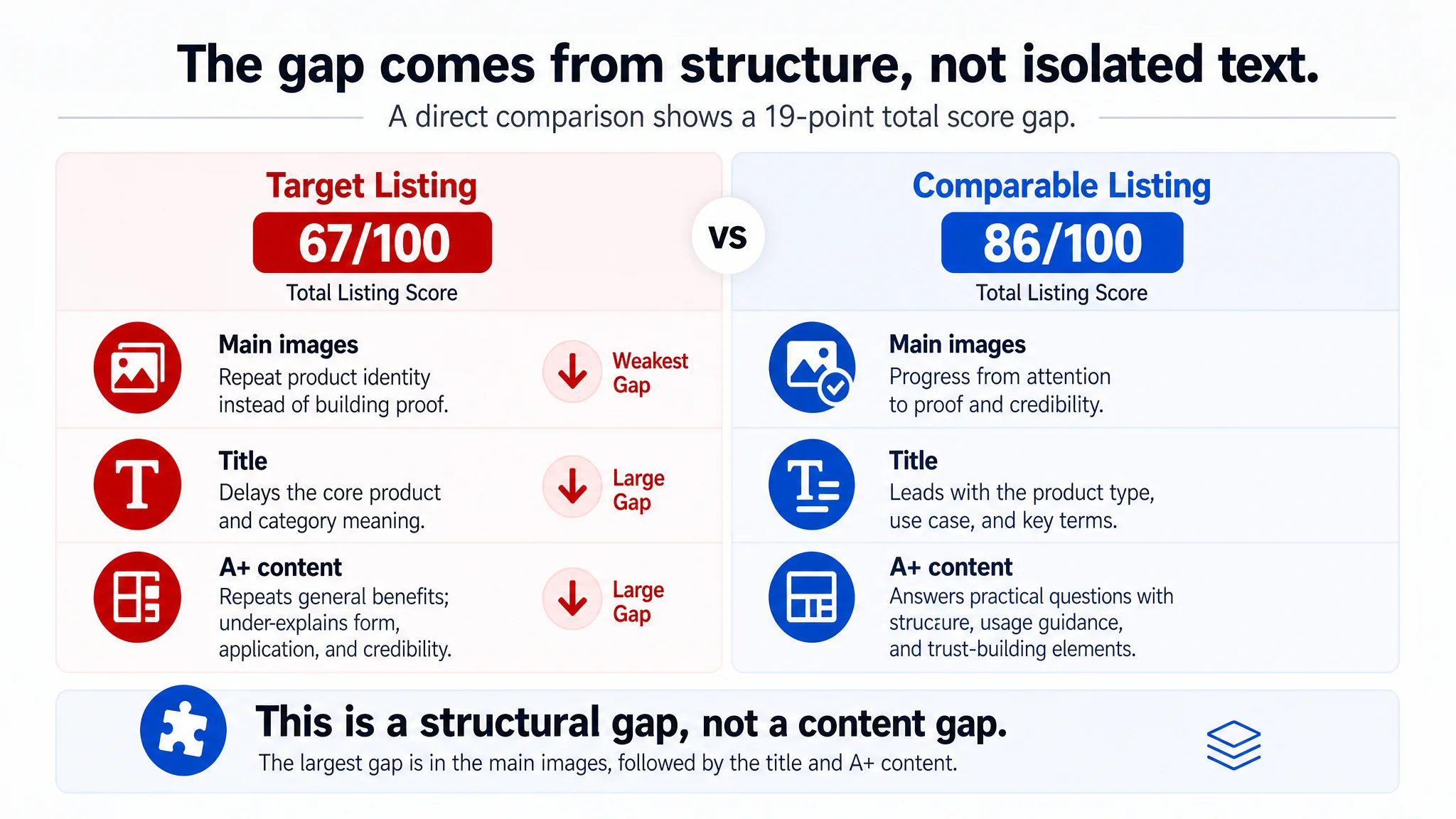
6. Score and review the listing. Listing quality should rely on composite internal metrics, not subjective praise. DeepBI Listing scores dimensions such as the main image, title, bullets, enriched content, and customer feedback, then identifies the modules contributing to score gaps. Before approval, verify required Amazon attributes and platform constraints, while editing for factual accuracy, brand voice, readability, and compliance.
7. Publish only approved assets. Human confirmation remains essential. Review old-versus-new versions, choose which individual assets to replace, and approve the final package. After approval, one-click SP-API synchronization can reduce a manual upload process from many minutes to seconds, while placing approved assets into the appropriate listing slots and monitoring submission status.
The key principle is that AI should not merely turn product facts into more words. It should help organize those facts according to the decisions shoppers need to make. A product page with information in every module can still underperform if the information repeats itself instead of moving the shopper from product recognition to credibility, usage understanding, and purchase confidence.
Turning an existing product website URL into an Amazon listing with AI
An existing product website can be a useful starting point for Amazon listing generation, particularly when the seller already has organized product information but lacks the time to adapt it manually. The required input is a publicly accessible product URL that contains relevant details such as product specifications, materials, dimensions, features, usage information, and approved product claims.
Access conditions are non-negotiable. The URL must not be protected by a password, subscription, or paywall. The seller must also own the website content or have explicit permission to reuse it for Amazon listing creation. AI should not be treated as a license to copy third-party descriptions, images, claims, or specifications. It should transform authorized source material into an Amazon-ready structure.
A controlled workflow typically follows these steps:
- The seller provides the accessible product URL.
- The system extracts relevant product information from that supplied source.
- The information is organized into Amazon listing components, such as the title, bullet points, product description, and other required fields.
- The seller or responsible operator verifies factual accuracy, product claims, specifications, completeness, and Amazon policy compliance.
- Approved content is published through the appropriate Amazon workflow.
The value is greatest when the process reduces listing cycle time without weakening content control. Faster generation can help a seller move from product data to an active listing more quickly, but speed alone does not guarantee higher CTR, CVR, lower ACoS, or improved BSR. Incorrect measurements, unsupported benefits, or exaggerated claims can create customer confusion, negative reviews, and costly revisions.
A reported example describes a seller managing more than 800 items who created approximately 300 AI-generated listings. That result demonstrates the possible scale of a URL- or data-supported workflow, not a standard output or guaranteed outcome. The actual volume depends on source quality, product complexity, category requirements, review time, and approval capacity.
The same limitation applies to the quality of the source itself. A website may contain many descriptions and benefits, but those statements still need to be organized around Amazon shopper decisions. In the gardening listing, the available information included natural-origin claims, soil-health positioning, application-related messaging, and product imagery. Yet the Amazon page still left practical questions unanswered, including the product’s physical form, how it worked in soil, and how a gardener should apply it. Simply transferring more website language would not have resolved the conversion problem.
DeepBI Listing is positioned as the control system behind this process rather than as an unrestricted AI writing tool. It can extract structured product DNA from existing product data, defining a single source of truth for the product’s attributes and boundaries. It can also compare listing elements with carefully matched competitors, diagnose gaps in titles, images, bullets, detail pages, and reviews, and convert those findings into generation-ready optimization instructions.
Before delivery, the workflow includes accuracy and compliance checks, including product-DNA consistency and Amazon image requirements. Once the seller approves the output, DeepBI Listing can synchronize approved content through Amazon’s Selling Partner API, subject to authorization and granted permissions. This helps reduce manual upload friction while preserving seller confirmation before content replaces existing listing assets.
Bulk-creating listings with AI
At catalog scale, the main advantage of AI-generated content is not novelty but throughput: it can reduce listing cycle time and remove a manual bottleneck without removing the controls needed to protect CTR, CVR, ACoS, and brand consistency.
- Prepare a structured input file before generation. Start with a spreadsheet or SKU list containing the product facts, target audience, positioning, selling points, variation details, and other approved inputs required for each listing. Accurate upstream data matters: unsupported claims, missing specifications, or incorrect product constraints can spread across many SKUs at once.
- Use a batch workflow instead of drafting one SKU at a time. Run AI generation across defined SKU groups, with prompts and product information mapped to each item. DeepBI Listing is designed as the execution layer for this process, combining multi-agent strategy generation with multi-SKU AI production rather than treating every listing as an isolated writing task.
- Translate diagnosis into an impact-ranked checklist. Prioritize the changes most likely to affect listing performance, such as product positioning, target audience, selling-point order, or gaps in the existing copy. DeepBI can convert diagnostic findings into structured optimization checklists, helping teams focus on changes with potential relevance to CTR, CVR, ACoS, or BSR instead of applying generic rewriting instructions.
- Use time benchmarks as directional, not universal promises. Reported comparisons suggest that manually writing a small batch may require roughly 2–3 days, while general chatbot drafting may take about 5–8 hours. A dedicated bulk AI workflow may produce drafts for hundreds of listings in roughly 15–30 minutes under suitable conditions. Actual time depends on input quality, review depth, catalog complexity, and the number of corrections required.
- Sample-review the outputs before approving the batch. Inspect a representative sample across products, variations, and input conditions. Check factual accuracy, readability, brand voice, keyword intent, variation logic, and compliance. Fast generation does not guarantee identical quality across every SKU, so sampling is the minimum control for detecting errors before they multiply.
- Correct systematic problems at the source. If multiple listings show the same omission, awkward structure, unsupported claim, or tone mismatch, revise the prompt, product data, or optimization rule before regenerating the affected group. This is more efficient than editing each listing independently and helps prevent recurring defects from extending the catalog-wide listing cycle time.
- Compare new and existing versions before publishing. Use DeepBI Listing’s old-versus-new comparison workflow to review proposed changes and select individual assets or listing elements rather than accepting every generated revision. Human reviewers should retain control over brand voice, exceptions, factual verification, and compliance decisions.
- Publish only approved listings through the connected delivery workflow. After evaluation and final approval, DeepBI Listing can synchronize selected changes through Amazon SP-API, reducing repetitive upload and placement work. The team remains responsible for the final approval gate, including confirming that the published content accurately represents the product and complies with Amazon requirements.
The gardening listing also demonstrates why batch workflows need diagnosis before generation. If a team identifies only that a page “needs more content,” it may generate additional benefit statements across titles, bullets, images, and A+ modules. That can increase volume while preserving the original problem. The more useful checklist identifies distinct gaps: delayed product meaning in the title, repeated product identity in the images, incomplete application guidance in the bullets, and insufficient expectation management in A+ content.
Scale becomes valuable when it reproduces a sound decision framework—not when it reproduces the same generic wording across a catalog.
Using AI to create A+ content
- Amazon-reported A+ Content benchmarks: Basic A+ Content uses Amazon’s standard content modules to add structured product explanations, supporting visuals, feature sections, and comparison elements below the core listing copy. Premium A+ Content offers a broader set of richer modules and presentation options, allowing sellers to build a more immersive persuasion experience. Amazon has reported that basic A+ Content is associated with sales increases of up to 8%, while premium A+ Content is associated with increases of up to 20%. These are reported association ranges, not guaranteed outcomes. The observed effect can vary substantially by category, demand level, product-market fit, content quality, traffic quality, and the strength of the existing detail page. Sellers should therefore evaluate A+ changes against seller-specific CVR, revenue per session, ACoS, and listing cycle time rather than treating the benchmark as a forecast.
- DeepBI Listing product documentation: A+ Content belongs to the persuasion and trust-building stage of the detail-page conversion process. It can expand on core selling points, address customer concerns, explain usage scenarios, present verified certifications or endorsements, and strengthen calls to action. The commercial issue is often not a lack of design activity, but incomplete persuasion coverage.
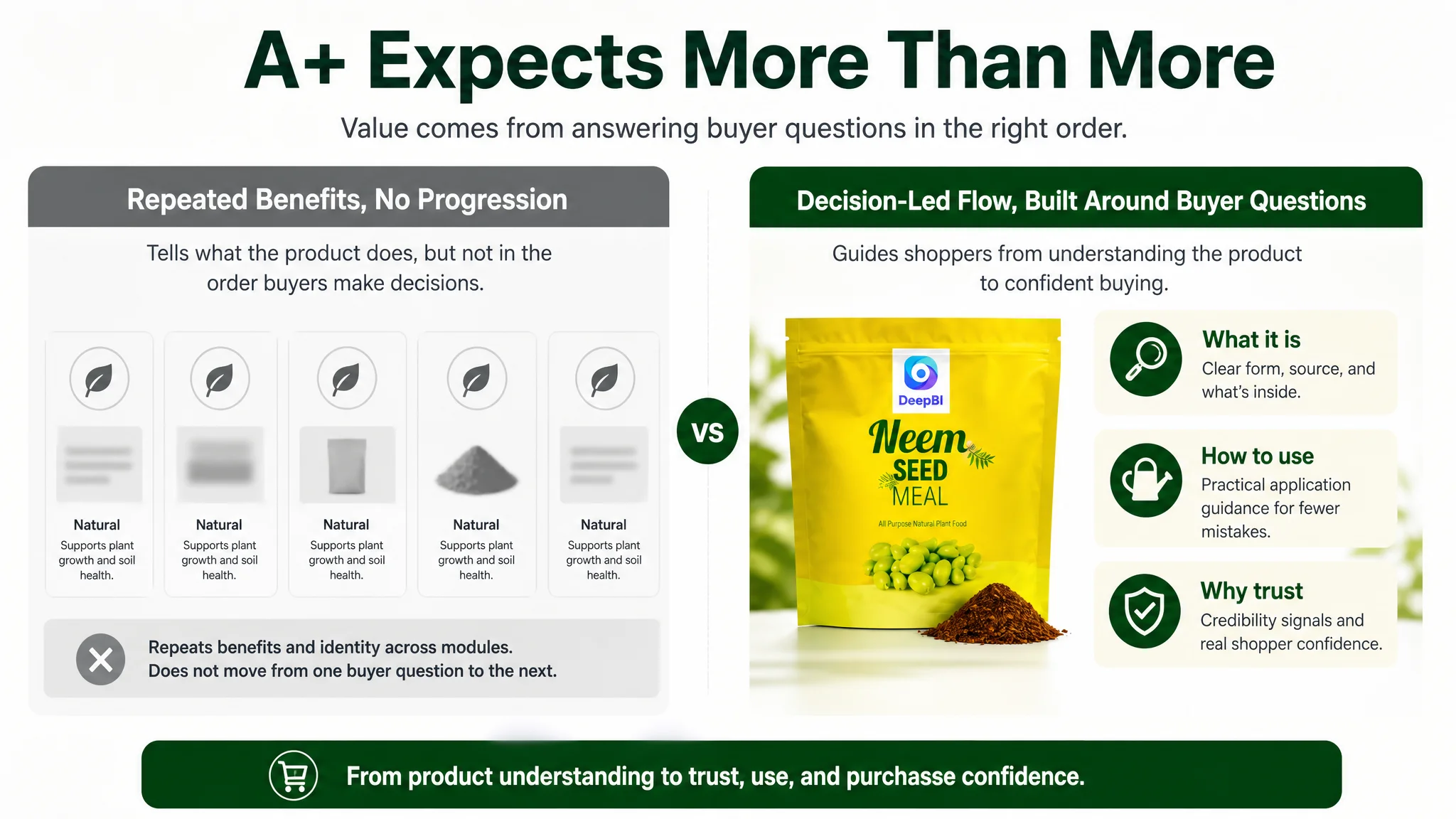
A neem seed meal fertilizer listing made this distinction clear. Its A+ content already included core selling-point imagery, application scenes, functional icons, and benefits lists. The problem was that the modules did not progress from one buyer question to the next. The page did not sufficiently clarify whether the product was processed neem meal, a powder, a pellet, or something closer to raw seed material. It also repeated general benefits without providing enough practical application guidance.
A listing may therefore have traffic and acceptable CTR while losing potential customers at the CVR stage because its A+ area is thin, repetitive, or missing high-value modules such as comparison tables, deeper specifications, authoritative proof, or scenario-based explanations. Adding another benefit icon is not necessarily an improvement if the shopper is still unsure what will arrive or how to use it.
- DeepBI Listing product documentation, DNA-first generation workflow: AI lowers the production barrier for A+ Content, which traditionally required substantial copywriting, design, review, and implementation resources. DeepBI generates Listing A+ content from the product DNA graph, using verified product structure, materials, logo placement, and functional details as the source of truth.
This boundary matters: generated content should not introduce unsupported features, specifications, materials, certifications, or internal structures. In the gardening example, the content could responsibly work with confirmed information such as neem seed meal, natural or plant-based positioning, slow-release nitrogen, supported nutrient analysis, soil and plant applications, and other substantiated product characteristics. It should not add a certification simply because a comparable listing uses one.
The workflow supports multiple-version generation for comparison, followed by front-end preview and user-controlled review of old and new assets. Approved content can then be synchronized through one-click application using Amazon’s SP-API.
- DeepBI Listing product documentation, competitor-layout-gap analysis: Competitor references should identify opportunities, not become templates for copying. Comparing A+ layouts can reveal that comparable listings use fuller module coverage while a seller’s page leaves key areas underdeveloped or absent. These gaps provide specific optimization actions: add a credible comparison structure, clarify usage scenarios, strengthen trust backing, or improve the sequence from product introduction to pain-point resolution and action guidance.
In the fertilizer listing, the relevant A+ sequence was more specific than “add richer content.” It was to:
1. Clarify the processed neem meal or powder form.
2. Explain why the product was worth choosing using confirmed attributes.
3. Show the primary application method.
4. Validate relevant plant and soil scenarios.
5. Explain the longer-term product mechanism without overpromising.
6. Close with a final, substantiated trust signal.
That sequence turns A+ content into a decision tool rather than a collection of decorative modules.
After publication, sellers should monitor the relevant ASIN’s CVR and supporting business metrics. Where visual iteration events are tracked in advertising reports, the resulting feedback loop can also connect content updates with CTR movement and help determine whether the A+ investment supports stronger conversion economics or lower ACoS.
Accuracy, measurement, and the questions sellers still ask
An AI draft is not evidence that a listing is accurate or commercially effective. Sellers need to evaluate both data quality and business results. Amazon’s quality signals are composite rather than based on one content check: they can reflect seller-submitted information, human audits, seller feedback, and listing acceptance rates. A listing that appears complete but contains unsupported specifications, unclear attributes, or claims that shoppers cannot verify may create downstream risk even if the copy reads smoothly.
AI can help identify and fill common missing attributes, organize product information, and produce a structured first draft. It should not be treated as the final compliance decision-maker. The seller remains responsible for checking the output against the actual product, confirming required details, removing unsupported claims, and approving what is submitted. Human review is particularly important where an error could create product-content mismatch, negative feedback, refunds, or listing restrictions.
Accuracy also requires a measurement framework. A practical review should compare the listing before and after an approved change, while separating traffic, conversion, and profitability signals:
- Impressions and CTR: Do more relevant shoppers see the listing, and are they clicking it?
- CVR: Once shoppers arrive, does the page persuade more of them to purchase?
- ACoS and TACoS: Does the improvement support more efficient paid sales and a healthier balance between advertising and total sales?
- Organic share and organic traffic: Is a larger portion of business coming from unpaid visibility rather than relying exclusively on advertising?
- BSR and listing cycle time: Does the workflow support stronger commercial momentum without creating an unnecessarily slow content-production process?
The logic is visibility plus persuasion. Keyword relevance and accurate attributes help shoppers find the product. The title, bullets, images, A+ content, and reviews then help them understand the offer, trust it, and convert.
The fertilizer listing showed why these signals need to be separated. DeepBI’s comparison identified a page-wide conversion gap, but the diagnosis did not establish a post-optimization advertising result. It would therefore be inaccurate to claim a specific ACoS reduction, CVR increase, or organic-order recovery. The evidence supported a different conclusion: before sending more paid traffic to the page, the seller needed to improve the page’s ability to turn visits into confidence and orders.
Better listing effectiveness can contribute to organic strength when relevance and conversion signals improve, but no workflow should promise a guaranteed ranking outcome.
DeepBI’s Organic Traffic bridge applies this logic by using high-CTR and high-CVR keyword signals to prioritize terms for top-of-search efforts and natural ranking growth. The purpose is not to declare every high-volume term valuable. It is to connect search-term evidence with listing decisions and traffic priorities, then observe whether the resulting changes improve CTR, CVR, organic share, or advertising efficiency.
For credibility, sellers should retain a controlled record of each change: the approved asset or copy, the target keywords, the publication date, and the subsequent KPI movement. AI supplies speed and structured recommendations; seller review, Amazon quality signals, and measured outcomes determine whether those recommendations deserve to remain live.
Conclusion: making AI-generated content effective on Amazon
AI-generated listing content is most useful when treated as a high-quality first draft, not as a replacement for strategic ownership. Its effectiveness should be judged by measurable workflow and marketplace signals:
- Measure time saved: Track listing cycle time and the hours required to move from product data to an approved, publishable draft.
- Check listing quality: Review factual accuracy, required attributes, brand voice, compliance, and alignment with the product’s real specifications before publication.
- Protect human control: Use [DeepBI: Listing] to support diagnosis, generation, comparison, publishing, and refinement, while sellers review and approve the final content.
- Monitor buyer behavior: Compare CTR, CVR, ACoS, and TACoS after changes, separating improved visibility from improved persuasion.
- Watch organic signals: Evaluate impressions, BSR movement, and sustained organic contribution rather than treating a single result as proof of effectiveness through [Organic bridge].
- Close the optimization loop: Connect competitor benchmarking and diagnosis to generation, approved publishing, and ongoing performance review through [Organic bridge only].
The gardening listing provides a useful operating lesson. The page was not missing information everywhere, and the first problem was not necessarily advertising. It had product claims, images, A+ modules, and customer feedback, but those elements did not form a sufficiently clear sequence for purchase decisions. The title delayed the core product meaning, the images repeated identity instead of advancing persuasion, the bullets lacked enough process guidance, and the A+ content did not fully manage expectations.
That pattern can occur in any category. A seller may interpret weak conversion as a traffic problem and respond by adjusting bids, adding keywords, or increasing budget. But if the page cannot explain the product, establish credibility, answer practical questions, and reduce purchase uncertainty, additional traffic may only expose the same conversion leak.
The practical principle is simple: use AI to accelerate execution, then use market evidence and human judgment to decide what deserves to remain live.