


Organic Rank Drops Are Diagnosable, Not Random
An organic rank decline—or a dropped Amazon listing ranking—is diagnosable, not random. Amazon does not disclose every ranking mechanism, so no single metric should be treated as proof of causation. However, a sudden decline is often traceable to a weakened, observable signal. Diagnose before increasing ad spend, changing the entire listing, or accepting higher ACoS.
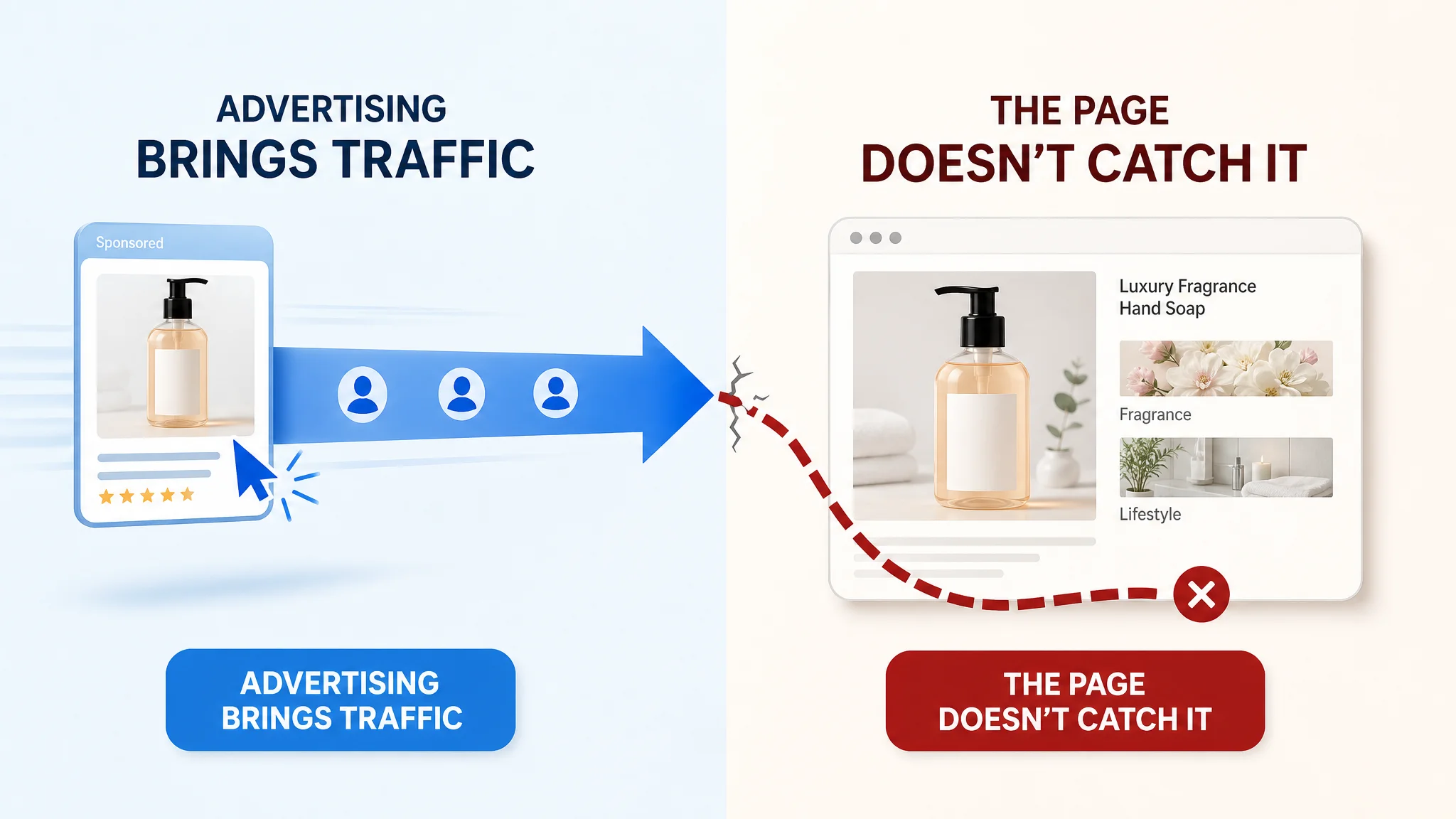
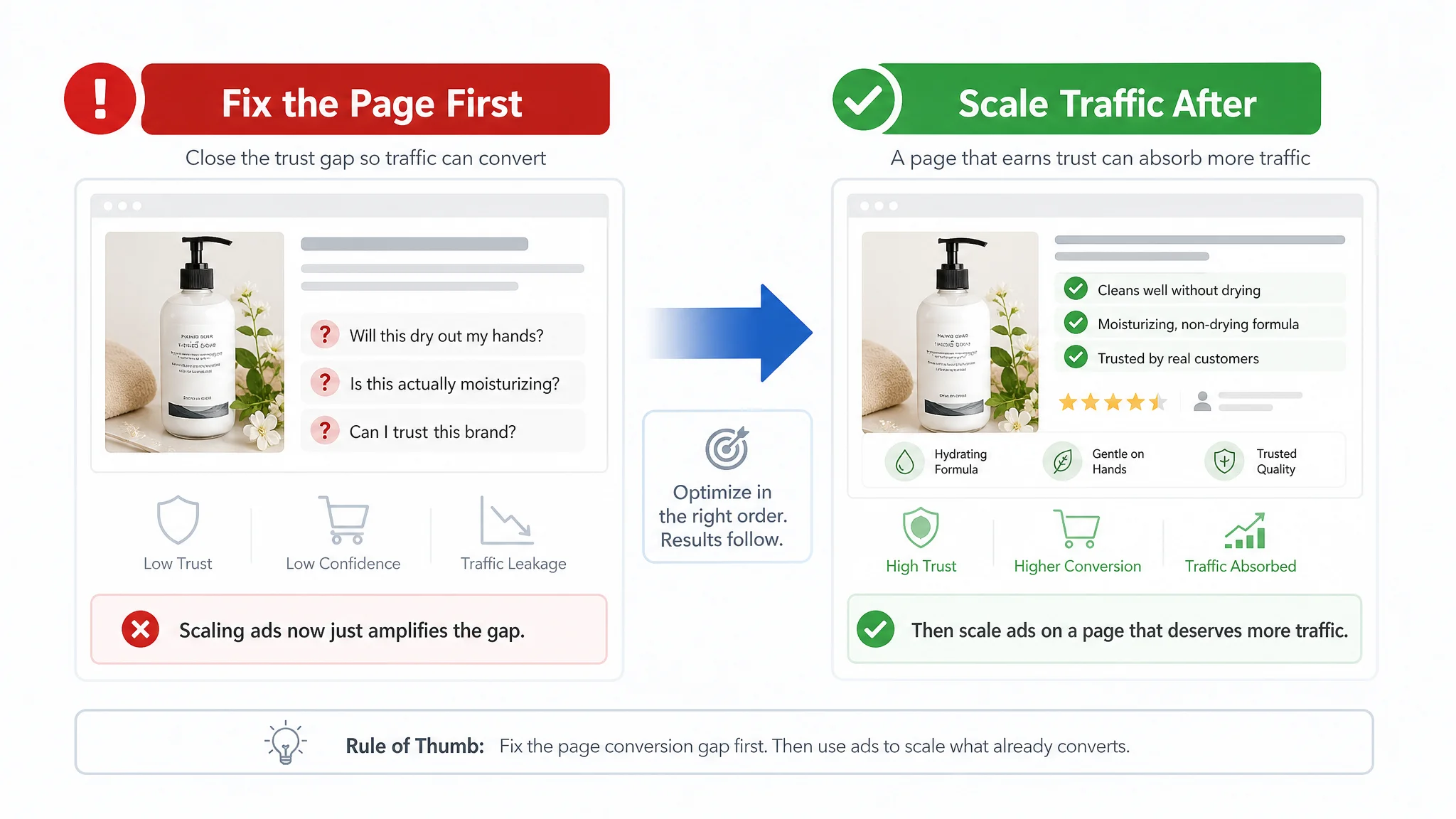
A common mistake is to treat every ranking or sales decline as an advertising problem. One premium hand soap seller initially believed that inaccurate bids, insufficient fragrance keywords, or more luxurious ad messaging were responsible for weak order growth. Ads were already generating traffic, but the page was not converting that traffic efficiently. A direct comparison with a stronger competitor showed that the more important weakness was the product page’s ability to establish functional trust: buyers needed reassurance that the soap would cleanse effectively without drying their hands. The listing was communicating fragrance and lifestyle before it answered that basic concern.
That diagnosis matters because additional traffic would have amplified the same conversion gap. The issue was not simply that advertising failed to bring shoppers to the listing; the page was consuming traffic without giving shoppers enough reason to complete the purchase. Organic ranking analysis therefore has to examine what happens after visibility is achieved, not just how much traffic advertising can generate.
Use a two-layer model. First, assess query-specific relevance: does the title, bullet-point structure, and product language clearly match the search term and buyer intent? Second, assess performance signals: do impressions become clicks and orders at a healthy rate, or does the funnel weaken at visibility, CTR, or CVR?
A practical investigation covers five areas:
- Query relevance and search-term alignment
- Title and bullet-point coverage
- Main-image click appeal and CTR
- Detail-page clarity, trust support, and CVR
- Customer feedback and reputation signals
Follow a fixed order: capture current data, compare against genuinely similar products, locate the funnel weakness, audit the relevant listing dimensions, and connect each gap to business metrics such as CTR, CVR, ACoS, or BSR. This process helps identify the likely weakened signal before you spend more money correcting the wrong problem.
How Amazon Organic Ranking Actually Works in 2026
Amazon does not assign a listing one universal organic position. A product can rank strongly for one search query and poorly for another because each query tests a different combination of relevance and performance.
A useful working model is:
Illustrative ranking model: relevance × performance
This is not Amazon’s disclosed formula. Relevance reflects how closely the listing matches the query through elements such as the title, bullets, and search terms. Performance can be assessed through query-related exposure, clicks, orders, CTR, CVR, and sales signals. Under this model, a highly relevant listing could plausibly outrank a stronger-selling product for a specific query, but that interpretation should not be treated as a confirmed internal rule.
Keyword rank and BSR answer different questions. Keyword rank measures where the listing appears for a particular search term. BSR is a relative sales position within a specific category node, not a ranking against all products on Amazon. Deals, external traffic, and seasonality can influence BSR without proving strong keyword-level visibility.
Amazon does not disclose its weighting or lookback windows. Recent sales velocity likely matters more than older history across unknown horizons, but this remains a practitioner hypothesis. Track keyword positions directly, then test the hypothesis against account-level impressions, clicks, orders, CTR, CVR, and sales data. Ad-driven purchases may also concentrate performance signals around particular queries, although advertising is only one input to diagnosis.
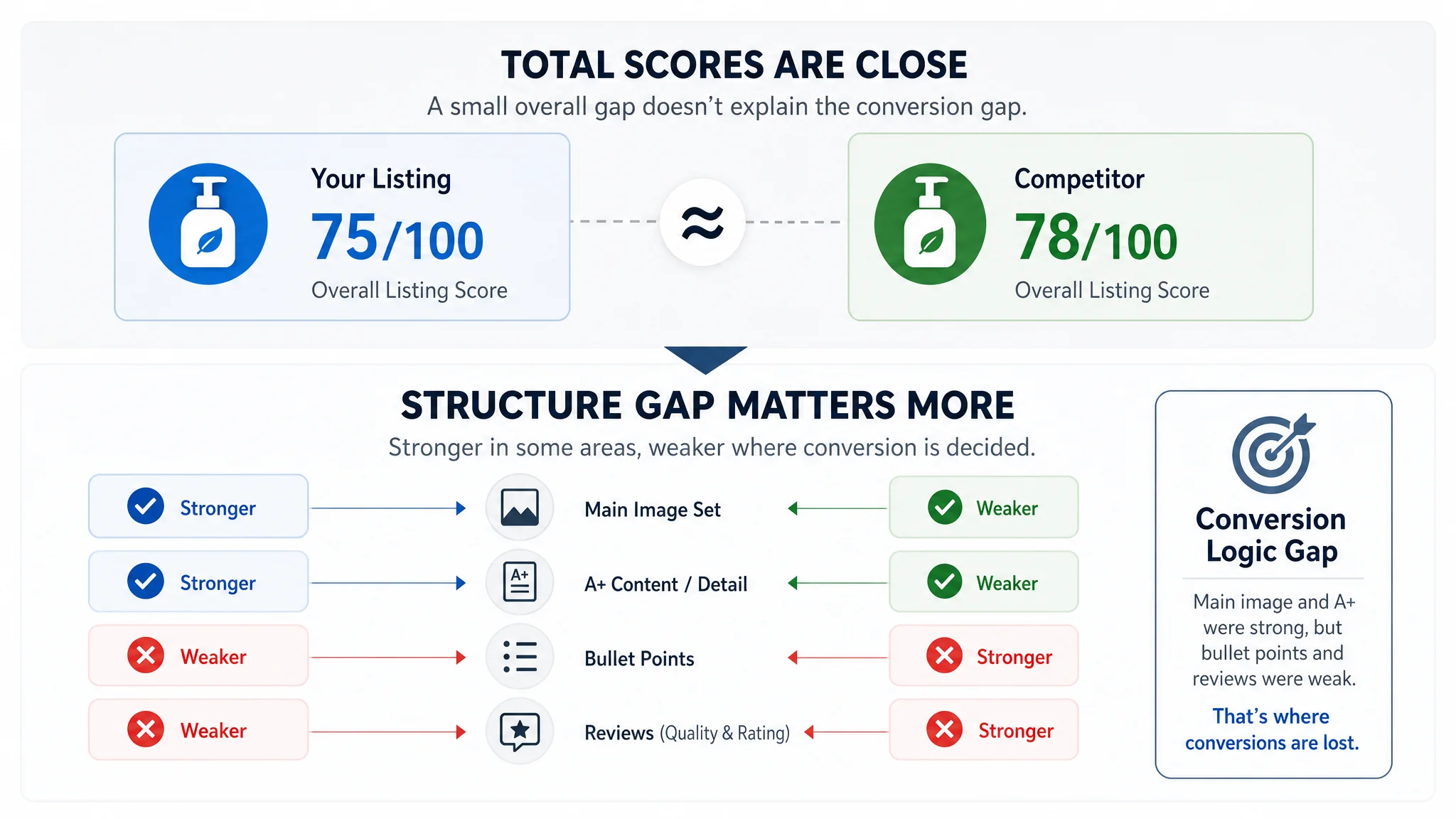
The hand soap example illustrates why overall listing quality cannot replace query- and funnel-level analysis. Its overall DeepBI Listing score was 75/100, only slightly below a competitor’s 78/100. That small aggregate gap did not explain the commercial difference by itself. The composition of the scores mattered: the seller’s main image set and A+ structure were comparatively strong, while bullet points and reviews were weaker. A listing can therefore appear broadly healthy while still underperforming on the specific elements that influence conversion for high-intent shoppers.
The Most Common Reasons Your Organic Ranking Dropped
Organic ranking is not earned once and then permanently secured. It is maintained through continuing signals from visibility, clicks, conversions, customer trust, availability, and offer performance. When one or more of those signals weaken, a keyword position can become vulnerable.
A ranking decline is therefore a symptom, not a diagnosis. Each possible trigger requires a different recovery path, which is why generic listing edits often fail. Investigate the following areas against exposure, orders, CTR, CVR, BSR, and account-level performance data before changing the listing.
1. Review Loss or Rating Drop
A lower star rating, slower review growth, unfavorable star distribution, or a weaker review count versus relevant competitors can reduce buyer trust. This may affect both CTR and CVR, especially when shoppers compare similar offers. Check rating history, review-count gaps, and the quality of customer-submitted images. The appropriate response is to identify the trust gap and improve the listing’s ability to answer buyer concerns, not to apply generic keyword changes.
In the hand soap case, the seller had 4.2 stars and more than 300 ratings, which did not look disastrous in isolation. However, the competitor had 4.4 stars and approximately 27% more reviews, along with a cleaner visible rating distribution and a lower negative-review ratio on the first page. The seller initially focused on advertising precision and fragrance keyword coverage because the listing appeared close in overall quality. The comparison showed that the modest review difference could still influence whether shoppers trusted a premium-priced product enough to convert after clicking.
This does not prove that reviews alone caused the performance gap. It does show why review strength must be assessed relative to the competitive set. When the product touches the body and the buyer cannot physically test it, social proof becomes part of the conversion argument alongside formula, claims, and imagery.
2. Losing the Buy Box
Buy Box loss can reduce the visibility and sales continuity of an offer, particularly when competing sellers or offer conditions change. Investigate price, fulfillment, seller performance, availability, and offer-level changes together. Do not assume a single pricing rule explains the outcome. Recovery depends on isolating the offer factor that changed and restoring a competitive, compliant selling condition.
3. Running Out of Stock
A stock-out interrupts the path from impression to click and order. It can also create a gap between historical ranking strength and current sales activity. However, inventory status alone does not prove algorithmic suppression or explain the entire decline. Compare the stock-out period with impressions, orders, BSR, and keyword movement, then separate inventory effects from changes in traffic or conversion.
4. Drop in Click-Through Rate
Lower CTR indicates that the listing is generating fewer clicks from available impressions. Review the main image, title, price presentation, and competitive context rather than assuming one universal cause. Visual assets function as commercial drivers, so connect any update to CTR tracking and, where available, tagged ad-report events.
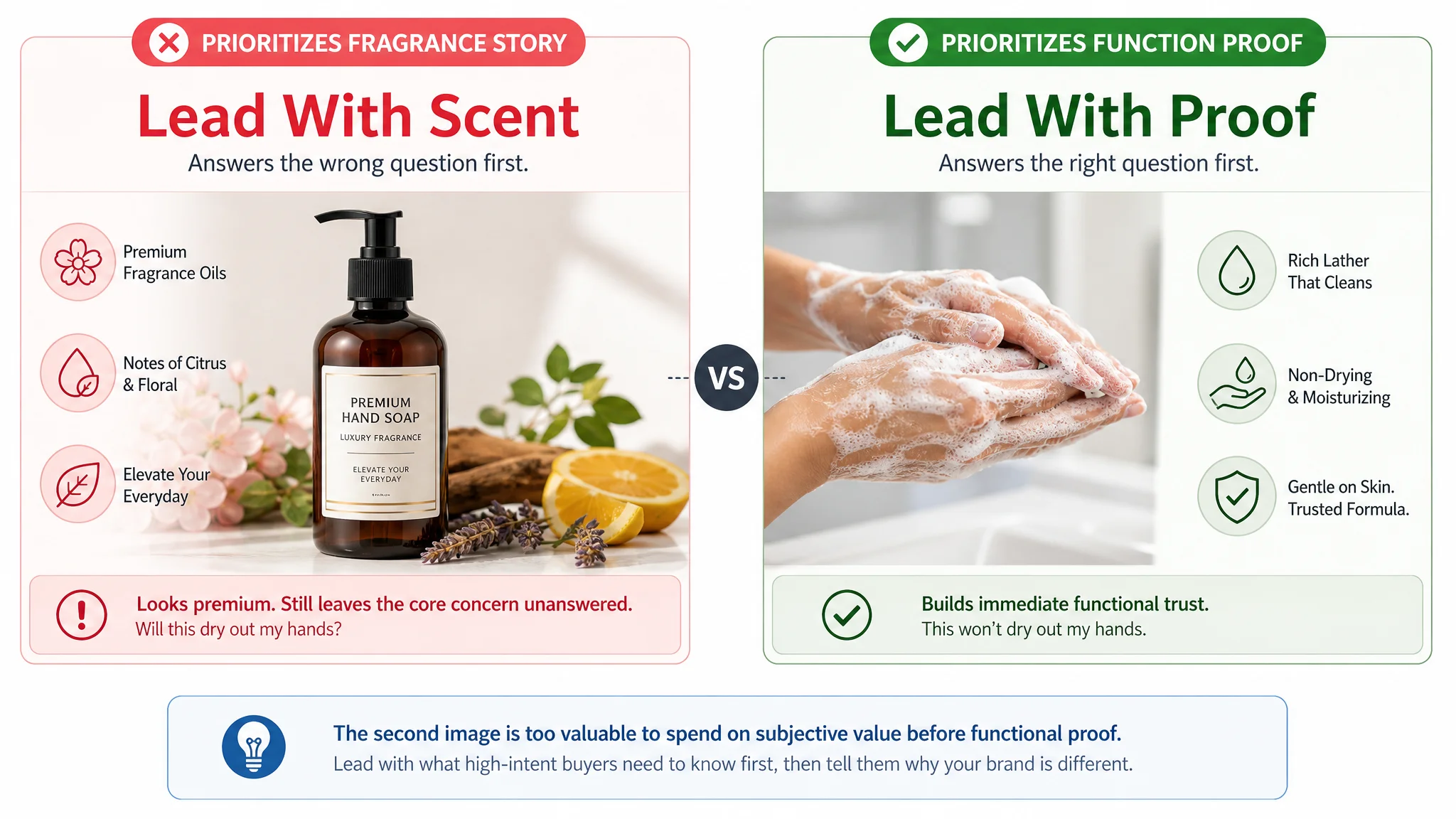
A listing can also have a structurally complete image set while using the available message sequence poorly. In the hand soap comparison, the seller’s main image system was actually stronger in structure, covering product definition, ingredients, specifications, benefits, and brand story. Yet the competitor used its second image to show a hand using the soap, visible foam, and messaging around softness and smoothness. The seller used a comparable position to extend the fragrance story.
The problem was not necessarily weak visual production. It was prioritization. The competitor used an early image to answer, “Does it lather, and is it gentle?” The seller used that space to answer, “What does it smell like?” For a product used directly on the body, the second question may be less urgent than the first. Main-image and secondary-image analysis should therefore examine which buyer concern each asset resolves, not just whether the assets look polished.
5. Conversion Rate Decline
A CVR decline means existing traffic is producing fewer orders. Possible gaps include detail-page information, trust elements, review strength, offer clarity, or product-to-expectation alignment. Diagnose the conversion funnel separately from CTR, then turn the confirmed gap into a specific content or offer action.
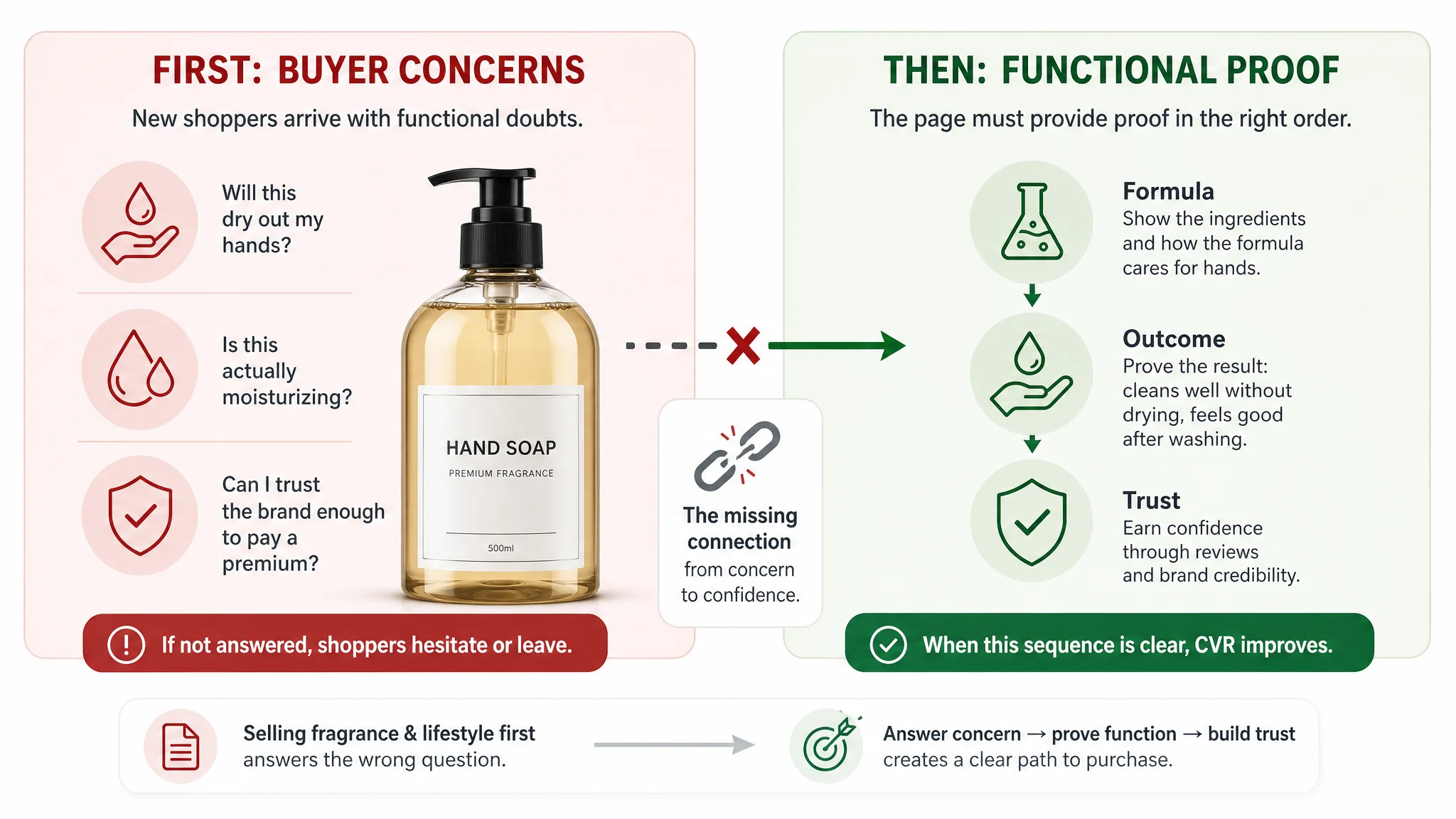
One hand soap seller’s page made this distinction visible. The product had advertising traffic, premium visuals, and a listing score that was only slightly behind a key competitor. The initial assumption was that ad targeting was inefficient. But the page was not quickly answering three functional questions:
1. Will this dry out my hands?
2. Is it genuinely moisturizing, or merely well scented?
3. Can the brand and formula justify a premium purchase?
The title emphasized premium fragrance and rejuvenation, while the bullet points began with product and size information, then leaned into scent and giftability. The competitor led with formula and post-wash outcomes such as soft and smooth hands, connected ingredients to benefits, and added trust markers. The seller’s page contained information, but it did not create a clear buying logic from concern to formula, outcome, trust, and lifestyle.
That is the difference between a page that looks complete and a page with conversion capacity. If the detail page does not resolve the buyer’s first objection, more clicks can increase ACoS without fixing the underlying ranking signal.
How to Diagnose the Problem Before You Spend
Start with a fixed comparison window, not memory. Compare current impressions, clicks, CTR, CVR, orders, ACoS, and BSR with recent baselines, such as 30 and 60 days earlier. Read keyword-rank trends across multiple observations; personalization, delivery context, platform tests, and normal volatility make single-day snapshots unreliable.
Then isolate the funnel:
- Falling impressions with stable CTR points to a visibility problem.
- Falling clicks with stable impressions points more toward a conversion or offer problem.
- Falling CTR suggests the listing is generating less interest, while falling CVR suggests the detail page, price, reviews, or offer may be failing to convert traffic.
Before increasing spend, check availability, price, seller metrics, Buy Box status, and fulfillment conditions. Determine whether the decline affects specific queries or the account more broadly. A query-specific drop calls for keyword, indexing, or relevance investigation; an account-wide decline requires broader operational and listing checks.
The hand soap seller’s diagnostic path demonstrates why the order matters. The team first viewed the problem through the advertising account: bids, budgets, fragrance keywords, and lifestyle-oriented creatives appeared to be the most adjustable variables. A direct listing comparison instead revealed a three-point overall score gap with very different internal composition:
- Title: 14 versus 15
- Main image set: 26 versus 24
- Bullet points: 4 versus 7
- Detail/A+: 21 versus 19
- Reviews: 10 versus 13
The seller was ahead in the main image set and A+ structure, but behind in bullet points and reviews. The page’s weakness was therefore not a general lack of visual quality. It was the combination of underdeveloped sales copy and weaker social proof at the point where shoppers were deciding whether to trust the product. The diagnosis supported a page-conversion intervention before further ad scaling.
Also inspect silent suppression, category classification, indexing, and backend search-term hygiene. Amazon backend search terms have a 250-byte limit: count every character and space, remain under the limit, and verify indexing after edits. Exceeding it can create errors, truncation, or non-indexing.
DeepBI’s Amazon-only organic analysis can help prioritize investigation using per-query visibility, TACOS direction, and organic-order share as trend signals—not as guaranteed alerts or monitoring. Its value is connecting cleaned historical data to a diagnosis before spend is increased.
Your Organic Rank Recovery Plan
Recovery depends on the diagnosed cause. A review problem, Buy Box loss, stock-out, weak CTR, and weak CVR require different interventions; generic listing edits can waste budget while BSR and organic-order share continue to deteriorate.
Recovering from Review and Rating Issues
Start by identifying whether negative feedback reflects product quality, unmet expectations, or an image-product mismatch. Correct the underlying customer experience first, then audit the title, images, and selling-point claims for accuracy. Product entity consistency is essential: visual optimization should not alter the product’s material, color, or industrial design. Accurate assets can reduce expectation gaps, while exaggerated visuals can damage CVR and create further review pressure.
The hand soap comparison also shows why review analysis should be connected to page messaging. A 4.2-star rating may appear acceptable until it is compared with a competitor at 4.4 stars and a materially larger review base. If the listing is also asking shoppers to believe moisturizing or non-drying claims, weaker social proof makes those claims harder to accept. The answer is not to hide the gap with more luxurious language; it is to make the formula, usage experience, and claims clearer while addressing the underlying customer experience.
Winning Back the Buy Box
Treat Buy Box loss as an offer-level problem, not simply a keyword problem. Review price competitiveness, fulfillment reliability, inventory availability, and seller-account conditions before increasing keyword spend. Restore a credible offer, then measure whether impressions, CTR, CVR, and organic-order share recover. Advertising should not be used to force traffic toward an offer that shoppers cannot consistently purchase.
Recovering from a Stock-Out
A stock-out interrupts both conversion economics and demand capture. Replenish with a realistic inventory plan, confirm that the listing and offer are fully purchasable, and avoid spreading campaigns across many queries while availability is still unstable. After replenishment, use qualified traffic to rebuild measurable impressions, clicks, and orders, while monitoring TACOS and the proportion of orders coming organically rather than assuming that purchase consistency alone will restore rank.
Improving CTR and CVR
Separate the diagnosis: low CTR points to weak search-result appeal, while low CVR points to a mismatch between traffic and the detail page. For CTR, strengthen the main image’s visual hook, contrast, and focus. For CVR, improve information density and clarify the core selling proposition in the listing and A+ content. DeepBI can connect impressions, clicks, orders, CTR, CVR, and advertising metrics to identify the weaker stage, convert the diagnosis into precise optimization instructions, apply approved assets, and measure later movement without promising an immediate ranking gain.
The hand soap case required a further distinction: the assets were not simply weak; their sequence was wrong. The title sold a premium fragrance experience before establishing formula credibility. The second image extended scent storytelling instead of bringing forward hydrating and non-drying proof. The bullet points described the product without leading the buyer through a decision path. The A+ page promoted the broader product family before the hero hand soap had fully secured its own value.
The recovery direction was therefore to reframe the page around trust without abandoning the premium positioning:
- Move formula and complete skin outcomes closer to the beginning of the title.
- Reorganize bullets around after-wash feel, fragrance structure, ingredient-to-benefit links, trust, and daily use.
- Use early images to communicate hydrating, non-drying, and plant-based formula benefits before expanding the fragrance story.
- Keep the main hand soap as the A+ hero before introducing other products or cross-sell content.
This approach addresses CVR because it changes what the shopper can understand quickly. A premium page can still communicate scent and lifestyle, but those messages should follow the functional proof that makes the purchase credible.
Concentrate on One or Two Primary Keywords First
Do not distribute limited demand across a broad keyword set immediately. Select one or two primary queries with strong CTR, CVR, and order value, focus top-of-search campaigns on them, and pursue paid volume alongside long-term organic improvement. DeepBI’s fifth-layer Amazon organic growth approach uses these signals to prioritize target queries while tracking TACOS and organic-order share. Its Sponsored Products capability can dynamically tune bids and budgets so qualified traffic remains aligned with those target queries.
Concentrated sales and behavior signals create a cleaner performance read than thinly spreading demand across loosely related terms. Once relevance and conversion economics are stable, expand into secondary and long-tail clusters. Strong visibility on a poorly matched, high-volume query is unlikely to produce stable ranking gains.
The fragrance hand soap seller initially moved in the opposite direction by expanding fragrance and gift-related keyword coverage and adjusting bids while the page still led with the wrong buying logic. This made it difficult to determine whether traffic quality or page conversion was responsible for the weak outcome. A more disciplined approach is to ensure that the listing can answer the core buyer concern for the selected query, then use concentrated traffic to test whether CTR, CVR, and order signals improve.
Why Continuous Monitoring Is the Real Competitive Advantage
Competitive sellers are not always the biggest spenders. They identify weakening signals early and correct the underlying issue before a small decline compounds into lower BSR, weaker CTR, falling CVR, and greater dependence on paid traffic.
Organic ranking is an ongoing performance outcome, not a permanent asset. A movement in an important query is an early warning, but a single-day snapshot rarely explains the cause. Review trends across:
- Visibility for priority queries
- CTR and CVR direction
- Availability and price position against the competitive set
- TACOS and organic-order share
- BSR movement and listing cycle time
This view separates temporary volatility from sustained signal drift. Paid support still has a legitimate role: advertising data can provide useful evidence about traffic quality and conversion behavior. However, sustainable organic strength is preferable to treating higher ad spend as the default response.
The hand soap case shows how the operating narrative can change when these signals are connected. The seller began with the assumption that ACoS had to be corrected through better bids and broader keyword control. After the listing was examined against a stronger competitor, the more useful question became whether the page could convincingly answer the buyer’s first concern. The page was then reorganized around functional proof, formula credibility, and trust before advertising was treated as the next lever.
The later operating observations were not presented as a guaranteed ranking outcome: CVR began to stabilize rather than fluctuate with every ad push, ACoS moved in a more controllable direction as paid clicks met a stronger page, and the listing regained some organic conversion capacity on core hand soap keywords. The important lesson is not a promised performance number. It is that advertising became more useful after the listing’s conversion logic was repaired.
DeepBI supports a data-driven Amazon-only loop: analyze performance and competitive evidence, execute prioritized Listing improvements, publish approved changes, and optimize through subsequent performance feedback. Sellers should define the profit and growth goals that determine which issues deserve priority. DeepBI helps organize diagnosis and iteration; it should not be treated as a guaranteed alerting or response-time service. The practical advantage comes from replacing disconnected, subjective decisions with an evidence chain that links Listing changes to CTR, CVR, ACoS, and organic performance trends.
Final Thoughts
An organic rank decline is a signal to investigate, not a reason to spend immediately. Use this checklist to turn the ranking dropped diagnosis into a controlled recovery process:
- Diagnose in order before spending: Compare keyword rank with BSR, then check relevance, CTR, CVR, Buy Box status, inventory, price, reviews, listing changes, and PPC changes across comparable periods. A decline is usually traceable to a change in one or more signals, but verify the cause in your own account before increasing budget.
- Match the recovery path to the cause: Address a relevance gap with targeted listing corrections; address weaker CTR or CVR by reviewing the main image, title, offer, rating, and traffic mix; address stock, Buy Box, or review disruptions through the corresponding operational fix. Generic edits or extra ad spend can be wasteful when the diagnosed problem lies elsewhere.
- Maintain rank through connected measurement: Analyze relevance and performance separately, then manage them together. Track keyword rank, BSR, CTR, CVR, and ACoS after each meaningful change, because position is maintained through consistent performance rather than earned once. DeepBI’s Amazon-only workflow connects listing diagnosis, optimization guidance, execution, and feedback in one traceable process.
The premium hand soap example reinforces the central point: a listing can look polished, receive advertising traffic, and hold a reasonably strong overall score while still losing conversion capacity because it answers the wrong question first. Fragrance, lifestyle, and brand-building may support the purchase, but they cannot replace early proof of function, formula, and trust.
Keep iterating as market conditions and shopper responses change; the seller who sees and responds to change first is better positioned to maintain rank.