


Understanding the Anatomy of the Amazon Organic Search Results Page
An Amazon search results page is not a single ranking list. It is a collection of shopper-facing listing blocks competing for attention. Before changing keywords, titles, or images, evaluate what shoppers actually see and identify which visible weakness is most likely suppressing CTR.
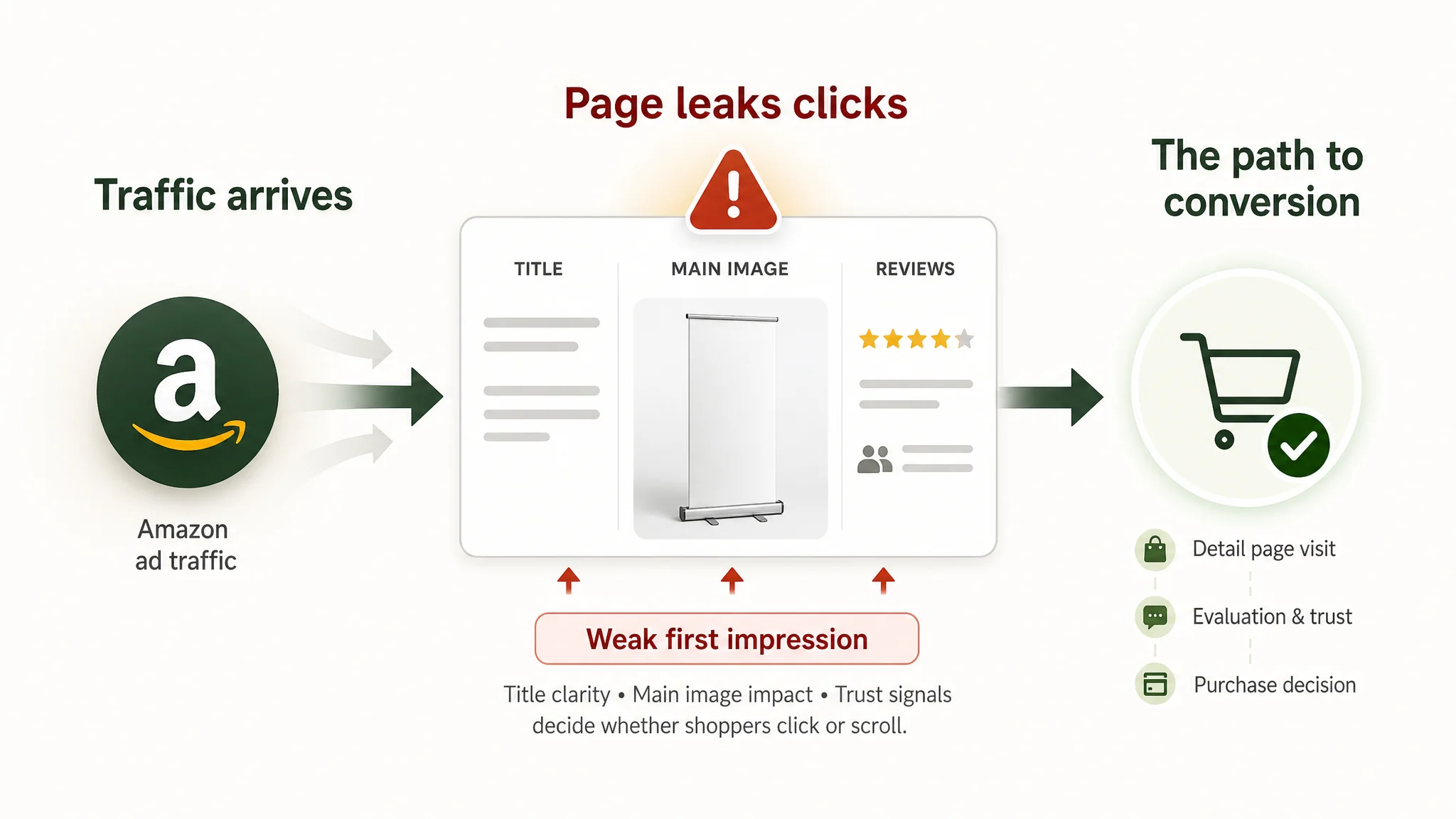
A custom retractable banner seller learned this distinction when rising ad spend was initially treated as an advertising problem. The team believed the listing was already in good shape because its bullet points, A+ content, and review rating appeared healthy. However, a comparison with a direct competitor showed that the main image, title, and review scale were weaker. The listing had content capable of supporting conversion later in the buying journey, but its search-result presentation was not strong enough to earn or justify more traffic. This is why a SERP audit must begin with the shopper’s first impression rather than with campaign settings alone.
1. Placement type and position. Organic placements appear within the unpaid search results, while sponsored placements are marked as advertising. The mix can vary by keyword and page layout. When sponsored placements occupy more visible space, organic listings may be pushed farther down, reducing immediate exposure even when their relevance is strong.
2. Trust and urgency badges. A listing may display signals such as Best Seller, Amazon’s Choice, Climate Pledge Friendly, or Limited Time Deal. These can influence attention and click decisions, but they are not ranking guarantees. Treat them as comparison variables rather than conclusions about search performance.
3. Main image and visual hierarchy. The primary image is often the first product-specific element a shopper processes. Compare visual focus, contrast, product scale, clutter, and whether the use or configuration is immediately clear. A weak visual hook can damage CTR before title or bullet-point improvements have any opportunity to work.
In the retractable banner comparison, the main-image gap was substantial: the target listing scored 16 out of 30 for its main image, compared with 25 out of 30 for the competitor. The target image communicated a printed design more readily than a physical, professional display product. It did not make the stand, base stability, or print quality easy to understand at a glance. The issue was therefore not simply that the image looked less attractive; it failed to communicate the product’s value in the exact place where shoppers decide whether to click.
4. Core offer information. Shoppers scan the title, rating stars, review volume, price, coupons, and deal messaging together. A shorter or clearer title may communicate the selling point faster; a stronger rating profile or more competitive price may reduce perceived purchase risk. Review these elements as a package, not as isolated fields.
5. Brand presence and supporting content. Brand names, storefront associations, and consistent visual presentation can strengthen recognition across competing blocks. Enhanced A+ content is generally encountered after the click rather than inside the search-result block, but brand-registered sellers should still compare its module richness, comparison tables, authority credentials, and use-scenario explanations because these elements can support CVR after SERP-driven traffic arrives.
6. Device-specific layout. Desktop and mobile results do not present the same amount of information in the same arrangement. Mobile viewing is central to SERP evaluation because limited screen space changes which listings and signals appear first and how quickly shoppers scroll. Inspect the target keyword on both layouts rather than relying on a desktop-only audit.
For one target keyword, place your listing block beside comparable blocks immediately above and below it. Select competitors by product form, price band, audience, use case, and meaningful market validation; an unrelated bestseller can create a misleading benchmark. Record concrete gaps—such as a weaker image focus, unclear title benefit, poor bullet ordering, thinner deal communication, or less developed A+ content—then rank them by expected CTR impact first and CVR impact second. A quantitative review across the main image, title, bullets, A+ page, and customer feedback creates a more disciplined improvement sequence than changing every field at once.
The retractable banner listing illustrates why this comparison needs to be specific. Its overall listing score was 66 out of 100 compared with 77 for the direct competitor. The target listing actually performed better in bullet-point logic and slightly ahead in A+ structure, but it lagged in the title, main image, and review scale. A general conclusion such as “the listing needs better content” would have missed the commercial constraint. The more useful conclusion was that the front of the page was weaker than the deeper content. A SERP audit should identify that kind of mismatch before a seller invests further in traffic.
How Amazon Ranks Products: Best Seller Rank, Keyword Ranking, and Documented Signals
Amazon visibility is often discussed as if one hidden score controls every result. That framing encourages sellers to chase alleged algorithm rules instead of managing the measurable inputs that influence demand, relevance, and conversion. Amazon does not publicly detail its exact search algorithm, so documented information should be separated from industry analysis and operational inference.
Understanding Amazon's Best Seller Rank (BSR)
Best Seller Rank, or BSR, is a product’s relative sales position within an Amazon category or subcategory. It is useful for comparing sales momentum among products in the same classification, but it is not the same as keyword ranking. A product may have a strong BSR while appearing low for an important shopper query, or rank well for a query while holding a weaker category position.
BSR should therefore be treated as a business indicator rather than a guaranteed optimization target. It can help teams monitor sales velocity and evaluate whether demand-generation work is producing commercial movement. However, Amazon does not publish a complete BSR formula, factor weighting, or update schedule. Discount depth should not be treated as a direct BSR control. The practical question is whether the offer, listing, traffic, and conversion performance are generating sustainable orders—not whether one isolated tactic supposedly forces a rank change.
A seller can also misread a difficult BSR or sales trend as proof that advertising needs to be pushed harder. In the retractable banner case, increasing ad pressure appeared to be the intuitive response because spend was rising while orders were not keeping pace. The diagnostic comparison showed that the problem was not simply a lack of traffic generation. The listing had a weaker first impression and lower review maturity than its direct competitor, so additional traffic was being sent into a page with limited conversion support. BSR and sales velocity could reflect that commercial weakness, but they could not explain which part of the funnel was responsible on their own.
Review BSR alongside:
- Orders and sales velocity
- Search exposure, clicks, CTR, and CVR
- ACoS and the profitability of the traffic producing those orders
- Category and subcategory context
- Listing cycle time when testing new positioning or creative
These measures provide a more useful operating view than BSR alone.
Keyword Ranking on Amazon
Keyword ranking is the position a product holds for a specific shopper query. It is query-specific, marketplace-specific, and potentially different across devices, placements, and shopper contexts. A listing is not simply “ranked” or “unranked” in general; it may perform differently for branded, generic, feature-based, and high-intent searches.
Industry analyses commonly associate organic visibility with keyword relevance, customer behavior, conversion rates, seller performance, and sales velocity. Those relationships are plausible operating hypotheses, not guaranteed ranking levers. For example, stronger relevance may improve the chance of matching a query, while better CTR and CVR may indicate that shoppers find the result useful and persuasive. Advertising activity can reveal demand and intent, but it does not prove that paid traffic automatically creates an organic ranking outcome.
The retractable banner listing showed why keyword relevance must be evaluated together with positioning. Its original title used “Roll Up Poster” rather than focusing tightly on “Retractable Banner” or “Roll Up Banner.” It also placed “Banner Only” in a way that could create uncertainty about whether a stand was included. The issue was not merely missing keywords. The title was failing to establish the exact product category, offer definition, and use cases that shoppers needed to understand before clicking. A title can therefore weaken both search matching and commercial clarity at the same time.
Use Amazon seller reporting and search-frequency-style demand data to prioritize decisions instead of relying on intuition. DeepBI’s organic layer can use advertising performance to select and prioritize keywords, weighting signals such as CTR, CVR, and order value. Teams can then compare winning terms with listing exposure, clicks, orders, and conversion performance before deciding which terms deserve greater emphasis in copy or visual optimization. The goal is a tighter relevance-to-conversion loop, with BSR and organic visibility monitored as outcomes rather than promised results.
Key Factors Influencing Click-Through Rates
Listings occupying similar Amazon search positions can receive very different click shares. Position creates exposure, but it does not determine the shopper’s response. The click decision is shaped by how clearly the listing presents the product, how closely the visible information matches the query, and how much trust the offer creates at a glance.
The main image is often the first point of comparison. It should be clear, easy to interpret at thumbnail size, and compliant with Amazon’s image requirements. In practical review, verify a pure white background, that the product occupies at least 85% of the frame, and that the full product is shown without cropping or visual distortion. The product must remain truthful: visual optimization should improve focus and comprehension rather than introduce unsupported attributes or alter the physical structure.
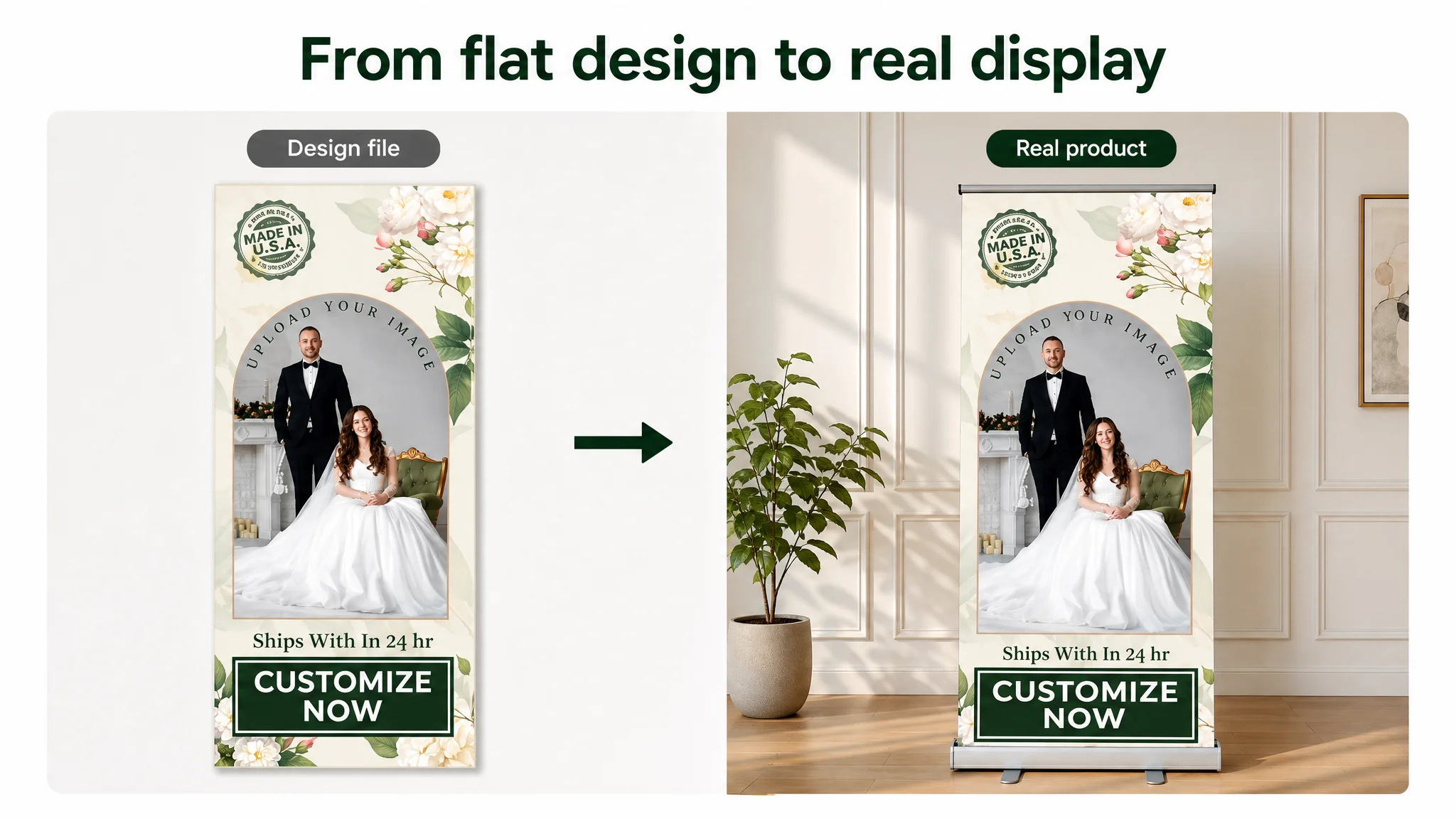
The retractable banner seller’s experience shows why visual clarity affects more than aesthetics. The original primary image included strong design elements and emotional text, but those elements competed with the physical product. Shoppers could not immediately see how the stand looked, whether the base appeared stable, or whether the banner represented a high-end display solution rather than a flat print file. The image therefore left important pre-purchase questions unanswered before shoppers even reached the detail page. When the main image does not establish value at the first glance, a strong A+ page may never receive enough attention to do its work.
Other visible factors also compete for the shopper’s attention:
- Title text and query relevance: The title should communicate the product and its primary value clearly while reflecting relevant search terms. Poor keyword placement or unclear wording can reduce the match between the query and the listing preview.
- Price and coupon signals: The displayed offer affects perceived competitiveness and can change which listing earns the click. These signals should be evaluated as part of the offer context, not treated as guaranteed ranking levers.
- Star rating and review volume: Rating distribution, review count, and credible image reviews contribute to perceived purchase risk.
- Badges and delivery messaging: Badges, Prime availability, and delivery information can strengthen trust when they are visible and meaningful to the shopper.
- Mobile and desktop rendering: A title, image, or offer that reads well on desktop may lose clarity on a smaller screen. Review both layouts for truncation, visual scale, and information hierarchy.
Review maturity can amplify the effect of the other factors. In the comparison, the target listing had a 4.2-star rating and 13 reviews, while the competitor had a 4.4-star rating and 50 reviews. The rating difference was not catastrophic, but the competitor’s larger review base created a stronger sense of market maturity. Because the target listing could not change review volume quickly, its main image and title had to work harder to communicate professionalism and reduce perceived risk. This does not mean visuals can replace reviews; it means a weaker trust signal increases the importance of every other visible signal.
The business effect is conditional. A stronger listing may increase CTR, creating more opportunities for shoppers to reach the detail page. Better post-click alignment may support CVR; conversion can contribute to sales velocity; sustained sales performance may then support future visibility signals. No single image, price, review, or badge guarantees a ranking improvement or directly determines BSR.
DeepBI’s listing layer helps replace subjective guesses with a structured diagnosis. It compares the listing with closely matched competitors across the main image, title, detail content, and customer feedback, then prioritizes likely weaknesses in click capture or conversion. When visual changes are published, DeepBI can mark a visual iteration event in its ad reports so sellers can examine subsequent CTR movement, including the following 7–14 days, and connect the change to measurable performance rather than relying on appearance alone.
Strategies to Improve Click-Through Rates
A listing earns an organic impression only if Amazon considers it relevant, but it earns the click when the shopper can recognize relevance, value, and trust quickly. Improve CTR through a controlled sequence, then monitor CVR, ACoS, BSR, and listing cycle time rather than assuming any single change will improve ranking.
- Rebuild the main image. Keep the asset within Amazon’s requirements, including a compliant white background, RGB color mode, and at least 1,600 pixels on the long edge where applicable. Use composition, contrast, framing, and product scale to communicate one clear benefit signal without adding unsupported claims. The product itself must remain authentic: do not alter its material, color, logo, structure, or functional details. An image-product mismatch can create distrust, refunds, and negative reviews that outweigh any potential CTR gain.
For the retractable banner listing, the visual direction was changed from presenting a design file to presenting a high-end customizable display product. The proposed image set emphasized a clear hero presentation, professional size visualization, and hardware proof showing the base, pole, and connection details. The purpose was not to decorate the listing, but to answer questions such as whether the product would look premium at an event and whether the hardware appeared professionally engineered. The broader principle is that the main image should communicate the product shoppers are actually buying, not only one attractive attribute of it.
- Tighten the title. Put the primary keyword and core purchase reason in the first visible words, followed by the product form and only useful modifiers. Remove redundant keyword strings and verify the title remains within Amazon’s documented character limit. The objective is not maximum keyword density; it is fast relevance recognition without sacrificing readability.
In the banner example, a more useful structure led with “Custom Retractable Banner 33x81,” clarified “Replacement Graphic – Banner Only,” and added relevant use cases such as business events, trade shows, and weddings. This was more than a keyword adjustment. It restored category clarity, reduced uncertainty about what was included, and connected the product to recognizable buying situations. Titles should help shoppers understand both what the item is and whether the offer matches their intended use.
- Restructure the five bullets. Lead with the strongest buyer benefits, not the seller’s preferred specification order. Each bullet should connect a category concern to a verified product feature or proof and then to the problem it solves. This structure gives shoppers a reason to continue from the search result into the detail page and can also support CVR after the click.
The seller’s existing bullet points were already stronger than the competitor’s in diagnostic scoring. They used a pain point, solution, technical proof, usage, and service sequence. The problem was not that every deeper content element needed to be replaced; it was that the strength of those bullets was not reflected in the title and main image. At the same time, bullet claims had to remain aligned with the actual offer. If the product is listed as “Banner Only,” language describing a complete stand, bracket, and carry case should not be added unless the offer is updated to include those components. Clear positioning is more valuable than a broader but inaccurate solution claim.
- Expand brand content. For brand-registered sellers, use A+ modules to explain pain points, use cases, genuine trust evidence, and product differences. Comparison charts can clarify variants without forcing shoppers to infer distinctions. Brand storytelling should connect the introduction, core selling points, problem solving, and trust support rather than repeat the bullets.
Strong A+ content was not the weak point in the banner listing. It included business, wedding, holiday, and commercial scenes, along with service promises and hardware explanations. However, much of that content appeared later in the journey, after the shopper had already decided whether the page deserved attention. A+ should therefore support the first-impression promise rather than attempt to compensate for an unclear title or weak main image.
- Design mobile first. Check whether the first image, title opening, and initial bullet text communicate value on a narrow screen. Then verify the desktop presentation for cropping, hierarchy, and module continuity. A desktop layout that looks complete may still hide the click-driving information on mobile.
- Protect profitable competitiveness. Review price against relevant alternatives, but set changes against margin and ACoS, not CTR alone. Coupons and deals can create short-term traffic events; their durable potential value comes from the sales history that may follow, not from the promotion itself. Measure the effect after the event before making a permanent price concession.
- Apply changes with control. DeepBI can translate diagnosis into structured image and text recommendations, generate multiple variants, and let the seller preview and compare them before selection. Once approved, its listing layer can sync assets through Amazon SP-API, match images to listing positions, and show the old version beside the proposed replacement. This reduces a manual upload process that can take minutes to seconds, while preserving seller approval and an auditable old-versus-new comparison.
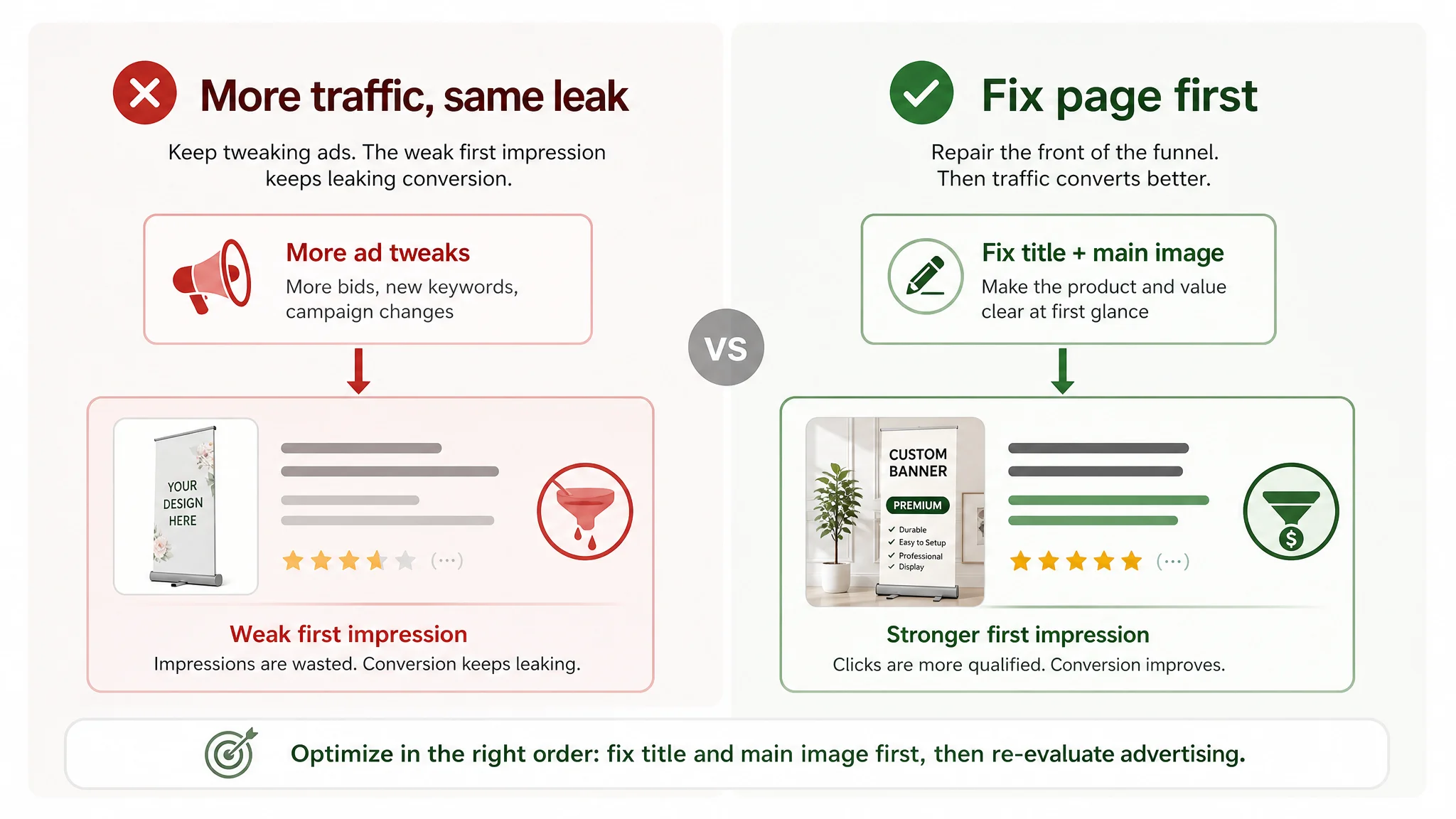
The sequence matters because a seller can otherwise keep optimizing the strongest part of the page while leaving the highest-impact weakness untouched. In the banner case, the deeper content was already relatively strong, but the title and main image were preventing that content from contributing fully. The correct priority was therefore not to rewrite every field at once, but to repair the front of the funnel and then evaluate whether the existing content could support the new promise.
Building the Organic Traffic Engine: Keyword Selection, Top of Search, and Dual Growth
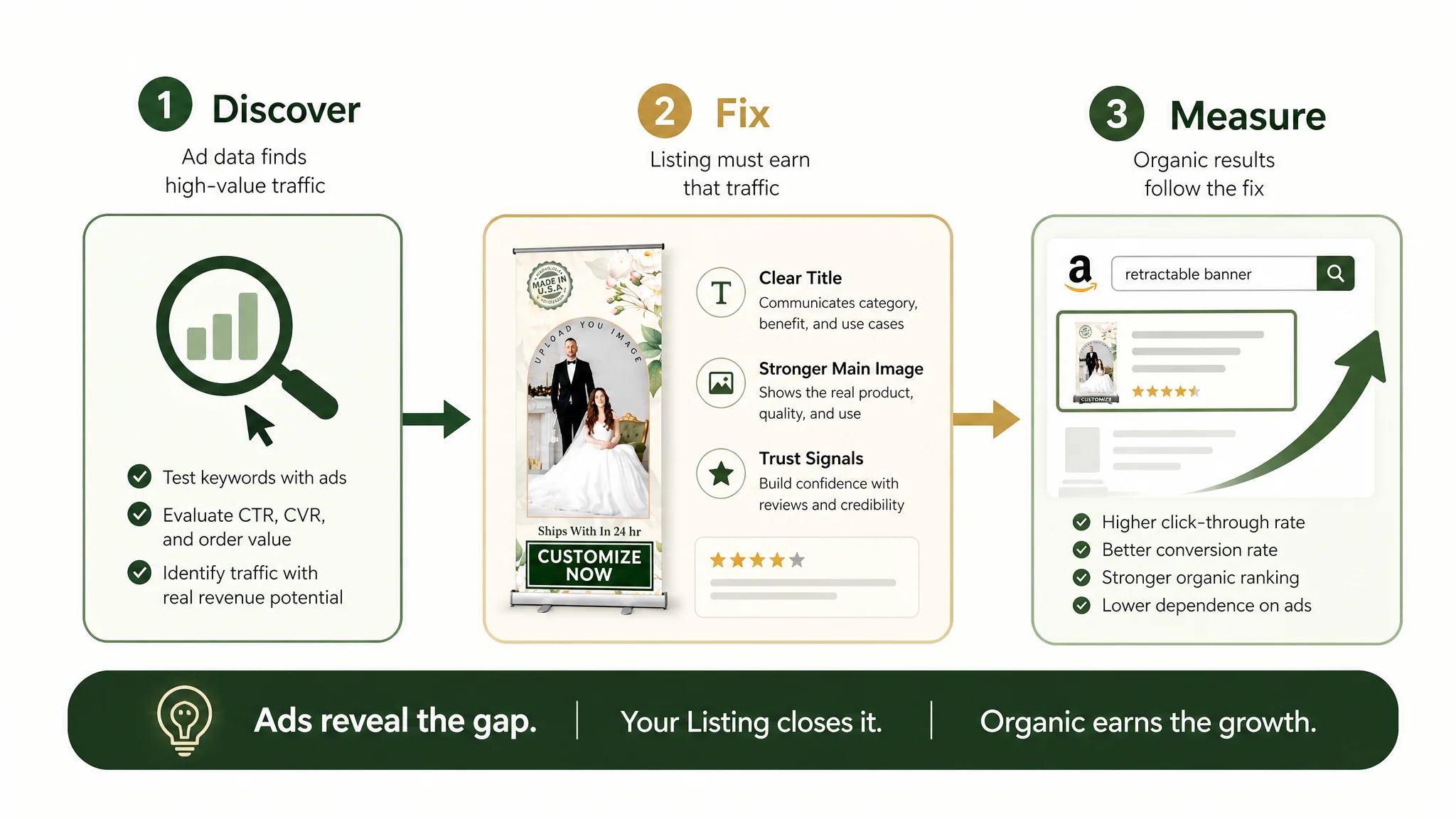
Organic traffic growth becomes more controllable when advertising is treated as a discovery and measurement system, not merely a source of paid orders. The operating loop is:
- Identify promising search terms from advertising data.
- Concentrate spend on terms that demonstrate commercial value.
- Improve the listing and conversion experience around those terms.
- Measure paid efficiency and organic contribution.
- Move only proven traffic into the scaling tier.
Keyword selection should come from observed performance rather than intuition. Review search-term and campaign data for terms with strong click-through rate (CTR), conversion rate (CVR), and order value. A keyword that attracts impressions but produces weak CTR may need better relevance or listing presentation. A keyword with clicks but poor CVR may be generating traffic the detail page cannot convert. High-order-value terms deserve separate attention because they can support revenue growth even when their click volume is not the highest.
The retractable banner seller’s original response to weak sales was to refine bids, keywords, and campaign structure. That reaction was understandable, but it assumed that the listing could convert any additional traffic once it arrived. The diagnostic evidence challenged that assumption: the title was underusing the core category term, the main image did not make the physical product feel premium, and the review base was less mature than the competitor’s. In this situation, advertising data was useful not because it proved that ads had failed, but because it helped reveal that traffic was reaching a page with an unresolved conversion gap.
Several campaigns and testing rounds may be necessary to identify reliable high-conversion keywords and useful competitor ASIN targets. Treat this stage as filtering, not scaling. Once the data separates high-performing traffic from weak or inconsistent traffic, place the surviving terms into dedicated campaigns with clearer budgets and bids.
For high-volume, high-performing keywords, use Top of Search bid multipliers selectively. Dedicated campaigns and concentrated Top of Search budgets improve placement control, while separating these terms from broader discovery activity makes spend easier to evaluate. Bid and budget changes should be based on trailing seven-day clicks, conversions, spend, and ACoS data rather than on a single-day fluctuation. The resulting funnel has four layers:
- Exploration to discover search terms and competitor ASIN targets.
- Filtering to remove traffic with weak CTR, CVR, order value, or ACoS.
- Precise targeting through dedicated campaigns and controlled Top of Search activity.
- Scaling only after performance remains sufficiently stable for the seller’s operating criteria.
Paid and organic growth should be managed in parallel. Use TACOS and organic order share as the primary outcome metrics. TACOS shows whether total sales are becoming less dependent on advertising spend, while organic order share indicates whether the business is gaining unpaid contribution for the targeted demand.
Advertising does not directly change organic rank or organic relevance. Ad-driven sales and improved listing conversion can support organic visibility indirectly through sales velocity and keyword-performance signals. A stronger listing can also create a measurable feedback loop: after an image or content change, compare subsequent CTR and CVR movement with the advertising data that motivated the change. If off-Amazon traffic is used, treat it as a seller-run activity and measure it through Amazon Attribution rather than mixing it into untracked demand.
The key operational question before scaling is not only whether a campaign can generate more clicks. It is whether the listing deserves more traffic in its current state. A page with a strong A+ story but a weak first impression may consume paid traffic without allowing the deeper content to influence enough shoppers. Advertising can amplify strengths, but it can also amplify the cost of an unresolved listing defect.
Measuring Progress and Avoiding Common Mistakes
Organic search growth should be measured through a defined scorecard, not a single ranking snapshot. For each priority keyword, record organic rank and review it alongside:
- Click-through rate (CTR)
- Conversion rate (CVR)
- Sales velocity
- TACOS
- Organic order share
- BSR within the relevant category or subcategory
These signals answer different questions. Organic rank shows visibility for the selected query. CTR indicates whether the search result earns attention, while CVR shows whether the listing converts that traffic. Sales velocity and organic order share connect visibility to business output. TACOS keeps the assessment tied to total revenue and advertising spend rather than isolated campaign results. BSR can provide additional context, but only when products are compared within the same category or subcategory; cross-category BSR comparisons are not meaningful.
A useful scorecard should also preserve the distinction between a traffic problem and a conversion problem. In the retractable banner diagnosis, the listing had evidence of a first-impression gap: its main-image score was 9 points below the competitor’s, while its bullet-point and A+ scores were not the primary weakness. Without separating these dimensions, a seller might see rising ad costs and conclude that more traffic or more keywords are required. A more precise measurement system would track whether title and image changes affect CTR first, then whether improved post-click clarity affects CVR and commercial efficiency.
Use a fixed review cadence and compare defined periods instead of reacting to daily noise. Every reported figure should include its time period, metric definition, comparison window, and source. When a listing or visual change goes live, mark the event as a measurement anchor, then compare post-change performance with the pre-change state. This separates observed market results from system predictions and prevents unsupported claims about ranking, revenue, or profit.
A practical measurement loop starts with the seller. Define the profit or growth target, acceptable TACOS, and preference between lower ACOS and greater scale. The operating system can then support analysis, execution, evaluation, optimization, and iteration. DeepBI materials describe this workflow as connecting diagnosis, planning, production, and delivery, while using business and advertising data to evaluate listing changes. Advertising signals may inform optimization, but they should not be presented as proof of a direct organic-ranking effect.
Avoid common shortcuts: vanity metrics, unverifiable benchmark targets, deep discounts that destroy margin, and undefined year-on-year claims. Do not solicit reviews through email; use Amazon’s official Request a Review mechanism. A credible organic-growth decision is one that links the action, period, source, KPI movement, and profitability outcome.
Frequently Asked Questions About Amazon Organic Search Traffic
How long does it take to see organic rank improvement?
There is no dependable universal timeline for organic rank improvement. The time and outcome depend on the product, category, query, conversion rate, sales velocity, listing conditions, and the quality of the changes applied. A listing with stronger relevance and conversion may respond differently from one with weak demand, limited sales history, or a poor SERP presentation. Sellers should review keyword rank, CTR, CVR, BSR, and organic order share on a fixed cadence rather than treating a short observation window as proof of success or failure.
Does running ads boost organic rank?
Advertising does not directly change organic rank, and paid placement should not be presented as a ranking guarantee. Ads can provide keyword, CTR, CVR, and order data while also supporting sales velocity indirectly when the traffic converts; those sales and conversion signals may contribute to the conditions associated with stronger organic visibility. Sellers can use this evidence to refine listings and isolate high-performing terms, while tracking TACOS and organic order share to determine whether paid activity is supporting profitable organic growth.
The retractable banner seller’s experience adds an important qualification: even when advertising generates traffic, the page may not be ready to benefit from more of it. The initial assumption was that ad refinement would solve the sales problem. The diagnosis instead found that the title and main image were not communicating the right product category and value clearly enough, while the review base was less mature than the competitor’s. Ads were not necessarily failing; the listing was not fully converting the traffic they created. Advertising should therefore be evaluated together with the page’s ability to earn trust and convert.
What is a good click-through rate to aim for?
There is no universal CTR benchmark that applies across every Amazon category, query, placement, device, and competitive set. A practical target should be based on the ASIN's historical CTR and a comparison with genuinely similar listings competing for the same search visibility. When CTR is weak, examine the SERP-facing image, visible title text, price, coupon signals, ratings, badges, delivery messaging, and mobile presentation before selecting a numeric objective. Any improvement should be evaluated alongside CVR, ACoS, sales velocity, and profitability rather than CTR alone.
How do I find keywords worth targeting?
Start with Amazon advertising performance data instead of relying only on intuition. Terms with strong CTR, CVR, and order value can provide evidence for keyword selection, although sellers should validate them against product relevance and listing fit. Amazon's own search-frequency-style reporting in seller tools can help identify terms shoppers search frequently for the product, while advertising data shows which terms attract qualified traffic. The strongest candidates can then be incorporated into relevant listing fields and, where justified, separated into focused campaigns for clearer budget and placement control.
Keyword selection should also reflect how shoppers identify the product. In the retractable banner example, “Retractable Banner” and “Roll Up Banner” communicated the product category more directly than “Roll Up Poster.” Adding relevant use cases such as business events, trade shows, and weddings helped connect the product with actual demand contexts. This illustrates why keyword decisions should combine performance data with category logic and offer clarity, rather than treating keyword volume as the only selection criterion.
What should I fix first if my listing gets impressions but few clicks?
First inspect the elements shoppers see before opening the detail page: the main image, visible title text, price and coupon signals, ratings and review volume, badges, delivery or Prime messaging, and mobile rendering. Amazon's main-image requirements also matter: the image should use a pure white background, show the full product, and have the product occupy at least 85% of the frame. Compare the SERP block with closely comparable competitors, identify the clearest visible gap, and prioritize the fix most likely to improve CTR without compromising compliance or margin. Review subsequent CTR and CVR against the seller's own baseline, and use only Amazon's official Request a Review process for review requests; emailing customers solely to solicit reviews is not acceptable.
If the listing also receives clicks but produces few orders, continue the diagnosis below the SERP. In the retractable banner case, the strongest evidence pointed to the title, main image, and review scale rather than to the bullets or A+ content. The main image looked more like a print design than a professional display product, while the title did not establish the category and offer as clearly as the competitor’s. The practical lesson is to distinguish between an impression-to-click problem and a click-to-conversion problem. Fix the earliest meaningful break in the funnel, then measure whether the later stages improve.