


Listing AI Content Compliance: What This Guide Covers
AI-assisted listing work is not automatically prohibited. The practical decision is whether a documented tool helps a human prepare content, or whether an agent is authorized to act on the seller account through an appropriate channel. This guide applies that distinction to both content quality and operational risk.
Compliance, however, cannot be separated from listing performance. A workflow may technically produce and publish content, yet still create commercial risk if the generated images misrepresent the product, the copy fails to answer buyer questions, or automation sends more traffic to a page that cannot convert it.
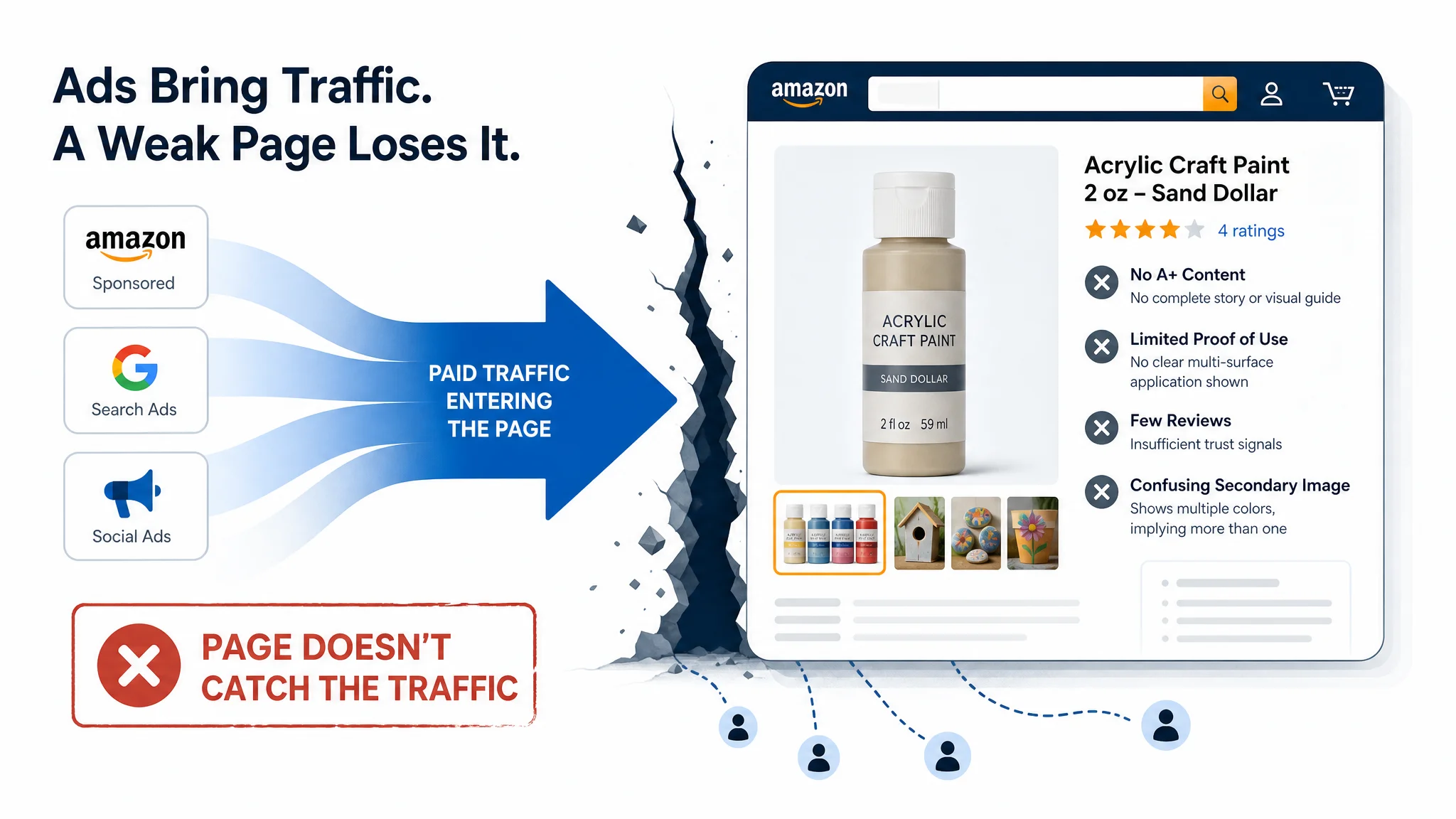
A craft-paint listing reviewed through DeepBI illustrates this operational connection. The seller initially believed rising advertising costs and weak sales were mainly caused by keywords, titles, and image relevance. After benchmarking the listing against a category-leading competitor, the more serious weaknesses were found in the product page itself: the page had no A+ content, limited visual proof of multi-surface use, very few reviews, and a secondary image that showed multiple bottles even though the offer was one 2 oz bottle in one color. The case demonstrates why AI compliance should include not only authorization and auditability, but also product truth and customer-facing accuracy.
- Define the scope: Review AI use across listing copy, including titles and bullet points; listing images, including main, secondary, detail-page, and A+ assets; and listing automation that applies approved changes.
- Separate instrument from agent: An image tool that processes files locally before human review and upload is treated as a human-operated instrument for this analysis, not an account-acting agent. This is a logical carve-out, not a blanket enforcement conclusion.
- Check account authority: If a system accesses the seller account, changes listing assets, or submits updates through an API, verify explicit authorization, limited permissions, and an official channel such as SP-API.
- Keep the human checkpoint: Require a comparison of original and proposed assets, allow item-level selection, and block files that fail platform format or dimension checks before upload.
- Protect product truth: AI-generated visuals should preserve the product’s material, color, and industrial design. Review any change that could create image-product mismatch, damage CVR, increase negative feedback, or weaken trust.
- Measure the operating impact: Connect the workflow to CTR, CVR, ACoS, BSR, and listing cycle time, then document who approved each change and how the result can be monitored or reversed where that capability is available.
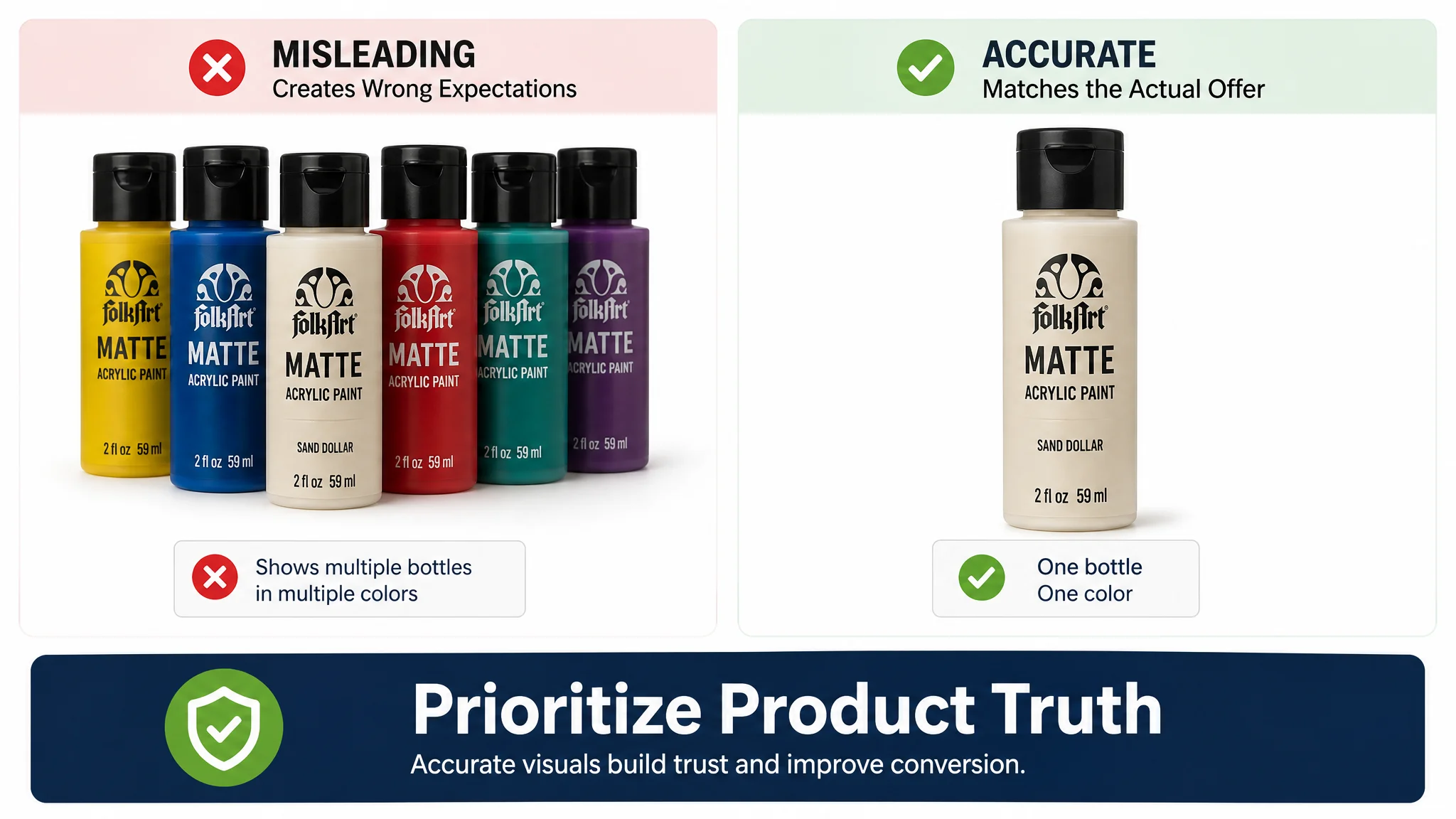
The craft-paint example shows why the product-truth requirement is not merely a technical image check. A secondary image displayed six bottles in different colors, while the actual offer was a single Sand Dollar bottle. Even though the primary image set was scored close to the competitor’s, that one visual could create a quantity and color expectation mismatch. A human review checkpoint should therefore ask not only whether an image meets platform dimensions, but also whether a shopper would understand exactly what is being purchased.
Amazon AI Agent Policy: New Automated Seller Rules 2026
As of the writing date, industry reporting describes a possible shift toward more explicit Amazon rules for AI agents and automated seller activity. That reporting should not be treated as confirmation of an Amazon policy change unless the underlying announcement, current Business Solutions Agreement, or Seller Central notice is available for review.
Some reports describe a transition window scheduled to end in June 2026. Sellers should verify whether that timetable still appears in current Amazon communications before changing automation workflows or making compliance claims. If an update to the Business Solutions Agreement is involved, review the current agreement text and the relevant Seller Central notice directly. Do not rely on an article summary, an unverified clause number, or an assumed effective date.
The practical response is controlled verification rather than immediate deactivation of every AI tool:
- Inventory AI-generated listing copy, images, repricing logic, and publishing automations.
- Identify which actions require human approval and which can execute through an API or workflow.
- Check current Amazon requirements for content accuracy, image standards, and account activity.
- Preserve approval records and the final content submitted for each ASIN.
- Monitor Seller Central for status changes, policy notices, or rejected submissions.
The need for controlled verification also applies to the business logic behind an automated change. In the craft-paint case, the seller’s initial response to weak sales was to adjust titles and ads toward more keywords. That approach was not automatically non-compliant, but it was poorly sequenced: the listing had a total score of 46 out of 100 compared with 80 for the benchmark competitor, with the largest gap in A+ and detail-page content. Verification should therefore include whether the proposed automation is addressing the diagnosed constraint or simply increasing activity around the wrong one.
After the reported transition period, Amazon may begin enforcing certain violation types more actively, but sellers should not assume the enforcement method, timing, or availability of additional warnings. Automation can reduce listing cycle time and support faster CTR or CVR testing only when the underlying content remains accurate and the workflow preserves accountable review.
What Is Amazon's AI Agent Policy?
Amazon AI compliance should be evaluated through one organizing question: Is the tool’s activity authorized, controlled, and accountable within a permitted platform framework? The issue is not simply whether a seller connected software or granted it account access. Seller permission to connect a tool does not automatically equal authorization from Amazon for every action that tool might perform.
Reporting has drawn a distinction between access provided “with the user’s permission” and access conducted “with authorization by” the platform. That reported distinction should be treated as a compliance lens, not as a new legal definition attributed to Amazon. In practical terms, automation using official, registered channels—such as the Selling Partner API within a defined permission scope—differs from bot-like behavior that operates outside approved channels or imitates user activity without equivalent platform authorization.
Authorization is only one part of accountability. The resulting content must still be accurate and suitable for the listing. In one real listing diagnosis, the seller had not created a clear A+ narrative, and the product page did not visually demonstrate the paint’s multi-surface use. The problem was initially framed as a keyword and advertising issue, but benchmarking showed that the page lacked the information and trust structure needed to convert visitors. An authorized workflow could have published more content efficiently, but it would not by itself have solved the absence of a credible sales story.
How an AI Agent Differs From an Operator-Driven Tool
Think of an operator-driven tool as a company car: the software can prepare the route and assist with execution, but the authorized driver selects the destination and remains accountable. A more autonomous agent resembles an unattended vehicle acting on its own instructions. The key questions are who acts, who approves, and what the platform can record.
- Operator-driven tool | Who acts: The tool prepares or executes a narrowly scoped task after seller direction. Who approves: The seller confirms the action. What is logged: The API records the resulting task status, such as success, processing, or rejection.
- Bot-like agent | Who acts: The software independently performs account activity. Who approves: Approval may exist only from the seller, without demonstrated platform authorization. What is logged: Activity may occur outside official, registered channels, reducing clear accountability.
This framework prevents sellers from treating every connected AI tool as equally permitted. Each workflow should be assessed by its channel, scope, approval control, and audit trail before automation is expanded.
The same distinction helps separate content preparation from content publication. An AI system may compare a listing against a competitor, identify that A+ content is missing, suggest a revised bullet-point sequence, or flag a misleading image. Those analytical tasks still require human judgment before publication. In the craft-paint case, the diagnosis recommended correcting the image, restructuring the bullets, and building an A+ visual story before scaling advertising. The value came from identifying the conversion bottleneck, not from allowing software to make unreviewed changes across the account.
Inventory and Listing Automation Boundaries
Listing Automation Thresholds
Automation risk is easier to manage when sellers classify changes by operational impact rather than treating every API action alike. The following three-tier model is an illustrative internal risk framework drawn from reporting and workflow controls, not Amazon’s official published taxonomy:
- Routine synchronization: Approved asset updates and status synchronization generally sit at the lower-impact level. A preview, approval gate, and clear processing status can help protect listing quality and listing cycle time.
- Bulk listing creation or modification: Large batches deserve additional review because one error can affect many ASINs, potentially disrupting CTR, CVR, ACoS, or BSR across multiple listings. A reported trigger around 500 ASINs in one batch should be treated as a testable risk threshold, not a confirmed Amazon rule.
- Account-level configuration: Account-wide settings, sensitive permissions, and changes affecting pricing, inventory, or orders require the highest level of human authorization. Tools should operate only within explicitly granted permissions; image-asset automation, for example, should not be assumed to control core business data.
The operational impact of a listing change is not determined only by the number of ASINs affected. A single customer-facing image can create a serious trust problem if it changes the apparent quantity, color, or configuration of the product. In the craft-paint diagnosis, the listing concerned one 2 oz Sand Dollar bottle, while a secondary image showed six bottles in several colors. That was a single-image problem, but it could affect conversion, customer expectations, and review quality. Item-level review is therefore important even when the workflow is not technically a bulk update.
Reported numerical parameters require verification against the applicable Amazon policy and tool configuration. One reported threshold is a 20% automated price-change limit within 24 hours. It applies to automated changes, not manual price updates made by a human operator; manual updates still must comply with Amazon’s broader pricing policies.
For audit readiness, retaining request IDs, approvals, before-and-after records, and status history for approximately 12 months is a reasonable internal practice pending verification. It should not be presented as a mandated Amazon retention period.
AI Agent Compliance Requirements
Treat the reported requirements as a control framework, not as permission to automate without review. Sellers should label automated activity as automated, comply with the current Amazon policy set, use approved authorization and data channels, and maintain a way to stop access on demand. The reported restriction against training AI models on Amazon data also requires separate verification before implementation. Commentators interpret that restriction as protecting Amazon’s advertising and AI product data; that is an interpretation, not a stated motive.
A complete control framework should also preserve the connection between the proposed change and the diagnosed business problem. For example, a tool may identify that a title contains fewer relevant terms than a competitor’s, but that does not prove the title is the primary conversion constraint. In the craft-paint listing, the seller’s title actually scored 11 out of 20 compared with the competitor’s 8 out of 20, while A+ and detail-page content scored 0 out of 25 compared with 24 out of 25 for the competitor. Automating more title edits would have been easier than rebuilding the page, but the evidence did not support treating the title as the main leak.
SP-API Registration as the Primary Approved Seller Automation Channel
- DeepBI listing product documentation: Use Amazon’s official Selling Partner API (SP-API) as the primary approved channel for seller operations, with internal authorization confirmation before access. Separate Amazon APIs govern specific functions. For seller repricing, verify seller-authorized SP-API pricing endpoints, such as the Product Pricing API or Competitive Pricing API; do not treat the Product Advertising API as a repricing source.
- Permission control: Apply least privilege. Permissions should match the task, and sellers should verify how access can be revoked immediately.
Action Audit Logs
- DeepBI listing product documentation: A retrievable record should include the timestamp, action type, input, output, approval reference, request or report identifier, and Amazon-side result. Amazon may request such logs during an investigation, as reported.
Rate-Limit Compliance
- Current Amazon policy and API documentation: Verify applicable limits before deployment. Updates faster than permitted API rates, or repricing based on scraped competitor data while bypassing approved channels, are canonical non-compliant patterns.
Human Authorization Checkpoints
- DeepBI listing product documentation: Require named human approval before consequential actions, including bulk listing changes, large automated price moves, or account-level configuration. Approval should identify the reviewer, scope, and decision, while preserving the ability to stop access on demand.
For customer-facing content, the approval should also confirm that the proposed change reflects the real offer. In the craft-paint example, the appropriate review would have caught that the secondary image implied a multi-color or multi-pack offer, even though the listing sold one bottle. It would also have asked whether claims about multi-surface use were supported by visible examples and whether the bullet points created a coherent buying path. Authorization and content validation should therefore be recorded together rather than treated as separate administrative steps.
AI-Generated Content in Listing Images and Copy: Disclosure Tagging
Reports have described a request for sellers to tag listing imagery and A+ content—enhanced product-page content—with photorealistic AI-generated people before upload. The reported process requires specified metadata keywords, particularly where a generated person appears to replace a human actor in advertising. Sellers should not treat this as a routine image-upload detail: a disclosure decision can affect approval, listing cycle time, and the risk of later compliance rework.
The reported legal trigger is a New York synthetic performer disclosure law covering digitally created media that appear as a real person and are used instead of a human actor in advertising. The stated exemptions include:
- Content featuring real people, including real people whose appearance has been altered with AI.
- Television characters.
- Video-game characters.
- Movie characters.
As of the writing date, there is no federal disclosure requirement of this kind. States have been filling that gap, while marketplace implementation may determine how sellers are expected to operationalize the rule. Reporting does not clearly establish whether potential penalties would apply to sellers, Amazon as the marketplace, or both.
The safer operating procedure is to inventory every AI-assisted image and A+ module, identify whether a photorealistic person is present, record the legal or marketplace basis for tagging, and preserve the metadata applied before upload. When the scope is uncertain, obtain legal review and document the decision rather than assuming that an image passed Amazon’s technical checks. Treat AI-generated copy separately, and verify whether the applicable rule reaches that content before publishing it.
Disclosure review should happen alongside product-accuracy review. In the craft-paint case, the central image problem did not involve a photorealistic person; it involved an offer mismatch. The image showed six bottles in multiple colors even though the product was one Sand Dollar bottle. The broader lesson is that a technically acceptable or properly tagged image can still be commercially misleading. Human review must check both disclosure obligations and whether the image gives a truthful impression of the product being sold.
A+ modules also deserve this level of review. The competitor’s page used A+ content to show brand trust, multi-surface applications, finish and formula information, project examples, and product value. The seller’s page had no A+ images or structured modules. AI can assist with planning that visual narrative, but the seller must verify that each scene, surface, accessory, and product representation remains consistent with the actual offer.
Ads Automation and AI-Generated Creative: Where the Risk Checklist Extends
Advertising workflows deserve the same authorization and accountability review as listing edits. A tool may improve creative production or connect advertising data without having unrestricted authority to publish assets or change account settings.
- AI-generated creative assets used in advertising: Verify that every image or asset preserves the product’s physical structure, material, color, aspect ratio, brand identity, and verified attributes. Do not approve creative that introduces fabricated accessories, altered functions, or unsupported claims, because image-product mismatch can create misrepresentation, negative reviews, and refunds.
- Automated bid or budget changes through unregistered tools: Treat any tool that pushes bid or budget changes without documented registration, user approval, and defined account scope as a separate risk surface. Record who authorized the action, what the tool can change, and whether the change can be reversed.
- User permission versus platform authorization: Ask two separate questions: Did the user explicitly permit this advertising action or asset workflow, and does the relevant platform authorization actually cover it? User permission alone should not be treated as proof of platform authorization.
- Scope and accountability records: Keep the tool’s requested permissions, intended output, approval owner, and execution log aligned. Narrow scopes are safer than broad account access, particularly when a workflow can publish creative or alter advertising settings.
- Apply the same reported enforcement principles to advertising workflows: Review advertising automation for authorization, truthful content, product consistency, and traceable human accountability rather than assuming that automation is acceptable because it operates outside the listing editor.
Advertising performance should also be interpreted together with listing quality. One craft-paint seller initially viewed rising advertising costs and weak orders as a traffic-quality problem. The team adjusted titles and ads, expecting more relevant traffic to solve the issue. However, benchmarking found that the listing’s main-image score was 24 out of 30 compared with 25 out of 30 for the competitor, while the A+ gap was 0 out of 25 versus 24 out of 25. The page was receiving traffic, but it lacked the visual proof and trust structure needed after the click.
This distinction matters for automated bid and budget changes. If a page has misleading imagery, very few reviews, and no A+ story, increasing bids may simply buy more inefficient visits. Advertising automation should therefore include a stop condition for unresolved listing defects, not only performance thresholds such as CTR or ACoS. Ads can amplify a strong page, but they can also amplify confusion and weak conversion capacity.
Enforcement Risk: ASIN Suppression, API Suspension, and Account Health
Non-compliance can interrupt business continuity through a qualified escalation path. The outcome depends on the nature, scope, and handling of the issue, but sellers should plan for more than a rejected asset:
- An ASIN may be suppressed from search or lose Buy Box eligibility, reducing impressions, CTR, CVR, and sales while weakening BSR.
- API access tokens may be revoked, interrupting automated listing updates, image synchronization, or other approved workflows.
- More serious or unresolved issues may contribute to account-level action, affecting broader operating capacity.
The commercial impact can extend beyond a single listing. Revenue may stop while the issue is investigated, inventory may remain stranded in fulfilment centres, and delayed delivery or unavailable products can strain supplier relationships. Reinstatement also consumes operator time and may require technical remediation, documentation, and repeated communication with Amazon.
A listing can also suffer commercially before formal enforcement occurs. When a secondary image implies that a customer will receive six bottles in multiple colors but the actual offer is one bottle, the resulting hesitation, dissatisfaction, or negative review can weaken conversion and trust. In the craft-paint case, the seller had only five total ratings, a 3.5-star rating, and mixed visible feedback, compared with a competitor that had a 4.7-star rating and more than 14,663 ratings. The misleading image therefore appeared within an already fragile trust environment.
Reinstatement generally requires a plan of action that explains the problem, the corrective steps taken, and the controls designed to prevent recurrence. Processing times vary, so sellers should consult current Amazon guidance rather than rely on a fixed estimate.
Periodic audits are essential because older automation can continue operating after platform requirements, input data, or tool behavior has changed. Review generated content, image validation, API permissions, submission logs, and blocked assets on a defined schedule. For SP-API workflows, least-privilege access and pre-submission checks can reduce unnecessary exposure, but they do not replace account-level compliance oversight.
The audit should examine whether the page still communicates the product accurately and convincingly. In the craft-paint example, this meant correcting the quantity-confusing image, adding visual proof of use on surfaces such as wood and rocks, restructuring the bullets, and developing A+ content around trust, project quality, and application. These are listing-quality controls as well as conversion controls.
A Practical Listing AI Compliance Checklist and Human-Review Workflow
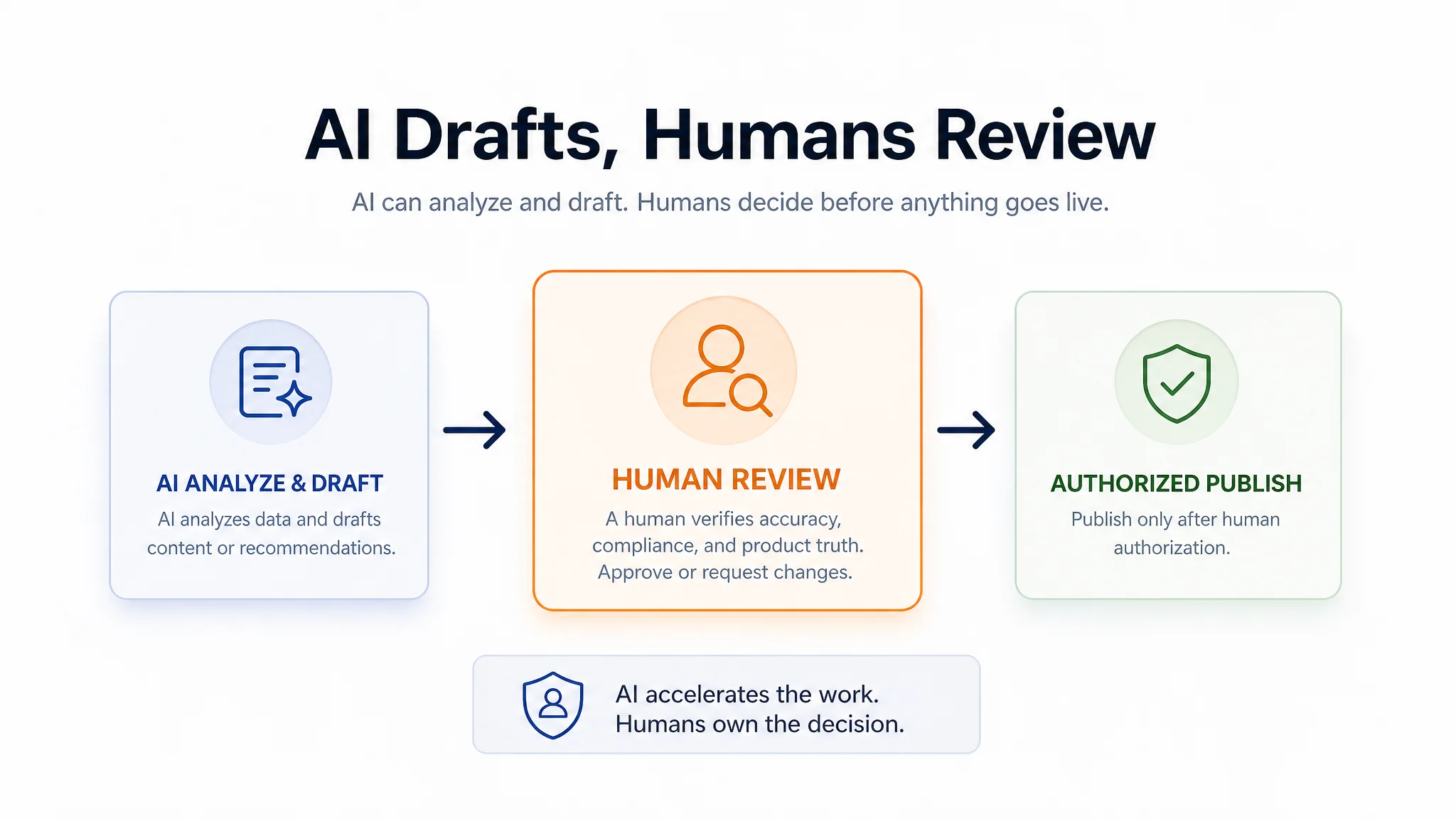
Use AI to analyze, draft, or recommend changes, but require human authorization for consequential updates and retain an auditable record. Choose the control pattern that fits the risk: AI drafts with human submission, autonomous operation within defined guardrails, or analysis agents with manual execution.
- Listing-copy generation: Verify every title, bullet, description, keyword, material, feature, dimension, and performance claim against product records; reject invented specifications.
- Listing imagery: Compare each generated asset with the physical product and approved source images for structure, materials, logos, placement, and features.
- Disclosure tagging: Confirm the required disclosure treatment when photorealistic AI-generated people appear in listing imagery.
- Listing and repricing automation: Define permitted actions, approval thresholds, API scopes, and stop conditions; do not allow automated review or Q&A activity.
- Tool registration status: Record whether each connected tool is registered or otherwise configured as required by the applicable Amazon workflow.
- Log retention: Preserve prompts or inputs, outputs, reviewer decisions, approval references, publication status, and change history for audit.
- Vendor authorization confirmation: Obtain written confirmation of which Amazon authorization, account permission, or API scope the tool operates under; verify it independently.
- Seller accountability: Review connected tools yourself. Vendor responsibility does not transfer the seller’s responsibility for account activity.
The product-accuracy check should include the shopper’s likely interpretation of the full image set. In the craft-paint listing, the secondary image showed six bottles in multiple colors, while the actual offer was one 2 oz Sand Dollar bottle. A human reviewer should have selected or rejected the asset based on that expectation mismatch before publication, regardless of whether the image passed technical format checks.
The same workflow should test whether content completes the buying argument. The competitor’s bullets introduced sensory benefits, durability and usage promises, and trust elements earlier, while the seller’s bullets contained information but felt more like a parameter list. The recommended revision was not to invent new claims, but to organize existing product truths into a clearer sequence: versatility, finish, surfaces, cleanup, and brand reassurance. AI can assist with this structure, but a reviewer must confirm that the wording remains supported by product records.
Follow this human-review workflow:
1. AI drafts or analyzes the proposed listing change.
2. A reviewer checks factual accuracy and policy-sensitive claims.
3. The reviewer verifies disclosure tagging for photorealistic AI people.
4. The reviewer compares proposed images with the actual offer, including quantity, color, packaging, accessories, and use context.
5. Approval is logged with a unique reference and the selected assets or text.
6. The approved content is published through the authorized channel.
7. The seller periodically re-audits permissions, outputs, logs, and results, including potential effects on CTR, CVR, ACoS, BSR, and listing cycle time.
DeepBI can illustrate the analysis-and-drafting-agent pattern: its Amazon-only listing-content workflow keeps human approval and an auditable record rather than publishing autonomously. It is an example of workflow design, not an Amazon approval, certification, or policy guarantor.
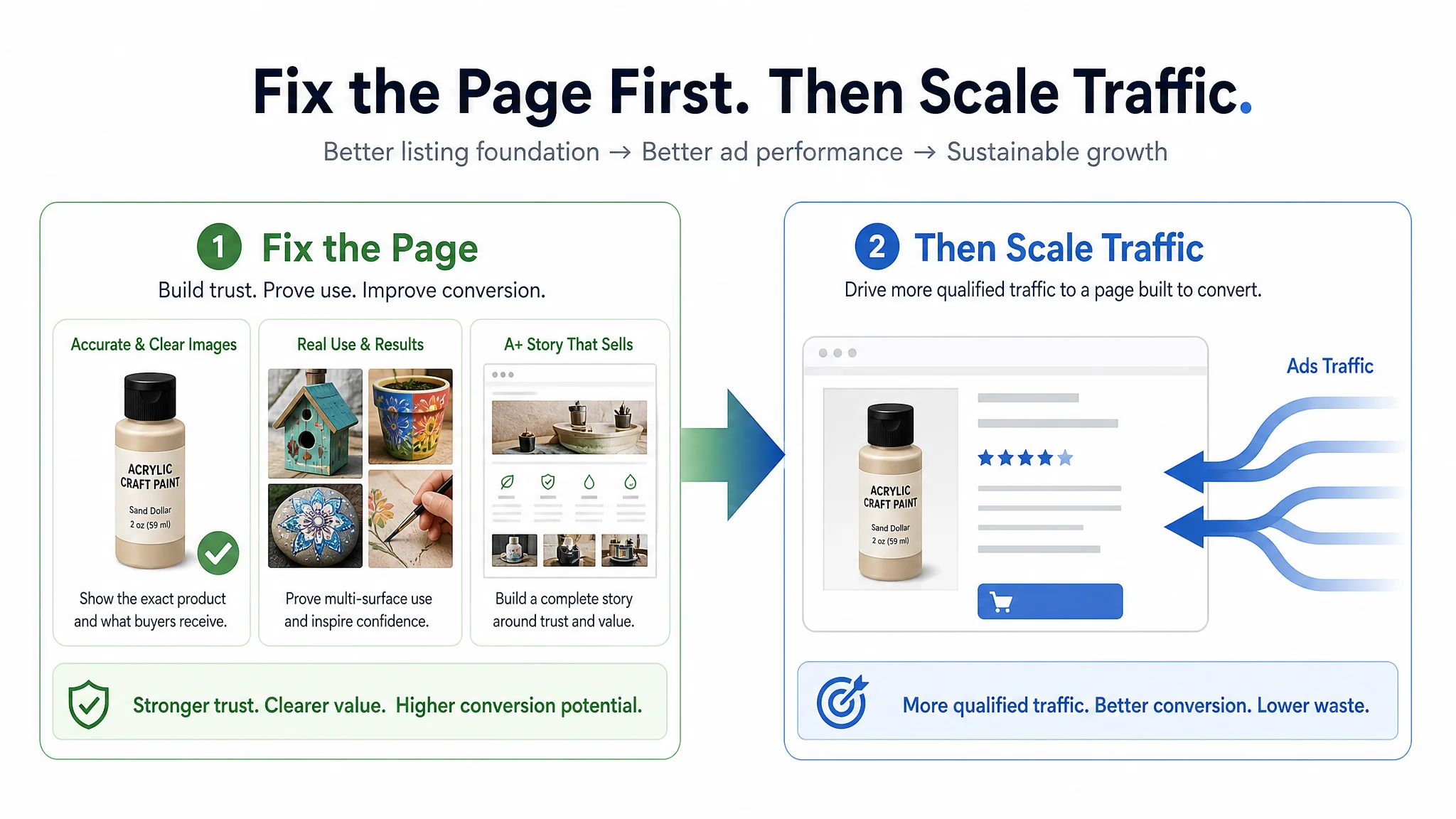
The craft-paint diagnosis also illustrates how this workflow can prevent an inverted optimization sequence. The seller first focused on keywords, title adjustments, and ads. Analysis then showed that the listing’s more fundamental weaknesses were missing A+ content, limited review proof, insufficient multi-surface demonstrations, and misleading imagery. A controlled workflow would allow AI to identify those issues, but would leave the decision to correct the page before scaling traffic with a human reviewer.
Choosing Compliance-Assist Tooling Without Outsourcing Accountability
A seller’s permission allows a tool to act within the granted access; it does not, by itself, establish Amazon authorization or transfer responsibility for the resulting listing, image, or account action. Evaluate the vendor as a compliance dependency, not merely as a productivity application. Before connecting an account, ask:
- Which Amazon authorization does the tool operate under? Confirm whether the connection uses Amazon’s Selling Partner API (SP-API), what scopes it requests, and whether access is limited to the stated business function.
- Is the tool registered with Amazon, and how does it identify automated activity? Require a clear explanation of its platform status, activity labeling, and submission behavior rather than assuming that user approval makes automation acceptable.
- What does the tool log, and how long are records retained? Look for action history, task identifiers, approval records, API outcomes, and a documented retention period that supports investigation.
- How can access be stopped on demand? Confirm the process, responsible party, expected timing, and whether permissions can be narrowed or disconnected during an incident.
- Does the vendor train models on Amazon data? Ask whether listing content, images, advertising information, or account data enters model-training workflows, and require the answer in written terms.
- What happens to the seller’s account if the tool is wrong? Clarify review controls, error handling, evidence preservation, remediation support, and allocation of responsibility if Amazon rejects content or takes account action.
Vendor evaluation should include the tool’s ability to identify business constraints rather than simply generate more content. In the craft-paint case, DeepBI’s comparison found that the title and main image scores were not the largest gaps. The decisive weakness was the absence of A+ and detail-page content, combined with a weak review base and confusing imagery. A tool that only recommends more keywords or automatically increases advertising activity would not address the diagnosed problem.
Tools such as DeepBI remain part of the seller’s evaluation and do not transfer the seller’s obligation to comply with Amazon’s requirements.
Protecting Organic Visibility: Why Compliant Listings Stay Indexed
Compliance protects more than an account from penalties. A non-compliant listing workflow—or repricing automation that operates outside permitted controls—may expose an ASIN to suppression from search and loss of Buy Box eligibility. If suppression removes the listing from organic discovery entirely, the seller also puts previously earned visibility at risk. The resulting damage can extend beyond immediate sales: CTR, CVR, ACoS, and BSR optimization work cannot compound normally when the offer is no longer reliably discoverable.
Even when no formal suppression occurs, inaccurate or incomplete content can make paid and organic visibility less valuable. The craft-paint listing had advertising traffic, but its page lacked a full trust and sales story. The seller’s main images were broadly competitive, yet the page did not show clear multi-surface applications, finished project quality, or brand reassurance. The missing A+ layer meant that shoppers who continued beyond the basic image and bullet sections had little additional information to support a purchase decision.
For that reason, compliance should be managed as an offensive continuity strategy, not only as a defensive obligation. Sellers who verify their publishing, imagery, repricing, and authorization stack can continue operating without the disruption associated with a non-compliant setup. Compliance does not guarantee rankings, indexing, organic traffic, or Buy Box eligibility; it reduces avoidable interruption while preserving the conditions under which organic performance can continue to be evaluated.
A practical loop is: validate content before submission, publish through authorized permissions, monitor marketplace processing and visibility status, then review performance signals before the next approved change. DeepBI supports this loop for listing assets by using authorized SP-API access, checking image requirements before publishing, recording Amazon processing outcomes, and marking successful visual changes for later report review. Sellers can also confirm proposed replacements before deployment rather than sending unverified assets blindly.
The sequence is important. DeepBI did not recommend fixing ads first for the craft-paint listing because the page had a 0 out of 25 A+ score and a structural trust deficit. The proposed path was to correct the misleading image, improve the bullet-point logic, build a visual A+ story, and then reconsider ad scaling once the page could credibly handle traffic. A compliant page does not automatically convert, but a page that cannot accurately explain and demonstrate the offer should not be treated as ready for unlimited traffic acquisition.
Marketplace-mediated enforcement still has an open reporting question: upload-time attestations place the burden on sellers, but detection of untagged photorealistic imagery remains unresolved. That uncertainty is another reason to maintain documented, reviewable controls rather than depend on enforcement detection alone.
FAQ
Is all automated listing software banned?
No blanket ban is established here. Automation remains subject to the authorization, control, disclosure, and documentation requirements applicable to the specific workflow.
Can I still use repricing tools?
Do not assume either permission or prohibition. Review the tool’s access scope and behavior, then verify the current requirements in Seller Central and the Business Solutions Agreement.
What counts as a high-impact action needing human authorization?
Treat any action that publishes or materially changes customer-facing content or account operations as potentially high impact. Require explicit seller approval before execution unless current Amazon guidance clearly states otherwise.
Do AI image tools fall inside the rules?
Possibly, depending on the tool and workflow. Product accuracy, permitted content, approval steps, and disclosure obligations should be checked rather than inferred from the fact that an API is used.
An image should also be reviewed for offer clarity. In one craft-paint listing, a secondary image showed several bottles and colors even though the product being sold was a single bottle in one color. That type of mismatch can create conversion and review risk even if the image was generated or processed through an otherwise authorized tool.
What should I do if my existing automation may not comply?
Pause or limit the workflow, review its permissions and approval points, validate product accuracy, and document the review before continuing.
Do I need to tag AI-generated people in my images?
This requirement is not verified by the available materials. Check the current Amazon guidance for the relevant image and disclosure context.
Where do I verify the current rules?
Use Seller Central and the current Business Solutions Agreement as the controlling verification sources for your workflow.
Conclusion and Next Steps
Listing AI content compliance becomes manageable when every automated action is authorized, traceable, and reviewed through the correct Amazon channel. It also requires a human assessment of whether the resulting page tells the truth and gives shoppers enough information to make a decision. Use this checklist to convert uncertainty into documented control:
- Inventory every connected tool and workflow stage, including listing generation, image processing, repricing, advertising, API delivery, and any external access to Seller Central data.
- Ask each vendor to state the authorization basis and permission scope for its connection, including whether it uses SP-API or another applicable Amazon API and what actions it can perform.
- Document and retain approval records before publication or application, including human approvals, old-versus-new comparisons, selected assets, report IDs, task statuses, and relevant Amazon processing outcomes.
- Maintain a human review checkpoint so an operator confirms product facts, images, brand elements, and proposed changes before content replaces an existing listing.
- Check the page’s actual conversion capacity before scaling traffic, including A+ depth, review context, visual proof of use, image accuracy, and whether the bullets form a clear buying path.
- Re-audit the workflow at least quarterly, checking permissions, action logs, automated thresholds, failed submissions, and whether actual behavior still matches the documented authorization.
- Monitor official notices, Seller Central guidance, the Business Solutions Agreement, and current agreement text rather than relying only on vendor summaries or older reporting.
The craft-paint diagnosis shows why this broader view matters. The seller initially treated weak sales and rising advertising costs as a keyword or traffic problem. A structured comparison instead found that the listing’s main constraint was conversion capacity: no A+ story, limited trust proof, weak visual evidence of multi-surface use, and an image that could confuse the product quantity and colors. The appropriate response was not simply to automate more advertising or generate more keywords, but to repair the page before asking it to absorb additional traffic.
AI-assisted listing content is not inherently banned as a category. The seller remains accountable for accuracy, authorization, channel use, and compliance, even when a vendor supplies the tool. Automation should support documented human decisions, preserve product truth, and help resolve the real listing constraint—not replace human responsibility or amplify a defective page.