


Why Amazon Ad ROI Quietly Slips (and What to Measure First)
Amazon ad auctions have become more competitive, and effective CPC has risen in many categories. As a result, the same budget may buy fewer impressions or clicks, while the acquired traffic may convert differently. ROI can erode quietly as traffic cost, traffic quality, and conversion quality shift together.
Start with ACoS, the primary advertising-efficiency metric. ACoS measures ad spend as a proportion of ad-attributed sales:
ACoS = ad spend ÷ ad-attributed sales
Pair it with ad-attributed ROI, which measures the sales return generated by advertising spend:
Ad-attributed ROI = ad-attributed sales ÷ ad spend
Then diagnose the funnel instead of reacting to ACoS alone:
- CPC shows what each click costs and helps identify rising traffic acquisition pressure.
- CTR shows how effectively impressions become clicks, making it a key signal of traffic quality and listing relevance.
- CVR shows how effectively clicks become orders, helping assess conversion quality across the detail page, offer, reviews, and product fit.
Use TACoS only as a business-level sanity check. It compares total ad spend with total revenue and helps show whether advertising is supporting a healthier overall sales mix. It is not a direct bidding lever and should not replace campaign-level diagnosis.
A real hand-soap listing illustrates why this distinction matters. The seller was receiving paid traffic, but orders were not growing in line with the traffic they were paying for, and ACoS remained difficult to reduce. The initial assumption was that the problem was advertising precision: perhaps bids were too high, keywords were too broad, or more fragrance-related terms were needed. A deeper listing comparison pointed elsewhere. The page looked premium, but it was not quickly answering the functional questions that mattered most to shoppers: whether the soap cleaned well, whether it would dry out their hands, and whether the moisturizing claim could be trusted.
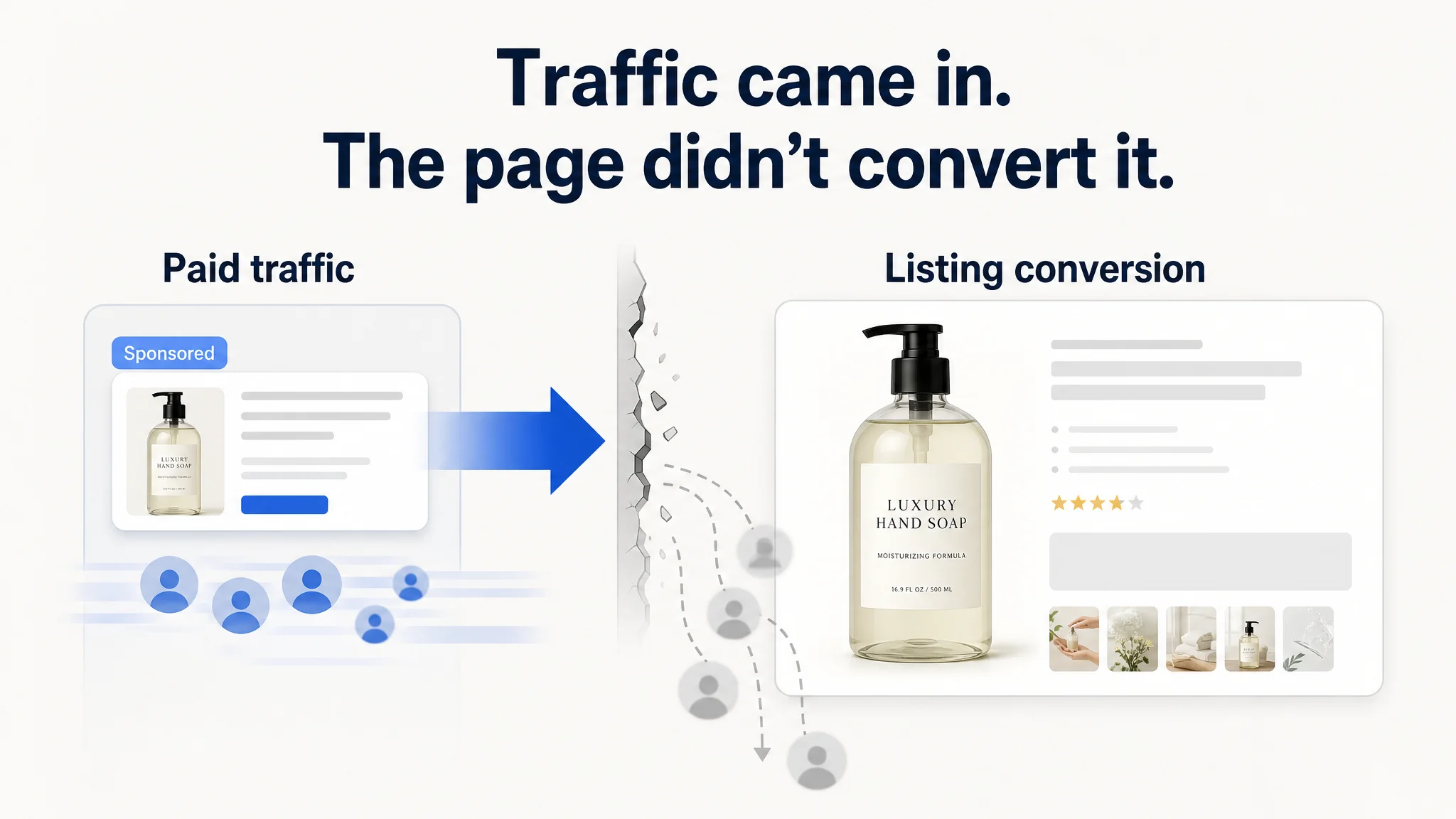
The listing had a DeepBI score of 75/100 compared with a competitor at 78/100, so nothing appeared obviously broken at the total-score level. Yet the score composition showed a different constraint: the seller’s main-image structure and A+ presentation were relatively strong, while bullet points scored only 4/10 and reviews were weaker than the competitor’s. In other words, the listing was attracting attention and communicating lifestyle, but its core sales logic and social proof were not strong enough to convert every paid click. Establishing a reliable baseline therefore requires more than recording ACoS. It requires connecting advertising metrics to the specific listing inputs that determine CVR.
Record these metrics by ASIN, campaign, and time period before making changes. From there, the operating loop is clear: diagnose the constraint, control budget and bids, improve conversion inputs, validate the effect through CTR, CVR, and ACoS, automate repeatable execution, scale proven patterns, and convert sustained ad signals into organic compounding and stronger BSR.
Find the Leak: Read Your Ad Account in Traffic Layers
Account-wide averages can conceal where ad spend is being lost. A blended ACoS may appear acceptable while unqualified traffic consumes budget and proven traffic remains underfunded. Instead, read performance by traffic function: evaluate impressions, clicks, CTR, CVR, orders, and ACoS within each layer.
Exploration, Filter, Precision, Scale
- Exploration: Use keywords and competitor ASIN targeting to widen reach and discover new sources of qualified traffic. The purpose is learning, not immediate efficiency. Exploration can tolerate weaker early ACoS when the traffic is producing useful signals for later decisions.
- Filter: Use a trailing window of ad data to remove traffic that repeatedly generates clicks without sufficient conversion quality. Review CTR, CVR, spend, and orders together rather than cutting a target from one weak day. Any cutoff should be a placeholder derived from the seller’s own trailing performance, not a universal rule.
- Precision: Concentrate spend on keywords and competitor ASINs that have demonstrated stronger conversion behavior. Test these targets through multiple rounds before treating the pattern as reliable. Precision is where bids become more deliberate because the traffic has earned greater confidence.
- Scale: Increase bids and budgets only after traffic has proven its ability to generate orders at an acceptable efficiency level. Scaling unqualified exploration simply increases ACoS; scaling proven traffic can expand volume while protecting budget control.
A healthy account is not one with the lowest ACoS in every layer. Exploration may produce a higher ACoS while supplying discovery data. The operating objective is to move budget progressively toward Precision and Scale, where CTR, CVR, and order quality justify greater investment.
This is also why expanding keyword coverage is not automatically a solution. In the hand-soap example, the seller initially considered adding more fragrance and gift-oriented keywords. That approach would have increased exposure to the same message the listing already emphasized: luxury, scent, and lifestyle. It did not address the unanswered functional concern about a gentle, non-drying cleanse. The issue was not simply whether more shoppers could be reached, but whether the page could convert the right shoppers after they arrived.
Applying a Competitor Layout and Placement Gap Lens
Competitor ASIN targeting should not be judged solely by whether a competitor converts. Apply a competitor_layout_gap review by comparing the competitor’s sponsored placements with its organic strength and listing layout. Examine placement visibility, main-image communication, A+ content, and five-bullet information gaps alongside ad exposure and conversion signals.
Prioritize relevant competitors with comparable product form, price range, use case, and audience. Then turn each identified gap into a ranked ad action list before changing bids. For example, determine whether to test a competitor target, adjust placement emphasis, expand a proven keyword group, or hold spend until the conversion weakness is understood. Diagnosis should come before bid changes, and subsequent ad data should confirm whether the selected action improves CTR, CVR, or ACoS.

The hand-soap comparison showed why a total listing score is not enough. Although the seller’s overall score was only three points behind the competitor’s, the competitor had stronger review quality and a cleaner visible rating distribution. Its page also used the second image to show a hand using the product with visible foam and messaging around softness and smoothness. The seller’s corresponding space extended the fragrance story through static visuals and scent notes. The competitor was therefore answering “Is this effective and gentle?” while the seller was answering “What does this luxury fragrance feel like?” A competitor-layout review made the conversion gap visible before another round of bid changes.
Control the Levers: Bids and Budgets Governed by Trailing Data
A single day of clicks is not a trend. If a target records weak conversion yesterday, cutting its bid immediately may overcorrect for normal volatility. The same issue can follow one period of inefficient spend: budget is pulled from the campaign even when the target has strong recent CVR and acceptable ACoS. The result is predictable—winning targets lose traffic, impressions decline, and potential organic lift is limited before the data is conclusive.
Use a trailing control window, roughly the most recent week, to govern changes. Review clicks, conversions, spend, and ACoS together instead of reacting to one metric or one day. The operating rules should answer four questions:
- Is the target converting consistently enough to protect from a blanket bid cut?
- Is spend rising faster than conversions across the review window?
- Does the campaign have enough budget to support proven targets?
- How much spend can be assigned to exploration without crowding out winners?
Set exploration-layer spend as a fixed share of the available budget. Keep the remainder available for targets with demonstrated conversion behavior, while monitoring CTR, CVR, ACoS, and downstream BSR movement.
However, trailing-data control should not become an excuse to protect inefficient traffic indefinitely. It must be paired with a diagnosis of what the traffic is landing on. In the hand-soap case, the seller was inclined to adjust bids and daily budgets because advertising appeared expensive. But the deeper finding was that the page was amplifying an incomplete decision path. The title led with emotional fragrance language, the bullets opened more like a specification list, and the A+ content promoted the wider product family before fully securing the hero hand soap. Reducing or increasing bids without addressing that mismatch would only change the amount of traffic entering the same weak conversion path.
Every bid or budget change should be a traceable step tied to a stated reason: raise a bid after sustained conversion efficiency, lower it after repeated inefficient spend, or reallocate budget when a proven target is constrained. Record the decision and review the subsequent data; after any adjustment, continue monitoring conversion.
For example, a reactive operator cuts a target after one expensive day and loses its next sales opportunity. Under rule-based control, the same target remains funded while its weekly trend is reviewed; exploration stays within its fixed share, and any later bid change is documented and reversible through a clear decision record. If CVR remains weak across the review window, the next question should not automatically be “Which bid should be changed?” It should be “What is preventing relevant traffic from converting?”
Repair the Handoff: Make Paid Clicks Land Somewhere That Converts
Better traffic selection cannot rescue a listing that fails to convert. Paid clicks and listing conversion quality are connected parts of the ROI equation: targeting can improve relevance and CTR, but weak on-page persuasion can keep CVR low, raise ACoS, and waste budget on clicks that never become orders.
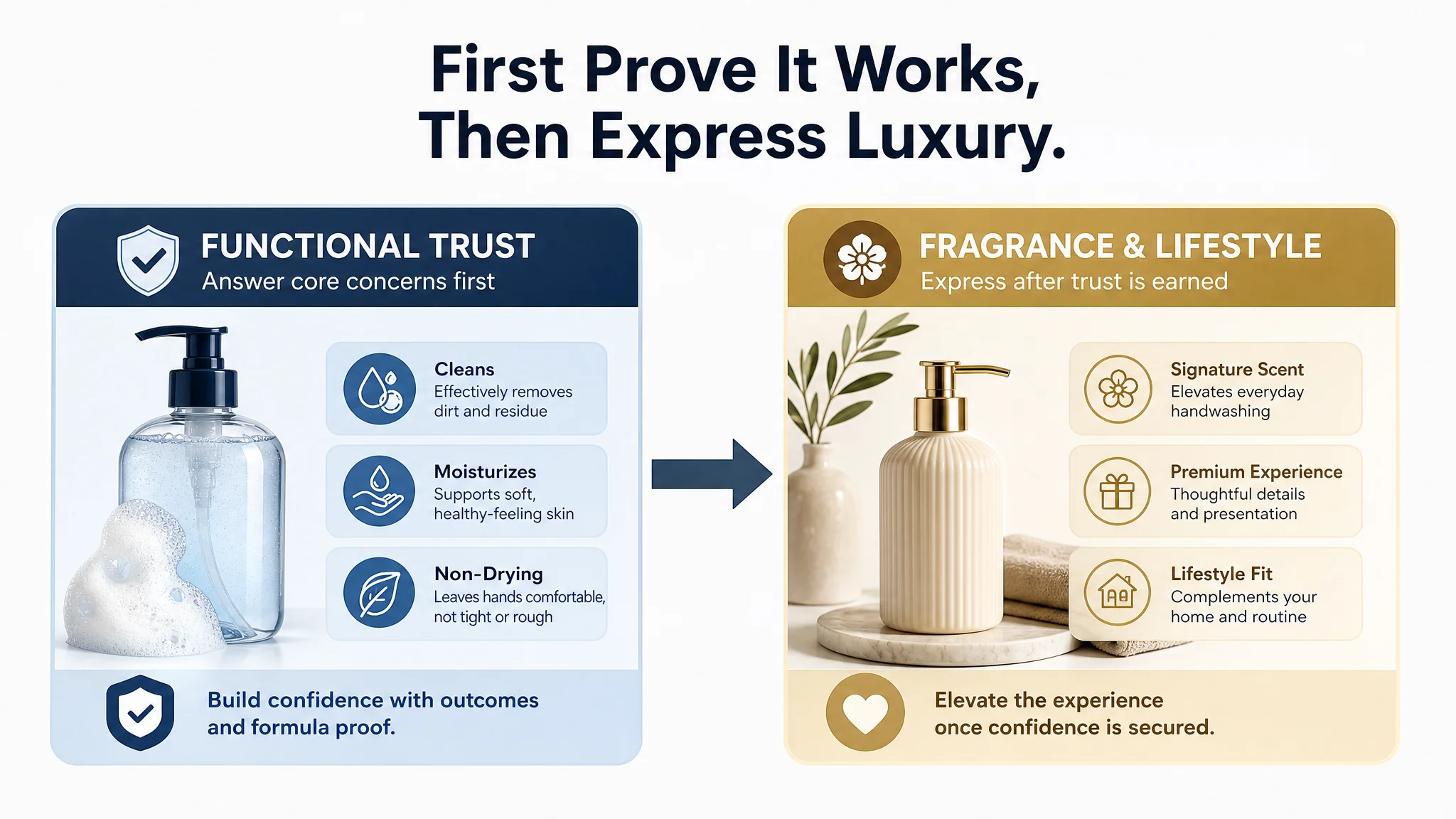
A premium hand-soap listing made this handoff problem particularly clear. Ads were not completely failing to bring people to the page, and the brand presentation looked high-end. The seller therefore treated keyword coverage and bidding as the main opportunity. Yet the page was selling fragrance and lifestyle before proving the basic product promise. The competitor connected ingredients such as aloe and shea butter to softness and care, while the seller described scent, packaging, and giftability in greater detail. The page contained information, but it did not lead shoppers from concern to formula, outcome, trust, and lifestyle. More clicks could not solve that sequence problem.
Start with the same keyword set used in the traffic-layer analysis. Use the competitor_layout_gap findings as the basis for the listing diagnosis, so the audit evaluates the same search targets and comparable competitors rather than creating a disconnected benchmark. Filter the comparison by product form, use case, price range, and audience.
Score four priority areas against those competitors:
- Main image clarity: Check product prominence, visual focus, distractions, and whether key information is immediately legible. Weaknesses here are likely CTR constraints.
- Title keyword coverage: Review keyword placement, primary-benefit clarity, structure, and unnecessary repetition. Title gaps can affect both relevance and conversion confidence.
- Five-bullet benefit structure: Examine benefit order, pain-point coverage, readability, and whether each feature is connected to a customer problem.
- A+ content presence: Assess information density, usage scenarios, comparison modules, and content that resolves hesitation after the click.
The hand-soap diagnosis showed why these areas should be scored by composition rather than appearance alone:
- The title included the core hand-soap term and some hydration language, but emotional phrases such as premium fragrance and rejuvenation received more emphasis than concrete formula proof.
- The main-image set was structurally complete and visually consistent, but its second-image priority was scent storytelling rather than functional reassurance.
- The bullets began with the product name and size, then moved into scent and packaging, instead of first explaining how the formula affects the user’s hands.
- The A+ page was polished, but it introduced lotion, candles, diffusers, and another scent before the hero hand soap’s functional claims were fully established.
- Reviews were weaker than the competitor’s, making the missing trust information in the copy more consequential.
The recommended logic was not to abandon premium positioning. It was to change the order of persuasion: establish a hydrating, non-drying cleanse first; connect ingredients to outcomes; then develop the fragrance and lifestyle story. The same principle applies across categories. A page can look complete and still lack the specific proof that high-intent shoppers need before purchasing.
Do not rely on a single overall listing score. Use Score_Report.json to identify the specific visual or text module behind each gap, then rank weaknesses by expected funnel impact. Prioritize main-image issues when CTR is the constraint; prioritize A+ and detail-page information gaps when relevant traffic arrives but CVR remains weak. Title and bullet improvements take priority when they influence both search relevance and on-page persuasion. Keep recommendations within the product’s actual attributes, and treat the ranking as a prioritization signal rather than a guaranteed conversion lift.
Validate Demand Signals Before You Commit Ad Budget
Demand validation should serve as an ad-budget gate, not as a separate product-trend exercise. Before increasing Sponsored Products spend, decide whether the available evidence supports a hold, test, or scale action. If demand is unclear, hold the budget and avoid turning a weak hypothesis into high ACoS. If signals are promising but unproven, run a controlled test with defined spend, keywords, and observation period. Scale only when demand appears durable across more than one signal and produces usable advertising evidence, such as stable CTR, improving CVR, and acceptable ACoS.
Demand validation also applies to the message being advertised. A product may have demand for its category while a particular positioning fails to create confidence. In the hand-soap case, the seller emphasized premium fragrance and gift appeal, but the more immediate purchase concern was whether the product would clean effectively without leaving hands dry or tight. The category and the brand positioning were not necessarily the problem. The problem was that the page and advertising were prioritizing a less urgent message before proving the functional reason to buy.
Durability, Utility, and Cross-Trend Fit as Budget Gates
Start with durability. Ask whether buyers are likely to want the product over time or whether interest is seasonal. Fads can rise and fall quickly, but their duration varies widely, so a short burst of attention is not enough to justify a large budget commitment.
Next, test inherent utility. Does the product solve a real, recurring problem, or does it work only under narrow conditions? A product with practical utility has a stronger basis for repeatable search and conversion than one dependent on temporary novelty.
Finally, assess cross-trend fit. Products positioned at the intersection of several existing demand movements may warrant test budget because they can draw interest from multiple buyer motivations. For example, a wearable device combining demand for personal health tracking with demand for convenient mobile connectivity may be more testable than a product tied to one isolated fad. The crossover supports a controlled test; it does not automatically justify scaling.
A useful parallel exists in listing diagnosis: several positive signals do not automatically prove that a page is ready for scale. The hand-soap listing had polished visuals, a premium brand tone, and an overall score close to its competitor’s. Those signals supported the idea that the product had a credible market position, but they did not prove that its conversion logic was healthy. Utility, trust, and the ability to communicate the product’s core benefit still had to be checked before additional ad budget was committed.
Where Demand Signals Surface
Build a cross-checked evidence chain rather than relying on one attractive metric. Review signals across:
- Trade publications and industry articles
- Observed advertising activity
- Seller forums and discussion groups
- Social communities
- Product-tracking tools
Treat product-tracking outputs as estimates, not exact sales data. An ASIN or marketplace observation cannot prove demand on its own, and neither can a single CTR, CVR, BSR movement, or competitor campaign. Compare external interest with actual advertising results after the test begins. Stable signals tracked through a defined observation window provide a stronger basis for the next budget decision than a one-time spike.
Let the System Do the Daily Work: Automated Tuning and Human Guardrails
Daily Sponsored Products management can consume attention without improving decision quality. Repeatedly checking clicks, conversions, spend, and ACoS may lead to inconsistent bids or delayed budget changes, especially across large SKU portfolios. A better operating model lets tools handle recurring analysis while the seller retains strategic control.
The seller should set the operating objective first: protect target profitability, pursue growth, tighten ACoS, or accept higher ACoS to capture more volume. Margin limits, acceptable efficiency ranges, campaign priorities, and escalation rules should also be defined before adjustments begin. These constraints determine what the system is allowed to recommend or execute.
DeepBI can serve as an Amazon-focused operating system for Sponsored Products advertising. Within a configured workflow, it can monitor recent clicks, conversions, spend, and ACoS behavior; support recurring analysis; assist with bid and budget adjustments; and feed results into the next iteration. Each action should be logged with its inputs, rationale, and resulting status, giving operators a reviewable record rather than an unexplained change.
The hand-soap diagnosis demonstrates why automation should not be allowed to optimize advertising in isolation. If a system sees high spend and weak conversion, it may recommend a bid reduction or budget shift. That may be appropriate, but the operator should also be able to see whether the listing’s main constraint is a bullet-point gap, weaker reviews, a misplaced image message, or A+ content that creates cross-sell distraction. In this case, the seller’s first interpretation focused on campaign precision. The diagnostic layer showed that the page itself was consuming traffic because it did not answer the buyer’s first functional questions. Automation is most useful when it helps surface that distinction rather than hiding it behind another bid adjustment.
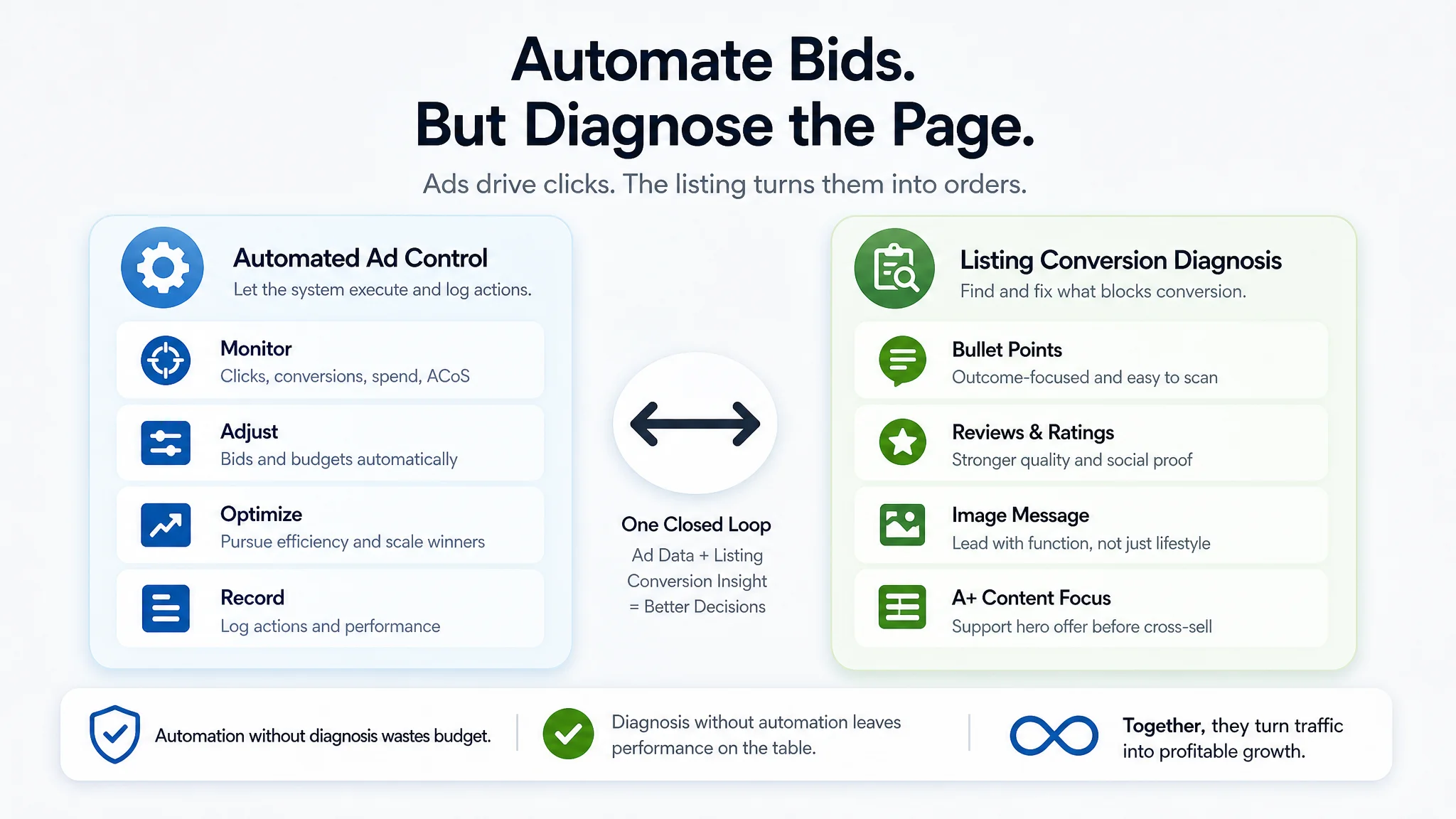
This tool-assisted approach reduces high-frequency manual intervention while keeping decisions explainable. A seller can review whether a bid change followed sufficient conversion evidence, whether spend is approaching a defined limit, and whether the observed ACoS movement supports further action. When data is sparse, conflicting, or inconclusive, the system should surface that uncertainty instead of forcing a conclusion.
Automation does not independently guarantee better ROI. Results depend on configuration, data quality, competition, and seller decisions. Humans remain accountable for goals, margin constraints, and judgment; the system functions as an executor that makes recurring operations more consistent and auditable.
Scale Winners Without Breaking ROI
Scaling is not a reward for one strong day. A campaign earns the right to scale when its conversion behavior remains consistent across a trailing review window and its returns stay stable enough to justify additional exposure. Look for repeatable CVR, controlled ACoS, and traffic quality that supports the campaign’s role in the account. A temporary CTR spike without sustained orders is insufficient evidence.
The same standard should apply to the listing receiving the additional traffic. A page with strong visual polish may generate clicks, but if its bullets, reviews, or functional proof remain weak, scaling can simply magnify the conversion gap. In the hand-soap case, the page’s overall score was close to the competitor’s, but its low bullet-point score and weaker social proof indicated that the page had not earned more aggressive traffic yet. The decision was therefore to rebuild the product-page logic before treating additional ad exposure as a growth lever.
Use a scaling ladder rather than a single aggressive adjustment:
- Increase bids in measured steps for the proven targets.
- Raise budgets in separate steps so bid efficiency and budget capacity can be evaluated independently.
- Record the trailing data that justified each change, including spend, sales, CVR, ACoS, and relevant organic movement such as BSR.
- Define an observation window after each step before making another change.
The decision rule is marginal return. Suppose the first step adds qualified traffic and improves total return. The next step may still produce sales but flatten the return curve. A later step can push the campaign into weaker auctions, causing spend to rise faster than revenue and degrading ACoS. Stop when the next increment no longer pays for itself.
If a step underperforms, pull back the bid or budget rather than spending through the deterioration. Review the change against the same trailing metrics that supported it, then decide whether to restore, hold, or abandon the increase.
Only a minority of traffic should reach the scale layer. Keep exploration bounded, validate stable signals first, and move proven winners outward gradually. Each scaling action should remain a reviewable event supported by observed performance rather than extrapolation. Before scaling, confirm not only that the campaign can buy traffic, but also that the listing can explain the product’s value in the order buyers need to understand it.
Turn Ad Wins Into Organic Rank and Compounding Growth
The goal is not to keep buying the same traffic; it is to turn paid demand into stronger Amazon performance.
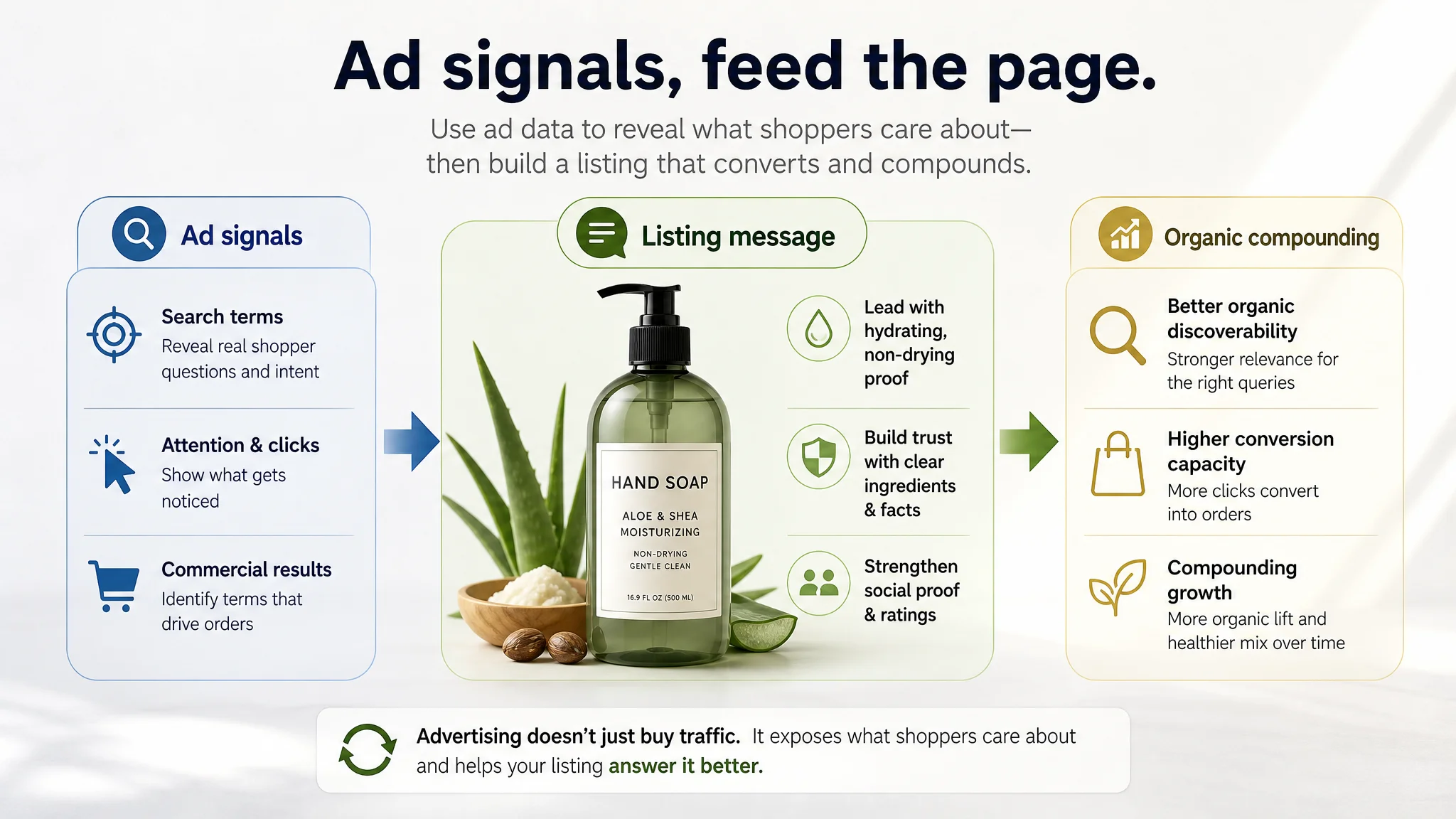
Sponsored Products data shows which search terms attract attention and produce commercial results. Review keywords with strong CTR, CVR, and order value, then separate them from terms that generate clicks without sufficient conversion. These winning terms reveal the demand your listing should serve more clearly through its title, images, and supporting content.
The hand-soap case shows how this feedback can change listing priorities. The seller initially leaned toward fragrance and gift-related messaging because those themes fit the premium brand identity. The diagnostic comparison suggested that the page should first communicate hydrating, non-drying performance and connect the formula to a softer post-wash feel. Once advertising data identifies which functional and category searches attract qualified shoppers, those signals can guide the order of claims in the title, bullets, images, and A+ content. Advertising is therefore not just a traffic source; it is also evidence about which customer concerns the listing must answer.
Use proven keywords to anchor dedicated campaigns designed to pursue top-of-search placement. Keep their budgets and bids under explicit control so you can evaluate whether additional visibility produces qualified sessions and orders, not merely higher spend. The advertising outcome is measurable through CTR, CVR, ACoS, and sales velocity.
Keep the organic outcomes separate. Advertising does not purchase organic rank, and a paid order is not an organic order. However, sustained visibility and conversion velocity can support stronger organic ranking when the offer, listing, and customer response remain competitive. If BSR improves and organic-order share rises while paid performance remains controlled, the account may be converting validated demand into a broader traffic mix.
This effect is directional, not guaranteed. Short-term advertising volume and long-term organic-rank improvement can move in parallel when you continue testing keywords, strengthening conversion quality, and measuring the resulting data. Over time, a larger organic-order share can lower the blended cost of growth because fewer incremental orders depend entirely on paid traffic.
The operating loop is simple: diagnose, control, convert, validate, automate, scale, and compound. Start this week by reviewing your strongest Sponsored Products keywords and selecting those with credible CTR, CVR, and order-value signals for listing and top-of-search testing. Before increasing spend, ask one additional question: does the listing answer the buyer’s first practical concern clearly enough to deserve the traffic? A page can look premium, score well overall, and still lose ROI when it leads with the wrong message. Advertising works best when it amplifies a conversion logic that is already credible.