


Key Takeaways
- DeepBI Listing Product Documentation: Calculate Amazon CTR as total clicks divided by total impressions, multiplied by 100. Read CTR alongside impressions, clicks, CVR, ACoS, and BSR so a click problem is not confused with a post-click conversion problem.
- Benchmarking and Funnel Diagnosis: Treat roughly 2.0% organic-search CTR and roughly 0.4% PPC CTR as broad averages, not universal targets. Compare performance by placement, category, price band, ad type, and time window; use baseline, competitive, and stretch tiers rather than one blended benchmark.
- Visible Listing Asset Optimization: Improve organic CTR through the SERP-visible assets shoppers use to judge relevance, value, and credibility, especially the main image, title, and supporting visual presentation. Front-load important keywords and attributes, clarify the visual hook, and preserve strict product-entity consistency so optimization does not create an image-product mismatch.
- Competitor Comparison and Measurement Loop: For a mature listing with impressions but weak clicks, compare three to five genuinely substitutable ASINs with a comparable use case, price band, audience, and review depth. Apply one selected asset change, mark the implementation point in the relevant Amazon-native report or DeepBI workflow, and compare subsequent CTR with the prior baseline over a consistent window.
Why Organic CTR on Amazon Decides Whether Your Listing Gets Seen
Impressions represent only potential traffic. If shoppers do not click, those impressions generate no sessions, product-page engagement, or opportunity to produce revenue. Organic click-through rate (CTR) is therefore a commercial gate, not a vanity metric.
A click is the shopper’s first judgment of relevance. Before reading every bullet or comparing specifications, shoppers decide whether a result appears to match their intent. The main image, title, price, and visible offer cues must earn that initial action. A listing may gain exposure yet lose the sale before shoppers evaluate its conversion strengths.
CTR also carries competitive significance. Multiple listings compete for demand on the same results page, and stronger click engagement can help one listing capture more available shopper attention than neighboring results. This is a competitive implication, not evidence that CTR alone determines organic ranking. The practical question is whether your listing turns existing exposure into qualified sessions.
DeepBI treats visual assets as a commercial engine rather than decoration, linking exposure, clicks, CTR, and CVR to identify where demand is being lost. This shifts optimization from “make the listing look better” to “remove the reason shoppers pass it by.”
A water dumbbell seller in the Japan marketplace illustrates why that distinction matters. The team believed weak CTR and difficult-to-control ACoS pointed primarily to advertising: better campaigns, bids, and keywords seemed like the logical answer. Yet the ads were already bringing traffic to the product page. A DeepBI comparison showed that the page itself had a total Listing score of 34/100, compared with 75/100 for a genuinely comparable competitor. The largest gaps were in the main image set and A+ content, not in the advertising setup.
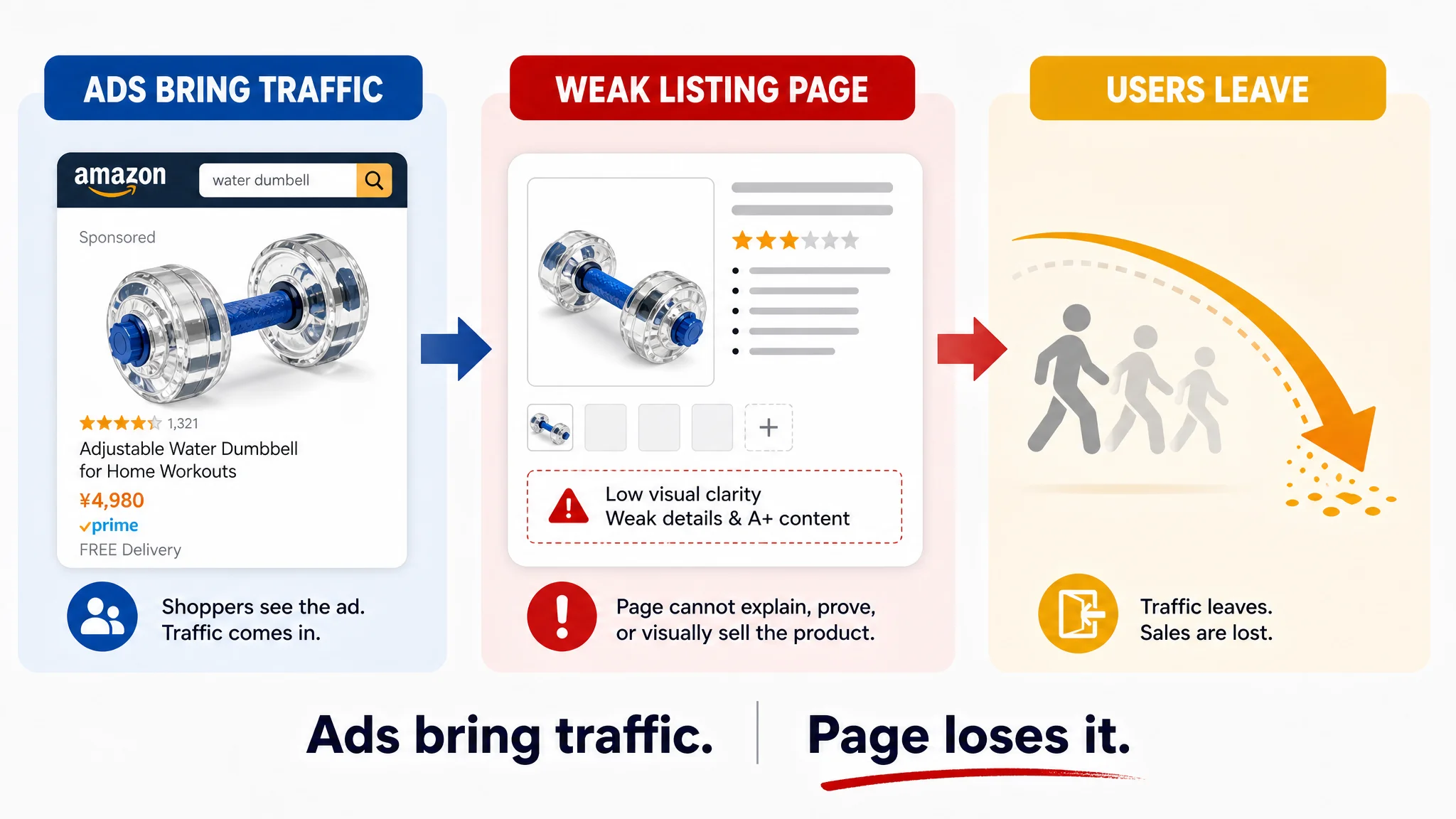
The issue was therefore not simply that shoppers were failing to see the product. The page was failing to provide enough visual reason to click and enough evidence to continue deciding after the click. This is why CTR should be read as part of a complete traffic-to-order path: a weak result-page presentation and a weak product-page experience can reinforce each other.
How Amazon CTR Impacts SEO and PPC
CTR matters in both organic and paid channels, but it should be treated as a performance signal rather than a single control lever.
For organic listings, a higher CTR is associated with stronger placement because more shoppers select the ASIN after seeing it in search results. That association may support visibility, but CTR does not independently determine indexing or ranking. Organic performance also depends on relevance, CVR, review quality, sales velocity, listing quality, and other ranking factors. A compelling main image or title may increase clicks, yet weak conversion can still constrain BSR and sustained visibility.
In PPC, a higher CTR can improve click economics at a given bid position. Generating more clicks from the same impression volume can reduce effective cost per click when spend is distributed across more visits. However, paid performance still depends on targeting, placement, bid levels, relevance, CVR, ACoS, and auction conditions. CTR alone does not determine advertising outcomes.
Use CTR as a diagnostic and feedback signal: compare it with CVR and ACoS, identify the listing element that may be suppressing clicks, and then measure the post-change trend rather than assuming causation. This keeps optimization focused on the complete traffic-to-order path.
The water dumbbell example shows how easily this diagnostic step can be skipped. The seller saw mediocre CTR and high ACoS on core keywords and treated them as evidence that bids or match types needed more work. The initial plan was to keep adjusting campaigns, search terms, and bids in the hope that additional impressions would eventually produce more orders.
The comparison produced a different explanation. Reviews were similar to the competitor, and the seller’s bullet points were actually more structured. But the main image dimension scored 8/30 against the competitor’s 25/30, while the detail and A+ dimension scored 0/25 against 21/25. The ads were not necessarily failing to create traffic; they were directing traffic toward a page with limited visual and explanatory capacity.
That distinction matters because advertising can amplify a listing’s weaknesses as well as its strengths. If CTR is weak, the first question should not always be whether to spend more or change keywords. It should also be whether the visible product presentation gives relevant shoppers a reason to choose the ASIN.
How to Calculate Amazon CTR
Amazon CTR = Total Clicks / Total Impressions
Use one consistent formula:
CTR = (Total Clicks / Total Impressions) × 100
For example, if a defined report shows 240 clicks and 12,000 impressions, the calculation is:
240 / 12,000 × 100 = 2% CTR
Recalculate only with comparable data. Keep the placement, marketplace, ASIN or campaign scope, and reporting window consistent. Do not compare search-placement CTR from one period with overall-placement CTR from another unless the distinction is clearly qualified. A clean baseline helps connect later visual changes to CTR, CVR, ACoS, and downstream BSR movement without confusing data shifts with listing improvements.
- Seller Central reports: Use the relevant business-report fields for impressions and clicks, then apply the formula to the same reporting window and ASIN scope.
- Brand Analytics Search Query Performance: Use query-level performance data when evaluating how an ASIN earns clicks for comparable search queries and periods.
- Amazon Advertising campaign reporting: Use campaign impressions and clicks when measuring ad CTR; keep campaign, placement, targeting, and date-range definitions consistent.
- DeepBI Listing Product Documentation: Treat extracted exposure, click, CTR, and CVR metrics as a tracking layer for repeatable records. Record each measurement period consistently so visual updates can be evaluated against later CTR movement and related ACoS changes.
A listing diagnosis should also preserve the distinction between a click problem and a conversion problem. In the water dumbbell case, the seller initially grouped weak CTR, difficult ACoS, and weak order performance under the broad label of “bad ads.” The DeepBI scoring comparison separated the dimensions: the title had a 5-point gap, the main image set had a 17-point gap, the bullets showed a relative advantage, and the detail or A+ content had a 21-point gap.
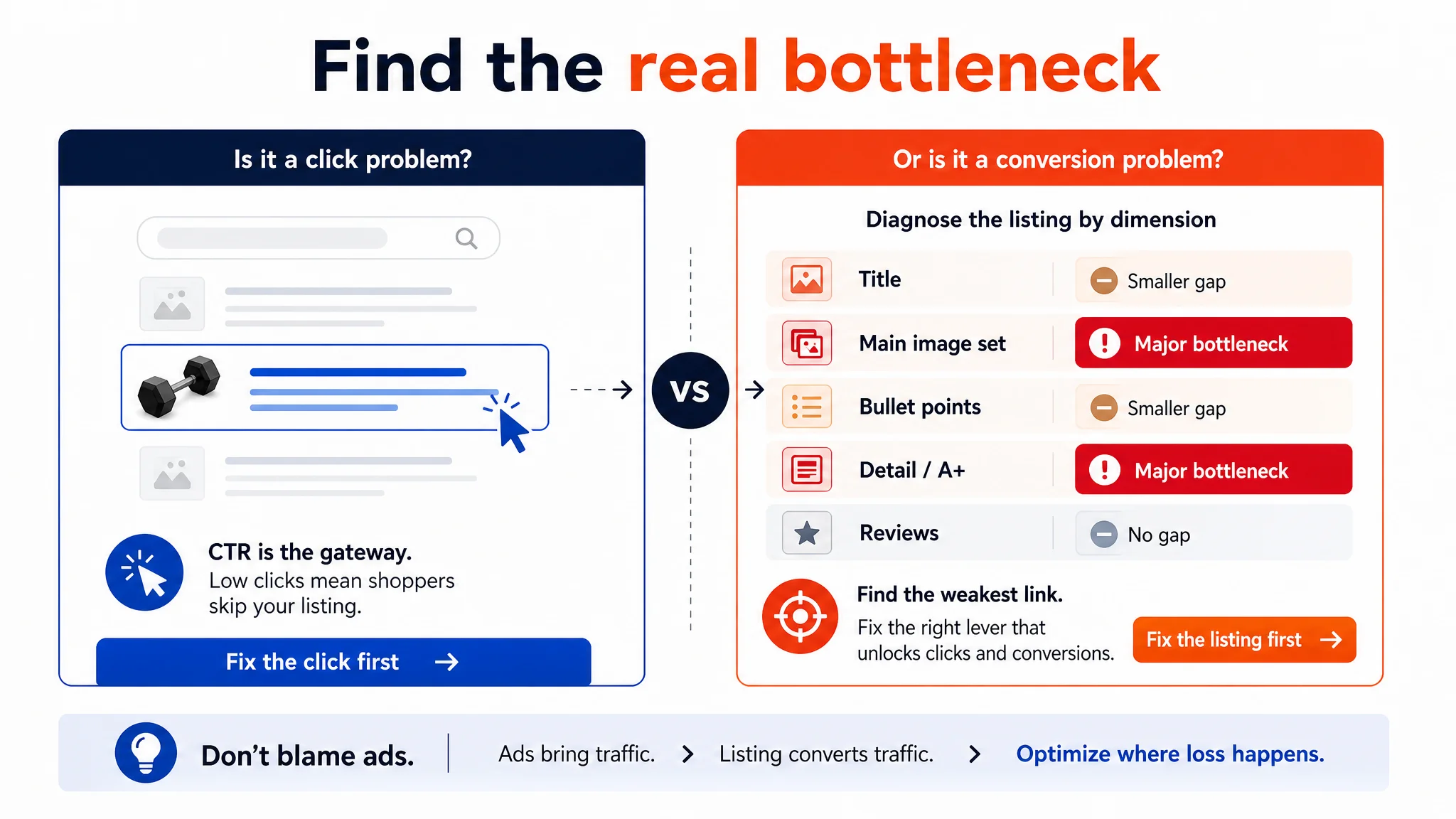
That kind of decomposition prevents a team from treating every performance issue as a campaign issue. A clean measurement record can show whether the first bottleneck is exposure, click generation, product-page engagement, or conversion. Without that separation, repeated ad changes can make the data more difficult to interpret rather than more useful.
Organic Amazon SEO CTR Benchmarks
Organic CTR is useful only as a contextual reference, not as a fixed score every listing must reach. As a practical starting framework, sellers can interpret search CTR across four broad bands:
- Below roughly 0.5%: a baseline warning band, especially when impressions are substantial but clicks remain limited.
- Roughly 0.5%–1.0%: a developing range that may indicate basic relevance, but leaves room to improve the main image, title, price presentation, or search alignment.
- Roughly 1.0%–2.0%: a competitive reference band for some organic search situations.
- Above roughly 2.0%: a stretch reference band that may indicate strong visual appeal and query fit.
Use roughly 2.0% as an average reference point for organic search CTR, not as a universal target. The appropriate comparison depends on category, price band, placement, and search context. A premium product in a crowded category should not be judged against a lower-priced item serving a different buying intent. Similarly, a top search placement and a deeper organic position do not offer equivalent click conditions.
Calibrate each band against impressions, clicks, CVR, ACoS, and BSR, then compare only with genuinely similar listings. If CTR is weak, diagnose the search-page presentation before changing the entire Listing. This keeps optimization focused on the factor limiting clicks and helps protect listing cycle time.
The water dumbbell comparison demonstrates why a benchmark without a competitor context can be misleading. The seller’s reviews were not dramatically worse than the benchmark listing: the seller had a 3.5-star average across 111 reviews, while the competitor had a 3.4-star average across 38 reviews. The seller also had almost three times the review volume. Those signals did not make the page strong, but they did show that reviews alone could not explain the full performance gap.
The larger difference was in the visible presentation. The seller’s main image set scored 8/30, while the competitor scored 25/30, and the seller had no A+ content while the competitor scored 21/25 in that dimension. Comparing only a broad CTR benchmark might have led the team to keep treating the problem as an abstract traffic shortfall. Comparing the listing against a genuinely substitutable competitor revealed a more actionable conclusion: the product was losing attention and confidence through its presentation.
Benchmarks should therefore identify where to investigate, not replace investigation. A listing with weak CTR may need a different title, a clearer main image, stronger offer framing, better review trust, or more relevant positioning. The benchmark does not tell you which one is responsible.
Amazon PPC CTR Benchmarks
Paid CTR should be interpreted as a placement-and-targeting signal, not a universal scorecard. A rough average reference point is 0.4%, but the meaningful comparison band depends on where the ad appeared and which shoppers it reached.
Use these tiers as directional context:
- Below roughly 0.3%: A weak click response that warrants investigation, especially when impressions are relevant and the product is visibly competitive.
- Roughly 0.3%–0.5%: A common middle range, close to the rough 0.4% reference point, but not automatically healthy or unhealthy.
- Roughly 0.5%–1.5%: A stronger paid response that may indicate better query alignment, targeting, placement, or creative appeal.
- Above roughly 1.5%: A high click rate that should be validated against CVR, ACoS, search-term quality, and traffic scale rather than treated as a default target.
The reference band varies by sponsored placement type, match type, targeting approach, category, bid environment, and other placement conditions. A broad-match campaign may naturally perform differently from a tightly targeted product ad, even when both receive relevant impressions. Review CTR alongside CVR and ACoS before reallocating budget.
Keep these paid benchmarks separate from organic search CTR benchmarks. Sponsored traffic operates under different auction, placement, and targeting mechanics, so applying one scale to both channels can waste optimization effort.
The seller who attributed the water dumbbell’s difficult ACoS to advertising illustrates another risk: a weak paid CTR can be a symptom of a weak visible offer rather than a standalone campaign defect. The team was ready to keep changing bids and keyword match types, but the competitor comparison showed that shoppers were encountering a much clearer visual proposition elsewhere. The competitor showed the product centrally, communicated pair and weight information, and used scene and detail images to answer questions before they became objections.
That does not prove that the listing alone determined every paid metric. It does show why paid CTR should be read alongside the assets displayed around the ad. If a relevant impression reaches a thumbnail that does not clarify what the product is, how it is sold, or why it is credible, more bidding may buy more exposure without repairing the click response.
How to Increase Amazon CTR: Core Drivers
Organic SEO Click-Through Drivers
Organic CTR is largely won before the shopper opens the listing. Start with the visible offer and relevance cues:
- Price framing: Compare price, coupon visibility, and shipping messaging with genuinely comparable ASINs. A competitive price can still lose clicks if the total value is unclear at thumbnail size.
- Review trust: Benchmark review volume, star distribution, and image-review signals. Ratings below roughly 4.3 stars may suppress clicks in many categories, but validate that pattern against the category benchmark rather than applying it universally.
- Title architecture: Front-load the most decisive keyword and product attributes because mobile results may truncate the later text. Check the title on key devices. Keep keyword work focused on the title, bullet points, and backend search terms; the title is a highly visible relevance field, not a guaranteed algorithmic priority.
- Hero-image interruption: Use one dominant, readable subject with clear visual hierarchy at thumbnail size. Test stronger focus, angle, detail, or context where appropriate. High-quality rendering can be evaluated as an option, but it is not a blanket replacement for accurate photography. Product structure, proportions, logo, and functional details must remain truthful.
The water dumbbell case shows why these drivers need to be assessed together. The seller had already refined the title and had bullet points with a logical structure. The text opened with safety compared with traditional iron dumbbells, included weight and portability information, and covered multiple usage scenarios. In the comparison, the seller’s bullet points scored 8/10 versus the competitor’s 6/10.
That relative text strength created a misleading impression that the Listing was generally healthy. In practice, the main image allowed the model to partially block the product, used low-information imagery, and did not clearly answer whether the item was sold as one piece or a pair, what weight it could hold, or how it addressed floor and leakage concerns. The listing had words, but it lacked visual logic.
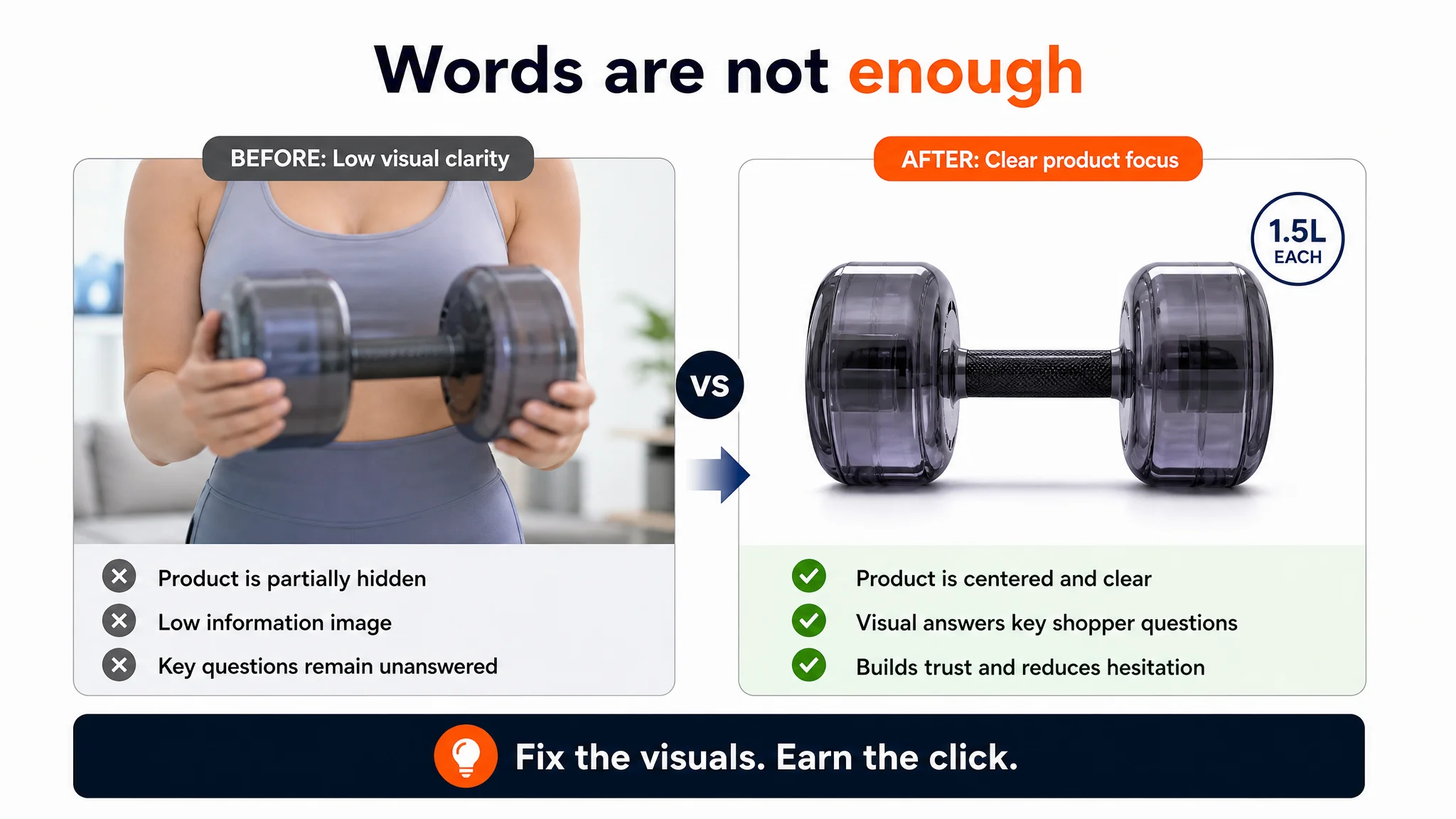
The corrective principle is not to replace text with images. It is to ensure that each visible asset performs the job appropriate to its position in the decision path. The title should establish relevance, the main image should earn attention, supporting images should reduce uncertainty, bullets should clarify benefits and proof, and A+ content should help the shopper complete a more confident decision.
DeepBI functions as an Amazon-only diagnostic and prioritization system. It identifies genuinely substitutable competitors by product form, function, use case, price band, and audience; scores the main image, title, bullets, A+ content, and review structure; and then surfaces where clicks are being lost. Its profile-driven generation can produce comparable image and copy variants with front-end preview, followed by approved asset application through the Amazon SP-API.
PPC Click-Through Drivers
Paid CTR requires a separate assessment of impressions, clicks, CTR, CVR, and ACoS. Compare sponsored-placement proximity within the results page, search relevance, and sponsored headline copy with the query and visible offer. If impressions are adequate but CTR is weak, inspect the main image, price framing, title alignment, and headline before increasing spend. If CTR is healthy but CVR is weak, investigate downstream trust content such as bullets, A+ modules, and review gaps.
Use video and other creative assets when category evidence indicates an attention gap; do not assume that every format will improve CTR.
In the water dumbbell case, the advertising diagnosis changed only after the page diagnosis became more specific. The seller was not told simply to “make the images prettier.” The proposed image set was designed to answer the questions that were limiting attention and confidence: whether the product was sold as a pair, whether its weight was adjustable, whether it was leak-resistant, whether it could be stored or carried easily, and whether it looked suitable for serious training.
That is the connection between PPC and Listing work. Ads can identify and bring qualified demand, but the product page still has to make the offer legible. If the page cannot communicate the product’s basic value and proof points, campaign adjustments may conceal the real problem rather than solve it.
The Practical Driver Checklist
Execute in this order:
1. Validate comparable competitors and price-band context.
2. Diagnose price, coupon, shipping, review volume, and sentiment gaps.
3. Repair title and bullet relevance and clarity.
4. Strengthen hero-image focus and pattern interruption.
5. Improve results-page proximity and sponsored headline copy.
6. Add video or other creative assets where evidence supports the investment.
7. Track CTR, CVR, ACoS, and BSR after each material listing change, using the diagnostic gap—not subjective taste—to set the next priority.
For a mature listing with weak CTR, this order helps prevent a common misallocation of effort. The water dumbbell seller had been treating campaign tuning as the first priority because ACoS and CTR were visible in the advertising dashboard. The comparison instead established that the main image set and missing A+ content were the most urgent gaps, while the bullets represented a relative strength that could be preserved.
The point is not that every listing should create A+ content before making any advertising change. The point is that the next action should follow the largest evidence-based bottleneck. If the main image cannot communicate the product at thumbnail size, increasing bids is unlikely to repair that problem. If CTR is healthy but CVR is weak, the priority may move further down the page to bullets, A+ modules, reviews, or offer clarity.
Diagnosing a Mature Listing That Gets Impressions but No Clicks
Stable impressions with weak CTR usually point first to a listing-presentation or relevance-cue gap, not a traffic shortage. Before increasing bids or expanding keywords, apply the mature_no_traffic logic: inspect why shoppers see the ASIN but select another result.
Start with the same SERP and select three to five genuinely substitutable ASINs. Keep the comparison set within a similar use case and product form, price band, and review depth. A category bestseller with a different audience, price position, or function can produce a false diagnosis. The quality of competitor selection determines the quality of the conclusion.
Apply the competitor_layout_gap logic across the visible click drivers:
- Does the main image communicate the primary benefit faster or with less visual friction?
- Does the opening title phrase make the product’s use case and selling point clearer?
- Is the price, coupon, variation, or delivery offer easier to understand?
- Does the rating and review-count profile appear more credible at a glance?
- Do the bullets and detail-page content support the promise made on the SERP?
Treat these as comparative signals, not proof of Amazon’s undisclosed ranking or indexing mechanisms. Relevance effects remain working hypotheses based on observed presentation patterns.
The water dumbbell listing provides a clear example of why this comparison should be multidimensional. Its total score was 34/100 against 75/100 for the benchmark competitor, but the gap was not evenly distributed:
- Title: Our Listing: 11, Competitor: 16, Full Score: 20, Gap: –5
- Main image set: Our Listing: 8, Competitor: 25, Full Score: 30, Gap: –17
- Bullet points: Our Listing: 8, Competitor: 6, Full Score: 10, Gap: +2
- Detail / A+: Our Listing: 0, Competitor: 21, Full Score: 25, Gap: –21
- Reviews: Our Listing: 7, Competitor: 7, Full Score: 15, Gap: 0
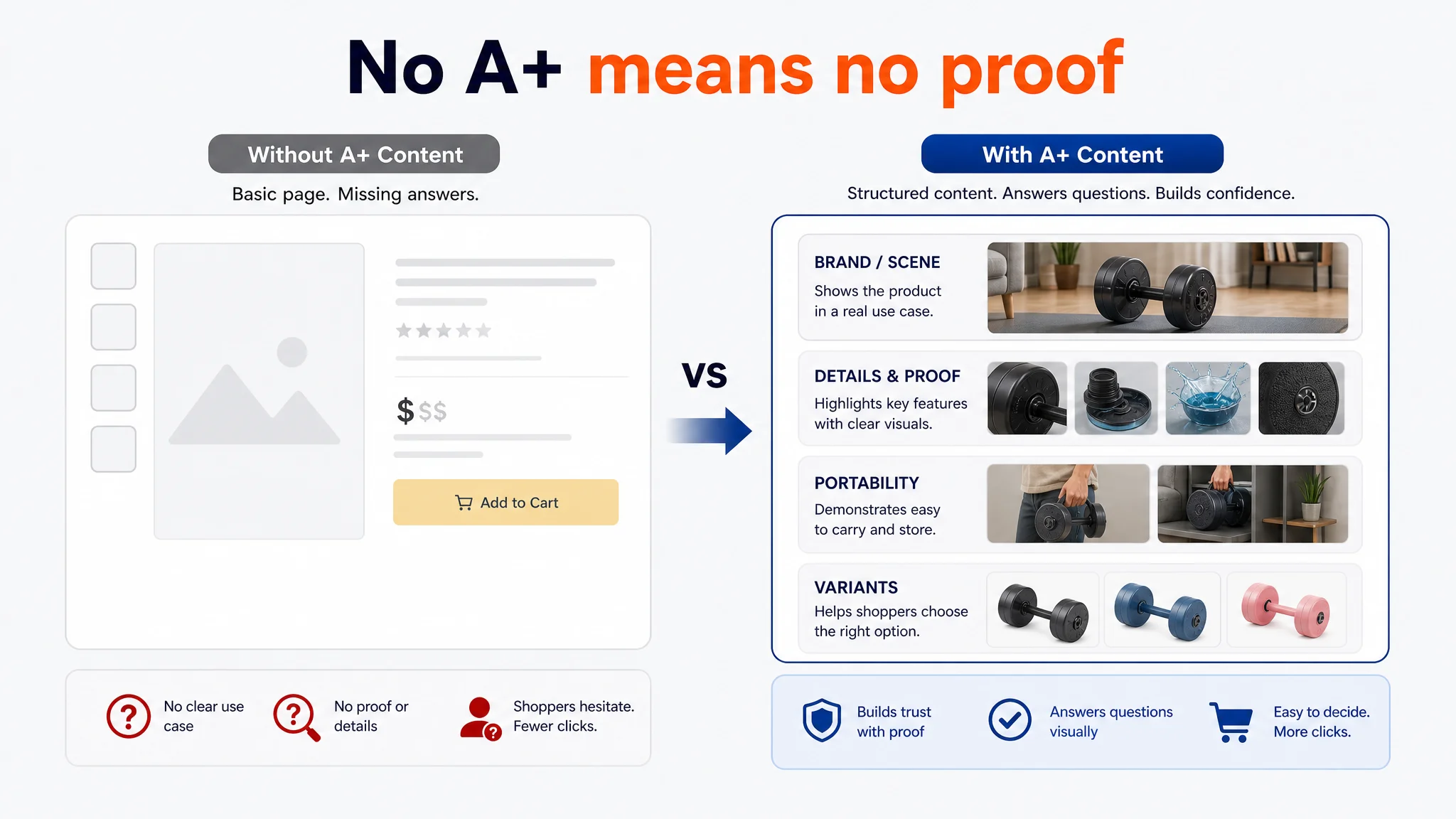
The result challenged the seller’s initial assumption that the page was broadly acceptable because the bullets were detailed and reviews were comparable. It also showed why “improve the listing” is too vague to guide action. The main image and A+ dimensions were the largest constraints, while the bullet points did not need to be rebuilt from scratch.
The visual comparison exposed specific reasons the competitor could earn attention more efficiently. Its product was clear and central, pair and weight information was easier to understand, and detail and usage scenes reduced uncertainty. The seller’s imagery did not clearly answer basic questions about quantity, adjustable weight, leak protection, floor safety, or portability. Those missing answers created friction before and after the click.
DeepBI can support competitor benchmarking and multidimensional listing diagnostics by decomposing the gap into specific modules and mapping each suppressing element to one clear action. Convert the findings into a priority list ordered by expected CTR impact: revise the highest-impact image, title phrase, or offer presentation first, then reassess CTR before expanding the change set.
This approach also protects against chasing secondary weaknesses. Reviews in the water dumbbell comparison still needed attention: the seller’s first-page negative-review ratio was about 37.5%, compared with about 25% for the competitor. But reviews did not explain a 41-point overall Listing gap. Treating review acquisition as the only response would have left the larger visual and A+ bottlenecks untouched.
Turning Better Click-Through Into Organic Ranking Momentum
Paid traffic can do more than generate immediate orders when it reveals which search terms attract qualified shoppers. The causal chain is conditional rather than automatic: improved CTR increases engagement relative to impressions; when relevance and CVR remain strong, that sustained performance may support better organic placement over time. Any resulting organic traffic should be measured, not assumed.
Use paid click-through, conversion, and order-value data to identify keywords that merit reinforcement. A term with strong CTR but weak CVR may require a relevance or listing-messaging correction. A term with healthy CTR, CVR, and order-value potential is a stronger candidate for title, image, and broader listing optimization. Track the change against keyword performance, orders, traffic, BSR, and ACoS using clear before-and-after time windows.
DeepBI’s natural-traffic growth layer supports this process by screening advertising signals and concentrating effort on high-value terms. Its workflow extracts exposure, clicks, orders, CTR, and CVR from historical business data, cross-validates those signals against listing scores, and applies keyword weighting to optimization decisions.
The water dumbbell case illustrates why a page should be repaired before using paid traffic as a broader performance test. When the listing lacked a strong visual and A+ sales logic, a weak keyword result could have meant several different things: poor query fit, weak click appeal, or inability of the page to convert a relevant visitor. The seller could not reliably distinguish those explanations while the page remained underbuilt.
Once the page was reframed around clearer product presentation, quantity and weight information, safety proof, portability, and usage scenes, subsequent advertising data could become more informative. A keyword that still underperformed after the page had a clearer proposition would provide a stronger basis for investigating targeting or market fit. This is why listing quality improves not only conversion capacity, but also the quality of the feedback loop.
This connects paid pull and organic lift within one Amazon-native growth loop: ads reveal qualified demand, listing improvements reinforce relevance, and subsequent CTR, CVR, and organic performance determine where continued investment is warranted.
Frequently Asked Questions
What counts as a good organic CTR on Amazon?
There is no universal organic CTR benchmark across every category, keyword, device, price point, and search position. Benchmark your listing against its historical performance and genuinely similar competitors, then interpret CTR alongside impressions, CVR, listing quality, and traffic source. An internal diagnostic example such as CTR below 0.35% may signal a weak visual hook in a specific workflow, but it is not an Amazon-wide pass-or-fail threshold.
A competitor comparison can make that diagnostic more useful. In the water dumbbell case, the seller’s review profile and bullet points were not uniformly weaker, but the main image and A+ presentation were far behind the benchmark. The practical question was therefore not simply whether the CTR fell below a generic number. It was which visible elements gave shoppers less reason to choose the listing.
Is the title officially Amazon’s most heavily weighted field?
Amazon has not officially confirmed that the title is its most heavily weighted ranking or click field. A relevant, readable title can support query alignment and shopper understanding, but organic CTR also depends on the main image, price, ratings, badges, offer details, and competitive search context. Measure the combined listing presentation rather than optimizing the title according to an unverified weighting rule.
The water dumbbell seller had already tried to refine the title, and the title still showed a gap against the competitor. That gap mattered, particularly because the core product term and key attributes were not clearly prioritized. However, the title was not the largest problem in the comparison. The main image and missing A+ content created much larger gaps, showing why title optimization should be prioritized within the full listing rather than treated as a substitute for visual and conversion work.
Are A10 and A12 official Amazon algorithm names?
No. A10 and A12 are unofficial industry shorthand used by sellers and SEO commentators to describe suspected or discussed ranking behavior. Amazon has not publicly confirmed them as official algorithm names, so neither label should be treated as a fixed explanation for CTR movement. Instead, diagnose observable changes in impressions, clicks, CTR, CVR, and BSR.
When a listing has weak CTR or CVR, algorithm labels can also distract from observable page problems. In the water dumbbell comparison, the actionable evidence was not a theory about an algorithm update. It was the difference between a 34/100 Listing score and a 75/100 competitor score, including a 17-point main-image gap and a 21-point A+ gap. Concrete asset and funnel evidence provides a more useful basis for deciding what to change.
Is a rating below 4.3 stars always a click-killer?
No. A rating below roughly 4.3 stars may suppress clicks in some categories, particularly when competing listings display stronger social proof, but it is not an automatic click-killer. Evaluate rating alongside review volume, price, image clarity, offer strength, and search intent. If CTR is weak, identify the full comparison gap before attributing the result to star ratings alone.
The water dumbbell comparison reinforces this point. Both listings had average ratings below the rough healthy reference point, but the seller had more reviews overall. The seller’s negative-review ratio was weaker, so reviews were a legitimate risk, but they did not explain the complete performance gap. The competitor’s stronger images and A+ content helped communicate safety, quality, usage, and product differentiation—areas that reviews alone could not repair.
A weak review profile should be addressed, but it should not automatically become the reason to postpone work on the main image, title, offer presentation, or A+ content. The correct priority depends on which gap is most likely limiting the current stage of the shopper journey.