


Why AI-Generated Listing Content Effectiveness Now Sets Your Amazon CTR and CVR Ceiling
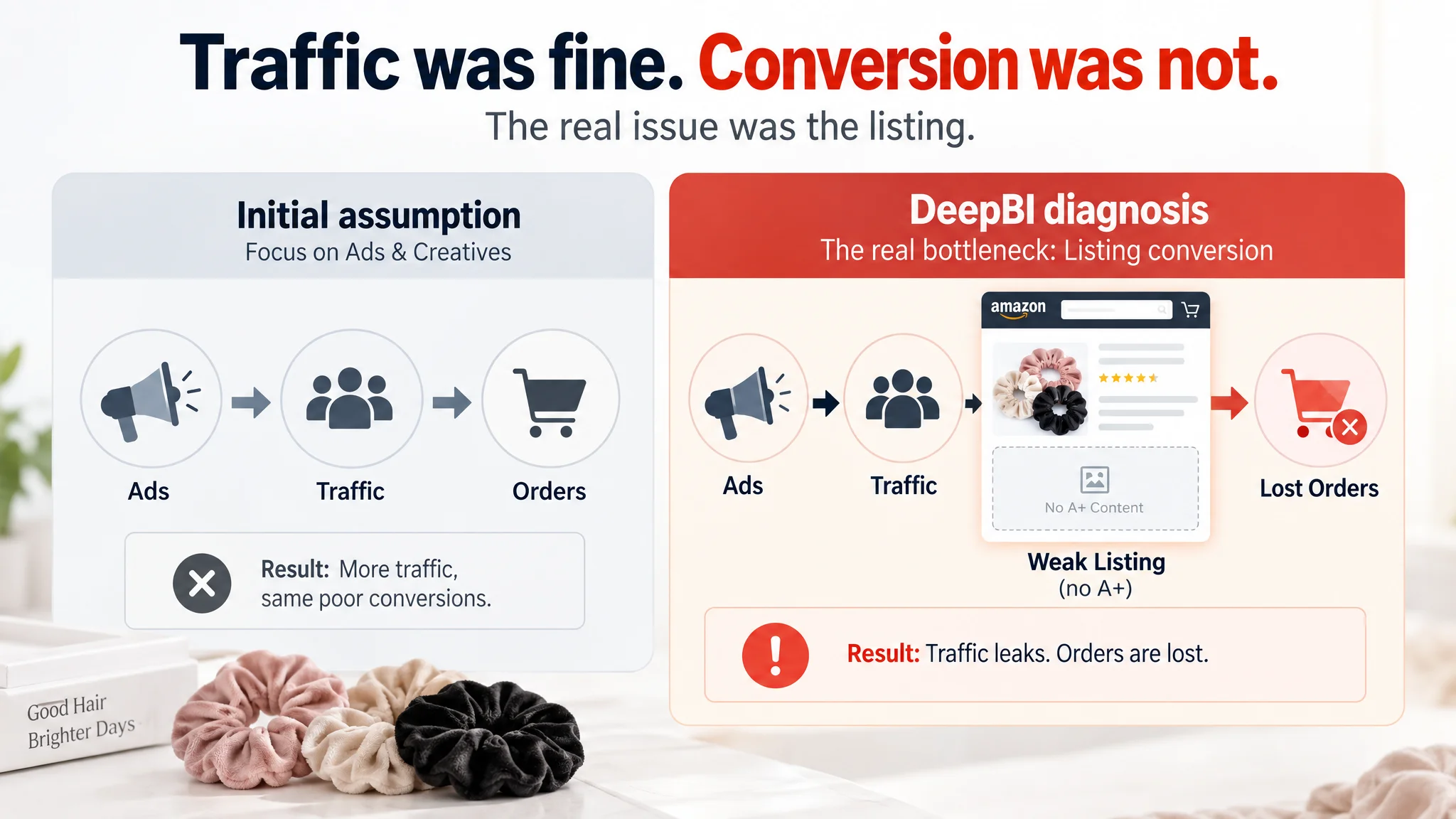
AI-generated listing content can set the ceiling for your Amazon CTR and CVR.
Effective content is not defined by polished language, attractive visuals, or a high diagnostic score. It is content that can improve click-through rate, conversion rate, and search visibility: stronger title and main-image communication may earn more clicks, clearer product benefits and proof may help convert that traffic, and more relevant keyword coverage may support discoverability. If those outcomes do not improve, a refined draft can still represent wasted production effort and leave ACoS, BSR, and listing cycle time under pressure.
Generating content before identifying the listing’s bottleneck is guesswork. A low CTR may indicate that the title or main image fails to create a compelling reason to click, while a low CVR may point to weak detail-page information, insufficient proof, or unclear benefit communication; these are different problems requiring different interventions. Content built without that diagnosis has no defined benchmark, constraint, or business outcome to optimize toward.
A hair accessories listing illustrates why this distinction matters. The team initially believed that rising ad pressure came mainly from weak campaigns, insufficient traffic, or creatives that needed more polishing. The main images looked acceptable, the product had a clear use case, and the listing had a 4.6-star rating with 343 reviews. Yet orders were not keeping pace with clicks, and lowering ACoS was becoming increasingly difficult.
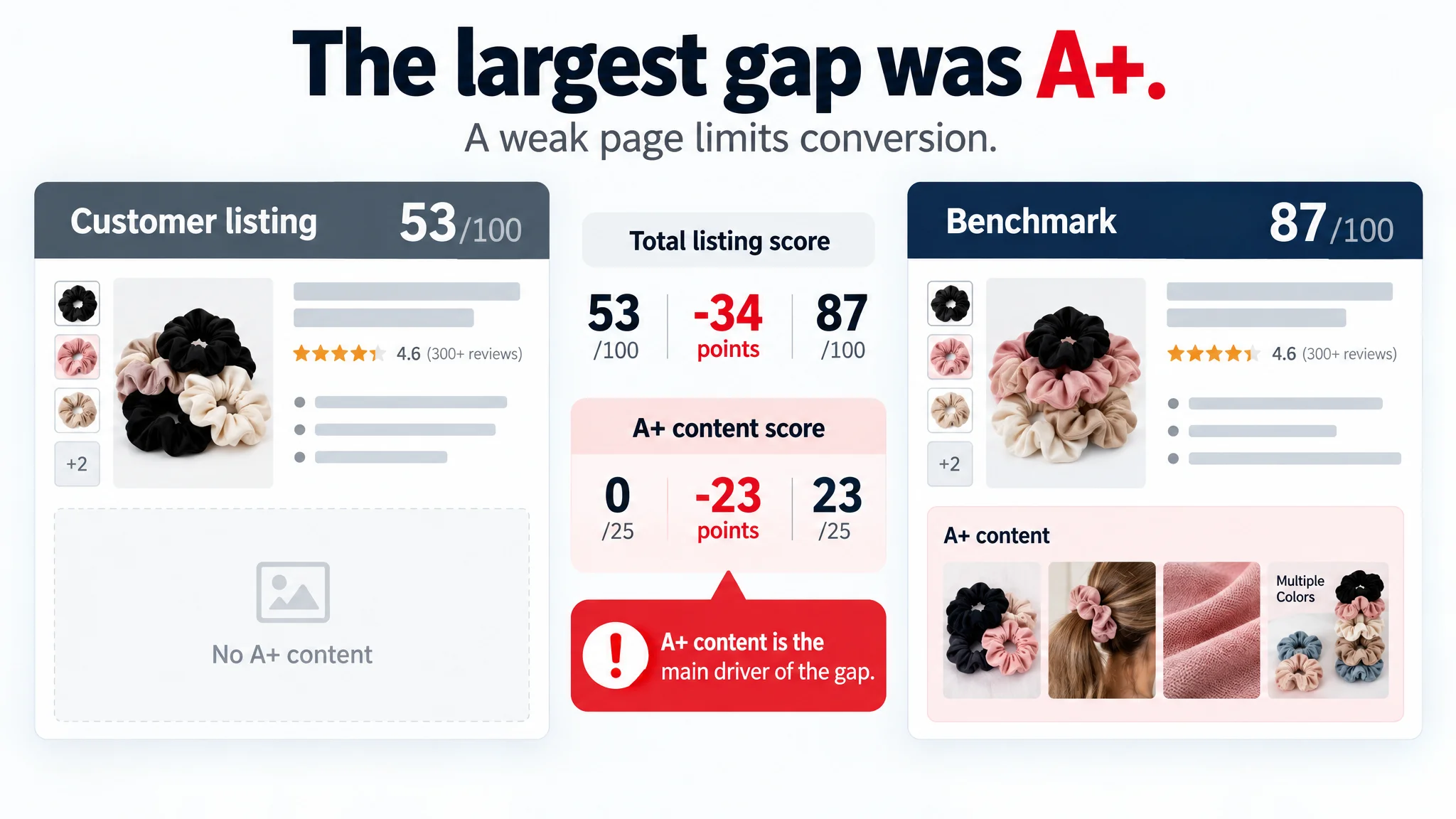
After DeepBI reviewed the title, images, bullets, A+ area, and review structure against a comparable competitor, the diagnosis changed. The customer listing scored 53/100 against the benchmark’s 87/100. The most significant difference was not the main image or star rating, but the A+ section: the customer listing had no A+ images and scored 0/25 in that dimension, while the benchmark scored 23/25. Advertising was bringing shoppers to a page that did not fully explain, reassure, or persuade.
DeepBI therefore positions listing diagnosis before generation, using the listing’s market position, competitive gaps, and performance signals to establish what should be improved before content is produced. The governing question is not whether AI can create a smoother draft, but whether the resulting content is likely to move the relevant funnel metric—and whether you can connect the change to evidence after implementation.
The Four Quality Gates That Decide Whether AI-Generated Listing Content Performs
Before generating new copy or images, score the existing listing against a comparable benchmark. Use competitor_layout_gap to compare products with similar form, price band, audience, use case, and functional logic. The goal is not an absolute “good” score; it is an evidence chain showing the benchmark, the observed gap, the affected surface, and the business hypothesis.
Relevance, clarity, visual coverage, and cross-surface consistency
- Relevance: Check title and bullet keyword coverage, product-function fit, and alignment with the search and use-case language used by the benchmark set. This can expose gaps that may restrict search visibility or weaken CTR, but relevance alone cannot guarantee ranking, clicks, or CVR if the offer or trust signals are weak.
- Clarity: Review title structure, selling-point order, readability, and whether features connect to customer problems across the title, bullets, and A+ content. Clear hierarchy can reduce decision friction, but it cannot compensate for poor relevance, inadequate proof, or uncompetitive economics.
- Visual coverage: Compare the main image and image set for visual quality, information density, usage scenarios, dimensions, and parameter graphics. Review A+ modules for comparison tables, supporting authority, and depth of use-case explanation. Broader coverage may support CTR and CVR, but it cannot guarantee performance and must remain faithful to the actual product. Product entity consistency is non-negotiable: AI must not alter material, color, or industrial design.
- Cross-surface consistency: Cross-check images, title, bullets, A+, confirmed specifications, and Product DNA for contradictory claims. Consistency reduces mismatch-driven negative reviews and refunds, but it does not prove that the claims are persuasive or differentiated.
The hair accessories diagnosis shows why a multidimensional score is more useful than a general visual impression. The customer listing’s title scored 11 versus the benchmark’s 16, the main images scored 24 versus 25, the bullets scored 6 versus 8, the A+ area scored 0 versus 23, and reviews scored 12 versus 15. A superficial review might have focused on the near-parity in main-image scores. The complete assessment showed that the missing A+ layer was a much larger constraint.
A multidimensional score can include titles, bullets, images, A+, review volume, and negative-review structure. Review signals are supporting inputs only, never a standalone listing-quality diagnosis.
Competitor Layout Gap Analysis: Turning Rival Listing Weaknesses Into Conversion Gains
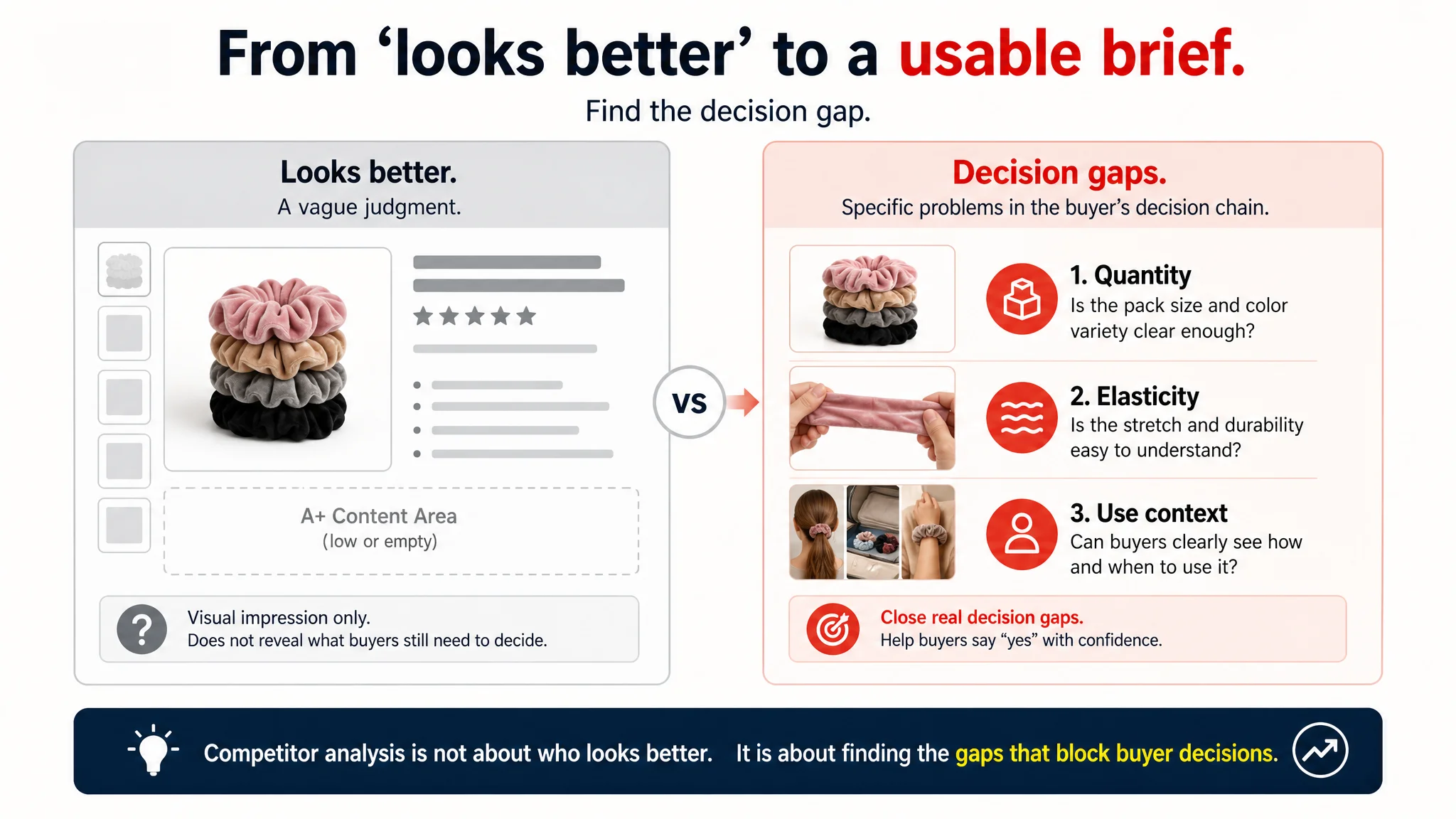
Treat competitor_layout_gap as the actionable space between what closely matched, high-ranking listings present and what buyers still need to decide. Use the gap to build generation briefs, not copying instructions.
- Build a screened benchmark set from high-competitiveness ASINs filtered by product form, use case, function, price band, audience, review validation, and competitive strength; do not rely on a single Bestseller or compare dissimilar products.
- Assess each listing across image composition, visual hierarchy, image-type coverage, module order, title and bullet structure, A+ completeness, review-backed trust, and information density.
- Map benefit sequencing to the decision path: the main image must earn the click, detail images and A+ content should resolve doubts, and bullets should progress from category concern to product benefit, evidence, and pain-point resolution.
- Test claim specificity by separating vague language from verifiable parameters, use scenarios, certifications, comparison visuals, and feature-to-problem explanations supported by the seller’s actual product information.
- Convert every confirmed gap into a generation brief or Optimization_Plan that specifies the target module, buyer problem, required evidence, composition, scene, information hierarchy, and text structure; never copy rival wording, product details, or design.
- Use multi-dimensional score comparisons across the main image, title, five bullets, A+ content, and customer feedback to produce a prioritized execution list, such as adding a parameter diagram, restructuring bullet order, or strengthening use-case proof.
- Prioritize by expected funnel impact and seller context: a scaling seller with low CTR may address the main image first, while a mature catalog with low CVR may prioritize trust, review, A+ content, and use-case clarity. A visually undifferentiated brand may need a different sequence.
- Before: your team concludes that a rival listing “looks better” without an execution order. After: the benchmark identifies the material image, module, claim, or sequencing gap and converts it into a constrained brief.
- Treat each recommendation as a hypothesis. Confirm it against your own exposure, clicks, orders, CTR, CVR, and listing baseline before attributing a weak funnel stage to a specific module; a score gap alone does not prove conversion lift.
In the hair scrunchies case, the benchmark did more than show that the competitor’s page looked more polished. It identified the specific decision gaps. The competitor used a color-range overview, real usage scenes, material close-ups, bundle layouts, and visual trust cues. The customer listing had no A+ images, no color overview, no elasticity demonstration, no lifestyle validation, and no structured trust-building modules.
The comparison also exposed a title problem. The customer title led with “12 Pcs,” placed “Hair Scrunchies” later, used “Suitable for Various Occasions” without adding much search value, and emphasized “Classic Black” even though the offer contained multiple colors. The recommended direction was to move core terms such as “Velvet Scrunchies” earlier and clarify the product’s pack, material, softness, and category relevance. The point was not to add words indiscriminately, but to align the title with how shoppers scan search results and how the offer is actually positioned.
This is what turns competitor analysis into an execution tool. Instead of asking an AI system to make the listing “more premium,” the team can ask it to solve a defined problem: clarify quantity, surface the product category earlier, explain elasticity, or create a visual sequence that answers specific buyer questions.
Shoppable Social Buying Raises the Bar for Your Amazon Listing Content
A buyer may encounter a product claim in a shoppable social post before ever reaching Amazon. That first exposure can establish expectations about the product’s benefit, appearance, use case, or performance. The Amazon listing then has to confirm the promise quickly and resolve the questions that a short social format cannot answer.
For sellers, this creates a direct listing-quality challenge. If the promise is clear off Amazon but vague on the detail page, CTR may not translate into CVR. If the product looks materially different from the expectation created elsewhere, the result can be hesitation, returns, or negative feedback. Cross-surface inconsistency should be treated as a possible trust risk and conversion weakness—not as proof of an automatic Amazon penalty.
The same principle applies when advertising is the discovery surface. In the hair scrunchies case, the team was already receiving traffic but initially interpreted the weak order output as a reason to improve campaigns, images, and reviews. The deeper diagnosis showed that the page lacked the visual and informational layer needed after the click. The problem was not simply whether shoppers could discover the product; it was whether the product page could continue the decision process.
Generated listing content should therefore make benefits easy to scan and verify. Each bullet should connect a customer concern to a confirmed product claim and the problem it solves, rather than presenting isolated specifications. Descriptions and A+ modules can expand on the same promise by answering questions about use, function, fit, or limitations.
Visual coverage matters equally. Images should show the product clearly, present relevant parameters, and demonstrate realistic use without changing the product’s material, color, structure, or design. A commercial generation workflow should preserve product identity while improving composition and information clarity. When text and visuals communicate the same verified benefit, your listing is better positioned to convert attention from any discovery surface into stronger CVR, more efficient ACoS, and more reliable search-driven growth.
Advertising on Both Google and Facebook Makes Listing Consistency the Deciding Layer
Google and Facebook can introduce your product at different intent stages. A Google visitor may arrive after actively searching for a solution, while a Facebook visitor may first encounter the product through a broader interest or lifestyle message. In both cases, the click creates a pre-formed expectation about the product, benefit, price, or offer.
Your Amazon listing is the surface that must resolve that promise. If the ad copy, website copy, and listing communicate different features, specifications, pricing, or use cases, buyers may hesitate rather than engage. That doubt can weaken CTR and CVR, raise ACoS, and make paid traffic less productive. Treat this as a managed buyer-trust and performance risk—not proof that Amazon automatically applies a penalty.
The hair scrunchies case provides a related operational warning: even when the external message is not obviously inconsistent, advertising can amplify an incomplete page. The team’s working assumption was that ads and creatives needed more attention. After the listing was dissected, the more important issue was that the product page had no A+ content to continue the explanation after the bullets. Increasing traffic without repairing that gap would have sent more shoppers into the same conversion constraint.
Amazon may consider off-Amazon content when evaluating listing accuracy, so review the applicable official policies before relying on website claims or promotional language. A lower price on your website should also be treated as a pricing-inconsistency risk to investigate and manage. It is not automatic proof of price manipulation and does not guarantee Buy Box loss.
Keep every external promise aligned with confirmed product capabilities. Product-entity consistency matters: AI-generated content should not alter the product’s material, color, structure, or design. Use ad signals to prioritize listing improvements, cross-check visual and written claims, and monitor CTR and CVR after changes. For post-purchase engagement, favor warranty registration, setup guides, or support access over discount-for-next-purchase calls to action.
Extra Images in Shopping Ads Set a Visual Bar AI-Generated Listings Must Clear
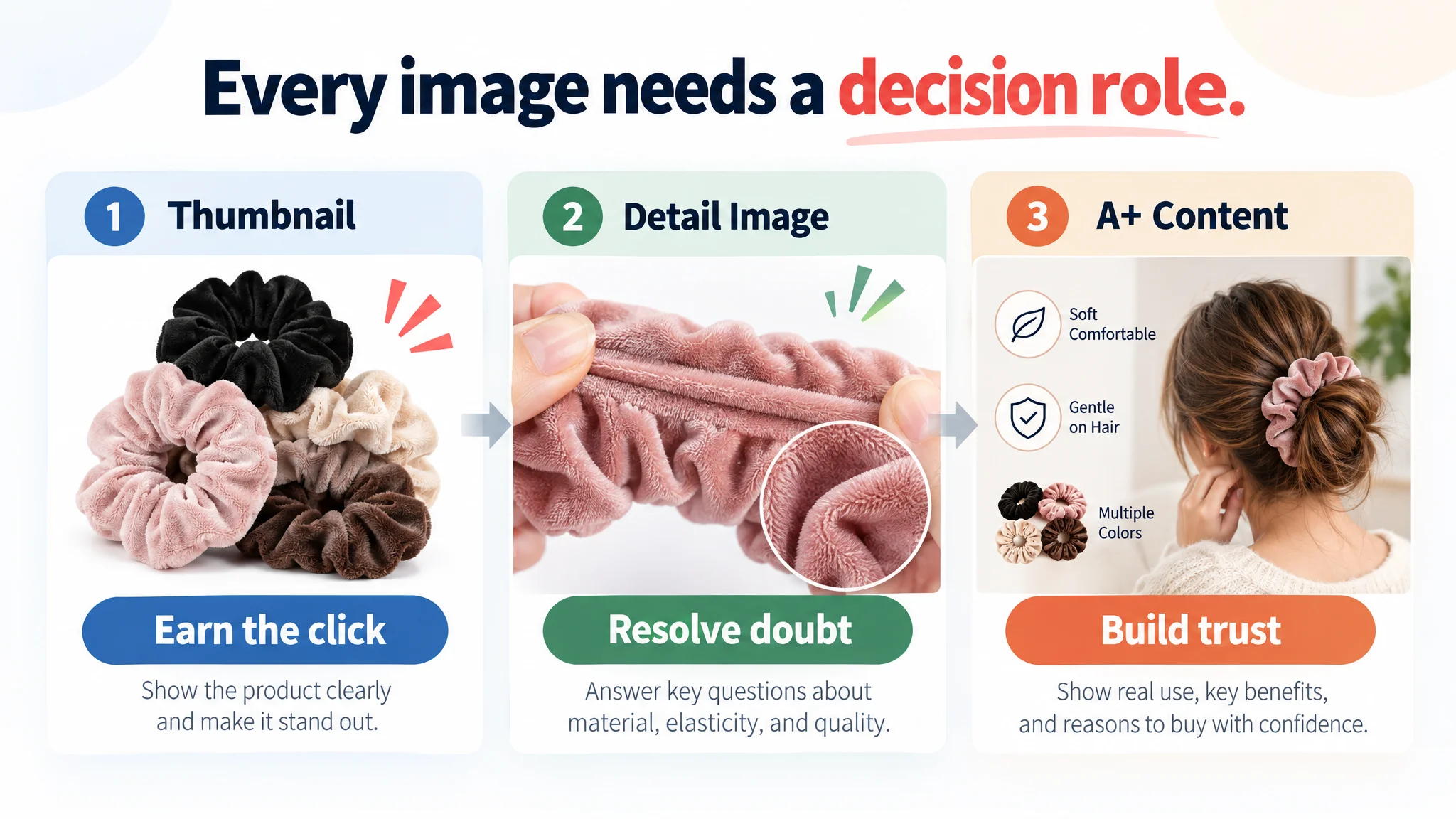
A single attractive hero image can earn attention, but it cannot answer every question that determines a purchase. On shopping and advertising surfaces, competing listings increasingly establish a visual-completeness standard: the thumbnail must attract the click, detail images must resolve uncertainty, and A+ modules must build confidence before the shopper commits. When any step is weak, CTR may suffer at the top of the funnel or CVR may fall after the click.
Your visual set should progressively cover the buyer’s questions:
- Thumbnail: What is the product, and is it worth opening?
- Detail image: What are its scale, use context, materials, texture, construction, and functional details?
- A+ content: Why should the shopper trust the claims, understand the use case, and choose this product?
The hair scrunchies listing had several images, including product-only visuals, scene shots, a parameter diagram, and a bag image. Yet the issue was not simply a lack of image count. The images had inconsistent lighting and composition, and the scenes did not consistently resemble real-life use. The benchmark, by contrast, used a cleaner sequence: quantity clarity, elasticity proof, close-up material detail, lifestyle context, and comparison framing.
That distinction matters. A listing can have many assets while still leaving the same buyer questions unanswered. In this case, the recommended image structure gave each slot a defined role:
- Quantity and order: show the 12 pieces in a clean grid.
- Elasticity proof: show stretching with only the relevant measurements.
- Material and real-life appearance: combine a texture close-up with an on-hair image.
- Bundle value: show the product and storage bag clearly.
- Comparison: frame the product’s relevant differences against a generic thin hair tie.
Use competitor_layout_gap to specify what your assets must add, such as missing scale cues, absent scene context, weak close-up detail, low information density, or incomplete trust modules. AI can generate and restructure main images, detail modules, A+ visuals, titles, and bullets from verified product information. Product DNA must remain the constraint: generated visuals may change composition or setting, but not the product’s physical structure, materials, logo, color rules, or functions.
Do not publish the first acceptable output. Generate multiple options, review them against the required Amazon placement and buyer question, then use a front-end preview and new-versus-old comparison. Select the strongest option or replace only a weak slot. After application, link the visual iteration to ad reporting so CTR changes can be evaluated rather than judged by preference alone.
Most Shoppers Want Personalization: What That Means Inside Listing Content
Listing personalization does not mean writing a different promise for every shopper. It means emphasizing the same verified product truth differently for defined buyer segments and use cases.
Consider a product with a confirmed fast-charging capability. For a commuter, a bullet might lead with reduced waiting during a daily travel routine, while an A+ module shows the charging feature within a time-pressured scenario. For a frequent traveler, the same truth could support a portability and convenience message, followed by a usage explanation. For a technical evaluator, the bullet should foreground the verified charging specification, while the A+ content gives that specification a clearer comparison or proof structure.
The underlying attribute remains unchanged. Only the benefit framing, information order, and supporting context move closer to each segment’s decision criteria. That distinction protects product-entity consistency and reduces the risk of invented functions, materials, or performance claims.
The scrunchies diagnosis shows how this works in a visually driven category. The customer listing emphasized gifting and party scenes, including themed-party positioning, but the competitor first addressed material, comfort, hair protection, dimensions, and elasticity. Scenes and emotion were not irrelevant; they were simply placed in the wrong order. Shoppers needed to know whether the scrunchie would be comfortable, durable, secure, and suitable for their hair before the party or fashion context could carry much persuasive weight.
Generic generation briefs fail because they omit the audience, use case, priority benefit, and proof required for the decision. A stronger brief defines those inputs before requesting bullets or A+ copy. Structured strategy generation can then rank selling points by likely impact, map each segment to a benefit hierarchy, and convert the hierarchy into pain-point-led bullets and logical A+ modules.
This approach may improve relevance and support stronger CTR or CVR, while repeat consideration remains directional rather than guaranteed. Validate the effect by segment and ASIN instead of generalizing one audience’s result across the catalog.
Personalization Tactics That Scale With AI-Generated Content
Personalization should address a suspected funnel constraint, not produce stylistic variety for its own sake. If weak relevance suppresses CTR or unclear information limits CVR, structured AI drafts can create targeted alternatives while preserving product truth.
- Use-case callouts: Reframe features around specific customer situations to make the benefit easier to recognize and support CVR. Generated drafts scale well across scenes and pain points, but every scenario must reflect an actual product use and cannot imply unsupported functions.
- Fit and compatibility guidance: Clarify who the product suits and reduce purchase uncertainty, potentially improving CVR and lowering wasted ad spend. AI can organize confirmed dimensions, requirements, and compatibility details, but uncertain specifications require human verification and brand-appropriate wording.
- Comparison framing: Make differentiation easier to scan in bullets or A+ content, helping shoppers evaluate alternatives. Multi-option drafts can vary the comparison structure, but benchmarks must be genuinely comparable; competitor claims and design cannot be copied.
- Bundle logic: Present relevant configurations or included items more clearly, reducing confusion during selection. Structured generation can scale known variants, yet humans must confirm what is included, compatible, and accurately represented.
- Warranty and support clarity: Replace vague reassurance with verified policy and evidence, strengthening trust and CVR. AI can suggest clearer wording, but a human must confirm the actual terms and avoid unsupported promises.
For the scrunchies listing, a stronger content hierarchy would connect each bullet to a separate concern: material and hair protection, size and elasticity, daily and active use, color variety, and the 12-piece set with storage bag. This is more useful than producing several versions that merely change tone. Each variation should have a reason to exist within the buyer decision path.
A multi-agent workflow can generate several strategies in parallel, then compare them for information density, compliance, and product consistency. You should select, edit, or reject each option based on brand tone, factual precision, and the intended CTR, CVR, ACoS, or listing cycle-time objective. Generation expands the choice set; it does not replace commercial judgment.
From AI Draft to Live Listing: Deployment Discipline That Protects Effectiveness
AI-generated copy does not improve CTR, CVR, ACoS, or BSR simply because it was produced quickly. Treat deployment as a controlled experiment: approve the content, preserve the baseline, release changes deliberately, and monitor the listing cycle before judging impact.
- Review every draft against your brand voice before publication: verify claims, terminology, tone, compliance language, and customer promise; reject or revise any line that could weaken trust or reduce CVR.
- Version the old and new listing content: retain the prior title, bullets, A+, and specifications, then compare and filter changes by field, claim, keyword, and intended KPI impact so diagnosis, strategy, and deployment remain connected.
- Use staged rollouts and defined monitoring windows: apply approved changes to a controlled set of listings or assets first, record the deployment time, and evaluate CTR, CVR, ACoS, BSR, and listing cycle time during a predefined observation period. For visual changes, a 7–14 day window provides a documented basis for reviewing CTR movement.
- Run an auditable consistency checklist across the title, bullets, A+, and specifications: define the exact match condition for each item, such as identical product attributes or compatible claims, and record an impact statement for every unchecked item before approval.
- Correct inconsistencies quickly and deploy only approved changes: use old-versus-new comparison to select specific replacements rather than applying every generated output. Where authorized, one-click SP-API application can synchronize approved listing content or assets, reduce manual upload work from minutes to seconds, and provide processing-status visibility; retain the prior version for rollback when supported.
The case demonstrates why deployment should follow diagnosis rather than precede it. The recommended changes were not a collection of cosmetic edits. They included a clearer title, a more structured bullet sequence, image roles linked to buyer questions, and an A+ flow designed to move from color and style to function, durability, lifestyle proof, and choice support. Each change was connected to a diagnosed gap.
A controlled process also prevents a common interpretation error: assuming that a listing is effective because the new images look better. The benchmark comparison may show that the content is more complete, but only post-publication measurement can indicate whether the selected intervention affected CTR, CVR, or another defined business signal.
When AI-Generated Listing Content Fails: Overpromise, Generic Voice, Compliance Drift
AI-generated listing content usually fails for one of four reasons: it exceeds product truth, sounds interchangeable, creates compliance risk, or becomes stale. Audit each failure before publication, then use CTR, CVR, ACoS, and BSR signals to prioritize corrections after launch.
- Overpromise: A claim exceeds verifiable product truth. This includes invented dimensions, materials, functions, accessories, performance values, or usage outcomes. Compare every title, bullet, and detail-page claim with confirmed product information and visible product attributes. Remove unsupported language or replace it with a specific, verified claim. Route uncertain parameters for human confirmation instead of allowing the model to fill the gap.
- Generic voice: The copy could describe any competitor in the category. Phrases such as “premium quality” or “optimize the design” provide little differentiation and rarely address a concrete buyer concern. Replace them with category-specific language tied to a confirmed feature, visual structure, use case, or search term. Compare keyword layout, selling-point clarity, feature priority, and pain-point coverage against relevant competitors without copying their product details.
- Compliance drift: Exaggerated advantages, promotional wording, invented specifications, or conflicting phrasing can create risk across the title, bullets, and other Listing surfaces. Flag the language, revise or remove it, and continue monitoring; compliance review is a risk signal, not an automatic approval guarantee.
- Staleness: Content no longer matches the product, images, positioning, search terms, competitor set, or market conditions. Recheck those inputs before reuse, then update or retire outdated copy. This protects listing relevance and prevents avoidable declines in CTR or CVR.
The scrunchies listing also shows that “fun” copy can become generic or incomplete when it is not connected to proof. Emphasizing parties and gifting without clearly explaining material, fit, comfort, durability, and elasticity made the page less reliable than the benchmark, even though the scenes themselves were not necessarily wrong. The correction was not to remove all lifestyle language, but to place it after the core product questions had been answered.
Measuring Listing Content Effectiveness Without Vanity Metrics
A listing score, predicted CTR, or vendor-reported percentage is not proof that content caused growth. Measure effectiveness through metrics tied to specific decisions:
- CTR: Does the main image, title, or other click-facing content earn the impression?
- CVR: Does the detail page convert the visit through clearer persuasion, stronger trust, and better information?
- Content quality: Which image, bullet, A+ element, or review-related weakness requires revision? Treat the score as a diagnostic, then cross-check it against impressions, clicks, orders, CTR, and CVR.
- Launch or update efficiency: How quickly and accurately did the approved change reach the live ASIN, and did the listing cycle time create an operational delay?
Paid traffic performance depends on how well the listing converts the click. Ad-attributed conversion quality can provide secondary context, but it should not stand alone as causal evidence. Natural-rank movement is also secondary: higher listing quality can support natural-rank gains that contribute to a healthier TACoS balance, while BSR and organic visibility may also reflect competition, price, traffic, or promotion.
The case’s 53/100 versus 87/100 comparison was useful because it exposed a structural gap, especially in A+ content. It was not, by itself, proof that one individual module would produce a specific conversion lift. The score helped prioritize the investigation; the business still needed to connect future changes to baseline traffic, clicks, orders, CTR, and CVR.
Set a defined pre-update baseline and post-update window. The product workflow uses 7–14 days to observe CTR slope after an image change, but that is an operational window, not a universal proof period. Hold ASIN, placement, traffic mix, price, inventory, offer, and campaign conditions as steady as practical. Record and separate seasonality, discounts, promotions, stock interruptions, review shocks, and major price changes.
State the Amazon platform, category, period, and similarity criteria behind every benchmark. Close the loop by measuring diagnosis, generation, deployment, and optimization separately—moving from unsupported claims to decision-grade evidence.
The Compounding Loop: Diagnosis, Generation, Deployment, Measurement
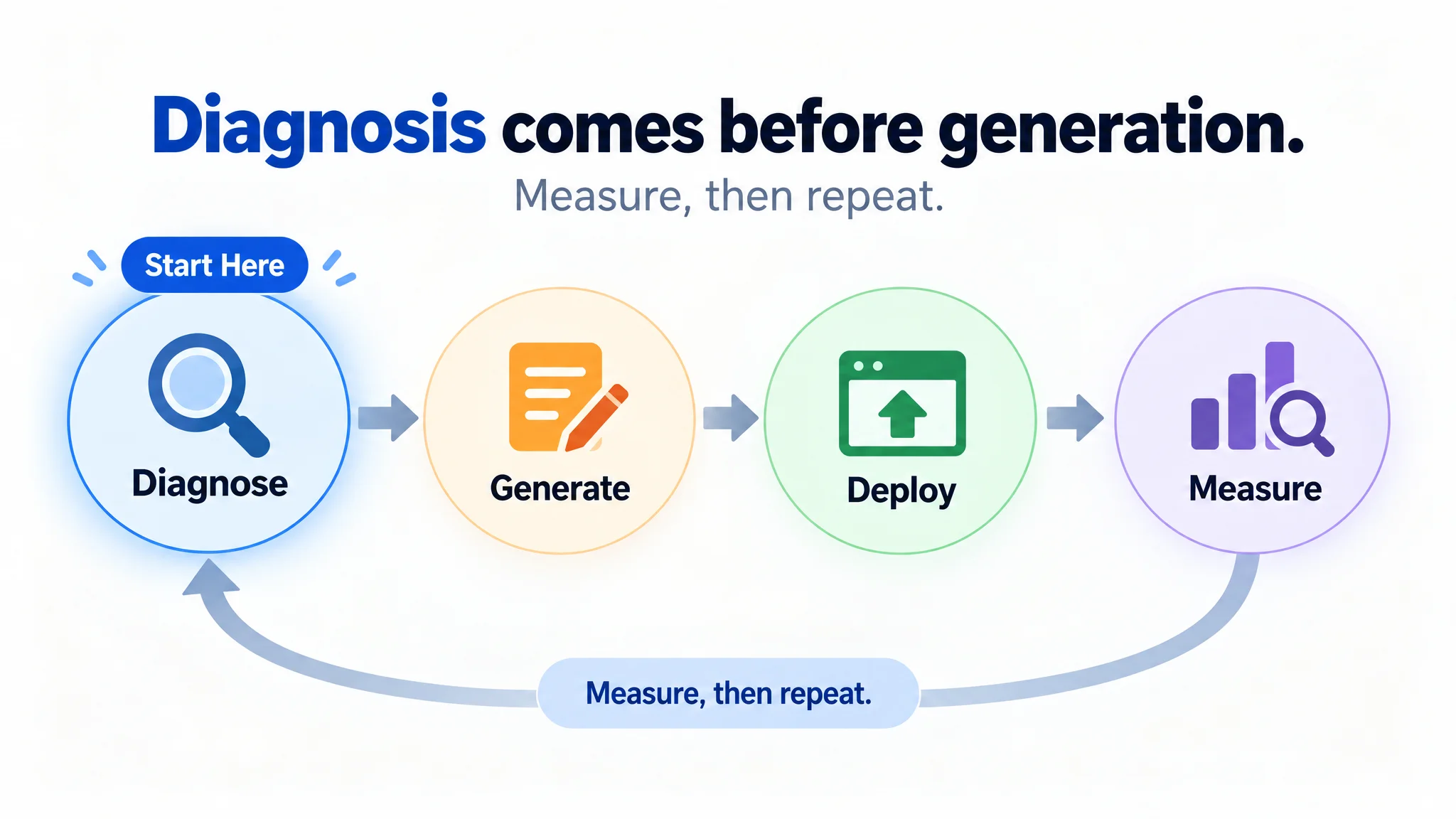
Listing effectiveness is a loop, not a one-time launch: you diagnose a funnel problem, generate a constrained response, publish an approved change, and measure whether the evidence supports the next decision.
- Start with the governing question: where is the listing losing demand? Separate click acquisition from on-page conversion before asking AI to rewrite or regenerate anything. A weak CTR points toward the search-result presentation, while a weak CVR points toward the product-detail experience, trust signals, or information structure.
- Establish the baseline before changing content. Record available impressions, clicks, orders, CTR, CVR, conversion distribution, and relevant advertising signals for the ASIN or group of ASINs under review. Add the current title, bullet points, main image, supporting images, A+ content, and any other listing elements included in the diagnosis.
- Treat the baseline as an evidence boundary, not a performance promise. A baseline tells you what happened before the change; it does not prove that a later movement came from one content revision. Keep the observation period, ASIN scope, traffic context, and content version visible in your working record.
- Identify the clearest weakness before selecting a generation task. If the available data shows weak CTR and the scoring output identifies a materially weak main-image presentation, prioritize the main image or title rather than redesigning every listing element. If CVR is weak and the detail-page, bullet, A+ content, or review signals lag genuinely similar benchmarks, prioritize information clarity and trust support.
- Use competitor listing gap analysis only when the benchmark is comparable. Compare products with similar use cases, product characteristics, price bands, and audiences. A mismatched competitor can create a false gap.
- Connect every diagnosed gap to a specific listing element. “Improve the listing” is not an executable diagnosis. State whether the gap concerns the main image, image sequence, title structure, bullet logic, supporting information, A+ content, or another defined element.
- Preserve the distinction between a directional signal and a confirmed cause. A low CTR alongside a weak main-image score supports prioritizing the image, but it does not establish that the image is the only cause. Phrase the decision conditionally and use post-publish measurement to determine whether the diagnosis was sufficiently accurate.
- Do not skip diagnosis because generation is fast. Skipping diagnosis risks optimizing against subjective taste, the wrong benchmark, or a problem that does not exist. In the scrunchies case, repeatedly tuning ads first would have left the 0/25 A+ gap untouched.
- Convert each high-priority gap into a production constraint. A useful generation brief should specify the required composition, viewpoint, lighting, scene, information density, title structure, or bullet-point logic where relevant. The instruction should tell the production process what to change and what to preserve.
- Require a one-to-one relationship between diagnosis and instruction. If the diagnosis identifies weak information hierarchy, the brief should define the intended hierarchy; if it identifies unclear product presentation, the brief should define the view or composition needed to clarify the product.
- Use DeepBI as an executor of an approved direction, not as an independent strategist. The optimization direction should come from analysis or an explicit human instruction. DeepBI can translate a vague recommendation into precise production instructions, but it should not be treated as permission to invent an unsupported strategy.
- Anchor generated content to Product_DNA.json and the actual product. Preserve the product’s physical structure, materials, logo, colors, specifications, and functions. Do not allow generated assets or copy to introduce accessories that are not included, exaggerate the product’s size, invent features or parameters, or imply unsupported use effects.
- Use Score_Report.json as the upstream diagnostic input. If the report is stale, incomplete, or detached from current listing data, a technically precise prompt can still produce the wrong output because it is executing an unreliable diagnosis.
- Protect brand consistency during generation. Do not alter the established identity system, including logos, fonts, or color schemes, simply to make a variant appear more distinctive. Brand compliance is part of listing effectiveness.
- Keep Amazon compliance inside the generation brief, not at the end of the process. Account for mandatory requirements such as the main-image white background, required image proportions, pixel dimensions, and title character limits.
- Review every generated output against product facts and policy requirements. Human approval remains necessary before publication. Check that the asset or text reflects the actual product, follows the brand system, satisfies Amazon requirements, and addresses the diagnosed gap.
- Do not mistake a generated option for a validated improvement. Generation creates an executable candidate; it does not establish that the candidate will improve CTR, CVR, ACoS, or BSR.
- Preserve a clear deployment change point. Publishing should create a precise time marker for the new listing version. The change point allows you to compare post-publish behavior with the pre-change baseline.
- Publish only approved assets into the correct listing slots. The approved image must be synchronized to the intended ASIN and matched to the correct slot, with the corresponding text or content placed in its intended field.
- Use SP-API only within the authorized boundary. The described workflow uses SP-API for image asset management and requires user authorization. It does not access pricing, inventory, orders, or other core business data.
- Record the deployment event as part of the evidence chain. Note which asset or content version was approved, where it was placed, when it was published, and which diagnosis it was intended to address.
- Do not treat publication as the end of the work. Publishing starts the measurable observation period. It gives you a time anchor for the next comparison, but it does not establish causality by itself.
- Measure the KPI tied to the original diagnosis first. For a click-acquisition problem, prioritize impressions, clicks, and CTR. For an on-page conversion problem, prioritize orders and CVR, then review the content elements intended to improve information or trust.
- Read ACoS and BSR as context, not as standalone proof. Movement in ACoS or BSR does not by itself identify the responsible listing element. Use those metrics alongside CTR, CVR, traffic conditions, and the marked content change point.
- Compare post-change performance with the pre-change baseline. Keep the comparison scoped to the ASINs, content versions, and observation periods actually evaluated. Avoid declaring success from a single favorable movement.
- Feed observed data back into the next scoring cycle. If the original gap remains, refine the diagnosis or select another content element; if the signal changes, reassess whether the next action should be generation, deployment review, or broader listing analysis.
- Use contradiction as a trigger for re-analysis. If the content change was designed to address weak CTR but CTR does not move while another signal changes, recheck the benchmark, traffic quality, content placement, product facts, and original scoring logic.
- Change the recommendation when the evidence changes. Weak CTR paired with a weak main-image diagnosis supports prioritizing the image or title. Weak CVR paired with weaker A+ content, bullets, or review signals supports prioritizing trust and information. Actual post-publish data that contradicts either diagnosis supports re-analysis.
- Do not skip generation logic after identifying a gap. A diagnosis without production constraints produces vague advice that different operators may interpret differently.
- Do not skip deployment controls after approving a candidate. An approved asset placed in the wrong slot creates a different test from the one reviewed.
- Do not skip measurement because the content looks stronger. Visual or editorial preference is not a substitute for evidence.
- Use the first week to create a decision record, not to force a conclusion. Begin with the data already available, document the initial weakness, select one high-confidence gap, and produce a controlled candidate.
- Day one: assemble the evidence already in hand. Pull the available impressions, clicks, orders, CTR, CVR, conversion distribution, and advertising signals for the selected ASIN or ASIN group. Save the current listing state and record missing inputs rather than filling them with assumptions.
- Day two: classify the primary funnel weakness. Decide whether the clearest issue is click acquisition or on-page conversion. Use the available scoring output to connect the issue to a listing element.
- Day three: benchmark against genuinely similar ASINs. Review comparable products by product type, use case, price band, and audience. Reject materially mismatched benchmarks.
- Day four: select one high-confidence content gap. Choose the gap with the clearest connection between the observed KPI weakness and the listing evidence. Limiting the first action to one defined priority protects interpretability.
- Day five: generate constrained variants or assets. Translate the selected gap into explicit instructions for composition, viewpoint, lighting, scene, information density, title structure, or bullet logic. Reject outputs that invent a feature, accessory, parameter, size, material, or use effect.
- Day six: complete human and compliance review. Check the candidate against Product_DNA.json, the scoring report, Amazon requirements, and the established brand identity.
- Day seven: publish the approved change and mark the starting point. Use the authorized deployment workflow, record the publication event, and begin comparing subsequent CTR, CVR, conversion distribution, and advertising signals with the baseline.
- Use the first-week sequence again at the next decision point, but do not copy the conclusion automatically. A prior improvement in CTR does not prove that the same image logic will improve CVR, and a change in CVR does not establish that the same content should be applied across all ASINs.
- Treat the loop as a control system for listing cycle time. Diagnosis reduces aimless production, constrained generation reduces ambiguous briefs, controlled deployment reduces placement errors, and measurement reduces unverified rollout.
- Keep the recommendation proportionate to the evidence. A small or noisy signal supports a cautious next step, not a universal content rule.
- Apply least-privilege thinking to the operating model. Use only the data and permissions required for the task. Maintain separate awareness of business data that the workflow does not access.
- Maintain an auditable checklist for every cycle. Confirm the diagnostic source, benchmark scope, selected gap, generation constraints, product-fact review, brand review, Amazon compliance review, approval status, ASIN and slot, publication time, baseline, post-change metrics, and next decision.
- Use the governing question to decide whether to continue, revise, or stop. Ask whether the published content addressed the measured weakness without creating a new compliance, brand, or product-fact problem.
- Understand the full Amazon loop as four connected actions: analyze the listing and funnel data, execute a constrained content response, publish the approved change to the correct Amazon slot, and optimize from the measured result.
- Close each cycle with evidence, not certainty. AI-generated listing content becomes more disciplined when diagnosis informs generation, generation produces a controlled candidate, deployment creates a clear test point, and measurement informs the next analysis.
The hair scrunchies listing makes this loop concrete. The team began with an assumption that ads and creatives were the main problem. The evidence instead pointed to listing conversion capacity: a 0/25 A+ score, a title that did not fully reflect search and offer logic, visuals without a consistent decision sequence, and bullets that emphasized scenes before proof. Once those gaps were translated into specific content instructions, the page moved toward a more coherent product story across title, images, bullets, and A+.
The broader lesson is not that every listing needs the same A+ structure or that one visual change will guarantee a KPI movement. It is that advertising should not be asked to compensate indefinitely for a page that has not answered the buyer’s questions. Diagnose the funnel stage, identify the content surface responsible for that stage, generate within verified product constraints, deploy with a clear change point, and measure the result before expanding the recommendation.