

What Counts as Organic Rank Decline (and What Doesn't)
Organic Position Versus Sales Rank
Organic rank is the position an ASIN occupies for a specific search term in unpaid search results. It is not one permanent score for the whole listing. A product may hold position for one keyword, move down for another, and remain unchanged for a third. Any diagnosis should therefore name the keyword, marketplace, device or search context where the movement was observed.
BSR-style sales rank is a different signal. It reflects sales performance within a category or subcategory and can move even when a product’s organic search position is stable. A BSR decline may warrant investigation, but it does not by itself prove that keyword visibility has fallen. Likewise, one lower organic position does not establish a business-level rank decline.
Observability: What You Can Actually Measure
Use a defined observation window rather than relying on a single search check. Practical options include:
- Daily checks for short-term movement around a listing or advertising change.
- A seven-day window to reduce the influence of one unusual observation.
- A 14-day comparison when evaluating post-change movement.
- A 28-day view for a steadier comparison of organic orders and keyword position.
These windows are measurement choices, not Amazon-documented thresholds. A genuine decline is more credible when the same keyword moves downward across repeated observations, related keywords show a consistent pattern, and organic order share also weakens over time. Normal positional churn is more likely when positions fluctuate but return toward their prior range, while organic order share, CTR, and CVR remain broadly stable.
The baseline should therefore combine keyword-specific organic rank with organic order share over time. Position provides visibility detail; organic order share offers a steadier business read than position alone. A reliable diagnosis starts by recording the baseline, date, keyword set, and comparison window. Only after that measurement is stable should the seller test explanations such as listing changes, traffic shifts, or conversion deterioration.
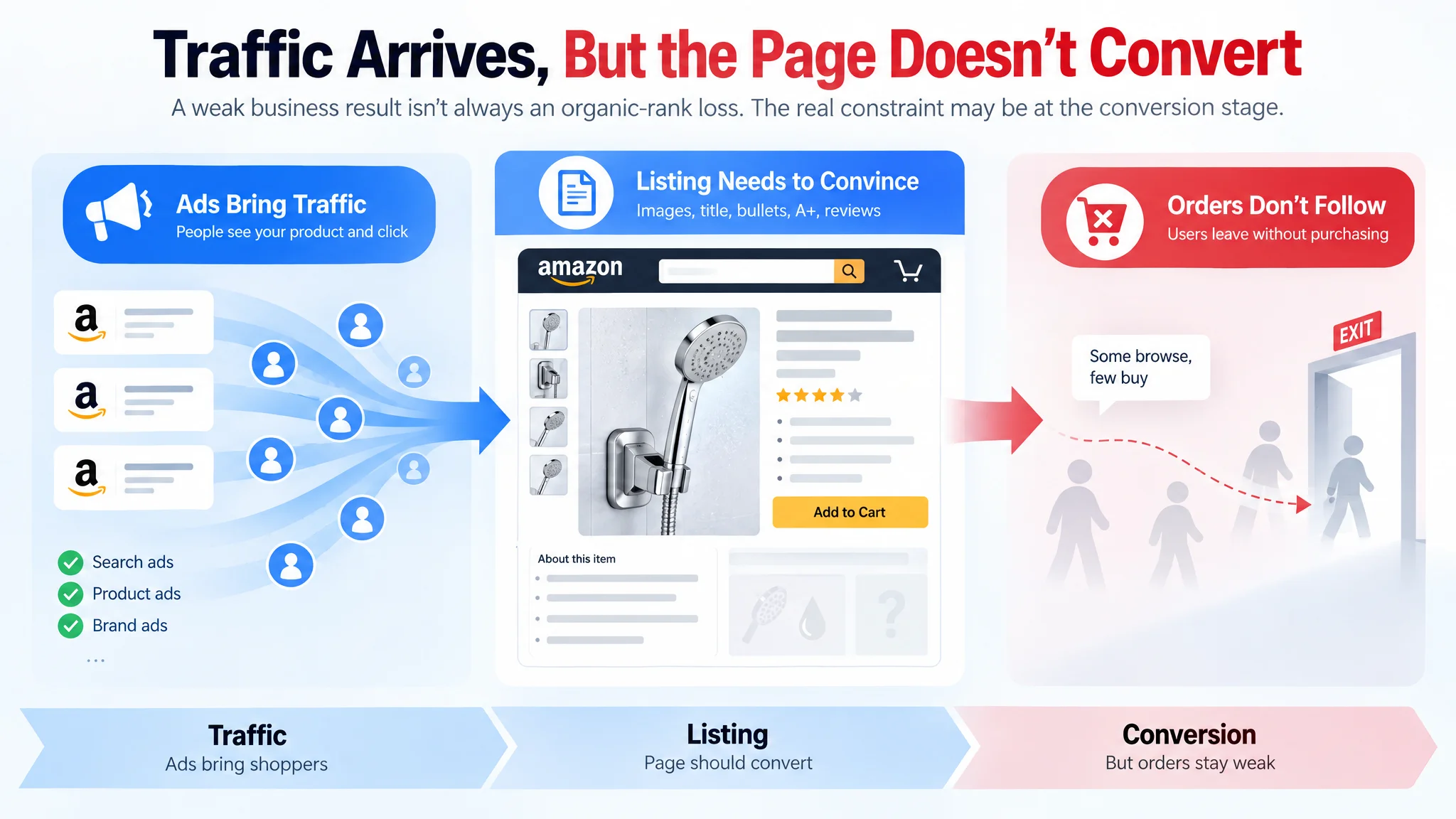
This distinction matters because a weak business result can look like a ranking problem even when the underlying weakness sits further down the funnel. In one US marketplace listing for a suction shower head holder, the seller was concerned about weak orders and high ACOS while advertising traffic continued to arrive. The initial interpretation focused on advertising efficiency, but the listing itself scored 44/100 against a benchmark competitor at 85/100. The result was a conversion bottleneck, not evidence by itself of an organic-rank loss. Before treating a commercial decline as a search-visibility problem, the seller must establish whether the loss occurs in exposure, clicks, conversion, or organic contribution.
The Signals Worth Diagnosing First
Demand, Conversion, and Relevance
Start with sales velocity and recency. A recent slowdown may help explain a weaker BSR or reduced organic visibility, but it cannot prove that demand alone caused the rank decline. Check whether the keyword’s traffic still converts. A lower CVR can indicate weaker offer fit, trust, or detail-page communication; it cannot, by itself, establish a ranking penalty.
Next, compare impressions, CTR, and listing relevance. A falling CTR may point to weaker search-result appeal, while relevance should be assessed through title keywords, keyword placement, selling-point clarity, main-image hierarchy, and alignment between claims and visuals. These signals can explain fewer clicks or weaker traffic quality, but neither a low CTR nor a listing score alone proves the cause of an organic-rank movement. Use exposure, clicks, orders, CTR, and CVR together rather than treating one metric as a complete diagnosis.
A practical example shows why these signals need to be separated. The shower accessory listing had reasonable advertising traffic, but the seller’s orders remained weak and ACOS was difficult to reduce. The team initially treated the situation as a bid and keyword problem, even adjusting campaigns and shifting budget toward higher-CTR targets. A deeper listing review found that the main images did not quickly communicate compatibility, waterproofness, load-bearing, or installation confidence, while the page had no A+ content at all. The traffic problem and the post-click problem were therefore not the same problem. A click could be purchased, but the page was not completing the decision.
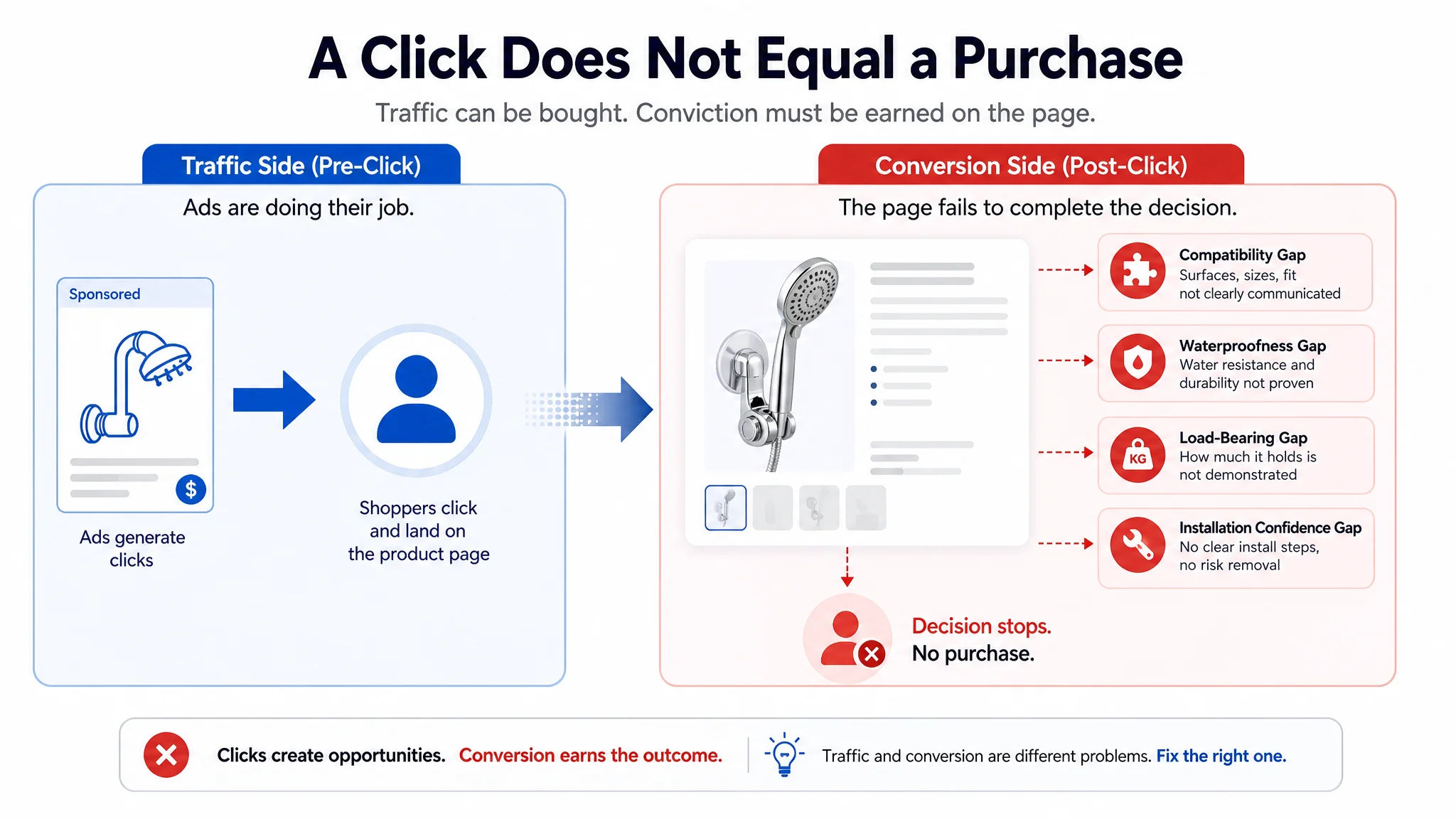
A useful working hypothesis is a conditional loop: stronger sales may support more reviews and credibility; stronger credibility may improve conversion competitiveness and visibility; greater visibility may create further sales. That loop is not confirmed causation. Amazon does not publicly confirm a direct click-to-rank mechanism, so do not treat ad clicks or CTR changes as direct organic-ranking inputs.
Market and Listing Friction
Check competitive density and new entrants within a genuinely comparable product form, price band, function, and audience. New or stronger competitors may explain lost visibility or conversion share, but a broad competitor comparison cannot isolate the cause.
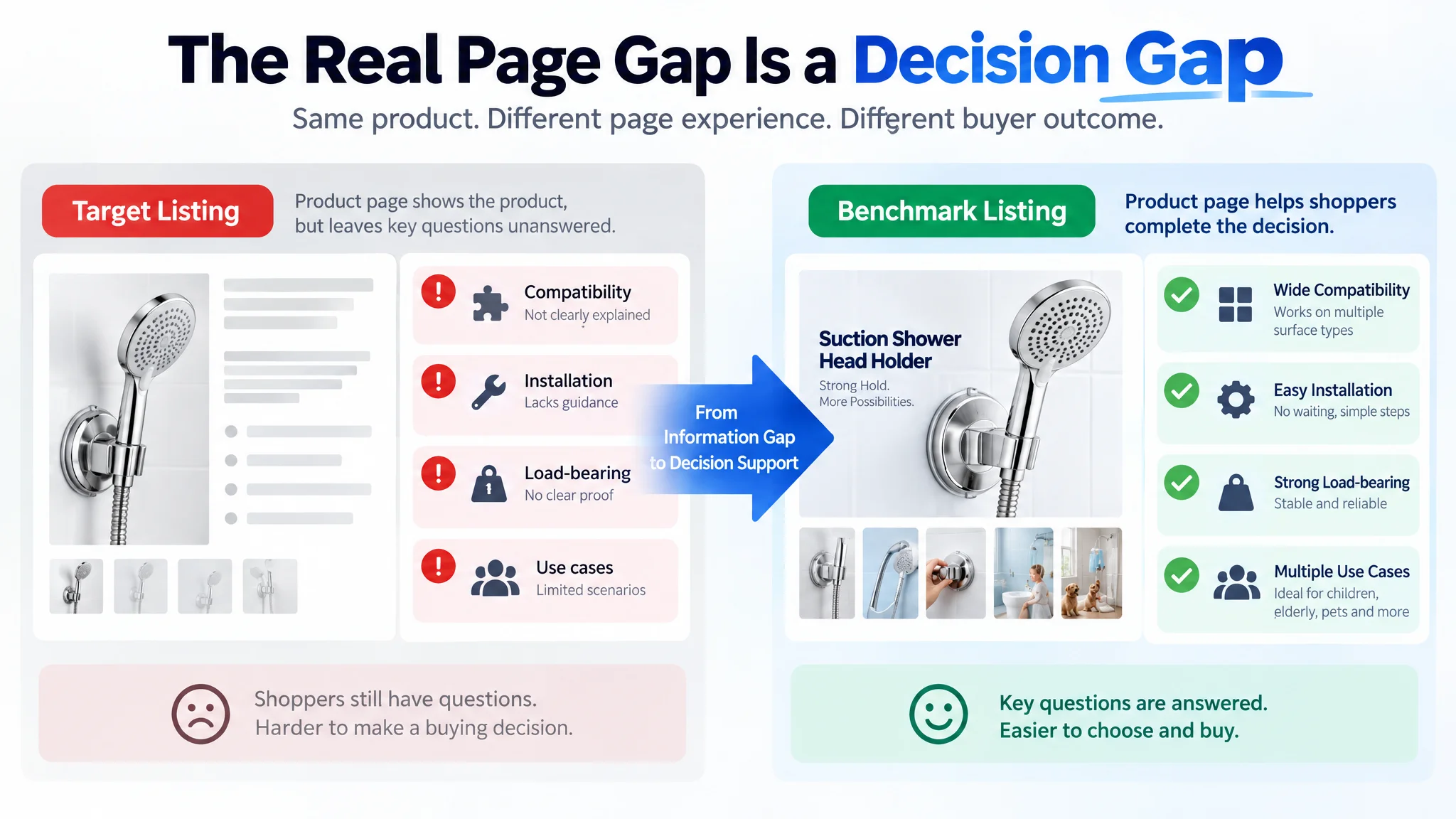
Listing friction can make competitive pressure more severe. In the shower holder example, the benchmark listing scored 23/25 for detail and A+ content while the target listing scored 0/25. The benchmark explained surface compatibility, size fit, installation timing, reuse, load-bearing, and use cases involving children, pets, and elderly users. The target page mainly presented the product without building the same decision structure. This does not prove that the competitor caused an organic-rank decline, but it does show how a competitor can capture conversion share when both products compete for similar demand.
Check availability, price changes, and coupon shifts separately. Stock friction may suppress orders; a higher price or removed coupon may weaken CVR. Each can explain sales deterioration, but none alone proves an organic algorithm change.
Finally, test for off-Amazon, branded, or other non-search demand. A sales increase may not reflect improved search visibility, and a decline in non-search demand may resemble an SEO problem. Keep the diagnosis evidence-led: do not invent multipliers, ratios, dwell-time thresholds, or bounce penalties when Amazon has not confirmed them.
A Five-Step Triage You Run Before You Touch Bids
A rank decline should first be treated as a diagnosis problem, not a bidding problem. Build a data evidence chain from search position, impressions, clicks, orders, CTR, and CVR before changing spend. The sequence below separates a real keyword loss from a broader category or operational issue.
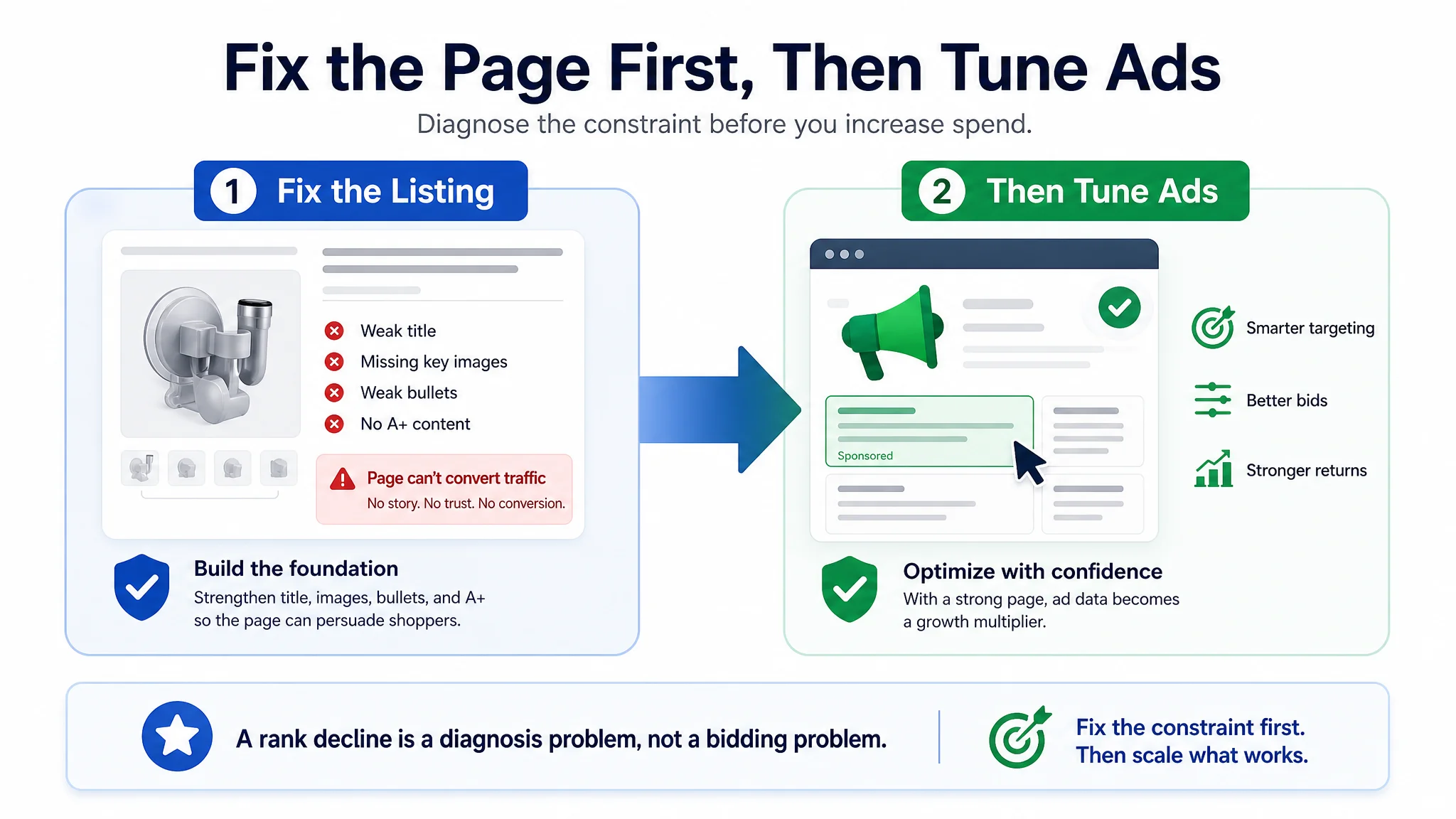
The same principle applies when the visible symptom is high ACOS rather than a confirmed organic decline. The suction shower head holder seller began by adjusting bids, keywords, placements, and campaign structure. Those actions were reasonable only if the main constraint was traffic acquisition. Once the listing was scored against a benchmark, the more immediate issue was clear: a weak page was receiving traffic it could not effectively convert. The order of diagnosis matters because bid optimization cannot repair missing compatibility information, absent A+ content, or weak trust signals.
Steps 1-3: Confirm, Check, Segment
- Step 1: Confirm the decline is real and keyword-specific. Compare the affected search terms across consistent reporting periods and check whether the movement appears in BSR, organic position, impressions, or clicks. A single fluctuating term is not enough evidence of a listing-wide decline. A useful test is to identify which keywords moved and which comparable terms remained stable.
- Step 2: Check availability and account-health basics. Confirm that the ASIN is buyable, in stock, not suppressed, and displaying normally. Review account-health alerts, fulfillment interruptions, pricing changes, and other conditions that can reduce discoverability or conversion before diagnosing relevance or bids.
- Step 3: Segment keyword-level demand. Group terms by CTR, CVR, orders, and order value. Give priority to keywords showing high click-through, high conversion, and high order value, because these signals identify where lost visibility may carry the greatest commercial cost. Advertising data should narrow the investigation, not replace it. If a visual or listing change is suspected, connect the publication event to subsequent CTR and CVR movement rather than relying on design judgment alone.
The segmentation step should also expose whether the page is failing after the click. In the shower holder case, the seller had focused on ad traffic because clicks were available, but the page did not resolve basic purchase questions. The title did not clearly front-load adjustability and no-drill installation, the image set offered limited proof of compatibility and load-bearing, and the bullets did not form a clear decision path. These findings did not establish an organic penalty; they identified why traffic could remain commercially inefficient even when the search term itself appeared relevant.
Steps 4-5: Separate Density From Collapse, Then Choose the Fix
- Step 4: Test for positional density. Check whether several competitors have compressed your position while category impressions, clicks, and conversion remain broadly active. A term can move down because the category has become denser, not because demand has collapsed. Also compare related terms to distinguish a category-wide shift from an ASIN-specific problem.
- Step 5: Choose the intervention only after these checks. A weak CTR pattern may point to the listing; a weak CVR pattern may require pricing, offer, or content review; an availability or account issue requires operational correction. For keywords with strong CTR, CVR, and order value, paid support can be tested to reinforce top-of-search presence. Treat short-term paid lift and long-term organic improvement as parallel tracks: ads can contribute indirectly through sales and conversion signals, but test the relationship per keyword.
Illustrative example, not performance data: if a tracked term moves from organic position 6 to 10 while category clicks remain active and the ASIN’s CVR holds, investigate positional density before rewriting the listing. If CTR and CVR also deteriorate, the fix may belong to content, pricing, or availability instead.
The distinction between a click problem and a conversion problem is especially important when advertising costs appear abnormal. For the shower holder, a higher-CTR target did not automatically solve the commercial issue because the listing still lacked the information shoppers needed after clicking. The eventual diagnostic direction was to improve the title, images, bullets, and A+ structure before treating further ad tuning as the primary fix. That is the practical meaning of choosing the intervention only after the evidence has been segmented.
Competitor Layout Gap: Benchmarking Against Category Winners
A rank decline does not automatically indicate an algorithm change. A competitor_layout_gap is a plausible diagnosis when organic losses are concentrated on target terms where the same stronger competitors consistently appear above the affected ASIN. The visible difference must also be specific enough to inspect: weaker image communication, less scannable copy, incomplete information hierarchy, or a less persuasive offer presentation can reduce CTR and CVR, eventually putting pressure on BSR.
Selecting the Right Benchmark ASINs
Do not benchmark against the category bestseller by default. Select ASINs that repeatedly outrank the reader for the affected term while remaining comparable in product form, price band, audience, and usage scenario. Distributed data collection and multi-dimensional semantic analysis can extract relevant search terms, simulate buyer-search conditions, identify category competitors, and filter candidates by functional and visual similarity.
The comparison should cover observable listing attributes:
- Main image treatment and information clarity
- Title structure and keyword layout
- Five-point information hierarchy, ordering, and pain-point coverage
- A+ content fullness, module structure, and visual flow
- Offer framing
- Review volume and rating structure as contextual inputs only
The purpose is not to copy competitor details or product presentation. It is to locate the specific listing module where the visible gap is concentrated.
The shower holder diagnosis illustrates why a total score alone is not enough. The target listing scored 44/100 versus 85/100 for the benchmark, but the largest difference was concentrated in detail and A+ content: 0/25 versus 23/25. The benchmark used its page to explain installation, surface compatibility, size, reuse, load-bearing, and different household scenarios. By contrast, the target page had limited visual and written support for questions such as whether the holder would fit a shower head, remain attached, or work on a particular surface. The comparison became useful only after the overall gap was connected to specific decision barriers.
From Scored Gaps to a Prioritized Fix List
A useful audit should produce more than a general score. It should show whether the difference is concentrated in images, title, bullets, A+, or rating structure, then convert that finding into a ranked execution list. For example, an abstract recommendation such as “improve durability communication” should become a precise visual or copy instruction with defined placement, hierarchy, and buyer-facing benefit.
In the shower holder listing, the title contained core keywords but read more like a flat function list than a decision path. The main image set showed the product but did not strongly demonstrate installation, compatibility, waterproofness, or load-bearing. The bullets mentioned functions and materials without guiding the shopper through fit, surface suitability, ease of installation, durability, and household use. The A+ section was absent. These were not separate cosmetic observations; together they explained why the listing had limited capacity to turn relevant visits into confident purchases.
Prioritize changes by their likely effect on CTR, CVR, ACoS, and listing cycle time. After review, approved listing content can be sent through a one-click Amazon SP-API application workflow, reducing manual transfer friction without turning the hand-off into a substitute for diagnosis.
A prioritized fix list for a page with this pattern would begin with the largest evidence-based gap rather than with bid changes. It might address the missing A+ structure and decision-critical information first, then strengthen image hooks and bullet sequencing, while preserving measurement of CTR and CVR after each controlled change. The point is not to imitate the benchmark mechanically. It is to repair the module where the shopper’s decision is breaking.
The Off-Search Layer and Proving Incrementality
Many category shoppers browse without using the exact keyword being diagnosed. A decline in search-discovered sales may therefore partly reflect demand that never entered the target-keyword path, rather than a direct loss of organic rank. Attribute outcomes by separating assisted results, where search contributes alongside other exposure; channel-only results, where the sale is not tied to the target search path; and search-bound results, where keyword search is the primary route. Geo holdouts and lift studies can serve as alternative causal checks when the business needs stronger evidence of incremental demand.
Proving incrementality is optional for a rank diagnosis. The immediate question is whether the product has weakened within the organic search system, not whether every sale can be assigned to one exposure source. Return to the core evidence chain: search-term relevance, organic visibility, CTR, CVR, and competitive listing gaps. This keeps off-search demand as a brief attribution gate while preserving the diagnostic focus on the signals most directly connected to organic rank and BSR movement.
The shower holder case also shows why attribution should not be used to avoid a page-level diagnosis. The seller knew that ads were generating traffic, but that fact did not establish that advertising was the root problem or that every weak order came from poor keyword selection. The listing review identified missing conversion evidence inside the page itself: no A+ story, weak compatibility explanation, limited installation guidance, and a visible trust gap relative to the benchmark. Those findings did not replace incrementality analysis, but they did show where the post-click experience was failing.
Who Owns the Diagnosis: Accountability When Discovery, Listing, and Rank Tracking Sit With One Team
Organic rank diagnosis breaks down when keyword discovery, listing work, and rank tracking sit with different teams and nobody owns the evidence chain. A ranking drop is then treated as an isolated symptom: one team changes keywords, another changes the listing, and a third reports movement without explaining the cause. When the evidence is fragmented, the default response is often more spend rather than a controlled diagnosis. That can increase ACoS without restoring BSR or organic order share.
A workable shared-ownership model assigns one accountable owner for the keyword set and the diagnostic record, even when specialists perform the underlying work. That owner establishes one re-measurement cadence and ensures that organic rank movement and organic order share are read together in one place. Rank alone can suggest visibility loss; order share helps test whether that loss is translating into a meaningful change in organic contribution. The two measures should be reviewed against the agreed keyword set, not against shifting terms selected after the decline.
The baseline must be explicit during the onboarding handoff. Before any keyword, listing, or traffic change is made, the owner and contributors should confirm the tracked terms, measurement cadence, current organic rank, organic order share, and the interpretation rules for future movement. DeepBI’s relevant role here is continuous tracking of organic rank movement and organic order share with a stable re-measurement cadence. Clear ownership keeps later actions tied to evidence instead of turning an unexplained decline into an automatic spending decision.
Ownership also needs to include the listing itself. In the shower holder case, the advertising team had continued working on bids and campaigns while the title, image set, bullets, A+ content, and review-related trust gap remained largely unchanged. The problem was not necessarily that the ad team had acted incorrectly; it was that no shared diagnostic process had forced the business to compare traffic acquisition with page conversion capacity. When one team owns only clicks and another owns only content, the central question—whether the page can convert the traffic being purchased—can remain unanswered.
Ad Data as Diagnostic Input, Not a Rescue Plan
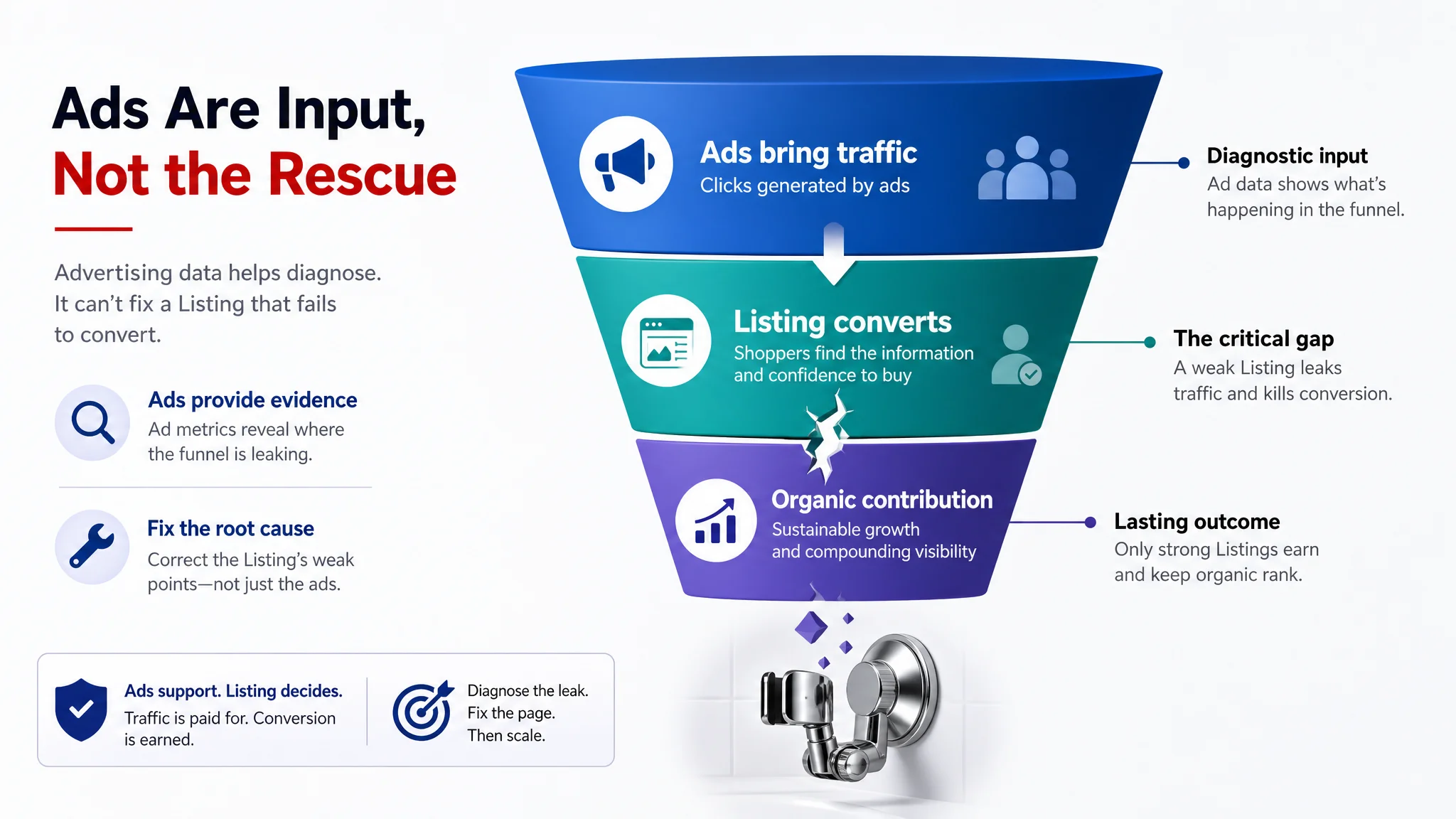
Advertising data is often the fastest readable evidence of a change in demand or relevance, but it is not automatically the cure for declining organic rank. At keyword level, separate three signals: terms that still generate conversions, terms that have lost conversion, and spend that is producing clicks without meaningful order value. This separates a traffic problem from a post-click conversion problem and prevents additional budget from masking a weak Listing.
Use a funnel rather than a single campaign judgment. Explore new keyword traffic and competitor-ASIN traffic to test where relevant demand may exist. Then use recent advertising data to filter low-conversion traffic, review CTR and CVR, and concentrate spend on terms with demonstrated conversion. Scale only proven traffic; do not assume that more impressions, lower bids, or continued campaign activity will restore BSR.
The shower holder seller initially followed the familiar route: campaign restructuring, bid adjustments, placement changes, and budget shifts toward higher-CTR targets. Those actions addressed the visible advertising controls, but the listing still had a 44/100 diagnostic score against 85/100 for the benchmark, including a 0/25 score for detail and A+ content. The later diagnosis did not say that advertising was irrelevant. It showed that advertising was paying for visits to a page that lacked the information needed to convert them. That is why the first intervention moved toward listing reconstruction rather than additional bid tuning.
A multi-layer traffic funnel can support daily bid and budget adjustments based on recent clicks, conversions, spend, and ACoS trends. The value of this process is not aggressive spending. It is a reviewable record of why traffic was expanded, reduced, or redirected. If clicks remain strong but CVR weakens, investigate the detail page, offer, images, or trust signals before increasing bids. If a term continues to convert, preserve it as a priority signal for Listing and relevance decisions.
In that listing, the relevant page checks included whether the title made the no-drill and adjustable functions clear, whether images showed compatibility and load-bearing, whether bullets screened unsuitable surfaces, and whether A+ content explained use cases and installation. These are examples of conversion diagnostics, not proof that one specific content change will produce a particular ranking outcome. They help identify whether the advertising problem is actually a page problem.
The highest-value advertising terms are also the terms whose organic position should be monitored after corrective actions. Ads provide evidence for the diagnosis; the corrective action may belong elsewhere.
Wrong Turns: Claims to Retire in Rank-Decline Diagnosis
- DeepBI Listing Product Document: Do not invent audience ratios or say that ad clicks directly raise organic rank. Some category demand never arrives through a given keyword, while advertising should be treated as an input for testing sales and conversion relationships—not proof of a direct ranking effect Amazon publicly confirms. Likewise, do not claim every ad-driven sale improves long-term organic performance. Results depend on keyword competitiveness, listing quality, and category dynamics. External sales may help Amazon observe new-customer demand, but no published weighting or decay-slowing effect is established.
- DeepBI Listing Product Document: Engagement signals may matter, but public evidence does not support second-level reading thresholds, fixed penalties, or a universal frequency cap stated as a multiple. Treat such ideas as hypotheses tested through like-for-like before-and-after measurement. Keep low conversion, ad quality, search visibility, and BSR mechanics distinct; sales activity alone does not prove that low CVR directly lowers rank. A single negative review also cannot be treated as proof that a brand is ruined.
- Compliance and Security: Multiple-device logins should not be described as an automatic suspension trigger. Separate security verification from an actual policy-driven suspension. Do not claim that automation alone lifts sales; automation may improve response speed and workflow efficiency, but outcomes still depend on message quality, listing quality, and market feedback. Replace off-platform collection or discount-incentive insert-card tactics with value-first, compliance-checked guidance.
- Platform Guidelines: Do not claim that deactivating a listing stops every new sale; distinguish seller-fulfilled orders from Fulfilled by Amazon listings. Avoid vague references to policy changes unless a specific, sourced date is available. Keep narrowly targeted performance results comparable with similarly targeted benchmarks, or omit the comparison.
- Businesses with high security requirements needing to avoid account linkage risks from manual backend logins by using a direct API connection: A direct attribution method can provide strong evidence of incrementality, but it is not the only proof. Combine it with alternative causal checks, controlled comparisons, and observable KPI changes in CTR, CVR, ACoS, or BSR. Claims that a product is already losing simply because it does not stand out should be softened to a defensible visibility argument.
A related wrong turn is to treat a high ACOS reading as a complete diagnosis. In the shower holder case, the seller saw high ACOS, weak order growth, and reasonable advertising traffic, then assumed that bids and keywords were the binding constraint. The listing audit showed that the page had no A+ content, weakly structured bullets, limited visual proof, and a weaker review base than the benchmark. The correct conclusion was not that high ACOS never reflects an advertising issue. It was that ACOS alone could not tell the team whether the loss occurred before the click or after it.
A 30-Day Diagnosis and Recovery Cadence
A useful recovery cadence is designed to reduce uncertainty, not to manufacture a short-term rank spike. Clustered, consistent testing produces a clearer evidence chain than isolated changes, especially when CTR, CVR, BSR, ACoS, organic rank, and organic order share can move for different reasons. A short push may not move a well-defended term, so each week should end with a diagnostic decision rather than a recovery promise.
- Week 1: Establish the baseline. Record organic rank by priority keyword, organic order share, impressions, clicks, orders, CTR, CVR, BSR, and relevant listing or availability status. Compare the same measurement windows and confirm that the decline is real rather than a reporting gap, temporary fluctuation, or delayed data.
- Week 2: Segment the problem. Separate keywords by search intent, position, and performance pattern instead of relying on one aggregate rank. Check the competitor layout gap against genuinely comparable listings, including product form, price band, audience, reviews, and semantic relevance. Confirm that the listing is available and that intended assets were successfully processed rather than blocked or delayed.
- Week 3: Test one probable cause. Select the strongest supported hypothesis and make the smallest reversible change. A targeted edit preserves attribution; changing multiple unrelated elements makes any CTR, CVR, or organic-order movement difficult to interpret.
- Week 4: Re-measure and decide. At the same fixed cadence, recheck organic rank and organic order share using the same sources and comparison point. Hold the change if the evidence remains consistent, revert if the hypothesis is weakened or business signals become abnormal, or extend the test when the evidence is incomplete.
Weekly success is a completed diagnosis or an eliminated hypothesis—not guaranteed rank recovery.
For a listing with the shower holder’s pattern, Week 1 would not stop at recording ad spend. It would also document the title, main-image set, bullet structure, A+ status, review context, and benchmark gap. Week 2 would separate whether the issue was weak search-result appeal, weak post-click conversion, or both. Week 3 could test a focused listing change, such as clearer compatibility communication, rather than changing bids and page content at the same time. Week 4 would then compare the same CTR, CVR, ACoS, organic rank, and organic order-share measures. This keeps the case evidence aligned with the diagnostic cadence instead of turning a page rebuild into an unmeasured bundle of changes.
Quick Answers to Common Diagnostic Questions
How quickly can organic rank move? Organic rank can change as search, click, order, CTR, and CVR signals change, but no universal timing rule should be assumed. Diagnose the relevant funnel gap before judging the effect of an intervention.
Can advertising lift organic rank? Advertising data can help reveal search, click, and conversion patterns that support diagnosis. It should not be treated as proof that ads automatically raise organic rank. If advertising produces clicks but the listing cannot answer compatibility, installation, durability, or trust questions, additional spend may simply create more inefficient sessions.
Does deactivating a listing stop sales? Do not assume a listing change will produce a specific sales outcome without evidence. Check the listing’s traffic, order, and conversion context before deciding whether deactivation is appropriate.
What should be checked first? Start with the core listing components: main image, title, bullet points, A+ content, and customer feedback. Cross-check them against impressions, clicks, orders, CTR, and CVR, then compare with a genuinely similar benchmark. In the shower holder diagnosis, the most important finding was not a general content weakness but the combination of missing A+ content, limited visual proof, weak decision-oriented bullets, and a weaker trust layer.
How long should diagnosis take? There is no fixed diagnostic duration that applies to every case. Continue until the available evidence supports a specific gap rather than relying on an unexplained overall score.
Can a small catalog use the same process? A small catalog can apply the same diagnosis-before-optimization logic when its data and benchmarks are usable. The workflow should still be adapted to the available evidence rather than treated as a universal formula.
What happens after diagnosis? Move from “groping in the dark” to precision targeting: identify the likely gap first, then select and review the intervention. This protects CTR, CVR, ACoS, and BSR decisions from unsupported assumptions.
Closing: Diagnose First, Spend Second
Organic rank decline is a symptom, not a diagnosis. Several causes may produce the same visible drop, so the practical rule is to identify the weakness before increasing spend.
The shower holder listing demonstrates why this order matters. The seller first saw a familiar advertising pattern: traffic was available, orders were weak, and ACOS was difficult to control. The initial response focused on bids, keywords, and campaigns. The listing diagnosis then revealed a different constraint: a 44/100 page versus an 85/100 benchmark, no A+ content, limited image-based proof, weakly structured bullets, and a fragile trust layer. The evidence did not prove an organic-ranking penalty or guarantee a particular recovery. It showed that the page was not yet carrying its share of the conversion argument.
- Treat rank decline as a signal to investigate demand, relevance, CTR, CVR, listing quality, reviews, and competitive pressure rather than as proof of one specific failure.
- Use the diagnosis to place the fix: a click problem may require stronger visual or relevance work, while a conversion problem may point to detail-page or trust gaps.
- Use paid support as a tool inside the plan. Ad data can help validate signals and measure CTR, CVR, ACoS, or organic order share, but paid traffic is not a substitute for locating the underlying weakness or a guarantee of rank recovery.
- Leaky-bucket analogy: Spending more traffic into a listing with an unresolved weakness may fill the bucket briefly, while the leak continues. Diagnose where the loss occurs, then decide whether paid support belongs in the response.
The practical sequence is therefore simple: confirm the movement, isolate the affected terms, separate visibility from conversion, benchmark the page against genuinely comparable competitors, and assign the fix to the right part of the funnel. Only then should additional spend be judged as a growth action rather than as a substitute for diagnosis.