

How to Use Amazon's Sponsored Products and Brands AI Prompts in Practice
Treat AI prompts as operating variables rather than permanent campaign settings. Prompts are generated continuously, so both their inputs and performance can change. A one-time review may miss shifts in CTR, CVR, ACoS, or spend allocation. Use the following five-step loop for Sponsored Products and Sponsored Brands.
1. Confirm enrollment and billing status.
Before evaluating results, verify that the relevant account or campaign is enrolled as required and that billing is active. If either condition is unresolved, prompt-level performance may not be available or may not be comparable.
2. Locate the prompt surface.
Find where the applicable prompt activity is presented in the advertising workflow. Avoid assuming that a missing view means missing history. Prompt reporting follows the same campaign and ad-group structure used in other Sponsored Products and Sponsored Brands reporting.
3. Compare prompt results with the parent campaign baseline.
Review prompt-level impressions, clicks, orders, CTR, CVR, spend, and ACoS against the parent campaign rather than judging a prompt in isolation. Also check downloadable reports and the Ads API before concluding that historical prompt data does not exist. The practical question is whether the prompt is contributing incremental commercial value while remaining within the campaign’s budget logic.
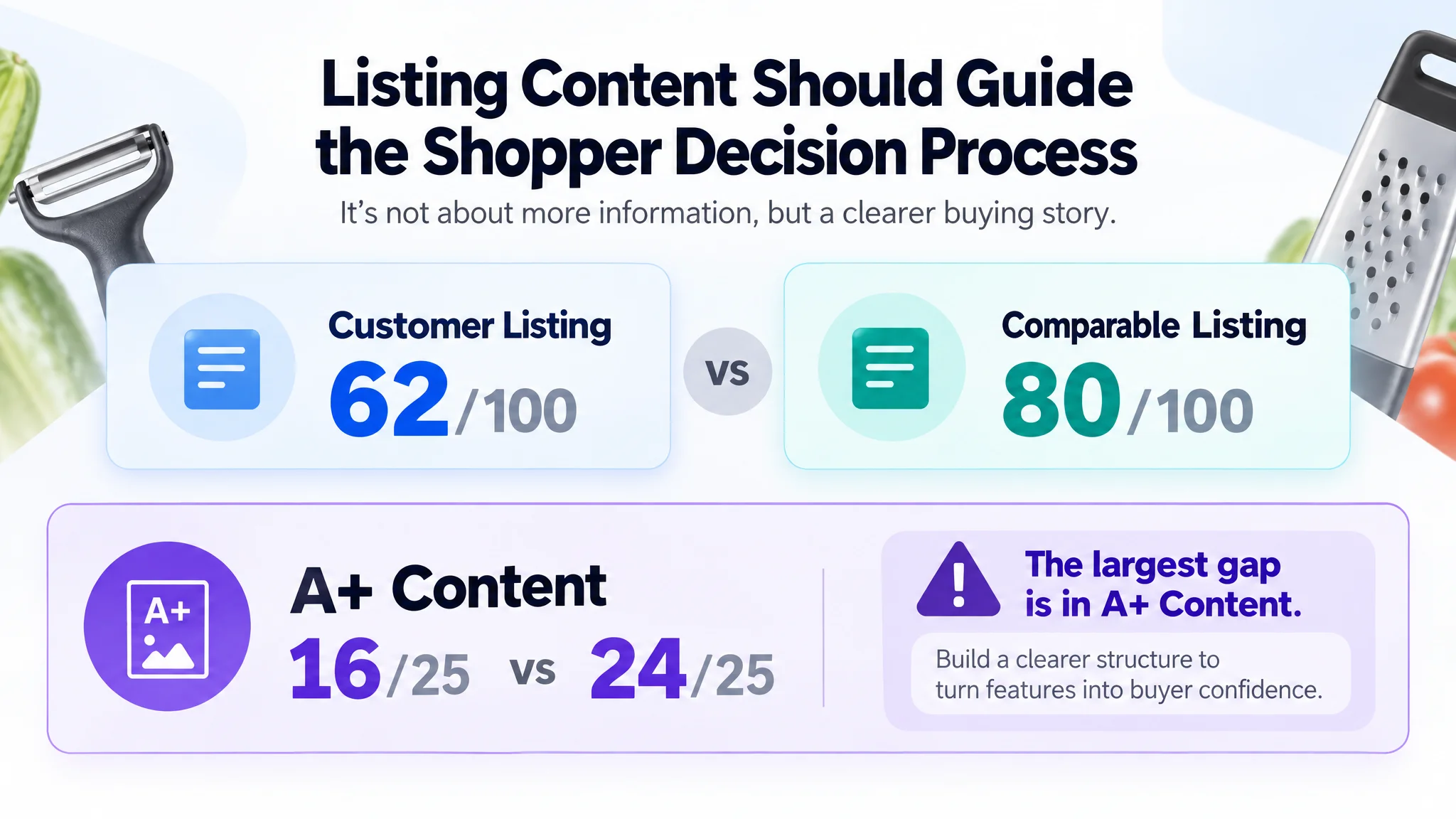
This comparison is especially important when the product page itself has unresolved conversion issues. In one kitchen-tools listing, the product offered peeling, julienne slicing, grating, and bottle opening, but its competitive score was only 62 out of 100 compared with 80 for a comparable listing. The initial instinct was to improve the feature description and attract more attention. A deeper review showed that the page was not turning those features into a clear buying story. If paid traffic had been evaluated without examining the page’s conversion structure, weak results could easily have been misread as a prompt, keyword, or bidding problem.
4. Choose an action for each prompt.
Keep prompts that support the campaign’s target economics. Refine the inputs when the prompt is relevant but produces weak CTR, CVR, or ACoS relative to the baseline. Disable a prompt when its contribution is persistently unattractive or difficult to defend. Record the reason so later decisions are based on evidence rather than preference.
5. Re-check after listing or creative changes.
A new image, title, or other creative change can alter the response to prompt-driven traffic. Revisit prompt and parent-campaign performance after the change instead of carrying forward the previous conclusion. DeepBI can serve as an ads-side diagnostic and optimisation layer, connecting prompt-driven and regular traffic signals within one accountable budget. It helps operators diagnose gaps and track CTR, CVR, and ACoS for the next decision, without managing Amazon prompt enrollment or replacing Amazon’s reporting routes.
The kitchen-tools example illustrates why this loop must connect advertising evidence with listing evidence. The page’s main problem was not necessarily a lack of product features. Its images showed product information without convincingly demonstrating outcomes, its bullet points listed functions without building a cooking-use logic, and its A+ content was too thin to establish trust. Advertising data could identify a commercial symptom, but the page diagnosis was needed to explain it. In practice, prompt performance should therefore be reviewed as part of a broader conversion system rather than as an isolated ad variable.
What Sponsored Prompts Are
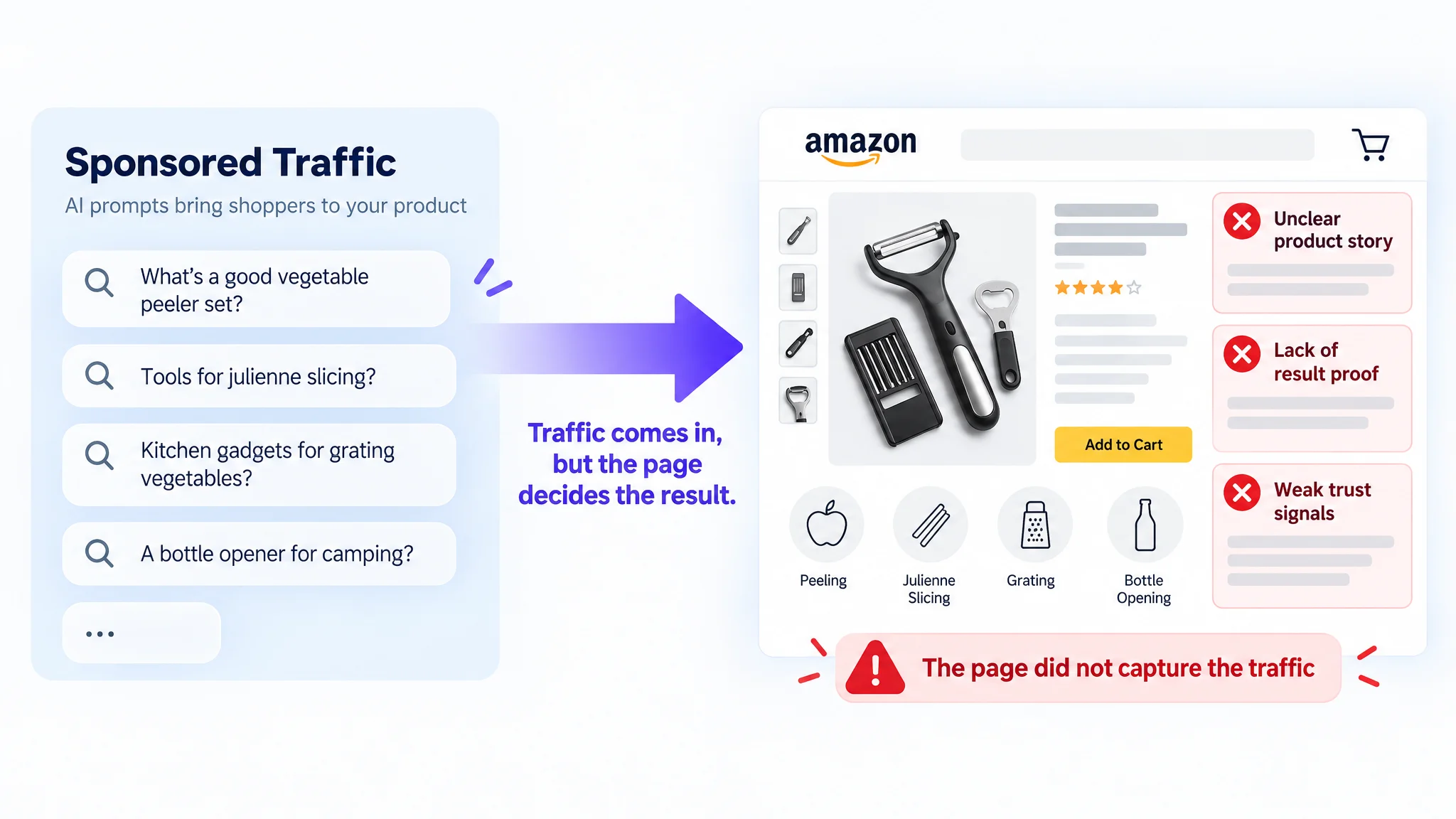
Sponsored prompts are shopper questions submitted within an Amazon shopping experience and answered through an AI-generated response. When relevant to the question and product context, sponsored placements may appear within or alongside that response. The prompt therefore serves as a discovery surface, connecting a shopper’s expressed need with products that may satisfy it.
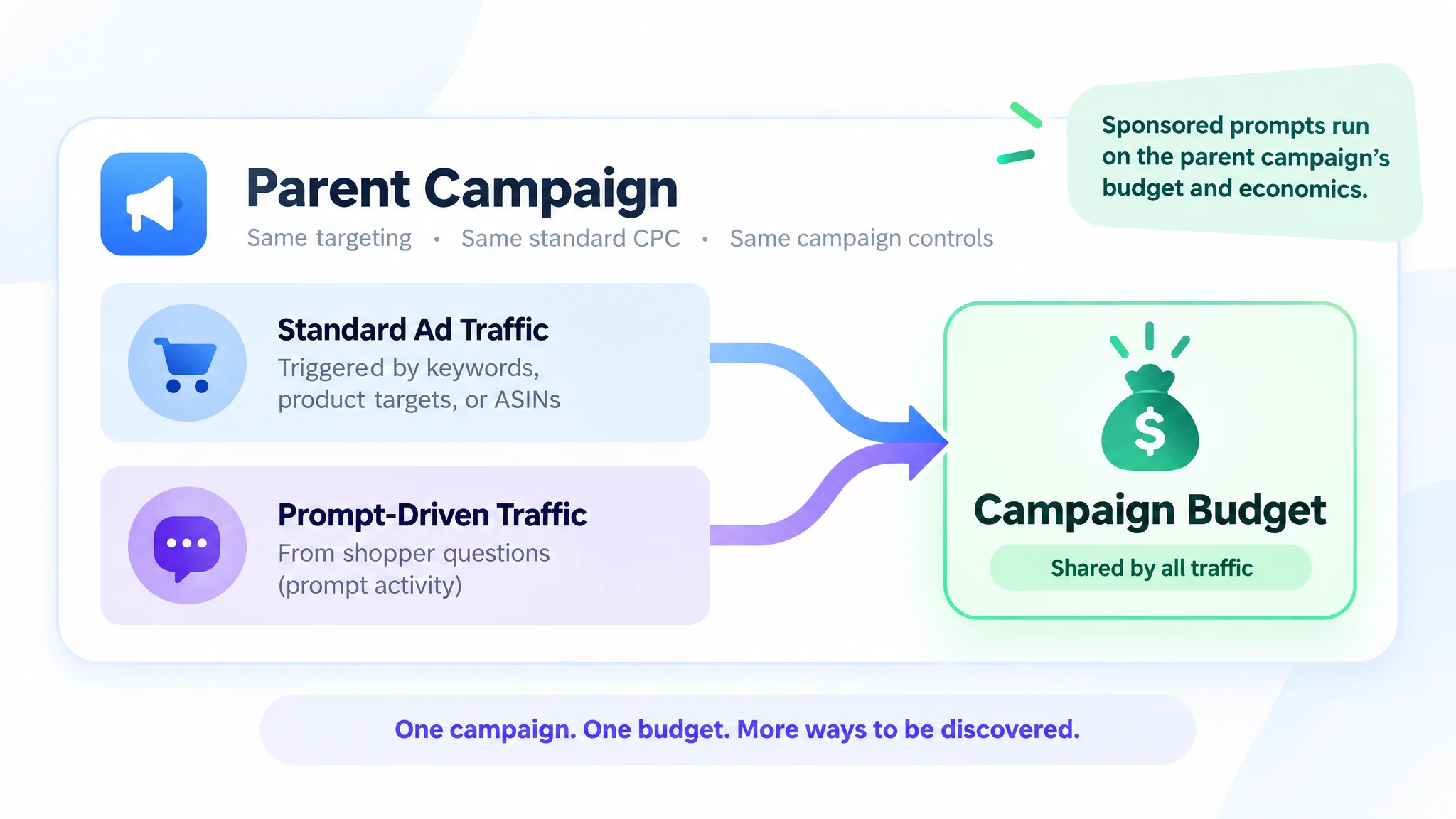
This differs from the traditional delivery of Sponsored Products or Sponsored Brands, which is based primarily on selected keywords, product targets, or ASIN relationships. A keyword-targeted ad begins with the advertiser’s targeting setup. A prompt-driven placement begins with the shopper’s question and the system’s interpretation of it. Advertisers should not treat each prompt as a new campaign or assume that every possible wording can be managed like a keyword.
The advertising economics still belong to the parent campaign. Budget allocation, bid controls, targeting configuration, attribution, and related guardrails remain campaign-level considerations. Sponsored prompts should not be treated as having a separate bidding system or independent financial model. Although their appearance may be prompt-led, the ad unit remains accountable to the campaign that funds and governs it.
That distinction creates a practical operating requirement. Operators need to monitor prompt-level discovery as an additional layer of evidence while continuing to evaluate the parent campaign through its established controls and metrics, including CTR, CVR, ACoS, and BSR where applicable. They must also manage the inputs that shape product eligibility and relevance, including listing claims, category signals, targeting structure, and brand-safe product information. Prompt monitoring shows how shoppers express demand; input management helps ensure the product is interpreted accurately when those questions arise.
A listing that contains several features but does not explain their roles clearly may be especially vulnerable to this gap. The kitchen-tool listing, for example, presented a multifunctional two-piece set, but shoppers could still be left asking which tool handled which task, what the finished result looked like, and whether the set was more useful than a basic peeler. The page contained information, but it did not provide a clear decision order. This is why prompt relevance should not be separated from the quality of the product information available to interpret that relevance.
What Changed on March 25, 2026
Amazon first announced the Sponsored Products and Sponsored Brands prompt change at its seller event on November 11, 2025. Prompt reporting became available by the end of November, giving enrolled advertisers a way to observe prompt-related activity before the billing transition.
The key operational date was March 25, 2026. On that date, prompts moved from beta access to general availability and began billing through Amazon’s standard cost-per-click model. The free beta ended. This was not the launch of a separate bidding system, but a change in how an available prompt capability was commercialized within the existing advertising structure.
The budget implication is more significant than the announcement language. Prompt billing runs through the parent campaign, so advertisers should not assume that prompt activity has its own isolated budget or spending control. An enrolled campaign’s existing budget may therefore be affected by prompt usage without a separate prompt-level allocation.
For operators, the practical shift is from testing a free feature to managing a paid campaign input. Review prompt activity alongside campaign-level spend and core advertising metrics, including CTR, CVR, and ACoS. A prompt that supports useful discovery or optimization may still require closer budget monitoring if it draws on the same campaign resources as other traffic.
It is also important not to mistake additional paid exposure for automatic business improvement. In the kitchen-tools listing, the product had several commercially useful functions, but the page did not yet make those functions easy to understand or trust. More traffic would have created more opportunities to expose the same uncertainty. The business question was therefore not simply whether a prompt could generate a click, but whether the listing could turn that click into a meaningful purchase decision.
The timeline should therefore be understood in three stages:
- November 11, 2025: Amazon announced the change at its seller event.
- By the end of November 2025: prompt reporting went live.
- March 25, 2026: general availability began, standard CPC billing started, and the free beta ended.
Advertisers enrolled in the capability should treat March 25 as a budget-management milestone, not merely a product-release date. The relevant question is whether campaign-level spending and resulting KPI movement remain defensible after prompts become part of the paid operating environment.
Where to Find Your Prompts
Start with the interface path used for prompt-level inspection:
Campaign → Ad Group → Ads → Prompts tab
The Prompts tab is the fastest place to conduct a spot review. Use it to check whether an AI-generated prompt or recommendation creates a brand-safety concern, conflicts with approved positioning, or could affect the ad’s relevance to the targeted search term. Review the prompt in the context of the ad and its campaign settings rather than assessing the wording in isolation. A prompt that appears harmless on its own may still create risk if it introduces messaging that weakens CTR, reduces CVR, or raises ACoS.
Interface reviews are necessary but insufficient for account-level oversight. Pair them with downloadable reports and the Ads API to examine prompt-related activity across campaigns and over time. Exports support a broader review of recurring patterns, including repeated recommendations, campaign-level differences, and changes that coincide with movement in CTR, CVR, ACoS, or BSR.
This two-track process separates immediate control from historical analysis:
- Interface review: inspect individual prompts and flag possible brand-safety or relevance issues before they influence execution.
- Export and API review: preserve records, compare activity across campaigns, and establish historical baselines for trend analysis.
Do not treat an incomplete or missing history in the Prompts tab as proof that no prompt-level baseline exists. Maintain downloadable records and API-based data where available so the operating record does not depend solely on what the interface currently displays.
The same principle applies to listing review. A prompt may indicate interest in a product function, but the interface alone cannot explain why the resulting traffic converts or fails to convert. In the kitchen-tools case, a shopper might understand that the product was multifunctional yet still fail to see which tool performed which task. A page-level review was needed to identify the missing proof: active peeling and julienne demonstrations, a clearer two-piece explanation, and a stronger connection between product features and everyday cooking situations.
What Amazon's AI Pulls From to Generate Prompts
- Amazon PDP elements: The primary input is the product detail page, including the title, bullet points, description, specifications, Q&A, and A+ Content. These elements establish the product facts and benefits available for prompt answers. When Amazon's AI answers a shopper prompt with information that the PDP does not clearly state, treat the response as a potential content-coverage gap rather than assuming the listing is complete.
A listing can contain all the relevant facts and still provide weak coverage if those facts are not organised around the shopper’s decision process. The kitchen-tool page mentioned multiple functions, materials, and use cases, but its title, images, bullets, and A+ content did not consistently explain how the two pieces worked together. The issue was therefore not simply missing information. It was a failure to turn information into a clear sales logic.
- Amazon Brand Store: Brand Store content provides broader brand and product-line context after the PDP layer. It can reinforce positioning, comparisons, and use-case communication, but it should not be treated as a substitute for missing product facts on the detail page.
- Campaign performance history: Historical Sponsored Products and Sponsored Brands results provide an additional signal in the approximate input order. Use the resulting prompt patterns alongside CTR, CVR, ACoS, and listing cycle time analysis; prompt generation does not replace ad-side measurement.
- Amazon shopper behavior data: Shopper signals appear later in the approximate weighting sequence, after PDP elements, Brand Store content, and campaign history. They may help explain which questions or product attributes receive attention, but they should not be treated as proof that a content change will improve BSR or organic discovery.
- DeepBI listing analysis: Compare PDP coverage across title, bullets, description, specifications, Q&A, and A+ Content with benchmark competitor layouts. The comparison should also review image coverage, benefits, use cases, sizing, and materials. DeepBI can semantically analyse PDP, A+, title, bullet, and image content, identify benchmark ASINs, and return a multidimensional score with prioritised weak points. Benchmark selection must remain within genuinely comparable products, price bands, use cases, and audiences.
In the kitchen-tools comparison, the customer listing scored 62 out of 100 against 80 for a comparable listing. The largest content gap was in A+ content, where the customer page scored 16 out of 25 compared with 24 out of 25 for the benchmark. The title, main image, bullet points, and reviews also had gaps, but the A+ difference showed that the page lacked the architecture needed to bring its claims together. This kind of prioritisation is more useful than changing every listing element at once.
- Ranked gap interpretation: Competitor benchmarking converts a vague thin-content concern into a ranked content-gap queue based on visible or confirmed product information. A missing parameter, weak image explanation, or underdeveloped use-case module can then be prioritised against likely effects on CTR and CVR. This listing-side scoring remains separate from ad-side measurement. Better answer coverage may support natural discovery surfaces, but that remains a hypothesis, not a guaranteed outcome.
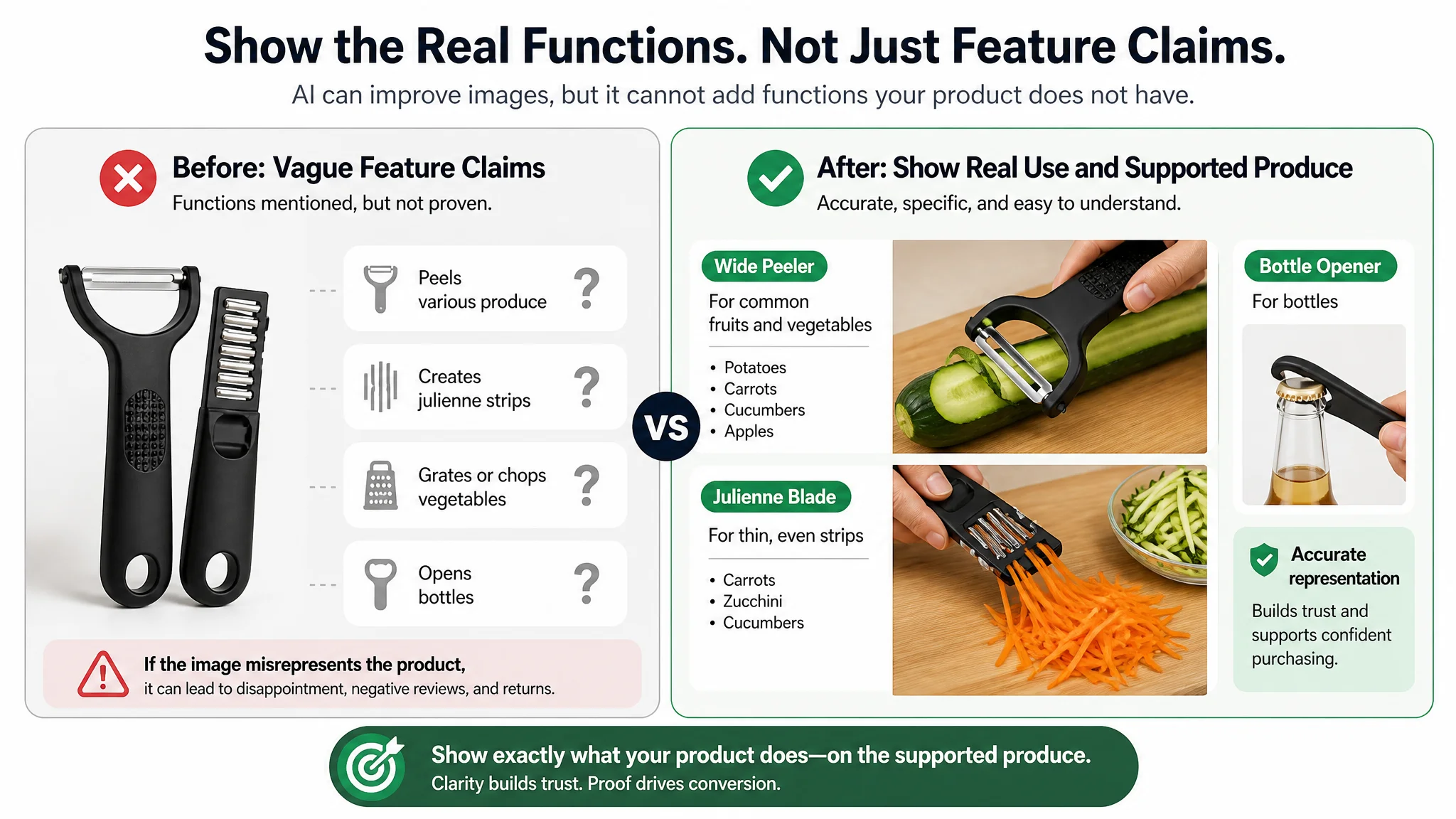
The important distinction is between identifying a content gap and assuming that every additional piece of information will improve performance. In the kitchen-tools case, the recommended direction was not to add more isolated feature claims. It was to show the product in use, clarify each tool’s role, and build a sequence from function recognition to purchase confidence.
The Risk Worth Understanding: Where the AI Usage Limits Actually Bite
Amazon’s AI usage limits are risk-based. They are neither a blanket ban on AI-assisted advertising nor blanket permission to publish anything an AI system produces. The practical question is what shoppers may believe after seeing the asset and whether that impression is properly disclosed and factually supportable.
Disclosure and labelling are publishing-workflow requirements, not a one-time metadata change made when an image is first generated. Photorealistic AI-generated people must be disclosed whether they were created with Amazon’s tool, a third-party tool, or another production system, and whether they appear in an image or video. Qualifying new or re-uploaded assets need the required metadata before publication. Reviewing existing content is a prudent audit practice, but it should not be treated as a universal requirement to relabel every historical asset retroactively.
The control point also shifts throughout the production lifecycle. A correctly tagged master file may lose required metadata after editing, resizing, format conversion, or compression. Operators therefore need to check the file that actually enters the advertising workflow, not just the original export.
The disclosure test is practical: could the audience be misled about the content’s origin if AI use were not disclosed? A disclosure label cannot rescue a fundamentally misleading claim. Existing advertising rules remain technology-neutral and apply whether content was generated, manually edited, or targeted with AI-assisted tools.
For product visuals, the safer operating model is structured control rather than a general-purpose AI drawing process. Define the product’s non-negotiable attributes, prevent the system from inventing accessories, functions, dimensions, or effects, compare the output with the product source, and obtain human approval before upload. This protects more than compliance: a product-image mismatch can damage CVR, increase refund exposure, and waste listing cycle time. The limits concern what may be said, shown, and promised to shoppers—not whether AI-assisted work was used to produce it.
The kitchen-tools listing shows why this distinction matters. Its stronger visual direction was not to make the product appear capable of handling every hard vegetable or performing every kitchen task. The page had to show supported produce, accurately demonstrate the peeling and julienne functions, clarify the role of each tool, and use the bottle opener only in a context where that function was genuinely provided. A more attractive image that misrepresented the product could increase clicks while creating disappointment, negative reviews, and returns.
The same applies to comparison-based creative work. Competitor visuals can reveal a better communication sequence, but they should be used as a reference for logic rather than copied as a template. AI-assisted production should make the existing product easier to understand, not turn it into a different product.
What the Early Data Is Showing
Early comparison research points to a meaningful difference between conventional search visibility and AI-mediated discovery. Only approximately 22% of products appearing on page one of search also appeared in AI-recommended results, while roughly 36% of AI recommendations came from outside that overlap. These figures do not establish a universal ranking rule, but they suggest that AI recommendations may be partly separate from page-one search rather than a direct mirror of it.
That distinction matters for Sponsored Products and Sponsored Brands planning. A product may have strong search visibility yet receive limited AI-mediated exposure, or appear in AI recommendations without leading page-one search results. Where the account structure permits, advertisers should therefore monitor CTR, CVR, ACoS, and BSR by traffic source rather than assume that search performance predicts every discovery path.
Some agencies have reported higher conversion rates on AI-mediated clicks in their own accounts. No public benchmark currently supports treating that observation as a market-wide CVR expectation. Test the correlation at the account level, documenting traffic definition, attribution windows, spend, and conversion volume. Higher conversion may reflect stronger pre-qualified intent, but that is an explanation to investigate rather than a proven characteristic of all AI-mediated traffic.
There is counterevidence as well. In some tracking, ads perceived as AI-generated underperformed, whether or not AI actually produced them. The relevant risk may therefore be perceived artificiality rather than AI use alone. Creative quality, message clarity, and customer response still require direct measurement.
The kitchen-tools case provides a useful warning against reading traffic exposure as conversion readiness. The listing had several potentially attractive functions, but the main image sequence did not convincingly prove the julienne result, one image introduced a negative limitation cue, and the A+ section showed outcomes without consistently showing the product producing them. These weaknesses could affect how traffic responds regardless of whether the traffic came from conventional targeting or an AI-mediated discovery surface.
Adoption is uneven: a vendor-and-partner survey found that 39% of agencies had significantly integrated AI into daily workflows, while 18% had barely started. DeepBI can assess campaign- and targeting-level performance and adjust bids and budgets daily using the previous seven days of clicks, conversions, spend, and ACOS, filtering low-converting traffic before scaling the rest. This creates a reviewable way to keep prompt-driven and regular traffic within one accountable budget instead of reacting to early anecdotes.
What to Do This Week
Use a controlled five-step review rather than changing prompts, bids, and listings simultaneously.
1. Confirm the operating baseline. Verify enrollment and billing status, then review prompt-level impressions, clicks, orders, CTR, CVR, and ACoS in both the Prompts tab and exported data. Compare these results with the parent campaign baseline so prompt performance is not judged in isolation. Confirm that required metadata remains attached before any qualifying creative assets are uploaded, including placement, format, dimensions, color mode, and other applicable platform requirements.
2. Triage prompt risk. Review pairings for misleading claims, off-brand presentation, inaccurate product attributes, or visual mismatch. Address the highest-risk items first. Product entity consistency should remain the hard boundary: AI-assisted changes must not alter the product’s material, color, structure, industrial design, specifications, included accessories, or established brand identity. Human review should precede publication.
In the kitchen-tools listing, this would mean checking that the visual sequence preserved the actual two-piece configuration, showed the correct tool performing each function, and did not imply unsupported performance. The page also needed to avoid presenting a limitation in a way that unnecessarily weakened the product while still remaining accurate. This is a content-control issue as much as an advertising issue.
3. Repair the inputs behind repeated failures. Use PDP and A+ diagnostics to locate missing or weak coverage, such as important specifications, comparison information, usage context, or trust content. Prioritize gaps that recur across misfiring prompts. Content changes may support both AI-mediated and natural discovery, but treat any CTR, CVR, ACoS, or BSR effect as a measurable hypothesis, not a promised outcome. Assign metadata ownership to the catalog or compliance team, creative review to content or brand owners, and advertising review to the campaign operator.
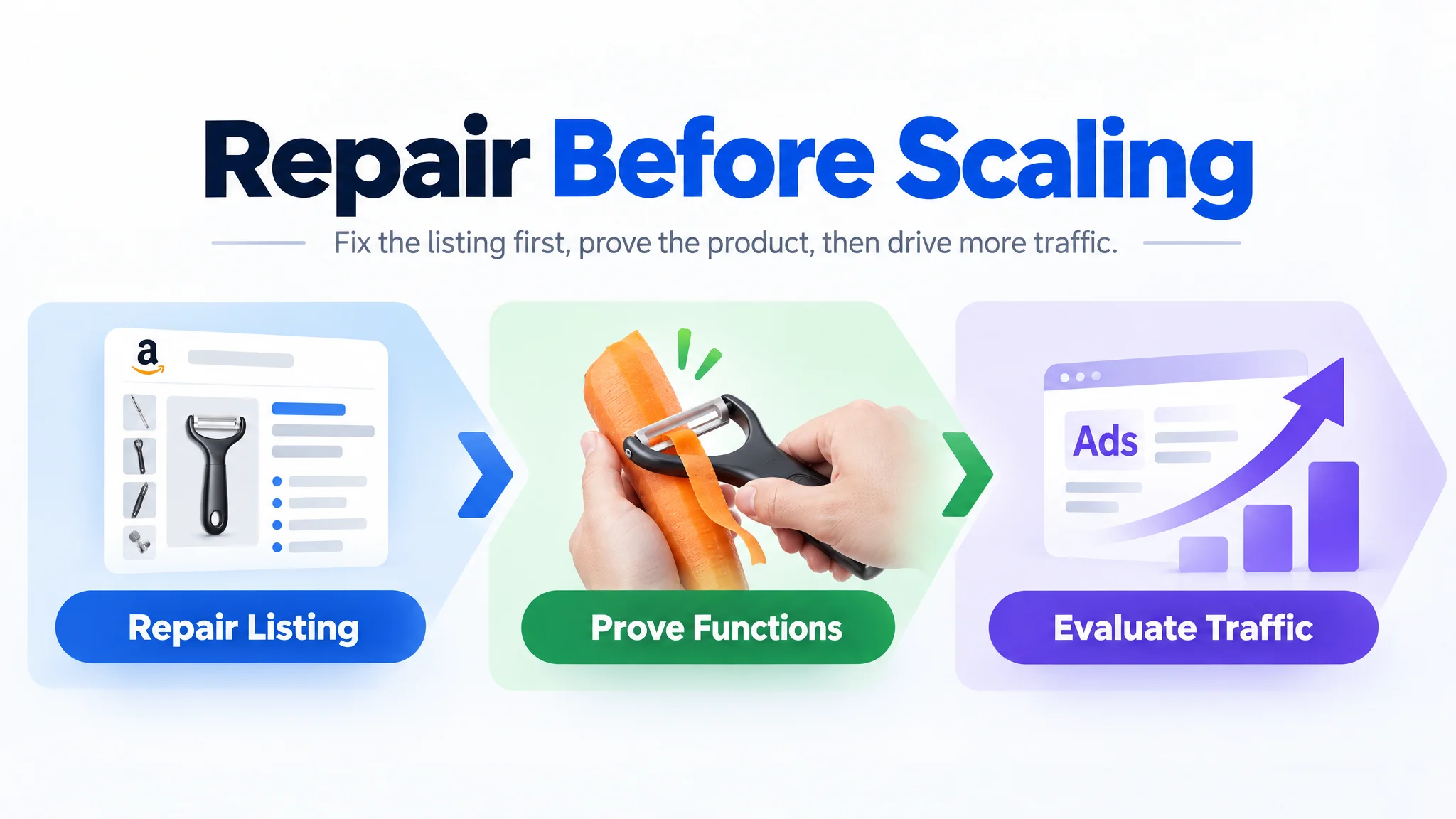
A useful repair sequence is to clarify the product identity first, prove the main functions visually, connect bullet points to everyday use, and then build A+ content around demonstrations, construction details, and the relationship between product components. In the kitchen-tools case, the greatest weakness was not a missing feature claim but the absence of a coherent path from seeing the set to trusting its usefulness.
4. Re-measure on a fixed cadence. Establish a weekly review for prompt outputs and a consistent comparison against the parent campaign. DeepBI can execute the budget and bid side of this cadence through daily parameter adjustments within the parent campaign’s bid, placement modifiers, and targeting, rather than through a parallel prompt budget. Its seven-day window can help damp short-term noise and keep decisions explainable and reviewable.
5. Apply guardrails before bulk disabling. If prompts remain unsuitable, document the decision and check Amazon’s current policy documentation. Disabling appears to carry no direct documented CPC penalty, but do not treat that as an absolute guarantee. Monitor spend, CTR, CVR, ACoS, and campaign delivery after any change before extending it across the account.
The order matters because advertising adjustments cannot substitute for a page that does not explain the product. In the kitchen-tools case, the recommended sequence was to rebuild the value hierarchy, strengthen the visual proof, clarify the title and bullet logic, improve the A+ trust sequence, and only then evaluate how paid and organic traffic responded. That approach avoids confusing traffic acquisition with conversion improvement.
Should You Opt Out Entirely?
Opting out is not automatically the safer growth decision, and remaining enrolled is not automatically the more efficient one. Base the choice on four operating conditions: prompt accuracy, review capacity, parent-campaign performance, and evidence of incremental business value.
Opting out is reasonable when:
- Prompt pairings repeatedly misrepresent the product’s materials, dimensions, functions, or included accessories.
- The category involves claims that are regulated or easy for an AI-generated prompt to overstate.
- The account lacks sufficient review capacity to verify prompts and resulting traffic before budget is exposed.
- Prompt-driven traffic produces weaker CVR or higher ACoS than the parent campaign baseline without a clear business offset.
Remaining enrolled is more defensible when prompts convert at or above the parent campaign baseline and the PDP provides strong coverage across the main image, title, bullets, A+ content, and other decision-making content. Strong PDP coverage gives the traffic a more reliable destination, but it does not eliminate the need for human review or policy checks.
The kitchen-tools listing demonstrates why the condition of the PDP should be part of this decision. The product had useful functions, but the page did not yet establish a convincing reason to click, a reason to trust, and a clear reason to buy. If prompt traffic had been judged only by clicks or surface-level relevance, the seller might have focused on acquiring more visits while leaving the conversion bottleneck untouched. The more defensible response was to repair the page’s communication structure before treating additional traffic as the solution.
Do not judge the decision from prompt clicks or CTR alone. Test the cannibalisation hypothesis using blended TACOS and total business performance. If AI-mediated traffic were purely cannibalising existing clicks, blended TACOS would rise as its share increased. Treat that as a falsifiable assumption rather than a conclusion: review trend data across a meaningful window, state the incrementality assumptions explicitly, and consider holdout tests or other measurement approaches where practical. A single week is insufficient to establish incremental sales.
Before opting in, remaining enrolled, or opting out, confirm Amazon’s current policy and document the decision point. Compare CTR, CVR, ACoS, TACOS, and total sales before and after the change. For accounts that remain enrolled, DeepBI can add an ad-side diagnostic and a gradual bid or budget reallocation layer based on historically converting traffic. Use it as a controlled decision-support layer while retaining human approval for product accuracy and regulated claims.
What's Coming Next
Transparency expectations for AI-assisted advertising are broadening across platforms and jurisdictions. TikTok and YouTube have introduced AI labelling measures, while additional US state laws continue to expand disclosure requirements. These developments do not establish one universal rule for every Amazon campaign, but they raise the operating standard for advertisers managing Sponsored Products and Sponsored Brands.
The European Union is also developing its framework through the EU AI Act, which entered into force on August 1, 2024. The Act is being implemented in stages across EU member states and, where applicable, the EEA, using a risk-based approach. Requirements should therefore be assessed by market, use case, and applicable obligations rather than treated as uniform across Europe.
The UK position is more cautious. The UK advertising regulator has stated that existing advertising rules are technology-neutral and that AI has not yet created unique Advertising Code issues. It has also remained open to changing its approach if future evidence supports doing so. Separately, the 2023 ISBA/IPA guiding principles on generative AI in advertising show that expectations are developing through industry initiatives as well as formal regulation.
For Amazon advertisers, the practical response is not to predict a confirmed regulatory roadmap. It is to establish durable habits now:
- Review AI-assisted copy, images, and recommendations before publication.
- Confirm that product claims, measurements, materials, functions, and visual details remain accurate.
- Apply or document labelling where the relevant platform or jurisdiction requires it.
- Keep a human confirmation step before changes reach a live listing or campaign.
- Monitor impressions, clicks, CTR, conversions, CVR, ACoS, and related business signals after launch.
These controls protect more than compliance. They help preserve product consistency and reduce the risk that an inaccurate AI output damages conversion or increases wasted spend. AI authorship alone does not determine ad impact. Relevance, audience value, product truth, and the resulting CTR and CVR remain the stronger tests. Labelling and human review should therefore be treated as routine operating disciplines, not one-off Amazon tasks.
The kitchen-tools listing offers a practical example of this standard. The optimisation direction stayed inside the product’s real boundaries: supported ingredients were demonstrated, each tool’s role was made clear, and competitor communication was used as a benchmark rather than copied. The aim was not to make the listing more impressive than the product. It was to make the actual product easier to understand and more credible.
Quick Answers on AI Usage Limits in SP Ads
The practical limits are straightforward: prompts share the parent campaign’s economics, opt-out decisions require verification and monitoring, and qualifying AI-generated assets must retain the required metadata through publication.
- Do Sponsored Products prompts have a separate bid? No. Prompts use the parent campaign’s bid, placement modifiers, and targeting. A prompt click therefore costs the same as a regular ad click within that campaign. Review prompt-level clicks, CVR, ACoS, and spend against the parent campaign baseline rather than treating prompts as a separate budget pool.
The campaign-level economics also mean that advertisers should inspect the destination listing. A page with unclear functions, weak result proof, or thin A+ content may absorb paid clicks without converting efficiently. In the kitchen-tools example, more traffic would not have resolved the uncertainty around the two-piece set or the product’s actual use cases. Advertising measurement and listing diagnosis must therefore be read together.
- Does opting out carry a documented penalty? No direct penalty appears in the available documentation, but that is not proof that every account or policy context will behave identically. Confirm Amazon’s current policy before making a bulk change, then monitor campaign spend, CTR, CVR, ACoS, and blended TACOS before and after the decision. Opting out is more defensible when prompt pairings repeatedly misrepresent the product, claims are easy to misstate, or the team lacks capacity for review.
- Do I have to retroactively tag every existing asset? Not as a universal requirement based on the available guidance. Qualifying new or re-uploaded assets must carry Amazon’s required metadata, while auditing existing content is recommended to identify exposure. Treat metadata as a production-lifecycle control: confirm that it remains attached after editing, compression, and publication. Disclosure also does not correct a fundamentally misleading product claim, and existing advertising rules apply regardless of whether content was AI-generated, edited, or targeted with AI assistance.
The broader operating lesson is that AI prompt management should not be reduced to a choice between opting in and opting out. The stronger question is whether the campaign, listing, creative assets, and review process can work together. Prompt traffic is only one part of that system. If the product page has a clear value hierarchy, proves its main functions, preserves product truth, and gives shoppers enough confidence to decide, campaign-level data becomes more useful. If those foundations are missing, additional traffic may only make the underlying conversion bottleneck more visible.