

Key Takeaways
- Amazon’s policy governs how AI-assisted and automated actions reach Amazon, not whether AI may be used at all. Automation is permitted only when it satisfies applicable Amazon requirements, permissions, and interface rules.
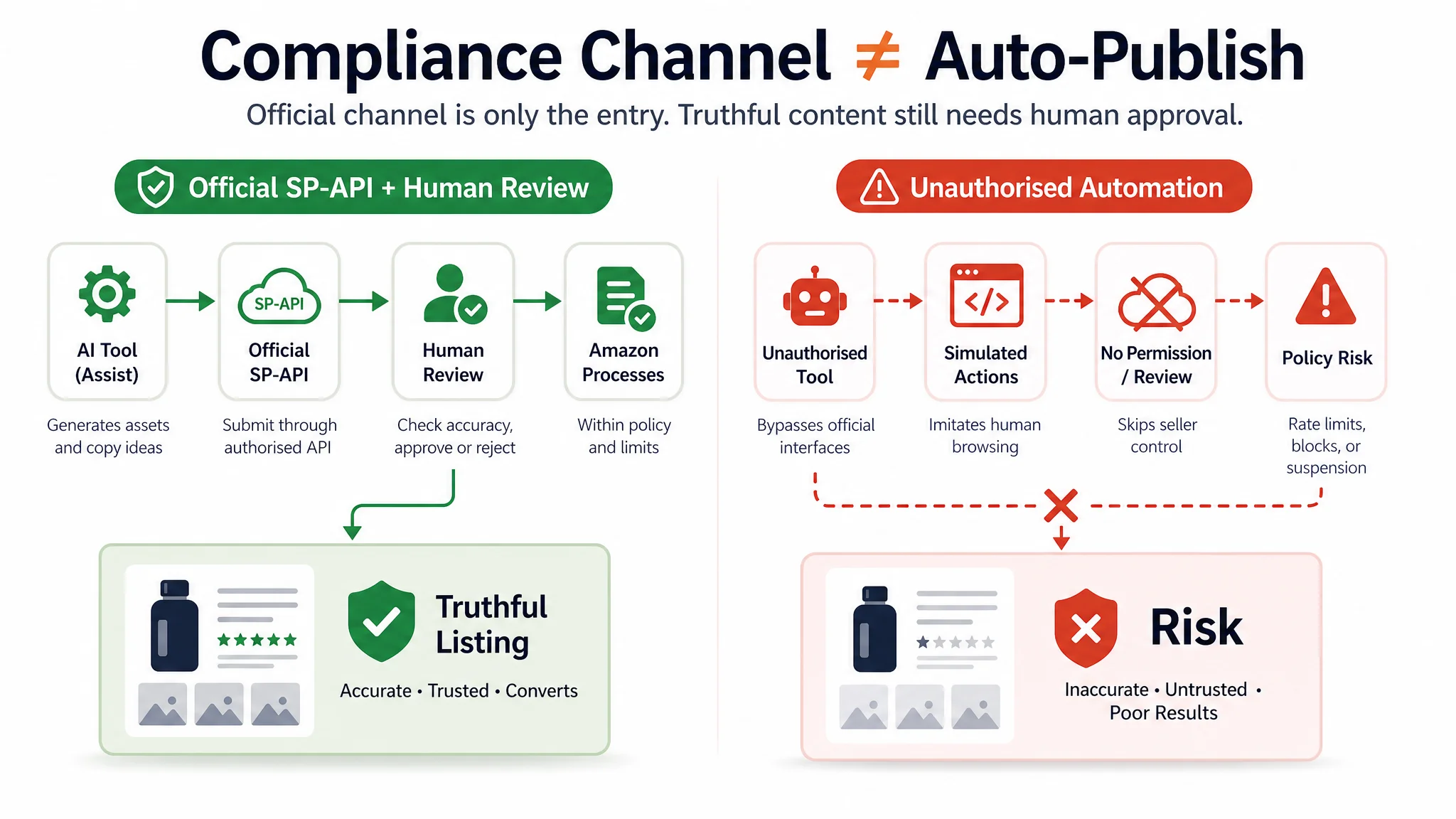
- The practical divide is between controlled automation through approved channels and unauthorised automation that bypasses Amazon’s interfaces, permissions, or required review. A workflow connected through the official SP-API is materially different from an unapproved tool that publishes directly without the seller’s control.
- Listing content and generated assets must remain faithful to the product. AI should not invent specifications, features, accessories, materials, colours, or product effects. Preserving product-entity consistency helps reduce image-product mismatch, customer dissatisfaction, refunds, and potential damage to CVR and BSR.
- High-impact listing changes require appropriate human authorisation. A recommendation or generated asset should not self-authorise publication; sellers should be able to review proposed changes, accept or reject individual assets, and confirm application before submission.
- Compliance also depends on documentation and traceability. Record the authorised workflow, review decisions, submission status, and Amazon processing feedback so that listing changes can be investigated and managed without relying on memory or informal manual steps.
- Conversion evidence should be part of the review process. A listing can be technically complete and still fail to convert if its images, bullets, reviews, and A+ content do not establish trust or explain the product clearly. A craft-paint listing benchmarked against a category-leading competitor demonstrated that a page with a Total Listing score of 46/100 and an A+ score of 0/25 could not be repaired through ad adjustments alone.
What Is Amazon's AI Agent Policy?
Amazon’s AI agent policy is best understood as a channel-and-behavior standard for sellers using automated tools. An agent that operates through an authorized Amazon interface—such as the Selling Partner API (SP-API), alongside other official Amazon APIs—can support controlled listing workflows. For example, a listing system may submit approved image assets through authorized permissions, preserve a user review step, and track Amazon’s processing status.
That is different from a script that imitates human browsing, uses headless-browser actions to evade detection, bypasses review controls, or sends requests beyond permitted limits. Unauthorized browser automation and rate-limit abuse are common compliance triggers. The practical risk model has three levels:
- Routine automation: Updating an approved image asset through an authorized API rather than uploading it manually.
- Material automation: Replacing multiple listing assets or changing core copy across products, where errors could affect CTR, CVR, ACoS, BSR, or listing cycle time.
- High-impact automation: Publishing broad changes without human review, or using simulated browsing to bypass Amazon’s controls.
The key question is not whether AI is involved. It is whether the tool uses an official channel, respects authorization and review boundaries, and keeps activity within Amazon’s permitted operating limits.
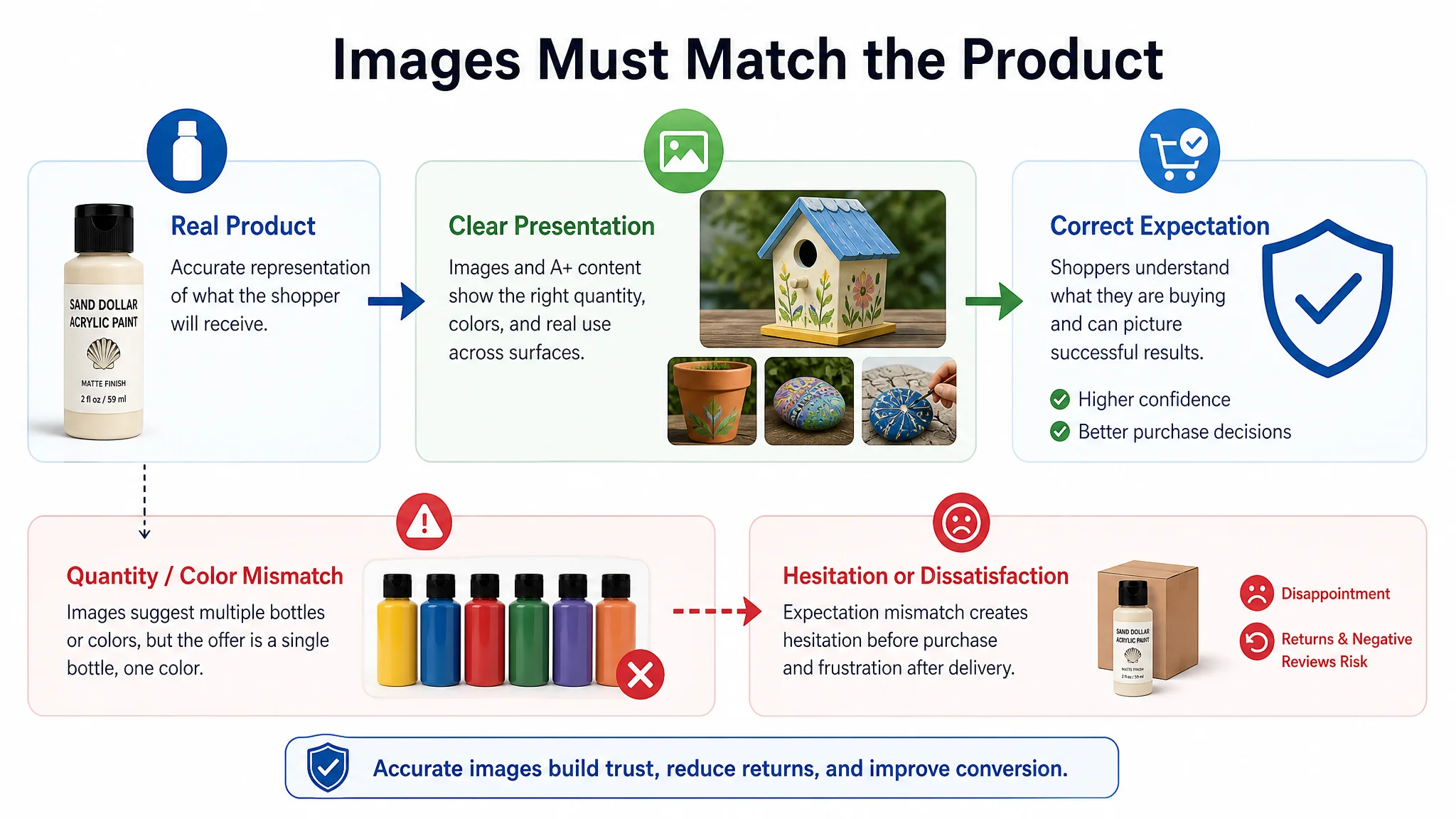
The same principle applies to the quality of the output being submitted. A technically authorized workflow does not make an inaccurate image or unsupported product claim acceptable. In one Amazon craft-paint listing review, the seller initially assumed that weaker sales were mainly caused by keywords, title structure, and advertising. Benchmarking revealed a different issue: the page had a 0/25 A+ score, very limited review proof, and a secondary image that made a single 2 oz bottle look like a multi-colour, multi-bottle offer. The problem was not merely how the content reached Amazon. The content itself was failing to represent the product and persuade the buyer accurately.
That distinction matters for AI governance. A compliant channel can deliver a proposal safely, but human review still needs to determine whether the proposal is truthful, useful, and appropriate for the affected listing.
Inventory and Listing Automation Boundaries
Listing Automation Thresholds
Automation risk is shaped not only by what a tool changes, but also by how many listings it affects, how substantial the change is, and what downstream actions it can trigger. Creating or applying updates across hundreds of SKUs requires more structured review than a single, user-selected image replacement. A broad rollout can influence listing cycle time, CTR, CVR, ACoS, and BSR, while also multiplying the cost of an incorrect claim or noncompliant asset.
A routine refresh—such as replacing one approved image after an old-versus-new comparison—has a narrower impact. Large price changes, major content rewrites, or edits that alter customer-facing claims deserve a higher review standard. Do not assume a universal numeric threshold; where Amazon policy publishes a threshold, confirm the current value in Seller Central before relying on it.
Inventory-driven automation requires the same caution. An inventory event may cascade into availability, price, or listing-content changes, turning a simple update into a broader workflow. A tool limited to authorized image-asset operations is materially different from one that can act on price, inventory, and order data.
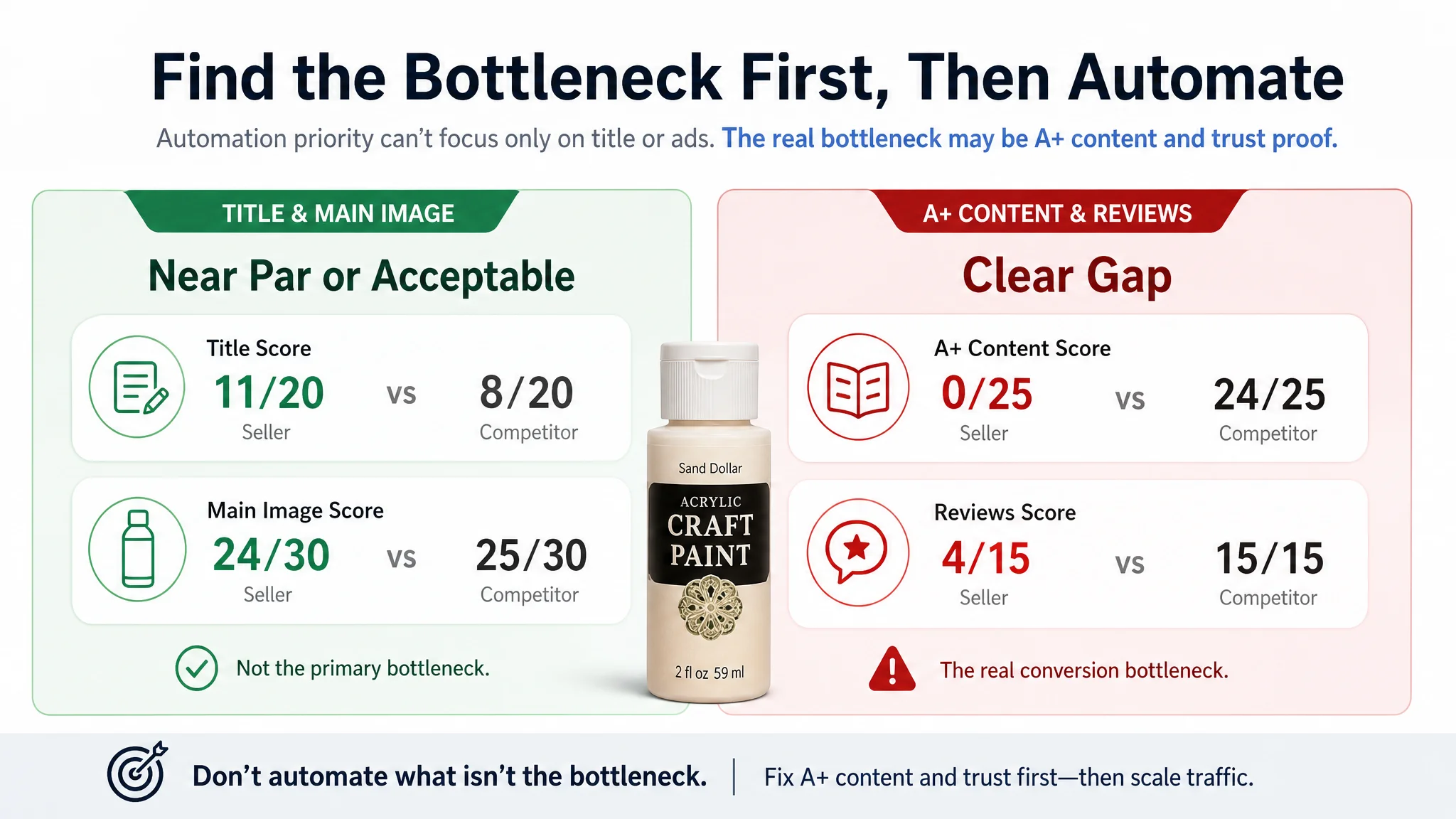
The scope of the change should also be assessed against the listing’s existing weaknesses. In the craft-paint example, changing a title or adding keywords would have been a relatively narrow content action, but it would not have addressed the main conversion constraints. The title actually scored 11/20 against the competitor’s 8/20, while the main-image scores were close at 24/30 versus 25/30. The largest gaps were in A+ or detail-page content, where the seller scored 0/25 against the competitor’s 24/25, and in reviews, where the seller scored 4/15 against 15/15.
This does not mean title or image changes were unnecessary. It means the scope and priority of automation should be based on evidence rather than on the most visible metric. A system that automatically rewrites titles because advertising performance is weak may make many changes without touching the actual bottleneck. A controlled workflow would first identify whether the listing needs better traffic, better product representation, stronger trust signals, or a more complete decision path.
Permitted pattern: verified product attributes, selected listing changes, compliance checks, and user confirmation before application.
Prohibited or higher-risk pattern: invented specifications, unsupported claims, unreviewed bulk creation, or automatic cross-system changes with broad customer impact.
Which side does my tool sit on?
A practical assessment should ask:
- Does the tool use an official Amazon interface?
- Can the seller see the exact affected ASINs, assets, fields, and claims?
- Can the seller reject individual recommendations?
- Does the workflow distinguish a routine update from a material or high-impact change?
- Does it check product truth before publication?
- Can the seller reconstruct what was approved and what Amazon processed?
- Does the workflow evaluate whether the change solves the actual listing problem, rather than simply producing more activity?
AI Agent Compliance Requirements
Compliance should be designed into the automation architecture, not added as a policy wrapper after deployment. The operating model should connect identity, approved access, authorization, review, and traceable execution so that listing changes can be checked without reconstructing events from scattered logs.
This architecture should also preserve the distinction between content generation and commercial diagnosis. An AI system may generate a revised title, image, bullet point, or A+ module, but it should not assume that the requested asset addresses the real business constraint. In the craft-paint listing, the team initially treated rising advertising costs and weak sales as a keyword and traffic-quality problem. A benchmark review showed that the page lacked a complete sales and trust story. More traffic would have sent shoppers to a page with no A+ content, limited review proof, and confusing product imagery.
The workflow therefore needs two types of control:
1. Compliance control: Is the proposed action authorized, accurate, and submitted through an approved channel?
2. Business control: Does the proposed action address the listing’s actual conversion or customer-understanding problem?
Both controls should be documented before a high-impact change is applied.
SP-API Registration and Approved Official Channels
- Use Amazon’s official authenticated SP-API channel rather than manual backend logins or informal access methods, reducing account-linkage and access-control risk.
- Record the registration or application identity associated with each integration, and assign an accountable business owner for the connected seller account.
- Verify current Amazon policy for registration details, identity requirements, and any record-retention obligations before deployment; do not treat unverified internal assumptions as fixed requirements.
- Apply least-privilege scopes: request only the permissions required for the intended workflow, and require explicit authorization before accessing sensitive areas such as price, inventory, or order data.
- Maintain traceable execution records, including the authorized user, selected action, request identifier, result, and any Amazon processing or rejection status.
- Convert these controls into a pre-launch checklist covering official access, identity ownership, scope review, authorization confirmation, and post-action monitoring.
Human Authorization Checkpoints
- Require documented human approval before high-impact actions, including large bulk listing creation, substantial price changes, and account-level configuration changes.
- Present the proposed change and its affected scope before application, allowing the authorized user to approve, reject, or narrow the action.
- Require item-level or batch-level selection where practical, rather than applying every generated recommendation by default.
- Separate content generation from content publication so a draft can be reviewed for policy risk, listing accuracy, CTR, CVR, and potential ACoS impact before release.
- Record who approved the action, what was approved, when it was submitted, and whether Amazon accepted, processed, or rejected it.
- Review the checklist periodically as permissions, workflows, and Amazon policy requirements change.
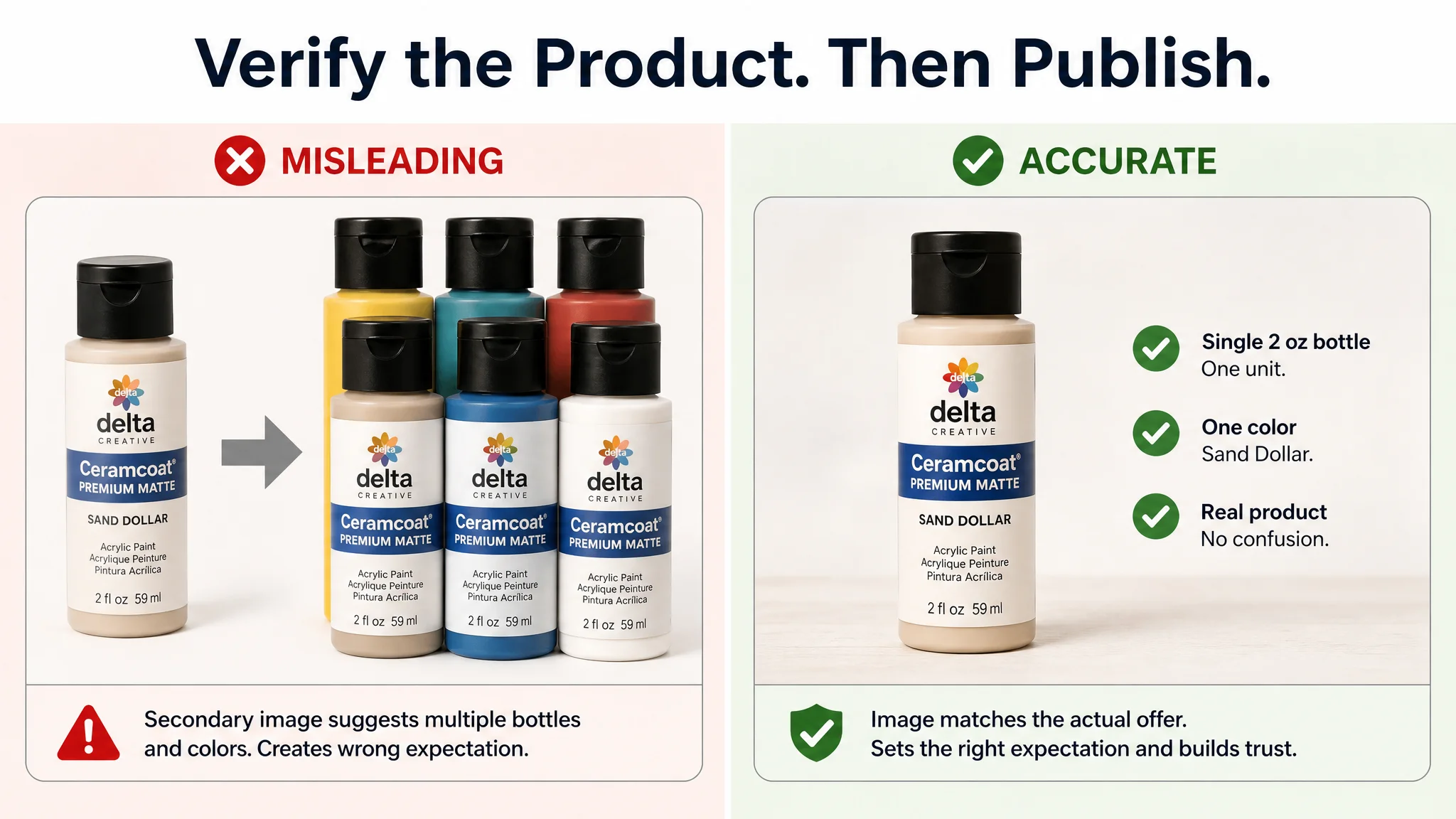
A useful approval checkpoint should show more than a generated replacement. It should show why the replacement is being proposed and what risk it may introduce. For example, the craft-paint review identified that one secondary image displayed six bottles in multiple colours even though the offer was for one 2 oz Sand Dollar bottle. An approver should be able to see the original asset, the proposed replacement, the actual product information, and the affected image slot before confirming the change. That is more reliable than approving a general instruction to “improve the images.”
The same principle applies to A+ content and bullet points. The proposed content should be checked against confirmed product facts and the intended decision path. In the paint listing, the recommendations focused on showing multi-surface use, clarifying finish and cleanup, and creating a coherent buying sequence. Those changes were useful because they reorganised existing product truths rather than introducing unsupported features or claims.
Action Audit Log
Automation is not operationally compliant if a seller cannot reconstruct what happened, who authorized it, and which listing state resulted. An investigation-ready audit log should be designed before deployment, not assembled after an incident.
At minimum, each record should include:
- Timestamp
- Action type
- Input and output
- Human or system actor
- Approval reference
- Unique task or request identifier
- Resulting Amazon processing status
A practical artefact-level accountability map looks like this:
- Source listing, user instruction, and selected scope: Accountable actor or system: Seller or approving user
- Product_DNA.json and Score_Report.json: Accountable actor or system: Scoring Agent
- Optimization_Plan.json: Accountable actor or system: Optimization Agent
- Evaluation_Report.json: Accountable actor or system: Evaluation Agent
- Original-versus-replacement comparison and approval: Accountable actor or system: Approving user
- API submission and request identifier: Accountable actor or system: Delivery Agent
- Processing, successful, or blocked status: Accountable actor or system: Amazon SP-API and platform record
- Post-publication visual iteration event: Accountable actor or system: Reporting workflow
For example, linking the approval record to the exact image, ASIN, account, and API request prevents a general “approved” status from being mistaken for authorization of every change. A successful publication can also be marked as a visual iteration event, allowing later review of CTR movement after the update.
The audit record should preserve the reasoning context as well as the submission mechanics. If an image was changed because it misrepresented quantity, that rationale should be recorded. If A+ content was proposed because the listing had no visual proof of multi-surface use, that should also be traceable. This helps distinguish a compliance correction from an arbitrary creative change.
In the craft-paint listing, the relevant evidence would include the original single-bottle offer, the misleading multi-bottle image, the proposed corrected asset, the review decision, and the resulting Amazon status. It would also be useful to preserve the benchmark findings showing that A+ content and reviews were larger gaps than the title or main-image score. Without this context, a later reviewer might see only that an image changed, not why the change was necessary or which conversion risk it was intended to address.
Store these records in tamper-evident storage, with controlled access and traceable changes. Retention should follow applicable Amazon and Seller Central requirements; verify the current documentation rather than relying on a fixed period.
Rate Limit Compliance
Rate-limit compliance is not only a technical performance concern. In Amazon’s Selling Partner API (SP-API), request pacing and burst behavior create observable automation patterns. A steady, controlled schedule appears different from concentrated bursts, sustained high concurrency, or repeated retries against the same endpoint.
Exceeding documented limits, sending duplicate operations, or immediately hammering an endpoint after a failure can resemble unauthorized automation even when the underlying listing task is legitimate. Enforcement exposure can therefore rise from the pattern of requests, not only from the seller’s intent. It may also interrupt listing workflows, extend listing cycle time, and delay actions that support CTR, CVR, ACoS, or BSR performance.
Pacing also protects the quality of the review process. If an agent generates and submits many title, image, or A+ changes in rapid succession, the seller may lose the ability to evaluate which change produced a result or introduced a problem. This is especially important when a listing has several connected weaknesses. Sending more traffic or more content changes into a weak page can increase noise without improving the underlying customer experience.
Practical controls should be built into the workflow:
- Centralize request scheduling instead of allowing separate jobs to compete for the same endpoint.
- Limit concurrent listing or asset-synchronization jobs.
- Apply bounded retries with delayed backoff after failures or throttling responses.
- Use unique request identifiers where supported to prevent duplicate submissions during network instability.
- Verify current Amazon documentation before setting any quota, burst, or request-rate policy.
- Sequence material listing changes so that the seller can review the effect of one controlled update before applying another broad change.
Pacing produces cleaner operational signals; cleaner signals reduce unnecessary compliance exposure while keeping authorized automation predictable and controlled.
Listing AI Content Compliance: Copy, Images, and Disclosure
AI-generated listing copy is not inherently banned, but using AI does not transfer responsibility away from the seller. Copy must be accurate, supported by confirmed product information, and free from misleading claims. A human seller, brand operator, or listing manager remains accountable for reviewing and approving the final content before publication.
Reviewers should check for invented features, unsupported specifications, exaggerated performance, and promotional language that the product cannot substantiate. A fast generation workflow that shortens listing cycle time has little value if inaccurate copy reduces CVR, increases returns, or creates compliance exposure.
Accuracy should be assessed in relation to the complete customer decision, not only individual sentences. A bullet point may be factually correct but still fail to answer the buyer’s question if the ordering and context are poor. In the craft-paint listing, the seller’s bullets contained useful information, but the competitor presented its use cases, finish, durability, and trust elements in a more persuasive sequence. The seller’s content read more like a parameter list, while the competitor created a clearer path from application to reassurance.
A compliant AI workflow should therefore ask:
- Is the statement supported by approved product information?
- Does it accurately describe the specific variant being sold?
- Does the image or copy create an expectation the product cannot meet?
- Does the content answer a relevant customer concern without overstating performance?
- Is the proposed content being used to solve a real information gap, or merely to add more words?
AI-Generated Images and the Main-Image Rules
AI-generated images require the same practical test as any other listing asset: do they represent the product truthfully and comply with the applicable Amazon rules? An image must not change the product’s material, color, structure, proportions, logo, or functional details. It must not add accessories that are not included, hide relevant defects, alter scale, or show effects the product cannot deliver.
The risk is not limited to obvious synthetic defects. A polished image can still be misleading if it changes the number of products, colours, sizes, included components, or expected use. In the craft-paint listing, the product was one 2 oz Sand Dollar bottle, but a secondary image showed six bottles in multiple colours. Even if the image appeared visually attractive, it could make shoppers believe they were purchasing a multi-pack or multi-colour set.
That mismatch creates two forms of risk:
- Before purchase: shoppers may hesitate because the offer is unclear or may click with the wrong expectation.
- After purchase: buyers may feel that the delivered product does not match what the listing showed, increasing dissatisfaction and review risk.
The appropriate correction was not simply to make the image more attractive. It was to show the single Sand Dollar bottle and, where relevant, the legitimate packaging variations for that one colour. This illustrates why human review must compare generated assets with the actual offer rather than judging only visual quality.
Main images generally face stricter requirements for presentation, background, product visibility, technical specifications, and placement. Additional or lifestyle images may provide more room for context and creative composition, but they cannot misrepresent the product or violate intellectual-property, content, or category rules. Category-specific image requirements control when they differ from general standards. Because Amazon guidance and interpretations can change, verify whether an AI-generated asset is acceptable as a main image in the relevant Seller Central and category guidance before upload.
The image set should also prove claims made elsewhere in the listing. The craft-paint competitor used images showing projects on wood, birdhouses, rocks, and other surfaces, while the seller relied more heavily on generic canvas scenes. If a listing claims multi-surface use, the visual assets should provide clear, truthful evidence of that use. If it claims a particular finish, the images should help buyers understand the finished result without implying performance the product cannot deliver.
Disclosure and Metadata Tagging
Do not assume that every AI-assisted listing requires a universal disclosure, keyword, or metadata tag. Disclosure obligations should be based only on requirements Amazon has confirmed for the relevant content type and marketplace. Check Seller Central for the current wording, required field, keyword scope, and marketplace applicability before adding or omitting metadata.
Regardless of disclosure status, human approval remains necessary. The accountable party should retain a review step that checks copy, images, intellectual-property concerns, category restrictions, and product consistency. AI use may be acceptable under the applicable rules; inaccurate or deceptive output is not.
AI Content Compliance Risk Checklist and Human-Review Workflow
AI output can accelerate listing production, but compliance depends on controlled decisions, documented checks, and a recoverable publication process. Treat each asset as a proposed change, not as publish-ready content.
A strong review should examine both policy exposure and conversion capacity. If a listing has a confusing product image, no meaningful A+ content, and limited review proof, adding more advertising or automatically producing more keyword-rich copy may increase activity without resolving the customer’s uncertainty. The craft-paint listing made this visible: the team initially focused on title and advertising, but the larger gap was the page’s inability to establish trust and explain how the product would be used.
Risk Checklist: Listing Copy, Images, and Ads Creative
- Check AI-generated titles, bullet points, descriptions, and A+ content against confirmed product facts; remove invented functions, specifications, materials, accessories, or usage effects.
- Verify that copy supports the intended product identity and does not introduce claims that could reduce CVR, trigger customer dissatisfaction, or create refund risk.
- Compare AI-generated main and secondary images with the physical product; confirm structure, proportions, openings, logo placement, brand colors, and included components remain accurate.
- Confirm that the number of products, colours, sizes, variants, and included accessories shown in an image match the actual offer.
- Validate image files against Amazon format requirements, white-background rules where applicable, color mode, and minimum pixel dimensions before upload.
- Review AI-generated video for product identity, factual demonstrations, visible features, and any claim that could misrepresent expected use.
- Review advertising descriptions and creative for the same factual accuracy and disclosure expectations as listing content, then route them through the same human review queue.
- Do not use competitor assets or third-party material as copied content; limit research to Amazon-approved analytics or a small manual sample of lawful, rights-cleared information.
- Compare the proposed listing with relevant competitors for information depth and customer reassurance, without copying their content or claims.
- Check whether the listing’s main weakness is traffic quality, product representation, content structure, review proof, or post-click trust before prioritising an automated change.
- For scalable execution, use DeepBI as a workflow example: proposed assets remain selectable and reviewable behind user confirmation rather than being applied automatically.
- Record the asset version, reviewer, decision, supporting checks, and intended ASIN before publication.
The review of the craft-paint listing shows why these checks need to work together. The title was not the main bottleneck, and the main-image score was close to the benchmark. However, the secondary image created an expectation mismatch, the bullets did not form a strong buying sequence, the page had no A+ story, and the review base was too limited to provide strong proof. A tool that checked only keyword density or image aesthetics would have missed the most important risks.
Human-Review Workflow
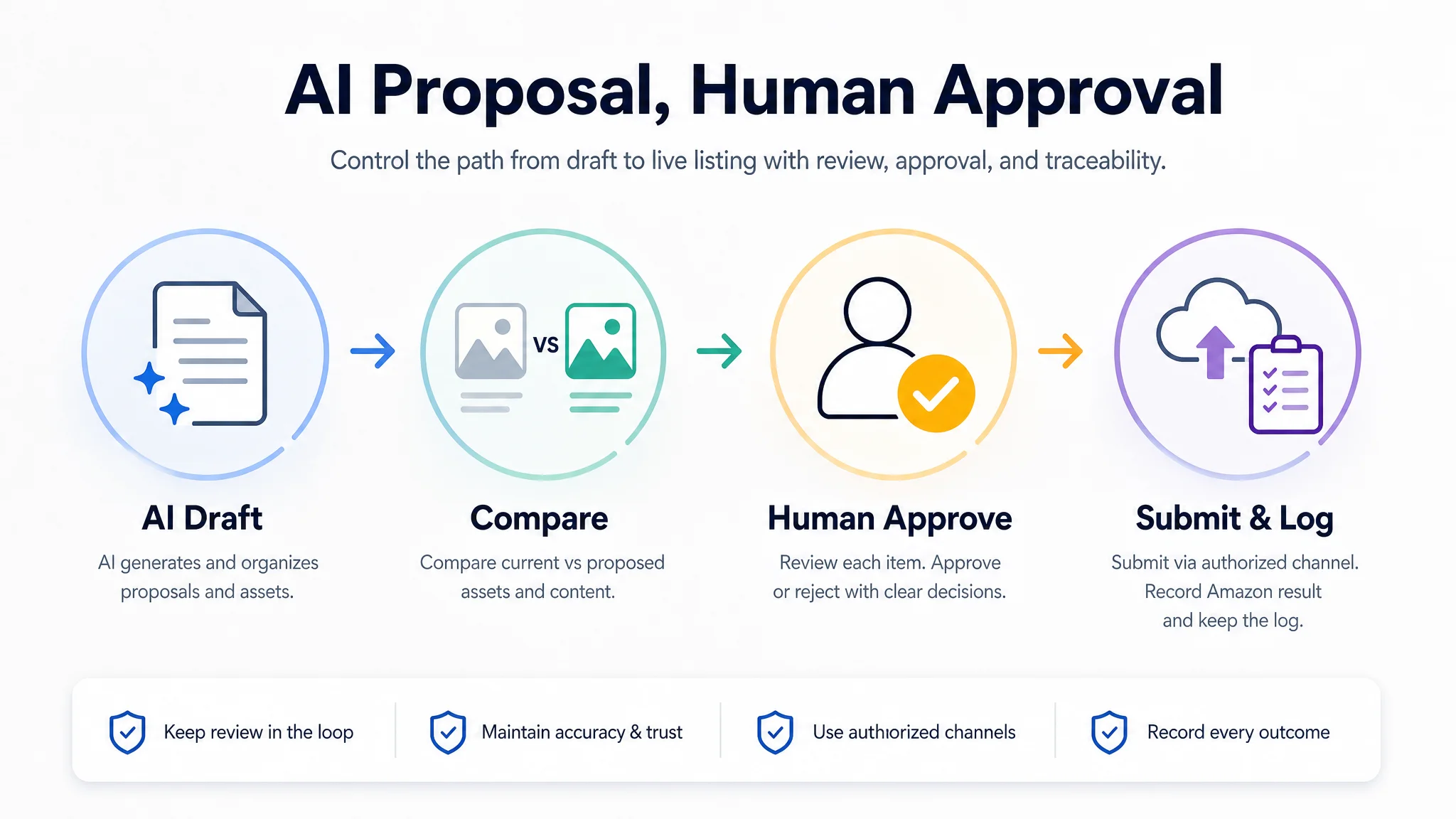
- Separate drafting from approval: let AI generate or organize proposals, while a listing owner or designated approver makes the publication decision.
- Assign senior approval to high-impact changes, including product identity, major claims, main images, videos, brand elements, and advertising creative.
- Present the current asset beside the proposed replacement and require explicit approval for each selected change.
- Confirm that human reviewers have checked factual claims, image accuracy, required disclosures, and alignment with the approved product information.
- Review whether the content provides a coherent customer decision path, including use case, product benefit, reassurance, and variant clarity.
- Store traceable evidence, such as the proposal, review decision, validation results, reviewer identity, timestamp, and report or task ID.
- Apply only approved assets, then monitor relevant CTR, CVR, ACoS, BSR, or listing cycle-time signals where applicable.
- Define a rollback path before release: retain the previous effective asset, document how to restore it, and verify that the restoration process works.
- If performance or compliance concerns emerge, pause further changes, restore the approved prior version, and record the reason and outcome.
The approval step should not be reduced to a single “publish all” button. In the craft-paint example, the proposed work involved several different decisions:
- Correcting an image that confused the quantity and colour of the product.
- Repositioning images to demonstrate multi-surface use.
- Rewriting bullets so that finish, application, cleanup, and brand reassurance followed a clearer sequence.
- Building A+ content around trust, project quality, usage context, and variant clarity.
These changes carry different levels of risk and should be reviewed separately. A seller may approve a corrected product image while requesting revisions to a proposed claim or A+ module. Granular approval helps preserve accountability and prevents a generally acceptable recommendation from authorising every associated change.
Where a Compliance-Assist Tool Fits
A compliance-assist tool should improve reviewability, not replace the seller’s judgment. For listing content, the practical control is to centralize proposed changes, preserve the original and revised versions, maintain a usable change history, and route high-impact edits for human approval. These controls create an audit trail showing what changed, why it changed, who approved it, and what was submitted through Amazon’s workflow.
The tool should also help distinguish between a traffic problem and a listing-conversion problem. In the craft-paint review, the initial assumption was that weak sales and rising advertising costs required better keywords and more aggressive advertising. DeepBI’s benchmark showed that the listing’s Total Listing score was 46/100 against a competitor’s 80/100, with the largest gap in A+ content and reviews. That diagnosis changed the order of operations: the page needed to rebuild its conversion capacity before the seller scaled traffic again.
DeepBI can be positioned briefly as an Amazon-only workflow aid rather than an independent compliance authority. Its workflow uses Amazon’s SP-API, generates a unique report_id for scoring tasks, presents original and proposed images for user confirmation, and records Amazon processing outcomes such as successful processing, pending status, or rejection. Those features can support evidence collection and review, but they do not establish complete listing-content audit coverage or guarantee compliance.
A compliance-assist tool can help surface issues such as:
- A product image that does not match the actual quantity or variant.
- A missing A+ layer in a category where visual explanation is important.
- Bullet points that contain information but fail to create a clear buying logic.
- A competitor gap that is concentrated in trust and product education rather than title keywords.
- A proposed change that may improve presentation but introduces an unsupported claim.
- A set of changes that should be sequenced rather than applied simultaneously.
The seller remains accountable for the final title, bullets, images, and other listing decisions. Automation may organize evidence and reduce listing cycle time, but it cannot transfer responsibility to the tool or to Amazon. Human approval should remain part of the control design whenever an edit could materially affect compliance, CTR, CVR, ACoS, or BSR.
Frequently Asked Questions
Does Amazon ban AI-generated listing images?
Not necessarily. AI-generated images should be used only when the product’s structure, proportions, materials, branding, features, and functionality remain accurate, while elements such as lighting, background, composition, or setting are enhanced. Verify the current official Amazon guidance before publication, because internal documentation cannot establish Amazon’s present policy.
An image can be visually polished and still create a compliance or conversion problem if it changes the perceived offer. For example, showing multiple bottles when the listing sells one bottle may cause shoppers to expect a different quantity or colour assortment. The review standard is therefore product truth, not merely image quality.
Does AI-written listing copy still require human review?
Yes, unless current Amazon guidance and your compliance process explicitly permit a different workflow. A human should verify every claim, specification, material, function, dimension, and performance statement against reliable product information before applying the content.
Human review should also assess the order and purpose of the copy. In the craft-paint listing, the seller had relevant information in its bullets, but the content did not guide the buyer as effectively as the competitor’s sequence. Reorganising confirmed facts can improve clarity, but the final structure still requires an accountable reviewer.
What makes a listing change high-impact?
A change is high-impact when it can materially alter customer understanding, eligibility, or conversion expectations. Treat updates to the main image, product identity, physical attributes, specifications, functionality, safety claims, title, or core bullet-point promises as high-impact, and require enhanced review against current requirements.
Changes to secondary images and A+ content can also be high-impact when they alter how buyers understand quantity, variant, usage, compatibility, finish, or expected results. A secondary image that makes one product look like a multi-pack may create a material expectation mismatch even if the product title remains unchanged.
What records should sellers keep?
Keep the original asset, generated version, prompt or structured instruction, source product information, review decision, validation result, application time, affected ASIN or image slot, and any Amazon processing or rejection status. Amazon may set different evidence requirements, so confirm the appropriate retention practice in current official guidance.
Where a change addresses a diagnosed business problem, retain the relevant rationale as well. This may include a benchmark comparison, the identified content gap, the product fact used for validation, and the reason for accepting or rejecting the proposal. Such records help show that the change was controlled rather than automatically applied.
What should I do if an existing tool appears non-compliant?
Pause publication and further automated changes, preserve the affected outputs and audit trail, and compare the tool’s behavior with current official Amazon guidance. Correct or remove unsupported content, require human approval, and resume use only after the workflow and evidence controls have been verified.
If the issue involves misleading product representation, review the full listing rather than correcting only the immediately visible asset. In the craft-paint example, correcting the confusing image was necessary, but the broader conversion issue also involved missing A+ content, limited trust proof, and weak visual evidence of multi-surface use.
Conclusion and Next Steps
What should you inventory first?
List every automated or AI-assisted action in your Amazon workflow, including diagnosis, content drafting, image generation, approval, and delivery. Map each action to a risk tier: routine refreshes, material listing or price changes, and high-impact actions such as large bulk listing creation or account-level configuration changes. The policy governs how automation reaches Amazon, not whether AI may be used at all; the practical boundary is compliant official-channel automation versus unauthorised automation.
The inventory should include the business purpose of each action. Ask whether the workflow is intended to improve traffic, product understanding, trust, conversion, or operational speed. In the craft-paint listing, the seller initially used advertising and keyword changes to address weak sales, but the diagnosis showed that the page lacked the content depth and trust signals needed to convert visitors. Mapping the workflow to the actual constraint would have changed the priority of the work.
Where is human authorisation required?
Add a documented approval checkpoint before any high-impact action reaches Amazon. The approver should compare the original and proposed content, confirm product truth, and explicitly approve the selected changes. No AI-drafted copy, image, or other listing change should publish without human review where the change could affect accuracy, customer expectations, CTR, CVR, or account risk.
Approval should be granular enough to distinguish between correcting a misleading product image, rewriting a bullet sequence, adding an A+ module, and changing a core product claim. The more directly a change affects product identity or customer expectations, the stronger the review should be.
What evidence and pacing controls should be enabled?
Use retention-ready, reviewable logs that record the timestamp, action type, input, output, actor, and approval reference. Store records in a tamper-evident manner and verify the current retention requirement in the latest official Seller Central documentation. Align request pacing and backoff behaviour with Amazon's documented limits; avoid bursts that could resemble unauthorised automation, even when the business intent is legitimate.
The evidence should connect the operational action with the listing diagnosis. If the purpose of a change was to correct a quantity mismatch, preserve the relevant image comparison. If the purpose was to build visual proof of multi-surface use, retain the approved product information and the reasoning behind the image or A+ proposal. This makes later performance and compliance reviews more meaningful.
What should you verify before the next bulk change?
Re-check Amazon's current policy, official API documentation, image requirements, and any applicable disclosure scope before execution. Listing AI content compliance is an accuracy-and-accountability problem before it is a technology problem: tools can structure decisions and preserve evidence, but responsibility for authorised, truthful content remains with the seller.
Before scaling a bulk change, also confirm that the listing is ready to receive more traffic. A page with confusing imagery, limited trust proof, and no meaningful A+ story may not benefit from more aggressive advertising or automated content volume. The craft-paint review showed that the central issue was not simply that ads failed to bring visitors. The page itself could not yet convert those visitors with sufficient confidence.
The right sequence is therefore:
1. Confirm the official channel and required permissions.
2. Identify the listing’s actual commercial and compliance constraints.
3. Validate product facts and customer-facing claims.
4. Generate proposed assets or copy.
5. Compare the current and proposed versions.
6. Obtain explicit human approval.
7. Submit through the authorised workflow with controlled pacing.
8. Record Amazon’s processing result.
9. Monitor CTR, CVR, ACoS, BSR, customer feedback, and listing integrity.
10. Retain a rollback path for any change that creates unexpected risk.
AI can make listing work faster, but speed is not the same as control. The most reliable workflow is one that uses automation to organise evidence, surface gaps, and prepare options while keeping the seller responsible for the truthfulness, approval, and commercial consequences of every published change.