

Why External Traffic Outperforms Internal PPC in 2026
Internal PPC remains essential, but it has a structural ceiling. Sellers compete for the same high-intent search demand, while rising CPCs make each additional click harder to justify. Once the most valuable queries are saturated, increasing spend may raise traffic without improving the economics of the next sale. The relevant controls are CTR, CVR, ACoS, and the resulting effect on BSR—not impressions alone.
External traffic expands the acquisition surface beyond Amazon’s search auction. When those visitors convert, they contribute sales velocity and conversion activity alongside PPC-generated orders. Amazon does not need to assign special organic weight to paid sales for this combination to matter: stronger total sales and more efficient conversion can support marketplace performance, provided the traffic is relevant and the listing converts it.
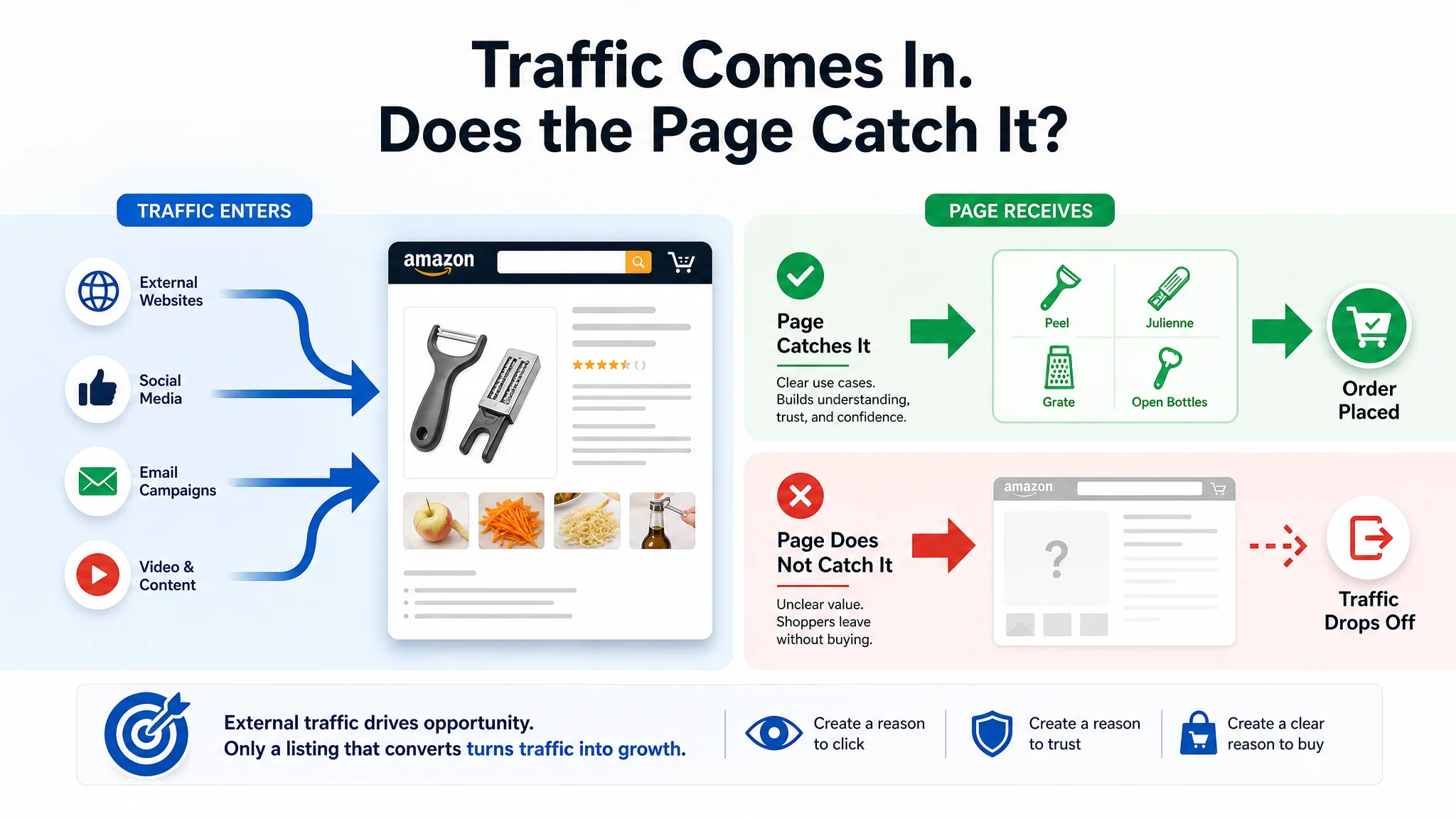
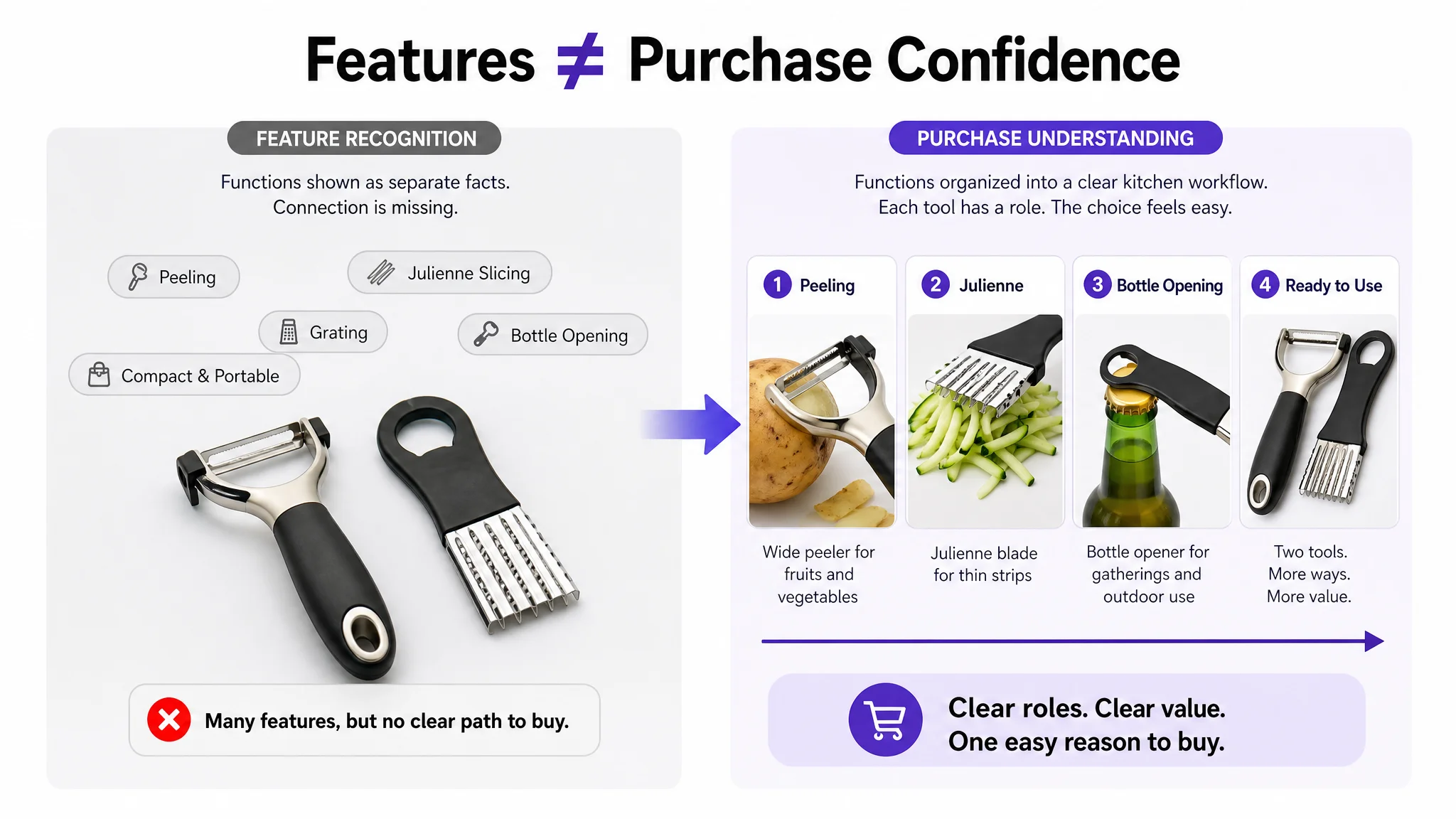
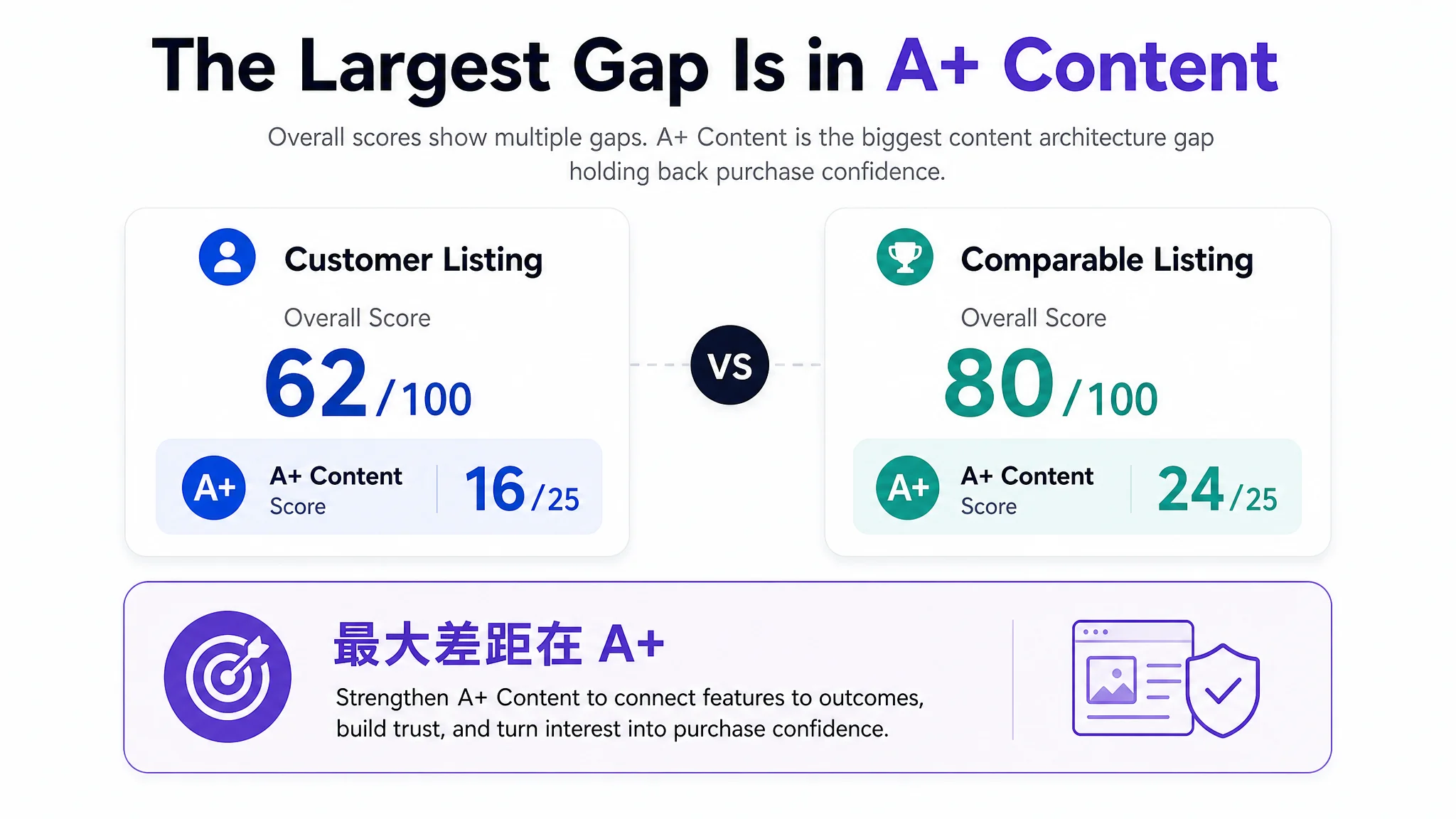
That final condition is where many external traffic strategies become overstated. A listing may have useful product features and still fail to turn qualified visitors into orders. In one kitchen-tools listing, the product offered peeling, julienne slicing, grating, and bottle opening, yet its competitive score was only 62 out of 100 compared with 80 for a comparable listing. The initial instinct was to explain the functions more clearly and add more product information. A deeper diagnosis found that the page did not lack features; it lacked a clear buying story. External traffic could have increased visits, but the page was not yet prepared to convert those visits into useful demand.
The operating objective is therefore not simply to acquire more external sessions. It is to acquire relevant sessions that reach a page capable of creating a reason to click, a reason to trust, and a clear reason to buy.
The Data Behind the Claim
The economics are straightforward. A hypothetical campaign with a $0.80 CPC and a 10% CVR produces an illustrative cost per sale of $8 ($0.80 ÷ 10%). At a $1.20 CPC and an 8% CVR, that cost rises to $15. These figures are examples, not universal benchmarks; actual results depend on margin, query mix, placement, and listing quality.
External traffic is valuable only when it produces qualified sessions that convert. High-volume visits that bounce or fail to purchase do not provide the same ranking benefit and may weaken the conversion signal associated with that traffic. The operating objective is therefore incremental converting demand, not external traffic volume.
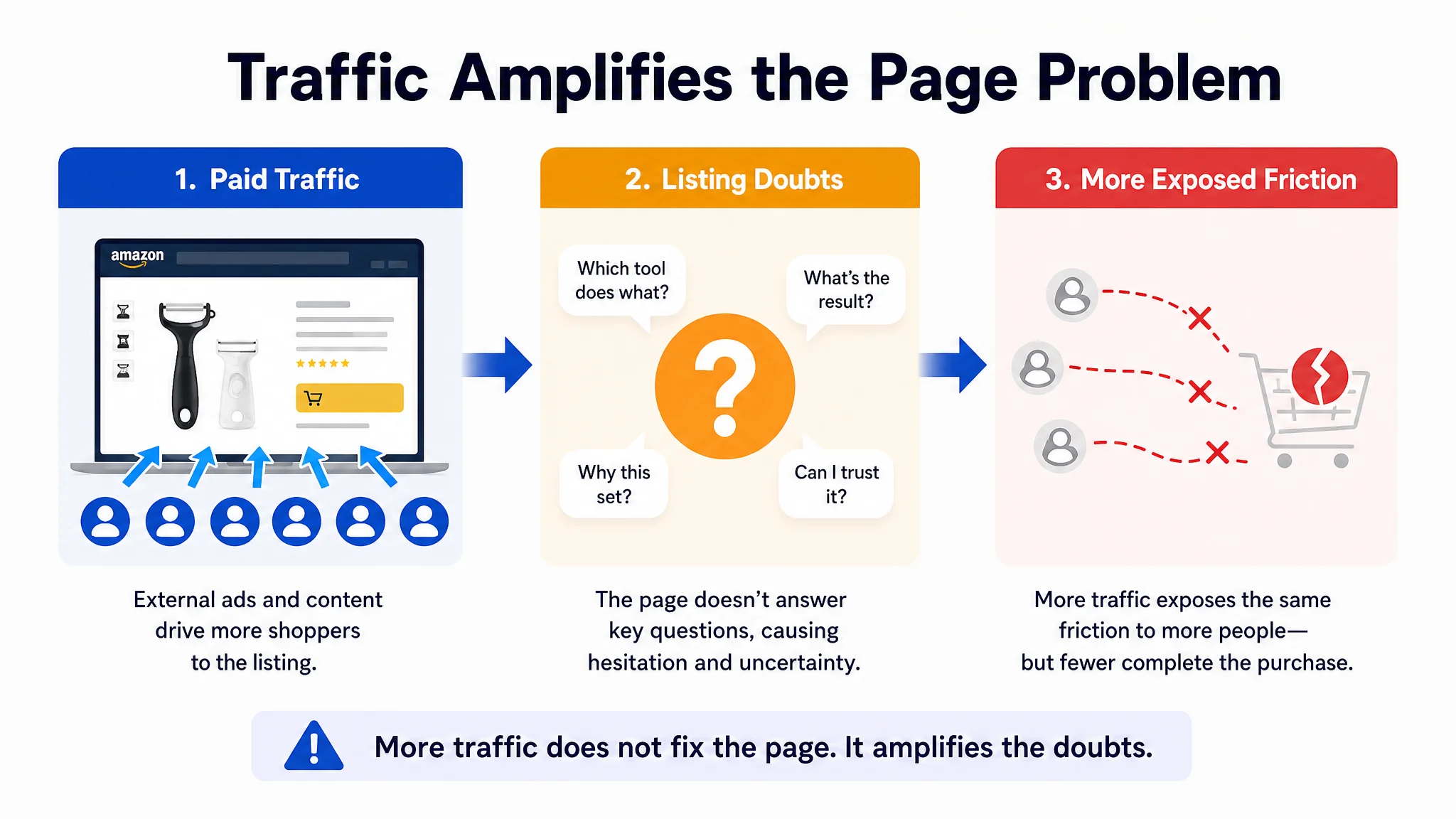
The kitchen-tool listing illustrates why this distinction matters. The page had product displays, material callouts, and usage references, but several visual elements showed features without proving outcomes. A shopper could see the tool without immediately understanding which piece performed which task, what the finished result should look like, or why the two-piece set was more useful than a basic peeler. Sending more traffic to that page would not automatically solve the problem. It could simply expose the same uncertainty to more visitors.
Attribution also requires caution. An external or ad-assisted path may influence a purchase even when the final click occurs on an Amazon search result, causing channel reports to understate its contribution. A channel that scales while TACoS remains flat may indicate incremental rather than cannibalizing revenue, but this is a diagnostic signal—not conclusive proof. Validate it against CVR, total sales, branded search behavior, and BSR movement.
The same discipline applies to listing diagnosis. If a product page has useful functions but weak conversion structure, a traffic report may show the symptom without explaining the constraint. The underlying question is whether the listing can turn external attention into completed shopping behavior.
The Algorithmic Shift: A10 and the Power of Shopping Signals
Amazon ranking is no longer best understood as simple keyword matching. Under the A10-style model, relevance still determines whether a product belongs in a search, but shopping behavior after the click helps determine whether it merits stronger organic visibility. Product-level sales velocity, conversion rate, order value, and signals such as whether shoppers continue toward purchase all matter more than impressions or clicks in isolation.
That distinction prevents a common PPC mistake: treating click-through rate as a direct organic-ranking lever. Ad CTR primarily affects ad placement, auction efficiency, and cost. A click becomes strategically valuable when the resulting session generates stronger conversion and sales signals.
A comparable mistake occurs when sellers treat product information as if it automatically creates conversion. The kitchen-tool seller initially focused on emphasizing the product’s multifunctional design. The title began with “3-in-1,” and the images attempted to communicate different uses, materials, and scenarios. Yet the page still did not give shoppers a clear decision sequence. The comparable listing assigned each tool a role in a familiar kitchen workflow, while the customer listing mostly presented functions as separate facts. The diagnostic finding was that feature recognition had not become purchase confidence.
The operating workflow should therefore connect paid traffic with measurable shopping outcomes. DeepBI’s Amazon-only organic-traffic module can prioritize terms by CTR, CVR, and order-value performance, then reinforce the highest-value terms through top-of-search campaigns. This creates short-term ad lift while the resulting sales and conversion behavior support longer-term natural-rank improvement.
However, the keyword and campaign workflow should not be separated from the receiving page. If the listing does not visually demonstrate the primary function, explain the role of each product component, or resolve basic trust concerns, better search-term targeting may produce more qualified clicks without producing proportionate orders. Paid traffic can reveal demand, but listing content determines whether much of that demand becomes useful shopping behavior.
The broader feedback loop should track exposure, clicks, orders, CTR, CVR, ACoS, and BSR. Advertising provides fast performance feedback, while listing and visual optimization turn winning search-term and attribute signals into more persuasive post-click experiences. The objective is not to buy rank, but to use paid traffic to generate and validate the behaviors that organic ranking can recognize.
The Financial Edge: Understanding the Brand Referral Bonus
External traffic should be evaluated based on both its conversion contribution and its net acquisition cost. For eligible purchases, Amazon’s Brand Referral Bonus averages about 10% of product sales. That credit can be included in an adjusted cost-per-sale calculation alongside traffic costs, referral fees, discounts, and other applicable expenses.
The opportunity is not universal. Rates, eligibility, category treatment, and program terms may vary, so sellers should verify Amazon’s current requirements before including the bonus in a forecast. The relevant question is not whether external traffic is automatically cheaper, but whether the eligible credit changes the economics of a specific product while supporting CVR, BSR, and efficient ACoS.
A bonus can improve the arithmetic of an acquisition channel, but it cannot repair a listing that fails to convert relevant traffic. In the kitchen-tools example, the core issue was concentrated in the page’s conversion structure: the title had weaker search and value signals, the image sequence was static and restrictive, the bullets listed functions without building a cooking-use logic, and the A+ section was too thin to establish trust. A lower adjusted traffic cost would still need to be evaluated against that conversion bottleneck.
Breaking Down the Math
Consider two illustrative cases:
- $40 product: Assume an external click campaign generates an eligible sale at an $8 traffic cost. A 10% bonus on product sales equals $4. Before other costs, the adjusted acquisition cost is $8 minus $4, or $4 per sale.
- $100 product: Assume the same model produces an eligible sale at an $18 traffic cost. A 10% bonus equals $10, creating an adjusted acquisition cost of $8 per sale before other applicable costs.
These calculations are examples, not promised outcomes. A sale may qualify only under specific program conditions, and the final result depends on category, fee structure, product price, traffic quality, and eligibility. Model the bonus separately from CTR and CVR, then compare the adjusted cost with PPC ACoS, contribution margin, and the traffic required to influence organic BSR. If the assumptions change, the apparent financial advantage changes with them.
A financially attractive channel should therefore be judged together with the page it feeds. Cost relief is useful only when the traffic reaches a listing whose value proposition, visuals, bullets, A+ content, and trust signals support conversion.
The "Middle Man" Strategy: Why You Shouldn't Link Directly to Amazon
External traffic should not move directly from an ad, influencer post, or content article to an Amazon listing by default. A controlled middle layer gives you an opportunity to qualify visitors, measure intent, and improve the quality of the traffic that ultimately reaches Amazon.
Landing Pages, First-Party Data, and Attribution Tagging
A focused landing page can explain the product’s use case, set expectations, answer basic objections, and distinguish casual visitors from plausible buyers before the Amazon click. This filtering reduces the risk that low-intent traffic inflates sessions while weakening CVR. It also gives shoppers a more consistent path from the external message to the listing, helping preserve the relationship among traffic quality, conversion rate, and eventual organic performance.
The layer can also support first-party data collection where permitted and properly disclosed. Useful inputs include email addresses, retargeting pixels, and behavioral signals such as page engagement, content interactions, and outbound-click intent. These signals help segment audiences and refine future campaigns instead of repeatedly sending the same broad traffic to Amazon.
Every external link should carry attribution tags, including links from paid campaigns, influencers, affiliates, and brand content. Pair those tags with server-side tracking, pixels, and web tags to reconcile campaign source, landing-page behavior, Amazon referral activity, and downstream performance where available. Review the resulting data against CTR, CVR, ACoS, and BSR movement rather than judging traffic volume alone.
The middle layer improves traffic quality, but it does not remove the need to inspect the Amazon page. For the kitchen-tool listing, a landing page could explain that the set supports peeling, julienne preparation, and bottle opening. But if the Amazon listing still showed a static result rather than the tool in use, or failed to distinguish the two pieces, the final conversion problem would remain. The external message and the Amazon page must carry the same promise; otherwise, filtering the audience only makes the expectation gap easier to observe.
AI-Assisted Shopping Discovery and What It Actually Rewards
AI-assisted shopping discovery primarily relies on the information Amazon already structures around a product: catalog data, listing content, customer reviews, and Q&A. External visibility does not replace the need for accurate titles, persuasive bullets, strong imagery, useful A+ content, and credible customer feedback.
External mentions contribute indirectly. They can generate more branded searches, send qualified traffic to the listing, and increase opportunities for legitimate review and engagement signals. The durable mechanism is therefore not “traffic at any cost.” It is a loop: external exposure creates demand, the middle layer improves traffic quality and measurement, and Amazon-native content converts that demand into stronger on-platform signals. Listing diagnostics should then connect those signals with CTR and CVR to identify the next required improvement.
The kitchen-tools diagnosis shows what “Amazon-native content” must accomplish in practice. The comparable listing did not merely mention multiple functions; it showed how each tool fit into a familiar preparation workflow. It used active demonstrations, broader use scenarios, hand-operation close-ups, material details, and side-by-side explanations of the different functions. This made the information easier for both shoppers and structured shopping systems to interpret. Accurate content is not only a catalog requirement. It is part of the conversion signal.
Common Pitfalls That Quietly Suppress Organic Lift
Operational Guardrails While Campaigns Run
External traffic rarely fails because the strategy is fundamentally wrong. It fails when operators cannot identify which visits generate qualified sales. Missing attribution tags obscure source-level CVR and make ACoS, BSR movement, and budget decisions harder to interpret. Low-intent or mismatched audiences can then inflate clicks without producing orders. Skipping a dedicated landing layer, neglecting the mobile experience, or sending shoppers to a page that does not immediately support the ad promise compounds the problem.
Use the ads layer as a filtering system: explore relevant keywords and competitor ASINs, review recent ad data, remove traffic with weak conversion, precision-test the high-converting terms, and scale bids and budget only around the surviving minority. Low ad CTR mainly affects visibility and advertising cost efficiency; the organic risk arises when low-quality traffic produces weak CVR and few sales. Since conversion performance contributes to ranking signals, filtering protects organic rank rather than merely reducing wasted spend.
A listing can also create weak conversion signals even when the audience is relevant. In the kitchen-tool case, the issue was not simply whether the page had enough information. It was that the information appeared in the wrong order. A warning about hard vegetables could create a negative buying signal, a fish-scaling image could distract from the main vegetable-peeling use case, and a static food-result image could show an outcome without proving that the tool could produce it. These issues could make qualified visitors hesitate even if the traffic source was well targeted.
External traffic also requires a measurement loop, not a one-time launch push. Tag each source, record the change point, and compare post-launch CTR, CVR, and sales performance over the following period. Stable advertising signals can inform repeated listing evaluation instead of ending the test after the first spike.
Operational controls matter as well. Enable two-step verification, store credentials securely, and use official API access with least-privilege permissions where applicable. If pausing seller-fulfilled listings, plan a two-day safety buffer; propagation often takes minutes, but allow up to an hour for verification rather than treating the timing as fixed.
Competitor Layout Gaps: The Listing Side of Organic Growth
External traffic cannot compensate for a listing that loses the click or fails to convert it. Treat the receiving page as the primary bottleneck, then address the layout gaps that prevent traffic from becoming ranking momentum.
A kitchen-tools comparison makes this visible. The customer listing scored 62 out of 100, compared with 80 for a comparable high-performing listing. The largest difference was in A+ content, where the customer page scored 16 out of 25 and the comparable page scored 24. The title, main image, bullets, and reviews also had gaps, but the eight-point A+ difference indicated that the page lacked the content architecture needed to turn feature recognition into purchase confidence.
- Identify the strongest comparable ASINs for the target keyword set using product form, price band, audience, use case, and feature similarity rather than selecting an unrelated category leader.
- Score the main image, title, bullet points, A+ content, and review structure against the benchmark, including image clarity, keyword placement, selling-point order, pain-point coverage, information density, star distribution, review volume, and quality image reviews.
- Use automated competitor identification and benchmark scoring to show exactly where value is being lost, instead of relying on a single aggregate score or subjective visual judgment.
- Diagnose CTR and CVR across dimensions: a weak CTR with a low main-image score points to a missing visual hook, while weak CVR alongside inferior A+ content and review signals points to poor information, trust, or selling-point communication.
- Convert each gap into an impact-ranked checklist covering composition, camera angle, lighting, visual hierarchy, title structure, keyword placement, and bullet-point logic, with priority assigned by expected CTR and CVR impact.
- Generate copy and visual variants from the product knowledge base, Product DNA, original assets, scoring report, and optimization plan; use competitor listings for directional style only, never to alter product structure or copy protected design elements.
- Compare proposed and existing assets, approve individual changes, then sync authorized image updates to Amazon through the seller API to reduce listing cycle time and manual upload errors.
- Track the resulting CTR and CVR movement. Closing the layout gap can improve both metrics, but only higher-quality post-click conversion can turn external traffic into durable organic-ranking signals.
The goal of comparison is not to copy a competitor’s wording or appearance. It is to identify where the shopper’s decision process is being interrupted. In the kitchen-tool listing, the comparable page gave each tool a recognizable role, demonstrated the product in active use, and used A+ content to establish trust. The customer page mostly displayed functions and product information without the same progression. That difference explained why adding more claims alone was unlikely to solve the conversion problem.
Turning External and Paid Traffic Into Durable Organic Rank
Keyword Mining and Top-of-Search Focus
External traffic and PPC should not be judged by clicks or attributed revenue alone. Their strategic value lies in whether they reveal demand that can later strengthen natural-order contribution and rank stability.
Start by mining ad performance at the search-term level. Use CTR to identify queries that attract relevant attention, CVR to confirm that the listing converts that intent, and order value to distinguish high-revenue demand from low-value volume. Then concentrate budget on a small group of terms with the strongest combined signal, pursuing top-of-search placement where the economics support it.
The operating loop consists of short-term ad lift followed by long-term natural-rank validation. Advertising creates qualified exposure and generates search-term evidence; listing and offer improvements should turn that evidence into stronger CVR, more organic orders, and greater BSR stability. Without the second step, paid traffic can increase sales while leaving the business dependent on rented visibility.
The kitchen-tool case demonstrates why the second step must begin with the page itself. A seller could mine terms related to vegetable peelers, julienne tools, stainless steel construction, or multifunctional kitchen tools. But if the title does not make the strongest search and value signals readable, or if the page does not demonstrate what the product does, higher-intent traffic may still encounter uncertainty. Keyword evidence should inform both campaign targeting and the listing’s value hierarchy.
DeepBI's Amazon-only organic module provides the measurement and prioritization layer for this loop. It separates organic performance from advertising-driven results, allowing operators to connect ad signals with subsequent natural-order contribution instead of treating every revenue increase as organic progress.
Measuring Organic Lift With TACoS and Natural Order Share
TACoS is total advertising spend divided by total sales. Natural order share is organic orders divided by total orders. Together, these metrics show whether growth is becoming less dependent on paid acquisition.
A useful counterfactual pattern is TACoS remaining flat for six months while an external channel grows from zero to about 35% of total revenue. That pattern supports incremental growth: the channel is adding demand without proportionally increasing the advertising burden. By contrast, if a channel mainly cannibalizes existing sales, spend rises without sufficient incremental total revenue, pushing TACoS upward.
Review these metrics alongside rank stability, CTR, CVR, and BSR—not revenue in isolation. DeepBI's Amazon-only organic module can prioritize terms and products by TACoS, natural order share, and rank stability, turning campaign data into a repeatable decision loop rather than a one-time traffic report.
For a listing with a diagnosed conversion bottleneck, these measurements should also be interpreted around the change point. If external traffic grows but CVR remains weak, the next action may be a page repair rather than a larger budget. If the listing changes improve the clarity of the primary functions and the resulting traffic converts more efficiently, the seller can then evaluate whether the improvement is contributing to organic performance. Without separating these stages, traffic acquisition and conversion improvement become difficult to distinguish.
Practical First Steps for the Next 90 Days
Treat the next 90 days as a controlled rollout, not a race to maximize external traffic. The operating objective is to improve traffic quality, CVR, and organic contribution while protecting ACoS and listing consistency.
- Establish measurement first. Add attribution tagging to every external link so sessions, orders, and converting traffic can be evaluated by source. Select two or three high-intent channels rather than spreading budget across every available platform.
- Build a landing layer. Route qualified visitors through a focused landing experience that supports product education and data capture before directing them to Amazon. Keep the message consistent with the listing so external clicks do not create an expectation gap that damages CVR.
- Close the highest-value listing gaps. Run a competitor layout gap analysis against genuinely similar products, comparing the main image, title, bullets, A+ content, and review-related trust signals. Prioritize the gaps most likely to affect CTR or CVR, then apply reviewed changes without altering the product’s actual attributes, branding, or specifications.
- Scale proven search demand. Launch a top-of-search push around the best-performing keywords identified through advertising and organic signals. Use the resulting CTR, CVR, ACoS, and order data to judge whether paid support is strengthening qualified demand rather than merely increasing impressions.
- Review and iterate monthly. Track TACoS, natural order share, CTR, CVR, and channel-level conversion. Expand only channels that produce converting traffic. Use the organic module to connect keyword and advertising signals with listing gaps, prioritize the next fix, measure the change, and feed the findings into the following cycle.
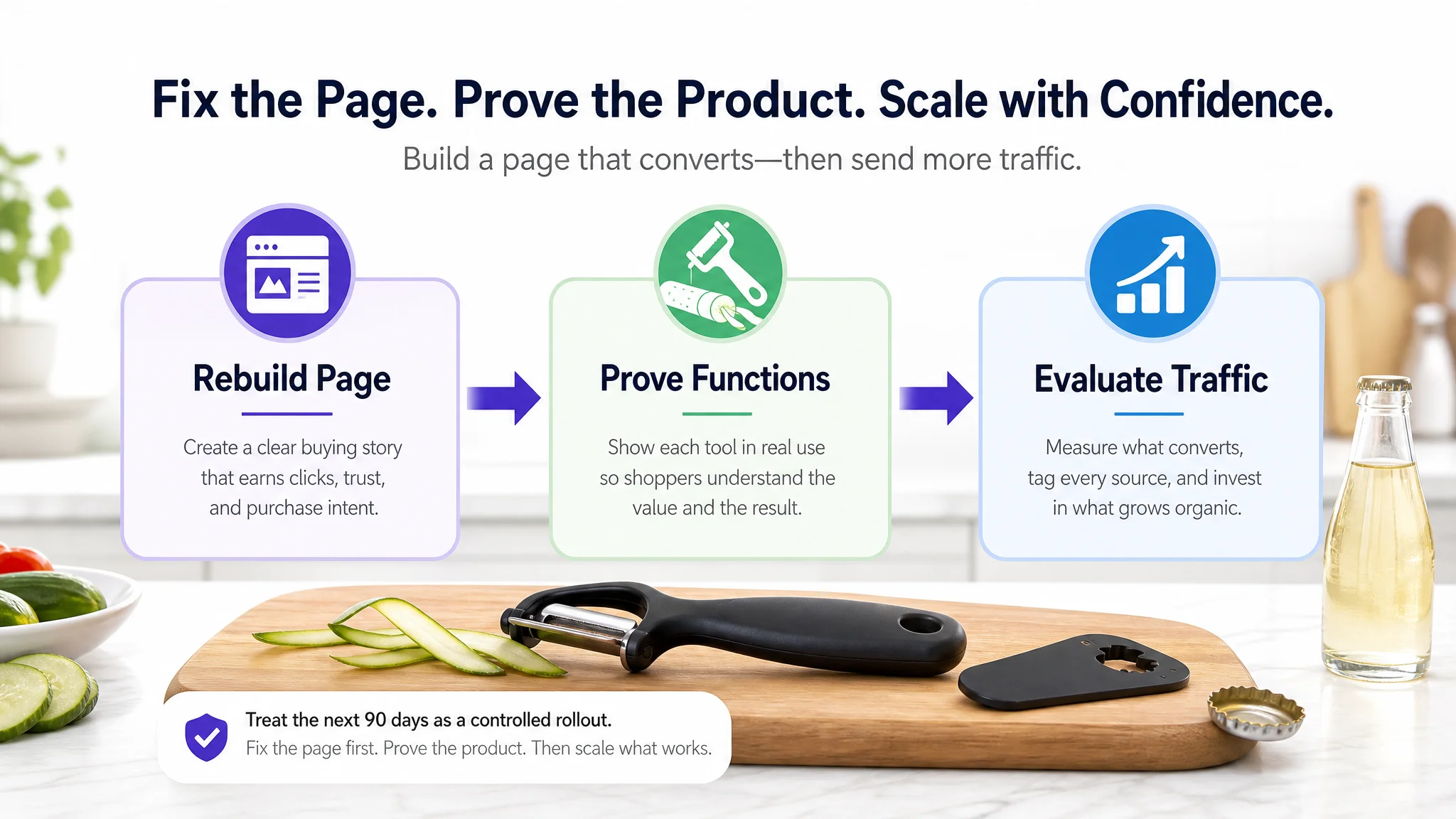
The order of operations matters. In the kitchen-tool listing, the rational first step was not to claim guaranteed advertising improvement or immediately scale traffic. It was to rebuild the page’s value hierarchy, demonstrate the primary functions, clarify the title and bullets, strengthen the A+ trust sequence, and keep every claim within the product’s real supported uses. Only after the page was better prepared could paid and organic traffic be evaluated more meaningfully.
Building a Defensible Moat
Rented visibility ends when spend stops; a defensible Amazon organic search system continues to build rank, conversion strength, and first-party audience assets. The operating loop is simple: attract qualified external traffic, convert it, measure its organic contribution, and reinvest only where the evidence supports durable progress.
- Treat external traffic as a ranking input only after it converts on the Amazon listing; bounced or mismatched traffic can weaken CVR rather than support organic growth.
- Separate temporary visibility from accumulated assets: PPC and paid placements rent attention, while stable rank, stronger conversion signals, branded search, and owned audience data can continue working after a campaign changes.
- Build a controlled landing layer that filters non-buyers, captures permitted first-party signals, and sends qualified visitors to the relevant Amazon listing.
- Tag every external source so attribution can distinguish paid, influencer, and content traffic from sales that would likely have occurred through existing demand.
- Review TACoS, natural order share, attributed conversions, and rank stability together; a channel that merely shifts existing Amazon sales may increase TACoS without creating incremental organic value.
- Use the Amazon-only DeepBI module as the long-term measurement and prioritization layer, ranking opportunities by conversion evidence, organic contribution, and stability rather than by traffic volume alone.
- Recheck the loop on a recurring cadence: external exposure should produce qualified visits, qualified visits should convert, conversions should strengthen organic signals, and measurement should determine the next investment.
- Preserve Amazon-specific focus. The goal is not a temporary launch spike, but a compounding system in which rank, conversion data, and audience assets make future organic search traffic less dependent on rented visibility.
The central lesson is that traffic and listing quality cannot be managed as separate systems. A kitchen-tool listing with useful functions still struggled because the page did not clearly connect those functions to an everyday buying decision. Its title was not only a keyword field, its images were not only product displays, its bullets were not only technical specifications, and its A+ content was not simply extra decoration. Each asset had to move the shopper from relevance to understanding, from understanding to trust, and from trust to purchase.
Before scaling external traffic, ask whether the listing has earned the opportunity to receive it. If the page can make the product easier to understand, easier to trust, and easier to place within a real use case, external traffic can become part of a durable organic-growth system. If it cannot, more traffic may only make the unresolved conversion bottleneck more expensive.