


Lead - Seller-workflow opening
It often begins mid-task. An Amazon operator, under pressure to refresh a listing before the next review cycle, opens an AI tool and pastes in product research, supplier notes, recurring customer-review themes, a keyword list, a brief for images not yet shot, and a few lines of draft copy. The tool returns faster drafts, cleaner keyword groupings, and creative directions. Speed feels like progress.
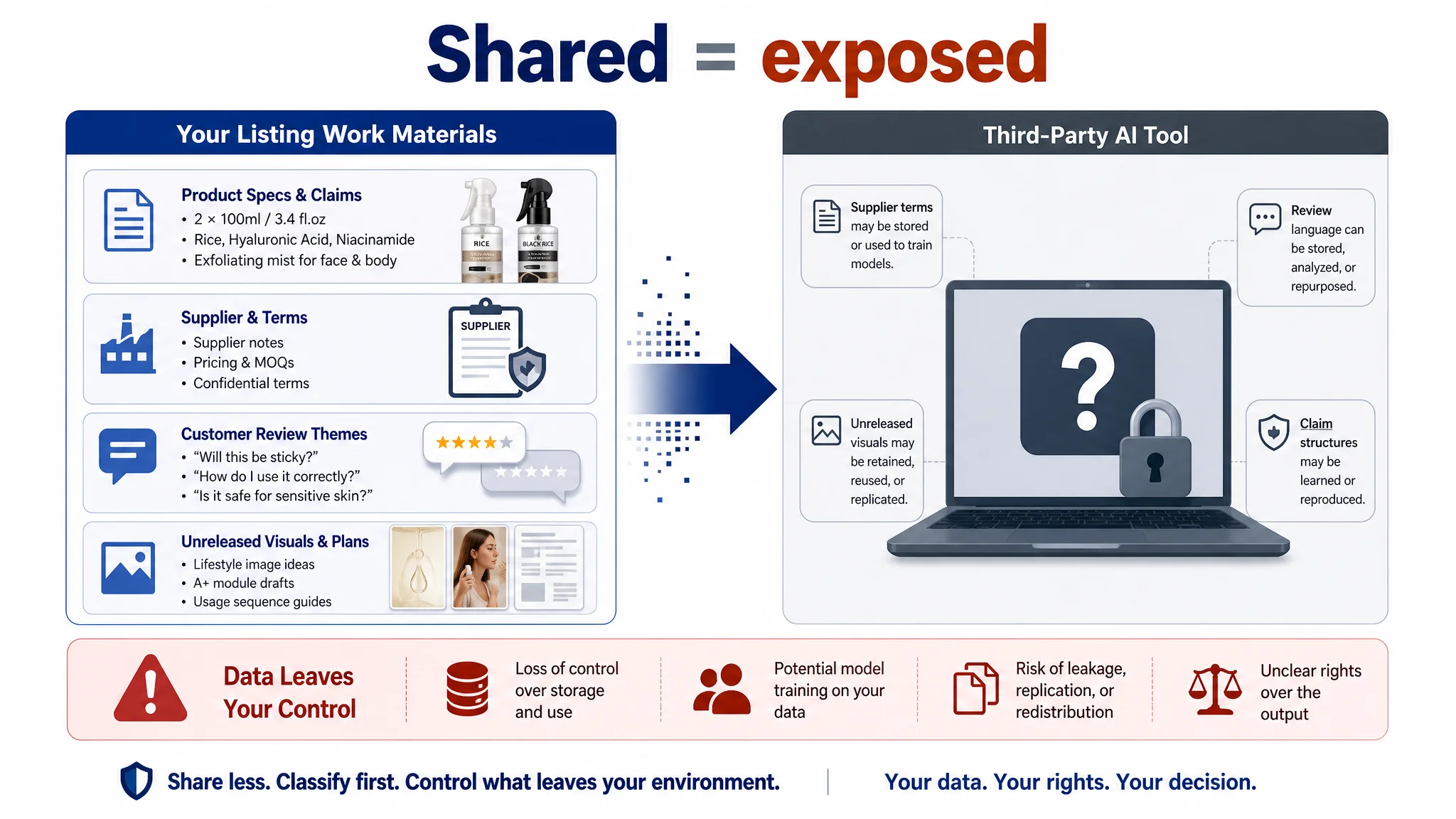
Then two questions surface. What data can we safely share with the tool? What IP rights do we retain in what comes back? The same session that saves listing cycle time can put supplier terms, unreleased visuals, and review language into a third-party system, while the output may carry unclear ownership. That is why data privacy and IP for AI tools belong in the seller workflow, not only in legal review. Copyright is where that tension first appears.
The AI and Copyright Law Debate: Why It Matters
A seller uses an AI tool to draft a listing title, generate a lifestyle image, or rewrite five bullets. The immediate gain is speed: a shorter listing cycle time, more testable variations, and potentially better CTR or CVR. The harder question comes after publishing. Who owns that copy? Can the seller reuse the image across marketplaces? Did uploading product specs, supplier photos, or unreleased designs expose confidential information? These are not mere productivity details; they are questions of ownership, licensing, and confidentiality.
The exfoliating mist listing review shows how quickly those questions attach to ordinary listing work. A US beauty seller was working on a rice and black rice exfoliating mist set for face and body. The working material included product specifications such as 2 × 100ml / 3.4 fl.oz, ingredient claims around rice bran water, hyaluronic acid, and niacinamide, main-image copy, A+ modules, and public competitor benchmark details. If any of that material is pasted into an AI tool to draft a title, rewrite bullets, or generate a lifestyle image, the team is not just saving time; it is deciding what listing logic, unreleased creative direction, and claim structure leave its controlled environment, and what rights it can assert over the returned draft. That is why data privacy and IP for AI tools have to be handled inside the listing workflow.
Copyright has historically rested on human authorship. A prompt can guide an output, but it does not automatically make the prompt writer the owner of that result. Vendors matter as well: training-data disputes can affect the tools sellers rely on—including availability, contract terms, and the risk passed downstream when output is published. Because the law is still developing, absolute answers are a poor basis for operations.
That is why internal policy is needed now. Practical issues are already arising in everyday workflows: who can approve a tool, what data may be uploaded, when a human must review output, and how to document that images and claims are original and permitted. Vendors that frame AI as an instruction-following tool rather than a creator—working within defined inputs and permissions—can reduce unsanctioned output, but they do not transfer legal ownership to the seller.
Can AI-Generated Works Be Protected Through Human Mediation?
The key distinction is not whether AI touched the work, but how much human judgment shaped the result. Purely autonomous output—prompts entered, images or text generated, and published with little or no human selection—sits on weak copyright ground. AI-assisted work is different when a person meaningfully selects, arranges, edits, or curates the output. That human contribution may be protectable, but the AI itself is not an author and cannot be a joint author.
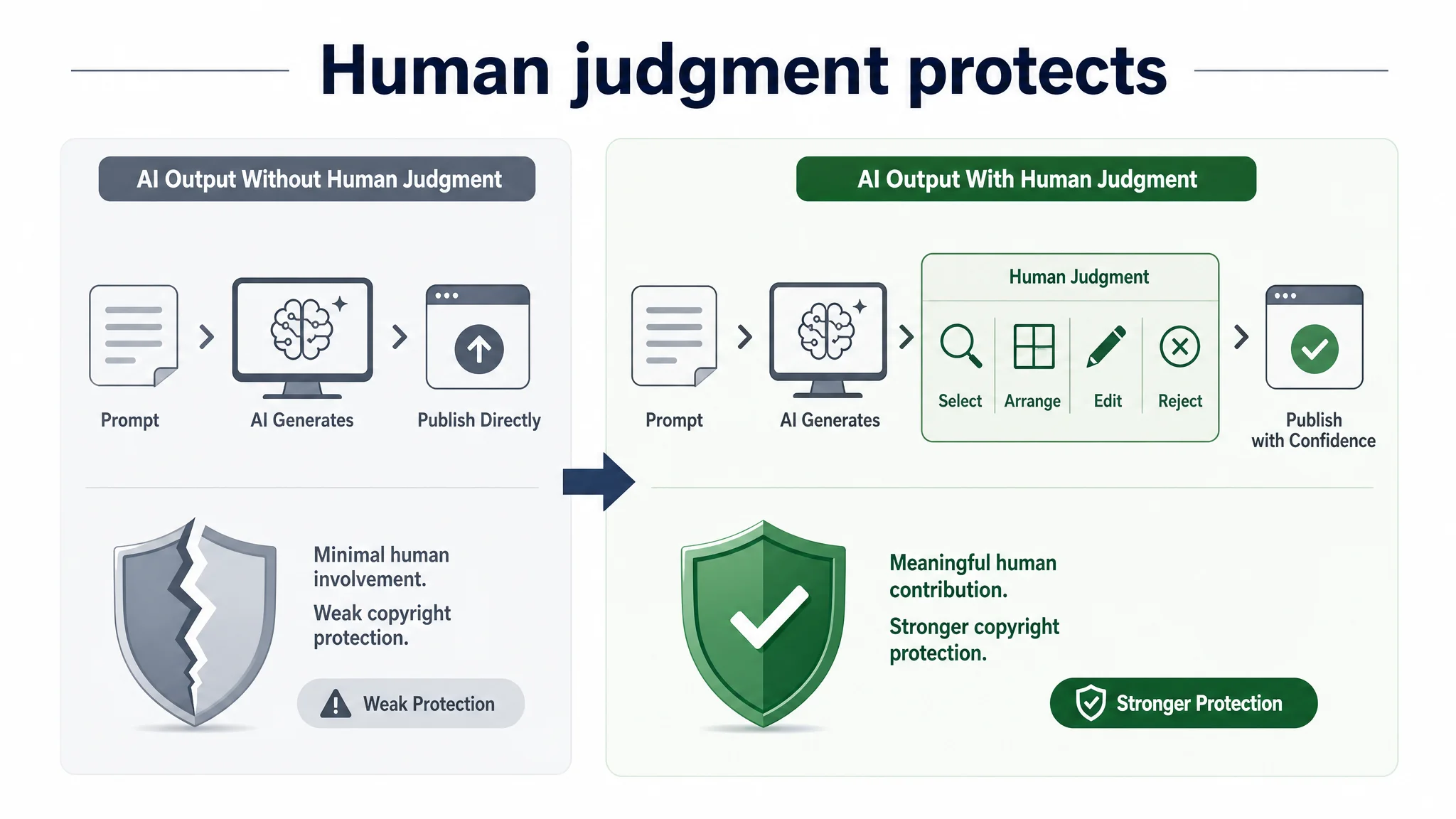
U.S. Copyright Office guidance follows that line: copyright protects human-authored expression. In its review of Zarya of the Dawn, registration was limited to the human-authored text and the selection, arrangement, and editing of the work—not the AI-generated images themselves. For sellers, this makes documentation practical: keep drafts, edit logs, and records of which elements you chose, rejected, or rewrote.
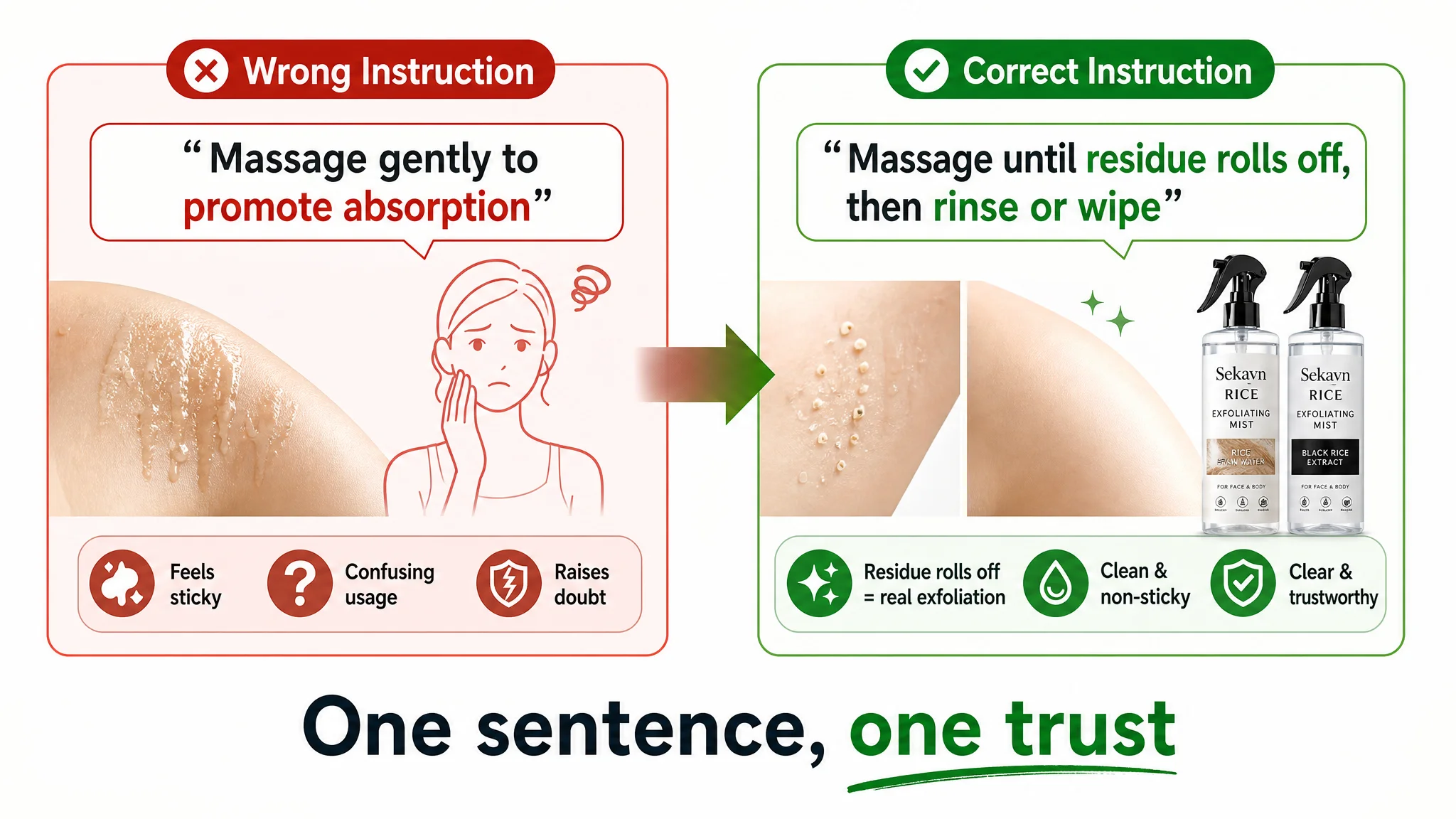
The exfoliating mist review is a useful operational example even though its visible problem was conversion, not registration. One main-image guide told shoppers to “massage gently to promote absorption,” while the product was actually meant to be sprayed on dry skin, massaged until residue rolled away, and then rinsed or wiped. The page also had an A+ area that was text only. The correction did not come from a tool publishing on its own; it came from a human diagnosis that rejected the contradictory usage story, selected a clearer sequence, and rebuilt the A+ flow around solution, visible benefit, gentleness, usage, and proof. That is exactly the kind of human selection, arrangement, editing, and rejection that should be logged. Whether or not AI assisted the first draft, the publishable asset depends on human judgment—and the record of that judgment is what makes the workflow defensible.
Global Perspectives: How Other Countries Are Handling It
India’s Copyright Act, 1957, points in a similar human-centered direction. Authorship is attributed to human roles, and for computer-generated works Section 2(d)(vi) points to the person who causes the work to be created. That does not make the AI an author. The common thread is human causation and control—not machine autonomy. The safer operating rule is to keep AI working under your direction and to preserve evidence of the human decisions that turn a draft into a publishable asset. The same logic applies to listing assets: the safer position is not “the tool made it,” but “a named human directed, selected, and edited the output.”
Data Privacy and IP Risk in AI Tool Workflows
Privacy and IP risk in AI tool workflows is a matter of operating discipline, not legal abstraction. Begin with a data map of what your team pastes, uploads, or connects to external tools. For Amazon listing work, the inventory usually includes product specs, supplier terms, customer-review themes, keyword or search-term context used for listing diagnosis, unpublished creative assets, and vendor documents. Classify each item by sensitivity and business criticality before it leaves your controlled environment.
The exfoliating mist review makes that inventory concrete. The team was working with a title, bullet structure, main-image sequence, A+ modules, product specifications, ingredient claims, and competitor benchmark observations. Some of that material is public-facing or category-level; some is internal reasoning about why the two bottles are not redundant, which usage claims are safe, and how the set should be positioned. A data map should separate those categories before anyone prompts an external tool. The same listing field can be harmless in one context—“2 × 100ml / 3.4 fl.oz”—and sensitive in another when it is combined with supplier details, unreleased images, or a full claim strategy. This is why classification has to happen before prompting, not after a draft comes back.
Separate persistence from spillover. Persistence is how long an input remains stored inside a tool, account, or workspace; spillover is how input moves beyond the intended workflow—for example, into another customer’s output or a public dataset. Under GDPR, you need a lawful basis; consent is only one basis, and explicit consent is generally required for special-category data. CCPA-style rights may also apply. Anonymization is not a switch: re-identification risk rises when anonymized data is combined with auxiliary data, especially when records are detailed or poorly protected, so use strong de-identification and privacy-enhancing safeguards.
Vendor terms matter. OpenAI consumer and business/API data-use terms differ, so check the applicable terms rather than making blanket claims about training use. IP risks include training-data copying, confidential information, open-source license restrictions, and missing attribution. DeepBI’s listing scoring/diagnosis output can help a team inventory the listing fields, title and bullet inputs, A+ modules, image briefs, and review-structure inputs that are being pasted into external AI tools before vendor review. In the exfoliating mist review, that structured view made visible exactly the fields a data map needs to name—title, main image set, bullets, detail/A+ content, and reviews—before those fields become prompts, briefs, or vendor inputs.
Case: ANI v. OpenAI - 1) Overview
ANI v. OpenAI is useful as a due-diligence prompt, not a headline to copy. Confirm the docket, the claims pleaded, and whether any order addresses data handling, training inputs, or output use. Treat summaries that skip those distinctions as unverified.
Case: ANI v. OpenAI - 2) Judgement / Status
Do not assume a final judgment from secondary coverage. Verify primary court records and vendor disclosures before a procurement or workflow decision; the operational checkpoint is whether retention, training use, and deletion can be explained.
Emerging AI Challenges That Outlast a Single Listing Refresh
A listing refresh can fix one weak image or rewrite one claim, but it does not settle the underlying AI risk. The innovation-versus-protection trade-off sits at the center: unrestricted training-data use may lower costs for AI vendors, yet it can weaken incentives for creators and brands to invest in original assets. For an Amazon seller, that trade-off becomes concrete in an AI-generated image-and-text draft that borrows too closely from a competitor’s composition, layout, or claims. The draft may look efficient, but it can invite IP complaints and image-product mismatch, hurting CTR, CVR, and review health while adding rework to the listing cycle.
The exfoliating mist review shows how a benchmark can be both useful and dangerous. The competitor Listing had a complete A+ flow: a hero module defining the set, skin-effect comparison, usage scenes, two-product breakdown, a how-to-use guide, and an ingredient/science module. DeepBI’s competitor benchmark layout helped the team see which public ASIN elements were safe to model—module order, question sequence, and the need to answer “why two bottles?” before asking for the sale. But the same benchmark becomes an IP risk if a team copies protected creative assets, exact before/after images, proprietary illustrations, or distinctive claim language. The safe lesson is to model the decision logic, not to lift the asset. That distinction matters because an AI-generated image-and-text draft that borrows too closely from a competitor’s composition, layout, or claims can invite complaints even when the page looks more efficient.
Risk also arrives through the data and design behind the model. Data poisoning and bias can arise from datasets, model design, objective functions, deployment context, and feedback loops, so a tool that performs well in a demo can behave differently in live workflows. Recommendation systems can amplify misinformation and contribute to polarization when engagement optimization rewards provocative content, but those effects are context-dependent and not solely caused by algorithmic bias. AI-as-a-Service lowers technical barriers, but it does not eliminate expertise; required expertise still varies by attack type and target. Getty Images filed a lawsuit against Stability AI—a reminder that training-data disputes are commercial questions.
DeepBI’s competitor benchmark layout can help teams see which public ASIN elements are safe to model, but it must not become a shortcut for copying protected creative assets. In the exfoliating mist review, the useful takeaway was the sequence of questions the A+ area had to answer, not a license to reuse the benchmark’s images, layouts, or exact wording.
A Practical Approval Routine for AI Tool Use
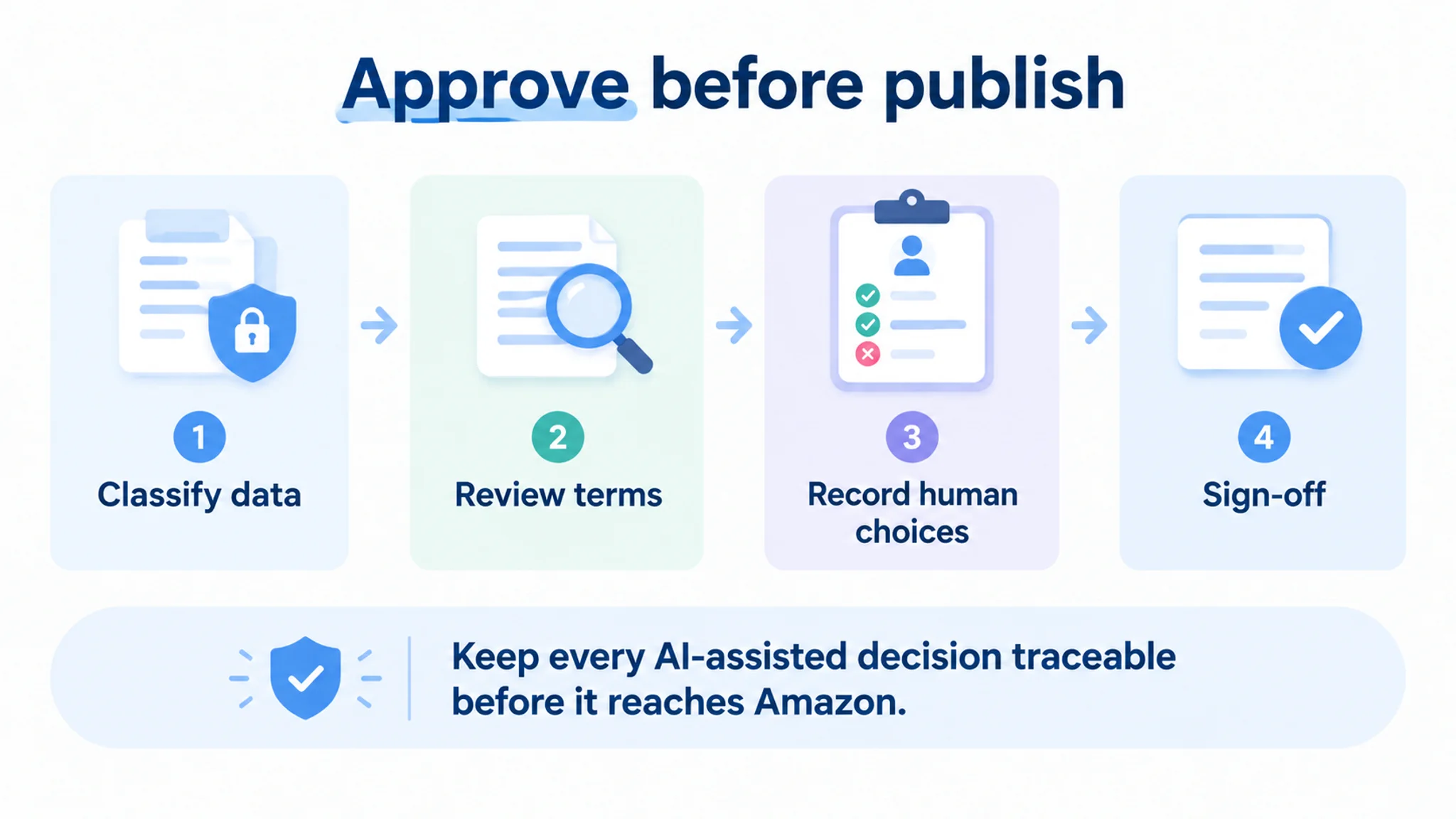
A practical approval routine does not turn operators into lawyers; it makes each AI-assisted listing decision traceable before it reaches Amazon.
The exfoliating mist review is a reminder that the routine has to catch errors that look like design choices. The main-image guide contained a usage instruction that contradicted the product: “massage gently to promote absorption” versus the actual spray-on-dry-skin, massage-until-residue-rolls-off, then rinse-or-wipe method. That single mismatch was not a traffic problem; it was a trust problem. An approval routine should make that kind of contradiction visible before publishing.
- Classify data before prompting: separate public product facts from supplier details, customer data, account credentials, and confidential commercial terms, and exclude anything vendor terms or internal policy do not allow.
- Review vendor terms and training-data use: check whether prompts or uploaded assets may train models, how long data is retained, and what opt-out or enterprise controls apply.
- Record human authorship choices: note which drafts were accepted, rejected, edited, or selectively applied.
- Require license and attribution checks for reference images, fonts, logos, and competitor visuals; limit competitor references to composition, lighting, and style.
- Review AI-assisted copy and images for similarity risk: unsupported claims, altered specs, invented accessories, changed logos, colors or materials, false proportions, and fake usage effects.
- Keep an AI disclosure or disclaimer where platform, market, or internal policy requires one, and have a human review the wording rather than assuming the tool supplies it.
- Document what was drafted versus what was applied, including selective replacements, as workflow evidence rather than a legal authorship determination.
- Treat DeepBI’s AI image-and-text draft as a reviewed draft, not an approved asset.
- Use DeepBI’s draft-versus-applied comparison to confirm which items will change and to support selective replacement before applying.
- Treat DeepBI’s one-click SP-API apply as a delivery step after human approval, not as a privacy, IP, or compliance guarantee.
- Require sign-off before publishing: a named reviewer confirms data classification, terms review, authorship notes, license checks, similarity review, and disclosure, and holds the listing if any item is unresolved.
In the exfoliating mist workflow, this would mean recording that the title direction was accepted, the old “absorption” wording was rejected, the three-step usage guide was rewritten, the A+ text-only block was replaced with a module flow, and the two-bottle roles were clarified. It would also mean checking the competitor benchmark as a reference for structure, not as a license to reuse visuals. DeepBI’s one-click SP-API apply is a delivery step after human approval, not a privacy, IP, or compliance guarantee. The named reviewer should hold the listing if the data classification, terms review, authorship notes, license checks, similarity review, or disclosure is unresolved.