

ACoS vs Profit in Amazon Ads: The Real Decision This Year
A campaign can report an ACoS inside the seller's comfort band and still function as a weak profit engine. ACoS compares ad spend only with ad-attributed sales. It does not account for product cost, Amazon storage and shipping fees, return frequency, or the margin left once the ad is paid for. Profit per order follows a different equation:
- Revenue
- minus landed product cost
- minus referral and fulfillment fees
- minus returns and return-related costs
- minus ad spend
A campaign can look acceptable on its first line and fail on its last.
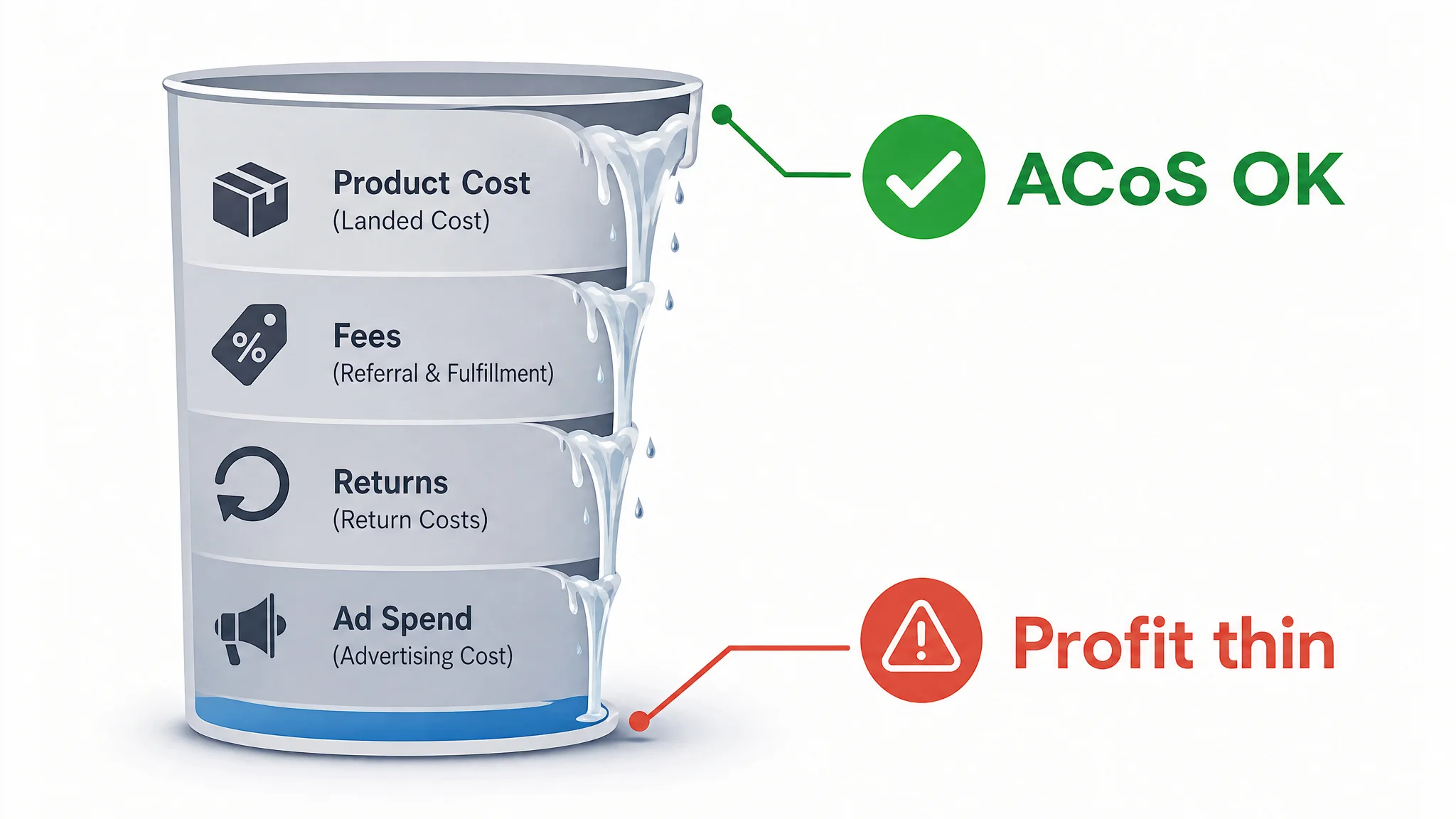
That is why a single ACoS target can conceal a margin problem. A lower ACoS on a thin-margin product may still leave little contribution profit, while a higher ACoS on a wider-margin product may leave more. The question is not which campaign has the more attractive ACoS, but which one adds profit after the full cost stack.
This playbook takes a profit-first view. Start with unit economics, translate gross margin into an ACoS guardrail, and then judge campaigns by contribution profit, CVR, and downstream signals such as BSR—not by ACoS alone. ACoS remains a useful diagnostic, but it is an output, not the decision. If Amazon CPCs are climbing this year, an ACoS that looked acceptable last year may now be masking a profit problem.
How to Reduce Your ACoS on Amazon: Top 5 Strategies
Lowering ACoS is rarely a matter of one clever bid change. It usually comes from several levers working together, and each lever should be judged by its effect on profit, not by ACoS alone.
1. Be retail aware. Align ad decisions with price position, margin structure, inventory pressure, and competitive context. A campaign can look acceptable on ACoS while still eroding contribution margin.
2. Pursue overall optimization, audits, and dayparting. Review the account as a system rather than chasing isolated keywords. Use audits to separate CTR problems from CVR problems, and use dayparting to focus spend on periods that support healthier campaign economics.
3. Manage keywords and audiences. Tighten match types, remove wasteful search terms, and evaluate audience signals against conversion quality. The goal is not simply cheaper clicks, but clicks that can become profitable orders.
4. Optimize bids, budgets, and placements. Adjust bids by performance tier, protect budgets where CVR is stronger, and test placement modifiers against margin rather than vanity metrics.
5. Use data-driven automation. Let repeatable rules and performance signals handle routine adjustments so human attention goes to exceptions and strategic decisions.
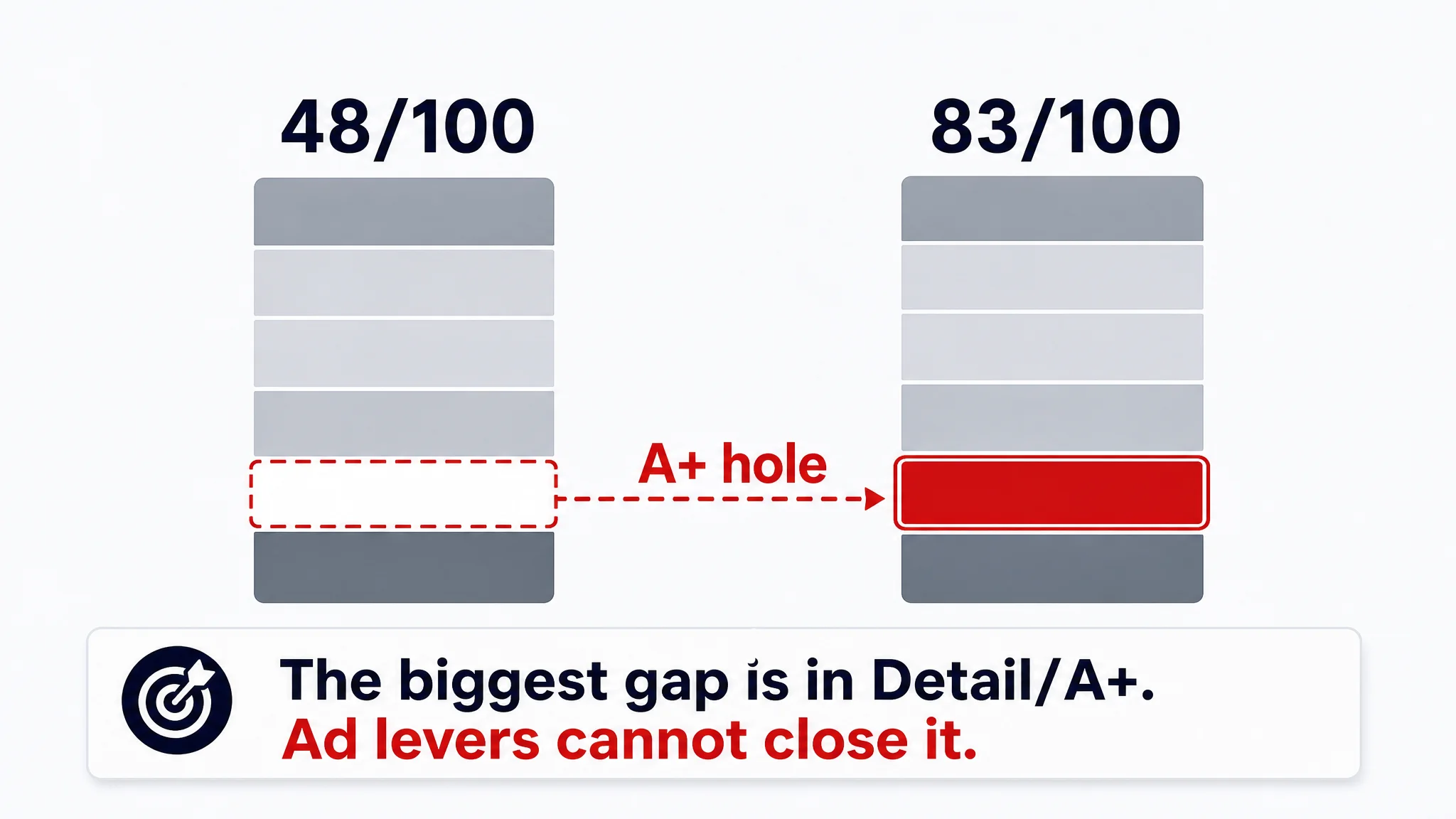
These are ACoS-reduction levers, not guarantees. A lower ACoS can still conceal weak profit when CVR, price, or margin structure is poor. One baking-tools seller running a Danish dough whisk and balloon whisk set on the US marketplace had been treating the problem as an ad problem: clicks were not cheap, ACoS was stubborn, and the team kept tuning campaigns. The product had 4.6 stars and clear main images, so the internal assumption was that better keywords, more bids, or more reviews would lift conversion. The benchmark told a different story. Against a category-leading competitor, the listing scored 48/100 versus 83/100, and the detail/A+ dimension was 0/25 versus 22/25. That gap reframes the five levers above: they can improve spend quality, but they cannot substitute for a page that is structurally unprepared to convert. The rest of this playbook therefore evaluates each strategy through profit: does it improve CTR and CVR in ways that support healthier ACoS, stronger BSR, and better campaign economics after margin? That is the standard to test against your own margin structure.
Strategy 1: Be Retail Aware
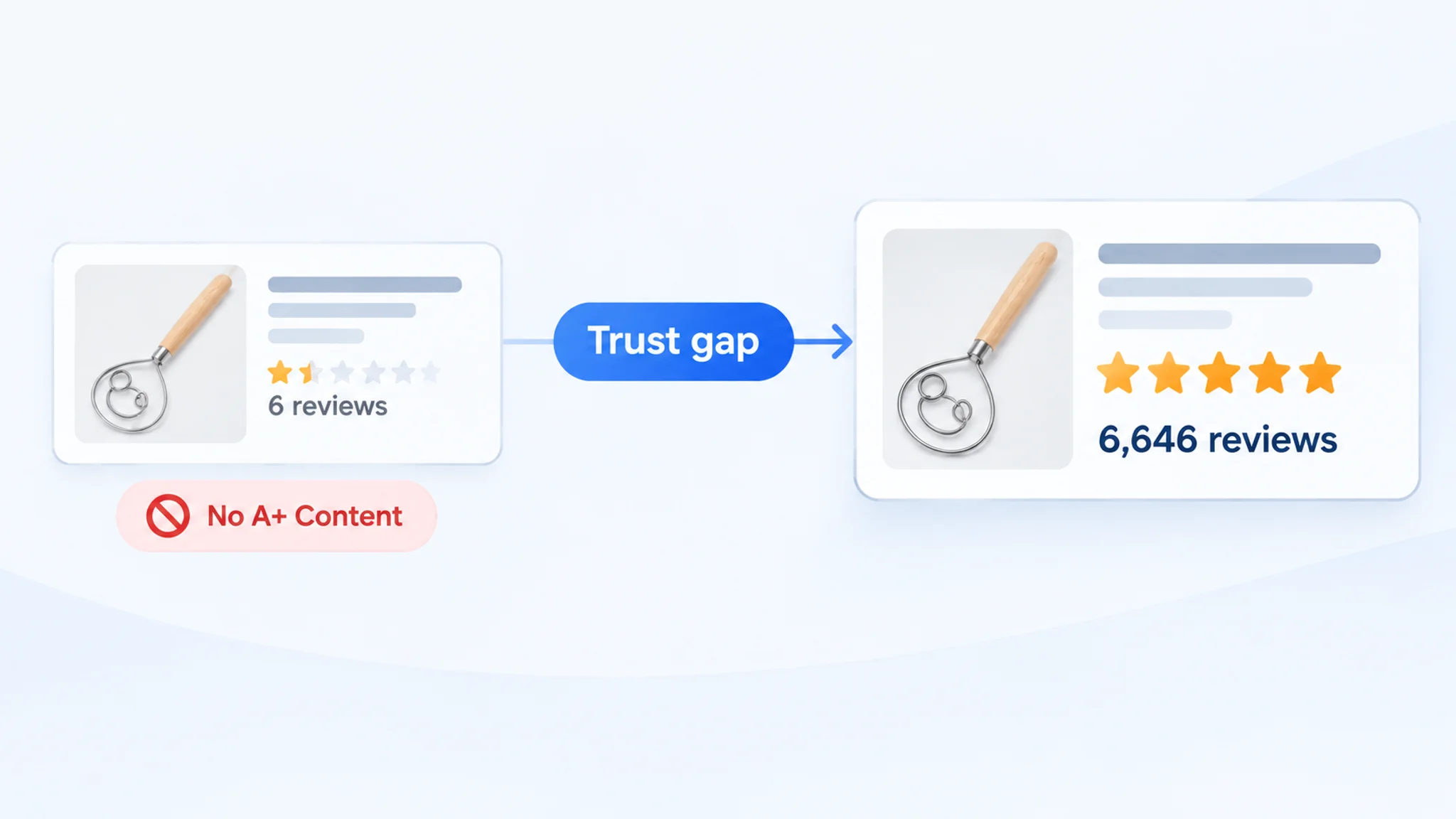
Before cutting bids, check retail reality. A bid change can improve ACoS on paper while masking weak conversion quality, stock constraints, or demand shifts. The cause-and-effect chain is straightforward: retail signal → conversion quality → ad efficiency → profit. If the ASIN has a weak conversion signal, the ad account may look efficient on low spend even as profit stays poor. In the dough whisk case, the retail signal was not “no traffic” but “traffic arriving at a page with no A+ content and only six reviews against a competitor’s 6,646.” That is a retail-readiness problem before it is a bidding problem.
1.1 Prioritize the Right ASINs to Advertise
ASIN selection is a major prioritization lever, but treat it as a practitioner heuristic—not a precise percentage. Begin with ad-report signals: impressions, clicks, orders, CTR, and CVR. Cross-validate those metrics against listing quality rather than optimizing bids in isolation. If CTR is weak and the main image lacks a visual hook, the constraint is often creative. If CVR lags and detail-page trust or review content is thin, more traffic may not repair economics. High-converting ASINs often improve blended ACoS—depending on bids, competition, and margin—but they do not always produce the lowest ACoS.
Also screen for inventory, cannibalization, and traffic seasonality. Advertising a weak-converting or thinly stocked ASIN, or one nearing stock-out, can create efficient-looking but unprofitable spend because demand cannot be fulfilled or the sales are not durable. PPC cannibalization can make attributed ad sales look healthy while shifting orders that might have occurred organically, so incremental profit may be weaker than ACoS suggests. Traffic seasonality can distort CTR and CVR; compare performance in matched windows before reallocating budget.
The dough whisk seller is a useful check on ASIN prioritization. On the surface, the ASIN looked ad-worthy: 4.6 stars, clear main images, and a product that fit the baking-tools category. But the listing had only six reviews, no A+ content, and a detail/A+ score of 0/25 against the benchmark’s 22/25. If the team had screened only ad-report CTR and CVR, it might have concluded the ASIN needed more traffic or better keywords. The listing benchmark showed the ASIN needed a better destination. Prioritizing the “right” ASIN is not only about which product can get clicks; it is about which product page can turn those clicks into orders after the click is paid for.
1.2 Content Optimization
Content quality is part of retail readiness. Check:
- Main-image composition and visual hook
- Information density
- Title keyword weight and character limits
- Bullets structured as pain point → proof → solution
- A+ trust modules with credible proof
Replace vague instructions such as “improve texture” with parameterized changes in composition, camera angle, lighting, scene elements, and color tone. This can shorten listing cycle time and improve CVR before spend scales.
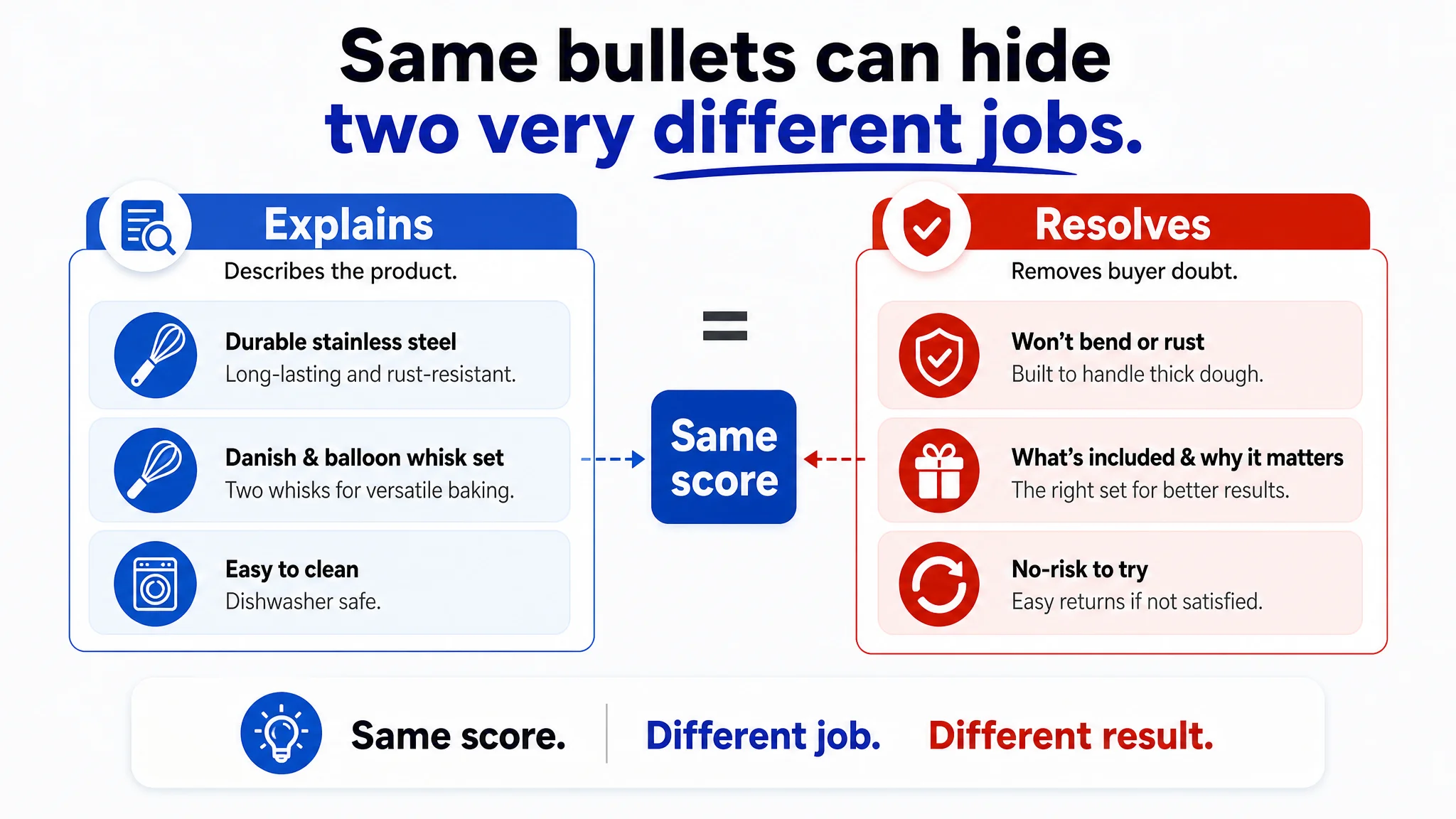
In the dough whisk listing, the bullet dimension was tied at 7/10 versus 7/10, but that hid a logic gap. The seller’s bullets started with product combination and scenarios, then moved into material, design, ergonomics, and convenience. The benchmark opened with material and durability, then moved through efficiency, versatility, ease of cleaning, and warranty. Both covered similar content areas, but the benchmark framed a decision path: “Can this tool survive my kitchen?” → “Does it work better than what I have?” → “Will it be hard to clean?” → “Will it clutter my kitchen?” The seller’s bullets explained the product; the competitor’s bullets resolved objections. The title had a similar issue: 10/14 versus 14/14, with brand-first structure and redundant verbs on the seller’s side, while the benchmark front-loaded “Danish Dough Whisk” and a “12 inch” spec. Content optimization is not copy polish. It is aligning title, bullets, and proof with how buyers search and how they decide.
(a) Product Image
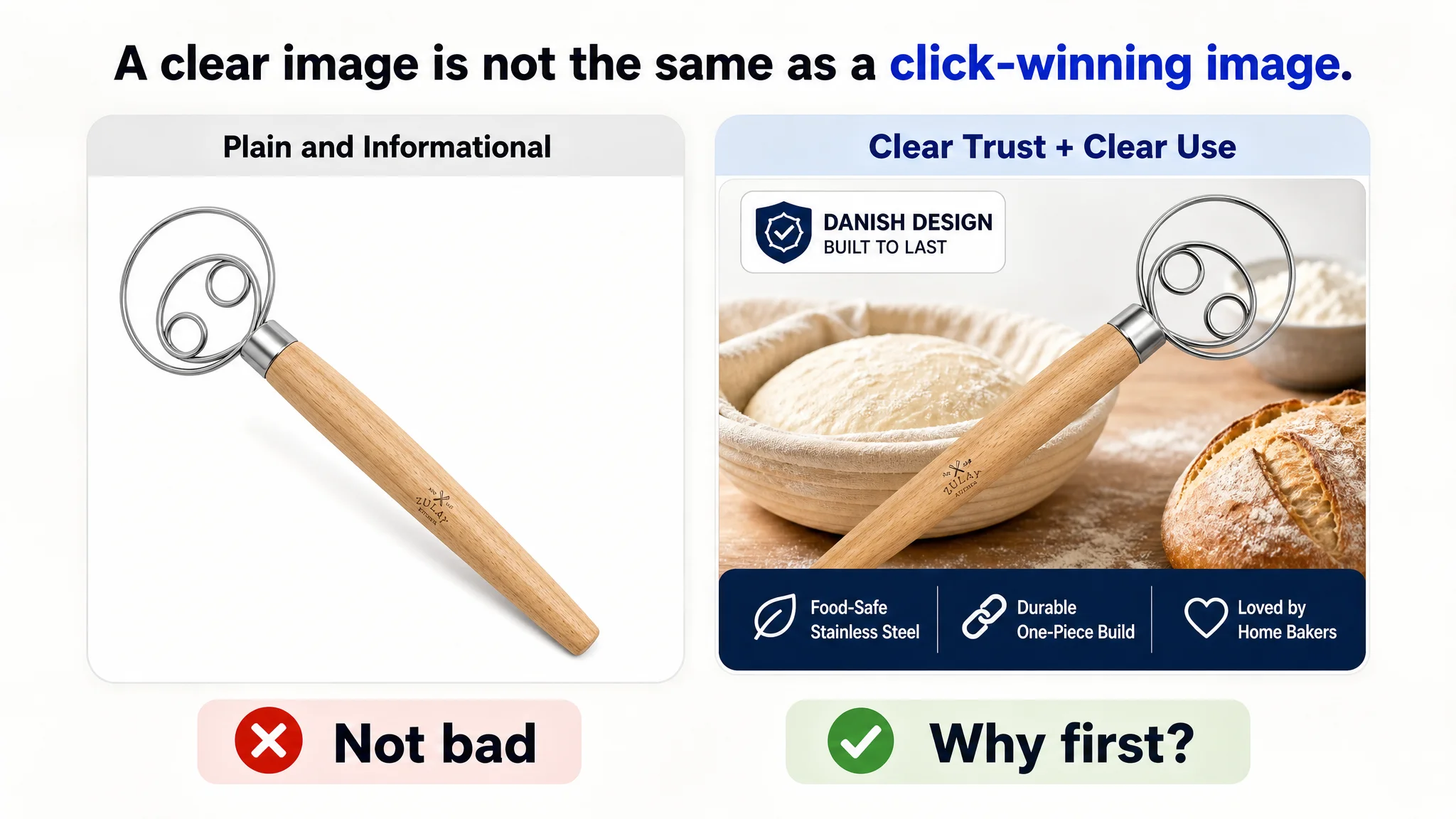
The main image is the first CTR filter. Meet Amazon’s mandatory standards for main-image white background ratio and pixel dimensions; title character limits are separate but equally non-negotiable. Then test the visual hook: a clearer product form, benefit cue, or scene cue can lift CTR, and ad-report changes in CTR will show whether clicks improve. Fix image and listing gaps before treating every weak ASIN as a bid problem.
The dough whisk seller’s main images were clear, but they were not yet persuasive. They lacked on-image trust cues such as material grade or durability signaling, made the “2-eye” dough whisk design require study rather than instant recognition, and used basic scene aesthetics that did not stand out in a scrolling field of similar stainless steel tools. DeepBI estimated that these gaps were not catastrophic, but enough to shave off roughly 3–5% conversion and depress CTR versus a more thoughtfully engineered gallery. This is the exact trap: main images can pass the “not bad” test while failing the “why click this one first?” test. Before treating weak CTR as a bidding problem, fix the image and listing gaps that keep the click from becoming a confident purchase.
ACoS vs Profit: The Metric Bridge That Prevents False Wins
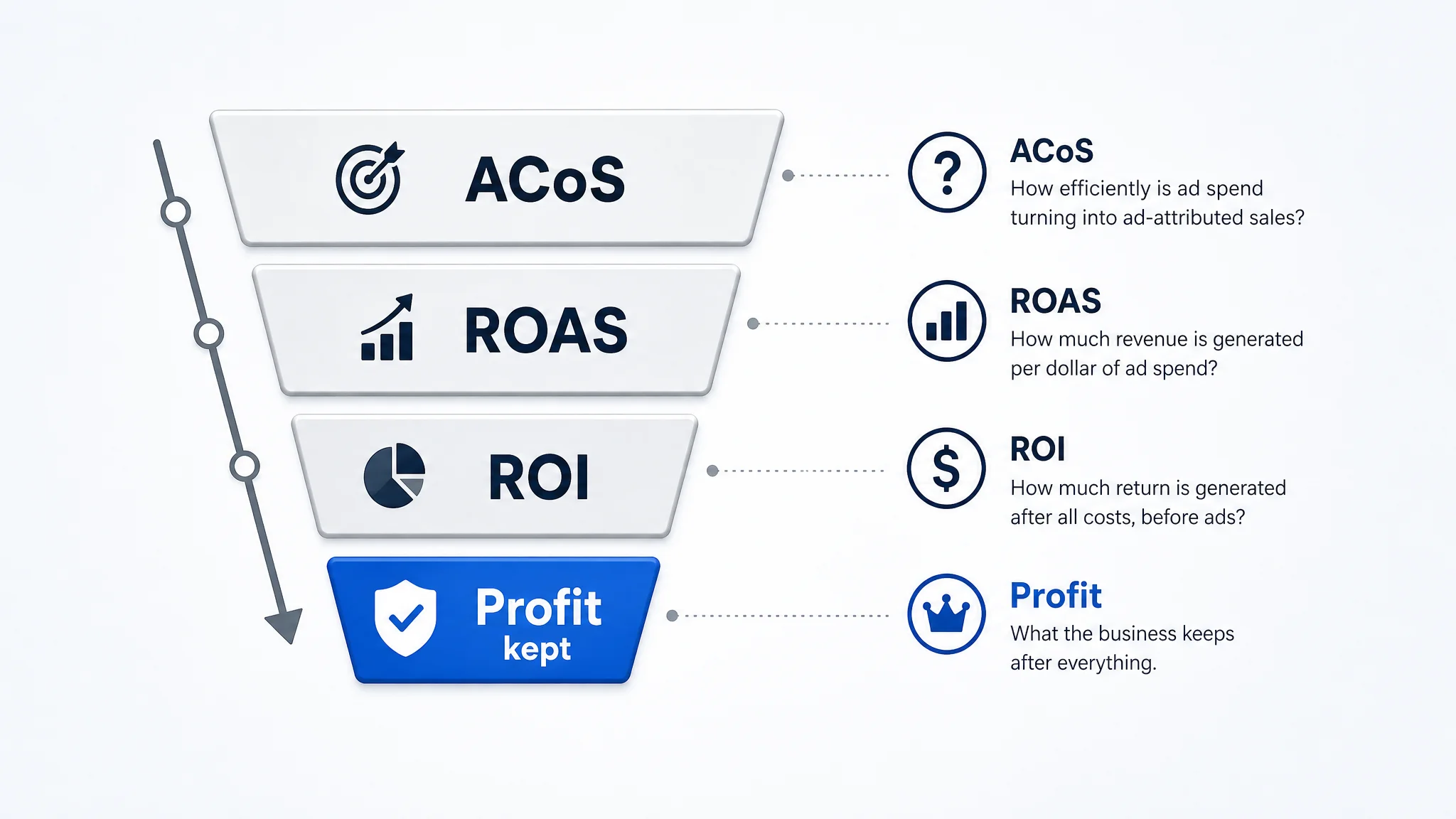
ACoS, ROAS, ROI, and profit after ads describe different things, and treating them as interchangeable is one of the fastest ways to record a false win. Before any bidding tactic can make sense, the vocabulary needs to be fixed.
- ACoS is ad spend divided by ad-attributed sales. It answers: what share of the revenue this campaign generated did I give back to Amazon?
- ROAS is ad-attributed sales divided by ad spend — the inverse of ACoS. It answers: how many sales dollars did each ad dollar return?
- ROI is profit generated by the ad activity divided by the cost of that activity. It answers a stricter question: after product cost, fees, and fulfillment, what did I actually gain?
- Profit after ads is the bottom line that remains once every variable cost is deducted from ad-driven revenue. It is the number the business keeps.
The distinction matters because ROAS is not ROI. If a campaign returns 2x revenue per $1 of spend, that is 2x ROAS; it is not 200% profit ROI. The revenue multiple says nothing about the margin structure underneath it, and margin is what converts revenue into earnings.
Break-even ACoS is the point where ad-attributed profit lands at zero. In a simplified view, it sits roughly at the pre-ad contribution margin rate: if a product contributes 30% of sales price before advertising, an ACoS near 30% spends that contribution, and an ACoS above it erodes it. Real thresholds, however, must absorb every variable cost—referral fees, fulfillment, returns, inbound freight, and promotions—so the practical break-even line is usually lower than the raw contribution figure and should be rebuilt against your own margin structure.
That gap explains why revenue volume can mislead. A campaign producing higher sales at a higher ACoS can deliver less profit than a smaller campaign at a lower ACoS, simply because the margin retained per dollar differs. Ranking the two by revenue rewards the louder campaign; ranking them by profit after ads rewards the healthier one. Test the comparison against your own cost stack before shifting budget toward the higher-revenue line.
The dough whisk seller had been reading ACoS as if it were the decision. The metric bridge shows why that was a false-win risk: a campaign can hold an acceptable ACoS while the destination page has 0/25 on detail/A+ and cannot convert the traffic it buys. Revenue and ROAS can look directional, but profit after ads is capped by CVR. The diagnosis was not “ACoS is too high” in isolation. It was “the page cannot turn clicks into orders, so ad spend is buying traffic that leaks.” DeepBI Ads Quant evaluates ad performance around ACoS, ROI, and effective ad spend share, supporting a profit-aware view of campaign economics rather than an ACoS-only view. Reading all three together keeps the decision anchored to the margin the business actually keeps.
Putting Strategies 2-5 Under a Profit Lens
Dayparting and audits, long-tail keywords and keyword harvesting, negative keywords, bid/budget/placement changes, and data-driven automation all look like ACoS-reduction levers. Under a profit lens, they are levers for spend quality. A lower ACoS on a low-margin SKU can still be a poor outcome, while a higher ACoS on a proven winner can be acceptable if incremental profit and TACoS remain healthy. Evaluate each change against contribution margin, conversion quality, and the campaign’s role in the portfolio—not the ACoS headline alone. Dayparting is a useful example: shifting spend toward hours with stronger conversion can improve CVR, but it should be tested against margin and demand patterns rather than applied as a blanket rule.
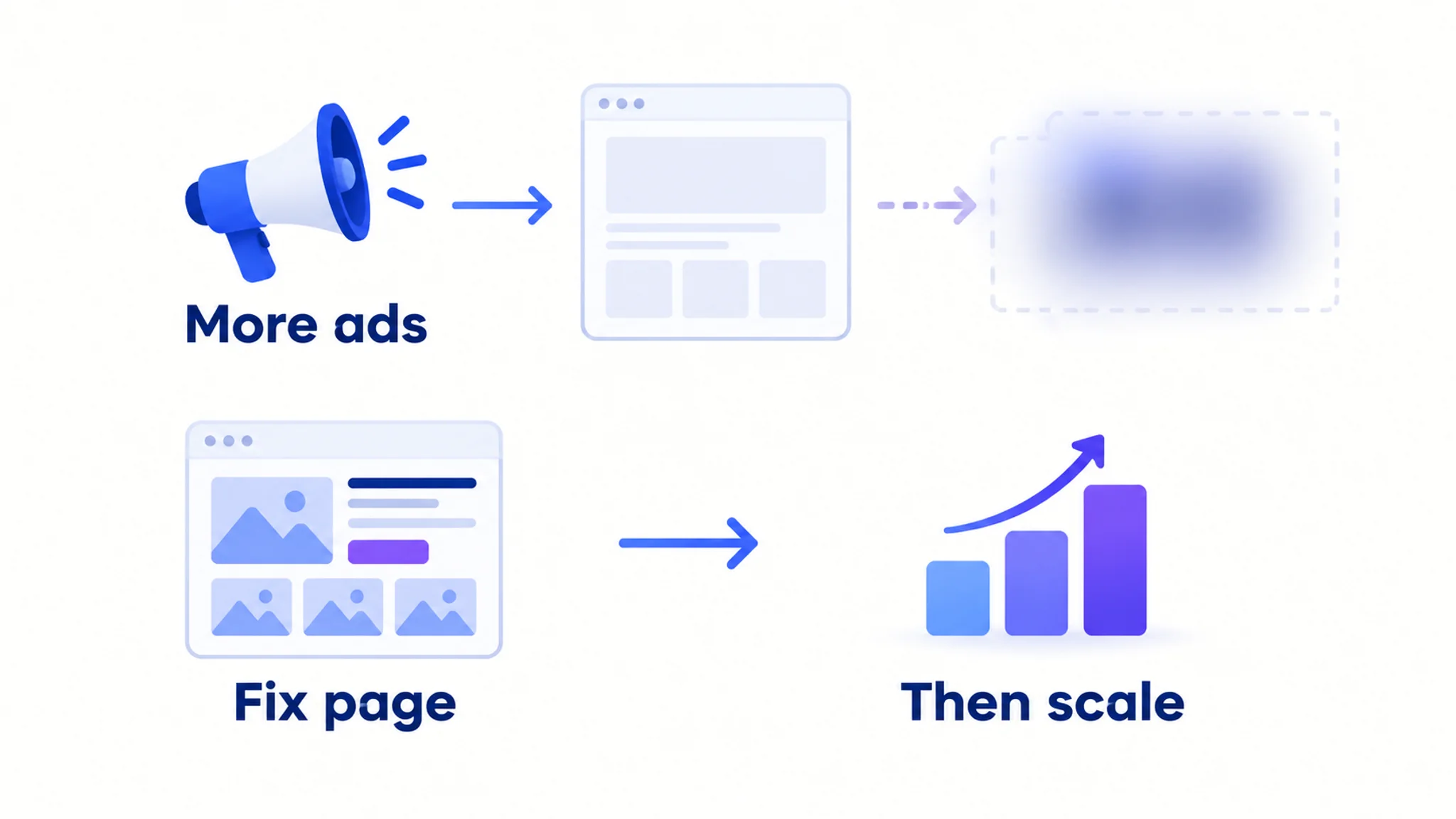
This is where the dough whisk case becomes a sequencing lesson. The team’s instinct was to keep iterating campaigns: keywords, bids, placements, maybe new creatives. DeepBI refused to start there because the listing had a 48/100 score with 0/25 on detail/A+. Option A was more ad iteration against a page that stopped selling below the gallery. Option B was repairing conversion capacity first so that any incremental traffic—paid or organic—landed on a page that looked and behaved like a category leader. Under a profit lens, Option B was non-negotiable, because otherwise every ad test is blurred by a low-information destination. The 22-point A+ deficit was more urgent than the 2-point main-image gap or the 4-point title gap.
The practical sequence runs from diagnostic to prescription. First, audit waste: search terms with clicks but weak CVR, placements that drain budget, and ad spend on SKUs whose margin cannot absorb it. Second, fix relevance. Mine high-converting search terms, test long-tail variants, and add negatives for irrelevant queries; this can improve CTR and CVR and keep traffic closer to intent. Third, adjust bids, budgets, and placements by product maturity and margin. Concentrate budget on proven winners, but keep defensive coverage where a competitor or category term protects a strategic position. Fourth, automate repeatable audits and bid rules, with review—automation can improve consistency, but it does not guarantee a lower ACoS.
Targeted ads can support sales and keyword relevance, which may indirectly contribute to organic visibility over time; results vary by category and execution. Use DeepBI Ads Quant’s four-layer funnel—explore, filter low-conversion traffic, focus on high-converting keywords and competitor ASINs, then scale proven traffic—as a mechanism for improving spend quality. Any optimization detached from real market benchmarks is a waste of resources.
A Profit-First Operating Loop with DeepBI
- DeepBI Listing Product Documentation (Merged Version). Treat the loop as a repeatable review cycle: define a profit or growth goal first, then inspect recent ad report data such as impressions, clicks, conversions, spend, ACoS, and TACoS; adjust bids and budgets only where recent signals support a change; review results against the original goal; and repeat. The source positions DeepBI as an executor and assistant rather than an autonomous decision-maker, so the seller owns the profit target, strategy preferences, and risk tolerance, while the system supports analysis and repeatable optimization. It also supports an observation window for performance review, which is why short-term ACoS fluctuations should not trigger random bid changes; the aim is to separate noise from stable click and conversion signals and improve CTR, CVR, and ACoS efficiency where the data supports it.
- project_0047. The system is positioned as an “executor,” not a “creator” or “decision-maker.” This boundary is useful for a profit-first loop: the seller sets the goal and strategic constraints, and the system handles the repeatable parts of analysis and optimization. For Amazon-only Sponsored Products workflows, DeepBI Ads Quant can adjust bids and budgets using recent click, conversion, spend, and ACoS signals to avoid short-term noise, but it should be treated as Sponsored Products optimization support rather than multi-platform management. Outcomes depend on margin structure and should be tested against your own economics; the loop is designed to improve decision quality, not to guarantee profit growth.
The dough whisk case shows why the loop starts with a goal and a diagnosis, not a bid change. The seller’s goal was healthier campaign economics, but the first review output was “listing is not retail-ready.” The system’s role as executor and assistant matters here: the seller owns the profit target, and the system supports analysis; in this case, that meant pushing a page rebuild before ad tuning. That boundary is also why the case did not begin with automated bid rules. Automation can improve consistency, but it cannot invent A+ content, trust signals, or a buying logic that the page never had.
Conclusion: Judge Amazon Ads by Profit, Not ACoS Alone
In practice, the opening dilemma resolves through the same discipline: ACoS describes ad efficiency, but it does not settle whether the campaign is worth scaling. Profit comes from retail awareness, stronger ASIN prioritization, content that earns clicks and conversions, and disciplined bid and budget work judged by contribution margin after ad spend. Use ACoS to diagnose efficiency, then confirm that the campaign is adding profit rather than merely buying revenue. That order keeps scaling decisions grounded.
The dough whisk seller’s most important shift was mental: high ACoS is not always an advertising problem. With a 48/100 listing against an 83/100 benchmark and 0/25 on detail/A+, tuning ads first was like repairing the sink while the main pipe was still cracked. Once title, bullets, main images, and A+ worked as one coherent buying logic, ads became a lever rather than a source of anxiety. If ad costs continue to pressure margins this year, review ACoS alongside profit before scaling spend.