


1. Why Fulfillment Choices Need an Ads Quant Operating Layer
Fulfillment is a cost-structure decision before it is a service-level decision. Choose FBA, SFP, or FBM and you fix three things at once: the per-unit cost floor, the delivery promise the listing inherits, and the margin left to spend on advertising. That third variable is where sellers most often lose control.
The real question: which cost structure can your ad economics support?
Work backwards. A higher fulfillment cost per unit compresses contribution margin, which lowers the ACoS your unit economics can absorb before orders turn unprofitable. A slower delivery promise weakens CVR, so the same bid buys fewer conversions. Either change alone re-prices every keyword. Treat allowable ACoS as derived from fulfillment economics rather than from a competitor benchmark, and budget and bid rules have an anchor; skip that step and the ad layer scales volume on top of a cost structure it never priced.
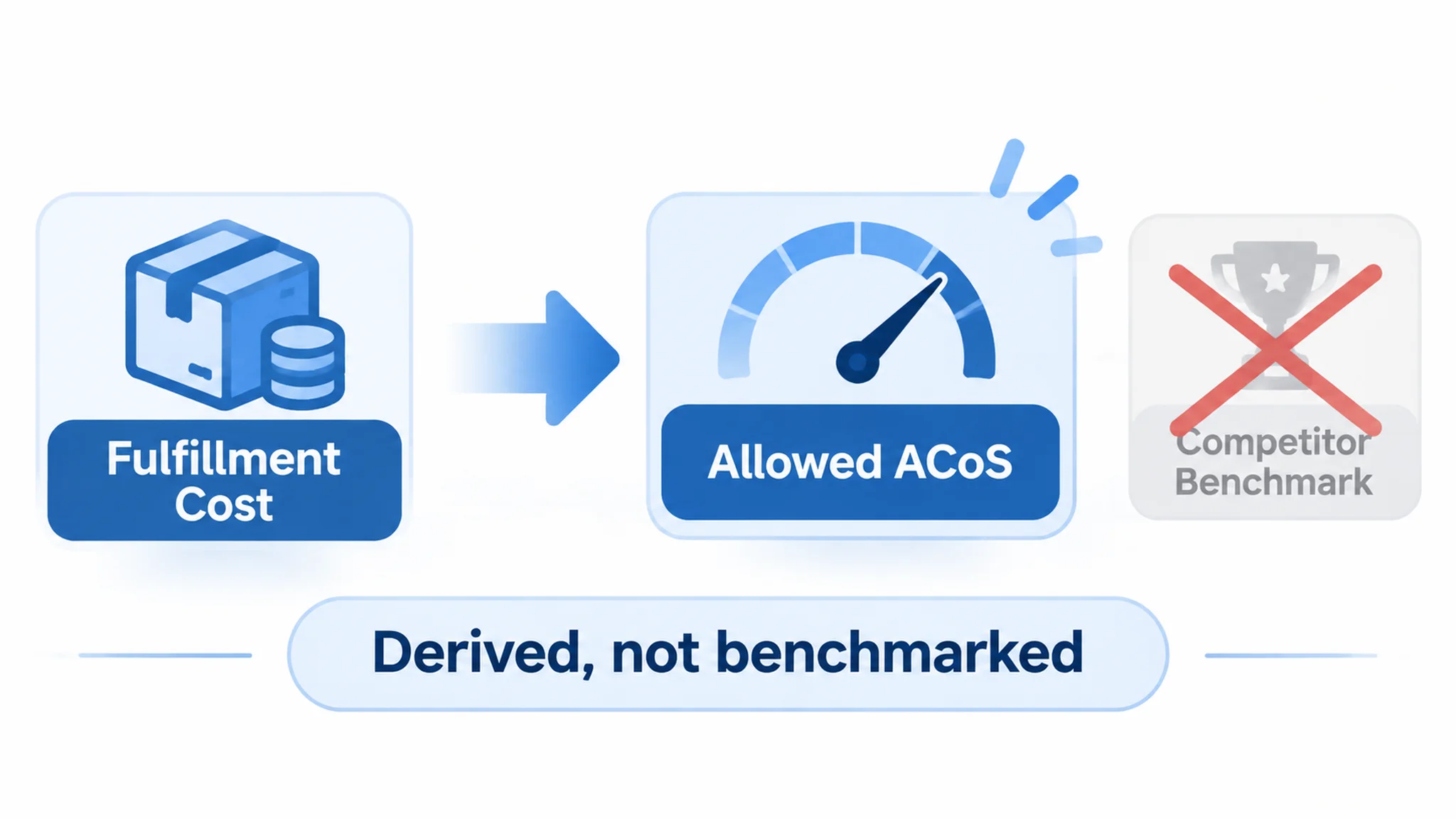
The FBA versus SFP versus FBM comparison that follows — cost, control, reach, operational burden — exists to answer one question: which cost structure leaves room to advertise?
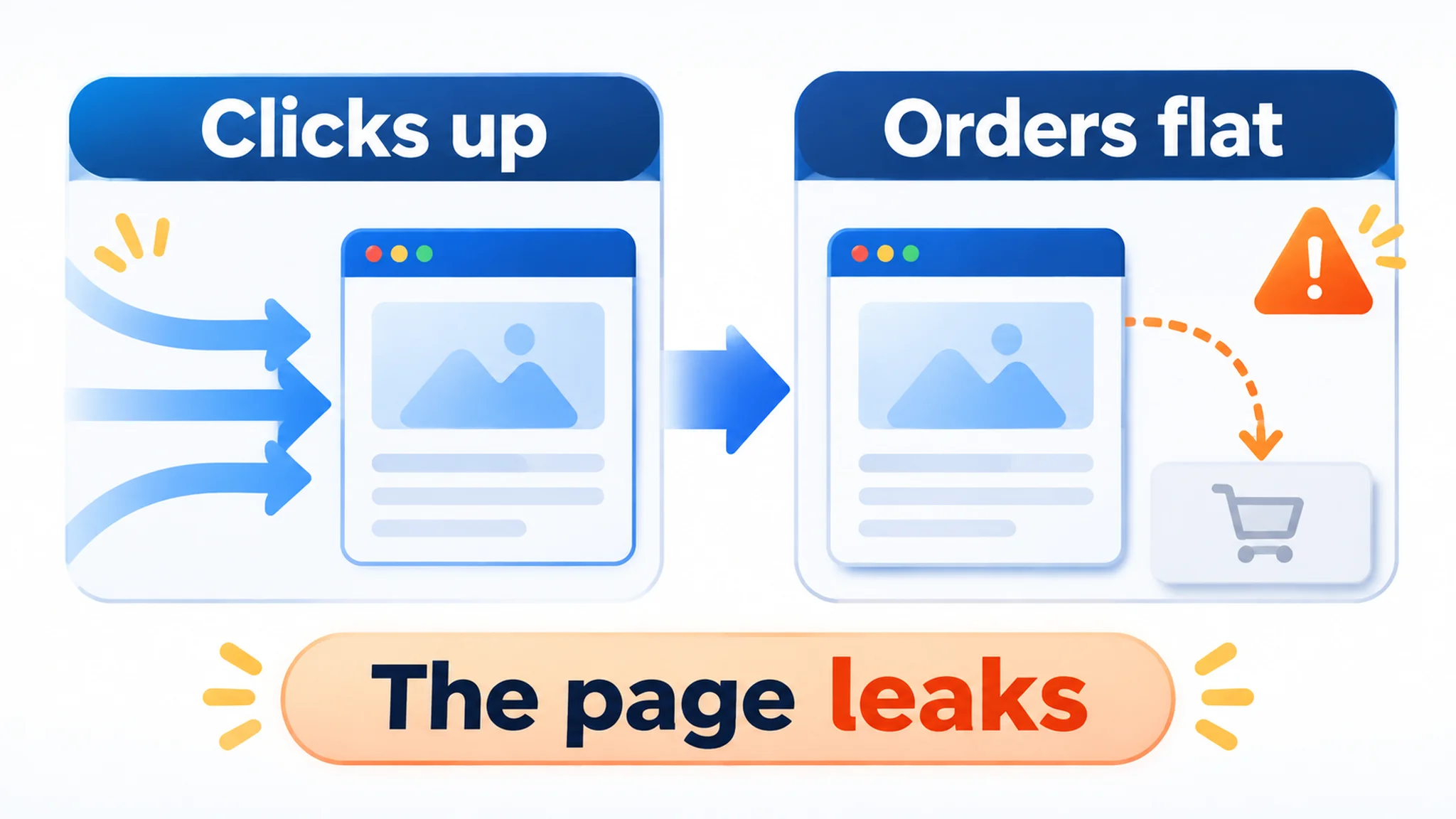
A parallel mistake appears on the conversion side of the same equation. Sellers assume that because the cost structure and the ad structure look sound, the remaining constraint must also sit in the ad layer. We have seen this play out in a mobile content-creation accessories account selling a magnetic back-camera vlog monitor for iPhone and Android. On paper the listing looked healthy: an overall listing score of 82 against a benchmark competitor's 83, 4.4 stars with more than 500 reviews, and a richer A+ story than most peers. Under rising ad pressure, traffic — paid and organic — was not turning into orders as expected, and ACoS was drifting out of a safe band. The team's first move was to refine keyword structure, adjust bids, and test more creatives. Click volume moved; conversion did not follow. The ad layer was being asked to compensate for a constraint that lived somewhere else entirely. Just as allowable ACoS has to be derived from fulfillment economics, conversion expectations have to be derived from what the page can actually close — otherwise every bid rule is calibrated against an assumption nobody verified.
What DeepBI does — and does not — control
DeepBI does not fulfill orders and does not manage carriers. It operates on the advertising and listing side: bids, budgets, keyword weighting, and creative iteration read against ad reports. Its contribution is making the ad layer measurable. When a new image is published, for example, the system marks a visual iteration event point in the ad reports so sellers can watch how CTR moves over the following 7–14 days, replacing subjective judgment with a data feedback loop.
That feedback only pays off if the constraint is real: set the ACoS ceiling from fulfillment cost, then let bid and budget rules operate beneath it. The same discipline applies to listing signals. In the vlog monitor account, ad reports were not short of data — exposure moved, CTR fluctuated — but the numbers were being read as an ad-efficiency story when they were really describing a page that could not convert the traffic it received. A feedback loop only produces a decision if the variable being watched is the variable that is actually binding.
2. Amazon Seller Shipping Options: FBA vs. SFP vs. FBM - A Bounded Decision Map
Cost, control, reach, and operational burden
FBA, SFP, and FBM/MFN are distinct fulfillment models, not interchangeable labels. FBA uses Amazon's fulfillment network. SFP lets the seller fulfill orders while meeting Amazon's Prime delivery and performance requirements. FBM/MFN leaves fulfillment entirely with the seller.
- Cost: FBA bundles fulfillment and storage into fees; SFP and FBM shift shipping, labor, and packaging costs to the seller. Compare total cost to serve, including returns handling and delivery exceptions, rather than headline rates.
- Control: FBA standardizes packing and delivery. SFP and FBM allow carrier choice, packaging inserts, and special handling.
- Reach: FBA provides broad network access. SFP and FBM reach depends on the seller's carrier coverage and geography. Prime eligibility can improve competitiveness, but it does not guarantee Buy Box allocation.
- Branding: SFP and FBM support custom unboxing and inserts. FBA leaves less room for that differentiation.
- Operational burden: FBA is the lightest. SFP is the heaviest because the seller must sustain Prime-level delivery performance. FBM is flexible but labor-intensive.
Why there is no universal winner
Use a bounded reach-versus-branding heuristic. If customers screen on delivery speed and the Prime badge, favor FBA or SFP where the economics hold. If differentiation depends on custom packaging, bundled inserts, or special handling, favor SFP or FBM only when operations can reliably hit delivery promises.
Pickup and delivery availability is conditional on seller location, carrier service coverage, and account settings. The right model protects contribution margin after fulfillment cost, ad spend, and expected return or negative-review risk. Prime eligibility may lift CVR and competitiveness, but it is not a guarantee. No model wins on every dimension.
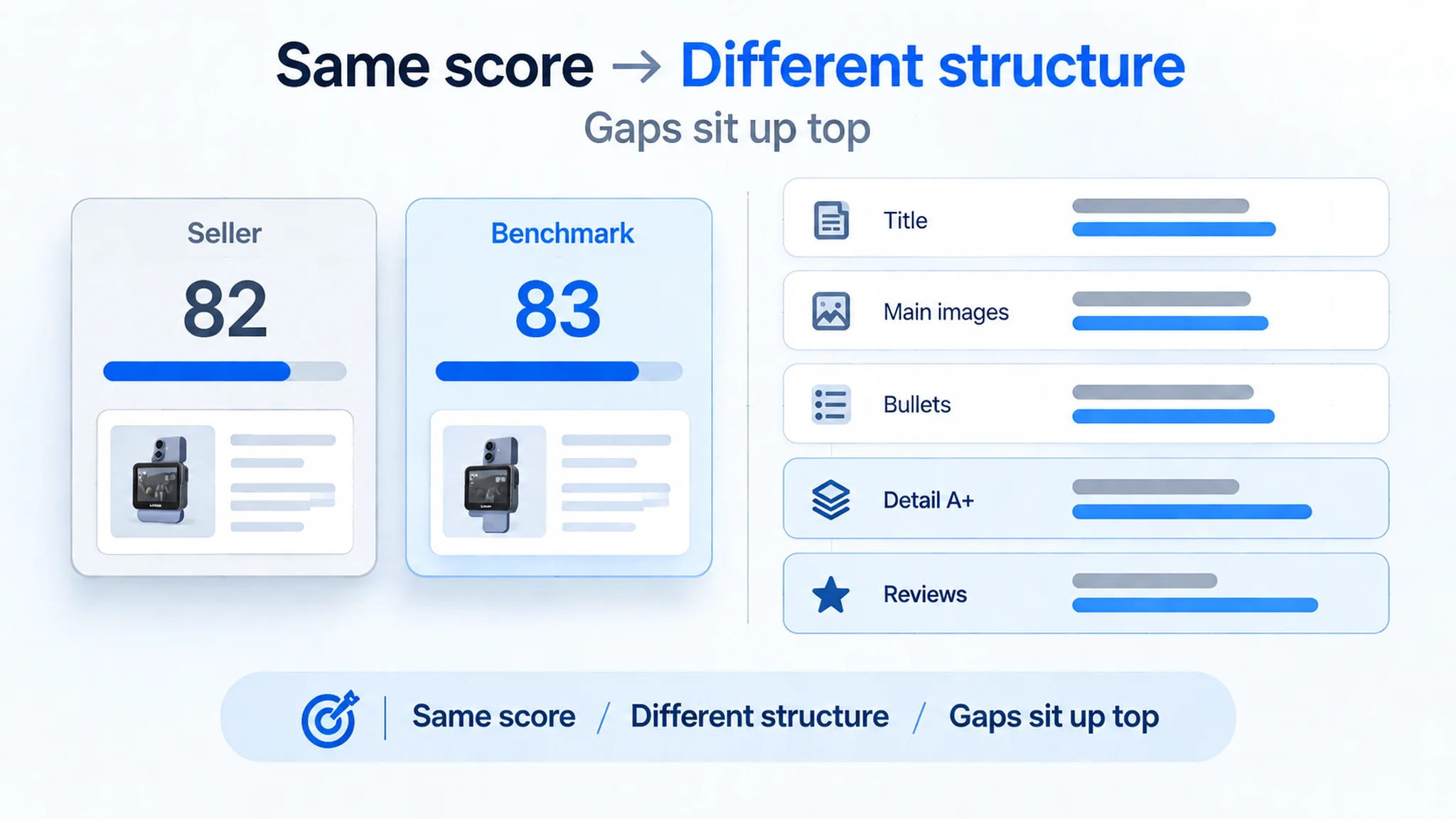
The same bounded logic applies when sellers compare themselves to a competitor. In the vlog monitor account, the benchmark comparison looked almost like a tie — title 15 versus 17, main images 25 versus 26, bullet points 7 versus 8 — while detail/A+ content actually ran ahead at 22 versus 20, and review trust was stronger with more reviews and a lower negative-review ratio. Read as headline numbers, there was no urgent gap to fix. Read structurally, the benchmark page was organized around the creator's decision sequence while the seller's page was organized around feature enumeration. That is the equivalent of picking a fulfillment model because the fee line looks competitive, without checking whether the total cost to serve holds up. A near-tie at the summary level can conceal a difference in kind rather than degree.
3. Fulfillment by Amazon (FBA): Amazon's Most Plug & Play Shipping Solution
FBA is operationally hands-off after inventory reaches Amazon's fulfillment centers. Amazon handles receiving, packing, shipping, customer service, and returns for FBA units. That reduces the seller's physical fulfillment workload, but it does not transfer ownership of the commercial model.
What Amazon handles and what the seller still owns
Amazon executes the fulfillment leg; the seller still owns inventory planning, listing quality, pricing, and advertising. Forecast errors, stale listings, weak price positioning, and poorly managed ad spend remain seller risks. A common failure mode is treating FBA as a complete growth system: inventory is sent in, the listing goes live, and the seller waits for demand. Operationally, that can look clean. Commercially, it leaves the demand engine unmanaged.
The listing-side version of this failure is treating the product page as fixed infrastructure. The vlog monitor seller had good reasons for confidence: A+ modules that beat the benchmark on richness and storytelling, review volume far ahead, and a lower negative-review ratio. The working assumptions followed naturally — the visuals are already more professional, the trust signals are already stronger, so if orders are lagging the leak must be in how traffic is bought. That is the same reasoning error as assuming that once inventory is in the fulfillment center the commercial work is done. The page was treated as a settled asset while bids, keywords, and creatives absorbed all the attention. DeepBI's listing analysis replaced the question "is this page good?" with a sharper one: is this page more persuasive than the best competitor at each decision step a buyer actually goes through? Moving from absolute self-assessment to external comparison is what exposed where the small gaps were load-bearing.
Listing quality and advertising are separate levers. DeepBI's listing diagnostics and ad-data feedback can help sellers read CTR and CVR signals after listing changes, but those signals do not replace inventory, pricing, or campaign decisions. FBA does not create traffic, guarantee sales, or secure the Buy Box. Prime-eligible delivery can improve conversion potential by removing delivery friction for Prime shoppers, yet the effect depends on demand, price, reviews, and listing relevance.
Fit and trade-offs: speed, control, fees, and brand experience
FBA fits sellers that prioritize speed and hands-off execution over direct control of packing, carrier selection, and returns handling. The trade-off is less control over the unboxing experience and a cost structure that must be modeled by fee component, not as one blended expense. Underwrite storage, fulfillment, and other charge components separately against contribution margin, then compare that margin with the CTR, CVR, ACoS, and inventory velocity the listing actually produces.
4. The Disadvantages of FBA: Cost, Control, and Visibility Risks
Fee variability and ancillary charges
FBA's base fulfillment fee is only one line in the cost stack. Aged-inventory storage surcharges, removal or disposal fees, unplanned services, and returns processing can change the effective contribution margin after a seller has already committed inventory. The risk is not that every fee is unpredictable; it is that several charges sit outside routine unit economics, so they surface late as margin leakage. A slow-moving SKU can absorb storage cost while still carrying ad spend; a removal decision adds cost at the exact moment cash is already tied up. Sellers need SKU-level oversight of inventory age, sell-through, and return patterns, not a single blended FBA rate. Otherwise, ACoS may look acceptable while net margin and BSR momentum deteriorate.
The conversion-side analogue is a listing that leaks margin in places the summary metrics never show. In the vlog monitor case, the page carried an 82 score and 4.4 stars with more than 500 reviews, yet specific costs were being paid beneath that surface: main image one never confirmed what was included in the kit, so buyers carried open questions about whether the magnetic ring, charging cable, and remote came in the box; the strongest front-versus-back-camera comparison sat at image six, where many buyers never scroll; and bullet points leaned on emotional framing like "capture warm moments" without a tight pain-point-to-proof loop. None of this shows up as a dramatic red flag at the summary level. It shows up as persistent conversion drag that raises the real cost of every click — the same way ancillary fulfillment charges surface late as margin leakage rather than as an obvious pricing failure.

Brand-experience and operational-visibility limits
FBA also separates the seller from parts of the customer experience. The seller controls listing assets and advertising, but not the final unboxing, handling, or post-purchase communication in the same way. For brand-sensitive sellers, that gap matters: a mismatch between product presentation and physical reality can damage reviews and repeat purchase, which then pressures CVR and raises the cost of every click. Platform-side review and approval status is another variable the seller cannot fully control; changes require preview, confirmation, and post-change visibility. Closer oversight does not mean rejecting FBA. It means assigning clear ownership for fee exceptions, inventory age, returns, and brand assets, then reviewing CTR, CVR, ACoS, and BSR together so cost and experience signals are not managed in isolation.
The same gap appears between a listing's presentation and what the buyer actually needs to know. The vlog monitor's A+ content was genuinely stronger than the benchmark's — clear problem-to-solution modules, real usage scenes with pets, makeup, and vlogs, before-and-after comparisons, and a consistent brand language. The structural flaw was ordering, not quality. The most decisive module, the front-versus-back-camera comparison that directly answers "why not just use my front camera?", was not elevated to the top of the flow. Quantitative advantages — 164FT or 50m range, 40ms latency, battery duration — were described but never summarized early as a single hard-proof block. Compatibility clarity, especially around MagSafe versus non-MagSafe phones and Google Pixel incompatibility, was pushed deep instead of surfaced early. A strong presentation that arrives in the wrong order still leaves the buyer unconvinced at the moment of decision, and that shows up downstream in reviews, returns questions, and weaker repeat purchase.

5. DeepBI Ads Quant: Turning Fulfillment-Cost Pressure into Budget and Bid Rules
Fulfillment cost changes the break-even line, but it does not adjust your bids. That work has to happen inside Amazon Sponsored Products. DeepBI Ads Quant is built for exactly that surface: Sponsored Products advertising execution. It is not a fulfillment provider, does not negotiate carrier rates, does not store inventory, and does not manage SFP or FBM operations. The fulfillment model is your decision; Ads Quant operates as an execution layer after that decision is made.
ACOS and ROI guardrails before scaling
When fulfillment costs rise, the same ACoS produces a thinner net margin. Ads Quant therefore treats ACoS as a guardrail tied to ROI and effective spend, not as a standalone target. Effective spend matters because budget burned on low-conversion traffic still consumes margin that fulfillment has already compressed. Guardrails are set before scaling: if a campaign's ACoS drifts past the ROI-justified ceiling, budget expansion stops until the signal recovers. The system executes against targets supplied by prior analysis or human instruction; it does not decide the optimization direction on its own.
This is why sequencing decisions matter more than the size of any single adjustment. In the vlog monitor account, the seller cycled through weeks of standard ad work — rebalancing keyword portfolios around "vlog monitor", "selfie screen", and "back camera monitor", testing campaign structures and bid strategies, refreshing creatives while leaving the underlying listing largely untouched. Exposure moved. CTR fluctuated. Conversion rate resisted improvement, ACoS stayed heavy, and the TACOS trend did not ease. Raising budget on top of a page that cannot close the traffic would have amplified the defect rather than fixed it: more clicks into a page that fails to quickly confirm kit contents, core pain-point relief, and compatibility simply increases wasted spend. A guardrail that stops expansion when ACoS drifts past the ROI ceiling is only protective if the direction of the fix is right — otherwise it just slows the rate at which you fund a leak.
Daily bid and budget adjustment without overreacting to noise
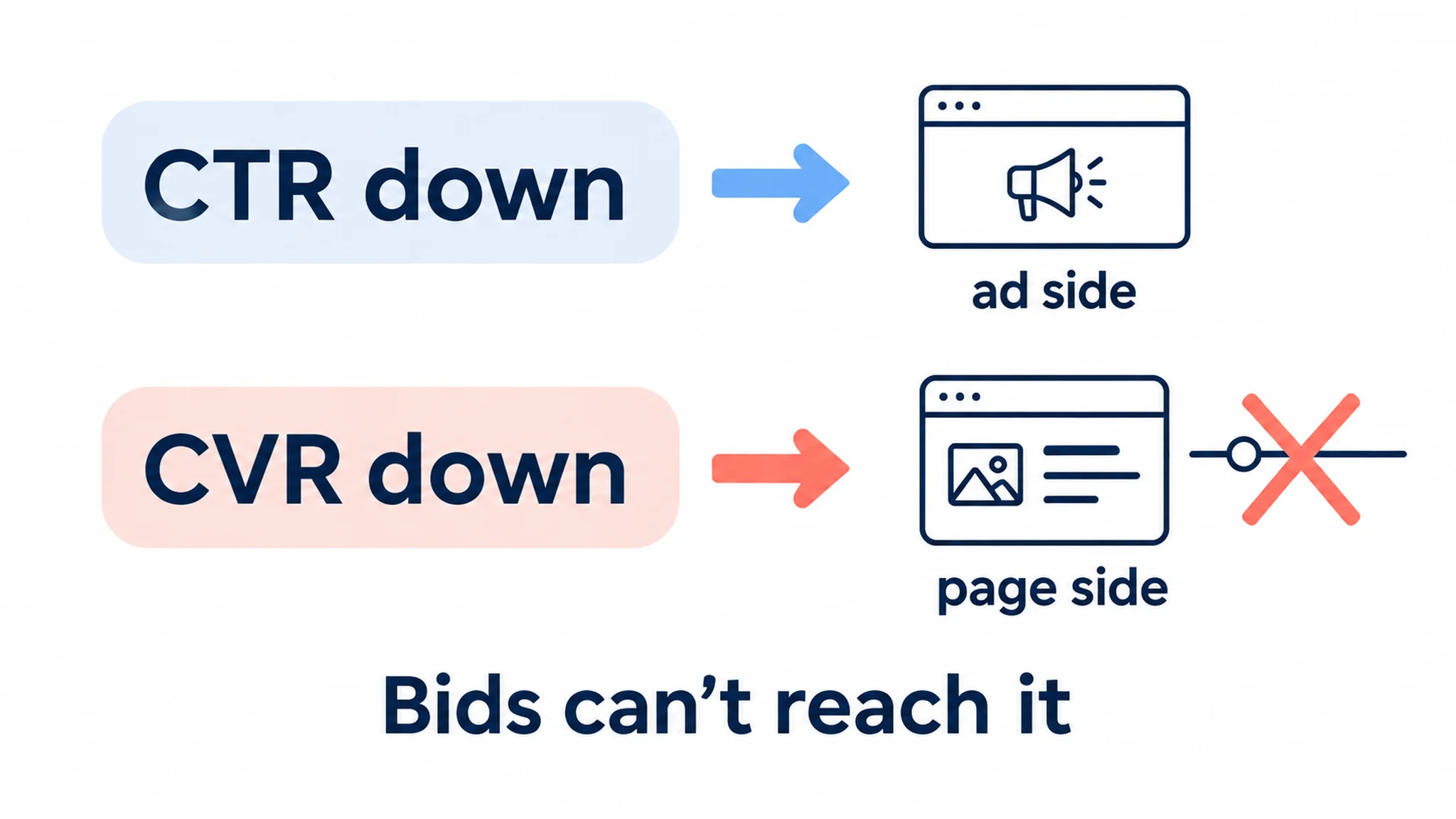
Daily adjustment should read recent click, conversion, spend, and ACoS signals across a recent window rather than a single day's swing. CTR and CVR are the leading indicators: a CTR breakdown points to click-side weakness, while a CVR breakdown points to conversion-side or detail-page weakness, and neither is fixed by raising bids. Ads Quant adjusts bids and budgets within that window so the response reflects a trend slope, not one noisy reading, keeping spend pointed at placements that still clear the ROI guardrail.
The diagnostic split between CTR and CVR is precisely what the vlog monitor case turned on. The seller read a CVR problem as a CTR-side problem. But when the listing was benchmarked against the strongest comparable product in the same subcategory, the gaps clustered where click-side metrics never look: title front-loading, main image sequencing, and bullet-point logic. The seller's title led with the brand name and moved into functional descriptors like "164FT Wireless Control" and "4K Magnetic Back Camera Monitor" before closing on "Black", while the benchmark led with the core search intent and named the audience and scenarios directly. Main image one showed a conceptual overview — monitor on phone, mounted to a tripod — without confirming the bundle. Those are conversion-side weaknesses, and no bid adjustment reaches them. Reading the signal correctly is what determines whether the next action belongs in the ad console or on the page.
6. DeepBI Ads Quant: Four-Layer Funnel for Cost-Controlled Scaling
Explore, filter, refine, and scale with evidence
DeepBI Ads Quant turns ad spend into a staged decision process rather than a single budget lever.
- Explore: open with keyword and competitor ASIN targets wide enough to surface demand signals.
- Filter: use recent ad data to remove low-conversion traffic before it distorts CTR, CVR, and ACoS reads.
- Refine: concentrate targeting and creative around high-conversion keywords and ASINs.
- Scale: raise budget and bids only for traffic that has already produced evidence.
Scaling is controlled expansion, not a blanket budget increase. If CTR and CVR hold while ACoS remains inside the profit band, incremental spend can be justified; if conversion weakens, the next move is refinement, not more spend. This protects BSR momentum and shortens listing cycle time by forcing decisions from observed traffic quality.
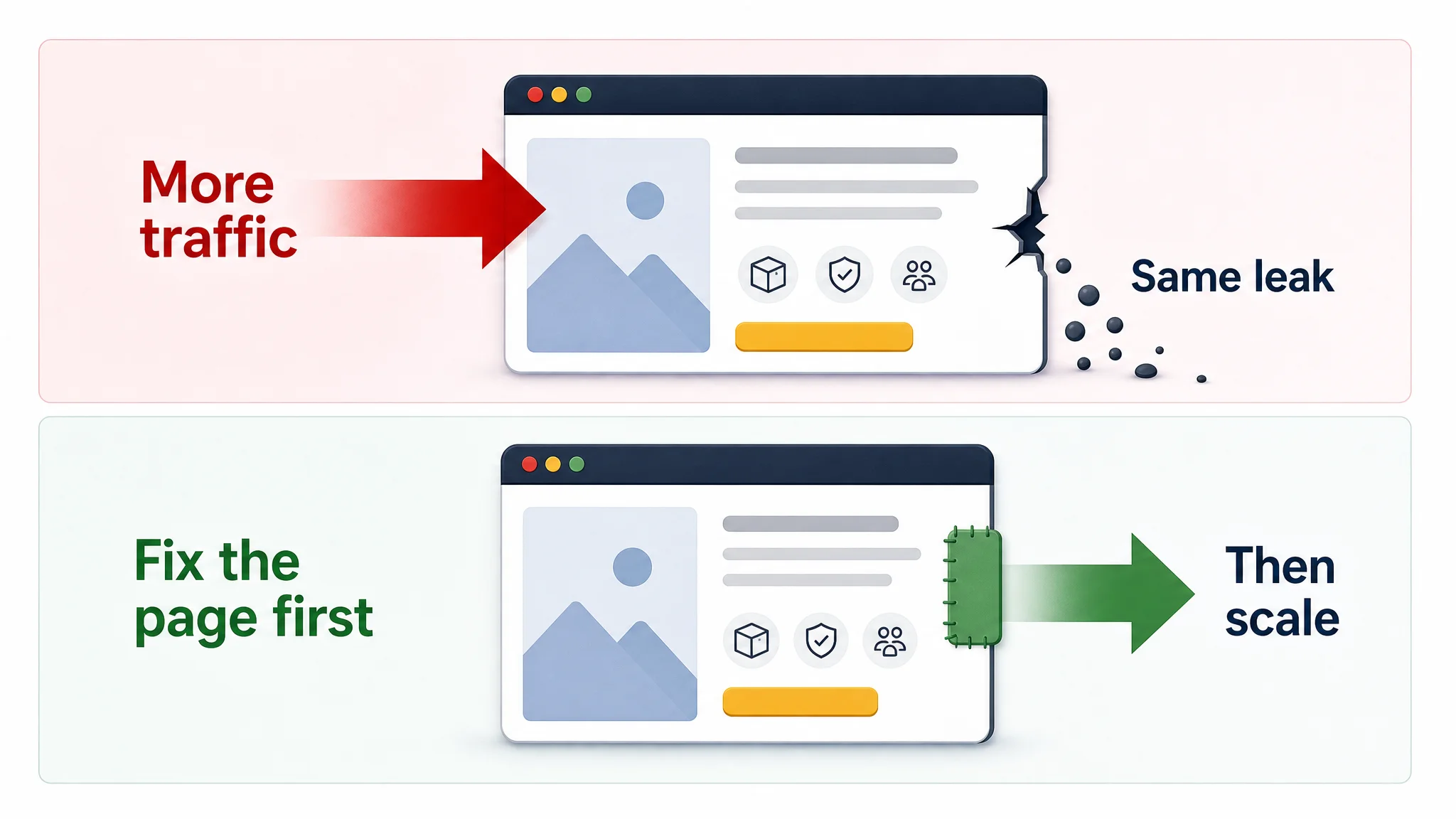
The refine stage is where most sellers misplace effort, because refinement can mean two very different things. It can mean tightening targeting, or it can mean rebuilding the asset that receives the traffic. In the vlog monitor case, the honest answer to "does this page deserve more traffic?" was no — and the evidence was structural rather than anecdotal. The score gaps against the benchmark were concentrated in title, main image, and bullet points, while detail/A+ content already ran slightly ahead and review trust was superior. That distribution told DeepBI where refinement would pay: rebuild the sales logic on the product page first so each incoming click has a higher probability of converting, then revisit ad scaling once conversion stabilizes upward and each incremental click carries a healthier expected return. Refining targeting on a page that has not yet earned the traffic just redistributes waste more efficiently.
Using competitorlayoutgap as a targeting lens, not a Listing claim
Use competitor_layout_gap narrowly: examine how competing offers present fulfillment promises and conversion cues, then translate those observations into keyword and ASIN targeting tests. It is a targeting input, not a Listing claim or fulfillment claim. Use the gap to decide where to explore, what to filter, and which traffic deserves refinement before budget or bid increases.
The vlog monitor case shows how much signal a careful gap read can carry. The benchmark title opened with "Magnetic Vlog Selfie Monitor Screen for iPhone & Android, 4K Wireless Video Recording with Remote Zoom & Shoot, Content Creator Essentials…" — naming the product, the audience, and the scenarios in one pass. The seller's title buried the primary keyword behind the brand and omitted long-tail scenario terms like YouTube, TikTok, and vlogging, which limited both search coverage and instant recognizability for creators scanning thumbnails at speed. That is a fair targeting input: it indicates where demand signals can be explored and which terms deserve refinement. It is not a claim about the seller's fulfillment model, and it should not be turned into a listing assertion without being tested.
7. Advantages of Amazon FBM/MFN: When Seller-Fulfilled Models Fit
FBM/MFN is a fit decision, not a default cost play. It can be the stronger operating model when the seller needs direct control over how an order is packed, presented, and handled, or when the product does not move cleanly through FBA's standardized flow. The advantage is control, not an automatic lower fulfillment cost.
Control, branding, and product-handling flexibility
Seller fulfillment lets the seller own packing standards, branding inserts, kitting, and handling steps. That control matters for products that need special packaging, configuration, or care that a standardized fulfillment process may not accommodate neatly. It also gives the seller direct command of inventory allocation and release, which can support launch timing and listing cycle time when speed to first available unit matters. When executed consistently, that control can support conversion rate by making the delivered experience match the listing promise, though it should be judged against CVR and ACoS impact rather than assumed.
Control over the delivered experience only converts into CVR when the promise itself is clear on the page. The vlog monitor seller controlled the product story end to end and still left basic questions unresolved at the top of the funnel. Main image one introduced a scenario — monitor on phone, mounted to a tripod — before establishing what a buyer receives. Later images brought in advanced scenes like pet vlogging and creator lifestyle setups before essential objections about ease of setup, compatibility, and range certainty had been resolved. The one image that spoke directly to the core pain point was buried. Control over presentation is only an advantage when it is used to answer decision barriers in the order buyers actually raise them.
Fit and trade-offs: delivery responsibility and operational load
The trade-off is explicit: the seller carries delivery-performance responsibility and the operational workload behind it. Packing labor, carrier selection, tracking quality, inventory synchronization, and exception handling sit with the seller. Service failures can damage cancellation metrics and CVR, and the added workload can lengthen listing cycle time or consume attention that would otherwise go to advertising and BSR growth. FBM/MFN fits sellers whose product-handling needs or control requirements justify that load. It does not fit as a blanket cost winner; compare it per SKU against the service level the listing and ad spend require.
Carrying operational responsibility has a page-level equivalent: unanswered pre-purchase questions become downstream workload. The vlog monitor's bullet points created resonance but not enough certainty. Built-in speakers for instant audio review, ultra-low latency, and extended wireless range were not framed as standalone selling points, and there was no explicit pro-tips area to pre-answer operational questions — which app to use for 4K, how the non-touchscreen behaves, how to review recorded video on the phone. On a product page, bullet points are often skimmed as the buyer's contract with the product. Missing usage guidance does not disappear; it relocates into customer service contacts and returns, the same way an unmanaged service promise relocates into cancellation metrics and CVR damage.
8. DeepBI Organic Traffic Bridge: Protecting TACOS and Natural Rank
Ad reports already hold the evidence: which search terms earn clicks, which convert, and which carry order value. DeepBI Organic Traffic uses those ad-derived signals to identify high-CTR, high-CVR, and high-order-value keywords, then treats that evidence as the input for reinforcing the terms worth defending. It is a secondary causal bridge, not a second Ads section: paid performance supplies the signal, and organic reinforcement applies it.
From ad keywords to natural-traffic reinforcement
Top of Search reinforcement should concentrate on high-value keywords where ad data shows both demand and acceptable economics. The aim is TACOS discipline and support for natural-order-share improvement, not a promise of rank movement. Weak evidence is expensive to reinforce because the term adds cost without strengthening the listing's organic position. Strong evidence makes the same budget work harder, since the keyword is already proving commercial intent through CTR, CVR, and order value. The practical filter is simple: reinforce only where paid signals and margin can survive together.
There is a second risk that sits alongside wasted reinforcement: a page with weak conversion efficiency struggles to defend or improve organic positions at all, which pushes the store into deeper dependence on paid traffic. That was the exposure in the vlog monitor account, where rising ad costs met a page that could not convert the traffic it already had. Ad-derived keyword evidence is only as reliable as the page receiving those clicks; if the page cannot close the demand a term represents, reinforcing that term compounds the problem on both the paid and organic sides.
One explicit decision-framework bridge sentence
After the seller chooses a fulfillment model, DeepBI Ads Quant sets budget and bid guardrails, and DeepBI Organic Traffic reinforces the keywords worth defending — but DeepBI does not execute fulfillment.
The handoff keeps fulfillment execution outside the software boundary. The software's role is to carry keyword evidence into ad guardrails and organic reinforcement, while the seller retains the fulfillment-model decision and the operating consequences that come with it.
9. Check Out These Additional Ecommerce Fulfillment Resources
How to use further reading without drifting off-topic
Keep further reading subordinate to the operating sequence: fulfillment model choice, ad budget guardrails, then evidence-based scaling. The themes below are optional study areas after you have reviewed your listing, Sponsored Products, and fulfillment-cost decisions. They are not DeepBI capabilities, and they should not pull the discussion into unrelated platform strategy.
- Fulfillment readiness: assess whether inventory, packaging, and delivery promises can support the demand your ads create before raising budget.
- Inventory turns as a capital choice: understand how faster or slower turns affect cash tied up in stock and the spend you can safely commit.
- Reverse logistics and returns experience: review how returns handling affects cost visibility, customer experience, and repeat-purchase risk.
Use each resource against one decision: readiness before budget ceilings, turns before controlled scaling, and returns experience before judging CVR or TACOS.
The vlog monitor case adds one more item to that readiness check. Before asking whether the page deserves more traffic, ask whether it answers what the buyer is buying, what problem it solves better than their current setup, and whether it works with their device. In that account, a one-point listing score gap against the benchmark concealed a difference in how the two pages guided a buyer's decision. Title, main images, and bullet points did not carry enough of the decision load, while the strongest A+ modules arrived too late to do maximum conversion work. Fixing that meant restructuring the title so the core keyword and creator scenarios came forward, re-sequencing the gallery toward bundle confirmation, performance proof, setup reassurance, and the front-versus-back-camera comparison, rebuilding the bullets around explicit advantages and a pro-tips section, and reordering the A+ flow so quantitative proof and compatibility logic surfaced early. Ads only scale what a page can already convert — so the more useful question before raising budget is whether the page has earned the traffic it is about to receive.