

The Hidden Cost of Amazon PPC Mistakes in 2025
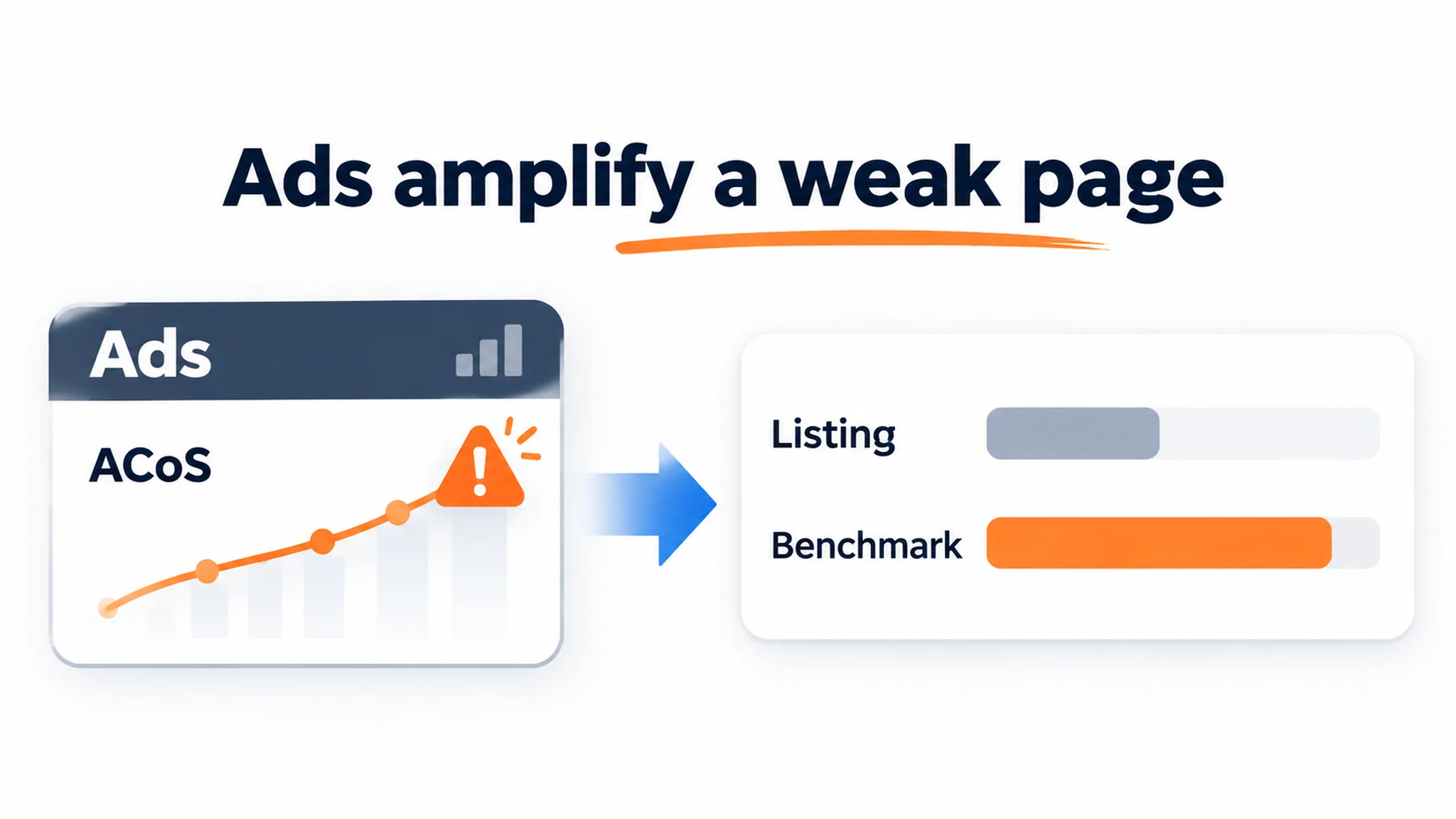
A bidding mistake rarely announces itself. A loose match type, an unchecked placement multiplier, a budget cap that runs out before peak conversion hours, or a bid rule applied to the wrong campaign can all look harmless in the interface. The damage appears later as a softer CTR, a weaker CVR, a rising ACoS, and a slower path to organic rank—often after the spend has already been committed. The first cost is wasted spend: low-intent search terms collect clicks, but the sale goes to a competitor or never happens. Because the waste is spread across many queries, it rarely appears as one obvious line item. The second is budget throttling: a campaign exhausts its daily budget early, then goes quiet during the hours when converting traffic is available. The reported ACoS may look controlled, but the campaign is no longer learning or selling at the right pace.
Distorted learning signals raise the price of every later decision. If bids, budgets, and negatives are changed too often, or if poor placements receive the same weight as converting ones, campaign data starts describing the seller’s interventions rather than real demand. Budget then follows noise. Profit falls even when the dashboard looks busy. Weak ad-to-organic follow-through compounds the loss. Sponsored Products is not only a direct-response channel; it also feeds keyword relevance and sales velocity that support organic visibility and BSR. When paid traffic is poorly targeted, the seller pays for clicks that do not reinforce the terms and conversion signals that matter.
A suction cup hooks seller showed how easily this cost can be misread as an ad problem. The seller saw a stubbornly high ACoS, expensive clicks, and campaigns that looked inefficient, so the team kept adjusting bids, keywords, and campaign structure. DeepBI’s diagnosis found a different constraint: against a benchmark listing in the US marketplace, the product page scored 66/100 versus 86/100. The largest gaps were title clarity, product-page trust, and review strength—not campaign settings. Ads were bringing traffic, but the page could not reliably convert it. That is why “high ACoS” was not the real enemy; the listing was the bottleneck the ad dashboard kept reflecting.
The corrective path is not a single bid change. It starts with diagnosis—search-term waste, placement drag, budget pacing, bid-rule conflicts, and campaign structure—then moves to restructuring match types, budgets, and controls, and ends with ROAS protection through guardrails and review cadence. Fix the system, not just the bid. In the suction cup hooks account, that meant reframing the problem as weak listing conversion capacity before more ad budget could amplify the page’s existing weaknesses.
30 Critical Amazon PPC Bidding Mistakes That Destroy Your ROAS
Use this as an audit checklist, not a verdict. Six diagnostic categories trace ROAS leakage from bidding logic through structure, targeting, budgets, optimization cadence, and platform execution. Confirm each pattern in ad reports before changing a bid.
Fundamental Bidding Strategy Errors
Waste preview: unprofitable bids and untied CVR or cost per conversion.
- Bidding to rank before break-even ACoS → set margin-based bid ceilings.
- Using one strategy for launch, growth, and harvest → assign stage-specific goals.
- Treating suggested bids as targets → anchor to CVR and cost per conversion.
- Raising bids to fix weak CTR or CVR → correct listing or targeting first.
- Changing bids without a baseline → log shifts and compare control periods.
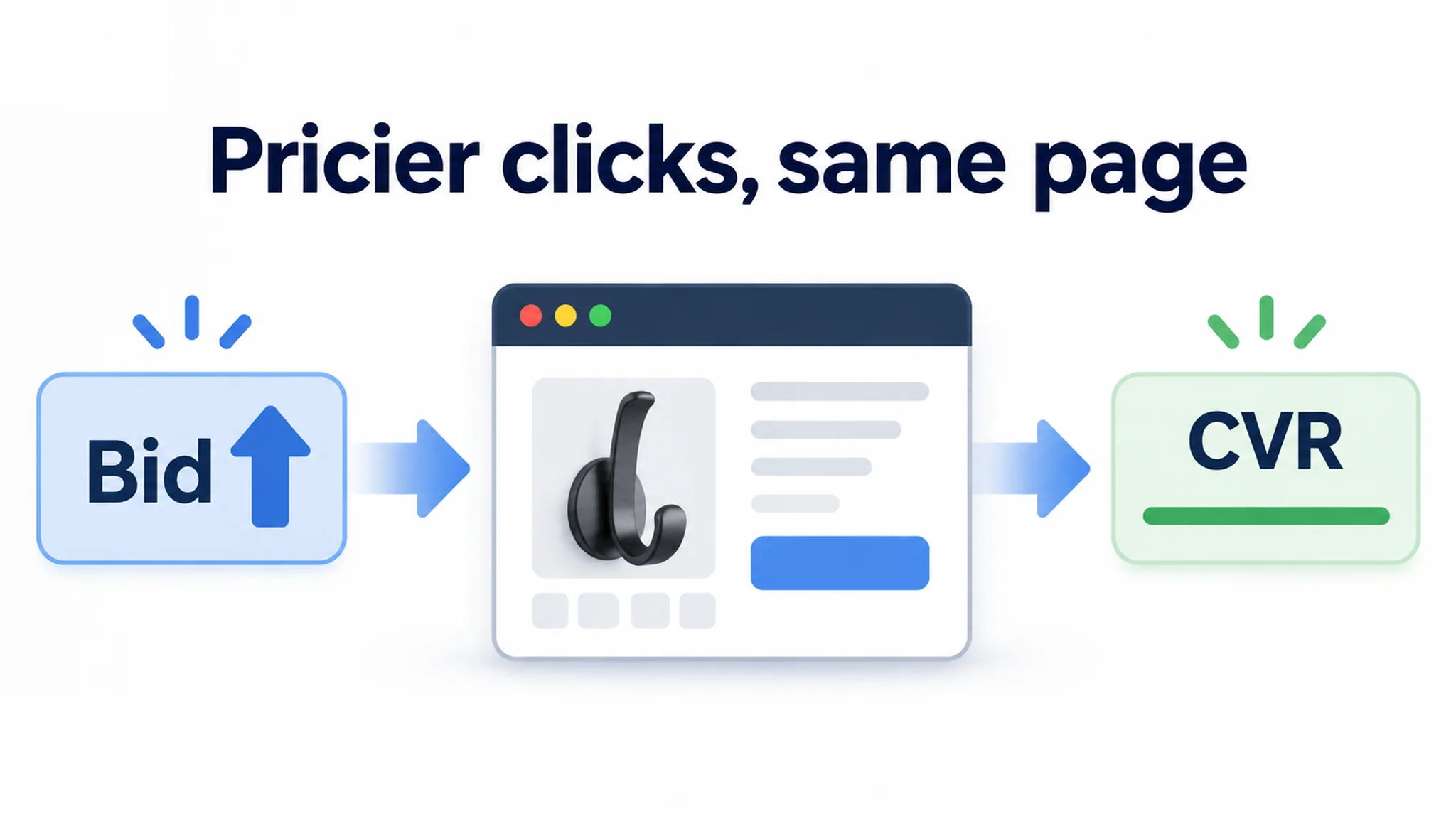
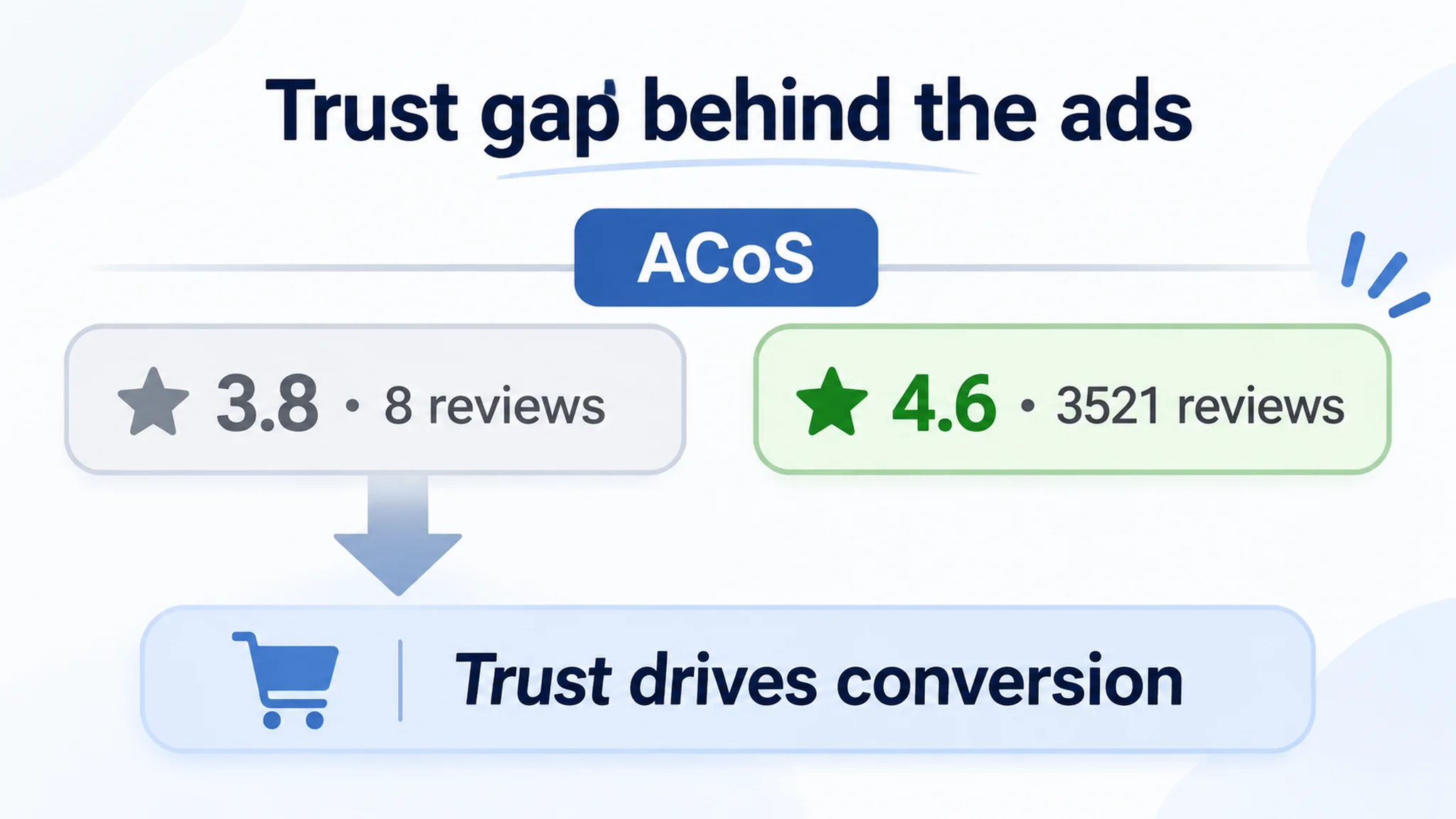
The suction cup hooks seller followed a common version of this mistake: the team treated high ACoS as a bidding problem and kept iterating bids while leaving the listing logic largely unchanged. The diagnosis showed why that order was wrong. The target title scored 9 against the benchmark’s 17, reviews scored 5 against 13, and the review base was 3.8 stars with 8 reviews versus 4.6 stars with 3521 reviews. Those gaps meant clicks were being bought at market prices but landing on a page that had not built enough trust or decision support to convert them. Raising bids to fix weak CTR or CVR would only have bought more expensive evidence of the same problem.
Campaign Structure Catastrophes
Waste preview: overlapping auctions, diluted budgets, unreadable ACoS attribution.
- Mixing match types in one ad group → separate to isolate intent and bids.
- Grouping ASINs with different margins → organize by economics and campaign role.
- Combining branded defense with prospecting → separate for readable ACoS.
- Letting campaigns compete on same terms → audit overlap, consolidate, or negate.
- Running auto as set-and-forget discovery → mine terms and graduate winners.
Clean campaign structure makes ACoS readable, but it cannot create conversion capacity that the page lacks. In the suction cup hooks account, the ad team could have separated match types and clarified campaign roles, yet the customer would still have arrived at a title with vague value language, visuals that described performance without proving it decisively, and A+ content that listed functions without reducing compatibility risk. Structure is necessary for control, but it is not a substitute for a listing that can carry the traffic.
Keyword Research and Targeting Blunders
Waste preview: irrelevant clicks, weak CVR, and spend without orders.
- Targeting broad terms without negatives → build negatives from search-term reports.
- Assigning one bid to every match type → set bids from conversion data.
- Copying listing keywords without validation → keep terms with relevance and orders.
- Targeting competitor ASINs without checks → validate price, rating, and relevance.
- Ignoring close variants → add negative exact and phrase terms early.
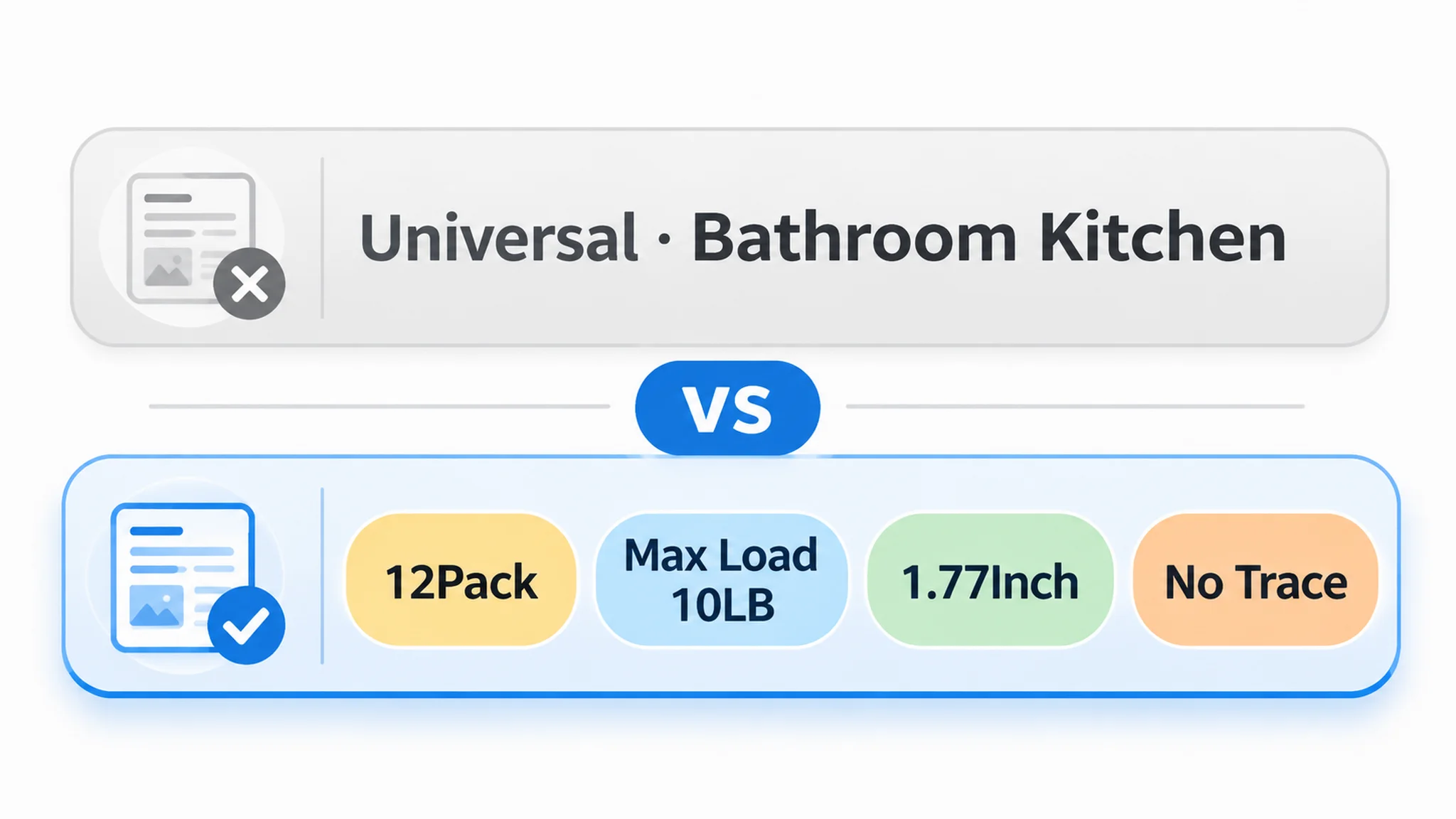
Keyword work also has a ceiling when the listing does not answer the user’s decision questions. The suction cup hooks seller assumed keywords were not tuned enough, but the benchmark title was doing more than stuffing terms: it placed brand and core keyword at the front, used concrete numbers such as “12Pack,” “Max Load 10LB,” and “1.77Inch,” expanded surfaces to tile, glass, window, shower, kitchen, and bathroom, and added pain-point language such as “No Trace, Reusable & Removable.” The target title used vague phrasing like “Universal” and covered a narrower set of scenarios. This is why keyword validation has to include page relevance and conversion logic, not just search volume and bid.
Budget Management Disasters
Waste preview: capped demand, spend spikes, and misallocated budget.
- Capping daily budget below profitable demand → size by role and ACoS headroom.
- Spreading budget evenly → fund campaigns with CVR evidence and ACoS control.
- Reviewing spend only monthly → use pacing checks before TACoS distortion.
- Giving weak campaigns proven budgets → set separate caps and weekly reviews.
- Changing budgets without alerts → define spend thresholds and document shifts.
When a page cannot convert, more budget mostly buys more exposure to the same weakness. DeepBI’s diagnosis of the suction cup hooks account was direct: further ad optimization without fixing the page would mainly amplify inefficiencies. The seller did not need a larger budget to solve a listing-trust problem; it needed the title, images, bullets, and A+ content to give paid traffic a better chance of converting. Budget should be released only after the page shows it can carry the demand.
Advanced Optimization Oversights
Waste preview: premature changes, single-metric decisions, missed harvest cycles.
- Changing bids too early → wait for enough clicks and conversions.
- Judging keywords by CTR alone → evaluate CVR, ACoS, and search-term intent.
- Leaving winners in discovery → move proven terms into exact-match control.
- Keeping losers because they have clicks → reduce, negate, or restructure.
- Cross-validating ad and business reports inconsistently → reconcile ACoS and TACoS first.
The suction cup hooks seller was not short of optimization activity; it was applying that activity before the page could convert. The team kept changing bids and search terms, but return did not improve because the product page was not communicating enough value, clarity, or safety. This is the advanced-optimization trap in practice: judging keywords by clicks or ACoS while missing the downstream CVR signal. Before changing bids too early or treating CTR as a verdict, the account needed to reconcile ad reports with the listing’s conversion reality.
Platform-Specific Pitfalls
Waste preview: misread signals and execution gaps that raise cost per order.
- Treating auto and manual as interchangeable → align objectives with campaign type.
- Reading suggested bids as market prices → treat them as directional inputs.
- Applying one bidding logic across formats → separate reporting and rules.
- Ignoring placement-level performance → reallocate only where CVR supports it.
- Running search-term reviews ad hoc → set a recurring cadence with owners.
The suction cup hooks account is also a platform-signal problem. The ads dashboard reported high ACoS, but the underlying platform signal was weak CVR and weak review trust. The benchmark listing had a mature trust engine behind each click: 4.6 stars, 3521 reviews, and a first page dominated by 4–5-star feedback. The target listing had almost no social proof and visible risk signals. Reading only the ad dashboard would have hidden the fact that the platform was already telling the seller the page could not carry the traffic.
The Implementation Framework: A 90-Day Bidding Reset
A bidding reset works only when diagnosis precedes action and every change has an owner, a metric, and a review gate. Use the sequence below to stop wasted spend first, then rebuild structure, then test advanced levers without confusing correlation with causation.
Phase 1: Stop the Bleeding (Week 1)
Goal: establish an objective baseline and remove obvious waste before restructuring.
- Pull a baseline from the search-term and campaign reports: impressions, clicks, orders, CTR, CVR, spend, CPC, ACoS, and conversion value; flag CTR below 0.35% as a click-side signal and CVR below 7% as a downstream signal where volume is sufficient.
- Run negative-keyword cleanup from the search-term report: isolate irrelevant, high-spend, zero-order terms and add them as exact or phrase negatives; avoid negating terms that already convert.
- Complete a campaign-role audit: label each campaign as discovery, exact-match conversion, ranking defense, or margin protection, and remove overlapping roles that compete for the same traffic.
- Set a profit-based max CPC from unit margin and observed CVR; cap bids at the break-even level and use a spend guardrail for campaigns with weak order data.
- Open a change log with date, owner, hypothesis, metric to watch, and manual reversal rule so every edit remains traceable.
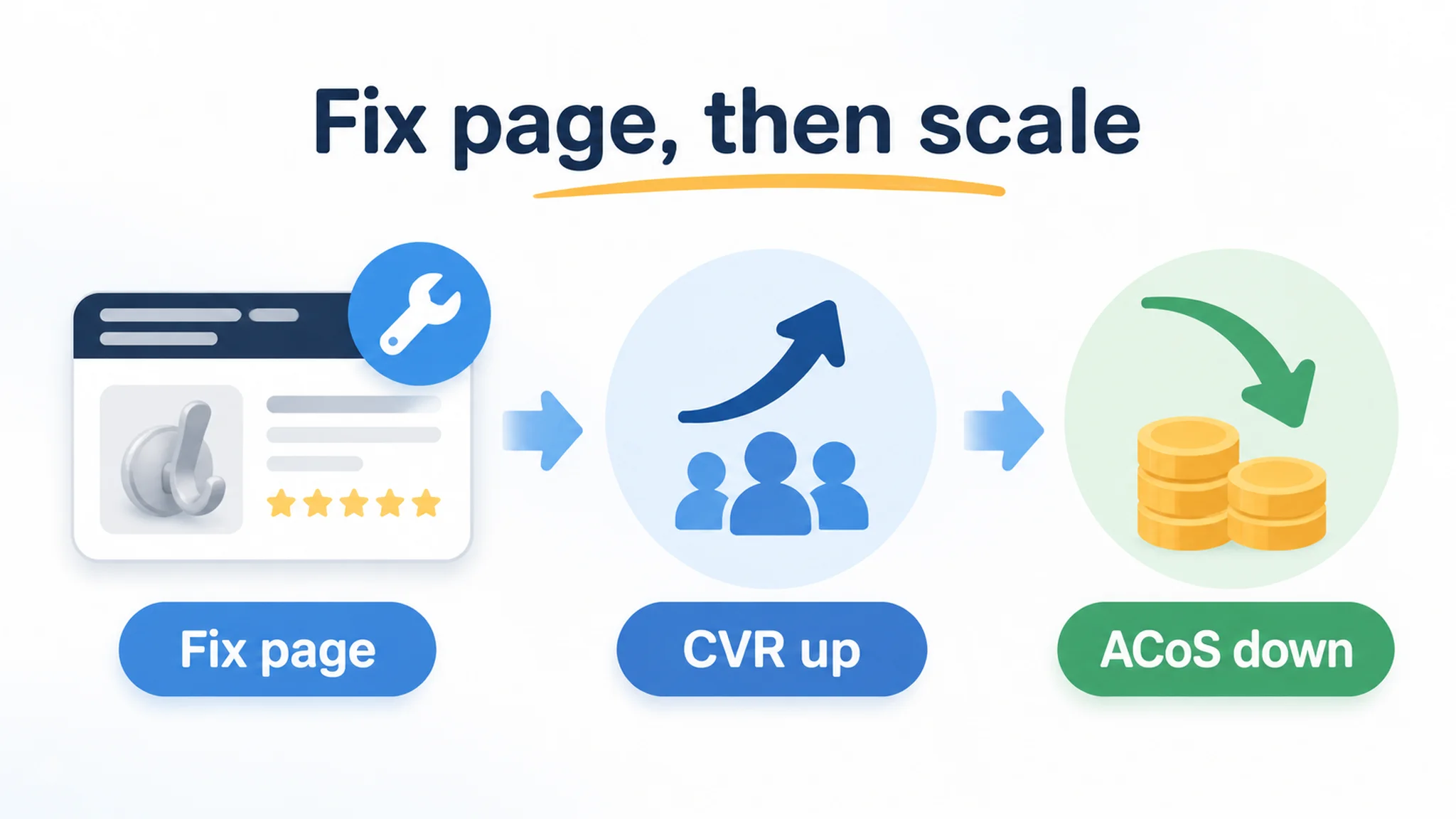
In the suction cup hooks account, the baseline that mattered was not only the campaign report. The listing score against the benchmark exposed the first bottleneck: 66/100 versus 86/100, with title at 9 versus 17, detail/A+ at 21 versus 24, and reviews at 5 versus 13. That baseline changed the order of operations. Negative-keyword cleanup and bid guardrails could stop obvious waste, but the account also needed a listing diagnosis before the team could interpret CVR and ACoS correctly.
Phase 2: Restructure for Success (Weeks 2-3)
Goal: rebuild campaign and match-type structure around clear portfolio objectives.
- Restructure campaigns by role and match type: keep proven converters in controlled exact-match campaigns; use phrase or broad/auto only for discovery with separate budgets.
- Assign match-type roles explicitly: exact for profit capture, phrase for controlled expansion, broad/auto for query mining; route converting search terms upward and negatives back to discovery.
- Set portfolio objectives by margin tier: define target ACoS or allowable cost per order per group rather than one blended target; protect high-margin groups and constrain low-margin groups.
- Use selective replacement: keep campaign elements that still perform and replace only the validated weak slot; avoid a full teardown that destroys learning.
- Define decision rules before launch: scale only when CTR, CVR, and ACoS stay within the role target; hold when data is thin; cut spend where the guardrail is breached.
Restructuring also has to account for what the traffic lands on. The suction cup hooks diagnosis did not call for a full teardown of the product or a blind budget reset; it called for selective replacement of the parts that were failing the conversion decision. The title needed to move from a generic product label to a conversion-oriented statement. The bullets needed to follow the user’s life cycle: durable, easy to install, removable without damage, waterproof and reusable, and usable across scenes. Campaign roles can route cleaner traffic, but the endpoint still has to answer the buyer’s questions.
Phase 3: Advanced Optimization (Week 4+)
Goal: test advanced levers in controlled increments and separate ad effects from organic movement.
- Test placement multipliers one at a time: top-of-search, product pages, and rest-of-search; hold budget and bid baseline stable while reading CTR, CVR, and ACoS.
- Test dayparting only where hourly data is sufficient: isolate hours with high spend and weak CVR, then shift budget toward windows with stronger order efficiency.
- Test bid rules with approval gates: base rules on ACoS, CTR, CVR, and spend thresholds; route exceptions to manual review instead of letting automation create duplicate or conflicting edits.
- Measure organic lift alongside ad metrics: track total sales, organic rank and BSR movement, branded versus non-branded demand, and use a predefined observation window such as 7-14 days where data volume allows.
- Run a weekly governance review: confirm checklist completion, compare results with the change log, and decide to scale, hold, or manually reverse each test before the next cycle.
Advanced levers such as placement multipliers, dayparting, and bid rules only make sense after the page can convert the traffic they help shape. DeepBI did not recommend “more ad tuning” first in the suction cup hooks account because the real constraint was listing conversion, not traffic volume. Testing a placement multiplier on a page that still has a weak title, thin decision support, and a weak review base would mostly produce cleaner reporting around the same conversion problem.
From Paid Bids to Organic Lift: Measuring TACOS and Total Impact
The Ads Quant discipline is not only a lever on ACoS. It is a way to buy cleaner demand signals. When a Sponsored Products campaign produces real sales velocity on relevant search terms, those clicks and conversions can support organic rank by strengthening the keyword-level performance that Amazon uses to judge relevance and customer response. But the link is conditional, not automatic. Paid sales that arrive through poor-fit terms, discount-dependent placements, or weak CVR can inflate ad sales while adding little organic reinforcement. The question is not “Did paid search generate orders?” It is “Did paid search generate incremental orders that improve the listing’s market position?”
TACOS is the first reality check because it measures ad spend against total sales, not just ad-attributed sales. ACOS tells you how efficiently the ad budget converts ad clicks into ad revenue; TACOS tells you whether the paid motion is becoming a larger or smaller tax on the whole business. Track it beside organic order share—organic orders divided by total orders—and BSR movement. A healthy pattern is rising total sales with stable or improving TACOS and a stable or rising organic order share. A warning pattern is flat total sales, falling organic order share, and paid orders replacing demand that would have converted anyway.
That distinction is incremental lift versus cannibalization. Before scaling bids, compare total sales, organic order share, CTR, CVR, and TACOS across bid changes. If paid sales rise but organic orders fall by a similar amount and total profit is flat, the campaign may be harvesting existing demand rather than creating lift. If total sales and organic order share hold or improve while TACOS stays controlled, the paid signal is more likely reinforcing the listing.
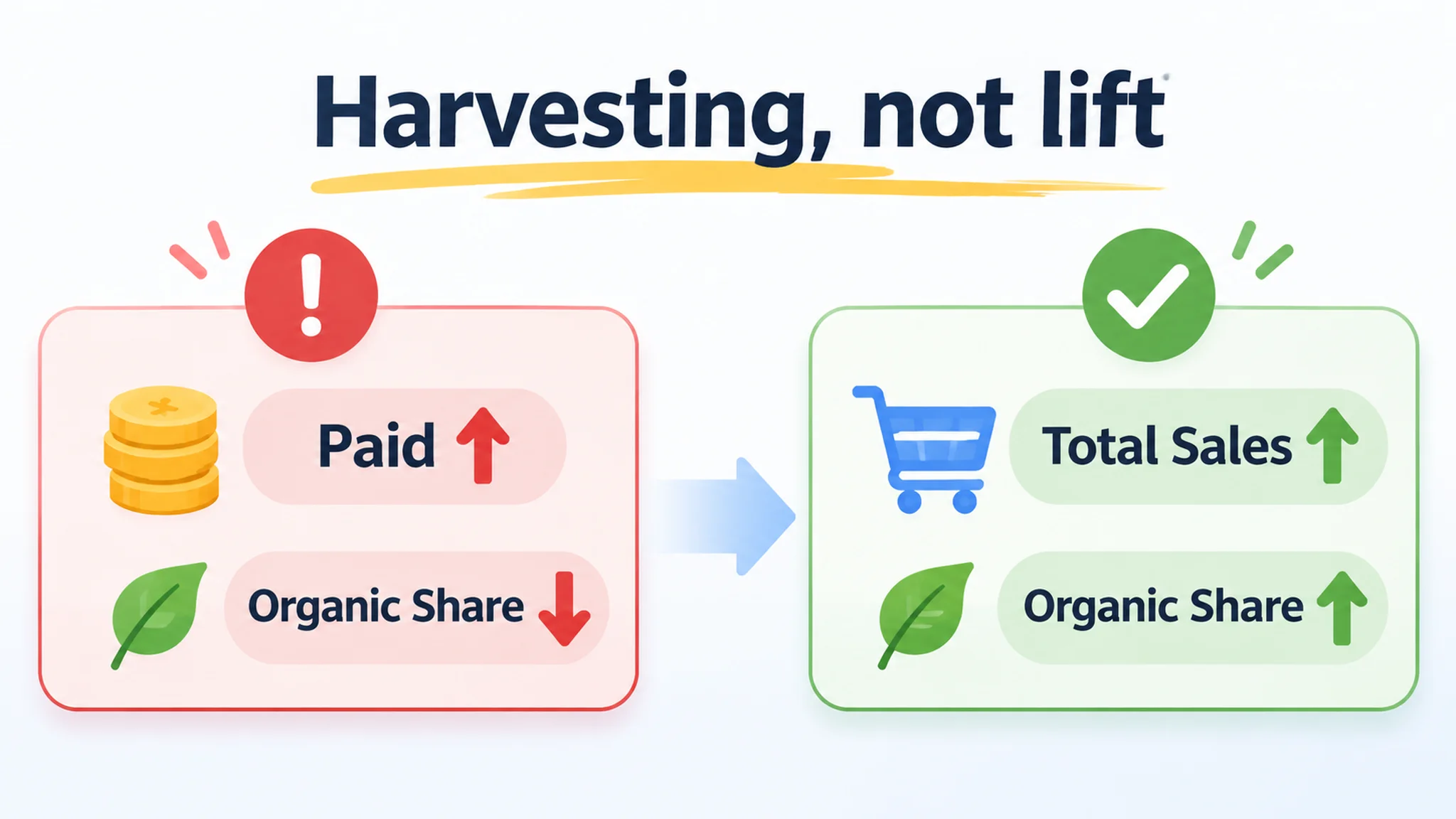
The suction cup hooks account is a useful reminder that ACOS can be a symptom rather than the root metric. The seller saw high ACoS and assumed the ads were inefficient, but the page had a title gap, a review-trust gap, and an A+ decision-support gap. In that condition, paid orders can look like activity while doing little to reinforce the listing’s market position. The better question was not “How do we force ACoS down?” but “Can this page turn paid traffic into orders that strengthen the listing?”
DeepBI’s fifth-layer organic traffic strategy applies this logic on Amazon. It harvests high-CTR, high-CVR, and high-order-value keywords from ad data and reinforces top-of-search coverage around those terms to support organic growth. This is a directional framework, not a guarantee: paid signal can reinforce organic performance only when it reflects genuine customer response and is checked against total-profit impact.
The Bottom Line: Your 90-Day Transformation Plan
The reset works as a repeatable operating rhythm—diagnose, correct, test, measure, scale—not as a single bid change. Use this checklist to keep the sequence disciplined and adapt each rule to the account’s structure, maturity, and margin profile. The suction cup hooks diagnosis is the reason the sequence starts with diagnosis rather than scaling: before pushing more budget, the seller had to ask whether the listing deserved more traffic and whether the product page could turn that traffic into orders.
- Run the audit in sequence: review bid basis, campaign structure, search-term waste, budget pacing, and profit measurement. Use CTR, CVR, ACoS, and budget utilization to locate the first bottleneck.
- Apply the profit-based bid rule: maximum CPC = allowable ad spend per order × conversion rate. Treat that ceiling as the bid limit for every target and portfolio review.
- Separate campaign roles: keep discovery campaigns, such as broad match and auto, distinct from exact-match performance campaigns; separate growth budgets from profitability budgets.
- Hold a weekly negative-keyword review: use search-term cost and conversion data to prune wasteful queries and promote converting terms into controlled exact targets.
- Test budget and placement changes against a baseline: adjust budget pacing, placement modifiers, and dayparting one variable at a time; do not scale until the measured result holds.
- Review TACOS and CM2 together: check total ad cost against total sales and contribution margin after PPC, not ACoS alone, to catch cannibalization or weak incremental lift.
- Scale only validated traffic: concentrate budget and bids on terms that survived screening and precision checks, and record the decision rule before the next change.
- Repeat the cycle: feed results into the next weekly review, mark the change point, and measure the trend before making another adjustment.