


Why This Playbook Fits the Current State of Amazon Search
Growing Amazon organic search traffic remains the objective, but the mechanics of earning it have shifted.
As Amazon revises search ranking and adds AI-assisted shopping surfaces to search in the current selling cycle, the platform is reading shopper behaviour more closely than keyword density. Placement decisions now reward measured shopper response and parseable listing content: a main image that earns the click, bullets that resolve doubt in one pass, A+ content that closes the sale. Stacking the same term a fourth time does none of that.
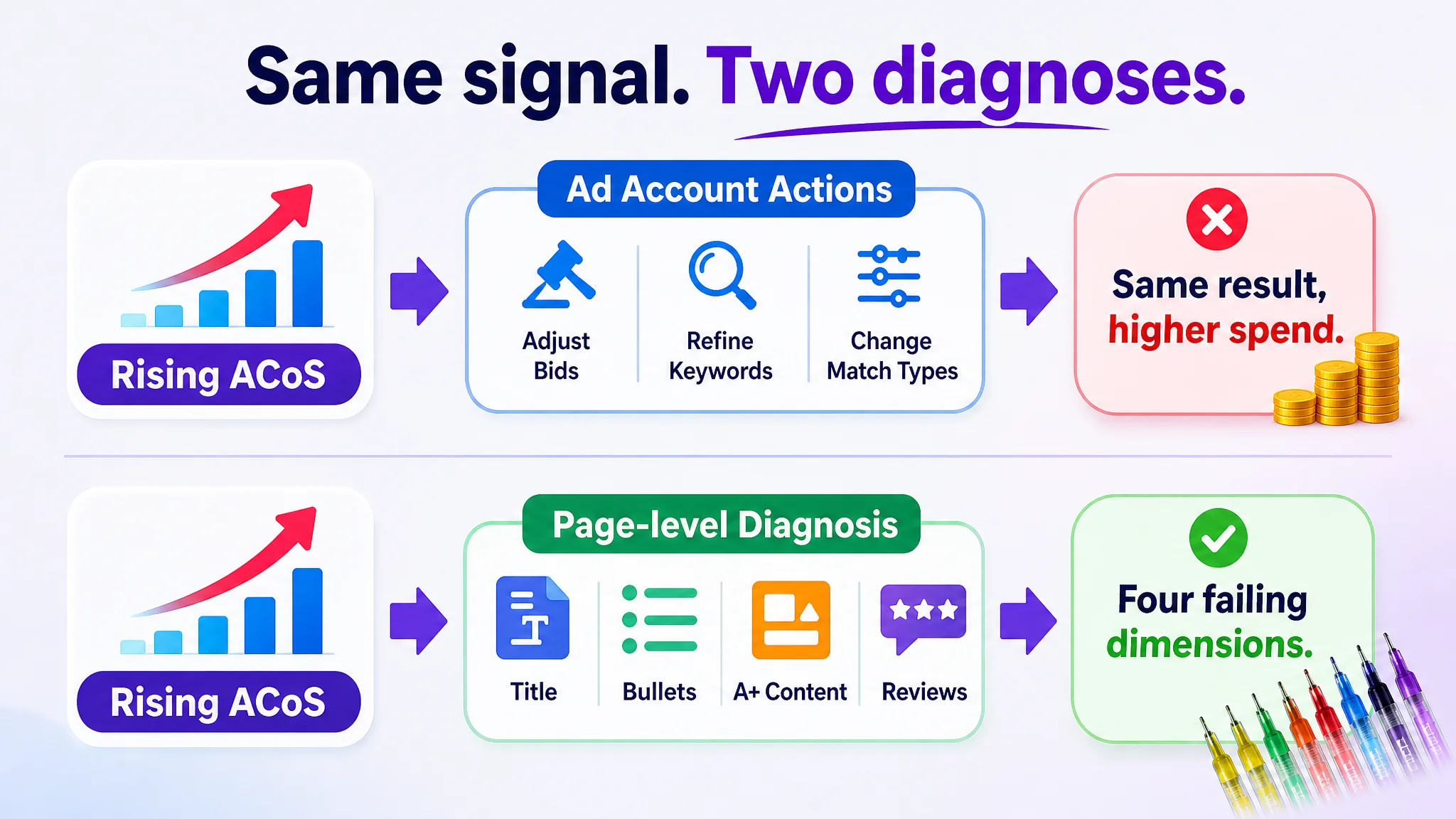
Sellers who keep optimising for repetition instead watch CTR stall, CVR slip, ACoS widen, and BSR drift—not because traffic dried up, but because the listing stopped giving the platform a reason to keep showing it. A nail-art-pen seller showed this pattern clearly: ad costs were climbing, ACoS was drifting upward, and the team had already run several rounds of keyword pruning, bid adjustments, and campaign restructuring. Their working conclusion was that Amazon ads had simply become harder to operate in the category. DeepBI’s audit of the listing pointed somewhere else. Compared with a comparable high-performing listing in the same subcategory, the product page scored 70 out of 100 against 86. The page was not failing to attract clicks; it was failing to give buyers enough reason to stay, believe, and buy once they arrived.
That is the thesis of this playbook: organic traffic is a behavioural outcome, not a keyword inventory.
By the end, you will be able to diagnose exactly where your listing loses that response. You will also be able to turn those gaps into concrete listing changes you can validate against your own ad data.
Chapter 1: What the Amazon A10 Algorithm Actually Is
Amazon does not publish its ranking formula. “A10” is industry shorthand for the current generation of Amazon search ranking, not an official model name or a documented set of weighted factors.
The operative mechanism is simpler and less mechanical than most keyword charts suggest: ranking is a prediction of which listing will convert and satisfy a shopper for a given query. Signals behave as feedback loops. Early clicks and conversions earn later impressions, and those impressions create more chances to accumulate the same signals. That model matters more as AI-assisted shopping surfaces expand, where query context and shopper intent are read alongside listing content. In practice, CTR tells you whether the listing earns the click; CVR tells you whether the detail page supports the promise. For keyword and content decisions, the practical implication is that relevance must be paired with proof of conversion: a term is only useful if the listing can win the click and carry the shopper through to purchase.
The nail-art-pen audit makes that split visible. The seller had traffic coming in and clicks being earned, but the page did not convert what it received. The main image was essentially at parity with the benchmark; the deficit sat in the trust layer—title, bullet points, A+ content, and review layer. In A10 terms, the listing was giving the system a weak conversion response after the click, which is exactly the kind of signal a behaviour-weighted system reads against further exposure.
How A10 Differs From A9
Practitioners describe A10 not as a documented relaunch but as a reweighting of the signals that already shaped ranking. Under the earlier keyword-relevance-led reading, the winning move was to pack the title with high-volume terms and trust relevance to carry the listing. Under the behaviour-weighted reading, that same title stacking stops paying: repeated modifiers consume space without improving CTR, while CVR and post-purchase satisfaction carry more influence over whether the listing keeps its position.
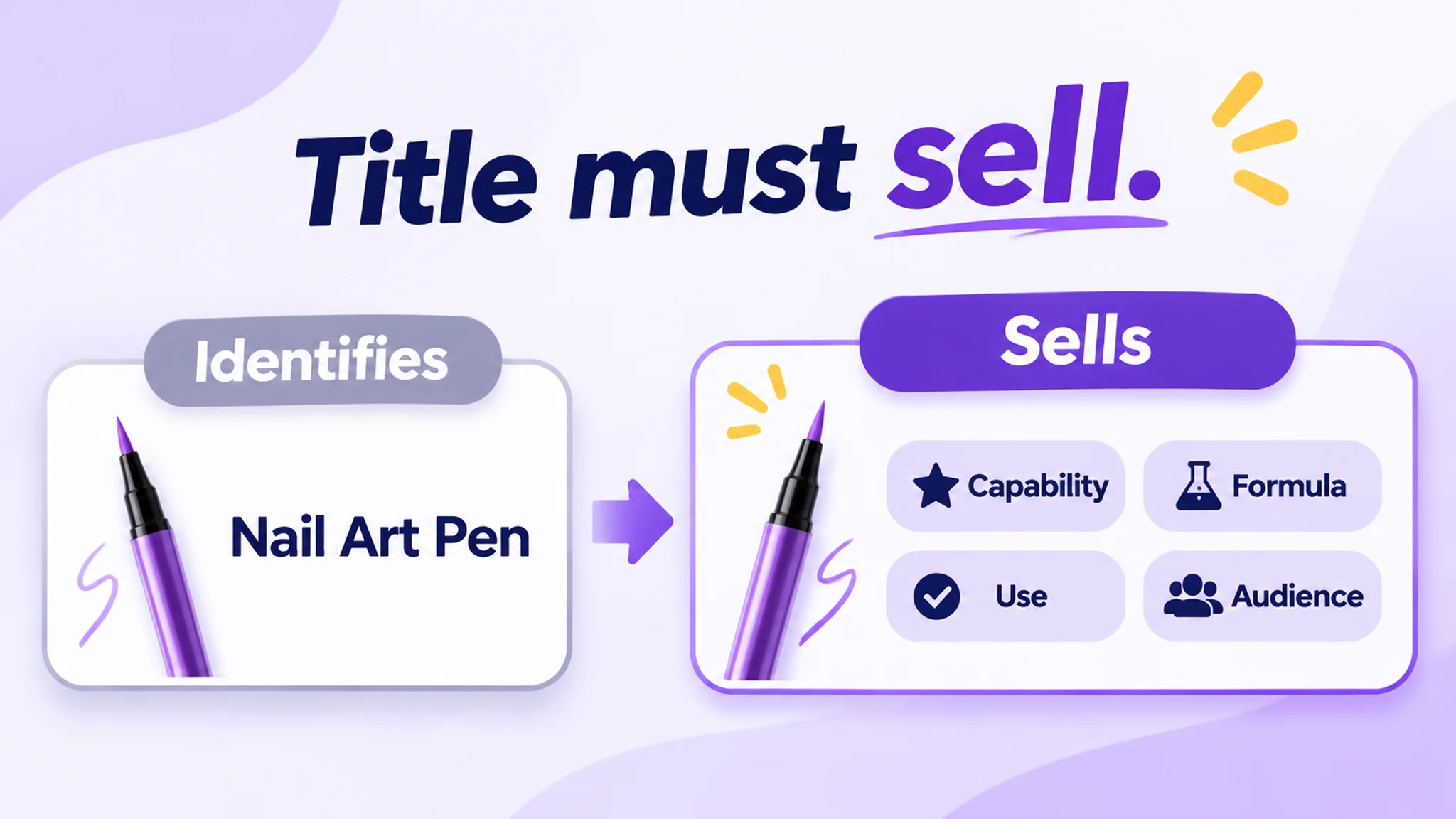
This is where the nail-art-pen title problem is instructive. The benchmark title followed a working structure: core product term, then the high-value attribute that defines the product’s capability, then a specific formula benefit, then the usage long-tail, then the audience and setting. The target title repeated the core term and not much else. It had no precision specification, no formula claim, and no long-tail coverage. In a category where buyers search by capability—fine tip, quick-drying, waterproof, dotting, liner—the title was opting out of most of the searches it could have qualified for. The title dimension scored 13 against 18 out of 20. That is not a character-count issue; it is the difference between a title that only gets the listing indexed and a title that also does selling work.
The practical consequence is a different operating loop. Keyword coverage still gets the listing indexed, but conversion feedback tells the system whether the traffic deserves more exposure. External traffic becomes measurable and therefore usable—not a mythic hack, but an input that can be observed and connected to on-listing behaviour.
The absolutist version of the story is too clean. Earlier systems measured external traffic less well and likely weighted it differently; they did not ignore it. The shift is in emphasis and measurability, not in an official reset.
Why Amazon Built A10 This Way
Amazon does not get paid when a listing matches a keyword. It gets paid when an order completes and the shopper keeps the product. A return or refund reverses the transaction and adds shipping, restocking, and support costs the marketplace absorbs. Authenticity works the same way: shoppers who stop trusting listings stop buying, and advertising health depends on that same trust, because sponsored placement only stays valuable when it leads to satisfied buyers rather than disputes.
So a behaviour-weighted system is the predictable outcome of those incentives. Listings that convert, hold their CVR, avoid refund pressure, and keep reviews credible earn more exposure; listings that win the click and then lose the sale do not. That is not arbitrary. It is the ranking logic you would build if completed orders, shopper trust, and ad health were your revenue. Your priorities follow directly: protect CTR and CVR, and treat listing accuracy as a commercial control, not a formality.
The nail-art-pen listing showed how small accuracy gaps turn into trust and return pressure. The first image included an accessory that was not part of the product specification. That creates a small expectation gap at the exact moment trust is being formed, and it can convert into returns and negative reviews later. The review layer was already the largest single deficit: 4 out of 15 against the benchmark’s 11, with a rating of 3.6 against 4.2, and roughly 25% of ratings at three stars and below against the benchmark’s 12.5%. Removing unconfirmed elements is not a design preference; it is part of protecting the conversion case A10 is reading.
Chapter 2: The 9 Ranking Factors That Drive A10
Disconnected tips tell you what to touch, not where value is leaking. Grouped into four bands, these nine factors work as a practitioner framework for prioritising work—not an Amazon-published list of weighted signals.
- Relevance and content structure: keyword-to-entity relevance in the title, bullet logic built as pain point to solution, and A+ depth that answers objections before the buyer scrolls away.
- Conversion and click behaviour: main-image appeal that earns CTR, and trust modules that hold CVR once the click lands.
- Velocity and traffic quality: sales velocity measured against the right competitive set, plus the precision of the search terms you push paid traffic through — pressure that later shows in ACoS and organic position.
- Trust and account health: product entity consistency, so visuals never contradict material, colour, or design and invite destructive negative reviews, alongside compliance and brand identity integrity.
- Use it by band, not by factor: score each band against your own account, repair the weakest one first, then work outward.
The nail-art-pen audit is a useful example of why the bands have to be read together. The five-dimension breakdown compared the target listing against a benchmark chosen under a strict similarity boundary—same product form, same use case, comparable price band and buyer intent, not the category bestseller. Title: 13 against 18 out of 20. Main image: 25 against 24 out of 30. Bullet points: 7 against 9 out of 10. A+ / detail page: 21 against 24 out of 25. Review layer: 4 against 11 out of 15. The main image was the only dimension where the target page was ahead. Every other dimension was behind, and the two largest deficits—title and review layer—were in places the team had never treated as problems. That is not a media-buying problem. It is a decision problem spread across relevance, conversion, and trust bands.

The 9 Factors Ranked by Weight
Ranked by practical impact rather than published Amazon weighting, the nine factors fall into bands. Conversion and click behaviour sit at the top, because CTR and CVR are the last signals produced before a purchase decision—so fix the main-image and title hook first. Velocity and traffic quality follow: keep a steady flow of qualified sessions rather than bursts of loosely matched traffic. Trust and satisfaction signals, returns included, come next—returns quietly erode the conversion case, so audit detail-page claims against what buyers actually receive. Structural readability—title logic, bullet flow, A+ completeness—sits last, so treat edits there as support for the bands above rather than the starting point.
The rationale is proximity to the purchase decision: a factor closer to the moment a shopper commits tends to matter more in practice.
The nail-art-pen seller had assumed the creatives were the strongest asset and the ads were the weak link. The audit found the opposite distribution: the main image was essentially at parity with the benchmark, while the title, bullet points, A+ content, and review layer carried almost the entire 16-point deficit. That does not mean main-image and title hooks do not matter; it means the hook can win the click and still hand the buyer to a page that fails to close. Fix the click path first, but do not stop there. The trust layer is part of the same conversion case.
DeepBI's organic-traffic layer screens keywords out of existing advertising data by high click-through, high conversion, and order value, showing which query-level behaviour already converts before you choose a band to invest in. High-value keywords can then be pulled into a concentrated top-of-search push: converting queries to concentrated spend, to short-term volume, to longer-term organic visibility. That push is only as useful as the page that receives it. In the nail-art-pen listing, more well-targeted traffic would have raised spend and produced more evidence that the page did not convert.
The Listing Foundation: Making the Click and the Conversion Happen
The shopper meets the title, first image, and bullet stack before anything else; that first frame decides whether the listing earns the click and then the conversion that supports organic impressions. Lead the title with the specific long-tail phrase a shopper would actually type, then add differentiators rather than a keyword chain. Build bullets as feature → benefit → proof → use case, written for small-screen scanning, not a specification sheet. Make imagery answer the first objection in the first frame. Use A+ content for comparison and reassurance, not decoration. Keep backend search terms to genuinely new terms with duplicates removed; limits vary by category, so confirm the current value in Seller Central.
The nail-art-pen title is a clean example of the difference between identification and selling. The benchmark title carried core product term, capability attribute, formula benefit, usage long-tail, and audience in one line. The target title repeated the core term and not much else. It described the product but did not state the capability. In a category where buyers search by fine tip, quick-drying, waterproof, dotting, and liner, that title was doing identification work while the benchmark was doing selling work. The fix was not to stuff more terms into the title; it was to make the title carry capability, formula, usage long-tail, and audience so the listing could compete for searches defined by what the product does, not only what it is.
The first image had a similar problem. The seller’s self-assessment was half right: the visuals were not ugly, and the image dimension scored slightly above the benchmark. But the first image was spending its most valuable slot on identification rather than evidence. The claim was 0.5mm precision, and the drawing example did not clearly demonstrate fine, controlled lines. Buyers in this category are not asking “what is it”—they are asking “can it actually do the thing.” The second issue was more serious than aesthetics: the first image included an accessory that was not part of the product specification. Once that was removed, the image discipline improved. The remaining images had a sequencing problem rather than a quality problem. The second image repeated the same feature list. The activation steps—shake, press vertically until ink flows, recap—were buried at the end instead of placed where hesitation begins. Three of the five images returned to the same pen tip specification, which is information the buyer already accepted after the first look. The fix was re-sequencing, not re-styling: first image proves fine-line capability, second slot carries activation guidance, later slots validate complex designs and distinct style categories.

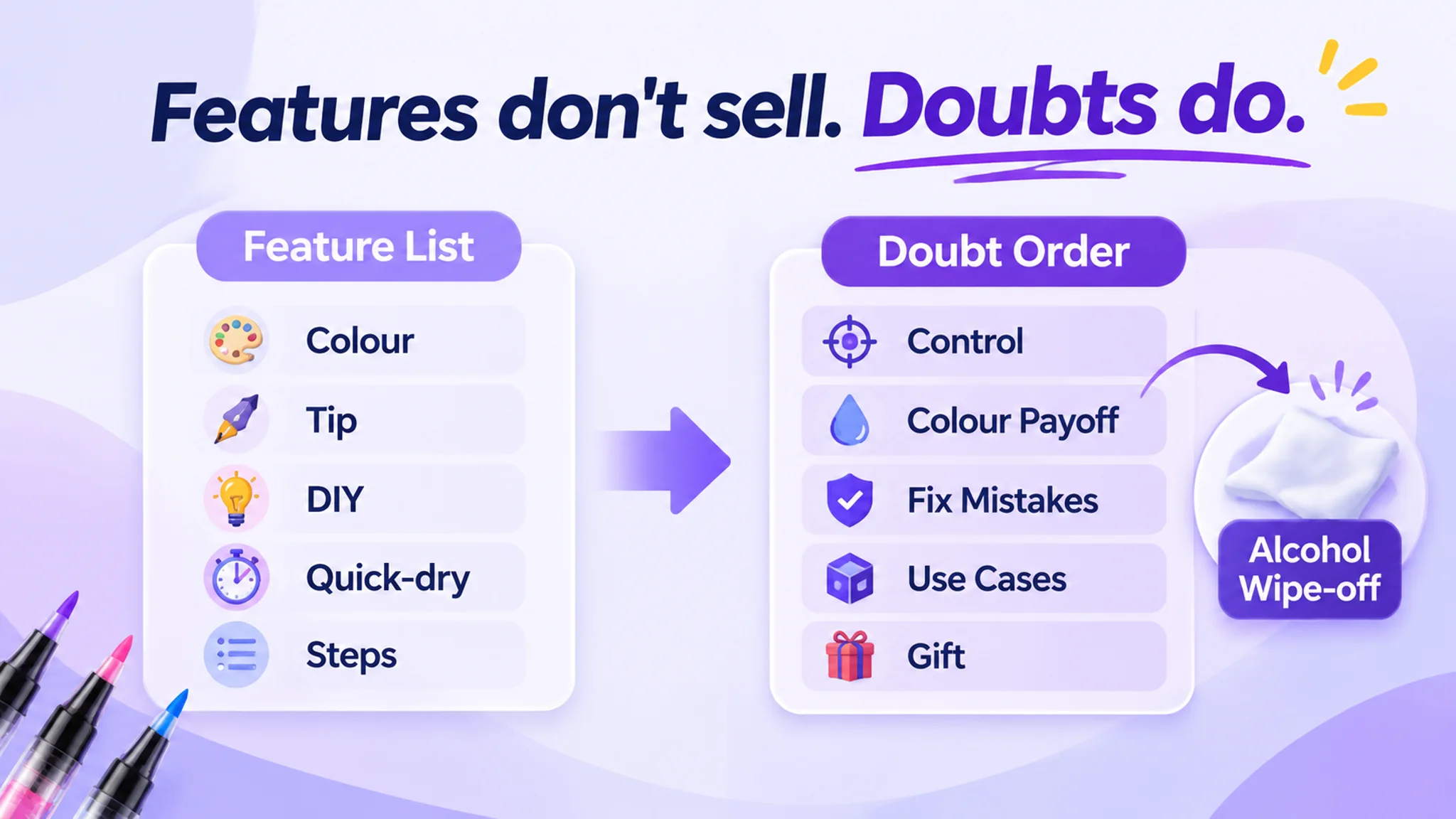
The bullet points had features but no buying order. The target sequence moved through colour variety, tip precision, home DIY scenario, quick-dry and no smudging, and usage steps. The benchmark started with the buyer’s real fear in this category—that fine detail work is hard to control—then moved to colour and formula payoff, effortless use with a correction path, multi-scenario versatility, and packaging and gifting. The most expensive omission was the correction mechanism. A product that can be wiped off with alcohol and restarted removes the fear of ruining a design. That single line changes the perceived risk of the purchase for a first-time buyer. The target page did not mention it anywhere. The buyer was left to assume that a mistake is permanent. A feature list answers “what is it.” A bullet sequence answers “what happens if I try it and I’m not good at it.” Only the second one sells.
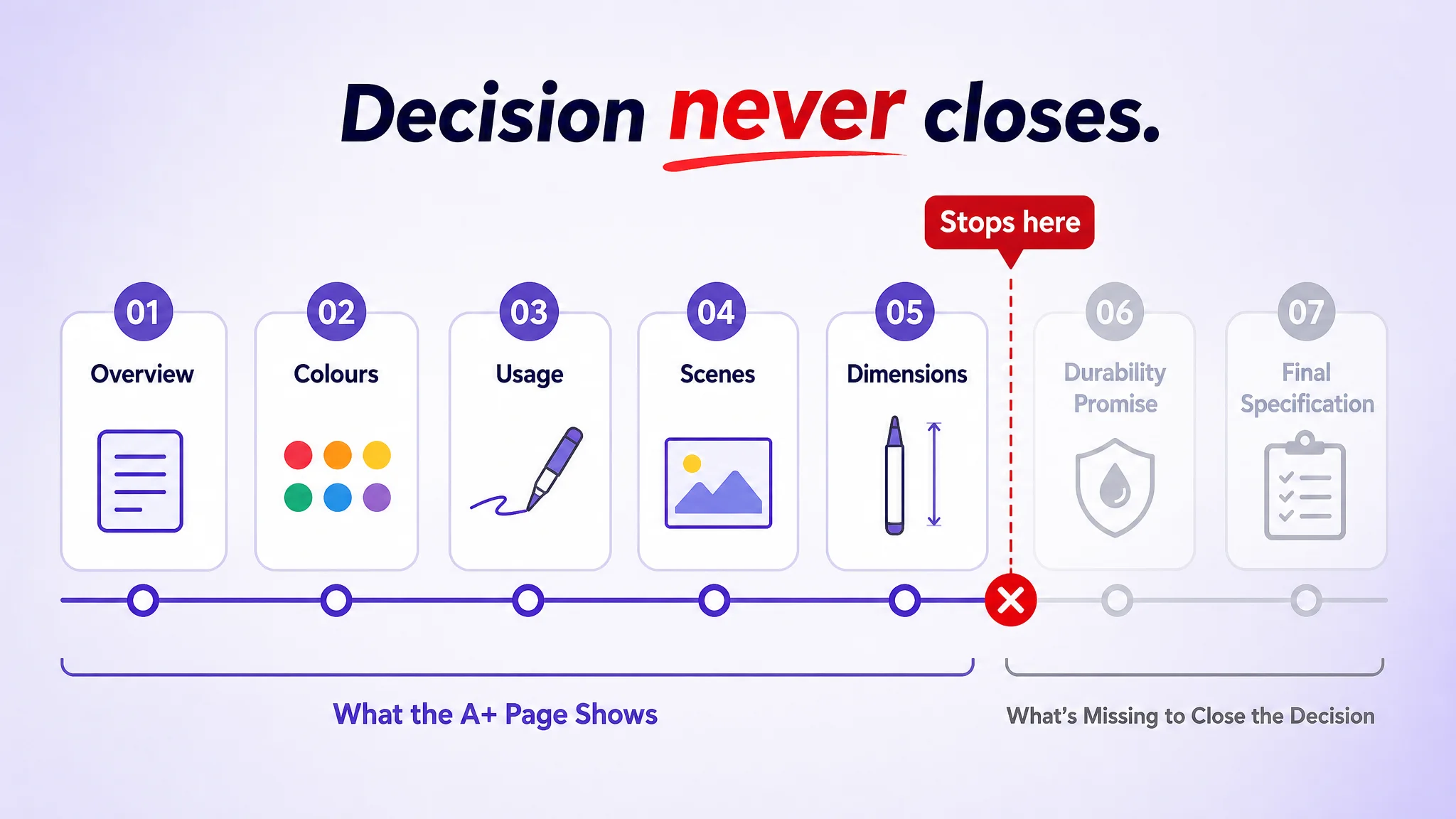
The A+ page stopped before the buyer was convinced. It was structurally complete but tonally flat. It opened with a summary of the kit rather than a direct visual confirmation of the pen-like precision the buyer was still doubting. Colour coverage was shown, but not the dense, multi-colour, complex designs that prove pigment strength. Usage steps were presented as a technical requirement rather than as a way to reduce the fear of failure. Most importantly, the page ended too early. There was no module confirming durability and water resistance as a single promise, and no closing module consolidating specifications, formula, and care instructions into a final decision driver. The benchmark opened with an emotional framing and closed with a gift scenario that expanded the purchase beyond personal use.
The review layer was the quietest leak. The review dimension was the largest single deficit: 4 out of 15 against 11. The rating sat at 3.6 against the benchmark’s 4.2. Total review volume was close—84 against 90—so this was not a scale problem. It was a quality and visibility problem. The audit found no readable customer review content surfacing on the first screen of the review area, while the benchmark showed eight detailed reviews including photo content. The share of three-star-and-below ratings stood at roughly 25% against the benchmark’s 12.5%. For a low-ticket, skill-dependent product, this matters disproportionately. The buyer is not only asking whether the product works—they are asking whether it works for someone like them. Photo reviews and detailed first-person accounts are the evidence that answers that question. Without them, the page is asking for trust it has not earned.
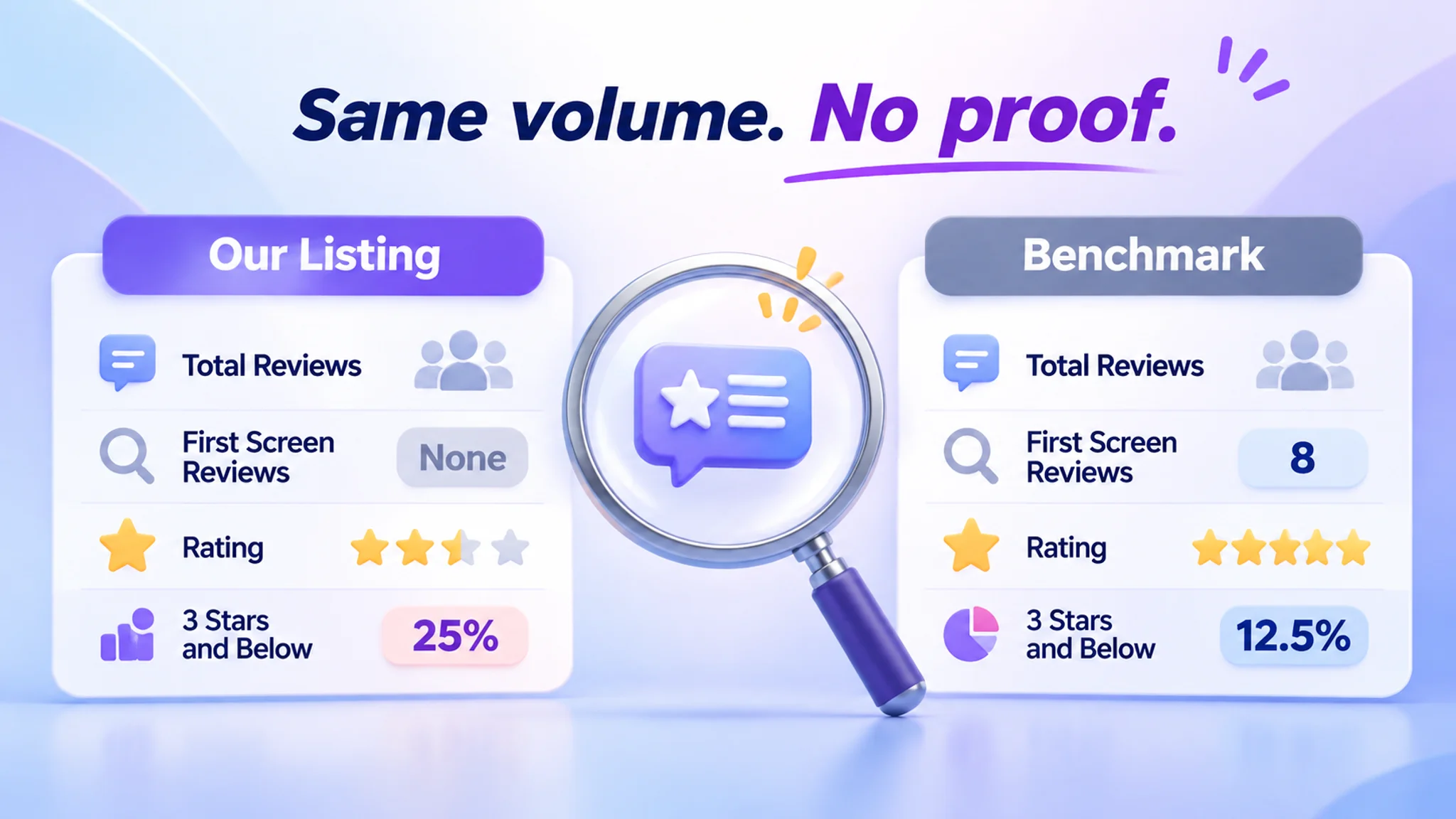
DeepBI’s listing diagnostics benchmark against strong comparable listings, apply multi-dimensional scoring across title, bullets, imagery, A+ content, and review structure—with review data used as a scoring input only—and produce a prioritised fix list ordered by expected impact. When you approve the content, one-click application pushes it to the live listing through the platform workflow, replacing the manual download-rename-upload cycle and shortening listing cycle time. The nail-art-pen rebuild shows why that prioritisation has to be dimension-level: the seller was confident about the creatives, and the main image score agreed, but the deficit was in the title, bullets, A+ closure, and review layer—the parts nobody was looking at.
Turning Ad Data Into Organic Rank Momentum
Organic keyword research shows demand exists; it cannot tell you which query closes the sale. Advertising answers that question directly: search-term data exposes queries with real click-through, conversion, and order value, separating terms that attract shoppers from terms that produce orders. A weak CTR and a weak CVR are different diagnoses—one points to front-end appeal, the other to detail-page trust and information density.
The nail-art-pen seller had already treated the problem as an ad-structure issue. They refined match types, cut keywords that were not converting, and adjusted bids by placement. Every action was reasonable. None moved the number. The reason is that they were treating a conversion symptom as a traffic problem. When a product page converts paid traffic badly, better targeting does not fix it—it just buys more of the same outcome at a higher price. The team was paying to send increasingly well-targeted buyers into a page that could not close them. That is why ad data has to be read alongside page readiness: the ad account can reveal which queries convert, but it cannot substitute for a page that gives the buyer a reason to believe.
Once a term proves it converts, concentrate budget on it through a dedicated top-of-search push instead of spreading spend across a broad keyword set. The goal is not simply lower ACoS but sales-and-conversion momentum around queries already showing purchase intent. That momentum can support organic visibility, but treat the relationship as indirect: Amazon does not disclose a direct ranking priority for any traffic source. In the nail-art-pen listing, the sequencing rule was straightforward: traffic volume should be scaled only after the page has demonstrated it can convert the traffic it already receives. Otherwise the ad account becomes an expensive testing instrument for a page-level problem that could be diagnosed directly.
Treat external traffic with the same discipline. Tag every external channel separately so you know which source converts on Amazon, and treat that traffic as a measurable contributor rather than a guaranteed rank lever. DeepBI’s organic layer carries the fifth funnel stage—keyword screening, top-of-search reinforcement, and parallel short-term volume plus long-term ranking growth—tracked through TACOS and organic order share. DeepBI’s four-layer funnel—exploration, filtering, precision, scaling—feeds the winner-keyword pool that this workflow depends on.
Mistakes That Quietly Suppress Organic Traffic
Most organic traffic losses are not dramatic. They are the cumulative effect of copy decisions that damage readability, dilute intent quality, and leave buyer objections unanswered—so CTR and CVR drift down while the listing looks, on the surface, fully optimised.
- Keyword stuffing that breaks readability. Stacked modifiers may match search terms, but they make the title hard to parse, weakening click appeal and intent match. The nail-art-pen title repeated the core term and not much else; it had no precision specification, no formula claim, and no long-tail coverage. The fix is to strip redundant modifiers while keeping high-value variation terms — covered in the title section.
- Optimising for desktop while shoppers browse on a phone. Copy that reads well in a wide layout collapses on a narrow screen. Check the mobile rendering of titles and bullets before publishing.
- Bullets written as a spec sheet. Parameters listed without association force the shopper to interpret the value. The nail-art-pen bullets had features but no buying order, and they left out the alcohol wipe-off correction path that would have reduced the perceived risk of ruining a design. The fix is the selling point + data support + pain-point solution pattern from the bullets section.
- Sending low-intent external traffic that converts poorly. Traffic that does not match the listing's promise drags CVR and inflates ACoS. Match external sources to intent before scaling spend.
- Ignoring return rate. Returns signal a mismatch between promise and product, and that mismatch erodes trust and repeat purchase. The nail-art-pen first image included an accessory that was not part of the specification, creating an expectation gap at the point trust is formed. Treat return reasons as copy feedback.
- Skipping launch-period review programmes where eligible. Where a programme applies to your brand and category, skipping it leaves trust signals thin during the window when they matter most. The nail-art-pen review layer was not a volume problem—84 against 90—but a quality and visibility problem: no readable review content on the first screen, while the benchmark showed eight detailed reviews including photo content.
- Leaving buyer objections unanswered. Objection-handling copy hygiene — placing the answer inside bullets, A+ content, and the description — improves comprehension and reduces hesitation. In the nail-art-pen A+ page, durability and water resistance were not consolidated into a single promise, and the page ended before a final specification confirmation. Note plainly: no confirmed ranking input exists for buyer-question features, and DeepBI does not offer question-and-answer automation.
A 30-Day Loop for Growing Organic Sessions
Organic growth is not a one-off listing edit; it is a loop: measure, fix, concentrate, restructure, re-measure. Start by baselining the account with a fixed keyword set, TACOS, organic order share, and listing-level CTR and CVR trends. That baseline gives every later change a reference point.
In weeks one and two, ship the prioritised listing fixes. In weeks two and three, screen advertising data for converting queries, then use the survivors to build the top-of-search push. In weeks three and four, restructure titles, bullets, and comparison blocks so they answer whole customer questions rather than scatter keywords. In week four, re-measure against the baseline and set the next cycle. Backend terms and content refresh should follow a maintenance interval, not a one-time rule.
The order matters: fixes without a baseline are guesswork; ad concentration without fixed listings amplifies weak pages. The nail-art-pen rebuild followed a deliberate order. Title and bullet points set expectations before the click and qualified the traffic. The first image confirmed the core capability within the first second. The activation and correction steps removed the fear of failure. The A+ modules closed the remaining rational doubts about durability, application range, and packaging. The review layer provided the social proof that no amount of copy can substitute for. Each layer answered a question the previous layer raised. Skipping a layer did not save time—it moved the drop-off further down the page, where it was harder to see and more expensive to fix.
DeepBI runs this as a standing cycle: keyword screening from ad data, top-of-search reinforcement on the survivors, dual tracking of short-term volume against long-term organic ranking, with TACOS and organic order share as the read-outs after each cycle.
Measuring What Matters: Organic Growth Without Guesswork
Vanity signals show movement; profit signals show whether the movement was worth it. Track TACOS and organic order share together. Advertising that never converts into organic demand is a rental cost, not growth.
Read ranking stability across your fixed keyword set, not a single day’s position. A spike can hide a weak listing; stable presence across the set shows CTR and CVR reinforcing rank. When the pairing diverges—paid volume rising while organic share stalls—fix the click and conversion path before adding spend.
The nail-art-pen seller’s clearest change was in how the team read its own numbers. Before the diagnosis, a rising ACoS was interpreted as an ad problem, and the response was always inside the ad account. After the diagnosis, the same signal was read as a page-level signal, and the first question became whether the listing deserved more traffic at all. Spend decisions became conditional on page readiness rather than on bid mechanics. The team gained a way to distinguish between a traffic problem and a conversion problem instead of treating both with the same toolset. What changed most was the standard: the team stopped asking whether the page looked good and started asking which specific buyer doubt each module was there to resolve.
DeepBI’s organic layer reads ad-driven volume and organic outcomes side by side, so you can judge whether a keyword produces durable organic demand or only paid sales. Then repeat the loop. Organic traffic is earned through shopper response, not decreed by keyword lists.