


Why Listing AI Content Compliance Is Now a Seller Workflow Problem
AI assistance already runs through the listing lifecycle: diagnosis, optimization suggestions, image generation, one-click application, and ad-data feedback. The practical question is no longer whether sellers use these tools, but whether each step can be explained, attributed, and defended. Use the checklist below as a working review frame for copy, images, and ads automation.
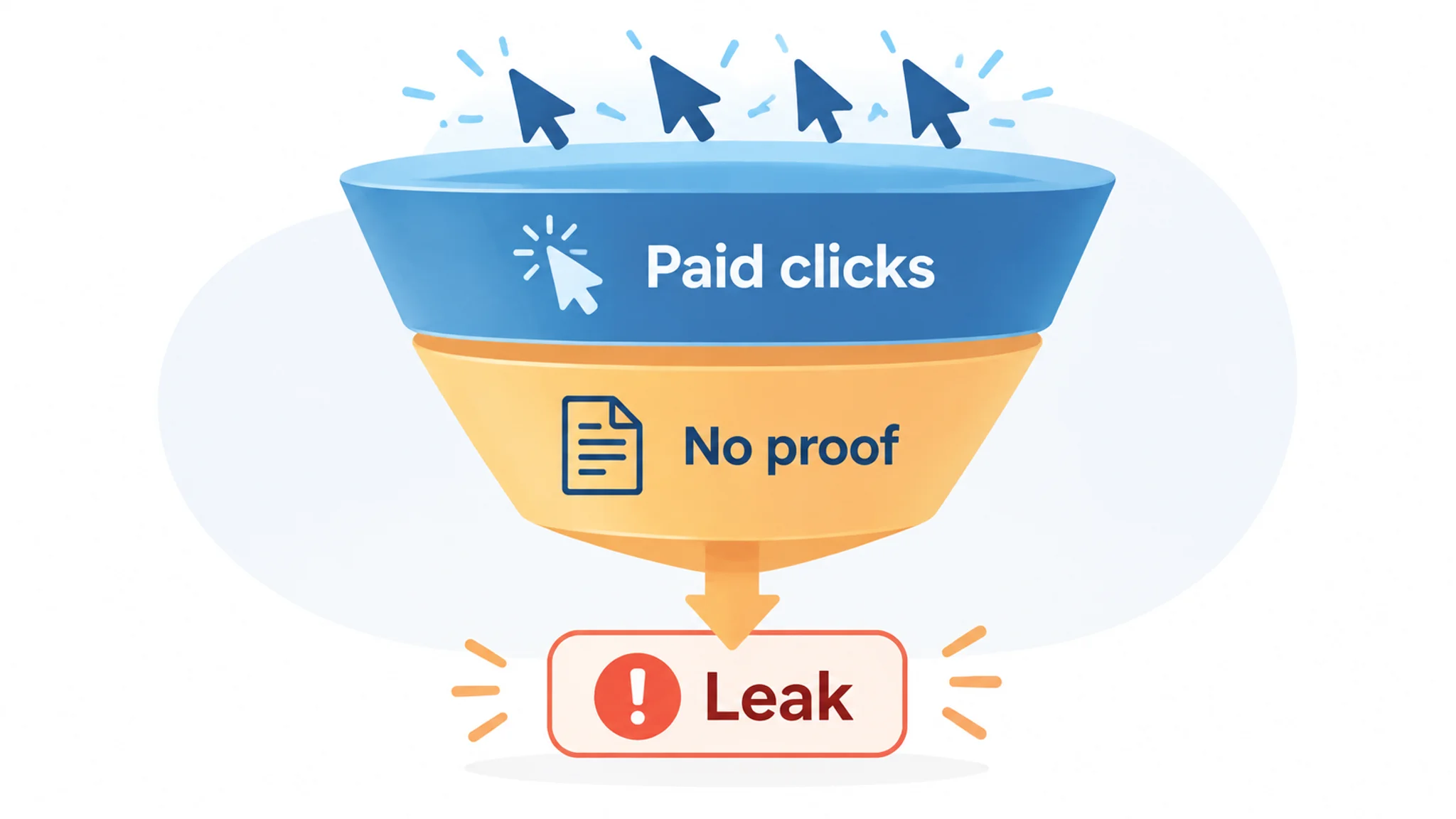
A recent mobility-aid listing review makes the workflow problem concrete. The seller was spending on ads and receiving clicks, but orders were not moving in proportion. The team's first diagnosis was ad inefficiency; a structured review instead found that the product page was making claims about height, firmness, stability, and hygiene without proving them in the order a buyer actually doubts them. That is not only a conversion problem. It is the kind of content-consistency problem a compliance-minded workflow is supposed to catch before more traffic is bought.
- Define the scope. Listing AI content compliance means managing AI-assisted titles, bullets, A+ copy, images, and related ads content through authorized tools, accurate claims, human review, and retained records.
- Read the policy lens correctly. The emphasis is transparency and attribution — what was generated, by which tool, under whose approval — not a blanket ban on automation. State policy points as of your writing date and verify the latest official documentation before relying on any interpretation.
- Compare two layouts. An automation-first layout treats AI output as final and publishes it directly; a compliance-first layout keeps a human approval gate, shows an old-versus-new comparison before replacement, and logs what changed.
- Check listing copy. Every measurable parameter — dimensions, weight, material, load ratings — must be real. Do not let a model fill gaps with plausible-sounding specs.
- Check images. Generated visuals must preserve product entity consistency across material, color, and industrial design. Unconstrained generation that alters structure produces image-product mismatch, then returns and damaging reviews.
- Check ads automation. Tag each AI-driven change so its downstream effect on CTR, CVR, and ACoS can be measured instead of assumed.
- Keep records and access tight. Retain task identifiers, processing status, and an audit trail per asset, and scope tool permissions to the specific job rather than broad account access.
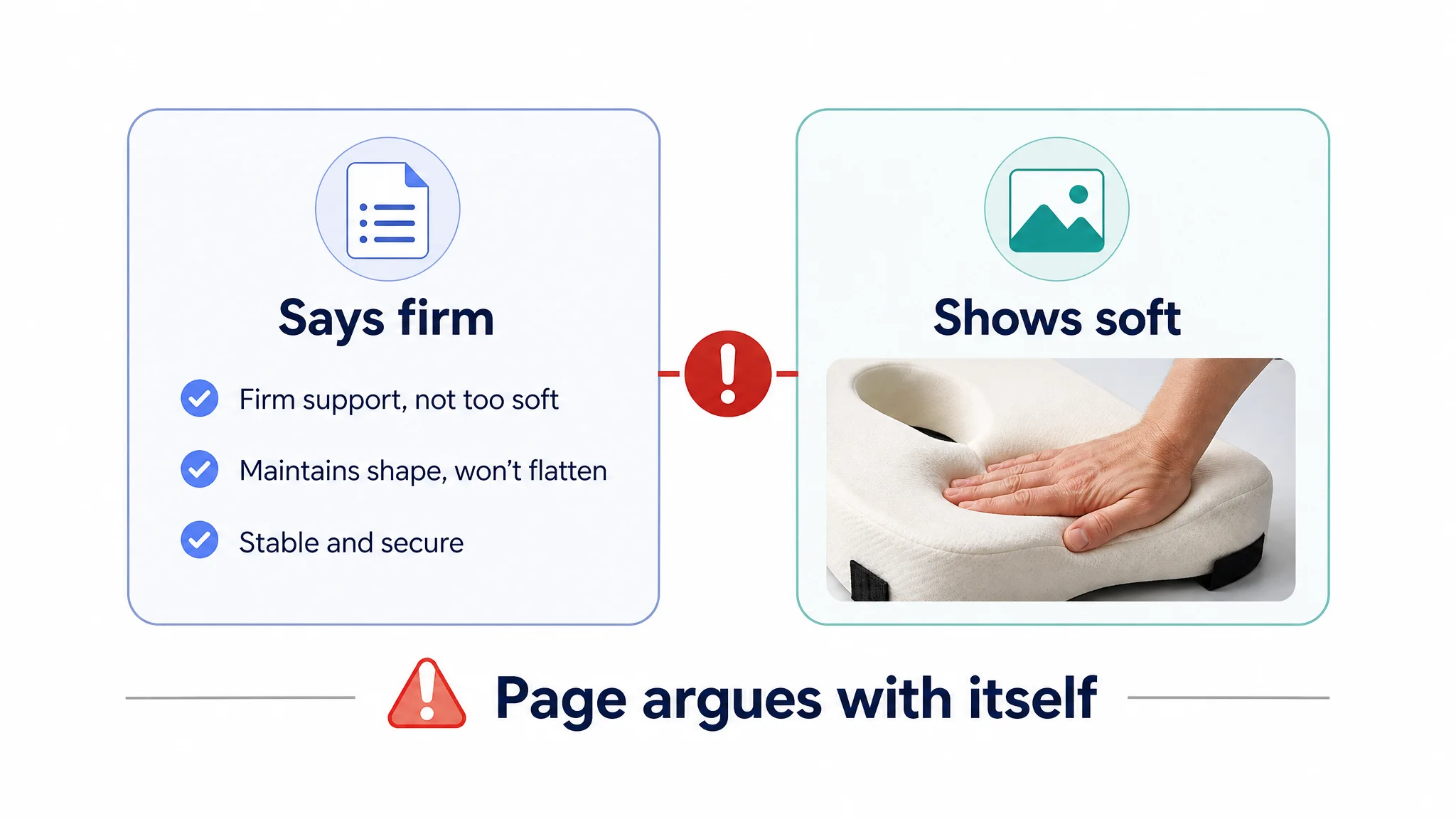
The mobility-aid review also shows why compliance cannot be reduced to a permissions checkbox. The target listing had real product facts — the 2-inch high-density foam, the U-shaped cutout, the hook-and-loop straps, the waterproof PU surface — but they were scattered in the order the seller found convenient. More damaging, one image showed a hand pressing visibly into the cushion, while the bullet points insisted the cushion ran firm rather than soft. The page was arguing with itself, and the buyer had no reason to believe the text over the picture. A workflow that reviews copy, images, and ads as separate approvals can miss exactly this kind of contradiction.
Amazon AI Agent Policy: New Automated Seller Rules in 2026
What Is Amazon’s AI Agent Policy?
For Amazon sellers, “AI agent policy” is shorthand for the rules and expectations that apply when automated systems touch listing content and seller operations. The scope can include automated access to seller accounts or marketplace data, third-party software, scripts, and algorithmic decisions that change titles, images, attributes, or other listing elements.
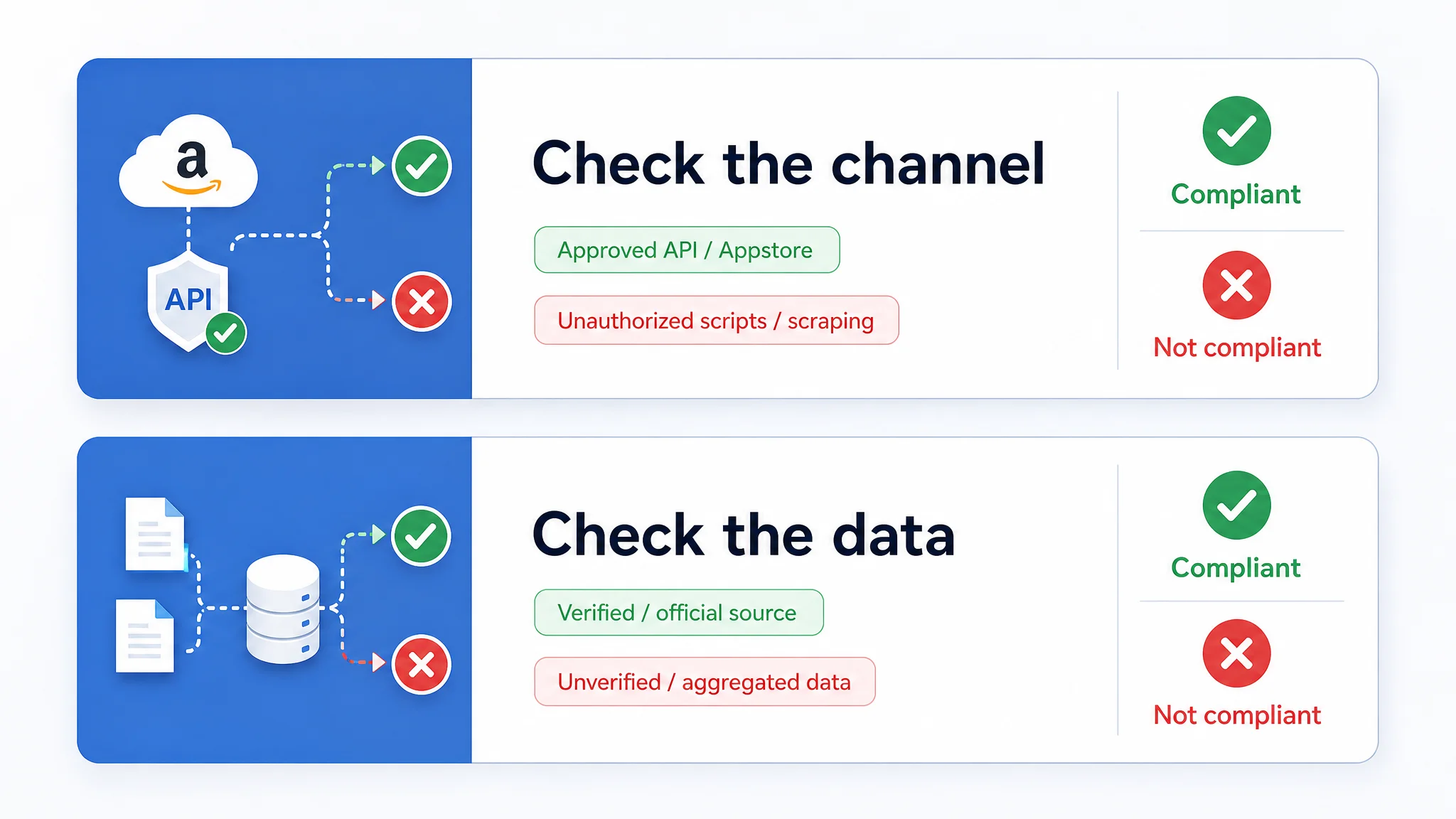
The crucial split is authorized versus unauthorized automation. Authorized channels, such as official Amazon APIs and, where applicable, Amazon Marketplace Appstore tools, give sellers a traceable route for access and change delivery. Unauthorized scripts or unapproved access paths can create operational and account risk, and they make it harder to prove who changed what. Transparency and attribution should therefore be treated as controls, not paperwork: a tool should show the permission scope it uses, the listing action it proposes, and the human approval point before publication. For example, an image workflow that connects through the official SP-API, requests only image-asset permissions, and presents a side-by-side original-versus-proposed comparison supports both review and attribution.
The mobility-aid review shows why that approval point cannot be only a permission check. The seller's page contained facts that were real, but the first image visually suggested softness while the copy claimed firm support. Whether the asset was AI-drafted or human-written, a reviewer who only asks “did the tool have access?” would miss the more important question: does the proposed asset agree with the approved claim set? That is where attribution and review meet content quality.
References to new automated seller rules in 2026 should be read as a discussion frame, not proof of a confirmed enforcement date. Sellers should verify any specific requirement against named official Amazon documentation before changing workflows.
What Is Amazon's AI Agent Policy?
Amazon's AI agent policy is best understood as the set of access and data-use rules that apply when automated tools interact with Amazon systems, not as a separate rulebook for every AI model or vendor. In practice, it can reach AI agents, bots, browser automation, third-party listing tools, and data-aggregation services, but the relevant question is not the label. It is how the tool connects to Amazon and where its inputs come from.
Amazon's Business Solutions Agreement and API policies prohibit unauthorized automated access. That separates scripts, headless browsers, credential-based backend automation, and scraping from approved channels such as Amazon's Selling Partner API (SP-API) or Marketplace Appstore apps. Sellers should verify each tool's status against the applicable official terms rather than assume that a familiar category, or an AI label, settles the question.
A practical compliance test has two dimensions:
- Execution channel: does the tool submit or retrieve data through an approved API or app channel, or through unauthorized automation?
- Input data source: are inputs seller-provided, drawn from authorized API data, or collected through scraping, unverified aggregators, or other sources whose permission is unclear?
The two dimensions are separate. A tool can submit through an official API and still create risk if its inputs come from unauthorized scraping or aggregator data. Treat that as a risk to verify, not an automatic violation.
Listing Automation Thresholds: A Decision Model, Not a Published Number Set
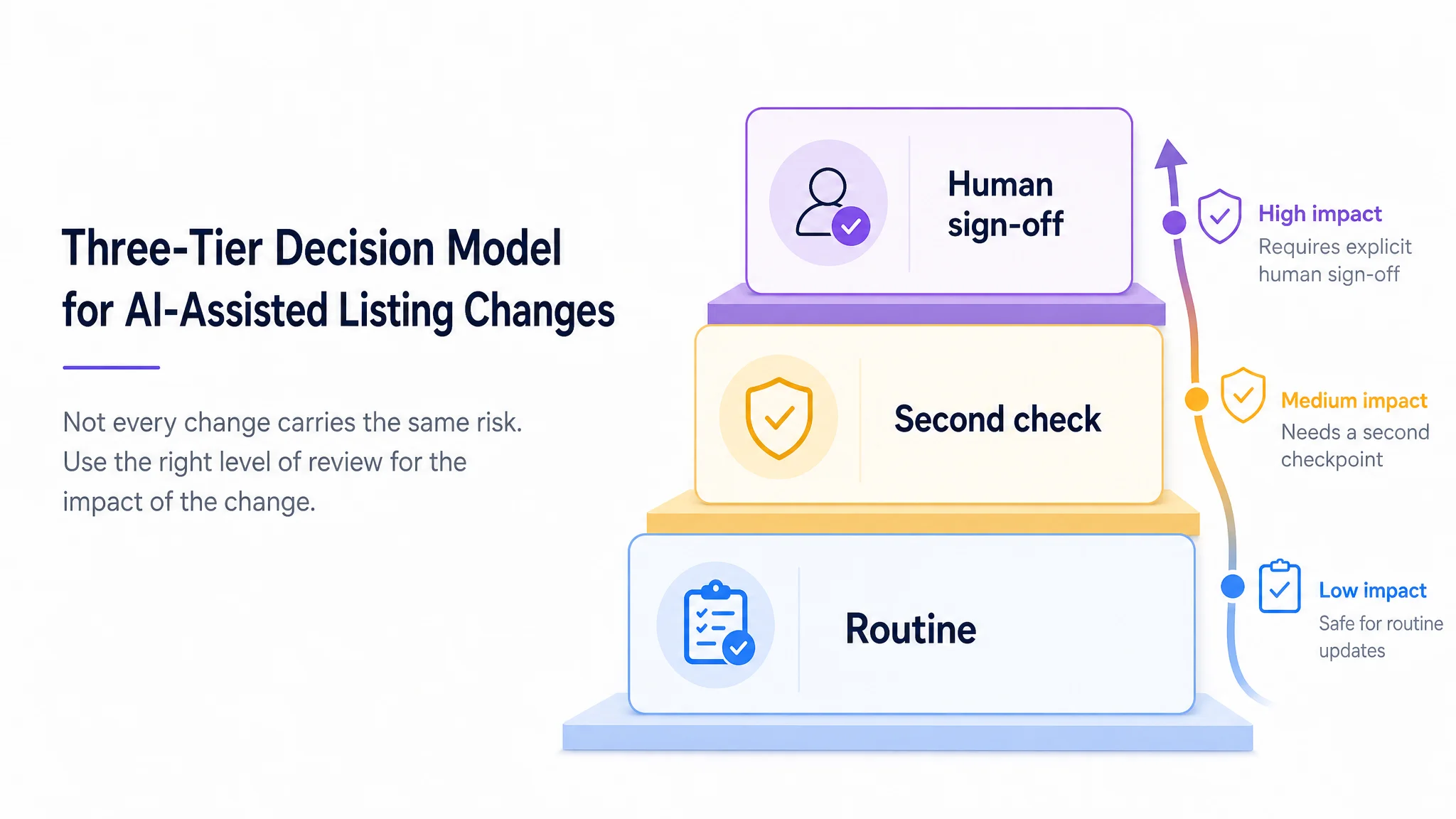
Treat listing automation thresholds as a decision model, not a published set of Amazon numbers. A three-tier working model classifies the decision before action: routine changes are low-risk, repeatable updates with a standard review path; moderate changes affect multiple assets or listings and need a second checkpoint; high-impact changes—changes that may affect pricing, broad catalog edits, or large batches—require explicit human authorization and documented records.
Use the model to ask verification questions. For price changes, ask whether automation may touch pricing at all; an image-asset workflow should stay outside pricing, inventory, and order data unless explicitly authorized. For batch edits, ask which listings are affected, who approves the batch, and whether selective replacement is possible rather than blanket overwrite. For human authorization gates, ask where approval occurs—before the push, not after. For record retention, ask what evidence you can produce later, such as report IDs, approval logs, and before/after comparisons, without assuming a specific Amazon retention period.
Numbers circulating in secondary commentary—a 20% daily price change, a 500-ASIN batch, or a 90-day window—are illustrative proposed benchmarks, not confirmed Amazon parameters, unless an official citation is supplied.
The mobility-aid review also shows why thresholds should be defined by consequence, not only by transaction type. The most consequential changes were not price edits or batch overwrites. They were changes to the title, first image, bullet sequence, and A+ evidence chain across multiple assets. Under a three-tier model, that is not a routine swap; it needs a second checkpoint and a before/after comparison. The seller's recoverable gap was concentrated on the page, so the approval question was not “may automation touch this?” but “which asset, in which order, against which approved fact?”
AI Agent Compliance Requirements and Action Audit Log
Treat the following as control checks to validate against official Amazon policy and API documentation, not as a published Amazon checklist. The aim is to make AI-assisted listing work auditable without overstating what the platform requires.
- Verify authorized access and SP-API registration: confirm the integration uses an approved SP-API path, and check the approval channel through the official API developer program or Marketplace Appstore where relevant.
- Confirm rate-limit compliance: document how requests are throttled, retried, and logged so AI-driven actions do not rely on unbounded or burst access.
- Define human authorization checkpoints: require a reviewer to approve listing changes at the point of application, with a visible comparison of current and proposed content before release.
- Validate data provenance: require product parameters, claims, and measurement values to be traceable to verifiable sources, and prohibit fabricated specifications.
- Apply access control on a least-privilege basis: scope permissions to the listing assets and actions needed, rather than requesting blanket authorization.
- Maintain an action audit log: record action type, reviewer, timestamp, and rollback note for each material change; verify any retention duration as an internal recommendation, not an Amazon published requirement.
- Test approval-channel verification: where relevant, confirm the app or integration path against the official developer program or Marketplace Appstore rather than relying on vendor assertion.
The mobility-aid listing is a useful stress test for these control checks. The product facts existed and were not fabricated; the failure was that the page did not make them traceable in the buyer's order of doubt. The main image contradicted the firmness claim, and the A+ page had no cleaning proof or slip proof at all. An audit log would have recorded that a change happened, but it would not have caught the claim-image conflict unless the review step compared the visible creative against the approved fact set. That is why data provenance and human authorization have to be checked together, not as separate paperwork.
Off-Amazon Content as a Listing-Risk Vector
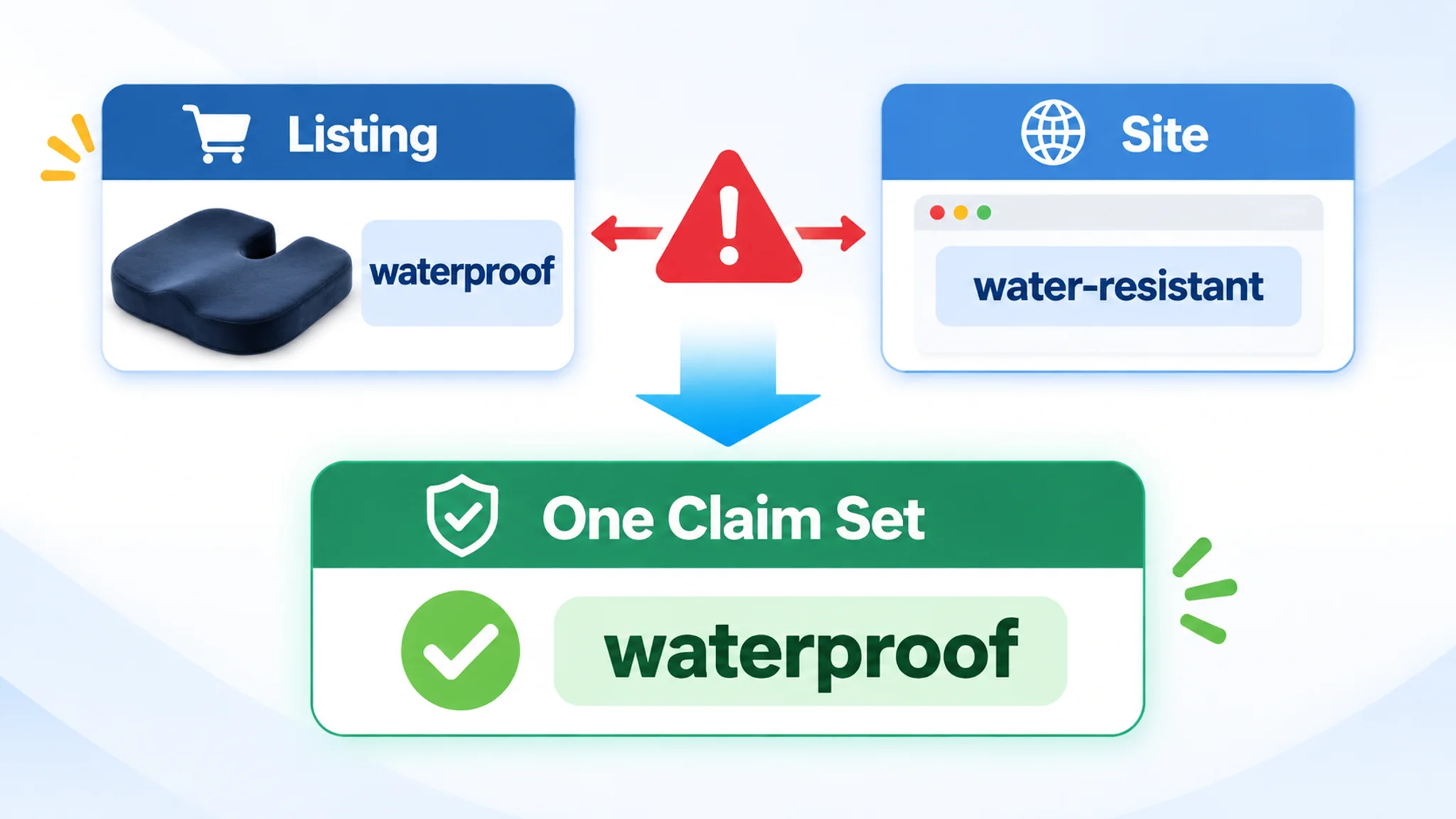
Listing AI content compliance does not stop at Seller Central. The same claim can appear on your website, social posts, influencer briefs, and Amazon ads. When those surfaces drift, the listing can look inconsistent even if every asset was approved in isolation. Amazon may use off-platform content as a cross-check, so treat any mismatch as a compliance risk.
- Audit listing copy against off-platform pages for paired claims: “water-resistant” versus “waterproof,” different warranty terms, and mismatched discount claims; align them to one approved claim set.
- Check images and video for the same product structure, accessories, included items, and size cues shown off Amazon; treat differences as a listing risk.
- Review ads and automation inputs so headlines, promotions, and eligibility claims pull from the same source of truth as the listing.
- Maintain one source of truth for product facts, warranty language, and promotional terms, with version control and named approval.
- Set a defined internal sync cadence, such as same-day or within 48 hours of a change, and log updates; this is an internal standard, not an Amazon rule.
- Assign an owner to reconcile listing copy, images, and ad automation before publishing, then track exceptions and close gaps.
Enforcement and Account Risk: What Sellers Should Plan For
Enforcement risk is better treated as graduated and conditional, not as a single automatic penalty. Depending on the facts and Amazon's review, possible outcomes can include listing suppression, revocation of API tokens, or account deactivation. These are potential consequences, not a promised sequence; a compliance issue may be resolved without escalation, or it may draw a narrower or broader response. A suppressed listing alone can extend listing cycle time, weaken CTR and CVR, and make ACoS harder to control.
Stale tooling and outdated configurations are a common exposure source. They can leave permissions, mappings, or validation rules behind the current operating reality, so errors persist undetected. Repeat issues, or activity routed through non-official channels, may escalate faster because they suggest a pattern of control weakness rather than an isolated mistake. Official encrypted API connections, scoped permissions, and pre-push validation reduce manual export and upload work and account-association risk, but they do not remove the need for oversight.
Run a periodic tool audit. Confirm which integrations are authorized, which scopes they hold, how compliance checks are configured, and how status results are reviewed. Record the owner and date of each check, and correct stale configurations before they become part of the account's risk profile. The aim is not to predict enforcement; it is to keep exposure visible, bounded, and correctable.
Building a Compliant Listing Workflow with Human Review
Treat compliant listing production as an internal SOP, not a one-off prompt. The workflow begins with a single source of truth: confirmed product facts, original images, locked physical attributes, brand rules, and approved specifications. AI drafts only from that record.
- Lock the source of truth. Keep product facts and original assets in one controlled record before drafting starts.
- Design intake and prompts. Pass approved facts through structured fields rather than free text. Set the priority order: product truth first, original assets second, competitor style references third, and use references only for composition, lighting, and style.
- Assign AI a drafting role. The model executes approved instructions; it should not invent selling points, dimensions, materials, performance, certifications, accessories, or scenes.
- Review claims and images. Compare every drafted claim with visible product information or confirmed specifications. Check images against the product truth file for structure, logo, accessories, proportions, color, material, and functional details.
- Require approval before applying changes. Use side-by-side before/after review, with selective approval where the process allows.
- Record each change as a workflow control. Log the action type, reviewer, timestamp, and rollback note so decisions stay traceable.
- Keep rollback qualified. Retain the prior effective asset and route blocked or rejected uploads back for correction. Where rollback is planned rather than live, verify availability first.
- Audit periodically. Sample approved listings against the source of truth and review recurring claim or image deviations.
The mobility-aid rebuild is a practical illustration. The seller's facts were already available; the problem was sequence. The revised title opened with the measurable 2-inch raise, then moved to material, audience, compatibility, and comfort, while removing the near-duplicate keyword so the remaining characters could work. The first image kept the product-on-toilet context but made the added height explicit and showed the cushion as integrated and secure. An early image prequalified the audience — the older user, the recovering user, the person who needs the seat to be higher — before technical strap-and-ring detail arrived. The hand-sinking firmness shot was replaced with evidence of resistance, because a page that claims firm support must show something pushing back.
The bullet points were reordered from an inert feature balance into a closed loop: the moment that hurts when sitting or standing, then tailbone pressure, then the U-shaped relief, then fit and tool-free installation, then strap security, then waterproof maintenance.

The A+ page became an evidence chain rather than a gallery: the 2-inch raise and ergonomic role, the U-shaped contour against tailbone pressure, fit through a compatibility comparison, foam resilience from a side profile, waterproofing with visible beading on the PU surface, strap security from below the seat, and a calm lifestyle close. Cleaning proof and slip proof, two of the buyer's loudest unspoken questions, had been missing entirely. This is what human review is for: not merely approving a file, but checking that the approved facts survive the order in which the page presents them.
The added review time can help protect CTR and CVR by reducing image-product mismatch and unsupported claims.
Approved Automation Use Cases vs. Prohibited Shortcuts
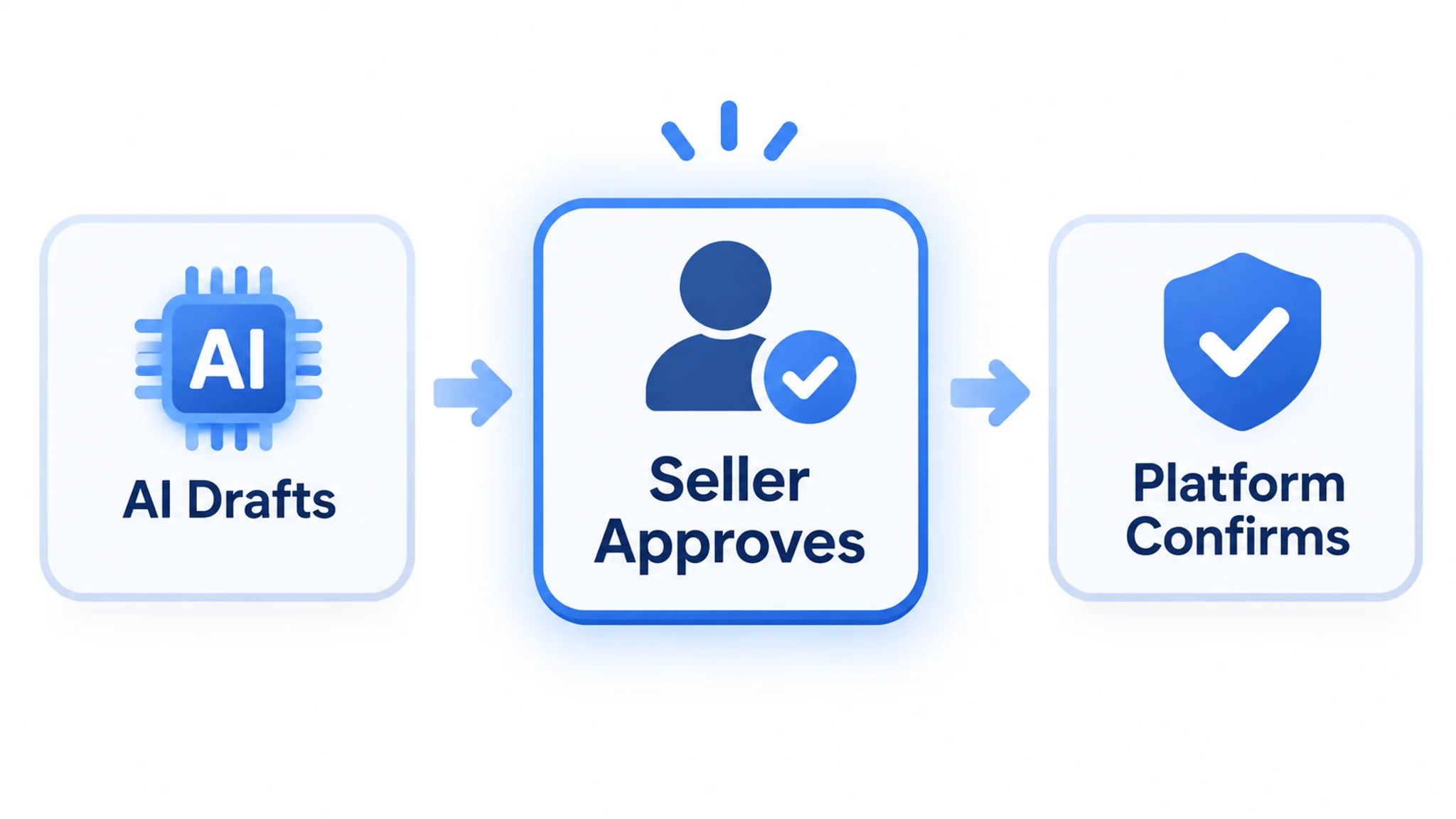
The dividing line is not whether AI is involved. It is whether a human confirms the output and whether the change travels through an authorized channel. Controlled use keeps the seller in command: the system drafts or proposes, the seller decides, and the platform confirms the result.
Commonly acceptable with controls, subject to official policy verification:
- AI-drafted titles, bullets, and image concepts, reviewed and explicitly confirmed by a person before anything reaches the listing. A side-by-side comparison of the current asset and the proposed replacement keeps each edit deliberate rather than automatic.
- Repricing within seller-defined guardrails, but only where separate official authorization and limit verification exist for that specific integration.
- Inventory and listing updates through official APIs under least-privilege scopes. A module authorized only for image asset management should never read or write price, inventory, or order data.
- Content-consistency checks that flag drifted specifications, altered logos and brand assets, or fabricated parameters — surfacing them for correction instead of overwriting them silently.
That control distinction matters when the content itself is the risk. In the mobility-aid review, the dangerous shortcut would not have been an unauthorized script in the ad account. It would have been publishing a first image that showed a hand sinking into the cushion while the bullets claimed firm support, because the visual and copy were approved as separate assets. A side-by-side comparison against the current asset and the approved fact set is what turns that from an automatic publish into a deliberate decision. The same logic applies to AI-drafted titles, bullets, and image concepts: the tool can propose, but the seller has to confirm that the proposal does not contradict the product truth.
Prohibited shortcuts look similar on the surface but remove the control that makes automation safe:
- Publishing generated content that bypasses review.
- Producing misleading claims, invented accessories, or exaggerated dimensions to lift CTR.
- Automating fake reviews or question-and-answer content.
- Unauthorized scraping of competitor listings or catalogues.
- Any tactic that evades policy enforcement rather than satisfying it.
Treat no list as a universal approval record. Verify each tool's authorization status directly, read the scopes it requests, and keep the human confirmation step intact.
Common Misreadings of Amazon AI Agent Policy
A policy guess becomes risky when sellers treat it as settled fact. The safer posture is conditional: separate what is confirmed, what is inferred, and what still requires verification before changing listing content or automation workflows.
- Misreading: a fixed effective date and exact numeric thresholds are confirmed. Safer interpretation: treat dates and numbers circulating outside the source text as unverified until checked against the policy notice or seller communication they claim to interpret. Use them as review triggers, not compliance guarantees.
- Misreading: the website is the “real truth.” Safer interpretation: read the website as one policy surface among several, and reconcile it with the account notice, help-page version, and written guidance tied to the specific marketplace and program. Where versions conflict, pause and confirm.
- Misreading: every AI agent needs separate explicit authorization. Safer interpretation: authorization can depend on the tool, integration, data access, and account permissions involved. Verify the actual permission boundary instead of assuming a per-agent rule.
- Misreading: violations trigger immediate suppression. Safer interpretation: enforcement timing and severity are context-dependent. Monitor listing status, performance notifications, and account health, and keep a remediation path ready.
- Misreading: off-platform complaints feed a defined “product risk score.” Safer interpretation: off-platform signals may prompt review, but do not assume a published formula or score.
How DeepBI Fits an Amazon Listing Compliance Workflow
DeepBI can be named here only as one Amazon-only listing tool example used inside a human-review workflow. Any product-level compliance statement, including whether a listing satisfies Amazon requirements, should be deferred to official Amazon Seller Central policy and the terms that govern the seller account, including the Business Solutions Agreement. That boundary matters because AI-assisted listing work is not a substitute for platform policy review or seller accountability.
Within that workflow, DeepBI’s documented role is narrow: it operates through Amazon’s Selling Partner API (SP-API) with permissions limited to image asset management, and it does not access pricing, inventory, or order data unless explicitly authorized. It is positioned as an executor, not a creator or decision-maker. The human review step remains decisive: before any image change is applied, the seller sees a side-by-side comparison of the original and proposed replacement, can select specific images to replace, and confirms the action. This keeps AI output inside a controlled listing process rather than presenting it as an autonomous compliance check.
A concrete example of that narrow role appeared in the mobility-aid review. DeepBI's structured comparison scored the target listing 62 out of 100 against 85 for a comparable high-performing listing. The gap was not evenly spread: the A+ detail page scored 12/25 against 23/25, the main image 21/30 against 27/30, the title 13/20 against 17/20, and bullet points 7/10 against 9/10. Reviews were level at 9/15 on both sides. That distribution mattered because it kept the work on the page and inside a human-review workflow rather than turning an ad-account adjustment into the first move. The tool identified a recoverable content gap; it did not declare the listing compliant or non-compliant.
Sellers should treat the tool as a drafting and execution aid for Amazon listing images, not as a source of policy approval. The final compliance judgment stays with the seller and official Amazon guidance.
A Practical Checklist for Listing AI Content Compliance
Use this checklist as an internal control set for AI-assisted listing content. It is not an Amazon requirement; verify the latest official Amazon policy before relying on it.
- Verify tool authorization: confirm official API or Marketplace Appstore access where applicable, and recheck status against official documentation.
- Maintain a single source of truth for product facts, so AI drafts draw from approved data rather than scattered files.
- Require human review before publication, with a named reviewer approving claims, images, and material listing changes.
- Substantiate claims with real measurements and visible product features; use explanatory placeholders when a parameter is uncertain.
- Review images against actual product structure and platform standards for mismatches that can affect CVR and returns.
- Check ads automation separately, confirming budget, bidding, and creative changes stay within seller-defined guardrails.
- Keep an action audit log recording action type, reviewer, timestamp, and rollback note for material changes.
- Set a sync cadence between source data and live listings, such as same-day or within 48 hours as an internal standard.
- Run a periodic tool audit to catch stale integrations, outdated permissions, and configuration drift.
- Define an escalation plan for pausing automation, contacting the tool provider or platform, and documenting corrections.
In the mobility-aid review, the checklist item that would have changed the sequence earliest was not “raise the bid” but “review images against actual product structure and platform standards.” The seller had been treating ACOS as the primary diagnosis; the page was the place where conversion actually leaked. That is the practical value of a checklist: it moves the first question from the ad account to the evidence chain.
Compliance here means transparency, attribution, and human review, not a ban on AI. Keep records clear, verify the latest official Amazon policy, and treat this checklist as an internal control set rather than a compliance guarantee.