


Why Listing Conversion Is a Moving Target
Detail-page modules, search-result layouts, and ad placements keep shifting. A listing that converted a few quarters ago can quietly fall behind a new benchmark set. Conversion is decided on the detail page, yet that page competes with competitors that are also changing images, offers, and review profiles. Keyword placement alone cannot carry a listing; Amazon's ranking reflects sales and conversion signals among other factors, so copy changes without a conversion read are incomplete. Because the benchmark moves, diagnosis must be repeatable.
Re-audit quarterly, and immediately after a category shift or the entry of a new benchmark, so CTR and CVR slippage surfaces before it compounds. The playbook ahead starts with benchmark selection, then runs a five-dimension audit across the main image, title, bullets, A+, and VoC, before prioritizing edits and measuring results against the same baseline.
Diagnose the Layout Gap Before You Rewrite Anything
Before you touch your title, bullets, or images, diagnose the layout gap: the difference between your page's information order and the order used by a benchmark set of comparable products. A useful benchmark shares core product form, price band, and audience, and has enough reviews to be market-validated; Bestseller #1 alone invites survivor bias. Rewriting before this comparison wastes a small seller's key advantage: specificity. You can fix an unstable visual focus, missing parameter visualization, or a weak scenario cue—if you know where your page diverges.
A grip-socks listing shows why the order matters. The team had already written its diagnosis: eight reviews against a category leader's 2,130, rising ad spend, and organic orders that stayed flat. They concluded the page was not trusted enough and that advertising was compensating for missing review volume. The scoring run against a benchmark selected from the same product form, same use case, and same price band told a different story: 62 out of 100 against 86, a 24-point gap, but 17 of those points sat in the detail page alone. The review gap was real. It was also not the dimension dragging the page down.
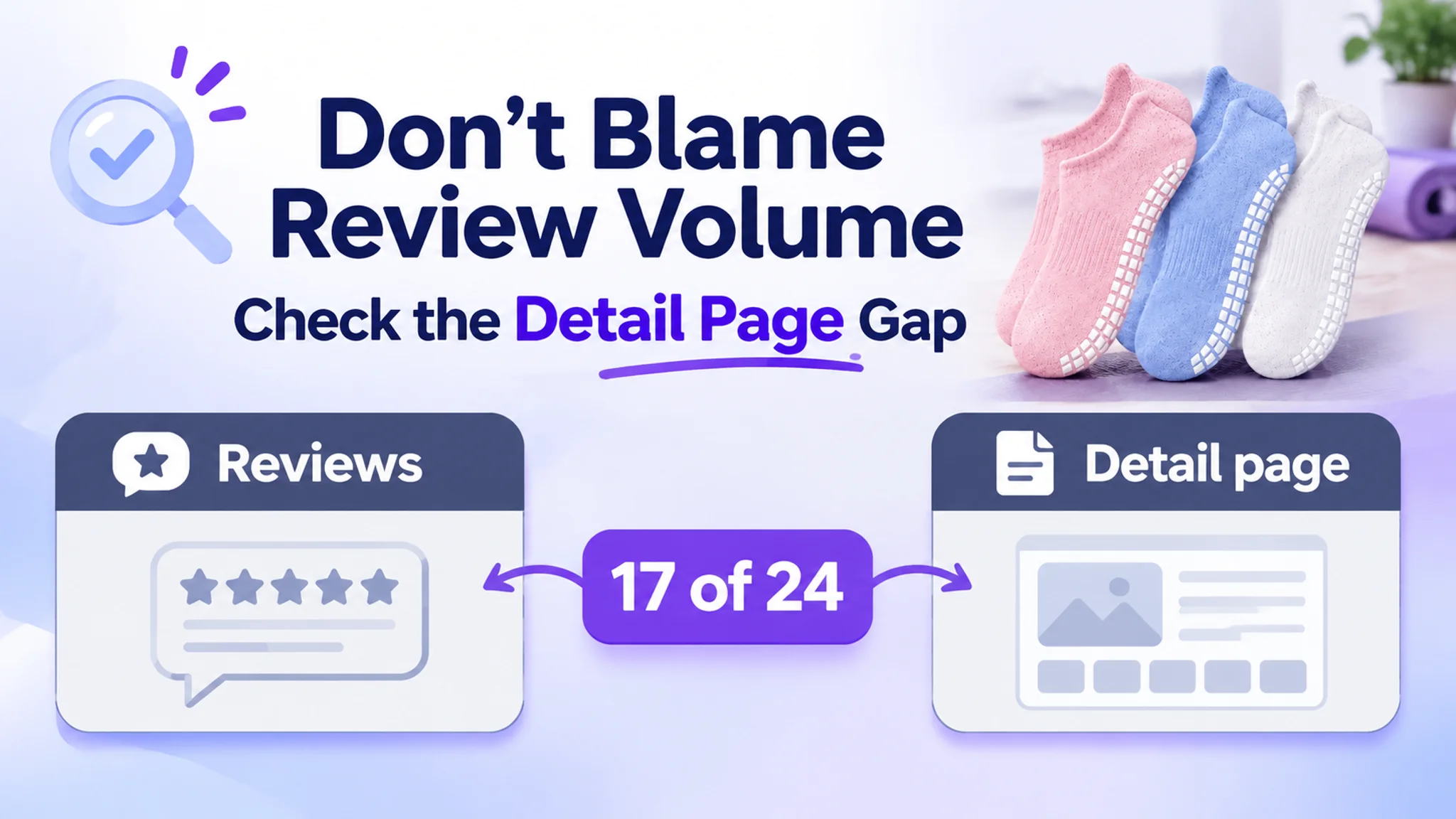
That is the layout gap in practice: not a vague feeling that the page is weak, but a ranked view of where the page diverges from a comparable set. Four diagnostic lenses are applied in later modules:
- Main image and visual hierarchy
- Title keyword and benefit ordering
- Bullet pain-point coverage and sequence
- A+ module order and conversion coverage
Let one strategic contradiction set priorities—for example, decent brand-term visibility but weak category-term presence. The diagnosis should output a ranked shortlist of gaps, not a single score. Order the list by severity, attach a rewrite action to each gap, and assign a validation metric: CTR for click and visual-hook gaps, CVR for trust and acceptance gaps.
Sample Competitor Report Overview: What a Credible Benchmark Contains
A credible sample report is interpretable only when its boundaries are visible before any comparison. In the grip-socks diagnosis, the benchmark was not the broad category's No. 1 Bestseller; it was a listing with the same product form, same use case, and same price band, which is what made the 62-versus-86 score readable. Use the checklist below to separate evidence from decoration.
- Scope the report first: category, competitor set, marketplace, time window, and data source. State inclusion rules and exclude weakly validated competitors.
- Label every sample number as illustrative and, where appropriate, de-identified; never present a figure as market truth.
- Open with a short executive summary that names the landscape, the main weaknesses, the strengths worth defending, and the priority order for action.
- Present modules in workflow order: data capture and cleaning, diagnosis, recommendation, production, and delivery.
- Link every recommendation row to the module that produced it and name its validation metric, such as CTR, CVR, or BSR movement.
- Flag small-base caveats plainly: a thin review base means each new negative review moves the average more than it would on a mature listing.
- Where a number is missing, describe the pattern qualitatively and mark it as a hypothesis to validate.
Module 0 - Product and Listing Structure: Auditing the Layout Gap
A live listing rarely loses conversion in one obvious place. It leaks through structure: a main image that promises something the title does not reinforce; title information ordered around internal priorities instead of buyer questions; bullets that list features without sequence; an A+ page with no clear hierarchy; variations that leave some ASINs under-explained; and a reader who stalls before reaching price. Audit the page as a structure, not a word count.
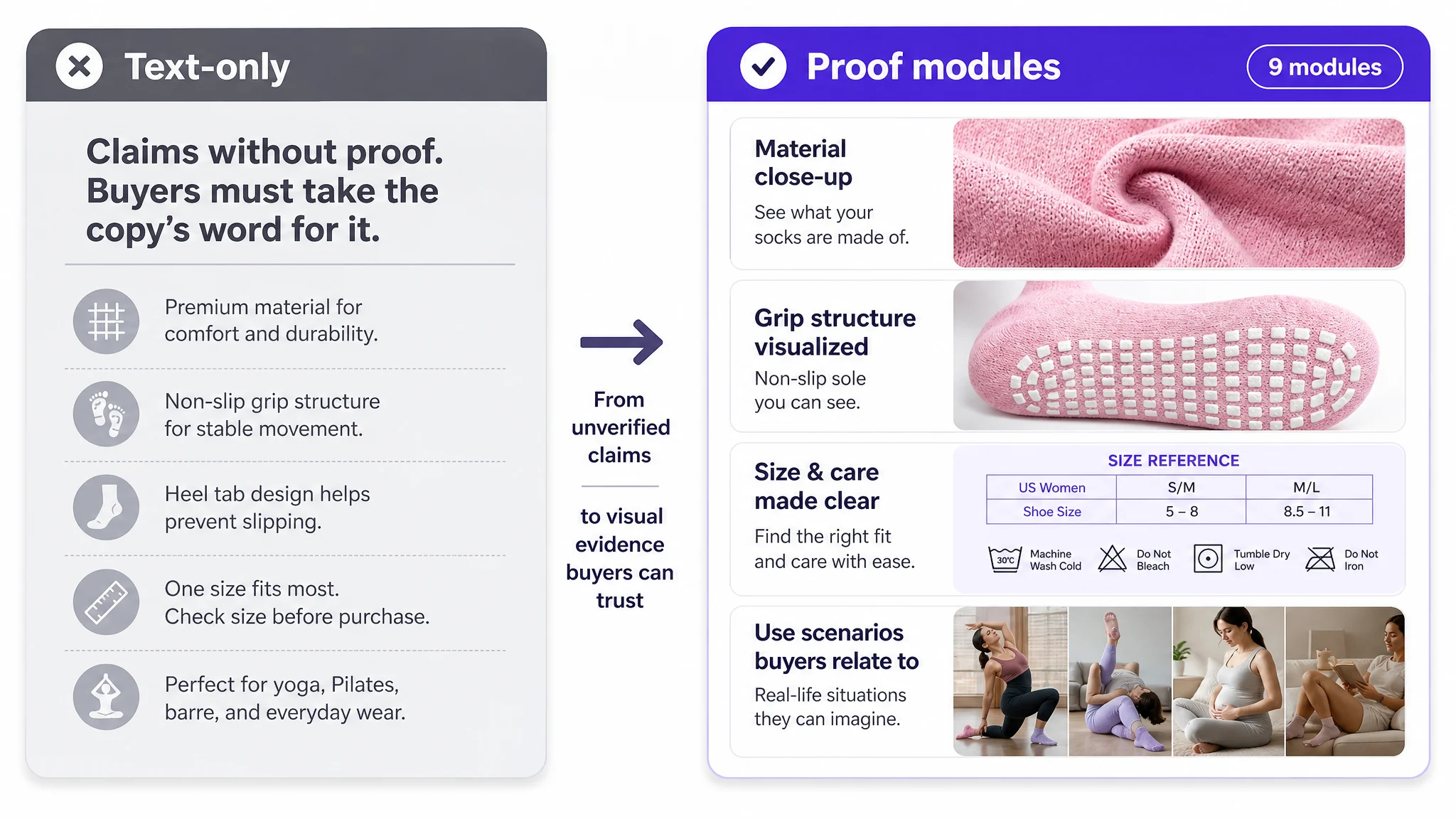
The grip-socks listing is a compact example. Its five-dimension scores were not uniformly low: title 14 against 16, main image set 24 against 26, bullets 8 against 8, reviews 10 against 13, and detail page 6 against 23. The bullet points were level. The detail page was a 17-point hole. Its A+ area was text-only: material, grip structure, heel tab, size question, and non-sporting use cases existed as claims, but there was no visual proof for a buyer to check. The benchmark listing ran nine full-width modules, including brand visual, multi-color display, size and care reference, material close-up, and use scenarios spanning studio work, recovery, pregnancy, and home. The target listing asked a skeptical buyer to take the copy's word for it.
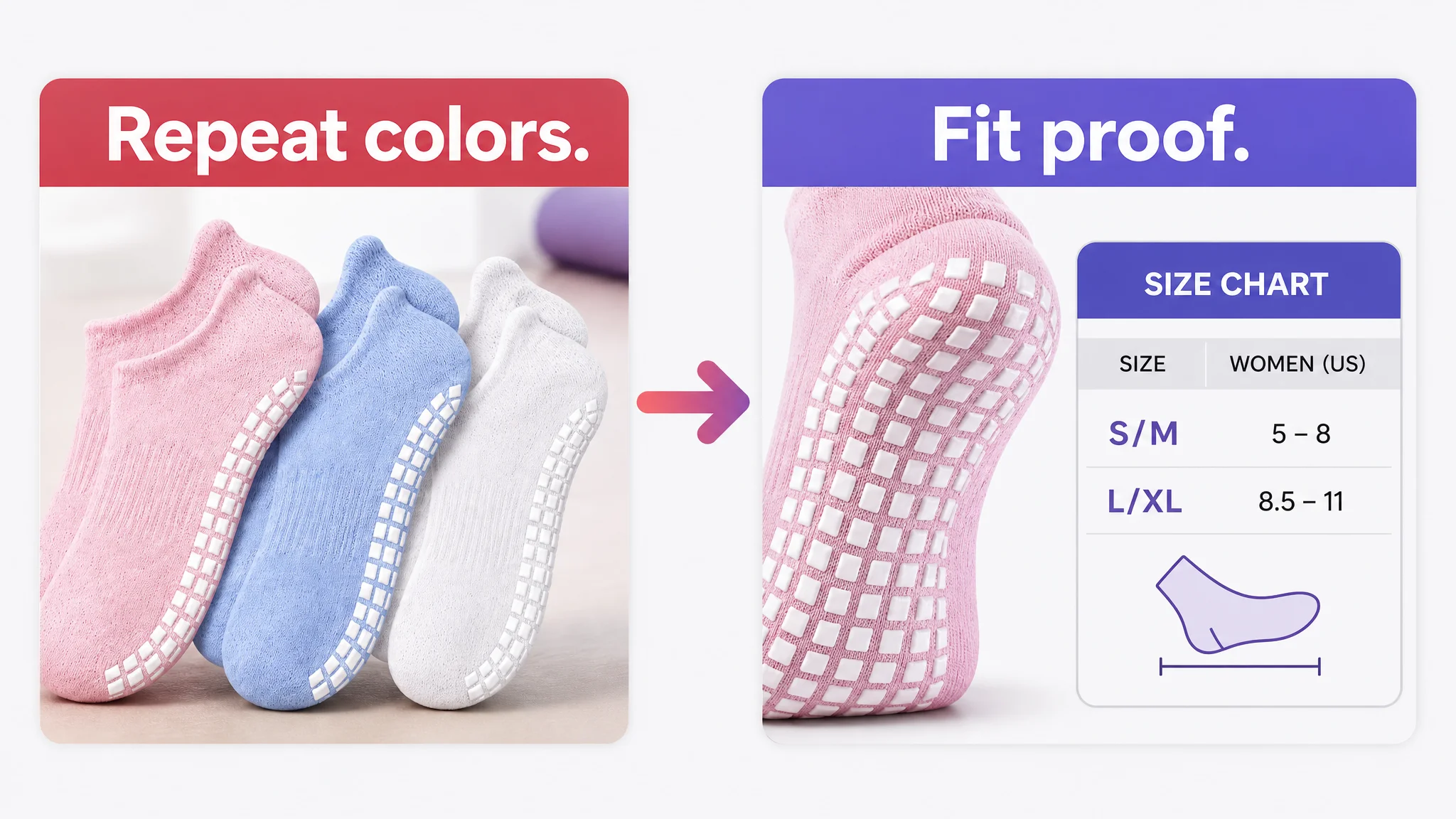
The main image gap looked small on paper—two points—but the behavior behind it was more serious. Two of the five image slots returned to quantity and color. One slot used a meditation scene, which asks almost nothing of a grip product's performance. The final slot, where a buyer in this category typically resolves the last objection, was spent on color options rather than sizing. The benchmark listing used its later slots for a structural close-up and a size chart, answering the two questions that stall this category: will these grip on the surface I use, and will they fit.
A subjective review says the page looks fine. A benchmark audit shows which module trails a comparable set and by how much. Compare each element with that benchmark set and score the gap across visual hook, information density, trust proof, A+ module coverage, and variant-level clarity. The result should be a ranked weak-point list tied to CTR and CVR, not a generic score. For that diagnostic, DeepBI is Amazon-only and selects competitor benchmarks from a broad ASIN pool; it scores main image, title, bullets, A+, and review structure to generate that ranked list for CTR and CVR.
Bullet and description allowances vary by seller type and can change, so verify current limits in Seller Central rather than trusting a remembered number. Keep the edit focused on information order, not padding. Then translate each scored gap into one specific page change.
Module 1 - Sales and Price: Reading Demand Signals First
Before you rewrite a bullet, read sales and price as a demand-signal story. Start with three readings: relative sales versus your benchmark, growth direction, and the price-gap trajectory. Together they turn raw numbers into a narrative you can act on. Keep that narrative honest, however: a pattern is a hypothesis to validate, not proof that one metric explains another.
The grip-socks benchmark was selected within the same price band, which removed an easy but false explanation. The 24-point gap was not concentrated in price; it was concentrated in the detail page. That does not prove price never matters. It means the demand-signal read had to be paired with a page-level read: the listing was receiving paid traffic while organic orders stayed flat. The price gap was not the first constraint the diagnosis could support.
If the price gap is narrowing while growth is faster than the benchmark's, the question changes. You are no longer asking only whether price blocks the click; you are testing which listing elements deserve the next investment. Check whether the main image earns the CTR and whether the detail page and review proof carry the CVR. Treat coupon placement, unit-price clarity, and pack-size framing as part of the layout gap—a presentation hypothesis to test inside the page, not a separate pricing strategy.
Benchmark selection matters here. Comparing against products in a very different price band can make the gap look meaningful when it is not. Keep the comparison close enough to inform the edit, then let CTR and CVR show you where the page leaks.
Module 2 - Search Demand and Keyword Structure: Map Terms Before Writing
Build the term map before you touch the title or bullets. Start with demand structure, not a random keyword list. Pull head terms, category modifiers, scenario and use-case phrases, and legally referenceable competitor-brand adjacency from reverse-deconstructing the current title and bullets, simulated buyer searches, and the leaf-category head-product set. That is demand evidence: it tells you what shoppers search and how the category frames the problem. Keep it in one column.
In a second column, log conversion evidence: CTR, CVR, and high-conversion attributes from ad data. These signals show what already attracts clicks or persuades shoppers; they do not by themselves prove demand volume. Treat the two columns as distinct inputs, not one blended list.
The grip-socks listing had a real title issue, but it was not a reason to rewrite everything. The brand term was missing, so brand equity and brand-adjacent search weight were not accumulating. The core phrase was not held together contiguously. The quantity signal sat at three pairs against the benchmark's six, which changes the value read before a click even happens. That is a term-map and ordering problem, not a bullet-copy problem. The same page's bullets were already level with the benchmark at 8 versus 8. Mapping first would have kept the work on the title instead of spreading effort across copy that was already competitive.
Then assign placement. Put the primary demand term and product form in the title. Use bullets for scenario phrases, category modifiers, and proof-backed attributes. Reserve legally referenceable competitor adjacency for factual comparison or compatibility contexts. Content written before this map usually gets rewritten because the page inherits phrasing instead of demand structure. Keyword stuffing may look relevant for a short window, but it usually weakens CVR and can be discounted by ranking systems. Map first, write second.
Module 3 - Category Core-Word Ranking and the Conversion Leak
Start with the terms that actually carry traffic in your category, not the ones you assume matter. Reverse-engineer your own title and bullets to extract the core search terms they imply, then confirm those terms against how buyers actually phrase searches in your node. That produces a candidate list worth auditing.
In the grip-socks diagnosis, the title's two-point gap—14 against 16—was a candidate explanation, not a proven cause. The missing brand term and the broken core phrase were visible. The quantity signal difference was visible. But the priority was set by the larger detail-page gap, not by the title alone. That is the discipline this module asks for: locate the occupiers of the core terms, lock the benchmark, and validate before rewriting. The page did not need a broader keyword list as much as it needed the existing argument finished.
Next, check who occupies those terms. Locate your product's bottom-end category node and pull the top-selling, high-conversion product matrix inside it. Lock your benchmark to products with similar form, price band, and audience—comparing your title keyword layout against an unrelated No. 1 Bestseller tells you nothing and misdirects effort. Any optimization detached from real market benchmarks is effort misspent.
Then interpret carefully. A missing core term is a candidate explanation for a CVR leak, not proof of one. The discipline matters: benchmark coverage is limited to the locked competitor set, and absence from that set does not mean absence across the category. Before you rewrite a title, validate. Run a paid-search test on the term, estimate its traffic, or compare CVR against benchmark ASINs that do rank there. Only after the term shows real traffic and a measurable close-rate gap should it drive edits.
The same discipline applies to long-tail terms. A term is genuinely lower-competition only after you have verified overlap and competitor coverage. A term you have not checked yet is unverified, not unoccupied.
From Gap Map to Listing Copy: Title, Bullets, Images, and A+
The gap map creates value only when it becomes page-level edits. Convert each finding into a short execution checklist, then write and preview the listing in the order shoppers judge it: title, bullets, images, A+.
The grip-socks gap map converted into a specific execution sequence. The detail page needed to become a sequence rather than a text block: use-case validation first so a buyer confirms the socks belong to their activity, then material and matrix silicone structure shown rather than asserted, then size and care reference placed where fitting doubt actually occurs, then the non-sporting scenarios—recovery, pregnancy, household surfaces—that the benchmark listing had used to widen its addressable audience. The main image chain needed to stop repeating quantity and color; the freed slots went to grip performance in a real studio setting, a structural close-up of the sole, heel tab, and arch band, and a size chart at the point of final hesitation. The title needed the core phrase held together, the brand term restored, and quantity and scenario signals ordered so a scanning buyer can parse them. The bullet points were mostly left alone because they were already competitive.
- Title: Front-load the primary intent term and the differentiating attribute; keep the line readable aloud and remove modifiers that do not sharpen relevance or clarity.
- Bullets: Give each bullet one benefit plus proof, ordered by the shopper's sequence of doubt; work the keyword in naturally instead of repeating it.
- Images: Make each image answer one purchase question—scale, material, in-use context, comparison, and what is in the box.
- A+ content: Sequence modules to resolve the objections the bullets raised, using the opening, selling points, pain-point resolution, trust proof, and action guidance as the page logic.
- Image quality: Treat visualization as a purchase-decision function, not decoration; buyers need to see fit, finish, and use before they trust the claim.
- Priority check: Use the Amazon-only DeepBI multi-agent strategy output, ranked by expected impact, to turn gap findings into an execution checklist for title, bullets, images, and A+.
- Generation: Use the Amazon-only DeepBI AI-assisted generation for main image, detail images, A+, title, and bullets, with multiple options and front-end preview.
- Application: Use the Amazon-only DeepBI one-click SP-API sync for approved content, with old-versus-new version comparison before publishing.
The Trust Layer: Ratings, Review Signal, and Offer Presentation
Copy can earn the click and still lose the sale at the trust layer. Many shoppers move straight to the review section before reading your bullets closely, so review volume and rating distribution are not side notes; they are conversion inputs that shape whether the edited page closes.
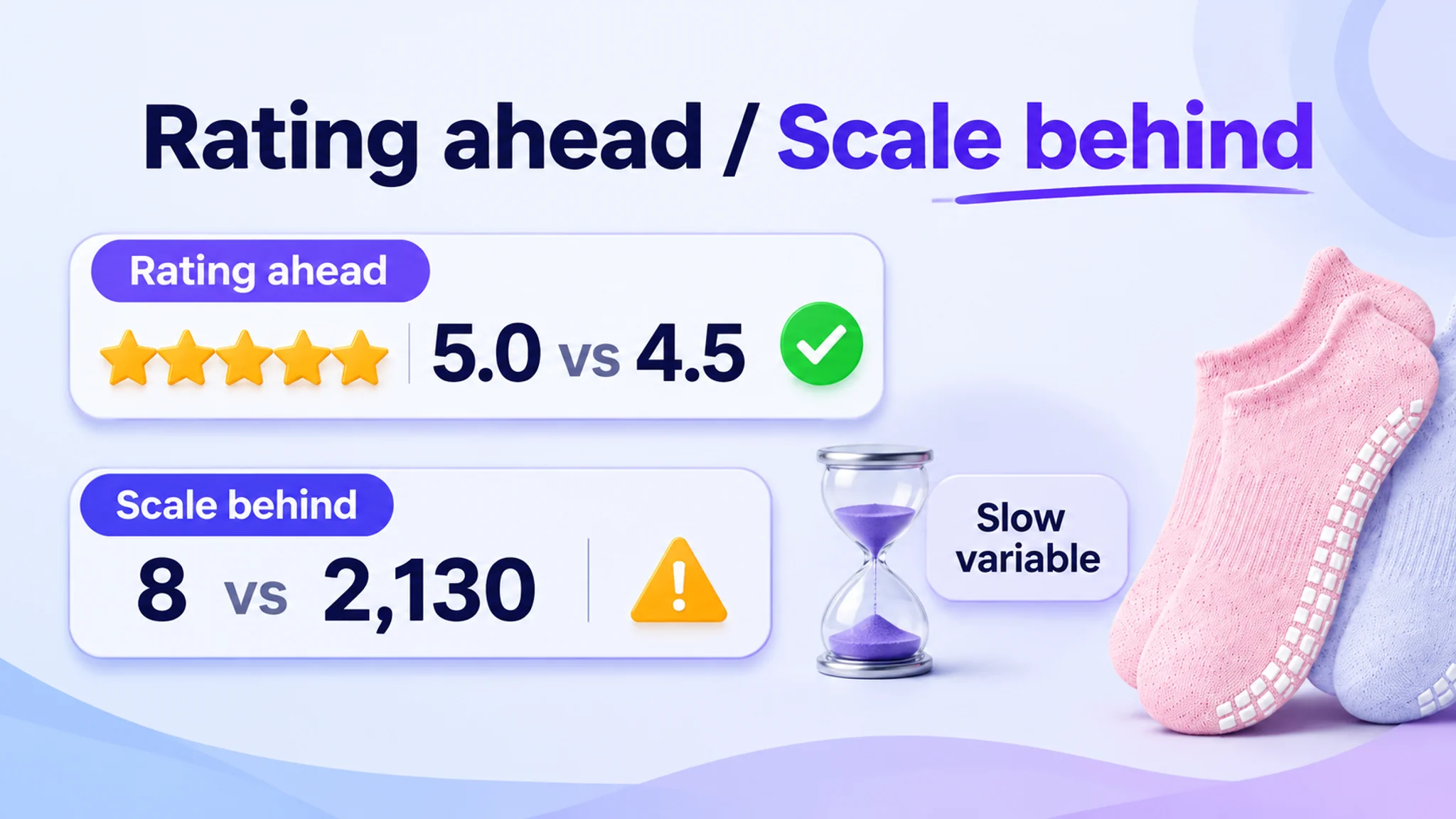
The grip-socks listing is the cautionary version. The team saw eight reviews against 2,130 and treated the page as untrusted. But the target listing held a 5.0 rating with no three-star-or-below reviews on the first page; the benchmark sat at 4.5 with a visible low-star review in the same position. On the dimension the team thought was broken, the target listing was ahead. What it lacked was scale and texture: verified-purchase reviews, photo and video content, helpfulness votes. Those are real weaknesses, and they are also slow variables. Nothing on the product page compresses them in a meaningful window. That is why review scale was placed outside the current optimization cycle instead of being allowed to set the priority order.
Use that signal as a diagnostic, not a target to manufacture. Read the rating curve, the review-count gap to competitors, and the objections that recur in review text and image reviews. Those patterns show which claims the page must answer and where proof is thin. They belong in the listing assessment as a scoring input, not as a reason to chase review volume.
Offer presentation belongs in the same layout-gap review: price transparency, variation clarity, and clear shipping and returns information. Copy alone cannot repair a page that makes the buyer work to understand the offer.
For the listing score, an Amazon-only DeepBI review-structure dimension can incorporate volume, rating distribution, and negative-review shape alongside copy and visual dimensions. Use it to prioritize fixes, not to treat reviews as something to manage.
Use Paid Traffic to Stress-Test the Rebuilt Listing
A listing edit is a hypothesis until qualified traffic hits it. You cannot judge a new main image, title, or A+ block from internal review alone. A controlled Amazon Sponsored Products push on the terms the page now targets gives you fast CTR and CVR reads: does the click hook attract the right shopper, and does the detail page close the click? That is the bridge. Paid traffic is the measurement instrument here, not the subject.
The grip-socks team's default move when conversion softened was to tighten campaign structure, retune bids, prune search terms, and push more budget at the best-performing keywords. That work is legitimate. It is also neutral against a page that cannot close. Advertising was delivering traffic into a page that had never finished its argument: no visual proof layer in A+, repetitive main image slots, and a final image slot spent on color rather than sizing. More spend produced more sessions at the same low intent-to-order rate and a higher cost per order. The rising ACOS read as an advertising problem; the underlying defect stayed where it was, now funded more heavily.

There was also a risk reason for the sequence. At the point of diagnosis, the store's traffic structure was leaning hard on paid. Paid traffic was arriving at a page that could not build trust quickly, so the paid share had to keep growing just to hold order volume flat. That structure gets more fragile the longer it runs: cost per order climbs, organic share erodes, and operating margin gets thinner while the dashboard still looks busy. Repairing the page was the only move available that could reduce dependence on that structure instead of deepening it. The recommendation was not "stop advertising." It was an order: fix the page's ability to convert first, correct the title's weighting second, leave the mostly competitive bullets alone third, and keep review scale out of this cycle.
Use a qualitative funnel. Start broad enough to explore relevant search terms and competitor ASINs. Filter out traffic that clicks but does not convert. Concentrate spend on proven terms that match the revised positioning. Then scale carefully, so added spend does not blur the signal you are trying to read.
Adjust bids and budgets daily from a rolling window of clicks, conversions, spend, and ACoS signals rather than reacting to single-day noise. After a visual change goes live, tag it as an iteration event and watch the CTR slope over the following 7–14 days; pair that with CVR and ACoS movement to confirm whether the edit earned its place.
On Amazon, DeepBI's four-layer traffic funnel and dynamic bid and budget adjustment can be used here only to validate the listing changes described earlier. Keep the test disciplined: paid traffic tells you whether the rebuilt page works before you commit more organic expectations to it.
A 30-Day Execution Sequence and Measurement Plan
A gap report earns its keep only when it becomes a schedule. Run the audit as four weeks of work, and attach a verification metric to every action so nothing ships on instinct alone.
The grip-socks diagnosis maps onto this sequence. The first week's five-dimension audit would surface the 17-point detail-page hole and the level bullet score. The second week's term map would isolate the missing brand term, the broken core phrase, and the quantity-signal gap. The third week's visual rebuild would turn the A+ area from text-only claims into a proof sequence. The fourth week would publish and read CTR, CVR, ACOS, and review sentiment against the same benchmark.
- Week 1 — Benchmark and score. Inside Amazon-only DeepBI, reverse-extract your core search terms from the current title and bullets, pull the terminal node, and lock one benchmark ASIN using similarity, price, and review filters. The five-dimension audit across main image, title, bullets, A+, and VoC returns a gap report rather than a vanity score, and each gap carries a unique report_id so the action stays traceable to the module that produced it.
- Week 2 — Term map and copy draft. Rebuild the title as brand + core benefit + product form + modifiers within Amazon's 200-character limit, and draft bullets on a pain-point-to-solution loop. Amazon-only DeepBI's prioritized execution list keeps the queue ordered by expected impact, so the highest-leverage edits land first.
- Week 3 — Visuals and A+ rebuild. Convert each gap into parameterized instructions covering composition, camera angle, lighting, scene elements, and color tone, then rebuild A+ by buyer-psychology module. Product DNA holds structure, material, color, and proportions fixed.
- Week 4 — Publish, then measure. Amazon-only DeepBI's one-click sync through SP-API applies changes to the live listing in seconds, and version comparison supports a clean before/after reading against the pre-apply visual comparison wall.
Measure natural ranking, ad impressions, CTR, CVR, and review sentiment trend against your own benchmark set and your own prior period, never against a universal number. Book the next audit before you close this one.
Failure Modes and a Closing Checklist
A conversion-minded audit usually fails less from missing data than from self-defeating habits. Watch for these behaviors before you edit a live listing.
The grip-socks listing is a useful failure-mode check because the team's first diagnosis was plausible and still wrong in priority. Rewriting the bullet points would have consumed a week and moved nothing because they were already equal at 8 versus 8. Treating the title gap as proven causation would have missed that the larger constraint was the detail page. Letting an eight-versus-2,130 review gap set the priority order would have put a slow variable in charge of the month's work.
- Treating keyword stuffing as optimization. Redundant modifiers and stacked terms can create a short-term relevance illusion while hurting CVR.
- Rewriting before benchmarking. Any rewrite detached from real market benchmarks is wasted resources; establish a similarity-constrained baseline first.
- Treating a keyword gap as proven causation. A gap is a hypothesis until paid-search and traffic data support it.
- Calling unverified terms "zero competition." Overlap and coverage still need verification.
- Asserting an official ranking algorithm name or weighting. Say ranking is influenced by sales and conversion signals among many other factors.
- Describing a performance report as complete seller data. Treat it as a diagnostic input and cross-check it against exposure, clicks, orders, CTR, and CVR.
- Using superlative self-descriptions or unverifiable credentials as evidence. Replace them with verifiable process or constraint statements.
- Claiming any tool eliminates market risk. Use manage or mitigate framing.
Before publishing, run this five-item checklist:
- Benchmark under similarity constraints before you rewrite.
- Validate keyword and visual gaps against real CTR, CVR, or traffic data.
- Mark unverified terms and remove "zero competition" claims.
- Label reports as diagnostic and avoid official algorithm or weighting claims.
- Preview the old and new version, verify product claims and compliance, and avoid no-risk language.