


Table of Contents
This guide maps the Amazon listing AI content compliance decision path, from why the question exists to what happens when a tag is missed.
- Why listing AI content compliance now sits inside routine listing review
- A narrow qualification test: which assets actually fall inside the disclosure question
- A verification-first tagging workflow for synthetic human imagery and regulated advertising content
- A consequence matrix separating documented enforcement from unverified risk
- A practical pre-publish review checklist for listing and compliance teams
- An applied FAQ on disclosure, tagging, and human review in the loop
Why This Exists
AI-generated human imagery in advertising has drawn consumer-protection attention because it can blur the line between a real person and a synthetic one. When an image implies an endorsement, demonstrates a result, or presents a lifestyle claim, buyers may reasonably infer that a human actually used the product. Regulators and consumer advocates therefore focus on whether such presentations could mislead, and on whether clear, conspicuous disclosure is needed. FTC guidance, for example, warns that undisclosed AI-generated endorsements may be deceptive when they mislead consumers.
That legal backdrop is not the same as an Amazon marketplace rule. For sellers, the controlling question is not what a particular jurisdiction may require in general, but what Amazon Seller Central and Amazon’s official generative-AI and listing-content policies require for a given listing. Those official sources define seller obligations; general legal disclosure debates do not substitute for them.
As of the writing date, policy details around AI content and tagging can be difficult to confirm from secondary commentary. Where the official position is uncertain, treat the issue as a verification task: check Seller Central and verify the latest official Amazon documentation before changing listings, adding disclosures, or assuming a mandatory tag applies. This keeps compliance work anchored to the marketplace policy that actually governs the account.
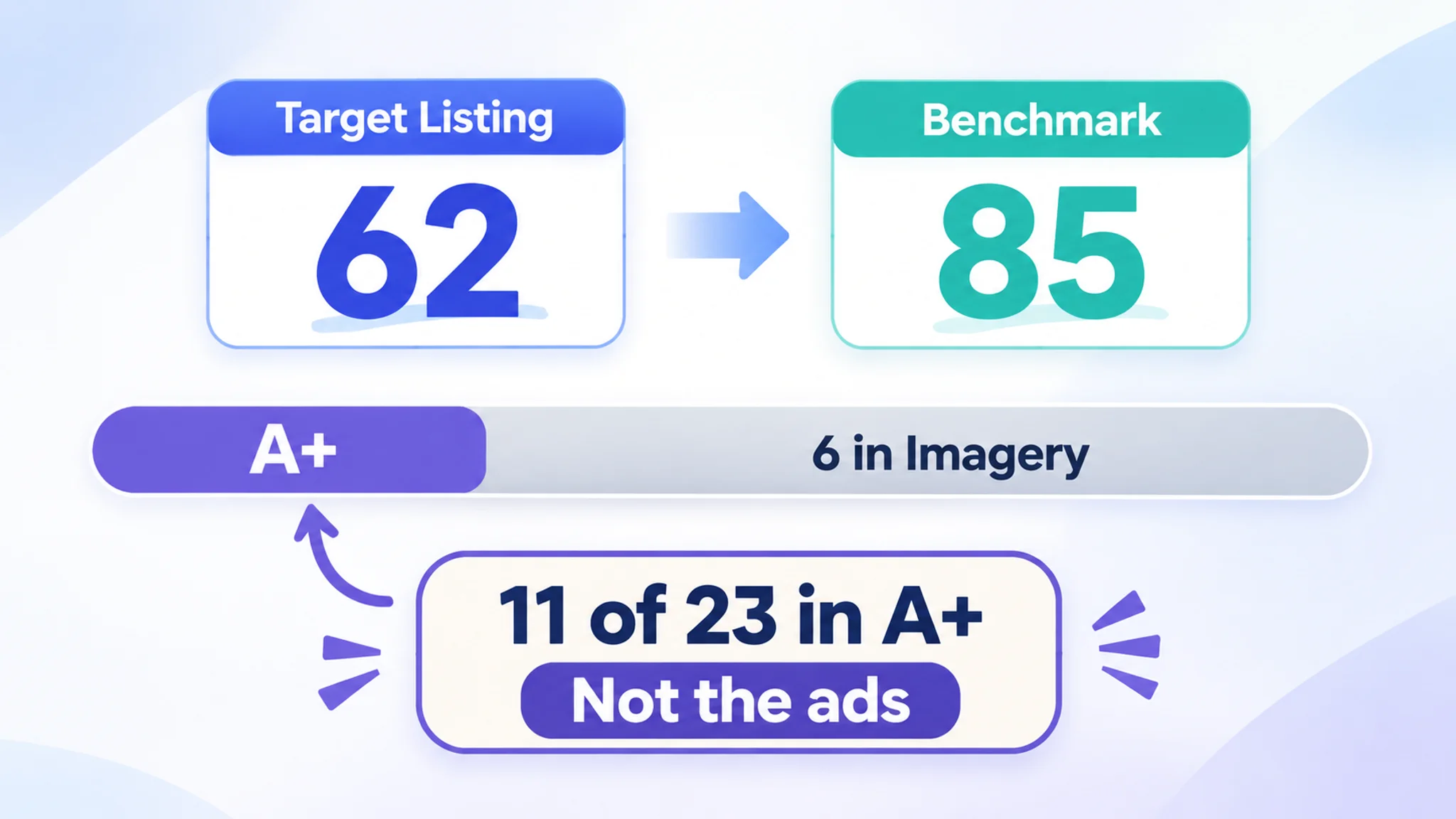
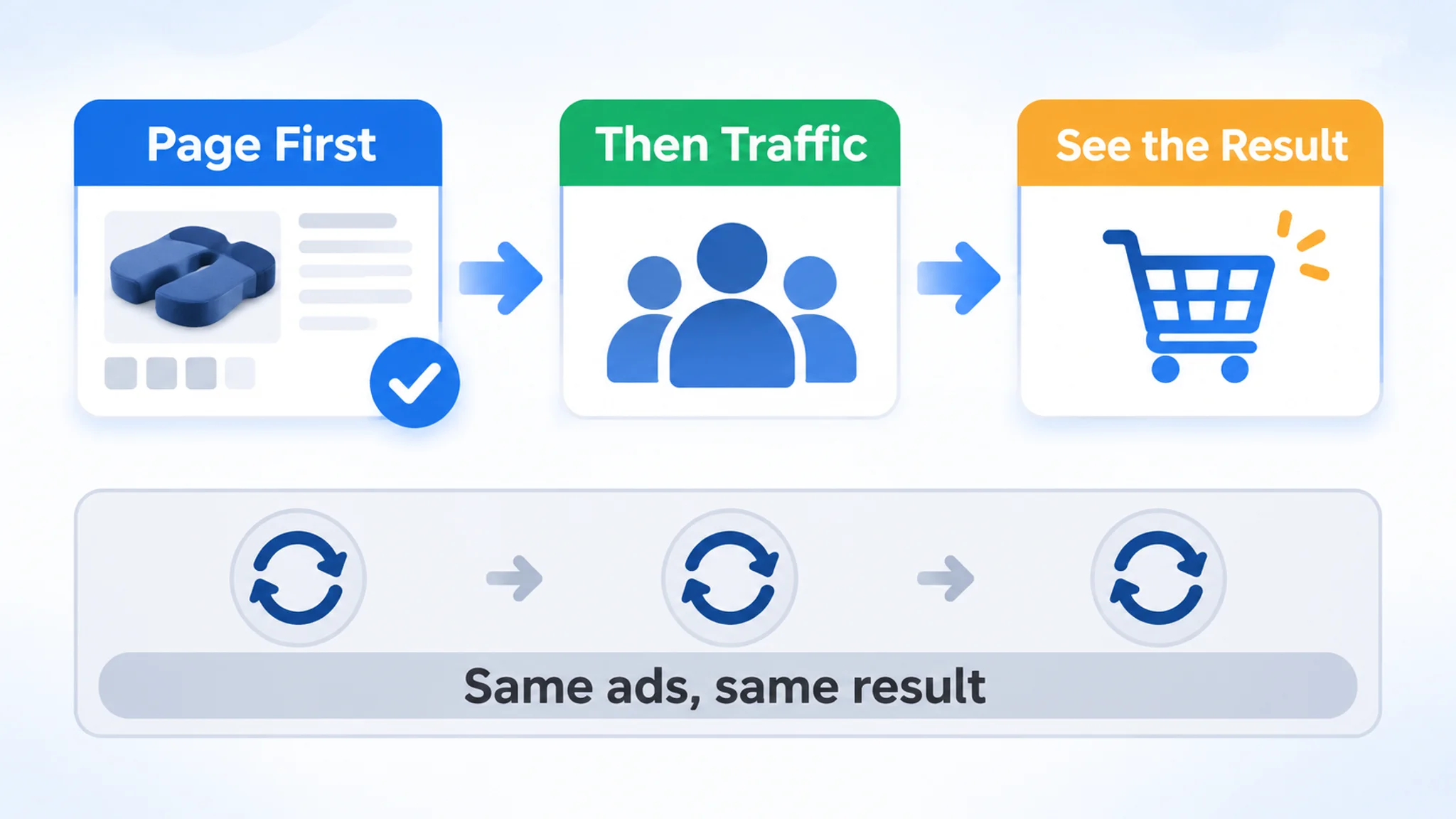
Compliance work tends to fail in the same shape as other listing work: the team answers the question it finds most urgent rather than the question that governs the outcome. In one recent listing review, a seller in the mobility-aid category was certain the problem sat in the advertising account. Spend was going out, clicks were arriving, and orders were not following in proportion. The working theory was campaign inefficiency — bids too loose, keywords drifted, structure overdue for another round of surgery. A structured comparison against a comparable high-performing listing in the same category put the target listing at 62 out of 100 against 85, and the largest block of that gap was not in the ads at all: 11 of the 23 points sat in the A+ detail page alone, with another 6 in imagery. The ads were not the leak. The instinct was understandable, the evidence behind it was real, and the conclusion was wrong. AI disclosure review carries the same risk. The question that governs the account is narrow and documentary — what does Amazon’s current official policy require for this specific asset — and it is easily displaced by a louder, more general question about what regulators might require, or by a vendor’s assurance that a tag is mandatory.
What Actually Qualifies
The compliance threshold is narrower than “any asset touched by AI.” Use a simple qualification test: if the person in the asset is AI-generated, treat that asset as a disclosure or tagging candidate; if the person is a real model photographed and only lightly retouched, do not put it in the same category, subject to official policy.
Treat these as candidates across listing images, video, and A+ content:
- AI virtual models or synthetic performers standing in for a real person.
- AI face-swapping that replaces a model’s face.
- AI outfit changes that make the person’s appearance substantially synthetic.
- Fully AI-generated photorealistic human figures.
Do not automatically apply the same treatment to ordinary AI-assisted editing:
- Background removal.
- Lighting adjustment and color correction.
- AI-generated backgrounds or lifestyle scenes without people.

The test is written asset by asset rather than listing by listing because listings never fail evenly. In the mobility-aid review, the 23-point gap was distributed across five dimensions and no two of them pointed the same way: title 13/20 against a benchmark’s 17/20, main image 21/30 against 27/30, bullets 7/10 against 9/10, A+ 12/25 against 23/25, and reviews dead level at 9/15 on both sides. A single verdict on that listing would have said “needs work” and stopped there. The dimension-level split said something far more useful: nearly half the recoverable gap sat in one content module, and a change made for that module would have been actively wrong if copied onto the title. Disclosure candidacy behaves the same way. One synthetic-human asset inside an image set does not make the set a synthetic asset, and a decision recorded for a video module should not travel into an A+ module with different mechanics.
Boundary cases need a second look. A partial face edit, a synthetic expression, or a background-only change may not fit cleanly into either list. The test is a starting point, not a substitute for policy review. Confirm the current official Amazon guidance before tagging or disclosing, and record the rationale so review stays consistent.
There is a second reason to record the rationale, beyond consistency. Candidacy is decided per asset, but whether a presentation misleads is decided against the rest of the page. An asset can pass every check in isolation and still contradict the copy sitting next to it. On that mobility-aid listing, one image showed a hand pressing visibly into the cushion while the bullet points insisted the foam runs firm, holds its shape, and will not flatten. Nothing about the image was non-compliant as an image. It was misleading as a claim, and only a reviewer holding the copy and the creative at the same time could see it.

Treating every retouched photo as a synthetic-person asset creates avoidable review work and can slow listing cycle time without improving compliance. The arithmetic is familiar: capacity spent on a category that does not require it is capacity not spent on the categories that do.
How to Add the Tag
Before you modify a single listing file, confirm the requirement directly against Amazon's own current documentation. Disclosure rules, tag syntax, and where a label must appear can differ by marketplace, category, and asset type, so treat any secondhand checklist as a lead to verify rather than an instruction to execute.
For that verification, use the question-and-answer format below.
Q: What should I check first? A: Whether a tag is required for the specific asset type, which field or string is named, and whether Amazon requires a separate consumer-visible disclosure. If you cannot find an official specification, document that gap and pause changes.
Q: How do I prepare a batch safely? A: Build an asset inventory covering main images, secondary images, video, and A+ modules, and record provenance for each file plus whether a synthetic human appears. Confirm each asset against its correct slot before editing, so a decision made for one image is not applied to an unrelated module.
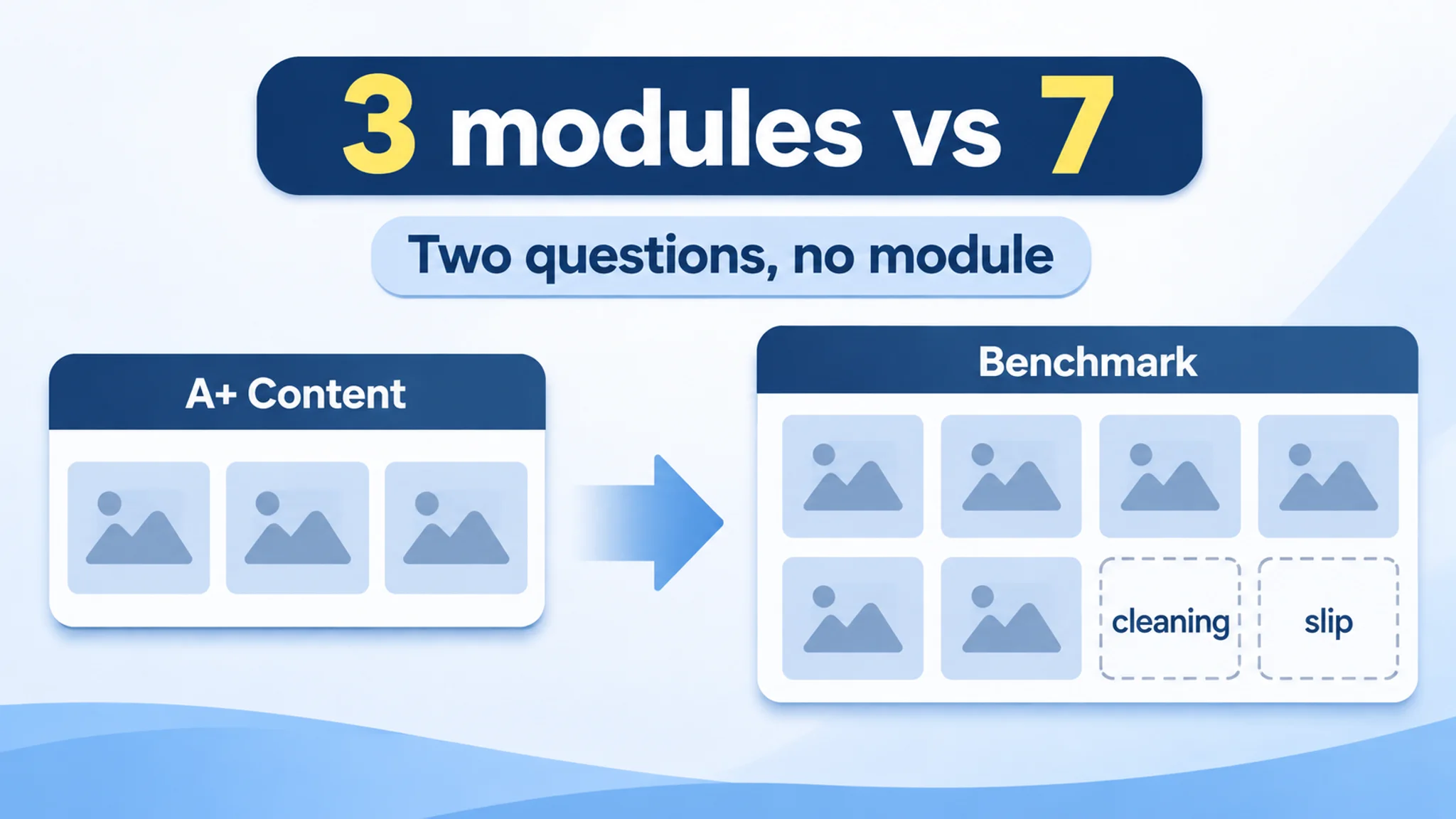
The inventory is not paperwork. It is the instrument that makes a finding possible. The mobility-aid comparison only located its gap because each asset was named, placed in a slot, and measured against the job that slot is supposed to do. Four assets on that listing were each doing a different job badly. The title front-loaded its core keyword and then repeated it in a near-duplicate form, spending its strongest position on nothing and leaving the audience signal out; a colour note consumed the tail while the numeric benefit went unstated. The lead image identified the product — a cushion sitting on a toilet — and never stated the added height, so the buyer’s first question went unanswered in the frame most likely to be seen. The bullets carried accurate facts in an inert order. The A+ page carried three images where the benchmark carried seven, and two of the buyer’s loudest unspoken questions, cleaning and slip resistance, had no module answering them at all. A batch-level pass over that listing would have returned one verdict and missed all four.
Q: How do I apply and verify? A: Edit metadata only through tools and fields named in official instructions, apply the exact string only where documentation specifies it, then add a clear and conspicuous disclosure wherever policy requires one and the tag alone does not satisfy that obligation. Do not assume an internal flag renders automatically to shoppers.
Q: How do I close the loop? A: Run compliance quality checks before re-upload, retain an audit trail of what changed and why, confirm the processing status returned after submission, and monitor for policy updates that affect CTR, CVR, or listing cycle time.
A returned status is a record of processing, not a measurement of outcome. The mobility-aid rebuild had no clean post-optimization performance window, so the honest account of it was about state rather than numbers: the page stopped arguing with itself, and the same claims began appearing in the same order across title, lead image, bullets, and A+. That is a defensible description of change. An assumed lift would not have been.
What Happens If You Don't Tag It
The honest answer is that the outcome depends on which kind of risk you are measuring. Treat Amazon's published enforcement outcomes as the primary source, and keep them separate from the consequences sellers speculate about in forums.
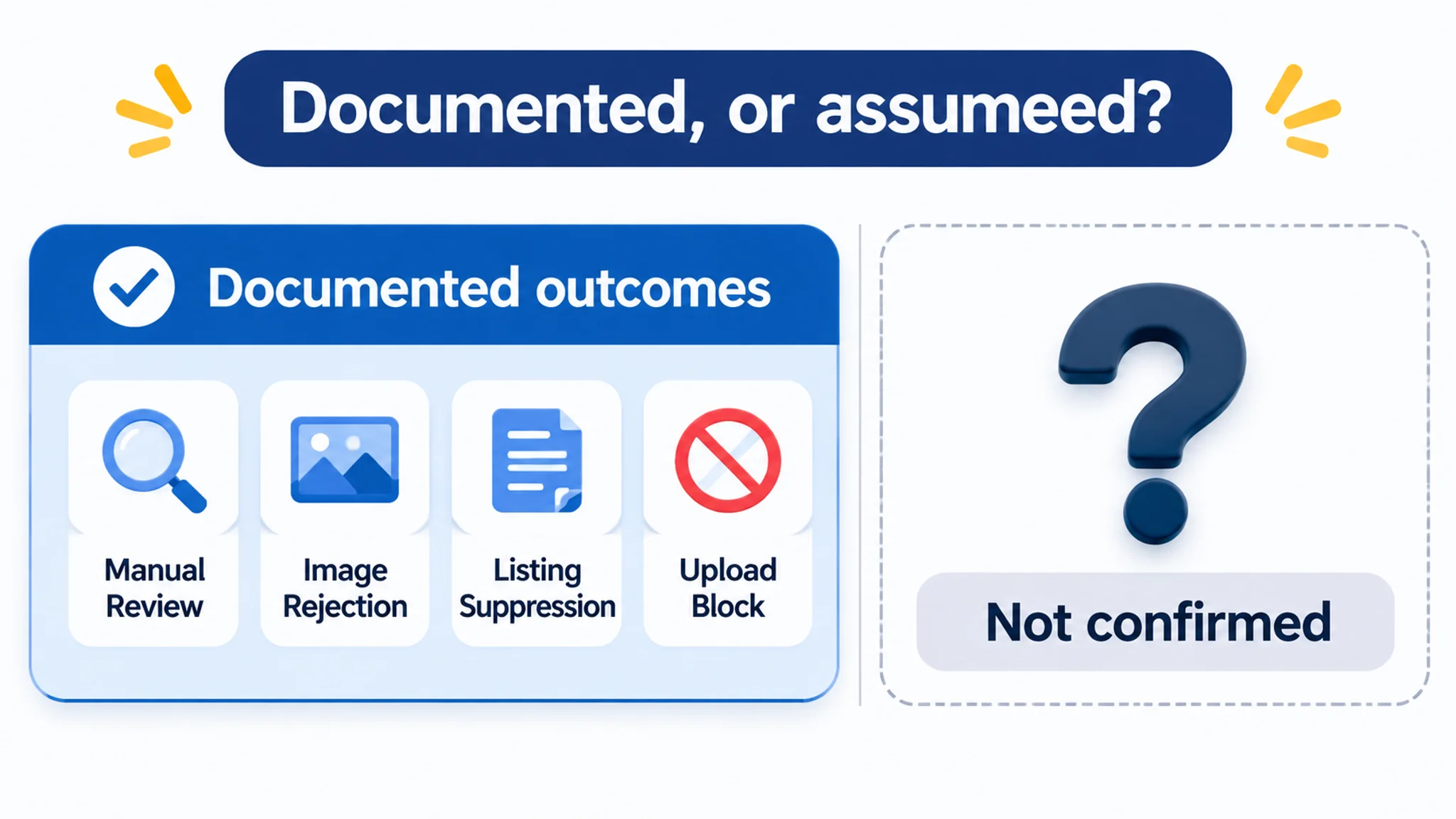
Documented outcomes. Where official policy and platform documentation describe a specific action — manual review, image rejection, listing suppression, or an upload block on assets that fail hard image standards — plan around exactly that action, no more. In practice, a listing workflow may return a backend processing status such as success, processing, or blocked for violation, and noncompliant images can be stopped before upload. Note the boundary: those documented outcomes concern image-standard and content compliance, not confirmation that an untagged AI-generated image is penalized in a particular way.
Not publicly confirmed. Whether untagged AI content triggers discrete enforcement, and on what timeline, is not publicly confirmed. Do not build a compliance plan on an assumed deadline.
General business risk. Disclosure rules in some markets are still developing, so treat legal exposure as a matter for qualified counsel rather than a fixed rule of thumb. Consumer trust is the more immediate concern: a model image that misrepresents scale, contents, or finish shows up as returns, negative reviews, and a weaker CVR long before any enforcement question arises.
The mechanism is mundane, which is why it gets discounted. A misleading visual does not announce itself as misleading. It produces a moment of hesitation at the point of decision, and the buyer resolves that hesitation against the seller. The mobility-aid listing made accurate claims about height, firmness, stability, and hygiene, but it did not present the evidence in the order a buyer actually doubts them, and one image argued the opposite of the copy. The benchmark treated firmness as a claim that must be demonstrated, with weight resisted rather than accepted. The target listing showed a hand sinking in. No enforcement action was required to make that expensive.
Prioritize by surface area. Sellers running hundreds of listings across multiple SKUs and marketplaces, with heavy use of AI-generated model imagery, have far more assets that could be questioned. Start review there, not with your ten best-selling ASINs.
Prioritization is where most of the leverage sits, and it is also where instinct is least reliable. The mobility-aid seller’s attention went to the ad account, because that was where cash was visibly leaving and where the numbers were loudest. The recoverable exposure was on the page, and it was measurable: 11 points in A+, 6 in imagery, 4 in title. The review dimension was level on both sides — 9/15 for each, ratings of 3.8 and 3.7, review counts of 82 and 106 — which made it a genuine drag but not a relative disadvantage, and not something that could be closed inside a planning cycle. Ranking by exposure means exactly this: order the work by where the documentable gap is large and addressable, not by where the anxiety is loudest.
A Practical Compliance Review Workflow
Use a controlled release process with named owners and explicit approval gates. Human judgment decides; tools only keep the review organized.
- Listing copy — listing/compliance reviewer. Check titles and bullets for AI-related claims, disclosure wording, and substantiation; measurements and specifications must match visible product facts or confirmed base information.
- Images, video, and A+ — creative lead; compliance reviewer signs off. Review synthetic human figures, AI-generated scenes, and module-level A+ assets for product mismatch, unrealistic presentation, and misleading context.
- Ads automation creative — ads manager; compliance reviewer signs off. Inspect automated creative and any asset that may include AI-generated people before placement.
- Publishing gate — publishing lead. Require documented human approval before release; approve only checked assets when tools present old-versus-proposed versions.
- Recordkeeping — operations lead. Log asset version, reviewer, approver, decision, and date; retain scoring or optimization reports for traceability.
- Re-review triggers — compliance reviewer. Reopen review after policy updates, new assets, changed product facts, or CTR/CVR shifts that raise claim or creative concerns.
This list looks administrative until you compare it against what a real review finds. In the mobility-aid case, the ads automation creative review was in effect the only review the team was running, and it was diligent: bids tightened, keywords pruned, campaign structure revised. Every round produced the same result at the bottom of the funnel, because the page, not the traffic, was setting the ceiling. The failure was not in how carefully the ads were reviewed. It was in the object of the review.
Applied to the page itself, the same list produces findings no campaign report contains. The main image and the bullet points were making opposite claims about firmness. The lead image answered “what is this” and left “why should I care” untouched. The A+ page had no module for cleaning and none for slip resistance, so two of the buyer’s three real questions were never answered. None of these are ad-account findings, and none would have surfaced in an ads review no matter how many times it was repeated. This is why the publishing gate is written as a gate and not as a courtesy: an approval only means something if the approver was holding the asset against the claim it is supposed to carry.
Re-review triggers matter for the same reason. The seller believed the images were acceptable. Subjective review would have found nothing, because there was nothing obvious to see. What surfaced the gap was a scored comparison against a comparable high-performing listing, which put a 6-point visual gap and an 11-point detail-page gap on the record. A trigger without a comparison is a hunch.
Where DeepBI Fits (Listing Only)
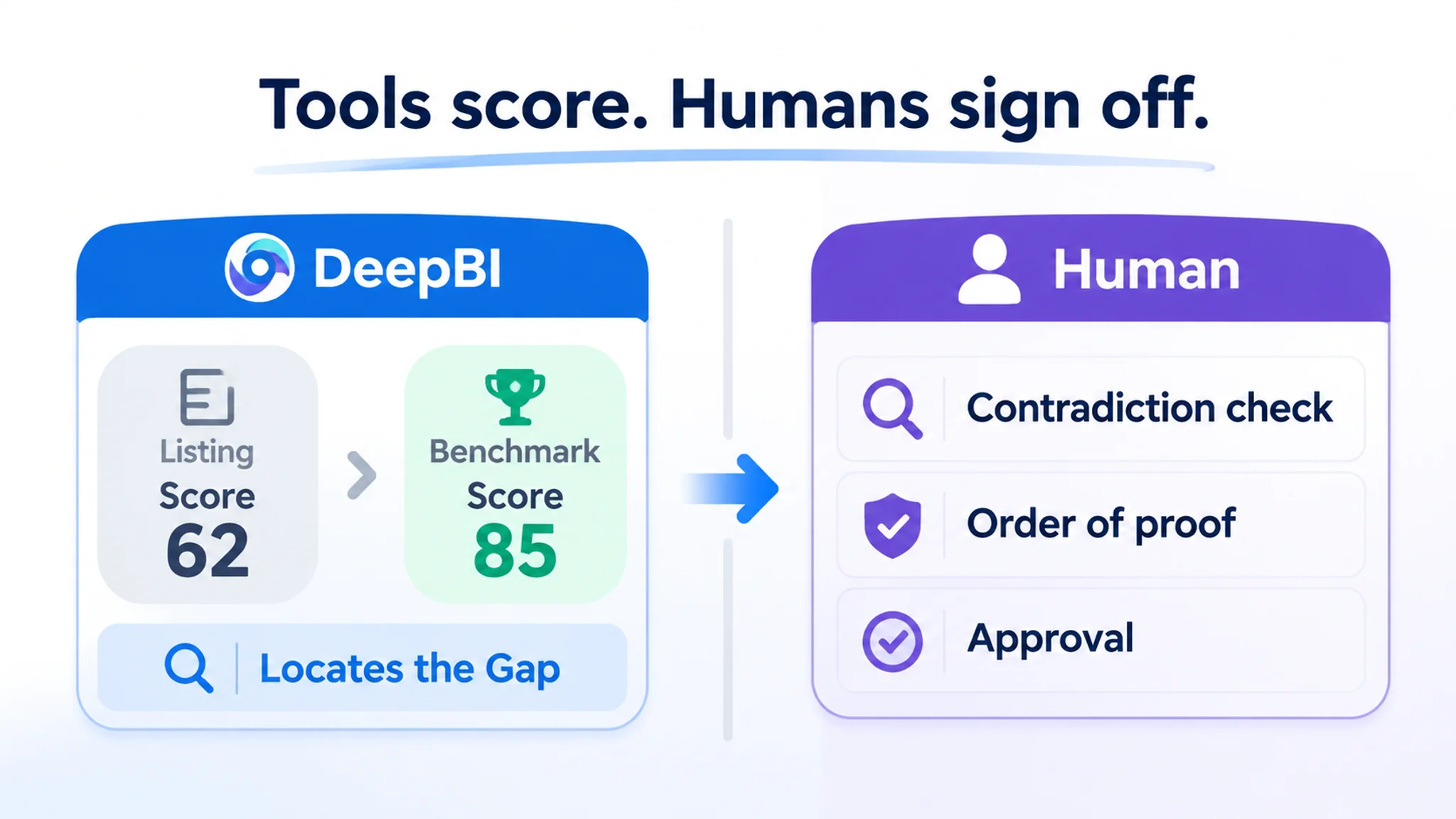
DeepBI supports listing scoring, copy suggestions, image generation constrained by a Product DNA map, and one-click application with user confirmation. It can organize listing work upstream of compliance review, but it does not certify legal compliance, detect AI-generated imagery, read metadata, or replace human sign-off.
The mobility-aid review is a fair picture of that boundary. DeepBI scored the listing at 62 against an 85 benchmark and broke the gap across title, main image, bullets, A+, and reviews, which is what located the leak and ended the ad-account hypothesis. It did not flag that the lead image argued against the bullet points. It did not know that cleaning proof and slip resistance had no equivalent anywhere on the page. It did not decide the order in which the page should earn belief — measurement before material, audience before mechanism, safety before aesthetics. Those were human findings, made by a reviewer comparing creative against copy and copy against creative. That division of labor is not something to apologize for. It is the reason sign-off cannot be delegated to a tool.
Where This Fits the Bigger Picture
Listing AI content compliance is not a one-time file edit. It belongs to listing-content operations, alongside copy updates, image refreshes, and publishing checks. As catalogs grow to hundreds of ASINs and creative workflows produce more AI-generated model assets, the review surface expands faster than any single approval can cover. The practical response is to prioritize by exposure: high-traffic, high-conversion listings and assets closest to the buying decision deserve the earliest scrutiny.
That requires operational scaffolding, not a one-off checklist. Sellers need an asset inventory that maps each generated image to its listing slot, named review ownership for approvals and exceptions, documentation of what was checked, and explicit re-review triggers when the catalog, creative workflow, or platform requirements change. The inventory earns its keep precisely where nothing is visible. The mobility-aid A+ page carried three modules against a benchmark’s seven, and the two missing ones — cleaning proof, slip resistance — happened to be the buyer’s loudest unspoken questions. Nothing on that page announced an absence. There was no empty frame to notice. A gap only becomes reviewable once the inventory names what each slot is supposed to prove.
Controls should hold the product entity consistent, preserve brand identity systems such as logos, fonts, and color schemes, and reject outputs that invent accessories or exaggerate dimensions. The mobility-aid case shows how far that check has to reach. Nothing on that page invented an accessory or exaggerated a dimension; the drift happened at the level of behavior. The copy claimed firm, the image demonstrated soft. An entity control that verifies parts and measurements but not how the product behaves under load will pass a page like that without a single exception.
When a publishing status returns as blocked or processing, treat it as an exception to resolve, not as proof that the asset is safe. The same discipline applies to reporting on your own work. Because the rebuild had no clean measurement window, the accurate account was qualitative: the team stopped treating ACOS as the primary diagnosis and started treating it as a symptom with an address on the page; title, lead image, bullets, and A+ began making the same claims in the same order instead of three different arguments competing for the same buyer; and ad traffic stopped functioning as a subsidy for a weak page. A page that repeats itself with evidence teaches the buyer to proceed. A page that contradicts itself teaches the buyer to hesitate. Neither statement is a number, and both are more reliable than a number would have been.
This discipline protects consumer trust and listing quality. Clear, accurate visual assets support CTR and CVR; mismatches invite returns and negative reviews, while rework lengthens listing cycle time. No review model eliminates enforcement risk, but it makes exposure visible and review repeatable.
Frequently Asked Questions
Do AI-generated backgrounds without people need a tag?
Use the narrow rule: if the person is AI-generated, treat it as a disclosure or tagging candidate. A people-free background is ordinary AI-assisted editing unless official Amazon policy says otherwise. As of the writing date, verify the latest official Amazon documentation.
What about AI touch-ups on a real model?
A real model photographed and lightly retouched for lighting, color, or background is generally not the same category. If the edit creates or replaces a person’s identity, treat it as a candidate. As of the writing date, verify the latest official Amazon documentation.
Does this apply to video and A+ content?
Apply the same qualification test to listing images, video, and A+ content when a synthetic human appears. Mechanics may differ by asset type, so do not assume one rule fits all. As of the writing date, verify the latest official Amazon documentation.
What if I cannot confirm Amazon’s official specification?
Do not guess field names, keyword strings, or case rules. Pause the asset, escalate to Amazon support or your compliance lead, and document the unresolved decision. As of the writing date, verify the latest official Amazon documentation before applying any tag.
Who should sign off before publishing?
A listing or compliance owner should sign off, with legal or brand review where needed. Tools can organize checks but should not replace human judgment. As of the writing date, verify the latest official Amazon documentation for sign-off requirements.
What should a seller do if a vendor claims a tag is mandatory?
Ask the vendor for a dated, official Amazon source and the exact required field or instruction. Until verified, treat the claim as unconfirmed and do not change files on assertion alone. As of the writing date, verify the latest official Amazon documentation.
The same standard applies to internal consensus, which is often harder to challenge than a vendor. The mobility-aid ads diagnosis was not a supplier’s claim; it was the team’s own working theory, repeated in enough meetings that it functioned as a fact. It survived for months because nobody tested it against the page, and it only broke when the listing was scored against a comparable benchmark and nearly half the gap turned out to sit in one A+ module. An unverified belief — whether it arrives from outside or originates in your own review meeting — is a hypothesis with a long half-life, not an instruction. Ask it for its dated source, and in the meantime, do not let it move files, budgets, or approvals.