

The Evolving Landscape of Amazon Listings and AI
The Amazon marketplace has evolved into a deeply competitive environment, where sellers face escalating traffic costs and intense pressure to optimize both Click-Through Rates (CTR) and Conversion Rates (CVR). Traditional listing optimization, often relying on subjective aesthetics and disconnected processes across diagnosis, planning, production, and delivery, proves inefficient and risky. For large sellers managing hundreds of SKUs, the manual effort required for constant updates and keyword research is time-consuming and prone to errors, hindering the ability to react swiftly to market shifts or prepare for peak seasons.
In real operations, this “subjective, fragmented” way of working doesn’t just mean inefficiency—it often leads to misdiagnosis. An industrial tools seller on Amazon US, for example, believed they had already built a “professional” listing for their 3-inch cut-off wheels: a detailed, spec-rich title, technically polished main images, and bullets that outperformed a key competitor in clarity. When ACOS stayed high and conversion felt fragile, the team instinctively blamed ads and keywords. They kept “turning the knobs” on bids and campaign structures, assuming the core problem was traffic quality.
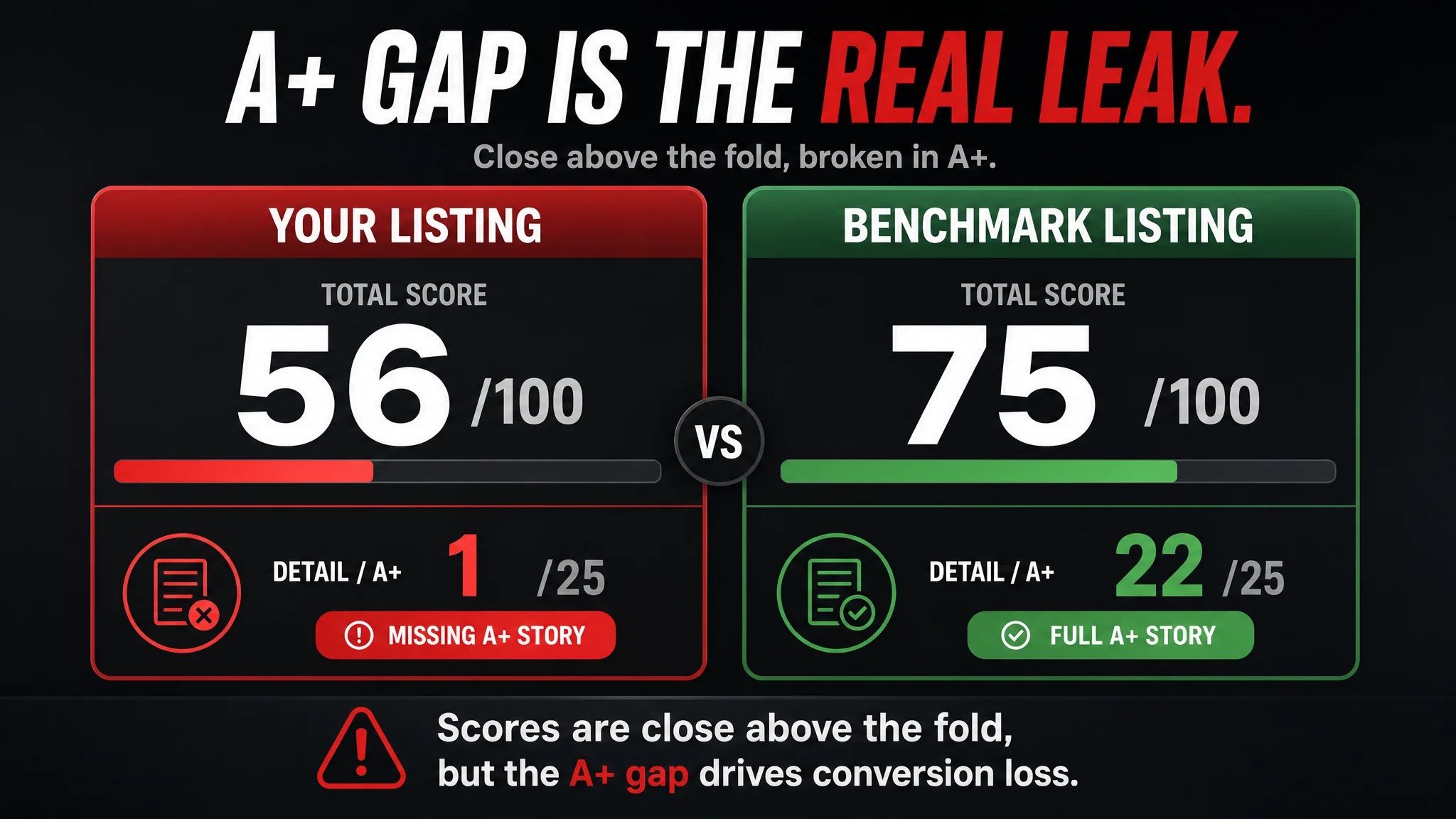
Only when DeepBI ran a full-funnel listing diagnosis did a different picture emerge: the listing scored 56/100 against a benchmark’s 75/100, and the gap wasn’t in the title, main image, or bullets—it was in the detail/A+ dimension, where the seller scored 1/25 versus the competitor’s 22/25. In other words, the page that all those paid clicks landed on had almost no visual story and no structured trust path, while the benchmark ran a fully built A+ “sales engine.” This illustrates how, without data and AI-driven diagnostics, teams can easily overestimate the strength of “visible” elements (title, main image, bullets) and completely overlook the conversion structure below the fold.
In this challenging landscape, Artificial Intelligence (AI) has emerged as a transformative force, fundamentally reshaping content generation and optimization for Amazon listings. AI systems are now capable of automating tedious tasks such as competitor analysis, data-driven scoring, and pain point identification, freeing up valuable operational time for strategic decision-making. This shift moves listing creation beyond mere visual appeal to a data-driven commercial engine, where every element, especially main images and A+ content, is optimized to drive clicks and conversions. By integrating AI, the inherent human uncertainty in optimization is significantly reduced, paving the way for a more precise and effective approach to enhancing listing performance—even in situations where sellers initially misjudge whether they have an “ads problem” or a “page problem.”
Why AI-Powered Listing Optimization is Essential for Amazon Sellers
For Amazon sellers, AI-powered listing optimization is no longer a luxury but a strategic imperative to navigate the competitive e-commerce landscape. Manual optimization processes are time-consuming and resource-intensive, often taking dozens of minutes for tasks like image uploads and content adjustments. In contrast, AI-driven systems like DeepBI reduce these operations to mere seconds through seamless API integration, significantly cutting operational costs and accelerating market response compared to traditional methods.
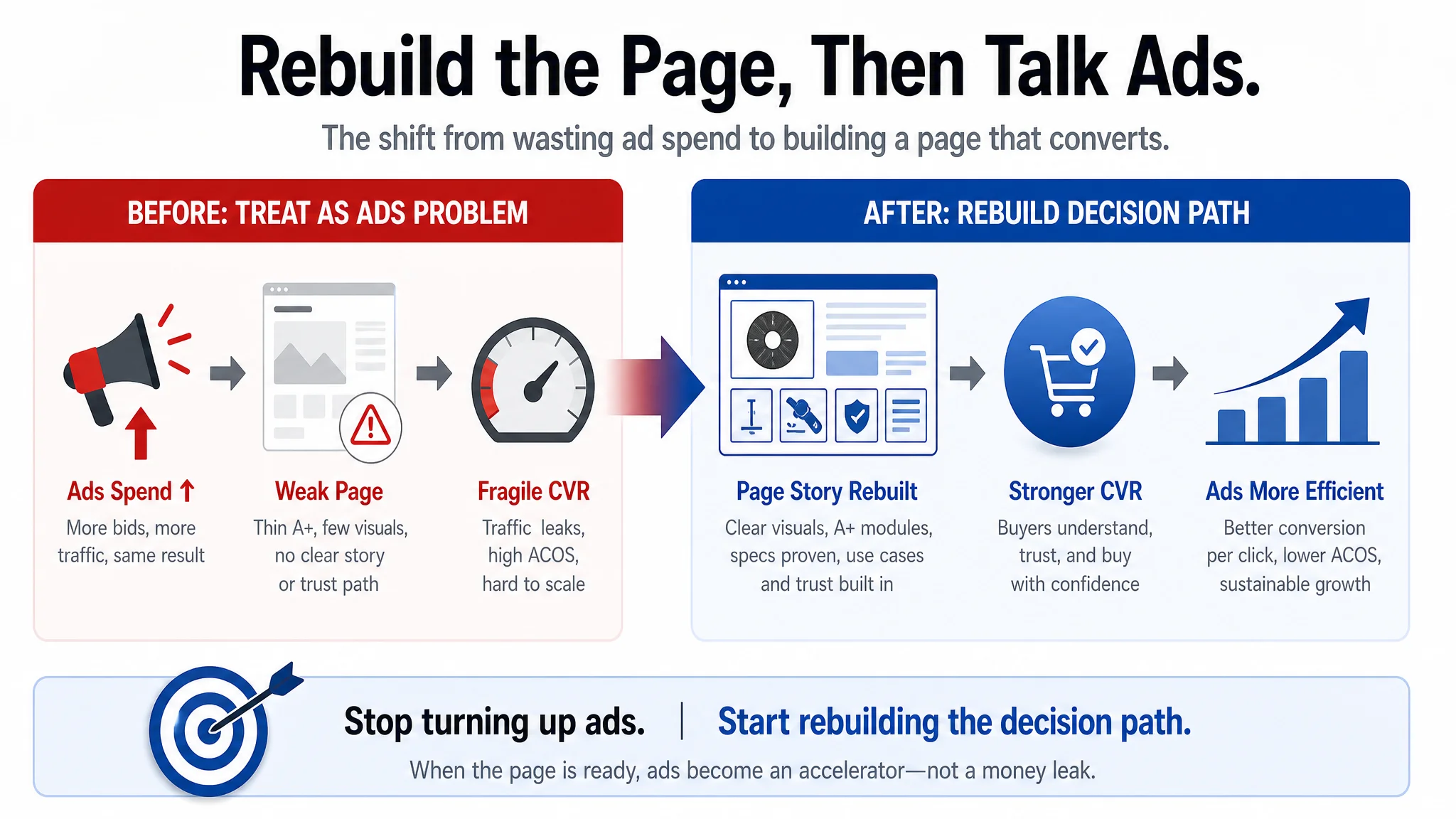
This time and cost gap becomes especially obvious when a listing is fundamentally underbuilt and requires a structural rebuild rather than cosmetic tweaks. In the industrial abrasives case, once the team realized the real constraint was “page conversion capacity” instead of traffic quality, they needed to reconstruct the visual and narrative spine of the product page: refocused main images around the 3-inch variant, clear thickness visualization, high-trust A+ modules, and bullets aligned to professional buyers’ decision logic. Doing this in a purely manual way—researching competitors, planning A+ layouts, testing variations—would have meant weeks of iterative work. With AI-driven diagnostics and content generation, that shift from “turn up ads” to “rebuild the decision path” could be executed far more quickly and consistently across SKUs.
Beyond efficiency, AI ensures unparalleled consistency across extensive product catalogs. Unlike general-purpose AI tools prone to "hallucinations" that can alter product details, specialized systems adhere to a "product entity consistency" principle. This strictly prohibits altering a product's core attributes like material, color, or industrial design, fundamentally mitigating the risk of damaging negative reviews from image-product mismatches and building customer trust. In the cut-off wheel example, the product’s core specs—3-inch diameter, 1 mm thickness, specific arbor size, and monocrystalline alumina material—were critical to professional buyers. DeepBI’s “Product DNA” mapping ensured that new visuals and rewritten bullets did not invent new features or misstate dimensions while still upgrading the way those attributes were communicated and visualized.
For sellers managing hundreds of SKUs, this industrial alignment of content is invaluable. Moreover, those SKUs often share the same pattern of misjudgment: teams may assume “our specs are better, our bullets are clearer, so ads and reviews must be the problem” when, in reality, the page’s lower layers lack a coherent story and trust structure.
Furthermore, AI profoundly enhances Amazon SEO. It leverages large language models to deconstruct titles and descriptions, identifying core search keywords and simulating buyer search behavior. This allows for precise keyword integration and strategic title restructuring, moving beyond subjective judgments to data-driven optimization. In the industrial case, for instance, DeepBI could detect missing search behaviors like “cut off wheels 3 inch 3/64” and tool-specific phrases such as “die grinder cut off wheel,” and adjust the title to both remove redundancy (“20 Pack” repeated) and align with how professionals actually search.
By deeply analyzing high-conversion search terms, AI also tailors content, transforming vague optimization goals into precise, actionable instructions for visual and textual elements. This direct alignment with customer needs and high-performing keywords ultimately boosts Click-Through Rates (CTR) and improves overall conversion rates (CVR), making AI an indispensable tool for maximizing listing effectiveness.
How AI Transforms the Amazon Listing Creation Workflow
AI fundamentally reshapes the Amazon listing creation and optimization process, moving beyond fragmented manual stages to an integrated, end-to-end intelligent system. This transformation streamlines complex operational decisions into a standardized, efficient workflow.
The AI-driven process begins with initial product data input, where the system ingests raw images and parameters to establish a "Product DNA." This foundational step locks in product authenticity, serving as the single source of truth for all subsequent content generation. In the industrial abrasives scenario, this meant encoding the wheel’s diameter, thickness, arbor size, material composition, and intended use cases into an unchangeable baseline. Even as new images and A+ modules were generated, the system prevented any “creative” drift away from those hard specs, ensuring that the upgraded page remained fully accurate for safety-sensitive buyers.
Following this, AI performs sophisticated market and competitive analysis. It leverages a distributed data capture matrix to identify benchmark competitors across the global market, employing a multi-dimensional semantic matching algorithm that goes beyond simple keyword analysis. This ensures precise competitive alignment and informs strategic positioning. In practice, DeepBI identified a directly comparable 3-inch cut-off wheel listing with significantly higher review volume and a robust A+ layout. It did not stop at surface keyword matching; it benchmarked against a product that addressed the same buyer profile and use scenarios, making the comparison truly meaningful.
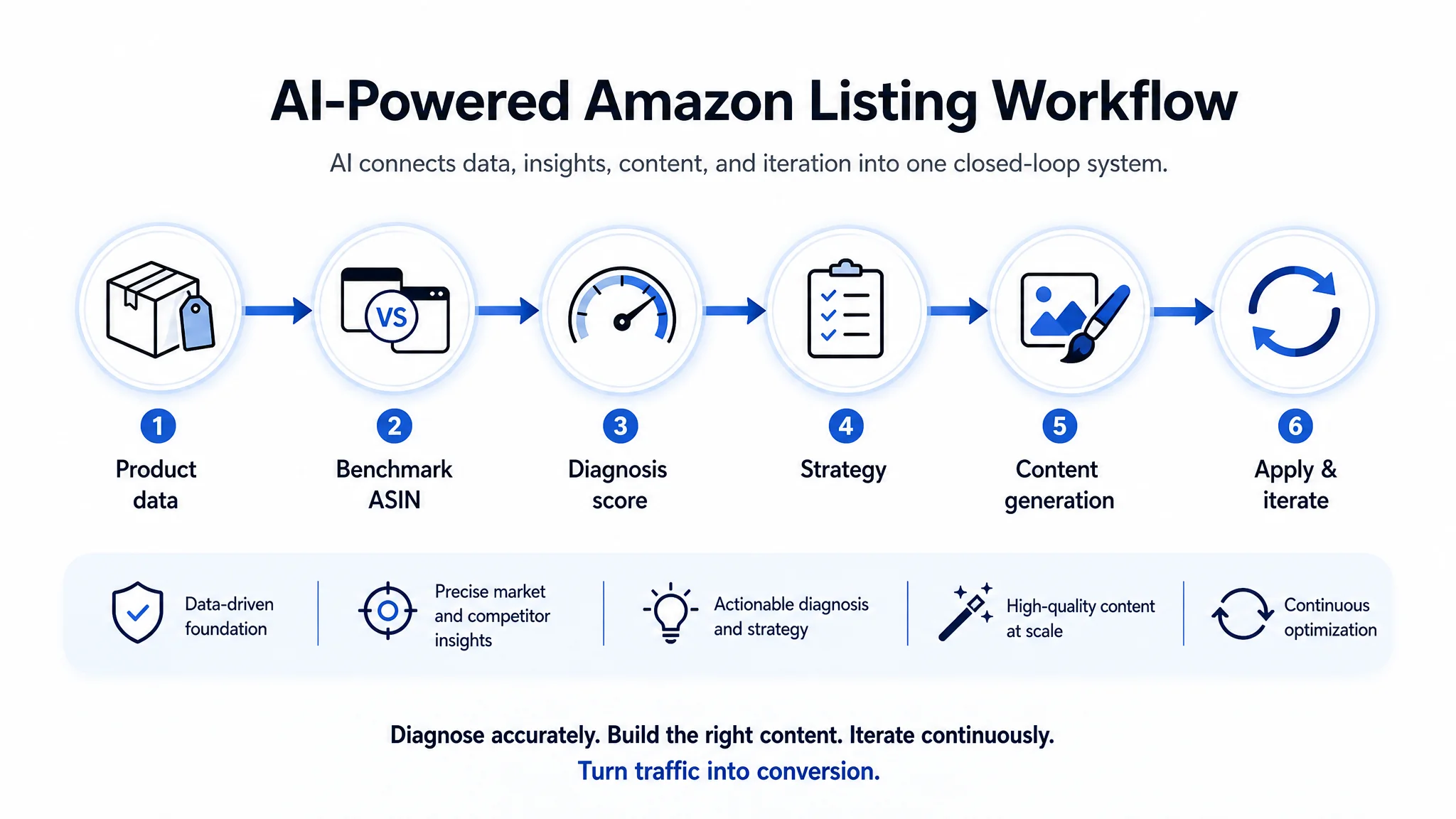
Next, the system moves into diagnosis and strategy generation. It quantifies the current visual performance of a product against benchmarks, generating a detailed score report that highlights specific weaknesses. In the abrasives case, the seller saw that title and main image scored at or above the competitor, but the detail/A+ section scored 1/25 versus the benchmark’s 22/25. That single dimension explained why ad traffic was underperforming: the page lacked a structured decision path and visual trust, especially below the fold. This diagnostic output, combined with product constraints, then fuels the creation of executable optimization plans. These plans translate abstract business strategies—such as “we need to reassure professional buyers on safety, fit, and material compatibility”—into precise, parameterized instructions for content production, including which A+ modules to prioritize and which usage scenes to visualize.
For content generation, AI produces visual assets, such as images, based on these strategic directives. Crucially, it integrates the "Product DNA" map to prevent AI hallucinations, ensuring that generated visuals remain true to the product's physical reality while optimizing elements like composition, lighting, and scene. In the case mentioned, this led to scenes that clearly showed a 3-inch wheel, the correct arbor fit, side-view thickness with intuitive comparisons, and real cutting scenarios—without mixing in other sizes or implying unsupported applications.
The workflow culminates in an iterative optimization and application phase. Generated content undergoes rigorous evaluation, including CTR prediction and information density checks, before the optimal solution is delivered. For the industrial seller, this meant not only generating new main image variations and A+ modules but also estimating which combinations were most likely to drive improved CTR from search results and a stronger CVR on the detail page. This entire process forms a closed loop from diagnosis to automated application via Amazon's SP-API, continuously refining listings based on performance data to drive improved CTR, CVR, and overall listing effectiveness.
Key AI Capabilities for Superior Amazon Listings
Advanced AI tools are transforming Amazon listing optimization, offering sophisticated capabilities that directly enhance quality and performance. These innovations streamline complex processes, from in-depth analysis to content generation and seamless application.
Intelligent Listing Diagnostics and Competitive Benchmarking
DeepBI leverages a proprietary distributed crawling matrix to capture real-time global market data, powering intelligent diagnostics. Its core "multi-dimensional semantic benchmarking algorithm" goes beyond simple keyword matching to precisely identify top-performing competitor ASINs. The system conducts a quantitative audit across five critical dimensions: main image visuals, title weighting, bullet point logic, A+ content richness, and customer feedback (VoC). By benchmarking against these top competitors, DeepBI uncovers the core issues hindering conversion, providing an objective, data-driven foundation for all subsequent optimization efforts.
In the industrial abrasives example, this scoring framework broke a deeply held internal assumption. The seller believed their listing was “already more professional” than the benchmark: they had front-loaded “3 Inch,” highlighted “Ultra Thin,” “1mm,” “100% Monocrystalline Alumina,” and provided a technically structured main-image set and cleaner bullets. DeepBI’s diagnostics confirmed part of that belief—title and main image were indeed competitive, even slightly stronger in some metrics—but exposed the real asymmetry: a nearly empty detail/A+ section facing a competitor’s fully architected A+ “story.” The numbers made this hard to ignore: a near-fatal gap on the detail/A+ dimension, in a category where technical buyers heavily rely on visual proof and structured reassurance.
This kind of quantitative breakdown is exactly where AI-driven diagnostics surpass manual review. Human teams often overfocus on what is visible above the fold and what they personally worked hard on (titles, images, bullets), while underestimating how much the lower half of the page influences conversion. DeepBI’s scoring made it clear that the listing’s main barrier was not awareness or traffic, but an underdeveloped conversion layer.
AI-Powered Content Generation and Optimization
DeepBI's AI-powered generation capabilities create high-quality listing content, including main images, detail images, A+ content, titles, and bullet points. Crucially, this system integrates "Product DNA" mapping, which digitally locks in the product's geometric and functional features. This ensures product authenticity and prevents "AI hallucinations" that could lead to product-image mismatches and post-sale risks, positioning DeepBI as a rigorous automated visual production system rather than a general-purpose creative tool.
In the cut-off wheel case, the seller’s textual technical story was already strong—monocrystalline alumina, ultra-thin 1 mm kerf, resin bond, long life—but almost none of it was visually expressed. AI content generation here was not about inventing new selling points; it was about turning existing strengths into visible, decision-driving assets:
- Reframing bullets around how professional buyers think: combining all core specs (diameter, arbor, thickness, max RPM) into a single snapshot, expanding generic “metal” into specific materials (stainless, alloy steels, cast iron), and making safety and tool load explicit.
- Generating A+ modules that visually prove thickness with side views and intuitive comparisons, show real cutting scenarios with clear material context, and highlight arbor fit and installation clarity.
- Building a consistent professional identity: workshop scenes with proper PPE, clean industrial backgrounds, and before/after visuals that illustrate longevity without fabricating numeric claims.
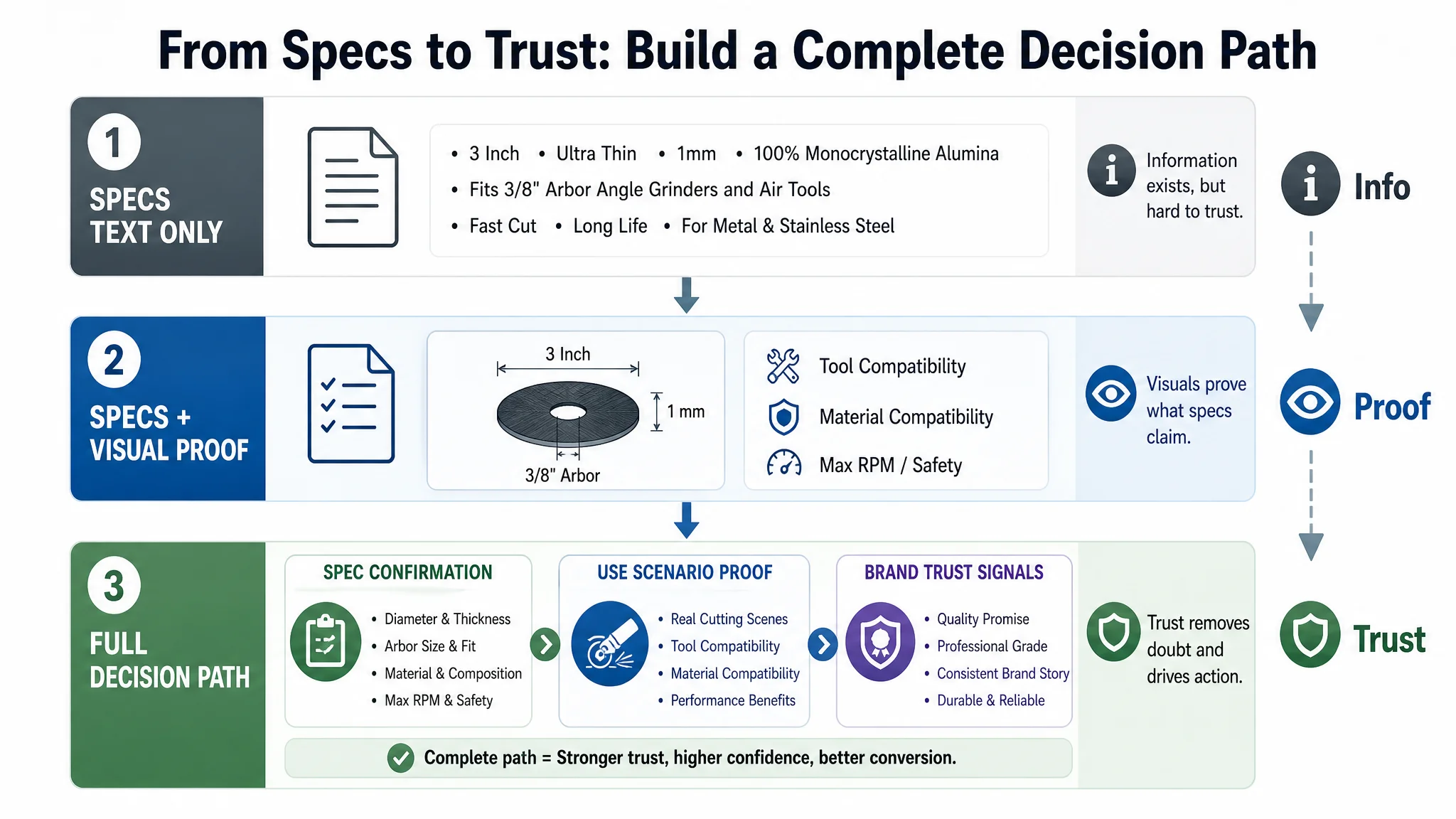
The platform supports multi-scheme comparison and front-end effect previews, allowing sellers to select the most impactful content. For the abrasives seller, this meant being able to compare different main image concepts (e.g., more spec-heavy vs more scene-focused) and A+ layouts to choose the version that best balanced technical clarity with visual appeal.
Streamlined Listing Application and Management
DeepBI significantly enhances operational efficiency through its streamlined application and management features. Optimized listing content can be applied with a single click directly from the DeepBI platform to Amazon's backend via the Amazon SP-API. This automation reduces a process that traditionally took dozens of minutes down to mere seconds, eliminating manual download and upload steps. This creates a closed loop from analysis and strategy to generation and launch, with support for comparing and filtering new and old versions.
In practice, once the industrial seller’s new main image set and A+ modules were ready, the team didn’t have to spend cycles downloading files, navigating Amazon’s UI, and manually updating each field. Instead, they could apply the complete “reframed” listing in one flow, then focus on monitoring results rather than wrestling with backend uploads.
Furthermore, DeepBI automatically links published content to ad reports, tracking the impact on key performance indicators like Click-Through Rate (CTR) to provide a data-driven feedback loop for continuous optimization. For the abrasives listing, this meant that once the revamped A+ and visuals were live, DeepBI could mark that iteration event and help the team see how CTR and CVR behaved after the change, separating the impact of page improvements from ongoing ad tweaks.
Measuring the Impact: AI-Driven Listing Performance and ROI
The effectiveness of Amazon listings, particularly those enhanced by AI, is best understood through measurable performance indicators and a clear return on investment (ROI) framework. AI-driven solutions like DeepBI are engineered to directly impact critical KPIs, ensuring that every optimization translates into tangible business value.
DeepBI focuses on transforming every visual and textual optimization into visible improvements in Click-Through Rate (CTR) and Conversion Rate (CVR). The system continuously extracts real-time underlying metrics such as impressions, clicks, and transactions, cross-validating them with a sophisticated five-dimensional scoring model. This model quantifies content quality across main image visuals, title weight, five-point description logic, A+ page richness, and user feedback (VoC), generating a comprehensive competitiveness radar.
In scenarios like the industrial abrasives listing, this KPI lens is particularly important to avoid chasing the wrong lever. Before DeepBI’s intervention, the seller treated rising ACOS and unstable conversion almost purely as an advertising problem. Ad dashboards were the only “measurement system” in play: bids, keywords, campaign types, search-term reports. There was no structured way to measure how incomplete A+ content or mixed-size imagery below the fold were constraining CVR.
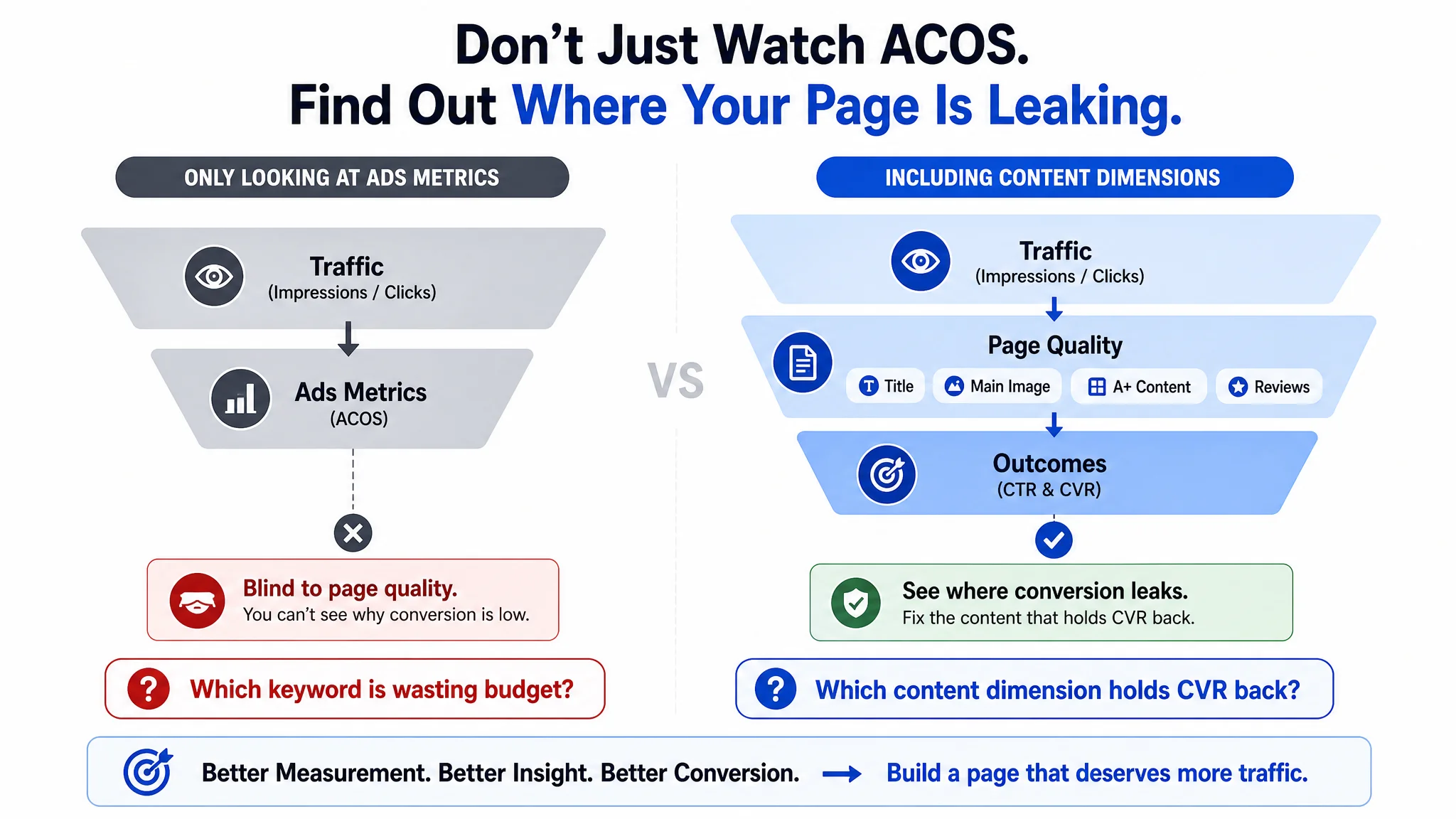
Once DeepBI exposed the detail/A+ score of 1/25 against a competitor’s 22/25 and linked that to funnel behavior, the measurement mindset shifted. Instead of asking only “Which keyword is wasting budget?” the seller could now ask “Which content dimension is holding CVR back?” and monitor whether improvements to that dimension actually changed outcome metrics. ACOS was no longer seen as an isolated ads metric but as a reflection of the combined effectiveness of traffic acquisition and page conversion.
Beyond optimizing existing listings, AI significantly enhances new product launch efficiency. By automating tedious tasks like competitive visual analysis, pain point identification, selling point extraction, and image generation, AI saves substantial operational time. What once took hours for manual content creation and iteration can be reduced to minutes or even seconds with one-click application modules, allowing sellers to focus on strategic business decisions.
The ROI of AI tools like DeepBI is realized through these improvements. Higher CTR and CVR lead to stronger organic rankings and a reduced reliance on paid traffic, ultimately lowering Total Advertising Cost of Sale (TACoS). In the industrial abrasives case, the key shift was conceptual: ads stopped being treated as a blunt instrument for “buying visibility” and started acting as a feeder into a page that could actually convert and build long-term ranking equity. Instead of pushing more traffic into a half-finished listing, the team learned to first raise the page’s conversion capacity and only then consider scaling spend.
DeepBI's system even marks "visual iteration event points" in ad reports, allowing sellers to directly observe the CTR changes following new image deployment, providing a clear evidence chain for performance impact. For sellers who have long felt that “creative changes” are hard to quantify, this event-based measurement closes the loop between content decisions and financial outcomes.
Best Practices for Implementing AI in Your Amazon Listing Strategy
While AI offers significant efficiency in Amazon listing optimization, a purely automated approach carries inherent risks. The most effective strategy is a hybrid model, combining AI's speed and data processing capabilities with essential human strategic input and oversight. This human review is crucial for catching potential issues such as prohibited claims, mentions of competitor brand names, or content that deviates from the established brand tone. DeepBI, for instance, is designed as an "executor" rather than a "blind creator," requiring human or analytical agent directives for optimization goals.
The industrial abrasives case underscores why this “AI + human” model matters. DeepBI could diagnose that the listing’s primary constraint was an incomplete A+ and a weak visual trust structure. It could also generate technically accurate, spec-consistent content to fill those gaps. But it still required the seller’s domain understanding to validate tone and positioning for professional buyers—ensuring, for example, that safety messaging was appropriate, that imagery reflected real workshop use instead of unrealistic “marketing” scenarios, and that claims stayed within what the brand was comfortable promising.
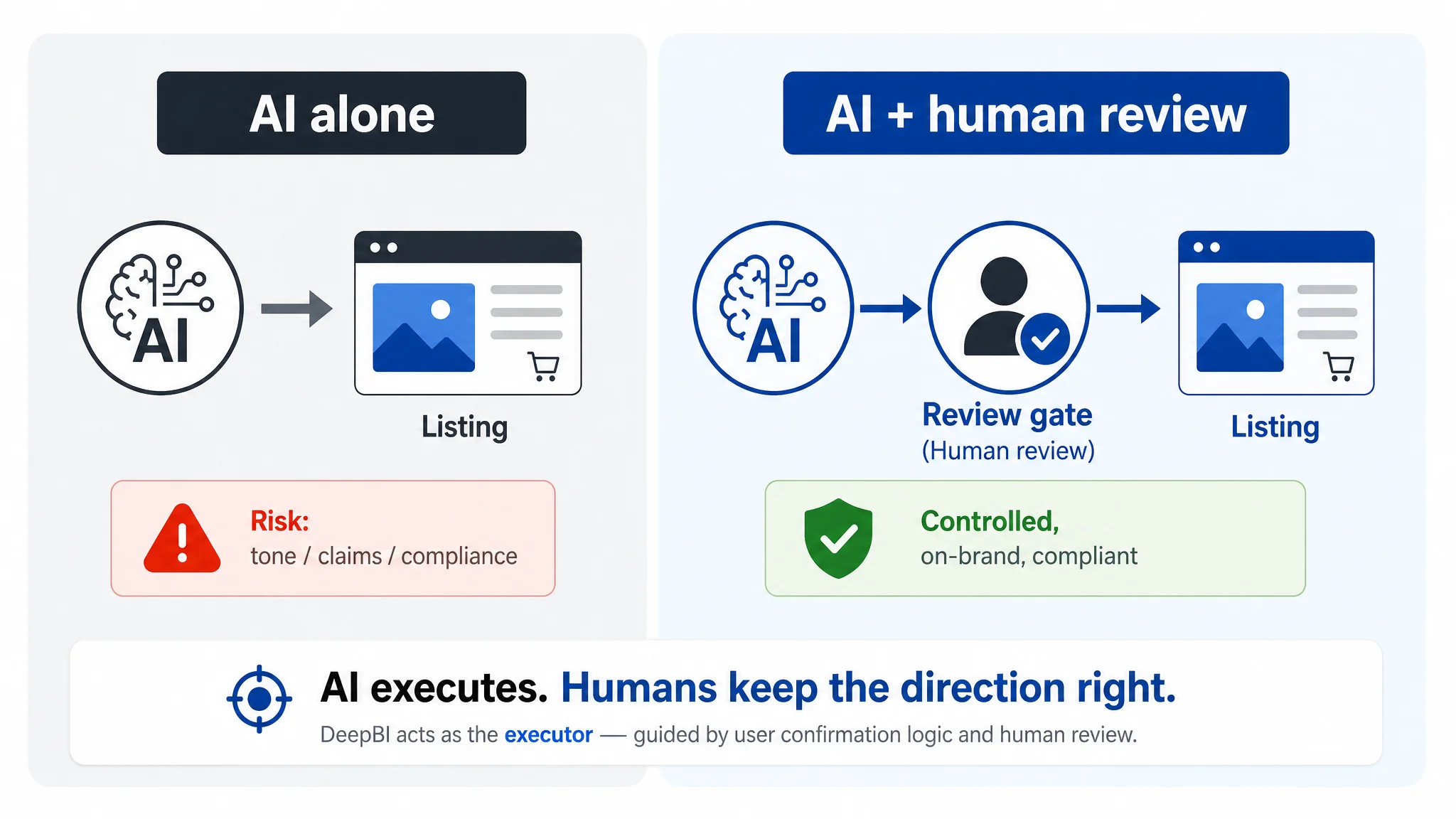
DeepBI reinforces this hybrid model through its strict "user confirmation logic" for content application. Before any changes are synchronized, the system presents a side-by-side comparison of original and proposed new content, granting sellers absolute control to approve or reject specific elements. In the abrasives example, this allowed the team to review proposed title revisions (such as removing redundant pack-size mentions, adding imperial equivalents, or expanding tool compatibility mentions) and approve only the changes that aligned with their brand and compliance guidelines.
Furthermore, DeepBI incorporates built-in technical red lines to enforce "product entity consistency" and prohibit fabricated parameters, ensuring content remains authentic and compliant with Amazon's mandatory standards and brand identity systems. This prevents issues like altering product physical structures or brand logos. For a safety-sensitive category like cut-off wheels, where max RPM, thickness, and arbor size directly affect safe use, such safeguards are critical.
Beyond initial review, continuous monitoring and iteration are vital for sustained listing effectiveness. DeepBI facilitates this by automatically marking "visual iteration event points" in advertising reports once new content is live. This allows sellers to directly observe changes in ASIN Click-Through Rate (CTR) over 7-14 days post-application, enabling data-driven adjustments and the continuous evolution of optimization strategies. For the industrial seller, this meant they could see how the rebuilt A+ and new visuals influenced buyer behavior before making further changes to ad spend. This iterative process ensures listings remain competitive and aligned with performance goals.
The Future of Amazon Selling: DeepBI's Holistic Approach to Listing Success
The landscape of Amazon selling is rapidly evolving, demanding a comprehensive, data-driven approach to sustain growth. DeepBI emerges as an AI-powered, Amazon-focused, full-funnel operational optimization system, designed to integrate listing excellence within a broader strategy for long-term profitability. It breaks traditional operational silos, unifying diagnosis, planning, production, and delivery into a seamless, intelligent optimization system.
The industrial abrasives case is a clear illustration of this full-funnel perspective. Initially, the seller treated ads and listing as almost separate worlds: ad teams tuned campaigns and bids, while content teams believed the page was “already professional.” ACOS and conversion looked like problems to be solved purely at the top of the funnel. DeepBI’s holistic diagnosis reframed the situation: it showed that the real bottleneck was in the mid-to-bottom funnel—specifically, a missing A+ story and a muddled visual trust path. Only by addressing the listing’s structural weaknesses could ad performance meaningfully improve.
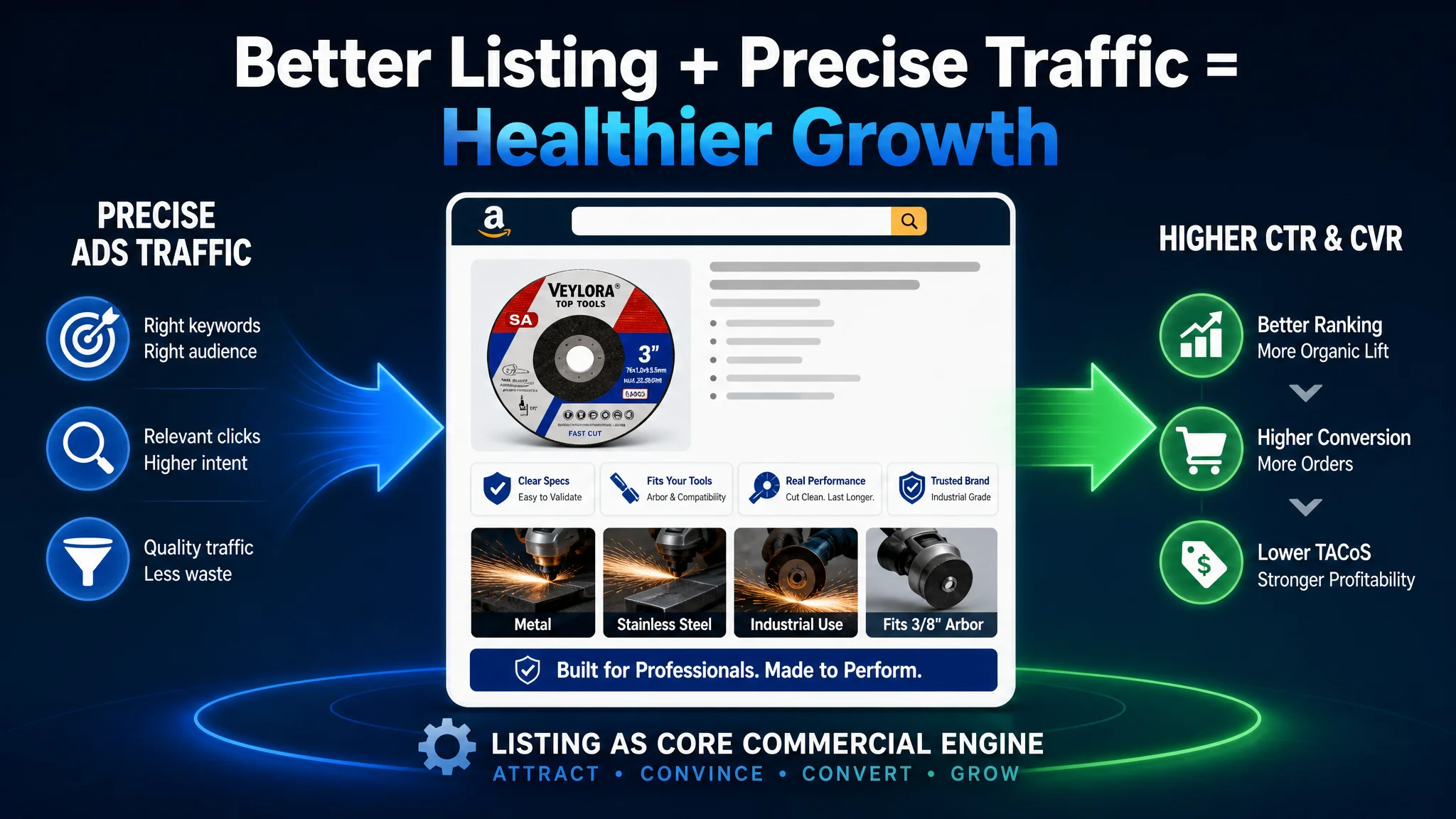
Optimized listings, powered by DeepBI, serve as the foundational "core commercial engine" that drives both improved ad performance and organic traffic. Visual assets, particularly main images and A+ pages, are no longer mere aesthetic displays but critical drivers of click-through rate (CTR) and conversion rate (CVR). DeepBI's core vision is to eliminate subjective human errors, ensuring every pixel change translates into measurable improvements in these key metrics. In the abrasives example, this meant transforming “better specs on paper” into a page that visually proves thickness, material, safety, and compatibility—so that every ad click lands on a sales engine instead of a thin spec sheet.
By enhancing CTR and CVR, DeepBI's optimized listings directly amplify the effectiveness of advertising campaigns. Traffic acquired through ads converts more efficiently, leading to significantly better Advertising Cost of Sale (ACoS) and overall Return on Investment (ROI). This deep synergy with ad campaign data—including impressions, clicks, and conversions—allows DeepBI to transform stable ad signals into stronger organic rankings and a lower Total Advertising Cost of Sale (TACoS). For the industrial seller, once the listing’s trust spine was rebuilt, ads stopped simply magnifying a weak page and started feeding into a conversion-capable asset.
This data-driven, automated operation forms a powerful commercial closed-loop: "better Listing + more precise traffic = healthier long-term growth" on Amazon. The key is understanding that “better listing” is not just about nicer images or more keywords—it is about a page whose structure, visuals, and copy collectively match how real buyers decide, and about using AI to reach that state faster and more reliably.
Conclusion
The landscape of Amazon selling is undergoing a profound transformation, with AI emerging as a game-changing best practice for maximizing listing effectiveness. DeepBI's full-link intelligent optimization system redefines the Amazon listing lifecycle, moving beyond fragmented processes to a unified, data-driven approach. By eliminating subjective errors and aligning every visual and textual element with commercial logic, AI directly translates into tangible improvements in key performance indicators such as Click-Through Rate (CTR) and Conversion Rate (CVR).
The industrial abrasives case demonstrates what can go wrong when teams rely on intuition alone. The seller assumed they had an “ads problem” because their title, main image, and bullets looked superior on the surface. DeepBI’s diagnostics showed that the real constraint was an empty A+ layer and a missing visual decision path—an underbuilt conversion structure that no amount of bid tweaking could fix. Once the listing’s trust spine was rebuilt with AI-guided visuals and structured A+ content, ad traffic no longer flowed into a half-finished page.
This shift empowers sellers with a significant competitive advantage. While traditional methods rely on intuition, AI-driven optimization provides a powerful "front-end radar system," enabling objective diagnosis, concrete recommendations, and the generation of "more profitable images" under strict commercial constraints. This not only boosts operational efficiency but also makes listing evolution a predictable, quantifiable scientific process, leading to sustained increases in organic ranking and long-term brand growth.
Embracing AI is no longer an option but a strategic imperative for sustained success on Amazon. As the platform evolves, leveraging intelligent systems like DeepBI to automate optimization and drive data-backed decisions will be crucial for securing a winning edge. Most importantly, AI helps sellers ask better questions: not just “How do we get more traffic?” but “Does this page truly deserve more traffic—and what must change in the listing before ads can do their job?”
Frequently Asked Questions (FAQs)
Is AI content allowed on Amazon?
Amazon prioritizes high-quality, accurate, and customer-centric content, irrespective of its creation method. DeepBI is engineered to produce content strictly adhering to Amazon's authenticity, product consistency, and visual quality standards. This ensures outputs align with platform policies, driving improved CTR and CVR. In practice, that means AI-generated modules—such as the A+ visuals for technical products—must faithfully reflect real specs and use cases, rather than exaggerating capabilities or inventing features.
What are the limitations of AI in listing creation?
AI's limitations include potential for factual inaccuracies or altering product attributes. DeepBI addresses this by positioning AI as an "executor," strictly guided by product DNA and market data. It prohibits generating non-existent features, exaggerating size, or changing inherent product characteristics, preventing AI hallucinations and ensuring content remains true to the product. In categories like industrial abrasives, where spec integrity (diameter, thickness, max RPM) is non-negotiable, these safeguards prevent the kind of misalignment that could harm both conversion and trust.
How does DeepBI ensure compliance with Amazon's guidelines?
DeepBI integrates multiple compliance safeguards. It automatically verifies and converts images to Amazon's mandatory standards (e.g., white background, pixel dimensions), blocking non-compliant assets. The system strictly adheres to "product entity consistency," preventing alteration of a product's inherent attributes or brand identity. Internal self-inspection mechanisms further prevent AI hallucinations, ensuring content is factually accurate and aligned with Amazon's principles. For sellers, this means they can upgrade listing effectiveness—titles, main images, A+ content—without risking policy violations or misrepresentations, even when making large-scale changes across many SKUs.