

Introduction
In the hyper-competitive Amazon marketplace, sellers face the dual pressures of rising advertising costs and the constant need to improve click-through (CTR) and conversion rates (CVR). Success is no longer a matter of simple copywriting; it demands a precise, data-informed approach to listing optimization, where every change is engineered to drive performance. Your product title is the primary gateway for customers in search results, making it a critical factor in your commercial success. A weak title leads to poor search ranking, diminished CTR, and ultimately, wasted ad spend. Many sellers fall into the trap of making subjective modifications based on intuition—a risky strategy that can cause key performance metrics to decline unexpectedly.
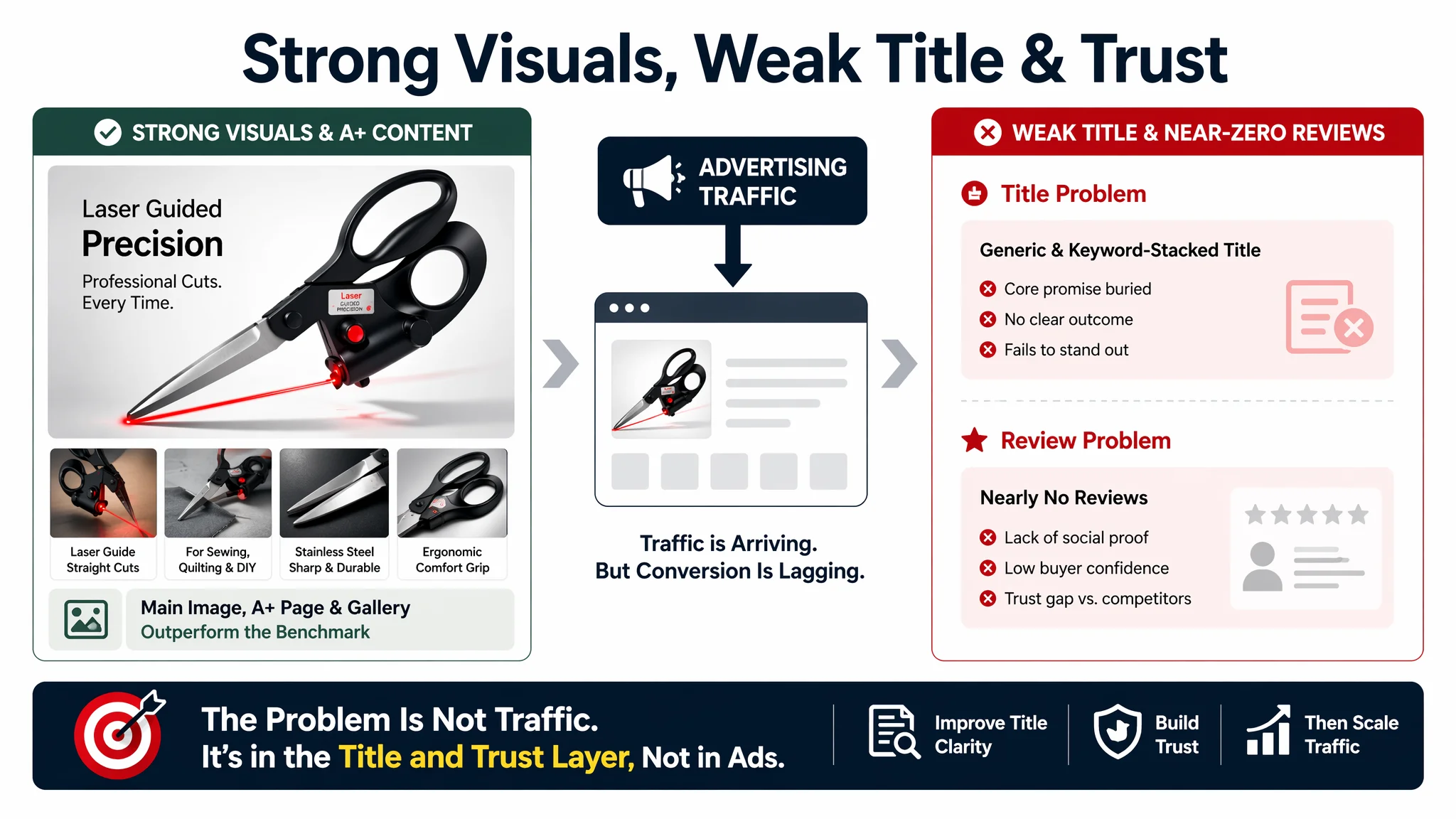
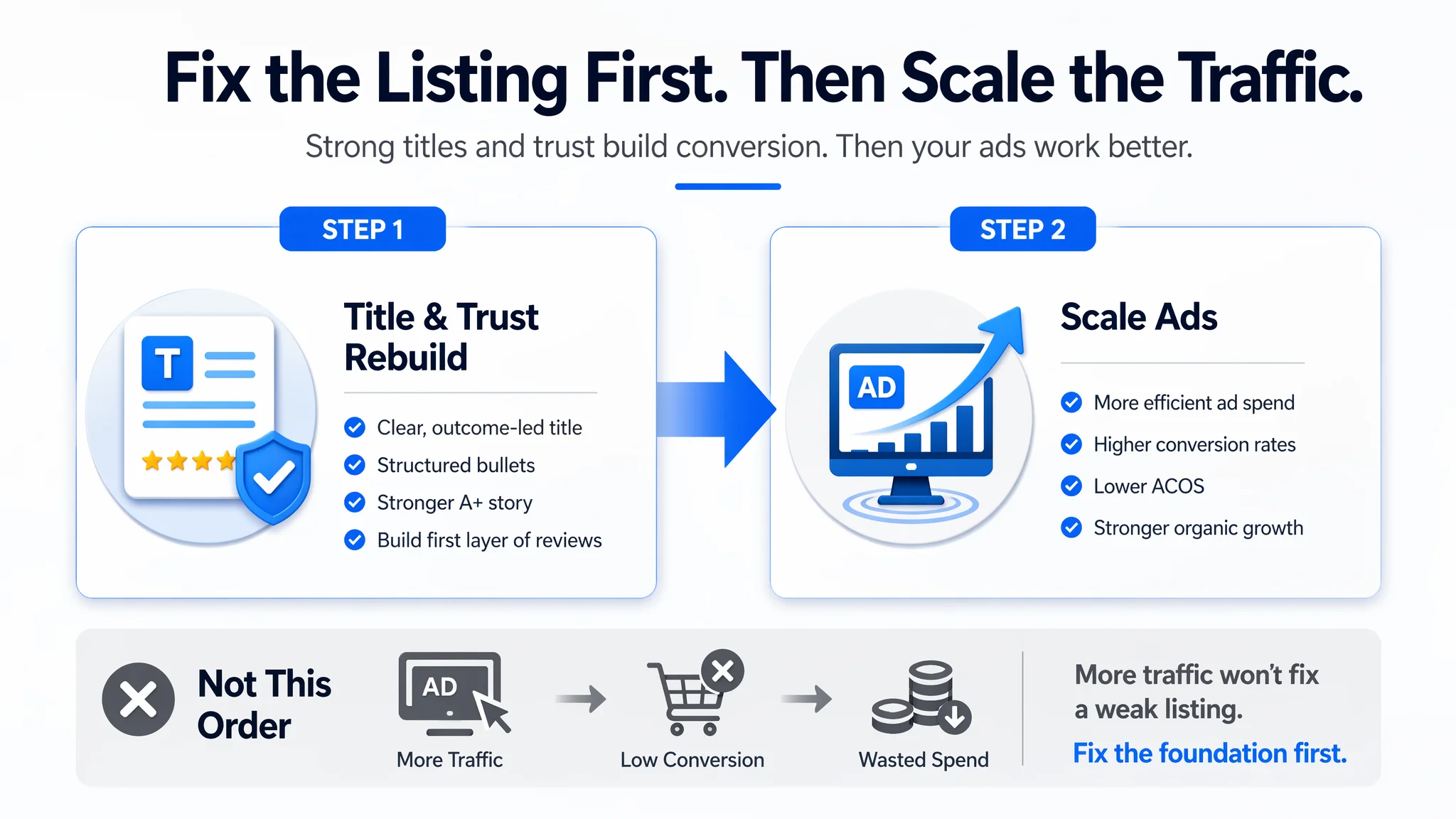
This disconnect between intuition and reality is not theoretical. In one sewing and crafts category project, the seller came to DeepBI convinced that “ads and creatives” were their main bottlenecks. Their laser-guided sewing scissors listing had highly polished visuals and a sophisticated A+ layout. The internal diagnosis was straightforward: ad spend was rising, ACOS was hard to control, and the solution, in their view, was “more images and better campaign tuning.” Only after DeepBI’s structured scoring revealed that the title severely underperformed the benchmark—and that reviews were nearly non-existent—did it become clear that the real issue sat in listing fundamentals rather than in advertising mechanics.
Effective Amazon title optimization is a methodical process. It involves a deep analysis of keyword structure, the strategic placement of core selling points, and adherence to platform-specific formatting standards to maximize visibility and appeal. This is where a data-first methodology becomes essential. To move sellers from blind trial-and-error to confident, evidence-based decision-making, we introduce DeepBI. This end-to-end intelligent optimization system is designed to break down the traditional silos between operational stages. By integrating quantitative diagnosis, strategic planning, content production, and one-click deployment, DeepBI provides a unified workflow that ensures every title modification is a calculated step toward improving your listing's performance and achieving sustainable growth.
The Critical Role of an Optimized Amazon Product Title
Your product title is foundational for discoverability and customer engagement within the Amazon ecosystem. It serves as the primary traffic entry point, heavily influencing how Amazon’s search algorithm ranks your listing and how potential buyers perceive your product. A poorly constructed title results in low visibility, effectively hiding your product from relevant searches, while a well-optimized one can significantly increase your impression share.
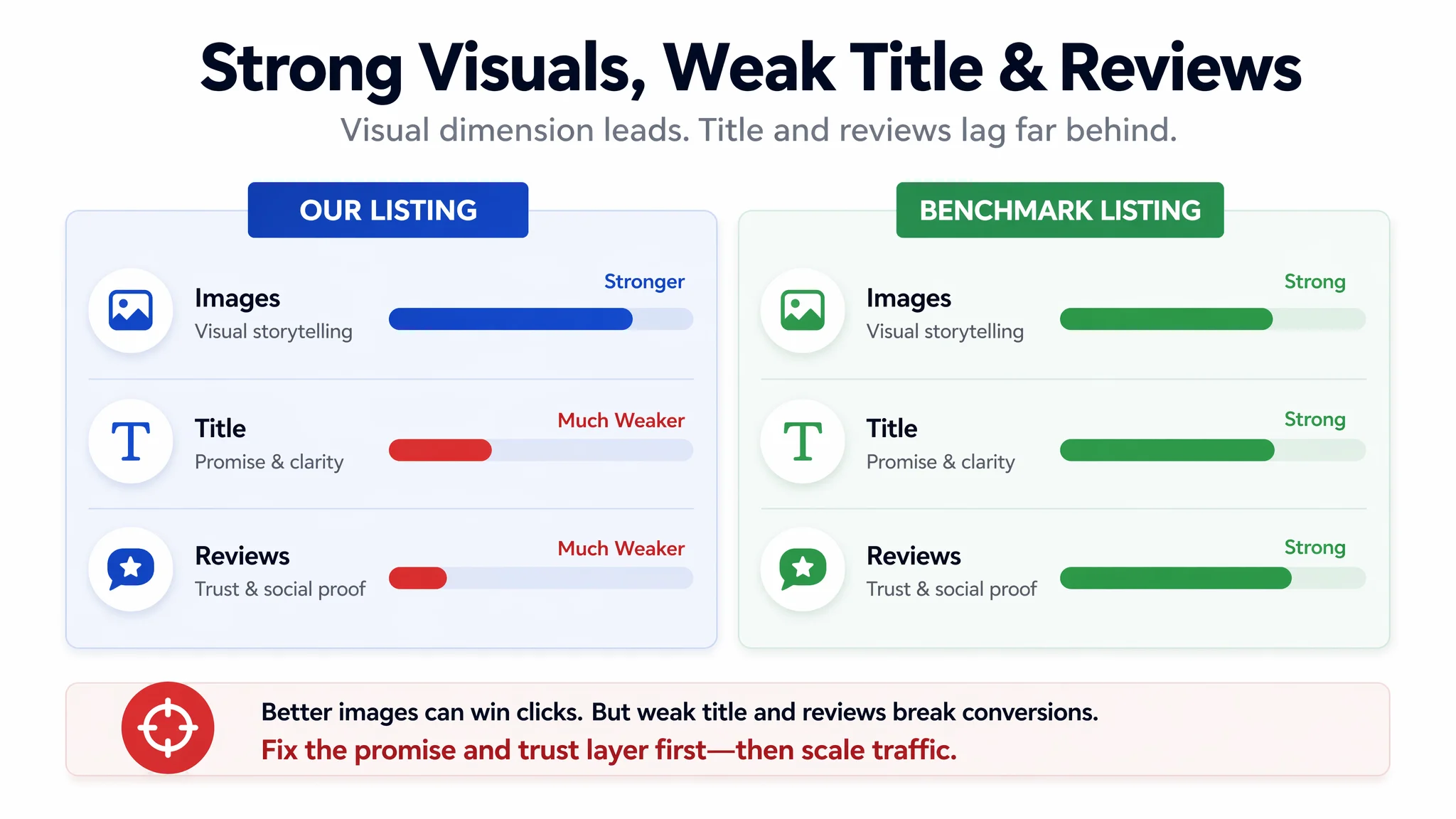
DeepBI’s work on the laser-guided sewing scissors listing illustrates this leverage clearly. The seller’s page already outperformed a long-established competitor in main images, bullet structure, and A+ content. Visual storytelling was modern and technically impressive, and the gallery was richer than the benchmark. Yet the DeepBI scoring model showed that the title scored less than half of the benchmark’s title score, while the review dimension also lagged severely. In practice, this meant that a page with “better” visuals was losing the battle at the very first line of text users see—the title—long before A+ strengths could influence the decision.
The link between title quality and key performance metrics is direct and measurable. Amazon's ranking system analyzes titles for keyword relevance and structure to determine where to place a product in search results. A compelling and clear title not only satisfies the algorithm but also entices customers to click, directly boosting your Click-Through Rate (CTR).
Once a shopper lands on your page, that same title reinforces their decision and clarifies your product's core value, which is crucial for improving the Conversion Rate (CVR). In the scissors example, DeepBI’s diagnosis showed that ads were already bringing “enough” traffic given the visuals, but the generic, keyword-stacked title failed to articulate a concrete outcome like “precision straight cuts.” As a result, traffic arrived, appreciated the imagery, but never fully understood what the product would do for them at a glance, and conversion stalled. True optimization moves beyond simple keyword stuffing; it requires a strategic balance between algorithm-friendliness and a positive consumer reading experience. Mastering this equilibrium is fundamental to driving traffic, increasing sales, and building a strong presence on the platform.
Decoding Amazon's Product Title Guidelines
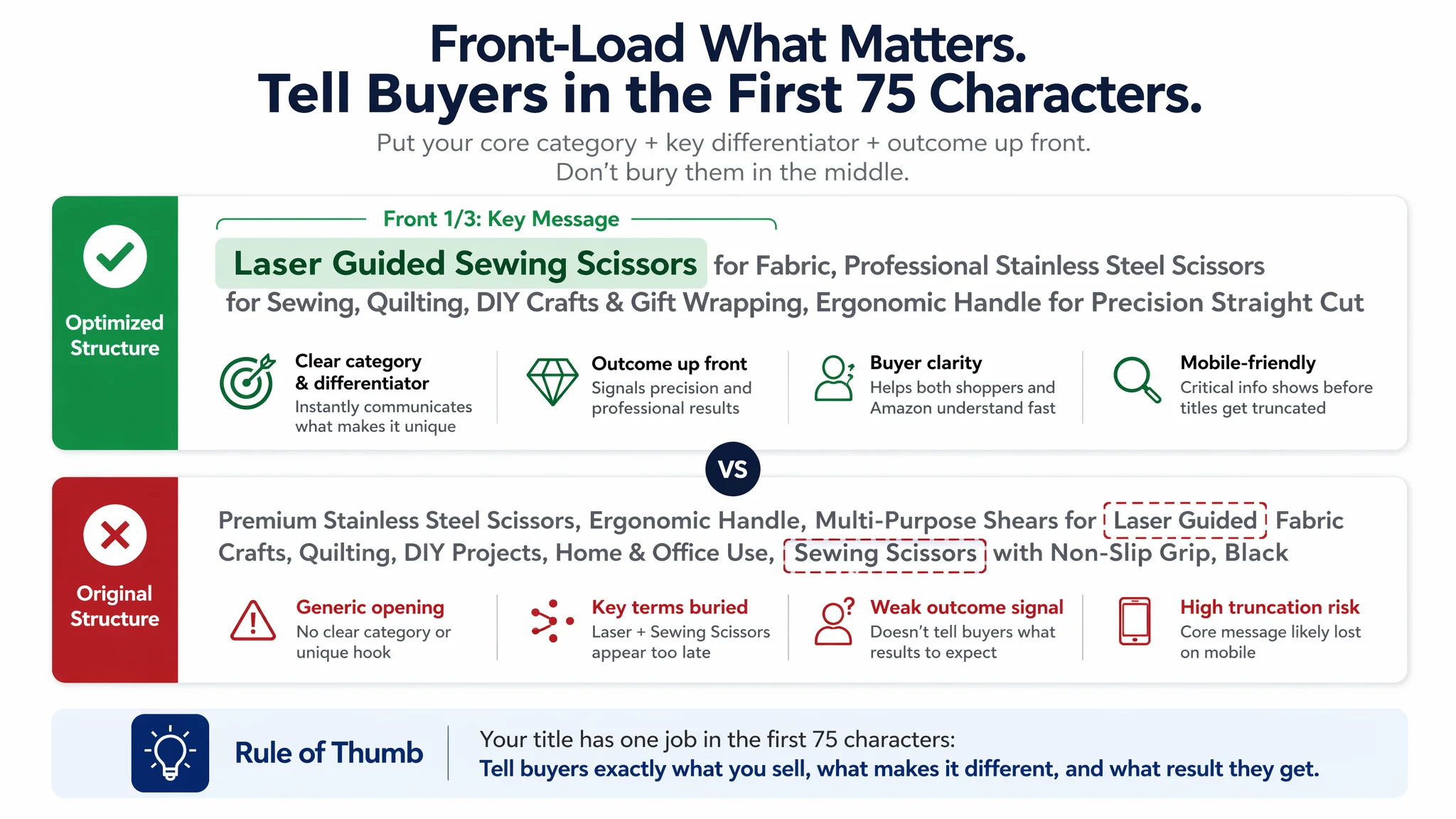
A high-performing product title begins with strict adherence to Amazon's platform rules. While these guidelines can seem complex, they provide the essential framework for visibility and compliance. Amazon generally allows titles up to 200 characters, but sellers must consult their specific category style guide for the exact limit. A critical factor to consider is display truncation; on mobile devices, titles are often cut off after approximately 75 characters. This makes it imperative to front-load your most crucial information—brand, core keywords, and key features—to maximize impact on every potential customer.
In the sewing scissors case, this “front-loading” principle was exactly where the listing fell short. The category-defining term “sewing scissors” and the unique selling point “laser guided” were not combined in a clear, outcome-oriented way at the front of the title. Instead, multiple descriptors and secondary phrases diluted the opening, so both users and the algorithm needed to “work” to decode what the product actually was. By contrast, the benchmark listing followed a disciplined pattern: brand, size, material, and a concise result promise were all front-loaded, ensuring that even truncated views still delivered a complete message.
Violating these guidelines, such as by including prohibited promotional terms like "bestseller" or "free shipping," can lead to serious consequences, including the suppression of your listing from search results. This action immediately halts traffic and sales, damaging your product's Best Sellers Rank (BSR).
Navigating these rules while outperforming competitors requires a structured approach. DeepBI’s multi-dimensional diagnostic tools automate this process by analyzing your title against both Amazon's requirements and the strategies of top-performing listings in your category. In the scissors project, this meant not just flagging potential compliance risks, but also quantifying where the title fell short relative to a high-performing incumbent: weak structural logic, diffuse promise, and poor outcome signaling. The system identifies compliance risks, structural weaknesses, and missed keyword opportunities, providing a clear path to create a title that is not only compliant but also engineered to drive higher Click-Through Rates (CTR).
Strategic Keyword Research for High-Impact Titles
A powerful title is built on strategic keyword research that prioritizes relevance over sheer volume. The objective is to attract high-intent buyers who are more likely to convert, which directly improves your Conversion Rate (CVR). This requires a methodical process that goes beyond simply guessing what customers are searching for.
Start by building a comprehensive keyword bank. This master list should include primary, secondary, and long-tail keywords, which are then strategically mapped across your entire listing—title, bullet points, description, and backend search terms. This method ensures maximum coverage without wasteful repetition. The title should feature your most critical, high-conversion keywords, while backend search terms should be used to capture relevant synonyms, alternate spellings, and long-tail variations not already indexed in the visible text.
The laser scissors seller initially pursued a common but risky tactic: packing as many seemingly relevant terms as possible into the title and trusting that ads would “clean up” the rest. Phrases related to sewing, fabric, DIY, and crafts were all present, but without a clear hierarchy or narrative. DeepBI’s analysis of winning search terms in the category, combined with benchmark mining, showed that high-performing titles prioritized problem and outcome language—words and phrases aligned with “cuts straight,” “precision,” “professional fabric use”—while relegating broader, lower-intent descriptors to other listing elements or backend fields. The existing title technically included many of these words, but scattered among less critical phrases, diluting their impact.
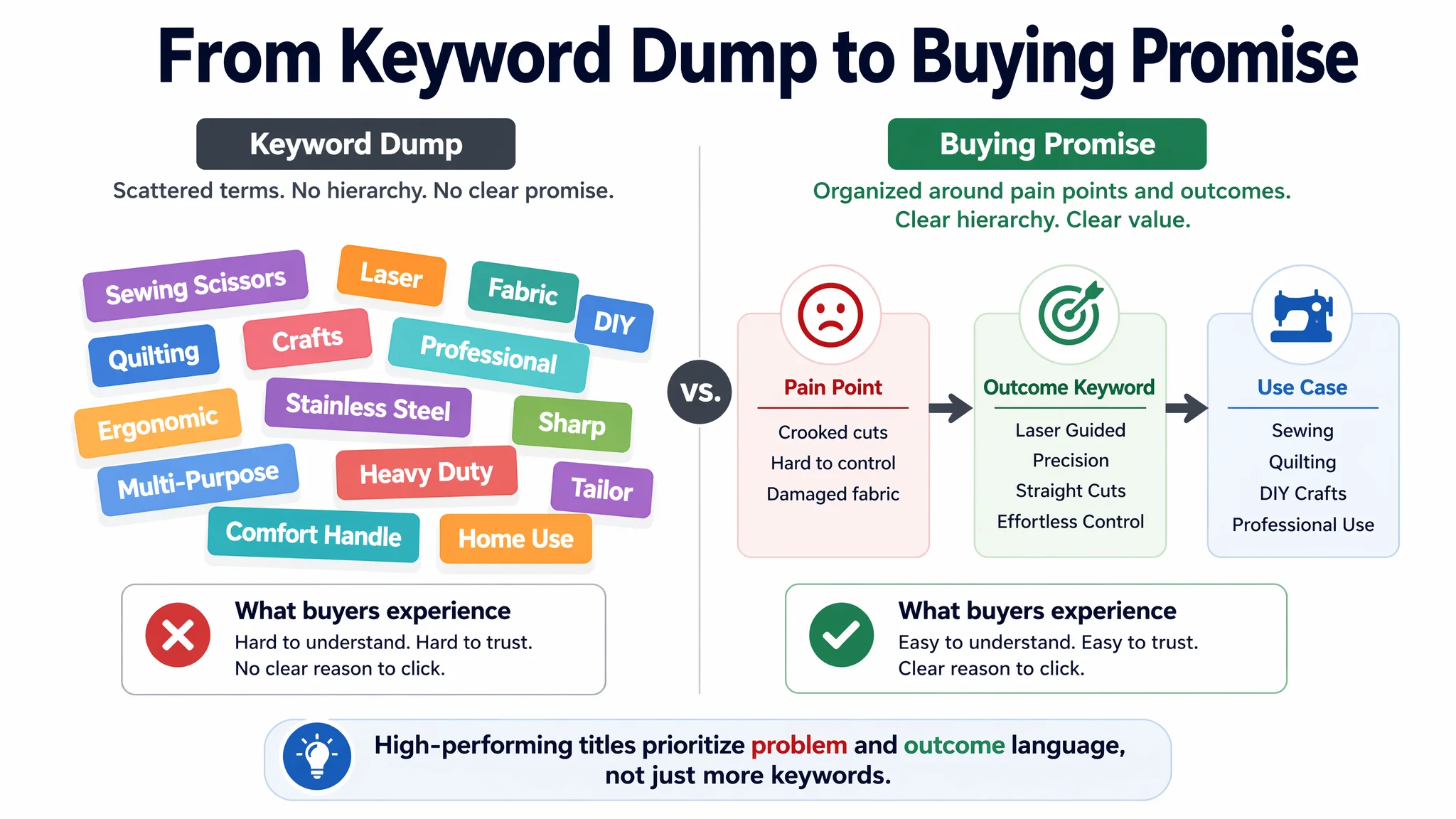
While manual competitor analysis can offer clues, an evidence-based process eliminates subjectivity and risk. DeepBI elevates this strategy by acting as an automated market health check. Its 'multi-dimensional semantic benchmarking algorithm' accurately identifies your true benchmark competitors, providing an objective foundation for analysis. In the scissors case, this meant isolating a long-established, high-review listing as the real point of comparison, rather than looking at a random assortment of mid-tier competitors.
The system then reverse-engineers top-performing titles and mines high-converting "Winning terms" from advertising data. This process uncovers the high-CTR variant feature words that market leaders use to drive sales, allowing you to integrate proven keywords directly into your title optimization workflow. For the scissors product, that meant elevating terms tied to “laser guidance” and “precision straight cuts” into the core title structure, while moving broader contextual keywords into bullets and A+ copy, turning a previously unfocused keyword dump into a targeted acquisition asset.
Crafting a Conversion-Focused Amazon Title Formula
An effective Amazon title must serve two masters: the search algorithm and the human shopper. Striking this balance is critical for both visibility and Click-Through Rate (CTR). While there is no single magic template, a proven, conversion-focused formula provides a strong foundation: Brand + Core Selling Point/Result Promise + Product Form + Supplementary Modifiers. This structure ensures you lead with your brand, immediately communicate the primary benefit, clarify what the product is, and then add relevant details like size, color, or material.
DeepBI applied this logic directly when rebuilding the laser scissors title. Instead of leading with a vague sequence of descriptors, the revised direction put the differentiator and the category side by side: “Laser Guided Sewing Scissors for Fabric” rather than a generic phrase where “laser” and “sewing scissors” were separated. Material and professionalism—“Stainless Steel,” “Professional”—were then layered in to raise perceived value, followed by tightly grouped use cases (“Sewing, Quilting, DIY Crafts & Gift Wrapping”) that reflected how real buyers describe their projects. Finally, the ergonomic and outcome promise (“Ergonomic Handle for Precision Straight Cut”) anchored the title in a specific result, turning the formula into a coherent buying argument rather than a keyword list.
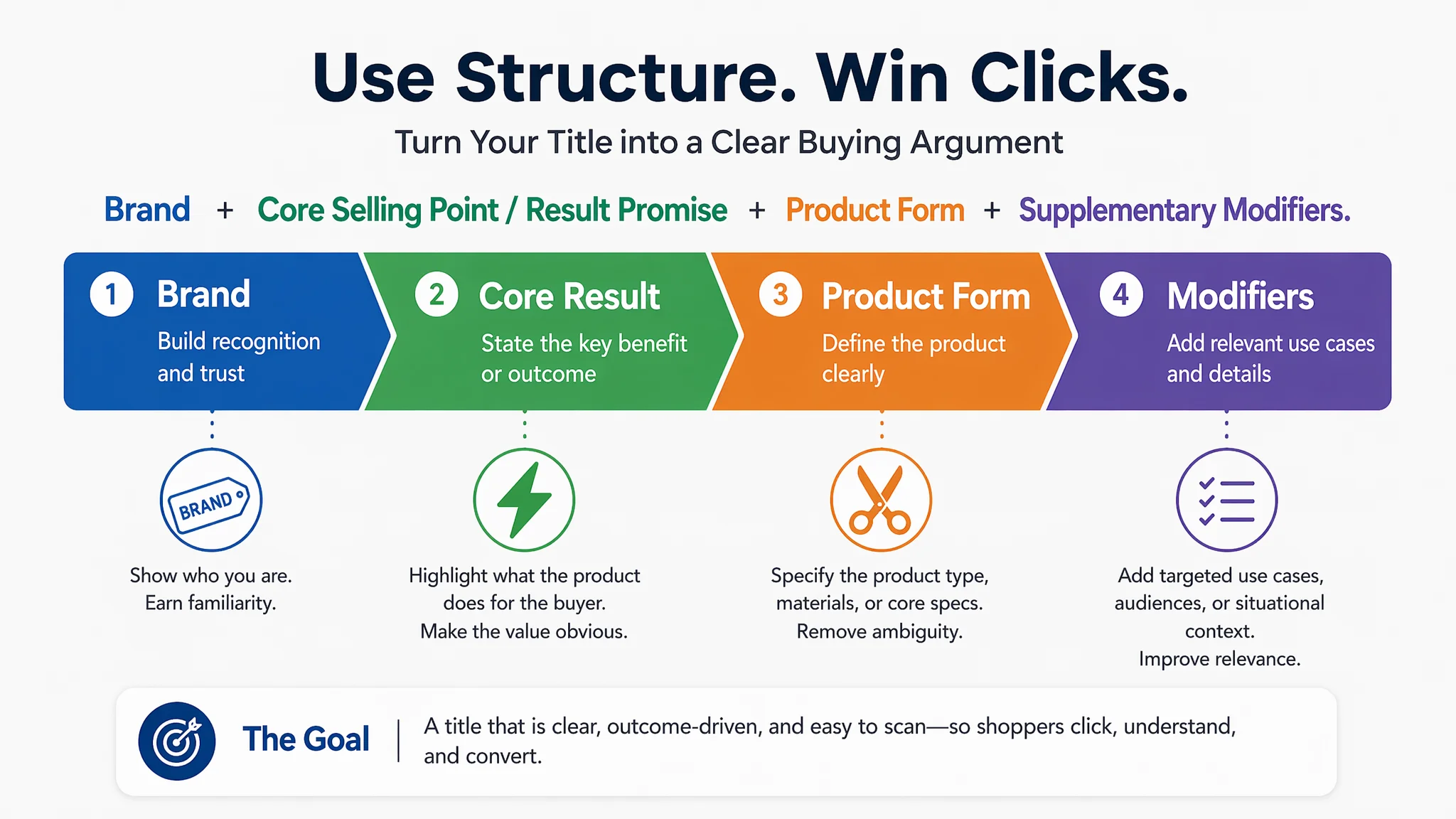
The goal is to achieve an ideal synthesis of keyword density for discoverability and a clear, compelling message that encourages clicks. Simply stuffing keywords creates a title that may rank but will not convert, ultimately harming your performance. In the scissors listing, the original keyword-stacked title helped the seller feel “covered” in terms of search terms, but it read more like a feature inventory than a promise. DeepBI’s restructuring did not remove relevant terms; it re-ordered and reframed them to speak directly to the buyer’s core concern: “Will this help me cut straight, clean lines on fabric without mistakes?”
Common pitfalls to avoid include using prohibited promotional language, adding special characters, and exceeding the 200-character limit, all of which can diminish your listing's weight in search results.
Manually perfecting this balance across a large catalog is a significant challenge. DeepBI automates this task by transforming optimization strategy into an executable 'design blueprint.' The platform analyzes high-performing competitor titles and incorporates high-conversion search terms from your own advertising data. Constrained by your product's unique "Product DNA," the AI generates a title that is not only algorithm-friendly but also structured for maximum customer appeal, directly impacting your CTR and CVR. In cases like the laser scissors, this means the system doesn’t just suggest “add laser” or “add sewing” as keywords; it proposes complete, human-readable title options in which those terms are locked into a tested, conversion-oriented logic.
Leveraging DeepBI for Advanced Title Optimization
Effective title optimization moves beyond intuition. DeepBI provides a quantitative framework for Amazon sellers, transforming this critical task into a systematic process. The platform begins with a diagnostic analysis, benchmarking your title against key competitors on factors like keyword layout, selling point clarity, and structural standardization. By analyzing high-frequency market search terms, it identifies precise opportunities for improvement. Instead of offering vague suggestions, DeepBI generates structured, executable strategies, such as reordering keywords to match top competitors' core conversion terms or rebuilding the title around a proven, high-performing structure.
The laser sewing scissors project shows how this shifts the conversation. Initially, the seller interpreted rising ad costs and flat orders as proof that “ads were underperforming.” DeepBI’s listing score deconstructed that belief by quantifying where the real gaps were: a title score far below the benchmark, and a review score that reflected an almost empty trust layer, despite outperformance in images and A+. This reframing moved the focus from “keep tuning bids” to “repair the listing’s conversion logic at the top of the page.”
This analytical rigor flows directly into execution. DeepBI’s AI generates multiple optimized title options based on the data-driven strategy, complete with a front-end preview. In the scissors case, the seller could compare different title variants that all respected Amazon guidelines but emphasized slightly different angles—laser precision, professional-grade materials, or multi-scene use—while staying anchored in the same proven formula. This allowed them to choose a direction strategically rather than guessing.
The most significant efficiency gain comes from its end-to-end workflow automation. Where sellers once faced a manual process of downloading, editing, and re-uploading content that could take over 30 minutes, DeepBI’s direct SP-API integration is a game-changer. With a single click, your chosen title is synced directly to your Amazon seller backend in seconds. For the scissors listing, this meant that once the new, outcome-focused title was locked in, it moved from “approved strategy” to “live on site” without introducing operational friction or delays. This drastic reduction in listing cycle time allows you to implement data-backed improvements faster, accelerating your ability to enhance Click-Through Rate (CTR) and Conversion Rate (CVR).
Continuous Optimization and Performance Monitoring
Treating title optimization as a one-time task is a critical mistake. The most successful Amazon sellers approach it as a continuous, iterative process—a dynamic logic that adapts to market feedback and competitive pressure. Without a systematic way to measure the impact of changes, optimization remains reliant on subjective judgment, making it impossible to know if a new title is a genuine improvement.
The sewing scissors case again highlights why this mindset matters. Before working with DeepBI, the team’s optimization loop was largely ad-centric: adjust bids, tweak creatives, add more gallery scenes, and watch ACOS. But there was no clear chain of evidence linking title changes, page structure, and performance outcomes. After DeepBI’s diagnosis, the sequence changed: first rebuild the title and clarify the value narrative in bullets, then refine A+ alignment, and only then resume aggressive ad testing. Monitoring shifts in impressions, CTR, and CVR after each step turned what had felt like “ads are getting harder to run” into a structured experiment with clear cause and effect.
After implementing a new title, it is essential to monitor its direct effect on key performance metrics. The most immediate indicators to watch are impressions, Click-Through Rate (CTR), and Conversion Rate (CVR). A positive change should increase visibility and attract more qualified clicks, which in turn boosts conversions. This creates a data-driven feedback loop, transforming title optimization from guesswork into a quantifiable science.
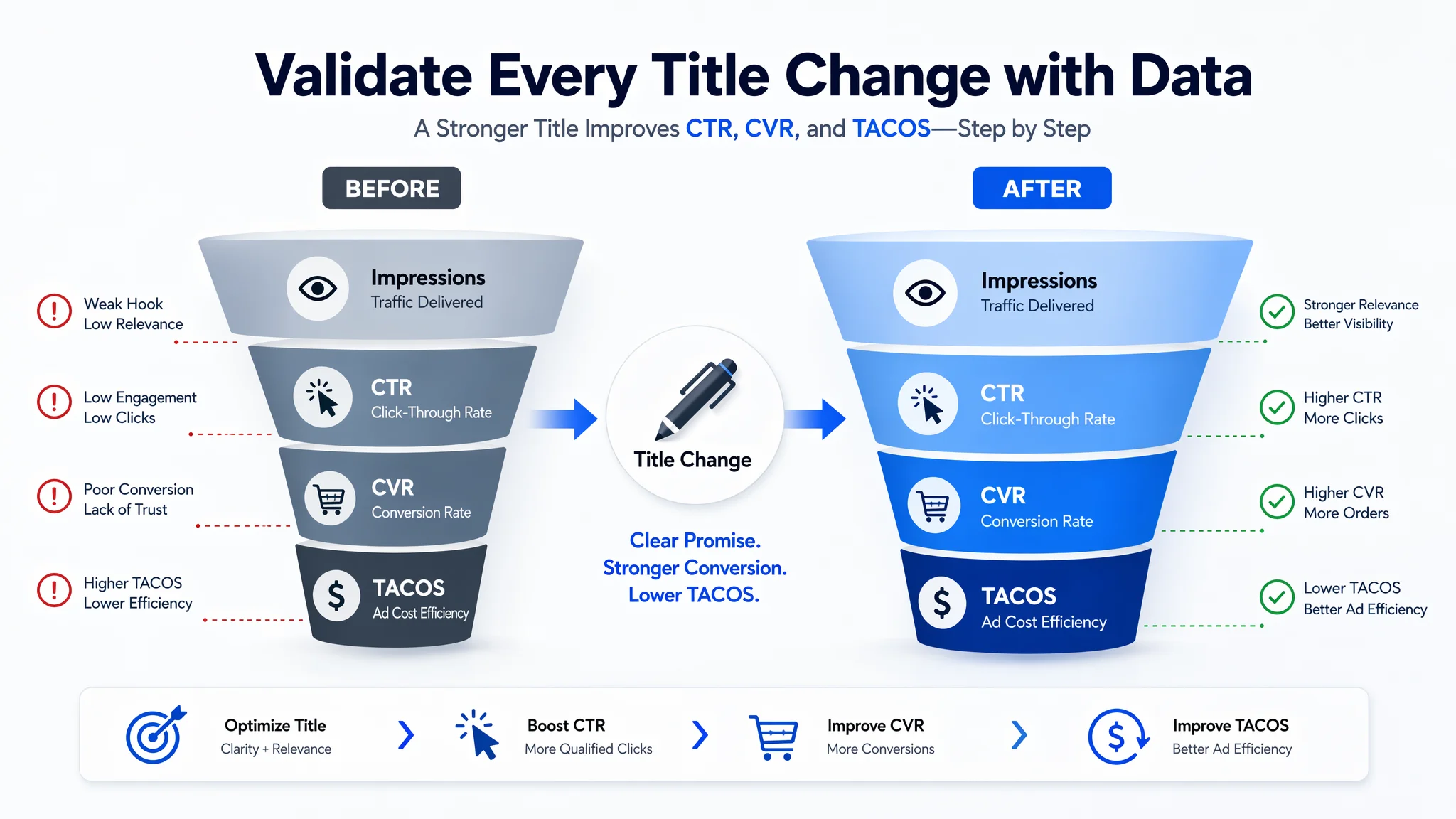
This ongoing cycle of refinement directly contributes to long-term growth. By consistently improving your title based on performance data, you enhance your product's organic visibility and ranking for high-value keywords. For a listing like the laser scissors, that also means paying attention to how changes in title clarity and trust-building (such as accumulating initial reviews through compliant programs and follow-ups) gradually reduce reliance on paid traffic alone.
DeepBI’s Organic Traffic module helps you track these long-term gains, allowing you to connect specific listing optimizations to sustained improvements in natural ranking. Over time, you can see whether a restructured, outcome-led title not only improved immediate CTR and CVR, but also helped the listing climb closer to entrenched incumbents on critical keywords. Ultimately, this disciplined approach not only strengthens your organic presence but also contributes to a lower Total Advertising Cost of Sales (TACOS).
Conclusion: Elevate Your Amazon Listings with Optimized Titles
Your Amazon product title is far more than a simple descriptor; it is a primary lever for driving visibility, traffic, and sales. A strategically optimized title directly influences your product's search ranking and is often the deciding factor in a shopper's decision to click. This initial engagement is critical, setting the stage for conversion and impacting key performance indicators from Click-Through Rate (CTR) to Best Seller Rank (BSR). Neglecting the title means leaving a core component of your listing’s success to chance.
The experience of the laser-guided sewing scissors seller underscores this reality. Despite superior visuals and a sophisticated A+ layout, performance remained constrained because the title failed to clearly express the core promise and the review layer could not carry trust. Advertising, in that context, simply amplified the listing’s structural weaknesses. Only after reframing the issue—from an “ad problem” to a “title and trust logic problem”—did optimization efforts begin to align with what buyers actually needed to see and understand.
By moving beyond subjective guesswork, DeepBI transforms title optimization into a predictable, data-driven science. By integrating diagnosis, planning, and execution into a unified algorithmic process, the platform ensures that every change is purposeful and measurable. It converts operational intuition into a concrete data evidence chain, empowering sellers to make decisions that consistently improve CTR and Conversion Rate (CVR). For any seller who feels that “ads are getting harder to optimize” despite visually strong pages, this approach offers a clear alternative: start with the listing—especially the title—prove that it deserves more traffic, and then let your advertising strategy build on that solid foundation.
By leveraging this full-link intelligent optimization system, you can elevate your entire listing lifecycle management, ensuring your titles are engineered to capture their full commercial potential and secure a stronger competitive position in the marketplace.