

Why Your Amazon Title Will Make or Break You in July 2026
July 2026 marks a critical deadline for Amazon sellers. According to an announcement in Seller Central, product titles exceeding 75 characters may be suppressed or flagged beginning that month. A title that once generated impressions could therefore become a discoverability, CTR, and sales risk if it is not revised before enforcement begins.
The rationale extends beyond policy enforcement. Shoppers increasingly browse on mobile devices, where long titles are truncated before the most persuasive information appears. Concise titles also provide AI shopping assistants with clearer inputs for interpreting, comparing, and matching products to customer intent. Amazon’s title guidelines are designed to apply consistently across marketplaces, regardless of the seller’s region, so local habits and legacy listing practices should not be treated as protection from the change.
AI-assisted shopping raises the competitive stakes further. Industry reports have attributed approximately 274 million daily queries to Rufus, while separate industry research has reported that Rufus users convert at a rate 60% higher than non-users. These figures should be treated as reported estimates rather than universal performance guarantees, but they point to a clear shift: title wording now shapes both human scanning and machine-assisted product discovery.
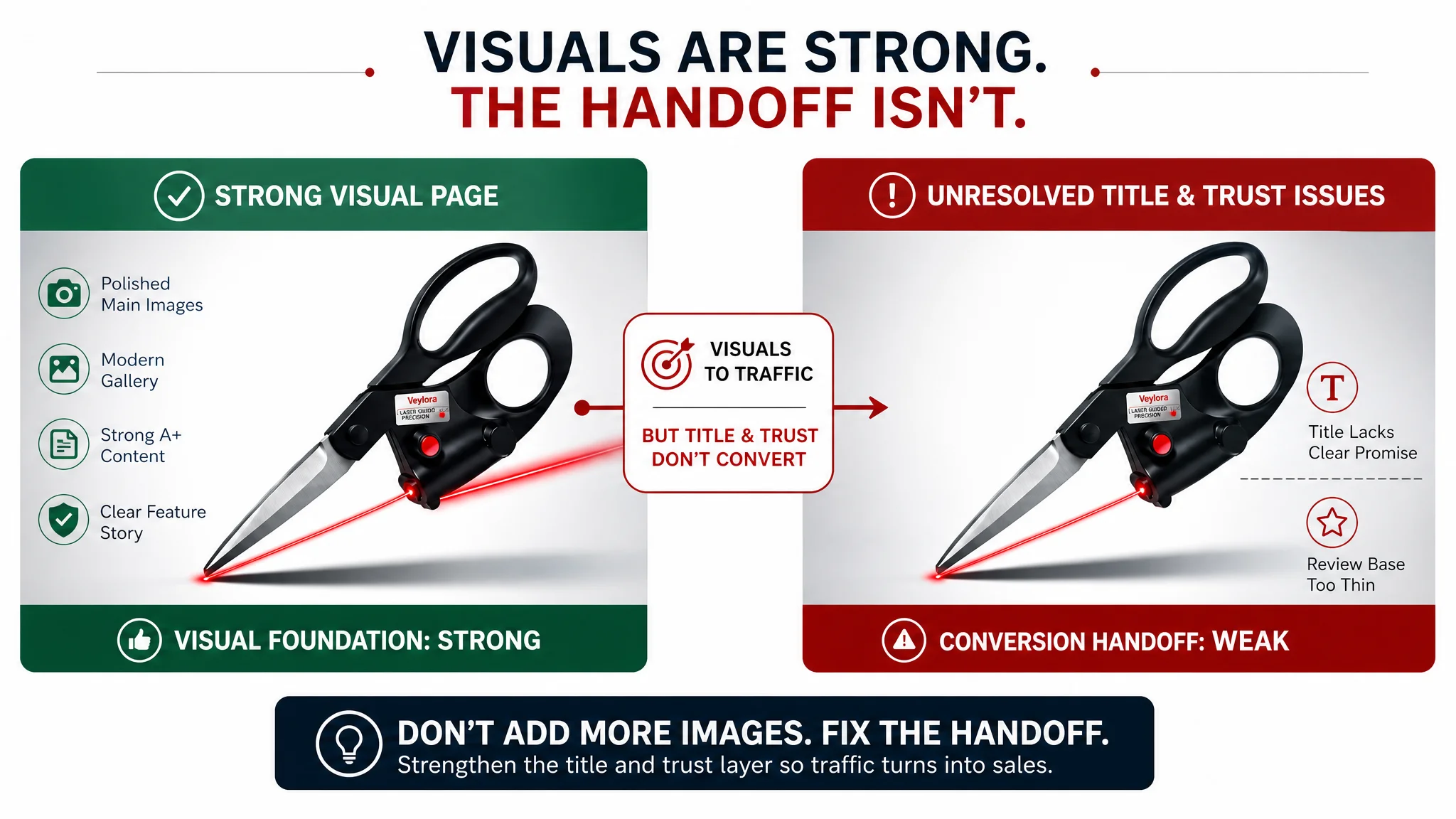
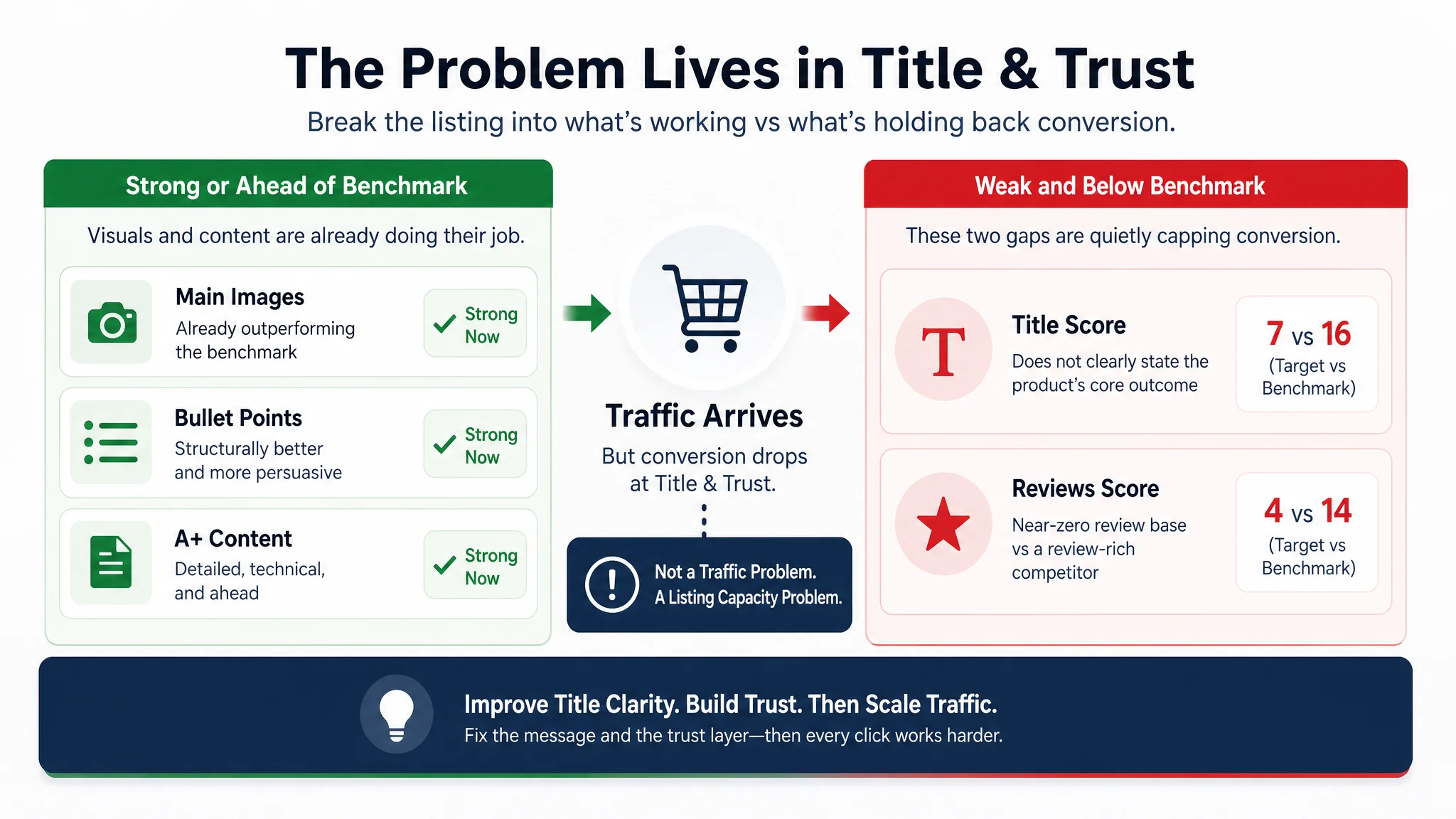
A real Listing diagnosis illustrates why this matters. A seller of laser-guided sewing scissors already had polished main images and a technically strong A+ page. The team initially believed that advertising structure and creative volume were the main problems, so they continued adjusting bids, testing keywords, and producing additional images. However, the Listing scored 66 out of 100 against a benchmark score of 77, with the largest gaps concentrated in the title and reviews rather than the visual content. The title scored 7 against the benchmark’s 16, while the main images, bullet points, and A+ content were already ahead of the benchmark.
The page was not simply lacking more traffic or more images. It lacked a clear promise in the title and enough trust signals to support the traffic already arriving. This distinction is central to title optimization: a title should not merely contain relevant keywords. It should quickly explain what the product is, what makes it different, and what practical result the buyer can expect.
Keyword stuffing is no longer a viable optimization strategy. Sellers need titles that meet the character constraint, state the product’s strongest differentiator early, and remain easy to parse. The practical objective is not merely compliance; it is to protect visibility, improve qualified traffic and CVR, and avoid preventable listing disruption before the deadline.
Amazon's Title Requirements: The Non-Negotiables
Treat compliance as the foundation of title performance: a title that violates Amazon's rules can be blocked, limiting discoverability before CTR or CVR have a chance to improve.
The 75-Character Limit and Its Rationale
- Keep the title at 75 characters or fewer, except where Amazon specifies an exception for right-justified items.
- Prioritize the 75-character limit for mobile readability, where long titles are truncated and key information may be hidden.
- Put the product type, core keyword, and essential differentiator first instead of filling available space with repeated or low-value terms.
- Review the final title in the relevant Amazon category Style Guide rather than applying a generalized character rule across every product type.
The practical challenge is deciding which information deserves the limited space. In the laser-guided sewing scissors diagnosis, the product’s title contained several relevant terms, but the core category phrase appeared too late and the laser feature was not clearly connected to a customer outcome. The title therefore covered keywords without establishing a strong reason to choose the product.
A shorter title would not automatically solve that problem. The more important task would be to place “laser-guided sewing scissors” near the beginning and connect the feature to a result such as precision straight cutting. This is why the character limit should be treated as a prioritization exercise, not simply a trimming exercise.
Special Characters, Word Repetition, and Naming Conventions
- Do not use prohibited special characters, including !, $, ?, _, {, }, ^, ¬, or ¦.
- Use characters such as ~, #, <, and > only where Amazon permits them for a specific context, such as style numbers or measurements.
- Do not repeat the same word more than twice, except for articles and prepositions.
- Correct keyword stuffing by changing “Baby Boy Outfits Baby Boy fall…” to “Baby Boy Fall Winter Clothes Set.”
- Exclude promotional phrases, subjective claims, and time-sensitive information; avoid wording such as “best seller,” “free shipping,” or unsupported superiority claims.
- Check the completed listing in Manage Inventory or the Listing Change Tool, then confirm the interpretation against Amazon's real Style Guide.
Compliance issues are often easier to identify than structural weaknesses. A title can avoid prohibited symbols and still perform poorly because its words are arranged like a keyword inventory rather than a buying message. In the sewing scissors example, the title technically included multiple relevant terms, but the sequence did not make the product’s main benefit immediately understandable. It referred to different uses and features without establishing a clear hierarchy.
The distinction matters because adding more compliant keywords would not necessarily repair the underlying communication problem. A compliant title still needs to be readable, logically ordered, and specific enough to answer the buyer’s first question: what does this product help me do?
Variation Listings and Parent-Child Titles
- Follow Amazon's variation naming conventions when creating parent and child titles.
- Keep the parent title focused on the shared product identity and avoid inserting child-specific attributes.
- Add the differentiating attribute, such as color or size, to each child title.
- Ensure the parent-child structure remains consistent so shoppers can understand the variation relationship without unnecessary keyword repetition.
Variation structure should support clarity rather than create additional opportunities for keyword repetition. The parent title should explain the shared product identity, while child titles should communicate only the attributes that distinguish one option from another.
The same principle applies to the broader title structure: every word should have a clear role. If the title already struggles to communicate the product’s primary function, adding color, size, or secondary use cases in the wrong place can make the message even harder to interpret. Accurate structure protects both compliance and the shopper’s ability to compare variations quickly.
Best Practices for Crafting a High-Performance Title
The Proven Title Formula (Brand + Type + Attribute + Variant)
A practical title structure is [Brand] + [Product Type / Primary Keyword] + [Key Attribute] + [Variant (size/color/count)]. For example: “Levi’s Men’s 501 Original Fit Jeans.” This sequence identifies the product quickly, places core relevance near the beginning, and gives shoppers essential context without turning the title into a keyword list.
Keep the strongest, highest-volume relevant keyword near the beginning to support A10-oriented discoverability. Then add only attributes that are accurate, differentiating, and useful to the buying decision. If the title must stay within 75 characters, move secondary details to bullet points or product highlights rather than forcing every claim into one line.
The formula becomes more useful when the key attribute is connected to a practical result. In the sewing scissors diagnosis, the recommended direction moved from a feature-heavy title toward a structured promise:
“Laser Guided Sewing Scissors for Fabric, Professional Stainless Steel Scissors for Sewing, Quilting, DIY Crafts & Gift Wrapping, Ergonomic Handle for Precision Straight Cut (Black)”
The important shift was not simply the addition of “laser” or “stainless steel.” It was the decision to explain the role of the laser: helping the user make a precision straight cut. The title began to communicate what the product does for the buyer rather than merely listing the product’s components and possible use cases.
This also shows why a strong A+ page cannot fully compensate for a weak title. The scissors Listing already had seven structured A+ modules, technical demonstrations, and a consistent laser visual motif. Yet the title remained a bottleneck because shoppers encountered an unclear promise before reaching those deeper modules. A title is the first layer of the buying argument, not a label that can be left for the A+ content to explain later.
Aligning with A10, COSMO, and Rufus: The AI-Era Evolution
Keyword placement alone is insufficient. Use intent-driven language that reflects customer needs, such as “waterproof hiking boots for rainy trails,” a phrase that communicates both product type and use case. Factual descriptors also help answer common questions in AI-assisted shopping: “ultralight” and “compressible,” for example, are meaningful for a sleeping bag only when the product genuinely has those properties.
A strong title should connect three elements:
1. What the product is.
2. What distinguishes it from alternatives.
3. What outcome or use case matters to the customer.
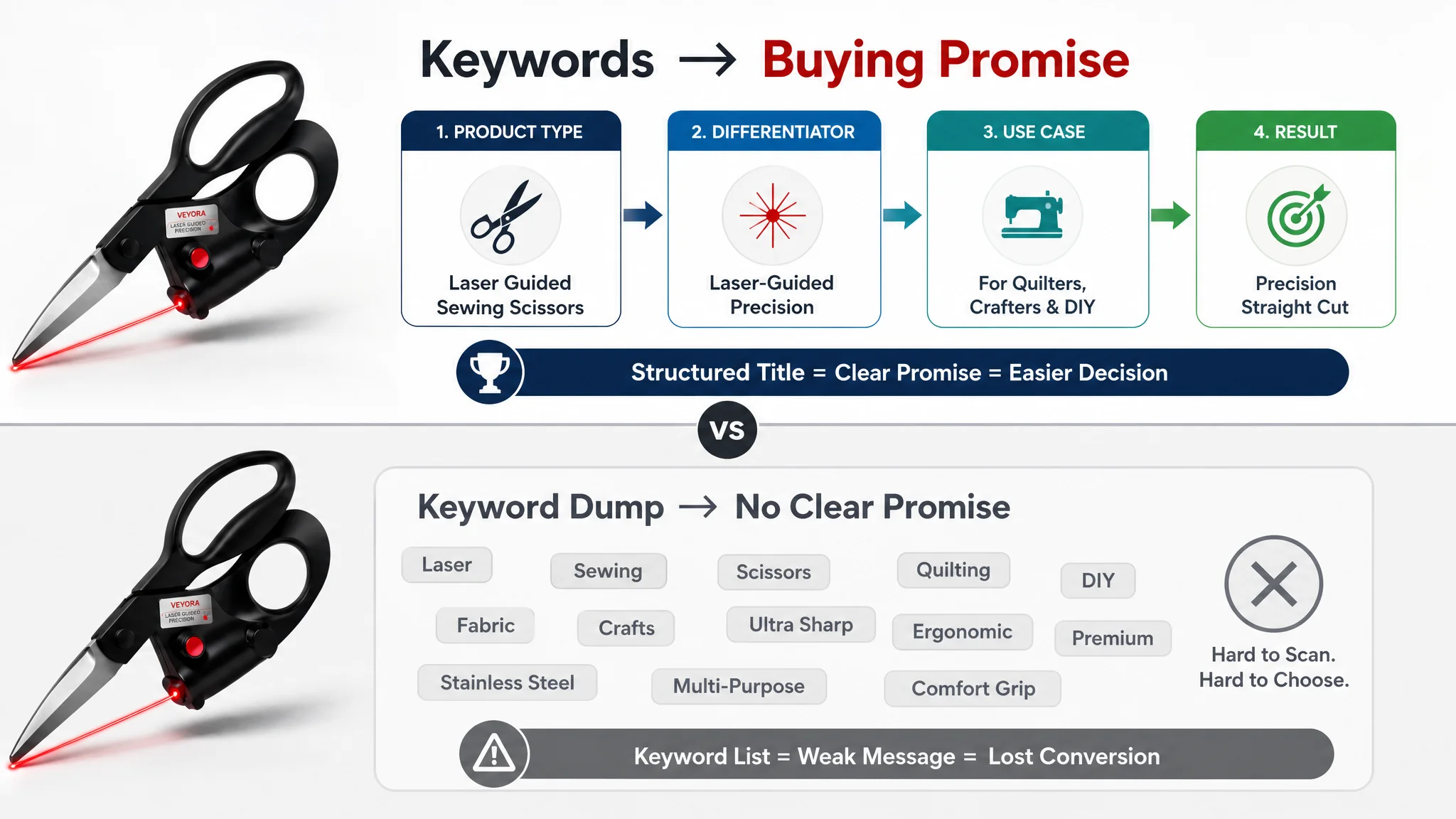
The laser scissors example demonstrates this progression. “Sewing scissors” identifies the category, “laser-guided” identifies the differentiator, and “precision straight cut” communicates the intended result. That structure is more useful to both shoppers and AI-assisted systems than a string of loosely related terms such as fabric, DIY, professional, sharp, craft, and sewing.
This does not mean every title should make aggressive performance claims. The outcome must remain accurate and supportable. The goal is to make the product’s meaning easier to interpret, not to promise more than the product can deliver.
Common Title Mistakes That Kill Rankings
Avoid repeated words, keyword stuffing, unsupported promotional language, all caps, and placing size or color in a parent title when those details belong to the child variation. Sellers remain responsible for factual accuracy even when Amazon automatically changes a title. Incorrect specifications can damage relevance, trust, CVR, and compliance.
Another common mistake is confusing keyword coverage with message quality. The sewing scissors seller initially believed that the Listing needed more relevant keywords and that advertising could handle the rest. The diagnostic review showed a different problem: the title pushed “Sewing Scissors” too far back, stacked terms without a clear order, and failed to explain how the laser feature helped the user cut more accurately.
The Listing’s visual content was not the main weakness. Its main images scored 26 against the benchmark’s 22, while its bullet points and A+ detail page also scored above the benchmark. Continuing to add images would therefore have addressed a smaller gap while leaving the title’s larger deficit untouched.
This is a useful diagnostic rule: when a page looks polished but conversion remains constrained, do not assume that more creative volume is the answer. Check whether the title makes a clear promise, whether the bullets develop that promise, and whether the rest of the page provides enough trust for the customer to act.
How DeepBI Automates Title Scorecard and AI-Driven Suggestions
DeepBI’s Listing module can benchmark titles against comparable competitors and score readability, keyword density, and conversion potential. It can generate data-driven alternatives, allow sellers to preview variants, and push a selected title live through SP-API. Its Organic Traffic module can also identify high-conversion-rate keywords from ad data for consideration in titles and organic ranking.
Competitive scoring is particularly useful when the initial diagnosis is wrong. In the sewing scissors example, the seller’s first response was to tune ads and produce more images. DeepBI’s scorecard separated the Listing into specific dimensions and showed that the largest gaps were the title, which scored 7 versus 16 for the benchmark, and reviews, which scored 4 versus 14. The visual areas that the team wanted to keep improving were already stronger than the benchmark.
This kind of breakdown turns a general concern—“the Listing is not breaking through”—into a prioritized operating problem. It helps sellers distinguish between a traffic issue, a title-clarity issue, a content issue, and a trust issue before allocating more budget or production effort.
The module should not replace human or policy review. Its value is in making the diagnosis more structured: identify where the Listing is underperforming, determine whether the title expresses the product’s strongest promise, and then test a controlled revision rather than changing several unrelated variables at once.
FAQ: Amazon Title Optimization Demystified
Will titles over 75 characters face enforcement after July 2026?
Yes. Under the stated policy direction, titles exceeding 75 characters after July 2026 may face suppression or manual enforcement. Sellers should verify the applicable category guidance and keep titles concise rather than treating the limit as a target.
Which special characters are prohibited?
Avoid decorative or promotional characters, including symbols such as !, $, ?, _, ~, {, }, and ^. Hyphens, commas, slashes, ampersands, and similar punctuation may be allowed when used accurately and consistently with Amazon’s category rules. Always check the current official guideline.
Can a stronger title improve discoverability and advertising?
Relevant keywords, clear structure, and readable selling points can support organic indexing. Better relevance and clarity may also increase CTR, which can improve ad relevance. These are established principles, not guaranteed ranking, CTR, CVR, or ACoS outcomes.
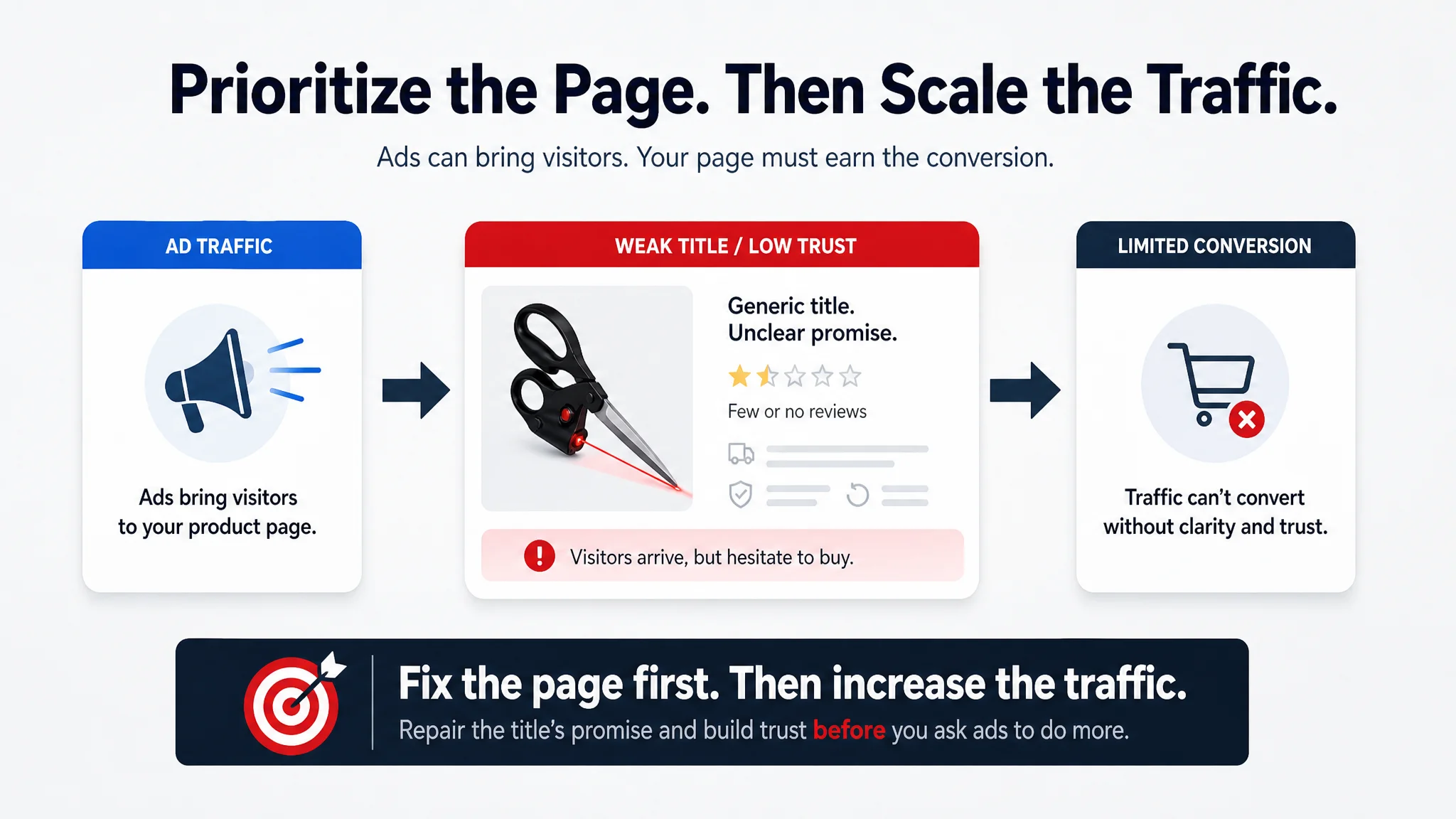
The relationship between titles and advertising is best understood as a funnel relationship rather than a guarantee. In the sewing scissors example, ads were already bringing acceptable traffic and the visual assets were strong enough to support clicks, but orders were lagging. The problem was that traffic reached a Listing with a weak title promise and an almost empty review base.
This is why ad performance can feel difficult to improve even when campaigns are receiving traffic. Advertising may be delivering visitors successfully while the Listing fails to convert enough of them. A stronger title cannot solve every conversion problem, but it can remove one of the first barriers between the click and the rest of the product story.
Can brand-registered descriptors appear in the brand name?
Yes, a brand-registered descriptor may be included as part of the brand name when it accurately reflects the registered brand and complies with Amazon policy.
What does DeepBI’s Listing module do?
It compares title keyword layout, selling-point clarity, and structure against benchmark ASINs, then provides executable recommendations and compliance checks for promotional or exaggerated language.
It can also help reveal when the title is not the only issue. In the sewing scissors analysis, the title gap was significant, but the review dimension was also weak: the Listing had two total reviews compared with more than ten thousand for the benchmark. That finding prevented the team from treating title rewriting as a complete solution. A clear title could improve the product promise, but trust signals would still need to be addressed separately.
Should DeepBI replace policy review?
No. Use it to diagnose and optimize titles, then verify the final wording against Amazon’s official guidelines.
How to Fix and Prevent Title Violations
Title suppression is more costly than a controlled pre-submission review: it can interrupt discoverability, weaken BSR, and lengthen listing cycle time. Use a repeatable troubleshooting flow rather than waiting for Amazon to reject the ASIN.
1. Find the signal. Check the Manage Inventory page for suppressed or inactive listings. Brand owners should also review the Listing Change Tool for title-related errors. Product Title violation notices provide another direct indication that an ASIN requires correction.
2. Download and isolate. Export the inventory report, locate the flagged ASINs, and record the affected titles. Separate title issues from unrelated inventory or offer problems.
3. Correct the source text. Edit the title using verified product facts only. Remove problematic promotional wording, exaggerated claims, unsupported attributes, and structural issues. For variation families, keep the parent title to a generic product identifier; place differentiating attributes such as size, color, or pack count in the child titles.
4. Pre-check and resubmit. DeepBI’s Listing module can screen titles for potential compliance, keyword-layout, selling-point, and structural issues before submission. Its optimization guidance can translate a diagnosed gap into a targeted text revision, reducing dependence on manual review. Treat this as a screening aid, not an approval guarantee.
5. Verify the result. Resubmit the corrected title through the applicable Amazon workflow, then monitor the listing status and confirm that the violation has cleared.
The same workflow should be used for performance-related title problems, even when Amazon has not issued a formal violation. A title can be technically compliant yet still underperform because its core category term is delayed, its differentiator is unclear, or its language does not reflect the customer’s intended use.
The laser scissors Listing is an example of why pre-submission review should include competitive and conversion analysis. The page did not lack visual investment, but its title communicated less effectively than the benchmark. A review process that checks only prohibited characters or length would have missed the larger commercial issue.
Maintain a title-review checkpoint before every major catalog update. Consistent checks help protect listing availability and support more stable CTR and CVR than reactive suppression repair.
Beyond the Title: How DeepBI Links Listing Health to Ads and Organic Growth
- DeepBI scoring service: An automated market health check system — Listing health extends beyond title quality. DeepBI evaluates titles alongside images, bullet points, A+ content, and reviews, then identifies competitive gaps through similarity-constrained benchmarking. This gives sellers a broader basis for protecting CTR, CVR, and organic visibility.
The broader view matters because a title is only one part of the conversion system. In the sewing scissors diagnosis, the title and review scores were substantially weaker than the benchmark, while the main images, bullet points, and A+ content were stronger. Without separating these dimensions, the seller could easily have continued investing in creative assets that were not the primary constraint.
- DeepBI Listing workflow: From diagnosis to delivery — A title is the entry point to performance, not a one-time rewrite. The workflow starts with a quantitative audit, generates optimization guidance, and supports execution through a unified Listing process.
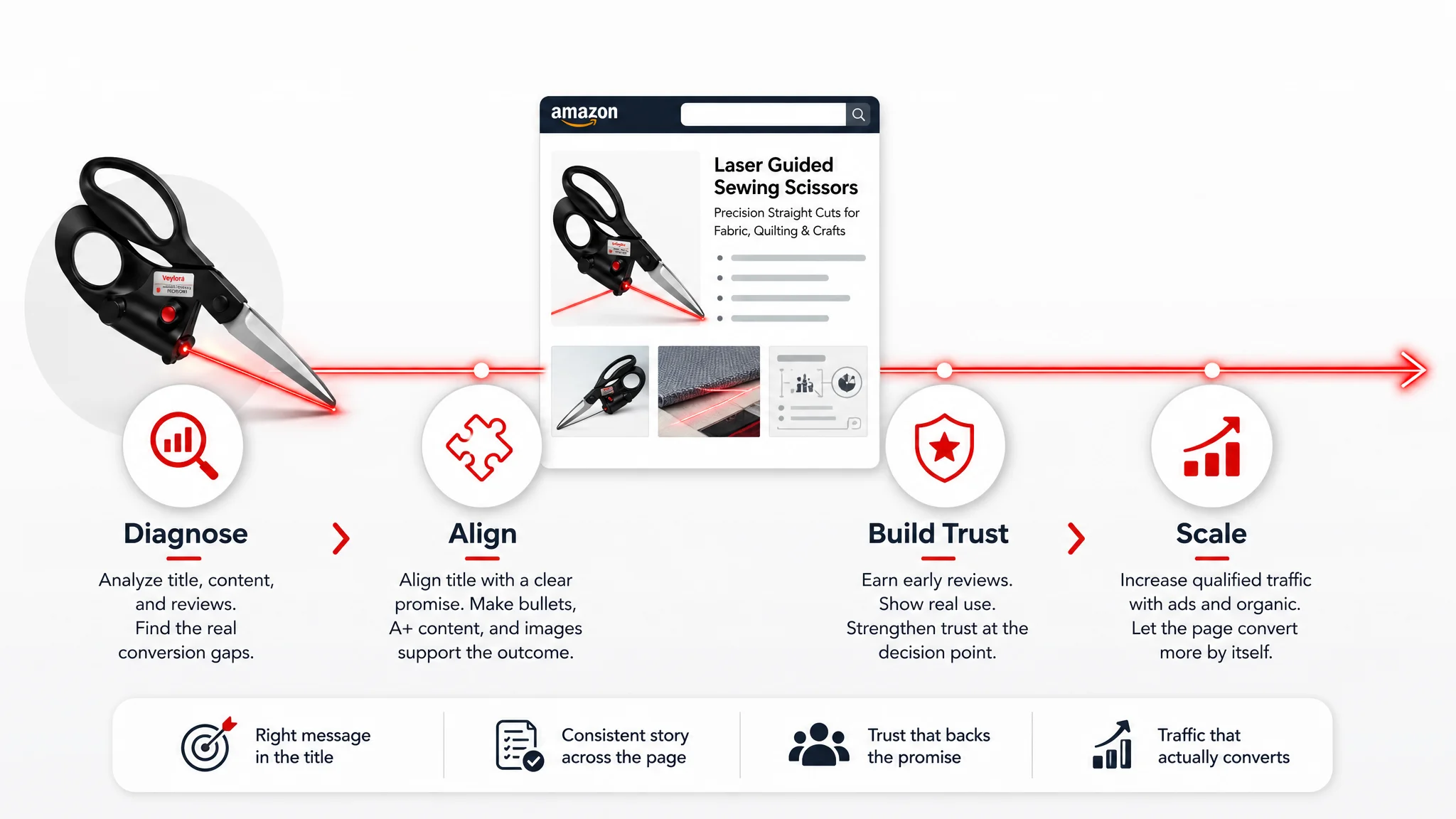
The recommended sequence in the sewing scissors example was to repair the title and clarify the bullet-point logic before scaling traffic again. The page already had a strong visual backbone, so the next step was not to add more modules but to align the existing content around a clearer promise: laser precision, professional use, and straight-cut performance.
- Title Analysis Agent — The system reviews keyword layout, selling-point clarity, and structural compliance against market search terms and competitor titles. DeepBI can continually rescore title quality as competitive conditions and algorithm preferences change.
This helps distinguish a title that contains the right vocabulary from one that uses that vocabulary persuasively. The diagnosed scissors title was not empty of keywords; its problem was that the words did not form a clear buying argument. Competitor comparison made the difference visible by showing how the benchmark title combined brand, size, material, result, and use case in a more disciplined sequence.
- One-Click Apply and automated publishing — Sellers can sync an approved, AI-generated optimized title live through the Listing module without leaving the platform. The workflow can also support comparison with previous versions, reducing manual downloading, uploading, and listing cycle time.
Controlled publishing is especially important when the title is one part of a broader Listing correction. Sellers should be able to identify which change addressed the title promise, which change improved bullet logic, and which remaining limitation belongs to reviews or other trust factors.
- Listing and advertising data integration — Impressions, clicks, orders, CTR, and CVR connect title quality with funnel performance. A clearer, more relevant title can support stronger click engagement and more efficient advertising decisions, including downstream analysis in DeepBI’s Ads Quant module.
The relationship becomes clearer when looking at the scissors Listing as a funnel. Main images and laser demonstrations were sufficient to support traffic, but the title did not explain the product’s outcome clearly enough, and the review base provided little social proof. Ads were therefore amplifying a page with a strong visual layer but a weaker title-and-trust layer.
- Closed-Loop optimization process — Follow Analyze → Execute → Optimize: diagnose the current Listing and benchmark gap, apply approved changes, then use performance feedback to guide the next iteration.
In practice, this means resisting the urge to adjust bids first whenever orders lag behind traffic. Diagnose whether the weakness sits in the title, images, bullets, A+, reviews, or the relationship between them. Then apply the highest-priority correction and measure the resulting funnel behavior.
- Listing health as a growth foundation — Stronger listing fundamentals can support both paid traffic efficiency and organic momentum, including more disciplined ACoS management and potential BSR improvement. Continuous measurement is more reliable than treating optimization as a completed project.
A polished A+ page may answer detailed objections, but it cannot always repair a title that fails to state the product’s core value. Likewise, a strong title may clarify the promise without fully resolving a near-zero review base. Listing health therefore depends on the complete decision path: relevance at the top, persuasive information through the page, and trust at the point of purchase.
Conclusion: Build a Title That Works Around the Clock
- Amazon Seller Central Guidelines — Supports the core compliance requirements behind sustainable Amazon title optimization: applicable character limits, accurate product information, appropriate variation naming, and avoidance of prohibited or repetitive wording. These rules protect account health while preserving the title’s role in search and customer communication.
- Amalytix — Reinforces the importance of structuring titles around relevant search terms and clear product information rather than treating the title as a collection of keywords.
- SellerApp — Supports evaluating title changes through marketplace performance indicators such as impressions, clicks, CTR, CVR, ACoS, and BSR rather than relying on assumptions.
- Incrementum Digital — Provides practical guidance for connecting title clarity and keyword relevance with discoverability, conversion, and more efficient advertising decisions.
- Helium10 — Contributes established Amazon title best practices, including readable keyword placement, disciplined word use, and customer-focused presentation.
- DeepBI Listing Module — Applies the Analyze → Execute → Optimize workflow by scoring title structure, keyword layout, selling-point clarity, and compliance; converting gaps into controlled recommendations; and tracking later impressions, clicks, CTR, CVR, ACoS, and TACoS. Apply this workflow through DeepBI’s Listing module to make title management a measured operating process rather than a one-time rewrite.
The central lesson is not that every weak Listing needs more images, more ad tests, or a longer title. It is that sellers need to identify where the conversion path is actually breaking.
A laser-guided sewing scissors Listing showed this clearly. Its main images scored higher than the benchmark, its bullet points and A+ content were structurally strong, and its advertising was already bringing traffic. Yet the title failed to communicate the product’s core outcome, while the review base provided very little trust. The initial assumption was that the ads and creative volume needed more work. The diagnostic conclusion was that the Listing’s title and trust layer were underdeveloped.
That distinction applies broadly across Amazon categories. Advertising can bring shoppers to a page, but it cannot replace a clear product promise. A+ content can explain technical details, but it may not compensate for a weak opening message. More keywords can increase coverage, but they cannot automatically turn a feature inventory into a reason to buy.
Before scaling traffic, ask whether the title clearly states what the product is, what makes it different, and what it helps the buyer accomplish. Then examine whether the bullets, images, A+ content, and reviews support that promise. When the answer is no, the most efficient optimization may begin with the Listing—not another round of bid adjustments.