


Understanding Amazon Conversion Rate - The Metric That Powers Profits
Amazon conversion rate (CVR) is the percentage of listing sessions that result in a unit sale. In practical terms, it shows how effectively a product page turns qualified traffic into orders. A high CTR may bring shoppers to the listing, but CVR determines whether that traffic generates revenue, reduces wasted ad spend, supports a healthier ACoS, and potentially strengthens sales velocity and BSR.
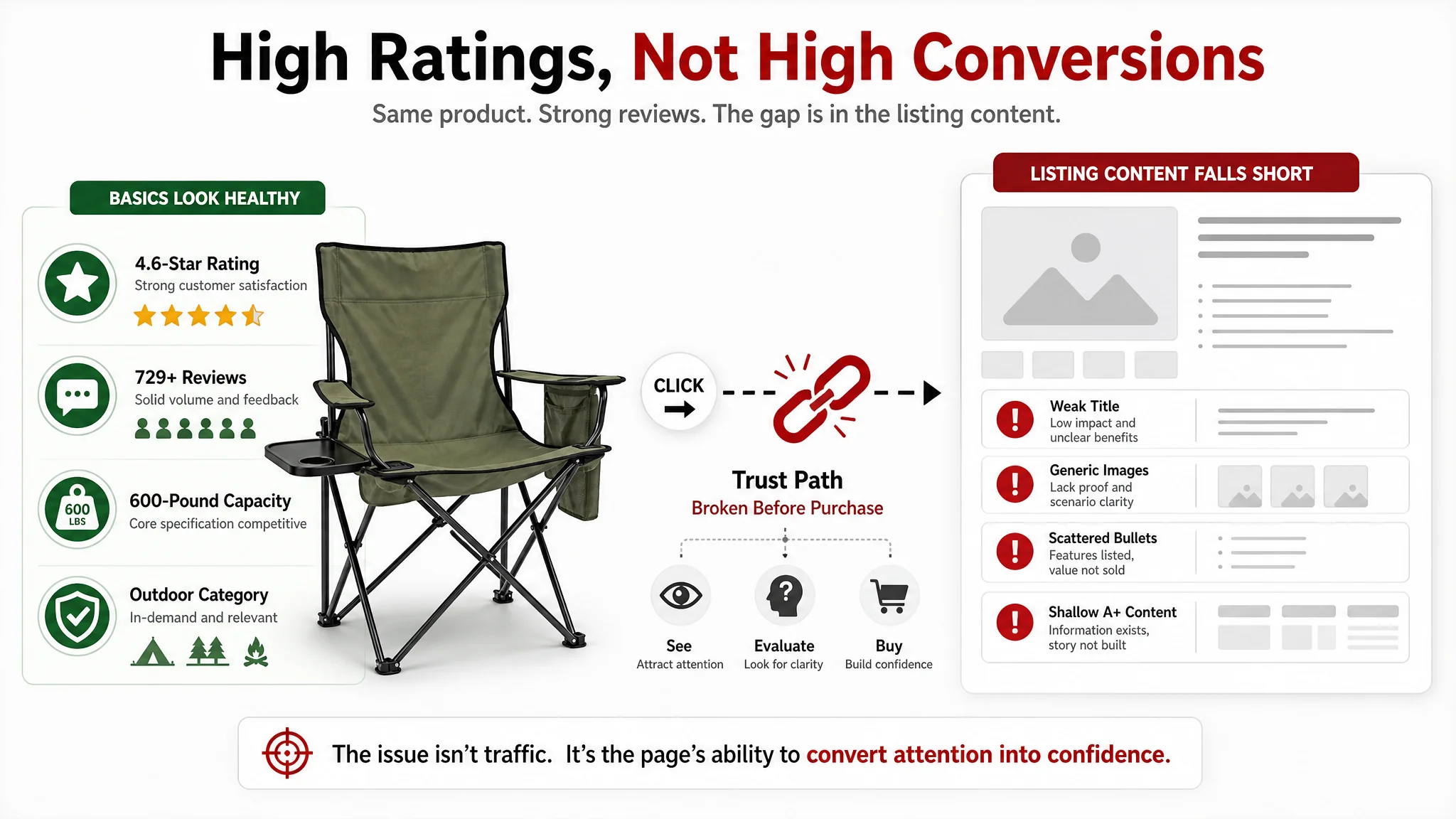
A listing can therefore appear healthy at the traffic level while still underperforming commercially. If shoppers click but do not find enough evidence to continue toward purchase, the problem may not be visibility. It may be the page’s ability to convert attention into confidence.
A camping chair seller in the US outdoor category illustrated this distinction clearly. The product had a 4.6-star rating, more than 729 reviews, competitive core specifications, and a 600-pound weight capacity. On paper, the listing did not look weak. However, it consistently underperformed against a leading benchmark listing in the same sub-niche in both click-through and conversion. The seller initially focused on advertising because the product’s ratings, reviews, and basic content appeared “good enough.”
A deeper comparison produced a different diagnosis. The seller’s listing scored 81/100, while the benchmark scored 91/100. The gap was concentrated in the title, main images, bullet points, and A+ content. Review quality was essentially comparable. In other words, strong ratings had not eliminated the conversion problem; they had made the weaker content structure easier to overlook.
Two perspectives are essential:
- Overall account conversion rate: The combined conversion performance of the seller’s catalog, useful for evaluating portfolio-level traffic quality and commercial health.
- ASIN-level conversion rate: The rate for one specific product or variation, which reveals whether a particular listing, price point, offer, or content strategy is converting effectively.
These metrics should not be measured against a single universal average. Electronics listings may convert differently from Home & Kitchen listings because consideration time, price, specifications, and purchase intent vary. Based on aggregated seller data through early 2025, typical conversion rates range from approximately 3% to 15%, depending on the category, with some fully optimized subcategories reaching higher levels.
Relevant benchmarks should therefore reflect the bottom-level category, comparable ASINs, price band, audience, and competitive position. Niche, seasonality, traffic quality, and competition can all materially affect results. Trust signals also matter: under some conditions, listings with 4.5+ stars and 50+ reviews may see nearly double the conversion rate. Treat this figure as a directional performance signal rather than a guaranteed outcome.
The camping chair example also shows why benchmarks must be specific. The seller was not competing against a random category average. It was competing against a similar product whose content made oversized comfort, family use, stability, and portability easier to understand. The relevant question was not simply whether the chair had good reviews, but whether its page communicated its value as effectively as the benchmark page did.
AI-Powered Tool for Powerful Listings
A listing converts most effectively when its content operates as one evidence-based system rather than a collection of isolated copy and design tasks. Headline, bullet points, main images, A+ content, backend search terms, and review signals should therefore be assessed together. A weak main-image hook can suppress CTR, while incomplete A+ content, unclear benefits, or limited review evidence can constrain CVR after the click.
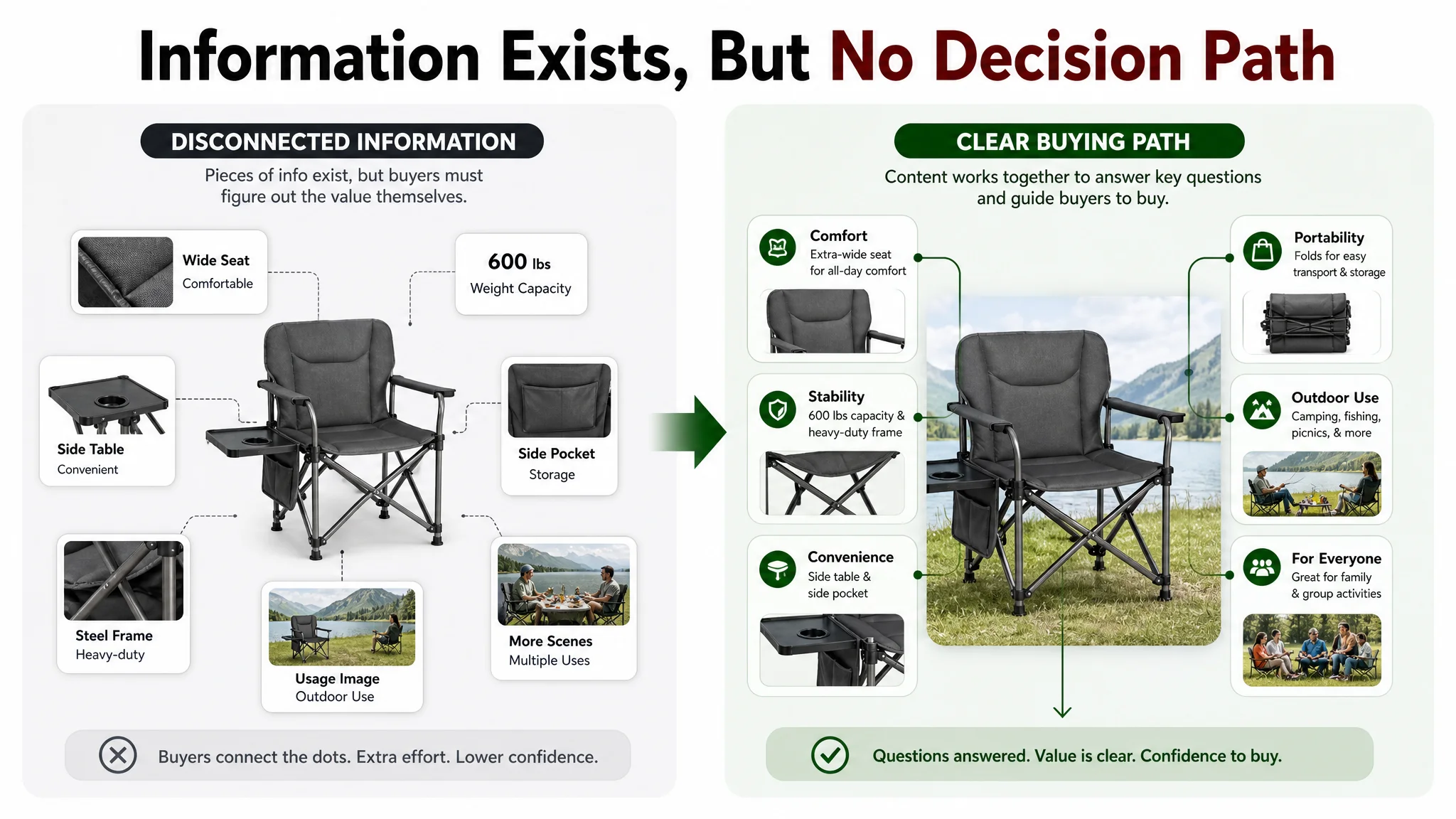
This system-level view is important because individual components can appear acceptable while the overall sales logic remains weak. In the camping chair example, the listing had many of the necessary elements: product specifications, usage images, a side table, a side pocket, a wide seat, and a heavy-duty frame. The problem was not a total lack of information. The problem was that these elements did not form a clear decision path.
The benchmark used its content to make the oversized dimensions obvious, present comfort as a central benefit, demonstrate stability through real-world scenes, and connect the product to camping, fishing, picnics, and barbecues. The seller’s page presented similar information more separately. Buyers had to assemble the value proposition for themselves. That extra decision effort can limit CVR even when the underlying product is competitive.
DeepBI’s Listing module uses distributed data capture and multi-agent semantic analysis to benchmark an ASIN against relevant, high-performing competitors. Instead of relying on surface-level keyword matching, it evaluates title structure, bullet-point logic, image quantity and variety, A+ modules, review quality, and benefit communication. The resulting output is a prioritized execution plan covering CTR-focused copy, conversion-oriented visual concepts, and SEO-rich keyword integration.
In the camping chair comparison, the scoring separated the problem into actionable dimensions:
- Title: 16 versus 18 out of 20, with core keywords present but weaker selling logic and emotional appeal
- Main images: 24 versus 27 out of 30, with functional presentation but less proof-driven visual communication
- Bullet points: 6 versus 8 out of 10, with relevant information that was more scattered and less persuasive
- Detail page and A+: 21 versus 24 out of 25, with multiple modules but a less coherent narrative
- Reviews: essentially equal in quality, although the benchmark had greater volume
This type of breakdown is more useful than simply labeling a listing “optimized” or “not optimized.” It identifies where conversion capacity is being lost and prevents sellers from assuming that the weakest visible metric is necessarily the root cause.
Amazon permits up to ten bullet points, but sellers should generally prioritize approximately five to seven high-impact benefits for quick scanning. Each point should connect a benefit to supporting evidence and a shopper pain point. High-quality, relevant UGC or brand videos may also increase engagement and support conversion when they comply with Amazon guidelines.
Visual auditing deserves particular attention. Some analyses associate listings with seven or more high-resolution images with conversion increases of up to 35%, although category, traffic quality, and execution can materially affect the result. DeepBI can help validate visual iterations against CTR and CVR data. Many clients using deep Listing optimization report conversion uplifts that may quickly offset costs, but outcomes vary by category and competitive landscape.
The camping chair diagnosis demonstrates why image quantity alone is not enough. The seller already had product and scene images, but they did not clearly prove the most important claims. “600 lbs capacity,” “extra-wide comfort,” and portability were present as specifications or scattered messages. They were not consistently made visible through people, scale, context, and use. The improvement opportunity was therefore not simply to add more images, but to make each image answer a specific buying question.
Amazon PPC Tool - Precision Traffic That Converts
A listing may have strong images, clear copy, and competitive pricing yet still record a weak CVR when its paid traffic is poorly matched to the product. Ad clicks do not carry the same level of purchase intent. A broad, loosely targeted term may generate impressions and clicks while producing few orders, wasting budget and directing low-converting sessions to the detail page. Overall traffic quality can suffer even when the listing itself is capable of converting relevant shoppers.
At the same time, weak CVR should not automatically be treated as proof of a traffic problem. A page may receive reasonably relevant visitors and still fail to convert them because the offer is not explained persuasively enough. This distinction matters before sellers change bids, restructure campaigns, or increase budgets.
The camping chair seller initially believed the issue was advertising efficiency. Bids for valuable camping keywords kept increasing, ACoS remained difficult to control, and organic rank did not improve in line with ad spend. The team considered more precise keywords, campaign restructuring, and additional ad-group segmentation. However, DeepBI’s listing comparison found that the core constraint was not primarily traffic acquisition. The page was underperforming the benchmark in the way it communicated comfort, stability, family use, and portability.
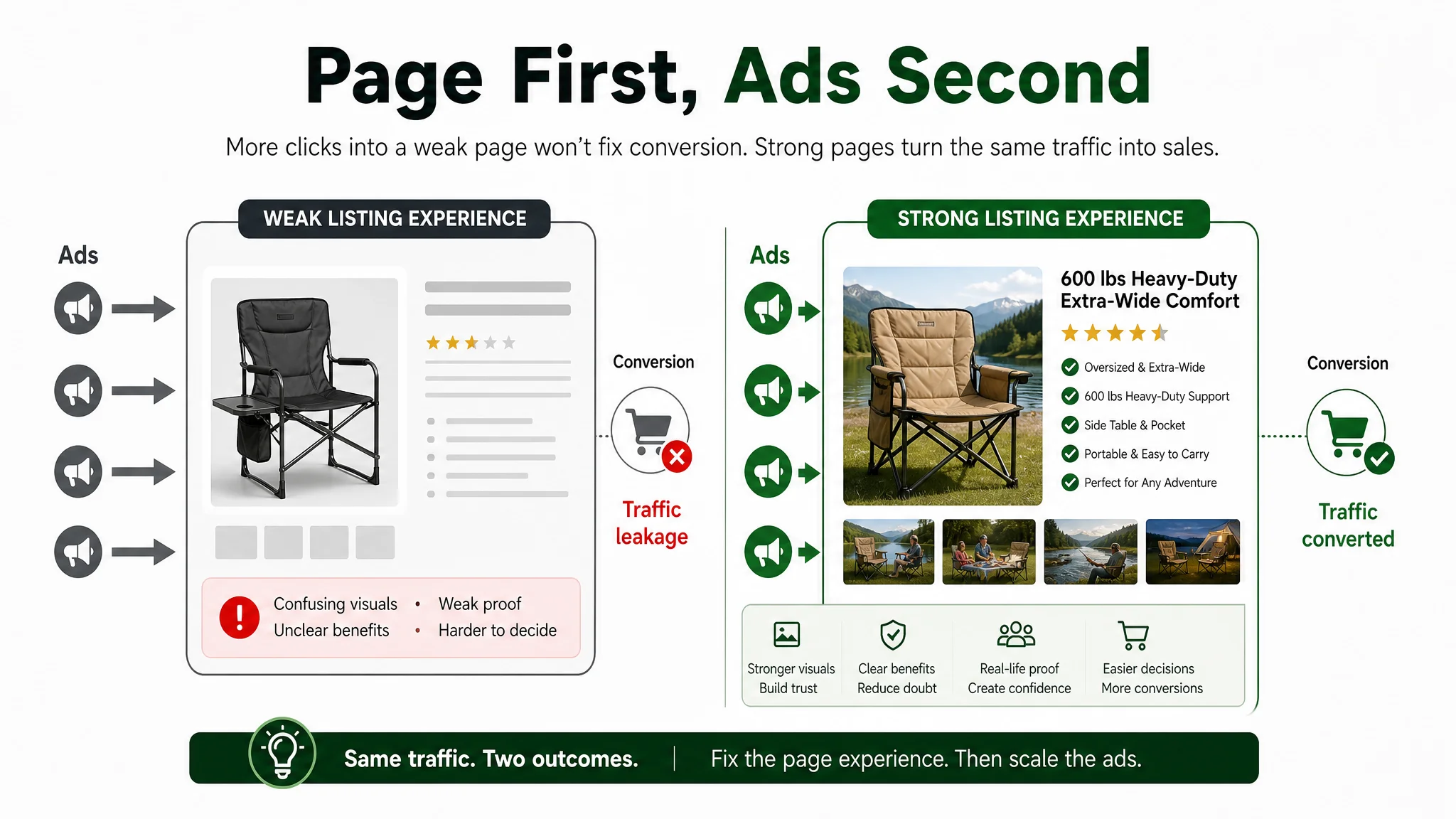
That diagnosis does not mean advertising was irrelevant. It means advertising was being asked to compensate for a page-level conversion gap. More clicks would continue to enter a weaker funnel unless the listing itself became more persuasive. The case therefore supports a practical rule: before treating high ACoS or weak CVR as a campaign problem, compare the listing’s conversion structure with a genuinely similar competitor.
PPC optimization requires more than raising bids. Sellers should refine keyword selection around search intent, add negative keywords to exclude irrelevant queries, adjust bids according to conversion and ACoS signals, and review search-term data to identify both waste and promising terms. Stable advertising signals, including impressions, clicks, CTR, CVR, and conversions, can also show which search themes warrant stronger listing support.
DeepBI’s AdsQuant module structures this process through a four-layer traffic funnel: Exploration, Filtration, Precision, and Volume. Exploration identifies potential search opportunities; Filtration removes low-converting or irrelevant terms; Precision concentrates spend on traffic with stronger conversion signals; and Volume scales qualified opportunities after they demonstrate value. The process is progressive: fewer low-quality visitors reach the listing, while a greater share of arriving shoppers aligns with the product’s offer.
In the camping chair case, the correct sequence was not to abandon advertising, but to change what advertising was amplifying. The listing first needed stronger visual proof and clearer buying logic. Once the page could better communicate the product’s actual strengths, refined traffic would have a stronger opportunity to convert. This is the difference between using PPC to discover and scale demand and using PPC to subsidize a page that loses the comparison.
When precise traffic is paired with a persuasive listing, CVR may improve meaningfully in some categories. Results still depend on account data, competition, offer quality, and category behavior, so sellers should assess the relationship through CVR, ACoS, and search-term-level performance rather than assume universal gains.
Next-gen Ad Automation Tool - Scale Efficiency, Lift Conversion Quality
PPC automation should serve as a safeguard for traffic quality, not a replacement for campaign strategy. Sellers still need to define targets, interpret search-term performance, refine product positioning, and connect advertising decisions with listing improvements. Automation handles the repetitive execution needed to apply those decisions consistently.
Rule-based bidding can adjust bids according to defined performance conditions, helping protect ACoS when conversion signals weaken and capture qualified demand when performance supports additional spend. Dayparting can reduce exposure during off-peak periods or hours with weaker CVR, while wasted-click controls can limit spend on low-converting queries, placements, or audience segments. These controls do not guarantee a higher CVR, but they can reduce budget leakage and preserve more spend for traffic with stronger conversion potential.
However, automation cannot correct a weak sales story on the product page. In the camping chair example, continued bid and campaign adjustments did not close the gap with the benchmark because the primary issue was not the speed of ad execution. The page still made shoppers work too hard to understand why the chair’s 600-pound capacity, extra-wide seat, side table, and portability mattered. Automation could make the traffic process more consistent, but it could not supply missing visual proof or reorganize fragmented selling points.
The operational benefit is equally important. When sellers no longer need to check and adjust every campaign manually, they can redirect time toward listing factors that influence CTR and CVR, including stronger product images, clearer copy, richer A+ Content, and structured image testing. Advertising reports can then inform those decisions by showing whether listing changes affect clicks, conversions, or ACoS.
One seller reported reducing manual advertising work by 15 hours per week through robust automation, then investing that time in A+ Content and image testing that improved conversion rate. This result should be viewed as an individual example, not a universal benchmark. The practical goal is to establish a repeatable loop: automate routine PPC controls, protect traffic quality, and use the recovered capacity for higher-value conversion work.
The camping chair diagnosis points to the same operating sequence from a different angle. Once the listing’s conversion logic became the priority, the required work became more specific: rebuild the title’s selling logic, redesign the main image system, reorder the bullet points, and create a more coherent A+ narrative. Automation is most useful when it creates capacity for this type of focused conversion work rather than encouraging sellers to keep adjusting campaigns without examining the page.
Profit Checker - Balance Margins and Conversion to Protect Your Bottom Line
A higher CVR is valuable only when the resulting orders remain economically viable. Discounts and coupons can reduce purchase hesitation and improve CVR, but they also lower realized revenue per order. Advertising can increase traffic and sales, yet higher spend may weaken ACoS if the listing does not convert efficiently. Increasing order volume without checking contribution per sale can therefore produce growth with limited bottom-line value.
The camping chair seller’s experience shows how a page-level conversion gap can create margin pressure even when the product itself is competitive. The team was relying more heavily on advertising to maintain sales while the listing continued to underperform the benchmark. Without improving the page, additional ad spend risked paying to reproduce the same conversion limitation. The issue was not simply whether more traffic could be purchased, but whether each click generated enough commercial value to justify the cost.
Use a product-level data check to establish the break-even CVR before changing the offer. Compare the realized selling price after discounts or coupons with product costs, marketplace fees, advertising cost, and the listing investment relevant to the optimization decision. The resulting contribution per order can then be compared with traffic cost to estimate the minimum conversion rate required for the listing to operate responsibly. Review this threshold alongside CTR, CVR, ACoS, and observed sales performance rather than treating any single KPI as definitive.
DeepBI’s Listing module adds competitive context through similarity-constrained benchmarking and a scoring system. It helps indicate whether the product’s pricing and offer structure are reasonably aligned with the market while identifying content or trust gaps that may suppress CVR. Sellers can use these findings to set a conversion target that supports margin requirements rather than simply matching competitor-level order volume.
For the camping chair, the benchmark comparison showed that the product had strong reviews and competitive specifications, so the page did not need to rely on unsupported discounting to create value. The more relevant opportunity was to communicate existing value more effectively: show the extra-wide seat instead of merely naming it, make the heavy-duty structure believable, and connect accessories to real use cases. This distinction helps protect margin because it focuses on improving perceived and understood value rather than automatically lowering price.
For some products, a professionally optimized listing may offset its investment within a few months when price, traffic volume, and conversion potential support that outcome. The timeline varies, so validate performance through measured CTR, CVR, ACoS, and listing-level contribution signals.
Find Best-Selling Products - How Product Selection Shapes Conversion Potential
Listing optimization cannot overcome every market constraint. Before a seller changes the title, images, or A+ content, product selection has already influenced the listing’s potential CVR through demand, competition, and pricing conditions.
A product aligned with validated customer demand may gain more relevant keyword visibility, giving qualified shoppers a clearer path to the detail page. If the market contains fewer closely comparable ASINs, strong content and accurate positioning may have greater room to influence conversion. Pricing also establishes a practical boundary: a product positioned far outside the competitive price band may face resistance, while similar pricing can make the listing easier for shoppers to assess. These factors do not guarantee a conversion rate, but they shape the starting conditions for CTR, CVR, ACoS, and the time required to establish a competitive BSR.
The camping chair seller’s product was not fundamentally misaligned with the category. Its 600-pound capacity, wide seat, steel frame, side table, and side pocket were relevant to the sub-niche. The problem was that those strengths were not positioned as clearly as they were on the benchmark listing. This is an important distinction during product evaluation: a product may have viable demand and competitive features, but still require stronger positioning to convert at its full potential.
DeepBI’s Listing competitive intelligence workflow helps assess these conditions by benchmarking a product against a top-performing, meaningfully similar ASIN. It uses the product title and bullet points to extract core search keywords, identifies relevant high-performing products, and applies filters for product form, function, use case, audience, and price range. The resulting comparison quantifies gaps across the title, main image, bullet points, A+ content, and customer feedback.
In the chair comparison, the benchmark’s advantage came less from superior review sentiment than from a clearer understanding of the buyer. The benchmark presented family-oriented outdoor scenes, multiple adults using the chair, and a more obvious connection between comfort and real-world use. The seller’s emphasis on younger social scenes narrowed the emotional range of the page, even though the underlying product could serve broader use cases.
Sellers can use these gaps to refine the product offering itself or evaluate adjacent niches where future listing optimization may have more room to improve CVR. The objective is not to declare a guaranteed best seller, but to select a starting market in which optimization has a stronger conversion opportunity.
The Synergy of Organic Traffic and Listing Conversion [Organic bridge]
Amazon conversion optimization is not a listing-only exercise. It is a traffic-and-offer system in which the right visitors reach a listing that provides enough relevance, clarity, and confidence to support a purchase.
When a product ranks more strongly for relevant search terms, it may attract higher-intent shoppers who are already closer to a buying decision. That traffic can convert more efficiently than broad, poorly matched visits, potentially improving CVR and supporting stronger sales velocity. The reverse relationship also matters. A conversion-ready listing can turn impressions into clicks and orders more consistently, helping sustain organic performance over time. This feedback loop is conditional, not automatic: keyword indexing can create impressions, relevant messaging can earn clicks, and a persuasive offer can generate sales signals that support continued visibility.
The camping chair seller experienced the risk of breaking this loop. Advertising spend was increasing, but organic rank did not improve in line with that investment, and the gap with the leading benchmark remained. The initial assumption was that more refined campaigns might solve the visibility problem. The diagnosis suggested that the page’s weaker conversion capacity was limiting the value of both paid and organic traffic. If shoppers reached the page but did not receive enough reasons to choose the product, additional visibility could not fully translate into stronger sales signals.
DeepBI’s Organic Traffic module helps operationalize this connection by identifying high-CTR, high-CVR keywords from advertising data and concentrating budget around terms that may be worth pursuing toward higher search positions. Paid data should be treated as a signal rather than a guarantee of organic placement.
The page’s content changes also demonstrate how organic and paid traffic can benefit from the same conversion architecture. A main image that makes “600 lbs heavy-duty” and “extra-wide comfort” immediately understandable can improve the quality of the click from search results. Bullet points that organize features into a buying sequence can support visitors arriving from either ads or organic search. A+ content that answers concerns about stability, portability, and use scenarios can then support the later stages of decision-making.
Track TACoS alongside natural order share to assess whether growth is becoming less dependent on paid spend and whether organic contribution is strengthening. If CTR is high but CVR remains weak, improve the listing. If CVR is strong but visibility is limited, refine traffic allocation and keyword coverage. Sustainable CVR improvement requires both an effective listing and well-matched visitors.
A Continuous Cycle: Monitor, Iterate, and Grow with Data
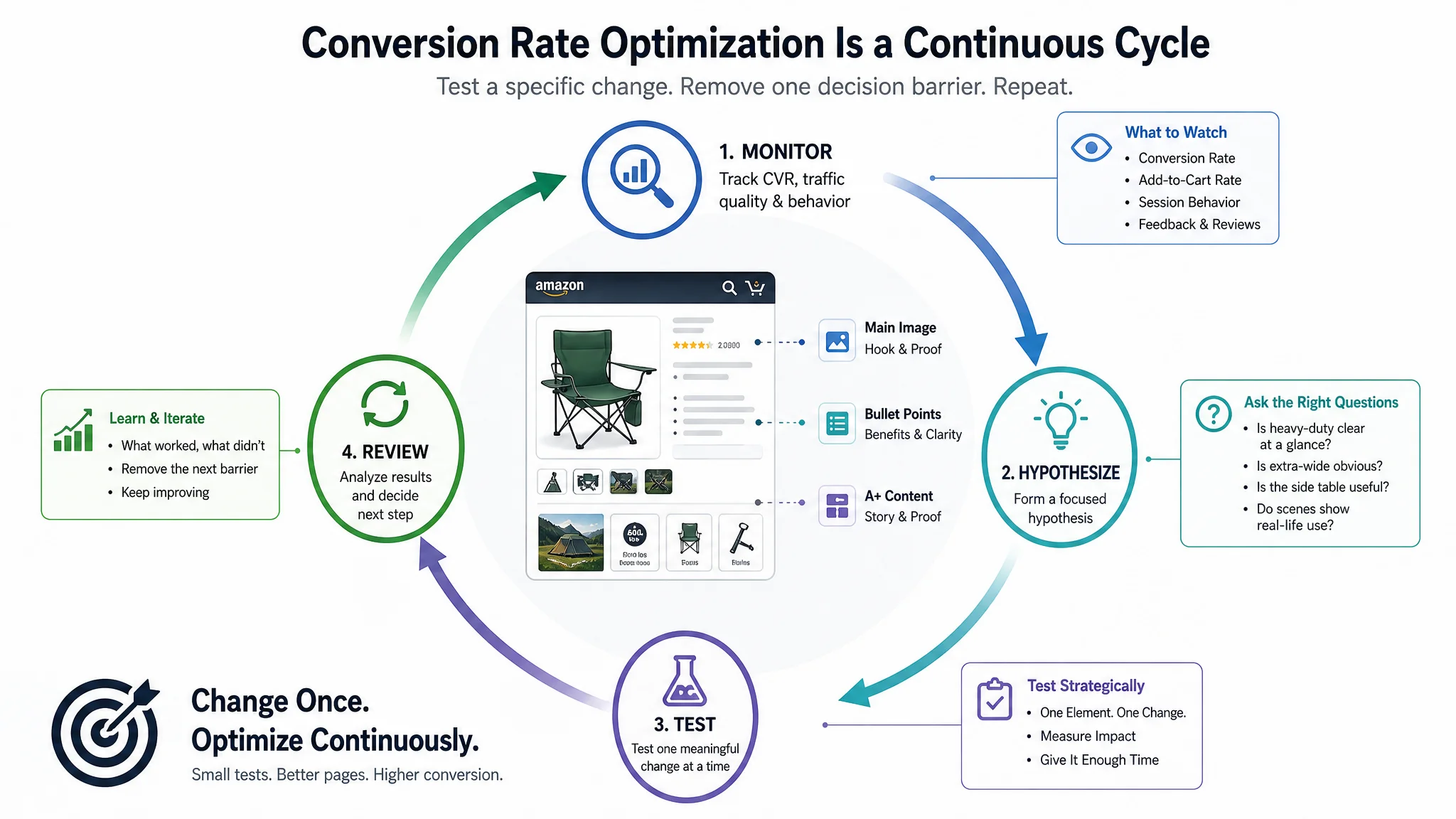
Improving an Amazon listing conversion rate is not a one-time repair. A listing can gain traction, lose relevance, face new competitors, or attract a different traffic mix, so CVR optimization should operate as a continuous feedback loop: monitor performance, form a focused hypothesis, test one meaningful change, and use the results to guide the next decision.
Track more than the headline conversion percentage. Review:
- CVR trends at the ASIN level and across meaningful time periods
- Top-keyword rankings and BSR movement
- The split between ad-driven CVR and organic CVR
- CTR, ACoS, TACoS, and other profit-related metrics
These signals help explain whether a CVR change results from stronger listing content, better traffic quality, improved organic visibility, or a less profitable offer strategy. A CVR increase accompanied by rising ACoS or falling margin may require a different response from a gain supported by growing organic order share.
The camping chair comparison provides a useful model for forming a focused hypothesis. Instead of broadly assuming that “ads are inefficient,” the seller could ask:
- Is the title making the product’s primary value clear enough?
- Do the main images visually prove the heavy-duty and extra-wide claims?
- Do the bullet points follow the buyer’s decision sequence?
- Does the A+ content address family use, comfort, stability, portability, and multiple outdoor scenarios?
- Is the page losing the comparison because of review quality, or because of content structure?
The diagnosis answered these questions at the module level. Reviews were not the main weakness. The product itself was not the main weakness. The larger issue was the way the page organized and demonstrated its value. That kind of diagnosis creates more useful tests than changing several campaigns and listing elements at the same time.
Use Seller Central resources such as Business Reports for recurring audits, then supplement them with suitable third-party analytics when deeper keyword, competitor, or profitability context is needed. DeepBI can provide unified visibility across Listing, Ads, and Organic modules, helping sellers connect changes across the funnel instead of evaluating each metric in isolation.
When testing visual and content changes, sellers should also evaluate whether the new structure addresses a specific decision barrier. For the camping chair, the recommended image system was designed around clear questions:
- Does the chair look strong enough for heavy-duty use?
- Can shoppers understand its dimensions at a glance?
- Is the 600-pound capacity shown in a believable real-world setting?
- Does the extra-wide seat look meaningfully different?
- Does the side table appear useful rather than merely present?
- Can buyers see how the chair fits into camping, fishing, picnics, and barbecues?
- Is the chair portable despite its heavy-duty construction?
The same logic applied to the bullet points and A+ content. Rather than adding disconnected claims, the page was reorganized around pain point, promise, and proof. The title emphasized the product’s selling logic. The bullets separated oversized comfort, heavy-duty support, convenience, portability, and multi-scenario use. The A+ sequence moved from an aspirational outdoor scene to core specifications, structural proof, practical accessories, portability, and broader use cases.
Treat every published change as the beginning of measurement, not the end of the work. Commit to a data-led cycle, test thoughtfully, and let AI-powered insights guide the optimization path.
The central lesson is simple: when advertising feels increasingly expensive, do not assume the answer is always more precise traffic or more aggressive bid management. First determine whether the listing is converting the traffic it already receives. A page with strong reviews can still lose the comparison if its images, copy, and A+ content do not create a clear and believable path to purchase. Fixing that conversion logic gives both organic visibility and paid traffic a stronger foundation.