

The Bidding Window Is Now - Why Every Bid Counts This Season
Prime Day and the Q4 ramp-up leave little time to identify winning keywords, control ACoS, and build the sales velocity needed to support organic ranking. As competition intensifies, an unchanged bid can continue paying for low-converting traffic while competitors capture higher-intent impressions.
The cost extends beyond wasted ad spend. Poor bid management can depress CVR, weaken the connection between advertising and BSR, and leave profitable search terms underfunded. Sellers often encounter campaigns with ACoS above 40%, particularly when bids, budgets, and search-term performance are reviewed manually and too infrequently. As a planning reference, reducing ACoS from above 40% to below 12% illustrates the opportunity that better decisions may unlock; it is not a guaranteed or universally verified result.
However, a high ACoS does not automatically mean that bids are the primary problem. In one Amazon US gas grill burner account, the team initially believed that keyword selection, bid levels, or campaign structure were responsible for slow order growth. Ads were generating impressions and traffic, but orders were not increasing at the same pace. The team continued adjusting bids and search terms while leaving the product page largely unchanged.
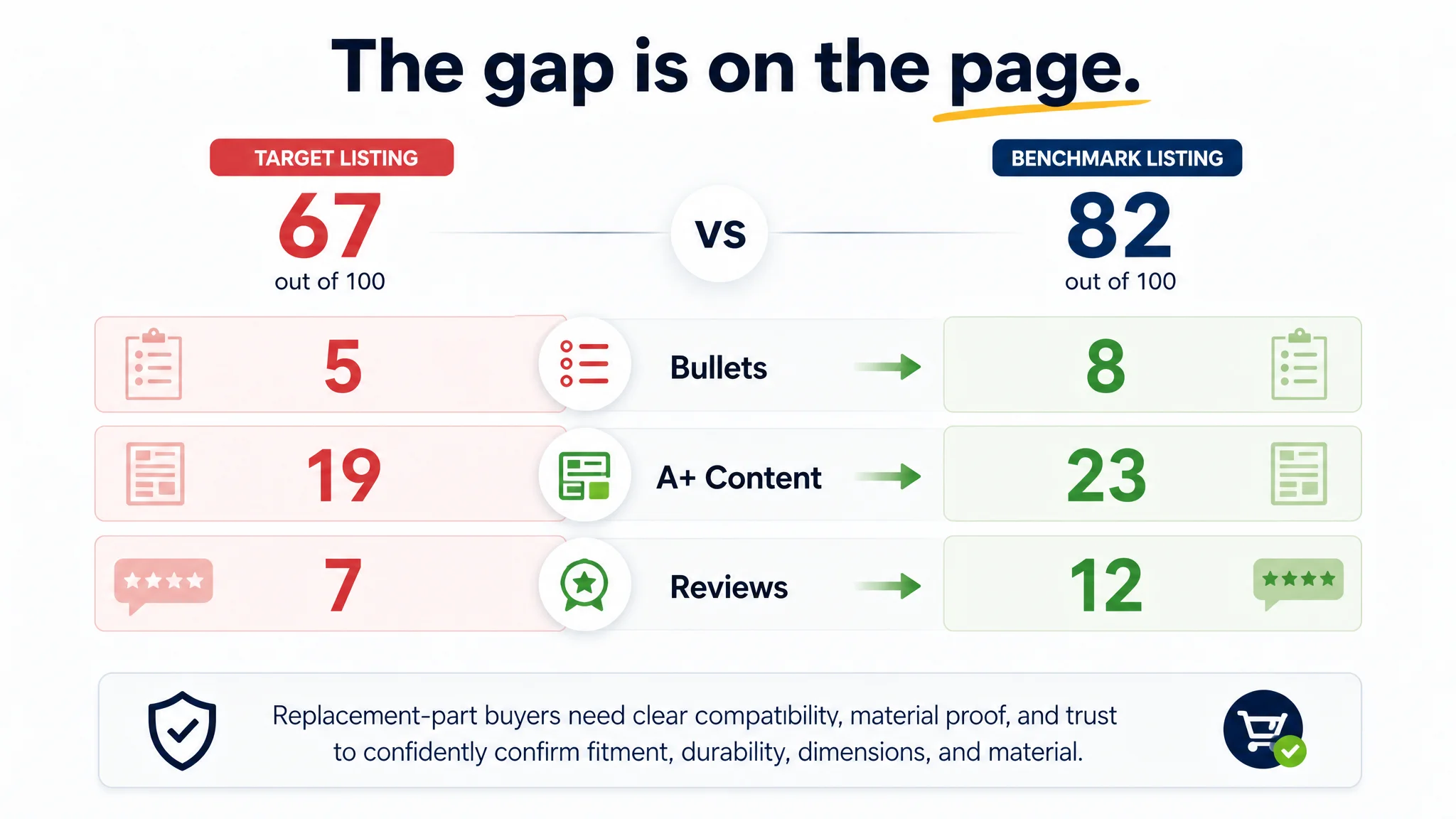
A full Listing diagnosis produced a different explanation. The target Listing scored 67 out of 100 against a strong benchmark Listing that scored 82. The largest gaps were in bullet points, A+ content, and review trust. The page was receiving paid traffic, but it was not giving shoppers enough compatibility information, material proof, or confidence to complete the purchase. In this situation, more aggressive bidding would have sent more visitors to a page with limited conversion capacity.
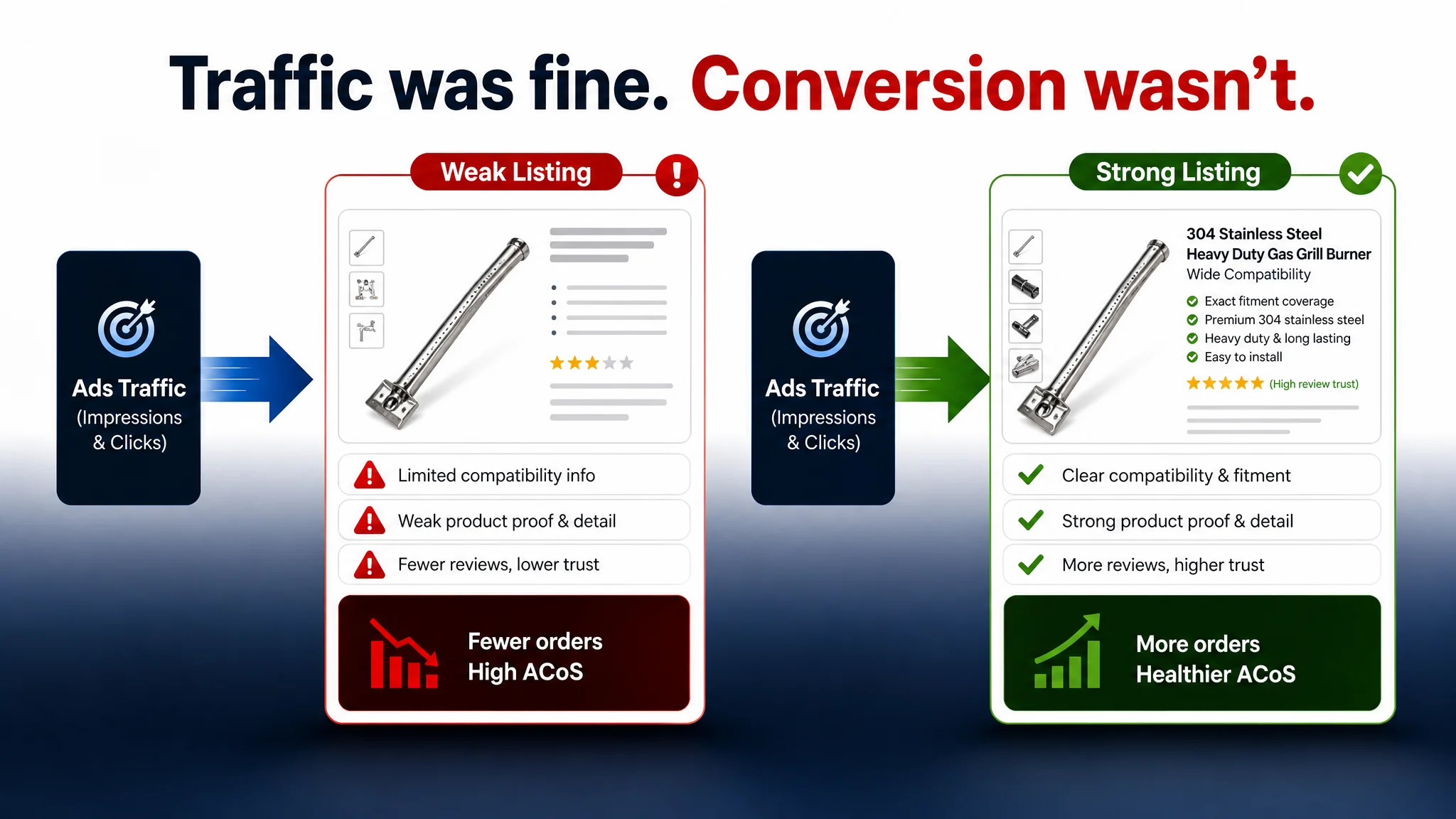
AI-powered bidding optimization offers a faster, more disciplined alternative, but it works best when advertising data is interpreted together with Listing performance. By processing impressions, clicks, CTR, CVR, conversions, ACoS, and TACoS together, an intelligent system can distinguish scalable traffic from costly activity and determine whether the primary constraint is traffic quality, bid efficiency, or page conversion. Rather than relying on isolated judgments, sellers gain a feedback loop: data informs the decision, the change is implemented, and subsequent results guide the next action.
The immediate priority is to establish that loop before the seasonal bidding window closes. Each delayed adjustment consumes budget, learning time, and potential ranking momentum. At the same time, sellers should verify that the Listing is strong enough to absorb additional traffic before treating higher bids as the default solution.
What Makes a Winning Bidding Strategy (and Why Manual Fails)
A successful Amazon bidding strategy is not a single bid applied across an entire campaign. It requires keyword-level control: high-value terms may justify aggressive bids, while weak or low-converting terms require limits or exclusion. Search-term isolation is equally important. Separating proven converting queries from discovery traffic makes it easier to protect ACoS, identify long-tail opportunities, and direct budget toward terms with stronger CVR.
Timing adds another layer of control. With dayparting, bids can increase during hours when conversion rates and revenue justify greater visibility, then decrease when clicks consume budget without generating sufficient sales. Dynamic adjustment should respond to changes in impressions, CTR, CVR, spend, and sales rather than wait for a weekly spreadsheet review.
Yet bid-level control cannot compensate for a page that fails to convert relevant visitors. The gas grill burner account demonstrated why this distinction matters. The team’s initial reasoning was straightforward: ACoS was too high, ACoS was an advertising metric, and therefore the problem had to be inside the ads. They added keywords, tested match types, and adjusted bids to pursue stronger placements.
The diagnostic comparison showed that the problem was broader. The target Listing was weaker than the direct benchmark across several dimensions:
- Overall Listing score: 67 versus 82
- Bullet points: 5 versus 8
- Detail and A+ content: 19 versus 23
- Reviews: 7 versus 12
- Main images: 24 versus 26
The gap was especially important in a replacement-part category, where shoppers need to confirm fitment, durability, dimensions, and material before purchasing. The ads could bring visitors to the page, but the page did not fully answer those questions. This meant that the account required both advertising discipline and Listing diagnosis—not another round of isolated bid changes.
Manual management struggles to keep pace with this operating tempo:
- Delayed reactions allow inefficient bids to continue spending after performance shifts.
- Limited review time causes sellers to miss profitable long-tail search terms.
- Broad campaign oversight creates budget leakage when weak queries compete with proven terms.
- Spreadsheets make data aggregation possible, but not continuous decision-making across thousands of keyword and time-based combinations.
- Simple rule-based automations break down when campaigns have different margins, conversion patterns, match types, and seasonal behavior.
- Manual bid adjustments can distract teams from a more fundamental question: whether the product page is capable of converting the traffic being purchased.
The practical answer is a dedicated Amazon PPC tool built to process substantial ad spend and support many sellers without relying on unverifiable scale claims. The right system should make granular, auditable adjustments at the campaign, keyword, search-term, and time-of-day levels. It should also help sellers connect advertising performance with Listing quality so that inefficient traffic is not confused with weak conversion capacity.
This replaces intuition and static rules with faster decisions aimed at improving ACoS while protecting profitable growth. In some accounts, the correct decision may be to raise a bid on a proven term. In others, it may be to repair the Listing before scaling the campaign.
DeepBI's Next-Gen Ad Automation Tool - Your Bidding Copilot
Manual bidding breaks down when dozens of campaigns, targets, budgets, and hourly signals require attention simultaneously. Repeated checks can delay bid changes, overspend on weak traffic, or miss opportunities where strong CTR and CVR justify greater visibility. DeepBI’s Ads automation addresses this gap by turning advertising data into a continuous decision workflow rather than a sequence of manual interventions.
Its four-layer traffic funnel—explore, filter, refine, and scale up—forms part of the Ads capability:
- Explore: test traffic opportunities and collect performance signals.
- Filter: separate inefficient clicks and targets from promising ones using advertising data.
- Refine: adjust bids and budgets around conversion quality and ACoS performance.
- Scale up: direct more budget toward validated opportunities while protecting efficiency.
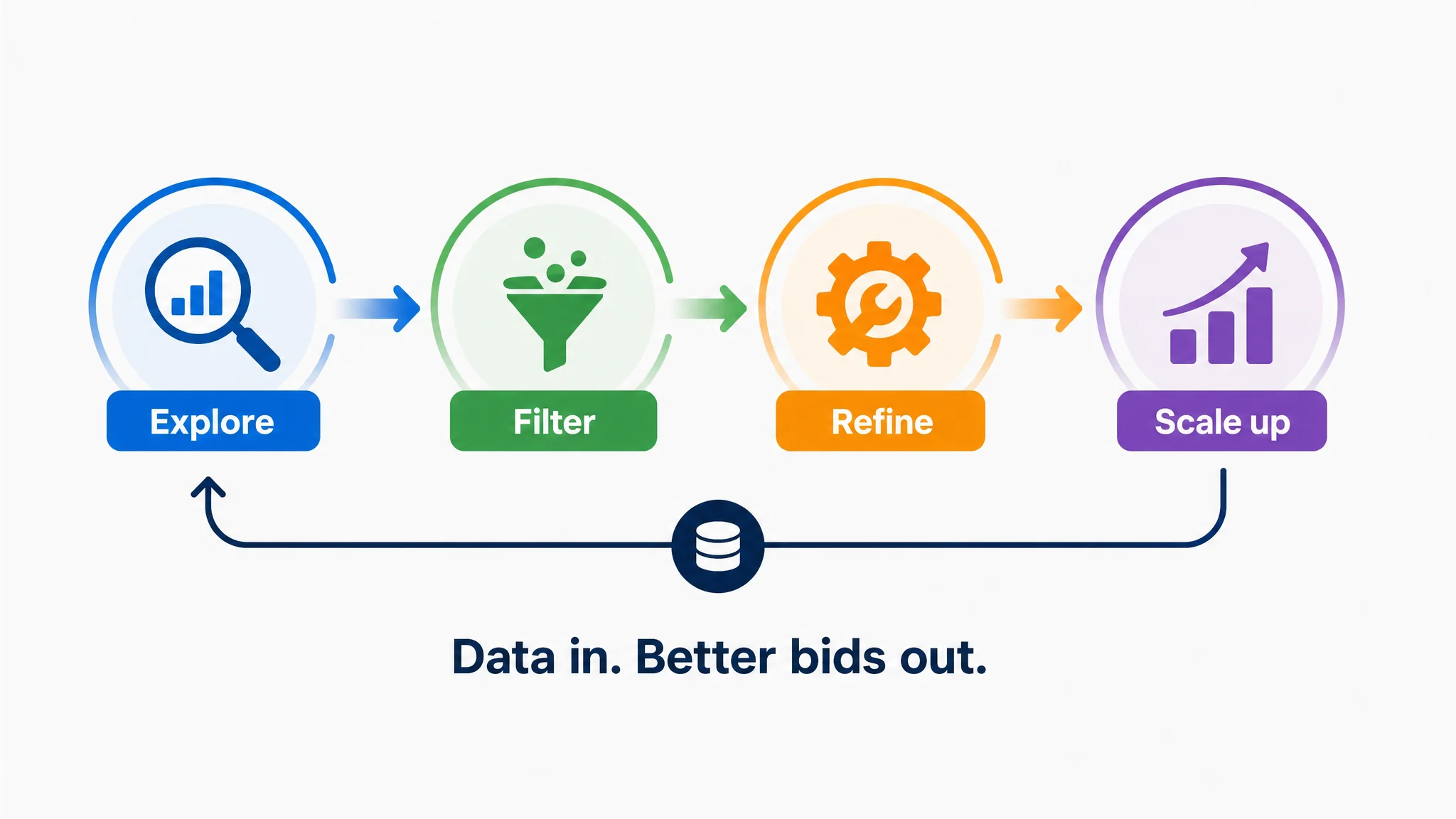
Using seven-day rolling performance data, the system can adjust daily bids and budgets as recent CTR, CVR, spend, sales, and ACoS signals change. Automated monitoring replaces repetitive campaign checks, allowing sellers to focus on strategy, inventory, and creative decisions. It can also manage the thousands of small timing decisions that one person cannot consistently make manually.
The value of this workflow becomes clearer when advertising data is used to challenge an initial diagnosis. In the gas grill burner account, the team was already looking inside the ads console for a solution. DeepBI instead compared the Listing with a strong competitor in the same subcategory and found that the page was materially weaker in the areas most likely to influence conversion: compatibility clarity, bullet-point logic, A+ detail, and review trust.
That did not make bid optimization irrelevant. It changed its sequence. The first priority was to improve the value of each paid click by rebuilding the page’s sales logic. Once the Listing has stronger evidence of fit, durability, and usability, bid changes can be evaluated against a more reliable conversion foundation. Automation is therefore most useful when it manages bidding within a broader diagnostic framework rather than treating every high ACoS problem as a bidding problem.
At-a-glance result snapshot
- Time saved: User-reported patterns indicate that sellers may reclaim more than ten hours per week, depending on account complexity and workflow.
- Advertising efficiency: An illustrative ACoS movement from 30% to 25% represents a five-percentage-point improvement—not a universal promise, but the type of gain better-timed bid decisions are designed to pursue.
- Growth support: Strong advertising signals can feed subsequent optimization, helping connect paid performance with stronger organic-ranking potential and lower TACoS.
- Decision quality: When advertising signals are reviewed alongside Listing scores and conversion gaps, sellers can avoid scaling traffic into pages that are not yet ready to convert it.
Accurate Sales Data Analysis & Profit Predictions - The Fuel Behind Every Bid
A bid can be mathematically efficient yet commercially unsound. If the system sees clicks, orders, or ROAS without accounting for Amazon fees, product costs, and contribution economics, it may increase spend on products that generate revenue but weaken profit. Accurate sales analytics are therefore indispensable to bid decisions: every optimization is limited by the quality of the data it receives.
DeepBI’s Ads Quant analytics layer is designed to consolidate sales, advertising performance, fees, and costs in a live dashboard. Rather than evaluating a keyword through ROAS alone, sellers can assess the broader relationship among impressions, clicks, CTR, CVR, orders, ACoS, TACoS, fees, and product economics. These signals can also be cross-validated against actual business performance instead of being treated as isolated advertising metrics.
The gas grill burner example also shows why conversion data needs context. The account had traffic entering the Listing, but orders lagged behind that traffic. Looking only at advertising activity could lead the team to conclude that bids or keyword coverage were insufficient. Looking at the page and benchmark comparison revealed another possibility: the traffic was being sent to a Listing with weaker compatibility communication, less visual material proof, less structured sizing information, and a weaker review profile.
That distinction matters because a low CVR can originate from different problems. Irrelevant traffic may require changes to targeting or bids. Relevant traffic that reaches a page without enough fitment or trust information may require Listing improvements. Without separating these situations, sellers may continue paying for more traffic while the underlying conversion constraint remains in place.
ROAS-based bidding becomes risky when profitability context is absent. A product may show attractive revenue efficiency while fees, fulfillment expenses, or underlying costs leave little room for additional ad spend. Accurate profit forecasts can support more disciplined decisions, including limiting aggressive bids on lower-margin products and prioritizing spend where the expected economics are stronger.
This analysis and prediction process should operate as a dedicated DeepBI workflow within Ads Quant, using authorized business data and reliable upstream inputs. Comparing forecast outcomes with actual CTR, CVR, orders, and ACoS enables sellers to refine bidding decisions based on evidence. Data-backed bidding may improve ROI and reduce wasted spend, but results depend on data completeness, cost accuracy, and continued validation.
AI-Powered Listings - Making Every Bid Count
An efficient bid can win relevant impressions at a controlled cost, but the Listing determines whether that traffic becomes profitable revenue. If the main image fails to attract attention, or the title, bullets, and A+ content do not answer shoppers’ questions, even a well-optimized bid can pay for clicks that generate few orders. Low CVR then drives effective ACoS higher because advertising spend is not supported by enough attributed sales.
The gas grill burner Listing illustrated this constraint clearly. The target page was not completely broken: its title and main images were relatively close to the benchmark. However, the page was meaningfully weaker in bullet points, A+ content, and reviews. The Listing did not communicate compatibility and product value with the same clarity as the stronger competitor. For a replacement part, where buyers are concerned about fitment, safety, durability, and installation risk, those gaps can directly reduce the likelihood of conversion.
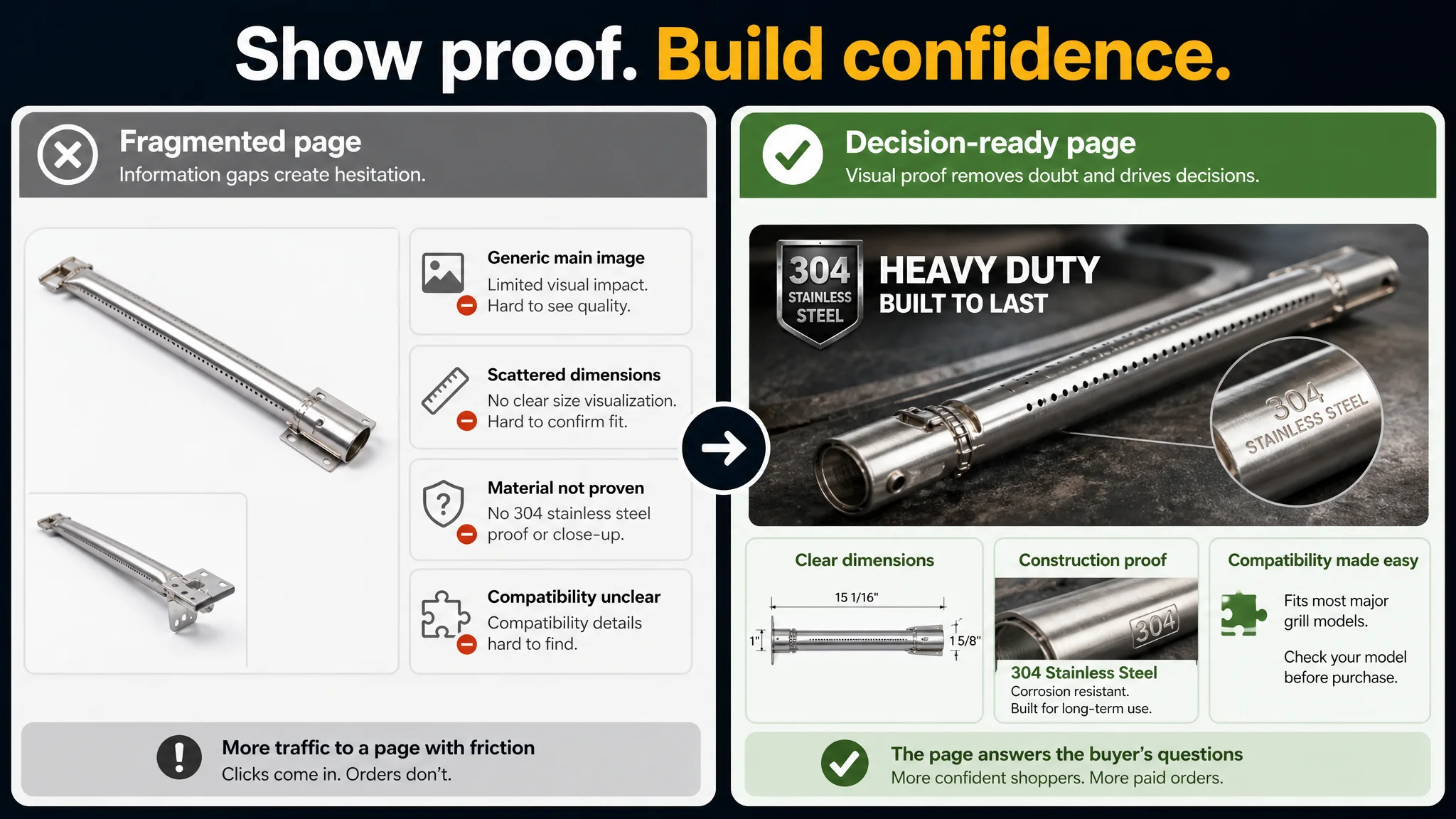
The page also lacked sufficient visual proof of its main selling points. The product was described as 304 stainless steel and heavy duty, but shoppers had limited visual evidence of the material, construction, dimensions, and compatibility. Some information was fragmented rather than arranged as a clear decision path from product attributes to fitment and use case. This is the difference between a page that displays product information and one that helps a shopper make a decision.
DeepBI’s AI-powered Listing optimization tool complements the Ads strategy by connecting funnel performance with page quality. Its diagnostic engine scores the main image, title, five bullet points, A+ content, and customer feedback, then compares weaknesses against a similarity-constrained benchmark. Sellers can review impressions, clicks, orders, CTR, and CVR alongside these scores to determine whether the issue is poor traffic relevance or weak traffic conversion.
Before-and-after patterns are indicative rather than guaranteed outcomes. For example, CTR below 0.35% combined with a weak main-image score can signal a missing visual hook and support a recommendation to restructure the image. CVR below 7%, paired with weaker A+ or review dimensions, can indicate that the page is not effectively converting paid traffic. Greater relevance may lift both CTR and CVR, while higher CVR can lower effective ACoS by generating more sales from paid clicks. However, a lower CTR is not automatically beneficial: removing irrelevant clicks creates value only when CVR, sales, and wasted spend improve together.
The Listing diagnosis for the grill burner suggested several specific directions:
- Reframe the title around “Gas Grill Burner Replacement,” “Heavy Duty,” and “304 Stainless Steel,” while expanding relevant compatibility coverage.
- Use the image stack to prove dimensions, material quality, construction details, and brand compatibility rather than relying on text alone.
- Rewrite the bullet points around a decision sequence: compatibility, dual-fuel and airflow function, material durability, precise fit, included hardware, and support.
- Restructure A+ content around material proof, compatibility, performance, technical specifications, and real grilling use cases.
- Treat reviews as an important trust dimension rather than assuming that copy and images alone can compensate for a weak review profile.
The review comparison was also meaningful. The target Listing had 4.3 stars and four total reviews, while the benchmark had 4.6 stars and 18 reviews, including image or video content. The target Listing also contained fitment-related concerns that could create hesitation even when they were not associated with the lowest ratings. DeepBI did not treat reviews as something that could be corrected immediately. Instead, the diagnosis showed why stronger visual proof and clearer compatibility information were necessary while review trust developed over time.
After reviewing old and new assets, sellers can use one-click SP-API synchronization to apply approved listing updates, reducing listing cycle time without uncontrolled replacement. The objective is not to optimize the page in isolation. It is to increase the value of every relevant impression and click before further advertising scale is applied.
Product Research - Choosing Winners Before Bidding
Bid optimization cannot rescue a product with weak demand, poor market fit, or limited conversion potential. If the Listing attracts clicks but fails to convert, CVR falls, ACoS rises, and each additional bid dollar becomes harder to justify. Product selection is therefore the first profitability decision in the advertising process, not a separate research exercise.
The replacement-part example adds another layer to this principle. Even within a narrow subcategory, products compete not only on basic function but also on compatibility coverage, material claims, dimensions, installation confidence, and review trust. The benchmark Listing performed better because it made those buying factors easier to evaluate. A seller may target relevant grill-related keywords, but if the page does not clearly show whether the part fits a shopper’s grill, traffic alone cannot resolve the uncertainty.
DeepBI treats this stage as an automated market health-check system rather than a simple scoring tool. It can trace a product to its narrow leaf category and identify leading products with strong sales and conversion signals, giving sellers a data-backed starting point for BSR and competitive research. It also filters potential benchmarks by product form, function, use case, price band, audience, and review validation, reducing the risk of planning bids around an unrelated bestseller.
Keyword exploration adds a second qualification layer. DeepBI can extract core search terms from Listing titles and bullet points, simulate buyer searches, and identify relevant demand signals before campaigns launch. These terms can guide initial target selection and help connect keyword relevance with expected CTR and CVR.
For the gas grill burner Listing, the title comparison showed why keyword selection should be connected to the way buyers evaluate the product. The benchmark front-loaded “304 Heavy Duty Cast Stainless Steel” and used a broader compatibility structure. The target title included a useful size detail but relied more heavily on the generic phrase “Stainless Steel Burner” and listed fewer compatible brands. The issue was not simply a lack of keywords. It was that the title did not fully combine the most important search and decision signals: replacement intent, material, durability, size, and compatibility.
Competitor reverse-engineering strengthens the bidding plan by revealing keyword structures, selling-point priorities, and commercial positioning among comparable products. DeepBI can also surface high-conversion search-term signals to inform product-attribute weighting and advertising-to-Listing decisions.
The objective is not to declare a guaranteed winner. It is to prioritize products and targets supported by stronger evidence of demand, credible conversion potential, and a price position worth validating—giving each bid a better chance to support profitable ACoS and organic growth.
The Organic Payoff - How Smart Bidding Fuels Natural Ranking
Smart bidding should not be evaluated solely by immediate ACoS. Disciplined advertising can create a longer-term growth loop by consistently directing relevant traffic to high-value keywords and converting that traffic efficiently.
Top-of-Search campaigns are particularly useful for prioritizing strategic keywords with strong commercial intent. When the Listing matches the query, CTR and CVR provide evidence that the product is relevant to shoppers. Sustained paid conversions may then support stronger organic placement for those terms, although no ranking increase or fixed timeline should be assumed. Organic momentum depends on the combined effects of ad relevance, Listing quality, conversion performance, and ongoing market feedback.
The gas grill burner diagnosis shows why Listing quality must be part of this loop. Before the page was restructured, additional advertising could have increased the number of visitors without resolving the page’s compatibility and trust gaps. The title, images, bullets, A+ content, and reviews needed to work together before paid traffic could reliably contribute to stronger conversion signals.
This is the fifth-layer funnel in DeepBI’s Organic Traffic module, built on Ads data rather than operating independently of campaign performance. DeepBI can use signals such as impressions, clicks, conversions, CTR, CVR, ACoS, and TACoS to identify winning terms and guide Listing titles, images, and other visual assets. Greater relevance and stronger conversion can make future traffic less dependent on paid placement.
The economic pattern is straightforward: before optimization, paid campaigns may generate most sales volume, keeping TACoS elevated. Once relevant keywords, Listing content, and bidding decisions are aligned, organic sales may contribute a larger share while paid sales remain stable or become less necessary. TACoS can then trend lower, improving contribution margin and freeing budget for scalable growth.
In the burner example, the recommended order was to repair the Listing’s sales logic first and then re-accelerate advertising when CTR and CVR showed signs of recovery. This does not guarantee organic improvement, but it creates a stronger foundation: paid traffic is directed to a page that is better prepared to convert, and the same improvements can benefit unpaid visitors as well.
Implementation Roadmap - From Setup to Scale
The fastest route to better ACoS and sustainable growth is not to delegate every decision to automation. Sellers should define the commercial direction, while DeepBI manages repetitive, data-intensive bidding work under human oversight.
- Step one: Connect the Amazon account. Authorize the account through Amazon’s official Selling Partner API (SP-API). This creates a standardized operating foundation and avoids the account-linkage risks associated with repeated manual backend access. Confirm that the required authorization and product inputs are accurate before optimization begins.
- Step two: Configure profit and campaign goals. Set the business priorities that should guide execution, such as target profitability, acceptable ACoS, campaign objectives, and growth priorities. These targets give the system a clear decision framework instead of allowing bids to change without commercial context.
- Step three: Diagnose the Listing before scaling traffic. Review the relationship between impressions, clicks, CTR, CVR, and ACoS alongside the title, images, bullets, A+ content, and reviews. The gas grill burner account shows why this step matters: the initial assumption was that ads needed more tuning, but the benchmark comparison identified a 15-point Listing score gap and weaker conversion logic. Sellers should determine whether the page can answer the main questions behind the target search terms before increasing spend.
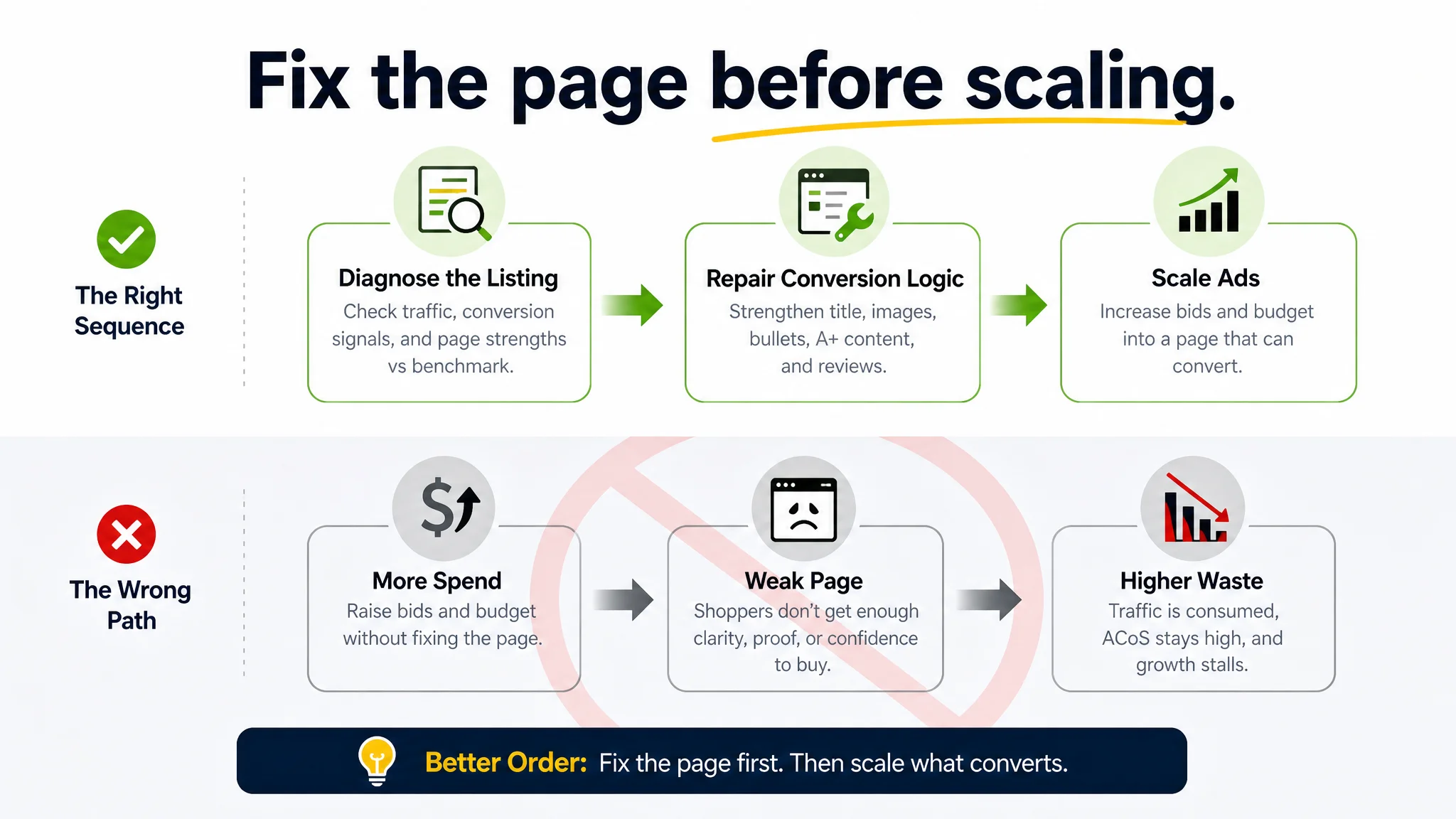
- Step four: Let DeepBI run the bidding framework. DeepBI can evaluate current advertising signals, identify performance issues, and apply approved optimization actions through the SP-API. The workflow moves from quantitative diagnosis to execution and feedback, using metrics such as impressions, clicks, CTR, CVR, and ACoS to inform subsequent decisions. The seller remains responsible for strategic direction and approval.
- Step five: Review insights and refine priorities. Examine the resulting performance, including ACoS, conversion efficiency, and potential effects on organic ranking and BSR. Use those insights to adjust profit thresholds, campaign priorities, or optimization direction. If traffic is present but CVR remains weak, revisit the Listing rather than automatically increasing bids.
Improvement depends on data quality, feedback, and ongoing review. Some sellers may see significant improvement within the first two billing cycles, but no fixed timeline should be assumed. The durable model is collaborative: the seller sets the targets, and DeepBI executes and optimizes within those boundaries.
Conclusion - The New Standard for Amazon Bidding
Seasonal bidding pressure leaves little room for delayed decisions. As competition intensifies before Prime Day, manual bid adjustments can consume valuable hours while weakening visibility, ACoS control, and the connection between advertising performance and organic growth. The practical response is not simply to bid more, but to establish a faster, data-driven feedback loop.
The most important diagnostic question is not always “How can we reduce the bid?” It may be “Does this Listing deserve more traffic yet?” In the gas grill burner account, the team initially associated high ACoS and slow order growth with keywords, bids, and campaign structure. A comparison with a strong competitor showed that the more immediate constraint was Listing conversion capacity. The target page scored 67 versus 82, with notable gaps in bullet points, A+ content, and reviews. More traffic could have amplified those weaknesses instead of solving them.
DeepBI is designed specifically for Amazon sellers, combining automated bid management with advertising analytics, Listing optimization, and ongoing performance feedback. By connecting impressions, clicks, conversions, CTR, CVR, ACoS, TACoS, and Listing signals, it helps turn campaign data into clearer optimization actions. Listing improvements can support stronger conversion performance and organic ranking, while feedback from published changes informs the next round of decisions.
Across this model, the operating pattern is clear: better-controlled bidding can support lower ACoS and higher ROI, while coordinated Listing and advertising optimization can contribute to improved TACoS, stronger BSR, and more time for strategic work. These are operating objectives, not guaranteed outcomes, but they offer a more sustainable path than disconnected manual adjustments.
The emerging standard for Amazon bidding is intelligent automation paired with accountable growth. Advertising should bring relevant shoppers to the page, while the Listing must provide the evidence and confidence required to convert them. When the page is not ready, the correct optimization may be to repair its title, images, bullets, A+ content, or trust signals before increasing spend.
Adopting that system before the seasonal bidding window closes can establish a foundation for more profitable Amazon growth through automated optimization—one that treats every bid not as an isolated expense, but as part of a connected traffic, conversion, and organic-growth process.