

Why Organic Traffic on Amazon Matters Now
Amazon is no longer only a place where shoppers complete purchases; it is increasingly where they begin product discovery. As the A9 ranking system continues to evolve, sellers must treat organic visibility as a strategic asset rather than a passive result of running ads. NIQ reports that more than 60% of consumers choose Amazon over Google when searching for products, placing Amazon search performance close to the center of demand capture.
Visibility is especially valuable because ranking can compound. A listing that earns qualified impressions, strong CTR, and consistent CVR generates better behavioral signals, which can support stronger BSR and broader organic reach over time. Paid traffic can create exposure quickly, but organic ranking can continue delivering product-page visits without requiring every click to be purchased. The objective is not to eliminate advertising; it is to use advertising and listing improvements to build a healthier balance between paid and unpaid traffic while protecting ACoS.
Amazon SEO also differs fundamentally from Google SEO. Google serves broader intent, including research, comparison, and informational queries. Amazon SEO is transactional and conversion-centric: keywords must align with shopping intent, while titles, bullet points, images, A+ content, CTR, and CVR must work together to remove purchase friction. Main images and A+ pages are therefore commercial conversion assets, not merely visual decoration.
A thermal shipping-label printer listing illustrates why this distinction matters. The product had a technically strong title, clear bullet points, a 4.5-star rating, and an overall Listing score of 74/100. The team initially assumed that the main weakness was traffic because orders lagged behind impressions and ACOS was difficult to control. However, a competitive diagnosis showed that the largest gaps were in the main image and A+ content, not in the basic textual foundation. The page described the product, but it did not clearly prove that the printer could produce reliable 4x6 labels, work across the buyer’s platforms and devices, or be set up without unnecessary friction.
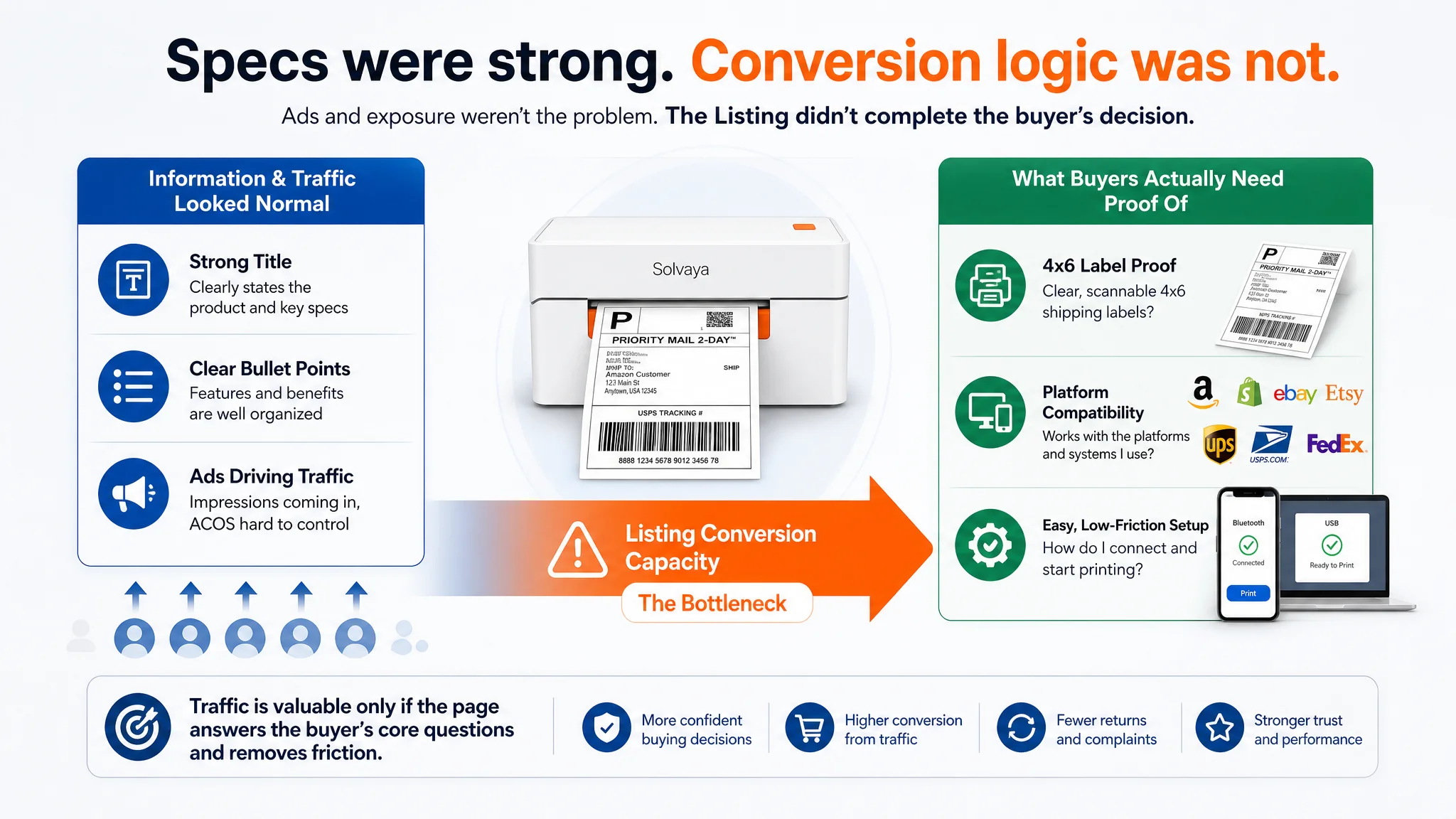
The cost of weak visibility is substantial. The supplied claim that 80% of purchases come from top-10 results illustrates the problem: a product buried beyond the first page may lose demand before shoppers ever evaluate its offer. Organic growth begins by earning that visibility and then converting it efficiently. A page that receives traffic but leaves core buying questions unanswered may also lose the opportunity to build the conversion and sales signals needed for stronger organic performance.
Amazon Product Page Setup: The Foundation of Organic Visibility
Organic search traffic depends on more than inserting keywords. Before analyzing search terms or increasing advertising, establish a clean product-page structure that Amazon can interpret consistently. Configure the category node, title, brand, and manufacturer part number with exact, product-supported information. The category node deserves particular attention: use Amazon’s Browse Tree Guide to select the most accurate browse path and, where applicable, the correct bottom-level leaf node.
Accurate initial setup helps reduce avoidable indexing and categorization problems. A mismatched node can place a product in an irrelevant shopping context, while inconsistent brand or manufacturer information can create catalog ambiguity. Titles should present the product identity and primary value clearly, using relevant terms without adding unsupported claims. These are widely observed best practices, not guaranteed algorithmic rewards, but they create a more reliable foundation for relevance, CTR, CVR, and BSR development under A9.
Treat the page structure as an operating system rather than a one-time form. As keyword data, impressions, clicks, orders, CTR, and CVR reveal new search behavior, review the title, node alignment, and supporting fields while keeping every change grounded in confirmed product attributes.
However, a technically correct structure does not automatically create a persuasive product page. In the label-printer example, the title and bullet points performed better than those of the benchmark competitor. The title clearly identified the product type, included 4x6 label use, and communicated features such as wireless connectivity, printing speed, resolution, and system compatibility. The bullets also connected speed, flexibility, and ink-free operation to user benefits. Yet the listing still underperformed against a benchmark with an overall score of 85/100.
The diagnosis was not that the page lacked information. It was that the information was not organized around the buyer’s decision. A technically accurate title can establish relevance, but the images and A+ content must still answer questions such as:
- Will this print a clear, scannable 4x6 shipping label?
- Does it work with the platforms and devices I already use?
- How does setup work?
- What happens if I use a Mac?
- Is this a dependable tool for my daily workflow?
Before editing, DeepBI’s AI benchmark diagnostics can compare the initial listing with a closely matched top-ranking competitor. Its quantified review of core listing dimensions helps expose structural gaps in the title, images, bullets, detail content, and reviews, giving sellers a prioritized starting point for optimization rather than relying on guesswork.
Create a Keyword Ranking Plan
Organic search growth starts with a keyword map, not a list of terms inserted wherever space is available. Use Brand Analytics, search query reports, and the Search Query Performance dashboard to identify queries with meaningful impressions, clicks, conversions, and sales. Prioritize opportunities where traffic quality and commercial results align, rather than selecting keywords solely because search volume appears large.
Amazon ranking is evaluated at the individual-keyword level, not as a single global visibility score. A product may rank strongly for one query and remain nearly invisible for another. Keyword-specific sales velocity is widely considered a major ranking factor, alongside relevance, CTR, CVR, and listing quality. Treat any hierarchy among these factors as a likely pattern based on seller experience and Amazon’s known priorities—not as an officially confirmed ranking order.
Organize targets into three groups:
- Core keywords: Primary demand terms that define the product and belong in strategically important listing fields.
- Long-tail keywords: More specific phrases that reflect clearer purchase intent and can support focused content and advertising.
- Competitor ASIN targets: Relevant ASINs selected for product-level research, limited to comparable functions, price bands, use cases, and audiences.
Keyword targeting alone cannot repair weak commercial performance. If impressions produce few clicks, adding more terms may increase indexing without improving traffic quality. The label-printer listing shows the opposite side of the same problem: the title and bullets already captured the product category and several important specifications, but the page still struggled to convert the traffic it received.
The team initially responded by considering more campaign adjustments, keyword coverage, bids, and negations. The competitive audit showed that the more important questions were visual and structural. The page needed to make the primary use case clearer: real 4x6 labels, readable barcodes, platform compatibility, connection paths, and setup guidance. This distinction matters because a keyword can attract a relevant shopper without giving that shopper enough confidence to purchase.
Image optimization, for example, has been associated with a 47% CTR improvement in the provided evidence. Track keyword-level CTR, CVR, ACoS, sales velocity, and BSR after each listing or visual change, then reallocate effort toward the opportunities producing measurable movement. If a keyword produces impressions but weak clicks, investigate the main image and offer presentation. If it produces clicks but weak orders, investigate whether the page is completing the buyer’s decision.
Refine Your Product Page Listing for Higher Conversions
Relevant keywords can attract shoppers, but ranking growth depends on what happens after the click. Build the title, bullet points, and description around high-priority search terms without keyword stuffing. Pair each term with a clear customer benefit, product differentiator, and factual support. A strong bullet, for example, connects a category concern to the product’s solution and the evidence that supports it. This approach serves both Amazon search relevance and shopper readability, giving traffic a stronger path to conversion and sales velocity.
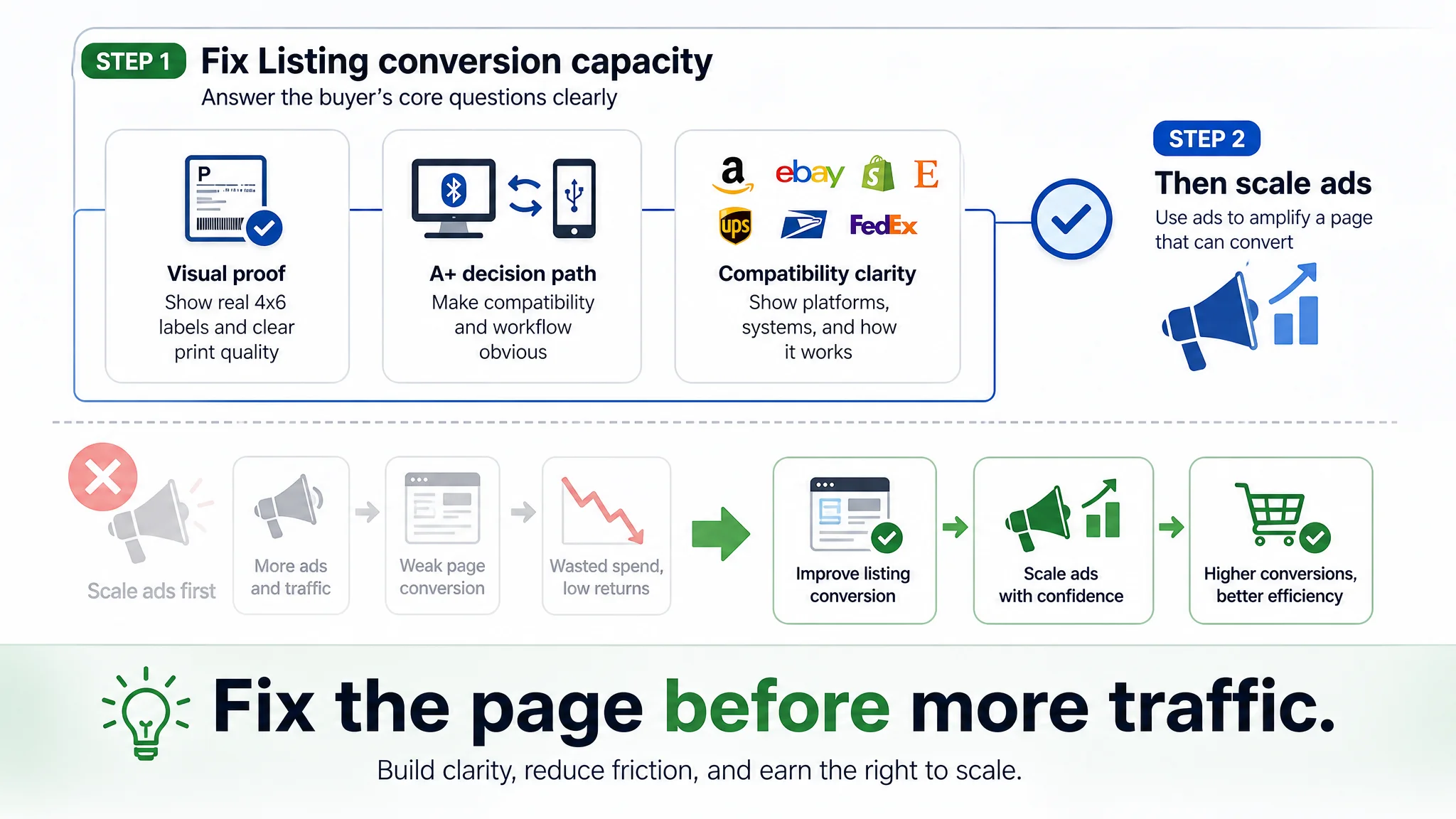
A useful way to test a listing is to separate information presence from decision usefulness. A page may mention Bluetooth, USB, speed, resolution, and compatibility, but still leave the shopper unsure how those features apply to a real task. For the label printer, the original bullets were not fundamentally weak. The recommended refinements were to make platform names explicit, translate speed into a human operating benefit, connect 203 dpi to scan reliability, and clarify label widths and supported formats.
This changes a bullet from a specification statement into a buying argument. Instead of simply saying that a printer operates at a certain speed, the page can explain how that speed supports a high-volume shipping workflow. Instead of listing 203 dpi, it can connect the resolution to readable barcodes and delivery accuracy. Instead of saying “widely compatible,” it can clarify the relevant ecommerce platforms, operating systems, and connection methods.
The image stack should reinforce the same promise. Evaluate the main image and secondary images for visual hooks, information density, composition, use-case coverage, size or feature diagrams, and image-type variety. In the reported 3D kitchen scissors case study, image improvements produced a 47% increase in CTR and a 19% rise in CVR. Results will vary by product and market, but the mechanism is practical: stronger images can earn more clicks, clarify value faster, and reduce uncertainty before purchase.
The label-printer diagnosis makes the mechanism more concrete. The original main image displayed the product, phone, manual, adapter, and accessories, but it did not clearly show the buyer’s desired outcome: a crisp 4x6 shipping label with a barcode, address, and readable details. The benchmark image was simpler, yet more persuasive because it immediately showed what the product was designed to produce.
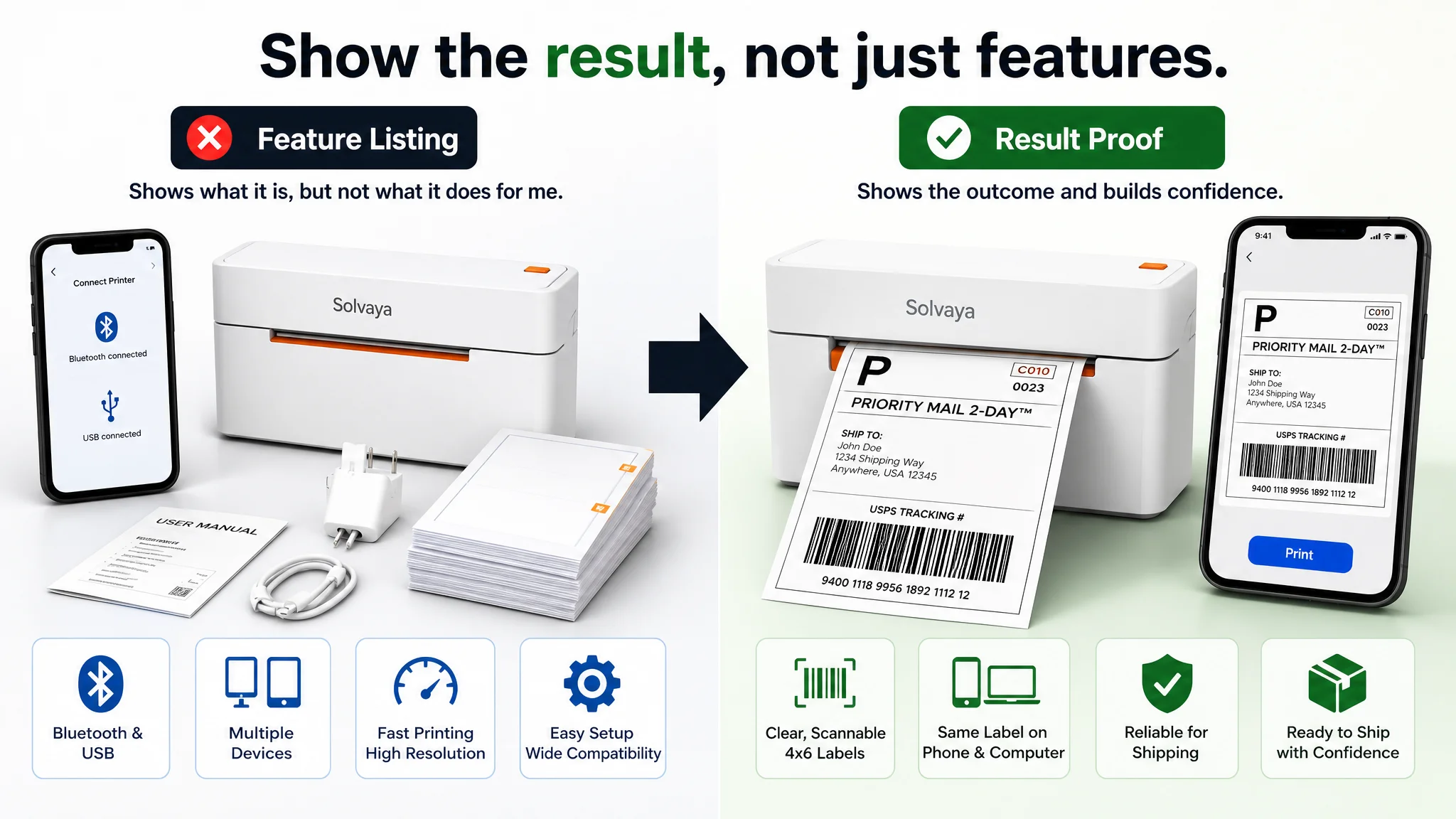
That difference explains why a feature collage can underperform a focused product demonstration. “Bluetooth,” “USB,” and “wireless” describe the device. A clearly printed 4x6 carrier label demonstrates the result. For a buyer comparing several products on the same search-results page, the second type of evidence may carry more decision value.
A+ Content and the brand story can extend that explanation through comparison tables, credible proof, use-case detail, and brand context. These elements may encourage deeper page engagement and help reduce bounce, but they should be treated as optimization goals rather than guaranteed outcomes.
In the label-printer case, the A+ modules contained product photos, feature explanations, accessories, and usage scenes, but they did not build a complete decision path. The benchmark used its A+ content to answer practical questions in sequence:
- Which ecommerce and shipping platforms are supported?
- How fast and clearly does the product print?
- Which systems connect through Bluetooth or USB?
- What label sizes and use cases are supported?
- How does the app workflow operate?
- What should a Mac user do if a security prompt appears?
This type of content does more than add information. It reduces perceived risk. It tells the buyer what will happen before, during, and after setup. It also helps compensate for a review-volume gap: the seller had 34 reviews compared with approximately 5,500 for the benchmark, despite a slightly higher star rating. In that situation, professional compatibility visuals, transparent setup guidance, and concrete performance proof become especially important trust signals.
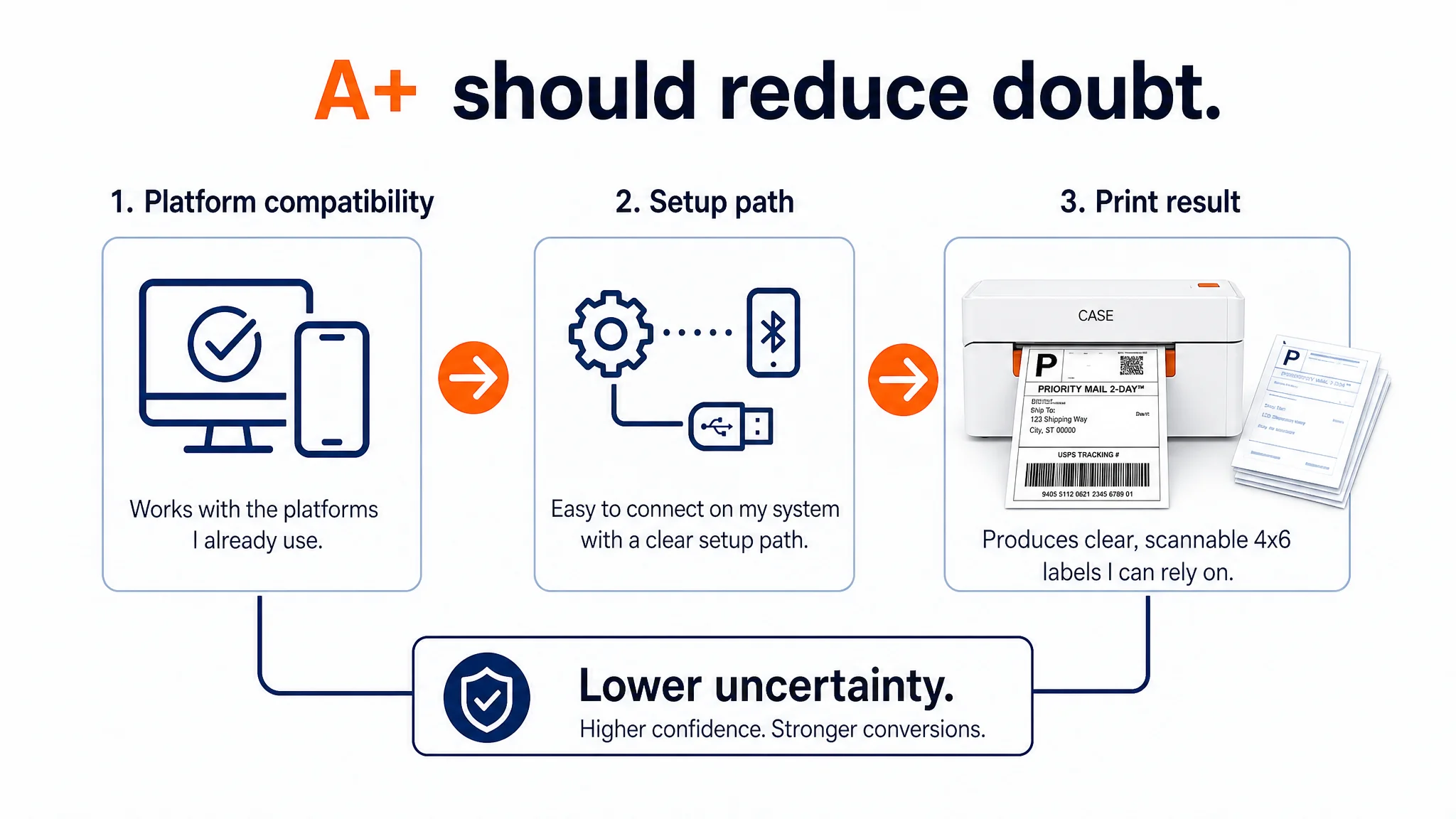
DeepBI supports this workflow by benchmarking competitor patterns, generating multiple image and A+ Content versions, and evaluating candidates for predicted CTR, information density, compliance, and product consistency. Its Product DNA constraint prevents creative assets from changing the product’s material, color, logo, or design. Approved updates can then be deployed through Amazon SP-API, shortening listing cycle time and creating a clearer link between visual changes and subsequent CTR or CVR data.
Generate Traffic and Reviews to Boost Rankings
Amazon organic growth is not built on listing relevance alone. Demand generated outside Amazon can bring qualified shoppers to a product detail page, create additional sales, and contribute to stronger organic signals when those customers convert and remain satisfied. Social media content, influencer referrals, and relevant external links are practical sources of off-Amazon traffic, but they should be evaluated through CTR, CVR, ACoS, and BSR rather than traffic volume alone.
Some Amazon experts believe external sales may receive additional ranking weight. Amazon has not publicly confirmed a universal weighting rule, so treat this as a working hypothesis—not a guaranteed growth lever. Track the source, conversion quality, repeat demand, and resulting BSR movement before increasing investment.
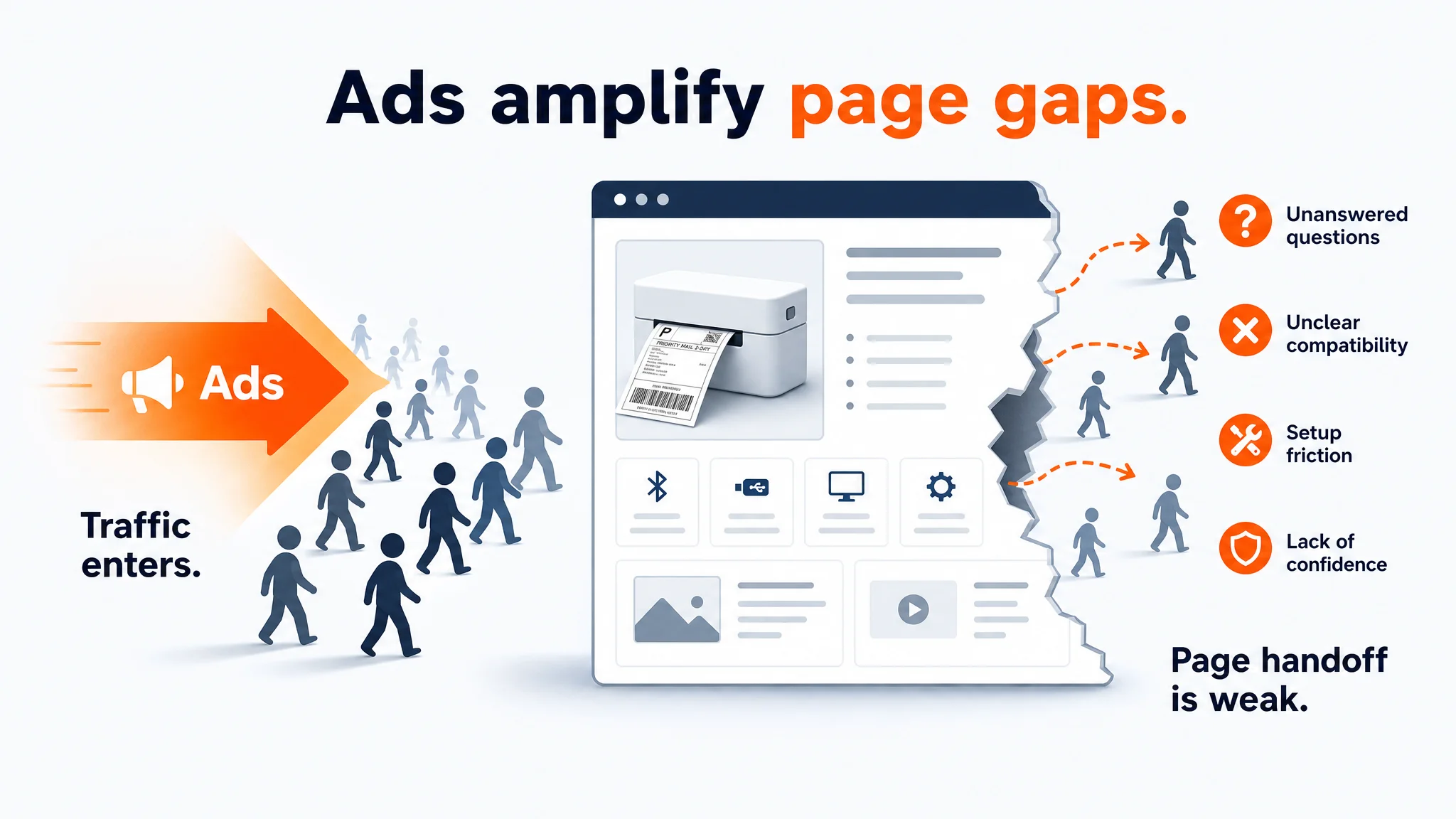
The same principle applies to paid traffic. More visitors do not automatically create healthier organic performance if the page cannot convert them. In the label-printer example, ads were already bringing shoppers to the listing. The problem was that the page looked informative without proving the product’s most important use case. The team initially treated ACOS and weak order volume as campaign problems, but the diagnosis showed that the page was consuming traffic rather than converting it.
Customer response is equally important. Monitor:
- Review velocity and total review growth
- Average star rating and positive sentiment
- Recurring complaints and product-quality concerns
- Return rate and the reasons behind returns
- CVR changes after review volume or sentiment changes
Earn reviews through compliant, neutral requests rather than incentives or manipulation. Amazon’s Request a Review button is the primary native option; Sellerise Review Requester is another source example sellers may evaluate for requesting reviews within applicable rules. Neither approach guarantees positive feedback.
Reviews should also be analyzed as a source of page-improvement evidence. In the label-printer case, the large difference in review volume created a clear trust disadvantage, even though the seller’s rating was slightly higher. The recommended response was not to treat rating alone as sufficient. The page needed to communicate professional ecosystem compatibility, app functionality, setup support, and the “no ink, low maintenance” value more clearly. Transparent guidance around Mac setup was also intended to reduce expectation gaps that could contribute to dissatisfaction or returns.
Sponsored Brands can also introduce qualified shoppers and generate sales. Over time, Amazon may recognize repeated purchase patterns among products and display them in Frequently Bought Together recommendations. Ads do not directly guarantee that placement; measure Sponsored Brands by incremental sales, CTR, CVR, ACoS, and downstream organic movement. Pair advertising data with review and listing analysis to identify whether paid demand is strengthening sustainable organic performance.
Optimize for the Amazon Algorithm
Amazon organic visibility is rarely improved by keyword placement alone. Seller observations consistently point to a combined relationship among keyword-specific sales velocity, conversion rate, relevance, and customer-satisfaction signals. A product that attracts clicks for a target query but fails to convert may struggle to build durable BSR momentum, while strong CVR and positive customer experience can support more efficient growth.
Neil Patel and Robyn Johnson, in the Intero Digital discussion, reinforce a conversion-centric view of Amazon search: visibility must ultimately lead to shopper action. Use that principle operationally. Map high-converting search terms to the title, bullets, images, and product details, then evaluate whether changes improve CTR, CVR, ACoS, and organic sales rather than relying on aesthetic judgment.
The label-printer audit provides a practical example of why this approach matters. The listing’s textual elements looked reasonably strong, yet the main image and A+ content did not consistently connect product specifications to the buyer’s core task. A shopper could learn that the device offered Bluetooth, USB, 150mm/s printing, and 203 dpi resolution, while still wondering whether it would print a reliable 4x6 label from the shopper’s actual platform and operating system.
That is a conversion-capacity problem rather than a simple keyword problem. The page needed to translate technical claims into visible proof:
- A real shipping label with a readable barcode
- A direct relationship between the phone app and the printed output
- A clear Bluetooth and USB compatibility matrix
- Platform logos relevant to ecommerce and shipping workflows
- A step-by-step setup path
- Transparent Mac guidance
- Examples of label sizes and broader use cases
Some sellers also monitor time on page, add-to-cart rate, and brand searches as possible behavioral signals. Amazon has not officially confirmed these as ranking factors, so treat them as diagnostic indicators—not guaranteed inputs or factors with a confirmed order of importance.
Use Brand Analytics to identify query and shopper patterns, Manage Your Experiments to evaluate eligible listing changes, and click-through tracking to compare impressions with visits after each update. Keep a defined change date and review the resulting CTR and CVR trend. Use the term A9 algorithm for Amazon search discussions; some sellers informally refer to an “A10” algorithm, but Amazon has not officially confirmed A10 as a separate algorithm. Optimize for measurable relevance, conversion, sales velocity, and customer satisfaction—not speculation.
How to Rank Higher on Amazon With Ads (and Not Destroy Profits)
Amazon advertising should function as a controlled testing and demand-generation system, not a shortcut to rank. Sponsored Products are the primary tool for high-intent keyword targeting, so RightSideUp recommends assigning roughly 50–60% of the advertising budget to them. Sponsored Brands support broader, top-of-funnel visibility, while Sponsored Display is useful for retargeting shoppers who have already shown interest.
The commercial objective is a profitable PPC-to-organic feedback loop. When a keyword produces converting traffic at an acceptable ACoS, it can generate keyword-specific sales velocity that may support stronger organic visibility and BSR performance. However, advertising should first validate which terms convert before they are permanently added to titles, bullets, or other listing content. A keyword with impressions but weak CTR or CVR should not automatically receive greater organic emphasis.
The label-printer case shows why this order matters. The team saw impressions, difficult ACOS control, and lagging orders, then naturally focused on campaign structure, bids, placements, keyword coverage, and negative targeting. Yet the page itself had not sufficiently answered the buyer’s core questions. Additional ad traffic would have amplified the same ambiguity: shoppers could arrive through relevant searches and still leave because the listing did not prove compatibility, ease of setup, or print quality.
This does not mean the ads were necessarily failing. It means the ads were sending traffic to a page whose conversion capacity was limited. Once the main-image sequence and A+ logic are built around the buyer’s real decision path, advertising data becomes more useful. Sellers can then distinguish between a term that attracts the wrong audience and a term that attracts the right audience but exposes a page-level weakness.
Video ads can deliver higher conversion rates in many campaigns, particularly when the product benefit is easier to demonstrate than explain, but results vary by audience, creative, placement, and offer. Measure them through CTR, CVR, ACoS, and attributed sales rather than assuming superiority.
DeepBI organizes traffic through four tiers: Exploration, Screening, Precision, and Scaling. Its dynamic bid adjustment helps shift spend toward more commercially useful traffic while limiting waste. By connecting ad signals such as impressions, clicks, conversions, ACoS, and TACoS with listing optimization, sellers can identify winning terms, refine conversion assets, and track whether improved CTR or CVR is reducing dependence on paid traffic.
Building a Continuous Improvement Engine with DeepBI
- [project_0082] DeepBI’s End-to-End Intelligent Optimization System: Connects diagnosis, planning, production, delivery, and feedback to support continuous Listing improvement and stronger organic performance.
- [project_0090] DeepBI Automated Market Health Check System: Frames scoring as a data-driven market health assessment rather than a standalone score, supporting structured decisions before traffic expansion.
- [project_0033] DeepBI Text Optimization: Deconstructs A+ pages into logical modules and restructures bullet points around a pain-point-to-solution flow, supporting stronger Listing relevance and conversion.
- [project_0019] Automation and Secure Delivery: Uses Amazon SP-API and least-privilege principles to support controlled, lower-friction implementation of approved Listing changes.
- [project_0079] Application and Delivery: Lets users preview and select approved assets before activating One-Click Apply, helping reduce Listing cycle time while preserving seller control.
- [project_0096] Manual Versus Automated Listing Delivery: Replaces manual downloading, renaming, backend login, and individual uploading with API-connected application that reduces delivery time from minutes to seconds.
- DeepBI Listing Product Documentation Compilation: Supports a feedback loop linking advertising exposure, clicks, conversions, CTR, CVR, TACoS, ACOS, Listing quality, and organic-ranking improvement.
- DeepBI Listing Product Documentation Compilation: Identifies high-converting search terms and applies their signals to Listing titles and images, connecting more precise traffic and stronger page conversion with reduced dependence on paid traffic.
A continuous improvement system is especially valuable when a listing appears healthy under a basic checklist but remains weak in actual market comparison. The label-printer listing scored 74/100, and its title and bullets outperformed the benchmark in some dimensions. Without a structured competitive diagnosis, the team could reasonably have continued treating the listing as “basically fine” and invested more heavily in ads.
The deeper comparison separated the page into distinct commercial dimensions. The main image scored 23 versus the benchmark’s 27 out of 30, while detail and A+ content scored 17 versus 23 out of 25. The audit therefore redirected effort toward the areas most likely to affect shopper confidence: visual proof, platform and system clarity, setup guidance, and trust-building content.
This type of diagnosis supports a more disciplined operating loop:
1. Compare the listing with genuinely relevant competitors.
2. Separate indexing and relevance problems from conversion problems.
3. Identify the buyer questions the current page leaves unanswered.
4. Create targeted title, bullet, image, and A+ changes.
5. Apply approved updates while preserving product consistency.
6. Measure CTR, CVR, ACoS, TACoS, sales velocity, reviews, and organic movement.
7. Use the results to prioritize the next improvement rather than repeating broad changes.
The purpose is not to imitate a competitor’s design. It is to understand how effectively the competitor explains the purchase decision and then build a more accurate, product-supported version for the seller’s own offer.
Key Takeaways and Next Steps
Amazon organic growth is not created by one isolated listing rewrite. It comes from the interaction of listing quality, keyword precision, conversion performance, customer trust, review velocity, and carefully calibrated advertising. A stronger image or more relevant keyword may improve CTR, CVR, or sales velocity, but the result must be measured rather than assumed.
A central lesson from the label-printer listing is that a page can look technically sound and still be commercially incomplete. The title and bullets were not the primary problem. The larger issue was that the visual and A+ content did not fully prove the product’s main job, compatibility, setup process, and reliability. The team initially interpreted the problem as weak traffic or difficult advertising efficiency, while the diagnosis showed that the page itself was not converting traffic effectively.
Start with an objective listing audit. Review the title, bullets, images, A+ Content, and customer feedback against genuinely comparable competitors, while preserving the product’s actual materials, color, design, and specifications. Then ask whether the page demonstrates the outcome buyers care about, rather than merely listing features.
For every major product claim, consider whether the page provides enough evidence:
- Does the hero image show the primary use case?
- Do the secondary images demonstrate performance rather than repeat features?
- Does the A+ content clarify compatibility and setup?
- Are limitations explained before they become return or review problems?
- Does the page offer enough trust and context to compete with products that have much greater review volume?
Use advertising as a validation layer before committing fully to organic changes. Exposure, clicks, orders, CTR, CVR, ACoS, and TACoS can help identify whether the main weakness is discoverability, click appeal, information quality, or trust. Keywords that generate qualified traffic and conversions can then guide more durable listing improvements, while review velocity and customer satisfaction should be developed legitimately through a reliable product experience.
A system such as DeepBI can support this cycle by connecting listing diagnosis, structured recommendations, approved implementation through SP-API, and performance feedback. Its scoring process should preserve product consistency and use reliable inputs rather than inventing claims. The objective is not guaranteed rankings or permanent automation; it is a repeatable process of measurement, refinement, and healthier dependence on organic traffic and long-term margins.
Amazon ads can amplify a strong listing, but they cannot replace one. Before increasing traffic, make sure the page can clearly answer the buyer’s most important questions, demonstrate the product’s real outcome, and reduce the uncertainty that prevents conversion. When the listing deserves the traffic it receives, paid and organic growth can begin working together instead of competing for the same inefficient clicks.