


How We Selected the Right AI Optimization Tools
Choosing an AI tool for Amazon requires more than checking whether it can generate copy or images. Sellers need a system that connects diagnosis, execution, measurement, and control. A narrow tool may improve one Listing element while leaving the underlying issue untouched: a weak main image can suppress CTR, unclear product-page messaging can limit CVR, and disconnected advertising analysis can obscure whether a change is influencing ACoS or organic momentum.
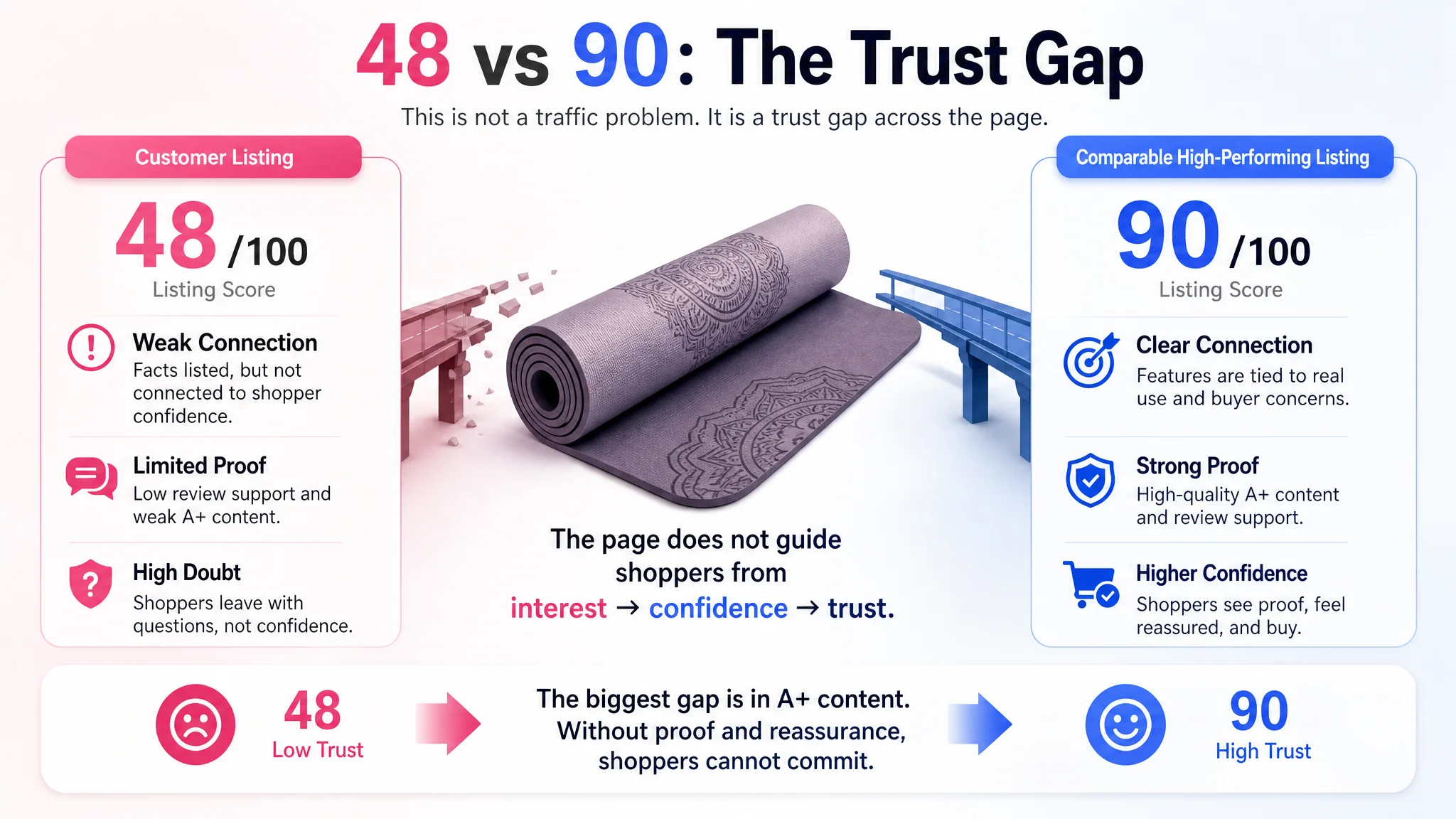
A real product-page diagnosis illustrates why isolated improvements can be misleading. In one US yoga and fitness listing, the page contained a distinctive design, material information, and several potentially relevant use cases, yet it scored only 48 out of 100 against a comparable high-performing page that scored 90. The initial direction focused on making the wording more attractive, repeating the non-slip benefit, and explaining the material more clearly. Those edits addressed individual claims, but they did not resolve the deeper issue: shoppers were not being guided from visual interest to functional confidence and then to purchase trust.
Our evaluation therefore focused on whether an AI platform could support a complete optimization workflow without sacrificing Amazon-specific accuracy or seller oversight.
Criteria: Comprehensive, Amazon-Specific, and Data-Driven
The first criterion was Amazon specificity. Generic AI can produce fluent language or attractive visuals, but Amazon optimization depends on marketplace signals such as search terms, ASIN and category data, competitor Listings, impressions, clicks, orders, CTR, CVR, ACoS, and TACoS. A useful platform must interpret these signals in relation to the product page and advertising funnel, not treat content creation as an isolated creative exercise.
This distinction matters because a page can contain all the expected information and still fail to convert. In the yoga mat example, the customer page included material and size details, non-slip and eco-related claims, portability information, and basic usage guidance. However, those points appeared mostly as separate facts. The page did not clearly answer the shopper’s practical concerns: whether the mat would remain stable during sweaty practice, protect comfort, fit the available space, remain easy to clean, and be worth trusting despite limited review support.
The second criterion was coverage. We looked for support across the key drivers of Listing and growth performance:
- Titles, bullet points, descriptions, and A+ content
- Main-image quality and supporting visual assets
- Reviews and customer trust signals
- Competitor gaps and category positioning
- Advertising reports and organic-growth indicators
Coverage must also include the relationship between these elements. In the yoga mat diagnosis, the main-image score was only two points below the comparable page, while the A+ content score was 21 points lower and the review score was 11 points lower. The page was not failing because every individual asset was poor. It was failing because the assets did not work together strongly enough to overcome doubt. A tool that examines only one image or one piece of copy would miss that page-level constraint.
The third criterion was automation depth. Generating a recommendation is only one step. The workflow should help identify the gap, convert the diagnosis into an executable plan, produce or revise the required asset, and reduce the time required to publish approved changes. This distinction matters for listing cycle time: manual downloading, renaming, uploading, and backend changes create friction, while API-connected delivery can reduce an operation that once took many minutes to seconds.
Finally, we assessed safeguards. AI-generated content must remain faithful to the actual product and comply with Amazon requirements. Product structure, materials, specifications, and visible attributes cannot be invented. Image outputs must also be reviewed against requirements such as format, dimensions, white-background rules for main images, and seller approval.
The yoga mat diagnosis shows why these safeguards are essential. A roughly 1 mm mat should not be presented as “extra thick” if that claim does not accurately describe the product. Its more defensible value may be foldability, lightweight portability, and ease of storage. Optimization should improve the way a product is presented without changing what the product physically is.
Why DeepBI Emerged as the Top Contender
DeepBI stood out because its workflow connects four normally separated stages: scoring and competitor benchmarking, structured optimization recommendations, AI image generation, and one-click application through Amazon SP-API. Its scoring service functions as an automated market health check, assessing titles, bullet logic, main images, A+ content, reviews, and competitor gaps rather than assigning an isolated content score.
The platform also connects strategy to execution. Diagnostic findings can be translated into parameterized design blueprints, while Product DNA provides a constraint for visual generation so that creative changes remain tied to the product’s actual structure. Approved assets can be previewed against existing versions and selected individually before replacement, preserving human control.
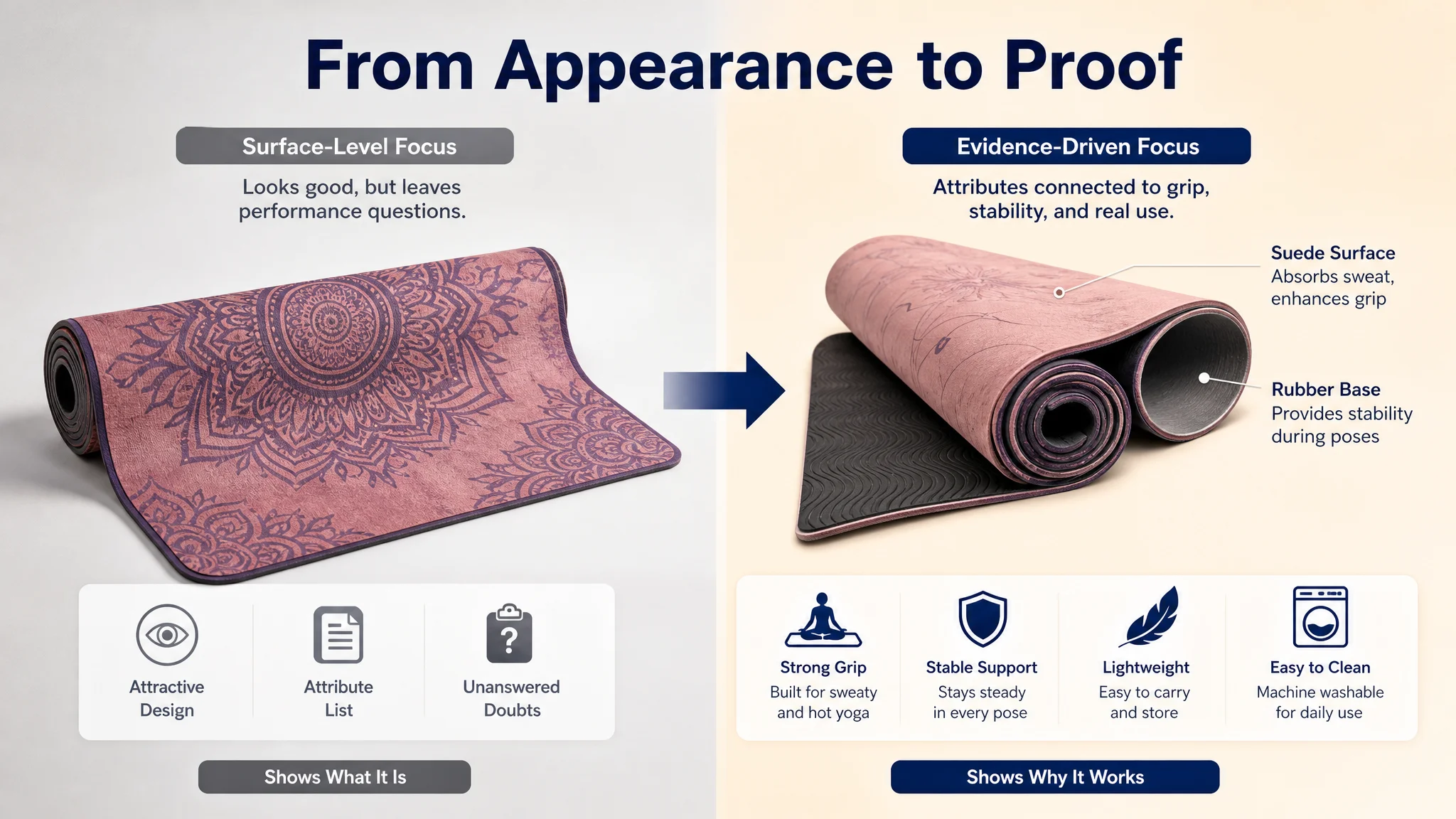
This connected diagnosis is particularly important when the visible problem is not the actual constraint. In the yoga mat case, the initial direction stayed close to surface-level improvements: make the design more attractive, repeat the non-slip benefit, add product details, and improve the wording around comfort and use. DeepBI’s comparison showed that the larger issue was the missing connection between attributes and purchase risk. The suede surface needed to be linked to sweat absorption and grip, the rubber base to stability, the lightweight construction to portability, and the washable positioning to post-practice maintenance.
Its strongest differentiator is the feedback loop. After an image is published, DeepBI marks a visual iteration event in advertising reports, allowing sellers to observe how the ASIN’s CTR changes over the following period. That link between change and measurement replaces subjective judgments with an evidence-based workflow. DeepBI was therefore selected not because one module solves every Amazon problem, but because its connected data, optimization, generation, delivery, and compliance layers address the operational gaps that narrow tools often leave behind.
Amazon AI Tools at a Glance
Amazon's Native AI Toolbox
Amazon’s native tools offer valuable first-party inputs because they operate close to the marketplace, seller account, and catalog. They are useful starting points for identifying demand, improving listing content, and monitoring operational signals, but sellers still need to translate those signals into coordinated actions.
- Amazon Opportunity Explorer helps sellers investigate niche and demand conditions. It can support early product research by showing where a category may contain customer demand or competitive opportunity before a seller commits resources.
- Enhance My Listing supports listing improvement by providing AI-assisted recommendations for content such as titles, bullets, or descriptions. These suggestions can help sellers identify content gaps that may affect CTR and CVR, while still requiring human review for brand positioning, product accuracy, and compliance.
- Amazon Seller Assistant can support account-level analysis and operational decision-making. Alongside account signals, sellers may also rely on Amazon’s inventory and business reports to understand stock conditions, sales activity, and catalog issues.
The practical limitation is not that these tools lack value. It is that signals and recommendations do not automatically form a complete operating loop. A seller may discover an attractive niche, receive listing suggestions, review account analytics, and identify an inventory concern in separate interfaces. The seller or team must then decide what to prioritize, produce the required assets, apply the changes, and monitor whether CTR, CVR, ACoS, BSR, or listing cycle time moves in the desired direction.
The yoga mat example demonstrates the cost of stopping at individual suggestions. The page already contained claims about natural rubber, suede, foldability, eco-related value, and non-slip performance. Adding another isolated claim would not necessarily solve the problem. The diagnostic task was to determine which concern was blocking conversion, how the page addressed that concern, and whether the content sequence created enough confidence. Native recommendations can be useful inputs, but the seller still needs a system for connecting page quality, trust signals, and advertising decisions.
The Ecosystem of Third-Party AI Tools
Third-party software expands the available toolkit by focusing deeply on specific jobs. One platform may specialize in product or niche research, another in PPC management, another in listing optimization, and another in repricing. This specialization can be useful when a seller needs a strong solution for one narrow problem, particularly as the catalog, advertising structure, or pricing complexity grows.
The trade-off appears when several specialist tools are used together. Each may have its own data model, dashboard, recommendations, and workflow. Teams can end up exporting research from one system, interpreting it in another, sending instructions to a content producer, uploading assets manually, and checking advertising or organic performance somewhere else. These hand-offs create data silos and increase the risk that a recommendation is delayed, misinterpreted, or disconnected from the product constraints that should govern execution.
An integrated approach addresses the connection problem rather than simply adding another isolated dashboard. DeepBI is designed to connect four operational stages: diagnosis, planning, production, and delivery. Its listing workflow combines intelligent scoring, optimization recommendations, AI image generation, and one-click application. The recommendations act as the bridge between identifying a weakness and producing an actionable improvement, while approved image assets can be synchronized through Amazon SP-API after seller review.
That distinction matters operationally. Instead of leaving a team to move manually from audit findings to production and then to asset delivery, a connected workflow can reduce hand-offs and shorten listing cycle time. Sellers retain approval over the selected changes, while the workflow makes the path from listing diagnosis to applied optimization more direct.
It also helps prevent a common misdiagnosis: treating low conversion as a traffic problem simply because advertising data is easier to access than page-quality evidence. In the yoga mat listing, the page had a 48-point score against a comparable page’s 90, a 21-point A+ gap, and a weak review profile. Those findings suggested that the first constraint was conversion capacity, not necessarily the next bid adjustment. An integrated workflow makes it easier to place advertising data in the context of the complete product page.
DeepBI's Core Optimization Methodology
DeepBI treats Amazon growth as a connected operating system rather than three separate tasks. Listing quality influences whether paid traffic earns a click and converts; advertising data reveals which searches, benefits, and product attributes deserve more attention; those validated signals can then inform improvements that support more durable organic growth. The workflow follows four stages: analyze, strategize, execute, and optimize. Each stage produces inputs for the next, creating a practical link between CTR, CVR, ACoS, listing cycle time, and potential BSR development without assuming any guaranteed outcome.
Listing Intelligence: From Audit to Conversion
The process begins with a quantitative listing audit across the main image, title, bullet points, A+ content, and customer feedback. DeepBI can compare the listing with a relevant benchmark selected through semantic, functional, visual, price, and audience similarity. It then cross-references those scores with seller data, including impressions, clicks, orders, CTR, and CVR.
This connection helps locate the actual funnel weakness. Low CTR may point to a main-image or message problem, while weak CVR may indicate unclear benefits, insufficient trust content, or a mismatch between shopper expectations and the page. Instead of returning a broad recommendation such as “make the image more persuasive,” the system can translate the gap into an executable specification covering composition, camera angle, lighting, scene elements, and information density. A vague benefit can become a concrete visual instruction with a defined product scale, viewpoint, infographic position, and message hierarchy.
A page-level comparison can also show that not every weak score deserves equal priority. In the yoga mat diagnosis, the title scored 14 out of 20 compared with 18 out of 20 for the comparable page. The main image scored 24 out of 30 compared with 26 out of 30. Those gaps were meaningful, but the larger weaknesses were A+ content, which scored 3 out of 25 compared with 24 out of 25, and reviews, which scored 2 out of 15 compared with 13 out of 15. This prevented the team from treating every content element as equally responsible for the conversion problem.
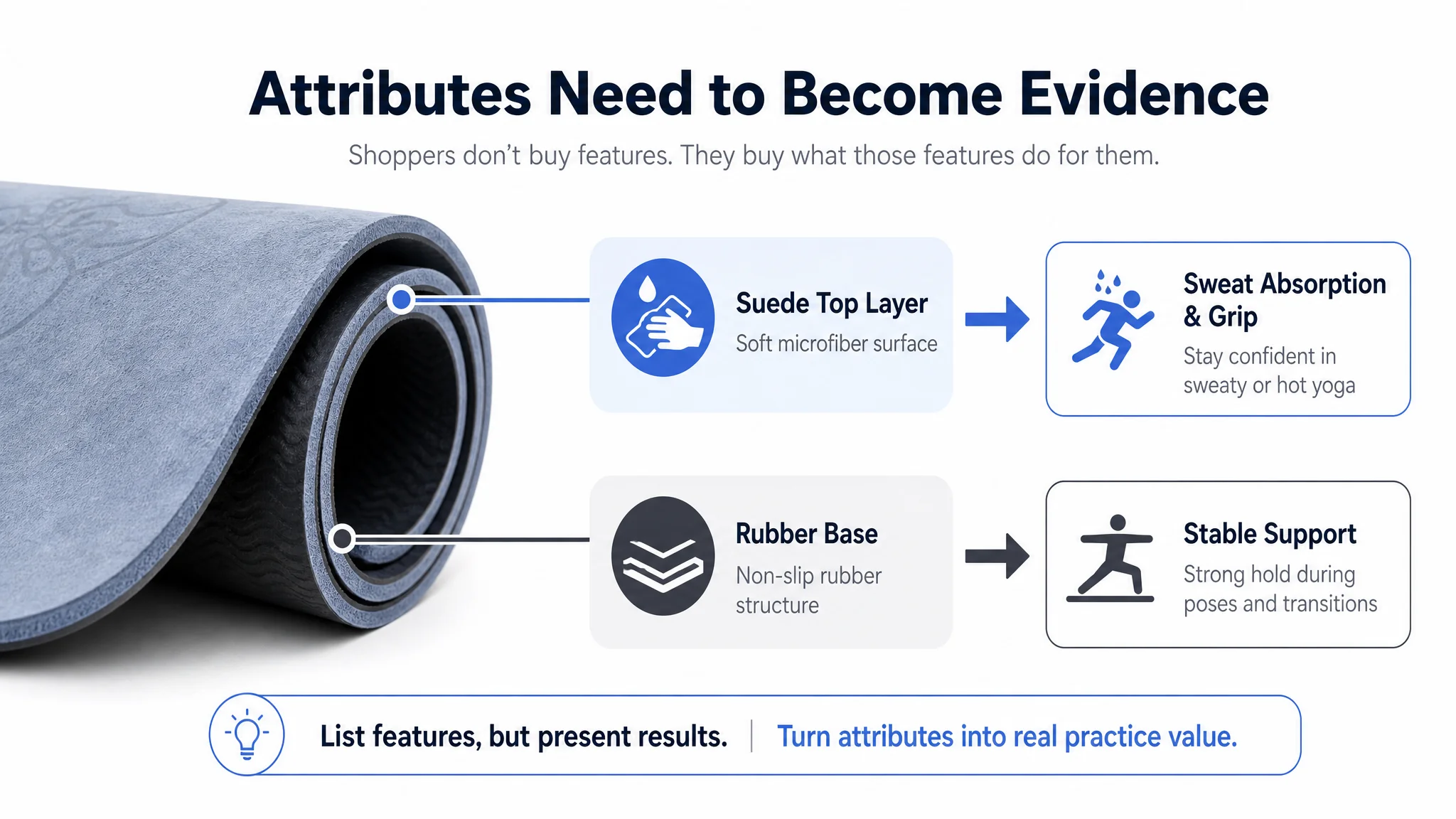
The same diagnosis also showed why feature extraction is not enough. “Natural rubber,” “suede surface,” “foldable,” “lightweight,” and “non-slip” may all be valid product attributes, but the page needed to explain what each feature changed during practice. The suede surface had to be connected to sweat absorption and grip during hot yoga. The rubber base had to be connected to stability during poses and transitions. The lightweight format had to be positioned around portability rather than cushioning. The washable claim had to address dirt, odor, and maintenance.
Execution remains constrained by verified product information. Product DNA, original assets, and confirmed attributes define what may change. Background, lighting, angle, and composition can be optimized, but the product’s material, color, branding, industrial design, and core functionality cannot be altered. Approved assets can then be selectively applied through Amazon SP-API, reducing manual upload time and shortening the listing cycle while preserving seller review before publication.
Advertising Quant: Precision PPC with the Four-Layer Funnel
The advertising layer connects four questions: Can shoppers see the offer, will they click, will the page convert them, and what performance signal should guide the next decision? This structure prevents PPC analysis from stopping at impressions or clicks alone.
DeepBI can use advertising reports to identify winning or high-conversion search terms and connect them with listing priorities. If a specific benefit or variation attribute repeatedly accompanies stronger conversion signals, that evidence can receive greater weight in image, title, bullet-point, or A+ planning. Sellers can therefore evaluate advertising opportunities through CTR, CVR, and ACoS together: traffic is not automatically valuable if the page fails to convert, and a converting term deserves more disciplined investigation before broader application.
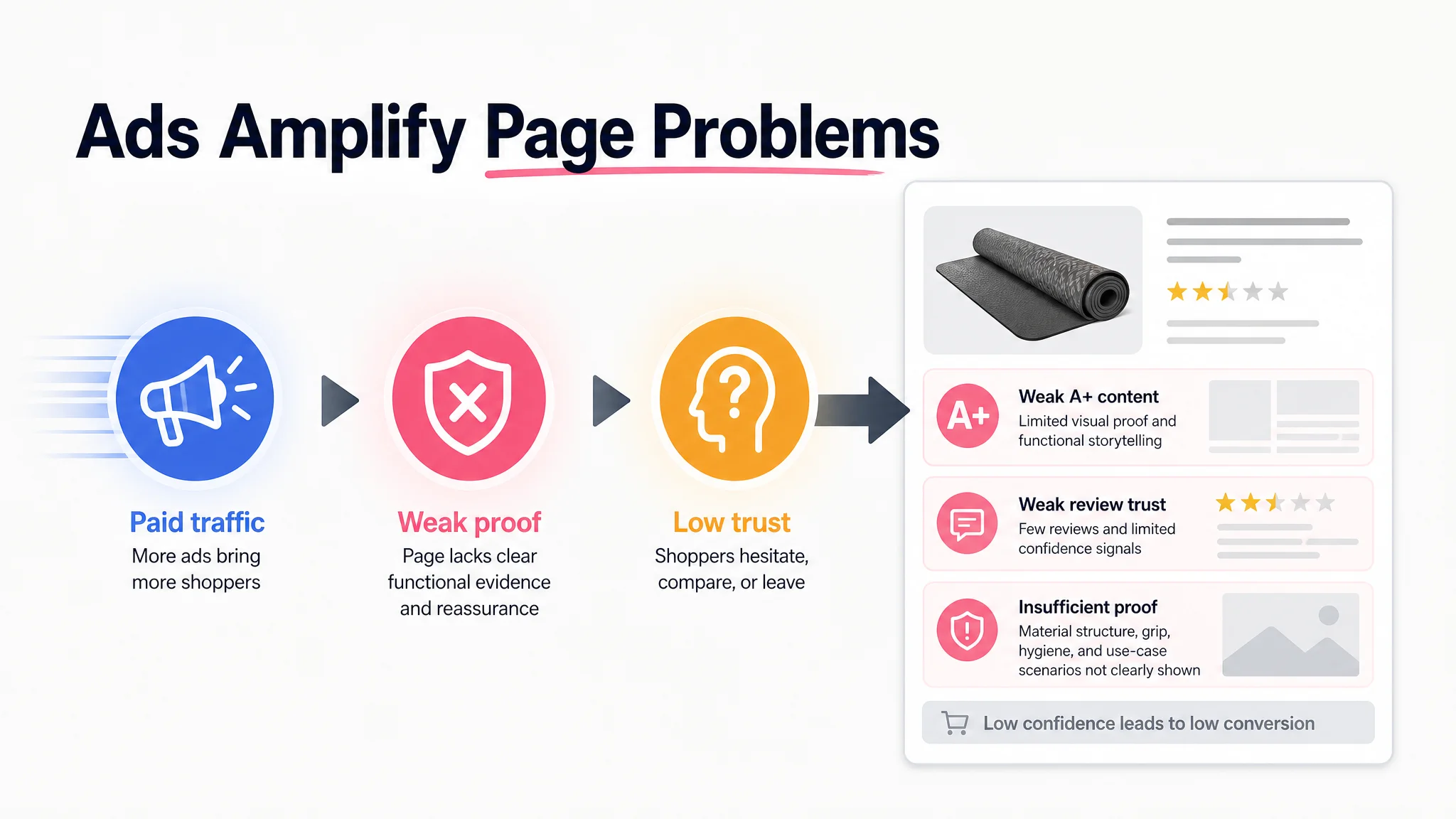
The yoga mat diagnosis provides a practical reason for this order of analysis. The available evidence pointed to a page-level conversion constraint: the Listing score was 42 points below the comparable page, the A+ score was 21 points lower, and the review score was 11 points lower. The title delayed the core product identity, the bullets listed attributes without following shopper concerns, and the image set emphasized appearance more than functional proof. Under those conditions, sending more traffic to the page could expose the same trust gap to more shoppers without repairing it.
The execution stage turns the strategy into controlled changes rather than unbounded automation. After a visual or content update is published, the event can be marked in advertising data, creating a time anchor for subsequent comparison. New results feed back into scoring and prioritization. The system supports faster, more consistent decisions while leaving room for seller judgment and manual PPC management where business context requires it.
Organic Growth: Turning Ad Efficiency into Lasting Rankings
Organic growth is the downstream opportunity, not a promised output. Better listing relevance and clearer communication can prepare the page to convert paid traffic more effectively. Advertising signals can then identify which terms and product benefits have evidence of customer response. Those signals may guide content refinement and broader application across related variations or a product line.
The final loop is therefore deliberate: analyze the listing and funnel data, strategize around the highest-value gaps, execute controlled listing or advertising actions, and optimize from the resulting CTR, CVR, ACoS, and sales evidence. When signals remain stable, sellers have a stronger basis for deciding which messages to retain and which experiments to discontinue. The methodology supports more informed organic-growth work, but BSR, organic sales, and reduced paid dependence must still be measured rather than assumed.
A page with weak trust cannot be treated as ready for organic expansion merely because it contains relevant keywords. In the yoga mat case, the product had several usable positioning assets, including its vintage design, foldable construction, storage bag, suede and natural rubber materials, machine-washable positioning, and broad use across yoga, Pilates, hot yoga, and family activities. The task was to organize those assets into a more believable buying argument before expecting traffic efficiency to improve. Organic growth depends not only on relevance, but also on whether the page can convert the attention that relevance attracts.
DeepBI vs. Standalone Tools: The Integration Advantage
Where Point Solutions Excel
Dedicated listing and PPC tools can be highly capable within their specific domains. A specialized listing platform may offer detailed content editing, keyword workflows, or asset management, while a PPC solution may provide sophisticated campaign analysis, search-term reporting, and bid-management functions. For sellers with established processes, these point solutions can deliver meaningful improvements in CTR, CVR, ACoS, or listing cycle time.
Their limitation is not necessarily functional weakness. It is the coordination cost created when important decisions are distributed across separate systems. A seller may audit a listing in one tool, analyze advertising terms in another, brief a designer separately, upload revised assets manually, and then return later to compare performance. Each handoff adds delay and creates opportunities for inconsistent keyword priorities, outdated files, or incomplete performance context.
That friction becomes more material as catalog size grows. Updating visual assets across hundreds of SKUs, for example, can consume substantial operational time and increase the risk of upload errors. Even when every individual tool performs well, the overall workflow can remain slow because the seller—not the system—must connect the evidence, decisions, execution, and measurement.
The same fragmentation can produce the wrong optimization order on an individual listing. In the yoga mat example, a team focused first on wording, material claims, and visual attractiveness. Those were reasonable observations, but they did not reveal that the page’s largest measurable weakness was its A+ content and its broader trust structure. Without a combined view of content, competitor benchmarks, reviews, and conversion logic, teams can spend time improving visible details while leaving the main conversion constraint intact.
What DeepBI Uniquely Delivers with a Unified Platform
DeepBI’s advantage is not simply having more features in one interface. It uses dedicated modules for diagnosis, optimization planning, AI image generation, and one-click application, while connecting the data and workflow between them. Its scoring process evaluates the main image, title, bullet points, A+ content, and Voice of the Customer alongside business signals such as impressions, clicks, orders, CTR, and CVR. The result is a performance-based diagnosis rather than an isolated content score.
That connection allows one function to inform another. If a listing audit indicates that weak CTR is associated with an ineffective main image, the finding can shape visual optimization. If CVR is weak, the workflow can examine missing product information, trust signals, or A+ content weaknesses. Advertising data can also inform the next decision: high-converting search terms and product attributes can receive greater weight in title and image optimization. After approved assets are applied, subsequent advertising performance can flow back into scoring and generation decisions.
The yoga mat page shows how this logic works in practice. The main image was not wholly inadequate; its score was close to the benchmark. The more consequential issue was that the page lacked a visual story explaining how the suede top and rubber base worked together, why the product suited sweaty practice, how it could be cleaned, and why its lightweight construction was useful. That finding led to a more complete image and A+ sequence rather than another isolated aesthetic revision.
This creates a practical loop:
- Analyze listing quality and business performance.
- Plan changes using listing evidence and advertising signals.
- Generate or refine the required assets.
- Apply approved updates without repeated downloading, renaming, and uploading.
- Evaluate changes through later CTR, CVR, ACoS, and organic performance signals.
Reducing a manual upload operation from roughly 30 minutes to seconds is valuable not because speed is an end in itself, but because shorter listing cycle time allows sellers to act on evidence sooner and with less process friction. Organic gains can also improve the balance between paid and unpaid traffic, potentially reducing dependence on advertising while supporting BSR and conversion performance.
A unified workflow still needs commercial discipline. Seller-defined targets and guardrails should guide advertising and optimization decisions so that attempts to accelerate traffic do not erode margins. The same principle applies to repricing decisions: growth actions must remain within approved profitability and risk boundaries. DeepBI therefore serves best as an integrated Amazon optimization engine within its documented listing, visual, execution, and advertising-data scope—not as a claim that every specialized tool is unnecessary.
Applying AI Optimization Across Seller Models
The most effective AI workflow depends on how a seller operates, how mature the listing is, and where the current funnel is breaking down. DeepBI should therefore be applied in sequence rather than as a universal automation layer: diagnose the listing, resolve conversion barriers, then use advertising and organic signals to prioritize the next action.
Its listing score can be evaluated alongside impressions, clicks, orders, CTR, and CVR. A low CTR paired with a weak main-image score points toward a visibility or visual-hook problem. A low CVR combined with weaker detail-page or review dimensions suggests an information or trust gap. This diagnosis gives sellers a practical starting point while keeping optimization tied to Amazon outcomes such as CTR, CVR, ACoS, TACoS, BSR, and listing cycle time.
New FBA Sellers
New FBA sellers should establish a conversion-ready listing before increasing advertising spend. Sending traffic to a page with an unclear title, weak bullet structure, an ineffective main image, incomplete A+ content, or limited review-based trust can inflate ACoS without creating enough orders to support organic momentum.
The yoga mat listing demonstrates how this can happen even when the product appears visually differentiated. Its vintage design could attract attention, but the page did not sufficiently establish functional confidence. With a 3.2-star rating from six reviews and a weak A+ section, the product had limited social proof to compensate for unclear performance messaging. Additional traffic would not automatically answer questions about grip, stability, comfort, hygiene, or portability.
A listing-first workflow can follow four steps:
- Use listing scoring and relevant competitor benchmarking to identify gaps in the title, bullets, main image, A+ content, and reviews.
- Diagnose whether the primary weakness is attracting clicks or converting them. CTR points toward the search-result presentation, while CVR points toward the detail-page experience and trust signals.
- Convert the gaps into precise optimization instructions rather than vague advice such as “improve the image.” DeepBI can specify elements such as composition, camera angle, lighting, scene elements, and color tone.
- Apply approved changes, then review subsequent advertising signals before expanding spend.
This approach gives a new seller a clearer baseline for deciding whether additional advertising is justified. The objective is not to automate every task immediately, but to reduce avoidable listing weaknesses before paid traffic magnifies them.
Private-Label Brands
Private-label brands generally have more control over product positioning, visual assets, and advertising budgets, so they can use DeepBI as an integrated optimization loop. The process begins with listing diagnosis and benchmark comparison, followed by structured improvements to the title, bullets, main image, and A+ content.
When visual assets require refinement, the workflow should preserve product accuracy. Product DNA remains the constraint: the system must not alter the product’s inherent structure, materials, features, specifications, or brand-identifying elements. Approved inputs can then guide AI image generation and style control, producing assets that express the intended optimization plan without creating an image-product mismatch.
The yoga mat case shows why product positioning must remain grounded in the actual offer. The recommended direction did not copy the competing page or invent a thicker construction. Instead, it clarified the product’s existing assets: a suede surface, natural rubber base, foldable format, storage bag, machine-washable positioning, and use across yoga, Pilates, hot yoga, and family activities. The 1 mm construction was framed around portability and storage convenience rather than unsupported cushioning. This is the difference between improving communication and changing the product promise.
Advertising data supplies the next layer of prioritization. Impressions, clicks, conversions, CTR, CVR, ACoS, and TACoS can indicate which terms, messages, or visual features deserve further attention. After an image is published, its relationship to advertising reports can help the brand assess its effect on metrics such as CTR. This connects listing refinement, paid traffic, and organic ranking work rather than treating them as separate projects.
FBM and Wholesale Sellers
FBM and wholesale sellers may not need the full visual-production workflow, especially when brand control or catalog flexibility is limited. They can still use DeepBI’s listing optimization and basic advertising analytics to address practical performance barriers.
The starting point is usually a focused review of title clarity, bullet-point structure, main-image presentation, A+ content, and conversion signals. Advertising data can then help distinguish a traffic problem from a page-quality problem and guide which content change deserves attention first. For sellers managing many established listings, this prioritization can reduce listing cycle time by directing effort toward the pages with the clearest CTR, CVR, or ACoS opportunity.
Across all three models, the operating principle remains consistent: match workflow depth to business maturity, but make listing quality the foundation before scaling the next growth lever.
Managing Risks and Ensuring Safe AI Adoption
AI can shorten listing cycle time and support stronger CTR, CVR, ACoS, or BSR outcomes, but automation also increases the speed at which mistakes can spread. Safe adoption therefore depends on control design, not simply on adding more automation. Sellers need clear boundaries around what AI may change, how financial decisions are constrained, and when a person must approve the result.
Common AI Pitfalls for Amazon Sellers
The first risk is product misrepresentation. AI-generated copy or visuals may introduce unsupported claims, inaccurate parameters, fabricated accessories, or features the product does not have. A mismatch between the listing and the physical product can lead to negative reviews, refunds, lower CVR, and potential compliance problems. Brand identity can also be diluted if an optimization system changes established logos, fonts, color schemes, or other recognizable elements.
The yoga mat diagnosis provides a straightforward example of how this risk can appear in copy. A roughly 1 mm mat should not be described as “extra thick” simply because thickness is a common category selling point. That wording could create an expectation the physical product does not satisfy. A more accurate presentation would emphasize foldability, low weight, and travel convenience while describing the actual structure and material characteristics.
A second risk is optimizing the wrong business objective. An aggressive price change may increase conversion temporarily while reducing contribution margin. Similarly, advertising recommendations that pursue volume without a seller-defined ACoS target or budget ceiling can consume cash faster than the product economics justify. Improving a surface-level metric is not valuable if profitability deteriorates.
The third risk is over-reliance on AI. A generated recommendation can appear logical while missing inventory constraints, brand positioning, product nuances, or a seller’s strategic priorities. Treating the system as an autonomous decision-maker removes the context and accountability that human review provides.
The yoga mat case also shows why a low-conversion result should not automatically be interpreted as a bid or keyword problem. The page’s low score, weak review profile, and missing A+ proof created a trust constraint that ad tuning alone could not repair. An AI system that recommends more traffic without checking the page’s ability to convert may accelerate spend without addressing the underlying issue.
How DeepBI's Design Mitigates These Risks
DeepBI is positioned as a commercial production system rather than an unrestricted creative tool. Its workflow uses Product DNA, original product imagery, and verified specifications as boundaries. The system is designed to preserve product structure, materials, branding, dimensions, and functionality, while prohibiting fabricated parameters, unsupported selling points, or invented usage scenarios.
Compliance detection operates as a risk-reduction layer. It checks claims, promotional wording, exaggerated advantages, platform image requirements, and consistency with the product specification. During evaluation, generated assets are compared with the product’s known attributes; detected deviations can trigger corrective instructions. Assets that fail required image formats, dimensions, color modes, or other Amazon standards are blocked before upload. These controls reduce the likelihood of publishing misleading content, but they should not be treated as a guarantee of policy compliance.
Financial guardrails require seller ownership. Before applying advertising, pricing, or optimization recommendations, the seller should define acceptable ACoS, budget ceilings, and margin limits. DeepBI’s documented listing workflow does not establish automatic control over price, advertising spend, inventory, or orders, so those boundaries must remain explicit in the seller’s operating process. No recommendation should be accepted merely because it promises faster growth.
Human approval is the final safeguard. Before an asset is applied, DeepBI presents the original and proposed replacement side by side, allowing the seller to approve only selected changes. Its controlled API workflow and least-privilege approach further limit unnecessary account access. Sellers should review the business impact, product accuracy, compliance exposure, and expected KPI effect before confirming any change. Automation can reduce repetitive work; accountable judgment must still control publication and spending.
Frequently Asked Questions About DeepBI
Is DeepBI just another suite that does many things poorly?
No. DeepBI is designed as a set of specialized Amazon optimization modules connected by an execution-oriented workflow. Its value is not simply that it places listing, advertising, and organic optimization under one login; each area has its own analytical depth.
For listing optimization, DeepBI evaluates multiple dimensions, including the main image, title, bullet points, A+ Content, and customer feedback signals. It can compare a seller’s listing with relevant benchmark ASINs selected according to product similarity, visual form, function, price range, and audience. The resulting gaps are converted into actionable content or image instructions rather than remaining as general recommendations. A+ Content is also broken into logical modules for more focused analysis.
The workflow then connects diagnosis to production and application. Structured scoring and product inputs support an optimization plan, while approved changes can move toward publishing through Amazon SP-API within the platform’s permitted scope. This audit-to-generate-to-apply flow reduces listing cycle time and gives sellers a practical path from weak content to improved CTR and CVR potential.
The yoga mat example shows why this breadth matters. A narrow copy tool might have repeated the non-slip or eco-related claims. A visual tool might have made the mandala pattern more prominent. A separate review of A+ content might have identified missing modules. The more complete diagnosis connected these observations and showed that shoppers needed a sequence of visual and functional proof, especially because the listing had a 3.2-star rating from six reviews and limited social proof. The problem was not simply a shortage of words or attractive imagery; it was the absence of a coherent conversion argument.
The advertising module is similarly built around Amazon-specific signals, including impressions, clicks, orders, CTR, CVR, ACoS, and TACoS. Because the modules exchange information, listing weaknesses can be considered when interpreting wasted ad spend. DeepBI is therefore broader than a point solution without being shallow by design. Its advantage comes from combining specialized analysis with coordinated execution.
How does DeepBI compare with a tool like Helium 10?
Helium 10 is commonly used as a research-focused suite, particularly for activities such as product, keyword, and market research. DeepBI serves a different role: it is an execution platform centered on diagnosing Amazon listing and advertising performance, generating optimization actions, and helping sellers apply approved changes.
The distinction is the operating loop. A research tool may help a seller identify an opportunity or collect market signals. DeepBI is intended to continue from analysis to strategy, content or image production, publishing, and performance feedback. For example, advertising data can reveal whether a listing’s main image or content is contributing to weak CTR or CVR, allowing the seller to prioritize a specific optimization rather than merely gather another report.
In a product-page situation such as the yoga mat listing, research can help establish category language and competitor context, but execution still requires decisions about information order, functional proof, A+ structure, review-related trust, and product accuracy. The benchmark page was not used as a template to copy. It served as evidence that the customer page needed stronger communication maturity, particularly in A+ content and shopper reassurance.
These tools do not need to be treated as mutually exclusive. A seller may use Helium 10 or another research platform for discovery, then use DeepBI to turn selected opportunities into listing and advertising execution. The right choice depends on whether the immediate constraint is market research, operational execution, or both.
Does DeepBI support FBM sellers?
Yes, FBM sellers can use DeepBI for Amazon listing optimization and advertising analytics. The same core needs still apply regardless of fulfillment method: clear titles and bullets, persuasive images and A+ Content, relevant keywords, and disciplined analysis of CTR, CVR, ACoS, and TACoS.
However, DeepBI’s scope should be understood clearly. It is not a repricing system and does not manage inventory across multiple sales channels. FBM sellers who require repricing rules, cross-channel stock synchronization, or broader order and inventory operations may need separate tools for those functions.
DeepBI’s Amazon-focused role is to improve the quality and performance of the seller’s content and advertising decisions, while leaving fulfillment-specific and multi-channel operations to systems designed for them.
The Operating Lesson: Diagnose the Page Before Scaling the Traffic
A complete Amazon optimization workflow should not begin with the assumption that the next problem is a keyword, bid, or budget problem. It should begin by asking whether the product page can convert the attention those decisions are intended to generate.
The yoga mat listing made this distinction visible. The product had a recognizable design, material information, portability, and several relevant use cases. Yet the page scored 48 out of 100 against a comparable page’s 90, carried a 3.2-star rating from six reviews, and had an A+ score of only 3 out of 25 compared with 24 out of 25 for the benchmark page.
The initial direction focused on making the product more attractive and repeating its benefits. The deeper diagnosis showed that the page needed a more persuasive order of information:
- Product recognition and category relevance in the title
- A main image that showed more than appearance
- Bullet points organized around shopper concerns
- Visual proof of material structure and functional benefits
- Use-case explanation for sweaty or demanding practice
- Practical reassurance around portability, cleaning, and storage
- A realistic understanding of how limited reviews affected trust
- Advertising evaluation only after the page could better receive traffic
This is the difference between isolated editing and conversion-system optimization. The title has to win recognition and relevance. The main image has to earn the click. The supporting images have to explain the product. The bullets have to follow the buyer’s concerns. The A+ section has to provide evidence and reassurance. Reviews have to be recognized as a trust constraint. Advertising has to be evaluated in relation to the page’s actual ability to convert.
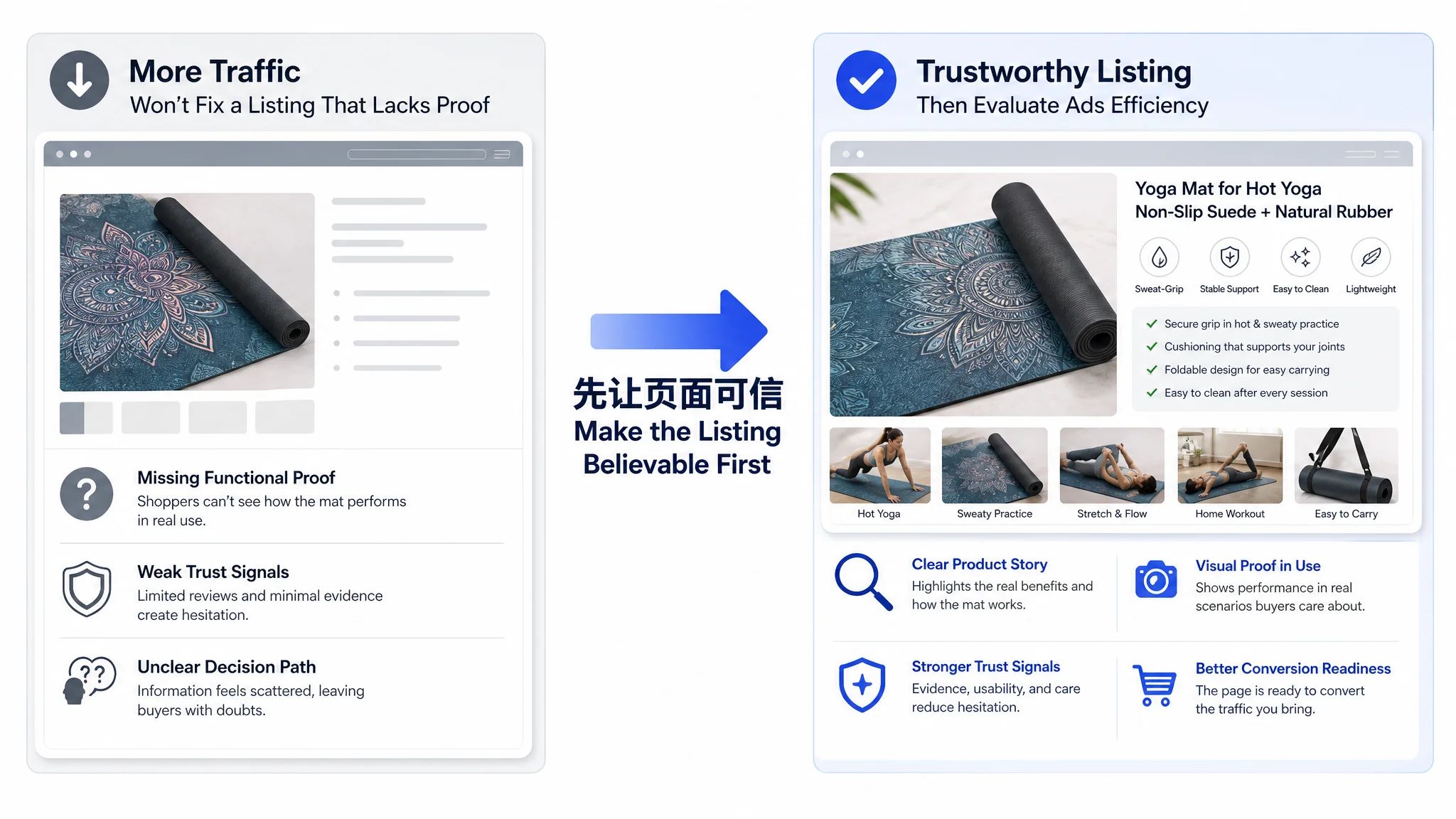
The case did not include a reported post-optimization CVR or ACoS figure, so the business result should not be overstated. What can be established is the change in operating judgment: the listing was no longer treated as a collection of separate assets, but as one conversion system.
For Amazon sellers, that changes the question from:
“Which ad setting should we adjust next?”
to:
“If more shoppers arrive today, does the product page give them enough evidence to buy?”
Before Amazon ads can become more efficient, the Listing first has to become more believable.