

Introduction: The 2026 Amazon landscape and why tool choice matters
Amazon’s position in online commerce makes operational precision increasingly important for sellers. According to an eMarketer projection, Amazon is expected to represent approximately 41% of e-commerce by 2026. Capturing even a small share of that demand requires more than launching a product and waiting for organic visibility. Sellers must identify viable opportunities, build listings that earn clicks, convert traffic efficiently, and respond to performance signals before competitors do.
Manual product selection and listing guesswork are becoming increasingly difficult to justify. A seller who relies on personal preference, spreadsheet reviews, or a designer’s subjective judgment may miss weak demand signals, competitive gaps, or visual problems that suppress CTR and CVR. The available source material also reports a 1.79% sales lift for tool users, reinforcing the broader case for using software to support operational decisions. Automation is not a substitute for commercial judgment, but it can reduce listing cycle time and make optimization more measurable through metrics such as CTR, CVR, ACoS, and BSR.
This is the market position DeepBI aims to occupy. It is an AI-powered, Amazon-specialist system built around three connected areas: Listing optimization, advertising-data analysis, and organic growth. Its documented workflow links diagnosis, recommendations, AI-generated visual assets, and one-click Listing application, with advertising signals feeding the optimization process.
The central question is not whether every seller needs another software subscription. It is whether DeepBI’s Amazon-focused combination of data analysis and execution is the right tool for Amazon sellers in 2026. Unlike an all-in-one, multi-platform suite, DeepBI is positioned as a specialist system for Amazon operations, making workflow depth and platform relevance more important than broad channel coverage.
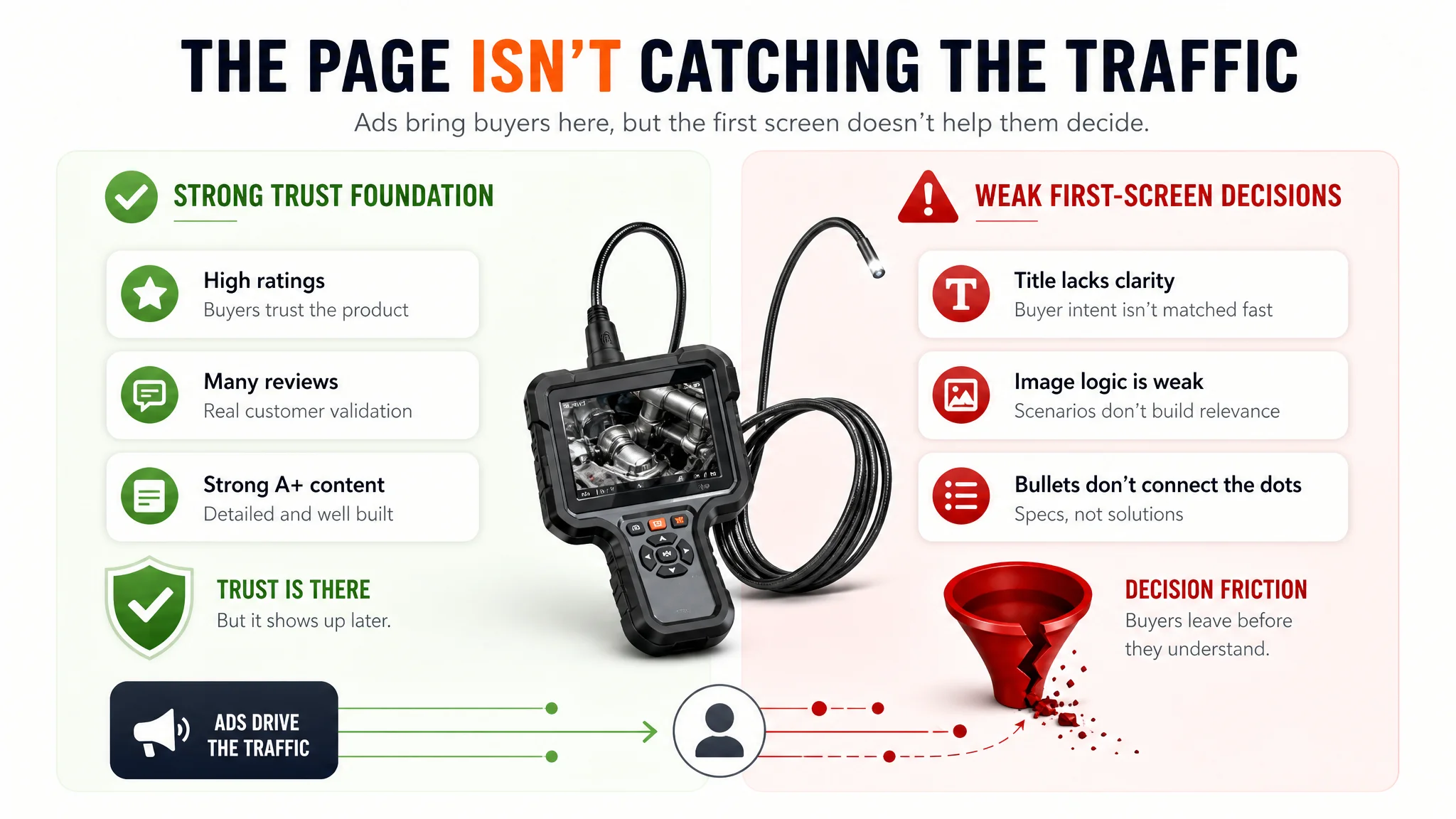
The practical value of this positioning becomes clearer when a listing appears healthy on the surface but still fails to convert advertising traffic efficiently. In one industrial-tools project, the borescope listing had a 4.7-star rating, 437 reviews, strong A+ content, and a DeepBI score of 79/100 compared with 81/100 for a benchmark competitor. The team initially saw little reason to change the page and focused instead on keyword expansion, campaign structure, and bid adjustments.
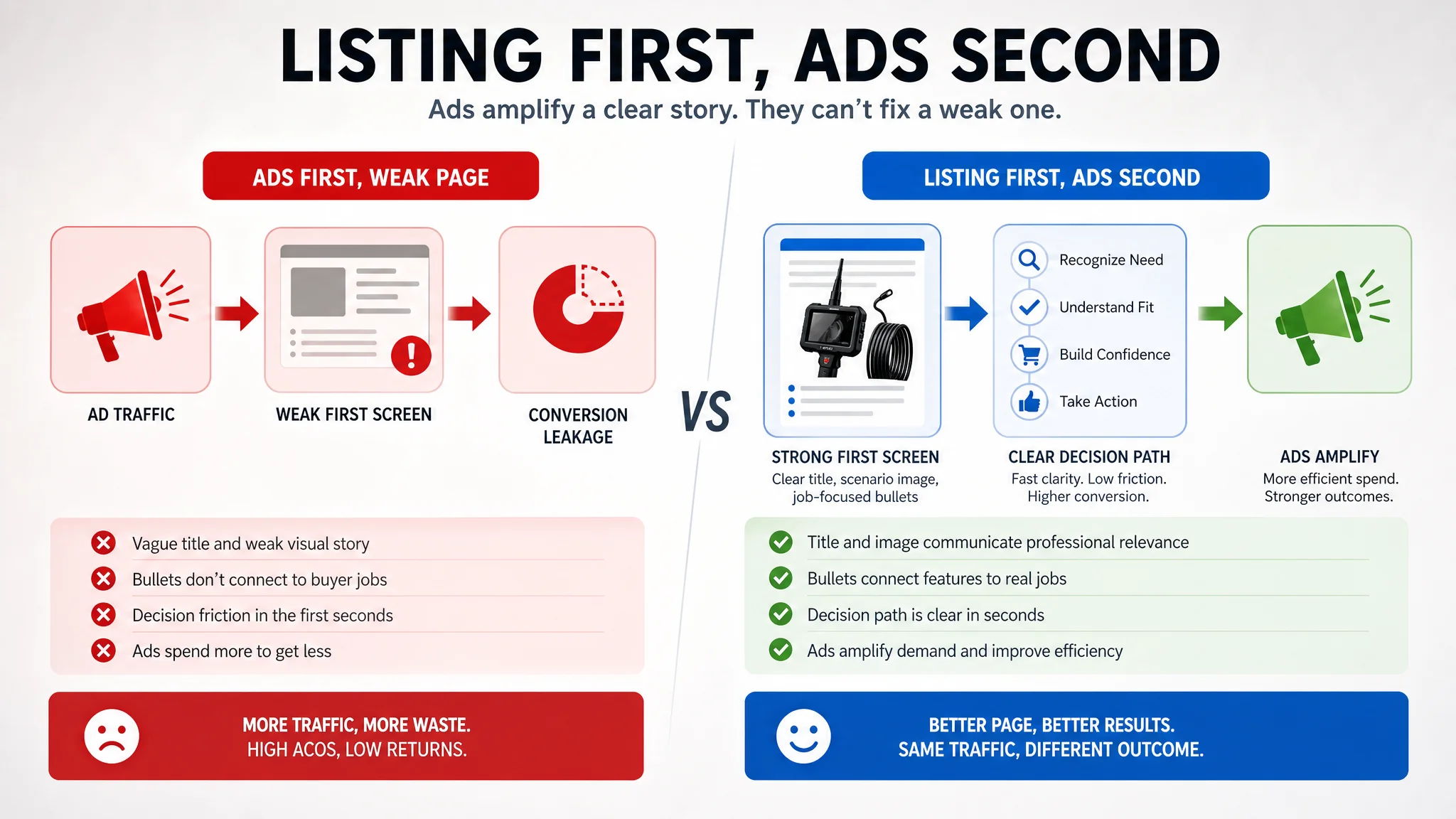
The diagnosis pointed elsewhere. The listing did not have an obvious trust or traffic problem; its front-half decision path was weaker. The title, main-image logic, and bullets were not aligned closely enough with how professional buyers searched, scanned, and evaluated the product. This distinction matters because advertising can bring shoppers to a page, but it cannot make a vague title clearer or turn a list of specifications into a convincing job solution. A useful Amazon tool must therefore help sellers identify not only where traffic comes from, but also what happens after the click.
What's Driving Amazon Product Demand in 2026
Consumer Behavior Shifts Post-2025
Amazon demand is increasingly shaped by consumers who evaluate more than price, convenience, and visual appeal. Health and wellness concerns influence 58% of U.S. food purchases, while 80% of consumers check product processing labels before buying. These signals raise the standard for product selection and listing communication: sellers must understand which benefits shoppers value, how those benefits are expressed, and whether the product can support credible, transparent claims.
Sustainability and transparency are also becoming stronger purchase considerations. Shoppers increasingly expect clearer information about materials, processing, sourcing, and product impact. For sellers, these expectations affect not only product-market fit but also the content required to earn attention and trust. A listing that ignores relevant buyer concerns may lose CTR or CVR even when the underlying product is competitive.
The same principle applies in technical categories, although the decision criteria look different. Industrial buyers may care about probe diameter, cable length, waterproofing, viewing angles, or screen quality, but those specifications matter because of the jobs they enable. A 3.9mm probe is more meaningful when the page shows how it enters a narrow mechanical gap. An 11.5-foot semi-rigid cable is more persuasive when the listing explains how it helps inspect pipes, wall structures, or engine compartments.
Intuition alone cannot reliably detect these shifts across crowded categories. Sellers need research that connects search behavior, competitor positioning, listing language, and performance signals. AI-driven trend detection is becoming important because it can organize large volumes of market information and identify recurring attributes faster than manual review.
DeepBI supports this approach by reverse-engineering titles and bullet points, extracting core search terms, comparing market benchmarks, and analyzing stable advertising signals such as impressions, clicks, conversions, CTR, CVR, TACoS, and ACoS. Its scoring service is designed as an automated market health check rather than a simple score, helping sellers replace subjective inspiration with a measurable evidence chain before committing to a product or listing direction.
A score alone, however, should not be treated as a final commercial judgment. The borescope example showed why: the overall score gap against the benchmark was only two points, yet the competitor had a meaningful advantage in title clarity and bullet-driven decision logic. The client’s A+ content and review volume were stronger, but those strengths appeared later in the buying journey. This kind of distribution matters because buyers often decide whether to continue evaluating a product before they reach the strongest parts of the page.
The Real Story Behind Amazon's Market Share in 2026
- Unverified market-share sources: Some online sources claim that Amazon controls 60% of the market. That figure is not supported by the materials provided and should not be treated as an established fact. Using an inflated estimate can distort decisions about product selection, advertising budgets, competitive intensity, and growth expectations.
- eMarketer projection: eMarketer projects Amazon's market share at approximately 41% by 2026. This is a more defensible reference point for evaluating Amazon's position. It still represents a substantial concentration of consumer demand: sellers do not need to capture the entire marketplace to build a meaningful business, but they do need to identify and win a focused share within a relevant category.
- DeepBI Listing Product Documentation (merged edition): The documentation frames Amazon as a highly competitive marketplace where traffic costs are rising and broad, poorly matched comparisons create wasted resources. It supports a disciplined workflow based on relevant competitor benchmarks, measurable gaps across listing assets, and business metrics including impressions, clicks, orders, CTR, CVR, ACoS, and TACoS.
- DeepBI capability materials: The platform's value is not based on assuming that Amazon's scale guarantees success. Its role is to help sellers convert a large marketplace into specific decisions: which competitive weaknesses to address, which listing improvements may support CTR or CVR, and how to connect visual iteration with subsequent advertising data. The opportunity is therefore substantial, but capturing it requires focused analysis rather than relying on headline market-share claims.
A marketplace with substantial demand also creates a higher cost for imprecise positioning. In the borescope listing, the seller was already competing for overlapping search terms with a strong benchmark. More traffic would not automatically resolve the problem because the page sent mixed signals: it could appear to be a professional inspection tool or a general-purpose gadget. The issue was not the size of Amazon’s opportunity, but whether the listing could claim a clear and relevant position within it.
High Demand Products to Sell on Amazon Right Now
Visible demand can identify promising categories, but it cannot establish competition, conversion potential, or profitability. External estimates should be treated as research inputs, then validated through comparable ASINs, listing gaps, CTR, CVR, price bands, and audience fit.
Beauty & Personal Care Winners
Acne patches illustrate the signal: external tools reportedly show Mighty Patch at approximately 182,000 units sold. That figure is not a guarantee. DeepBI’s Listing analysis can compare visual hooks, titles, bullets, reviews, and trust signals to determine whether a new offer can earn clicks and conversions.
Kitchen & Home Essentials
Owala FreeSip is reported in public product data with approximately 113,315 reviews, indicating substantial buyer attention and established competition. Sellers still need to assess differentiation, price, and listing quality. DeepBI helps benchmark comparable ASINs rather than treating one bestseller as proof of opportunity.
Tech Accessories & Electronics
High search activity and strong BSR can attract sellers to chargers, cases, and related accessories, but crowded results often compress margins. DeepBI’s Listing workflow filters comparable products by form, function, audience, and price before identifying gaps that may affect CTR and CVR.
Health & Wellness Products
Health-related demand can be attractive, yet claims, trust, reviews, and compliance-sensitive messaging influence conversion. External keyword or category data should be validated against competitor listings. DeepBI can quantify differences across images, copy, A+ content, and customer feedback without promising sales.
Pet & Baby Categories (with corrected market projection)
Public market reports project the baby-products market at approximately $212 billion in 2023 and $310 billion by 2030. Growth does not remove competition or inventory risk. DeepBI can connect category signals with listing gaps and conversion evidence before capital is committed.
Seasonal & Trending Items
Seasonal products may show sudden search and BSR movement, but short demand windows increase stockout and overstock risk. Sellers should verify trend persistence and listing readiness. DeepBI’s in-page insights and competitor diagnosis can surface keyword, content, and review gaps before launch.
Across all of these categories, product demand is only one part of the opportunity. Sellers must also ask whether the listing explains the product in the way the intended buyer makes decisions. In a technical category, the relevant gap may not be a missing feature. It may be that a feature is present but positioned too late, described too generally, or disconnected from the buyer’s actual job.
How to Find the Best Products with DeepBI: A Data-Driven Approach
Turning Best Sellers Lists into Actionable Insights
Amazon Best Sellers lists are useful for spotting demand, but they are not product decisions. Validate shortlisted ideas against BSR movement, price range, review depth, use case, and competitive density. Movers & Shakers and other early signals can reveal emerging interest, while keyword data helps test whether demand is broad, seasonal, or concentrated around a few terms.
A similar discipline is needed when evaluating an existing product. A listing with high ratings and substantial review volume may appear to be a strong candidate for more advertising, but those signals do not prove that the first screen is competitive. The borescope page had more reviews than its benchmark and a higher star rating, yet its title placed the core product term too late and its bullets emphasized specifications more than professional outcomes. Best-seller or review data can establish market attention, but it cannot replace a page-level diagnosis.
Product Opportunity Explorer Meets AI Diagnosis
Product Opportunity Explorer can frame the opportunity by comparing demand, search behavior, and competition. DeepBI then helps validate the Listing against genuinely comparable ASINs rather than only the category leader. Its workflow benchmarks main images, titles, bullets, A+ content, and customer feedback, producing granular gap findings instead of a single quality score. Sellers can examine BSR analytics and performance data alongside these findings to prioritize opportunities.
AI diagnosis is most useful when it connects a weak Listing dimension to a KPI: a weak visual hook may warrant CTR work, while weak trust content or feature communication may warrant CVR work. Sellers still need to validate margins, compliance, and product feasibility.
The value of multidimensional diagnosis is that it can reveal where a score is being won or lost. In the borescope analysis, the overall gap was narrow, but the distribution was uneven: the client’s A+ content was stronger than the benchmark, while the title and bullets lagged. The main image had acceptable raw quality but a weaker scenario anchor. That finding was more actionable than simply concluding that the listing was two points behind.
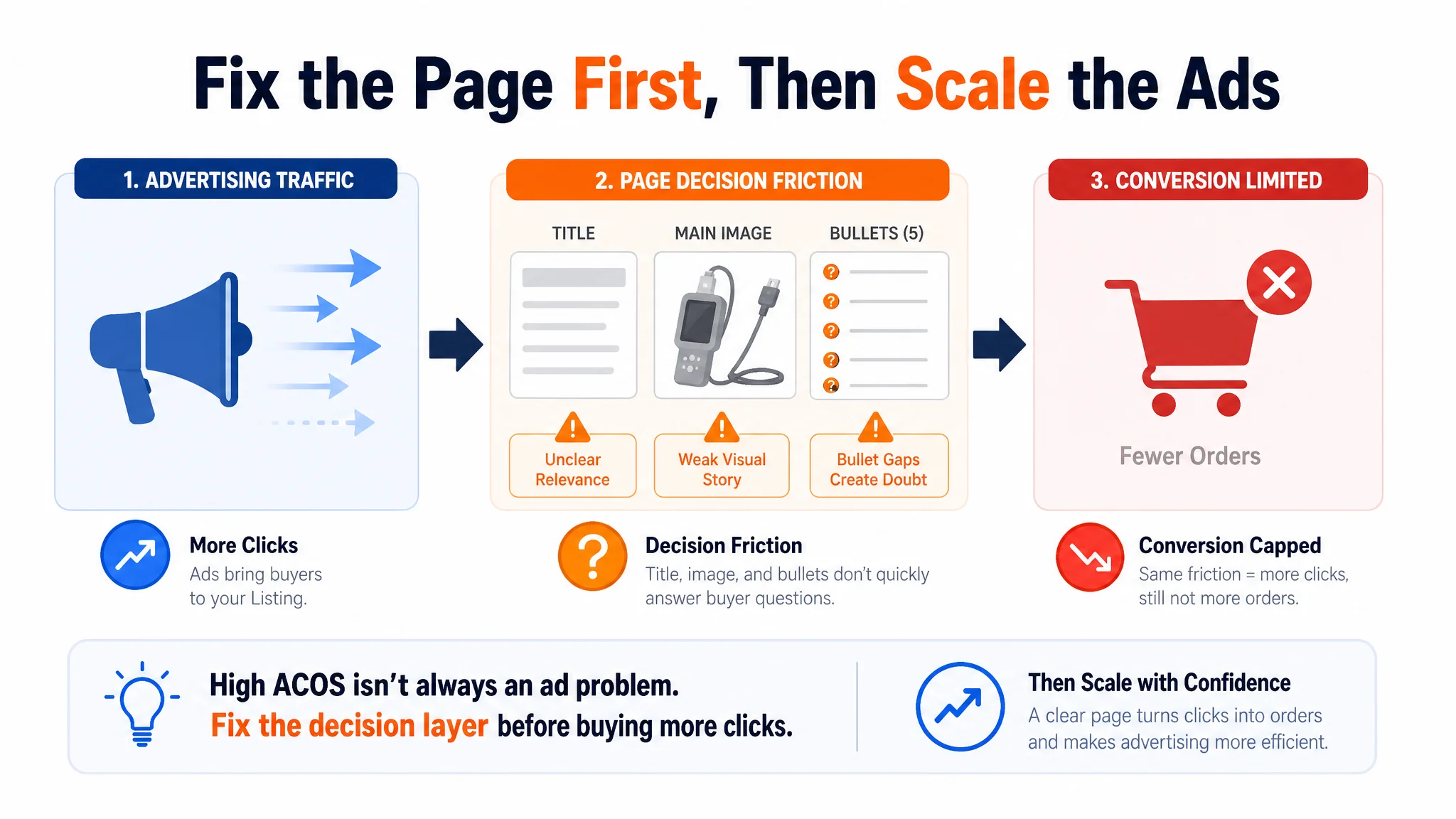
The initial team assumption was that stubborn ACOS and weak click-to-order performance required more keyword expansion and bid adjustments. The diagnosis showed that increasing traffic before correcting the title, main image, and bullet logic would mainly expose more shoppers to the same decision friction. This is where AI analysis can support commercial judgment: not by making the decision automatically, but by clarifying whether the apparent advertising problem is actually a page problem.
Mining Customer Reviews for Product Gaps
Reviews expose recurring objections, missing information, and mismatches between customer expectations and the Listing. DeepBI’s feedback analysis can compare rating distribution, review volume, and the trust value of image reviews. Sellers must interpret these signals before changing the product or its claims.
Review volume should also be interpreted in context. The borescope listing had 437 reviews and a 4.7-star rating, which initially suggested that customer trust was not the main constraint. Yet DeepBI still identified a relative weakness in the professional depth of the review content. More importantly, the strongest conversion gap appeared before shoppers reached the review section. This shows why reviews should be analyzed as one layer of the decision path, not used as proof that every other layer is working.
A page can have credible social proof and still fail to answer basic pre-purchase questions. For this product, buyers needed to understand whether the probe could enter narrow spaces, whether the screen supported real-time inspection without a phone, and where the cable length and waterproofing mattered. If the title, images, and bullets do not make those answers easy to find, review strength may arrive too late to repair the initial hesitation.
Tracking Early Trends with Real-Time Data
Real-time in-page insights can surface overlooked keyword strategies, competitor positioning, and review gaps as research develops. Used with Best Sellers, Product Opportunity Explorer, and Movers & Shakers data, they turn fragmented signals into a prioritized research queue rather than an automatic product verdict.
This same process can reveal whether a competitor is winning through a genuinely superior product or through clearer communication. In the borescope comparison, the benchmark was not simply offering more features. It framed similar capabilities around industrial jobs, time savings, cost avoidance, and reduced uncertainty. Its title led with terms such as “3.9mm Endoscope Camera,” “1920P HD,” and “4.3-inch IPS Screen,” while its bullets followed a pain-solution-value structure.
That comparison changes the optimization question. Instead of asking only which keywords have demand, the seller can ask which language helps the intended buyer recognize the product’s relevance quickly. Data becomes more useful when it connects search behavior to the exact content and visual decisions that influence CTR and CVR.
Smart Selling Strategies for Sustainable Profits
Why Margins Matter More Than Sales Volume
High sales volume can conceal weak economics when advertising costs, returns, storage, and fulfillment reduce contribution. As planning benchmarks—not guarantees—many sellers use 15–20% net margins and 25–30% gross margins to assess whether growth is sustainable. DeepBI does not promise these outcomes, but its data can support better decisions by connecting demand, listing quality, and advertising efficiency. ACoS, CVR, CTR, and BSR should be reviewed alongside unit economics rather than treated as isolated success signals.
The relationship between advertising efficiency and listing quality is particularly important. When a page has weak early-stage decision logic, additional clicks can increase costs without addressing the reason shoppers hesitate. The industrial-tools seller initially treated high ACOS as an advertising problem because the listing looked strong in aggregate. However, the analysis found that the title, main image, and bullets were not communicating professional relevance quickly enough.
This does not mean that every high-ACOS listing has a content problem. It means sellers should distinguish between a traffic bottleneck and a conversion bottleneck before allocating more budget. If clicks are reaching the right audience but the page fails to establish relevance, bid changes may optimize the cost of sending shoppers to an underperforming decision path rather than improve the underlying economics.
Listing Optimization That Converts and Ranks
A listing must satisfy both Amazon search relevance and shopper decision-making. DeepBI’s Listing engine uses keyword DNA: verified product attributes remain fixed while high-frequency, high-click, and high-converting terms receive greater emphasis. It can generate titles, bullets, and A+ content that combine search-optimized phrasing with conversion elements such as clear benefits, readable structure, and pain-point-to-solution logic. Competitive benchmarking also exposes gaps in titles, bullets, images, and A+ modules. Used with CTR and CVR data, these findings can guide priorities without guaranteeing organic ranking gains.
The borescope diagnosis demonstrates why these elements need to be assessed as a connected system. The client’s original title put the brand name first, emphasized “Dual Lens” without making it the primary search differentiator, and included a broad phrase such as “Gift for Men” that diluted the professional positioning. The benchmark more directly connected the core product term with image quality, screen size, quantified specifications, and mechanic-oriented use cases.
The bullets created a similar gap. The client’s copy was technically accurate but focused heavily on attributes and accessories. The competitor connected each feature to a job or payoff: a thin probe to access in tight spaces, an independent screen to avoid dirtying a phone and support on-the-spot analysis, and a long cable to reach difficult inspection areas. The difference was not simply better wording. It was a different decision structure.
This is why a feature should not be treated as persuasive merely because it appears on the page. “Dual lens,” “IP67,” or “11.5-foot cable” becomes commercially meaningful when the buyer understands what problem the feature solves. DeepBI’s recommended workflow translates specifications into a job script:
- Dual lens and 1920P clarity: explain how two viewing angles support inspections in narrow or complex spaces.
- 4.3-inch IPS screen: position the display as an independent tool for real-time analysis rather than a technical specification alone.
- 11.5-foot semi-rigid cable: connect length and flexibility to pipes, walls, engines, and other working environments.
- IP67 waterproofing and adjustable LEDs: show how durability and visibility support inspections in wet or dark areas.
- Accessories: explain how included hooks, magnets, and other components assist with specific retrieval or inspection tasks.
The same logic applies to images. The client’s main-image set had acceptable aesthetics and even a slightly higher raw score than the benchmark, but its scenario anchoring was weak. Product-only imagery, multi-panel compositions, and information spread across several images required shoppers to swipe and interpret before understanding the product’s core use case. The competitor used stronger industrial contrast and clearer scenes of the probe entering mechanical gaps, allowing buyers to understand the tool’s purpose more quickly.
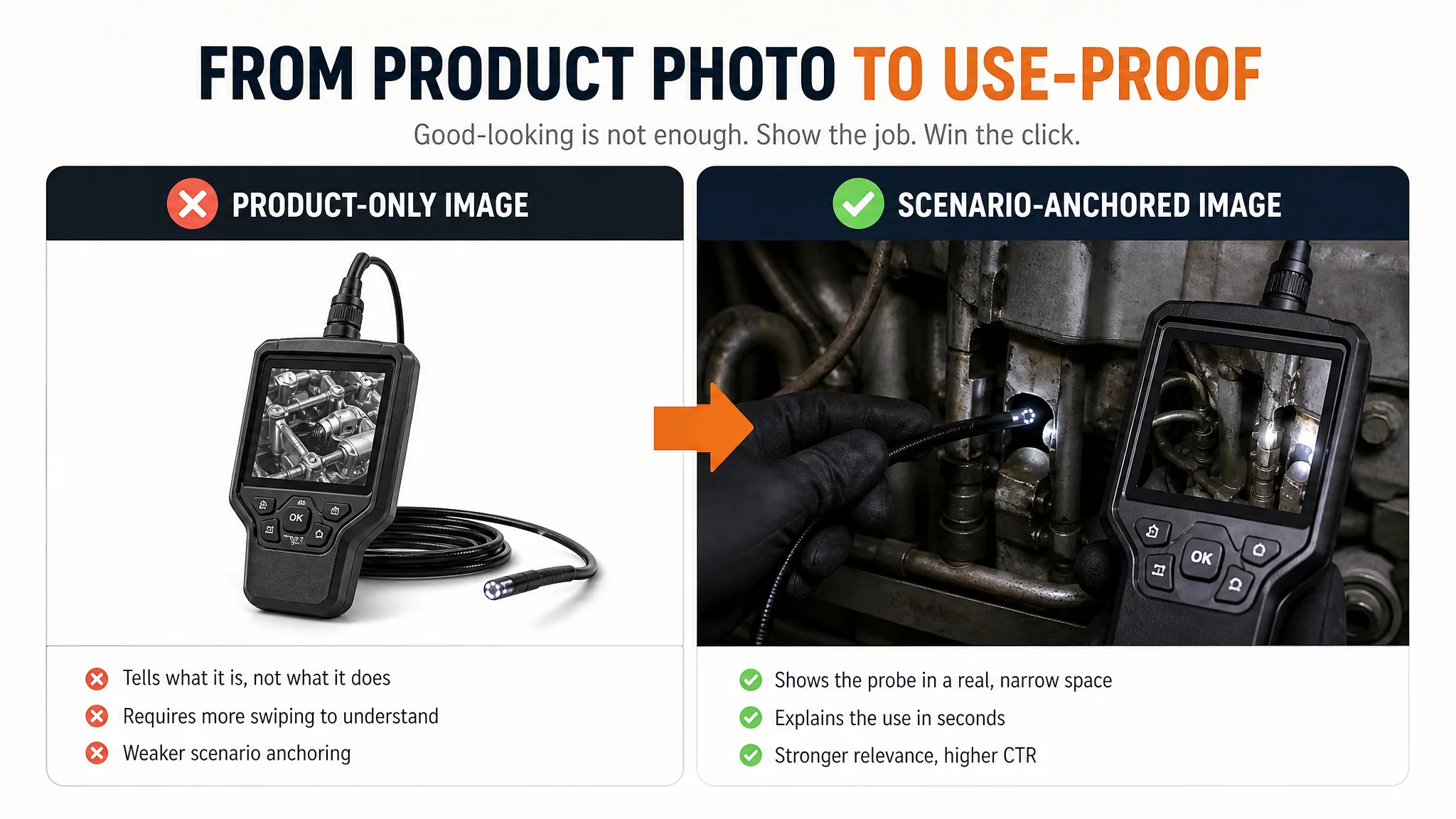
A useful visual optimization process therefore asks more than whether an image looks polished. It asks whether the image answers, almost immediately:
- What is this product?
- Who is it for?
- Where can it be used?
- What problem does it solve?
- Why is this version worth considering?
A+ content remains important, but it should not be used to compensate for weak first-screen communication. In this case, the A+ modules were already stronger than the benchmark, with real-world scenes involving cars, appliances, air conditioning, and pipes. The recommendation was not simply to add more content. It was to align the existing content around the dual-lens promise, visual proof of front and side views, screen clarity, waterproofing, cable flexibility, and the completeness of the tool kit.
That sequencing matters. A+ content can deepen conviction, but the title, main image, and bullets usually have to earn the shopper’s continued attention first.
Product Bundling and Inventory Smarts
Bundling can create differentiation, raise perceived value, and reduce direct comparison. DeepBI is not a standalone bundling tool, but competitor benchmarking may reveal successful complementary-product structures for further evaluation. Its dynamic market and advertising signals can also flag demand spikes or high-performing attributes, helping sellers review inventory risk before a stockout damages BSR and listing momentum. This is demand awareness, not full inventory forecasting or replenishment management. The Ads bridge is similarly limited but useful: ACOS and high-converting keyword data can help validate whether a product or listing merits further testing.
The borescope example also shows that perceived value is not created only through additional components. The listing already included a tool kit, but the optimization work focused on explaining what buyers could do with the accessories, such as retrieving lost items with a hook or magnet. Clear presentation of what is included can reduce last-mile uncertainty, but it should support the central professional positioning rather than distract from it.
Similarly, advertising signals should be interpreted alongside the page’s ability to communicate value. If high-converting search terms reveal strong demand for a specific use case, the listing should make that use case visible and understandable. Otherwise, the seller may be paying to acquire interest that the content fails to convert.

DeepBI Verdict: Fit, Risks, and Next Steps
DeepBI is worth considering when the primary constraint is not basic keyword discovery, but the quality and repeatability of Amazon listing decisions. Its specialist workflow combines keyword research, multidimensional semantic analysis, similarity-based competitor benchmarking, AI-powered listing diagnosis, and execution-oriented optimization. It can assess titles, bullets, images, A+ content, and customer feedback, then connect those findings to content and visual changes.
The industrial borescope example illustrates the type of problem the platform is designed to address. The seller did not have a visibly broken listing. Ratings were high, review volume was substantial, A+ content was strong, and the overall score was close to the benchmark. Yet advertising efficiency had reached a ceiling because the front section of the page did not make the product’s professional value clear enough.
The team initially responded as though the problem were advertising structure: expand keywords, refine campaigns, and adjust bids. DeepBI’s diagnosis reframed the issue as listing conversion capacity. The benchmark’s advantage came from title clarity, scenario-focused visuals, and bullets that connected features to jobs, time, and money. Once those layers were prioritized, advertising could function as an amplifier of a clearer product story rather than a patch for weak messaging.
The strongest fit is a data-driven seller, brand, or technical team focused on improving listing quality and aligning organic growth with advertising signals. For example, weak CTR may justify deeper main-image diagnosis, while weak CVR may indicate problems with listing messaging, A+ content, or buyer trust. Connecting these decisions to CTR, CVR, ACoS, and BSR is more useful than relying on a generic listing score. DeepBI’s Amazon-only focus and AI-driven execution add specialization, but the system remains an execution layer—not a replacement for human strategy or every seller function.
One important qualification is that a narrow score gap does not necessarily mean a narrow commercial gap. A listing may outperform a competitor on reviews or A+ content while losing the first-screen decision in search results. Sellers evaluating DeepBI should therefore look beyond the total score and examine which dimensions influence the buyer’s earliest decisions. The purpose of the tool is not just to report that a page is close to a benchmark, but to identify where that closeness conceals a meaningful weakness.
The main risk is overbuying complexity. Complete beginners seeking a plug-and-play, multi-platform suite may prefer a broader and simpler tool. Sellers who need only basic research may also find DeepBI’s specialist depth excessive. The available materials do not provide independent review patterns, ratings, user counts, or testimonials, so its case should be judged by workflow fit rather than rating signals.
Before starting a trial, identify the bottleneck: keyword coverage, competitor benchmarking, low CTR, low CVR, listing cycle time, or inconsistent optimization. If listing intelligence is the constraint, DeepBI is more compelling; if not, a lighter tool may be the better choice. For sellers with high ACOS, the first diagnostic question should be equally specific: is the problem that the right shoppers are not arriving, or that the page does not help them decide once they arrive?
Frequently Asked Questions
Is DeepBI a broad multi-platform marketplace suite?
No. DeepBI is positioned as an Amazon-focused system for cross-border sellers and brands. Its workflows center on Amazon Listings, A+ content, advertising reports, and Amazon SP-API delivery rather than serving as a general tool for multiple marketplaces. That specialist focus is relevant for sellers who want Amazon-specific analysis, including multidimensional semantic analysis, competitive benchmarking, and AI-powered listing diagnosis.
Can DeepBI quantify and optimize advertising performance?
DeepBI can connect advertising signals such as impressions, clicks, conversions, CTR, CVR, TACoS, and ACoS to listing diagnostics. High-converting search terms or product attributes can inform recommendations for titles, images, and other listing elements. After an approved change is published, the system can tag the event in advertising reports, helping sellers evaluate its relationship to metrics such as CTR.
However, DeepBI does not replace advertising strategy or guarantee improved CTR, CVR, ACoS, or BSR. Sellers still need to set objectives, interpret market conditions, allocate budgets, and decide which recommendations to apply.
A listing diagnosis can also prevent sellers from treating every advertising problem as a campaign problem. In the borescope project, the seller saw stubborn ACOS and weaker-than-expected conversion and initially responded with more keyword and bid work. The page-level analysis showed that the traffic was being sent into a title, image sequence, and bullet structure that did not quickly communicate professional relevance. The appropriate sequence was to improve the page’s early decision path before using advertising to scale it.
This does not mean that page optimization automatically solves advertising inefficiency. It means that sellers should evaluate the entire path from search term to click to first-screen comprehension to conversion. Advertising data can identify where performance is weak; listing diagnosis can help explain why.
Does DeepBI make decisions for the seller?
No. Its stated role is an executor and analysis system, not the final creator or decision-maker. Recommendations depend on inputs such as scoring reports, product constraints, advertising data, and authorized Amazon access. Human review remains necessary before publishing or changing an optimization direction. The organic traffic growth strategy (5th funnel layer) can support broader growth planning, but human judgment remains essential to determine whether a proposed action fits the product, brand, and commercial priorities.
For technical products in particular, human review is needed to confirm that specifications, use cases, claims, and compliance-sensitive language are accurate. AI can identify that a competitor connects a feature to a stronger buyer outcome, but the seller must still decide whether that outcome is true, supportable, and appropriate for the product.
Ultimately, DeepBI is most valuable when it improves the quality of the question being asked. Instead of asking only how to acquire more traffic, sellers can ask whether the title, images, bullets, A+ content, and reviews create a coherent decision path for the intended buyer. That shift helps prevent a common Amazon mistake: using advertising to amplify a listing before the listing is ready to convert the attention it receives.