

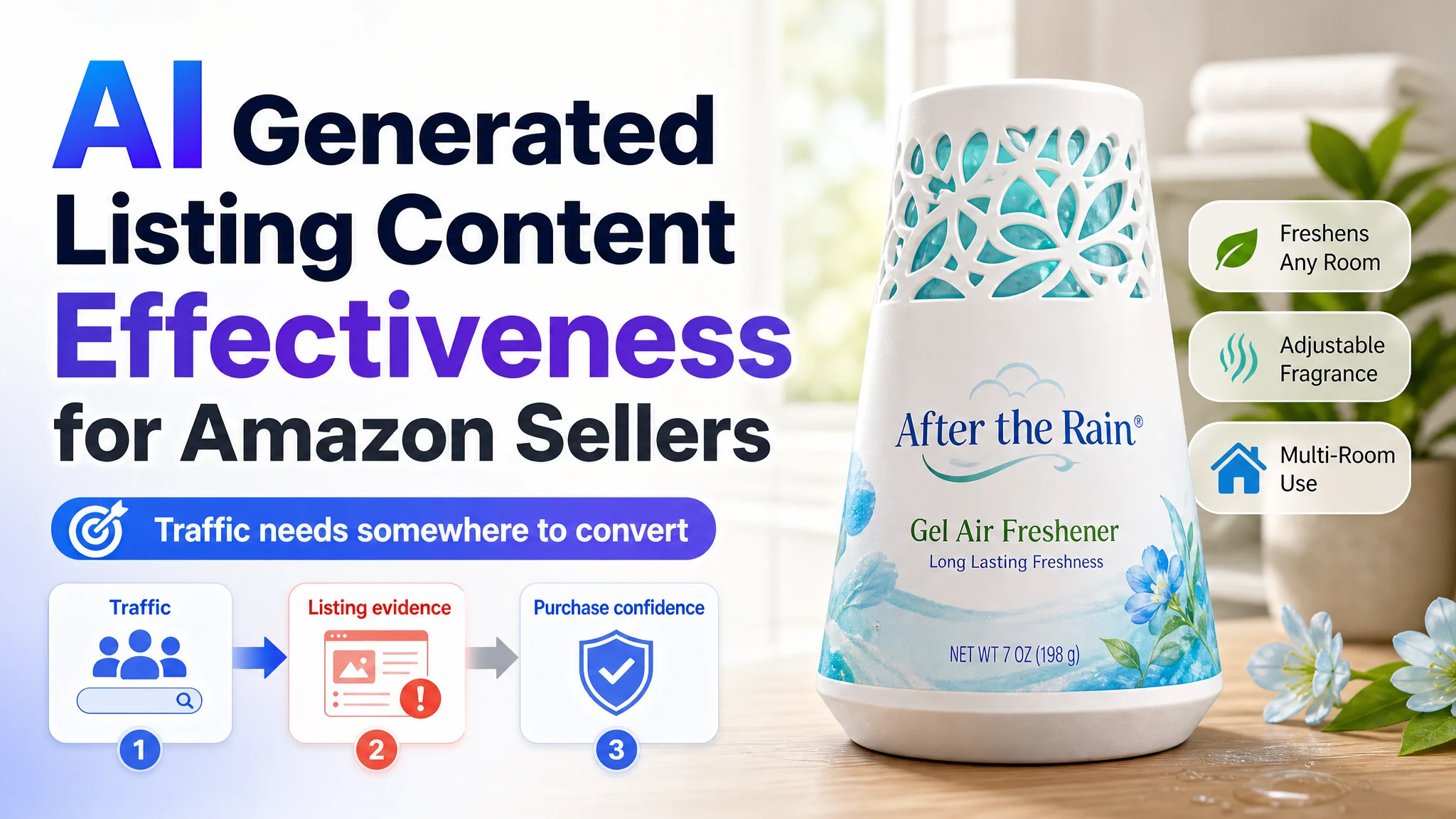
The New Shopping Era Demands Smarter Listing Content
Product discovery is no longer limited to scanning Amazon search results and opening listings one by one. Adobe reported a 3,300% surge in traffic from generative AI, highlighting how quickly AI-assisted discovery is becoming commercially relevant. The authority of Adobe’s analysis makes the signal difficult for sellers to dismiss, even though it does not imply that every shopper has adopted these tools.
Consumers are also changing how they research products. Some compare product options through ChatGPT, while others ask Amazon Rufus questions to narrow choices, evaluate features, or identify the best fit. Tinuiti research found that 34% of consumers planned to use ChatGPT for shopping-related research; this should be read as a meaningful segment, not evidence that most consumers already shop this way.
The business risk is straightforward: a listing written only for human scanning may fail to communicate its key advantages when interpreted by an AI assistant. Vague claims, scattered specifications, incomplete use-case information, and outdated images can reduce the chance that a product is accurately compared or recommended. Weak interpretation can ultimately affect CTR, CVR, ACoS, and BSR.
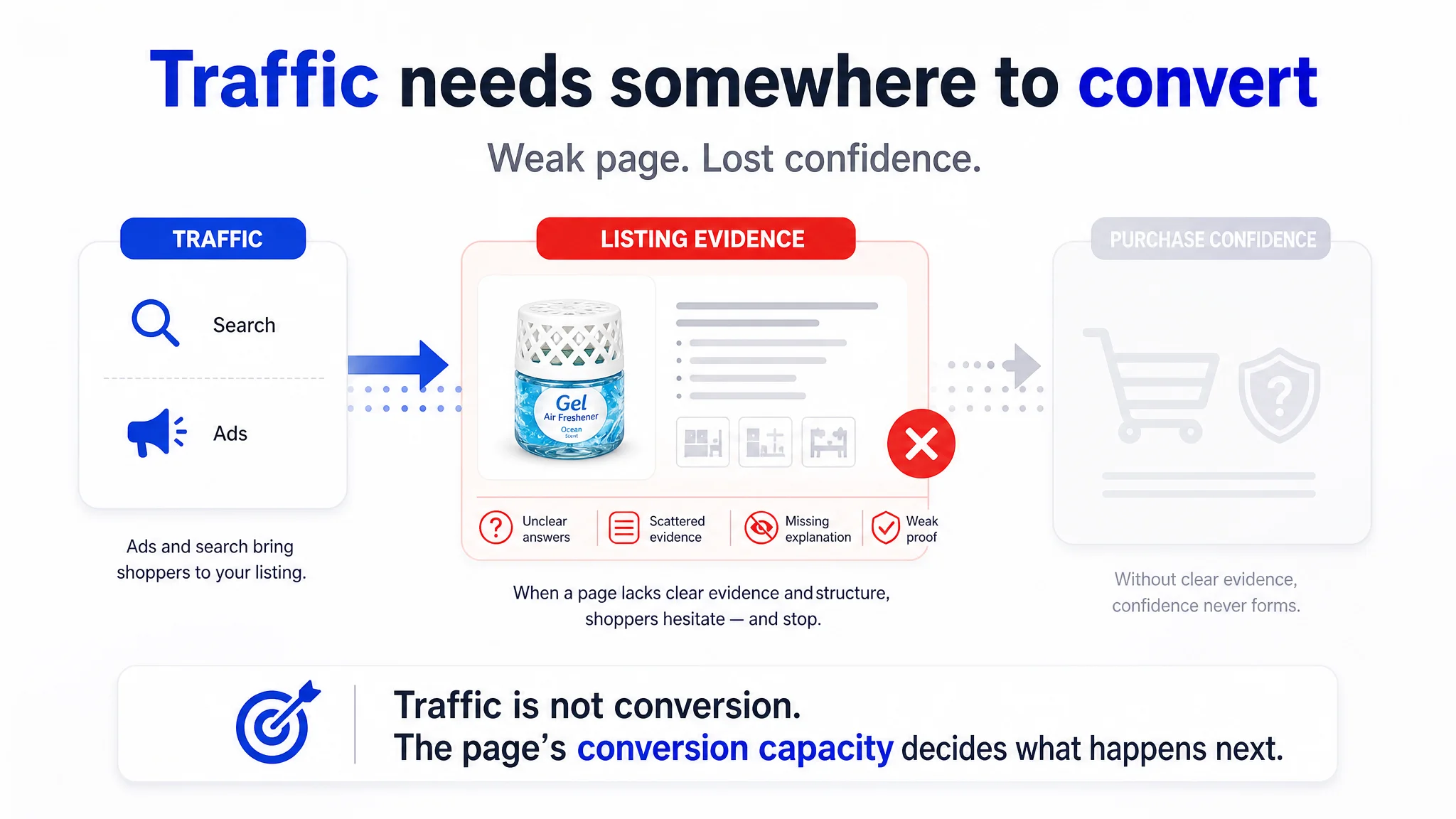
This risk is not limited to AI-assisted discovery. A conventional shopper can also struggle when a listing identifies a product without explaining how it works or why it fits a specific need. In one US marketplace listing for a gel air freshener, the product could be recognized from the page, but the title, images, bullets, and A+ content did not create a connected path from recognition to purchase confidence. The team initially leaned toward reinforcing freshness claims, multi-room use, and brand history. A deeper diagnosis found that the more fundamental issue was the page’s missing sales logic.
Sellers should therefore treat listing content as structured commercial data, not one-time copy. Titles, bullets, images, A+ content, and supporting details need clear relationships, concrete product facts, and regular refreshes. AI-generated content is not a novelty added to the workflow; it is a necessary response to AI-driven shopping behavior and to the broader need for listings to communicate clearly at every decision point.
What "Effective" AI-Generated Listing Content Really Means
AI can produce a title, bullet points, image direction, or A+ draft quickly. That speed is useful for reducing listing cycle time and creating an initial optimization direction, but it does not prove commercial effectiveness. A draft becomes campaign-ready only after human review confirms the product facts, brand voice, marketplace requirements, and intended customer promise.
Effective listing content should be judged by its ability to support the Amazon funnel. Sellers should examine:
- CTR: Does the main image and title earn qualified clicks?
- CVR: Does the detail page make the product’s value, use case, and evidence easy to understand?
- SEO quality: Are relevant keywords placed naturally, with readable structure rather than keyword stacking?
- Information hierarchy: Can shoppers quickly identify the primary benefit, supporting proof, and key constraints?
- Compliance and accuracy: Are claims, materials, dimensions, functions, and performance statements confirmed?
- Differentiation: Does the listing address meaningful gaps against genuinely comparable products without copying unsupported claims?
The main risk is confusing content volume with business impact. More generated variations may increase output, while unclear messaging, weak trust signals, or product-image mismatch can undermine CVR, CTR, and advertising efficiency.
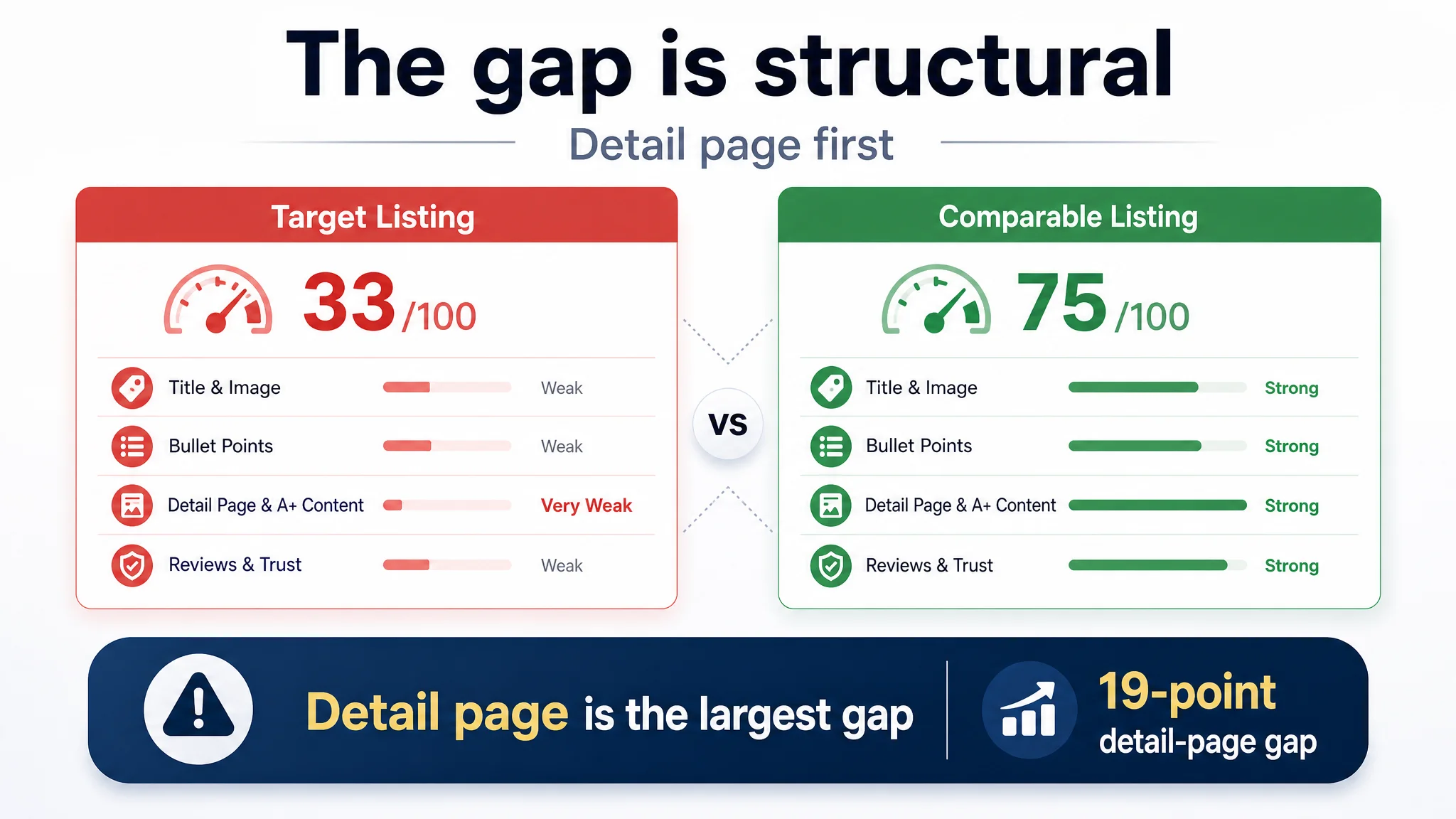
A real listing diagnosis illustrates why these measures need to be considered together. The gel air freshener listing had the basic elements expected on an Amazon product page: a product image, title, bullet points, descriptive content, and reviews. Yet the page scored 33 out of 100 against 75 for a comparable high-performing listing. The largest gap was in the detail page and A+ content dimension, while the main image and reviews also lagged behind.
The page was not empty. It was incomplete at several decision points. The title did not clearly establish the product category, the thumbnail did not answer basic questions about size or placement, the bullets made broad promises without showing how the product delivered them, and the A+ content repeated information instead of developing a visual explanation. The 3.9-star rating and 26 total reviews also provided a weaker trust base than the comparable listing’s 4.3 stars and 207 reviews.
This distinction matters when evaluating AI-generated content. The goal is not to produce more claims or more design variations. The goal is to make each content element perform a clear commercial role and connect with the elements around it.
Measurement also requires clean inputs. Incorrect localization, currencies, rankings, or inconsistent account data can produce misleading conclusions about content performance. Treat relationships between listing changes and metrics as diagnostic hypotheses, then verify them against account data. When evidence is limited, report qualified observations rather than unsupported conversion, ACoS, or BSR improvement percentages.
A Systematic Approach to AI-Powered Listing Optimization
From Guesswork to Benchmarking: Diagnose Before You Generate
AI-generated listing content is only as effective as the diagnosis behind it. DeepBI connects listing scoring, similarity-based competitor benchmarking, strategy, generation, validation, and execution instead of treating them as separate tasks.
The importance of diagnosis becomes clear when a team is already looking at a listing that appears to contain enough information. The gel air freshener page did not have a single missing sentence that could explain its weak conversion capacity. Its title, images, bullet points, A+ content, and reviews were each carrying part of the buyer’s decision, but they were not working together.
The customer’s initial direction focused on strengthening individual claims such as lasting freshness, multi-room use, and brand history. Those messages were not irrelevant, but they did not resolve the more basic questions a shopper still had:
- What exactly is the product?
- How is the fragrance released?
- Can the intensity be adjusted?
- Where can the product be placed?
- How long does it last?
- Why should the shopper trust this specific format?
DeepBI’s diagnosis showed that the issue was not simply weak copy. The listing lacked a connected path from product recognition to purchase confidence. The 19-point gap in the detail-page dimension was larger than the gap in any other individual area, which changed the order of priorities. The diagnosis pointed toward a coordinated repair across search clarity, visual explanation, functional communication, and trust-building.
For example, a fictional health-equipment seller may have a technically accurate main image that provides little usage context, while its A+ modules repeat the same product benefits. DeepBI can identify these module-level gaps, compare the listing with relevant ASINs based on product type, price range, audience, and use case, then translate the findings into specific actions. Those actions might include clarifying the usage scene, improving information hierarchy, and assigning distinct roles to each A+ module.
Success can be evaluated through audit scores, benchmark gaps, content completeness, information density, CTR, CVR, exposure, clicks, orders, and advertising-cost metrics such as ACoS. These indicators create a testing basis rather than a guaranteed result.
AI-Powered Content Creation That Respects Your Brand DNA
Generation follows strategy rather than replacing it. DeepBI uses a Product DNA representation to preserve product structure, materials, logo placement, brand colors, and functional components. Competitor assets inform composition, lighting, and market style, but do not become templates for copying. Text and visual assets are also cross-checked against product information so claims remain aligned with confirmed specifications.
This distinction is especially important when the product’s value depends on showing a mechanism or use context. In the gel air freshener diagnosis, the word “Adjustables” appeared in the existing product information but did not explain what could be adjusted. A generated title could repeat the word, but repetition alone would not make the function understandable. The content direction therefore needed to show the adjustable cone being twisted or set to control fragrance intensity.
The same principle applied to the image sequence. The proposed assets were not simply additional product images. Each image was assigned a specific job: identify the gel format and scent, establish size and placement, demonstrate operation, support the continuous-release concept and stated duration, and confirm a relevant household use case. AI can accelerate the production of those assets, but the strategy must come from an understanding of the buyer’s unanswered questions.
Generation should also preserve product boundaries. A comparable listing may use room scenes, pet-related context, or multiple product formats, but those elements should not be transferred automatically to another ASIN. In the gel air freshener example, the stronger direction was to focus the A+ content on the specific After the Rain gel cone rather than introduce unrelated scents or formats that could dilute product relevance.
Closing the Loop with One-Click Execution
After review, approved assets can be applied through Amazon SP-API and mapped to the appropriate main-image, secondary-image, or A+ placement. This replaces manual downloading, renaming, and sequential uploading with a connected delivery process. Published visual changes can then be linked to advertising reports, allowing sellers to observe CTR movement after an iteration and refine the next optimization cycle.
The value of connected execution is not only speed. It also reduces the risk that the approved strategy is weakened during manual implementation. If the first image is intended to establish product identity, the second to provide size context, and another to demonstrate operation, those roles need to remain clear when assets are mapped to the live listing.
Execution should still be controlled. The gel air freshener case did not provide post-optimization advertising results, so it would be inappropriate to claim a measured improvement in ACOS, CVR, or organic orders. The more defensible conclusion is that the diagnosis established a clearer basis for testing: first repair the listing’s information and trust gaps, then evaluate how traffic responds.
Building Responsible AI into Listing Content Strategies
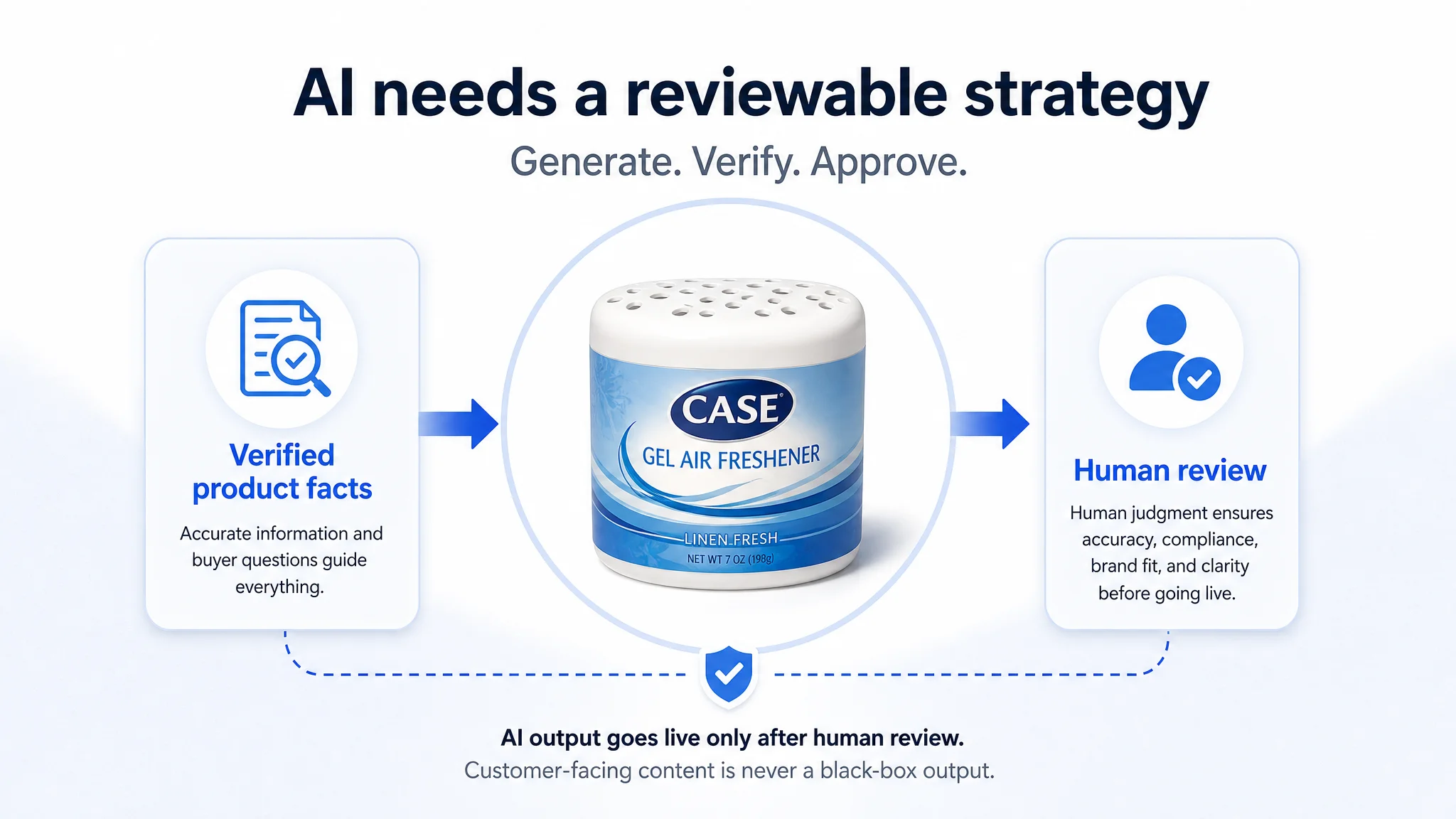
AI can accelerate listing creation, but customer-facing content cannot be treated as a black-box output. A title or bullet point may affect CTR, CVR, BSR, and ACoS, while an unsupported claim can create compliance exposure, customer disappointment, or negative reviews. Responsible use therefore starts with deliberate application: use AI where it extends structured analysis and production, while keeping clear oversight and brand-safety controls.
For AI-generated titles and bullet points, every recommendation should be traceable. Sellers need to understand which keyword rationale, competitor benchmark, customer pain point, or structural gap supports a proposed change. Benchmarks should be relevant to the product, audience, price range, and market position rather than copied from mismatched competitors. The system should also avoid inventing specifications, materials, functions, or performance claims that are not verified.
The gel air freshener diagnosis shows why this matters. The proposed title direction clarified the product as an “Adjustables Gel Air Freshener, After the Rain Scent, 7 Ounce.” The value of this revision was not keyword insertion alone. It made the product category, form, scent, and size easier to interpret. At the same time, the page needed to explain what “Adjustables” meant rather than leave the shopper to infer the function.
The same discipline applied to performance language. The image and A+ recommendations could support the stated continuous-release concept and the claim of up to three weeks of freshness, but they should not promise more than the product material supports. Responsible optimization makes existing value more legible; it does not manufacture stronger value through more confident wording.
DeepBI supports this reviewable workflow through diagnostics that identify where a listing loses quality across areas such as the title and bullet points, then connect each gap to an actionable optimization plan. Its approach treats AI as an executor of structured strategy, not an independent decision-maker. Product information and defined constraints guide generation, while the reasoning behind each change remains available for review.
Human participation is still required for proofreading, factual and compliance checks, positioning accuracy, and final brand judgment. Teams should compare proposed content with the original listing, verify every claim, and approve only changes that represent the product truthfully. The strongest operating model is not AI instead of expertise, but AI accelerating and extending expert work without removing accountability.
From Listing Quality to Advertising Efficiency - The Conversion Bridge
How Optimized Listings Reduce Wasted Ad Spend
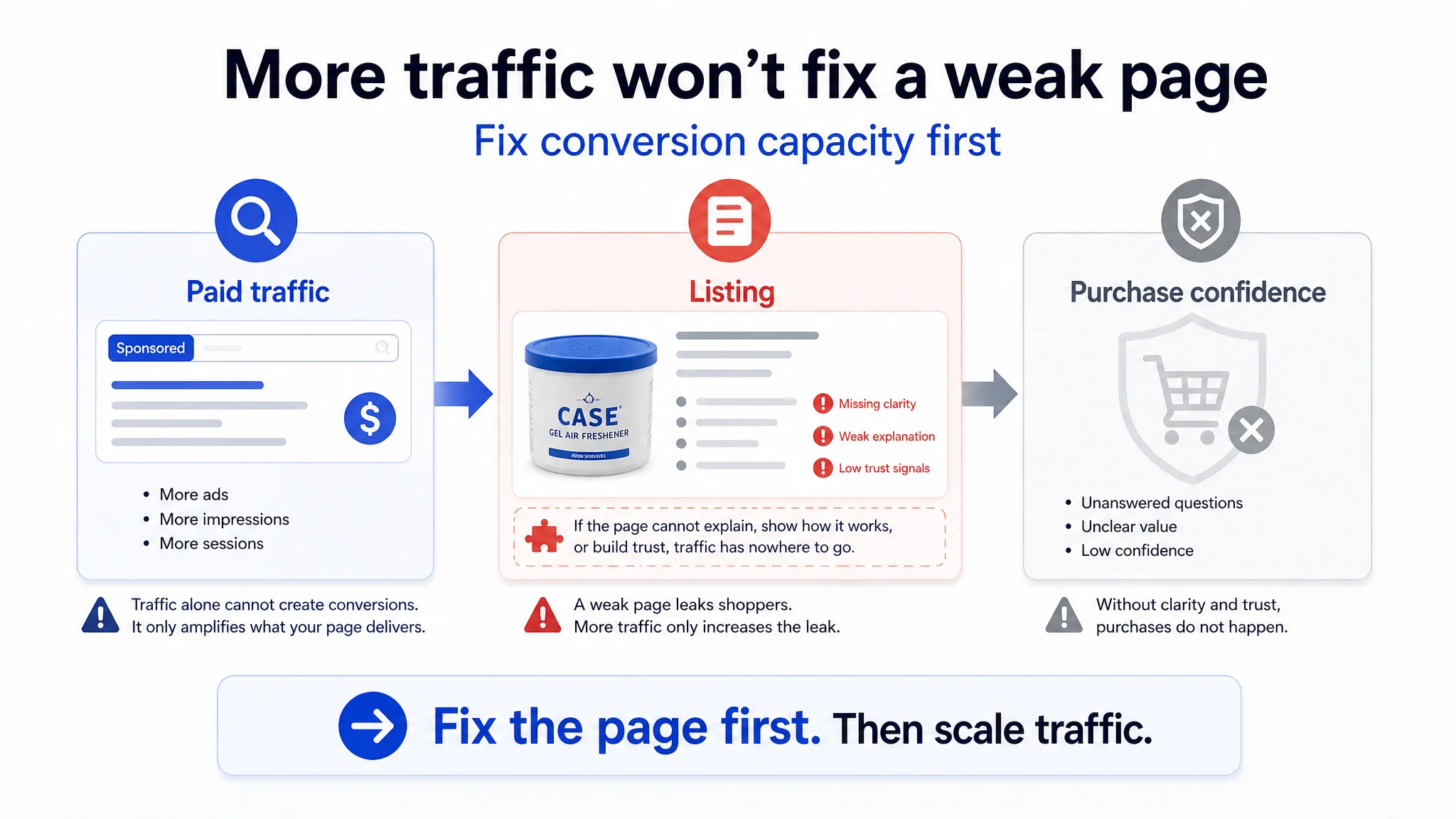
Paid traffic does not convert in isolation. It lands on a listing, and the listing must quickly confirm that the product matches the shopper’s search intent. When information is poorly structured or important keywords are buried, relevant shoppers may hesitate, weakening CTR and CVR while increasing the risk of wasted ad spend. A stronger listing gives advertising traffic a clearer destination and helps support healthier ACoS.
This is where sellers frequently misdiagnose the bottleneck. A listing may receive traffic, but that does not prove that the page is prepared to convert it. The gel air freshener seller initially leaned toward reinforcing product claims, while a broader diagnosis found that the page lacked the sales logic needed to move shoppers from recognition to understanding, trust, and purchase.
The page was not necessarily failing because the advertising entrance was irrelevant. It was failing because the destination did not answer practical questions quickly enough. More impressions would not resolve the missing core phrase “Gel Air Freshener” in the title. More clicks would not explain how the adjustable mechanism worked. More sessions would not compensate for an A+ section that repeated information instead of building confidence.
Consider a seller whose advertising data shows that “fast charging” is a high-converting keyword. Instead of treating the phrase as an isolated search term, the seller can revise the bullet points around the underlying offer: lead with the fast-charging benefit, support it with a verified product attribute, and explain the customer problem it solves. This structure connects the keyword, product value, and shopper need without inventing a new claim. The resulting ad destination is more precisely aligned with the traffic being purchased.
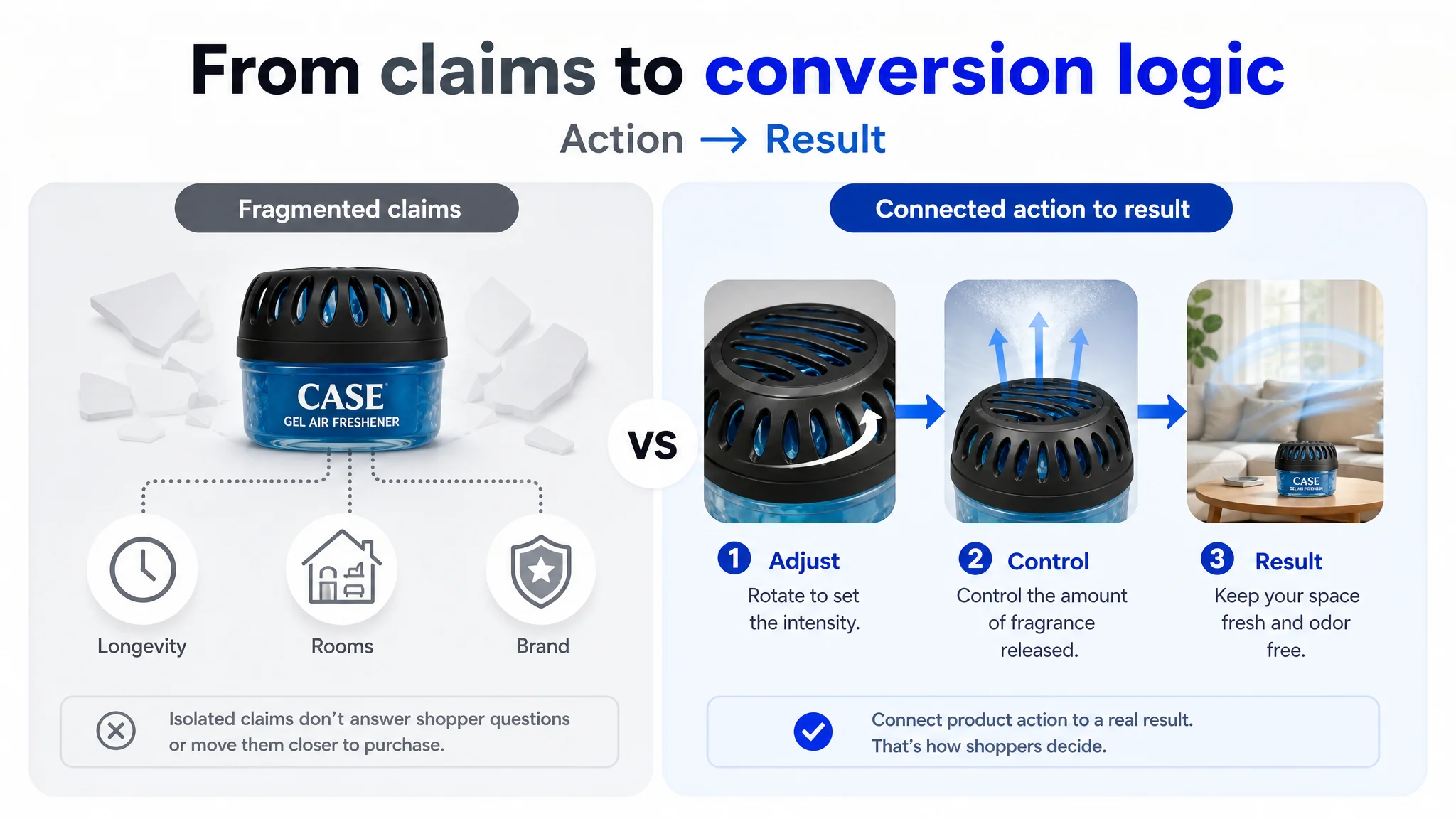
The same action-to-result logic was needed in the air freshener listing. Its existing bullets moved between longevity, room use, and brand history. The stronger proposed sequence was:
1. Adjust the product.
2. Control the amount of fragrance released.
3. Address unwanted odors.
4. Leave behind a clean, refreshing scent.
This sequence made the product’s function easier to understand because it connected a physical action with a practical outcome. It turned broad claims into a more coherent explanation of how the product works.
This is the conversion bridge between Listing and Ads. Listing optimization clarifies the promise and places relevant terms where shoppers can understand them; advertising signals then reveal which value themes deserve further refinement. DeepBI’s Ads module may be used with a four-layer funnel model to help identify higher-quality traffic, while its Listing capabilities connect those signals to keyword weighting and content priorities.
The practical action is to evaluate CTR, CVR, and ACoS together rather than judging ad performance separately from listing quality. A high ACoS signal should not automatically be treated as a bidding problem. If the page is difficult to search, interpret, or trust, campaign changes may only obscure the underlying content constraint.
Better-aligned content can help sellers convert paid traffic more efficiently and reduce advertising waste. But the appropriate conclusion must remain evidence-based: diagnose whether the listing can receive and convert traffic before deciding how aggressively to scale that traffic.
Future-Proofing Your Content Strategy
Amazon listing content cannot be treated as finished once it is published. As Cosmo, Rufus, and related algorithms evolve, semantic quality, product accuracy, and compliance will matter increasingly alongside keyword coverage. Weak or ambiguous content can reduce relevance, constrain CVR, waste ad spend through poorer conversion, and make it harder to improve CTR, ACoS, or BSR through later optimization.
The need for continuous diagnosis also applies to listings that appear complete. The gel air freshener page contained the expected content components, but those components did not form a complete buying system. Its title, images, bullets, A+ content, and reviews each answered part of the shopper’s decision, while important questions remained unresolved between sections.
A durable approach combines AI assistance with human governance. AI can help diagnose gaps, structure recommendations, and accelerate content execution, but people must confirm product facts, brand consistency, customer-facing claims, and Amazon requirements before changes go live. Human review is not an optional safeguard when generated content represents a product to customers.
The strongest systems are not purely black-box generators. DeepBI, for example, links listing diagnosis to an evidence chain across the main image, title, bullets, detail page, and reviews. Its structured constraints and one-to-one mapping between identified gaps and executable recommendations make the reasoning more inspectable. The workflow also supports user confirmation, comparison of new and existing assets, and selective replacement rather than unchecked wholesale changes.
A useful way to maintain this system is to treat every listing element as part of a buyer-question sequence:
- What exactly is this product? The title and first image should establish the category, format, scent, size, or other essential identity information.
- Will it fit where I need it? Images and A+ content should provide appropriate scale and placement context.
- How does it work? Bullets and visuals should demonstrate the relevant mechanism rather than rely on an unclear product label.
- What will it do? The listing should connect product actions and verified attributes with customer outcomes.
- How long will it last? Any duration or performance statement should be presented clearly and within the limits of the supporting product information.
- Can I trust this purchase? Reviews, brand history, visual consistency, and accurate product explanation should reinforce confidence rather than substitute for it.
This sequence does not mean every listing must use the same copy formula or image count. It means that content should be organized around the decisions shoppers need to make. In the air freshener example, brand history could support trust, but it was more useful after the specific product, mechanism, placement, and intended outcome had been established.
After launch, treat each update as an iteration point. Connect listing diagnostics with impressions, clicks, orders, CTR, and CVR, then use advertising feedback to reassess priorities. Continuous diagnosis, controlled execution, and measured iteration help reduce listing cycle time while protecting compliance and product accuracy.
The long-term goal is not a guaranteed ranking or one perfect draft. It is a managed content capability that can adapt as marketplace signals and business performance change. Before scaling paid traffic, sellers should first determine whether the listing can explain the product, demonstrate its use, support its claims, and build enough confidence for a purchase decision.
When the page is structurally ready, advertising has a clearer role: bringing qualified shoppers to an offer they can understand. When it is not, advertising may only make the listing’s existing weaknesses more visible.