


How the Amazon PPC Auction Works - The Second-Price Principle
Amazon PPC bidding becomes easier to manage once sellers separate two ideas: the maximum amount they are willing to bid and the actual cost charged for a click. These figures are related, but they are not automatically identical.
Amazon uses a second-price auction principle. The advertiser with the winning bid does not simply pay the full maximum bid. Instead, the winner generally pays slightly more than the next-highest competing bid, subject to the auction’s applicable conditions and increment. The maximum bid functions as a ceiling for what the advertiser is prepared to pay, not as a guaranteed cost for every click.
Consider a simplified example. Seller A submits a maximum bid of $2.00. The next-highest competing bid is $1.50. If Seller A wins the placement, the actual cost per click may be $1.51: one cent above the second-highest bid rather than the full $2.00 maximum. The $2.00 bid helped Seller A compete for the placement, while the $1.50 competing bid influenced the final CPC.
This distinction matters because a high maximum bid does not automatically produce a high ACoS, just as a low bid does not automatically produce efficient growth. Actual CPC depends on the competitive auction environment. When competition is weak, an advertiser may win while paying considerably less than the maximum bid. When competition is stronger, the clearing cost can move closer to the bid ceiling.
The practical implication is that sellers should evaluate bidding through outcomes, not bid values alone. A bid change should be assessed against:
- CTR: Is the ad earning enough visibility and clicks to justify its position?
- CVR: Do those clicks convert at a rate that supports the traffic cost?
- ACoS: Is the actual CPC producing profitable or strategically acceptable sales?
- BSR and organic visibility: Is paid traffic contributing to broader product momentum?
- Campaign scalability: Can the campaign expand without allowing costs to rise faster than conversions?
This relationship between auction cost and page performance is particularly important when a seller believes that rising ad costs automatically indicate a bidding problem. In one US marketplace case, the seller saw advertising costs increasing, orders remaining unstable, and concluded that the ads were poorly optimized. However, the available Listing report contained no score for the title, main image, bullet points, A+ content, reviews, or competitors. There was no objective evidence showing whether the page could convert the traffic being purchased.
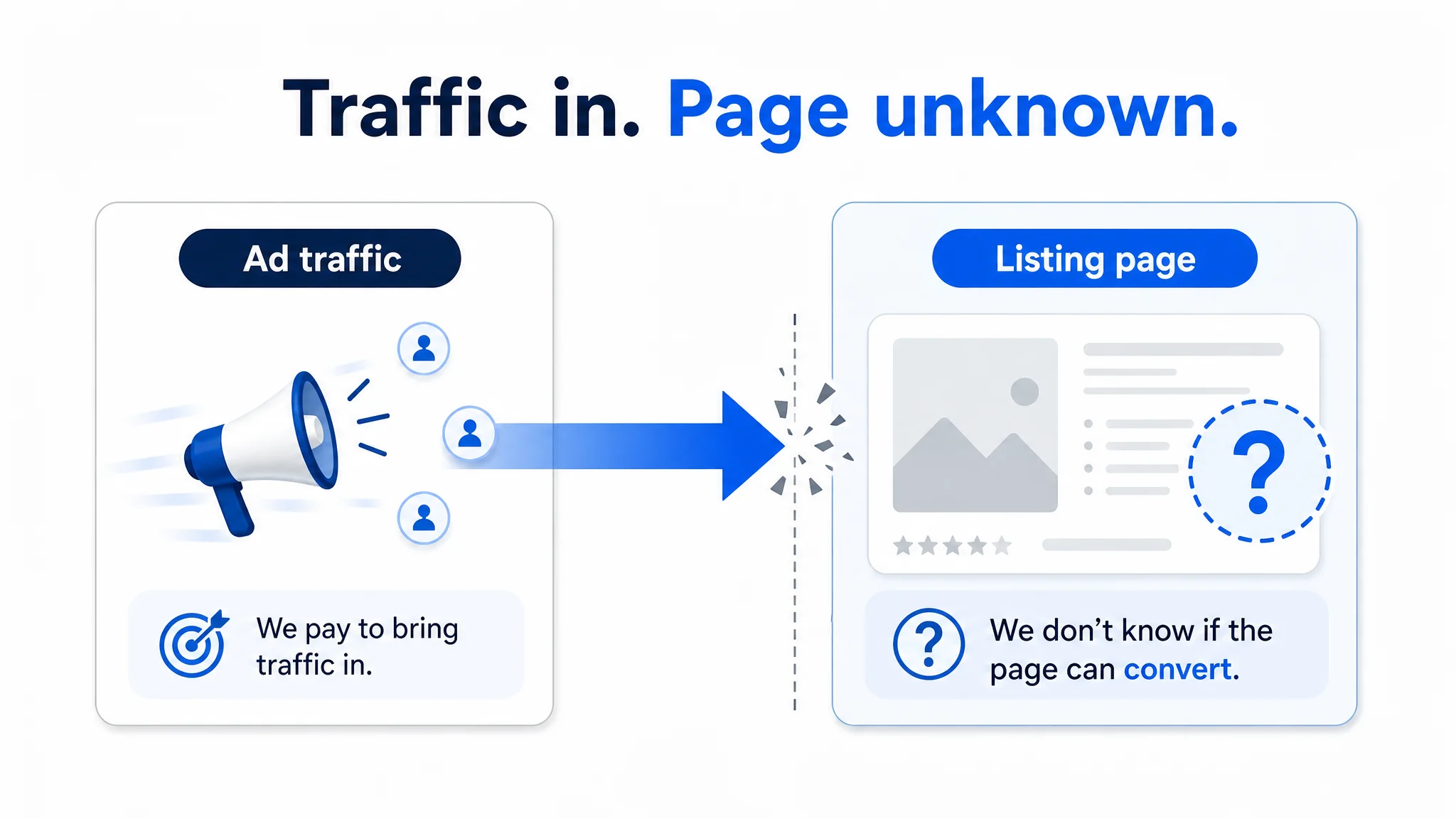
That meant the seller was not simply trying to optimize an auction. The team was sending traffic into a product page whose conversion capacity had never been diagnosed. Without knowing whether the page had a weak thumbnail, unclear value communication, insufficient trust signals, or a competitive content gap, changing bids could only alter the amount of traffic entering an unknown system.
The case illustrates why auction mechanics cannot be separated entirely from Listing quality. A bid may determine whether an ad can compete for exposure, but the product page determines what happens after the click. Treating every increase in ad cost as proof that bids are wrong can lead sellers to optimize the auction while ignoring a potentially more fundamental conversion constraint.
Understanding the auction also prevents a common management error: assuming that reducing every bid is the only way to control spend. A seller may lower a bid and lose valuable impressions, while the previous higher bid may have been charged at a much lower CPC than its ceiling. Conversely, raising a maximum bid can increase eligibility for competitive placements without guaranteeing a proportional increase in actual CPC.
Effective bid management therefore requires observing the relationship between the maximum bid, actual CPC, conversion performance, Listing quality, and profitability. The bid sets the boundary of participation; auction competition helps determine the price paid. The product page then determines whether that paid traffic has a reasonable opportunity to convert. That foundation allows sellers to adjust bids deliberately instead of treating the maximum bid as the advertising cost itself.
Bids vs. CPC: Decoding the Difference and Why It Matters
A bid and a cost per click (CPC) are related, but they are not the same metric. Confusing them can lead to inaccurate performance analysis, unnecessary bid increases, and poor decisions about ACoS or campaign profitability.
A bid is the maximum amount an advertiser is willing to pay for a click on an ad. It establishes an upper cost boundary for the auction. For example, if a keyword bid is set at $1.20, the advertiser is signaling that a click is worth up to $1.20 under the campaign’s targeting and profitability assumptions.
CPC, by contrast, is the actual amount charged for a click that occurs. It reflects the price produced by the specific auction conditions surrounding that impression, rather than simply repeating the maximum bid configured in the campaign.
When competition is relatively weak, the actual CPC can be substantially lower than the maximum bid. An advertiser may remain eligible for the placement without needing to spend the full amount available in the bid setting. When competition is intense, competing advertisers may place stronger bids, and the resulting CPC may move closer to the advertiser’s maximum. The gap between bid and CPC is therefore variable; it should not be treated as a fixed percentage or predictable standard.
This distinction changes how campaign data should be interpreted. A high bid does not guarantee a high CPC on every click, just as a low CPC does not prove that the bid is optimally calibrated. Repeatedly raising bids simply because impressions or clicks are limited can increase the campaign’s cost ceiling without resolving the underlying issue. Likewise, lowering bids solely because current CPC is low may reduce reach before the advertiser understands whether additional qualified traffic is available.
The same caution applies when a seller has limited Listing evidence. In the US marketplace case described earlier, the team was adjusting bids, budgets, match types, keyword lists, and campaign structures because advertising felt increasingly expensive. Yet the report offered no measurable Listing diagnosis: the total score, title score, main image score, bullet score, A+ score, review score, and competitor scores were all marked “N/A.”
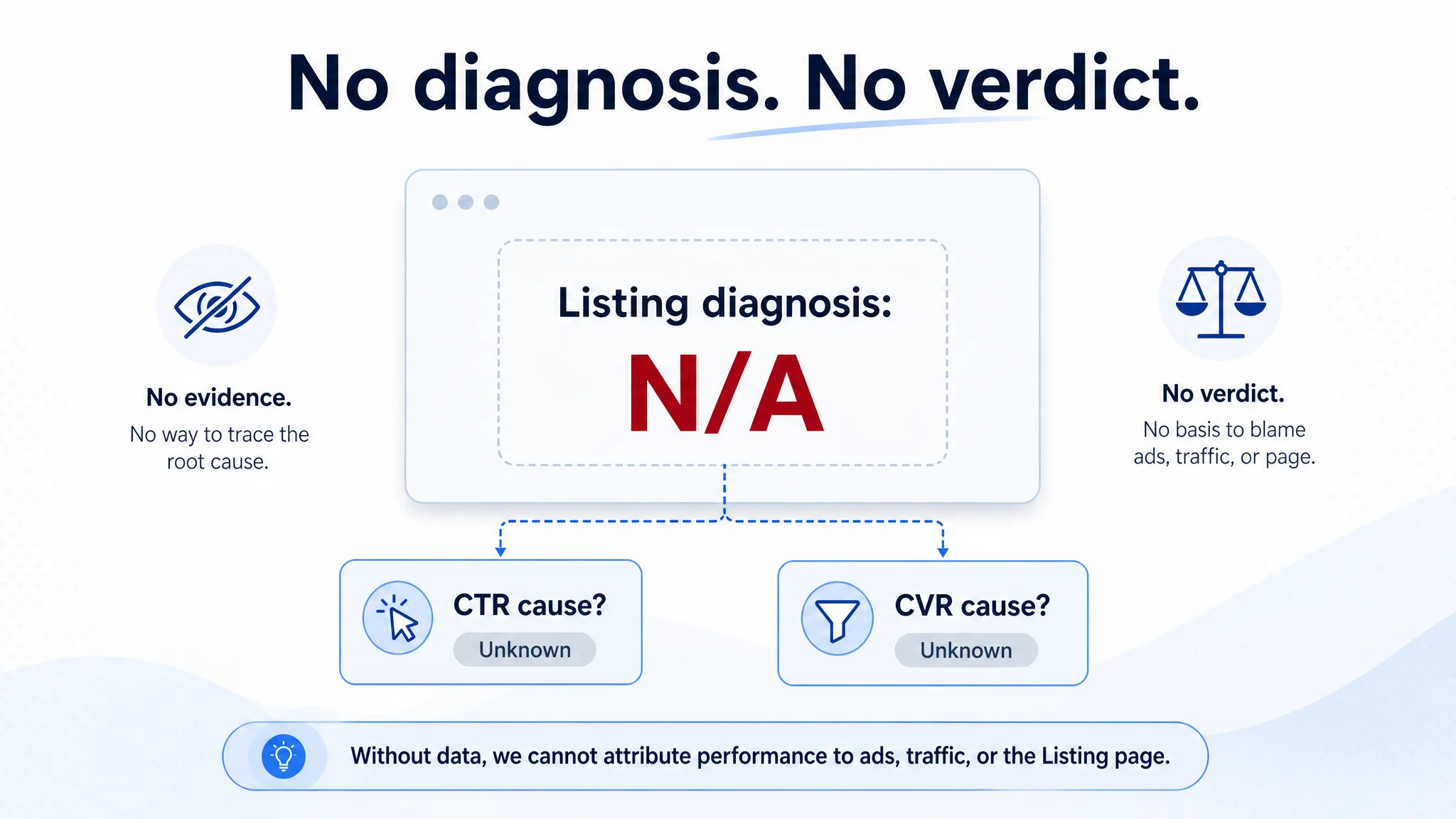
As a result, the team could not tell whether a weak advertising outcome was caused by auction economics, traffic relevance, or the page itself. They could not responsibly connect a possible low CTR to the main image or title, or a possible low CVR to bullets, A+ content, reviews, or trust. The missing information did not prove that the bids were correct, but it also did not prove that the bids were the primary problem.
Practical bid optimization starts by separating the two questions:
- Bid question: What is the highest amount the campaign can afford to pay for a click while supporting its target ACoS and contribution margin?
- CPC question: What price is the campaign actually paying, and how does that price relate to CTR, CVR, orders, and revenue?
- Listing question: Once the click occurs, does the product page provide enough clarity, relevance, and trust to support conversion?
The answer should be evaluated at the keyword, targeting, placement, and campaign levels where possible. A CPC that appears acceptable may still produce weak results if CVR is low. Conversely, a higher CPC may be commercially viable when CTR and CVR support profitable sales and contribute to stronger organic visibility or BSR. If the page has never been benchmarked, however, a low CVR should not immediately be treated as a bidding verdict.
Effective management therefore requires boundaries and evidence. Set bids according to the maximum acceptable economics, then assess actual CPC alongside conversion, profitability, traffic relevance, and Listing quality. Treating the bid as a cost guarantee obscures auction behavior; treating CPC as the bid itself obscures the role of strategic control. Ignoring the product page obscures whether the purchased click had a fair opportunity to become an order.
Key Elements That Shape Your Amazon Bidding and CPC
Product Lifecycle and Competitive Landscape
- Amazon bidding strategy guidance: Product lifecycle should determine how aggressively a seller bids. A new product often has limited conversion history, low organic rank, and few or no reviews. Those constraints can reduce organic visibility and weaken CVR, so higher initial bids may be necessary to generate impressions, clicks, and early conversion signals. The purpose is not to spend without limits, but to purchase enough relevant traffic to evaluate demand and support a path toward stronger BSR and organic placement.
- Amazon bidding strategy guidance: Mature products can usually rely more on historical performance. Established CTR, CVR, ACoS, conversion by keyword, and placement-level results provide a stronger basis for setting bids. Rather than maintaining launch-level aggressiveness, sellers can reduce bids where historical data shows that lower CPC still produces acceptable sales volume. This lifecycle distinction prevents one universal bid rule from being applied to products with fundamentally different levels of market evidence.
- DeepBI Listing Product Documentation: Competition should be evaluated through comparable market data, not assumed universal CPC benchmarks. Sellers should check the average CPC within their own category and compare relevant products using similarities such as function, use case, price range, audience, and market performance. DeepBI’s documented workflow connects advertising signals, including impressions, clicks, conversions, CTR, CVR, TACoS, and ACoS, with competitive benchmarking and Listing optimization. These signals can reveal whether a high CPC is supported by conversion or is simply purchasing inefficient traffic.
The need for competitive benchmarking becomes even clearer when a product page has no established diagnostic baseline. In the case with the blank Listing report, there was no validated benchmark competitor, no module-level comparison, and no quantified view of how the page stood against category leaders. The seller was therefore making advertising decisions without knowing whether the product page was competitive in the first place.
This is different from having weak performance data. Weak performance data can still be analyzed. A report filled with “N/A” removes the evidence chain needed to interpret that performance. Before deciding whether to bid more aggressively for a new product or reduce waste on a mature one, the seller must know what the page is capable of supporting. Product lifecycle influences bid strategy, but Listing readiness influences whether additional traffic can be evaluated meaningfully.
Placement Adjustments - The Full Three-Placement Picture
- Amazon advertising placement guidance: Amazon’s three core ad placements require separate bid consideration: Top of Search (First Page), Product Pages, and Rest of Search (Other Pages). Top of Search can capture high-intent visibility, but its premium traffic may produce a higher CPC and greater ACoS risk. Product Pages can support consideration alongside competing or complementary products, while results depend heavily on relevance, offer strength, reviews, and Listing quality.
- Amazon advertising placement guidance: Rest of Search should not be treated as an insignificant remainder. It includes the second page and later search pages, along with other available inventory. Increasing visibility there may provide lower-CPC exposure when performance supports it. Sellers should compare CTR, CVR, CPC, sales, and ACoS across all three placements before shifting budget or applying placement multipliers. A placement that appears less prominent may still contribute efficient discovery and conversion volume.
Placement analysis also depends on the page receiving the traffic. A Top-of-Search placement can create valuable visibility, but it cannot compensate for a main image that fails to communicate clearly at thumbnail size. Product Page traffic may expose a product to shoppers already comparing alternatives, but the destination Listing still needs to establish differentiation, answer objections, and provide trust.
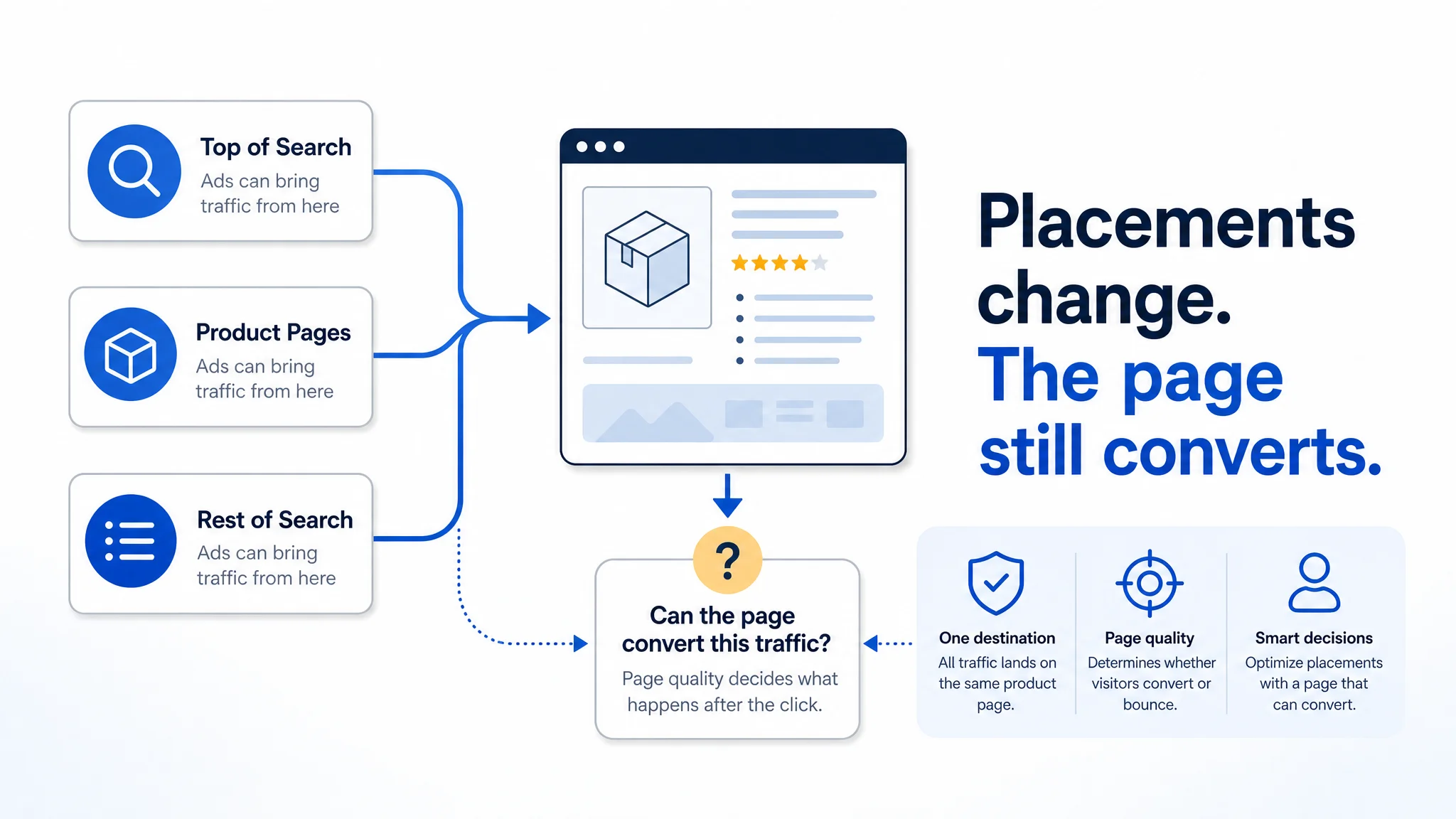
In the blank-diagnosis case, the seller’s advertising costs were rising and orders were unstable, but there was no evidence showing whether the page performed differently across placements. The absence of a main-image, title, bullet, A+, review, or competitor assessment meant the team could not determine whether a placement problem was actually a page problem appearing at a particular stage of the funnel.
That is why placement modifiers should not be evaluated only through CPC or ACoS. If one placement generates clicks but the Listing cannot convert those clicks, increasing or decreasing the modifier may move the symptom without resolving the cause. Placement data should be read together with page-level evidence.
Performance Thresholds and Dayparting Data Sources
- Amazon keyword performance guidance: A keyword receiving more than 10 clicks without a sale should be treated as a review trigger, not an automatic verdict. The seller should examine search-term relevance, Listing CVR, offer competitiveness, placement, and traffic quality. Depending on that diagnosis, the appropriate action may be to reduce the bid, refine targeting, improve the Listing, or pause the keyword. This threshold helps limit wasted spend while avoiding decisions based on a single click or an isolated short-term result.
- Amazon Marketing Stream and specialized hourly reporting tools: Dayparting should be based on hourly sales and advertising performance data rather than broad business reports. Amazon Marketing Stream or specialized tools such as DeepBI can provide the hourly signals needed to compare spend, clicks, conversions, CPC, CVR, and ACoS by time of day. Sellers can then concentrate bids during periods that support profitable conversion and reduce exposure during weak intervals. Any schedule should be reviewed against sufficient data and refreshed as performance changes.
A threshold such as more than 10 clicks without a sale is useful only when the seller investigates what happened after the click. If the Listing has not been benchmarked, the correct response may not be to pause the keyword immediately. The traffic may be irrelevant, but the page may also be failing to resolve buyer concerns. The threshold should trigger diagnosis rather than replace it.
This was the central difficulty in the blank-report case. The seller had been cycling through familiar advertising actions—adjusting bids and budgets, changing match types and keyword lists, shifting budgets between campaigns and ad groups, and waiting for the learning phase to produce better results. None of those actions could answer whether the page was conversion-ready. A reporting threshold could identify a symptom, but without Listing evidence it could not identify the cause.
Selecting Your Base Bid: Data-Backed Approaches for New and Mature Products
A base bid should be treated as a starting hypothesis, not a permanent setting. It determines how aggressively a campaign competes for impressions and clicks, but its value can only be judged through the quality and profitability of the traffic it generates. The calibration process should connect exposure, clicks, sessions, orders, CTR, CVR, CPC, ACoS, and sales rather than relying on bid level alone.
Launch Phase Bidding: Starting Strong
New products lack sufficient first-party campaign history, so the initial bid must combine market reference points with controlled testing. A practical starting approach is to set the bid slightly above the relevant category-average CPC, then refine it using comparable ASIN data. Comparable products can help establish a reasonable range for expected click costs, search competitiveness, and likely traffic quality.
This launch setting is not a promise of a particular number of sessions, orders, or ACoS. It is designed to create enough auction participation to collect useful evidence. If the bid is too conservative, the campaign may receive limited impressions and clicks, making it difficult to distinguish weak demand from insufficient visibility. If it is too aggressive, CPC and ACoS can rise before the Listing has demonstrated adequate CVR.
The first evaluation should therefore examine the complete traffic path:
- Are impressions producing qualified clicks and a healthy CTR?
- Does the traffic convert at an acceptable CVR?
- Is CPC rising faster than sales or contribution margin?
- Are search-term and placement results producing useful traffic, or mainly expensive sessions with weak purchase intent?
- Does the product page give those sessions enough clarity and trust to support a purchase decision?
The blank Listing case shows why this last question matters. The seller wanted to treat the situation as an advertising problem, but there was no score or benchmark for the page’s title, main image, bullets, A+ content, or reviews. The first task was therefore not to decide whether the launch bid should be higher or lower. It was to establish whether the page had the structural capacity to support the traffic being purchased.
As data accumulates, adjust the bid according to observed performance rather than treating the launch benchmark as fixed. Listing quality also matters: changes that improve CTR or CVR can alter the economics of the same bid, so bidding decisions should be interpreted alongside Listing performance and traffic relevance.
Mature Product Bidding: Cutting Waste and Maximizing Volume
For a mature product, historical campaign performance should replace broad launch assumptions. Review conversion rate, target ACoS, sales, CPC, impressions, clicks, CTR, TACoS, and traffic quality by campaign, keyword, placement, and search term. A bid is productive when it supports qualified traffic and profitable sales; a high impression or session count alone does not prove that the bid is working.
When CVR is strong and ACoS remains within the target range, a measured bid increase may help capture additional eligible traffic. When clicks accumulate without conversions, or CPC rises while sales and profitability remain flat, lowering the bid or reallocating spend can reduce waste. The right response depends on the campaign objective: a profitability-focused campaign may accept lower volume, while a visibility or sales-growth campaign may tolerate a different ACoS profile.
Higher bids generally create more opportunities to win impressions and generate sessions, but the relationship varies widely by niche, placement, competition, relevance, and budget. There is no universal session-growth ratio that can be applied across products. Monitor actual changes in impressions, CTR, CVR, sales, ACoS, and BSR instead of assuming that a fixed bid increase will produce a predictable traffic gain.
The case demonstrates another maturity issue: even when a seller has been advertising for some time, the Listing may still lack a mature diagnostic foundation. The US marketplace seller had already been changing campaigns and budgets, yet the page still had no measurable benchmark or module-level assessment. Operational activity had accumulated, but structured judgment had not. That is why “mature campaign” should not be confused with “mature evidence base.”
If the seller cannot determine whether low CVR is linked to the main image, title, bullets, A+, or reviews, then continued bid changes may simply create more uncertainty. A mature product requires not only historical ad data, but also a clear understanding of the page that receives the traffic.
Revisit base bids periodically as the product moves through its lifecycle, competitors change their auction behavior, conversion rates shift, and campaign objectives evolve. Treat each adjustment as part of a feedback loop: record the change, observe the resulting traffic and profitability, and use that evidence to guide the next decision. This converts bidding from a static setting into a repeatable data-evidence process.
Bid Optimization Strategies That Drive Amazon PPC Success
Bid optimization is not a one-time adjustment to a campaign setting. It is a controlled process that balances traffic acquisition, conversion quality, ACoS, and organic visibility. A bid that appears expensive may be justified when it produces qualified sessions and sales velocity; the same bid becomes wasteful when impressions and clicks fail to produce conversions. The operating model should therefore shift as the campaign gathers evidence.
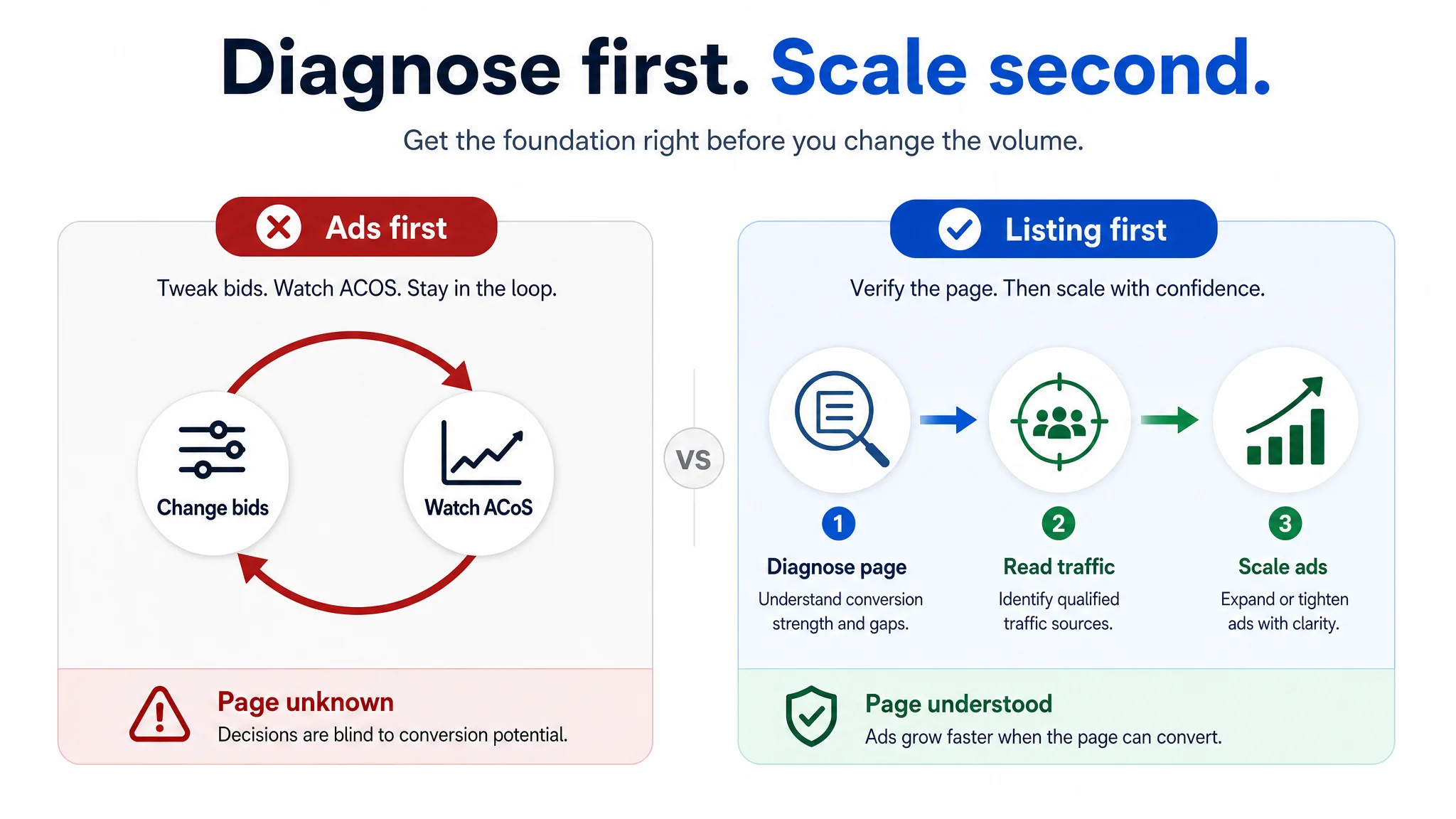
Before that process begins, sellers need to confirm that the destination Listing is sufficiently understood. In the blank-diagnosis case, the advertising team had been operating as if more precise campaign controls would solve the problem. But without knowing whether the page could convert, the team could not distinguish an inefficient traffic source from an inefficient conversion destination. Bid optimization should therefore be part of a broader funnel diagnosis, not a substitute for one.
Performance vs. Profitability: Two Phases, One Goal
The performance phase prioritizes revenue growth, relevant sessions, and demand discovery. For keywords with strong CTR, CVR, or clear sales contribution, raising bids can help secure more auction opportunities and collect additional performance data. Initial spend may increase while the seller tests demand, expands reach, and builds sales velocity. This phase is particularly useful when the campaign has limited conversion history and the primary constraint is insufficient traffic rather than excessive ACoS.
Potential organic-rank improvement should be treated as a possible business outcome, not an automatic consequence of higher bids or more sessions. PPC activity can provide useful sales and keyword signals, but sellers should verify ranking changes through Brand Analytics rather than infer them from total sales alone. Total sales exceeding PPC-attributed sales does not definitively prove that advertising improved organic rank.
The profitability phase applies tighter efficiency controls. Review keywords with ACoS above target, weak CVR, high spend without orders, or declining conversion quality. Reduce bids when the traffic is not economically viable, and pause terms that continue to consume budget without a credible path to conversion. The objective is not simply to cut spend; it is to redirect budget toward traffic that supports the required contribution margin and campaign role.
The two phases also require different levels of Listing confidence. If the page has a strong, measured conversion foundation, a performance phase can be used to test traffic expansion more confidently. If the page has not been diagnosed, additional spend may be testing the page’s weaknesses rather than the keyword’s potential. In the case with all key Listing fields marked “N/A,” the appropriate first move was to establish page-level evidence before treating aggressive advertising as a meaningful growth test.
These phases are complementary rather than permanent labels. A keyword may receive an aggressive bid during demand exploration, then move into a profitability review once enough data is available. Monitor CTR, CVR, ACoS, attributed sales, BSR-related movement, and Listing changes together, and allow observed performance—not a fixed percentage rule—to determine the next adjustment.
Using Placement Modifiers and Dayparting to Gain an Edge
A base bid does not have equal value across every placement. For critical, high-converting keywords, a higher Top of Search modifier can be appropriate when premium visibility produces stronger CVR or supports an important launch objective. The decision should be supported by placement-level results, not by the assumption that the first position is always the most profitable.
Product Pages and Rest of Search require separate evaluation. If a placement generates efficient conversions, increase its priority gradually; if it produces clicks with weak CVR or pushes ACoS above target, reduce the modifier or limit exposure. Comparing placement-specific impressions, CTR, CVR, and ACoS prevents one strong location from hiding waste in another.
Time also changes traffic quality. Amazon Marketing Stream or DeepBI automated scheduling capabilities can help shift budgets toward higher-value hours when conversion performance justifies the change. Dayparting should be reviewed against hourly spend, orders, CVR, and ACoS, then adjusted as new data arrives. It is an iterative allocation method, not a promise of a guaranteed lift.
However, no placement or dayparting adjustment should be treated as a complete solution when the page itself is not understood. The case seller had no evidence showing whether the main image was competitive, whether the title communicated the right value, whether bullets addressed category-specific buyer concerns, or whether A+ content and reviews built sufficient trust. Those unknowns could affect conversion across every placement and every hour.
The practical lesson is not to avoid placement optimization. It is to place it in the correct decision order: first establish whether the Listing can support conversion, then identify which placements and time periods bring qualified traffic, and only then apply modifiers with greater confidence.
DeepBI in Action: Dynamic Bid Optimization with the Four-Layer Funnel
DeepBI's Ads four-layer traffic funnel provides a structured way to move from broad discovery to controlled scaling:
- Exploration: Test relevant keywords and traffic sources to identify demand and collect initial signals.
- Preliminary filtering: Remove or deprioritize terms showing weak engagement, inefficient spend, or early signs of poor conversion.
- Precision: Concentrate bids on keywords whose seven-day performance indicates stronger CTR, CVR, and economic potential, while identifying under-converting terms for bid reduction or pausing.
- Scaling: Expand budget or bids around validated opportunities while continuing to monitor ACoS, sales, and placement quality.
The value of the funnel is its feedback loop. Seven-day performance data can inform whether a keyword should advance, remain under observation, or receive a lower bid. Stable advertising signals can also support related Listing and visual optimization decisions, linking ad evidence with broader conversion work. Each adjustment should be followed by measurement and re-evaluation. The system improves decision discipline; it does not eliminate uncertainty or guarantee a specific percentage improvement.
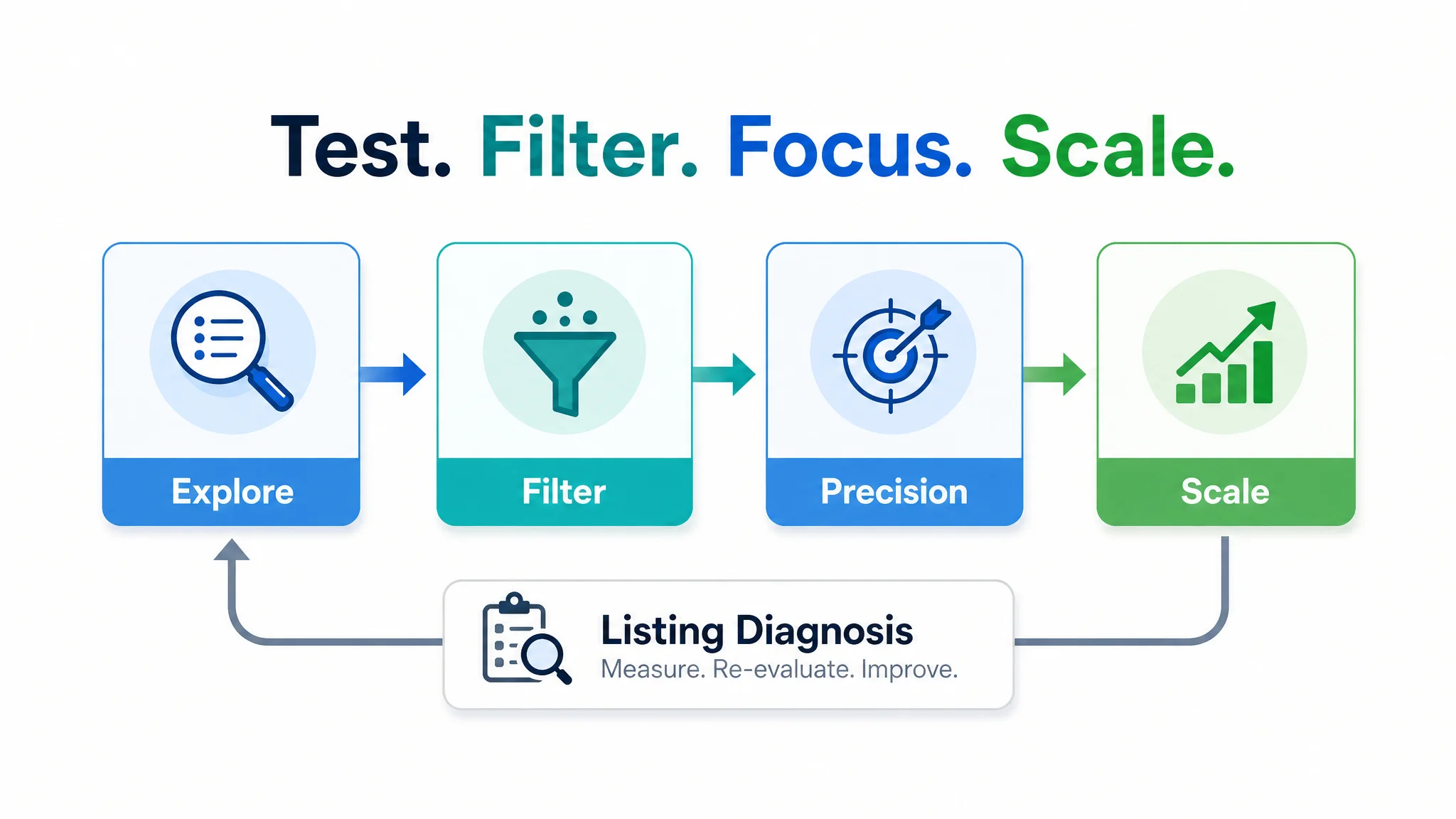
The blank Listing case highlights why the funnel should not be interpreted as an ads-only sequence. Exploration can reveal traffic signals, but without a page diagnosis, weak conversion may be incorrectly attributed to the keyword. Preliminary filtering can remove expensive terms, but it may also hide the fact that a relevant term is being sent to a page that does not resolve buyer concerns. Precision and scaling become more reliable only after the Listing’s title, main image, bullets, A+, reviews, and competitive position have been examined.
Once the page-level evidence exists, advertising and Listing signals can reinforce one another. A weak CTR may direct attention to the search-result presentation, while weak CVR may direct attention to the product-page content and trust structure. In that sense, the four-layer funnel is most valuable when it participates in a wider evidence loop rather than operating as an isolated bid automation system.
Advanced Bidding Strategies: Automation, Organic Synergy, and DeepBI
From Manual to Automated: The Next Evolution
Manual bid management can work for a small campaign, but its limitations appear quickly as an account expands. An advertiser may need to evaluate thousands of keywords, compare placements, monitor intraday changes, and determine whether shifts in CTR, CVR, ACoS, or conversion volume require a bid adjustment. Spreadsheet-based workflows separate these signals and slow the response. By the time a decision is made, the auction environment may have changed.
The operational problem is not simply the number of adjustments. It is the need to connect each adjustment to business intent. A lower bid may reduce wasted spend but also remove valuable Top-of-Search exposure. A higher bid may increase clicks without improving CVR. Advertising data may reveal high-converting search terms, yet that insight can remain disconnected from Listing optimization and organic growth.
The case with the blank Listing report shows that automation cannot compensate for an absent judgment framework. The seller had already been changing bids, budgets, match types, keyword lists, campaigns, and ad groups. The issue was not a shortage of available controls. It was that no one could objectively answer whether the product page deserved more traffic. Automating decisions before defining the page-level evidence to be evaluated could simply make the same uncertainty operate faster.
DeepBI is positioned as an Amazon-only, AI-centric system that brings Listing optimization, advertising management, and organic traffic development into one feedback loop. Its scoring service is designed as an automated market health check rather than a simple score: it collects structured data, analyzes performance signals, and supports recommendations grounded in observed account and product information. For advertising operations, this approach helps address four recurring sources of loss:
- Wasted ad spend caused by bids that do not reflect keyword or placement value.
- Repetitive spreadsheet work required to inspect reports and update bids.
- Slow reaction times when performance changes within the day.
- Fragmented feedback between advertising results, Listing decisions, and organic performance.
Within the DeepBI Ads Quant module, bids are recalibrated dynamically each day rather than managed through isolated manual edits. Its four-layer model separates traffic by strategic role, allowing the account to protect core demand while controlling exploration and expansion. The scaling layer is reserved for high-value traffic, representing approximately 10–15% of total flow, instead of allowing aggressive scaling to consume the entire budget.
The objective is not to promise a fixed ACoS reduction. It is to create a repeatable decision process in which keyword, placement, time, conversion, and Listing signals inform bid allocation. In the case where all Listing dimensions were marked “N/A,” the correct automation objective was not simply to generate another bid recommendation. It was to help establish the missing diagnostic base: identify a relevant benchmark, evaluate page modules, connect advertising symptoms to possible content gaps, and determine whether scaling should proceed.
For example, an illustrative account might move from broad manual bid changes to daily prioritization of terms with stronger CVR and more defensible ACoS. Such a shift could improve budget concentration and reduce low-value clicks, but any before-and-after result is hypothetical; actual outcomes vary by product, market, competition, budget, and execution. Automation improves the consistency and speed of decisions, but the decisions still need to be grounded in an understood conversion environment.
Bridging Ads and Organic: The Fifth Layer Advantage
Advertising can provide more than immediate sales when its signals are fed back into the Listing and organic strategy. DeepBI analyzes advertising reports, including impressions, clicks, conversions, ACoS, and TACoS, then identifies high-performing search terms and applies keyword weighting to optimization decisions. Strong CTR may support attention to click-driving visual elements, while weak CVR can direct analysis toward information density, trust signals, and selling-point communication.
This connection is especially important when the initial assumption is that “the ads do not work.” A weak CTR may indicate that the main image or title does not create enough reason to click. A weak CVR may indicate that the product page does not explain the value clearly, resolve buyer concerns, or establish enough trust. These conclusions should not be assumed from a single metric, but advertising data can help identify where a deeper Listing diagnosis should begin.
In the blank-report case, the missing evidence chain meant that the seller could not connect any advertising outcome to a specific Listing module. There was no quantified comparison showing whether the main image had lower information density than a benchmark, whether bullets were merely listing features, whether A+ content lacked comparison or lifestyle modules, or whether reviews were weaker than category norms. The absence of that connection was itself the reason to pause the ads-first approach.
The Organic fifth funnel layer uses high-CTR and high-CVR advertising keywords to build concentrated Top-of-Search campaigns. The near-term purpose is to capture qualified demand and support immediate sales; the longer-term purpose is to reinforce the relevance signals associated with organic visibility and BSR. This does not make organic gains automatic. It creates a tighter feedback loop in which paid traffic reveals which terms deserve concentrated investment and Listing attention.
For sellers, the practical sequence is clear: diagnose the Listing, automate bid analysis, isolate high-value advertising signals, apply those signals to Listing optimization, and then return performance data to the next bidding and content decisions. Ads remain the primary control system for traffic and spend, while organic growth becomes a connected outcome of disciplined signal use rather than a separate project.
Wrapping Up: Your Continuous Improvement Flywheel
- DeepBI Listing Product Documentation Combined Edition — A sustainable Amazon bidding strategy begins with understanding the auction: placements compete for attention, bids influence eligibility and cost, and the winning decision depends on more than the bid alone. Sellers then move from auction mechanics to data-informed bid setting, using campaign performance and business objectives to decide whether the priority is efficient sales, controlled ACoS, stronger CTR, improved CVR, or support for broader organic visibility. The operating principle is not to raise or lower bids mechanically. It is to connect each adjustment to a defined objective and verify the result against the relevant KPI.
An efficient bid that reduces spend but weakens conversion may not serve the business; a more aggressive bid may be justified when the campaign has sufficient conversion evidence and the product can support the economics. Listing quality, advertising signals, and organic development should therefore be evaluated as connected parts of one operating system rather than isolated tasks.
The case of the undiagnosed US marketplace Listing adds an important condition to this principle: before asking whether a bid is efficient, sellers need to know whether the page receiving the traffic is conversion-ready. A seller may spend considerable effort changing bids and campaigns while the real judgment gap remains untouched. If the page has never been benchmarked, the business cannot clearly distinguish a traffic problem from a conversion problem.
- DeepBI Listing Product Documentation Combined Edition — Bidding cannot be treated as a static setting because competition, market conditions, product lifecycle, placement performance, and campaign results continue to change. The documentation describes a connected workflow spanning diagnosis, strategy, production, delivery, and feedback. Advertising inputs such as impressions, clicks, conversions, CTR, CVR, TACoS, and ACoS can inform later Listing and campaign decisions, while newly published assets create a starting point for controlled observation and review. After images are uploaded, changes in CTR from ad reports will be tracked.
This feedback loop supports a shift from reactive bid changes to proactive, goal-based management: identify the business objective, review the evidence, adjust the campaign or Listing input, and verify the resulting movement before scaling the decision. Automation should remain guided and controlled, with sellers reviewing generated assets and selecting what to apply rather than treating system output as an unconditional instruction.
The same discipline applies to organic growth: advertising signals may reveal which creative or product features deserve further investigation, but correlation should not be mistaken for proof that a single bid change caused a ranking result. DeepBI’s role is to connect diagnosis, execution, advertising feedback, and ongoing Listing improvement so that management can evolve with the market instead of waiting for performance problems to force a reaction.
The most important operating question is therefore not always, “Which bid should change next?” It may first be:
“Do we have enough evidence to know whether this Listing can convert the traffic we are paying for?”
When a Listing report contains no meaningful benchmark or module-level judgment, the main risk is not simply an inefficient keyword or an uncomfortable ACoS. It is making repeated advertising decisions without understanding the destination of that traffic. Bidding becomes more effective when auction mechanics, campaign performance, and Listing conversion capacity are evaluated as one continuous improvement flywheel.