


Introduction: Why Amazon Data Matters More Than Ever
- Amazon performance reports — Source for Amazon’s reported scale, including approximately 11.95 million daily orders, annual revenue of approximately $638 billion, and third-party sellers accounting for more than 60% of sales in Q2 2024.
- analyzer.tools — Third-party estimates covering Amazon seller growth, including approximately 1,350,500 new sellers in 2024 and an estimated 1.8–2 million active sellers after distinguishing seller registrations from active marketplace participants.
- webinterpret.com — Third-party analysis supporting Amazon marketplace scale, seller participation, and the growing importance of data-driven decisions across listing performance, advertising efficiency, and organic growth.
- DeepBI Listing Product Document: Consolidated Edition — Product documentation describing DeepBI as an AI-driven system that connects diagnosis, strategy, production, and delivery through intelligent scoring, optimization recommendations, AI image generation, and one-click application.
- DeepBI Listing Product Document: Consolidated Edition — Evidence that DeepBI connects listing scores with impressions, clicks, orders, CTR, and CVR, helping sellers identify measurable gaps and translate marketplace signals into executable listing and advertising actions.
- DeepBI Listing Product Document: Consolidated Edition — Workflow evidence showing that DeepBI converts abstract optimization strategies into parameterized design instructions, applies approved assets through SP-API, and establishes a measurement feedback loop for tracking performance changes such as CTR.
The scale of Amazon creates opportunity, but it also makes weak diagnosis increasingly expensive. Sellers are not competing only for impressions. They are competing for attention, trust, and the buyer’s decision within a highly compressed product-page experience.
A keyboard-cleaner listing in the UK electronics-accessory category illustrates this distinction. The seller initially viewed the challenge as one of exposure: improve keywords, adjust images, and then increase advertising. However, DeepBI’s listing assessment scored the page at 41/100 against a comparable benchmark listing scored at 85/100. The largest gaps were not in keyword presence alone. The page had no A+ Content, no reviews, weak visual storytelling, and limited proof of product value.
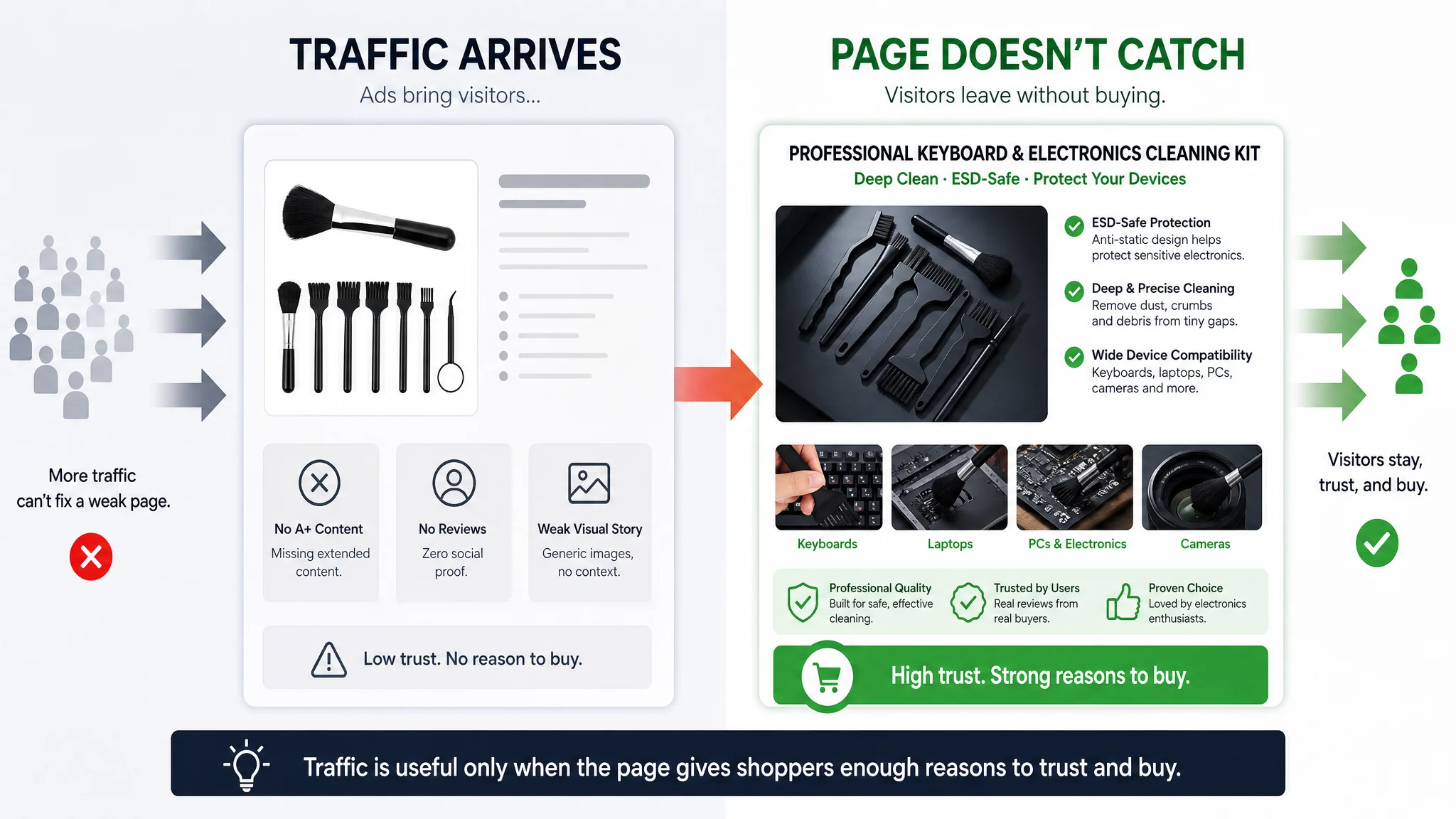
The practical lesson is important: Amazon data is useful only when it helps sellers distinguish a traffic problem from a conversion problem. More visits cannot compensate for a product page that does not give shoppers enough reasons to trust and buy.
The New Amazon Shopper: Demographics That Redefine Listing Strategy
- Webinterpret.com — Amazon shopper demographics: Source for the reported global Amazon user base of approximately 310 million, the age distribution showing that 49% of shoppers are between 25 and 44, and the corrected finding that more than 50% of Amazon shoppers are female. These figures support demographic-led decisions about listing copy, imagery, positioning, and messaging, with the goal of improving CTR and CVR through greater relevance.
- DeepBI Listing Product Document (Merged Version): Source for DeepBI’s listing diagnostics and content-optimization workflows. The system evaluates titles, bullet points, main images, A+ content, and customer feedback; identifies gaps against comparable listings; and converts findings into structured copy and visual recommendations. It can connect listing changes with exposure, clicks, orders, CTR, and CVR, while preserving verified product attributes and preventing image–product mismatches.
Demographic data should not be treated as a decorative statistic. It should influence how a product is named, shown, and explained. Shoppers need to recognize the product’s use case quickly, understand whether it fits their situation, and see evidence that it will solve the problem they came to Amazon to address.
This is where the distinction between technical accuracy and shopper relevance becomes visible. In the keyboard-cleaner case, the seller’s title led with “9-Piece Anti-Static ESD Detail Brushes Kit.” The wording communicated technical attributes, but it did not immediately align with the everyday search intent of shoppers looking for a keyboard cleaner, laptop cleaner, or electronics cleaning kit. A benchmark listing instead placed terms such as “Keyboard Cleaner,” “Cleaning Kit,” and device names closer to the center of its message.
The seller had not necessarily described the product incorrectly. The problem was that the listing was organized around what the product was, rather than around how shoppers searched for and understood the solution. DeepBI therefore recommended preserving the ESD and anti-static differentiation while integrating more familiar use cases such as keyboards, laptops, PCs, cameras, and other electronics.
This supports a broader point about Amazon demographics and listing strategy: relevance is not created by adding more information. It is created by arranging verified product information around the shopper’s decision process.
Third-Party Seller Dominance and the Need for Competitive Benchmarking
Third-party sellers generate more than 60% of Amazon sales, confirming that independent businesses can build substantial revenue on the platform. More than 55,000 sellers exceed $1 million in sales, while average annual seller sales surpass $290,000. These figures demonstrate meaningful opportunity, but they also reflect a highly competitive marketplace in which visibility and conversion cannot be left to intuition.
A listing may lose impressions, clicks, or orders not because demand is absent, but because its title, bullet points, visual presentation, A+ Content, or review structure is weaker than those of comparable products. Without continuous competitor and product benchmarking, sellers may optimize against the wrong reference point—for example, a top bestseller in a different price range, use case, audience, or product form. This can waste listing cycle time and make improvements to CTR, CVR, ACoS, or BSR difficult to sustain.
A real listing comparison shows why this matters. For the 9-piece anti-static electronics-cleaning kit, DeepBI identified the following differences against a mature benchmark:
- Total listing score: 41/100 versus 85/100
- Title: 13/20 versus 15/20
- Main images: 21/30 versus 27/30
- Bullet points: 6/10 versus 8/10
- Detail/A+ Content: 0/25 versus 23/25
- Reviews: 1/15 versus 12/15
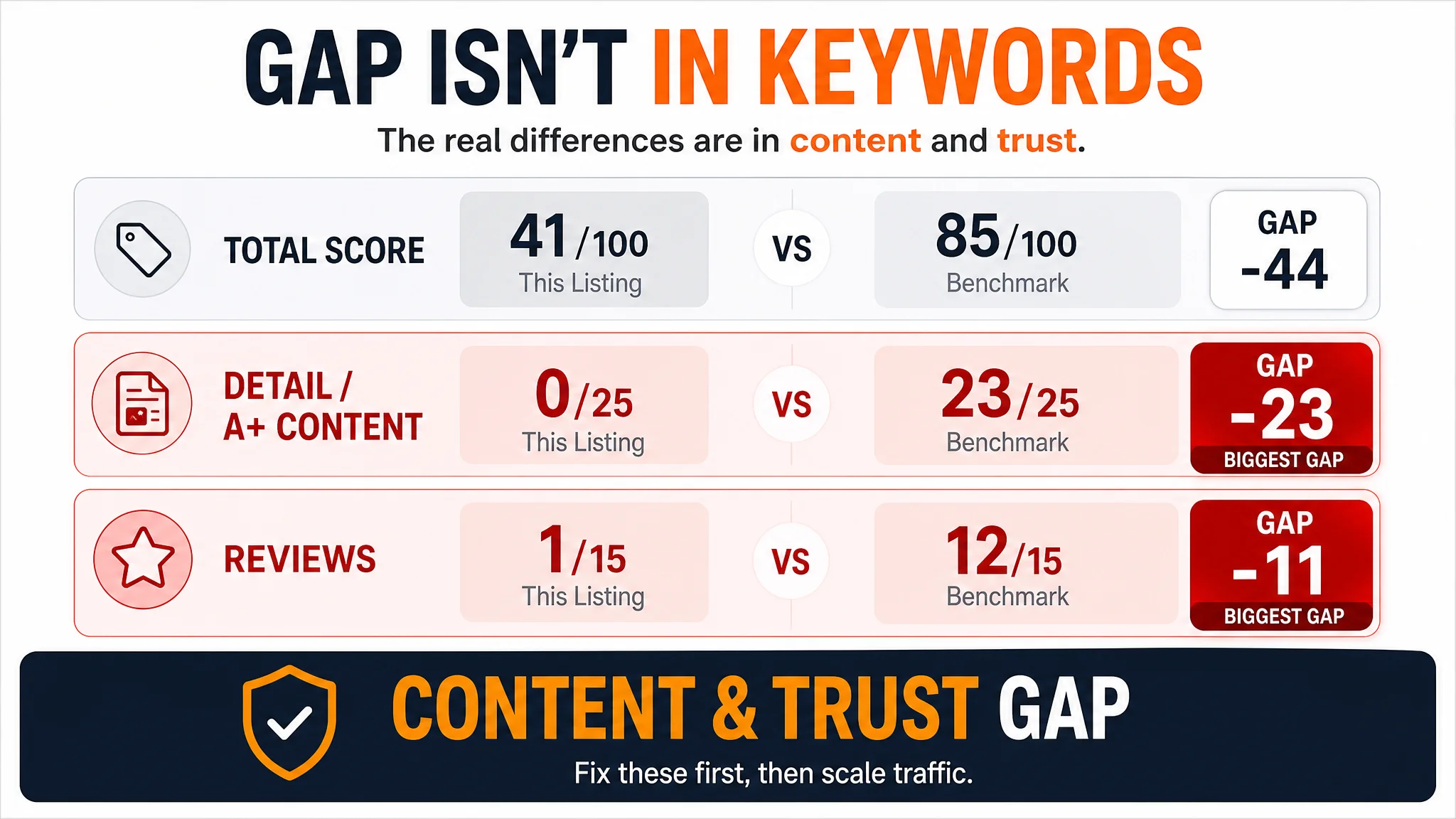
The comparison changed the nature of the problem. The title and bullet-point gaps were relatively limited, while the detail-content and review gaps were much larger. The benchmark was not simply using slightly better keywords. Its title, images, A+ Content, and social proof worked together to communicate a complete solution.
The benchmark also positioned the product differently. Its images presented a complete, professional cleaning kit with a transparent case, modular layout, multiple devices, and visible before-and-after use cases. The seller’s images looked more like a basic assortment of brushes. That difference affected not only visual appeal but also price perception and perceived product specialization.
DeepBI addresses this challenge through competitor benchmarking and product strength scoring. It uses multidimensional comparisons to identify high-performing ASINs that are genuinely comparable, then audits the listing across key dimensions:
- Title keyword placement, structure, and selling-point clarity
- Bullet-point order, readability, and pain-point coverage
- A+ Content completeness and trust-building elements
- Review volume, star distribution, and image-review signals
The system quantifies competitive gaps and turns them into a prioritized optimization plan. Each recommendation is tied to a specific copy, visual, or A+ Content change, giving sellers an evidence-based path from benchmarking to execution instead of relying on subjective trial and error.
Benchmarking is therefore not about copying a competitor’s creative style. It is about identifying which parts of the competitor’s product-page logic reduce uncertainty more effectively. A competitor may be winning because it explains use cases more clearly, demonstrates outcomes visually, or creates stronger trust—not simply because it ranks for more keywords.
The Advertising Landscape: Why Ad Spend Is Non-Negotiable and How to Win
Amazon’s advertising revenue segment is approximately $56.2 billion and continues to grow, reflecting the central role paid visibility plays in marketplace competition. Sellers cannot treat advertising as an optional traffic source: without sufficient exposure, even a strong listing may struggle to generate the clicks, conversions, and sales velocity needed to support organic ranking and BSR growth.
The challenge is not simply to spend more. Unstructured campaigns often combine high-converting search terms with low-value traffic, allowing weak keywords to consume budget while bids remain disconnected from recent performance. The result can be rising ACoS, unstable TACoS, and limited visibility into which investments are generating scalable sales.
At the same time, poor conversion can be misdiagnosed as an advertising problem. The keyboard-cleaner seller initially planned to improve keywords, adjust bids, and then scale Amazon ads. The underlying assumption was straightforward: low visibility was causing low sales, so more relevant traffic should solve the issue.
DeepBI’s listing score showed why that sequence was risky. The page had no A+ Content, zero reviews, weak visual storytelling, and no complete explanation of how the kit worked across keyboards, screens, ports, lenses, and other devices. Even qualified traffic would have arrived at a page with limited trust and limited purchase justification. The problem was not that advertising could never work; it was that the listing lacked the conversion capacity required to make advertising useful.
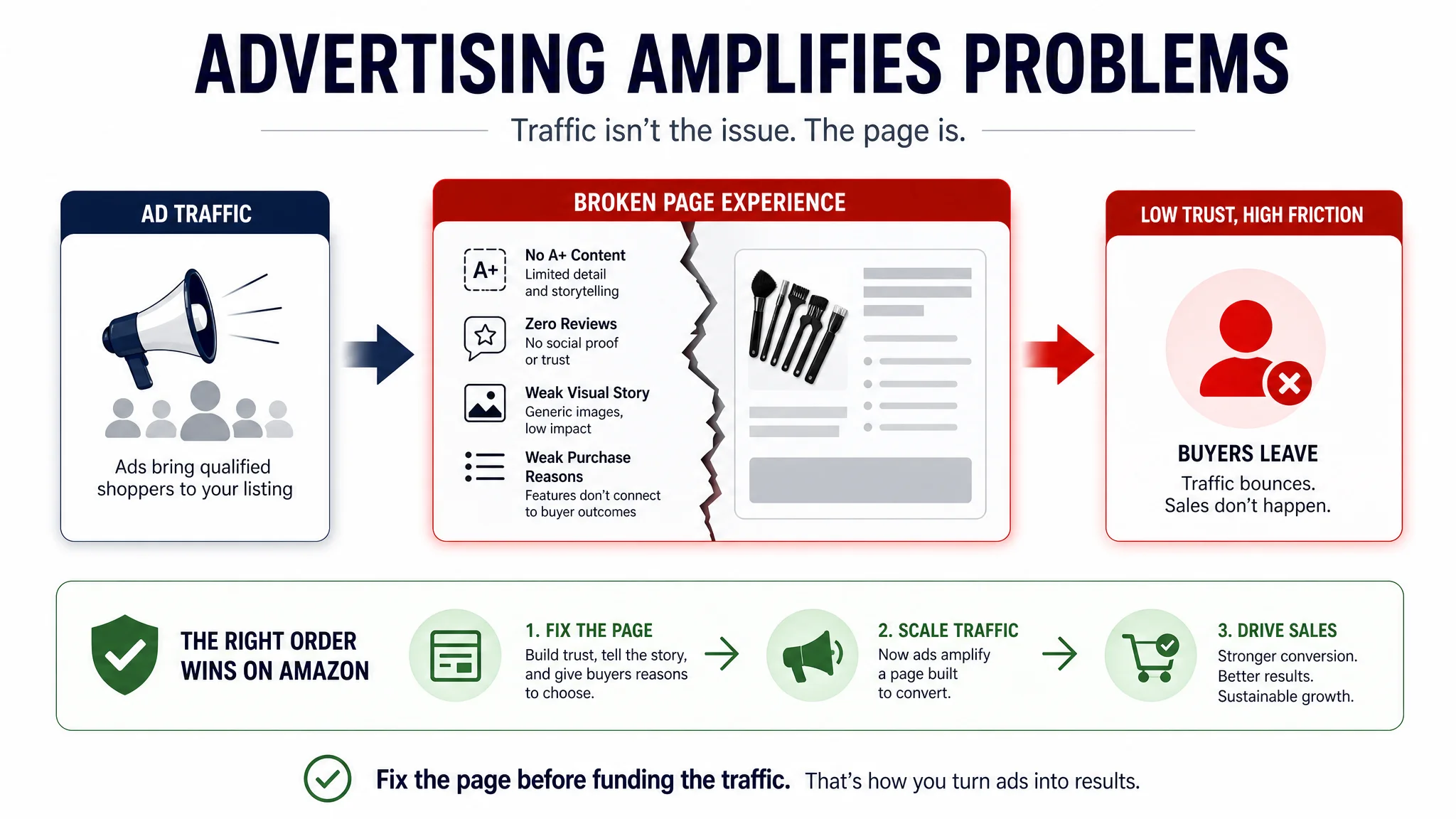
This is why advertising should be evaluated together with CTR, CVR, listing quality, and competitive position. A campaign can bring a shopper to the page, but it cannot independently provide the missing before-and-after proof, explain the contents of the kit, or overcome the absence of social proof.
DeepBI addresses this challenge through a four-layer advertising funnel and dynamic bidding workflow. It separates high-converting keywords from inefficient traffic, reallocates budget toward stronger opportunities, and adjusts bids using seven-day rolling data rather than isolated daily fluctuations. Sellers can then evaluate decisions using CTR, conversion rate, ACoS, and TACoS instead of relying on impressions or spend alone.
A unified campaign-period performance example shows ACoS declining from an average starting point above 40% to below 12% within a quarter. This is not a guaranteed outcome; rather, it illustrates what disciplined keyword, budget, and bid management can achieve when optimization is tied to measurable data. Advertising reports can also guide listing and visual improvements, allowing stronger CTR and CVR to support both paid efficiency and sustainable organic growth.
The correct order of operations is often diagnostic rather than purely tactical:
1. Determine whether the listing can convert relevant traffic.
2. Identify whether the largest gaps are in keywords, visuals, content, reviews, or offer clarity.
3. Rebuild the weakest conversion assets.
4. Then scale advertising against a page that can explain and justify the purchase.
Advertising amplifies what is already true on the page. If the page is incomplete, it can amplify wasted spend; if the page communicates value and trust clearly, it can amplify a stronger offer.
FBA Still Reigns: Optimizing Listings for Fulfillment Success
More than 80% of Amazon sellers use Fulfillment by Amazon (FBA), making it a major logistics backbone for the marketplace. FBA can provide Prime fulfillment, outsourced storage and shipping, and Amazon-managed customer-service support. For select items, Amazon’s internal analysis indicates that FBA can be up to 70% more cost-effective than equivalent premium shipping options—not a universal 70% cost reduction.
FBA is not the best choice for every product or seller. Sellers should weigh product size, sales velocity, storage exposure, margins, and their ability to manage fulfillment in-house. Merchant fulfillment may provide greater control for certain products, while FBA can simplify operations for sellers prioritizing scalable delivery and Prime eligibility. In either case, fulfillment is only the operational foundation; it does not automatically create demand or convert every visit.
Once a product enters FBA, listing quality becomes critical. Prime visibility and delivery trust must be converted through a strong main image, clear benefits, persuasive copy, and credible supporting content. DeepBI evaluates core listing elements against relevant competitors, identifies conversion gaps, and generates improvements such as A+ Content, infographic-rich images, and keyword-optimized titles and bullet points.
The keyboard-cleaner comparison makes this operational distinction clear. The product could potentially benefit from reliable fulfillment and delivery expectations, but the page still needed to answer basic buyer questions before traffic could become orders:
- Is this kit intended for keyboards only or for multiple electronics?
- What tools are included?
- Can it be used safely on screens, ports, earbuds, and delicate components?
- Does it actually remove dust and debris?
- Why should a buyer trust a new product with no reviews?
The benchmark answered these questions through its A+ modules, product breakdowns, usage scenes, and before-and-after visuals. The seller’s page largely provided product information without building the same decision path. FBA could deliver the order efficiently, but it could not create the missing product-page logic.
The KPI objective is clear: improve weak visual hooks that suppress CTR, strengthen informational and trust-building content that limits CVR, and support more efficient advertising and organic growth. After selected images are applied through the platform, DeepBI marks a visual iteration event so sellers can compare CTR changes over the following 7–14 days. FBA delivers the order; an optimized listing earns it.
AI and Augmented Reality: The Future of Product Content
Amazon is making product discovery more intelligent and interactive. Rufus, Amazon’s generative AI shopping assistant, became available to customers in 2024, helping shoppers ask product questions and explore recommendations through natural-language interactions. In October 2024, Amazon also launched AI Creative Studio, extending AI support to product-content development. Official Amazon announcements point to a platform where listing copy, visuals, and shopping guidance increasingly operate as one experience.
Amazon’s investment in augmented reality reinforces this shift. Usage of View in Your Room increased by as much as eightfold, showing that shoppers are becoming more willing to evaluate products through interactive, spatial experiences before purchasing. AI-generated listings, richer content modules, and AR tools are raising expectations for relevance, clarity, and visual confidence. Weak content can suppress CTR and CVR even when the underlying product is competitive.
The keyboard-cleaner case shows why richer content should be built around buyer questions rather than added as decoration. The benchmark’s A+ Content used a multi-device hero, an exploded view of the kit, keyboard before-and-after imagery, earbud close-ups, screen-cleaning comparisons, portability references, and gift-oriented presentation. Each module addressed a different uncertainty: compatibility, contents, cleaning effectiveness, safety, portability, or suitability as a gift.
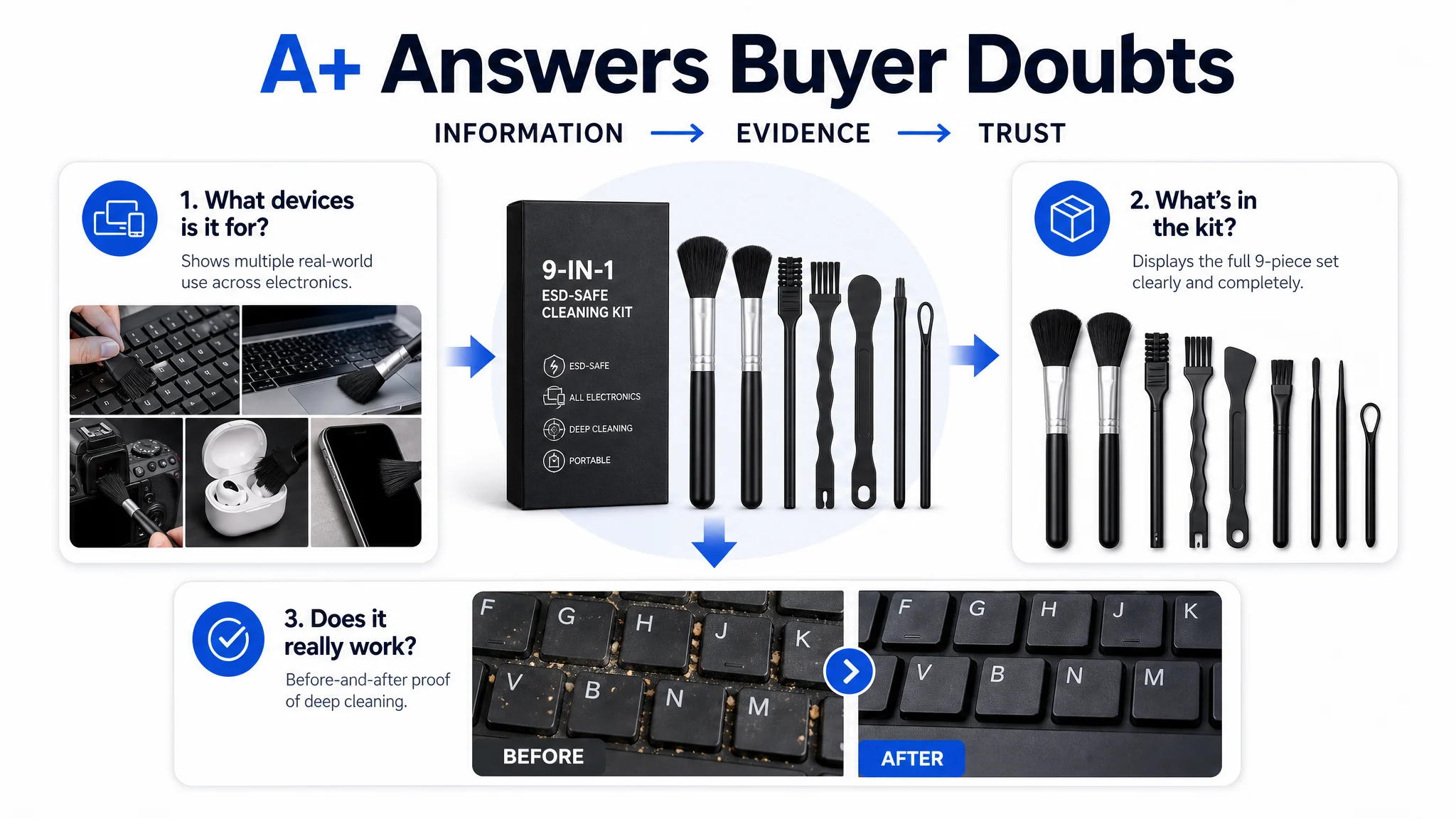
By contrast, the seller had no A+ modules at all. The lack of content meant that even important differentiators such as anti-static construction and ESD awareness were not supported by a coherent visual story. The product may have had technical value, but that value was not being translated into shopper confidence.
DeepBI’s Product-DNA-based generation system helps sellers prepare for this shift without allowing creative automation to distort the product itself. It uses Product DNA as the source of truth, then combines structured analysis with AI-generated graphics and text. Sellers can produce and evaluate multiple versions of A+ Content, product images, bullet points, and rich media, with priorities informed by listing gaps and signals such as impressions, CTR, CVR, and TACoS.
For this type of listing, AI-assisted production can support several practical improvements:
- Reframe the product from a generic brush bundle to a professional electronics-cleaning kit.
- Show how different tools correspond to different surfaces and use cases.
- Build before-and-after scenes that demonstrate the intended outcome.
- Explain technical attributes such as anti-static design without overwhelming general shoppers.
- Create a consistent visual system across the main images, bullets, and A+ Content.
The practical advantage is scale with control: more content variations, faster listing cycle time, and stronger alignment between product facts and Amazon’s AI-driven direction. Rather than treating new content formats as isolated experiments, sellers can build a repeatable system for adapting listings as customer expectations evolve.
Automation, however, does not remove the need for diagnosis. Generating more images would not by itself solve the keyboard-cleaner listing’s problem. The useful sequence was to identify the missing conversion assets first, then use AI-supported production to build content around those specific gaps.
From Paid to Organic: Closing the Loop with DeepBI's Fifth-Layer Growth Engine
Advertising data should not be used only to improve ACoS. When a search term delivers strong CTR and CVR, it indicates that the keyword is attracting relevant shoppers and matching the product’s offer. These ad-qualified terms can become priorities for listing language, visual emphasis, and organic-ranking strategy.
DeepBI’s organic traffic module extends this process through its fifth-layer funnel. It identifies high-CTR and high-CVR keywords from advertising data, develops them into organic-ranking opportunities, funds focused Top of Search campaigns, and monitors daily rank changes. The objective is not to treat paid and organic traffic as separate channels, but to use paid activity to strengthen the signals that support natural visibility.
The operating loop is straightforward:
- Advertising data surfaces promising keywords and product attributes.
- DeepBI applies those signals to titles, images, A+ content, and bullet points.
- Improved relevance and CVR support stronger sales performance and potential BSR gains.
- Paid sales and organic visibility reinforce one another, reducing dependence on advertising over time.
The keyboard-cleaner case demonstrates why this loop must begin with a credible page. The seller initially wanted to use keywords and advertising to create exposure, but the listing’s low conversion capacity meant that traffic would not necessarily produce the sales and engagement signals needed for sustained growth. Before paid data could reliably guide organic priorities, the page needed a clearer search position and a stronger conversion story.
The title therefore needed to connect technical differentiation with high-intent language such as “keyboard cleaner,” “cleaning kit,” and “laptop cleaner.” The bullets needed to move from a specification list toward a value sequence covering deep cleaning, anti-static safety, surface-specific use, multi-device maintenance, and ease of use. The images and A+ Content needed to make those promises visible.
This is the difference between collecting keyword data and using it strategically. A high-performing search term is useful only when the listing can fulfill the expectation created by that term. If a shopper searches for a keyboard-cleaning kit but arrives at images that look like generic brushes and content that does not demonstrate cleaning outcomes, relevance at the traffic stage may not translate into conversion.
Amazon’s ranking system responds to a combination of sales activity, relevance, and conversion signals rather than keyword targeting alone. DeepBI therefore connects campaign decisions with listing execution and rank monitoring.
For context, a generalized case-study illustration might show TACoS moving from 10.40% to 7.36% after this methodology is applied. These figures are not guaranteed benchmarks; they demonstrate how a stronger organic contribution can reduce blended advertising pressure. The result is a measurable flywheel: better keyword evidence improves the listing, stronger conversion supports ranking, and organic traffic gradually carries more of the growth load.
Conclusion: Turning Information into Impact with DeepBI
The most useful Amazon statistics 2025 are not isolated facts. They describe the operating environment sellers must navigate: the seller base continues to grow, women represent the dominant shopper demographic, advertising operates at substantial scale, and third-party sellers account for most marketplace activity. Together, these Amazon seller facts point to a more competitive funnel in which small gaps in relevance, presentation, or traffic efficiency can affect CTR, CVR, ACoS, and BSR.
The keyboard-cleaner listing shows how those gaps can combine. Its total score was 41/100 against a comparable benchmark at 85/100. The largest weaknesses were not simply keyword-related: A+ Content was absent, reviews were at zero, images communicated a generic brush bundle rather than a professional electronics kit, and the bullets did not create a persuasive path from product feature to buyer outcome.
The seller’s initial instinct was to improve keywords and push ads. The diagnosis redirected attention toward listing conversion capacity. That shift did not turn the article into a story about one product; it demonstrates a broader operating principle: before increasing traffic, sellers must determine whether the page is prepared to convert it.
Awareness alone does not create an advantage. Sellers need a repeatable workflow that converts Amazon demographics, Amazon advertising statistics, and listing performance signals into prioritized action. DeepBI provides that operating structure by diagnosing competitiveness across listing elements, translating gaps into specific optimization instructions, and helping sellers connect listing decisions with advertising data and organic traffic signals.
Its value lies in continuity. Approved assets can be applied with user confirmation, implementation can be marked as an event point, and subsequent performance data can guide further evaluation and iteration. This approach replaces isolated, gut-feeling changes with a measurable process designed to shorten listing cycle time and clarify the relationship between content, paid traffic, and organic growth.
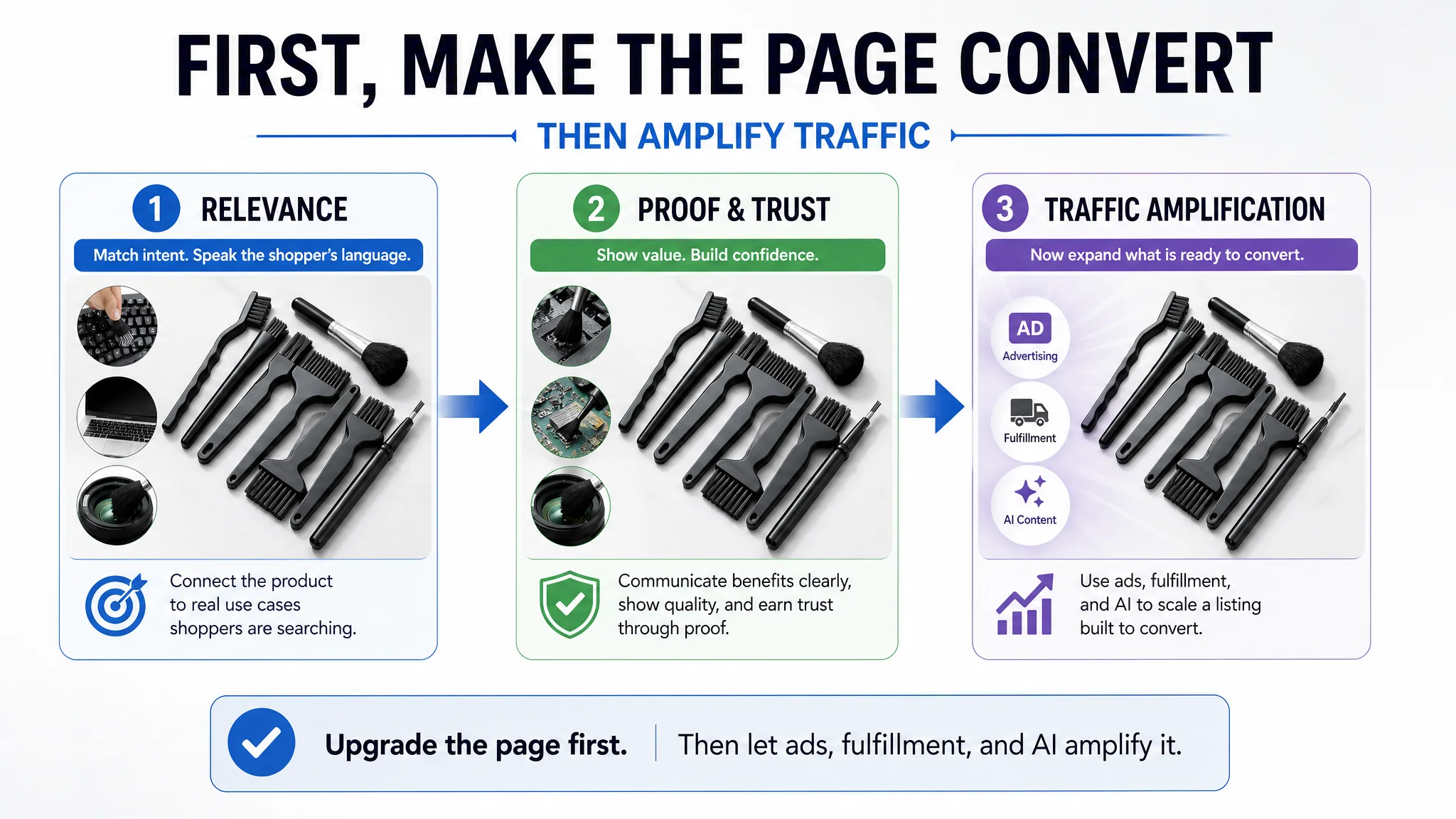
The practical takeaway is clear: use DeepBI as a data-driven, AI-augmented workflow for interpreting Amazon trends and executing disciplined improvements across the growth funnel. Advertising can create visibility, fulfillment can support delivery, and AI can accelerate content production—but the listing itself must still provide the relevance, proof, and trust that turn marketplace traffic into decisions.