

The Infrastructure Shift - Amazon Opens Its Logistics Network
Amazon is moving beyond its role as a marketplace and fulfillment provider. With the launch of Amazon Supply Chain Services, it is making end-to-end logistics capabilities available to businesses more broadly. The strategic shift is substantial: infrastructure developed for Amazon’s own retail engine is becoming a business service that other companies can potentially use to improve transportation, fulfillment, delivery, and inventory coordination.
The closest analogy is AWS. Amazon first built computing infrastructure for its own operations, then transformed that internal capability into an external platform and a major competitive differentiator. Supply Chain Services follows a similar logic. Rather than treating logistics as a back-office cost center, Amazon is positioning its network as an operational product. For sellers and brands, access to that product could influence delivery reliability, customer experience, working capital, and the ability to scale without independently building an equivalent network.
The underlying infrastructure is already substantial. ShipMatrix ranks Amazon as the second-largest domestic delivery network by volume. Amazon states that it delivers more than 13 billion items annually and reports an average on-time delivery rate of 96.4%. Its logistics assets extend beyond fulfillment centers and delivery stations to include trailers, intermodal containers, and aircraft. Together, these assets give Amazon control across multiple transportation stages rather than limiting it to a single parcel handoff.
This scale was not assembled as a short-term response to marketplace growth. Amazon’s logistics buildout began in 2013 and reflects more than a decade of deliberate investment. The result is a network designed around dense shipment volume, integrated data, and coordinated movement from inventory position through final delivery. For sellers, the potential advantage is not simply reduced shipping friction. More predictable logistics can support a better customer experience while reducing the operational variability that complicates inventory planning, replenishment, and expansion into additional channels.
The broader market is also showing interest in logistics consolidation, although the evidence requires careful qualification. A November 2025 Reach3 Insights survey of 51 multimodal shippers found that 69% were interested in learning about a provider’s other services. That finding describes the surveyed group, not businesses generally or the entire market. It does, however, help explain why an integrated provider may attract attention: shippers are assessing whether multiple logistics functions can be coordinated through fewer relationships and systems.
Sellers should therefore assess Amazon’s logistics network as a potential strategic capability rather than merely another fulfillment option. The evaluation should begin with SKU-level economics and service requirements: compare expected delivery performance, landed cost, inventory placement, replenishment needs, and listing cycle time, then model the likely effect on CVR, BSR, and contribution margin before expanding adoption.
However, a stronger logistics network does not remove the need for commercial diagnosis. Faster or more reliable delivery can improve the offer, but it cannot repair a product page that leaves shoppers uncertain. A handheld car vacuum listing provides a useful example: the page already had product photography, usage scenes, brand content, related-product recommendations, and video. Yet its overall Listing score was 70, compared with 87 for a closely matched high-performing competitor. The issue was not the absence of operational or content assets. It was whether those assets helped the shopper make a confident decision.
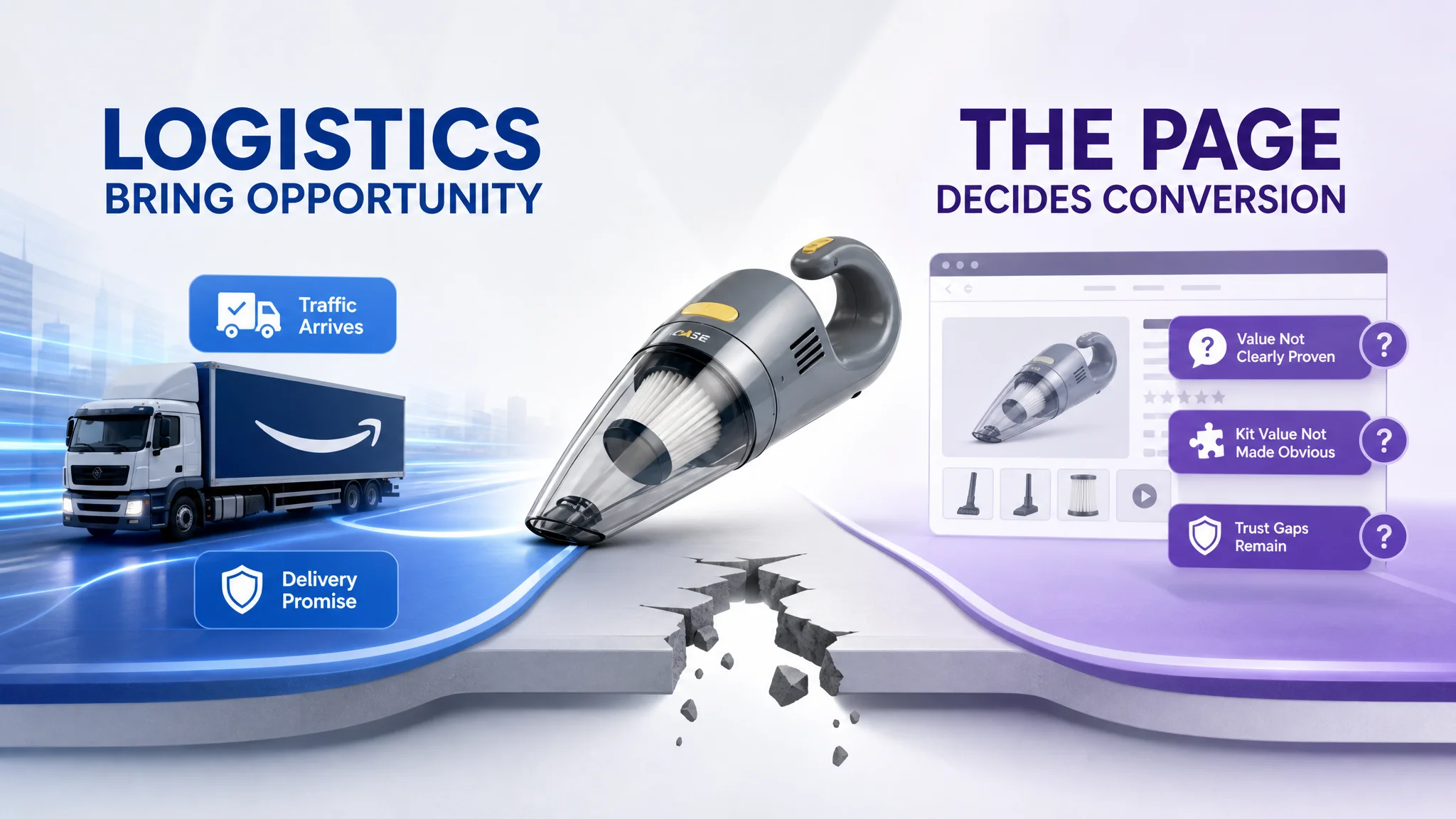
That distinction matters when evaluating logistics investments. Improved delivery can bring a stronger promise to the market, but the Listing still has to communicate why the product is worth choosing. Logistics can reduce friction after the purchase decision; it cannot make the decision for the shopper.
How Amazon Selling Partners Proved the Model
Amazon’s logistics network is not a theoretical promise built around future scale. Its reliability has been tested through years of daily transactions, operational exceptions, seasonal surges, and cross-border fulfillment demands. Since 2006, independent sellers have shipped more than 80 billion units through Fulfillment by Amazon (FBA). That volume provides a meaningful historical benchmark: Amazon has already processed logistics at a scale that few individual sellers could build or manage independently.
For sellers, the significance extends beyond shipment volume. FBA turns a complex operating requirement into an accessible service layer. Rather than coordinating warehousing, pick-and-pack operations, delivery, and customer-facing fulfillment expectations separately, sellers can connect their inventory to an established network. The practical result is a shorter path from inventory to customer, with less operational overhead competing with listing management, advertising, and product development.
Finer Form’s experience illustrates how that simplification can create value across the supply chain. The company described Amazon’s contribution plainly: “Amazon has added value at every stage…” This statement matters because it presents logistics as more than a final-mile delivery function. For a smaller business managing international growth, value can arise across connected stages, including inventory movement, fulfillment execution, and access to a customer-ready delivery model. The fewer handoffs a seller must manage independently, the easier it is to control listing cycle time, protect margins, and maintain a consistent customer experience.
The model is also gaining validation from recognizable enterprises. Lands’ End’s CEO highlighted the use of Amazon Selling Partner solutions (ASCS) to position inventory closer to customers. That objective reflects an enterprise-level logistics priority: inventory placement is not simply about moving products faster; it is about aligning stock with demand so delivery performance and operational responsiveness can improve together.
The progression is clear: FBA established scale, independent sellers demonstrated trust through repeated use, and established brands began applying the same network logic to more complex inventory needs. Sellers should therefore evaluate Amazon logistics as infrastructure that can support growth, not as a substitute for strategy. The opportunity lies in pairing that infrastructure with strong demand generation, accurate inventory decisions, and listings capable of converting the traffic that reliable fulfillment helps attract.
The car vacuum example shows why the final part of that combination deserves separate attention. The seller’s page contained the expected modules, but the content did not consistently explain why the particular kit was worth choosing. Usage scenes showed the vacuum inside a vehicle, yet the page did not make the combined value of the attachments, reach, power, and maintenance components sufficiently clear. The comparable Listing scored 87, while the customer Listing scored 70. This was not a failure of having no content; it was a failure to turn content into a coherent buying path.
A logistics system can make a product easier to receive, but the Listing must still make it easier to select. Scale creates capacity. Conversion depends on whether the customer-facing offer uses that capacity effectively.
Strategic Opportunities for Amazon Sellers - The AI-Driven Listing Advantage
Amazon’s logistics network can make delivery faster and more reliable, but access to logistics alone does not create profitable growth. Instead, it creates a stronger commercial opportunity: when buyers receive dependable delivery expectations, they may be more willing to consider products capable of meeting those expectations. The seller must then convert that demand through a relevant product page, persuasive content, and traffic that reaches the right shoppers.
Amazon has reported sales-lift effects of approximately 20% in some logistics-related contexts, but this is a conditional, Amazon-reported metric—not a guaranteed outcome for every ASIN. The commercial result still depends on CTR, CVR, ACoS, and the speed at which sellers can identify and implement listing improvements. DeepBI’s Amazon-optimized Listing module provides the execution layer for that process.
Turning Logistics Scale into Listing Conversion
Faster delivery raises the buyer’s expectations for the entire purchase experience. If the listing is unclear, visually weak, or unable to communicate product value quickly, logistics cannot fully capture the demand it helps generate. The opportunity, therefore, is to connect delivery reliability with a product page that earns the click and supports the purchase decision.
This is where sellers can easily misdiagnose the constraint. When traffic reaches a product page but orders remain weak, the initial response is often to adjust keywords, bids, budgets, or campaign structure. Those may be relevant levers, but they do not answer whether the page can convert the traffic it receives.
An automotive accessories seller faced this type of problem with a handheld car vacuum Listing. The page was not empty: it included product photography, usage scenes, brand content, related-product recommendations, and video guidance. The initial optimization direction was therefore to add more explanation, more usage scenes, and more maintenance guidance. A deeper review found that the page did not primarily need more demonstrations. It needed clearer proof and a stronger decision order.
The page presented the vacuum as a product, while the stronger competitor presented it as a complete, credible cleaning solution. The customer Listing showed cleaning scenarios but did not consistently explain why this specific kit was worth choosing. The attachments were mentioned, yet their combined value was not made sufficiently visible. Product features were described, but they were not always connected to the shopper’s concrete concerns: power for crumbs and pet hair, reach into rear seats and trunks, attachment usefulness, battery risk, and filter maintenance.
This distinction is important for logistics-led growth. Delivery reliability can strengthen the overall offer, but it cannot compensate for a page that does not establish value. The Listing must translate infrastructure advantages into a customer-facing reason to buy.
DeepBI begins with a quantitative audit of the ASIN across the main image, title, bullet points, A+ content, and customer feedback. It compares the listing with highly similar, commercially validated Amazon competitors, helping sellers distinguish a traffic problem from a conversion problem. Weak CTR may point to insufficient main-image appeal, while weak CVR may indicate gaps in information, trust signals, or detail-page communication.
The car vacuum comparison illustrates why a multi-dimensional audit is more useful than reacting to one symptom:
- Title: Customer Listing: 15/20, Comparable Listing: 18/20, Gap: -3
- Main image: Customer Listing: 24/30, Comparable Listing: 26/30, Gap: -2
- Bullet points: Customer Listing: 6/10, Comparable Listing: 7/10, Gap: -1
- A+ and detail content: Customer Listing: 21/25, Comparable Listing: 23/25, Gap: -2
- Reviews: Customer Listing: 4/15, Comparable Listing: 13/15, Gap: -9
- Total: Customer Listing: 70/100, Comparable Listing: 87/100, Gap: -17
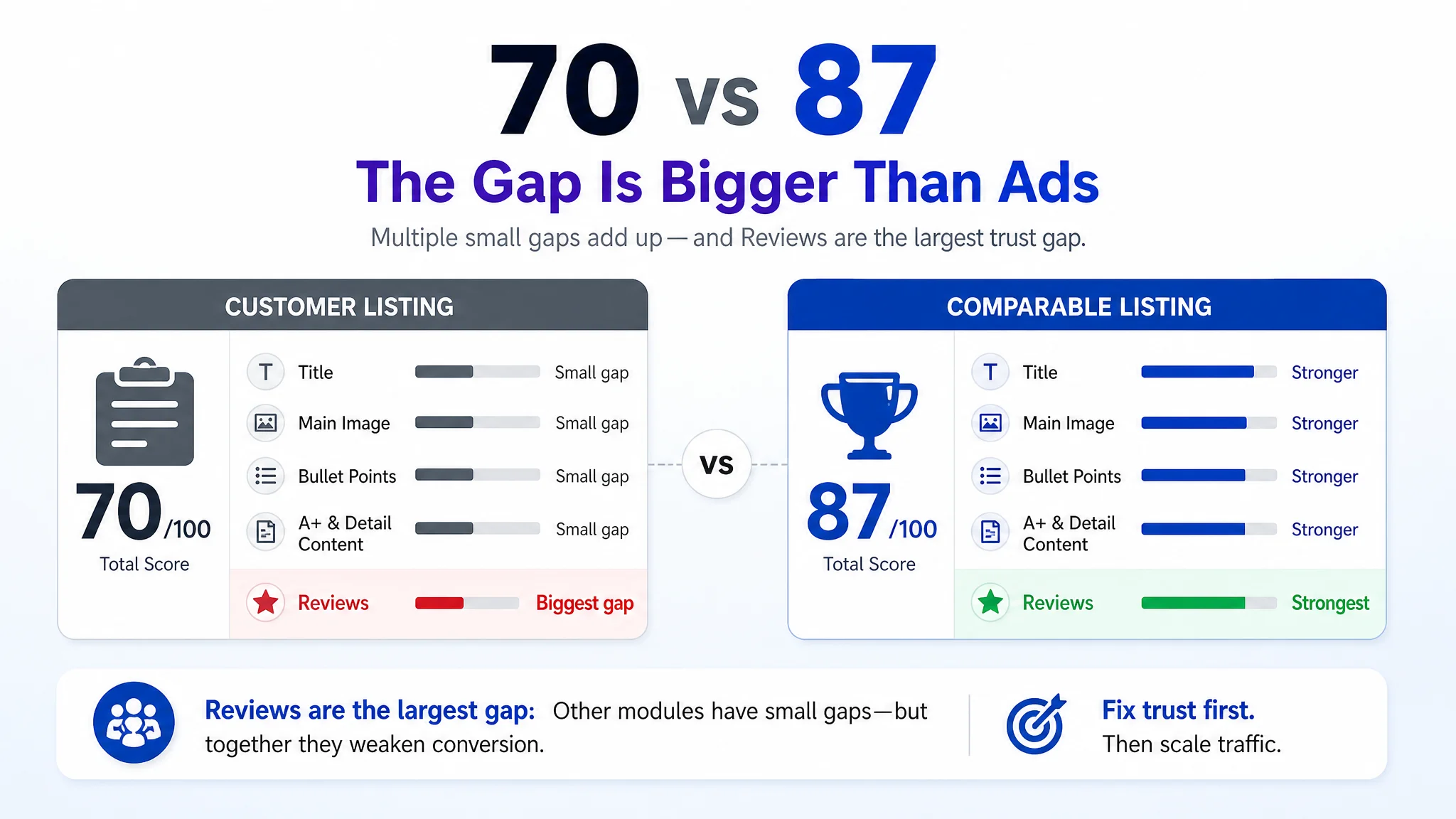
The largest numerical gap was in reviews, but the controllable Listing elements also weakened the same commercial outcome. The page had information, but not enough buying logic. That is exactly the kind of distinction a diagnostic workflow should surface before a seller increases traffic.
The module then turns broad advice into executable instructions. Rather than recommending that a seller simply “improve the image,” it specifies changes involving composition, camera angle, lighting, scene elements, color treatment, title structure, or bullet-point logic. Product DNA constraints protect the product’s actual structure, materials, logo, and functional attributes while still allowing improvements to presentation and visual hierarchy. This makes AI-assisted production more practical without introducing unsupported product claims.
Competitive Benchmarking with Logistics-Speed Metrics
Logistics-enabled demand should be evaluated against the listing’s ability to capture it. DeepBI’s scoring workflow establishes an ASIN benchmark and connects listing diagnostics with impressions, clicks, orders, CTR, and CVR. This evidence chain helps sellers prioritize the constraint with the greatest commercial impact rather than redesigning every asset at once.
For example, a listing receiving impressions but generating weak CTR may require attention to the main image, visual hook, or title relevance. A listing attracting clicks but producing weak CVR may need stronger A+ content, clearer benefit communication, or more credible trust signals. These are diagnostic directions, not universal thresholds or guaranteed outcomes; the value lies in linking each symptom to a specific listing element.
The car vacuum Listing demonstrated why this linkage matters. Its title, main image, bullet points, and A+ content each showed relatively modest individual gaps when compared with the stronger competitor. Taken together, however, they weakened the shopper’s ability to understand the product’s complete value. The review disadvantage added a serious trust constraint, especially because negative feedback concentrated around suction strength and reliability. The page therefore needed more precise proof, not simply more traffic.
AI-generated visual assets can be assessed for visual attractiveness, predicted CTR, information density, compliance, and product-DNA consistency before delivery. After seller review, approved assets can be applied through Amazon SP-API to supported placements, including Main and PT01–PT06 images and A+ content. This shortens listing cycle time and transforms optimization from subjective judgment into a controlled execution process.
The point is not to generate more assets for their own sake. A high-performing image sequence should assign each asset a different decision-making role. For the car vacuum Listing, that meant establishing the complete kit first, then showing specific cleaning problems, proving reach through the flexible hose and 16-foot cord, differentiating attachments by surface and use, and finally reducing maintenance uncertainty through the extra filter and cleaning brush.
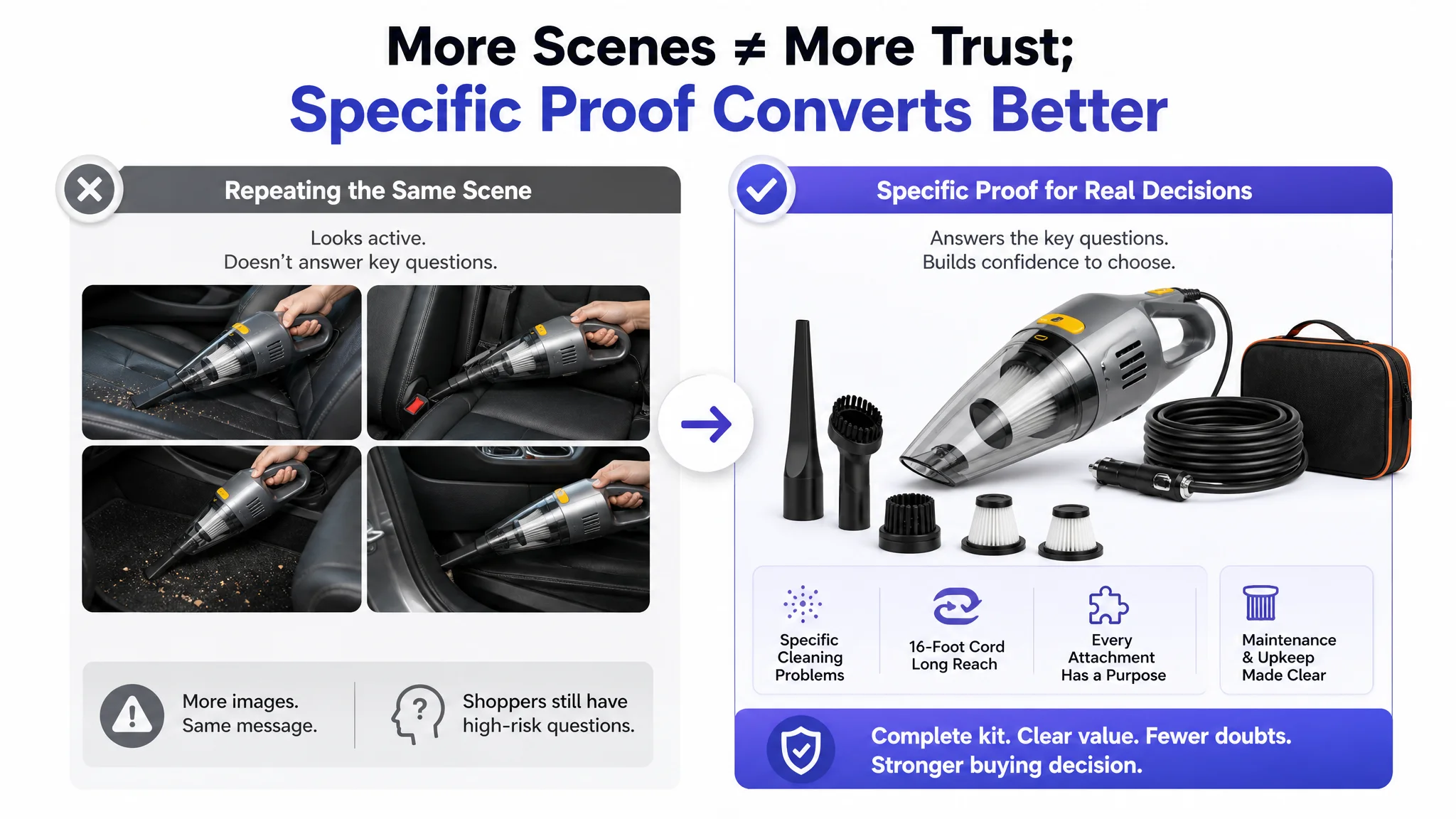
When logistics performance and Listing diagnostics are evaluated together, sellers can distinguish an infrastructure constraint from a communication constraint. That prevents a faster fulfillment promise from being treated as a complete commercial solution.
Aligning Ad Traffic to Logistics-Optimized Listings
Logistics creates the opportunity, while advertising determines which shoppers encounter it. Sending more traffic to an unprepared listing can increase spend without improving CVR, while a stronger listing may remain underutilized when traffic is poorly matched. The practical objective is to align ad relevance, listing communication, and delivery expectations.
The car vacuum case made this risk explicit. The team could have interpreted weak commercial performance as a bid, keyword, or traffic-quality problem. But the product page already left unresolved questions about power, reach, kit completeness, attachment roles, and filter upkeep. Advertising could bring shoppers to the Listing, but it could not explain the kit’s value more clearly than the page itself.
Advertising does not only amplify a product’s strengths. It can also amplify the weaknesses of the page receiving the traffic.
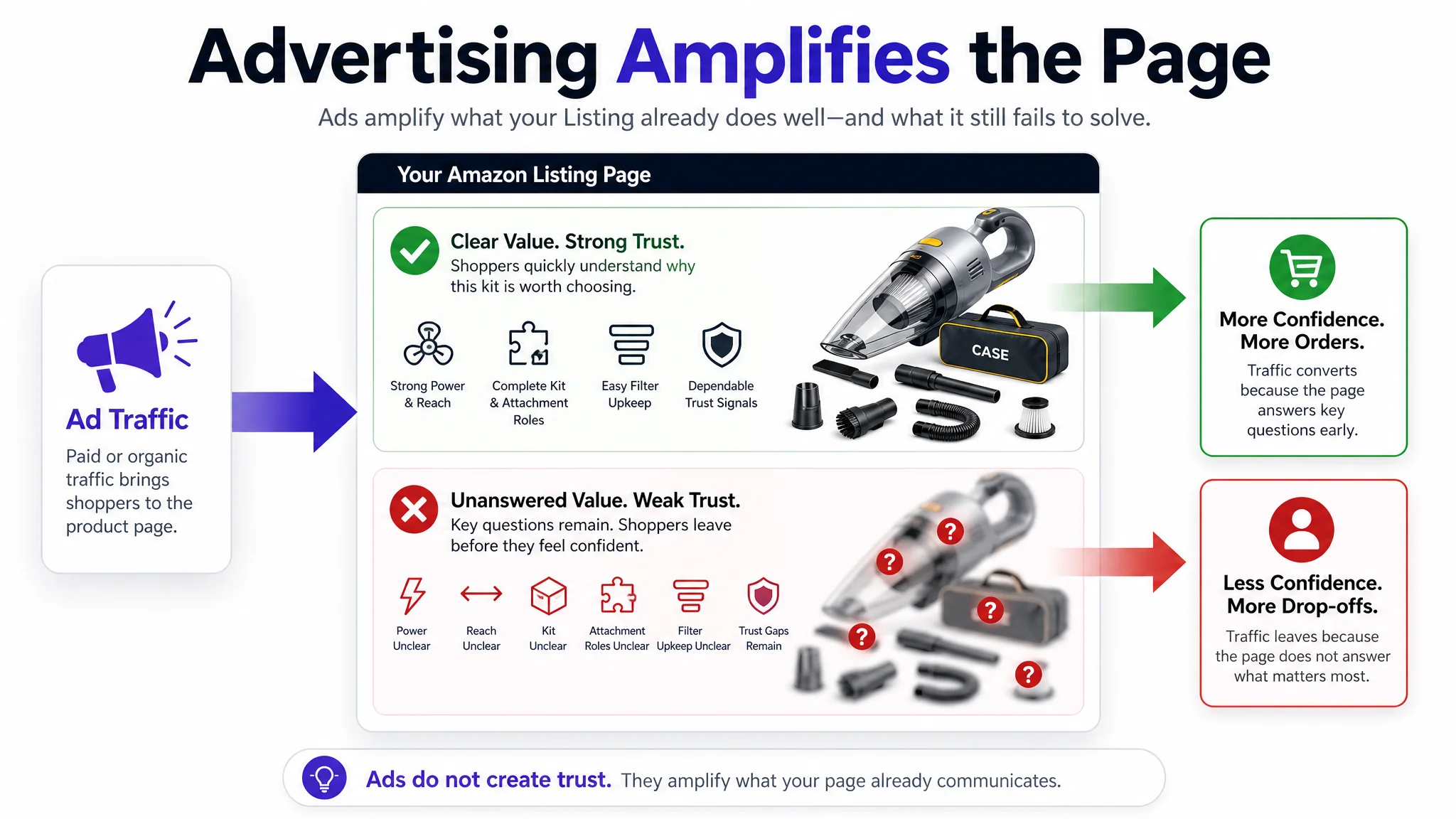
That is why DeepBI did not treat the situation as a simple bid-management exercise. The first task was to determine whether the product page had enough conversion capacity to make additional traffic useful. Since the case material does not include post-optimization advertising results, it would be premature to claim a specific ACOS or CVR improvement. The valid conclusion is about decision order: repair the Listing’s conversion logic before using more traffic to test its commercial potential.
Advertising data can guide listing priorities. High-converting search terms or product attributes may receive greater emphasis in the title, imagery, and supporting content. For the car vacuum, the category signal and useful specifications needed to appear earlier in the title. “Car Vacuum Cleaner” was placed near the beginning of the comparable Listing, while the customer title gave early space to the brand name. Specifications such as “16 Ft Cord” and “12v” also answered practical questions quickly, including whether the product depended on a battery and whether it could reach the rear of a vehicle.
After an approved visual is applied, DeepBI marks an iteration point in its ad reports, allowing sellers to observe subsequent CTR movement over the cited 7–14-day window. This creates a feedback loop between execution and measurement.
The operating principle is straightforward: use logistics to strengthen the offer, DeepBI to improve the Amazon listing, and advertising data to refine traffic allocation. Stronger listing quality combined with more precise traffic gives logistics-enabled demand a clearer path to clicks, conversions, and healthier ACoS.
How Amazon Supply Chain Services Can Work for Your Business
- Amazon Supply Chain Services, supplychain.amazon.com and aboutamazon.com: Treat ASCS as a modular operating layer, not an all-or-nothing commitment. A seller can begin with inbound placement to reduce network complexity, add warehousing when inventory positioning becomes the constraint, or evaluate last-mile delivery separately when delivery speed is the commercial priority. This staged approach lets the business connect a specific logistics problem to a specific service rather than redesigning its entire supply chain at once. Amazon aims to eventually support sectors including healthcare, but sellers should assess only the capabilities and categories that are available for their operation.
- Qualified consolidation-interest survey: Consolidation is becoming commercially relevant because sellers are under pressure to simplify fragmented logistics and gain more consistent control over delivery performance. The practical entry question is not whether Amazon should manage every logistics function. It is which stage creates the greatest impact on contribution margin, delivery promise, inventory flow, or customer experience. Start with the bottleneck that most directly affects conversion and operating cost, then expand only when the evidence supports it.
- US consumer delivery-expectation statistic: In April 2025, 56% of US consumers expected e-commerce delivery within two days. That expectation raises the cost of waiting. A seller may preserve an acceptable product and advertising strategy yet lose demand when a competing offer provides a faster or more dependable delivery promise. Logistics speed should therefore be evaluated alongside CTR, CVR, ACoS, BSR, and listing cycle time—not treated as a back-office metric disconnected from revenue.
- Finer Form and Lands’ End testimonies: These adoption signals show why established brands can view Amazon’s logistics network as an operational extension rather than merely a fulfillment option. Their relevance is strategic: when a seller is ready to rely on external infrastructure, the remaining challenge is coordinating logistics gains with the customer-facing Listing. Faster delivery cannot compensate for a weak main image, unclear title, or poorly structured bullets.
- DeepBI Listing Product Document (merged edition): DeepBI provides the execution layer between logistics improvement and commercial return. Sellers define the profit or growth target; DeepBI performs data analysis, diagnostics, content synchronization, and rapid Listing iteration. Its workflow can compare Listing elements, identify conversion bottlenecks, translate findings into executable content changes, and synchronize selected assets through SP-API. In practice, improved delivery should be paired with rapid Listing refinement so the offer is ready to convert the additional demand that better logistics can attract.
The car vacuum diagnosis shows what this execution layer should accomplish. The recommended changes were not a collection of unrelated creative edits. They followed a decision sequence: clarify the category and specifications in the title, make the complete kit visible earlier, replace repetitive usage scenes with problem-specific proof, connect bullet-point specifications to shopper concerns, and use A+ content to close trust gaps around attachments, reach, power, and filter maintenance. The objective was to recover conversion capacity, not merely increase the amount of content on the page.
- DeepBI Listing Product Document (merged edition), with Amazon-focused advertising execution: The same human-AI division of work applies to traffic. The seller establishes budget and efficiency boundaries, while DeepBI supports traffic pruning and budget-aware bid adjustments so spend is not directed toward weak or poorly matched opportunities. This prevents the “fast delivery to a poor page” scenario: logistics creates a stronger promise, Listing execution improves CVR, and advertising discipline protects ACoS. The operating principle is simple—choose the logistics module that removes the constraint, then use Amazon-specific Listing and advertising iteration to convert that improvement into measurable business value.
The Data-Driven Seller's Roadmap
Amazon logistics becomes a sustainable seller advantage only when fulfillment performance is connected to a disciplined commercial operating system. Fast, reliable delivery can support customer trust and protect the buying experience, but logistics alone does not create profitable growth. The advantage emerges when sellers can diagnose where performance is being lost, improve the Listing and traffic system, and measure the result through Amazon signals such as CTR, CVR, ACoS, BSR, and listing cycle time.
The roadmap rests on three connected pillars.
- ASCS logistics access: ASCS provides the logistics foundation through which sellers can use Amazon's fulfillment network as part of their operating model. Its strategic value is not simply access to delivery infrastructure. It is the ability to make logistics speed and reliability part of a broader, measurable seller system rather than treating fulfillment as an isolated service decision.
- DeepBI Listing conversion mastery: DeepBI connects Listing diagnosis with constrained execution. Scoring identifies gaps across the main image, title, bullet points, detail page, and reviews, while product constraints and Amazon requirements define what can be changed. Product DNA remains the ultimate boundary: optimization must preserve the product's inherent attributes rather than inventing features, specifications, or accessories. Through Amazon SP-API, approved changes can be synchronized into the seller workflow, creating a clearer link between diagnosis, implementation, CVR, and listing cycle time.
The automotive accessories example demonstrates why this pillar must be treated as conversion mastery rather than content production. The page already had product photography, usage scenes, brand content, related products, and video, yet it still scored 70 against a comparable Listing’s 87. Its weakness was not a simple lack of assets. The title delayed the clearest category signal, the images did not establish the full kit early enough, the bullets did not consistently translate specifications into solutions, and the A+ content repeated usage without fully resolving trust questions.
That diagnosis also shows why review data must be interpreted carefully. The customer Listing had a 3.7-star rating and 65 reviews, compared with 4.0 stars and 248,432 reviews for the comparable Listing. The review gap was a serious constraint, but it was not the only lever available. Content could not create historical social proof, yet it could prevent vague communication from making the trust problem worse. A stronger Listing had to be precise about power, reach, attachments, maintenance, and the product’s role as a convenient tool for regular upkeep.
- The DeepBI Ads Quant traffic-efficiency bridge: Traffic and conversion should not be managed as separate problems. Advertising signals such as impressions, clicks, orders, CTR, CVR, and ACoS can help distinguish weak traffic acquisition from Listing or trust deficiencies. DeepBI Ads Quant serves as the bridge between traffic efficiency and conversion work, directing attention toward the relationship between paid visibility, Listing quality, and commercial outcomes.
The multiplier is Amazon-only, AI-powered iteration. AI is most valuable when it operates within verified inputs, Product DNA, platform rules, and Amazon performance feedback. The process moves from diagnosis to precise instructions, from constrained generation to publication, and from publication to measurement. When an image or Listing change is published, the event can establish a timing anchor for observing subsequent advertising and conversion signals. That feedback supports another evidence-based iteration rather than subjective creative guesswork.
The opportunity is not to pursue logistics, content, or advertising in isolation. It is to connect ASCS access with conversion mastery and traffic-efficiency analysis within one Amazon operating loop. Sellers who maintain this discipline can assess whether logistics reliability is supporting stronger trust, whether the Listing is converting available demand, and whether advertising spend is acquiring that demand efficiently.
The practical sequence is equally important. Before scaling traffic, sellers should ask whether the page identifies the product clearly, communicates its complete value, answers the shopper’s highest-risk questions, and provides credible proof in the right order. A Listing can have every expected module and still fail to create a buying decision. Conversely, a logistics advantage becomes more valuable when the page is prepared to convert the demand that reliable delivery helps attract.
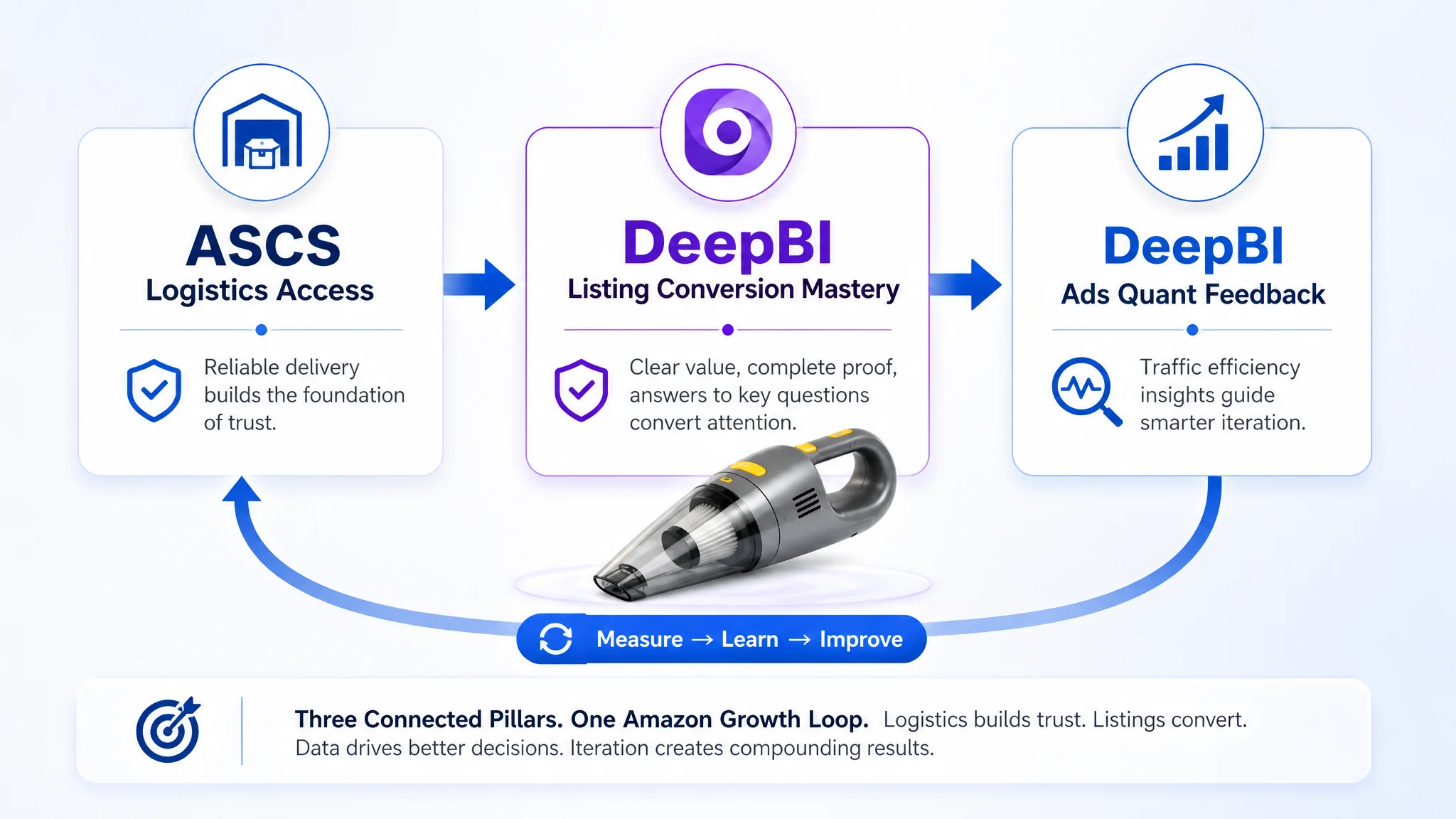
The governing principle is simple: start with diagnosis, act with AI precision.