

Conversion Rate as a Growth Engine
A listing can attract substantial traffic and still lose revenue when shoppers do not buy. Conversion rate optimization is therefore a business priority, not a cosmetic exercise. It determines how efficiently paid clicks and free organic visits become orders while influencing the performance signals that support continued growth.
A practical example comes from a thermal shipping-label printer listing that appeared reasonably strong by internal standards. Its overall Listing score was 74/100, the title scored higher than a major benchmark competitor, the bullet points were slightly stronger, and the product rating was 4.5 stars. Yet orders lagged behind impressions and ACOS remained difficult to control. The team initially concluded that the main problem was traffic quality, bids, or keyword coverage.
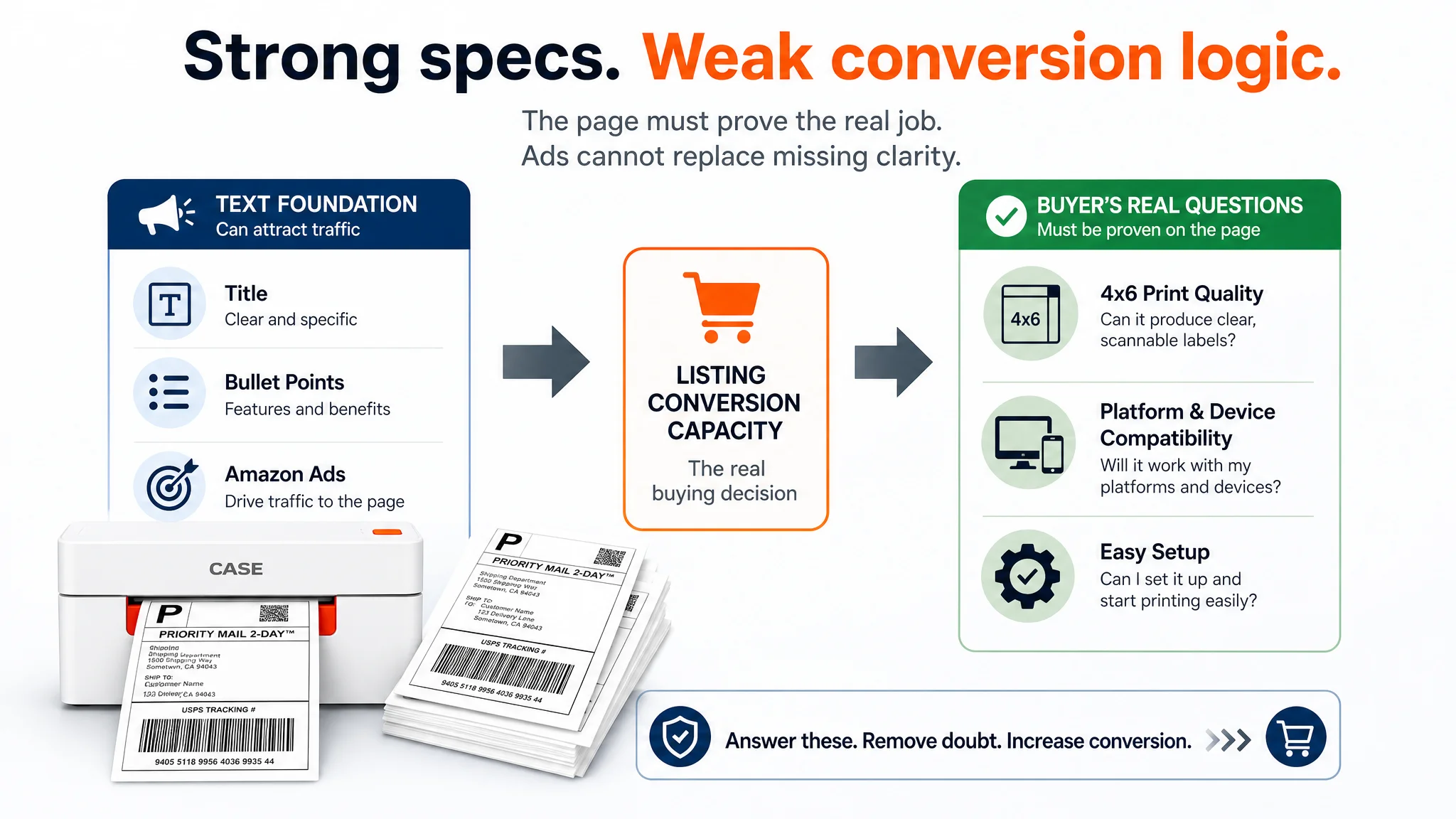
A deeper diagnostic showed a different constraint. Compared with a category-leading benchmark at 85/100, the largest gaps were in the main image set, A+ content, and trust-building details. The page contained information, but it did not quickly prove that the printer could produce clear 4x6 shipping labels, work with the buyer’s platforms and devices, or provide a manageable setup path—especially for Mac users. The issue was not simply whether the listing looked professional. It was whether the page could convert the traffic being sent to it.
That distinction is central to conversion optimization: a listing should be evaluated by how effectively it answers buyer questions, not only by whether it satisfies an internal content checklist.
What Makes Amazon Conversion Rate Optimization So Critical
- Treat CVR as a financial efficiency metric alongside CTR, ACoS, BSR, and sales velocity. A higher CVR means more orders from the same traffic volume, improving the commercial return of the listing without requiring the same increase in advertising spend.
- Use simple arithmetic to understand the upside: if traffic and average order value remain constant, doubling CVR can double revenue without increasing ad spend. This is a conditional scenario, not a promise of a universal result, but it shows why improving the conversion step can be more efficient than purchasing additional traffic.
- Separate paid and organic traffic in your analysis. A paid advertising click may carry a cost, while an organic click does not; both, however, create an opportunity for an order. A listing that converts both sources more effectively can reduce dependence on paid acquisition and potentially support a healthier TACoS.
- Diagnose CVR through the full funnel rather than judging visual polish alone. A strong image may help CTR, while clearer benefits, stronger proof, better pricing, or a reliable delivery promise may determine whether the shopper completes the purchase.
- Replace disconnected listing work with a measurable process. When a visual or content update is tied to subsequent impressions, clicks, orders, CTR, and CVR, you can evaluate whether the change improved business performance instead of relying on subjective design preference.
The label-printer example illustrates why these metrics must be connected. The seller had already invested in a technically sound title, detailed bullets, a full image set, and advertising campaigns. Because the text looked stronger than the benchmark, the team treated the Listing as “basically fine” and continued adjusting campaigns. However, the main image did not clearly show a crisp, scannable 4x6 shipping label, and the A+ content did not explain platform compatibility, connection methods, or Mac setup in enough detail. Advertising was bringing shoppers to the page, but the page was not completing the buying logic.
The practical lesson is not that advertising data is unimportant. It is that advertising data should be interpreted together with page-level conversion capacity. When clicks are present but orders remain weak, more traffic may simply expose the same unresolved doubt to more shoppers.
How CVR Impacts Visibility, Ranking, and Sales Velocity
- Remember Amazon’s commercial objective: surface products that are relevant to a search and likely to satisfy the shopper. Conversion behavior is therefore an important performance signal associated with the relevance and ranking logic commonly discussed around the A9 and A10 algorithm families.
- Recognize the practical feedback loop: higher CVR can support more orders from existing traffic; stronger order velocity may contribute to greater organic visibility; increased visibility can generate additional organic visits; and sustained sales performance can support ongoing BSR and ranking gains.
- View the flywheel as cumulative rather than instantaneous. A single conversion improvement will not automatically guarantee a ranking jump. Consistent performance across traffic, conversion, inventory, pricing, and customer experience gives the loop a stronger foundation.
- Protect Buy Box eligibility and delivery consistency while optimizing CVR. A highly persuasive listing cannot sustain sales velocity if shoppers encounter an unavailable offer, an uncompetitive offer, or a delivery promise that weakens purchase confidence.
- Use post-change data to verify the mechanism. If a new visual or content revision is published, mark the iteration and compare the following performance window for changes in CTR, CVR, orders, and ACoS. This turns listing optimization into a repeatable growth cycle rather than a one-time refresh.
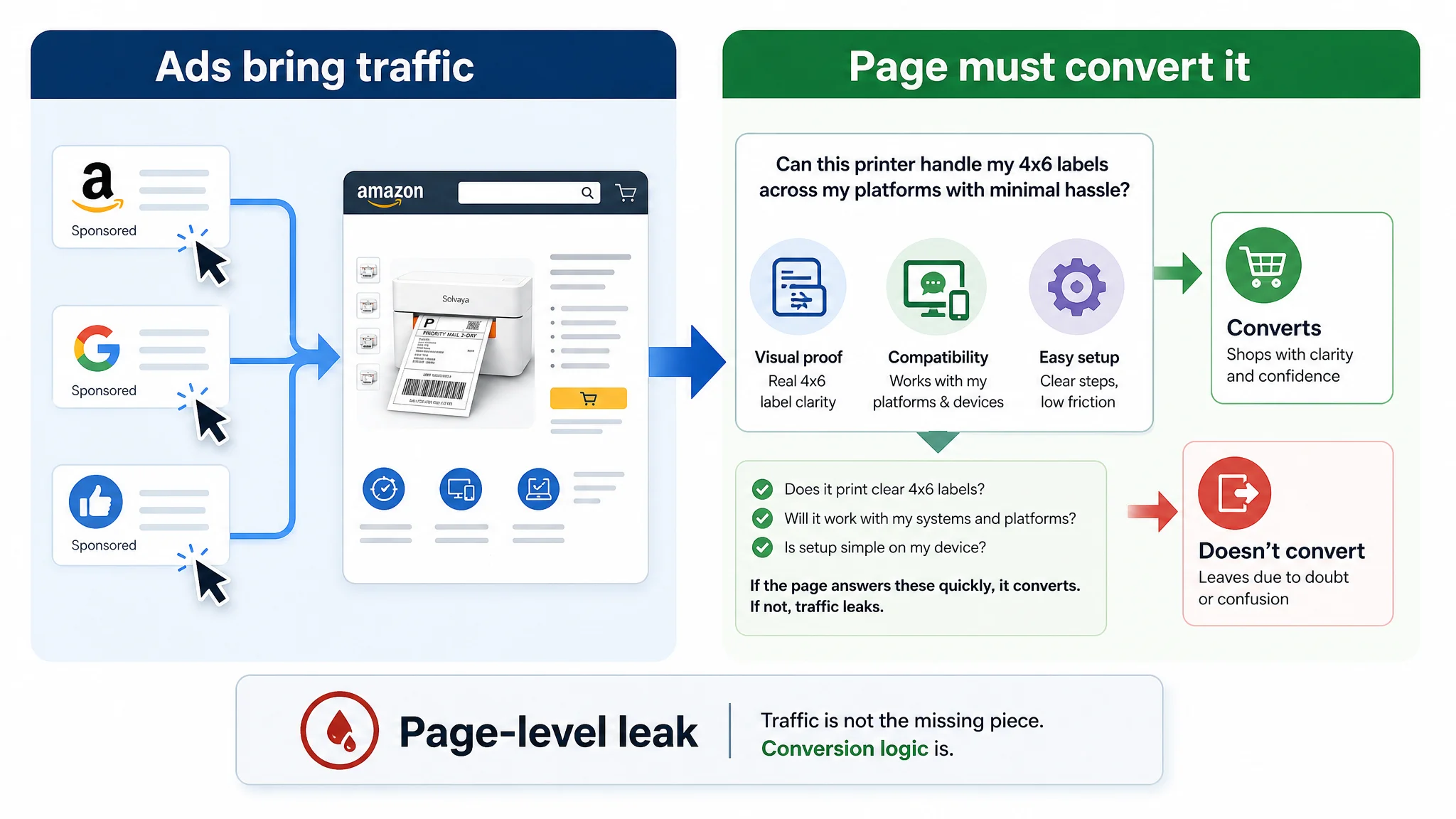
A page-level weakness can interrupt this flywheel even when the product is relevant and the advertising is active. In the printer example, the team was considering additional ad and bid adjustments while the Listing still left basic questions unanswered: whether the product printed actual 4x6 labels clearly, whether it supported Amazon, Shopify, eBay, or shipping platforms, and whether a Mac user could complete setup without friction.
This is why advertising should amplify a listing’s strengths rather than compensate for its missing decision logic. If the page does not establish clarity and trust, increased spend may generate more visits without producing the order velocity needed to support sustainable growth.
Where to Track Your Amazon Conversion Rate and Benchmark It
Locating Your CVR in Seller Central and Beyond
Start with your own first-party data before comparing your listing with any external estimate. In Seller Central, open Business Reports and review Detail Page Sales and Traffic by Child Item. The key metric is usually shown as Unit Session Percentage, Amazon’s conversion-rate proxy for the selected child ASIN and reporting period. It is calculated from detail-page sessions and units ordered, so confirm that the date range, marketplace, child variation, and traffic context are consistent.
Review CVR alongside:
- Sessions and page views
- Units ordered and ordered product sales
- Impressions, clicks, and CTR where available
- Traffic source, such as Sponsored Products, organic search, or external traffic
- Price, coupon, delivery promise, Buy Box status, and inventory availability
A falling CVR with stable traffic may indicate a detail-page, offer, or competitive problem. A low CVR combined with weak CTR can suggest that the listing is losing prospects before they reach the product page. Treating CVR as an isolated score can lead you toward the wrong listing change, making ACoS, BSR, or sales velocity more difficult to improve.
The thermal printer listing shows how misleading isolated scores can be. The page had a 74/100 overall score, a title score of 17 versus the benchmark’s 15 out of 20, and bullet points scoring 8 versus 7 out of 10. Its 4.5-star rating was also slightly above the benchmark’s 4.4. These signals made the team believe that the listing was not the bottleneck. However, the main image score was 23 versus 27 out of 30, detail-page and A+ content scored 17 versus 23 out of 25, and the review volume was only 34 compared with approximately 5,500.
The diagnosis therefore had to move beyond “Is the copy acceptable?” and ask “Where does the page fail to reduce purchase risk?” The answer was found in visual proof, setup guidance, ecosystem compatibility, and trust communication. A listing can perform well on selected content dimensions and still have weak overall conversion capacity.
Third-party dashboards can help organize trends, keyword traffic, and competitive context, but their estimates are not fully accurate substitutes for Seller Central data. Use them to formulate questions, not to override your actual orders and sessions.
DeepBI can add another diagnostic layer by connecting seller data, including impressions, clicks, orders, CTR, and CVR, with listing-level scoring. Its Listing scoring and competitive benchmarking can compare gaps across the main image, title, bullets, detail page, and reviews against genuinely similar products. Comparable items should align in product form, function, price band, use case, and audience.
Conversion Rate Benchmarks by Product Category (2026)
Category benchmarks are directional starting points, not performance guarantees. For an initial diagnosis, sellers may use broad working ranges such as:
- Electronics: approximately 2%–5% CVR
- Consumables: approximately 5%–10% CVR
These bands should not be presented as universal 2026 facts. Electronics often involve more comparison, technical uncertainty, and price sensitivity, while consumables may benefit from repeat-purchase intent and clearer use cases. Individual products can perform well above or below these ranges without proving that the listing is defective.
Interpret the range in relation to product price, traffic source, product maturity, review strength, competition, fulfillment, availability, offer quality, and promotional intensity. Compare paid and organic traffic separately where possible. Then prioritize the largest measurable gap: weak CTR suggests a click-generation issue, while adequate CTR with weak CVR points more directly to the offer or detail page. A structured benchmark helps determine which listing improvement deserves attention first instead of encouraging pursuit of an arbitrary category average.
Competitive benchmarking should also examine what the stronger listing explains better. In the label-printer comparison, the benchmark did not simply contain more attractive graphics. It made the product’s decision logic easier to follow: it showed a recognizable shipping label, clarified performance, demonstrated platform compatibility, explained system and connection paths, and addressed setup concerns. The relevant question was not “Can this listing add more content?” but “Which unanswered question is preventing the buyer from committing?”
Crafting Amazon Listings That Drive Conversion
A listing converts when every visible element answers the shopper’s next question with minimal friction. The title earns attention, bullets organize the value proposition, the description builds confidence, and visuals make the product easier to understand. Treat these components as one conversion system: greater clarity can support CTR and CVR, while faster, more disciplined iteration can shorten listing cycle time and inform improvements in BSR and ACoS.
Product Titles: Mobile-First and Keyword-Rich
Your title must communicate the product’s category, primary benefit, and defining attributes before a mobile shopper reaches the end of the line. Follow Amazon’s 2025 requirements by keeping the title within 200 characters and avoiding any word repeated more than twice. Compliance is only the baseline; a title can meet the limit and still lose conversions if it reads like an inventory of search terms.
Lead with the information most likely to determine relevance and purchase intent. Use important customer language naturally, remove lengthy or repetitive modifiers, and make the structure easy to scan. Avoid keyword stuffing, as awkward phrasing can reduce readability even when relevant terms are included. Backend search terms are better suited to ranking-related synonyms, common misspellings, and auxiliary terms that do not belong in the visible title.
The printer listing demonstrates an important limit of title optimization. Its title clearly identified the product type and included relevant attributes such as wireless Bluetooth connectivity, 4x6 label printing, speed, resolution, ink-free operation, and system compatibility. DeepBI did not recommend replacing the textual foundation. Instead, it suggested targeted refinements: naming major platforms more explicitly, translating speed into a human-use statement, connecting resolution with scan reliability, and clarifying label width and supported formats.
This matters because a strong title can establish relevance without resolving the final purchase concern. The title may tell a shopper what the product is, while the images and A+ content must prove how it works in the shopper’s actual workflow.
DeepBI can score title quality across keyword layout, selling-point clarity, and structural compliance, then generate on-brand revisions within the character limit. Use the score and competitor benchmark as diagnostic starting points, not as substitutes for compliance review.
Bullet Points: Lead With Benefits, Not Specs
Use all five bullet points to address the customer’s main concerns in a logical order. Put the benefit first and the supporting feature or specification second. A bare specification is rarely persuasive; connect it to the problem it helps solve.
A practical structure is:
- Core customer concern
- Product benefit or solution
- Supporting feature, measurement, or proof
- Problem resolved for the shopper
This approach turns technical information into purchase reasoning. Rather than presenting capacity, material, or dimensions in isolation, explain how each attribute supports the intended use. Keep every bullet focused on one meaningful benefit, use readable phrasing, and avoid repeating the same claim across multiple points. DeepBI evaluates selling-point order, pain-point coverage, and readability, helping you determine whether the five bullets form a persuasive sequence rather than a specification list.
The printer’s original bullets were already organized around performance, compatibility, flexibility, and cost. The improvement opportunity was to make each point carry more conversion weight:
- Connect Bluetooth and the dedicated app with the practical ability to design and print from a smartphone.
- Translate speed into a throughput statement, such as up to 72 sheets of 4x6 labels per minute where supported by the product information.
- Link 203 dpi to readable barcodes and scan reliability rather than leaving it as an isolated technical number.
- Name relevant ecommerce and logistics platforms instead of relying on a vague claim of broad compatibility.
- Explain the 1-inch to 4.1-inch label-width range through shipping, inventory, product-tag, and file-label use cases.
- Turn “no ink” into a concrete maintenance and ongoing-cost benefit.
The broader lesson is that technically correct bullets may still underperform when they do not answer the buyer’s operational question. A buyer is not only asking whether the printer has Bluetooth or 203 dpi resolution. They are asking whether it will print the labels they need, through the systems they use, without creating avoidable work.
Product Description: Convert Shoppers, Not Algorithms
Use the product description to answer questions that remain after the title and bullets: how the product fits into the customer’s routine, what the brand stands for, how key benefits work, and what expectations the shopper should have. Expand on the strongest benefits with clear usage context and relevant brand story, adding detail that supports purchase confidence.
Do not treat description copy as a primary ranking field or assume that adding keywords directly improves Amazon search ranking. Keep the language natural and customer-oriented. Where applicable, strengthen the broader detail-page experience with comparison tables, usage scenarios, authoritative proof, and deeper benefit explanations. DeepBI can assess detail-page completeness and conversion-supporting content, allowing you to prioritize gaps that may affect CVR.
For a product with compatibility and setup considerations, the detail page should reduce uncertainty before checkout. In the printer example, shoppers needed to know how the product connected to iOS, Android, Windows, and Mac, which functions used Bluetooth or USB, how the app workflow operated, and what to expect from the Mac installation process. These are not peripheral technical details. They determine whether a buyer believes the product will fit into an existing business routine.
High-Impact Visuals and Video
Plan exactly seven image slots: one main image and six additional images, with video permitted in an additional slot. The main image should use a pure white background and present the product clearly at a scale that makes its form immediately understandable. Use the remaining slots to address different shopper questions rather than repeating the same angle.
Support the product with infographics, close-up details, size or parameter visuals, lifestyle imagery, and video where appropriate. Zooming can help shoppers inspect quality more closely, reducing uncertainty and potential returns; it should not be presented as a ranking mechanism.
Visual accuracy is essential. DeepBI’s Product DNA constraints are designed to prevent generated assets from changing the product’s structure, material, color, logo, proportions, or included accessories. It can score visual quality, benchmark suitably similar competitors, convert vague recommendations into executable image instructions, generate on-brand assets, and publish approved content through SP-API. After publication, connect visual iteration points to ad reporting and monitor CTR changes, creating a measurable feedback loop rather than relying solely on subjective judgment.
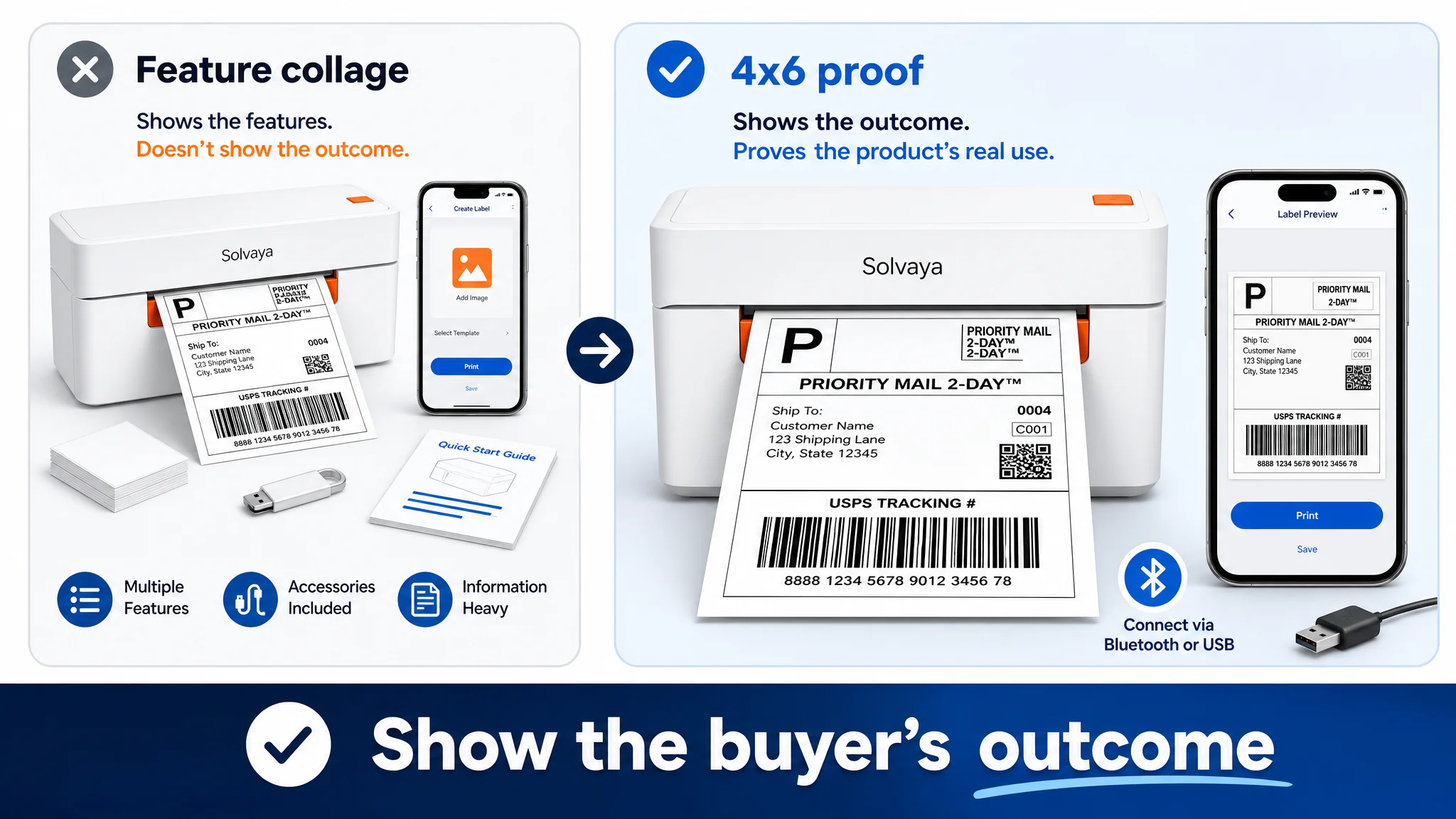
The main image should show the buyer’s desired outcome, not merely a collection of included components. In the printer example, the original hero image displayed the device, phone, manual, USB drive, adapter, and a label containing seller-oriented terms such as “Wireless,” “USB,” and “Bluetooth.” It did not clearly show a crisp 4x6 shipping label with a barcode and address, nor did it connect the phone interface to the printed result.
The benchmark’s simpler image was more effective because it immediately demonstrated the product’s primary job. A product image can contain more objects and still communicate less value. When the buyer’s concern is “Will this reliably print my shipping labels?” a real printed label is stronger evidence than a collection of accessories.
A useful image sequence gives each frame a specific decision-making role:
- Main image: show the printer and a clearly printed 4x6 shipping label.
- Performance image: visualize speed, 203 dpi clarity, barcode readability, and small-text detail.
- Use-case image: show shipping, inventory, product tags, and other supported label types.
- Connection image: distinguish Bluetooth and USB paths for each supported system and platform.
- Workload image: show label rolls, fan-fold stacks, and a realistic small-business workflow.
- Setup or guidance image: show app steps, imports, pairing, or other practical instructions.
- Video or final supporting image: demonstrate the product in use without repeating the previous frames.
This sequence moves the shopper from “It has Bluetooth and USB” to “I understand what it prints, how clearly it prints, how fast it works, which systems it supports, and how I will use it.”
Power of A+ Content and Premium A+ to Lift Conversions
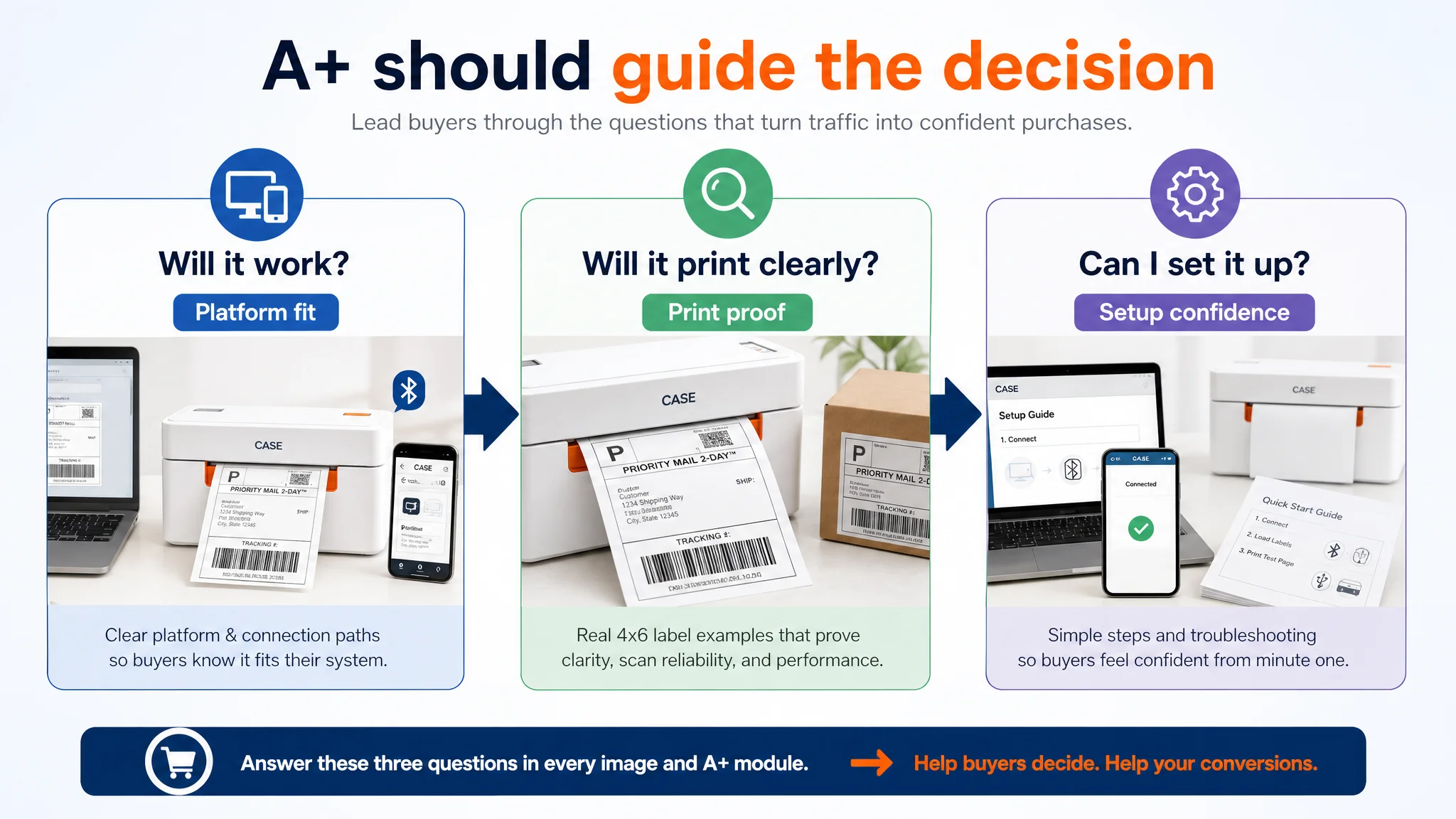
A+ content should do more than make a detail page look polished. It should help shoppers answer questions that standard images, bullets, and product descriptions leave unresolved: Is this product suitable for my use case? What evidence supports its claims? How does it differ from alternatives? Can I trust the quality and expected experience?
When these questions remain unanswered, shoppers stay in comparison mode or leave the listing. A structured A+ experience can reduce confusion, strengthen credibility, and guide more qualified traffic toward purchase. Amazon has stated that A+ content may produce an approximate 3% to 20% conversion-rate lift, but the outcome depends on the product, competitive context, traffic quality, and execution. Treat that range as a reference, not a guarantee.
The label-printer listing had A+ modules and a full image set, but that did not mean the content had completed its job. The modules showed selling points, product photos, accessories, and several use scenes. What was missing was a decision path: confirmation of platform compatibility, a system-and-connection matrix, proof of print quality and throughput, app instructions, and troubleshooting guidance. The content was informative in isolation but not sufficiently reassuring for a buyer deciding between similar products.
Building Trust Through Rich Visual Storytelling
Effective A+ content turns product information into a decision sequence. A useful structure can move from product introduction and core benefits to pain-point resolution, trust proof, and a clear purchase-oriented conclusion. Each module should address one practical concern rather than repeat the title or bullet points.
For example, a generic statement such as “high quality” offers little decision value. A relevant certification image, demonstrated usage scenario, comparison table, or clearly explained product feature can provide stronger support when the evidence is genuine and applicable. The visual story and its text must remain aligned with the actual product. Invented parameters, unsupported certifications, or altered product details can create product-image mismatch, negative reviews, refunds, and compliance risk.
DeepBI supports this process through Listing competitive benchmarking and A+ gap identification. It can compare the detail page with market reference points, identify missing conversion modules such as authoritative proof or comparison information, and turn those gaps into structured optimization plans. Its AI-generated modules are constrained by product information and visual consistency requirements, while preview capabilities allow you to review original and proposed assets side by side before applying selected changes.
For the printer, a stronger A+ sequence would have addressed the following questions in order:
1. Will it work with my business ecosystem?
A platform wall showing supported ecommerce and shipping platforms could make compatibility visible immediately.
2. Will it print clearly and quickly enough?
Large speed and resolution figures should be paired with close-ups of barcodes and small text on real-looking labels.
3. How does it connect to my system?
A matrix can distinguish Bluetooth connections through the app from USB connections for Windows and Mac.
4. Can it support more than one workflow?
Showing the 1-inch to 4.1-inch label-width range through shipping, inventory, product-tag, and file-label examples gives “no ink” and flexibility a practical meaning.
5. Can I set it up without excessive friction?
A step-by-step app path—download, pair, choose or import a label, preview, and print—turns an abstract convenience claim into an understandable process.
6. What happens if I encounter a Mac issue?
Transparent guidance around common security prompts can prevent a known friction point from becoming a surprise after purchase.
The purpose is not to add modules for their own sake. It is to reduce the perceived risk that caused the page to lose shoppers to a better-explained alternative.
Optimizing A+ for Mobile Shoppers and SEO
Mobile shoppers often scan before they read. Design each A+ module with a clear image-text hierarchy: one central visual idea, a concise headline, and short supporting copy. Keep the most important benefit visible early, use sufficient contrast and readable type, and avoid dense text blocks that force shoppers to pause and decode the page. A compact sequence of focused modules is generally easier to navigate than one crowded visual panel.
Alt text should describe the image accurately and provide Amazon with useful product context. It can support how the content is understood in relation to the listing, but it should not be treated as a major Google Image Search ranking tactic. Write descriptive, product-relevant text without stuffing repetitive keywords or claiming benefits the image cannot substantiate.
Premium A+ can provide additional creative formats, but access is not universal. Your brand must be enrolled in Amazon Brand Registry and meet Amazon’s eligibility criteria before you can use Premium A+ features. Check eligibility within Seller Central and plan content around the modules available to your account. Use CTR and CVR to evaluate whether stronger visual communication is helping traffic move from product comparison to purchase, while monitoring ACoS and listing cycle time to keep the investment commercially disciplined.
A+ should also compensate for weaknesses elsewhere in the trust structure where possible. The printer listing had a similar star rating to the benchmark but a much smaller review base: 34 reviews compared with approximately 5,500. That gap could not be solved through design alone, and it should not be hidden. However, the page could have done more to establish professional context through genuine platform compatibility, realistic use cases, setup guidance, and transparent expectations.
A high rating does not automatically create the same confidence as a large body of customer evidence. When review scale is limited, every visual and instructional element must work harder to answer, “Will this be as reliable and usable as the established alternative?”
Keyword Strategy That Supports Conversion
Targeting Buyer Intent With Long-Tail Keywords
Keyword selection should begin with the shopper’s likely decision stage, not search volume alone. Broad terms can generate impressions, but they may also attract shoppers whose needs, budgets, or expectations do not match your offer. That mismatch can weaken CTR, reduce CVR, increase wasted ad spend, and make organic sales velocity harder to sustain.
Long-tail keywords often provide a clearer purchase-intent signal because they describe a more specific product need, use case, feature, or constraint. Prioritize terms that align with what your product actually delivers and with the benefits you can support on the detail page. A smaller pool of highly relevant searches can be more valuable than broad traffic that produces clicks without conversions.
Use a disciplined feedback loop:
- Identify terms that describe the product, its primary benefit, and the shopper problem it solves.
- Compare those terms with customer language appearing in relevant search and advertising data.
- Evaluate performance through CTR, CVR, ACoS, and the quality of resulting traffic rather than impressions alone.
- Retain terms that attract qualified shoppers and revise or deprioritize terms that create repeated clicks without meaningful conversion.
DeepBI supports this process through Listing analysis. It can examine your title and bullet points, extract core search terms, and compare visible keyword coverage, selling-point clarity, pain-point coverage, and readability against publicly visible competitor content. Use those findings to locate gaps in how your offer is expressed, not to assume access to competitors’ hidden backend terms.
The printer example cautions against treating keywords as the default explanation for every conversion problem. The title and bullets already covered the main product category, performance, compatibility, and ink-free operation. The more consequential gap was that the page did not visually prove the use case behind those terms. A shopper searching for a 4x6 label printer still needs to see a clear 4x6 label, understand platform support, and trust the setup process.
Keywords can attract a qualified shopper, but they cannot alone prove that the product will fit the shopper’s workflow.
Where to Insert Keywords for Maximum CVR
Keyword placement should support both retrieval and decision-making. Put the primary product expression and strongest purchase-relevant qualifier in the title while keeping the structure readable and aligned with Amazon requirements. Shoppers should understand what the product is and why it matters without having to decode a string of disconnected phrases.
Use bullet points to connect relevant terms with benefits, evidence, and solved problems. A useful structure moves from the category concern to your product’s response and then to the practical outcome for the shopper. This gives each keyword a persuasive role instead of treating it as an isolated insertion.
Do not force every variation into visible copy. Repeated or awkward wording can reduce readability, weaken benefit clarity, and hurt the very CVR the keyword strategy is intended to support. Keep the product description focused on objections, usage context, differentiation, and purchase confidence. It can support conversion through clear communication, but it should not be treated as a direct organic-ranking lever.
DeepBI Ads analytics can provide a controlled bridge between marketplace behavior and listing refinement. Use stable advertising signals to identify search terms or attributes associated with conversions, then test whether those insights improve the relevance and clarity of the title, bullets, or visual content. Treat ad data as directional evidence, not proof that every high-volume term belongs in the listing.
In the printer case, the more useful refinement was to make platform names and connection paths explicit rather than adding broad keyword volume. Terms related to Amazon, eBay, Shopify, Etsy, UPS, USPS, and FedEx were valuable because they reflected the buyer’s operating environment. Their value increased when the visual and A+ content also confirmed what “compatible” meant.
Pricing and Trust Signals That Influence Buyers
Balancing Competitive Price and Perceived Value
Price is one of the first signals shoppers use to decide whether a listing deserves further attention. A low price may increase clicks, but it can also weaken perceived quality, reduce margin, and create expectations the product cannot meet. A high price can support premium positioning, yet it increases the evidence required from the images, copy, reviews, features, and fulfillment promise. The objective is not simply to be cheaper than competing offers; it is to make the price credible relative to the value communicated on the detail page.
Review your price alongside competing products, review depth, feature differences, and the strength of your trust signals. If the offer is positioned above the market, the listing should clearly explain why through specific benefits and proof. If it is positioned below the market, avoid making the discount the only reason to buy. Track how pricing changes affect CTR, CVR, ACoS, order volume, and BSR rather than evaluating price through revenue alone.
The printer comparison shows why perceived value cannot be separated from proof. The product had technically strong specifications, including speed, resolution, wireless connectivity, and ink-free printing. But those specifications were not translated consistently into buyer outcomes such as clear, scannable labels, practical throughput, platform fit, and low setup risk. Better specifications do not automatically justify an offer if the page does not make their value easy to understand.
Automated repricing can help sellers respond to market movement, but it should be governed by minimum margins, inventory conditions, and a clear positioning strategy. A price adjustment that wins clicks but lowers CVR or makes ACoS unsustainable is not a successful optimization. In one case study, repricing contributed to a different performance outcome, but results vary by category and competition. Treat any example as directional evidence, not a guaranteed benchmark, and validate changes against your own business metrics.
Ethical Review Management and Its Conversion Impact
Reviews function as social proof because shoppers use them to assess product quality, reliability, and whether the listing’s promises match the ownership experience. A strong detail page can still lose the sale when its review score, review volume, or recurring complaint patterns create doubt. That trust gap can appear in CVR even when impressions and clicks remain healthy.
Ethical review management begins with monitoring, analysis, and product improvement—not generating, soliciting, removing, or automatically managing reviews. Examine star distribution, review-count gaps, customer feedback, and recurring sentiment patterns. Separate complaints about product quality from those caused by unclear instructions, inaccurate images, missing specifications, or delivery expectations. Each pattern points to a different corrective action.
The label-printer listing had a 4.5-star rating, slightly above the benchmark’s 4.4, but only 34 reviews compared with approximately 5,500. The rating alone therefore created an incomplete trust picture. The page needed to use genuine compatibility information, app guidance, realistic performance proof, and transparent Mac instructions to reduce the uncertainty created by the review-volume gap.
This also shows why review analysis should be connected to listing content. If buyers repeatedly report confusion about system limitations or setup, the response may not be another advertising adjustment. It may be clearer copy, a connection matrix, an installation guide, or a more accurate image sequence. Conversely, if feedback identifies a product-quality issue, content changes cannot substitute for product improvement.
DeepBI can use review scores and sentiment patterns as Listing diagnostic inputs to identify possible content, product-quality, or expectation gaps. Its role is diagnosis: connecting review and feedback signals with listing dimensions and business metrics such as impressions, clicks, orders, CTR, and CVR. This helps determine whether weak conversion may reflect insufficient detail-page trust or a broader offer problem. The next step remains human-led execution: revise the relevant content, investigate quality issues, or correct the customer expectation.
The Prime Effect and Inventory Stability
Delivery confidence is part of the offer, not a separate operational detail. Prime eligibility and stable inventory can support faster, more predictable delivery promises, reducing hesitation between product interest and checkout. When shoppers see uncertain availability, delayed shipping, or a changing delivery window, purchase friction rises and CVR can suffer even if the listing itself is persuasive.
Inventory planning therefore protects both sales velocity and trust. Monitor stock levels against demand, replenishment timing, and promotional activity so that a traffic increase does not lead directly to an unavailable offer. Stable availability also helps preserve a consistent shipping promise, while stockouts can interrupt BSR momentum and direct shoppers to competing listings. Review inventory and fulfillment alongside CTR and CVR: if clicks remain strong but orders weaken as delivery speed or availability deteriorates, the constraint may be operational rather than content-related.
Common Mistakes That Kill Your Amazon Conversion Rate
Use this checklist to identify small sources of friction that can lower CTR, weaken CVR, increase ACoS, and slow sales velocity even when the product itself is competitive:
- Keyword-stuffed titles: Remove repetitive modifiers and awkward search-term sequences. A title that sacrifices clarity for keyword volume can reduce shopper comprehension and weaken the click-to-conversion path.
- Poor mobile presentation: Review the listing on a smaller screen and confirm that the title, price, main image, key benefits, and variation information are easy to understand without excessive scrolling or truncated context.
- Weak image sequencing: Do not treat image order as an afterthought. Lead with the product’s clearest value, then use varied visuals to explain use cases, dimensions, features, and important buying details.
- Missing A+ content on high-traffic ASINs: High traffic creates more opportunities to convert, but thin detail-page content leaves shoppers without deeper explanations, comparisons, or confidence-building information when they are evaluating the purchase.
- Using the description primarily for SEO: A description that only repeats keywords, specifications, or feature lists does little to resolve customer concerns. Reframe the content around buyer pain points, solutions, use cases, and reasons to choose the product.
- Unused backend search terms: Check whether relevant search terms are missing from the backend fields. Failing to provide useful indexing signals can limit discoverability for queries that the visible copy cannot naturally accommodate.
- Inconsistent pricing: Review price changes across variations, promotional periods, and comparable offers. Unexpected price differences or unstable positioning can create hesitation, reduce perceived value, and interrupt conversion after the shopper has already engaged.
- Stockouts: Monitor availability before traffic and advertising expose the listing to more shoppers. A stockout breaks sales velocity, wastes demand-generation effort, and can weaken the continuity of the listing’s commercial momentum.
- Ignored negative review trends: Do not assess reviews only by average rating. Repeated complaints about the same feature, defect, packaging issue, or expectation gap can reveal a conversion barrier that copy alone cannot solve.
The thermal printer listing exposed another common mistake: assuming that a complete image set is automatically an effective image set. The page had multiple visuals, but the main image did not show the primary outcome clearly, and the A+ content did not provide a complete decision path. Similarly, the title and bullets were strong by score but did not eliminate the need for better visual proof.
DeepBI’s Listing scoring engine can flag many content and presentation gaps across titles, images, five-point copy, A+ content, and customer-feedback dimensions. Use its score-loss diagnosis to create a prioritized fix list, then audit pricing, inventory, backend terms, and review trends separately, as those areas require operational verification beyond its supported listing workflow.
Using Data and Tools to Continuously Improve Conversion
Amazon conversion rate optimization is not a one-time listing rewrite. It is a continuous operating cycle: audit the current Listing, prioritize the highest-impact gaps, implement a controlled change, measure CTR and CVR, and refine the next iteration. When connected to ACoS, BSR, advertising search terms, and listing cycle time, optimization becomes a business system rather than a sequence of subjective edits.
The core discipline is to change one meaningful variable or content area at a time, establish a measurement point, and compare performance with a relevant baseline. A stronger image may influence CTR, while clearer bullets or more persuasive A+ content may influence CVR. Advertising results can also reveal whether the Listing attracts the right traffic. Without measurement, even a visually appealing update can consume resources without improving commercial performance.
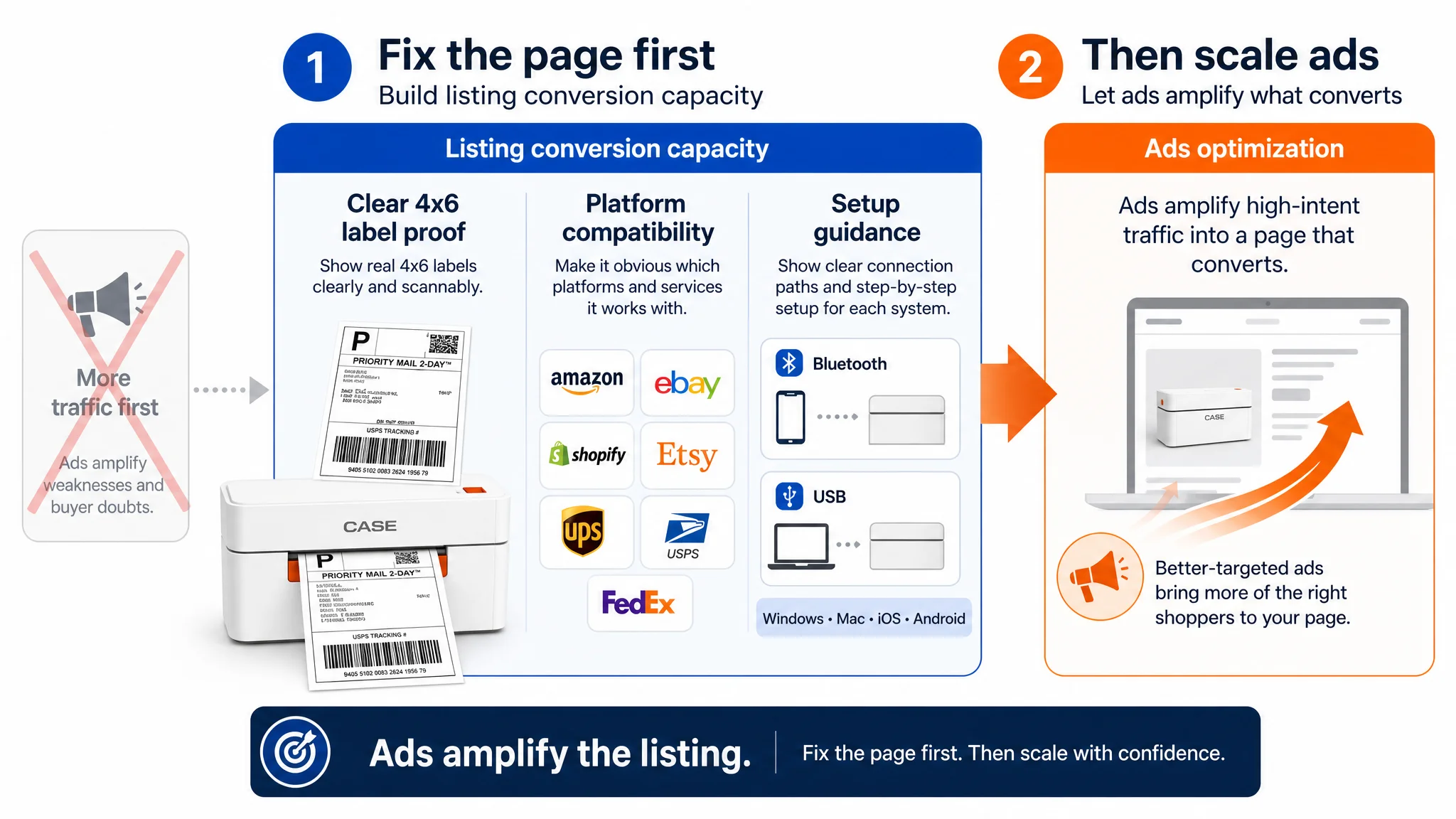
The printer example also shows why the order of operations matters. The seller’s initial instinct was to keep adjusting campaign structures, bids, placements, keywords, and negations. DeepBI’s diagnosis instead prioritized the page’s ability to convert incremental traffic:
1. Show real 4x6 label output clearly.
2. Explain platform and system compatibility.
3. Clarify Bluetooth and USB connection paths.
4. Provide app and Mac setup guidance.
5. Use A+ content to reduce risk and explain broader use cases.
6. Return to ad optimization after the Listing’s conversion logic had been strengthened.
This is not an argument against advertising optimization. It is an argument for fixing the structural leak before increasing the volume of traffic entering it.
A/B Testing With Manage Your Experiments
Eligible Brand Registered sellers can use Amazon’s Manage Your Experiments to test supported Listing elements, including titles, images, A+ content, and bullet points, subject to Amazon’s availability, account eligibility, and experiment types. Amazon determines the available testing scope, so do not assume that every Listing component can be tested in every account.
Measured experiments are the appropriate way to validate a proposed change. Rather than deciding that a new headline or image “should” perform better, compare the versions through Amazon’s supported workflow and evaluate the resulting signals. Depending on the element and traffic conditions, review changes in CTR, CVR, sales velocity, and related advertising efficiency such as ACoS. Keep the winning version only when the evidence supports the decision, and document what changed and when it was applied.
For the printer, a meaningful test would not simply compare two attractive hero images. It would test whether showing the actual 4x6 output communicates the product’s job more effectively than a feature collage. Similarly, A+ changes should be assessed by whether they help shoppers understand compatibility, setup, performance, and use cases—not merely whether the modules appear more polished.
DeepBI does not provide native A/B testing. It prepares optimized Listing content and assets that you can test through Manage Your Experiments or other Amazon-supported measurement workflows.
How DeepBI Amplifies Your Optimization Workflow
DeepBI helps organize the work before and after an experiment. Its Amazon-only Listing audits examine core components such as the main image, title, bullet points, A+ content, and relevant customer-feedback signals. Competitive benchmarking then identifies gaps against a similarity-constrained competitor, helping you distinguish a genuine positioning weakness from a cosmetic preference. The objective is not an attractive score; it is a data evidence chain showing which content module contributes to a performance gap.
In the label-printer diagnosis, this evidence chain separated the strong textual foundation from the weaker visual and structural components. The page did not require a complete rewrite simply because the overall score was below the benchmark. It required a focused response to the gaps that affected buyer decisions: missing proof of the primary use case, incomplete system clarity, weak setup guidance, and insufficient trust-building detail.
The platform turns those findings into structured recommendations and optimized text or visual assets. Rather than offering vague advice such as “improve the image,” recommendations can define composition, camera angle, lighting, and other execution parameters. Product attributes must remain accurate, with product reality serving as the constraint against misleading visual changes or unsupported claims.
After approval, SP-API one-click publishing eliminates repetitive downloading and re-uploading. A process that once took many minutes can be reduced to seconds, shortening listing cycle time and creating a clear application point for subsequent analysis. DeepBI can connect published Listing changes with advertising data, including impressions, clicks, conversions, CTR, CVR, ACoS, and TACoS. High-converting search terms from Ads can then inform titles, images, and other Listing improvements, while the resulting Organic strategy uses stronger relevance and conversion signals to support visibility and BSR.
Conclusion: Building a Conversion-First Amazon Business
A conversion-first Amazon business is not built through a single listing redesign. It develops through a repeatable cycle of auditing, prioritizing, implementing, and measuring. When more relevant shoppers become buyers, CVR can support revenue and sales velocity. Stronger conversion signals may also help a listing make better use of its existing traffic, reduce dependence on inefficient paid clicks, and contribute to healthier organic visibility and ranking over time. The practical effect should be evaluated through the metrics that matter: CTR, CVR, ACoS, BSR, orders, and listing cycle time.
Start with a structured listing audit rather than changing every asset at once. Review the main image, title, bullet points, A+ content, and customer feedback alongside relevant competitor benchmarks. The objective is to identify the weaknesses most likely to affect the funnel. A low CTR may point to a problem with the main image or title. Strong clicks but weak CVR may indicate that the detail page does not communicate value, product fit, or credible differentiation clearly enough. Prioritize the highest-impact gap first, then define the metric that should indicate whether the change is working.
The thermal printer listing is a useful reminder that an apparently strong page can still have a serious conversion constraint. Its title and bullets were not fundamentally weak. Its rating was not poor. Its advertising structure was not necessarily the root problem. The deeper issue was that the images and A+ content did not clearly demonstrate the product’s primary job or remove concerns about compatibility, setup, and reliability.
Favor small, evidence-based improvements over guesswork. Replace one selected image, refine a specific content element, or address a clearly documented customer objection instead of committing immediately to a full redesign. Record when the change is applied, compare the old and new assets, and observe the relevant performance data before deciding what to adjust next. This disciplined approach protects strategic clarity and makes it easier to connect an action with movement in CTR, CVR, ACoS, BSR, or sales velocity.
DeepBI can support this operating rhythm as an Amazon-focused partner, connecting diagnosis, recommendations, content creation, and implementation in one workflow. It can help translate quantified listing weaknesses into executable image instructions, reduce manual upload work from a lengthy operation to seconds, and tag published image events in advertising reports to support CTR analysis. Through Amazon’s SP-API, sellers can manage listing assets while retaining control over which individual changes to apply. The seller’s judgment remains essential: tools can accelerate audits and execution, but they do not replace product knowledge, strategic decisions, or ongoing measurement.
The most important operating principle is simple:
Advertising brings shoppers to the listing. The listing must give them enough clarity and confidence to buy.
Build the routine, test each meaningful change against evidence, and let the next audit be guided by what the data reveals.