

Understanding Amazon's 2025-2026 Algorithm Shift and Its Budget Impact
Amazon advertising is moving beyond a simple keyword-to-product match. Search terms still matter, but product visibility increasingly depends on how well an offer fits a shopper’s intent, use case, and likely purchase context. Personalized recommendations, behavioral signals, and semantic relationships can influence which products receive attention after a shopper begins browsing or searching.
For sellers, the commercial impact is significant. A budget organized only into broad, phrase, exact, and branded keyword silos may not show which customer persona is producing profitable growth. It can also overfund high-volume terms that generate impressions and clicks while underfunding narrower audiences with stronger CVR, healthier ACoS, or greater potential to improve BSR.
Rising CPC pressure makes this weakness more expensive. As more advertisers compete for valuable placements, purchasing the same keyword traffic can require progressively greater bids. Higher CPC does not automatically create better results: if the landing-page message, product positioning, or audience fit is weak, the additional spend may raise ACoS without producing proportional gains in CVR. Budget decisions therefore need to evaluate the quality of traffic, not only its volume.
This distinction is easy to miss when advertising performance looks unstable. One US marketplace seller came to DeepBI convinced that the problem was simply “bad Amazon ads.” Advertising costs felt increasingly difficult to control, orders were unstable, and the team had already cycled through bid adjustments, budget changes, match-type revisions, and keyword restructuring. Yet when the product was reviewed in the Listing system, the core diagnostic fields were all marked “N/A”: total Listing score, title score, main-image score, bullet-point score, A+ or detail-page score, review and rating score, and competitor scores.
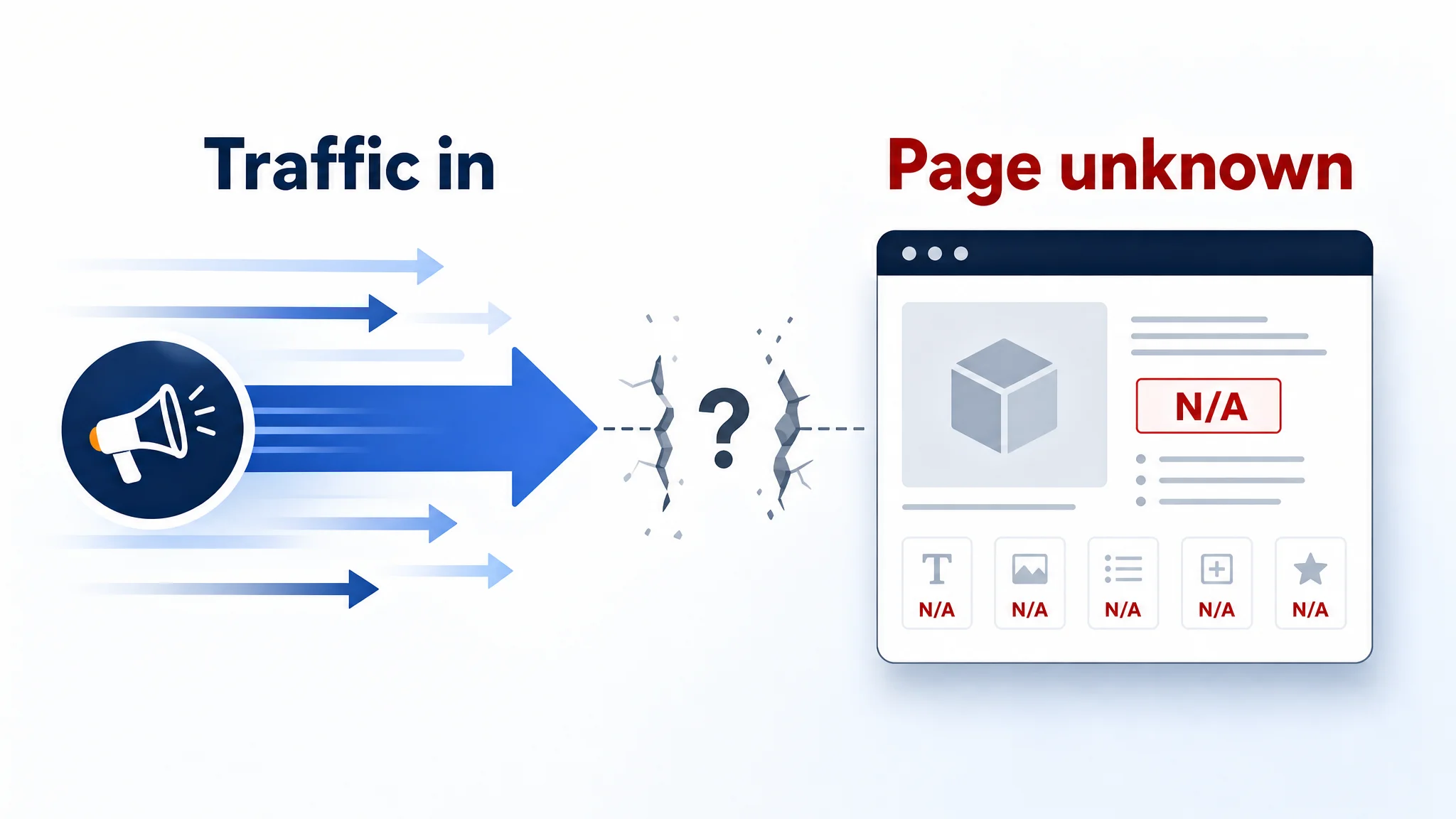
The absence of data did not prove that the Listing had a low CTR or a weak CVR. It revealed something more fundamental: the seller was making traffic decisions without knowing whether the product page was competitive or capable of converting additional traffic. The team thought it was testing advertising, but it was also testing an undiagnosed page. This is why a budget decision should not begin with “Which keyword should receive more money?” It should first establish whether the destination can support that investment.
AI-assisted shopping adds another layer. As shoppers increasingly use recommendation and conversational tools to narrow choices, products may be evaluated through attributes, benefits, and use cases rather than through one exact search phrase. Backend attributes become more important in helping Amazon interpret product relevance. These fields should support the product’s actual identity and intended use, while titles, bullets, images, and structured listing information reinforce the same positioning. Keyword data remains useful, but it functions as one signal within a broader relevance system.
A controlled Trellis A/B test pattern provides a practical direction: variants using audience signals produced stronger engagement and ROAS than approaches relying on less differentiated targeting. The lesson is not that every seller should abandon keyword campaigns. It is that audience context can improve how spend is assigned and evaluated.
A more resilient allocation model groups campaigns around customer intent and persona alongside keyword structure. Sellers can distinguish discovery audiences from high-intent shoppers, compare traffic quality through CTR and CVR, and shift funding toward segments that produce acceptable ACoS or contribute to stronger organic momentum. Listing decisions should also be connected to advertising evidence. Systems that analyze search language, audience priorities, and signals such as impressions, clicks, conversions, CTR, CVR, TACoS, and ACoS can support an iterative feedback loop rather than a fixed annual budget split.
The execution change is straightforward: treat keywords as inputs, not the entire budgeting framework. Review spend by audience, intent, placement, and conversion behavior; then reallocate through controlled tests and documented learning. Before scaling any segment, also verify that the Listing has been evaluated against a relevant benchmark. Otherwise, the account may be optimizing traffic into a page whose conversion capacity has never been judged.
Campaign Architecture for 2026: The Persona-Based Framework
Old vs. New Structure
- DeepBI Listing Product Documentation, Consolidated Edition — The documented workflow supports a layered operating model that begins with market analysis, product positioning, target audience definition, and selling-point priority before moving into execution and feedback. This provides a useful foundation for replacing a keyword-first portfolio with campaigns organized around audience relevance and purchase intent.
- DeepBI Listing Product Documentation, Consolidated Edition — A one-dimensional keyword structure tends to group spend around search terms without clearly separating why different shoppers are searching, where they are in the funnel, or what information they need before converting. A persona–intent architecture adds those dimensions: discovery audiences, problem-aware shoppers, comparison-stage shoppers, and high-intent buyers can be evaluated through separate campaign roles and budget rules.
- DeepBI Listing Product Documentation, Consolidated Edition — The archive identifies multiple relevant dimensions, including target audience, positioning, visual style, semantic function, selling-point priority, and funnel stage. Used as campaign design inputs, these dimensions can connect search-term evidence with the persona and intent being served, rather than treating every click as an interchangeable unit.
- DeepBI Listing Product Documentation, Consolidated Edition — The documented data inputs include search terms, listing content, competitor features, impressions, clicks, orders, CTR, CVR, ACoS, and TACoS. This combination supports budget reviews based on funnel contribution and commercial outcomes, not only on keyword-level traffic volume.
The same logic applies to the Listing itself. In the seller case described above, there was no validated competitor benchmark, no module-level gap analysis, and no objective view of how the title, main image, bullets, A+, or reviews compared with relevant category leaders. The team had a campaign structure to adjust, but no stable page-level judgment to guide the adjustment. A persona-based portfolio cannot fully solve that problem if the page does not communicate a clear promise to the persona receiving the traffic.
Why Persona-Based Portfolios Win
- DeepBI Listing Product Documentation, Consolidated Edition — The archive describes a strategy layer that determines product positioning, target audience, and selling-point priority before execution. That sequence is important because persona-based allocation should not begin with an arbitrary audience label; it should connect the audience to a product promise, a relevant message, and a measurable stage of the conversion path.
- DeepBI Listing Product Documentation, Consolidated Edition — Separating persona and intent layers can increase signal density by allowing teams to compare CTR, CVR, ACoS, and TACoS within more meaningful groups. A weak CTR may point toward a top-of-funnel creative or main-image problem, while a weak CVR may indicate insufficient detail-page information, trust, or offer communication. These diagnoses support more precise budget movement than a blanket decision to raise or lower a keyword bid.
- DeepBI Listing Product Documentation, Consolidated Edition — The workflow extracts high-converting search terms and uses keyword weighting to give greater emphasis to attributes associated with conversion. In a persona-based portfolio, that feedback can help refine the message assigned to each intent layer while preserving a connection between advertising signals, Listing optimization, and eventual ACoS or Listing cycle-time decisions.
A real operating problem appears when teams interpret every weak outcome as a targeting problem. In the US seller case, the internal consensus was that the ads were not optimized enough. The team adjusted bids and budgets, changed match types and keyword lists, shifted funds between campaigns and ad groups, and waited for the learning phase to improve. But because the Listing had not been scored or compared with a true benchmark, there was no evidence showing whether the problem was actually the traffic source, the offer, the page message, or the trust structure.
That does not mean the ads were necessarily healthy. It means the team could not responsibly identify the cause. A persona-based system improves budget visibility only when the corresponding Listing can be evaluated against the needs of the shoppers being targeted. Otherwise, the account may separate audiences cleanly while still sending them to a page that has not answered their core questions.
Proof That Persona Signals Beat Keyword-Only Structure
- Trellis A/B test — The referenced test provides directional support for evaluating persona targeting by total impact rather than by immediate sponsored-attribution metrics alone. The reported 3.2x total impact should be treated as evidence from that test context, not as a universal multiplier or guaranteed budget return. Its strategic value is the measurement principle: persona-aligned campaigns may reveal effects that a keyword-only report would understate.
- Organic uplift example — The referenced case includes a 67% increase in organic sales. That result should likewise be read as directional evidence, not as a repeatable forecast. Organic movement can strengthen the argument for examining how paid discovery contributes to broader demand, BSR, and non-ad sales rather than allocating all budget solely to the last measurable keyword interaction.
- Amazon Marketing Cloud attribution insights — AMC, considered here as an attribution concept rather than a DeepBI integration, has been used to show that top-of-funnel touchpoints influenced approximately 70% of conversions in the cited evidence pattern. The implication is not that every product will produce the same share, but that persona-aligned discovery and consideration campaigns deserve budget scrutiny alongside bottom-funnel terms.
- DeepBI Listing Product Documentation, Consolidated Edition — The archive describes feedback loops that compare predicted and actual market performance after implementation. This supports a cautious execution rule: allocate by persona and intent, monitor CTR, CVR, ACoS, TACoS, and organic direction, then reweight budgets as evidence accumulates. A high bid may signal value, but it requires validation through conversion-path and profitability data.
The evidence also supports a second discipline: do not confuse a missing diagnosis with a negative diagnosis. In the empty Listing report, every key field was “N/A.” That did not establish that the main image was weak, that the bullets failed, or that the A+ content lacked depth. It established that none of those questions had been answered. Persona signals can improve allocation, but they cannot replace the need to determine whether the Listing can convert the audience being acquired.
The 2026 Campaign Taxonomy and Budget Allocation Model
A sustainable Amazon budget should not reward the keyword with the cheapest recent sale by default. It should balance persona value, purchase intent, contribution margin, and potential customer lifetime value (LTV). The percentages below are starting hypotheses for portfolio design, not universal benchmarks. Sellers should validate them against CTR, CVR, ACoS, TACoS, repeat-purchase behavior, and inventory capacity. Ad-driven traffic and stronger Listing quality can reinforce one another: better images and persuasive content can lift CTR and CVR, allowing the same budget to produce more qualified sessions.
Portfolio-Level Allocation by Persona
A practical starting portfolio can divide spend into three persona-oriented pools:
- Loyalists: 30%–40% for branded defense, repeat-purchase products, complementary products, and audiences with established product familiarity. These campaigns often support efficient CVR and protect profitable demand, but their incremental value should still be measured rather than assumed.
- Researchers: 40%–50% for comparison shoppers evaluating features, price, reviews, and alternatives. This pool deserves the largest share when the product has strong differentiation and the Listing can convert detailed consideration into sales.
- Impulse Buyers: 15%–25% for highly visual, immediately understandable offers and time-sensitive demand. Keep this pool controlled if conversion depends heavily on discounts or if low-margin orders quickly inflate ACoS.
The right mix changes by product maturity. A new Listing may temporarily place more budget into Researchers to collect qualified signals, while a mature product may shift funds toward Loyalists and profitable retention. Review each persona pool at the portfolio level, not only by search term. A campaign with a higher ACoS may still deserve funding if it introduces customers whose expected LTV supports that acquisition cost.
However, the persona allocation should be paired with a page-readiness check. The seller who believed the ads were the central problem had not established whether the Listing deserved additional traffic at all. There was no total score, no title or main-image assessment, no bullet or A+ evaluation, and no competitor comparison. In that situation, assigning more budget to Researchers would not answer the commercial question. The first step would be to determine whether the page clearly communicates the product’s value to comparison-stage shoppers.
The same principle applies to Loyalists and Impulse Buyers. A branded campaign may capture existing demand efficiently, but efficient branded traffic does not prove that the page is competitive with new shoppers. A visual product may receive impressions, but without knowing whether the main image creates sufficient clarity at thumbnail size, additional exposure may simply increase the number of visitors who encounter the same unresolved page problem.
Campaign-Level Segmentation by Purchase Intent
Within each persona pool, segment campaigns by intent rather than combining every query and target into one budget. An initial allocation might reserve 45%–55% for high-intent demand, 25%–35% for consideration, and 15%–25% for discovery.
High-intent campaigns include exact-match terms, branded terms, and proven product targets. They should receive dependable daily budgets because budget depletion here can suppress efficient CVR. Consideration campaigns can include broader relevant terms and competitive product targeting, where the objective is to qualify shoppers and identify converting attributes. Discovery campaigns should have explicit caps because their role is signal collection, not unlimited spend.
Move budget only after checking more than clicks. A candidate for expansion should show acceptable CVR, manageable ACoS, adequate contribution margin, and enough volume to avoid decisions based on noise. For exact-match campaigns with solid conversion history, dynamic bidding up and down can improve efficiency, but it should remain conditional rather than automatic: inventory, placement, margin, and recent performance still require review.
The page must also be considered at each stage. The Amazon path is not only a sequence of targeting decisions:
1. The search or browse result uses the main image and title to influence CTR.
2. The product page uses the title, bullets, images, A+, offer, and reviews to influence CVR.
3. Advertising determines how much and what kind of traffic enters those stages.
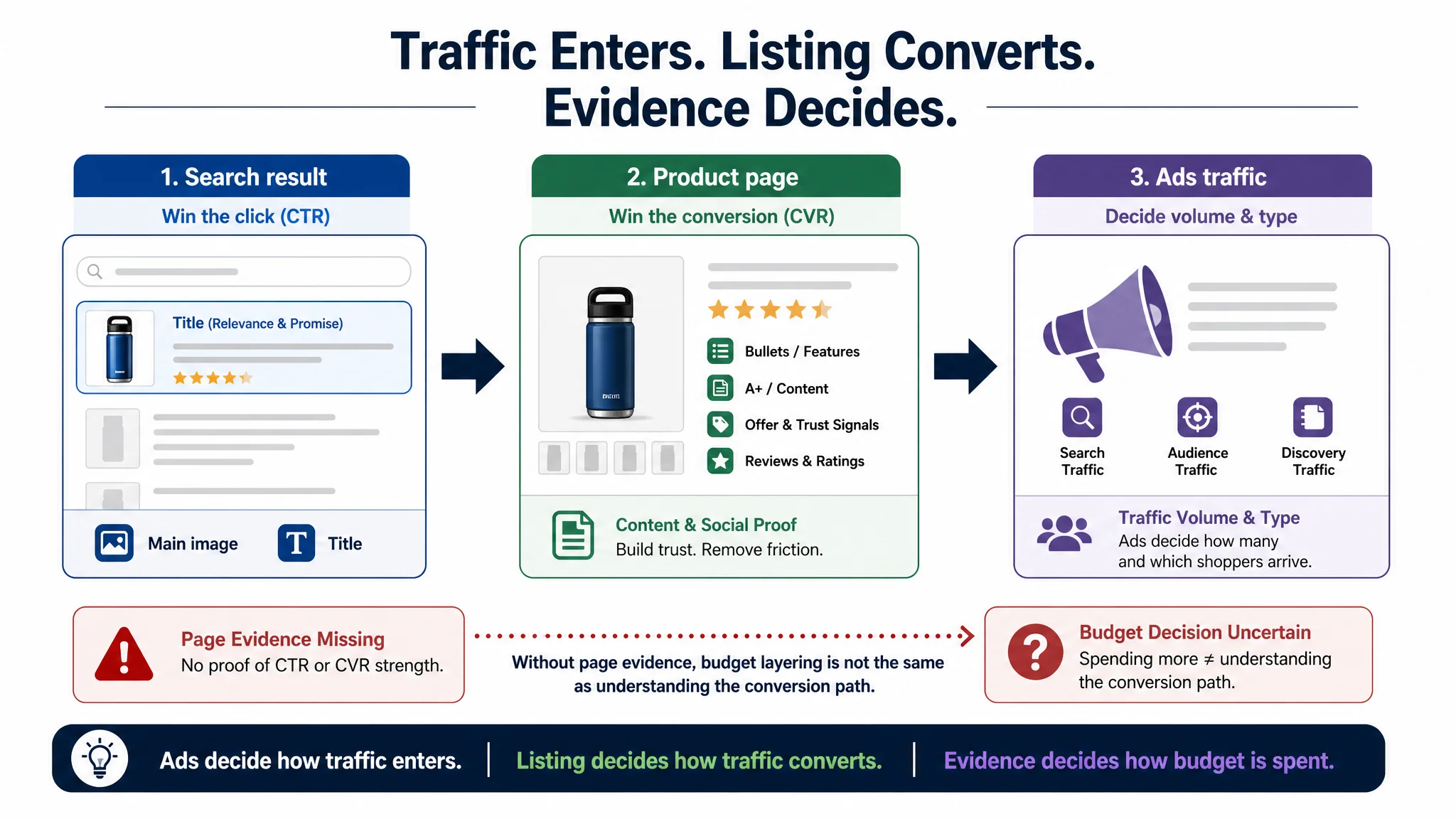
In the case with no Listing data, the team could not tell whether a future CTR issue would relate to the main image, title, or traffic quality. It also could not determine whether a future CVR issue would relate to page information, trust, A+, bullets, or social proof. That uncertainty makes aggressive budget movement premature. Segmentation becomes useful when it clarifies the conversion path; it becomes misleading when it creates an appearance of precision without page-level evidence.
Updated ACoS Targets and Break-Even Math
ACoS is calculated as:
ACoS = (Ad Spend ÷ Ad Revenue) × 100
A useful target relationship is:
Target ACoS = Profit Margin − Desired Margin
For example, if the pre-ad profit margin is 45% and the seller requires a 15% margin after advertising, the target ACoS is approximately 30%. This is a planning ceiling, not a promise that every campaign should reach the same number. Branded and high-intent campaigns may justify lower ranges, such as roughly 10%–20%; consideration campaigns may operate around 20%–35%; and discovery or competitive targeting may require roughly 30%–50% while being judged on downstream value. These ranges must be adjusted for fees, discounts, returns, and product economics.
Break-even analysis makes the constraint concrete. If one order generates $30 in contribution before advertising, the maximum first-order ad spend at break-even is $30. If the ad-attributed revenue is $100, break-even ACoS is 30%. When expected LTV adds another $20 of contribution, allowable acquisition spend can rise to $50, but only if repeat-purchase probability is supported by the seller’s data.
Use portfolio caps to prevent exploratory spend from consuming profitable demand. Amazon’s own cost-control data has associated these controls with a 2.6x uplift in attributed sales; treat that as general support for disciplined caps and controls, not as a guaranteed campaign outcome.
ACoS targets are meaningful only when the underlying conversion path is understood. In the empty Listing case, the seller was focused on rising ad costs and unstable orders, but the absence of Listing scores meant that no one could connect the symptoms to a specific page module. Lowering bids might reduce spend, but it would not reveal whether the product page was failing to communicate value. Raising bids might increase traffic, but it could amplify a page defect if conversion capacity was weak.
The practical conclusion is not to ignore ACoS. It is to interpret ACoS together with page diagnosis. If the Listing is competitive and the page converts relevant traffic, campaign-level economics can guide scaling. If the Listing has not been benchmarked, ACoS may indicate that something is wrong without showing where the problem sits.
Product Targeting: Training the Recommendation Engine
Product targeting is often treated as a secondary tactic for reaching shoppers who browse competing ASINs. That view is too narrow. It can expose a product to shoppers who have already demonstrated category interest, while generating behavioral signals that help Amazon interpret where the product fits in the market. Impressions, clicks, detail-page visits, conversions, and the relationship between competing products can reveal more than a keyword report alone.
For sellers replacing keyword-centric budgeting, the strategic question is not whether product targeting should replace search campaigns. It is where product targeting can add discovery and consideration signals that keyword campaigns may miss. These signals can also be evaluated alongside CTR, CVR, ACoS, and BSR movement, creating a broader feedback loop between advertising, Listing quality, and organic visibility.
That feedback loop depends on meaningful comparison. In the seller case, competitor scores were also “N/A,” so the team had no validated benchmark against which to judge whether its product page was ready to receive comparison traffic. Product targeting could bring shoppers from relevant competitor pages, but without reviewing the competing offer and the destination Listing side by side, the team would not know whether weak performance reflected poor targeting or a less convincing page.
Mapping the Customer Journey to Targeting Strategies
Product-targeting campaigns should be organized around shopping behavior rather than placed in one undifferentiated budget group.
- Discovery: Targeting relevant category pages and closely related products can introduce the ASIN to shoppers who have not yet selected a brand or model. At this stage, the primary diagnostic is often CTR. A weak CTR may indicate that the main image, price position, rating profile, or visible value proposition is not competitive in the placement.
- Consideration: Targeting comparable or substitute products can reach shoppers actively weighing alternatives. This stage places more pressure on CVR, detail-page clarity, and the credibility of the product’s core benefits. The Listing must answer why the shopper should choose this ASIN instead of the product already under consideration.
- Conversion: More precise targeting against high-intent products, relevant variations, or closely matched alternatives can support shoppers nearer to purchase. ACoS and CVR should carry greater weight here, since inefficient traffic can consume budget without improving contribution.
- Learning and refinement: Performance from each layer should feed back into targeting, Listing, and budget decisions. If a product target produces clicks but weak CVR, the issue may be offer competitiveness or product-page communication rather than traffic volume. If it produces strong CVR at an acceptable ACoS, it deserves a controlled scale-up.
The distinction between traffic and page performance was central to the empty diagnosis. Without Listing scores or competitor comparisons, the seller could not determine whether a future low CTR would primarily reflect the main image and title, or whether a low CVR would relate to bullets, A+, reviews, or offer communication. Product targeting therefore should not be evaluated in isolation. A target may be commercially relevant, yet the destination page may still fail to resolve the shopper’s comparison questions.
DeepBI’s Ads capability is designed to test and scale product-targeting ads through this four-layer funnel. Rather than treating every target as equally valuable, the workflow can use campaign results to identify where the product attracts attention, where it loses consideration, and where additional budget is justified. The resulting advertising signals can also inform Listing optimization: stable impressions, clicks, CTR, CVR, and ACoS data can be connected to image and page-level decisions.
Budget Shift Toward Product Targeting (with Evidence)
Budget allocation should become more deliberate during the consideration stage. Keyword campaigns remain important for capturing explicit search demand, but product targeting can deserve a larger share when shoppers are comparing alternatives and the Listing has a credible competitive position. The shift should be incremental: establish a controlled test budget, separate targets by funnel layer, and scale only when CVR and ACoS support the decision.
There is also a potential compounding effect. Reported observations have linked product-targeting activity with subsequent organic uplift, suggesting that paid exposure may contribute to stronger market signals beyond the immediate attributed order. This is evidence of a possible relationship, not a guaranteed outcome. Sellers should validate it by tracking BSR, organic impressions, organic orders, CTR, CVR, and TACoS before and after structured tests, while accounting for Listing or pricing changes.
DeepBI’s broader feedback loop strengthens this process by comparing predicted opportunities with actual advertising performance. When a new Listing asset is applied, its impact can be observed through later CTR and CVR movement, helping distinguish a targeting problem from a conversion problem. The practical objective is not simply to spend more on product targets. It is to build a measurable discovery-to-consideration system in which budget, Listing decisions, and recommendation signals improve together.
The case provides an important limitation to this model. The seller was not yet in a position to make a confident budget expansion because the Listing had not been objectively assessed. Before product targeting was scaled, the required judgment was whether the page could stand against the products from which comparison shoppers would arrive. This is not an argument against product targeting. It is an argument for sequencing: establish the destination’s competitive and conversion logic before using more budget to expose its unknowns.
Sponsored Display: The Full-Funnel Budget Expand
Keyword campaigns and product-detail-page targeting capture demand that already exists. They do not fully address shoppers who are discovering the category, comparing alternatives, or returning after an initial visit. A budget plan built only around direct-response capture can therefore produce acceptable short-term ACoS while limiting reach, branded demand, and future conversion volume.
Sponsored Display gives sellers a way to fund these missing stages. Its role should not be judged only by immediate attributed orders. Awareness activity may influence branded search and later conversion; consideration activity may improve product discovery and detail-page traffic; retargeting may recover shoppers who already showed intent. Each role should be evaluated against its relevant signals, including impressions, CTR, CVR, ACoS, branded traffic, and changes in BSR.
Full-funnel expansion should still follow the same page-readiness principle. More awareness can create more opportunities for a product to be considered, but it also sends more shoppers toward the product page. In the case where the Listing report was blank, the seller had no evidence that the page had been aligned with category expectations. Spending more at the awareness or retargeting level without resolving that uncertainty could make the account appear more active without clarifying whether the page was converting the exposure.
New Optimized Targeting and Three-Tier Display Structure
Amazon’s optimized-targeting launch in October 2025 makes Sponsored Display budget planning more important. Rather than treating targeting as a fixed list of manually selected audiences, sellers can assess optimized targeting as a demand-discovery layer within a controlled budget. It should expand the system’s ability to find relevant shoppers, but it should not become an unrestricted spending pool. Set clear budget limits, define the campaign objective, and review the resulting audience, placement, CTR, CVR, and ACoS signals before increasing spend.
A practical three-tier structure is:
- Audience awareness: Allocate roughly 30% of the Sponsored Display budget to reach relevant shoppers earlier in the journey. The goal is qualified exposure and future demand creation, not immediate order volume alone. Review reach, CTR, branded-search response, and downstream conversion signals.
- Consideration: Allocate roughly 30% to shoppers comparing products or engaging with related category content. This tier should support product discovery and detail-page visits. Monitor CTR, detail-page engagement, CVR, and the effect on branded and non-branded campaign performance.
- Retargeting: Allocate roughly 40% to shoppers who have already viewed or engaged with the product or related Listings. These audiences are closer to purchase, so CVR and ACoS generally deserve greater weight, alongside frequency and incremental sales indicators.
As a starting point, display may represent approximately 15% to 25% of total advertising spend, with the three tiers divided according to the ratios above. This is a testing framework, not a universal formula. A new product with limited awareness may require more funding for reach, while a mature Listing with substantial detail-page traffic may justify a larger retargeting share. Reallocate only after a defined observation window and compare results with prior business data.
Amazon has reported stronger category performance when advertisers combine branded advertising with display advertising than when relying on narrower approaches. That comparison does not guarantee a sales uplift for every account, but it supports keeping a measured display budget rather than excluding the channel because its attribution is less immediate. The operating principle is simple: fund the full customer journey, then let CTR, CVR, ACoS, branded demand, and BSR evidence determine the next allocation.
A further operating rule is necessary when page-level information is missing: do not interpret every display outcome as evidence about the audience. If a retargeted shopper returns to a page with unclear value communication, weak trust signals, or incomplete decision information, low conversion may reflect the page rather than the audience. The case did not establish which of these Listing weaknesses existed; it showed that the seller had not measured them. That is precisely why display and full-funnel budgets should be expanded only alongside a structured Listing diagnosis.
Leveraging AI for Automated Budget Optimization (DeepBI in Action)
Persona-based budgeting only creates value when the operating system can act on the strategy consistently. DeepBI’s Ads module is designed to turn Amazon advertising signals into structured Sponsored Products execution, replacing constant manual intervention with a controlled optimization loop. The objective is not to spend more indiscriminately, but to move budget toward the audiences, search terms, and intent signals that produce stronger CTR, CVR, and ACoS performance.
The module organizes advertising activity through a four-layer funnel:
- Exploration: Test relevant search terms and targeting opportunities to identify initial traffic and conversion signals.
- Screening: Evaluate performance and separate promising targets from terms that consume spend without sufficient engagement or sales.
- Precision: Concentrate bids and budgets around validated keywords and segments with stronger conversion evidence.
- Scaling: Expand investment in proven opportunities while maintaining the seller’s efficiency or growth priorities.
This structure prevents a common budget failure: treating every keyword as equally valuable after launch. A term may generate impressions but weak CTR, attract clicks but produce a poor CVR, or convert only when supported by a specific bid level. DeepBI can review these differences through seven-day performance metrics and adjust daily bids and budgets accordingly. Stronger signals receive more room to develop; weaker signals are constrained before they absorb a disproportionate share of the portfolio.
Automation does not remove the need for judgment about the destination page. In the empty Listing case, the team had already been adjusting bids, budgets, match types, and campaign structures. The missing element was not another execution control. It was a reliable basis for deciding whether the product page was ready to receive more traffic. Automation can make an incorrect assumption operate faster, so the system must distinguish between a measured conversion problem and an unmeasured page problem.
The workflow can also promote high-performing keywords into dedicated campaigns. Instead of leaving a proven term buried inside a broad discovery structure, DeepBI can move it into a more focused Sponsored Products campaign where its budget, bid, and performance can be managed with greater precision. This separation clarifies which spending supports exploration and which spending is intended to capture validated demand. It also gives sellers a cleaner basis for monitoring ACoS, CVR, and the relationship between paid traffic and BSR movement.
Sellers still define the commercial boundary. They can set an ACoS target, prioritize a growth objective, or establish the desired balance between efficient conversion and broader keyword discovery. DeepBI then handles the repetitive execution required to pursue that direction, including ongoing bid and budget adjustments based on the latest seven-day evidence.
For example, a seller may cap the total budget for an Amazon product portfolio to protect contribution margin. If one persona-related segment produces a higher CVR and more acceptable ACoS than the others, DeepBI can automatically reallocate available funds toward that segment while limiting spend in lower-conversion groups. The seller retains control of the portfolio ceiling, but no longer needs to monitor every campaign and make manual changes throughout the day.
Before applying that logic aggressively, the seller should establish what the Listing is being optimized to achieve. A page with a title and main image that do not communicate the offer clearly may require a different response from a page with strong first-click performance but insufficient information deeper in the funnel. The case’s missing scores meant that these distinctions could not yet be made. A responsible system therefore connects advertising automation with Listing-level measurement rather than treating campaign data as a complete explanation.
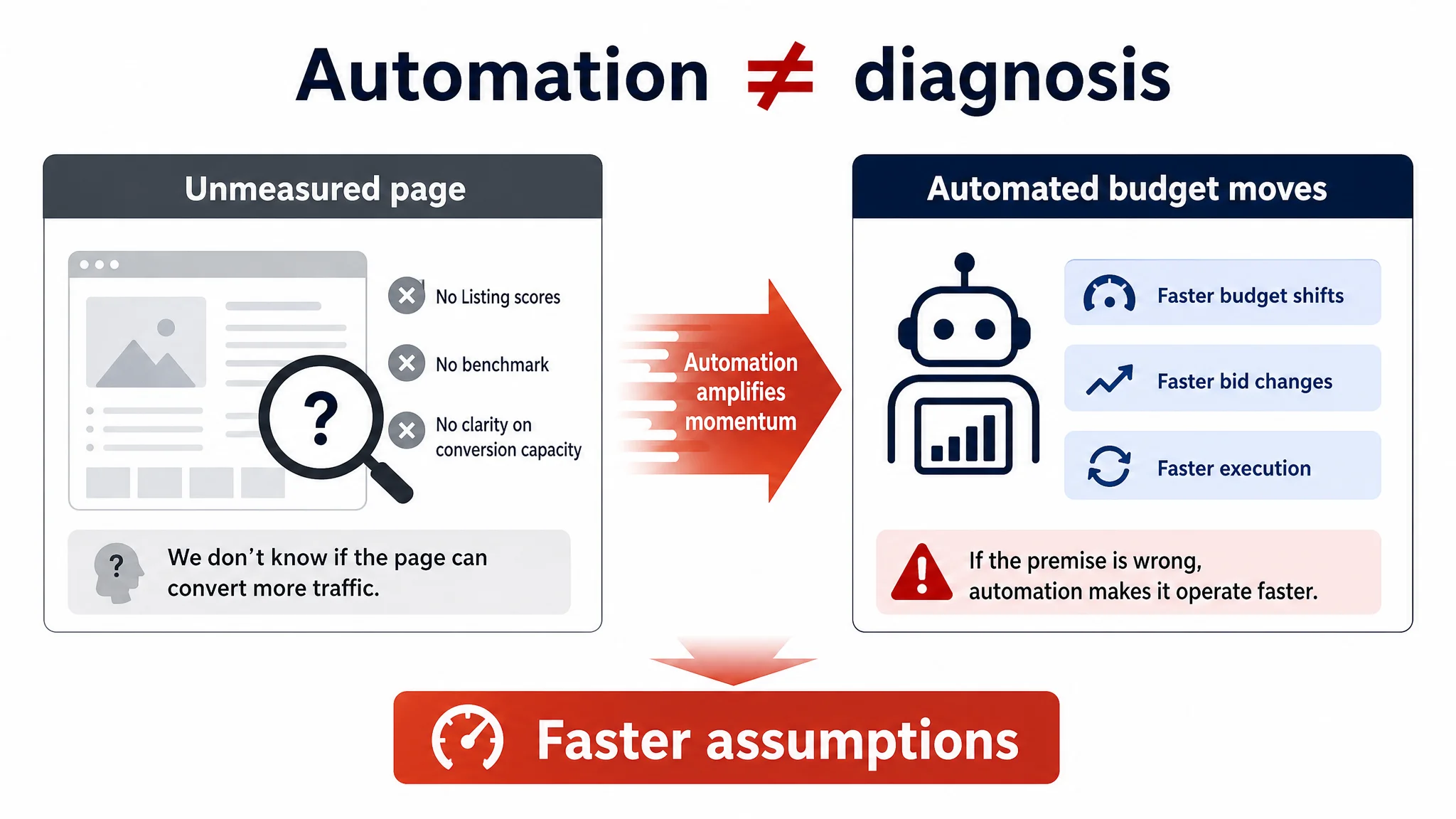
Automation therefore serves as a governance mechanism, not a substitute for strategy. It enforces budget goals, reduces micromanagement, and continuously redirects Sponsored Products spend toward stronger signals and higher-converting segments. It cannot, by itself, determine whether weak conversion originates in traffic quality, offer competitiveness, page content, or social proof.
Weekly Maintenance Routines and Your 90-Day Transition Plan
A persona-based budget model only works when it is maintained as an operating system rather than treated as a one-time campaign restructure. Weekly review should connect audience intent with Amazon performance signals, including CTR, CVR, ACoS, TACoS, and BSR movement. The objective is not to change every campaign each week, but to identify meaningful deviations, apply controlled adjustments, and record the date of each change for later comparison.
A practical weekly routine includes:
- Keyword negation: Review search-term performance and exclude irrelevant queries, duplicated intent, or terms that consume spend without contributing sales. A starting review rule might flag a keyword with 50 or more clicks and no sale, but the appropriate threshold depends on category, price, conversion rate, margin, and campaign maturity.
- Bid review: Compare bids with impressions, clicks, CVR, ACoS, and placement-level results. Reduce bids where spend is rising without proportional conversion, and protect terms that produce efficient sales without assuming that historical performance will continue unchanged.
- Placement adjustment: Examine top-of-search, rest-of-search, and product-page performance separately. Adjust placement modifiers only when the additional exposure supports the campaign’s target ACoS and does not simply inflate clicks with weak CVR.
- Budget reallocation: Move budget toward persona and funnel segments that demonstrate stronger contribution to sales, while preserving enough spend for controlled learning in newer segments.
- Change logging: Record the adjustment, reason, date, and expected KPI movement. Review the next reporting window against the previous baseline rather than judging an isolated day.
The weekly review should include a page-level check when advertising results are difficult to interpret. If clicks are arriving but conversion is weak, the question should not immediately be “Which bid should be reduced?” It should also be “Has the title, main image, bullets, A+, offer, and review position been compared with a relevant benchmark?” If the answer is no, the correct action may be to create the missing evidence chain before making a major budget decision.
Thresholds should guide investigation, not operate as universal rules. For example, a 30-day ACoS that exceeds the target by more than 50% may justify a bid, placement, or targeting review. It may also reflect a deliberate awareness investment, a seasonal shift, or insufficient conversion data. Sellers should customize the rule by contribution margin, inventory position, product lifecycle, and persona objective.
A staged 90-day transition
- Foundation, Days 1–14: Establish the baseline. Map campaigns to personas and funnel roles, document target ACoS and acceptable testing ranges, and separate branded, non-branded, product, and discovery activity where appropriate. Also establish a Listing baseline: identify a true benchmark competitor, evaluate title, main image, bullets, A+, and reviews, and document the major gaps. The realistic outcome is a cleaner measurement structure and a reliable record of CTR, CVR, ACoS, TACoS, and BSR—not an immediate performance uplift.
- Core Build, Days 15–45: Begin reallocating budgets and applying the weekly maintenance routine. DeepBI can automate recurring bid and placement optimization tasks, reducing repetitive monitoring and surfacing adjustments for the relevant campaign or persona segment. Keep decision controls in place and review proposed changes against seller-owned performance data. At the same time, address the Listing modules that most directly affect the conversion path: improve the main image and title when the first-click message is weak, restructure bullets when they do not resolve buyer questions, or strengthen A+ content when the consideration stage lacks clarity and trust. The expected operational outcome is a functioning allocation workflow with clearer ownership and fewer manual cycles.
- Optimization, Days 46–90: Compare cohorts and changes over consistent windows, refine thresholds, and shift budget based on validated contribution rather than clicks alone. DeepBI can support recurring data capture, reporting, evaluation, and feedback tracking so later decisions reflect observed impressions, clicks, conversions, CTR, CVR, TACoS, and ACoS. Compare those results with the Listing changes and benchmark position rather than attributing every movement to advertising. The realistic outcome is a more disciplined optimization loop, not a guaranteed revenue or ROI result.
Competitor bid observations can provide context, but they are not proof of profitable strategy. Validate similarity, then test the signal against your own impressions, CVR, ACoS, margins, and inventory constraints before changing allocation. A competitor’s high bid may reflect a different objective, economics, or attribution model.
The empty Listing case illustrates why the Foundation stage matters. The seller’s problem was initially framed as an advertising problem, but the system could not produce a score for the Listing or its modules. Until the benchmark and page-level evidence were established, any campaign change remained difficult to interpret. A 90-day transition should therefore build both sides of the operating system: the ability to allocate and automate spend, and the ability to judge whether the page can convert that spend.
The Bottom Line: Persona-Based Structure as Durable Advantage
Amazon advertising performance is increasingly shaped by campaign structure, not only by bid levels or keyword volume. A keyword-centric account can generate traffic while obscuring who is responding, what intent they represent, and which signals deserve additional investment. A persona-based structure gives each budget decision a clearer commercial purpose: attract the right shopper, match the message to the buying stage, and measure movement through CTR, CVR, ACoS, and eventually BSR.
The framework rests on seven connected principles:
- Plan around personas first: define the customer, need, and value proposition before assigning spend.
- Segment by intent: distinguish discovery, consideration, and purchase-oriented signals rather than treating every query as equivalent.
- Train the signal system: feed campaigns with useful engagement and conversion signals so optimization is based on meaningful behavior.
- Allocate across the full funnel: reserve budget for both demand creation and demand capture instead of concentrating only on bottom-funnel clicks.
- Apply disciplined budget controls: set guardrails for spend, bids, placement, and acceptable ACoS while protecting campaigns that produce qualified signals.
- Use automation for execution: reduce repetitive work in campaign deployment, monitoring, and approved adjustments without handing strategic judgment to an algorithm.
- Optimize continuously: connect advertising results with Listing performance, then use the feedback to refine personas, creative, targeting, and allocation.
A further principle should be added to the operating sequence:
- Diagnose the destination before scaling the traffic: establish whether the Listing is competitive, conversion-ready, and aligned with the audience receiving the budget.
Evidence from the selected materials supports the direction, while also requiring careful interpretation. A controlled advertising test reported roughly 1.5 times higher engagement and twice the ROAS under a stronger structure. Other findings linked product targeting with a 67% increase in organic sales after 90 days, while attribution analysis found that about 70% of converters had encountered a top-of-funnel ad. These results do not establish a universal outcome, but they illustrate why paid media can influence more than immediate attributed sales. Better-aligned traffic may improve the interaction between ad exposure, Listing CTR, CVR, and organic demand.
Budget discipline matters equally. One reported comparison associated tighter cost control with a 2.6-times sales multiplier, and combining ad formats was associated with a 47% sales uplift. Such figures should be treated as directional evidence, not promises. Results depend on product-market fit, retail readiness, creative quality, competition, and execution.
The empty Listing diagnosis adds a different kind of evidence. It did not provide a performance uplift or a numerical result. Instead, it showed how a seller can spend time adjusting bids, budgets, match types, and campaign structures while lacking the information required to judge the product page. Every core Listing field was “N/A,” including the overall score, module scores, and competitor scores. The problem was therefore not proven to be a weak ad, a weak keyword, or a weak page. The problem was that the team had no structured way to determine which of those explanations was valid.
That distinction matters. A budget framework can organize spend by persona, intent, placement, and funnel stage, but it cannot make an unmeasured page competitive. Advertising does not only amplify strengths. It can also amplify defects that have never been diagnosed. When the Listing has not been benchmarked, the most important optimization may be to establish the evidence chain between traffic, page content, shopper questions, and conversion behavior.
AI can help make this structure operational by connecting exposure, clicks, conversions, CTR, CVR, ACoS, and Listing diagnostics, then returning performance feedback into the next optimization cycle. The seller still sets the strategic direction and approval boundaries. Those who restructure early may build stronger organizational learning, cleaner signal histories, and more customer-aligned budget decisions. That combination can become a durable advantage, even though no framework guarantees a competitive moat.
The final decision sequence is therefore straightforward:
1. Define the audience, intent, and commercial objective.
2. Confirm that the Listing is positioned against a relevant benchmark.
3. Identify whether the title, main image, bullets, A+, reviews, or offer create a conversion constraint.
4. Allocate controlled budget to the appropriate funnel and persona segments.
5. Monitor CTR, CVR, ACoS, TACoS, BSR, and Listing changes together.
6. Automate repetitive adjustments only after the strategic boundaries and measurement system are clear.
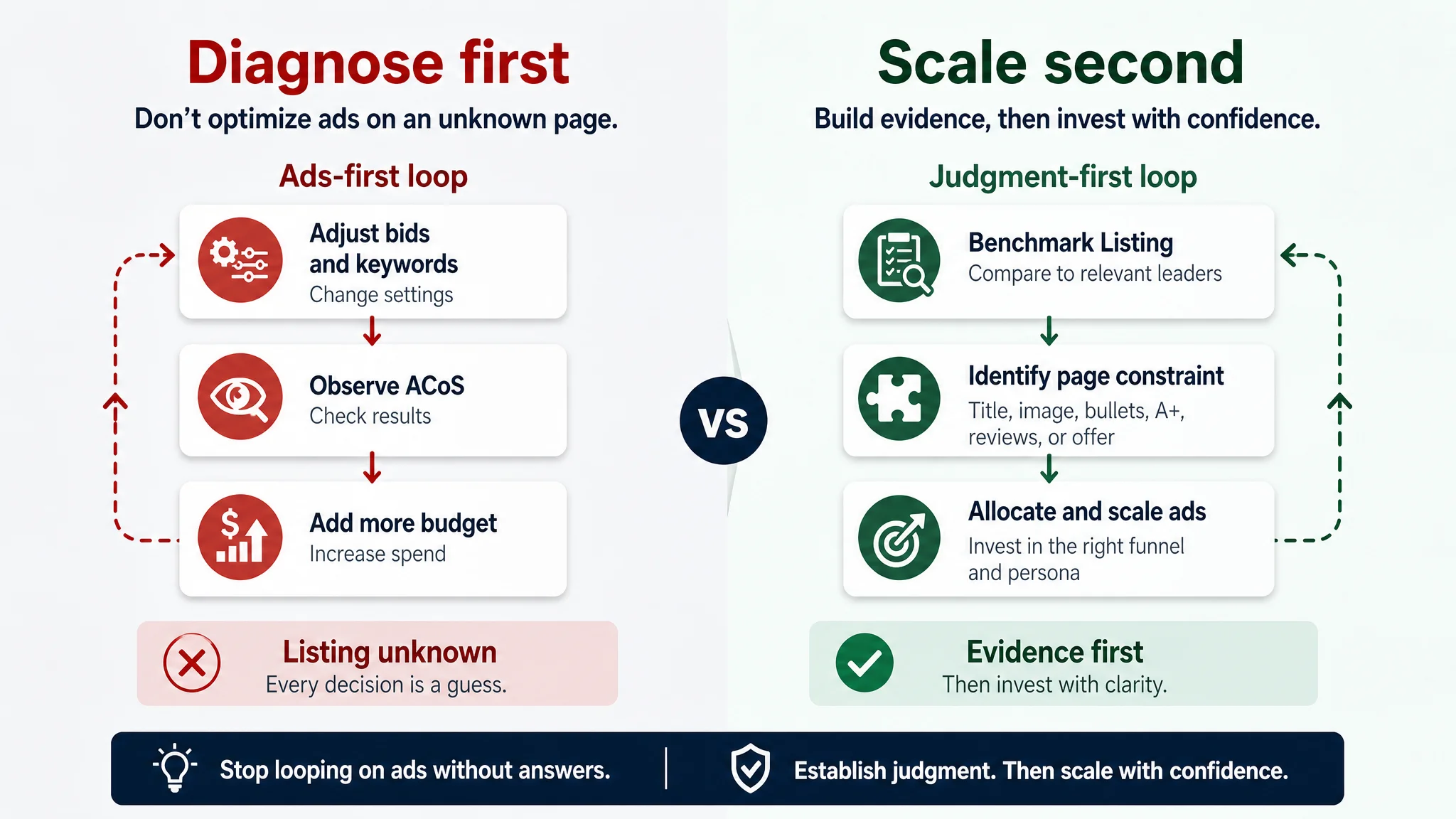
Before asking which bid to raise next, sellers should be able to answer a more basic question:
Is this product page capable of converting the traffic we are preparing to buy?
Until that question is supported by structured evidence, advertising optimization may continue to feel unstable regardless of how often campaigns are rebuilt.