


At a Glance: The Hidden Risks of Generative AI
Data entered into a generative AI tool should not automatically be treated as private. Many tools retain user inputs for a period of time and may use them to improve or train their systems, depending on the provider, settings, and account terms. A conversational interface can also make disclosure feel informal, encouraging employees to paste confidential strategies, product specifications, customer information, internal documents, or personal data that would normally require stricter handling.
The risk is not limited to accidental disclosure. Once sensitive material has been ingested, tracing where it went, who can access it, or whether it can be fully removed may be difficult or nearly impossible. Proprietary information may then create intellectual-property, contractual, privacy, or competitive risks. AI’s broad appetite for data can also make data stores more attractive targets for criminals.
AI-related risk also includes a quieter governance problem: making business decisions without a reliable understanding of the data behind them. An Amazon seller once approached DeepBI convinced that rising ad costs and unstable orders were evidence of poor advertising performance. However, when the product was reviewed, the Listing report contained no measurable score for the title, main image, bullet points, A+ content, reviews, or competitors. Every key field was marked “N/A.” The immediate issue was not simply that advertising might be inefficient. It was that the team was making ad-spend decisions without knowing whether the product page could convert the traffic at all.

That example illustrates why organizations should separate risk categories rather than label every problem as AI-related. The December 2022 Activision incident highlights the consequences of sensitive information being exposed through workplace communication and tools. Yum! Brands suffered a ransomware attack, while the T-Mobile breach was associated with API exploitation—not AI capabilities. A missing Listing diagnosis is not a data breach either, but it demonstrates a related governance failure: decisions become unreliable when data boundaries, evidence, and accountability are unclear.
Businesses handling proprietary, personal, or regulated data should act now: define what may be entered into AI tools, restrict access, review provider retention terms, and require human approval for sensitive workflows. They should also require a clear evidence chain before acting on AI-assisted recommendations. AI adoption is therefore a data-governance decision, not merely a productivity choice.
Why AI Tools Are Data-Hungry and What That Means for Your IP
AI tools depend on large volumes of data because data provides the raw material for generating patterns, recommendations, summaries, and creative outputs. A useful distinction is that data consists of recorded inputs—such as product specifications, customer details, sales figures, images, or internal documents—while information is data interpreted in a context that gives it business meaning. A spreadsheet may be data; the pricing strategy revealed by that spreadsheet is information and potentially valuable intellectual property.
For an Amazon seller, the same distinction applies to operational decisions. Advertising costs, search terms, click-through rates, conversion rates, Listing content, competitor positioning, and review patterns may each look like separate data points. Together, they reveal the commercial logic behind a product page and its growth strategy. Giving an AI system access to those signals without defining how they will be processed, retained, or used can expose more than a single prompt.
Conversational interfaces make disclosure feel unusually harmless. Users can type as though they are asking a colleague for help, then paste a supplier contract, private customer message, product roadmap, or unreleased Listing copy. Illinois cybersecurity guidance highlights this oversharing risk: convenience can reduce the pause that normally precedes sharing sensitive material.
The same convenience can encourage teams to skip a more fundamental question: whether the available data is sufficient to support a business decision. In the Amazon seller example, the team initially assumed the problem was “bad Amazon ads” and continued thinking about bids, budgets, match types, and campaign structure. Yet the Listing system had no structured evidence showing the product’s position against a relevant benchmark. The absence of data did not make the judgment neutral; it made the judgment speculative.
The input may also have a longer digital life than the conversation suggests. Depending on the tool, account configuration, and provider policies, prompts and uploaded files may be processed, logged, or retained for a period of time. MIT-related research and commentary on AI data practices emphasize that once information has been ingested into a system, identifying every copy and removing it completely may be nearly impossible.
That persistence matters beyond IP leakage. As Qualys security analysis indicates, if organizations accumulate large collections of business and personal data, those repositories could become more attractive targets for cybercriminals. The risk is not that every AI tool causes a breach; it is that unnecessary collection can enlarge the potential payoff of unauthorized access.
It also matters for the quality of decisions. Advertising does not simply create performance; it amplifies the conditions of the page receiving the traffic. If a team cannot determine whether the title, main image, bullet points, A+ content, or social proof are competitive, increasing traffic may amplify an unknown weakness. Treat prompts and uploads as business disclosures, and treat missing evidence as a business risk—not as permission to guess.
Best Practice 1: Treat AI Inputs as Public Information
- MIT guidance on avoiding the sharing of sensitive data: Treat every prompt submitted to a public AI tool as information that could become public. Do not enter personally identifiable information, business plans, customer lists, source code, internal operating documents, or comparable confidential material. Sensitive information includes student records protected under FERPA, personal data covered by GDPR, intellectual property, and trade secrets. Once submitted, information may be difficult to retrieve, control, or verify as deleted, so the safest default is not to provide it in the first place.
- Relevant GDPR guidance on personal data and generative AI: Apply data-minimization thinking before using an AI system. Ask whether the task can be completed with non-sensitive signals, redacted content, or aggregated information instead of identifiable records. A request to improve an Amazon Listing, for example, should not require uploading customer names, contact details, order-level records, or private business plans. Keeping those inputs outside public AI workflows reduces unnecessary exposure while preserving room to improve CTR, CVR, ACoS, BSR, and Listing cycle time.
- DeepBI Listing Product Documentation: For Listing optimization, DeepBI does not require raw customer data. Its workflow can use public ASIN and Listing-performance signals, including competitor presentation, Listing content, search terms, and market-level advertising indicators. This creates a practical boundary: use public or non-sensitive signals for diagnosis and optimization, while keeping customer records, proprietary code, trade secrets, and other protected information out of public AI tools.
The value of using limited, structured inputs is not only privacy protection. It also makes the resulting judgment easier to trace. In the Amazon seller example, the problem was not an excess of sensitive information in the report; it was the absence of a usable Listing evidence chain. There was no total score, no title or main-image assessment, no bullet-point or A+ breakdown, and no competitor comparison. The seller was spending on traffic without a clear answer to whether the page deserved more traffic.
That distinction is important. Data minimization does not mean operating without evidence. It means using the minimum appropriate evidence needed for a specific decision. Public Listing content and market-level signals can support a page diagnosis without exposing customer records or private business plans. A responsible AI workflow should therefore ask two questions at the same time: “Do we need this data?” and “Do we have enough reliable data to support the decision?”
Best Practice 2: Customize Privacy Settings in AI Platforms
Privacy settings are an important first layer of protection when using generative AI for Amazon operations. Many platforms offer controls that allow users to opt out of using submitted content for training-related purposes or to delete conversation history. Availability, scope, and retention rules vary, so users should review these options rather than accepting default settings automatically.
For example, an Amazon seller preparing a launch might use an AI tool to refine a product description containing unreleased positioning and pricing plans. Disabling training-related data use can reduce the chance that those prompts are included in broader service-improvement processes. Deleting the conversation afterward can further reduce the amount of information retained in the account, subject to the platform’s stated policies and any applicable backups or legal retention requirements.
A separate scenario involves a team member pasting customer messages into an AI workspace to summarize recurring concerns. History controls may limit how long those conversations remain accessible, but they do not make sensitive customer information appropriate to share by default. The safer approach is to remove unnecessary identifiers and provide only the minimum information needed for the task.
Settings also need to be considered alongside the quality and completeness of the inputs. In the Amazon Listing situation, the team’s initial conclusion—“our ads are not optimized enough”—was formed before there was a structured view of the product page. Changing campaign settings would not have solved the missing evidence. Privacy controls could limit how data was retained, but they could not turn an incomplete diagnosis into a reliable one.
Review privacy settings at both the individual and organizational level, and reassess them when platform policies or workflows change. Controls can reduce exposure, but they do not guarantee confidentiality. Responsible use still depends on cautious inputs, least-privilege access, structured data sharing, a documented evidence chain, and human confirmation before sensitive information is submitted or a recommendation is acted upon.
Best Practice 3: Use Approved, Privacy-Respecting AI Tools
Privacy cannot be managed through user caution alone. Even a careful employee may upload sensitive product information, customer data, or proprietary creative assets to a platform whose default settings do not match the organization’s requirements. Selecting the right tool is therefore a security control, not merely a convenience decision.
Organizations should prioritize AI tools reviewed by internal IT, privacy, legal, or security teams. Recognized certification processes can provide an additional screening signal, although approval or certification does not eliminate every risk. Curated resources, such as MIT’s approved tool list, can help teams distinguish tools that have passed institutional review from services chosen only because they are popular or easy to access.
Enterprise-grade AI platforms may also offer stronger data-processing agreements, clearer confidentiality terms, administrative controls, and more defined responsibilities for handling submitted information. Before adoption, compare those commitments with internal security policies, contractual obligations, retention rules, and applicable compliance requirements.
Approval should cover not only where data goes, but also how the tool supports business judgment. In the Amazon seller example, the Listing report was effectively empty: total score, title, main image, bullet points, A+ content, reviews, and competitor scores were all marked “N/A.” At first glance, this could be treated as a reporting or tooling issue. From a business standpoint, it meant the seller had no stable basis for deciding whether to keep scaling ads, repair the page, or compare the product against a relevant benchmark.
That is why the team refused to treat the situation as a pure ad-optimization case. Before adjusting bids or budgets, the necessary questions were: Who is the true benchmark? Where is the largest module-level gap? Is the page capable of converting the traffic already being purchased? An approved AI tool should help establish those boundaries and evidence, not encourage teams to keep changing variables simply because the controls are available.
For Amazon operations, privacy-aware design should extend into the workflow itself. A platform using Amazon’s official SP-API through an encrypted channel, requiring explicit authorization, and applying least-privilege permissions can reduce unnecessary account exposure. Limiting access to image-asset management, while excluding pricing, inventory, and order data unless expressly authorized, creates a narrower operating boundary. Structured inputs and pre-upload compliance checks can further reduce uncontrolled data handling.
These safeguards still require due diligence: verify how underlying AI providers process and retain prompts or uploaded assets before approval. Then document the tool’s permitted use, data boundaries, evidence requirements, and review owner so privacy protection and sound decision-making remain part of the Listing cycle rather than afterthoughts.
The Legal Landscape: Data Privacy Regulations and Intellectual Property
- Illinois cybersecurity source — Addresses automated decision-making and its relationship to privacy and cybersecurity obligations, including the conditional relevance of GDPR Article 22(1) and PIPL Article 73. AI tools that evaluate information or influence decisions may qualify as automated decision systems, potentially creating additional review, transparency, or governance requirements.
- MIT’s Written Information Security Program — Provides a corporate-policy reference for organizing safeguards around confidential, personal, and regulated information. Internal rules should address what employees may submit to AI systems, approved tools, access controls, retention, and incident reporting.
- Qualys blog — Supplies context on GDPR and CCPA as privacy frameworks relevant to organizational use of data in AI workflows. These frameworks may raise obligations concerning personal information, transparency, access, deletion, and responsible processing.
- General Data Protection Regulation (GDPR) — Article 22(1) concerns individuals’ rights in relation to decisions based solely on automated processing. Its application to a particular AI workflow depends on the facts and should not be assumed.
- Personal Information Protection Law (PIPL) — Article 73 addresses automated decision-making terminology and related concepts. Organizations using AI with personal information may need to assess whether additional duties could apply.
- Health Insurance Portability and Accountability Act (HIPAA) — A relevant framework where protected health information is involved. AI use does not remove a company’s responsibility to protect the data it provides.
- DeepBI Listing Product Documentation — Records controls such as structured inputs, product-identity constraints, least-privilege image-asset access, and checks against copying protected competitor designs. It does not resolve the unsettled question of ownership of AI-generated content; companies remain responsible for protecting their inputs and reviewing outputs.
Legal compliance and operational judgment are connected because both depend on traceability. If an organization cannot explain what information entered an AI system, which permissions were granted, how the recommendation was produced, or who approved the result, it may struggle to demonstrate responsible handling when a dispute or incident occurs.
The Amazon Listing example shows the operational side of that problem. A seller can make repeated advertising decisions while lacking a documented comparison of the title, main image, bullet points, A+ content, and reviews against a true category benchmark. Even without a privacy incident, the decision process is difficult to defend because the evidence chain is missing. Structured records, restricted access, and human review help address both data-protection obligations and the accountability gap created by unsupported AI-assisted decisions.
AI Policy & Ethics: Building a Responsible Usage Framework
- DeepBI Listing Product Document (Merged Edition) — Supports transparent, evidence-based AI workflows, including documented data chains, actionable score reports, structured inputs, human review, factual verification, compliance checks, and correction workflows.
- DeepBI Listing Product Document (Merged Edition), “Data Evidence Chain” — Supports replacing subjective optimization with traceable analysis of images, titles, bullet points, detail pages, and reviews.
- DeepBI Listing Product Document (Merged Edition), “Human Oversight” — Supports the principle that AI should assist rather than override human decision-making; users review and approve proposed changes before application.
- DeepBI Listing Product Document (Merged Edition), “Fair Competitor Selection” — Supports similarity constraints based on product form, price range, audience, visual characteristics, and semantic function, while noting that such constraints do not establish fairness across all demographic or market groups.
- DeepBI Listing Product Document (Merged Edition), “Quality and Accountability Controls” — Supports DNA consistency checks, factual-attribute verification, compliance review, and correction workflows as mechanisms for identifying and correcting AI errors.
- DeepBI Listing Product Document (Merged Edition), “Strict Factual Boundaries” — Supports prohibiting fabricated product defects, unsupported functions, nonexistent attributes, and recommendations that depart from verified product information.
- DeepBI Listing Product Document (Merged Edition), “Least-Privilege Access” — Supports limiting API permissions to image-asset management unless additional access is explicitly authorized.
- DeepBI Listing Product Document (Merged Edition), “Ethical AI as a Business Differentiator” — Supports positioning constrained, evidence-based production as a more accountable alternative to unrestricted AI generation, without claiming that it eliminates algorithmic bias.
A responsible framework should also define the order in which decisions are made. AI can generate suggestions quickly, but speed does not compensate for an unverified starting point. In the Amazon seller example, the team had been cycling through bids, budgets, match types, and campaign structures because advertising felt like the visible problem. Yet without Listing scores or competitor benchmarks, it could not establish whether low CTR, low CVR, or unstable orders were caused by advertising or by a page-level weakness.
Human oversight therefore means more than approving the final wording or image. It means challenging the premise of the recommendation. Before asking how to lower ACoS, a reviewer should ask whether the available data shows that the product page is conversion-ready. Before accepting a competitor comparison, the team should verify that the benchmark is functionally and commercially relevant. Before publishing generated content, the team should check product facts, claims, permissions, and intellectual-property boundaries.
This creates a more accountable sequence:
1. Define the permitted data and access scope.
2. Establish a reliable evidence chain.
3. Select a relevant benchmark and identify measurable gaps.
4. Generate recommendations within verified product constraints.
5. Require human review, factual verification, and compliance checks.
6. Monitor outcomes and correct the workflow when the evidence changes.
That sequence helps prevent AI from becoming a faster way to automate unsupported assumptions.
DeepBI: A Privacy-First AI Platform for Amazon Sellers
For Amazon sellers, privacy protection is not separate from Listing performance. Product specifications, brand assets, customer insights, and advertising data can reveal the commercial strategy behind a Listing. A privacy-first platform reduces exposure by designing its workflow around the least sensitive data necessary for each task.
DeepBI’s Listing optimization uses distributed data crawling and multidimensional semantic analysis to benchmark comparable ASINs across visible catalog signals, including Listing content and product-page elements. Sellers can evaluate positioning without uploading sensitive internal documents for the analysis. Because the comparison is based on publicly available Amazon catalog data, trade secrets remain outside the benchmarking workflow.
This approach is particularly important when a team is unsure whether it has an advertising problem or a page-conversion problem. In the Amazon seller example, the initial request was effectively to help fix rising ad costs and unstable orders. However, the product had no Listing score, no module-level breakdown, and no competitor score. The correct first step was not to continue changing bids. It was to establish whether the page could support efficient traffic.
A normal diagnosis would examine the search-results and product-page funnel:
1. The search-results page uses the main image and title to influence CTR.
2. The product page uses the title, bullets, images, A+, and reviews to influence CVR.
3. Advertising determines how much and what type of traffic is sent through those stages.
If the main image and title are weaker than a relevant benchmark, the priority may be restoring click appeal and clarity. If bullets and A+ content do not resolve buyer concerns or build trust, the priority may be improving page-level conversion. If reviews and ratings create a trust deficit, aggressive traffic scaling may need to be reconsidered. Without that evidence, advertising can amplify a defect that has never been identified.
The platform also treats generated assets as business outputs rather than disposable experiments. DeepBI-generated product images and copy create new intellectual property that the seller owns, while structured product information constrains generation so the visual result remains consistent with the actual product.
Data governance extends beyond the model workflow. DeepBI’s data-processing agreements specify that input signals are not used to train public models. When Amazon account access is required, the platform connects through SP-API using strict permission scopes aligned with Amazon data-protection policies, limiting access to the data needed for the authorized workflow.
Advertising data deserves similar care because campaign performance can influence Listing visibility, CTR, CVR, and ACoS. AdsQuant processes campaign performance metrics while seller financial data remains encrypted within AWS-based infrastructure unless the seller explicitly opts in to external transfer. Protecting both Listing and advertising data gives sellers a more controlled foundation for Amazon growth.
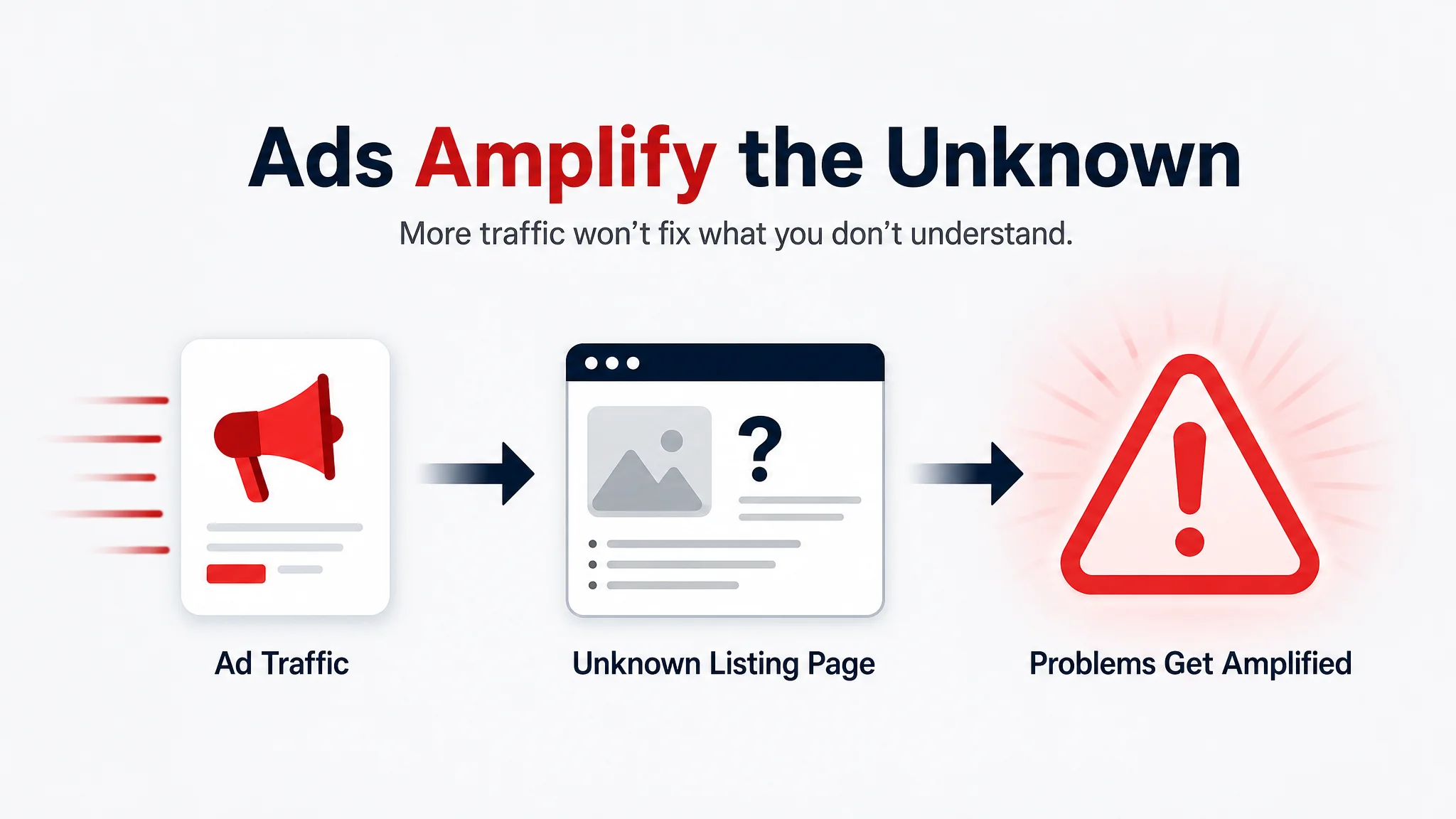
The central principle is that privacy-aware AI should reduce exposure while improving the quality of judgment. It should not require sensitive data when public or aggregated signals are sufficient, and it should not produce confident recommendations when the underlying Listing evidence is missing. In the “N/A” situation, the most responsible output was not another advertising adjustment. It was a clearer decision path: diagnose the page, establish the benchmark, identify the conversion gaps, and only then reconsider ad scaling.
Conclusion: Balancing Innovation with Data Stewardship
AI adoption does not require choosing between innovation and privacy. It requires treating data stewardship as part of the operating model. Three practices provide a practical foundation: treat every AI input as though it could become public information, customize available privacy settings to reduce unnecessary retention or reuse, and rely on approved, privacy-respecting tools for proprietary, personal, or regulated data.
A fourth practice is equally important: do not allow AI-assisted decisions to outrun the evidence supporting them. The Amazon seller example began with a familiar diagnosis—“the ads are the problem”—but the Listing report contained no measurable assessment of the title, main image, bullet points, A+ content, reviews, or competitors. The absence of those signals meant the team did not know whether it was buying the wrong traffic or sending traffic to a page that had never been made conversion-ready.
These safeguards are not a substitute for judgment. Privacy settings can reduce exposure, but they do not make careless inputs safe, and their protections may vary by platform and account configuration. Similarly, an AI recommendation cannot replace a benchmark, a data evidence chain, or human review. Once confidential information is disclosed, reversing that exposure can be difficult or impossible—much like sending a confidential memo to a public bulletin board and trying to collect every copy afterward.
Start with a simple audit. Review what employees and teams currently enter into AI platforms, identify sensitive categories, and confirm which tools and settings are approved for each use. Then examine whether important business decisions are supported by reliable, traceable evidence. For Amazon operations, that means checking whether the Listing has been evaluated against a relevant benchmark before scaling traffic, and whether recommendations can be tied to specific page modules and verified product information.
Sustainable AI adoption depends on making privacy and evidence-based judgment prerequisites for responsible experimentation, not barriers that stop useful work before it begins.