

Introduction - The Growing Complexity of Selling on Amazon
Selling on Amazon is no longer a matter of publishing a product and waiting for demand to arrive. Sellers must manage a chain of decisions that influence visibility, conversion, advertising efficiency, inventory risk, and profitability at the same time. Listing suppression can remove a product from meaningful traffic. Rising advertising costs can make every click more expensive to justify. Margin pressure grows when fees, promotions, and acquisition costs consume more of each sale.
Inventory creates a familiar trade-off: stockouts kill rank, while overstocking kills cash flow. Too little inventory can interrupt sales velocity and weaken organic momentum; too much ties up capital and increases the pressure to discount. At the same time, sellers are expected to protect CTR and CVR, control ACoS, support BSR, and move listing improvements through the production cycle without introducing new compliance or content problems.
The difficulty is not simply the number of tasks. It is the connection between them. A weak image may reduce CTR, an unclear value proposition may depress CVR, and inefficient traffic may conceal a listing problem behind rising ACoS. When diagnosis, planning, production, advertising analysis, and delivery sit in separate tools or teams, the gap between identifying an issue and applying a fix becomes a business risk.
A US outdoor seller of an oversized, heavy-duty camping director’s chair experienced this kind of gap. The product had a 4.6-star rating, more than 729 reviews, a 600-pound weight capacity, and a competitive steel frame. Advertising was generating traffic, but click-through and conversion performance remained weaker than those of a leading benchmark listing. The team initially treated the situation as an advertising problem and continued adjusting bids, keywords, and campaign structures. DeepBI’s diagnosis showed that the more important constraint was the product page itself: its main images, bullet points, and A+ content were not converting available traffic as efficiently as the benchmark.

The problem was therefore not simply a lack of traffic. The page was not making each click valuable enough. This distinction is central to Amazon operations: advertising can bring shoppers to a listing, but the listing must still establish relevance, trust, and a clear reason to buy.
DeepBI AI Workbench addresses this complexity as an Amazon-focused AI system rather than a collection of isolated utilities. It connects listing scoring, recommendations, competitor benchmarking, visual production, advertising signals, and application in an end-to-end workflow. By coordinating listing quality, paid traffic insights, and organic growth decisions, an integrated intelligence workbench gives sellers a more coherent operating foundation for improving performance while keeping execution grounded in Amazon-specific data.
What Makes an AI Workbench Different from Isolated Tools
An AI workbench for Amazon selling is not another dashboard or a collection of disconnected features. It is a connected operating system that brings listing data, advertising performance, and organic KPIs into one decision workflow. Listing quality can be evaluated alongside impressions, clicks, orders, CTR, CVR, ACoS, and signals related to organic visibility such as BSR.
With isolated tools, sellers often research keywords in one platform, manage PPC in another, review accounting data elsewhere, and then reconcile conflicting reports manually. That separation creates business loss: important signals arrive late, listing changes are disconnected from ad performance, and teams spend time assembling data instead of deciding whether to improve an image, revise copy, adjust a campaign, or investigate conversion loss.
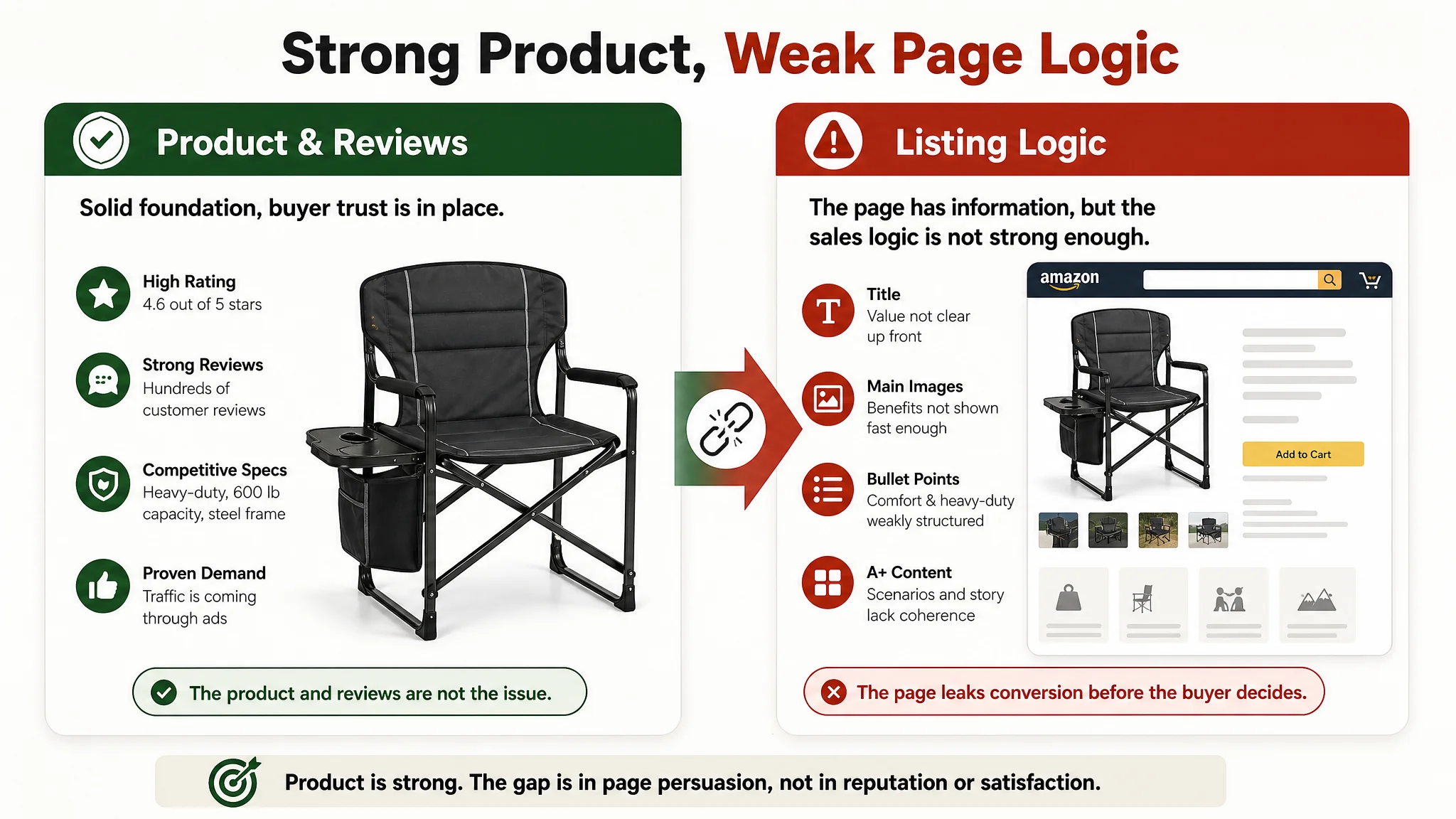
A camping chair seller’s experience shows why this connection matters. The operations team saw rising bid pressure, difficult ACoS control, and weaker-than-expected organic momentum. Because the product had strong ratings, solid reviews, and competitive specifications, the team assumed the main problem was campaign efficiency. They continued tuning Sponsored Products and Sponsored Brands, but the gap with the leading competitor did not close. Once DeepBI scored and benchmarked the listing, the diagnosis shifted: the product page scored 81/100 versus 91/100 for the benchmark, with the main weaknesses concentrated in the title, main images, bullet points, and A+ content. Reviews were essentially equal in quality, so the problem was not primarily reputation or product satisfaction.
A stronger workbench connects diagnosis, planning, production, and delivery. DeepBI’s documented workflow links listing scoring with seller performance metrics and advertising data, then converts identified gaps into structured optimization instructions. Rather than switching between systems, the seller can move from identifying a problem to selecting an appropriate listing action within one workflow.
The same case also illustrates the value of structured diagnosis. The seller’s page was not empty or obviously defective. It contained specifications, feature images, and lifestyle scenes. The issue was that the content did not form a persuasive decision path. Comfort was scattered across several bullets, heavy-duty performance was stated more than demonstrated, and the A+ modules did not organize camping, fishing, picnic, and BBQ use into a coherent story. A workbench must therefore identify not only whether content exists, but whether the content performs the right commercial function.
For Amazon operations, the system should also be Amazon-native. SP-API connectivity enables secure listing-related execution, while real-time analytics keeps decisions tied to current funnel signals. DeepBI’s One-Click Apply workflow reduces manual asset handling from a process taking minutes to one completed in seconds through API synchronization.
The practical test is simple: after the data is connected, does the platform surface the most important action for improving CTR, CVR, ACoS, BSR, or listing cycle time? If not, it remains a reporting tool—not an AI workbench.
AI-Powered Product Discovery - Finding Opportunities Before They Surface
Many sellers use listing tools only after a product has been selected, leaving the most expensive decision—what to develop and how to position it—to intuition. DeepBI’s Listing module extends upstream into product discovery, helping sellers examine market structure before investing in production, creative work, and a full listing cycle.
Its distributed crawling architecture processes large volumes of Amazon market data across thousands of ASINs. Multidimensional semantic analysis goes beyond matching identical keywords: it compares product forms, visual presentation, semantic function, use cases, titles, bullet-point logic, reviews, ratings, and image content. Similarity filters also keep the benchmark commercially relevant by excluding mismatched price bands, weakly validated products, or unrelated product types.
The camping chair diagnosis demonstrates why product discovery should include positioning and communication, not only product specifications. The seller already had meaningful strengths: a 600-pound capacity, an extra-wide seat, a steel frame, a side table, and a side pocket. Yet the benchmark made its oversized dimensions, comfort, stability, and family-oriented use cases more obvious. The seller’s product was not necessarily weaker; its competitive value was less clearly expressed. This is the kind of gap that can remain invisible when research focuses only on keywords, price, and ratings.
Consider an outdoor furniture seller evaluating 20 competitor ASINs as an illustrative research exercise. DeepBI can organize the comparison around keyword coverage, review sentiment, feature communication, price positioning, and visual differentiation. The seller can then synthesize a target profile: which features appear consistently in stronger offers, which price points define the relevant segment, and which visual styles are overused or poorly executed. The goal is not to promise bestseller status, but to expose underserved positioning and competitor weaknesses before the product is shaped.
A benchmark may reveal, for example, that a category repeatedly uses the same functional language while one competitor communicates comfort, portability, or family use more effectively. In the chair case, the leading listing used multiple adults and family scenes to make stability and comfort feel tangible, while the customer’s page relied more heavily on specifications and generic social scenes. That comparison changed the question from “Which keywords should receive more budget?” to “Which buyer concern is the page failing to answer?”
This evidence chain reduces subjective product selection and connects discovery with execution. A clearer position can support stronger future CTR and CVR, reduce avoidable listing revisions, and shorten listing cycle time before launch.
The Listing Optimization Engine - From Diagnosis to One-Click Perfection
A listing can lose sales long before shoppers reach the Buy Box. DeepBI starts by scoring the main image, title, bullet points, A+ content, and review-rating patterns against carefully matched leading competitors. Its weighted quality score does more than produce a total: it shows where points are being lost and identifies the weakness most likely to affect CTR or CVR. For example, weak CTR paired with a low main-image score signals a visual-hook problem, while weak CVR alongside gaps in A+ content and rating patterns points to a trust or information-depth issue.
The camping chair listing looked healthy at first glance, with an overall score of 81/100, a 4.6-star rating, and more than 729 reviews. However, the benchmark scored 91/100. The difference came from specific content dimensions: the title scored 16 versus 18 out of 20, the main images 24 versus 27 out of 30, the bullet points 6 versus 8 out of 10, and the detail page or A+ content 21 versus 24 out of 25. Review quality was essentially equal. This comparison made the issue more precise: high ratings did not compensate for weaker sales logic across the page.
The competitor benchmark map then isolates high-performing SKUs and exposes practical gaps in keyword density, title structure, image composition, color treatment, information density, mobile readability, and A+ module coverage. Sellers can turn those findings into precise specifications rather than vague advice, covering visual hierarchy, camera angle, scene elements, keyword placement, and pain-point coverage.
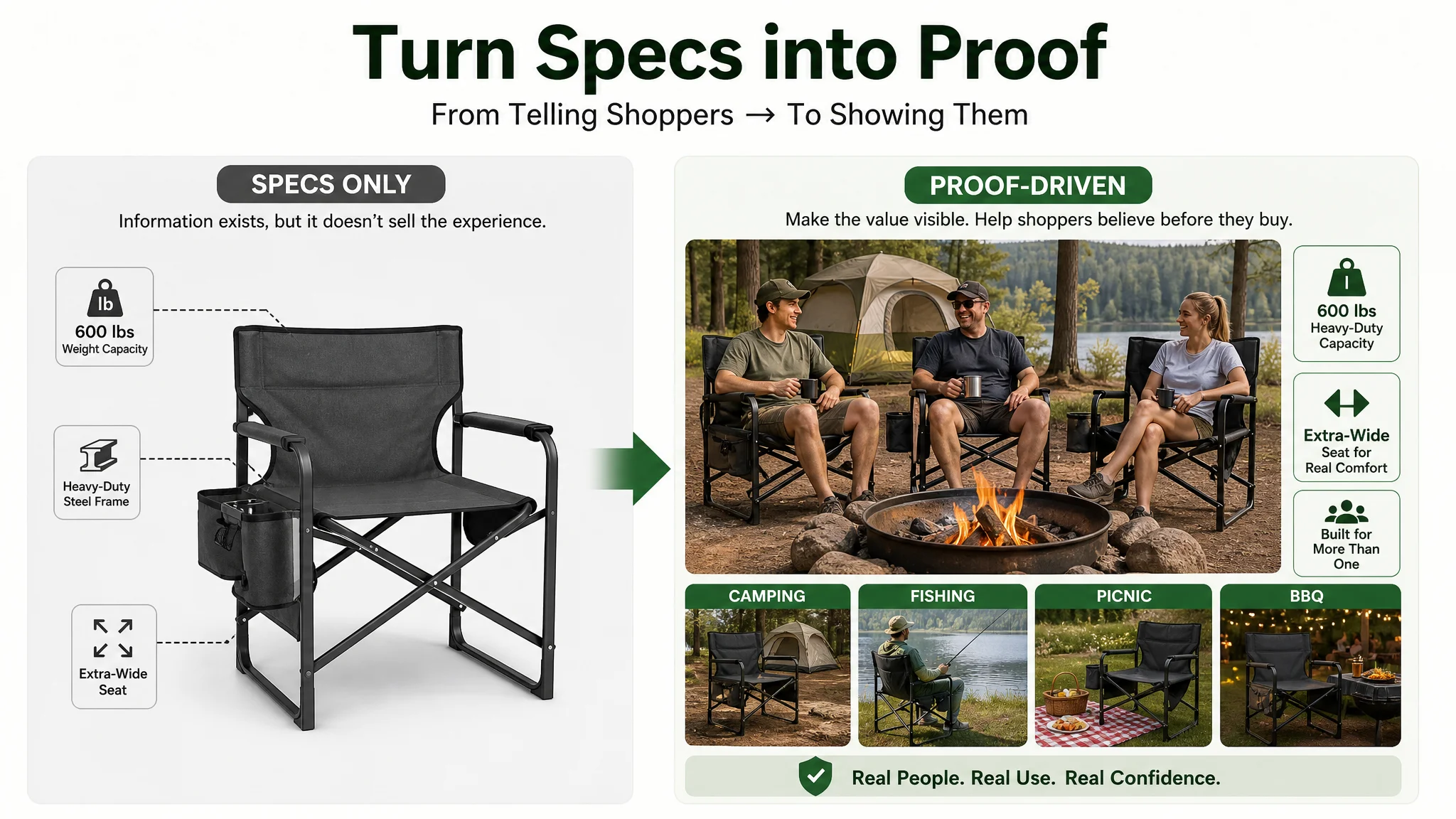
In the chair case, the benchmark did more than list an oversized seat and heavy-duty frame. It made the 600-pound capacity visible through scenes with multiple adults, made the extra-wide seat visually obvious, and connected the product to camping, fishing, picnics, and BBQs. The customer listing had many relevant modules, but the information was fragmented. Comfort appeared across several bullet points rather than as a central promise, and the lifestyle scenes did not speak as directly to family decision makers or larger-body users. The diagnosis therefore focused on conversion architecture rather than simply adding more content.
DeepBI uses the product’s DNA as the source of truth to generate main images, lifestyle and callout visuals, infographics, A+ modules, titles, and bullets without changing verified product attributes, materials, color rules, or design. Sellers preview original and proposed content side by side, approve the full set or selected assets, and synchronize them to Seller Central through SP-API. This replaces manual downloading, renaming, and uploading, while reducing listing cycle time, upload errors, and enabling version-history rollback.
For the camping chair, the optimization direction translated verified product strengths into a clearer buying sequence. The main image system was designed to demonstrate heavy-duty authority, dimensions, real-world load capacity, extra-wide comfort, and the practical use of the side table. The bullet points were reorganized around pain point, promise, and proof: extra-wide comfort, 600-pound support, side-table and storage convenience, multi-scenario use, and portability. These changes did not require inventing new features; they clarified the existing ones so each asset performed a distinct role.
For example, a supplement brand may find its main image ranks 12th among 15 competitors. After creating a lifestyle and callout image, it can assess the resulting CTR direction without claiming a guaranteed percentage improvement. Review analysis remains focused on rating patterns—not review management.
When Listings and Ads Talk to Each Other - Closing the Performance Gap
A weak listing can make even well-targeted advertising expensive. If the main image fails to earn clicks, CTR suffers; if the page does not communicate the product’s strongest benefits, CVR can remain low while ACoS rises. The traditional approach evaluates listing quality through subjective judgment, then treats advertising reports as a separate activity. DeepBI connects both sides into a measurable feedback loop.
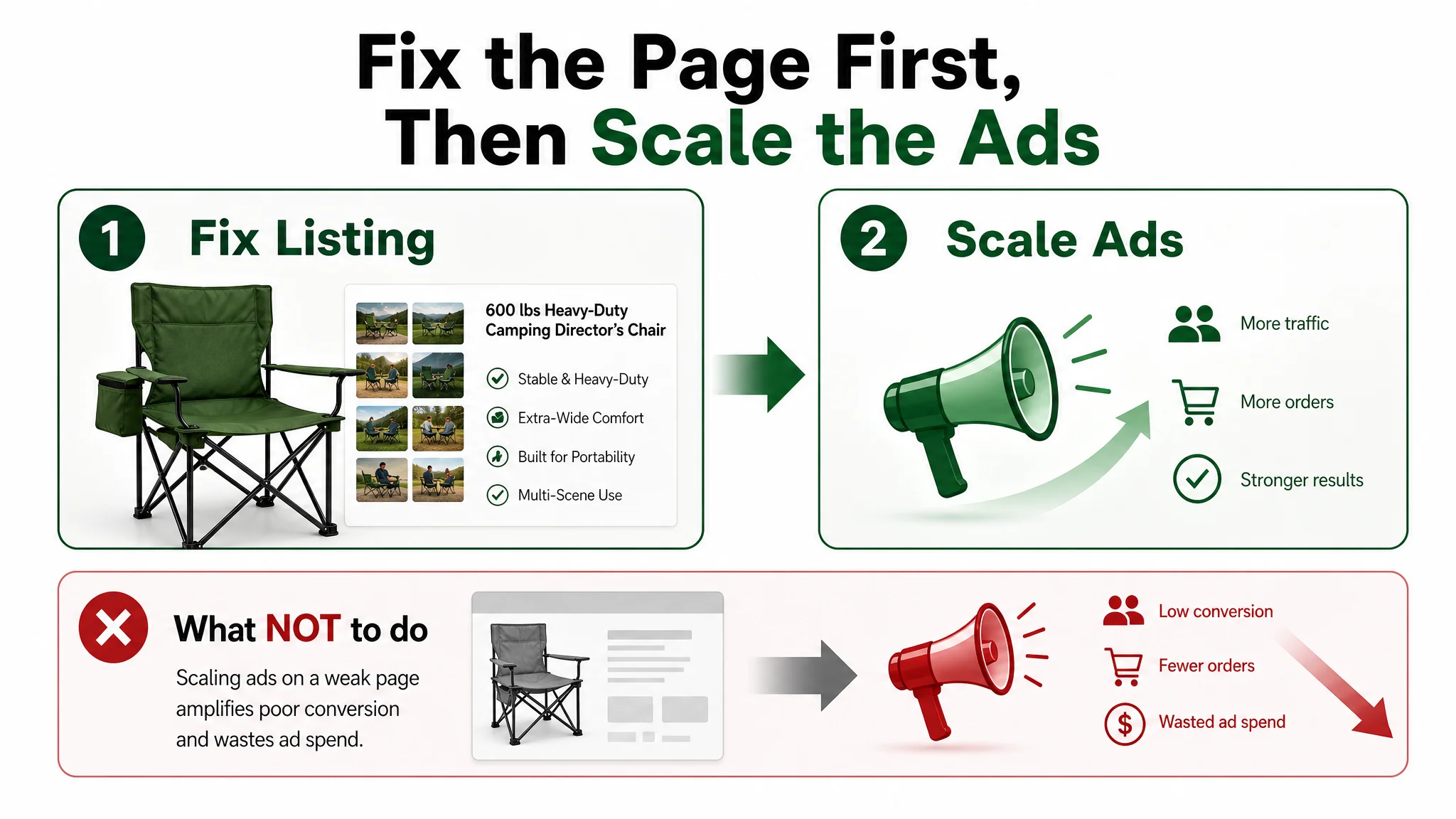
This distinction was clear in the camping chair case. The seller initially viewed rising bids, persistent ACoS pressure, and weak organic movement as evidence that campaigns needed more precise keywords or a new structure. Yet advertising was already bringing shoppers to the page. DeepBI found that the more important leak occurred after the click: the page did not visually prove the chair’s stability, comfort, portability, and multi-scene value as effectively as the benchmark. More ad traffic through the same page would have amplified the weaker conversion structure rather than solving it.
Its Ads Quant layer uses shared listing data across a four-layer funnel: exploration, preliminary filtering, precise targeting, and scaling. Every 24 hours, it analyses the previous seven days of clicks, conversions, spend, and ACOS for each keyword or ASIN. Based on those signals, it can autonomously reallocate bids and budgets to protect margins, reduce attention on inefficient traffic, and scale opportunities that show stronger conversion potential.
The loop then runs back into the listing. Advertising data whispers back to the listing, revealing which search terms, attributes, and page elements deserve attention. DeepBI converts those signals into listing-improvement tasks, such as strengthening the main image when CTR is weak or clarifying core benefits when CVR lags. When visual changes are published, they can be linked to advertising reports so sellers can observe subsequent CTR movement.
The chair diagnosis made this loop more actionable. A weak main-image score pointed toward a click-stage problem, while weaker bullet and A+ scores pointed toward a conversion-stage problem. The resulting recommendations were not generic “improve the listing” instructions. They specified how to show the 600-pound capacity with real-world load proof, how to make the 28-inch seat visually understandable, and how to organize family and multi-use scenarios into a clearer narrative. Advertising data could then be interpreted against a page whose conversion logic had been deliberately strengthened.
Aligning advertising keywords with titles, images, and selling-point content can improve traffic relevance and support stronger ROAS, without treating any uplift as guaranteed. The practical objective is a coordinated system where listing quality earns more valuable clicks, and advertising evidence continuously sharpens the page.
Intelligent Inventory, Pricing, and Operations That Protect Profits
Stockouts kill rank; excess inventory kills cash flow. The hard part is seeing the danger early enough to act.
DeepBI correlates listing impressions, clicks, orders, CTR, and CVR with inventory velocity. When traffic and conversion remain strong while available units are being consumed faster than planned, the system can flag a potential stockout before depleted inventory damages BSR. Sellers gain an evidence chain instead of reacting after sales collapse.
The same operating view helps prevent a different mistake: treating every Amazon inventory metric as interchangeable. IPI primarily influences storage-volume limits. Restock limits are calculated separately through factors such as sales forecasts and available capacity. Confusing the two can lead to unnecessary shipment delays, premature purchasing, or poor storage decisions. DeepBI’s inventory dashboard separates IPI from restock-limit metrics so operators can match each action to the correct constraint.
Pricing requires similar discipline. DeepBI can surface competitor price changes and promotional signals, giving sellers context for shifts in CVR, BSR, or ACoS. It is decision support, not a repricer: the seller remains responsible for choosing and applying the price.
The camping chair example also shows why operational decisions should follow diagnosis rather than replace it. When advertising appears expensive, a seller may be tempted to compensate with higher bids or broader exposure. But if the product page is losing the comparison on its title, images, bullets, and A+ content, additional traffic can increase pressure on advertising economics without addressing the underlying constraint. Separating traffic acquisition from page conversion helps operators decide whether the next action belongs in the campaign, the listing, or both.
Consider a seasonal outdoor furniture brand that receives 10,000 units too early. Storage surcharges begin accumulating while cash sits idle. Demand sensing can help phase shipments around expected demand, reducing exposure to excess stock without waiting for a stockout warning. The advantage is not more data alone; it is connecting demand, inventory, pricing, and Amazon operating limits before a margin problem becomes unavoidable.
Organic Traffic Growth - Turning Ad Spend into Lasting Rank
Advertising should not be judged only by the orders it generates today. Its deeper value lies in identifying which search terms can attract qualified traffic, convert efficiently, and support profitable organic growth.
DeepBI analyzes campaign signals across click-through rate (CTR), conversion rate (CVR), and order value to identify high-potential keywords. These insights connect advertising performance with listing optimization: strong search terms can inform titles, images, and selling-point presentation, while weak CTR or CVR signals reveal where the listing is losing momentum. Better relevance and stronger conversion can help turn paid traffic into broader demand without promising a specific ranking outcome.
The camping chair seller’s experience illustrates why advertising alone may not produce the expected organic progress. The team was investing effort in campaigns, but the product page still converted less effectively than a leading benchmark. Because the benchmark had stronger content and visual persuasion, it could turn comparable traffic into stronger commercial signals. The problem was not simply that the seller needed to buy more visibility; the page first needed to give organic and paid visitors better reasons to continue toward purchase.
Sellers can also allocate a controlled share of the budget to Top-of-Search placements for priority terms. The goal is not to buy organic rank directly, but to create short-term sales momentum around the keywords that already show commercial value. The resulting double lift combines immediate paid visibility with the potential for stronger organic visibility as sales and conversion signals accumulate.
For the chair, strengthening the listing meant connecting high-value product attributes to the way shoppers evaluate the category. The title could make the oversized positioning clearer, the images could prove the heavy-duty promise, and the A+ content could demonstrate camping, fishing, picnic, and BBQ use. Those changes help ensure that paid traffic supports a page capable of generating stronger conversion signals rather than merely sustaining exposure.
Consider a brand spending $10,000 per month with 60% TACOS. After applying DeepBI’s natural-traffic strategy, it increases organic sales to 45% of total revenue over two months while maintaining overall revenue growth. More sales now come without advertising costs, reducing dependence on paid traffic.
That is why TACOS and organic order share provide a clearer view of business health than ACoS alone. ACoS measures campaign efficiency; TACOS and organic share reveal whether advertising is building a more profitable growth base. A listing that cannot convert traffic efficiently will continue to make that base more expensive, regardless of how often campaigns are restructured.
Conclusion - Building a Smarter Amazon Business with DeepBI
Amazon operations become difficult when diagnosis, decision-making, content production, deployment, and measurement are handled in separate systems. Sellers may identify a listing weakness, yet lose time translating that insight into an approved change. During that delay, CTR, CVR, ACoS, BSR, and listing cycle time remain exposed to the same unresolved problem.
The camping chair example shows how easily a seller can misidentify that problem. Strong ratings, detailed reviews, and competitive specifications made the listing appear healthy, so the team focused on bids, keywords, and campaign structure. Benchmarking revealed a different constraint: the page scored below the leading competitor in the title, main images, bullet points, and A+ content, while review quality was essentially comparable. The page had product information, but it lacked a sufficiently clear and persuasive sales logic.
DeepBI closes this gap by connecting intelligent scoring, optimization recommendations, constrained asset generation, and one-click application within a single workflow. Score_Report.json and Product_DNA.json provide the core inputs, while Optimization_Plan.json translates findings into executable direction. Sellers retain approval through comparisons and selective replacement, while deployment creates a clear point from which listing and advertising signals can be evaluated.
The practical shift is from frantic daily firefighting to a repeatable operating rhythm: identify what needs to change, define how it should change, execute it accurately, and feed performance data back into the next decision. Rather than relying only on short-term fixes or subjective trial and error, sellers can build infrastructure that supports ongoing adaptation as market conditions and competitive pressure evolve.
DeepBI does not promise automatic growth. It gives sellers a more connected, evidence-led foundation for pursuing controlled improvements in listing quality, traffic, conversion, and resource allocation. The central lesson is straightforward: before pouring more fuel into the traffic engine, determine whether the listing can convert the traffic it already receives. When diagnosis connects advertising signals with page-level evidence, sellers can fix the real constraint instead of repeatedly optimizing the wrong one.