

The Hidden Cost of Manual Amazon Ads: The Complexity Trap
Manual Amazon advertising often starts with a reasonable goal: respond faster to changing performance. A seller may add one rule to raise bids when impressions are strong, another to lower bids when ACoS increases, and a third to protect spend when conversions weaken. Each instruction appears useful in isolation. Together, they can create a management problem known as the complexity trap.
The complexity trap occurs when manual rules and piecemeal automation accumulate without a shared decision layer. As the rule set expands, instructions can overlap, contradict one another, or respond to different signals at the same time. For example, one rule may raise a keyword bid to capture more traffic, while another lowers that bid to protect ACoS. A separate campaign-level adjustment may then change the same decision again based on budget or conversion performance.
The result is not simply more work. The rules can cannibalize one another, making it difficult to identify which action caused a change in CTR, CVR, or ACoS. Operators spend more time checking exceptions and reconciling settings, while optimization becomes slower and less consistent.
A similar problem appears when teams treat advertising as the only controllable layer. One home-security seller had a wall-outlet security camera Listing that scored 76/100, higher than a benchmark competitor’s 65/100. Because the title, bullets, and A+ content appeared stronger on paper, the team assumed that the product page had already been solved. When advertising remained unstable and orders did not rise in line with traffic, they continued reworking keywords, bids, campaign structures, and creatives.
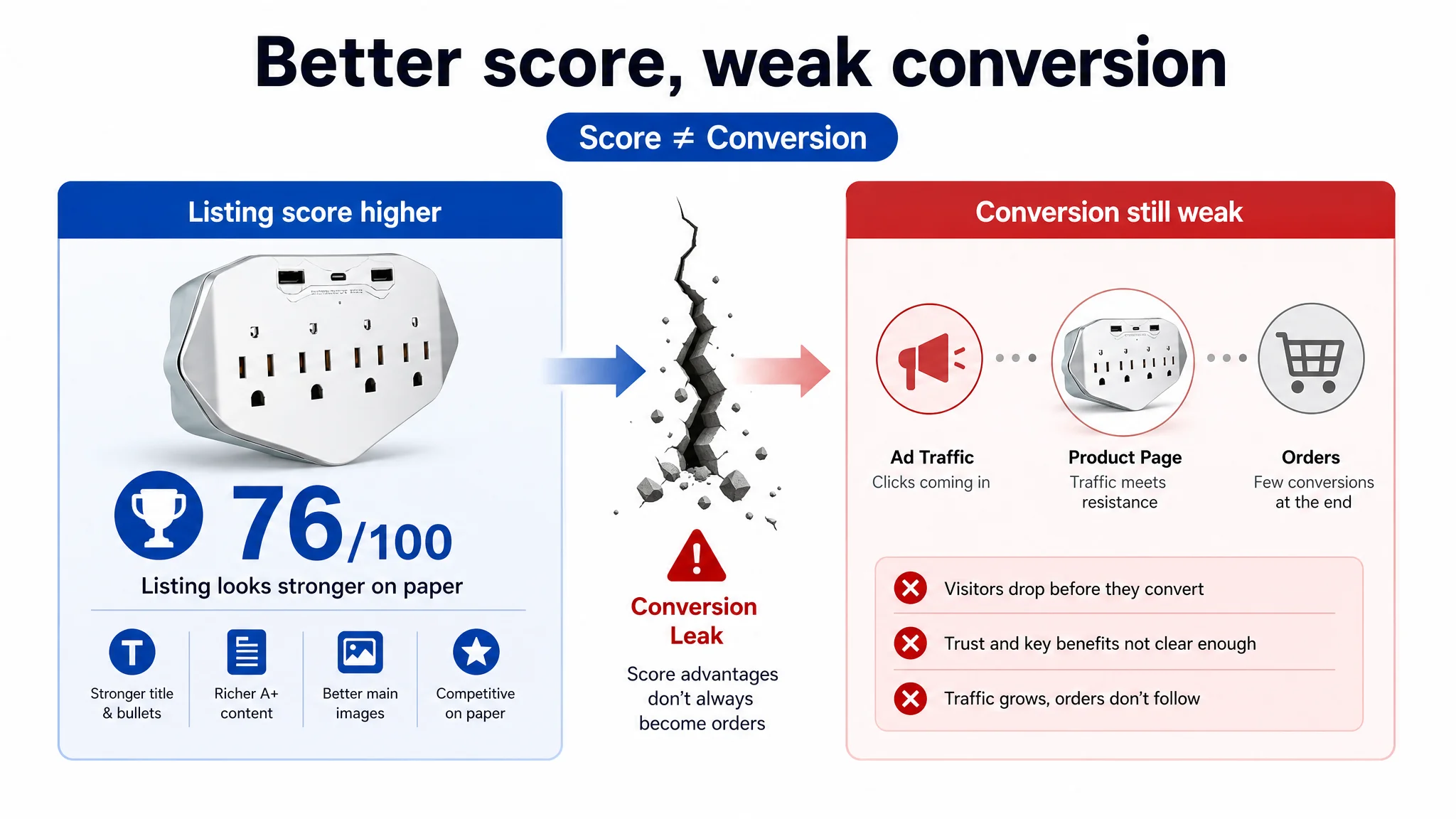
The diagnosis later showed that the problem was not simply a lack of advertising control. The page was receiving traffic, but its visual and textual structure was not converting that traffic efficiently. The product’s most important promises—discreet surveillance, everyday outlet functionality, and easy remote control—were present, but they were not presented at the moments when buyers needed reassurance. This illustrates why disconnected optimization can become a complexity trap: teams keep adding actions at the ad layer while the real conversion constraint remains elsewhere.
Disconnected workflows create a similar problem when diagnosis, planning, execution, and measurement sit in separate tools or processes. A scalable approach needs one coordinated loop: quantify the current state, apply a decision, return advertising data to the system, and refine the next action. Without that feedback structure, adding automation can increase complexity faster than it increases control.
What AI Ad Optimization Really Means (And Why Rules Aren't Enough)
Traditional PPC automation follows a fixed script: if ACoS rises above a threshold, lower the bid; if clicks increase, raise it; if a keyword stops converting, pause it. These if-then rules can handle isolated conditions, but Amazon performance rarely changes one variable at a time. Bid, placement, keyword relevance, impressions, CTR, CVR, conversion value, inventory position, and competitive pressure interact continuously.
Agentic AI ad optimization approaches the problem differently. Instead of waiting for a predefined trigger, DeepBI’s Ads Quant engine operates continuously, analyzing thousands of Amazon performance signals simultaneously. It can evaluate relationships across campaigns and performance dimensions, identify emerging inefficiencies, and take autonomous optimization actions as conditions change. The objective is not to eliminate guesswork, but to minimize it with a persistent decision loop.
Static rules cannot reliably react in real time because they are designed around predetermined thresholds. They may lower a bid after ACoS deteriorates, while missing the underlying shift in CTR, CVR, placement quality, or conversion value that caused the change. Continuous analysis allows optimization decisions to account for those variables together, with direct implications for ACoS, spend efficiency, and listing performance.
This distinction matters because an advertising signal does not always identify the location of the underlying problem. In the wall-outlet camera example, the seller initially interpreted unstable ad performance and weak order growth as evidence of poor bids, keywords, or budget allocation. Yet the Listing had already achieved higher audit scores than the benchmark competitor: title performance was 15 versus 11, main images 24 versus 23, bullet points 8 versus 4, and detail/A+ content 21 versus 19.
A simple rule-based interpretation could conclude that the page was strong and that advertising required further tuning. A broader diagnosis compared the page’s structure with its actual persuasion path. It found that the core claims were not supported by equally clear visual proof. The hidden lens was not immediately felt as invisible, remote control was not shown with enough clarity, and the A+ content felt more technically complete than emotionally convincing. The higher Listing score indicated potential, but it did not prove that the page could convert incremental traffic.
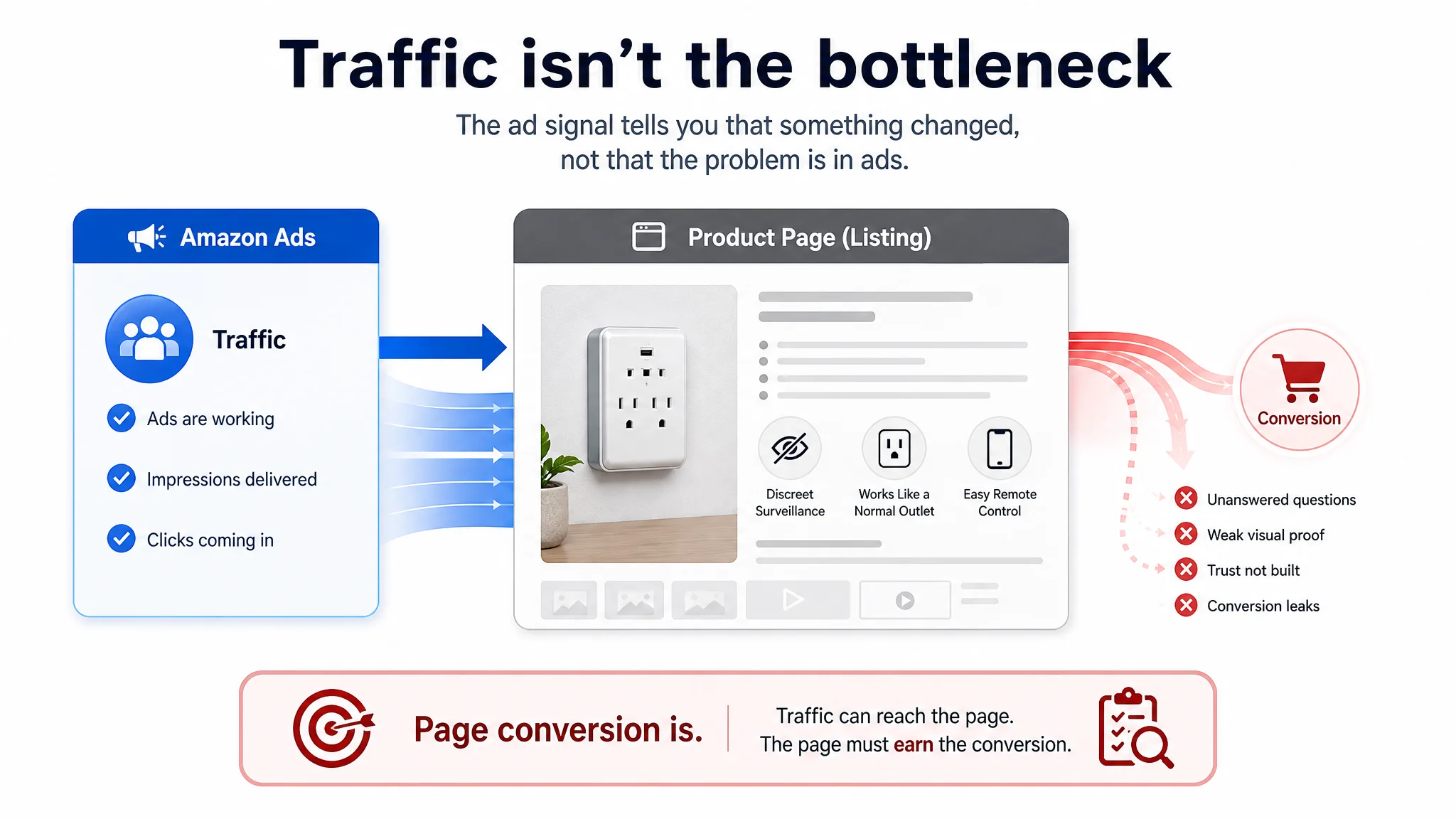
DeepBI also connects advertising signals with ongoing Amazon optimization. For example, when listing content changes, ad data can help measure the resulting CTR and conversion impact rather than leaving visual decisions to intuition.
In internal tests with over 100 sellers over a 6-month period, average ACoS was reduced by 20-30%.
From Static Automation to Agentic AI: The Evolution of Ad Management
Early ad automation reduced repetitive work through fixed bid rules and schedules. If a keyword met a predefined condition, the system adjusted its bid; if a campaign reached a scheduled time, it paused or resumed. Useful as guardrails, these triggers reacted to isolated events rather than understanding why performance changed. They could affect ACoS, but they did not explain whether a weak result came from low traffic quality, poor creative relevance, or a conversion problem.
Agentic AI takes a broader view. Instead of optimizing one metric at a time, it interprets conversion value, funnel signals, and longer-term campaign health. A low CTR may call for stronger visual competitiveness, while a low CVR may point to clearer selling-point communication or richer A+ content. The decision is tied to the business problem, not merely to a threshold.
The wall-outlet camera Listing demonstrates why this distinction is important. The seller had treated the page as “good enough” because it contained a mature title structure, logical bullets, and richer A+ content than the benchmark. However, deeper analysis showed that information density and conversion strength were not the same thing. The title and bullets explained the product, but the image sequence did not give the buyer a dominant visual reason to trust the product’s discreet design. The A+ page described functions and scenarios, but some modules felt more like technical renderings than real home environments.
The problem was therefore not that the Listing lacked information. It was that the information did not appear in the right order or with enough visual proof. A buyer considering a hidden camera may first need to know whether the product will actually blend into a room, then whether it can be operated easily, whether it requires ongoing fees, and whether the image quality matches the promise. A page can score well in separate content categories while still failing to guide those decisions as a connected sequence.
DeepBI applies this feedback-loop logic across listing and visual optimization. It digests advertising signals such as impressions, clicks, conversions, TACoS, and ACoS, then connects each tracked optimization change to its market outcome. When a new image is published, DeepBI marks a visual iteration event in the ad report, allowing sellers to observe subsequent CTR movement over the defined 7–14 day window. Those results can inform the next scoring and generation decision.
The progression is therefore from trigger-based automation to continuous data digestion and increasingly autonomous decision-making. For Amazon operators, the practical gain is a campaign system that learns from changes rather than repeatedly applying the same rules.
Escaping the Complexity Trap: Why Manual Matrix Management Fails
Amazon PPC complexity does not come from keywords alone. A single advertising program can combine campaign types, match types, placements, and devices, with each combination producing different CTR, CVR, spend, and ACoS signals. The operator is not managing one bid sheet; they are coordinating a matrix of interacting decisions.
That matrix expands quickly across hundreds of search terms and multiple SKUs. A keyword may perform well in one placement but waste spend in another, while mobile traffic behaves differently from desktop traffic. Seasonal demand adds another layer: bids, budgets, and keyword priorities may need to change as buying intent shifts. Reviewing each term manually, identifying the cause of an ACoS change, and updating related decisions before the next sales window is unrealistic at scale. Delays and inconsistent updates can reduce conversion efficiency and allow wasted spend to accumulate.
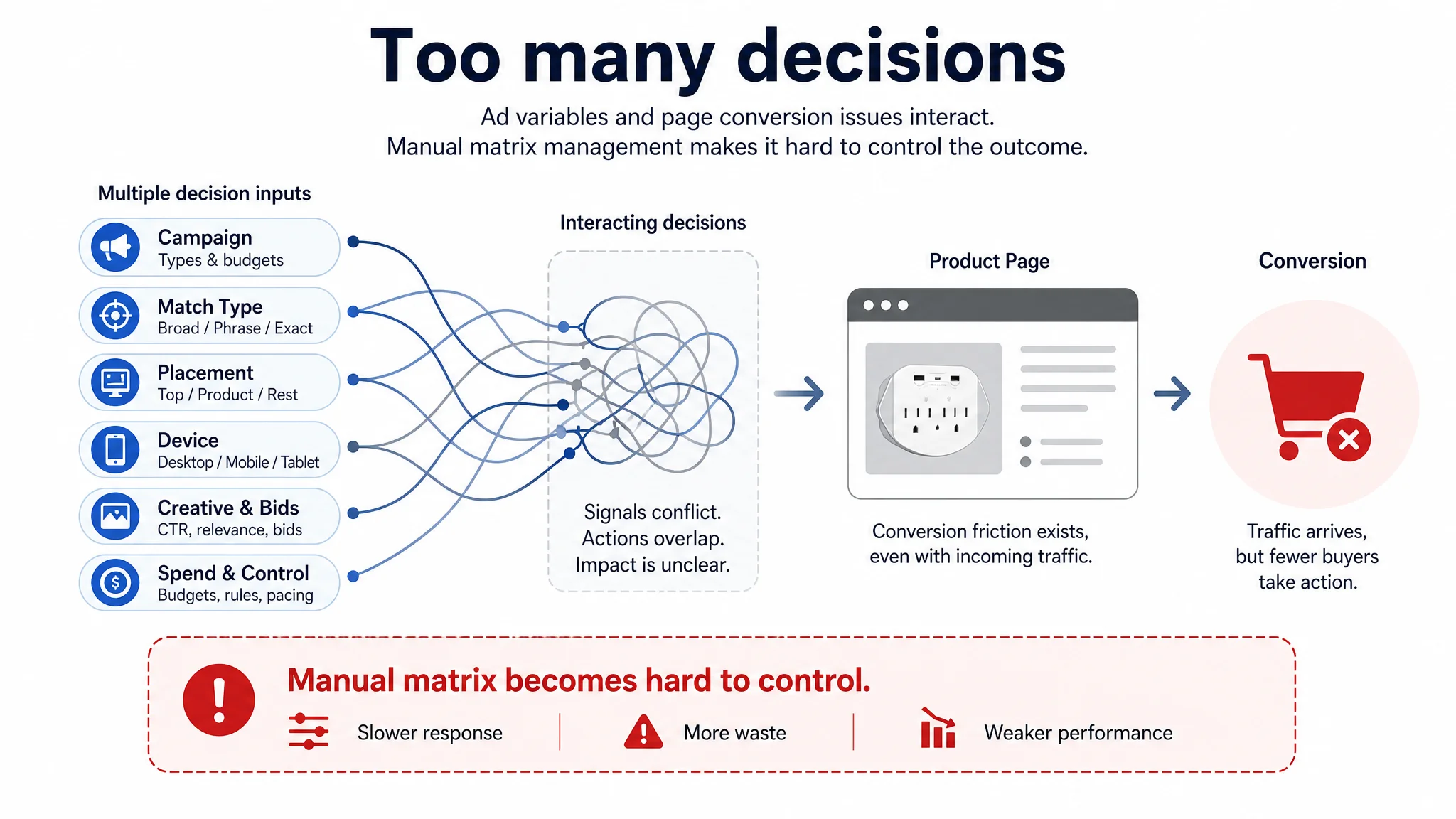
Manual matrix management also becomes inefficient when the page receiving the traffic is not evaluated alongside the campaign data. In the camera example, the team kept splitting campaigns, reworking bids, and testing creatives around the same core images. These actions increased activity, but they did not address the page-level questions that were affecting conversion: Was the camera visibly discreet? Could shoppers understand the remote-monitoring experience? Did the page make local storage and the absence of subscription fees easy to trust?
The seller’s initial conclusion—“the problem must be the ads”—was understandable because the Listing looked stronger than the benchmark in several audited dimensions. But the comparison showed that the competitor’s page made certain decisions more immediate. It gave greater visual emphasis to image quality, presented app control more clearly, and used real-life context to make the product easier to understand. The issue was not simply that one page contained more information. It was that the information was organized around different buyer concerns.
DeepBI addresses the complexity by connecting advertising reports, keyword weighting, structured analysis, and feedback into one coordinated workflow. Impressions, clicks, conversions, CTR, CVR, TACoS, and ACoS become linked inputs rather than disconnected spreadsheet tabs. Its Orchestrator routes tasks and preserves decision context, while high-converting search-term signals receive greater weight in downstream optimization. Instead of asking an operator to inspect every cell in the matrix, DeepBI narrows attention to the signals and priorities that require action, helping coordinate optimization decisions across a repeatable, data-linked loop.
The Speed Advantage: Real-Time Analysis vs. Reactive Data Dumping
Amazon advertising performance can change faster than a manual reporting routine can capture it. Sellers who download campaign reports once a day—or even once a week—often optimize against yesterday’s conditions. By then, a decline in CVR may have increased ACoS, reduced budget efficiency, and weakened the sales velocity that supports BSR.
DeepBI is designed around continuous advertising-signal feedback rather than periodic data dumping. It brings exposure, clicks, conversions, spend, ACoS, and related performance signals into the optimization workflow, allowing changes in campaign health to be identified near real time. The operating principle is simple: detect the signal, interpret its commercial impact, and trigger the next optimization action while the data is still useful.
Consider a keyword whose ACoS suddenly spikes after conversion performance deteriorates. In a manual workflow, the issue may remain unnoticed until the next report download, followed by analysis, discussion, and campaign changes several hours later. During that delay, the keyword can continue consuming budget without producing efficient sales. A continuous workflow can detect the abnormal pattern within minutes, enabling a bid adjustment, budget shift, or other corrective action before the loss compounds.
However, speed does not mean automatically changing bids whenever a metric moves. A faster decision loop must still determine whether the weakness originates in traffic acquisition or conversion capacity. The wall-outlet camera seller had already spent time adjusting campaigns because advertising appeared to be the most visible source of pressure. But further diagnosis showed that sending more traffic to the existing page could increase wasted clicks if the page still failed to answer concerns about discretion, setup, reliability, and actual image quality.
This is why a useful optimization loop needs to connect advertising speed with Listing diagnosis. Rapidly identifying a CVR decline is only the first step. The next question is whether to change targeting, reduce exposure, or investigate the page that receives the traffic. Without that second layer, real-time automation can simply accelerate the wrong decision.
Even a 24-hour delay can translate into wasted spend, missed sales opportunities, and slower listing momentum. DeepBI’s advantage is therefore not a promise of sub-second optimization. It is the ability to keep processing click, conversion, and spend signals continuously, shortening the path from performance change to informed Amazon PPC action.
Three Core Capabilities of an Agentic AI Engine on Amazon
Autonomous Keyword-Level Bid and Budget Reallocation
DeepBI Ads Quant evaluates keyword-level performance across Sponsored Products, Sponsored Brands, and Sponsored Display, then identifies where spend is producing clicks, conversions, and acceptable ACoS. Budget and bid adjustments can prioritize stronger traffic while reducing exposure to inefficient terms and placements. The objective is not to spend more, but to fix the leaks before you scale the spend.
The phrase “fix the leaks” should include the conversion path beyond the campaign console. If a page receives relevant traffic but does not make its strongest product advantage clear, reallocating more budget toward that traffic may not solve the commercial problem. In the camera example, the product’s wall-outlet format and multi-function design were genuine differentiators, but the primary image set did not give them a sufficiently clear visual anchor. Before increasing exposure, the page needed to make the product’s value easier to recognize and trust.
Rapid Negative Keyword Harvesting and Bid-Responsive Creative Testing
Search-term and conversion signals provide a fast route to negative keyword decisions. Ads Quant can surface terms that consume budget without supporting CVR, helping operators exclude waste before it compounds. Bid-responsive testing should be understood as measuring bid and placement responses—not automated creative generation or A/B testing. Advertising signals can also inform which Listing messages deserve stronger emphasis, while campaign controls remain focused on bids, placements, and exclusions.
For example, if advertising is bringing visits but the Listing’s conversion behavior remains weak, the correct response may not be to exclude more terms immediately. The seller may need to examine whether the page visually proves the claims those search terms promise. In the camera case, the copy mentioned 1080P resolution, remote monitoring, local storage, and a discreet outlet design, but some of those benefits were not made immediately visible. A new creative or keyword decision should therefore be evaluated alongside the page’s ability to fulfill the expectation created by the ad.
Conversion-Driven Campaign Restructuring and Predictive Targeting
When clicks accumulate but CVR weakens, Ads Quant can use conversion patterns to identify structural problems: mismatched targeting, inefficient campaign groupings, or budget assigned to low-value traffic. The next action is campaign restructuring around proven search terms and conversion behavior, rather than relying on impressions alone. Pattern-based targeting can guide adjustments across the relevant Sponsored Ads workflows, without claiming certainty about future demand.
A weak CVR does not always mean that targeting is wrong. In the wall-outlet camera case, the seller initially assumed that poor conversion was an advertising-structure issue. The deeper review found that the page’s persuasion path was incomplete. The main images did not sufficiently demonstrate that the camera could blend into an ordinary room, and the A+ content did not give remote control and real-life use enough clarity. This meant the advertising system was being asked to compensate for a page-level trust gap.
Together, these capabilities turn advertising data into operational decisions. CTR shows whether traffic is being won, CVR shows whether it is commercially qualified, and ACoS shows whether spend is sustainable. The engine’s role is to correct those leaks before additional budget magnifies them. It must also help distinguish an acquisition problem from a conversion problem so that the next action addresses the correct layer.
Inside DeepBI's Automated Optimization Loop
DeepBI turns Amazon advertising data into a continuous optimization loop rather than a periodic reporting exercise. The process follows six operating steps:
- Collect: Amazon Advertising API data flows into the system, including campaign, keyword, impression, click, conversion, spend, ACoS, and related performance signals.
- Parse: DeepBI evaluates patterns at campaign and keyword level, comparing CTR, CVR, ACoS, and budget utilization against observed performance.
- Select: The system identifies the next action. A keyword generating conversions at an acceptable ACoS may receive a bid increase, while inefficient traffic may trigger a bid reduction or budget shift.
- Execute: Approved changes are applied to keyword bids and campaign budgets. Stronger-performing areas can receive more budget, while weaker areas are constrained.
- Measure: Subsequent impressions, clicks, conversions, and ACoS are tracked against the prior state. When a new visual or Listing change is applied, the event point provides a clear reference for measuring its effect on metrics such as CTR.
- Reinforce: Results feed back into the decision process, allowing future actions to reflect actual marketplace response rather than static rules.
The loop is most useful when it preserves the distinction between a performance signal and its likely cause. In the wall-outlet camera case, the initial data could have supported another round of bid and keyword adjustments. Instead, the Listing was compared with a benchmark across title, main images, bullet logic, A+ structure, and review profile. That comparison revealed that a higher audit score did not guarantee stronger conversion capacity. The next optimization priority therefore shifted from “keep fixing ads” to “rebuild the persuasion path of the Listing.”
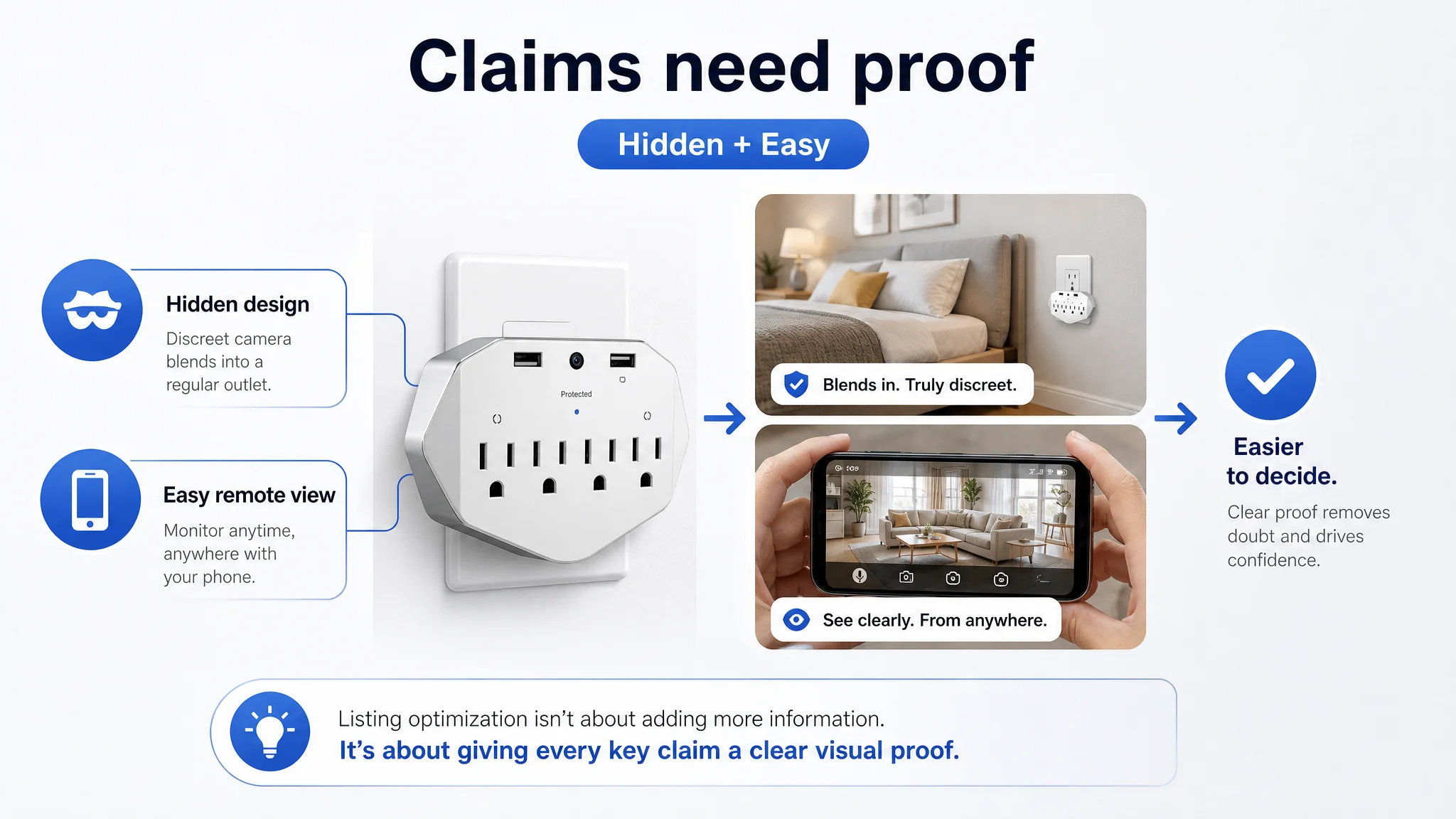
The revised direction focused on making key claims visibly obvious: a clean primary image to clarify the product, a real bedroom scene to show how the outlet blends into daily life, a clear remote-view composition to reduce setup anxiety, and a more direct image-quality comparison to make the 1080P claim tangible. These changes were not separate from advertising optimization. They created a clearer page-level condition for evaluating the value of future ad traffic.
Because the loop runs continuously, it can respond when a new competitor reduces visibility or when CVR changes and makes a previously acceptable bid uneconomical. It reacts to observed patterns; it does not predict future events with certainty.
The business impact is reflected in qualified internal testing: “In internal tests with over 100 sellers over a 6-month period, average ACoS was reduced by 20-30%.”
The Organic Traffic Bonus: How Ad Efficiency Lifts Rankings (bridge section)
Amazon advertising can create value beyond the sales directly attributed to sponsored placements. When the optimization loop reduces wasted spend, improves targeting, and raises conversion efficiency, ACoS may become more sustainable. That stronger economics gives sellers room to maintain effective coverage while identifying which keywords, audiences, and listing elements produce the best CTR and CVR.
The potential organic benefit is indirect. Stable advertising data can reveal which search terms and product attributes generate meaningful clicks and conversions. Those signals can guide listing and visual improvements, which may strengthen CVR and reduce dependence on paid traffic. If the listing converts more consistently, Amazon may receive stronger relevance and sales signals, potentially supporting improved organic visibility, BSR, or share over time.
The wall-outlet camera example shows why this process cannot be separated into “ads first” and “Listing later.” The seller had low review volume compared with the benchmark—3 reviews versus 181—which made the page more vulnerable to early mismatches between buyer expectations and actual usage. Concerns about whether the camera looked truly hidden, whether setup was easy, or whether image quality matched the claim could affect both paid conversion and the organic trust signals accumulated over time.
Improving the page’s visual proof and decision sequence was therefore part of creating a more stable traffic structure. A stronger page could make each new ad click more useful, while clearer conversion data could provide better evidence for later listing and advertising decisions. The organic benefit remained a possible downstream effect rather than an automatic result.
This is a possible downstream effect—not a guaranteed ranking boost, and not the result of lower ACoS alone. The practical chain is:
- Less wasted Amazon ad spend can improve profitability and ACoS.
- Better keyword and listing decisions may strengthen CTR and CVR.
- Stronger conversion performance may support greater organic sales contribution.
Some sellers report organic sales share over 60% after sustained ad optimization, but that result is not universal and should not be treated as a benchmark. DeepBI’s role remains centered on using advertising and conversion signals to improve Amazon campaign and listing decisions. Organic growth is the secondary benefit of a healthier advertising loop, not a standalone Ads Quant capability.
How to Transition Your Amazon Campaigns to AI-Driven Automation
Start by consolidating fragmented campaigns into a smaller set of coherent campaigns or objective groups. The goal is not to erase useful segmentation, but to reduce overlapping manual decisions and create cleaner signals for optimization. Each group should have a clear commercial purpose, such as profitable sales, efficient ACoS or TACoS, or improved conversion efficiency.
Next, move from frequent bid edits toward goal-based bidding. Instead of reacting to every fluctuation in impressions or clicks, define the outcome the campaign should pursue and let advertising feedback guide adjustments. CTR, CVR, ACoS, TACoS, and conversion distribution provide a more useful control layer than subjective judgments alone. Low CTR may point to a weak click-driving presentation, while low CVR can signal a detail-page conversion problem.
The wall-outlet camera seller’s experience illustrates why both signals should be read together. The team saw advertising pressure and assumed that the page was not the bottleneck because its audit score exceeded the benchmark. But the actual gap was concentrated in the moments between the click and the purchase decision. The page needed to show the hidden lens more clearly, make remote operation easier to understand, and connect product features with real home scenarios. In this situation, more bid tuning could not substitute for clearer Listing communication.
Automation is only as reliable as its inputs. Keep upstream scoring data, product constraints, and Amazon account authorization accurate and structured. DeepBI relies on defined inputs such as Score_Report.json and Product_DNA.json, rather than unstructured free text. Official SP-API connectivity also helps standardize operations and reduce risks associated with manual backend logins.
Before expanding automation, run a bounded experiment. Compare the current setup with the proposed change, retain human selection during the initial rollout, and treat the application point as the start of measurement. Then resist micromanaging every adjustment. As stable advertising signals accumulate, the optimization loop can identify attributes associated with stronger conversion and feed those signals into later decisions. Human oversight sets the goals and constraints; continuous data feedback drives the iteration.
From Executor to Strategic Coach: The New Seller Role
Once the optimization loop is operating, the seller’s job moves beyond bid changes, keyword checks, and repetitive PPC execution. DeepBI is positioned to handle thousands of daily optimizations across the advertising workflow, allowing the seller to spend less time reacting to every fluctuation in CTR, CVR, and ACoS and more time deciding where the business should go.
The higher-value agenda is strategic:
- Select products with stronger commercial potential.
- Coordinate advertising priorities with inventory planning.
- Protect the customer experience and service quality.
- Review performance signals such as BSR, CVR, and ACoS before approving broader changes.
- Decide which recommendations fit the product, brand, and operating constraints.
The seller’s role also includes challenging the first diagnosis. In the camera example, the team had already invested in titles, bullets, A+ content, and advertising adjustments. The difficult strategic decision was recognizing that a higher Listing score did not mean the page was ready to receive more traffic. The seller had to reconsider how buyers evaluated discretion, usability, image quality, and ongoing cost, then allow those concerns to shape the next Listing and advertising decisions.
A useful way to express the role shift is through a clearly generic seller voice: “I now focus on inventory and service because DeepBI runs the ads loop.” This is a writing device, not a verified customer testimonial. The seller remains accountable for judgment. DeepBI can automate analysis and repetitive optimization, but human review and authorization still matter, particularly when changes affect listing assets or depend on accurate product and business inputs.
The practical objective is not to promise a fixed number of hours saved. An AI-enabled operating model may allow a seller to redirect roughly 12 hours per week toward product selection, inventory decisions, service, and strategic planning, depending on the account. The seller becomes a coach of the system: setting priorities, checking business impact, and ensuring that automation supports profitable growth rather than merely increasing activity.
What Real Results Look Like (Without Overpromising)
The value of an Amazon ads optimization loop should be measured through controlled, observable changes in core KPIs—not through promises of universal growth. The clearest internal result is:
“In internal tests with over 100 sellers over a 6-month period, average ACoS was reduced by 20-30%.”
This is a qualified internal finding, not a guaranteed outcome for every account. ACoS performance depends on the quality of the campaign structure, the accuracy of the data entering the workflow, the product’s conversion rate, the niche, and the intensity of competing offers. If targeting is weak, listing content does not convert traffic, or the market is highly competitive, automation cannot remove those underlying constraints by itself.
The wall-outlet camera case reinforces the same limitation from a different direction. The Listing scored higher than the benchmark, but the seller still faced unstable advertising performance and insufficient order growth. The issue was not resolved by claiming that a better score automatically produced a better result. Instead, the diagnosis examined whether the page could convert the traffic being purchased. The review identified gaps in visual clarity, trust-building, real-life context, and the connection between product claims and buyer decisions.
The loop is most useful when it turns advertising data into specific actions. CTR and CVR can help identify whether the primary weakness is attracting clicks or converting them. Subsequent listing or visual changes can then be evaluated against later ad-report data, including ACoS and conversion behavior. This creates a measurable feedback process rather than a one-time optimization exercise.
Improved organic share may emerge as a downstream effect when stronger paid traffic signals support better listing performance and relevance. However, it should be treated as a possibility to monitor, not an automatic result. Sellers should set expectations around measurable movement in CTR, CVR, ACoS, and listing cycle time, then judge progress against their own baseline and market conditions.
Conclusion: Building a Self-Improving Ad Machine on Amazon
Amazon advertising becomes difficult to scale when listing decisions, campaign signals, and marketplace feedback remain disconnected. An automated optimization loop creates a more manageable operating system: diagnose a weakness, apply a targeted change, observe impressions, clicks, CTR, CVR, ACoS, or TACoS, and feed the observed response into the next decision.
The practical discipline is simple: test before scaling. Treat each listing or creative update as an iteration with a clear time anchor, then compare predicted value with actual market performance. A change that supports stronger CTR but fails to improve CVR requires a different response from one that improves conversion while increasing ACoS. The loop helps turn those signals into structured learning across SKUs, rather than leaving operators to rely on isolated judgments or disconnected manual reviews.
One important diagnostic rule is that a higher Listing score than a competitor does not automatically mean that the page is ready for more traffic. In the wall-outlet camera example, the seller’s page looked stronger in title, bullets, and A+ scoring, yet the visual funnel did not make the product’s most important advantages sufficiently clear. The main image set diluted the discreet-camera promise, the A+ content did not fully establish real-home trust, and remote control was not shown with enough clarity. The initial instinct was to keep fixing ads; the more useful direction was to rebuild the page’s persuasion path first.
DeepBI supports this feedback-driven workflow by connecting listing improvements with advertising data and refining subsequent scoring and generation strategies. Results remain signals for the next iteration, not guaranteed outcomes, so sellers should scale spend only after the evidence supports it.
Sellers should always adhere to Amazon’s advertising policies and verify the latest guidelines. DeepBI operates within Amazon’s terms of service and helps sellers stay compliant while automating optimization.
Fix the leaks before you scale the spend.