Why Keyword Layout Will Make or Break Your Amazon Strategy
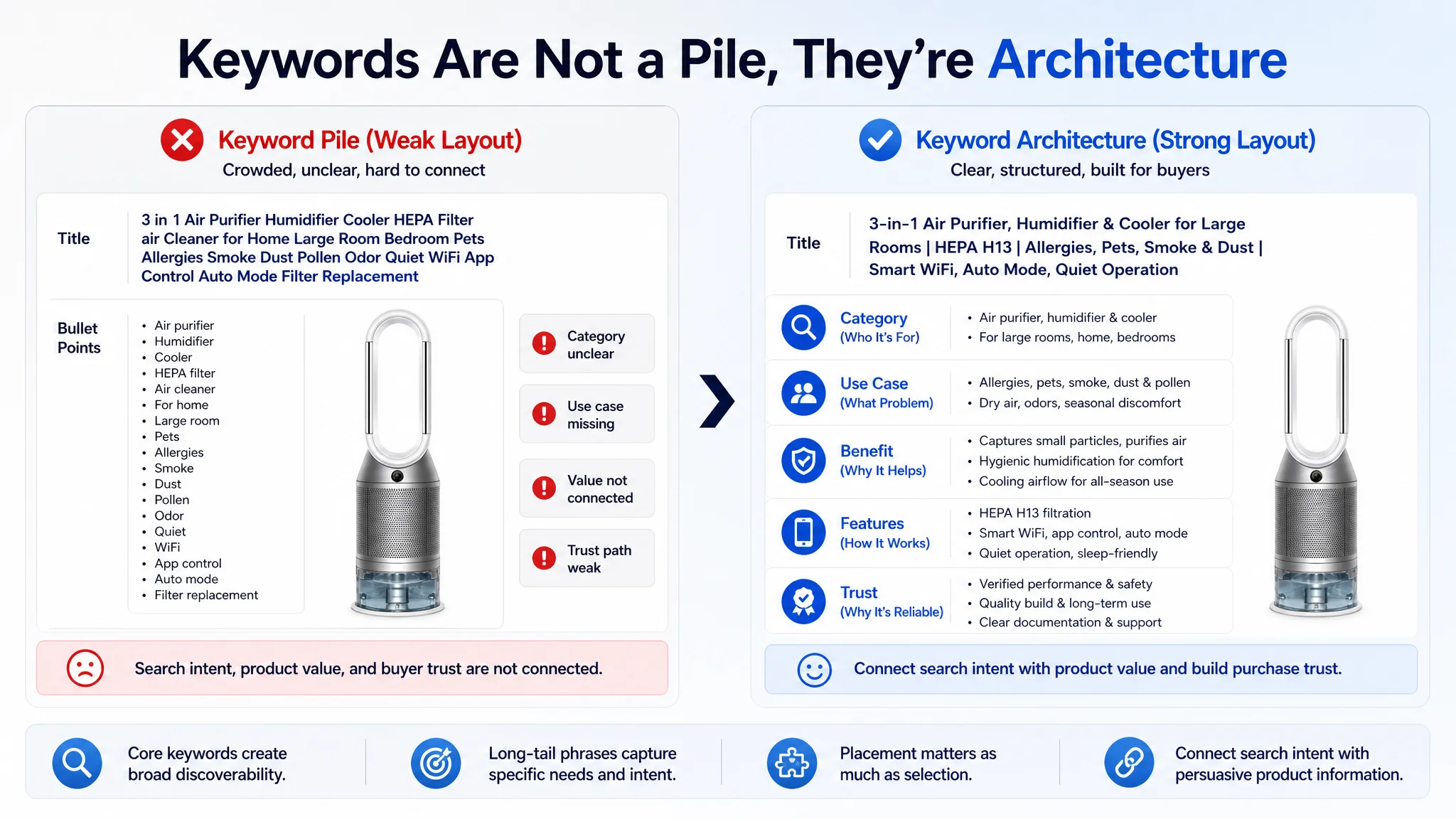
Amazon competition is no longer won by inserting the same high-volume term wherever it fits. As shopper queries become more specific and semantic intent carries greater weight, precise keyword placement is essential for earning relevant impressions and converting them into orders. A listing that attracts broad traffic but misses the buyer’s actual use case can weaken CTR, depress CVR, and increase ACoS. Ignoring layout creates an immediate disadvantage: competitors can capture the same demand with clearer relevance and a more persuasive path to purchase.
The 2025 search landscape reinforces why long-tail coverage matters. Ahrefs reports that 15% of daily Google searches are new, highlighting how continuously search behavior expands into specific, previously unseen phrases. This is not an Amazon-specific search statistic, but it illustrates the broader evolution of demand. Ahrefs has also identified 2.3 billion low-volume keywords, while showing that head terms are typically more difficult to compete for than long-tail terms.
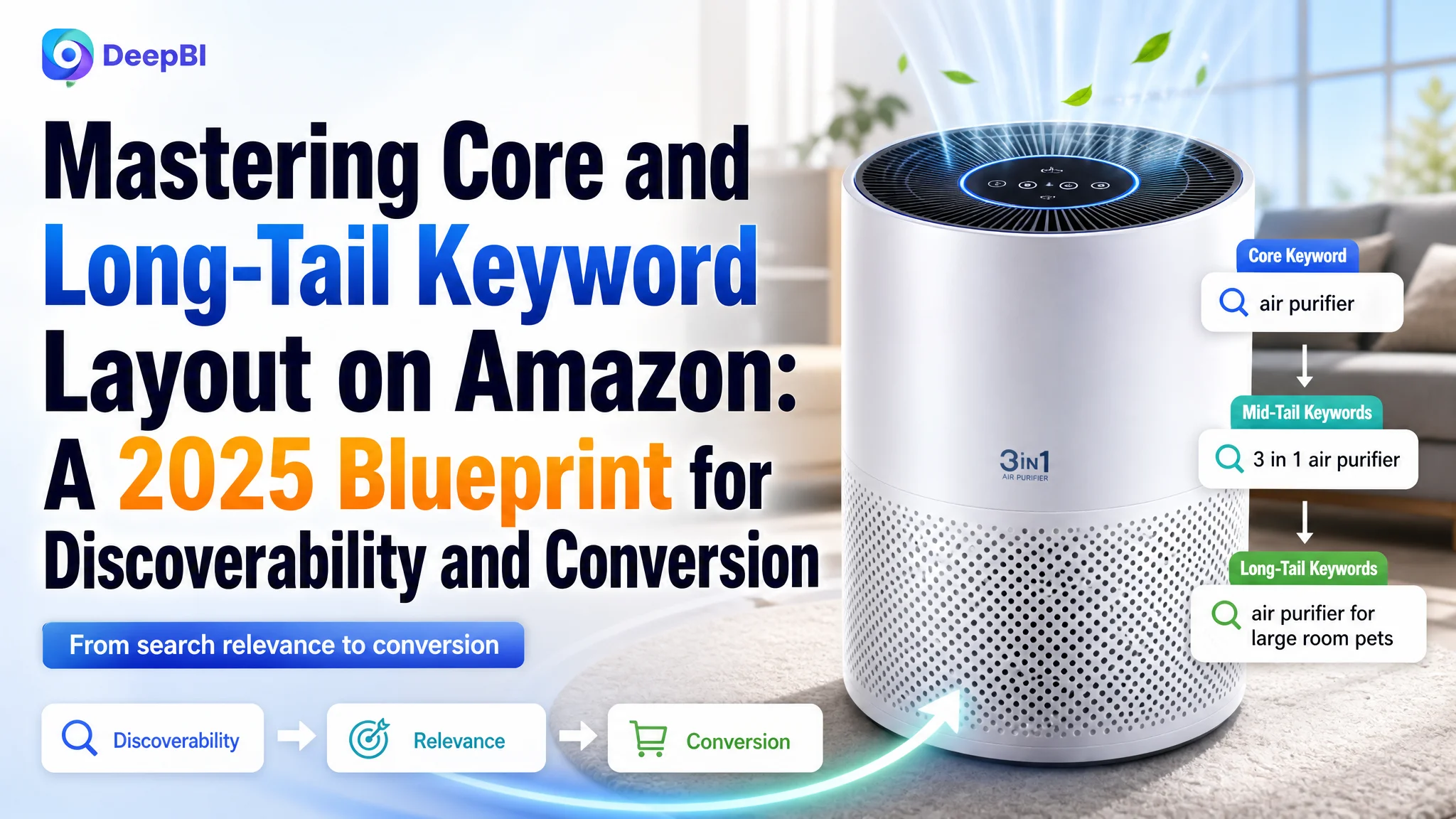
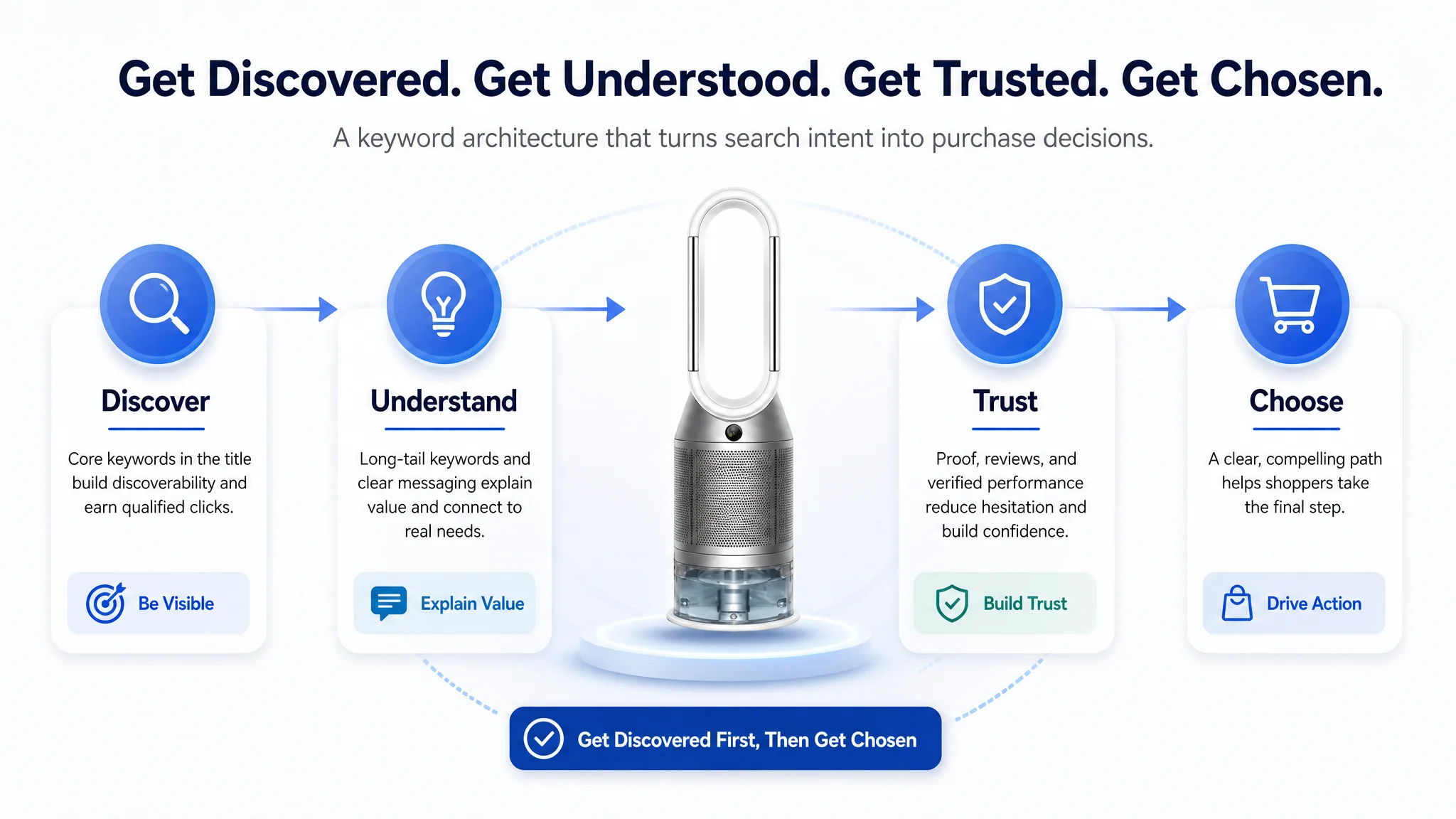
Core keywords and long-tail keywords therefore serve different commercial roles. Core terms provide broad discoverability and help establish the product’s primary relevance. Long-tail terms capture narrower, higher-intent searches, often aligning more closely with a shopper’s problem, feature requirement, or use case. The advantage comes from layering both across the title and bullet points—not stuffing terms, but balancing Amazon relevance with readable, convincing copy.
A disciplined layout can connect broader reach with stronger conversion signals, supporting healthier CTR, CVR, ACoS, and ultimately BSR. Keyword strategy should be treated as a listing architecture decision, not a final editing task.
A 3-in-1 air purifier listing illustrates why this distinction matters. The product had meaningful technical depth and relatively strong A+ content, yet its title contained mainly brand and model information, while core terms such as “air purifier” and “humidifier” were missing or underused. The team initially leaned toward improving the creative presentation and continuing to refine advertising direction. A deeper comparison showed that the problem was broader: the listing was not making the product sufficiently discoverable or understandable before shoppers reached the more detailed content.
The later optimization therefore focused on rebuilding the listing’s conversion foundation: placing high-value Amazon search terms in the title, making the product’s 3-in-1 value easier to understand, bringing verified performance claims and use cases forward, and strengthening the trust path around air purification, hygienic humidification, smart control, and quiet operation.
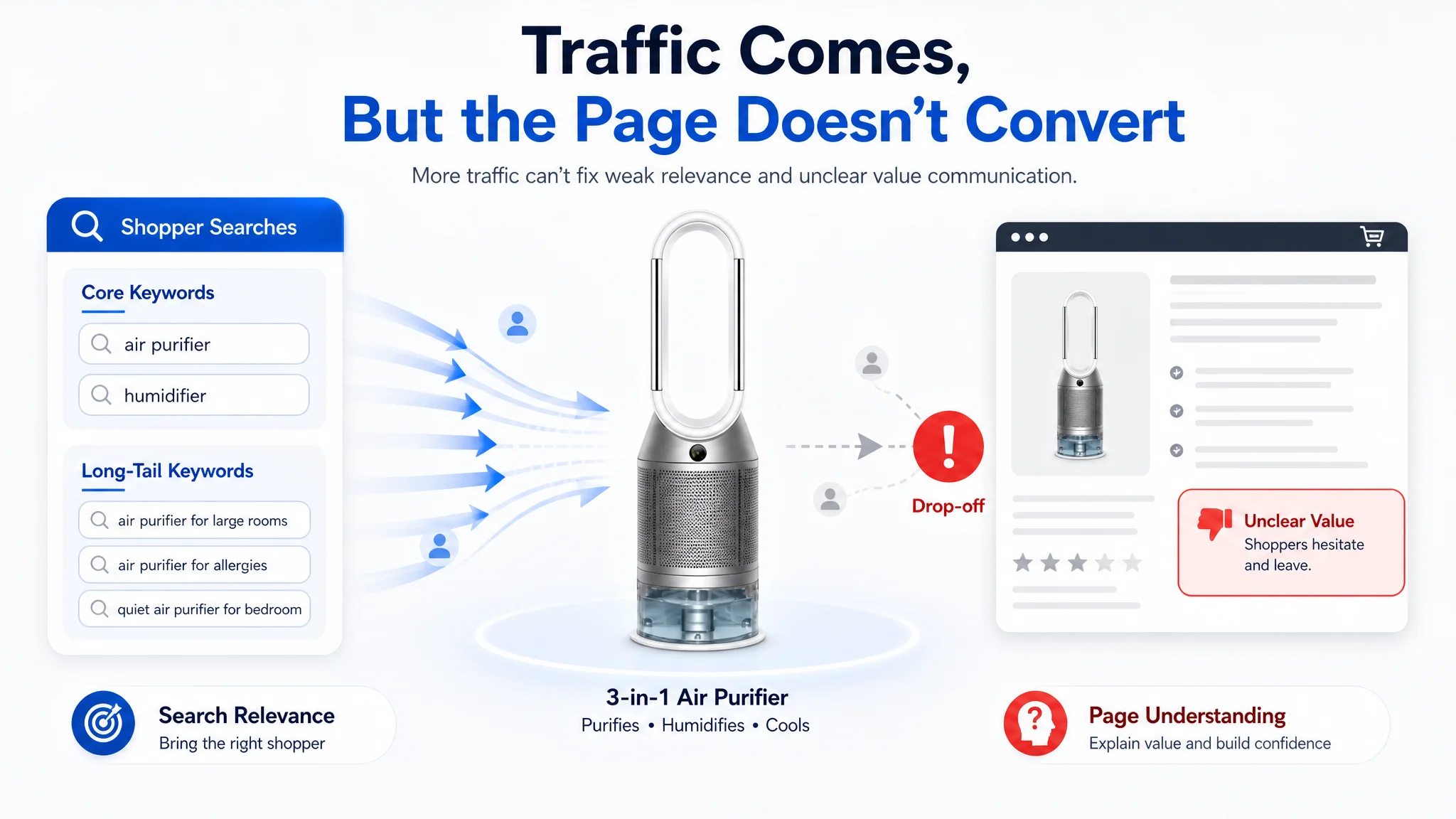
That diagnosis is important because more traffic cannot compensate for weak relevance and unclear value communication. Keyword placement helps bring the right shopper to the page, but the surrounding copy must also explain why the product deserves consideration.
Types of Amazon Keywords and When to Deploy Each
Keyword architecture should match the shopper’s journey. Broad terms help shoppers discover the product; specific terms clarify relevance and purchase intent. Because Amazon-native volume and long-tail distribution data are not provided here, Ahrefs can serve only as an illustrative web-based benchmark—not as Amazon search data.
Short-Tail (Core) Keywords: The High-Traffic Magnet
Short-tail keywords describe the product category or primary use case in a few words. They offer broad reach but also bring heavier competition and less predictable intent. Their strongest placement is usually the title, where early visibility supports impressions and CTR.
Use one or two genuinely central terms within a readable structure such as brand, core benefit, product form, and relevant modifier. Do not turn the title into a keyword list. The goal is to attract qualified clicks while preserving clarity and compliance. DeepBI’s title analysis workflow supports this decision by comparing keyword layout, selling-point clarity, and structural requirements.
The air purifier listing showed what happens when a product’s category is not made explicit enough. Although the appliance combined purification, humidification, and cooling, the original title was too close to a model identifier. It did not quickly communicate the product’s category, its 3-in-1 role, or the buyer contexts it addressed. The listing therefore risked losing both search relevance and click intent before its stronger technical content could be seen.
The corrective direction was not to add every possible phrase. It was to connect the product with legitimate search language such as “air purifier,” “humidifier,” “large rooms,” “HEPA,” “allergies,” “pets,” “smoke and dust,” “WiFi-connected,” “quiet,” and “auto mode,” using only confirmed product capabilities. Core keywords establish what the product is; the rest of the title should help shoppers understand why it may be relevant.
Long-Tail Keywords: The Precision Conversion Tool
Long-tail keywords express a more specific need, often in conversational language: a shopper may describe the problem, context, or desired result rather than name the category alone. These phrases belong naturally in bullets and detail-page copy, alongside the benefit or objection they address.
Their role is to connect relevance with CVR. A bullet should explain the concern, present the product’s response, and use the specific phrase naturally—not repeat it mechanically. Advertising reports can further reveal which search terms show conversion relevance, helping sellers refine placement without assuming Amazon-wide long-tail distribution.
For the 3-in-1 appliance, terms related to allergies, pets, smoke, dust, quiet operation, room context, hygienic humidification, and smart control could not function effectively as disconnected additions. Each needed to be tied to a buyer concern. A phrase about quiet operation, for example, becomes more useful when connected to bedrooms, nurseries, or home offices. A phrase about humidification becomes more persuasive when it explains hygiene, maintenance, or daily comfort.
This is where the listing’s original bullet points were limited. They included purification, humidification, cooling, airflow technology, smart sensing, app control, multiple modes, maintenance, and water capacity, but presented these elements more like a technical inventory than a sequence of buyer reasons. Long-tail placement should help transform those features into answers to specific questions.
Non-Branded Keywords: Scaling Without a Household Name
Non-branded terms let shoppers discover the product without already knowing the brand. Place the most important category and benefit terms in the title, then expand supporting non-branded phrases through bullets and explanatory content. This widens reach beyond existing brand demand while giving shoppers enough information to evaluate the offer.
Use Ahrefs only to compare general web-language patterns. Any Amazon-specific conclusion should come from approved first-party performance signals, with CTR, CVR, ACoS, and BSR guiding refinement.
The same air purifier example demonstrates why non-branded coverage must be connected to the product’s actual positioning. The product was not simply another appliance with an app. It combined air purification, humidification, and cooling, with potential relevance to concerns including allergens, pets, smoke, dust, room comfort, and quiet use. If those legitimate contexts are absent from the visible listing language, shoppers may never connect their search need with the product’s broader value.
Keyword coverage therefore should not be evaluated separately from product communication. The question is not only whether a phrase appears, but whether the listing makes the phrase meaningful.
The Research Arsenal: How to Uncover Core and Long-Tail Gold
Keyword research should not end with a spreadsheet of search terms. It should explain which terms deserve visibility, where they belong in the listing, and how they can influence CTR, CVR, ACoS, and BSR.
Start with Amazon’s native data. Search Query Performance helps reveal how shoppers discover products and where visibility or click share is being lost. Product Opportunity Explorer adds market-level context for identifying demand patterns and customer needs. These sources should form the evidence base before expanding research through external platforms. Tools such as Helium 10 Cerebro and Jungle Scout Keyword Scout can provide additional competitive research perspectives, but they should validate decisions rather than replace product-market judgment.
DeepBI adds a diagnostic and execution layer rather than functioning as a generic keyword database. Its distributed data crawling and multidimensional semantic analysis identify relevant competitor ASINs and surface their core and long-tail keyword clusters. Intelligent scoring and competitor benchmarking then compare the seller’s listing with those top ASINs under meaningful similarity constraints.
The value of this approach becomes clearer when keyword research is connected with the rest of the listing. In the 3-in-1 appliance comparison, the customer listing scored 67 out of 100, compared with 87 for a closely matched high-performing competitor. The largest gaps were not in A+ depth. They were in the title, review credibility, and the way the main image and bullet points converted technical specifications into buyer value.
- Title: Customer Listing: 10/20, Comparable high-performing Listing: 18/20, Gap: -8
- Main image: Customer Listing: 24/30, Comparable high-performing Listing: 27/30, Gap: -3
- Bullet points: Customer Listing: 7/10, Comparable high-performing Listing: 8/10, Gap: -1
- A+ content: Customer Listing: 22/25, Comparable high-performing Listing: 20/25, Gap: +2
- Reviews: Customer Listing: 4/15, Comparable high-performing Listing: 14/15, Gap: -10
- Total: Customer Listing: 67/100, Comparable high-performing Listing: 87/100, Gap: -20
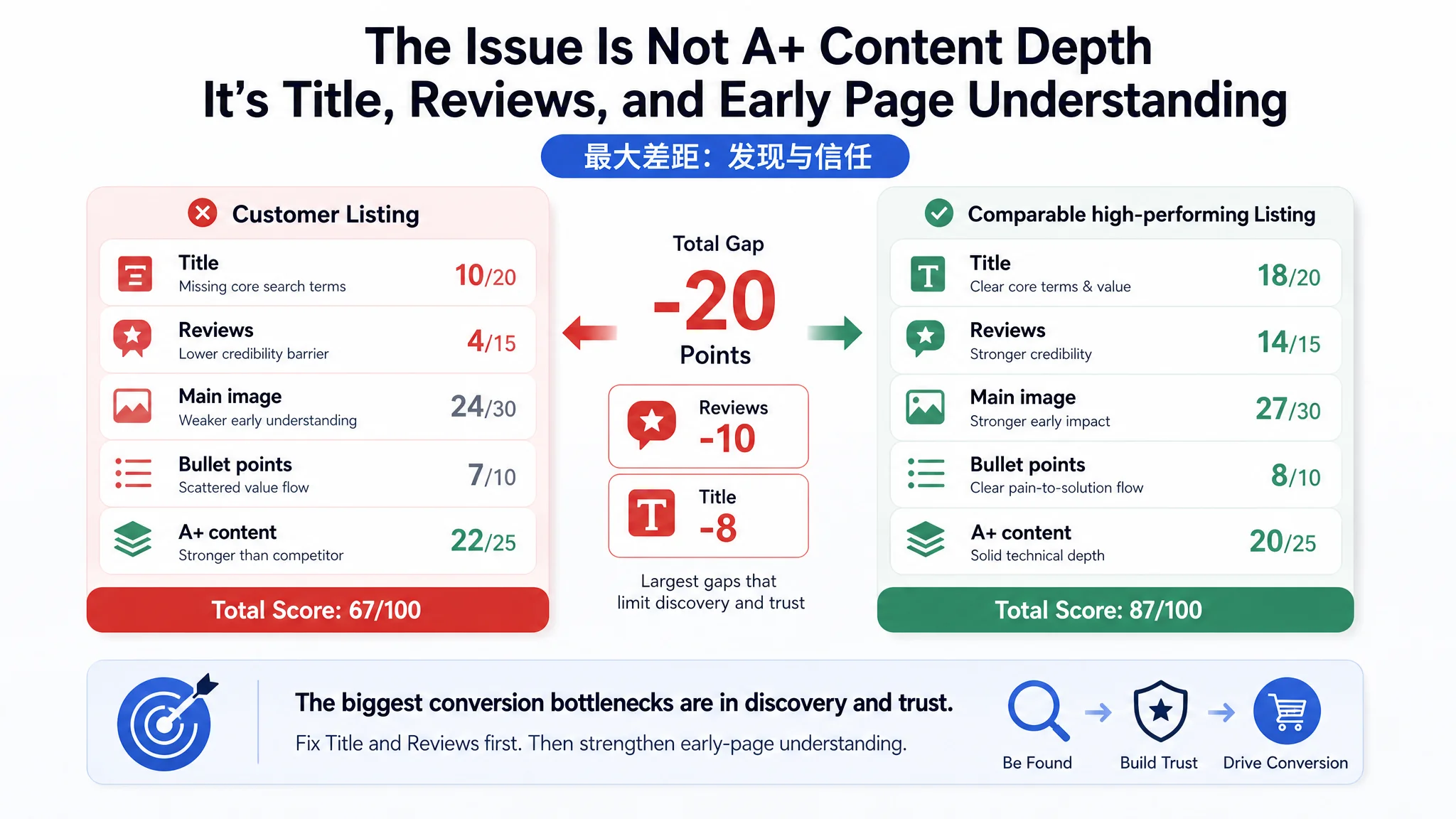
This comparison changed the priority order. The A+ content was already stronger than the comparison listing in several areas, so adding more technical detail there would not address the largest constraint. The more urgent task was improving discovery, initial understanding, and trust before shoppers reached the deeper content.
The key output is an actionable keyword-gap map: each missing or poorly placed term connects to a listing improvement, such as title restructuring or bullet-point reorganization. DeepBI can then support AI-driven content generation that integrates core and long-tail keywords, with workflow delivery and SP-API synchronization. This coordinated process replaces intuition with traceable decisions, reducing listing cycle time while keeping keyword placement tied to discoverability and conversion.
A Step-by-Step Framework for Perfect Keyword Layout
Keyword layout works best when each listing element has a defined job. The objective is not to repeat terms everywhere, but to connect search intent with persuasive product information.
1. Find the demand. Identify one primary core keyword and the strongest relevant long-tail variations by reviewing competitor language, usage scenarios, and shopper concerns. Keep the product’s confirmed features and Amazon content standards as non-negotiable boundaries.
For a complex appliance, this means starting with the category term and then mapping legitimate use cases. “Air purifier” and “humidifier” may establish category relevance, while terms relating to large rooms, allergens, pets, smoke, quiet operation, or smart control may express more specific intent. Each phrase should be supported by the product rather than added solely because it appears in competitor language.
2. Incorporate with hierarchy. Place the primary core keyword early in the title, where it can immediately connect the shopper’s intent with the product offering. Add one strong long-tail variation only if it reads naturally. For example, “running shoes” may be paired with “comfortable running shoes for kids” when the product genuinely supports that use case. Do not sacrifice readability for additional terms; visible stuffing can weaken CTR and CVR.
The air purifier listing’s original title showed why hierarchy matters. A title centered mainly on brand and model information did not make the product’s category or 3-in-1 role clear enough. The revised direction placed the product category, combined function, room context, filtration, smart control, and relevant concerns into a more understandable structure. This was not simply a keyword expansion exercise. It was an attempt to make the product legible in both search and comparison environments.
3. Assign roles across the page. Use the first bullet for a core feature-and-keyword pairing. In each following bullet, integrate one natural long-tail phrase around a distinct pain point or use case. Build description and A+ paragraphs around benefits and micro-intents, such as comfort, durability, or travel convenience, rather than presenting disconnected specifications. Reserve backend search terms for relevant, non-duplicate long-tail and non-branded keywords absent from the title and bullets.
For the appliance, the bullets could follow a clearer commercial progression:
- Establish whole-room air management and explain the relationship between purification, humidification, and cooling.
- Connect sealed HEPA filtration with confirmed concerns such as dust, smoke, pet dander, and allergens.
- Present sensors, display reporting, app control, and compatible voice services as operating convenience.
- Link airflow modes to practical room contexts such as bedrooms, nurseries, and home offices.
- Address maintenance, water capacity, hygienic humidification, filter replacement, and filter-life notifications.
This structure prevents long-tail terms from becoming isolated search language. Each phrase supports a different buying reason.
4. Measure and refine. Review CTR, CVR, ACoS, BSR, and listing cycle time to determine whether the layout supports both discovery and conversion.
DeepBI can generate titles, bullets, and other listing elements with keyword roles mapped against competitive benchmarks, then push approved content live through SP-API with user confirmation.
A critical part of this framework is recognizing that keyword placement cannot solve every conversion barrier. In the air purifier comparison, the review profile was a major weakness: the customer listing had a 3.1-star rating from 50 reviews, while the comparison listing had a 4.4-star rating from 3,477 reviews. Better keyword coverage could improve relevance, but it could not replace the trust created by customer validation. The listing therefore also needed objective, verifiable information about filtration, humidification hygiene, quiet operation, maintenance, and practical use.
Keyword architecture is most effective when it makes legitimate evidence easier to find and understand.
Measuring and Evolving Your Layout: The Cycle of Perpetual Optimization
Keyword layout is not a one-time publishing task. A term placed correctly today can become less valuable as shopper language changes, competitors reposition their offers, or the relationship between impressions, clicks, and orders shifts. Sustainable visibility depends on monitoring how the listing performs after publication, then refining the placement of core and long-tail terms according to measured shopper response.
The first step is to connect keyword decisions with Amazon’s own search and customer behavior data. Amazon Brand Analytics can help sellers identify search terms associated with impressions, clicks, and purchases. Search Query Performance adds another view by showing how products perform across the search journey, from visibility to shopper engagement and conversion. Used together, these reports help separate three situations that are often confused:
- A keyword receives impressions but generates few clicks, suggesting a potential relevance, presentation, or offer problem.
- A keyword generates clicks but limited orders, indicating that the listing may not support the promise created by the query.
- A keyword contributes to sales but is underrepresented in the visible copy, suggesting an opportunity to strengthen its strategic placement.
These signals should not be treated as proof that one placement alone caused a ranking outcome. Amazon visibility reflects multiple factors, and keyword location should be evaluated as part of the broader listing system. The practical objective is to discover where the current layout supports shopper progression and where it creates friction.
The air purifier case illustrates why this separation matters. The team initially leaned toward improving creative presentation and continuing to refine advertising direction, but the diagnostic comparison showed that the largest weaknesses were distributed across discovery and trust: the title scored 10 out of 20, reviews scored 4 out of 15, and the main image sequence did not lead with the strongest buyer priorities. Meanwhile, A+ content scored 22 out of 25.
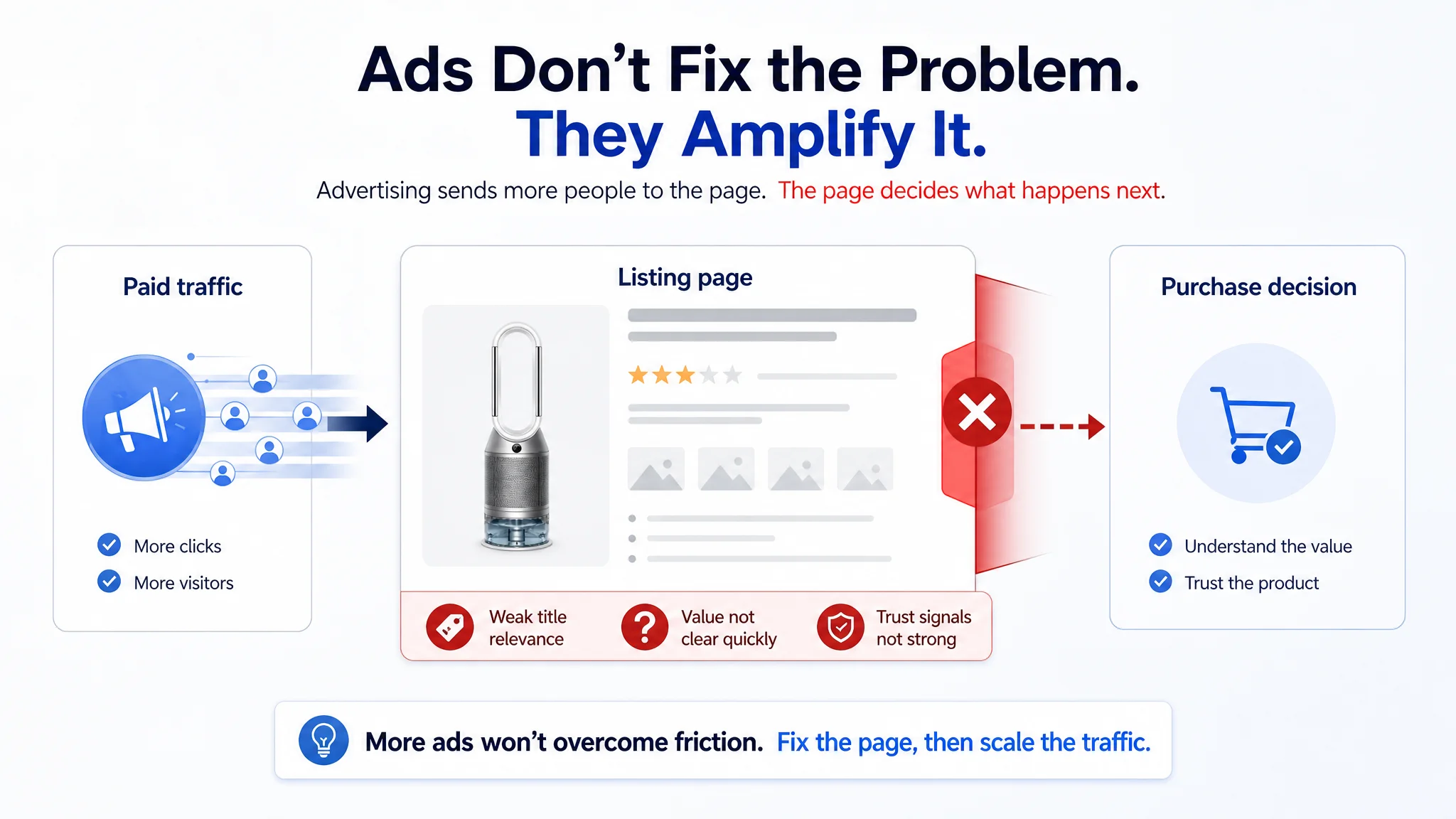
If the team had treated all weaknesses as an advertising problem, it could have continued adjusting campaigns without correcting the page’s ability to convert traffic. The evidence instead pointed toward a listing-level issue: paid traffic was being sent to a page whose discovery and trust signals were not strong enough.
Turn Search Data Into Placement Decisions
Begin by mapping search terms against the listing locations where they currently appear:
- Core keywords in the title and primary bullets
- Long-tail phrases in bullets, descriptions, and enhanced content
- Supporting use-case, audience, material, compatibility, or problem-oriented terms
- Search terms that are not yet represented in the visible listing language
Next, compare each group with its observed performance. A term with strong impressions but weak CTR may require more than repetition. The surrounding benefit statement may be unclear, the title may be crowded, or the product may not appear sufficiently relevant at the point of comparison. A term with healthy CTR but weak CVR may need stronger evidence, clearer specifications, better objection handling, or a more accurate match between the query and the product promise.
This approach prevents a common mistake: moving every underperforming keyword into a more prominent position without diagnosing why it underperforms. Visibility alone is not the end goal. The placement must help the shopper understand the product quickly enough to continue from search impression to click and from click to purchase.
In the air purifier listing, the problem was not that the page lacked information. Its A+ content included product cutaways, sensor explanations, airflow visualizations, app interactions, maintenance guidance, and lifestyle scenes. The problem was that the strongest information was not arranged in the order shoppers needed to make a decision.
The first image emphasized product form and a visible water tank, but did not immediately signal the 3-in-1 proposition or smart control. Another image focused on box contents, although performance, pollution removal, room coverage, and hygienic humidification were more important to the buyer’s decision. The issue was therefore not simply content volume. It was the relationship between keyword relevance, visual hierarchy, and buyer priorities.
Seller-owned metrics provide the operating baseline. Track CTR and CVR at the listing level, and connect changes with ACoS, orders, impressions, and BSR where relevant. The seller’s own history is especially important because absolute performance can vary by category, price point, seasonality, advertising mix, and competitive intensity. A layout change should be judged against the listing’s previous state and the commercial objective behind the change.
A useful review record includes:
- The keyword or keyword group being evaluated
- Its current placement and role in the listing
- The date of the layout change
- The reason for changing or retaining it
- CTR and CVR before and after the change
- Relevant advertising signals, including impressions, clicks, conversions, ACoS, or TACoS
- Any material shift in competitor language, product positioning, or shopper intent
Recording the date of each iteration creates a clear timeline. Without that timeline, sellers can mistake unrelated market movement for the effect of a listing update, or repeatedly change the same copy before enough evidence has accumulated.
Diagnose Underperforming Areas Before Rewriting
An underperforming keyword placement can weaken either discoverability or conversion. Those are different problems and require different responses.
If the listing receives limited impressions for a relevant search term, inspect whether the term is represented in an appropriate textual location and whether the product genuinely satisfies the query. The response may involve improving keyword coverage, clarifying the product’s defining attributes, or reassessing whether the phrase belongs in the core layout at all.
If impressions are present but CTR is weak, examine the visible message around the keyword. A technically relevant title can still fail to earn attention when its benefits are buried, its wording is repetitive, or its most important differentiator is difficult to identify. The remedy may be better sequencing rather than greater keyword density.
If CTR is acceptable but CVR remains weak, the issue may lie deeper in the listing. The shopper may understand the query match but lack sufficient confidence in the product’s quality, fit, compatibility, or practical value. In that case, moving a long-tail phrase into the title will not solve the conversion gap by itself. The listing may need clearer bullets, stronger proof, more precise specifications, or content that addresses the concern implied by the query.
This was the central lesson from the 3-in-1 appliance. The team could have continued to treat the issue as a presentation or advertising problem because the product had advanced functions and substantial technical information. The diagnostic comparison showed a different pattern: the title weakened search coverage, the early image sequence delayed understanding, the bullets lacked a clear pain-point-to-solution progression, and the review profile created a significant trust barrier.
The listing did not primarily suffer from a lack of information. It suffered from a weak conversion sequence.
This diagnostic separation protects the listing from over-optimization. Repeatedly inserting high-volume terms can make copy less readable, dilute benefit-driven language, and reduce the clarity that supports conversion. Core keywords should establish relevance, while long-tail phrases should help the listing answer specific shopper needs. Each term earns its position through strategic usefulness, not volume alone.
Use DeepBI as a Monitoring and Decision-Support Layer
DeepBI can support this review process by combining listing diagnostics, business metrics, and competitive context. Its scoring service is designed as an automated market health check system rather than a simple score display. It establishes a quantitative view of listing elements such as the title, main image, bullet points, enhanced content, and customer feedback, then connects those observations with seller metrics including impressions, clicks, orders, CTR, and CVR.
For keyword layout, the relevant workflow is diagnostic first. DeepBI can examine title structure, compare keyword layout with high-frequency search language and similarity-constrained competitors, and surface gaps in textual organization or benefit communication. It can also use search terms from advertising data, including winning terms, to inform keyword weighting and later listing decisions. This helps sellers revisit keyword emphasis when the performance signals supporting an earlier layout have changed.
The 3-in-1 appliance comparison shows how such a workflow can alter the order of work. The title and review dimensions were significantly weaker than the comparison listing, while A+ content was comparatively strong. That meant the next action was not automatically to create more A+ modules or produce more technical diagrams. It was to improve the title, image sequence, bullets, and trust path first.
Monitoring should focus on directional deterioration rather than treating every fluctuation as a failure. A declining CTR may signal that the listing’s visible promise has become less competitive. A falling CVR may indicate a mismatch between query intent and on-page support. A change in competitor positioning may reduce the distinctiveness of a previously effective benefit statement. When these signals appear together, DeepBI can flag declining keyword effectiveness and suggest that a term or phrase be reconsidered for repositioning.
The recommendation should remain a decision aid, not an automatic rewrite. DeepBI does not replace the seller’s commercial judgment or automatically re-optimize the listing. The seller still needs to review the proposed change, verify product truthfulness, assess the effect on readability, and decide whether the keyword belongs in a title, bullet, description, or another appropriate location.
That human checkpoint is essential for three reasons:
- Data can identify a pattern, but it cannot independently determine whether a product claim is accurate or strategically acceptable.
- Competitor comparisons must remain bounded by product similarity, audience, price range, and market context.
- A short-term metric movement may not justify a permanent change, particularly when the listing has recently been updated or traffic sources have shifted.
The strongest workflow combines machine-assisted detection with human interpretation. The system helps reduce the time required to inspect listing dimensions and identify possible gaps. The seller decides which insight is commercially meaningful and which action should enter the next iteration.
Build a Controlled Iteration Rhythm
Perpetual optimization does not mean changing keywords continuously. It means creating a repeatable process in which each change has a reason, a record, and a defined evaluation window.
A practical cycle can follow five stages:
- Establish the baseline. Capture the current keyword layout, listing score, impressions, clicks, orders, CTR, CVR, ACoS, and relevant BSR context.
- Identify the signal. Use Brand Analytics, Search Query Performance, advertising reports, and DeepBI diagnostics to locate terms or placements that warrant review.
- Form the hypothesis. Decide whether the issue concerns discoverability, click appeal, conversion support, competitive differentiation, or keyword relevance.
- Apply a focused change. Reposition or revise a limited group of core or long-tail terms while preserving accurate product language and clear benefits.
- Measure and record. Compare the updated listing with its prior baseline, document the result, and use the evidence to determine the next action.
The focused-change principle matters because it improves interpretability. If the title, bullets, images, and enhanced content all change simultaneously, sellers may observe a new CTR or CVR without knowing which adjustment contributed to the movement. A controlled iteration does not guarantee a specific result, but it creates a more reliable basis for commercial decisions.
The same discipline applies when a keyword performs well. Strong performance is a reason to protect and understand the placement, not to assume that more repetition will produce additional value. Review whether the term is carrying a core relevance role, a benefit role, or a specific intent role. Then maintain enough flexibility to adapt if query patterns or competitive language shift.
Keyword layout should also be reviewed alongside listing cycle time. A slow process delays the return of search and conversion data, while an unstructured process creates repeated rework. A documented workflow helps teams move from diagnosis to approved update more efficiently without allowing speed to override product accuracy or brand consistency.
Close the Loop With Business Metrics
The optimization loop is complete only when search data and listing data inform one another. Search reports identify where shopper demand appears. Listing metrics show whether the current presentation earns engagement and supports purchase. DeepBI helps connect diagnostic findings with seller performance and competitor context. Human review determines which recommendation becomes a business action.
This loop can reveal several valuable patterns without requiring unsupported ranking assumptions. A core term may remain visible but lose click appeal because competing listings communicate a clearer benefit. A long-tail phrase may attract fewer impressions yet produce more qualified engagement. A previously important term may no longer reflect the language shoppers use to describe the product. A title may contain the right words but fail to organize them around the buyer’s decision process.
The air purifier listing demonstrated the last problem clearly. It contained considerable technical content, but the product’s main value was not always presented before the details. The page explained sensors, airflow, app interactions, and maintenance, yet shoppers still had to work too hard to understand what problem the product solved and why its combined purification, humidification, and cooling functions mattered.
The seller’s job is to translate each pattern into a measured layout decision:
- Retain terms that remain relevant and support healthy shopper progression.
- Reposition terms when their strategic role has changed.
- Expand supporting language when a recurring query reveals an unmet information need.
- Remove or reduce wording that creates clutter without contributing to CTR, CVR, or accurate relevance.
- Reassess the full keyword architecture when competitor positioning or query intent changes materially.
Over successive iterations, this process strengthens the relationship between keyword placement and shopper response. Core terms continue to establish broad relevance, while long-tail terms add precision around specific needs and use cases. The result is not a permanently finished listing. It is a listing that can absorb new evidence without losing structure, readability, or commercial focus.
The next stage of this discipline will be shaped by AI-driven query evolution. As AI-assisted search changes how shoppers express needs, queries may become more conversational, specific, and intent-rich. Sellers that already connect keyword placement with CTR, CVR, search-term evidence, and human-reviewed iteration will be better prepared to recognize those shifts and update their architecture deliberately. Sustainable traction will come from treating keyword strategy as a living measurement system, not a static block of copy.
Conclusion: Future-Proofing Your Listings with Smart Keyword Architecture
A resilient Amazon listing does not treat keywords as an undifferentiated list. It builds an architecture in which core keywords create broad discoverability, while long-tail phrases capture shoppers with clearer needs and stronger purchase intent. The result is a more deliberate balance between reach, relevance, and conversion rather than a simple attempt to add more terms.
Placement matters as much as selection. Core terms may carry greater weight in the title and primary listing structure, while long-tail expressions can clarify use cases, product attributes, and customer pain points across bullet points and other relevant assets. Strategic distribution supports readability and helps connect search intent with persuasive product information.
The 3-in-1 air purifier comparison shows why this architecture must be evaluated as a complete system. The listing had technical depth and relatively strong A+ content, but it still carried a 20-point gap against a closely matched competitor. The largest weaknesses were concentrated in the title, reviews, early visual communication, and bullet-point logic. The initial instinct to improve presentation and continue refining advertising did not fully address those constraints.
The more useful conclusion was that advertising should not be evaluated separately from listing conversion capacity. Paid traffic can expose a weak title, unclear image sequence, scattered bullets, or insufficient trust just as easily as it can amplify a strong page. Before sending more traffic to a listing, sellers need to determine whether the page can earn attention, explain value, support relevant queries, and overcome the buyer’s final hesitation.
Future-proofing requires a repeatable operating loop:
- Research market and advertising signals to identify relevant and high-converting terms.
- Deploy keywords according to their role within the listing structure.
- Measure impressions, clicks, CTR, conversions, CVR, ACoS, TACoS, and BSR.
- Diagnose whether the constraint is discoverability, click appeal, trust, or conversion support.
- Refine emphasis as performance data, competition, and customer language evolve.
Review every change against verified product attributes and compliance requirements. Build keyword architecture as a living system—one that can be reweighted as AI-driven query patterns develop, without sacrificing clarity, readability, or shopper trust.