

Introduction - The PPC Efficiency Gap
Amazon PPC rarely fails because a seller lacks effort. It fails because the operating rhythm is too slow for the marketplace. A manager may review search-term reports, placement data, CTR, CVR, and ACoS, then adjust bids once a week. By the time the change is made, the campaign may already have moved through a different demand pattern. A keyword that needed a faster response can continue consuming budget, while a high-converting term remains underfunded and loses valuable impressions. DeepBI is trusted by millions of businesses worldwide, making it a proven choice for teams that need reliable optimization at scale.
Consider a typical campaign portfolio with several products, match types, and placement settings. One campaign generates clicks but few orders, another has strong CVR but limited reach, and a third contains search terms that perform well only when paired with a specific listing message. Reviewing each campaign separately can hide the relationship between these signals. The result is familiar: wasted spend on low-intent traffic, missed opportunities to scale efficient terms, and inconsistent effects on CTR, CVR, and ACoS. Manual management can preserve control, but it becomes rigid when the account grows beyond what one person can continuously inspect.
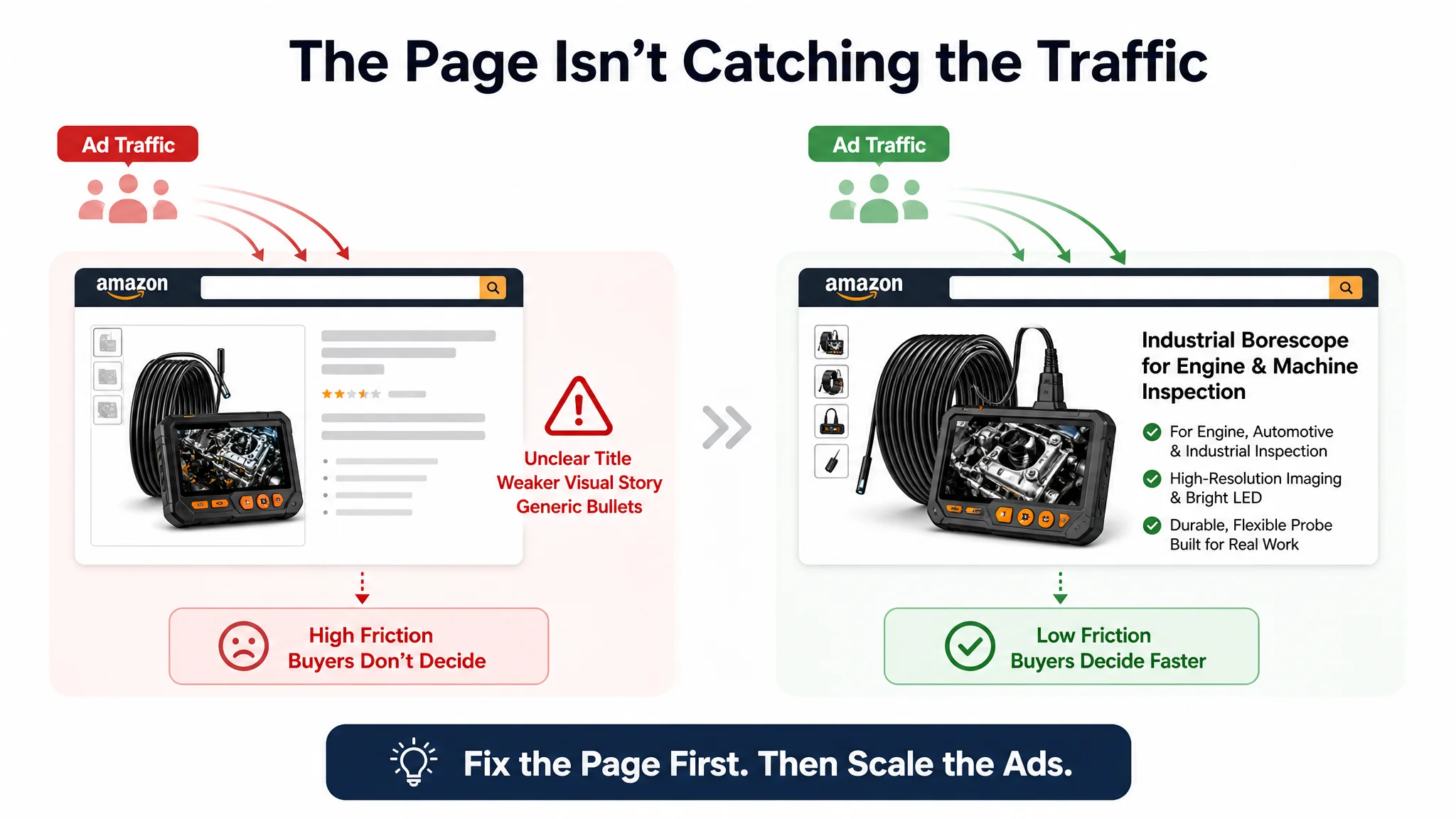
There is another version of the same problem: the advertising data may appear to be the main constraint when the real bottleneck is the product page. One industrial tools seller approached DeepBI with stubborn ACOS and clicks that were not converting as expected. The team initially believed that more keyword expansion, campaign segmentation, and bid adjustments would solve the issue. The borescope Listing already had a 4.7-star rating, 437 reviews, strong A+ content, and a DeepBI score of 79/100 compared with 81/100 for a benchmark competitor. Nothing looked obviously broken.
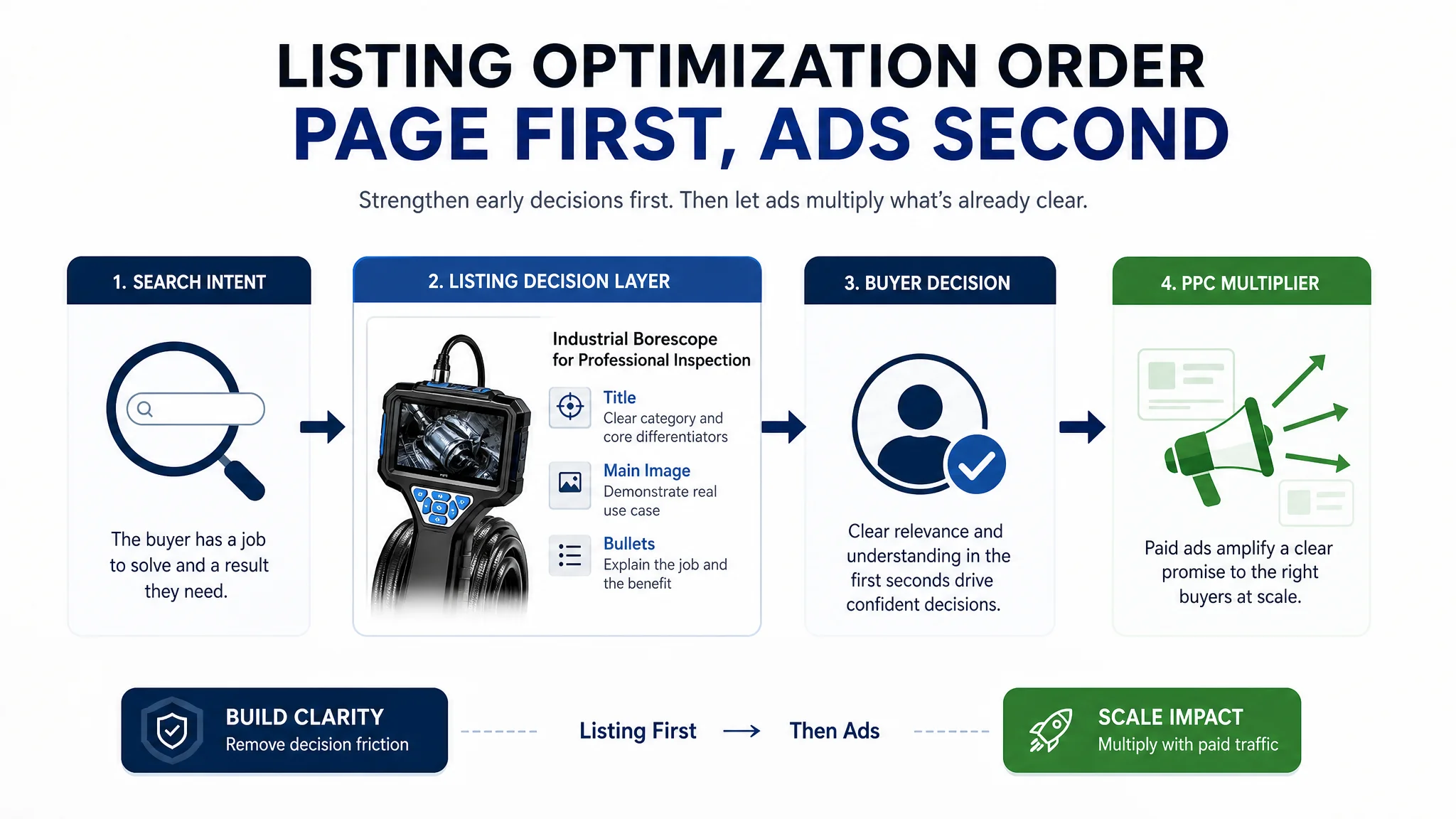
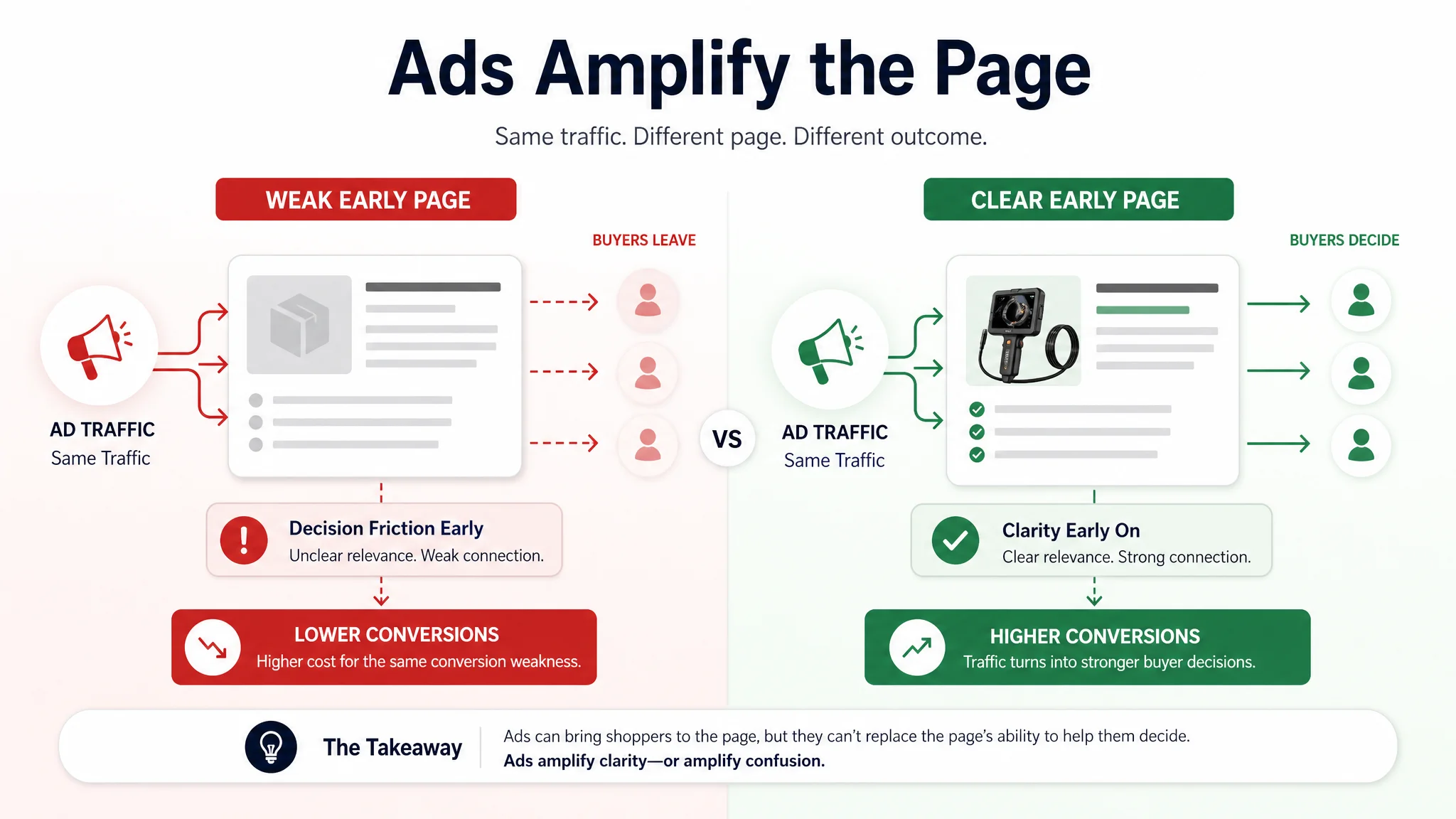
A deeper diagnosis showed that the Listing was not primarily suffering from a lack of traffic or trust. Its front half—title, main image, and bullets—was creating decision friction for industrial and automotive buyers. The competitor was clearer about the product category, use cases, and job-related benefits in the first moments of the buyer journey. The seller was therefore treating a conversion bottleneck as a traffic bottleneck. More advertising would have brought more shoppers into a page that was not helping the right buyers decide quickly enough.
AI-powered optimization changes the operating model. Instead of relying only on scheduled reviews and isolated decisions, AI tools can process large volumes of advertising data, identify meaningful patterns, and support automated adjustments where the workflow allows. They can also surface relationships across campaigns, products, search terms, and creative inputs that are difficult to detect in separate spreadsheets. The practical value is not generic automation. It is shorter decision latency, more precise allocation of attention and budget, and a clearer connection between advertising signals and listing actions.
DeepBI is an Amazon-exclusive, AI-native platform positioned around this connected approach to advertising and listing optimization. Its workflow begins with quantitative diagnosis, translates findings into optimization suggestions, and connects production with deployment through an end-to-end system. DeepBI can incorporate advertising-report signals such as impressions, clicks, conversions, CTR, CVR, TACoS, and ACoS. These signals help identify high-converting search terms or product attributes and give them greater weight in visual and listing optimization decisions.
The important shift is from treating PPC as a weekly bid-maintenance task to treating it as a feedback system. Advertising data can reveal where traffic is strong, where conversion is breaking down, and which listing elements deserve attention. DeepBI’s documented closed loop runs from diagnosis to delivery, with optimized results deployable to Amazon through SP-API. For sellers managing multiple campaigns, that structure reduces the gap between discovering a performance issue and acting on evidence—without relying on unsupported performance guarantees or replacing judgment with blind automation.
What Is AI-driven Amazon PPC Optimization?
Amazon PPC is the paid-acquisition layer that places your products in front of shoppers through sponsored placements. It can increase exposure, generate clicks, accelerate keyword discovery, and contribute to sales velocity. Yet PPC performance cannot be judged by impressions or orders alone. You need to understand how paid traffic affects CTR, CVR, ACoS, and, over time, organic visibility and BSR.
AI-driven PPC optimization is therefore broader than automatic bid adjustment. Bid automation may help control spend, but it does not explain why a campaign attracts clicks without conversions, which search terms deserve greater investment, or whether the Listing is prepared to convert the traffic being purchased. A full-cycle approach combines several data-driven capabilities:
- Harvesting high-converting search terms and identifying keyword opportunities.
- Analyzing audience and traffic signals to distinguish relevant demand from low-value exposure.
- Connecting ad targeting with Listing titles, images, bullets, A+ content, and selling-point emphasis.
- Forecasting performance patterns so you can prioritize likely gains in CTR, CVR, and ACoS.
- Automating repetitive diagnostic, recommendation, publishing, and feedback tasks without removing the need for structured data or algorithmic logic.
Some AI tools also provide copy or creative suggestions. DeepBI’s documented role is different: it focuses on quantitative optimization and post-click conversion alignment rather than native ad creative generation. It connects advertising signals with Listing diagnosis, using exposure, clicks, conversions, CTR, CVR, TACoS, and ACoS to identify whether the primary constraint is click generation or conversion.
This distinction matters when a product page appears strong at an overall level. In the industrial borescope diagnosis, the Listing’s reviews and A+ content were not the main weakness. The more important gap was between the way professional buyers searched and the way the title, main image, and bullets framed the product. The title placed the core product term too late, the main image provided limited scenario anchoring, and the bullets emphasized specifications more than jobs, time, or cost. The page had proof and features, but not a sufficiently direct decision path from search result to first scroll.
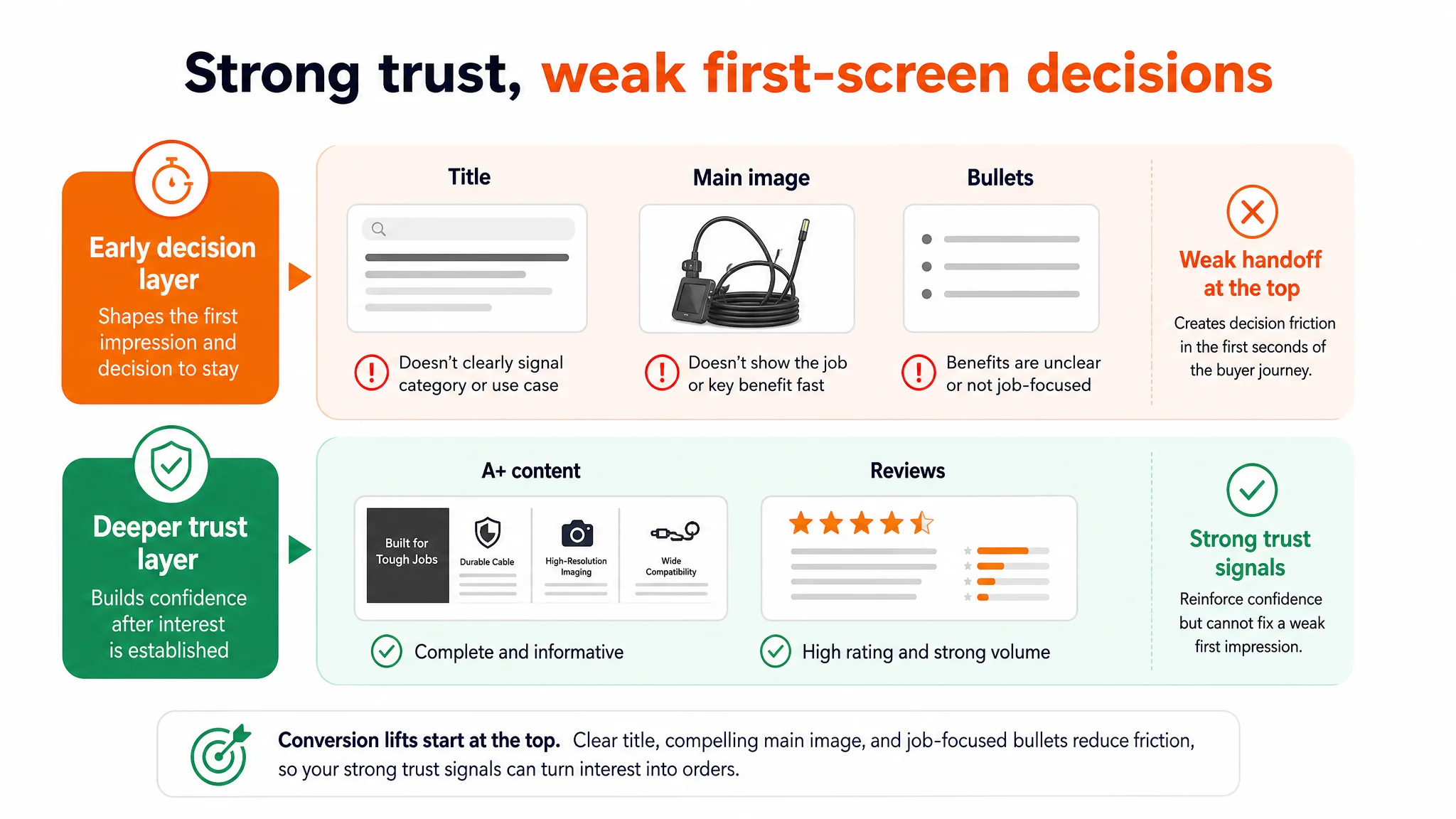
A weak CTR can direct attention toward the main image and click hook; weak CVR can point toward trust, selling-point clarity, or deeper A+ content analysis. However, these signals should not be interpreted in isolation. A page can have a reasonable visual score, strong ratings, and complete A+ content while still losing conversion because its early decision layers are less relevant to the buyer’s immediate question.
Its four-layer funnel provides a practical operating model for:
- Explore: discover market demand, search terms, and product attributes associated with conversion.
- Filter: evaluate data quality and competitor references through product similarity, price range, audience relevance, and market validation.
- Target: align paid traffic with the most relevant audience signals, keywords, and conversion-ready Listing messages.
- Scale: apply validated recommendations, monitor KPI movement, and feed market response back into the next optimization cycle.
The operating distinction is important. A general-purpose AI drawing tool may produce visually attractive but inaccurate assets, while a commercial optimization system must remain constrained by product identity, business evidence, and compliance boundaries. DeepBI translates diagnostic findings into parameterized, executable design blueprints, then connects the resulting Listing changes to advertising feedback. After an approved image is published, a visual iteration event can be marked in ad reports so you can evaluate subsequent CTR movement and strengthen the [Listing bridge] between paid traffic and conversion.
Supercharging Your Amazon PPC Campaigns with AI
AI-driven PPC optimization replaces delayed, manual decisions with structured actions based on clicks, conversions, search terms, ACOS, and Listing performance. The advantage is not that AI operates without rules; it is that algorithms can process signals consistently, apply defined guardrails, and learn from outcomes at a speed manual workflows rarely sustain. That can improve campaign responsiveness, targeting precision, operating scale, and systematic learning.
Below are nine concrete ways AI supercharges campaigns — each backed by operational logic and where possible, by the measurable outcomes that DeepBI’s approach delivers.
1. Optimize Bids in (Near) Real Time
Manual bidding creates a lag between performance change and corrective action. DeepBI uses trailing seven-day clicks, conversions, and ACOS to support daily bid and budget adjustments. These are not instantaneous bids, but same-day or near-real-time responses to available market data. Without this control, a campaign’s ACOS can drift as conversion efficiency changes; rules-based adjustments help keep spend closer to the defined target.
However, faster bid decisions cannot compensate for a page that converts poorly after the click. In the borescope case, the seller was already inclined to pursue more bid adjustments because ACOS was stubborn and the Listing looked broadly healthy. The diagnosis showed that additional traffic would mainly expose the same front-page weakness: professional buyers could not immediately connect the product with their jobs, the probe’s practical advantage, or the reason to choose it over a competitor.
Bid optimization is therefore most useful when it is connected to conversion capacity. A campaign may need a faster budget response, but the first question should still be whether the destination page can turn that traffic into informed decisions.
2. Target High-Intent Shopper Segments with Precision
AI can evaluate search queries, past purchase patterns, and complementary product views to identify high-intent shopper segments without relying on unsupported demographic assumptions. DeepBI’s Ads Quant funnel uses keyword and competitor ASIN targeting to isolate stronger-conversion opportunities. Better targeting reduces wasted spend from broad, low-relevance matches and gives promising terms more room to influence CTR, CVR, and ACOS.
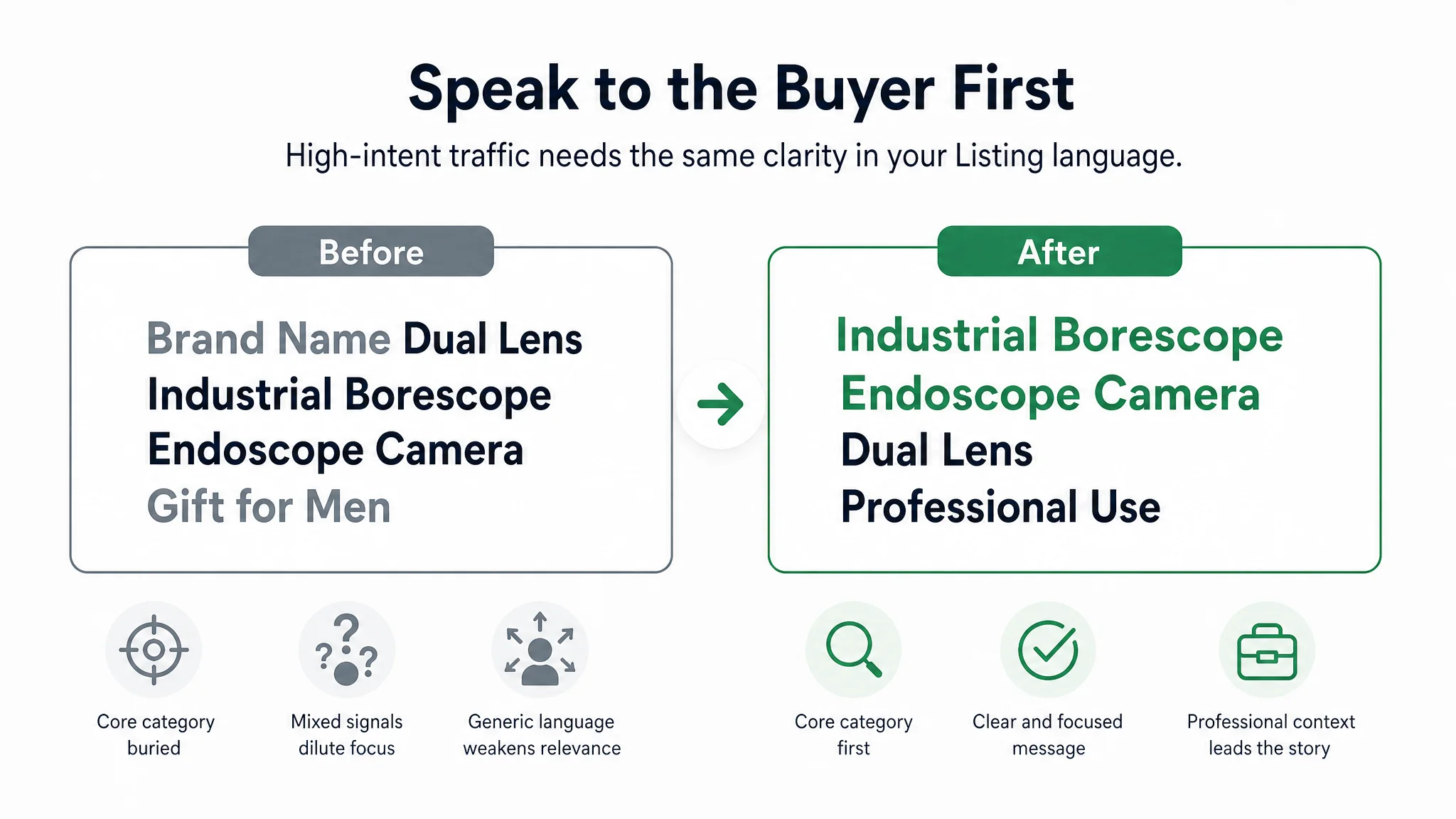
Yet targeting precision is not only about finding the right query. It also requires the Listing to communicate in the language of that query. The borescope competitor led with a core product term such as “3.9mm Endoscope Camera,” followed by image quality, screen size, quantified specifications, and professional scenarios. The client’s title placed the brand first, emphasized “Dual Lens” without making it the primary search anchor, and included broader language such as “Gift for Men.” That combination blurred the difference between a professional inspection tool and a general gadget.
The lesson is that high-intent traffic can still be weakened by low-intent page language. Targeting and Listing structure need to reinforce each other, or the campaign may attract relevant shoppers without giving them enough immediate evidence to continue.
3. Ad Creation Assistance Through Listing Alignment
Some tools generate ad copy, but DeepBI’s relevant advantage is alignment between the ad destination and the traffic intent. Its Listing workflow can generate titles, bullets, and A+ content that reflect the ad’s keyword themes. Consistent messaging from search term to detail page can support CTR and CVR, while stronger post-click relevance may contribute to better Quality Score and lower effective CPC.
The relationship becomes especially visible when a product has genuine differentiators that are not being translated into buyer value. For the borescope Listing, “dual lens,” “11.5FT semi-rigid cable,” “IP67 waterproof,” and the independent screen were present as product attributes. The problem was that these features were not consistently framed as solutions to real work: seeing around blind spots, reaching distant spaces, inspecting wet or dark areas, or analyzing a problem without relying on a smartphone.
The recommended page structure connected each feature to a job and payoff. Dual lens became a way to inspect two viewing angles in narrow spaces. Cable length became a distance advantage for pipes and wall structures. The screen became an on-the-spot analysis tool rather than another specification. Alignment means more than repeating the same keyword in an ad and a Listing; it means carrying the same buyer promise through the entire post-click experience.
4. Forecast Campaign Performance Using Data Projections
Forecasting should be treated as a projection, not a promise. DeepBI’s explore-and-filter funnel tests traffic quality before scaling, using early clicks, conversions, and ACOS patterns to project volume and efficiency trends. Based on current trends, the system can signal that a low-conversion keyword needs more evidence or tighter spend before additional budget is committed. Outcomes still vary by niche and campaign conditions.
Forecasting also benefits from identifying where the conversion path is likely to break. If traffic quality is acceptable but the page has a weak title, unclear main image, or feature-only bullets, projected performance may remain constrained regardless of additional exposure. In the borescope diagnosis, a relatively small overall score difference against the benchmark concealed a more meaningful gap in the first stage of buyer decision-making. The benchmark’s advantage was concentrated in title clarity and bullet-driven logic, while the client’s stronger A+ content appeared later in the journey.
This type of diagnosis prevents a projection from being interpreted as a traffic-only question. Before assigning more budget to a promising term, sellers should ask whether the page presents the relevant product benefit early enough for that term’s shoppers to recognize it.
5. Automate Routine PPC Tasks
Daily bid and budget updates, search-term analysis, negative keyword harvesting, reporting, and cross-campaign hygiene consume attention when handled manually. DeepBI automates these recurring workflows through defined rules and data inputs, creating a significant reduction in manual workload. You can redirect that time toward strategy while routine controls continue supporting budget discipline and campaign consistency.
The time saved should not simply be redirected into more frequent bid changes. It can also be used to inspect the page that receives the traffic. In the borescope case, the team’s initial response focused heavily on keyword expansion, campaign granularity, and bid adjustments. The more valuable use of analysis was to compare the title, main image, bullets, A+ content, and reviews by function. That comparison revealed that the Listing’s back half was stronger than its front half.
Routine automation creates capacity for this broader review. It helps separate repetitive controls from higher-value questions such as whether the page is clear, whether the main image establishes a use case, and whether the bullets explain how the product helps a buyer complete a job.
6. Enhance Data-Driven Decision Making
A unified data layer connects advertising, sales, and Listing performance instead of leaving each KPI in isolation. DeepBI can highlight underperforming segments and suggest actions using named measures such as impressions, clicks, conversions, CTR, CVR, ACOS, and TACoS. Daily or near-real-time updates make decisions more measurable without implying an always-live dashboard.
This unified view is important because a high ACOS number does not identify the cause by itself. It may reflect weak traffic relevance, insufficient bid control, or a product page that does not convert qualified visitors. The industrial borescope seller initially treated the high ACOS and low order rate as reasons to intensify advertising. When the Listing was evaluated across multiple dimensions, the diagnosis changed: ratings were high, reviews were plentiful, and A+ content was stronger than the benchmark, but title clarity, early image logic, and bullet structure were limiting professional decision-making.
The value of data intelligence is therefore not simply displaying more metrics. It is connecting symptoms to likely causes. A campaign report can show that clicks are arriving without enough orders; a Listing diagnosis can help determine whether the problem is the ad, the page, or the relationship between the two.
7. Automate Keyword Research and Discovery
Manual research often misses long-tail opportunities because it depends on limited sampling and repeated effort. DeepBI’s exploration layer mines seed keywords and competitor ASINs, filters low performers, and escalates winners for further evaluation. Winning ad terms can also inform Listing priorities and later support organic search efforts through stronger relevance and conversion signals.
Keyword discovery becomes more valuable when the resulting terms influence the page’s communication hierarchy. In the borescope example, professional buyers were more likely to respond to category and use-case language such as “industrial borescope,” “endoscope camera,” “car engine,” and “mechanic tools” than to a broad gift-oriented framing. The recommendation was not to remove every secondary use, but to make professional intent primary and position the gift angle as secondary.
This shows why keyword research should not end with campaign construction. Search language can guide the title, image emphasis, bullets, and A+ content so that the product page reflects what high-intent shoppers are actually trying to solve.
8. Continuous Campaign Optimization Through Iterative Tuning
Performance changes as bids, budgets, targeting, and Listing conditions change. DeepBI applies ongoing parameter adjustments within guardrails, then records performance so you can assess which changes preceded improvement. This is continuous tuning, not controlled A/B testing. The resulting feedback loop replaces subjective judgment with a clearer path from diagnosis to action and measurement.
The feedback loop must include Listing changes, not only campaign changes. The borescope diagnosis found that the main image looked acceptable from a raw aesthetic perspective, and even scored slightly higher than the benchmark, but it did not establish an immediate use case. The product was shown largely on its own, while the competitor used strong industrial contrast and clear visual evidence of the probe operating in narrow mechanical spaces. The issue was not simply whether the image looked attractive; it was whether the image answered the buyer’s first questions quickly:
- What is this?
- Where can I use it?
- How thin is the probe?
- Is this a serious tool or a casual gadget?
Reordering the optimization sequence—page first, ads second—creates a more meaningful iteration. Once the title, main image, and bullets are aligned with the buyer’s job, subsequent advertising data can better indicate whether improved messaging is influencing CTR, CVR, ACOS, or TACoS.
9. (Near) Real-Time Performance Monitoring and Alerts
DeepBI provides daily performance summaries and anomaly alerts when campaigns deviate from defined targets. If spend accelerates while conversions weaken, a prompt flag can help prevent a budget blowout before the issue persists. Monitoring therefore supports faster intervention while remaining grounded in scheduled data updates, thresholds, and algorithmic logic rather than an unsupported claim of instantaneous surveillance.
Alerts are most useful when they trigger a structured diagnosis rather than an automatic assumption about the cause. Spend can accelerate because targeting has broadened, because a keyword has changed, or because the page is attracting clicks without completing the sale. In the borescope case, the visible symptom was advertising inefficiency, but the deeper cause was a Listing that asked professional shoppers to do too much interpretation during the early stages of the page.
Monitoring should therefore connect an anomaly to both advertising and Listing evidence. Faster intervention is valuable, but the intervention must address the correct layer of the funnel.
From Paid Ads to Profitable Funnels: Linking PPC, Listings, and Organic Growth
PPC optimization should not end when a campaign identifies a profitable keyword. High-performing search terms also reveal what shoppers respond to, which product attributes earn clicks, and which queries produce conversions. DeepBI can extract these “winning terms” from advertising data and use the signals to prioritize Listing improvements. PPC remains the control point: advertising performance supplies the evidence, while the Listing becomes the conversion layer that determines how efficiently that traffic produces sales.
The first connection is between keyword intelligence and organic visibility. If advertising data shows that a specific, product-supported attribute consistently generates conversions, that signal can guide emphasis in the title, images, bullet points, and A+ content. A term associated with a meaningful product benefit may receive greater prominence in the Listing’s visual and textual communication. This does not manipulate or guarantee organic rankings. It gives you a more evidence-based way to align the page with shopper language and search intent, potentially supporting organic visibility as the Listing becomes more relevant and persuasive.
The industrial borescope diagnosis illustrates why this alignment must happen at the beginning of the page, not only in the deeper content. The benchmark connected its product term with image quality, screen size, probe diameter, cable length, and professional scenarios in a compact title. The client’s title contained relevant information, but the order and framing weakened immediate clarity. A shopper scanning multiple search results had to work harder to determine whether the product was designed primarily for professional inspection or positioned as a general-purpose gift gadget.
A keyword can therefore be technically present while still being strategically underused. Search relevance depends not only on inclusion, but also on prominence, context, and the ability of the surrounding page to confirm the query.
The second connection is between Listing quality and paid-traffic CVR. A campaign can achieve strong impressions and clicks while still producing weak results if the product page fails to confirm the promise made in the ad. When CTR is weak, the priority may be the main image’s visual hook. When CVR is weak, the diagnosis can shift toward information density, trust signals, A+ structure, and clearer communication of core benefits. DeepBI supports this workflow by combining advertising signals with Listing diagnosis and generating mapped optimization directions grounded in the product’s confirmed attributes.
The borescope page had a particularly clear version of this problem. Its bullets described technical specifications and accessories, but the competitor’s bullets followed a pain–solution–value structure. The competitor explained how a slimmer probe could help with tight spaces, how an independent screen could support on-the-spot analysis, and how cable length, waterproofing, and adjustable LEDs related to actual inspection conditions. The client’s bullets were not inaccurate; they were simply more function-first than outcome-first.
That distinction can affect conversion even when two products contain similar features. A specification becomes persuasive when the shopper can immediately understand which job it supports, what friction it removes, or how it may save time and effort. The page must not merely prove that the product has a feature. It must explain why that feature matters in the buyer’s situation.
The commercial effect should be tracked through Amazon KPIs, not subjective impressions. A stronger main image may improve CTR; clearer benefit communication may improve CVR; and higher conversion from comparable paid traffic can support better ACOS. As paid traffic produces more sales efficiently, dependence on paid acquisition may decline, contributing to healthier TACOS over time. These outcomes are causal targets, not automatic guarantees, so each change requires measurement.
After a Listing asset is applied, mark the iteration in the advertising workflow and compare subsequent CTR, CVR, ACOS, and TACOS movement over a defined 7–14-day observation window. This creates a feedback loop: PPC identifies valuable demand, Listing optimization helps convert it, and the resulting data determines the next advertising priority. The result is a unified funnel in which paid media remains the growth engine, while Listing and organic visibility serve as supporting bridges to more sustainable performance.
The sequence matters. In the borescope case, the recommended approach was not to continue amplifying the page with more traffic. It was to strengthen the early decision path first: lead with the professional category and core differentiators in the title, make the main image demonstrate the tool’s use case, and turn bullets from a specification list into a job script. Once the page was better prepared to explain the product, advertising could function as a multiplier rather than a patch for unclear messaging.
Conclusion - Embracing AI for Sustainable Amazon Advertising Success
Amazon PPC management is moving from a manual cycle of downloading reports, adjusting bids, and reviewing campaigns one at a time toward a data-driven operating model. Manual judgment still matters, but it becomes less effective when rising SKU counts, expanding keyword sets, and changing market signals exceed the time available for daily review. AI helps organize these signals, identify priorities, and turn recurring analysis into a more consistent workflow.
Across this article, nine capabilities formed the foundation of AI-powered PPC optimization:
1. Bid adjustment based on performance signals.
2. Budget allocation across campaigns and products.
3. Targeting refinement for more relevant traffic.
4. Keyword discovery from search and advertising data.
5. Search-term analysis to distinguish productive and wasteful spend.
6. Campaign monitoring for changes in CTR, CVR, ACoS, and conversion behavior.
7. Performance diagnosis that connects symptoms with likely causes.
8. Optimization recommendations for improving traffic quality and advertising efficiency.
9. Feedback from advertising results into listing, visual, keyword, and broader growth decisions.
These capabilities are most valuable when they operate as a connected system rather than as isolated tools. A seller may identify a high-potential keyword, adjust targeting, monitor its CTR and CVR, evaluate its ACoS, and then use the resulting data to improve the listing or visual content. If these steps remain separated across spreadsheets and dashboards, important relationships can be missed. An Amazon-centric system can connect bidding, targeting, keyword discovery, monitoring, and optimization within a shared operating process.
The industrial borescope diagnosis demonstrates why this connection matters. The seller had strong reviews, a high rating, and well-built A+ content, yet advertising efficiency remained constrained. The initial instinct was to push more traffic through keyword and bid changes. The deeper analysis found that the title, main image, and bullets were not translating the product’s professional value quickly enough. The competitor’s advantage was not simply a larger feature set. It was a clearer decision path that connected specifications to jobs, time, cost, and confidence.
This is why an apparently small overall Listing-score gap can conceal a larger commercial gap. Different parts of a page do different jobs. A strong review section may build trust later in the journey, while a weak main image or unclear title can prevent the shopper from reaching that evidence with the right expectations. AI-driven optimization is most useful when it can identify these relationships rather than treating the Listing as a single undifferentiated score.
DeepBI supports this broader logic by connecting diagnosis, strategy, generation, evaluation, delivery, and feedback through structured workflows. Its advertising-data inputs can include impressions, clicks, conversions, CTR, CVR, TACoS, and ACoS, allowing sellers to use market signals as evidence for continued iteration. When a visual update goes live, the application event can establish a clear testing starting point for comparing subsequent CTR changes. The platform’s scoring service is intended as an automated market health check system, not merely a superficial score, and its recommendations remain bounded by structured inputs, product realities, and user review.
The practical shift is therefore not to remove human oversight or assume that every AI recommendation will produce a result. It is to establish systematic daily management: review the highest-impact signals, validate changes against Amazon KPIs, record what was changed, and allow sufficient data to return before drawing conclusions. This discipline can reduce listing cycle time, improve decision traceability, and support more informed efforts to strengthen CTR, CVR, ACoS, and BSR over time.
Most importantly, sellers should distinguish between a traffic problem and a conversion-capacity problem. Advertising can bring shoppers to a page, but it cannot decide whether the title is immediately relevant, whether the main image demonstrates a credible use case, or whether the bullets explain how the product helps complete a job. When those elements are unclear, more traffic may increase the cost of the same conversion weakness.
Explore DeepBI as a way to connect your Amazon advertising and optimization workflows. Use its data intelligence to build a measured feedback loop, test decisions carefully, and pursue sustainable, profitable growth rather than short-term efficiency claims.