

Why Organic Traffic on Amazon Matters More Than Ever
Amazon organic search traffic is valuable because it reaches shoppers with immediate purchase intent. Unlike a general search engine, Amazon is a transactional search engine: customers arrive not only to find information, but also to compare products and make purchases. As a result, visibility in Amazon search provides a direct commercial advantage.
NIQ reports that more than 60% of consumers choose Amazon over major search engines when beginning their shopping journey. Approximately 80% of purchases also come from the top 10 search results. For sellers, ranking near the top can therefore influence the volume of qualified sessions, sales opportunities, and downstream listing performance.
Amazon should not be treated as Google with a product catalog attached. Its ranking environment is shaped by marketplace-specific signals, including query relevance, shopper engagement, and conversion performance. A listing may contain relevant keywords yet struggle to gain organic traction if its main image generates a weak CTR or its detail page fails to convert visits into orders. A weak CVR can also limit the sales momentum needed to strengthen BSR.
A BBQ accessories seller experienced this problem from the paid side first. Sponsored Products campaigns were generating a stable volume of impressions, and clicks were not entirely absent, but orders on the grill-grates Listing did not follow. The team initially concluded that advertising had become too expensive and repeatedly adjusted bids, keywords, match types, and budgets. However, DeepBI’s diagnosis found that the Listing scored 65 out of 100, compared with 85 for a benchmark competitor in the same category. The largest gaps were in the title, bullet points, detail and A+ content, and review trust.
The issue was not that advertising could not bring shoppers to the page. The page was not strong enough to convert the traffic it received. This distinction matters for organic growth as well: paid and organic visitors ultimately encounter the same Listing. If the page does not establish relevance, explain value, and reduce purchase risk, more traffic may simply expose the weakness more clearly.
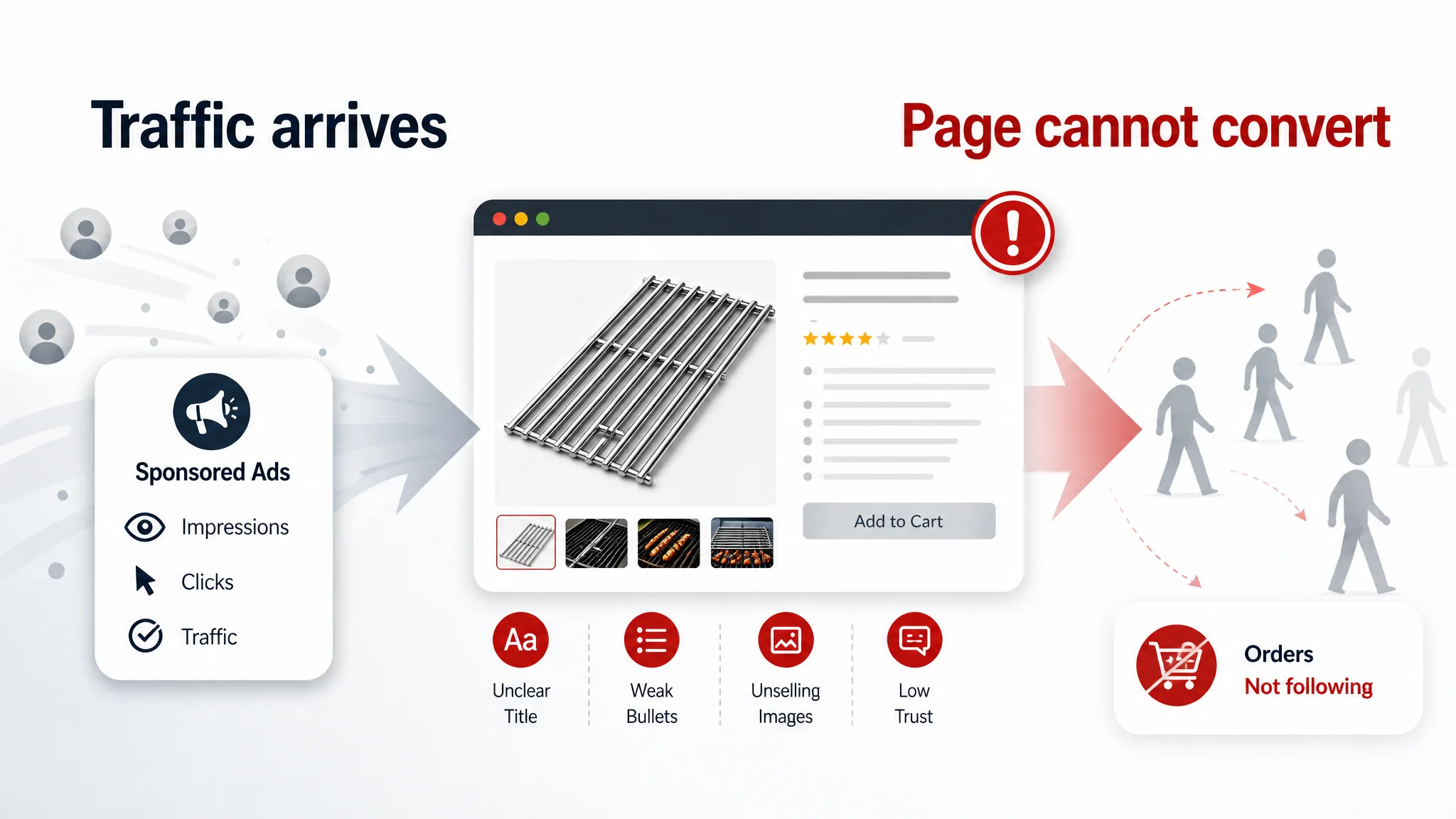
Sustainable organic growth requires a connected operating process: improve relevance so the product appears for the right searches, strengthen the listing to raise CTR and CVR, and continue optimising as performance data changes. Paid or external traffic may contribute indirectly when it generates sales and conversions, but organic visibility is built through consistent listing quality and measurable marketplace performance—not through a shortcut or automatic ranking boost.
Understanding the Amazon Ranking Algorithm (A9, A10, and COSMO)
Amazon organic search has evolved from straightforward keyword matching toward a broader assessment of relevance, buyer intent, and marketplace performance. Sellers must therefore optimize the entire customer journey rather than simply add more search terms to a listing.
A9 is commonly described as prioritizing relevance and sales velocity. Products that match the query and generate consistent sales are more likely to gain visibility. Later interpretations of A10 suggest that Amazon incorporated broader behavioral signals, including clicks and dwell time, while conversion performance remained important. Because these mechanisms are not fully public, sellers should treat them as informed models rather than fixed rules.
More recently, COSMO has been associated with understanding what the shopper intends to accomplish, rather than matching words alone. A listing may contain a relevant keyword yet perform poorly if its images, features, price, or product details fail to satisfy the underlying use case.
The grill-grates diagnosis illustrates why keyword relevance cannot be separated from the rest of the shopper journey. The seller’s title included general product descriptions such as “Triangle Rod” and “Stainless Steel,” but it did not communicate compatibility and technical distinctions as clearly as the benchmark Listing. The benchmark led with details such as quantity, 304 stainless steel, heavy-duty construction, and compatible grill models. These elements supported both search coverage and the buyer’s immediate question: “Will this fit my grill, and is it durable enough to justify the purchase?”
The same gap appeared further down the page. The grill grates used 9.5 mm solid triangle rods and 304 stainless steel, but those advantages were only partially explained and were barely demonstrated visually. In contrast, the benchmark Listing used clearer usage scenarios, compatibility information, and visual proof. The product therefore faced a conversion problem even when it was relevant enough to attract a visit.
As Robyn Johnson noted via Search Engine Land, Amazon’s search engine prioritizes conversions over clicks. CTR can attract attention, but CVR, customer satisfaction, reviews, relevance, and other performance signals help determine whether that visibility endures.
Consider two yoga mats: a higher-priced mat may generate the same dollar revenue with fewer units sold. Revenue alone does not establish ranking strength. Amazon appears to place greater weight on whether shoppers click, convert, receive what they expected, and remain satisfied. Optimize keywords, images, detail-page information, pricing, and product quality together while monitoring CTR, CVR, ACoS, reviews, and BSR.
Winning Keyword Research for Organic Discoverability
Organic keyword research should begin with buyer intent rather than search volume alone. Amazon searches are primarily transactional or commercial, so prioritize terms that indicate a shopper is evaluating a product or ready to purchase.
Use the following process:
- Start with relevance: Extract terms that accurately describe your product, use case, audience, material, size, or key benefit. Review competitor titles and bullets within the same product type, price range, and target audience.
- Separate keyword length: Short-tail keywords, such as “practice skin,” attract broader traffic but usually face stronger competition and less specific intent. Long-tail keywords contain more detail and often match a clearer buying need. For example, “tattoo practice skin for beginners” has approximately 2,300 monthly searches, lower competition, and strong conversion potential.
- Validate commercial value: Compare impressions, clicks, CTR, conversions, and CVR from advertising and search-query data. A high-volume keyword is not automatically a high-converting keyword.
- Prioritise and place: Build a list ranked by relevance, purchase intent, competition, and conversion evidence. Use the strongest terms naturally in the title, bullets, and other relevant listing fields. The backend search-term field allows 250 bytes of space-separated keywords; exceeding that limit can cause truncation or indexing issues.
- Refresh continuously: Reassess the list as advertising performance and conversion patterns change. DeepBI’s Organic Traffic module can analyse advertising and search-query data to surface high-CTR and high-CVR keywords for organic focus, reducing manual guesswork.
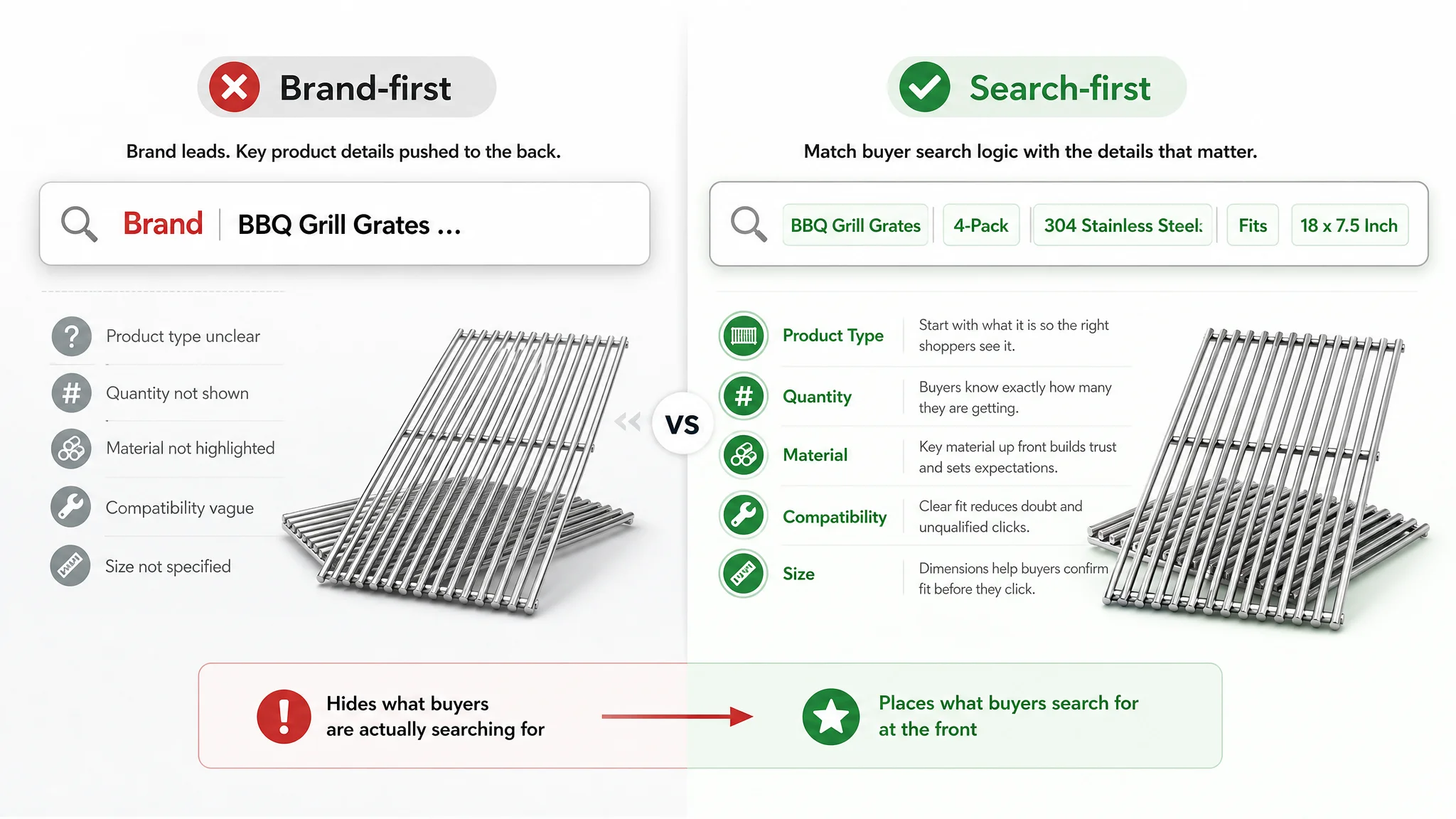
The grill-grates Listing shows why keyword prioritization should include search logic and fit-related intent. The original title placed the brand name in the prime opening position, while important terms such as quantity, material grade, and compatibility were pushed back. It also used broad language around “3, 4, or 5 burners,” which was less useful than naming compatible brands and model references.
DeepBI’s recommended structure moved from brand-first to query-first:
“[Brand] 4 Pcs Heavy Duty Stainless Steel Triangle Rod Grill Grates for Blaze 3, 4, 5 Burner, AOG, RCS, Summerset Sizzler, BBQ Cooking Grate Replacement Parts, 18 x 7-3/8 Inch”
The value of this change was not simply adding more keywords. It connected search terms to the buyer’s actual decision process: product type, quantity, material, compatibility, and dimensions. A keyword can attract organic visibility, but its commercial value depends on whether the resulting page confirms that the product is relevant and suitable.
Next, create a prioritised keyword list based on those four criteria, then connect each priority term to a specific listing placement and KPI to monitor, such as CTR, CVR, ACoS, or BSR.
Optimising Your Product Listing for Search and Conversion
Organic traffic creates business value only when shoppers click and buy. Your listing must therefore serve two purposes: help Amazon understand relevance and give customers enough confidence to convert. Strategic keyword placement can support discoverability, while the main image and offer clarity influence CTR. The detail page, trust signals, and persuasive copy then affect CVR, which can reinforce relevance and support organic ranking.
The grill-grates case demonstrates what happens when these elements are treated as separate tasks. The seller initially saw high ACOS and assumed that bids and keywords were the primary problem. Yet the Listing was 20 points behind the benchmark overall, with a detail and A+ score of 16 out of 25 compared with 23 out of 25 for the benchmark. The page contained product information, but it did not guide the shopper through a convincing reason to buy.
For the title, aim for approximately 150 characters when that length allows you to communicate the product clearly. Amazon permits up to 200 characters, but filling the limit is not the objective. Lead with the primary keyword, then add the product form and key benefits without keyword stuffing or redundant wording.
Write bullets using feature-benefit framing:
- State the customer-relevant benefit or selling point.
- Add a verified specification or supporting feature.
- Explain the problem it solves or the outcome it enables.
In the grill-grates Listing, the original bullets were largely a parameter list. They covered compatibility, dimensions, material, heat resistance, and cleaning, but they did not create a persuasive sequence. The revised structure instead moved from premium material and solid triangle rods to precise fit, heat distribution, cleaning convenience, and professional grilling support. This turned individual specifications into a buying path.
The distinction is important. “304 stainless steel” is a feature. When connected to durability, heat performance, and a clear visual explanation, it becomes a reason for the shopper to choose the product. Similarly, compatibility information becomes more persuasive when it helps a buyer quickly confirm that the grates will fit a specific grill.
Use clear, high-quality images with accurate proportions, a readable visual hierarchy, and useful usage or sizing context. The main image earns the click, while supporting images help resolve objections. A+ Content should deepen product understanding through complete modules, comparisons, proof points, and usage scenarios. Amazon claims that A+ Content can increase sales by up to 8%, making it a valuable conversion layer.
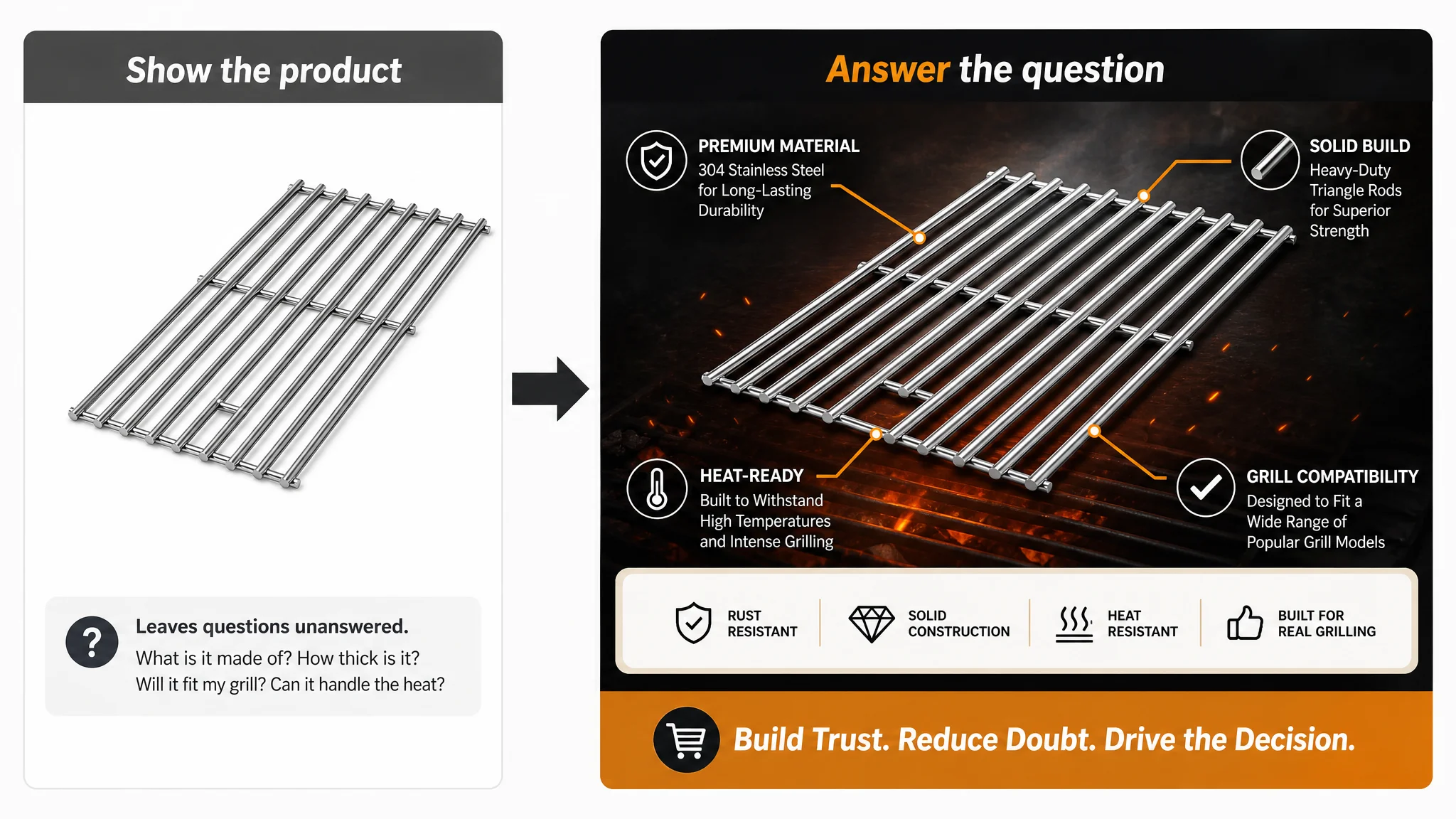
The same BBQ Listing had product-only images with a clean, white-background appearance, but the visual set did not communicate the category’s most important purchase drivers: heat, durability, thickness, and trust. DeepBI recommended showing the 9.5 mm rod thickness, 304 stainless steel, laser-welded construction, high-temperature performance, and cleaning benefit through focused visual modules. The objective was not simply to make the images more attractive. Each image needed to answer a specific buyer question.
The A+ analysis revealed a similar issue. The original modules showed product shots, process details, and dimensional comparisons, but they did not fully answer what the grate would do for the grilling experience, why the technical claims should be trusted, or whether the product would fit a specific grill. A stronger A+ structure could begin with a realistic grilling scene, then explain the triangle-rod design, provide thickness and durability proof, clarify compatibility, and address cleaning and maintenance.
DeepBI’s Listing module connects this work to data. It provides AI-driven scoring across listing elements, comparable competitor benchmarking, and generative text and visual content for titles, bullets, and A+ Content based on Product DNA. By linking listing optimisation to CTR and CVR, sellers can move from subjective edits toward measurable improvements in organic performance.
Backend Search Terms: The 250-Byte Secret
Amazon’s backend search-term field is a supporting indexing tool, not a storage bin for every keyword you can find. Used carefully, it can help your product appear for relevant long-tail queries that are not fully covered by the visible listing.
The limit is 250 bytes, not 500 characters. Byte count matters because character encoding can cause some characters to consume more than one byte. A keyword set that appears short on screen may still exceed Amazon’s limit and lose effectiveness if the field is not checked properly.
Prioritize terms that expand relevant coverage without duplicating the listing:
- Add meaningful synonyms that shoppers may use instead of the wording in your title or bullets.
- Include widely understood abbreviations where they match real search behavior.
- Consider common, relevant misspellings that customers may enter.
- Use specific combinations that reflect long-tail search intent.
- Avoid repeating keywords already present in the title or bullet points.
- Remove irrelevant terms, competitor references, and broad keyword stuffing.
The compatibility gap in the grill-grates Listing illustrates why backend terms should support, rather than replace, visible listing clarity. Generic wording around burner counts was less precise than the benchmark’s references to compatible brands and models. Backend coverage may help capture related searches, but it cannot fully compensate for a title, bullet structure, or compatibility guide that leaves shoppers uncertain.
Before saving, review every term for product relevance and confirm the total byte usage. A shorter, cleaner field can be more valuable than a crowded one because it concentrates indexing support on queries that fit the product. Track whether improved search coverage contributes to organic traffic, BSR movement, and ultimately CVR. Backend terms should support the listing’s broader keyword and conversion strategy rather than replace it.
Using Advertising Data to Power Your Organic Strategy
Amazon PPC data is more than a way to manage ACoS; it is market evidence. MerchantSpring notes that advertising conversion data can guide organic keyword selection because paid campaigns reveal which search terms attract shoppers who actually buy, rather than merely generate impressions or clicks.
Begin with relevant keywords that produce strong CVR, sales, and conversion signals in advertising. Give these terms stronger organic coverage in the title, bullet points, and backend search terms while preserving natural, customer-focused copy. Do not automatically promote a keyword with high clicks but weak conversions. First investigate its relevance, search intent, offer fit, listing alignment, and post-click experience. Low CTR may point to a targeting or main-image issue, while low CVR may indicate weak information, trust, or offer communication.
The BBQ seller’s experience is a useful warning against reading advertising data too narrowly. The team saw stable impressions, some clicks, and high ACOS, then treated the result as evidence of inefficient campaigns. Several cycles of bid and keyword adjustments did not resolve the underlying problem because the page itself remained largely unchanged. DeepBI’s diagnosis found that advertising was feeding a Listing with weak conversion capacity, not necessarily exposing a purely defective campaign.
This does not mean that every low-CVR keyword is caused by a Listing problem. Relevance, intent, pricing, targeting, and offer quality still need to be checked. However, when multiple relevant traffic sources reach a page that lacks clear benefits, trust, compatibility information, or visual proof, changing bids alone is unlikely to solve the problem.
Coordinating paid and organic visibility also gives your product more search-result real estate. Appearing in both a sponsored and an organic position can create more opportunities for shoppers to notice the brand and may strengthen perceived credibility. Any organic benefit comes from the resulting relevance, conversions, and sales—not from advertising spend alone.
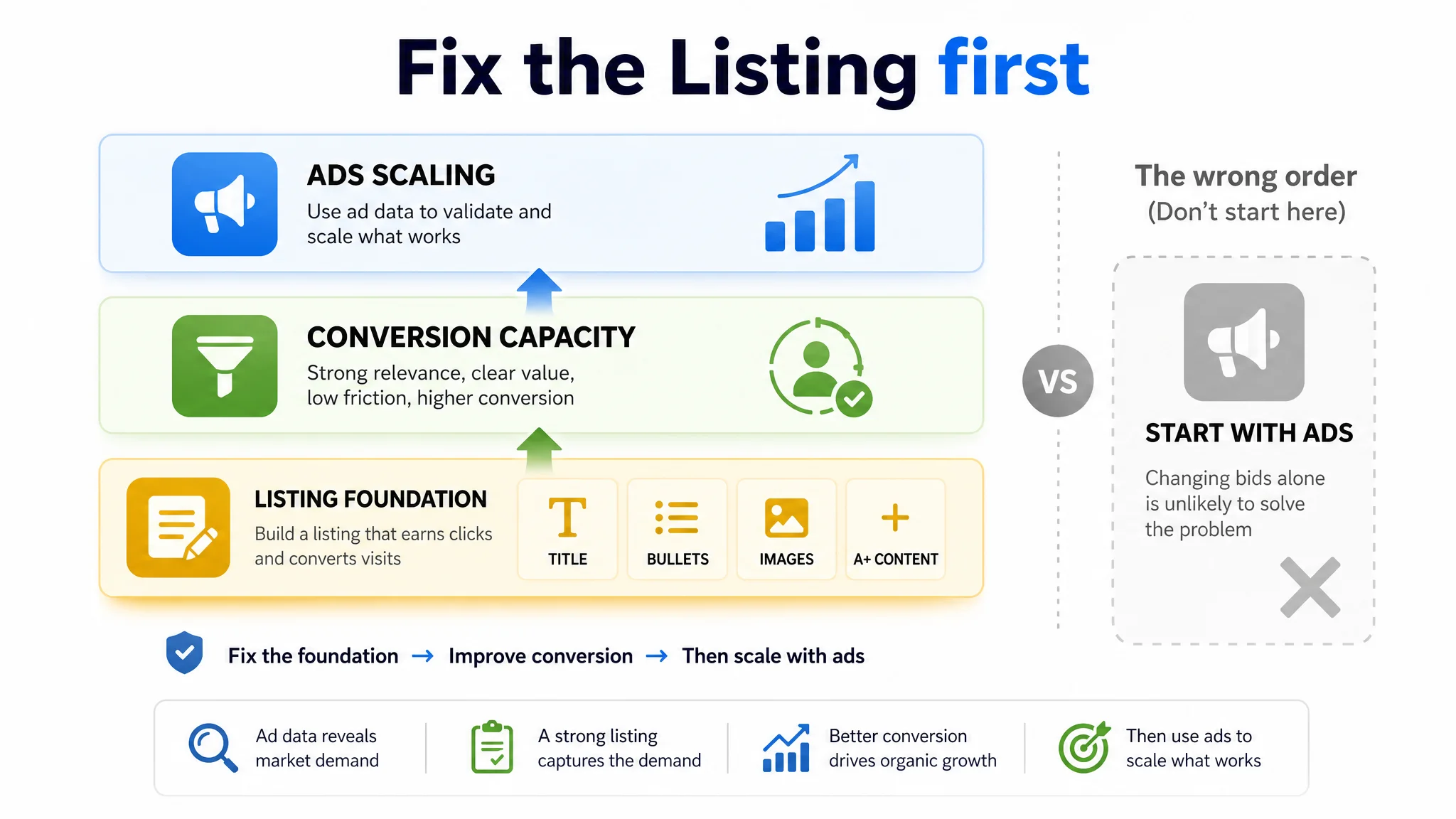
DeepBI’s cross-module workflow helps automate this feedback loop. The Ads Quant module identifies high-conversion keywords, while the Organic Traffic module applies that intelligence to organic targeting and content strategy. By connecting diagnosis, planning, and optimization, the workflow reduces spreadsheet work and supports iterative improvements to CVR, ACoS, listing cycle time, and organic keyword rankings.
Measuring and Improving Organic Performance Over Time
Organic growth is not a one-time listing project. It is an observable, iterative process that connects visibility, conversion, efficiency, and ranking signals. Track these metrics together instead of judging progress from impressions or sales alone:
- Organic session share: Shows how much of your product-page traffic comes from unpaid search and other organic sources.
- Organic conversion rate: Indicates whether that traffic is turning into orders. A rising share with a falling conversion rate may signal a mismatch between search intent, listing content, and product-page experience.
- Keyword ranking positions: Reveal whether target terms are gaining or losing visibility. Treat ranking movement as a leading indicator, not a guarantee of future sales.
- TACOS: Total Advertising Cost of Sales helps connect ad spend with total revenue. A declining TACOS can indicate a growing organic contribution and reduced reliance on paid traffic, although it should be interpreted alongside sessions, conversion, and sales trends.
Amazon Brand Analytics can provide useful organic performance data for this review. DeepBI’s Organic Traffic module adds ongoing TACOS tracking and organic-position monitoring, helping you visualize whether listing and keyword changes are contributing to broader organic gains.
The grill-grates case also shows why these metrics should be interpreted as a connected system. A high ACOS accompanied by weak conversion may indicate that the page is consuming traffic. A low CTR may point to a title or main-image issue. A weak CVR may indicate that shoppers do not understand the product, cannot confirm compatibility, or do not see enough evidence to trust the offer. The correct diagnosis requires comparing page quality, competitor benchmarks, advertising signals, and conversion behavior together.
Use a repeatable cycle: record a baseline, make one identifiable listing or keyword change, mark the change date, and compare CTR, CVR, ranking positions, organic share, and TACOS over time. As organic contribution becomes more consistent, you can consider reallocating part of the advertising budget to listing improvements and other activities that reinforce organic performance.
Begin by documenting today’s baseline and reviewing the selected metrics on a consistent schedule.
Future-Proofing Your Organic Strategy for 2025 and Beyond
Amazon organic search is moving toward intent-based ranking. COSMO reflects this direction by helping Amazon understand what shoppers are trying to accomplish, not simply which keywords appear on a product page. Sellers who rely on keyword repetition or temporary ranking tactics will be increasingly exposed when the shopper’s actual need does not match the listing.
As Amazon improves its understanding of intent, high-quality content, strong conversion performance, and authentic customer satisfaction signals are likely to become more important. Your title and bullets should clarify the product’s use case, while images and A+ Content should address purchase objections. Track the effect through CTR, CVR, ACoS, and BSR rather than treating keyword visibility as the sole objective. Accurate product claims also protect trust by reducing mismatched expectations, negative reviews, refunds, and after-sales problems.
The grill-grates Listing demonstrates why this broader understanding of intent matters. A shopper looking for replacement grates is not only searching for a product category. The shopper may also be trying to confirm material quality, dimensions, durability, heat performance, cleaning convenience, and model compatibility. A page that lists “stainless steel” but does not show thickness, fit, construction, or usage context may match part of the query while failing the underlying decision.
Reviews are another part of this experience. The seller’s Listing had a 4.5-star rating but only two reviews, while the benchmark had 13 reviews with a 4.8-star rating and more detailed usage information. The limited review volume created a trust gap that advertising could not close. The appropriate response was not to treat copy as a substitute for reviews, but to strengthen the rest of the page with clearer technical proof, compatibility information, and visual evidence while the review base develops organically.
Amazon Posts provide a free visibility tool that can build value over time when used consistently. Treat them as part of an ongoing content system rather than a one-time promotional push: maintain a steady presence, reinforce relevant use cases, and connect that activity to the broader product-page experience.
A durable organic strategy should operate like “Prime Day every day”—not through constant discounting, but through constant readiness to meet shopper intent. Review exposure, clicks, orders, CTR, and CVR alongside listing quality and customer feedback. Then improve the weakest point systematically. Sustainable growth comes from a stronger listing, more precise traffic, and a customer experience that remains convincing after the purchase.
Conclusion: Your Organic Growth Roadmap
Sustainable Amazon organic growth is not an overnight ranking event. It is a repeatable flywheel: uncover high-value search terms, improve the listing around shopper intent, measure performance, and refine the next iteration using real data.
Start with keyword intelligence rather than keyword volume alone. Amazon is transactional, so conversion potential matters alongside search demand. Use long-tail opportunities and high-conversion PPC search terms to guide titles, bullets, images, and A+ Content. Then evaluate the changes through CTR, CVR, impressions, clicks, orders, ACoS, and BSR—not rankings in isolation. Stronger conversion and customer satisfaction support organic visibility, while paid-search evidence can reveal which terms and messages deserve greater emphasis in the listing.
The BBQ grill-grates diagnosis provides a practical reminder of how this process works. The seller initially treated high ACOS as an advertising problem and continued adjusting campaigns. DeepBI instead found a 20-point gap against the benchmark Listing, with weaknesses in title search logic, bullet-point persuasion, A+ storytelling, and review trust. The recommended path was to rebuild the Listing’s sales logic first, then reassess advertising once the page had a stronger ability to convert traffic.
That does not mean advertising should be ignored. It means ad data should be interpreted in the context of the product page. When a Listing is not ready to explain its value or resolve buyer objections, additional traffic can amplify the weakness. When the page is relevant, persuasive, visually clear, and trustworthy, the same advertising data becomes more useful for identifying the next organic opportunity.
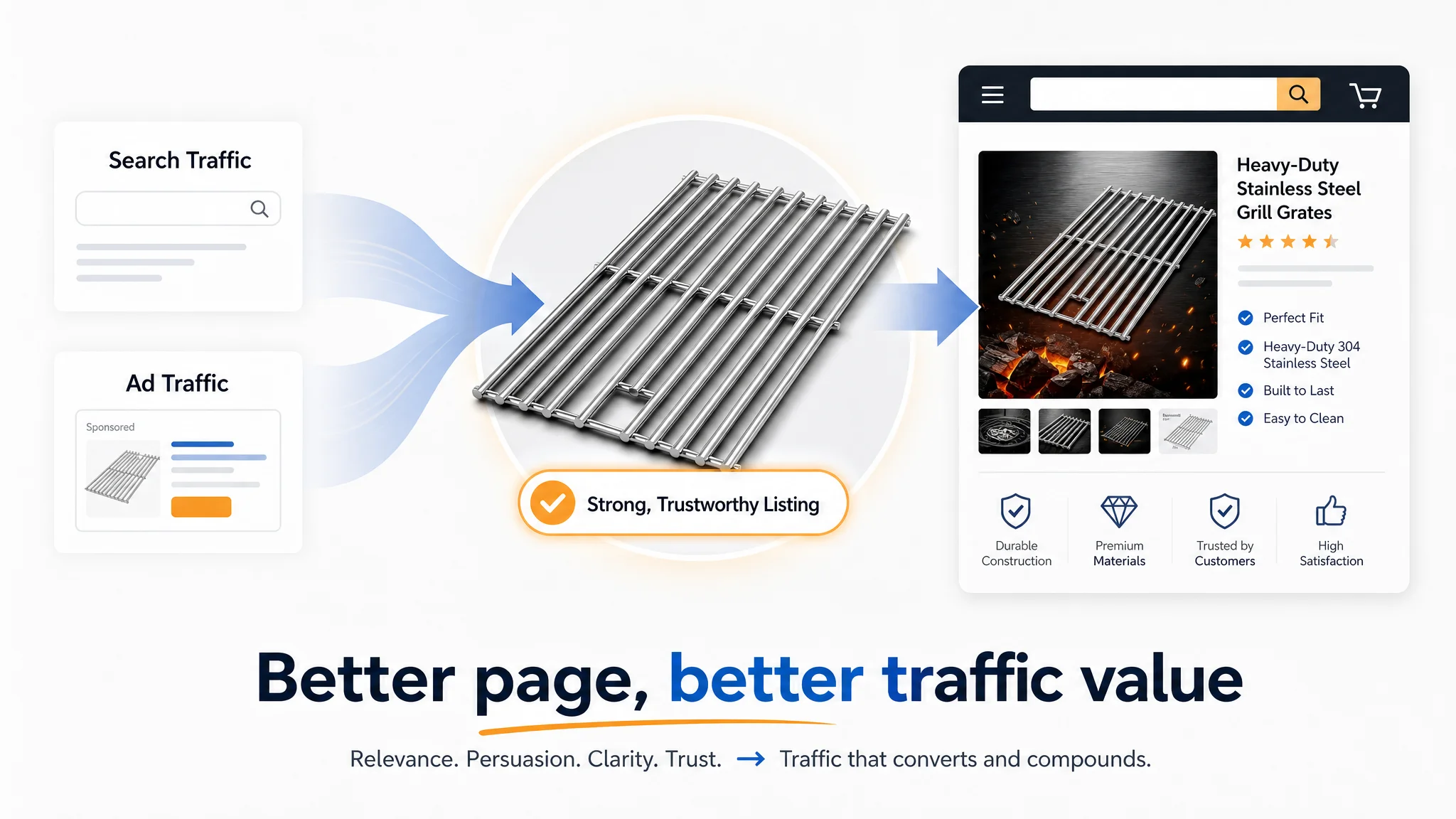
Treat every update as part of a learning cycle. Diagnose the weakness, apply an approved improvement, establish a clear deployment point, and monitor the subsequent data before deciding what to change next. This approach turns listing optimization from a one-time rewrite into an accountable operating process.
DeepBI brings Amazon listing analysis, advertising signals, organic-growth inputs, optimization workflows, and implementation into one Amazon-focused solution, helping you connect diagnosis with measurable action. DeepBI respects user privacy and follows applicable data-protection requirements when processing data. Explore DeepBI to build a more disciplined, data-driven path to organic growth.