


Introduction: Why Keywords Are the Foundation of Amazon Success
Keywords are not merely words to insert into a title, bullet points, or search-term fields. They are the connection between what shoppers want, what Amazon can understand, and what a listing is prepared to deliver. When that connection is weak, even a strong product may struggle to earn impressions, clicks, and conversions.
Many sellers still approach keyword research superficially. They collect a few high-volume terms, copy phrases from competitors, or place as many related words as possible into the listing. This approach can create a list, but not necessarily a strategy. It may overlook search intent, product attributes, buyer language, keyword relationships, and the difference between traffic that generates clicks and traffic that produces orders. Keyword stuffing can also weaken readability, making it harder for shoppers to understand the product’s value after they arrive.
A stronger approach treats keyword research as a data-driven business system. Market search behavior, competitor listing structures, product attributes, advertising reports, and conversion signals can be connected to identify which terms deserve attention and where they should influence the listing. For example, an extracted keyword may be relevant but commercially weak, while another term linked to a specific product attribute may show stronger conversion potential. The practical question is not simply, “How many keywords can this listing contain?” It is, “Which search signals can improve qualified visibility, CTR, CVR, ACoS, and, over time, BSR?”
A technical product page can make this distinction especially clear. An industrial borescope listing already had a 4.7-star rating, 437 reviews, strong A+ content, and a DeepBI score of 79/100 compared with a benchmark at 81/100. The seller initially believed the remaining issue was advertising efficiency, so the natural response was to expand keywords, refine campaigns, and adjust bids. However, the diagnosis showed that the title, main-image logic, and bullets were not aligned closely enough with how mechanics and technicians searched and evaluated the product. The page had traffic potential, but its front half was not helping the right buyers decide quickly.
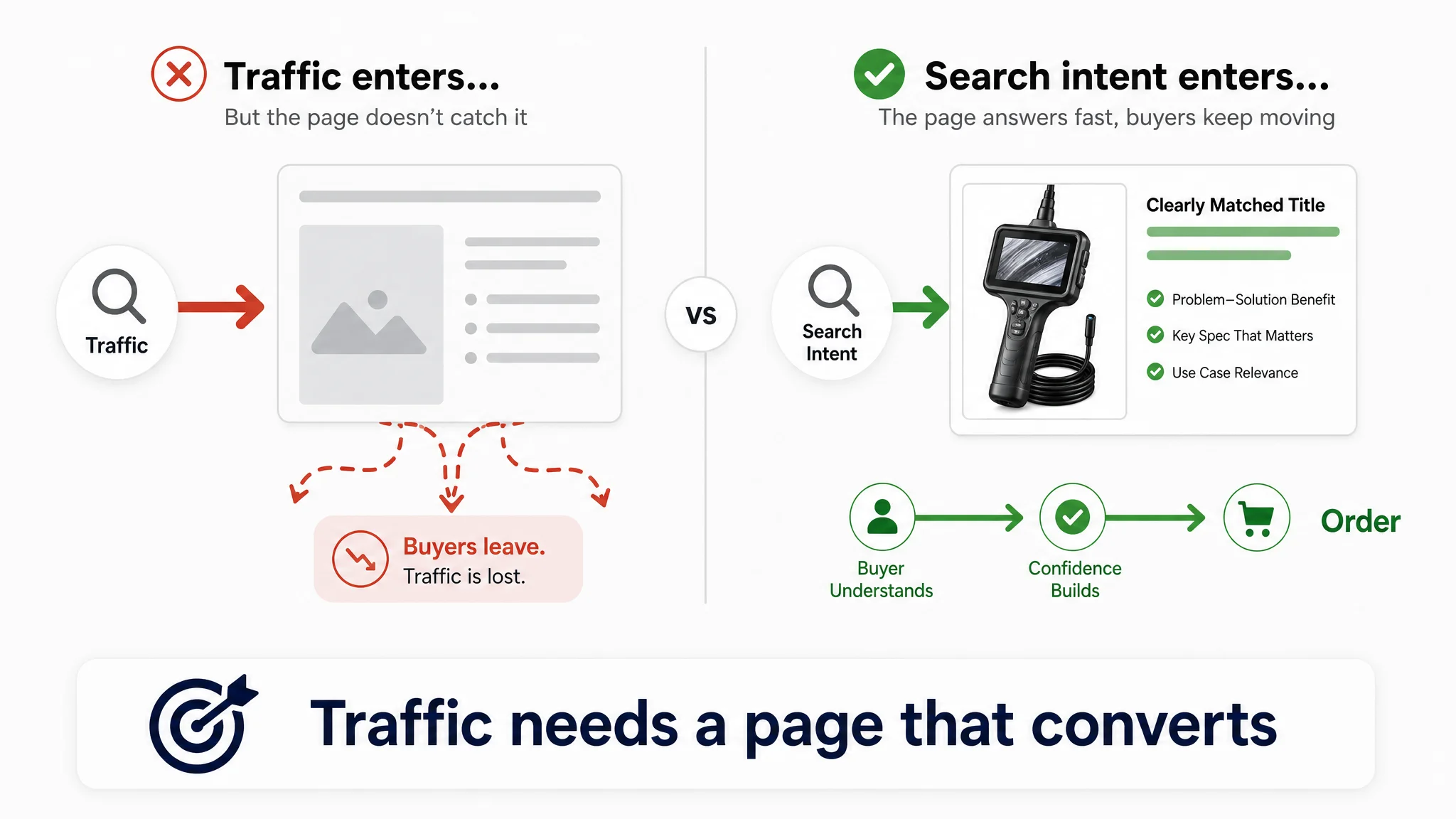
This is why keyword research cannot be separated from listing conversion capacity. In that example, the competitor’s advantage was concentrated in title clarity and bullet-point decision logic, while the client’s stronger A+ content and review volume appeared later in the buying journey. The problem was not simply whether the product was visible for a query. It was whether the wording and presentation after the click confirmed that the product was the right tool for a specific job.
This evidence-based process can become a competitive moat because it converts scattered observations into repeatable decisions. A listing built around verified market language is more difficult to imitate than one based only on intuition or surface-level competitor copying. DeepBI’s documented workflow illustrates this connection by analyzing titles and bullet points, extracting core search keywords, comparing keyword layouts with market search terms, and applying weighting to advertising signals. The goal is to connect research with implementation rather than leave keyword decisions in a spreadsheet.
The process should be viewed as a progression. First, sellers need to distinguish keyword types and understand their strategic roles. Next, they can discover and prioritize terms through market, competitor, listing, and advertising evidence. Those terms then need to be implemented naturally across the listing, measured through funnel metrics, and refined as performance data returns. Any optimization detached from real market benchmarks is a waste of resources. Advanced keyword research therefore serves as the foundation for an ongoing optimization cycle, linking search visibility to shopper response and commercial performance rather than treating research as a one-time task.
What Exactly Is Amazon Keyword Research? (And Why Every Seller Needs It)
- DeepBI Listing Product Document — Combined Edition
Supports defining Amazon keyword research as the structured discovery of shopper search terms and their alignment with product titles, bullet points, and other listing content. It connects keyword relevance with traffic-entry potential, exposure, clicks, orders, CTR, and CVR, while cautioning that relevance alone does not guarantee ranking or sales.
- DeepBI Listing Product Document — Keyword Extraction and Market Search Workflow
Describes an LLM-based workflow that analyzes a product title and bullet points to identify core search keywords, then simulates buyer searches to collect relevant market and competitor information. This supports using keyword research to compare term coverage and listing relevance rather than relying only on intuition.
- DeepBI Listing Product Document — Title Analysis Agent
Covers comparison of keyword placement, selling-point clarity, and title structure against high-frequency market search terms. The source supports the relationship between keyword relevance, search visibility, shopper engagement, and the listing’s opportunity to generate clicks.
- DeepBI Listing Product Document — Winning Terms and Listing Optimization
Explains that high-converting search terms can become weighting signals for title and image optimization. The material links more precise traffic with listing quality and conversion performance, while recognizing that visual presentation, trust, and content quality also influence CVR and sales.
- DeepBI Listing Product Document — Performance Metrics and Data Connector
Identifies exposure, clicks, orders, CTR, and CVR as underlying performance inputs. These metrics provide a basis for evaluating whether keyword coverage is creating visibility and qualified traffic, and whether the listing is converting that traffic into business results.
- Amazon Brand Analytics — Search Query Performance
Included as an Amazon resource for examining search-query-level visibility, clicks, cart activity, and purchases. It is relevant to keyword research because it helps sellers connect shopper queries with movement through the discovery and conversion funnel. The available DeepBI archive does not independently document this resource.
- Amazon Brand Analytics — Top Search Terms
Included as an Amazon resource for reviewing prominent search terms and product-discovery patterns. It can support prioritization of relevant terms, but the available archive does not establish that DeepBI directly uses this report.
- DeepBI Listing Product Document — Continuous Optimization Feedback Loop
Supports treating keyword research as an ongoing process. Advertising and market-performance data flow back into scoring, strategy, and later optimization, allowing sellers to compare predicted value with actual CTR, CVR, and sales signals instead of treating keyword selection as a one-time listing task.
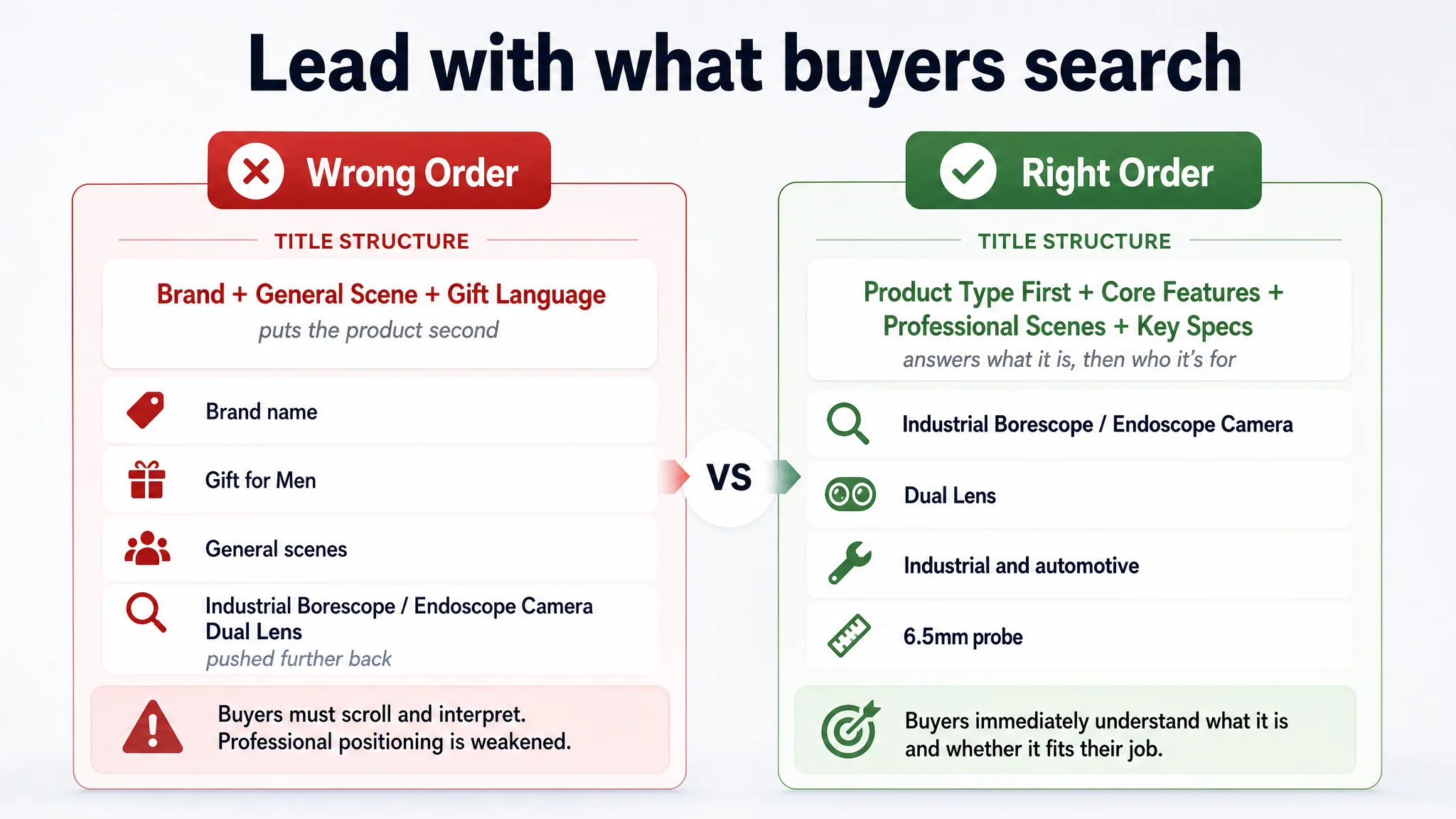
The industrial borescope example illustrates why these distinctions matter. The product page was not obviously weak when judged through ratings, review volume, or A+ completeness. Yet its title placed the brand name ahead of the core product term, emphasized “Dual Lens” without making its practical value clear, and included broad wording such as “Gift for Men” that weakened the professional positioning. The issue was not a complete absence of keywords. It was a mismatch between keyword placement, buyer intent, and the decision a professional buyer needed to make.
This distinction is central to keyword research. A listing can contain relevant terms and still fail to convert the traffic those terms attract. Search language must be evaluated together with the buyer’s job, the product’s verified attributes, the competitor’s framing, and the information available in the first few seconds after a click. Keyword research is therefore not only a discovery exercise. It is a method for deciding what the page should communicate first.
Who Gains the Most from Strategic Keyword Research?
Strategic keyword research is not reserved for brands with large advertising budgets. Its value depends less on company size than on how effectively a seller connects buyer language with product attributes, listing structure, and competitive positioning. Any optimization detached from real market benchmarks risks wasting resources, particularly when it changes titles or bullets without a clear relationship to search demand, CTR, CVR, ACoS, or BSR.
For solo sellers and boutique businesses, keyword research can reveal niche markets that broad category terms conceal. By examining relevant search terms, competitor listings, and buyer language, a seller can identify specific needs that align with the product’s actual features. This approach helps narrow the competitive field and prioritize listing improvements that may influence qualified traffic and conversion. The objective is not to target every available term, but to find a defensible match between the product, the customer segment, and the search intent.
Established brands can apply the same discipline to protect existing demand. Ongoing analysis of comparable competitors can expose gaps in keyword coverage, unclear selling points, or shifts in how customers describe the category. A brand can then reinforce differentiated benefits in its title, bullets, images, and visual emphasis rather than relying on historical brand recognition alone. Competitor comparisons should remain controlled: products with substantially different functions, price bands, or audiences can distort the benchmark and lead to weak decisions. Market-share defense is more credible when the analysis compares genuinely similar offers and identifies where the brand’s listing is becoming less relevant.
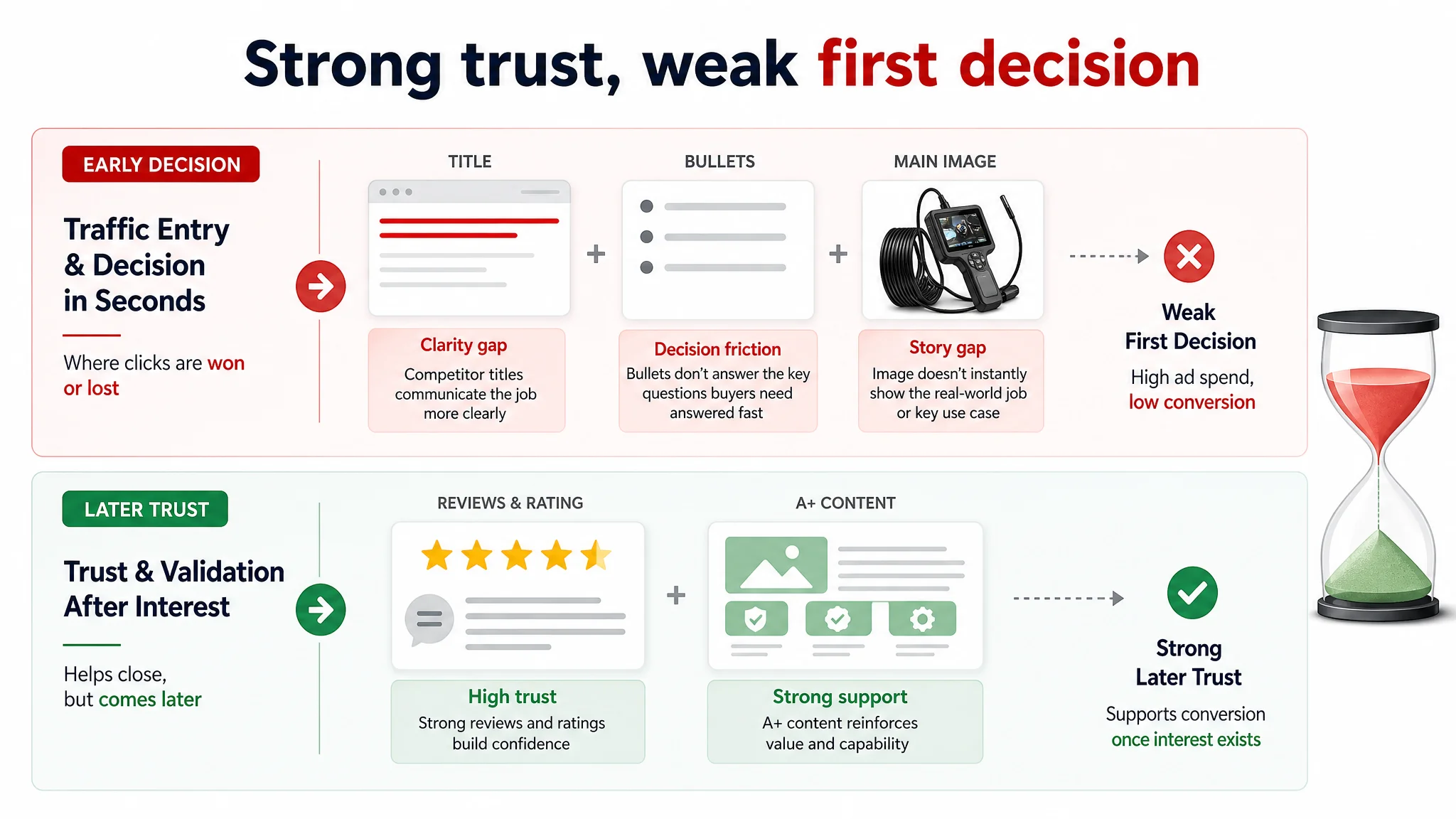
The borescope example shows why even an established-looking listing benefits from this discipline. The client had more than triple the benchmark competitor’s review volume—437 compared with 136—and a higher star rating of 4.7 compared with 4.5. Those signals suggested strong trust, but they did not eliminate the need to examine how professional buyers searched and scanned the page. The benchmark’s title led with a core product term such as “3.9mm Endoscope Camera,” followed by output quality, screen size, quantified specifications, and professional use scenarios. The client’s title presented valid information, but its order created a less direct path for mechanics and technicians.
The lesson is not that reviews or brand strength are unimportant. It is that different assets operate at different points in the funnel. Social proof may support confidence later, while title and bullet clarity determine whether a shopper recognizes relevance early. Strategic keyword research helps a seller identify which part of that path is limiting performance instead of assuming that the strongest visible asset is also the most important next optimization.
New entrants face a different challenge: limited budget, limited review history, and little tolerance for inefficient testing. Precise long-tail targeting can provide a practical starting point by focusing resources on specific, lower-competition search intents connected to the product’s attributes. Keyword analysis can help extract these precise buyer expressions, although it cannot guarantee ranking, traffic, or sales. The resulting terms should be validated against the product’s real capabilities before they are added to the listing or advertising structure.
Across all seller types, the operating principle is the same: use market signals to replace guesswork, then translate the strongest relevant terms into clearer listing priorities. That process can support better CTR and CVR decisions while helping control ACoS and reduce wasted listing revision time.
The Four Pillars of Amazon Keywords: When to Use Each Type
Keyword research becomes more useful when terms are classified by their role in the shopper funnel rather than treated as interchangeable words. Short-tail keywords create broad visibility, long-tail keywords capture specific purchase intent, branded keywords protect demand that already exists, and non-branded keywords introduce the product to new audiences. A balanced structure helps sellers connect search visibility with CTR, CVR, ACoS, and ultimately BSR without forcing every term into the same listing position.
Short-Tail Keywords: Visibility at Scale
Short-tail keywords are broad, high-frequency terms that describe a product category or primary use case. They can expose a listing to a large search audience, making them valuable for top-of-funnel discovery and category visibility. Their broad meaning also creates a strategic limitation: a shopper searching a general term may still be comparing several product types, features, or price points.
Use these terms to establish relevance in the title and other prominent listing elements when they accurately describe the product. Do not sacrifice clarity by adding loosely related high-volume phrases. A term that increases impressions but produces weak CTR can dilute the listing’s traffic quality and raise ACoS. Short-tail keywords should therefore create the entry point, not carry the entire conversion strategy.
The borescope page demonstrates why broad terms need to be positioned carefully. Its title used a combination of technical and general language, but the inclusion of “Gift for Men” broadened the audience while making the product’s professional purpose less immediate. For a mechanic or technician scanning multiple search results, the central question was whether this was an industrial inspection tool or a general-purpose gadget. The problem was not that the broader phrase was inherently invalid; it was that it competed with the professional category terms for attention.
A short-tail keyword should establish what the product is before secondary positioning expands who might buy it. When the order is reversed, the listing may attract impressions without making its most valuable audience feel immediately recognized.
Long-Tail Keywords: Precision Targeting That Converts
Long-tail keywords contain more detail, often combining the product category with a feature, audience, use case, size, or problem to solve. Their specificity can make them valuable for shoppers who have progressed further in the funnel and know more precisely what they want. The available evidence supports using them as precision opportunities, but not assigning them a guaranteed conversion-rate advantage.
These terms should reflect confirmed product attributes and genuine shopper needs. They can be integrated into bullet-point structures that connect a feature to a pain point or solution, rather than appearing as disconnected keyword lists. Search-term data, competitor layouts, and winning-term signals can help identify which specific attributes deserve greater emphasis. The goal is stronger query-to-listing alignment, which may support more qualified clicks and a clearer path to CVR.
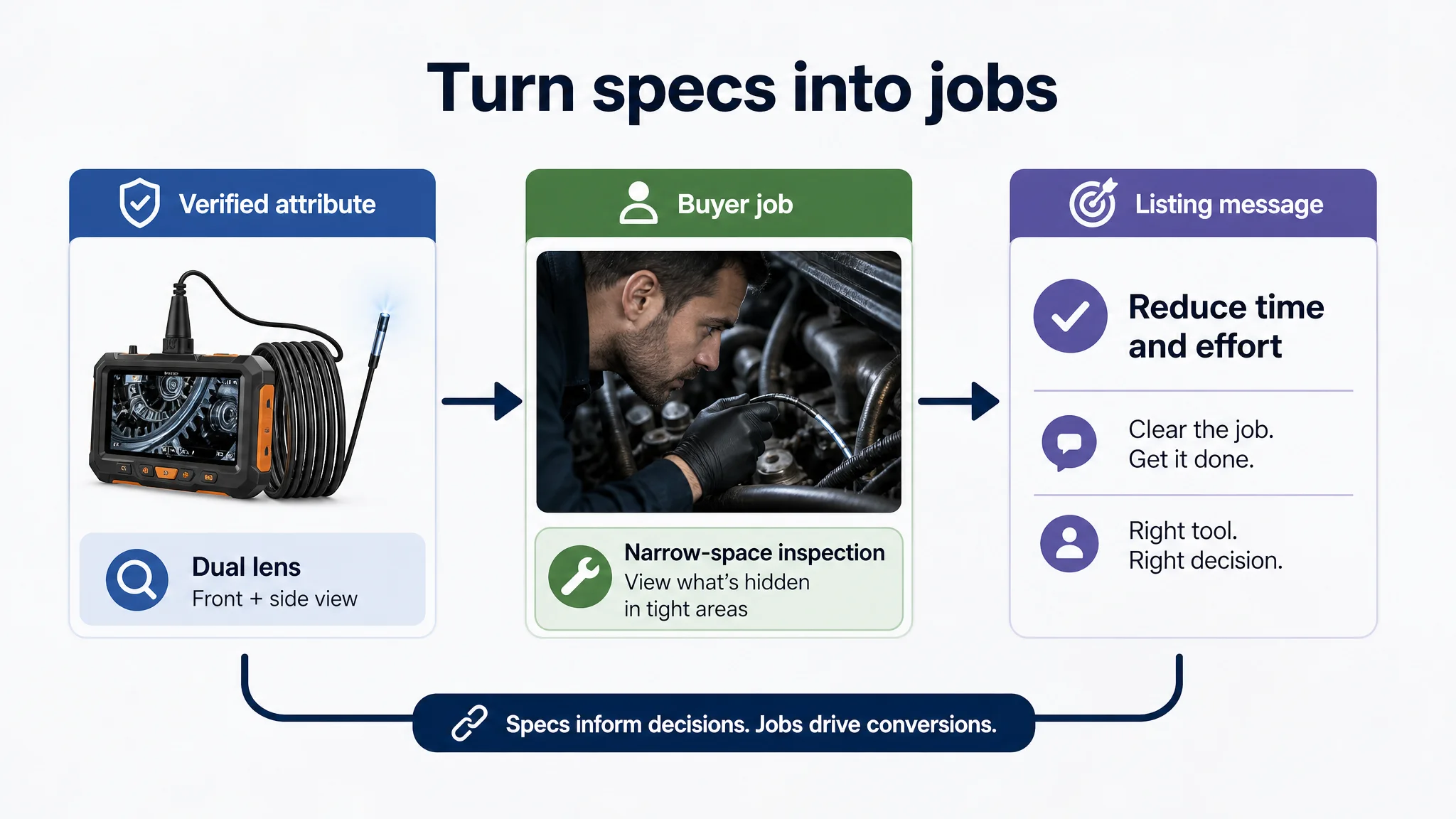
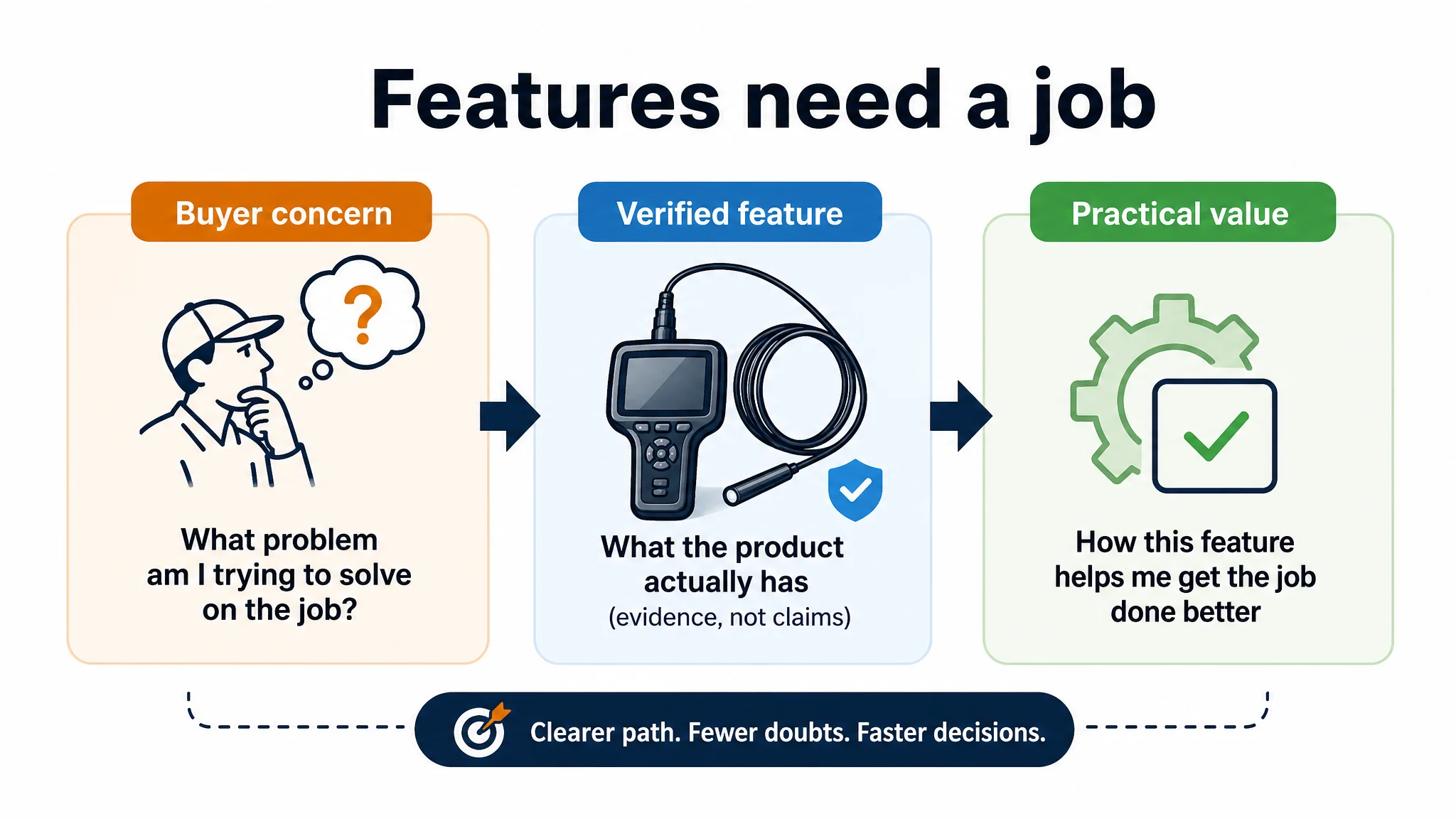
In the borescope analysis, terms connected to a “3.9mm” probe, “1920P HD,” “4.3-inch IPS screen,” “11.5FT semi-rigid cable,” and “IP67 waterproof” were not valuable merely because they were specifications. Their value came from the jobs they helped explain: entering narrow mechanical gaps, examining images without relying on a smartphone, reaching distant areas such as pipes or wall structures, and working in wet or dark environments.
This is the difference between a long-tail keyword and a useful long-tail message. “11.5FT semi-rigid cable” becomes more persuasive when the bullet explains where that length matters. “Dual lens” becomes more meaningful when it shows how front and side views can help reveal a blind spot. Specific language should reduce uncertainty, not force shoppers to interpret a specification on their own.
Branded Keywords: Defending Your Brand's Territory
Branded keywords include the brand name, product line, or branded product terminology. They address shoppers who already recognize the brand or are searching for a known product. Their strategic role is defensive as well as commercial: a listing must remain clearly relevant when existing demand reaches the brand’s storefront or product detail page.
Branded terms should be combined with accurate product descriptors so shoppers can distinguish models, variants, and use cases. Monitoring branded queries can also reveal whether traffic is reaching the correct ASIN and whether the listing communicates the expected value. Protecting this demand supports efficient traffic capture, while misleading brand-term usage can damage trust and weaken downstream conversion.
The industrial-tools example also illustrates why branded language should not automatically lead every title. In that page, placing the brand name first pushed the core product term further back, even though the benchmark began with the product category and professional use context. For a shopper who does not yet know the brand, this ordering uses valuable early title space without answering the most important relevance question.
Branded terms can protect existing demand, but they should not obscure the product language that new or professional buyers use to identify the item. The correct balance depends on the audience and the query, not on a universal preference for placing the brand first.
Non-Branded Keywords: Expanding into New Shopper Audiences
Non-branded keywords describe the category, problem, feature, or use case without relying on a brand name. They are central to acquisition because they help reach shoppers who have not yet selected a brand. These terms should be mapped to the product’s confirmed positioning and target audience, then balanced with branded coverage.
Together, branded and non-branded terms serve different audience segments: one captures existing recognition, while the other expands reach. Reviewing both groups alongside CTR, CVR, and ACoS shows whether the listing is merely attracting demand or converting the right demand.
For the borescope listing, terms such as “industrial borescope,” “endoscope camera,” “car engine,” and “mechanic tools” helped define the non-branded professional audience more clearly than a general gift-oriented phrase. This did not mean removing every broader audience reference. It meant establishing the primary use case before adding secondary positioning. A keyword strategy is stronger when it makes the intended buyer obvious rather than trying to make the product appear relevant to everyone at once.
Advanced Keyword Discovery: Move Beyond Guesswork with Data
Inside Amazon's Data Toolbox (Search Bar, Opportunity Explorer, Brand Analytics)
- Amazon Search Bar: Use autocomplete suggestions as early evidence of how shoppers phrase demand. Collect recurring terms, variants, and long-tail modifiers, then compare them with the product’s actual features and intended use. These suggestions can expand the candidate list, but they should not be treated as proof of search volume, relevance, or profitability.
- Amazon Opportunity Explorer: Use category and customer-demand information to examine search behavior, competitive intensity, and potential gaps where the available data supports those conclusions. The purpose is not to copy every visible term, but to identify themes that warrant validation through listing relevance, advertising performance, and competitor review.
- Amazon Brand Analytics: Where available, use search and conversion-related reports to distinguish terms that attract attention from those associated with stronger purchase behavior. A keyword that may support CTR but weak CVR requires a different decision from one that appears relevant across both stages. These signals can also inform ACoS decisions and prioritization.
- Source-use principle: Treat native Amazon data as the primary market reference, then organize candidates by search intent, product fit, funnel role, and expected impact on CTR, CVR, ACoS, and BSR. This multi-stage process is more defensible than selecting keywords from a single list.
The practical value of these tools increases when sellers compare search terms with what happens on the page. In the borescope example, the issue could not be explained by keyword visibility alone. The client and benchmark were appearing in overlapping search environments, but the benchmark’s title made its professional relevance more immediate. The benchmark connected the core product term with probe diameter, image quality, screen size, and mechanic-oriented scenarios. The client’s page contained many valid features, but the relationship between those features and the buyer’s job was less direct.
That comparison changes the research question. Instead of asking only which terms appear frequently, sellers should ask which terms help a qualified shopper recognize the product, understand its difference, and continue toward purchase. Search data identifies possible demand; listing analysis explains whether the page is prepared to convert that demand.
Reverse-ASIN Competitor Analysis: Steal Your Rivals' Keyword Strategy (Ethically)
- Competitor listing analysis: Reverse-ASIN research can reveal terms repeatedly associated with top-ranking products, including title language, bullet-point themes, and product attributes. The goal is to identify market vocabulary and possible gaps, not to duplicate a competitor’s copy or make unsupported claims.
- DeepBI reverse-ASIN benchmark: DeepBI's reverse-ASIN competitor benchmark analyzes multiple top-ranking ASINs to surface keyword gaps and reduce manual guesswork. Its broader workflow can extract candidate terms, retrieve relevant products, identify the applicable leaf category, and compare a market set rather than relying on one rival.
- Validation safeguard: Competitor terms should be filtered by product form, category, price band, audience, use scenario, and confirmed specifications. A high-frequency term can still be commercially unsuitable if the product cannot deliver the promised function. Excluding poorly matched benchmarks protects relevance, CVR, and listing credibility.
A useful competitor benchmark goes beyond counting repeated words. In the industrial borescope comparison, the competitor’s advantage was visible in the structure of its title and bullets. The title led with a highly specific product term and connected it quickly to measurable specifications and professional scenarios. Its bullets followed a pain–solution–value sequence: a narrow probe addressed access limitations, a standalone screen addressed the risk of dirtying an expensive phone, and a flexible inspection camera was connected to vehicle repair, machinery, and home maintenance.
The client’s bullets were technically accurate but more function-first. They listed specifications and accessories without consistently explaining how those features saved time, reduced effort, or improved a professional inspection. This was not a case of copying competitor language. It was a case of identifying the decision logic behind the competitor’s language and testing whether the client’s own verified attributes could answer the same buyer questions more effectively.
Competitor analysis is most useful when it reveals what shoppers are being helped to decide. The objective is not to reproduce another listing’s wording. It is to understand which product attributes are being translated into recognizable jobs, outcomes, and reassurance.
AI-Assisted Keyword Mining: Let Technology Surface Hidden Opportunities
- AI discovery workflow: AI may help expand a seed list by analyzing titles, bullets, product attributes, and competitor language. DeepBI uses an LLM to reverse-engineer listing content, extract core search keywords, and simulate broad search-page retrieval. Its process also applies semantic matching rather than relying only on exact keyword overlap.
- Human review remains essential: AI-generated candidates are hypotheses, not verified demand. Review each term against native Amazon signals, product specifications, customer intent, and competitor context before using it in a listing or campaign. Unsupported features, materials, or performance claims should never be introduced merely because an AI system suggests them.
- Execution standard: Feed validated terms into a structured keyword map, assign priority by relevance and funnel role, and monitor downstream effects on CTR, CVR, ACoS, BSR, and listing cycle time. Automation should narrow research effort while leaving commercial judgment and compliance control with the seller.
AI-assisted analysis is particularly useful when a page appears strong at a surface level but contains subtle alignment problems. The borescope listing had a high rating, substantial review volume, and a small overall score gap against the benchmark. A simple checklist might have concluded that only minor changes were necessary. A deeper comparison instead surfaced differences in keyword order, title focus, bullet logic, and scenario anchoring.
The same process also helped separate valid opportunities from unsupported positioning. “Dual lens” could be retained because it was a confirmed product attribute, but it needed to be connected to front and side viewing angles in narrow spaces. “IP67 waterproof” and “semi-rigid cable” could be emphasized because they were part of the product information, but their value had to be explained through appropriate work environments. AI can surface these relationships; it cannot replace product verification or commercial judgment.
The Implementation Playbook: Optimizing Your Listing for Every Keyword
Keyword research creates value only when it changes the listing in a controlled sequence. Start with the highest-impact visible fields, assign each keyword to a shopper-relevant message, then use backend terms to capture legitimate variations. The objective is not maximum repetition; it is stronger indexing, clearer relevance, higher CTR, and better CVR without violating Amazon style or factual requirements.
Step 1 - Engineer a High-Impact Product Title
Build the title around the product information shoppers need first: brand, core selling point or outcome, product form, and relevant supporting modifiers. Place the strongest, most commercially important keyword near the beginning, while keeping the wording readable and consistent with the actual product.
Titles may be up to 200 characters, but filling available space with repeated terms can weaken clarity and potentially create compliance risk. Remove redundant wording, incorporate relevant high-performing variants only where they fit naturally, and confirm every claim against the product details. A precise title can improve search relevance and give shoppers enough context to decide whether to click.
The borescope analysis provides a practical example of why title order matters. The recommended structure moved “Industrial Borescope” and “Endoscope Camera” closer to the beginning, surfaced “Dual Lens” as a meaningful differentiator, and connected “1920P HD,” the 4.3-inch IPS screen, the 11.5FT semi-rigid cable, and IP67 waterproofing to professional use. “Car Engine” and “Mechanic Tools” clarified the primary audience, while “Gift for Men” became a secondary positioning element rather than the central message.
The purpose was not to add more specifications. It was to make the first 200 characters perform a clearer job:
- Identify the category.
- State the meaningful difference.
- Confirm the professional use context.
- Provide enough specification reassurance to justify the click.
A title should earn a click from the right buyer, not simply collect every potentially relevant phrase.
Step 2 - Turn Bullet Points into Conversion Machines
Assign each major keyword cluster to a buyer concern rather than inserting isolated phrases into generic specifications. A useful structure is:
- State the category concern or shopper need.
- Present the product benefit and supporting fact.
- Explain the problem that feature helps solve.
For example, a capacity specification should be connected to a practical benefit and use case instead of appearing as a bare number. This approach gives keywords semantic context while making the bullets work harder for CVR. Keep each statement factual: do not add unsupported materials, functions, performance claims, or specifications simply to include another search term.
In the borescope example, the difference between a specification list and a conversion-oriented bullet structure was visible across several attributes:
- Dual lens and 1920P HD clarity: The feature was connected to viewing from two angles in narrow spaces and to jobs such as automotive diagnostics, industrial machinery, and HVAC inspection. The benefit was reduced time and effort during complex inspections.
- 4.3-inch IPS screen: The screen was framed as an independent tool for real-time analysis rather than merely a display specification. The content also clarified that the device did not take photos or videos, reducing the possibility of post-purchase misunderstanding.
- 11.5FT semi-rigid cable: Cable length was translated into access across pipes, drains, and wall structures, allowing buyers to understand where the distance advantage mattered.
- IP67 waterproofing and adjustable LEDs: These attributes were connected to visibility and durability in wet or dark environments, rather than left as isolated technical terms.
- Complete tool kit: Accessories such as the hook and magnet were tied to practical retrieval tasks, making the contents of the package easier to evaluate.
The bullets remained factual, but their logic changed from “what the product has” to “what the buyer can do with it.” That is the role of keyword-informed copy: not to repeat terms more often, but to place them inside a decision path.
Step 3 - Weave Keywords into a Compelling Description
Use the description to expand the product story introduced by the title and bullets. Organize related terms around use cases, benefits, and verified product attributes, rather than repeating the same phrase across multiple paragraphs. The description should answer the questions that remain after the shopper scans the bullets: what the product does, who it serves, and which confirmed features support the purchase decision.
Review the finished copy for natural reading flow and alignment with Amazon style guidance. DeepBI can generate optimized titles, bullets, and descriptions from the defined keyword strategy, while keeping recommendations tied to the product information supplied for analysis.
The description should also support, rather than contradict, the front-page message. In the borescope example, the A+ content was already stronger than the benchmark, with real-world scenes involving cars, appliances, air conditioning, and pipes. The opportunity was not to add unlimited content. It was to align the stronger detail-page storytelling with the professional promise established in the title and bullets.
This distinction matters because a page can contain persuasive content that arrives too late in the journey. If the title and first-screen information position a technical product ambiguously, shoppers may never reach the A+ modules that explain its value. Keyword placement and content sequencing determine whether the strongest information is available when the shopper needs it.
Step 4 - Master the Backend Search Terms Field
Use backend generic keywords for relevant synonyms, alternate phrasing, and legitimate misspellings that shoppers may enter but that would make visible copy awkward. Keep the field within Amazon’s 250-byte limit, remove duplicate terms already covered, and exclude irrelevant traffic. Backend terms should extend the keyword map, not compensate for weak customer-facing copy.
Once the content is reviewed and approved, DeepBI can use one-click SP-API sync to publish the optimized listing content to Amazon, shortening listing cycle time and reducing manual transfer errors. Monitor CTR, CVR, ACoS, and BSR after publication, then refine keyword placement based on observed performance and new diagnostic findings.
Backend terms cannot solve a front-page positioning problem. In the borescope example, the core issue was not that every possible synonym had been omitted. The title, main image, and bullets needed to make professional relevance clear in the visible content. Adding more hidden terms while leaving the first-screen decision path unchanged would not address the reason qualified shoppers might hesitate after clicking.
The backend should therefore support a coherent visible strategy. It should capture legitimate variations that improve discoverability, while the title, bullets, images, and description do the work of explaining why the product fits the search.
Measure, Learn, and Iterate: The Cycle of Continuous Keyword Improvement
Keyword research should not end when a listing goes live. Search behavior, competitor positioning, seasonality, and shopper expectations continue to change, so a keyword strategy that once supported visibility may later lose relevance. Treating optimization as a one-time edit can leave declining CTR, CVR, BSR, or ACoS unexplained. A continuous improvement cycle replaces guesswork with evidence: measure performance, diagnose the likely weakness, adjust the listing, and review the next set of signals.
Tap into Amazon Brand Analytics for Real Performance Data
Amazon Brand Analytics provides a useful reference point for evaluating whether keyword decisions are aligned with actual shopper behavior. Sellers can review click share, conversion share, search rank, and keyword performance over time rather than judging a term solely by search volume or advertising activity.
These metrics answer different questions:
- Click share: Is the listing attracting a meaningful portion of shopper attention for a search term?
- Conversion share: Does the listing contribute to purchases after shoppers select a result?
- Search rank: Is the product maintaining or losing visibility for relevant queries?
- Keyword performance over time: Is the term consistently productive, seasonally concentrated, or weakening?
CTR is especially valuable as a funnel signal. A falling CTR may indicate that the listing is less competitive on the search results page, but it does not independently prove that a particular keyword caused the decline. CVR adds the next layer of interpretation: strong clicks with weak conversion may point to a mismatch between the search promise and the listing’s offer, content, price, or product fit. Reviewing CTR, CVR, ACoS, and BSR together produces a more reliable diagnosis than optimizing around any single metric.
A similar diagnostic issue appeared in the industrial borescope example. The seller saw stubborn ACoS and clicks that were not converting as expected, then interpreted the pattern primarily as an advertising problem. The page already had strong ratings, many reviews, and complete A+ content, so additional keyword expansion and bid adjustments seemed like a reasonable next step. However, the diagnosis found that the early-page experience was the limiting factor: title clarity was weaker, bullets were less connected to professional jobs, and the main image did not establish a clear use case quickly enough.
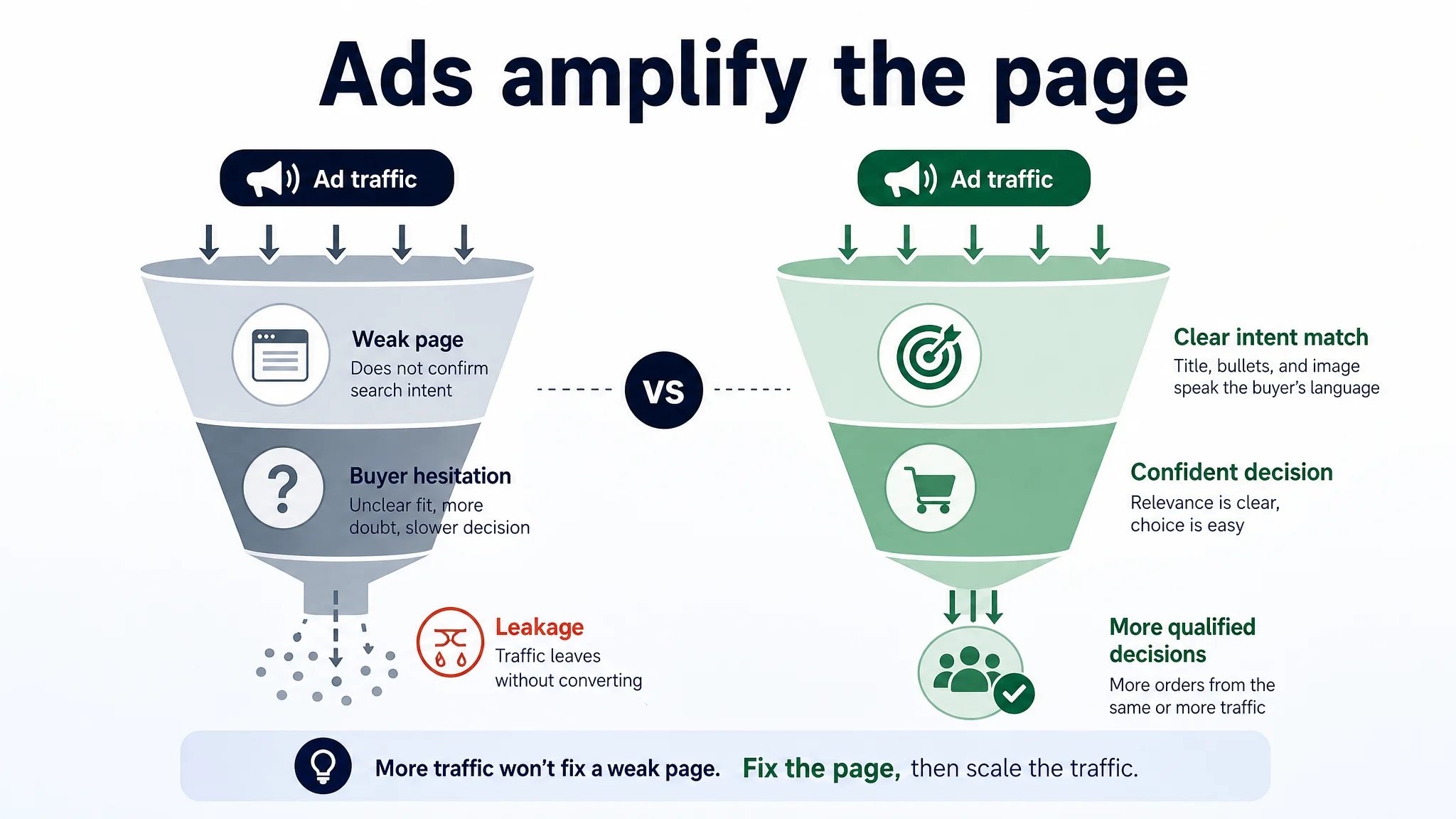
This does not prove that every high-ACoS campaign is caused by a listing problem. It demonstrates why the metrics must be interpreted together. When advertising brings people to a page but the page does not confirm the search intent, more traffic can magnify the conversion loss rather than solve it. A keyword report can identify where traffic is coming from; listing diagnosis helps determine whether the page is prepared to receive it.
DeepBI’s intelligent diagnosis can support this feedback loop by monitoring CTR, CVR, and session metrics, flagging keyword-related degradation, and recommending prioritized listing adjustments. Its broader workflow connects diagnosis with executable optimization instructions, allowing sellers to move from identifying a weak signal to selecting a targeted listing change. Advertising-report data can then be compared with the point at which an asset or listing adjustment went live, while keeping the interpretation cautious: observed movement is evidence for investigation, not automatic proof of causation.
Tuning for Seasons, Trends, and Shifting Shopper Behavior
A keyword can be relevant yet perform differently as demand changes. Seasonal shopping periods, emerging category language, competitor tactics, and shifts in shopper intent may alter which terms attract qualified traffic. Sellers should therefore revisit keyword priorities when Brand Analytics and advertising reports show changes in click share, conversion share, search rank, CTR, CVR, or ACoS.
The practical response is not to replace every keyword at once. Preserve terms with stable commercial value, identify weakening or newly relevant language, and adjust titles, bullets, backend terms, or supporting content according to the diagnosed need. Compare the updated listing against subsequent performance data, then feed the findings into the next optimization cycle. This disciplined sequence helps protect listing consistency while keeping keyword strategy responsive to market signals.
The same principle applies when the listing is not broadly declining but is quietly underperforming against a close competitor. A small overall score difference can hide a meaningful gap in one part of the funnel. In the borescope comparison, the total score difference was only two points, while the title was three points behind the benchmark and the bullets were one point behind. The client’s A+ content was stronger, but that strength did not fully compensate for weaker early decision architecture.
Sellers should therefore avoid relying on a single aggregate score or a general impression that a page is “good enough.” Break performance down by stage and asset. If search visibility is acceptable but clicks or conversion are weak, the next keyword decision may involve title hierarchy, image communication, bullet logic, or the relationship between the query and the product promise—not another round of bid changes.
Closing the Loop with AI: How Automation Amplifies Your Keyword Strategy
Keyword research creates value only when it changes the listing, and the listing creates further value only when its performance feeds the next optimization decision. For many sellers, this loop breaks between discovery, writing, diagnosis, and implementation. Manual handoffs slow the listing cycle, make keyword coverage inconsistent, and make it harder to connect changes with movements in CTR, CVR, ACoS, or BSR.
DeepBI’s Listing module can serve as the automation layer for this implementation and measurement loop. It connects keyword-informed listing work with four approved capabilities:
- Intelligent listing scoring and diagnosis: The system evaluates core listing elements, including the title, bullet points, main image, A+ content, and customer-feedback dimensions. Rather than returning a generic score, it identifies concrete gaps that may weaken competitiveness and clarifies where content or presentation requires attention.
- Competitive benchmarking: Similarity constraints and multidimensional comparisons help identify a relevant benchmark ASIN. Sellers can then examine differences in visual presentation, title structure, bullet-point logic, and detail-page content instead of copying isolated competitor keywords without context.
- AI content generation: Diagnostic findings can be converted into structured recommendations and keyword-aware content drafts. The purpose is not to force keywords into the copy, but to improve relevance and organization while preserving the product’s verified attributes. Sellers should review generated content before publication, particularly where product specifications or compliance requirements are involved.
- One-click SP-API synchronization: After reviewing old and new assets, users can selectively apply approved replacements through Amazon’s SP-API. This reduces repetitive downloading, renaming, and uploading, shortening listing cycle time while keeping deployment under user control. The workflow is limited by Amazon’s content standards and the system’s permitted access scope; it is not an autonomous decision-maker.
The borescope analysis shows why these capabilities need to work together. Scoring identified that the listing was not uniformly weak: its A+ content and reviews were valuable assets, while its title, bullets, and main-image scenario anchoring created the more important gap. Competitive benchmarking then clarified how the benchmark communicated professional use, probe capability, and inspection outcomes. AI-assisted recommendations could translate those findings into a revised title, more job-oriented bullets, and clearer visual priorities.
The same diagnosis also prevented an inefficient sequence. Rather than starting with more advertising changes, the recommended order was to strengthen the page’s front-half decision path first. The goal was to make terms such as “dual lens,” “11.5FT semi-rigid cable,” and “IP67 waterproof” function as reasons to choose the product, not merely as entries in a specification list. Automation was useful because it connected the evidence to concrete assets, but the decision about what to change still depended on product facts, buyer context, and competitive interpretation.
After deployment, listing and advertising data can support a subsequent diagnosis. A better-optimized detail page may also help Sponsored Products traffic convert more efficiently, potentially supporting CVR and ACoS for campaigns sending clicks to those ASINs. Campaign results still depend on bids, targeting, competition, traffic quality, and other variables, so the listing should be treated as one part of the performance system—not a guaranteed outcome.
Advertising does not only amplify advantages. It can also amplify a page’s existing defects. If the visible content does not align with the query or does not explain the product’s job quickly enough, more traffic may increase the cost of the same conversion problem. The practical action is to use each keyword cycle as a controlled loop: diagnose the current page, benchmark the competitive gap, generate and review targeted improvements, synchronize approved assets, then measure the resulting CTR, CVR, ACoS, and BSR signals before the next iteration.
Final Thoughts: Making Advanced Keyword Research Your Unfair Advantage
Advanced keyword research is not a one-time exercise in collecting popular search terms. It is a connected operating system for Amazon listings: discover relevant market language, evaluate its commercial value, translate it into accurate listing actions, and measure what happens after implementation.
The process starts with evidence. Reverse-analyzing a product’s title and bullet points can reveal its core search terms, while simulated buyer searches and competitor signals can broaden the opportunity set. The objective is not to gather the largest possible keyword list. It is to identify terms and attributes that match the product’s actual function, audience, price range, and verified features. Relevance must remain the filter that prevents attractive but misleading optimization.
The industrial borescope example shows why the quality of that evidence matters. A page can have a 4.7-star rating, 437 reviews, and well-developed A+ content while still losing efficiency because its title, main image, and bullets do not reflect how its most valuable buyers search and decide. The competitor’s advantage did not come simply from having more features. It came from connecting product terms and specifications to professional jobs, time savings, access limitations, and decision reassurance.
The next step is execution. High-converting terms or meaningful product attributes can help prioritize title structure, bullet points, images, and other selling points. Keyword research becomes valuable only when it informs clear listing decisions without inventing specifications, materials, benefits, or use cases. A disciplined workflow connects each selected term to a specific change and reduces subjective rewriting.
This also means that keywords should not be evaluated independently from visual content. In the borescope example, the main images looked polished but required too much interpretation. The product-only presentation did not anchor the first click in a clear work scenario, while the benchmark showed the probe inside mechanical gaps and communicated core specifications quickly. Image strategy therefore became part of the keyword strategy: the page needed to show what terms such as “industrial borescope,” “dual lens,” and “3.9mm probe” meant in practice.
Measurement then completes the evidence chain. After implementation, sellers can compare impressions, clicks, orders, CTR, CVR, ACoS, and TACoS to determine whether an optimization should be retained, revised, or expanded. BSR may provide an additional directional signal, but no keyword adjustment should be treated as a guaranteed ranking or sales solution. Advertising and business data are feedback, not proof of a permanent advantage.
For solo sellers and boutique brands, this approach can also support a healthier growth model. Ad data may reveal which terms deserve greater emphasis in visual content or selling points, helping connect keyword priorities with conversion-focused creative decisions. The practical advantage comes from shortening the distance between observation and action while preserving a clear record of what changed and why.
For technical and industrial products, the distance between a keyword and a purchase decision can be especially important. A buyer may need to know whether a probe can enter a narrow gap, whether a screen supports immediate analysis, whether a cable can reach the work area, or whether the product fits a professional environment. If the listing merely names those features, the buyer must perform the interpretation. If the listing connects them to a real job, the same keywords become part of a clearer decision path.
When keyword discovery, listing implementation, and performance measurement operate as a recurring loop, optimization stops being an occasional rewrite. It becomes a measurable process that can respond to market feedback and changing customer behavior. Sellers who build this discipline are better positioned to improve CTR and CVR, manage ACoS more deliberately, and make informed decisions about future listing work. The durable advantage is not a secret term or a guaranteed position; it is the ability to keep learning from Amazon data and continuously improve the listing with evidence.