

The Hidden Power of Backend Keywords for Amazon SEO
Visibility is the first condition for conversion on Amazon. If shoppers do not encounter an ASIN in relevant search results, strong product quality, competitive pricing, and persuasive listing copy have limited opportunity to influence CTR or CVR. The search results page determines which products receive attention, and that attention is heavily concentrated near the top: 70% of customers never go beyond the first page, while 35% click the first product.
For sellers, limited visibility creates a direct commercial risk. Fewer qualified impressions can suppress CTR, reduce sales velocity, weaken BSR, and make it more difficult for a product to build sustained organic momentum. Paid traffic may temporarily increase exposure, but organic discoverability remains important for controlling long-term acquisition costs and supporting healthier ACoS. A listing that is relevant but difficult to find still leaves demand uncaptured.
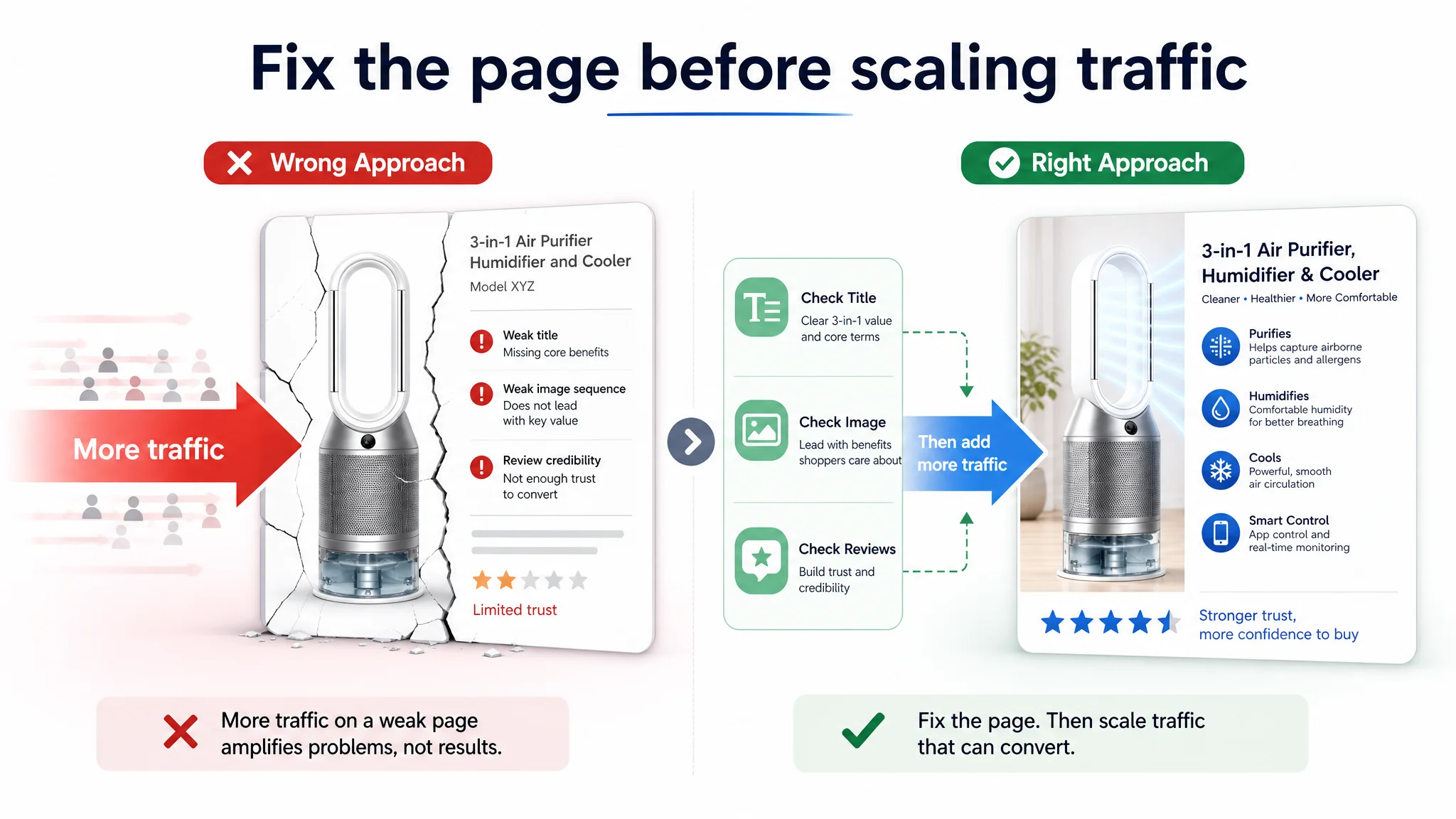
However, visibility alone does not guarantee conversion. A listing must also help shoppers understand the product, trust its claims, and recognize why it deserves consideration over competing options. This distinction became clear in an analysis of a premium 3-in-1 appliance that combined air purification, humidification, and cooling. The product contained substantial technical information, yet its Listing scored 67 out of 100 compared with 87 for a closely matched high-performing competitor.
The initial instinct was to improve the product’s creative presentation and continue refining the advertising direction. The team assumed that the main problem was insufficient feature communication. DeepBI’s comparison showed a more fundamental issue: the largest gaps were in the title, review credibility, and the way the main image and bullet points translated technical specifications into buyer value. The A+ content was already relatively strong, scoring 22 out of 25 compared with 20 out of 25 for the comparison Listing.
The lesson is important for backend keyword strategy. A listing can have meaningful product advantages and extensive technical content, but still lose commercial opportunities if it is difficult to discover or if the page cannot convert the traffic it receives. Backend search terms can expand relevant reach, but they must work together with a listing structure that earns attention and builds confidence.
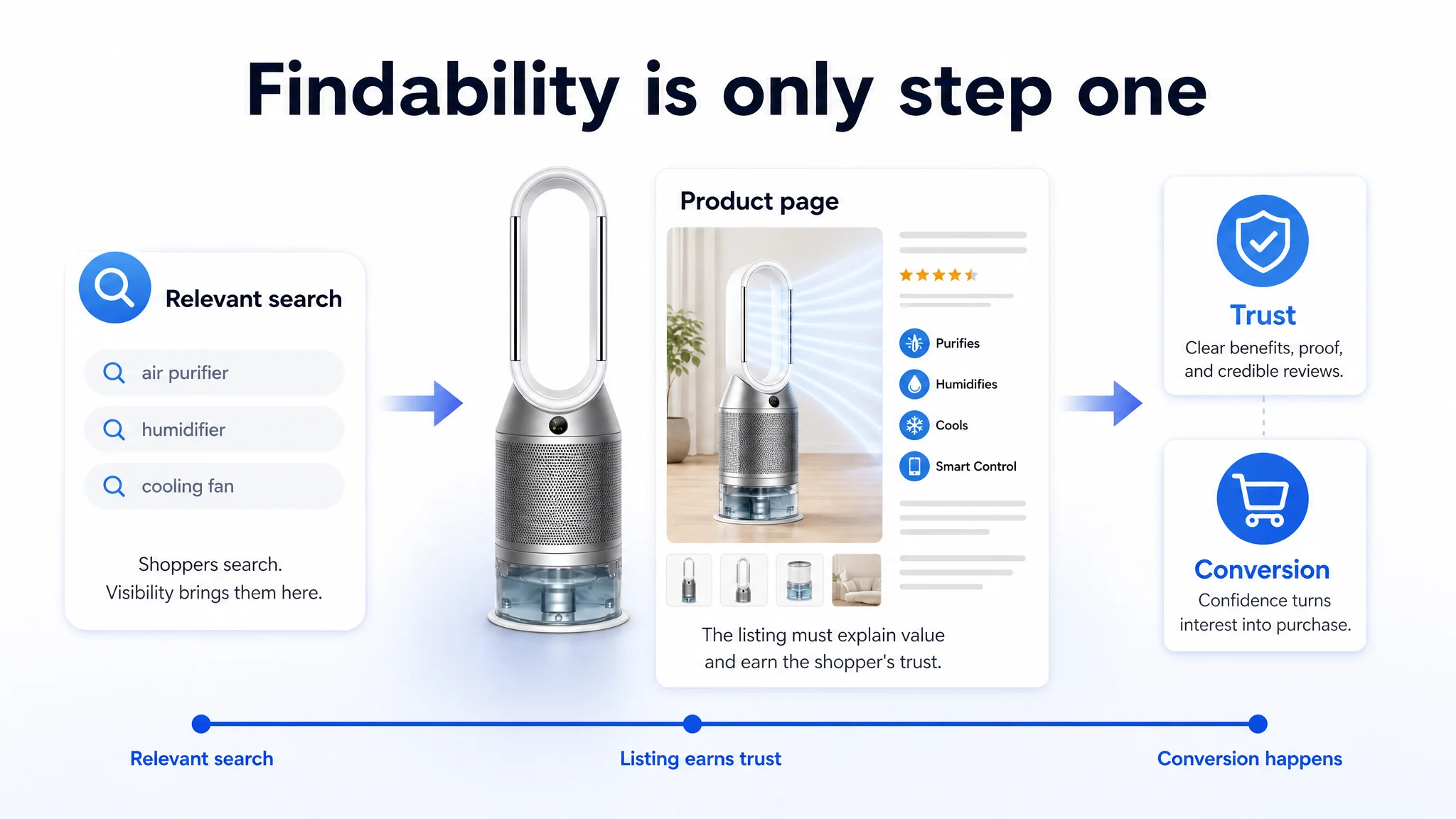
This is why backend search terms deserve greater attention. Visible listing content—such as the title, bullet points, and product description—must balance keyword relevance with readability and customer persuasion. It cannot always include every relevant variation, synonym, alternate phrasing, or specific query a shopper may use. Backend search terms provide additional space for precise, relevant keywords that support search reach without overcrowding customer-facing copy.
Many sellers neglect this field because it is not visible on the product page. As a result, backend keywords function as a hidden lever rather than an obvious branding element. Their value depends on disciplined selection: terms should accurately relate to the product, reflect realistic buyer language, and comply with Amazon’s requirements. Irrelevant, repetitive, or exaggerated keywords can dilute relevance and create compliance risk instead of improving discoverability.
The practical opportunity lies in connecting keyword research with listing decisions. Sellers can compare search language, identify missed query variations, and assign each term to the most appropriate location rather than forcing every phrase into the title or bullets. A precise backend strategy can broaden the range of relevant searches associated with an ASIN while preserving a clear customer-facing message.
At the same time, sellers should avoid treating backend keywords as a substitute for fixing visible conversion barriers. In the 3-in-1 appliance analysis, the title contained mainly brand and model information, while core category terms such as “air purifier” and “humidifier” were missing or underused. The main value proposition was also not immediately clear. Adding more paid traffic before repairing those discovery and trust signals could have amplified page-level friction rather than solved it.
For Amazon SEO in 2025 and beyond, backend search terms should be treated as a required part of listing optimization—not as a last-minute field completed after the visible copy is finished. The execution standard is straightforward: use evidence-based, compliant terms to expand organic reach, then monitor impressions, CTR, CVR, ACoS, and BSR to determine whether broader keyword coverage is attracting commercially relevant traffic. Just as importantly, confirm that the listing can explain the product and support conversion once the additional traffic arrives.
What Are Amazon Backend Search Terms?
Amazon backend search terms are hidden keywords entered in a product listing’s search-term field. Shoppers do not see them on the detail page, but Amazon can use them to index the ASIN for relevant searches that are not fully covered by the visible title, bullet points, description, or other frontend content.
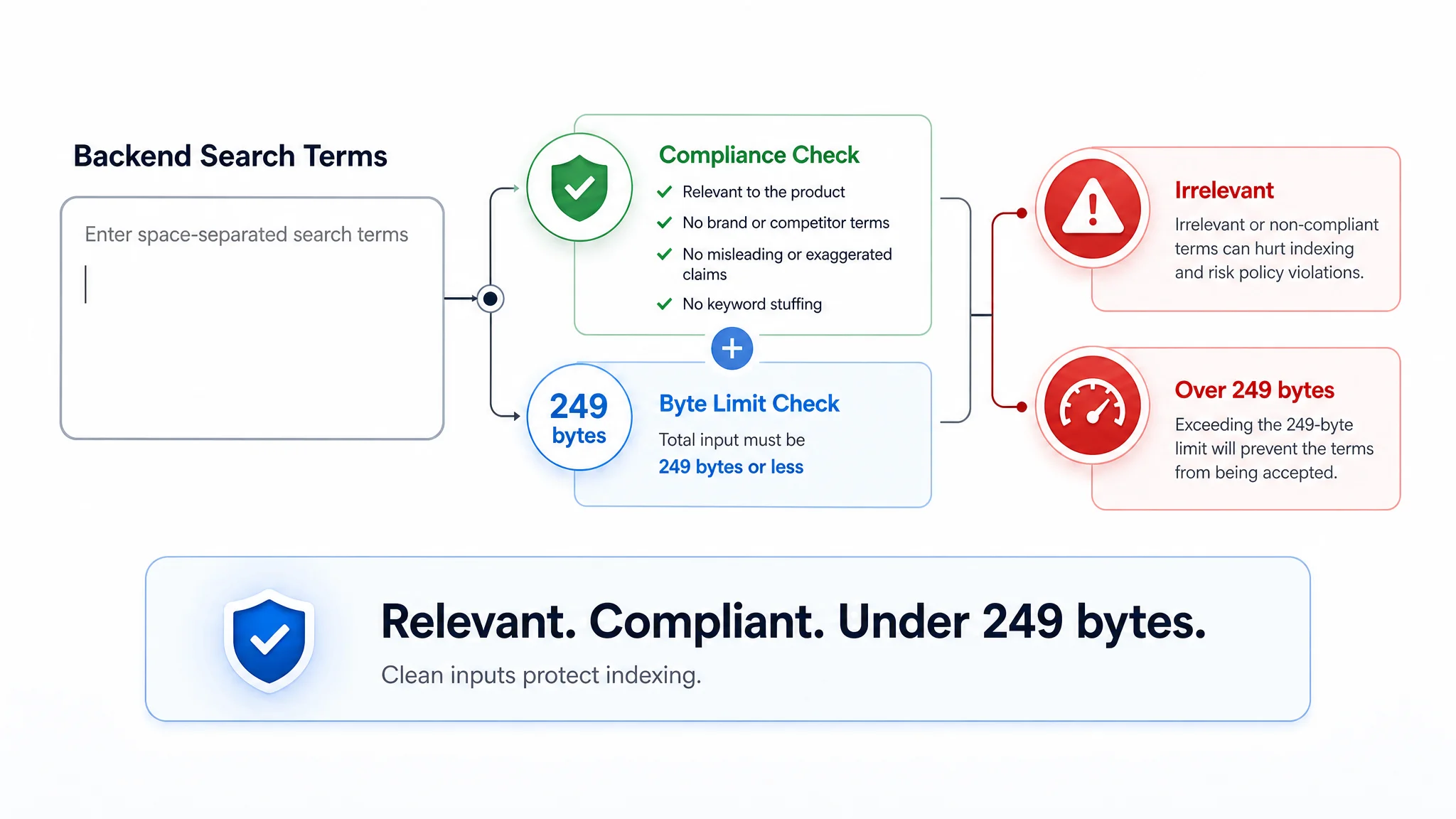
The available space is limited to 249 bytes—not 250 bytes. Byte limits are not always the same as character limits. Depending on the characters used, one character may consume one or more bytes. Sellers should also account for every space, because each space consumes one byte. Punctuation and other special characters consume space as well, reducing the room available for meaningful search terms.
A practical backend entry should therefore use relevant words in a clean, space-separated format, such as:
silicone spatula heat resistant kitchen utensil
Avoid unnecessary punctuation, repeated terms, and decorative formatting. The objective is to use the field for additional relevant language, not to create a readable sentence or reproduce the frontend copy word for word.
Amazon does not depend on the order in which backend keywords are entered. Its search system automatically combines words and evaluates appropriate keyword combinations according to relevance. For example, separate terms such as “silicone,” “spatula,” and “heat resistant” may contribute to relevant combinations without requiring sellers to enter every possible phrase in a specific sequence. Amazon’s algorithm determines which combinations are appropriate for indexing based on the product and the submitted terms.
Backend terms also should not be treated as a place to add every possible variation. Amazon’s engine corrects common misspellings, so deliberately entering misspelled words wastes valuable byte capacity and can weaken the quality of the keyword set. The same applies to irrelevant high-volume terms: they may consume space without improving organic discoverability, CTR, CVR, or BSR.
A useful way to understand the field is as an expansion layer. It should add relevant search paths that the frontend cannot naturally accommodate, while the visible listing should still communicate the product’s primary category, value proposition, and reasons to buy. In the 3-in-1 appliance analysis, adding terms such as “air purifier,” “humidifier,” “large rooms,” “HEPA,” “allergies,” “pets,” “smoke,” and “dust” to the title direction was necessary because the product’s role was not immediately legible from the original title. Backend terms could support additional variations, but they could not fully replace a title that failed to establish the product category.
Frontend keywords support shopper-facing communication and conversion. They must fit naturally into the title, bullets, and description while presenting the product clearly. Backend search terms support additional indexing opportunities without appearing to shoppers. Both areas must remain closely aligned with the product. Accurate formatting and strict relevance allow sellers to use the 249-byte field efficiently while reducing duplication and wasted keyword space.
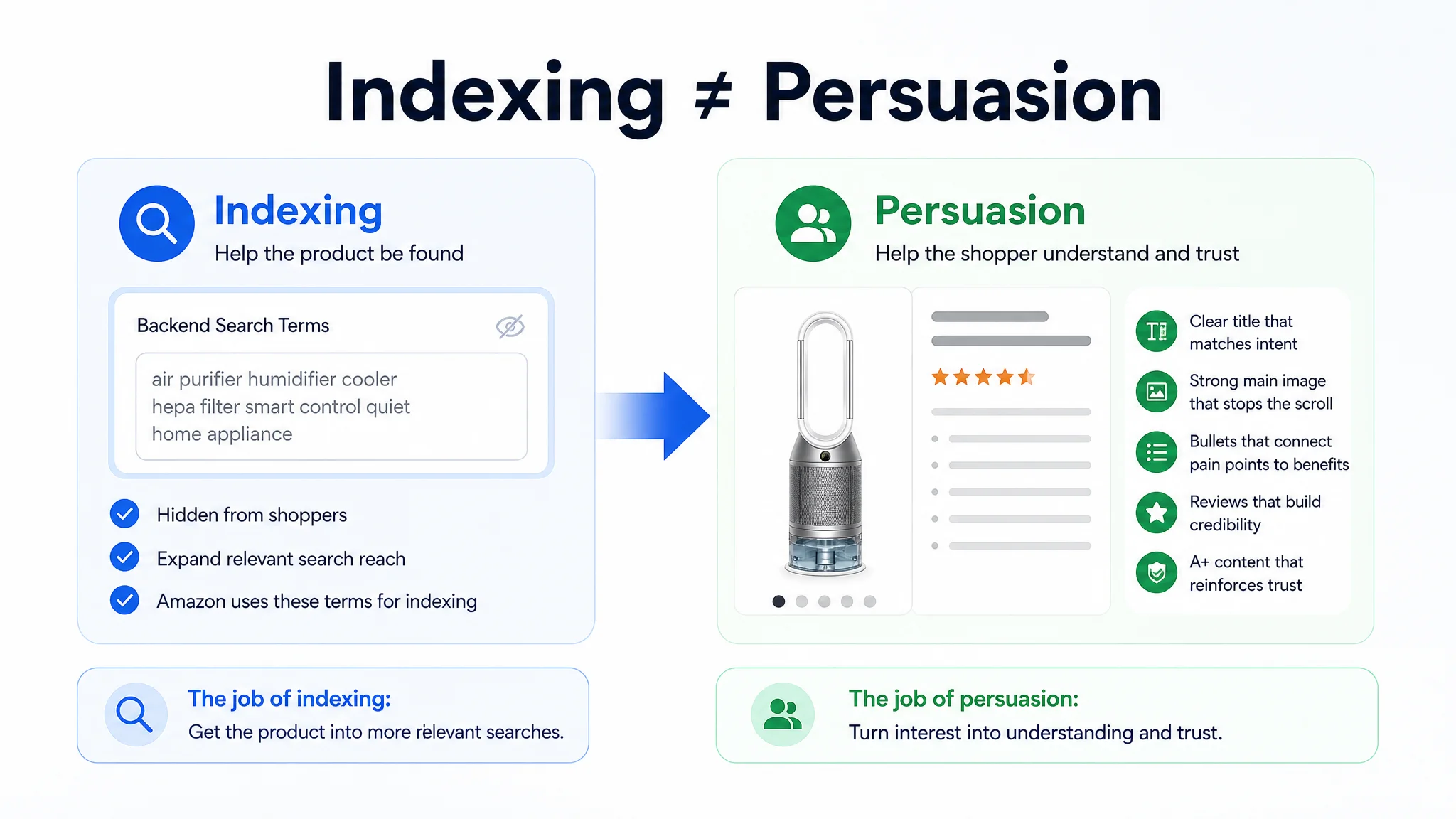
The distinction between indexing and persuasion is critical. Backend terms may help Amazon associate an ASIN with a relevant search, but they do not explain why the product is worth buying. In the appliance analysis, the product page contained technical diagrams, sensor explanations, airflow visualizations, app interactions, and maintenance guidance. The problem was not simply a lack of information. The information was not arranged in the order shoppers needed to make a decision.
Backend search terms can improve the chance that the right shopper finds the product. The title, images, bullets, reviews, and A+ content must then help that shopper understand the offer and overcome hesitation.
How to Build High-Impact Backend Keywords
Backend search terms should expand relevant coverage rather than duplicate the listing. Do not repeat keywords already used in the title, bullet points, or description because Amazon already indexes those visible fields. Repeating them consumes limited backend capacity without creating meaningful search coverage. Start by reviewing the complete listing, then reserve backend space for relevant terms that provide new ways for shoppers to find the product.
This review should include more than a keyword inventory. Sellers should ask whether the visible listing already communicates the product’s category and core use cases clearly. If an important product category is missing from the title, that issue should be corrected in the frontend rather than hidden entirely in backend fields. The 3-in-1 appliance example illustrates why: the original title was too close to a model identifier and did not clearly communicate the product’s role as an air purifier and humidifier. That limited both search coverage and click intent.
Prioritize synonyms, alternate names, regional variations, and genuine search phrases. Avoid deliberately adding misspellings; there is no sound ranking advantage to weakening keyword quality. Long-tail phrases are especially useful because they reflect specific customer intent and may align more closely with the product’s use case. For a silicone spatula, a compliant keyword string could be:
heat resistant baking scraper rubber kitchen tool espátula de silicona
This example combines relevant product variations with a Spanish term that may support discovery in the US market. Language expansion should remain accurate to the product and the customers it serves. Do not add translations for features, materials, or uses the product does not actually have.
For more complex products, search terms should also reflect how customers describe their problems. A 3-in-1 appliance may be associated with searches related to air purification, humidification, cooling, allergens, pets, smoke, dust, quiet operation, smart control, or large-room use. Those terms should only be selected when they accurately describe confirmed product capabilities. The purpose is not to create the broadest possible vocabulary, but to connect the product with legitimate purchase intent.
Formatting affects how much relevant coverage fits into the field. Separate terms with single spaces. Avoid commas, punctuation, and the word “and” in the backend string because these consume bytes without adding useful search meaning. Build a readable sequence of independent terms rather than repeating a phrase in multiple grammatical forms. The goal is not to fill every available space, but to maximize credible, non-overlapping search paths.
Use Amazon’s indexing behavior and autocomplete suggestions as practical evidence of real customer searches. A term that appears in autocomplete can indicate established search activity, but it still requires a relevance check against the product. Irrelevant keywords may attract low-intent impressions, reducing CTR and CVR while weakening the relationship between the listing and its traffic. Poor relevance can also undermine organic ranking and increase dependence on paid traffic, affecting ACoS.
The same principle applies to advertising data. A search term that generates a click is not automatically a good backend keyword. It should be evaluated against the product, the customer’s likely intent, and the quality of the resulting traffic. If shoppers arrive but do not understand the product or trust the page, broader keyword coverage may increase exposure without creating commercially useful visibility.
A comparable listing analysis can help reveal whether a product is missing important search language or whether its page is failing at a later stage of the funnel. In the 3-in-1 appliance case, the comparison found a 20-point overall Listing gap, but that gap was not evenly distributed:
- Title: Customer Listing: 10/20, Comparable high-performing Listing: 18/20, Gap: -8
- Main image: Customer Listing: 24/30, Comparable high-performing Listing: 27/30, Gap: -3
- Bullet points: Customer Listing: 7/10, Comparable high-performing Listing: 8/10, Gap: -1
- A+ content: Customer Listing: 22/25, Comparable high-performing Listing: 20/25, Gap: +2
- Reviews: Customer Listing: 4/15, Comparable high-performing Listing: 14/15, Gap: -10
- Total: Customer Listing: 67/100, Comparable high-performing Listing: 87/100, Gap: -20
This comparison prevented the team from assuming that more technical A+ content or more advertising adjustments would solve the main problem. The largest weaknesses were in search communication and trust. Backend keyword research could help address missed search coverage, but the title and early-page content also needed to make the product understandable.
Competitive analysis adds another layer of prioritization. DeepBI can analyze product information, competitor listings, usage scenarios, and functional similarities to identify high-value backend keyword gaps for which top competitors rank. Its workflow also uses market search signals and, where available, high-conversion winning terms to weight opportunities. Sellers can then select gaps supported by confirmed product attributes, prioritize the strongest terms, and avoid speculative additions.
This relevance-first process turns backend optimization into a controlled input for stronger CTR, CVR, BSR, and listing performance rather than a volume exercise. It also helps distinguish between two different problems: not being found for a relevant search and being found but failing to persuade the shopper after the click.
Forbidden Search Terms and Amazon Policy Traps
Backend search terms can improve organic discoverability only when they remain relevant, factual, and compliant. Attempts to force visibility with restricted or misleading language can damage indexing, listing status, and account standing. A small increase in keyword coverage is not worth risking ASIN suppression or account suspension.
Amazon prohibits the improper use of brand names in backend fields. Terms such as Apple, Nike, and Amazon should not be added to attract shoppers searching for another brand. Sellers should also exclude:
- ASINs, which are product identifiers rather than search terms
- Temporary or promotional phrases such as “new,” “on sale,” or similar time-sensitive wording
- Subjective claims such as “best,” “cheapest,” or other unverified superiority statements
- Offensive terms or language that violates Amazon’s content standards
These terms do not become acceptable simply because they may generate impressions. Irrelevant brand references can weaken search relevance, while promotional or subjective claims can create compliance concerns. Depending on the violation, Amazon may suppress the ASIN or take action against the seller account. The commercial impact can include reduced organic visibility, weaker traffic quality, lower CTR, and disruption to the listing’s ability to support CVR and BSR growth.
Relevance also requires discipline when a product has multiple functions. The 3-in-1 appliance offered purification, humidification, and cooling, but each function still needed to be supported by the actual product and its confirmed claims. The page could discuss concerns such as allergens, pets, smoke, dust, quiet operation, and maintenance only where the product evidence supported those uses. The presence of multiple features does not justify adding every adjacent category term.
Sellers must also distinguish keyword stuffing from exceeding the backend field’s byte limit. These are separate problems and require separate checks.
Keyword stuffing means repeating the same word or closely related terms excessively in an attempt to manipulate relevance. For example, repeating “wireless earbuds” several times instead of using distinct, relevant search variations creates redundant data rather than useful coverage. This practice may violate Amazon’s guidelines and can cause the listing to be suppressed or the entire backend field to be ignored.
Byte overflow is a technical limit issue. If the combined backend search terms exceed 249 bytes, Amazon may ignore all terms in that field. This can eliminate the discoverability benefit of otherwise relevant keywords, even when none of the individual terms is prohibited.
A compliant maintenance process therefore needs two validation layers: policy review and byte-count review. First, remove restricted brands, ASINs, temporary phrases, subjective claims, offensive language, and duplicated terms. Then verify that the remaining search terms fit within the 249-byte limit. Treat the field as a controlled relevance asset, not a place to repeat every possible query. Clean inputs protect indexing stability while supporting more dependable organic traffic, CTR, CVR, and BSR performance.
Step-by-Step: Adding & Maintaining Your Search Terms
Backend search terms can expand organic discoverability only when they are entered accurately, kept within Amazon’s limits, and maintained as customer demand changes. A reliable workflow prevents wasted indexing opportunities and protects listing performance across CTR, CVR, ACoS, and BSR.
The process should begin with diagnosis rather than immediate editing. Before adding terms, review the listing as a complete sales path:
- Is the product discoverable for its core category?
- Does the title communicate the primary use case?
- Do the first images establish the product’s role quickly?
- Do the bullets convert features into buying reasons?
- Does the page provide enough trust and evidence for the category?
- Is the problem actually a keyword gap, or is traffic arriving at a page with weak conversion capacity?
The 3-in-1 appliance analysis demonstrated why this order matters. The product had technical depth and strong A+ content, but a weak title, a less effective image sequence, scattered bullet logic, and a poor review profile. If the team had treated the problem as a purely advertising or backend keyword issue, it could have expanded traffic without resolving the barriers that prevented shoppers from moving toward purchase.
1. Log in to Seller Central. Use the account with the appropriate catalog and listing permissions. Starting from the correct account helps prevent unauthorized edits or confusion between marketplaces.
2. Navigate to “Manage All Inventory.” Locate the ASIN or SKU you want to update. Confirm that you are editing the correct product before changing any catalog information.
3. Edit the listing and locate the “Generic Keywords” field. Open the listing-editing interface and find the backend search-term field. Review the prepared keyword set before pasting it. The terms should support the product’s actual attributes and customer intent rather than introduce irrelevant traffic that may weaken CVR.
Amazon’s mandatory attribute requirement does not apply to every product type. It applies to certain product types, numbering 15, rather than 23. Check the requirements shown for the relevant product type before assuming that the attribute is required.
4. Paste the prepared 249-byte keyword string and verify it with a byte counter. Do not rely on character count alone, because byte usage can differ depending on the characters included. Remove unnecessary repetition, punctuation, and spacing when required, while preserving the most valuable search concepts. Always complete the byte check before submitting an update; a keyword revision that exceeds the limit may not be accepted or may fail to represent the intended strategy.
5. Save the changes. After saving, confirm that the update was accepted and that the correct listing remains active. Record the date, keyword version, and ASIN so later performance changes can be evaluated against the correct revision.
For multiple listings, use Amazon’s inventory file template for bulk updates. Prepare the file carefully, map each keyword string to the correct SKU or product identifier, and validate the 249-byte limit for every row before uploading. Bulk editing reduces listing cycle time, but one mapping or formatting error can affect many products at once.
Treat backend terms as an operating asset rather than a one-time submission. Conduct a structured review each quarter, examining shifts in search behavior and performance signals such as CTR, CVR, ACoS, and BSR. Rotate terms seasonally when demand changes—for example, prioritize relevant Q1 fitness searches during the first quarter and appropriate Q4 holiday terms before holiday demand peaks. Verify every revised string against the byte limit before applying it.
Maintenance should also include a page-level review. If impressions increase but CTR remains weak, the title or main image may not be communicating the product clearly enough. If clicks increase but CVR remains weak, the issue may lie in trust, bullet-point logic, reviews, or the overall conversion sequence rather than in the backend keyword set.
In the appliance analysis, the page’s A+ content was already stronger than the comparison Listing, while reviews scored 4 out of 15 and the title scored 10 out of 20. That evidence suggested that more technical content was not the first priority. Backend optimization should therefore be evaluated alongside title clarity, image hierarchy, customer proof, and the ability of the page to answer practical concerns.
Common Questions and Myths Debunked
Are backend search terms measured by characters or bytes?
Amazon backend search terms are measured in bytes, not simply by the number of visible characters. Spaces and special characters also count toward the field’s capacity. Treat the limit as a technical constraint: review the complete string, remove unnecessary separators, and confirm that the final entry remains within the permitted space. Careful byte management protects indexing quality without sacrificing relevant search coverage.
Does the order of backend keywords affect indexing?
No. Keyword order does not determine whether terms can be indexed. Amazon can automatically combine words in the backend field to match relevant customer searches. You therefore do not need to build awkward phrases or repeat a keyword in multiple orders. Focus instead on distinct, relevant terms that expand legitimate coverage and support stronger organic discoverability.
Can irrelevant terms increase visibility?
They can create exposure, but not useful visibility. Irrelevant terms may attract shoppers who are unlikely to click or buy. That low-quality traffic can weaken CTR and CVR signals, undermining the listing’s performance rather than improving its organic position. Every backend term should describe the product, its use, or a genuinely relevant search intent.
The same principle applies when a listing has an attractive technical story. The 3-in-1 appliance had multiple functions and substantial specifications, but its technical depth did not automatically create purchase confidence. Its page still needed to clarify the product’s role, establish trust, and connect features with practical outcomes. More impressions would not resolve that communication gap by themselves.
Can you use competitor brand names as backend keywords?
No. Using competitor brand names is strictly prohibited. Competitive research should reveal search themes, product attributes, and legitimate category language—not provide a reason to insert another company’s brand into your backend field. Keep your keyword strategy compliant and centered on the product you actually sell.
Should you add deliberate misspellings?
No. Do not add deliberate misspellings. Amazon automatically corrects common misspellings, so filling backend space with misspelled versions usually adds no meaningful coverage and can reduce the room available for relevant terms. Use accurate, customer-facing language and prioritize valid search variations instead.
Can Spanish translations help a US listing?
Yes, relevant Spanish translations can benefit listings targeting the US market. They may capture legitimate searches from Spanish-speaking shoppers when the translation accurately reflects the product and its use. Add only relevant terms, and do not treat translation as a license to accumulate unrelated vocabulary.
Is keyword stuffing the same as exceeding the byte limit?
No. These are separate problems. Keyword stuffing involves unnecessary repetition, which violates guidelines and reduces the quality of the search-term field. Exceeding the 249-byte limit is a technical issue that may cause the field to be ignored. Stay below the limit while also removing repeated terms.
How can DeepBI identify missing backend keywords?
DeepBI can reverse-ASIN relevant top competitors, extract core search terms from their titles and bullet points, and simulate buyer searches. Its semantic matching process selects genuinely comparable ASINs rather than relying only on shared words. It can then benchmark your listing, identify gaps in search-term coverage and keyword layout, and surface potentially high-value backend terms you may be missing. Use those findings as a research input, then apply relevance and compliance checks before implementation.
The same benchmarking process can also show whether a keyword gap is the only problem. In the 3-in-1 appliance analysis, DeepBI compared the title, main image, bullet points, A+ content, and reviews rather than examining search terms in isolation. The analysis found that A+ content was relatively strong, while the title and review credibility were much weaker than those of the comparison Listing.
That broader view matters because a seller may correctly identify missing keywords and still see limited commercial improvement if the page does not convert the resulting traffic. Keyword research should therefore answer both questions:
1. Which relevant searches is the ASIN missing?
2. Can the Listing earn attention and trust when shoppers arrive through those searches?
Elevate Your Visibility with AI-Powered Optimization
Manual keyword research can consume hours across competitor listings, search results, customer language, and advertising reports. That workload also creates a practical risk: sellers may collect a large vocabulary without knowing which terms are relevant, commercially useful, or missing from their own backend fields. AI-assisted research can shorten listing cycle time by accelerating competitor benchmarking and surfacing language that deserves human review, without removing the need for judgment.
A credible starting point is reverse-ASIN lookup. By examining closely comparable products, sellers can identify the search terms and product attributes associated with competing listings. Competitive benchmarking then adds context: the goal is not to imitate every high-ranking ASIN, but to compare products with similar functions, use cases, audiences, and positioning. DeepBI is designed for Amazon-focused analysis and can use semantic matching to identify appropriate benchmark ASINs rather than relying only on simple keyword overlap.
Semantic comparison is particularly important for products with overlapping but non-identical functions. A 3-in-1 air purifier, humidifier, and cooling appliance should not be benchmarked against every product that happens to share a word such as “air” or “smart.” The comparison should consider the product’s actual combination of functions, intended rooms, customer concerns, and positioning. This helps distinguish legitimate keyword opportunities from terms that merely appear relevant at a superficial level.
DeepBI’s smart scoring and benchmarking workflows can compare a listing’s title, bullet points, images, A+ content, and customer feedback with those of relevant competitors. This analysis helps reveal terms for which benchmark ASINs are indexed while exposing potential backend keyword gaps in the seller’s own listing. The output is more useful when treated as a prioritized research map: which vocabulary appears repeatedly, which selling points are underrepresented, and which terms may deserve validation before being added to backend search fields.
The appliance analysis illustrates why this wider diagnostic view is valuable. The customer Listing scored 67 out of 100 versus 87 for a closely matched high-performing Listing. The title gap was eight points, the review gap was ten points, and the main image and bullet points also lagged behind. Meanwhile, A+ content scored higher than the comparison Listing. Without a structured benchmark, a team might have continued adding technical explanation to an already strong section or focused on advertising adjustments instead of repairing earlier-stage weaknesses.
Its listing diagnostic and optimization capabilities can also recommend content improvements, such as clearer keyword placement, stronger selling-point structure, better coverage of customer pain points, and more useful trust information. These changes may support clearer relevance signals and improve the listing’s ability to earn clicks or conversions, but they do not guarantee higher BSR, CTR, or CVR, or lower ACoS.
For complex products, AI-assisted diagnostics should translate technical specifications into a buyer-oriented structure. In the appliance case, the recommended direction was not simply to add more specifications. It was to:
- Clarify the 3-in-1 value earlier
- Use relevant category terms in the title
- Connect filtration claims with concerns such as dust, smoke, pets, and allergens
- Present smart controls as a convenience benefit
- Link airflow modes to real room contexts
- Address hygienic humidification and maintenance concerns
- Reorder images and A+ modules around attention, proof, and risk reduction
This is the difference between collecting information and organizing it into a conversion path. Technology should serve a decision sequence: establish what the product is, explain the problem it solves, provide evidence, and reduce the shopper’s remaining concerns.
Advertising data provides a focused bridge between paid and organic research. DeepBI can surface high-conversion search-term signals from Amazon advertising data; relevant terms may then inform backend keyword selection, subject to seller review. A term should be added only when it accurately describes the product and complies with Amazon requirements. AI serves as a research and execution aid, not the final decision-maker. Sellers remain responsible for confirming relevance, avoiding unsupported claims, and completing the compliance review before publishing any optimization.
The advertising connection should be interpreted carefully. When advertising becomes difficult to control, the answer is not always another round of bid, keyword, or placement adjustments. In the appliance case, the Listing had a weak title, an underpowered early image sequence, scattered bullet logic, and a major review trust deficit. DeepBI’s conclusion was not to abandon advertising, but to repair the page before expecting paid traffic to work more efficiently.
Advertising can amplify a listing’s strengths, but it can also amplify defects. If shoppers arrive through paid search and do not understand the product, trust its performance, or see credible reasons to choose it, additional traffic may simply expose more shoppers to the same friction. Backend terms should therefore be used as part of a coordinated visibility and conversion strategy, not as an isolated way to increase impressions.
A disciplined AI-assisted workflow should follow this order:
1. Compare the listing with genuinely relevant competitors.
2. Identify missing search language and underrepresented product attributes.
3. Separate frontend keyword gaps from backend keyword opportunities.
4. Check whether the title, images, bullets, reviews, and A+ content support conversion.
5. Validate every proposed term against the product and Amazon policy.
6. Confirm the final backend string remains within 249 bytes.
7. Monitor impressions, CTR, CVR, ACoS, and BSR after implementation.
8. Reassess the page if traffic grows without corresponding improvement in shopper engagement or purchase behavior.
The objective is not to produce the longest keyword list or the most technically detailed Listing. It is to build a page that can be found for relevant searches, communicate its value quickly, provide credible proof, and reduce the hesitation that prevents conversion. Backend search terms contribute to the first part of that process, while the rest of the Listing must be prepared to receive and convert the resulting traffic.