

The New 75-Character Era Has Arrived
Amazon announced a 75-character title limit on July 27, 2026, marking a major shift in listing requirements. The policy applies across all product categories except media. For sellers, title length is now a direct compliance issue—not simply a copywriting preference.
Amazon’s stated rationale is practical: shorter titles display more cleanly on mobile devices and create a more consistent shopping experience. Titles that do not comply may be automatically corrected by Amazon’s AI, with sellers receiving a 14-day window to review the changes. Losing control over title wording can affect keyword relevance, click-through rate (CTR), conversion rate (CVR), and ultimately organic visibility.
This update also clarifies how sellers should view the previous limit. Since January 2025, the 200-character title limit has been a hard ceiling, not a recommended target. Filling every available character with repeated keywords or lengthy modifiers was never the strongest optimization strategy.
The better response is to restructure titles around the information shoppers need first: brand, core selling point or result, product form, and essential supporting modifiers. Effective optimization balances Amazon search relevance with consumer readability rather than relying on keyword stuffing.
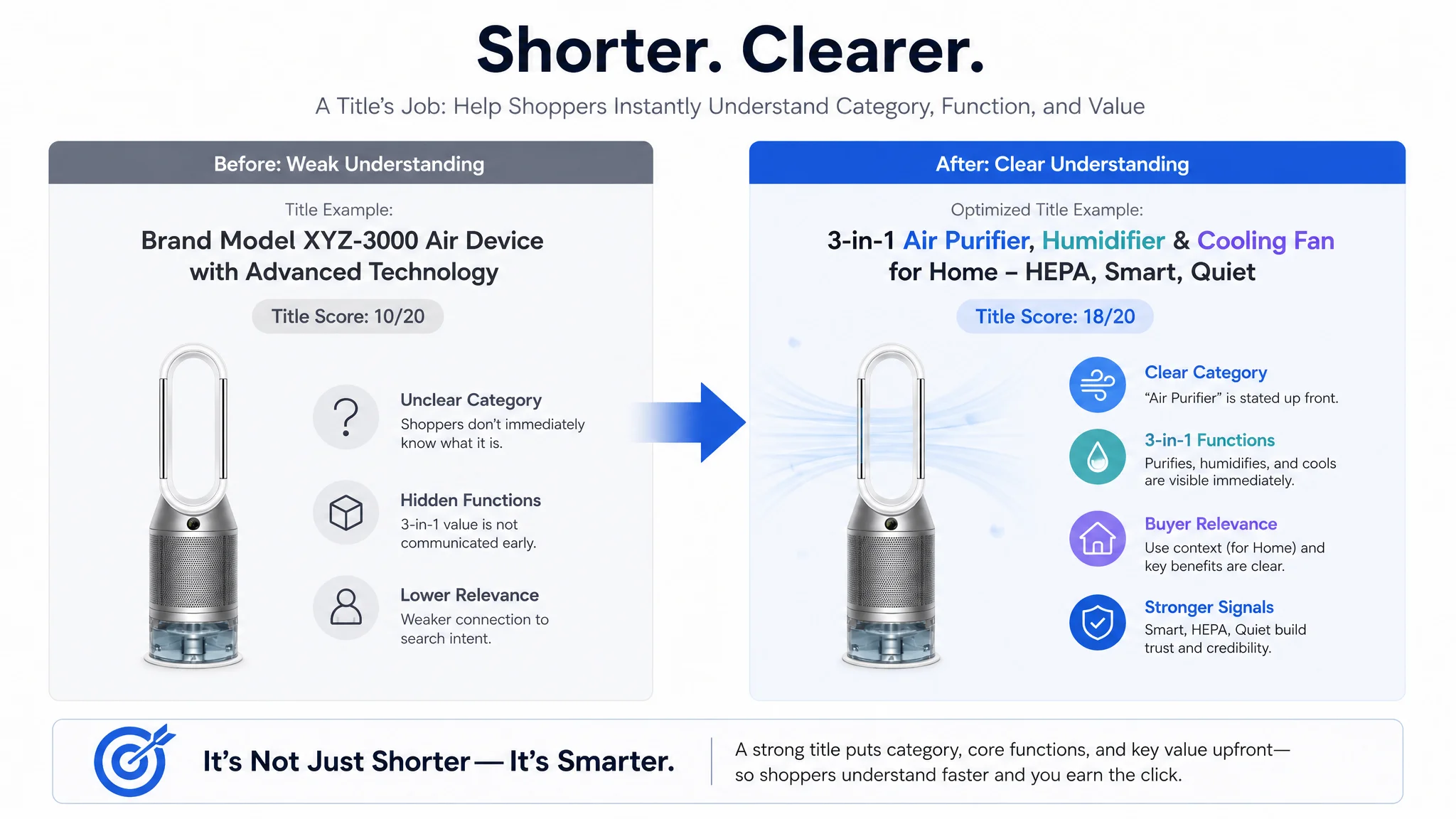
A 3-in-1 air purifier listing illustrates why this distinction matters. The product had substantial technical content, but its original title was centered mainly on brand and model information. DeepBI’s comparison found that the title scored 10 out of 20, compared with 18 out of 20 for a closely matched high-performing competitor. The issue was not simply that the title was too long or too short. It failed to make the product’s category, combined function, and buyer relevance immediately clear.
The strategies that follow focus on shortening titles without weakening their commercial message, improving mobile discoverability, and turning compliance work into a clearer path toward stronger listing performance.
Product Title Requirements and Guidelines (covers " " and " ")
Exact Rules You Must Follow
Amazon titles must contain no more than 75 characters, including spaces, and must accurately represent the product. The same requirement applies to every product, including both new and existing listings.
Titles must also follow these restrictions:
- Do not use promotional phrases such as “HOT ITEM” or “BEST SELLER.”
- Do not use special characters, except where Amazon permits “/” or “-”.
- Do not repeat a word more than twice. Amazon’s stated exceptions include articles, prepositions, and subjective descriptors.
For example:
- Compliant: “Stainless Steel Water Bottle 32 oz - Leakproof Insulated Flask” — 62 characters
- Non-compliant: “HOT ITEM!!! Stainless Steel Water Bottle Water Bottle - Best Seller for Outdoor Travel” — 86 characters; it exceeds the limit and includes promotional language, prohibited punctuation, and unnecessary repetition.
Variations require additional care. When no variation is selected, the parent title is shown. After a specific variation is selected, the child ASIN title may be displayed on the detail page. Review both levels for accuracy and compliance.
A compliant title still needs to perform a commercial job. It should help the shopper understand what the product is, why it is relevant, and whether it deserves further attention. In the air purifier example, the product combined purification, humidification, and cooling, but those functions were not communicated strongly enough through the original title. Adding a precise category term such as “air purifier” or “humidifier,” together with a clear use context, could improve both search legibility and shopper understanding.
Compliance therefore should not be treated as a mechanical character-count exercise. A title can meet the limit and still fail to connect search intent with the product’s main value.
Consequences of Non-Compliance
A title that violates these requirements can be automatically corrected by Amazon and may face search suppression. That can reduce discoverability, weaken organic traffic, and affect CTR, CVR, BSR, and ultimately ACoS. Sellers should audit existing titles as well as new listings, remove promotional and repetitive wording, verify character counts including spaces, and preserve only accurate, high-value product terms. A concise title is not merely shorter; it is a safeguard for listing visibility and catalog stability.
The business risk is even greater when a title is technically present but commercially weak. In the air purifier case, the Listing was not missing information overall. Its A+ content included technical visualizations, sensor explanations, airflow demonstrations, app interactions, and maintenance guidance. Yet the title and other early-funnel elements did not give shoppers a clear reason to continue evaluating the product.
That distinction matters after a policy change. Amazon may correct a non-compliant title, but an automated correction cannot be assumed to preserve the product’s positioning, relevant search language, or conversion logic. Sellers need to review not only whether the title follows the rule, but also whether it still communicates the product’s strongest and most credible value.
Best Practices for Rewriting Your Titles (covers " ")
Anatomy of a Successful Short Title
A shorter title should concentrate relevance rather than remove meaning. Start with the primary keyword, then retain the two or three product descriptors most closely tied to shopper intent, such as material, product type, size, or a verified benefit. Use clear wording and avoid repeated modifiers.
For example:
- Before: “Premium Stainless Steel Insulated Water Bottle – Keeps Drinks Cold 24 Hrs” — 92 characters
- After: “Premium Stainless Steel Insulated Water Bottle – BPA‑Free” — 62 characters
The revised version keeps the brand-relevant product category, material, and a meaningful attribute while reducing clutter. Check the result on mobile, where titles around the 70–80 character range may be truncated. A title that displays its strongest relevance early can support higher-quality clicks, stronger CVR, and less wasted traffic from high-intent searches. Data-driven restructuring can also improve conversion quality and help align organic and advertising signals.
A useful structure is:
1. Core product category
2. Primary function or result
3. Important use case or product context
4. One or two verified supporting benefits
5. Brand or model information where it contributes to recognition
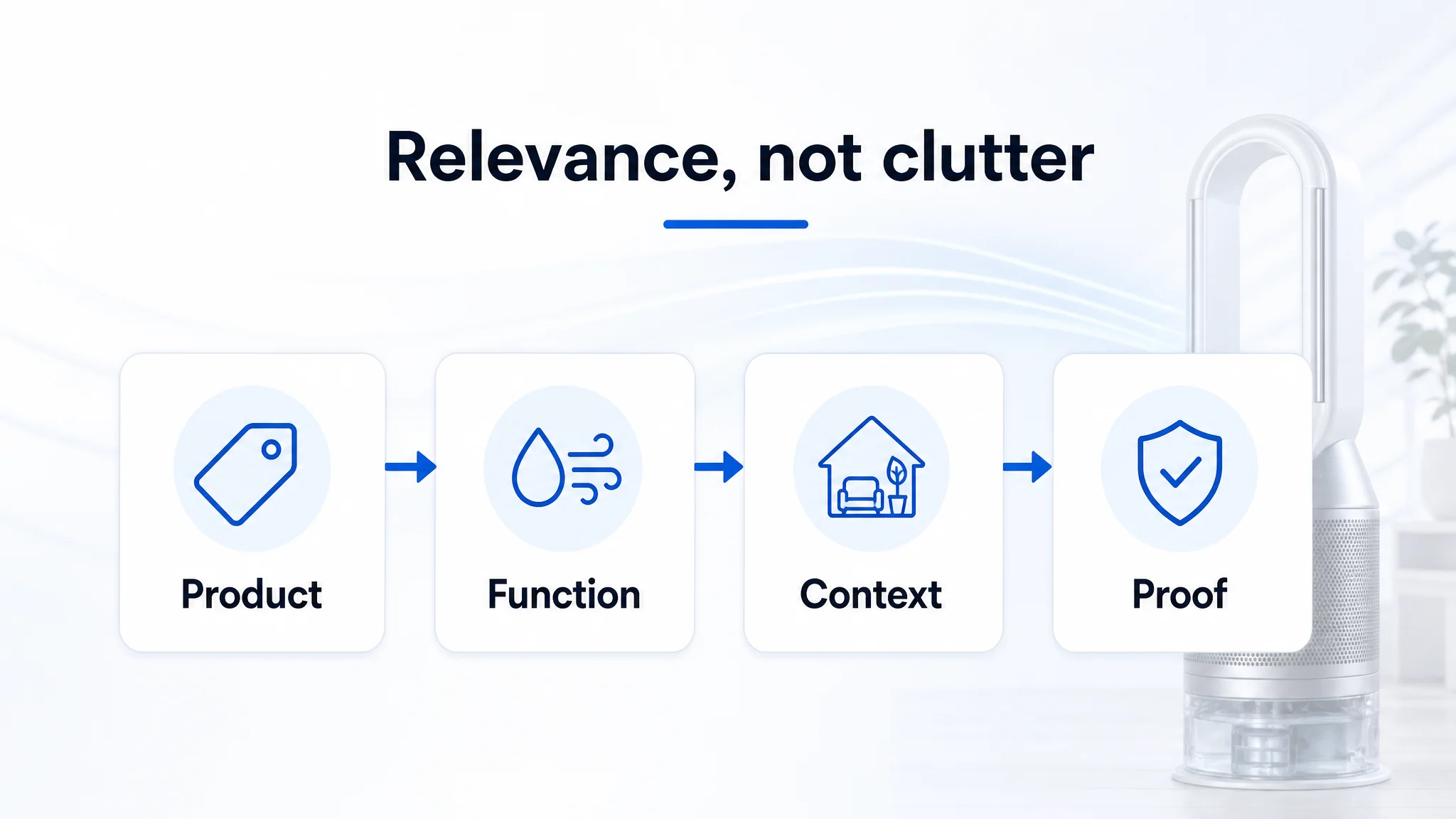
The 3-in-1 air purifier listing showed why this structure is more effective than simply adding more keywords. Its original title was close to a model identifier, while the product had a meaningful distinction: it combined air purification, humidification, and cooling. The recommended direction brought forward terms and contexts such as air purifier, humidifier, large rooms, HEPA, allergies, pets, smoke, dust, WiFi connection, quiet operation, and auto mode, using only confirmed product information.
The goal was not to copy a competitor’s wording or fill the title with every possible term. It was to make the product legible within Amazon’s search and comparison environment. A shopper should understand the product’s role before moving to another listing or needing to study the deeper content.
This also explains why title optimization cannot be separated completely from conversion analysis. A title may generate a click, but the page still needs to explain the value and address buyer hesitation. In the air purifier case, DeepBI found that the title, main image, bullets, and reviews all affected the Listing’s ability to handle traffic. Improving the title was necessary, but it was part of a broader conversion foundation rather than a standalone fix.
Leveraging Item Highlights for Maximum Reach
Do not force every feature into the title. Move secondary keywords and supporting benefits into the searchable Item Highlights field, which allows up to 125 characters. This preserves discoverability while keeping the title readable and focused.
Item Highlights can provide space for information that supports the title without competing with the product’s primary identity. For a complex appliance, details such as room context, operating modes, maintenance information, or specific use cases may be more useful there than in a crowded title, provided the terms are accurate and permitted.
The air purifier Listing contained many relevant functions, including smart sensing, app control, multiple airflow modes, water capacity, and maintenance guidance. The problem was not a lack of possible content. The problem was deciding what shoppers needed to see first and what could support the decision later.
That hierarchy is essential under a shorter title limit. The title should establish the product and its main commercial distinction. Item Highlights and other searchable fields can then reinforce relevant search terms and buyer concerns without turning the first line of the Listing into a technical inventory.
Manual vs. AI Rewriting - When to Trust Your Own Judgment
Amazon’s AI title suggestions in Seller Central can provide a useful benchmarking reference, but they are not automatically suitable for every brand or ASIN. Manually review high-revenue and top-20% ASINs, confirming every claim against the product specifications.
Automated rewriting may identify a compliant structure, but it may not understand which product distinction is most important to the shopper or which wording supports the Listing’s broader conversion path. In the air purifier case, the product’s technical depth could have encouraged a system or team to emphasize more specifications. The comparison showed that the larger gaps were in title clarity, review credibility, and the ability of the main image and bullet points to translate technical features into buyer value.
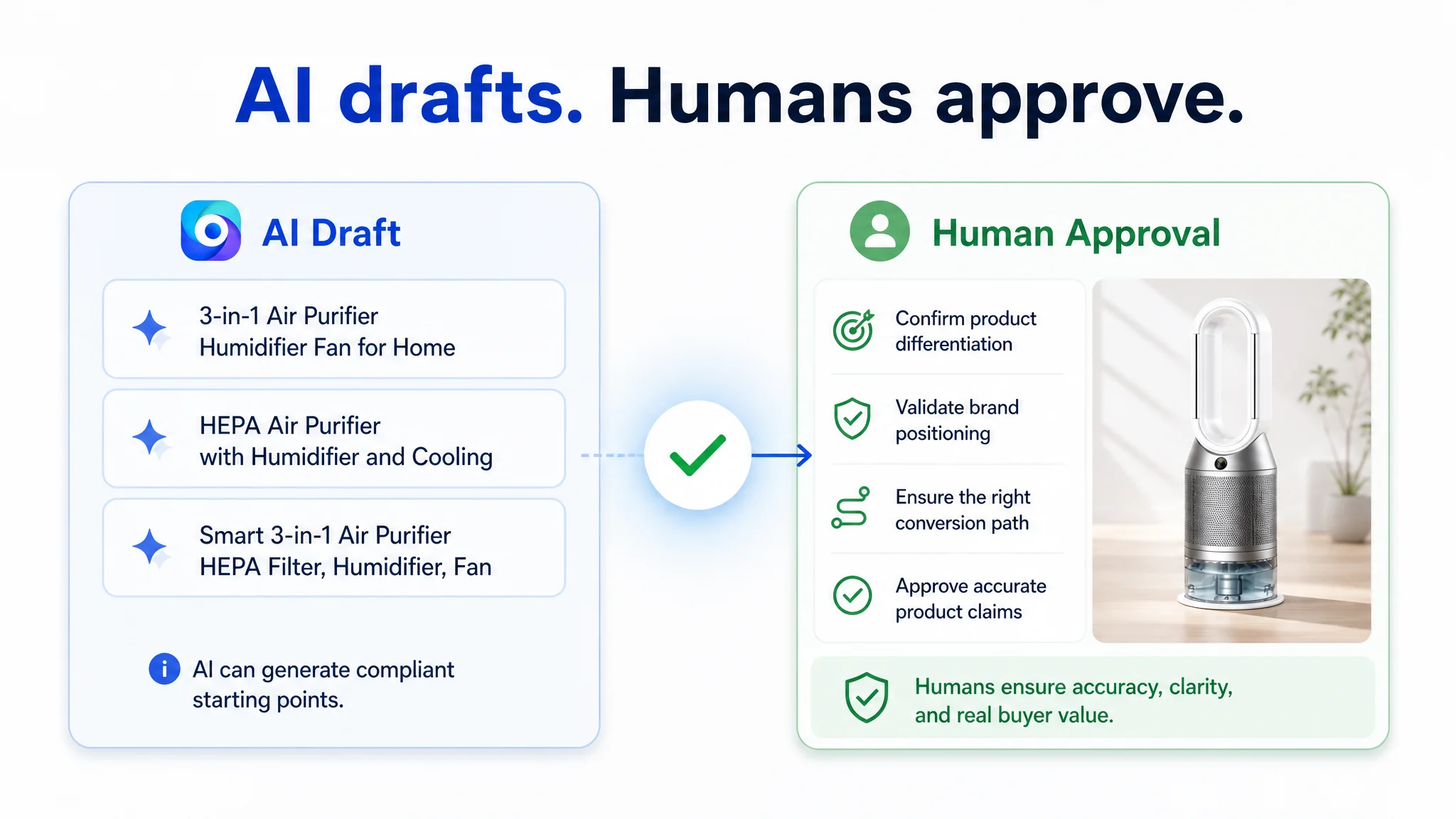
DeepBI can help generate compliant titles, integrate Item Highlights, and apply bulk updates through SP-API. Use its data-led recommendations as an execution aid, while retaining human approval for strategic listings.
Human review is especially important for claims involving filtration performance, room coverage, allergies, smoke, quiet operation, or hygienic humidification. Every statement must match the confirmed product specifications. A shorter compliant title is not an improvement if it introduces an unsupported claim or misrepresents the product.
Frequently Asked Questions (covers " ")
What happens if my Amazon title exceeds 75 characters?
Amazon’s AI may rewrite a title that exceeds 75 characters. Sellers have a 14-day review period to assess the proposed version and make changes. If no action is taken during that period, the AI-generated version may become permanent. Review affected titles promptly rather than assuming the automated rewrite will protect your search visibility or conversion performance.
The review should cover more than the number of characters. Check whether the proposed title preserves the product category, the highest-value search terms, the main differentiator, and any information shoppers need to understand the product. An automated rewrite may remove clutter, but it may also make a complex product sound generic.
Can I rely entirely on Amazon’s AI rewrite?
That approach carries risk. An automated suggestion may not reflect the brand-specific conversion data behind your listing and may favor generic keywords over the terms that support strong CTR and CVR. Amazon’s rewrite can provide a starting point, but sellers should evaluate keyword relevance, brand positioning, and the title’s likely impact on listing performance before accepting it.
A weak Listing can make this risk harder to see. In the air purifier case, the team initially leaned toward improving creative presentation and continuing to refine advertising direction. The diagnostic comparison changed that priority by showing that the Listing scored 67 out of 100, compared with 87 for a closely matched high-performing competitor. The largest gaps were in reviews and title performance, while A+ content was already relatively strong.
This is why sellers should not ask only whether an AI-generated title is compliant. They should also ask whether it strengthens the page’s ability to earn attention, explain value, and support trust.
Which ASINs should I review first?
Maintain manual control over high-value ASINs, especially those generating substantial revenue or contributing meaningfully to CTR, CVR, ACoS, or BSR. Prioritize these listings before auditing and rewriting the rest of the catalog. This sequence protects the listings where an unsuitable title change could create the greatest business risk.
Also prioritize ASINs with clear Listing weaknesses. A technically strong product can still lose commercial effectiveness when its title is too close to a model identifier, its main value proposition is unclear, or its title does not contain relevant category language.
For products with several functions or use cases, review whether the title communicates the reason the product exists. The 3-in-1 appliance, for example, needed to make its combined purification, humidification, and cooling role clearer before shoppers reached the deeper content.
How can I manage the remaining catalog efficiently?
After securing priority ASINs, use DeepBI Listing to assess title and broader Listing weaknesses with performance data such as impressions, clicks, orders, CTR, and CVR. Its structured recommendations can support consistent catalog review, while seller confirmation remains part of the application process. This approach reduces blind edits and helps shorten listing cycle time without surrendering control of valuable listings.
Catalog management should follow a decision order rather than a simple bulk rewrite. First identify non-compliant titles and high-risk ASINs. Then distinguish between title problems, page-level conversion problems, content gaps, and trust barriers. This prevents sellers from applying the same rewrite pattern to every product when the underlying commercial constraints are different.
Troubleshooting Common Title Issues (covers " ")
A shorter title does not automatically cause a ranking decline, but removing high-value search terms without review can reduce discoverability. Resolve implementation issues by separating mandatory information from search-focused copy and monitoring the results.
- Compliance information: When a title contains required details, such as jewelry carat weight or an FTC-related phrase, place the mandatory information in Item Highlights or key attributes where Amazon permits. Do not remove required wording simply to meet the character limit.
- Abbreviations: Use an abbreviation only when the applicable Amazon rule allows it. Otherwise, retain the approved wording and redistribute less critical descriptive language.
- Keyword retention: If CTR, CVR, or BSR changes after a title revision, review the first 40–50 characters first. Keep the core keyword there when possible, then reinforce relevant search terms through searchable Item Highlights. Use DeepBI and keyword tracking to identify which terms generate meaningful visibility and should remain in the listing.
- Variation consistency: Use a generic parent title for the shared product family and specific child titles for attributes such as size or color. Amazon displays the parent title before a shopper selects a variation; after a specific variation is selected, the child ASIN title may be displayed. Align both levels to prevent confusing differences across the detail page.
- Audit and correction: DeepBI diagnostic scoring can identify non-compliant titles and formatting gaps. Use the results to bulk-audit related ASINs, correct recurring inconsistencies, and then monitor CTR, CVR, ACoS, and BSR rather than judging the change from title length alone.
Title changes should also be reviewed in relation to the rest of the Listing. If the title becomes clearer but the main image still fails to communicate the product’s role, or if the bullets do not answer the shopper’s practical questions, the expected conversion improvement may not appear.
The air purifier comparison made this visible. The Listing’s title scored 10 out of 20, but it also had a review score of 4 out of 15, compared with 14 out of 15 for the benchmark Listing. Its main image sequence and bullet-point logic also left important buyer concerns unresolved. The page therefore required more than a compliant title; it needed a coordinated improvement in discovery, explanation, proof, and trust.
This is why title performance should be monitored as part of the full conversion path rather than judged in isolation.
How DeepBI Turns the Title Limit into a Growth Advantage
A shorter title does not have to reduce discoverability. It can create a disciplined operating process that connects Listing quality, advertising relevance, and organic growth. DeepBI is an AI-driven, Amazon-only operations system designed to support diagnosis, strategy, execution, and ongoing optimization while sellers retain commercial control.
AI-Powered Title & Listing Optimization
DeepBI treats Listing optimization as a market health check, not a one-time copy edit. It scores core Listing elements, benchmarks relevant competitors, and identifies weaknesses in keyword layout, selling-point clarity, structure, and compliance. Sellers can then review compliant AI-generated titles and Item Highlights that prioritize meaningful search terms and product benefits rather than keyword stuffing.
The 3-in-1 air purifier case demonstrates the value of this broader diagnosis. The customer Listing scored 67 out of 100, compared with 87 for a comparable high-performing Listing. The score breakdown showed:
- Title: Customer Listing: 10/20, Comparable high-performing Listing: 18/20, Gap: -8
- Main image: Customer Listing: 24/30, Comparable high-performing Listing: 27/30, Gap: -3
- Bullet points: Customer Listing: 7/10, Comparable high-performing Listing: 8/10, Gap: -1
- A+ content: Customer Listing: 22/25, Comparable high-performing Listing: 20/25, Gap: +2
- Reviews: Customer Listing: 4/15, Comparable high-performing Listing: 14/15, Gap: -10
- Total: Customer Listing: 67/100, Comparable high-performing Listing: 87/100, Gap: -20
The diagnostic changed the order of work. A+ content was already stronger than the benchmark in the scoring, so adding more technical detail there was unlikely to address the largest constraint. The more urgent priorities were title relevance, early-stage comprehension, review-related trust barriers, and the way the main image and bullets guided the buyer.
The system generates multiple versions for comparison, allows the seller to select the preferred result, and synchronizes approved Listing updates through Amazon SP-API. This shortens Listing cycle time and creates a repeatable path from diagnosis to delivery.
From Optimized Listings to Smarter Ad Targeting
A stronger Listing gives advertising data a better destination. Through the Ads bridge, DeepBI connects impressions, clicks, conversions, CTR, ACoS, and TACoS with Listing decisions. Winning search terms can guide title and content priorities, improving relevance and helping reduce wasted ad spend. The goal is not to optimize Ads in isolation, but to make paid traffic more closely match the Listing’s actual value proposition.
This relationship is particularly important when advertising pressure increases. The air purifier team initially considered creative presentation and continued advertising refinement as likely solutions. The diagnostic evidence showed why that sequence was risky: the title did not capture enough relevant search intent, the main image sequence delayed the strongest product explanation, the bullets lacked a clear pain-point-to-solution progression, and the review profile created a substantial trust deficit.
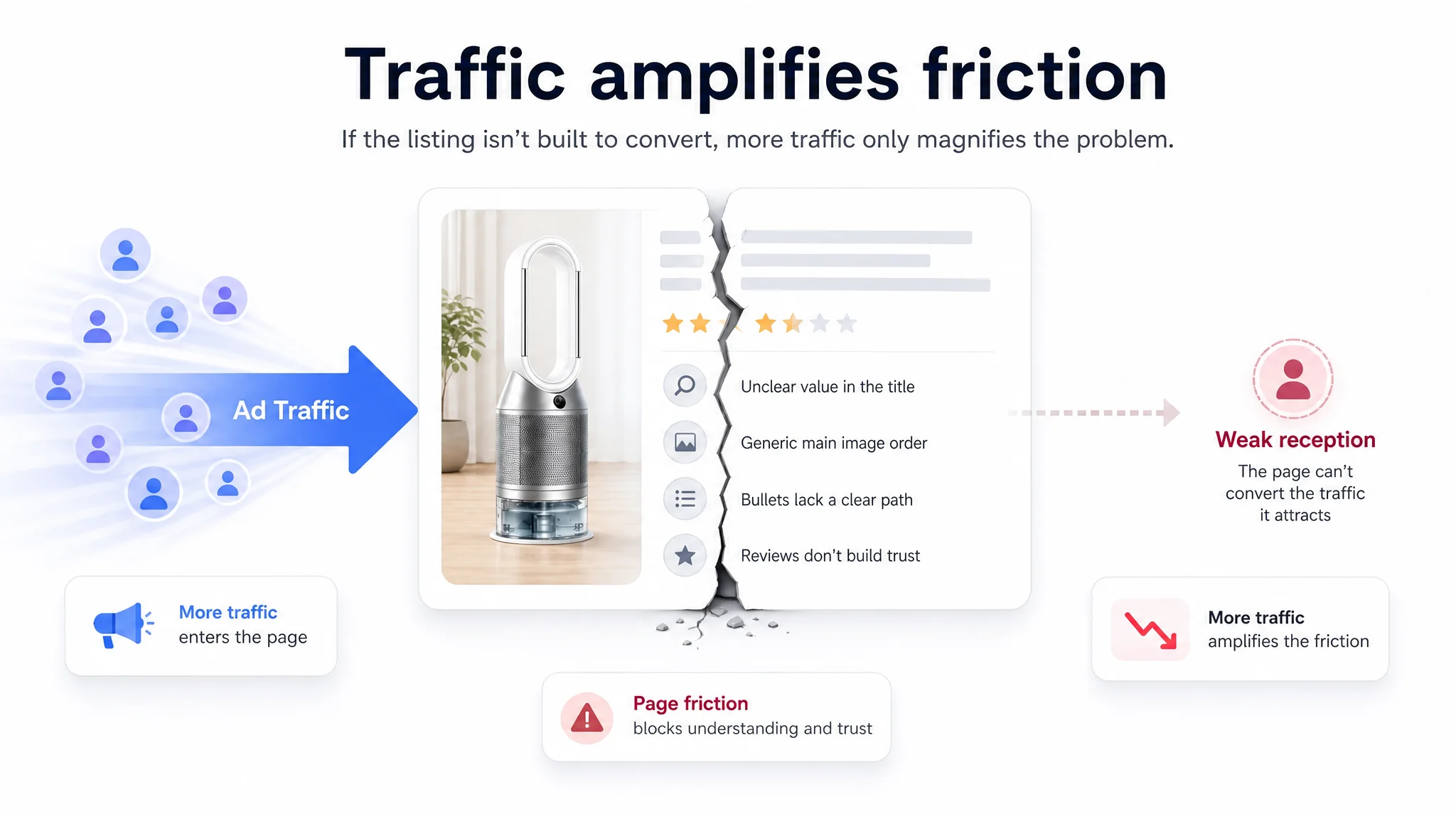
More traffic would not automatically solve those problems. It could instead send additional shoppers into a page that had not yet earned their confidence.
Advertising can amplify a Listing’s strengths, but it can also amplify page-level friction. Before increasing traffic, sellers should determine whether the page can explain the product, prove its value, and answer the final objections raised by the category.
Building Organic Momentum Through Content Excellence
When high-converting search terms inform clearer, compliant content, the Listing is better positioned to support natural-ranking improvement. Through the Organic bridge, stronger content and stable advertising signals can reinforce one another, supporting BSR progress and healthier TACoS over time without promising a guaranteed outcome.
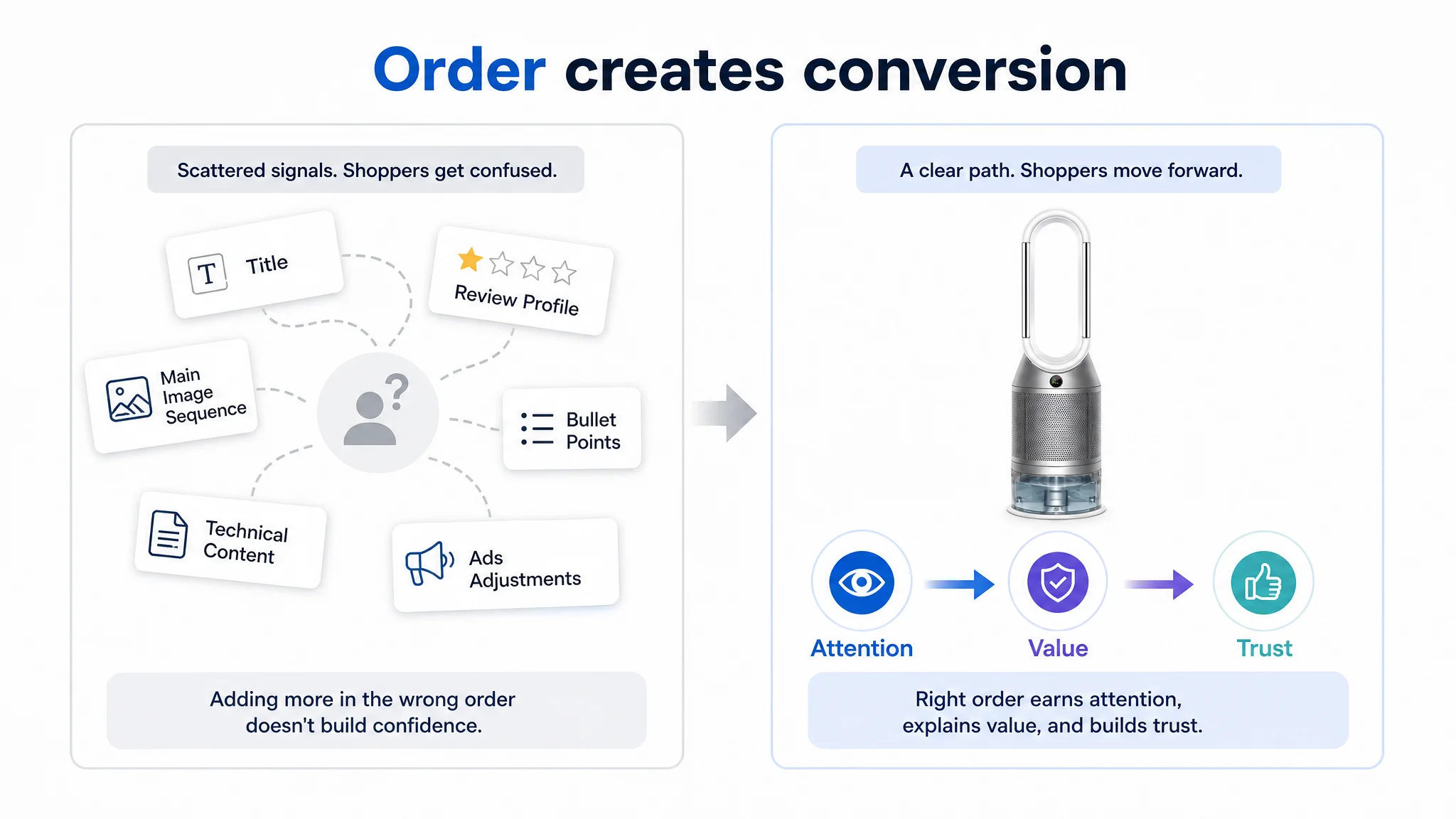
Content excellence means more than adding information. It means arranging information in the order shoppers need it.
For the air purifier Listing, the recommended content sequence moved toward:
- Clear category and 3-in-1 positioning in the title
- Whole-room value and primary use cases in the opening visual communication
- Verified filtration and performance evidence as proof
- Smart controls as a convenience benefit
- Airflow modes connected to practical room settings
- Hygienic humidification and maintenance guidance to reduce risk
- Objective claims and confirmed specifications where review strength was limited
This approach reflects a broader principle: technology should appear as proof of a buyer benefit, not as a substitute for explaining that benefit. A page can contain extensive technical content and still have weak conversion capacity if the information is not ordered around attention, understanding, credibility, and hesitation.
Sellers set the profit or growth priority; DeepBI handles recurring analysis and daily execution. That human-AI workflow turns the title limit into a controlled growth system.
Conclusion: Take Control Before the Deadline
The 75-character title limit should be treated as an immediate catalog priority, not a last-minute formatting task. Once the deadline takes effect, unmanaged titles may be rewritten into more generic versions, weakening the clarity of the offer and reducing control over how shoppers encounter the product.
The constraint also creates a strategic opportunity. A shorter title can be restructured around the information mobile shoppers need most: the core product identity, the strongest differentiator, and the clearest relevant search terms. The goal is not simply compliance. It is to make every character support comprehension, CTR, and, where the Listing experience remains aligned, CVR.
The air purifier Listing showed why this work should begin with diagnosis rather than isolated editing. The product had meaningful technical capabilities and relatively strong A+ depth, but its title, review profile, main image sequence, and bullet-point logic left important gaps in the early conversion path. The team could have continued adding technical content or tuning advertising, but the comparison evidence pointed to a more fundamental issue: the Listing was not yet communicating and proving its value in the order shoppers needed.
Start with a catalog audit now. Review title length, keyword placement, selling-point clarity, and structural compliance, then prioritize top ASINs and listings with the greatest commercial importance or the clearest weaknesses. Do not wait to revise every SKU at once.
Tools like DeepBI can help automate this process by evaluating titles, comparing them with relevant benchmark ASINs, identifying weak points, and turning findings into executable restructuring guidance. For larger catalogs, that workflow can reduce manual work and shorten Listing cycle time while keeping approval under seller control.
Proactive adaptation protects compliance today and creates a more disciplined foundation for long-term Listing optimization. A high-converting Amazon Listing is not the sum of its features. It is the order in which the page earns attention, explains value, proves credibility, and removes hesitation.